



Abstract
Farthing (2005) tested a prediction derived from costly-signaling theory, that women would prefer physical risk takers (brave, athletic, fit) over risk-avoiders as long-term mates. Using scenarios involving high-risk acts, the prediction was confirmed for heroic (brave, altruistic) but not for non-heroic (brave, non-altruistic) acts. Apparently, women's concerns over risks to their mates overrode any positive signal value of men's risk taking, when the acts were highly risky and had no redeeming practical value.
The present studies revisited the costly-signaling hypothesis using both medium- and high-risk scenarios, and it was predicted that for non-heroic acts women would prefer risk takers over risk avoiders for medium-level risks but not for highly risky acts. The prediction was supported in two studies. In Study 1, risk takers were preferred for non-heroic medium-risk acts, but risk avoiders were preferred for high-risk acts. For heroic acts, risk takers were preferred for both high- and medium-risk acts. Study 2 crossed two act risk levels with two actor skill levels, with non-heroic risks. Risk takers were preferred for the least risky combination (medium-risk act, high-skill actor) and also for the two moderately risky combinations, but risk avoiders were preferred for the riskiest combination (high-risk act, medium-skill actor). In Study 1, participants compared high-level risk takers versus risk avoiders on several person adjectives. Both heroic and non-heroic risk takers were perceived as more brave, athletic, physically fit, impulsive, attention-seeking, and foolish, and less emotionally stable and self-controlled, compared to risk avoiders. But only heroic risk takers were perceived as more altruistic, agreeable, conscientious, and sexy than risk avoiders.
Introduction
Costly signaling theory (Bleige Bird, Smith, and Bird 2001; Hawkes and Bleige Bird 2002) suggests that some costly or risky behaviors can be explained in terms of a signaler doing something that calls attention to his or her special qualities, such as generosity, skill, or courage, where the noticing of these qualities by others has potential present or future benefits to the signaler. For example, the signaled qualities might make the signaler more attractive as a mate or as a hunting or coalition partner. In order for costly signaling behaviors to persist and to possibly become evolved behavioral adaptations, two other requirements, besides potential benefits to the signaler, must be met. The signal must be truly costly or risky, so that it cannot be faked, and noticing of the signal must be of some benefit to the one who notices it (such as the potential mate or coalition partner). For example, Hawkes and Bleigh Bird (2002) have explained the persistence of hunting among males as a case of costly signaling, in hunter-gatherer-gardener societies where hunting is a relatively inefficient way of obtaining food. Successful hunting shows a man's skill and courage and physical fitness, and it also shows generosity when he shares the meat with others, without expecting or receiving any reciprocation in kind. In the modern world, charitable giving or blood donating may be cases of costly signaling.
Costly signaling theory is a descendant of Zahavi's (1977; Zahavi and Zahavi, 1997) handicap hypothesis, designed to explain certain sex differences in structure or behavior among animals (for example, the peacock's heavy plumage), and of Hawke's (1991) show-off hypothesis, intended to explain some aspects of human male behavior as attention-getting behavior to attract females. Costly signaling theory is broader in conception than the show-off hypothesis, in that it allows that costly signaling might be done by either males or females, and that the intended recipients might be of either the same or opposite sex.
Farthing (2005) tested a hypothesis derived from costly signaling theory in regard to physical risk taking. Two facts about physical risk taking are particularly striking: (1) It is done much more by men than by women, and (2) it is done more by men of peak reproductive age (late teens, early 20s) than by older or younger males (Arnett, 1995; Byrnes, Miller and Schafer, 1999; Irwin, 1993). These differences have been shown for a variety of different physically risky activities, such as risky sports, fast driving, aggression, and petty crime. They also occur for the special case of homicide, for which Wilson and Daly (1985) coined the term “the young male syndrome.” The term is appropriate also for non-homicidal physical risk taking by young males.
Farthing (2005; also Kelly and Dunbar, 2001) suggested that part of the explanation for the young male syndrome in regard to physical risk taking may be that it is a costly signal designed to attract the favorable attention of young women. When a man engages in a physically risky activity, such as skiing fast down the expert slope or climbing up a steep mountain, he is displaying his athleticism, physical fitness and courage. Thinking back to human ancestral times, for women these characteristics would be desirable in a potential mate, since they suggest that a man is athletic, brave and healthy and capable of being a good provider for a woman and her children. A man with such traits would also presumably have “good genes” for making healthy children. In the modern world, aside from war, men rarely have an opportunity to demonstrate their bravery and physical prowess by doing practical things, such as hunting big game with spears. Such qualities can usually be shown only in rather arbitrary, non-practical risky activities, such as risky sports. One practical risk-taking situation that occasionally arises, however, is an opportunity for heroism, when one takes physical risks in order to save someone else's life (for example, jumping into a river to save a drowning person). Heroic risk taking should be doubly attractive to a potential mate, since it indicates not only courage and physical prowess, but also altruism.
Farthing (2005) predicted that women would be significantly more attracted to men who are physical risk takers, compared to risk avoiders, for both heroic and non-heroic risky acts. Participants read several scenarios in which a person had to decide whether to engage in a physically risky act. Some scenarios involved heroic acts (both physically risky and altruistic, such as saving a child from a fire), whereas others were non-heroic (e.g. whitewater kayaking, high-speed driving, traveling alone in a dangerous country). All of the acts were explicitly characterized as “very risky.” Participants were asked to indicate their relative degree of preference, as a long-term mate, for a person who decides to take the risk versus one who decides not to take the risk.
Farthing's (2005) results supported the costly signaling theory prediction for a set of four heroic risky acts: both men and women significantly preferred risk takers over risk avoiders as potential mates, with the preference being greater for female participants than for males. However, the prediction was not supported for a set of ten non-heroic physical risks: neither women nor men preferred risk takers as mates, and in fact, both women and men significantly preferred risk avoiders over risk takers for non-heroic risks, on the average.
In explaining the unexpected contrary results regarding women's preferences for non-heroic risk takers, Farthing (2005) pointed to the fact that all of the risky acts had been explicitly characterized as “very risky.” He suggested that women (and men) prefer mates who avoid highly-risky, non-heroic acts because they don't want their mates to be seriously injured or killed doing things that have no compensating practical or altruistic value, such as heroic life saving. Thus, though women might be attracted to men who display traits such as bravery, athleticism, and physical fitness, such a preference could be overcome by concerns about the potential mate's personal safety.
The question arises, then, whether women would be attracted to takers of non-heroic physical risks if the risks were not too great. Perhaps the original hypothesis, that women would prefer non-heroic physical risk takers over risk avoiders as mates, would hold true for activities described as only low to medium in riskiness. In other words, while women might not want daredevils as mates (they would prefer avoiders of high risks), they would not want wimps, either (they would prefer risk takers over risk avoiders for moderate risks).
Thus, it seems worthwhile to re-open the question of attitudes toward risk takers as mates by examining the effects of the degree of riskiness of the act in question. The level of riskiness of an act for a particular individual can be affected by two different factors: (1) activity riskiness per se, that is, inherent features of the risky act and/or the situation itself (such as steeper mountain ski slopes, more turbulent whitewater rivers, faster driving speeds, two bullies or one), and (2) the skill of the actor for the relevant action (e.g. his/her experience and skill at skiing, kayaking, driving, self-defense). When the actor is more skilled, his or her effective risk level is lower than for the less skilled actor, regardless of the inherent riskiness of the situation.
Study 1 examined the effect of activity riskiness per se, for both heroic and non-heroic physical risks, on women's preferences for risk takers versus risk avoiders as long term mates. It was predicted that preferences for risk-taking mates would be inversely related to the riskiness of the acts. More specifically, in accordance with the derivation from costly-signaling theory, for non-heroic physical risks women would prefer risk takers as mates where the risk level was only low to moderate, but in accordance with prior results (Farthing, 2005), it was predicted that women would prefer risk avoiders where the risk level was very high. Also, in accordance with prior results, it was predicted that the level of preference for heroic risk takers would be greater than for non-heroic risk takers, at both high and moderate risk levels.
In Study 2 the relationship between risk level and preference for risk-takers versus risk avoiders as mates was further examined by varying both the inherent riskiness of the risky act and the actor's skill level for the required action, for non-heroic physical risks. It was predicted that both factors would affect preferences, such that preference for risk-takers as mates would be greatest for highly-skilled actors taking moderate risks, and lowest for moderately-skilled actors taking high-level risks.
Study 1: Heroic vs. Non-Heroic Risk Takers
Women rated their degree of preference for risk-takers versus risk-avoiders in 16 different risky-decision scenarios, in a study with a repeated-measures design involving 2 risk types (heroic vs. non-heroic) × 2 risk levels (high vs. medium). After reading each scenario, participants indicated their degree of preference for either the risk taker or the risk avoider as a long-term mate. Participants also rated the perceived riskiness of each of the scenarios, so that relationships between perceived riskiness and mate preferences could be compared across all 16 scenarios.
A secondary purpose of Study 1 was to assess women's perceptions of risk takers versus risk avoiders for a number of person adjectives. It was predicted that risk takers would be perceived as more brave and athletic than risk avoiders. In addition, it was predicted that heroic risk takers would be perceived as more altruistic and conscientious than non-heroic risk takers.
Materials and Methods
Participants were undergraduate women at the University of Maine. As an incentive to participate they received bonus points in their introductory psychology course. Since it was not possible to obtain a broadly representative sample, it was decided to create a more homogenous sample by selecting only participants of American or Canadian nationality. In addition, since questions about mate preferences are most important for younger women, only women under age 30 were selected. About 5–10% of potential participants were eliminated because of these constraints. Usable data were obtained from 76 women (mean age 19.4 years), over 95% of whom were unmarried.
After signing consent forms, participants responded to three questionnaires in the following sequence: (1) Activity Riskiness Questionnaire; (2) Person Adjectives Scale; and (3) Attitudes toward Risk Takers Questionnaire.
Risk scenarios. The 16 risk scenarios involved four different heroic risk situations and four non-heroic risk situations. Each risk situation was used in two different scenarios, with one described as and labeled as “very risky” and the other described as and labeled as “somewhat risky.” The four heroic risk situations were saving a child from a burning house, saving a child from a river, defending a child from a bully, and saving a skater who has fallen through the ice on a lake. The four non-heroic physical risk situations were Alpine (downhill) skiing, speeding in a car, defending oneself from a mugger, and swimming in a lake. The first three scenarios in each list were similar to those used by Farthing (2005). See the appendix for the wording of all 16 scenarios on the Attitudes toward Risk Takers Questionnaire.
Examples of heroic and non-heroic risk scenarios:
In all scenarios the actor (Person) was described as moderately skilled or knowledgeable about the risky action, in order to reduce variability that might result from different participants making different assumptions about Person's skill level.
Activity Riskiness Questionnaire. The 16 scenarios were presented in matching high and moderate-risk pairs, with heroic and non-heroic pairs alternating, and the more risky scenario presented first in each pair. Below each scenario was a question about how risky it would be for Person to try to do the risky activity. Participants responded by marking a short vertical line across a 14 cm horizontal scale. The scale was marked “0, Not at all risky” at the left end, and “100, Extremely risky” at the right end. The scale was divided by vertical hashmarks into ten segments corresponding to 10, 20, etc. (the hashmarks were not labeled).
Person Adjectives Scale. Only the eight high risk scenarios (comparable to those used by Farthing, 2005) were used in the Person Adjectives Scale, since the focus of this part of the study was on the comparison of heroic vs. non-heroic risk takers. Heroic and non-heroic scenarios were alternated. Following each scenario, two persons were described, where Person A decides not to take the risk and Person B decides to go ahead and take the risk. For example, for the ice-skater rescue scenario:
Person A decides to go find someone who can help.
Person B decides to go ahead and try to rescue the skater from the icy water.
Below that were lines labeled 1 through 18. Each number label was followed by a different adjective. Participants were asked to compare Person B and Person A on the person adjective by circling a digit on a seven point −3 to +3 scale. For example: “Impulsive. Person B (risk taker) is __ impulsive as/than Person A (risk avoider).” Cover-page instructions defined the ratings as follows: −3 much less; −2 less; −1 slightly less; 0 equally as; +1 slightly more; +2 more; +3 much more.) See Table 1 for the full list of adjectives.
Mean person adjective ratings comparing risk takers versus risk avoiders, for high-risk heroic and non-heroic acts. Ratings were on a scale of −3 to +3, where positive numbers in columns 2 and 3 indicate that the risk taker was rated as “more ______ than” the risk avoider and negative numbers indicate that the risk taker was rated “less ____ than” the risk avoider.

* In columns 2 and 3, * indicates p < .001 for the difference between the mean rating and the zero indifference level (single-sample t-tests, two-tailed). In column 4, * indicates p < .001 for the difference between means for heroic versus non-heroic risk scenarios (t-tests, two-tailed).
Attitudes toward Risk Takers Questionnaire. All 16 risk scenarios were used; they were presented in a quasi-random sequence. Each scenario was followed by a description of the decisions by Person A (risk avoider) and Person B (risk taker), as in the Person Adjectives Scale. Below that was the question: “Which person, A or B, would be more desirable to you as a long-term mate or spouse, other things being equal?” Participants responded by making a short vertical line through a 15 cm scale. The scale was divided into ten equal segments by vertical hashmarks, but only the middle and end points were labeled. At the left end the scale was labeled “100, A is much more desirable than B,” the right end was labeled “100, B is much more desirable than A,” and the middle hashmark was labeled “0, A and B are equally desirable.”
Results
Attitudes toward risk takers. Cronbach alpha reliability coefficients for mate preference ratings for the four scenarios within each condition (2 risk types × 2 risk levels) were moderate but high enough to justify using the condition means of each subject in further data analyses. Alphas were .79, .76, .67 and .62 for the high-risk heroic, low-risk heroic, high-risk non-heroic, and low-risk non-heroic conditions, respectively.
Figure 1 shows the mean mate preference ratings for each of the four conditions: 2 risk types (heroic vs. non-heroic) × 2 risk levels (medium vs. high). Note that in the data figures, preferences for Person A (risk avoider) are indicated as negative values to distinguish them from preferences for Person B (risk taker). However, negative values were not used on the response scale itself, in order to avoid any connotation that negative was somehow less desirable than positive.

Women's mean preference ratings for risk-takers versus risk-avoiders as long-term mates, for medium- and high-risk heroic and non-heroic physical risks. Positive values indicate a preference for risk takers over risk avoiders; negative values indicate a preference for risk avoiders. The vertical bars represent the standard errors of the means.
A repeated-measures GLM analysis (SPSS for Windows 12.0) of 2 risk types × 2 risk levels indicated a significant main effects for risk type, F(1, 75) = 68.6, p < .001, η2 = .48, and for risk level, F(1, 75) = 130.0, p < .001, η2 = .63, and for the interaction between risk type and risk level, F(1, 75) = 6.89, p < .01, η2 = .08. Women's degree of preference for risk takers as mates was greater for heroic risks than for non-heroic physical risks, and greater for medium risks than for high-level risks. The interaction effect indicated that the effect of risk level was somewhat greater for non-heroic risks than for heroic risks.
An additional analysis used single-sample t-tests (two-tailed) to compare each of the four mate-preference means in Figure 1 against the zero reference level (no preference). For heroic risks, women significantly preferred risk takers over risk avoiders as mates for moderately risky tasks, t(75) = 11.3, p < .001, though not for highly risky tasks, t = 1.45, p = .15. For non-heroic risks, women significantly preferred risk takers over risk avoiders for moderately risky tasks, t = 4.48, p < .001, but for highly risky tasks they significantly preferred risk avoiders over risk takers, t = −6.69, p < .001.
Mean riskiness ratings were 71.4, 66.5 for high-risk heroic and non-heroic scenarios, respectively, and 43.9 and 34.6 for medium-risk heroic and non-heroic scenarios, respectively, on the zero to 100 riskiness scale. A 2 × 2 GLM repeated-measures analysis showed significant main effects for risk level, as expected, F(1, 75) = 297.1, p < .001, η2 = .80, and for risk type, F = 33.6, p < .001, η2 = .31. The effect of risk type was not expected. The intent had been to design scenarios that were identical in perceived riskiness for heroic and non-heroic risks at each risk level, on the average. However, the fact that the heroic risk scenarios were perceived as slightly riskier than the non-heroic scenarios indicates that the finding that heroic risk takers were more preferred than non-heroic risk takers (Figure 1) cannot be explained by assuming that the heroic scenarios were less risky.
Perceived riskiness varied across the four individual risk scenarios in each of the four risk type × risk level conditions. The scatterplot in Figure 2 shows that the mean degree of preference for risk takers as mates was significantly negatively correlated with mean perceived riskiness across all eight risk scenarios, for both heroic (r = −.91, df = 6, p < .01) and non-heroic risk scenarios (r = −.89, p < .01). The scatterplot also shows that at any particular perceived riskiness level, the preference for risk taker mates is greater for heroic than for non-heroic physical risks.

Scatterplot showing negative correlations between riskiness ratings and preferences for risk-takers versus risk-avoiders, for eight heroic risk scenarios and eight non-heroic physical risk scenarios.
In addition, within each of the four risk type by risk level conditions there was a significant negative correlation across participants between mean mate preference ratings and mean perceived riskiness, r = −.38, −.37, −.45, and −.44, for the high-risk heroic, low-risk heroic, high-risk non-heroic, and low-risk non-heroic conditions, respectively (all df = 74, all p < .001).
Person adjectives. Table 1 shows the mean ratings for each of the 18 adjectives of the Person Adjectives Questionnaire, for heroic and non-heroic risk takers. All of the scenarios were high risk, with the actor described as moderately skilled or knowledgeable about the required action. Although the adjectives were originally presented in a quasi-random sequence (starting with “intelligent”), in Table 1 they are grouped with conceptually similar items. Columns 2 and 3 show the mean ratings for heroic and non-heroic risk takers on the seven-point +3 to −3 rating scale. Positive numbers indicate that the risk taker was rated as “more ___ than” (e.g. more brave than) the risk avoider, while negative numbers indicate that the risk taker was “less ____ than” (e.g. less emotionally stable than) the risk avoider.
Participants judged risk takers to be significantly different (all p < .001) from risk avoiders for most of the person adjectives, for both heroic and non-heroic risks. Risk takers were judged to be significantly more brave, athletic, and physically fit than risk avoiders, as predicted. Risk takers were also judged superior on some other desirable traits, including ambitious, self confident, fun to be with, and open to new experiences. However, for both heroic and non-heroic risky acts, risk takers were judged to have higher levels of several undesirable traits, including impulsive, attention-seeking, and foolish, while they were judged as less self controlled and intelligent compared to risk avoiders. The fact that risk-takers were rated as less intelligent than risk avoiders suggests that participants perceived high-level risk taking as reflecting poor judgment by the actors (i.e., the potential mates).
The fourth column in Table 1 shows the differences in mean ratings for heroic minus non-heroic risk takers. Most noteworthy is the finding that heroic risk takers were rated significantly more positively (compared to risk avoiders) than non-heroic risk takers for three pro-social adjectives: agreeable, conscientious, and altruistic. Heroic risk takers also had higher ratings for brave and sexy, compared to non-heroic risk takers. On the other hand, heroic risk takers were rated significantly less badly than non-heroic risk takers for several adjectives, including attention seeking, emotionally stable, self-controlled, and intelligent (all p < .001).
Study 2: High- vs. Medium-Skilled Risk Takers
Study 1 showed that, for non-heroic physically risky activities, women preferred risk takers over risk avoiders as long-term mates for moderately risky activities, but not for high-risk activities, where they preferred risk avoiders as mates. Across the eight non-heroic risk scenarios, perceived riskiness was negatively correlated with the degree of preference for risk-takers over risk-avoiders as mates.
The actual physical riskiness of an activity to an individual would depend not only on the inherent riskiness of the act itself, in its particular context, but also on the individual's level of skill for the required action. For example, skiing down a steep and narrow trail would be more risky than skiing down a relatively wide and moderately-sloped beginner trail, but skiing either trail would be less risky for an expert skier than for an intermediate-level skier. Study 2 manipulated 2 act riskiness levels × 2 actor skill levels. It was predicted that, for non-heroic risks, participants would prefer risk takers as mates in the lowest risk condition (medium-risk act, high-skill actor), but they would prefer risk-avoiders as mates for the highest-risk combination (high-risk act, medium-skill actor), with preferences for risk takers being intermediate for the two medium-riskiness conditions.
A secondary purpose of Study 2 was to determine whether participants' attitudes toward personal physical risk taking were affected by the same variables, in the same way, as their attitudes toward risk takers as mates. Farthing (2005) found a positive correlation between reported likelihood of self risk taking and preferences for high-level risk takers as mates, suggesting assortative mate selection on the basis of attitudes toward risk taking. It was predicted that within each of the 2 risk levels × 2 skill levels conditions there would be a positive correlation, such that participants reporting greater likelihoods of self risk taking would also report more favorable attitudes toward risk takers as mates.
Materials and Methods
Participants were different volunteers from the same subject pool, under the same conditions as in Study 1. Usable data were obtained for 63 females and 55 males, mean age 19.8 years.
Participants answered two questionnaires, Attitudes toward Risk Takers Questionnaire and Attitudes toward Personal Risk Taking Questionnaire, with about half of the participants taking each questionnaire first. The procedure for the Attitudes toward Risk Takers questionnaire was the same as in Study 1. (Study 2 was actually conducted before Study 1.) Participants read brief scenarios where a person had to decide whether to engage in a specified risky act. They then rated the relative attractiveness of a risk-taker versus a risk-avoider as a potential long-term mate, using a linear scale like that used in Study 1. Questionnaires for males and females were worded appropriately, such that they were judging the attractiveness of risk takers of the opposite sex.
Participants judged 24 different risky scenarios, arranged in a quasi-random sequence. For half of the participants the sequence of the scenarios was the reverse order of the sequence for the other participants. The scenarios included four different types of non-heroic physically risky acts, and two heroic risky acts. Each of the six act types was used four times, with variations in the description suitable for a design of 2 risk levels × 2 skill levels. Thus, for each risk type two of the scenarios involved acts that were explicitly labeled as “very risky,” while the other two were described as “somewhat risky,” with appropriate variations of the details of the description. For each of these scenario pairs, in one the actor was described as “expert” at the type of activity required whereas the actor was described as “moderately skilled” or knowledgeable in the other scenario. The scenarios were similar to those used by Farthing (2005). The four non-heroic scenarios included Alpine (downhill) skiing, whitewater kayaking, speeding in a car, and self-defense from a mugger. The two heroic scenarios included rescuing a child from a river and defending a child from a bully.
The Attitudes toward Personal Risk Taking Questionnaire employed the same 24 scenarios. For each pair of high-risk and moderate risk scenarios, participants were asked to assume that they were “expert” at the required skill in one scenario, and “moderately skilled” in the other scenario. Below each scenario the alternative choices were described, and they were asked how likely it was that they would choose the riskier option. For example:
(A) You are an expert skier. You decide to ski down the beginner trail.
(B) You are an expert skier. You decide to go ahead and try to ski down the expert trail.
Question: How likely is it that you would choose the riskier option B?
Out of 100 opportunities I would probably choose B _____ times.”
Participants responded by drawing a short vertical line across a 15 cm horizontal linear scale. The scale was divided into ten equal units by vertical hashmarks, and labeled “0” at the left end, “50” in the middle, and “100” at the right end. The measurement of subjective act engagement likelihood in terms of predicted frequency out of 100 opportunities was based on Gigerenzer's (1998, 2003) demonstrations that people understand and use probability predictions about events better when they are stated in terms of frequencies within specified categories than when they are stated in terms of single event probabilities.
Results
Figure 3 shows the mean mate preference ratings for the four non-heroic risk scenarios in each of the 2 act risk levels × 2 skill level conditions, for males and females. Data for the two heroic acts will not be presented in detail because there were not enough heroic risk scenarios to justify presenting mean scores for each condition.
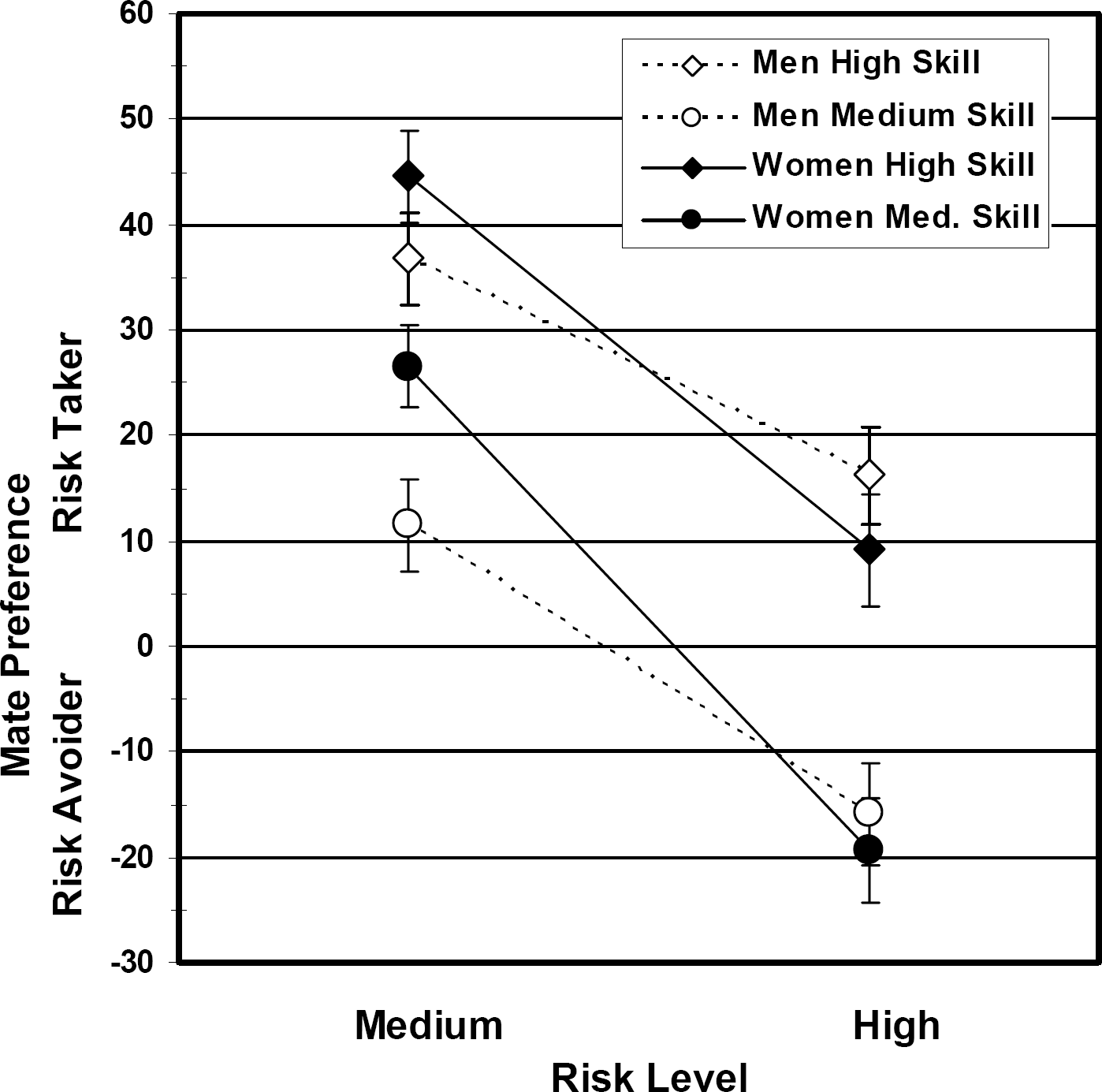
Mean mate preference ratings for risk takers versus risk avoiders for medium- and high-risk level non-heroic physical risks, where the actors were described as either high or medium skilled for the required physical acts. Solid lines are for women participants rating men as potential long-term mates; dashed lines are for men rating women as potential mates. Vertical lines represent standard errors.
A GLM repeated measures analysis, 2 risk levels × 2 skill levels × 2 sexes, found significant main effects for both risk level, F(1, 116) = 173.6, p < .001, η2 = .60, and skill level, F = 127.6, p < .001, η2 = .52, but not for sex. A significant risk level × sex interaction, F(1, 116) = 11.67, p < .001, η2 = .09, indicated a greater effect of act risk level for women than for men, with women approving risk-taker mates more than men did for medium-level risks, t(1, 116) = 2.08, p < .05 two-tailed, but not for high-level risks. A significant risk × skill interaction, F(1, 116) = 8.91, p < .01, η2 = .07, indicated that the effect of skill level was greater for high-level risks than for medium level risks .
Mean mate preference scores in each of the eight conditions in Figure 3 were compared against the zero indifference level via single-sample t-tests (two-tailed). For men, all four data points differed significantly from the zero indifference level (all p < .01). For women, all points differed significantly from zero (p < .001), except for a marginal difference in the high-risk, high-skill condition (p < .10). Thus, both men and women preferred risk takers over risk avoiders as mates for the lowest-risk condition (medium-risk act, high-skill actor), and for the medium-risk conditions (medium-risk act, medium-skill actor; and high-risk act, high-skill actor). However, both men and women preferred risk avoiders over risk takers as mates for the highest risk condition (high-risk acts, medium-skilled actor).
The main effects of both act risk level and actor skill level on mate preferences shown in Figure 3 held true for all four non-heroic acts, and also for both of the two heroic acts. It is noteworthy, however, that for both heroic acts women significantly preferred risk takers over risk avoiders as mates in both the high-risk, high-skill condition and the high-risk, medium-skill condition (both p < .01), whereas men significantly preferred risk takers in the high-risk, high-skill condition (p < .01) but not in the high-risk, medium-skill condition.
Figure 4 shows the mean self risk taking likelihood ratings for the non-heroic risk scenarios in each of the 2 act risk levels × 2 skill level conditions, for males and females. A GLM repeated-measures analysis of 2 risk levels × 2 skill levels × 2 sexes showed significant main effects for risk level, F(1, 116) = 217.5, p < .001, η2 = .65, for skill level, F = 202.3, p < .001, η2 = .64, and for sex, F = 10.78, p < .001, η2 = .085. Reported risky act engagement likelihood was greater for men than for women overall. However, a significant interaction between risk level and sex indicated that the effect of act risk level was greater for women than for men, F = 14.26, p < .001, η2 = .11. A significant interaction between skill level and risk level indicated that the effect of skill level was somewhat greater for high-level risks than for medium risks (F = 17.25, p < .001, η2 = .13. Data for the heroic risk scenarios will not be presented in detail, though it is noteworthy that the main effects for risk level, skill level, and sex occurred for both of the two heroic risk acts, as well as for each of the four non-heroic acts.
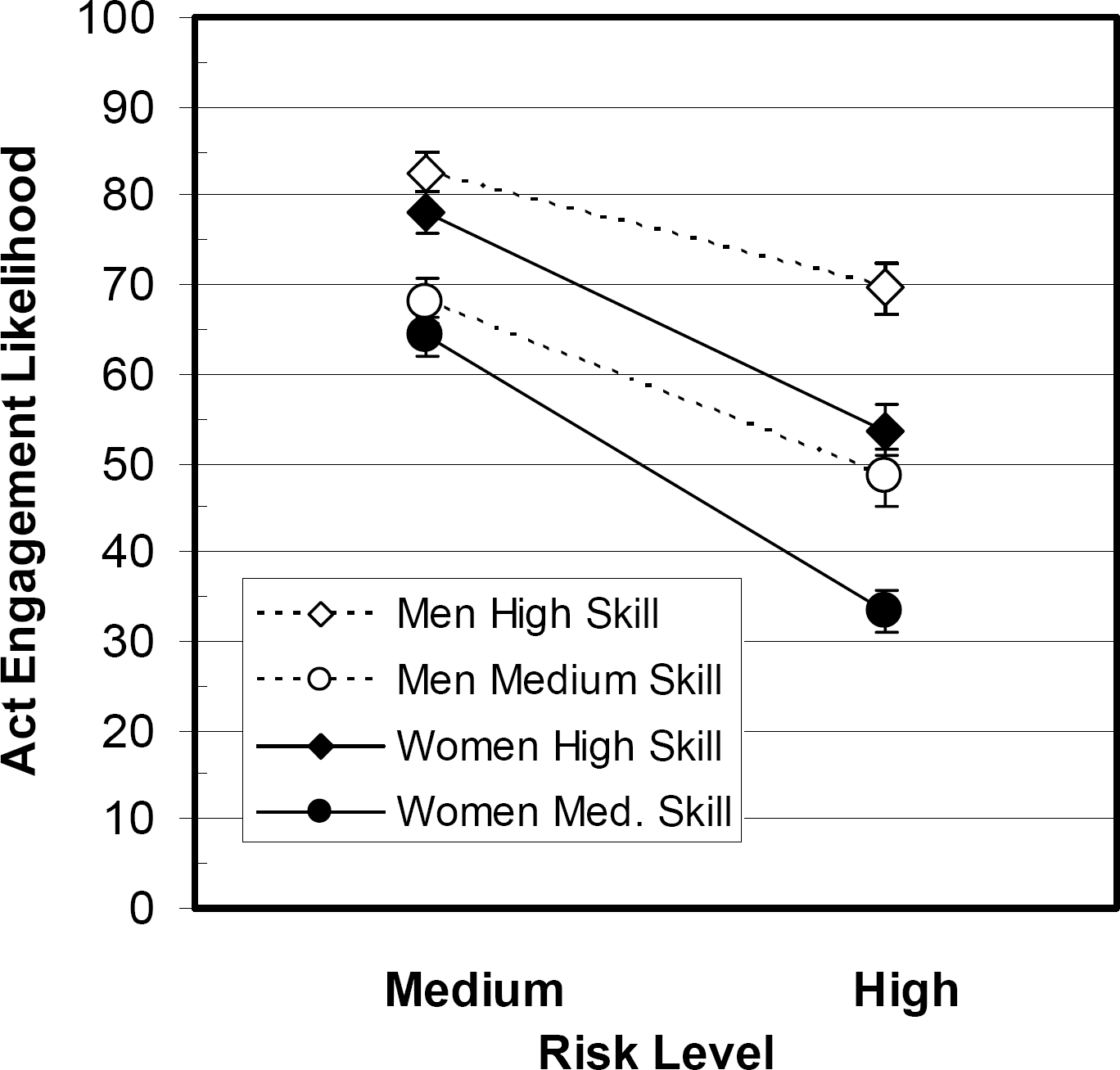
Mean self risk-taking likelihood ratings for men and women for medium and high level non-heroic physical risks scenarios. Participants were asked to imagine that they had either high or medium level skills for the required physical acts. Vertical bars represent standard errors.
Self risk taking likelihood ratings were significantly correlated with attitudes toward risk takers as mates for all four conditions, r = .61, .52, .56, and .49, for the high-risk, high-skill, the high-risk, medium-skill, the low-risk, high-skill, and the low-risk, medium-skill conditions, respectively, with males and females combined (all p <.001, df = 116).
Discussion
The main purpose of the present studies was a further test of a derivation from costly-signaling theory, that women would be attracted to physical risk takers as long-term mates. Farthing (2005) found that women were attracted to heroic risk takers, but not to non-heroic risk takers, for highly risky acts. In this study the riskiness of the actions was varied, and it was predicted that women would prefer takers of non-heroic risks over risk avoiders when the risk level was low to moderate, but not when the risk level was very high. It was also predicted that the degree of preference for risk takers as mates would be negatively correlated with the degree of riskiness of the various acts, for both heroic and non-heroic risky acts.
Predictions about the effects of activity riskiness on women's preferences for risk takers as mates were supported in both studies. In Study 1 (Figures 1 and 2) women preferred takers of non-heroic physical risks over risk avoiders as mates when activities were described as “somewhat risky,” but the preference was reversed in favor of risk avoiders when the acts were described as “very risky.” At both medium and high risk levels, preferences for risk takers were greater for heroic risks than for non-heroic risks, confirming Farthing's (2005) results. In addition, Study 1 found that women's degree of preference for risk takers over risk avoiders was inversely related to act riskiness, for both heroic and non-heroic risks. This latter finding is consistent with results reported by Wilke, Hutchinson, Todd, and Kruger (2006), where for both women and men the reported attractiveness of risk-taking dating partners was negatively correlated with the perceived riskiness of activities in several domains (recreation, ethics, gambling, investment, health, and social domains).
In Study 2 (Figure 3), riskiness to actors taking non-heroic physical risks was manipulated in a 2 × 2 design, with high or medium levels of inherent activity riskiness crossed with high or medium levels of the individual's skill or knowledge about the required risky activity. Both variables significantly affected preferences for risk takers as mates, for both women and men. Preferences for risk takers were greater for medium than for highly risky activities (as in Study 1), and preferences were greater for highly skilled actors than for moderately skilled actors. The effects of the two variables were approximately additive, such that risk takers were most strongly preferred over risk avoiders in scenarios involving the least risky combination (medium-risk act, high-skill actor), and risk takers were less strongly but still significantly preferred for the moderately risky combinations (medium-risk act with medium skill, high-risk act with high skill), but risk avoiders were significantly preferred over risk takers in the riskiest condition (high risk act, medium skilled actor).
These results support Farthing's (2005) original prediction derived from costly-signaling theory, that women would prefer takers of non-heroic, as well as heroic, physical risks as mates over risk avoiders, provided that the risk level to the potential mate is low to moderate, but not if the risk level is very high. In other words, for non-heroic acts, women don't want wimps as mates, but they don't want daredevils, either.
The proposed interpretation of the results is that takers of low to moderate non-heroic physical risks may be successfully signaling desirable traits such as bravery and fitness, compared to risk avoiders. But daredevils who take high level risks are not preferred because positive attributes such as bravery and fitness are overshadowed by the possibility that they could be seriously injured or killed, thus reducing or eliminating their value as mates. For heroic risks, on the other hand, the altruistic component of the risky acts is such an important signal of mate quality that it can overcome worries about risks to the mate's physical safety, such that heroic risk takers may be attractive as mates even when the risk level is very high.
Of course, preferences for risk takers versus risk avoiders as mates are likely to be affected by other factors besides the riskiness and altruism of the activity. For example, Study 2 found positive correlations indicating that participants who reported being more likely to engage in physically-risky activities themselves (Figure 4) also had more favorable attitudes toward risk takers as mates. This finding suggests positive assortment for mate selection on the basis of attitudes toward risk taking. Evidence for such positive assortment was also found by Farthing (2005) and Wilke et al. (2006). Also, factors related to the personal or cultural meanings of different risky activities would be expected to affect attitudes toward risk takers as mates.
Roberts (1998) and others (e.g. Farrelly, Lazarus and Roberts, 2007; Zahavi and Zahavi, 1997) have argued that altruism may be a costly signal that affects mate selection. People who show generosity or willingness to take risks to protect or help other people are likely to do the same thing for their own mate and children, thus making them more attractive as mates. In further support of the idea that heroism may be a costly signal that influences sexual selection, Griskevicius et al. (2007) found that men (but not women) reported being more likely to engage in risky, heroic acts when romantic or sexual motives were induced, compared to a condition where such motives were not induced.
Roberts (1998) and others (Van Vugt, Roberts, and Hardy, 2007) have proposed a competitive altruism hypothesis, which says that people may compete in shows of generosity when their generosity can increase their status among potential mates or coalition partners who perceive their generous acts. Several studies have presented evidence in support of the idea that altruists—generous or helpful people—are more attractive as mates than non-altruists (e.g. Farrelly et al, 2007). The competitive altruism hypothesis implies that people who are perceived as more altruistic will be judged more attractive as mates than people who are perceived as less altruistic. But whereas taking higher-level heroic risks is logically more altruistic than taking lower-level heroic risks, in the present study takers of high-level heroic risks were actually preferred less than takers of lower-level heroic risks (Figure 1). Apparently, determinants of attitudes toward altruists who do risky, heroic acts are not entirely the same as those for altruists who are generous with their money or time and effort. Also, the actual performance of heroic versus economic altruistic acts is affected by different variables for men and women (Griskevicius et al., 2007).
The effects of riskiness and other variables on attitudes toward risk takers as mates may be mediated by observer's inferences about various desirable and undesirable personal traits of the actors. Study 1 (Table 1) assessed participants' judgments comparing risk takers versus risk avoiders on eighteen different personal adjectives, for both heroic and non-heroic high level risks with moderately-skilled actors. Since attitudes toward risk takers as mates were much more favorable for heroic risk takers than for non-heroic risk takers (Figure 1), we would expect to find judgments of the traits of heroic risk takers to be more favorable than judgments of non-heroic risk takers, for at least some of the desirable traits, and less negative for some of the negative traits. This was indeed the case. Most noteworthy, heroic risk takers were judged more positively than non-heroic risk takers for three pro-social traits: altruistic, conscientious, and agreeable. Also, there were some traits where both heroic and non-heroic risk takers were judged less favorably than risk avoiders, but the ratings were less unfavorable for heroic than for non-heroic risk takers, including attention-seeking, emotionally-stable, self-controlled, and intelligent.
Not surprisingly, both heroic and non-heroic risk takers were judged more brave, athletic and physically fit than risk avoiders. These positive traits had been posited as costly signals that would make risk-takers attractive as mates. But risk takers were also judged to be more impulsive and foolish, traits that would make them less attractive as mates, at least for high-level risks. This study only measured trait judgments for takers of high-level risks; future research should compare trait judgments for high-, medium- and low-level risk takers.
The present investigation of subject's judgments of the personal traits of risk takers was primarily exploratory in nature. It indicated some of the personal traits that may be most useful for understanding attitudes toward risk takers under various conditions. It showed differences in trait judgments for heroic versus non-heroic risk takers. In future research it would be worthwhile to examine and compare trait judgments for performers of different specific acts that are equally risky but which differ on other dimensions. For example, risky acts might differ in familiarity, legality, and riskiness to self versus others. Also, it would be worthwhile to examine and compare trait judgments for risk takers in the five different evolutionarily valid domains of risk taking that have been proposed by Kruger, Wang, and Wilke (2007).
The present Study 2, and also Farthing (2005) and Wilke et al. (2006), found that men and women's attitudes toward risk takers as mates were similar. But Farthing (2005) found that men had more favorable attitudes toward same-sex risk takers as friends than women did. Thus, it would be worthwhile to compare male and female trait judgments of risk takers as same-sex or opposite-sex friends, as well as as short-term or long-term mates, to learn more about possible mediators of attitudes toward risk takers for various types of risks.