



Abstract
Although prior research has examined the relationship between genetic relatedness and helping behavior (Burnstein, Crandall, and Kitayama, 1994), less is known about its role in aggressive responses to insults (Fitzgerald and Ketterer, 2011). Drawing on inclusive fitness theory (Hamilton, 1964) and the Kinship, Acceptance, and Rejection Model of Altruism and Aggression (KARMAA; Webster, 2008; Webster et al., 2012), we designed a 2 (participant gender) × 2 (target gender) × 2 (insult: status vs. reproductive) × 3 (relatedness: stranger vs. cousin vs. sibling) between-person experiment in which 489 participants (a) read vignettes in which a stranger, cousin, or sibling was insulted and (b) reported their emotional reaction and retaliation likelihood (six-item α= .91) in response to the insult. Consistent with theory and prior research, men were significantly more aggressive than women, and people were significantly more aggressive responding to insults against kin than non-kin. These findings support theoretically-derived, dynamic, and domain-specific links among insults, gender, relatedness, and aggression.
Introduction
In summer 2012, the United States media followed the search for a man considered armed and dangerous, presumably hiding in New York. After days of evading the hunt, Pernell McBride was arrested for murder. According to witnesses, McBride shot his victim, John Alston, in broad daylight at point-blank range without provocation. As the story unfolded, however, the motive behind the shooting became clearer—McBride was angry with Alston over an altercation involving McBride's sister. Alston had publicly degraded McBride's sister's reputation the previous day, making an insulting reference to her vagina in front of a crowd of people. Upon hearing of the incident, McBride confronted Alston for disrespecting his sister and shot him, ensuring that his sister's reputation would not be hurt by Alston again (Cobin, 2012).
Kinship and Altruism
While the example above shows that people are capable of extreme violence, it also provides support for human altruism—people often behave prosocially, providing benefits to others (e.g., defending them) even though those behaviors can be costly (e.g., threatening one's own safety or freedom). Historically, altruistic behavior has been an evolutionary puzzle because the survival and reproductive costs associated with helping seem to outweigh any direct benefits. As such, the puzzle of human altruism has inspired a wealth of research on the contexts in which such acts are undertaken (see Burnstein, 2005 for a review). Notably, many studies have shown that people are more likely to help their closely related kin than distant kin or unrelated others. For instance, people are more likely to give emotional and social support to their full- or half-siblings (i.e., genetically related siblings) than to their step- or adopted siblings (i.e., non-genetically related siblings; Mikkelson, Floyd, and Pauley, 2011; Mikkelson, Myers, and Hannawa, 2011). People are also more willing to financially support or invest in closer kin. For example, in analyses of wills, closer kin received a larger proportion of inheritances than did more distant relatives (Judge, 1995; Judge and Hrdy, 1992; Smith, Kish, and Crawford, 1987; Webster, Bryan, Crawford, McCarthy, and Cohen, 2008). Experiments involving money allocation to relatives have replicated this effect (Webster, 2003, 2004). Additionally, in an experiment designed to ensure that participants felt the burden of their altruistic actions, participants voluntarily endured increasingly intense physical pain longer when they believed that their parents or siblings would receive financial compensation for each painful second than when they believed that their cousins, grandparents, or unrelated others would receive the compensation (Madsen et al., 2007).
This pattern of findings—that we are more likely to engage in behaviors that benefit our close relatives—can be explained in terms of inclusive fitness (Hamilton, 1964). Because we share a large portion of genes with our closely (vs. distantly) related kin, the costs associated with our altruistic behavior can be outweighed by the reproductive benefits. That is, by providing help, we potentially increase our close kin's reproductive success and our own reproductive success indirectly. Providing help to unrelated individuals is not directly beneficial, as our costly behavior could interrupt or end our own reproductive abilities with less genetic payout. Put simply, by helping close others, we help ourselves.
Kinship and Aggression
Inclusive fitness theory effectively guides the study of altruism from an evolutionary perspective, accounting for the influence of kinship on helping tendencies. As in the opening example, however, some altruistic behaviors are inherently aggressive (Webster et al., 2012). That is, depending on one's perspective in a given situation, one's actions may be seen as altruistic (e.g., from McBride's sister's perspective) or as aggressive (e.g., from Alston's perspective). The link between altruism and aggression, and the impact of kinship, is the basis for the Kinship, Acceptance, and Rejection Model of Altruism and Aggression (KARMAA; Webster, 2008; Webster et al., 2012). According to the KARMAA, cues to genetic or perceived relatedness can promote altruism, but can also facilitate aggression should one's kin be threatened. While research on the impact of kinship on aggression is sparse, we know that animals will aggress against a predator, or an unsuspecting human, when their kin or offspring (e.g., cubs) are threatened (for an example, see Bly, 2011). Similarly, studies of crime statistics have indicated that a majority of murders in the United States involved a blow to the murderer's self-esteem, public image, or a degradation of his or her family (Geen and Donnerstein, 1998).
Aggressive responses to insults directed at one's kin have been studied in college students (Fitzgerald and Ketterer, 2011). When kin were insulted by a stranger, participants were more likely to retaliate on behalf of siblings than cousins. The authors included insult type as a moderator of the effects. Specifically, they examined whether differing reactions would emerge in response to reproductive insults versus status insults. While both types of insults are offensive, the authors hypothesized that reproductive insults (e.g., slut for women, faggot for men) would elicit more retaliation because those insults are thought to directly damage one's reproductive reputation/success more so than the more indirect status insults (e.g., bitch for women, asshole for men). Findings supported their hypothesis for both verbal and physical retaliation. This is consistent with related research showing that people behave more aggressively when domains related to mate value are challenged (Kirkpatrick, Waugh, Valencia, and Webster, 2002; Webster and Kirkpatrick, 2006).
The Current Study
The present study extends this line of research to an international sample, investigating the effects of both reproductive and status insults on aggression as a function of genetic relatedness. As in the Fitzgerald and Ketterer (2011) research, this study includes male and female siblings and cousins as targets, but also includes an unknown target—a stranger—for comparison. We developed three focused hypotheses for this study:
Consistent with most research on gender differences in aggression (e.g., Bettencourt and Miller, 1996; Eagly and Steffen, 1986), we expected men to respond more aggressively than women.
Drawing on inclusive fitness theory and using a set of planned contrasts, we expected participants to respond more aggressively (a) on behalf of kin (siblings and cousins) than non-kin (strangers), and (b) on behalf of close kin (siblings) than distant kin (cousins).
Following Fitzgerald and Ketterer (2011; Kirkpatrick et al., 2002), we expected reproductive insults to elicit more aggression than status insults.
Materials and Methods
Participants and Procedure
We recruited 489 participants (227 women) who ranged in age from 18 to 61 years (M = 29.75 years, SD = 9.11). The majority of participants were Asian (55%, with 31% White, 3% Black, 2% Hispanic, 1% Arab, 1% Native American, and 7% Biracial/Biethnic or Other). We recruited participants via Amazon's Mechanical Turk (MTurk), which has been widely adopted by psychology departments and business schools. MTurk allows for reaching a much broader sample than university participant pools, and has been found to meet appropriate psychometric standards (Buhrmester, Kwang, and Gosling, 2011; Goodman, Cryder, and Cheema, in press). Participants were from 56 countries, with the majority of the sample representing India, the United States, Canada, and the United Kingdom (in descending order). The survey was presented in English, and English fluency was a prerequisite. Nearly half the sample (44%) reported English to be their first/primary language.
In a between-person design, participants were randomly assigned to read 1 of 12 vignettes in which someone insulted their sibling, their cousin, or a stranger. In the example vignette below, the target of the insult is the participant's sister.
Please read the following scenario and imagine that it is happening to you. The sibling referred to below is a female that has the same biological mother and father as you.
You're at a big party and there are lots of people around. Suddenly someone you do not know walks up to you and calls your sister a whore.
All vignettes were identical in setting, with random assignment of target person and insult. Following Fitzgerald and Ketterer's (2011) design, two types of gender-specific insults were used. Reproductive insults included whore and slut for female targets. Pussy and faggot were used for male targets. Status insults included bitch and gold digger for female targets. Asshole and douchebag were used for male targets. In sum, the current study was a 2 (participant gender) × 2 (target gender) × 2 (insult type) × 3 (relatedness: sibling vs. cousin vs. stranger) between-person design.
After reading the vignette, participants responded to six items focused on their reactions. These items assessed how offended, distressed, and angry they would be in such a situation, and how likely they would be to retaliate in general, to verbally retaliate (i.e., insult the offender), or to physically hurt the offender. Responses were made on a nine-point scale (1 = not at all, 9 = extremely). The items were averaged into a measure of reactive aggression (α = .91, M = 5.06, SD = 2.11).
Results
Primary Analyses
We conducted the regression analog of a 2 (participant gender; −.5 = women, .5 = men) × 2 (target gender; −.5 = female, .5 = male) × 2 (insult type; −.5 = status, .5 = reproductive) × 3 (relatedness) between-person ANOVA (see Cohen, Cohen, West, and Aiken, 2003, pp. 332–341; Judd, McClelland, and Ryan, 2009, pp. 159–217). Cell means and standard deviations of aggressive responding are presented in Table 1. Because relatedness had three levels, we used two contrast codes: kin versus non-kin (strangers = −.67, cousins = .33, siblings = .33) and siblings versus cousins (strangers = 0, cousins = −.5, siblings = .5). We first tested the full factorial ANOVA including the four-way interaction; however, because the four-way was non-significant, we dropped this term and used a simpler model that included all possible three-way interactions (Table 2).
Means (and standard deviations) of aggressive responses in each cell.

Aggressive responses as a function of participant gender, target gender, insult type, and relatedness to the target.

p < .05
p < .01
p < .001.
First, we predicted that men would respond more aggressively than women across situations (Hypothesis 1). Consistent with our hypothesis, there was a main effect of participant gender such that men were more aggressive than women (b = 0.47, t468 = 2.69, p < .01, d = 0.25). Second, we predicted that participants would respond more aggressively on behalf of kin than non-kin (Hypothesis 2a) and on behalf of siblings than cousins (Hypothesis 2b). Results supported Hypothesis 2a, but only marginally supported Hypothesis 2b. There was a main effect for kin versus non-kin, such that participants were more aggressive on behalf of kin (b = 1.39, t468 = 7.31, p < .001, d = 0.68). Siblings versus cousins produced a marginal effect (b = 0.39, t468 = 1.59, p = .12, d = 0.15), with sibling targets provoking the most aggressive responses. Both of these relatedness effects were qualified by two higher-order interactions.
There was a significant interaction between target gender and kin versus non-kin (b = −0.81, t468 = −1.99, p < .05, d = 0.18; Figure 1). Simple effects tests (Aiken and West, 1991; Judd, McClelland, and Ryan, 2009) showed that the kin versus non-kin difference was stronger for female targets (b = 1.81, t468 = 6.53, p < .001, d = 0.60) than male targets (b = 1.00, t468 = 3.78, p < .001, d = 0.35), although both differences were significantly positive. We also tested simple target gender differences within this interaction. Target gender differences were significant for neither kin nor non-kin (bs < 0.53, ts468 = 6.53, ps > .09, ds < 0.16).
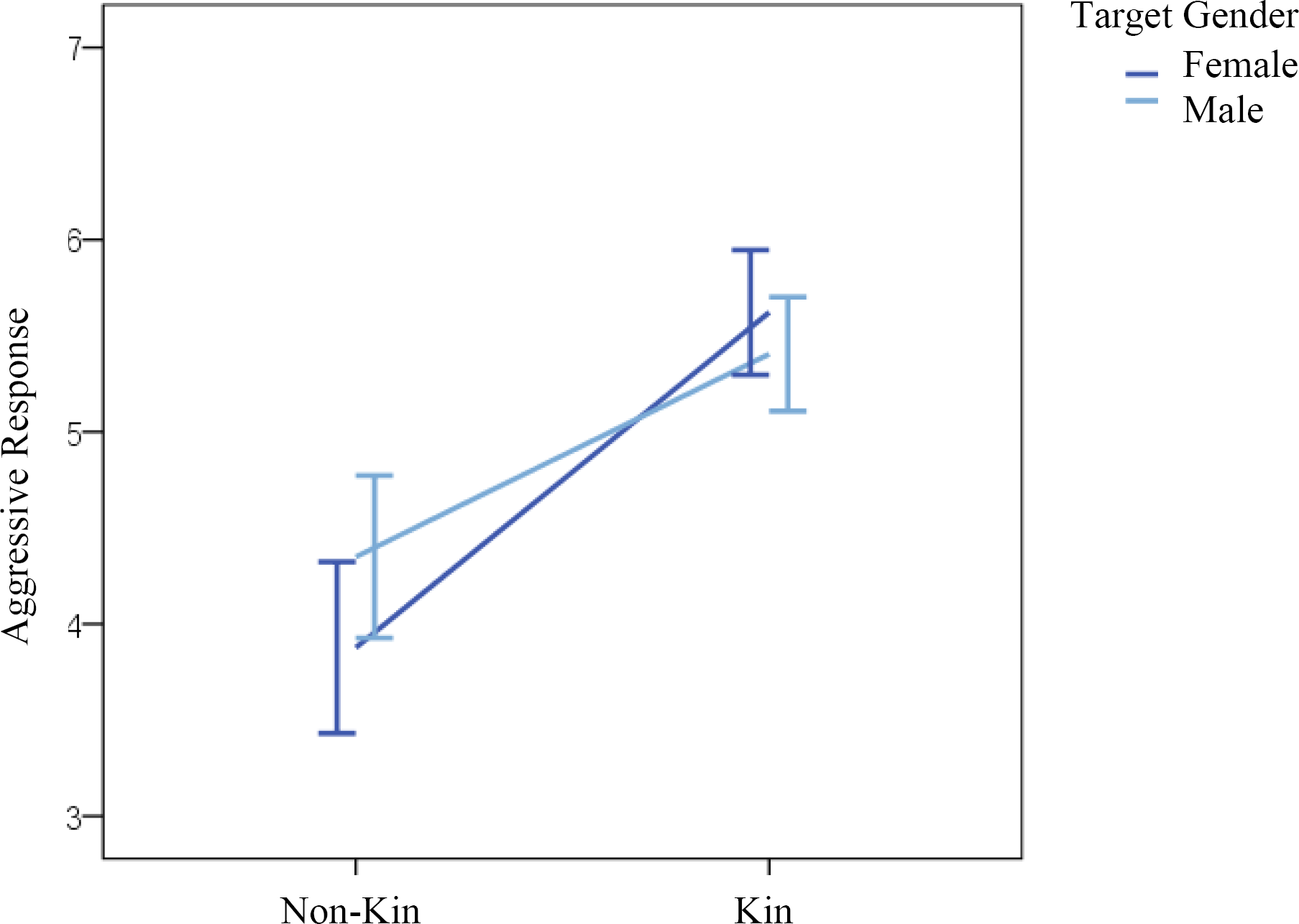
Interaction between target gender and kin vs. non-kin on aggressive responding. Error bars represent 95% confidence intervals.
Last, we predicted that reproductive insults would elicit more aggressive responses than would status insults (Hypothesis 3). This hypothesis was not supported. There was a significant three-way interaction among target gender, sibling versus cousin, and insult type (b = −1.78, t468 = −2.01, p < .05, d = 0.19; Figure 2). We decomposed this interaction by conducting simple effects tests (Aiken and West, 1991; Judd et al., 2009). Specifically, we first tested each of the two-way sibling-versus-cousin-by-insult-type interactions within each level of target gender. No interaction was present for female targets (p = .54, d = 0.06), but the interaction was significant among male targets (b = −1.39, t468 = −2.21, p < 0.05, d = 0.20). We decomposed this two-way interaction to test simple effects. When status insults were used, participants were more aggressive on behalf of their siblings than their cousins (b = 1.31, t468 = 3.08, p < .01, d = 0.28). The effect was non-significant when reproductive insults were used (p = 0.87, d = 0.02). We also tested the status-versus-reproductive-insult difference within levels of kinship. Status insults resulted in more aggression than reproductive insults when the target was a male sibling (b = −0.98, t468 = −2.33, p < 0.05, d = 0.22), but this effect was non-significant when the target was a male cousin (p = 0.38, d = 0.08).

Interaction among target gender, sibling versus cousin, and insult type on aggressive responding. Error bars represent 95% confidence intervals.
Ancillary Analyses
At the request of our reviewers, we conducted an investigation to ensure that the insults used did in fact represent insults to one's status or reproductive prospects. We surveyed 11 participants (7 men, 4 women; Mage = 21.5 years, SDage = 2.34) on how insulting each of the eight words would be to (a) a man's status/social standing, (b) a woman's status/social standing, (c) a man's reproductive (i.e., sexual) prospects, and (d) a woman's reproductive (i.e., sexual) prospects. Ratings were made on a nine-point Likert scale (1 = not at all, 9 = extremely).
Following Judd et al.'s (2009) recommendations on within-person contrasts, we specifically tested the extent to which a given insult (e.g., asshole) corresponded to its intended sex–insult-type pair (e.g., a man's status/social standing; coded “3”) versus the average of the other three sex–insult-type pairs (coded “−1”). When tested individually, seven of the eight insults significantly corresponded to their respective category (Table 3), although one—douchebag—only marginally so (p ≤ .10). For example, status insults directed at women were seen as significantly more insulting to a woman's status than their reproductive prospects or a man's status or reproductive prospects. Note that one insult—pussy, which was used as a male reproductive insult in prior research (Fitzgerald and Ketterer, 2011)—was not perceived to insult a man's reproductive prospects (vs. the other three sex–insult-type pairs) and thus did not align with our expectations. However, when we tested the average of each type of insult—male status insults, female status insults, male reproductive insults, and female reproductive insults—each pair significantly corresponded to its predicted category (Table 3). Because the average of each pair of insults was used in our main analyses, we are confident in the validity of our results. Nevertheless, we recommend that future researchers (a) consider an alternative to using pussy as a male reproductive insult, and (b) pretest specific insults themselves rather than rely on insults used in prior research (e.g., Fitzgerald and Ketterer, 2011).
Tests of within-person contrasts comparing a given insult (italics) or insult pair's intended sex–insult-type pair (contrast coded “3”) with the average of the other three unintended sex–insult-type pairs (contrast coded “−1”). Positive mean differences support expectations.

Note: N = 11.
p < .05
p < .01
p < .001.
Discussion
Although a popular adage has proclaimed that words can never hurt us (Cupples, 1872), the case of Pernell McBride shows that some words (e.g., insults)—if directed at the right person—can be so harmful that they evoke intense aggression and even murder. In this study, we empirically examined aggressive responses to insults and whether such responses differed as a function of one's perceived genetic relatedness to the target of the insult. Taking an inclusive fitness approach (Hamilton, 1964) and drawing from the KARMAA (Webster, 2008), we predicted that participants would respond more aggressively when their kin (vs. non-kin) were insulted. Looking within levels of kinship, we also predicted that participants would more aggressively respond to insults directed at close kin (i.e., siblings) than distant kin (i.e., cousins) or non-kin (i.e., strangers). Consistent with prior research (Fitzgerald and Ketterer, 2011), we included two types of insults—reproductive and status insults—and expected aggressive responses to vary with insult type. Specifically, we predicted participants would respond most aggressively to reproductive insults, as these insults are believed to directly injure one's reproductive reputation/success (Fitzgerald and Ketterer, 2011).
Our results generally supported our hypotheses. First, consistent with most research on gender differences in aggression (e.g., Bettencourt and Miller, 1996; Eagly and Steffen, 1986), men were more aggressive than women in all conditions (Hypothesis 1). Second, we found that people were more aggressive on behalf of their kin than an unrelated stranger. We also found trending support for our prediction that more aggression would be elicited on behalf of siblings (i.e., close kin) than cousins (i.e., distant kin). The data did not support Hypothesis 3: people were not more aggressive in response to reproductive insults than to status insults; aggressive responses were roughly equal across insult type in most conditions. While status insults may be a more indirect method of damaging one's reputation, when they are delivered in front of a large crowd as described in our vignettes, it seems that they can be just as damning. Theoretically, the present research supports not only inclusive fitness theory (Hamilton, 1964) and the KARMAA (Webster, 2008; Webster et al., 2012), but also domain-specific views on the nature of aggression (Kirkpatrick et al., 2002; Webster and Kirkpatrick, 2006).
One potential limitation of this study lies in its methodology. Though effective in the current study, employing vignettes and questionnaires may not evoke or capture the magnitude of aggressive responding that would occur in a face-to-face interaction. This may be why we only found marginal support for more aggressive responding on behalf of siblings versus cousins. Future research would benefit from behavioral measures such as noise blasts (e.g., DeWall, Bushman, Giancola, and Webster, 2010) or hot sauce allocation (e.g., Kirkpatrick et al., 2002; Webster and Kirkpatrick, 2006). Additionally, content analyses of reasons given for personal altercations (e.g., brawls, fist fights, spats) could provide a more ecologically valid view of the power of different types of insults.
A second limitation of this study involves potential mediators of the effects of kinship on helping behavior. Models proposed by Korchmaros and Kenny (2001, 2006) and Webster (2008) implicate several factors including emotional closeness, perceived similarity, and frequency and amount of interaction. Inclusion of such mediators could be fruitful in future endeavors.
The current study employed an entirely between-subjects design to better clarify the effects of our manipulated variables on aggressive responding. In an attempt to simplify the study design, the current study did not include offender gender as a variable. Fitzgerald and Ketterer (2011) included gender of the insulter in their study and obtained mixed results depending on type of retaliation (verbal vs. physical). For instance, participants were more likely to physically aggress against a male than female offender. Future researchers may want to include same- and opposite-sex offenders to provide a more thorough picture of the effects.
Last, this study included eight insults belonging to two distinct categories: reproduction and status. Upon examination, one of the insults used—pussy—was not perceived to be insulting to a male's reproductive prospects. Future research hoping to employ reproductive insults should avoid use of this term.
In sum, the current study took an inclusive fitness approach to aggressive responses to insults—an approach that has been applied to the understanding of altruism but has rarely informed research focused on aggression. When provoked by insults, people followed the pattern found in the altruism literature: as genetic relatedness increased, their responses provided benefit to others (e.g., protection or defense of reputation) even at cost to themselves (e.g., their own physical safety or reputation). We hope that this research will foster a greater understanding of how inclusive fitness theory can inform not only helping behavior, but also harming behavior.
Footnotes
Acknowledgements
The research was presented at the 24th annual meeting of the Human Behavior and Evolution Society (HBES) in Albuquerque, New Mexico (June 2012).