




Abstract
We examined how different types of reproductive limitations — functional (schizoid personality disorder and schizophrenia), physical (malnutrition), and sexual (bisexuality and homosexuality) — influenced altruistic intentions toward hypothetical target individuals of differing degrees of relatedness (r = 0, .25, and .50). Participants were 312 undergraduate students who completed a questionnaire on altruism toward hypothetical friends, half-siblings, and siblings with these different types of reproductive limitations. Genetic relatedness and reproductive limitations did not influence altruistic decision-making when the cost of altruism was low but did as the cost of altruism increased, with participants being more likely to help a sibling over a half-sibling and a half-sibling over a friend. Participants also indicated they were more likely to help a healthy (control) person over people with a reproductive limitation. Of the three types of reproductive limitations, functional limitations had the strongest effect on altruistic decision-making, indicating that people were less likely to help those who exhibit abnormal social behavior.
Introduction
Considerable evidence exists in support of the basic premise of Hamilton's (1964) inclusive fitness theory (Burnstein, Crandall, and Kitayama, 1994; Kaplan, 2005; Kruger, 2001; Stewart-Williams, 2007). Specifically, an individual will behave altruistically toward another when the cost of behaving altruistically (c) is less than the product of the reproductive benefits (b) and the degree of genetic relatedness (r) between the actor and recipient (c < br). However, additional factors can influence the probability of behaving altruistically toward kin. For example, disorders that limit mating frequency or conception probability reduce the likelihood of passing on genes. Hence, people may be less altruistic toward kin with such reproductive limitations because of the decreased chances of passing on the gene responsible for altruism.
The results of several studies on mothers and children suggest that this is the case. Mann (1992) examined the behavior of human mothers with premature monozygotic twins; one twin was physically healthy and the other possessed a disability. She found that these mothers displayed a behavioral preference for their healthy twin by the time the infants were 4 months of age. Bereczkei (2001) observed that Hungarian mothers provided more care (e.g., longer periods of breast feeding) to healthy than high risk (e.g., low birth weight) infants. Scheper-Hughes (1985) found that economically disadvantaged Brazilian mothers were emotionally detached from their sick or deformed children, perhaps because these mothers could not afford to invest limited resources on a child who would most likely die or require extensive resources to function adequately. The mothers would neglect the child, who would usually then starve to death—suggesting that mothers may invest more in children who do not display signs of diminished reproductive value.
Burnstein et al. (1994) discovered that people said they would act more altruistically toward a healthy sibling than a sibling whose visible or known disability signals a decreased chance of reproducing. However, the reproductive limitations that Bernstein et al. examined were global indicators: age and general health. We know relatively little about how siblings might behave toward one another when they have more specific types of reproductive limitations (e.g., specific types of illnesses). It is plausible that altruism toward siblings may differ depending upon the type of reproductive limitation. Therefore, the purpose of the present study was to examine how genetic relatedness and different types of reproductive limitations influence altruistic behavior at three levels of altruistic costliness.
Reproductive Limitations
Reproductive limitations can differ in severity, permanence, and the degree to which they are obvious to an observer. For example, a woman in her 50s is likely to exhibit obvious cues of being post-menopausal, a severe and permanent reproductive limitation (te Velde, Dorland, and Broekmans, 1998). On the other hand, a 25 year old homosexual male may exhibit no obvious reproductive limitation; others may or may not know that he is homosexual. Since homosexuals can (and many do) produce biological offspring, homosexuality is not necessarily a severe or permanent reproductive limitation.
We know that people possess evolved psychological mechanisms that evaluate a person's mate value, and that these mechanisms predispose people to prefer and seek out mates with characteristics indicative of high mate value (Miller, 2001). For example, men prefer youthful, healthy women with a .70 hip-to-waist ratio (Singh, 1993); women prefer men who appear wealthy, dominant, prestigious, athletic, and socially competent (Betzig, 1986; Buss, Shackelford, Kirkpatrick, and Larsen, 2001; Dixon, Halliwell, East, Wignarajah, and Andersen, 2003; Hughes and Gallup, 2003). Therefore, it is also likely that similar mechanisms influence altruistic behavior towards kin. In other words, just as people evaluate reproductive potential in choosing mating partners, they may also evaluate reproductive potential in assessing whether or not to behave altruistically toward an individual. In this study, we manipulated functional, physical, and sexual limitations, each differing in level of severity.
Functional reproductive limitations.
Psychological disorders that disrupt overall mental and behavioral functioning can also decrease the probability of reproduction (Havercamp, Propping, and Hilger, 1982; Lane, Byrne, Mulvany, Kinsella, Waddingtong, Walsh, Larkin, and O'Callaghan 1995; Nanko and Moridaira, 1993). Havercamp et al. (1982), for example, found a significant decrease in the marital rates and reproduction rates of schizophrenics compared to base rates from the national census. Less severe forms of mental illness may also impair reproductive success. For instance, schizoid personality disorder has been described as a precursor to schizophrenia (Perez-Alvarez, 2003). People who suffer from schizoid personality disorder tend to be solitary and have relatively little interest in ‘having sexual experiences with another person’ (American Psychiatric Association, 1994, p. 638).
There are at least two plausible reasons why people would exhibit less altruistic behavior toward persons with mental illness. First, people may consider reproductive cues when making decisions about altruistic behavior because altruism is a means of indirectly enhancing one's own inclusive fitness (Hamilton, 1964). Given the lower marital and reproduction rates among schizophrenics (Havercamp et al., 1982; Lane et al., 1995; Nanko and Moridaira, 1993), helping schizophrenic kin would have a lower fitness payoff than helping kin who are not mentally ill. Second, the mentally ill are less likely to be cooperative and to behave altruistically (McGuire, Fawzy, Spar, Weigel, and Troisi, 1994). As Trivers' (1971) reciprocal altruism theory proposed, people are more likely to act altruistically to those who will reciprocate the favor in the future (Essock-Vitale and McGuire, 1980; Stewart-Williams, 2007). People behave in ways that signal their traits and temperament; similarly, people possess mechanisms for recognizing traits and temperaments (Buss, 1991; McGuire et al., 1994). Thus, it is also likely that people may be less likely to behave altruistically toward the mentally ill because they believe that altruistic behaviors toward them may go unreciprocated.
Physical reproductive limitations.
Numerous studies have found that physical stature is related to attractiveness (Buss and Schmitt, 1993; Dixon et al., 2003; Hughes and Gallup, 2003; Nettle, 2002; Singh, 1993). For example, women prefer tall men as mates over short men (Buss and Schmitt, 1993), and male height is correlated with reproductive success (Nettle, 2002).
Weight is also a physical indicator of reproductive value. The female body must contain at least 22% body fat in order to maintain reproductive ability (Frisch, 1987). Women of reproductive age who do not meet this minimum level of body fat typically stop ovulating. Women who are obese also have greater difficulty conceiving than women of normal weight (Norman, Noakes, Wu, Davies, Moran, and Wang, 2004). Men prefer mating partners who are of average weight over women who are excessively thin or overweight (Rozin and Fallon, 1988). Weight also affects men's reproductive capacity and attractiveness. Women tend to prefer men of moderate weight, with a slightly athletic build over excessively thin or overweight men (Dixon et al., 2003; Hughes and Gallup, 2003). Weight is also correlated with sperm count. Decreased sperm count and sperm concentration has been found in underweight males (body mass index < 20 kg/m2) (Jenson, Andersen, Jorgenson, Andersen, Carlsen, Petersen, and Skakkebaek, 2004). In addition, an increase in weight correlates negatively with testosterone level (Kley, Solbach, McKinnan, and Kruskemper, 1979). Low levels of testosterone decrease males' sex drive and therefore decrease reproductive success. Thus, weight is an obvious reproductive limitation, somewhat severe, and not necessarily permanent. Weight can fluctuate depending on caloric intake and expenditure.
Sexual reproductive limitations.
Sexual reproductive limitations refer to a person's predisposition to engage in sexual activities that do not lead to reproduction. If a person is homosexual, for example, he or she is less likely to reproduce because the sexual behavior that he or she pursues will not lead to reproduction. This also holds true, to a lesser extent, for bisexuality. Although homosexuals have substantially lower rates of reproducing than heterosexuals (Bell and Weinberg, 1978; Saghir and Robins, 1973), sexual orientation is certainly not as obvious as, say, schizophrenia or malnourishment. Although some homosexuals exhibit behavioral or sartorial cues that are associated with homosexuality, this is not the case for all, or perhaps most, homosexuals. Homosexuality, thus, is not an obvious reproductive limitation. It is also not necessarily severe, in that homosexuals are physically capable of reproducing.
There is conflicting evidence regarding homosexuality and inclusive fitness. E. O. Wilson (1975, 1978) theorized that homosexuals would have a greater willingness to aid their kin than heterosexuals because homosexuals are more likely to pass on their altruism gene through investing in kin members than through engaging in reproduction. Vasey, Pocock, and VanderLaan (2007) found support for this among androphilic fa'afafine in Independent Samoa. Other research has found that homosexuals are just as likely as heterosexuals to aid their heterosexual kin (Bobrow and Bailey, 2001; Rahman and Hull, 2005), but no studies to date have examined whether heterosexual people would be just as likely to help homosexual kin. However, because homosexuality and bisexuality are reproductive limitations, people may be less likely to aid homosexual or bisexual kin members.
Types of Altruism
Altruistic decisions in the current study were categorized based on the costs to the altruist and the benefits to the recipient. We used three levels of altruism: everyday, extraordinary, and life-threatening. Following Burnstein et al. (1994), everyday altruism consists of situations in which the cost to the altruist is minor, such as driving someone to work. In everyday altruistic instances, the altruist still suffers some cost, but that cost is not detrimental to his or her living situation (e.g., it is not financially harmful) nor is it life-threatening. The example of everyday altruism used in this study describes buying a few minor items from the grocery store. Extraordinary altruistic acts include a greater cost and benefit than everyday altruism. Extraordinary altruism consists of altruistic acts that benefit the recipient at a large, but not dangerous, cost to the altruist. The altruist will not risk his or her life with this act, but the cost may bring great financial discomfort. The example of extraordinary altruism included in this study describes loaning someone $10,000. The final level of altruism is life-threatening altruism. This type of altruism is made up of life-or-death situations in which the altruist may save the recipient's life, but may lose his or her own life in the process. Rescuing someone from a burning house and donating a kidney are prime examples of life-threatening altruism (Burnstein et al., 1994; Stewart-Williams, 2008). However, the burning house example represents the life-threatening altruism scenario used in this study.
Inclusive Fitness and Reproductive Limitations
Although genetic relatedness may play a role in low-level altruism conditions, the effect is not very pronounced (Stewart-Williams, 2007). This is because the cost of the act is very small (e.g., running some errands or picking up a few groceries) (Burnstein et al., 1994). In this study, genetic relatedness is unlikely to influence low-level altruism because the costs and benefits are not biologically significant. Thus, reproductive limitations should also not influence everyday altruism.
Hypothesis 1: Genetic relatedness and reproductive limitations will not have significant influences on participants' responses to hypothetical everyday altruism.
With extraordinary altruism, the altruist is making a considerable personal sacrifice but not risking his or her life. Nevertheless, the benefit that the recipient receives is great enough to increase the quality of his or her life. Therefore, genetic relatedness should influence extraordinary altruism. However, previous research has not shown that reproductive limitations moderate the relationship between genetic relatedness and extraordinary altruism (Burnstein et al., 1994). This is probably due to the lack of biological danger to the altruist. Helping this recipient (even with a reproductive limitation) will not decrease the altruist's probability of survival and reproduction.
Hypothesis 2: As degree of genetic relatedness increases, extraordinary altruism ratings will increase as well, but reproductive limitations will not have a significant influence on participants' responses.
Once the biological costs and benefits of an altruistic act reach the point of potential life or death, genetic relatedness and reproductive limitations are both relevant. At this level of altruism, all factors that may influence the probability of one passing on the altruism gene are taken into account. As degree of genetic relatedness decreases, the probability of that relative having the altruism gene decreases, and the likelihood of helping that relative decreases as well. Also, if someone possesses a limitation that may inhibit the reproduction of the altruism gene, then the likelihood of helping that person decreases.
Hypothesis 3: As the degree of genetic relatedness increases, life-threatening altruism ratings will increase; and as the degree of reproductive limitation increases (for each reproductive limitation), altruism ratings will decrease.
If, as we have argued, people will be less likely to aid kin with reproductive limitations, the kin least likely to receive help would be those with the most obvious, severe, and permanent limitation. Therefore, among the reproductive limitations that we are examining, people with functional limitations (schizophrenia and schizoid personality disorder) would receive less altruistic behavior than those with physical (underweight) or sexual (homosexuality and bisexuality) reproductive limitations.
Hypothesis 4: Altruism ratings toward recipients with functional reproductive limitations will be significantly lower than altruism ratings toward all other recipients.
Materials and Methods
Participants and Design
Participants were 312 undergraduate students (210 females and 102 males) from Central Michigan University who volunteered to participate for extra course credit. Each altruism condition consisted of 104 participants (70 females and 34 males). The average age of the sample was 18.99 years (SD = 1.49).
Reproductive limitations, degree of severity, and genetic relatedness were within-subject variables whereas level of altruism was a between-subject variable. The study design crossed three levels of genetic relatedness (friend, half-sibling, and sibling) with three types of reproductive limitations (functional, physical, and sexual) in three levels of hypothetical altruism (everyday, extraordinary, and life-threatening). Each reproductive limitation contained two degrees of severity (mild and severe) and a no-limitation control. The dependent variable was the participants' estimates of their likelihood to act altruistically toward each hypothetical person.
Stimulus Materials and Measures
The stimulus materials consisted of questionnaires containing 42 descriptions of fictional people — 21 male and 21 female — described as having different degrees of genetic relatedness and reproductive limitations. Three levels of genetic relatedness were used: friend (r = 0), half-sibling (r = .25), and sibling (r = .50). As described above, three types of reproductive limitations were used (functional, physical, and sexual), each with two degrees of severity and a no-limitation control, resulting in six possible reproductive limitations and a control. Therefore, each of the 42 descriptions was generated to focus on one specific reproductive limitation for the hypothetical males and females of each degree of genetic relatedness (3 degrees of genetic relatedness × 2 sexes × 7 possible reproductive limitations including the control).
Every description revealed five manipulated details of each hypothetical person: their sex, their genetic relation to the participant, and their reproductive value within each of the three types of reproductive limitations manipulated in this study. Each description represented one reproductive limitation while all other limitations were held constant at the control level (e.g., if a person was described as being schizophrenic, then he was also described as being heterosexual and maintaining a healthy weight). Example stimulus materials are presented in Table 4 in the Appendix.
For functional reproductive limitations, the target individuals were described as having either schizoid personality disorder (mild) or schizophrenia (severe). In the case of sexual limitations, we created scenarios in which the target persons were either bisexual (mild) or homosexual (severe). Finally, people evidencing physical reproductive limitations were described as underweight (mild) or severely underweight (severe). These descriptions were held in accordance with the body mass index (BMI). To limit variability within each weight level, a specific weight was assigned for each weight level. A healthy weight is classified as a BMI ≤ 25 kg/m2 (Flegal, Carroll, Kuczmarski, and Johnson, 1998). A BMI ≤ 25 kg/m2 is equal to a person who is 5′ 10″ weighing no more than 174 lbs. Therefore, males in the healthy weight condition were described as weighing 170 lbs. Also, a BMI ≤ 25 kg/m2 is equal to a person who is 5′ 4″ weighing no more than 145 lbs., so the females in the healthy weight condition were described as weighing 140 lbs. The next two levels of the physical limitation variable were categorized as such: underweight (BMI = 20 kg/m2) and severely underweight (BMI = 15 kg/m2). A BMI = 20 kg/m2 is equal to a 5′ 10″ male weighing 140 lbs. Therefore, all males in the underweight condition were described as weighing 140 lbs. In addition, a BMI = 20 kg/m2 is equal to a 5′ 4″ female weighing 117 lbs. As for the severely underweight condition, in accordance with a BMI = 15 kg/m2, males were described as 5′ 10″ weighing 105 lbs. and females were described as 5′ 4″ weighing 88 lbs. The target individuals in the control condition were described as being heterosexual, maintaining a healthy weight (i.e., 140 lbs. for females and 170 lbs. for males), and exhibiting no abnormal behavior.
Three other details pertaining to the hypothetical people were held constant. In all descriptions, the hypothetical individuals were depicted as having no children. Height of each person was rounded to the nearest inch from the average height for males (5′ 10″) and females (5′4″) in the United States (Tanner and Davies, 1985). Age of the individuals was held at 25-years-old.
The 42 descriptions were randomly placed within each of the altruism condition questionnaires. Everyday altruism depicted a hypothetical scenario involving picking up a few small items from the store for the hypothetical target person; extraordinary altruism involved a scenario in which the participant loans the target person $10,000; and life-threatening altruism depicted theoretically rescuing the target person from a burning house. Participants were randomly assigned to one of the three altruism conditions. In each condition, participants were asked, “What is the likelihood of you helping him/her?” Responses were recorded using a 9-point bipolar scale in which 1 = highly unlikely and 9 = highly likely.
Procedure
Sessions began with the experimenter reading the consent form. Participants signed two consent forms, returned one to the researcher, and kept the second copy for themselves. Next, participants received a questionnaire in their randomly-assigned altruism condition. For each description, participants indicated their likelihood of performing the altruistic act by circling a number on the 9-point bipolar scale that was located below every description. Sessions ended when the researcher collected the stimulus materials and debriefed the participants.
Results
Participants reported their likelihood of helping a male and a female in each cell of the study design. Target sex did not elicit any significant effects, nor did it interact with any of the variables so target sex was collapsed and the average of these two ratings (male and female target) was the dependent measure entered into all analyses. Participant sex did not elicit any significant effects as well.
Altruism ratings for each of the three types of reproductive limitations were entered into separate 3 (degree of limitation: none, mild, and severe) × 3 (genetic relatedness: friend, half-sibling, and sibling) repeated measures analyses of variance (ANOVAs) for each level of altruism, resulting in nine ANOVAs overall. Because there were three ANOVAs conducted at each altruism level (one for each reproductive limitation) that shared common control groups (i.e., no limitation at each level of genetic relatedness), the alpha level for overall tests was set at .016.
In the everyday altruism condition, differences in genetic relatedness and in reproductive limitations had no effect on hypothetical altruistic behavior. However, within the extraordinary altruism and life-threatening altruism conditions, greater genetic relatedness resulted in higher altruism ratings. There was a main effect for genetic relatedness in all but the everyday altruism condition, so in the reporting of results below we will only focus on main effects of reproductive limitations and interactions between reproductive limitations and genetic relatedness. See Tables 1, 2, and 3 for the mean altruism ratings and ANOVA results pertaining to genetic relatedness.
Functional Reproductive Limitations
In the extraordinary altruism condition, functional reproductive limitations interacted with genetic relatedness, F(4, 412) = 4.61, p = .001, ηp2 = .04. Follow-up analyses revealed simple main effects for degree of functional limitation at all levels of genetic relatedness: siblings, F(2, 206) = 30.15, p < .01; half-siblings, F(2, 206) = 11.62, p < .01; and friends, F(2, 206) = 18.93, p < .01. Participants indicated they were more likely to hypothetically help siblings with no symptoms than siblings with schizoid symptoms and schizophrenic symptoms, but there were no differences in treatment directed toward siblings with schizoid and schizophrenic symptoms. The same relationship was found with friends. However, participants also indicated a greater likelihood to help half-siblings with no symptoms than those with schizoid symptoms, and a greater likelihood of help half-siblings with schizoid symptoms than those with schizophrenic symptoms.
Functional limitations interacted with genetic relatedness in the life-threatening altruism condition as well. Further analyses found functional limitations to have significant main effects at all levels of genetic relatedness: siblings, F(2, 206) = 23.99, p < .01; half-siblings, F(2, 206) = 18.35, p < .01; and friends, F(2, 206) = 64.54, p < .01. Participants indicated a greater likelihood of hypothetically helping siblings with no functional limitation than both siblings with schizoid symptoms and siblings with schizophrenic symptoms; the latter two groups did not differ significantly. The same relationship was found with half-siblings. Participants' intentions to perform life-threatening altruism were higher toward friends with no limitation than friends with schizoid symptoms, and more likely to provide the same help to friends with schizoid symptoms than friends with schizophrenic symptoms. See Table 1 for mean altruism ratings and ANOVA results.
Mean Altruism Ratings (SDs) and ANOVA Results for Genetic Relatedness and Functional Reproductive Limitations.

Note: Across rows representing individual conditions, means with different superscripts are significantly different at alpha < .016.
Physical Reproductive Limitations
In the extraordinary altruism condition, physical reproductive limitations significantly interacted with genetic relatedness, F(4, 412) = 3.87, p = .004, ηp2 = .04. Follow-up analyses revealed significant main effects of degree of physical limitation for siblings, F(2, 206) = 9.99, p < .01, and friends, F(2, 206) = 4.43, p = .01 (means for half-siblings did not differ significantly). Participants indicated similar treatment for siblings with no limitation and underweight siblings, but participants were significantly more likely to provide hypothetical help underweight siblings than severely underweight siblings. The same relationship was also found with friends.
In the life threatening altruism condition, there was a small main effect for physical condition, F(2, 206) = 4.27, p = .015, ηp2 = .04. That is, collapsing across genetic relatedness, participants were more likely to provide hypothetical life-threatening help to healthy weight and underweight people than severely underweight people. There were no interactions. See Table 2 for mean altruism ratings and ANOVA results.
Mean Altruism Ratings (SDs) and ANOVA Results for Genetic Relatedness and Physical Reproductive Limitations.

Note: Across rows representing individual conditions, means with different superscripts are significantly different at alpha < .016.
Sexual Reproductive Limitations
In the extraordinary altruism condition, sexual reproductive limitations interacted with genetic relatedness F(4, 412) = 3.87, p = .004, ηp2 = .04. The degree of reproductive limitation had no significant effect for friends or half-siblings, but did matter for full siblings, F(2, 206) = 14.08, p < .01. Further analysis revealed that participants indicated they were more likely to help a heterosexual sibling than a bisexual or homosexual sibling. The latter two groups did not differ significantly.
Sexual reproductive limitations also had a significant main effect in the life-threatening altruism condition as well, F(2, 206) = 16.37, p < .01, ηp2 = .14. Participants indicated they were more likely to help a heterosexual recipient than a bisexual recipient and homosexual recipient. However, altruism ratings for bisexual and homosexual recipients were not significantly different. There were no interactions. See Table 3 for mean altruism ratings and ANOVA results.
Mean Altruism Ratings (SDs) and ANOVA Results for Genetic Relatedness and Sexual Reproductive Limitations.

Note: Across rows representing individual conditions, means with different superscripts are significantly different at alpha < .016.
Comparative Effects of Reproductive Limitations
In the extraordinary altruism condition, the mean altruism rating for functional limitations was significantly lower than the mean altruism rating for physical limitations, t(103) = −5.57, p < .01, and sexual limitations, t(103) = −4.37, p < .01. Altruism ratings for people with physical limitations and people with sexual limitations were not significantly different. In the life-threatening condition, the mean altruism rating for people with functional limitations was significantly lower than the mean altruism rating for people with physical limitations, t(103) = −7.64, p < .01 and sexual limitations, t(103) = −4.78, p < .01. In addition, the mean altruism rating for people with sexual limitations was significantly lower than the mean altruism rating for people with physical limitations, t(103) = −2.67, p < .01. See Tables 1, 2, and 3 for the mean altruism ratings.
Discussion
The purpose of this study was to examine the influence of reproductive limitations and genetic relatedness on the intentions of engaging in hypothetical everyday, extraordinary, and life-threatening altruism. We found, as expected, that genetic relatedness and reproductive limitations were unrelated to everyday altruism. That is, people indicated they would be just as likely to give routine help to friends as kin, and to those with reproductive limitations as to those without such limitations. However, as the cost of altruism increased, genetic relatedness and reproductive limitations became more influential in decisions about altruistic behavior.
Functional limitations had the strongest influence on altruistic intentions. People in the extraordinary and life-threatening altruism conditions indicated they would be least likely to help siblings, half-siblings, and friends who exhibited these abnormal behaviors. These decreased altruism ratings could be the product of at least three evolved cognitive mechanisms. One mechanism focuses on the recipients' reproductive potential. People are less likely to be altruistic if the recipients' future reproductive potential is decreased (Burnstein et al., 1994; Essock-Vitale and McGuire, 1985; Hamilton, 1964). However, mechanisms that influence reciprocal altruism (Trivers, 1971) and stigma avoidance (Kurzban and Leary, 2001; Tybur, Lieberman, and Griskevicius, in press), may account for these decreased altruism ratings as well, particularly among non-kin. People are more likely to be altruistic toward those who will reciprocate later. Therefore, people will be less altruistic toward kin and friends who exhibit abnormal social behavior because they will be less likely to help the altruist in the future. Finally, people also tend to avoid others who exhibit signs of carrying pathogens or who behave abnormally. They probably do so in order to avoid disease or physical or psychological harm (Kurzban and Leary, 2001; Tybur et al., in press). Both of these two mechanisms may also account for the decreased altruism ratings toward people with functional limitations.
The mechanisms described above may also influence altruistic decision-making toward people with physical limitations. Being severely underweight indicates being malnourished, and being malnourished is associated with decreased reproductive potential (Frisch, 1987; Jensen, et al., 2004). Thus, people may have indicated a lowered likelihood of helping severely underweight kin because of their decreased probability of reproducing and passing on the altruism gene. If a kin member's reproductive potential decreases, the likelihood of altruism toward that person also decreases. Our results supported this reproduction argument, except for extraordinary altruism among half-siblings, which showed no significant differences between the degrees of physical limitation. This could be due to negative feelings associated with half-siblings. In order to have a half-sibling, one parent must have reproduced with a person other than the altruist's second parent. This implies a number of unpleasant possibilities (e.g., divorce, death of a parent, or an affair). Participants indicated significantly lower altruism ratings toward half-siblings when compared to full siblings, and half-siblings received significantly higher altruism ratings when compared to friends; so genetic relatedness played a role in the altruistic intentions. However, participants may not want to loan money to their half-siblings because of these negative associations, regardless of whether or not the half-sibling is healthy.
Lower altruism ratings towards severely underweight friends may also be due to pathogen avoidance (Kurzban and Leary, 2001; Tybur et al., in press). Participants may avoid severely underweight friends because malnourishment can be a sign of an infectious disease. To avoid contracting the disease, people might be less likely to interact with an extremely thin person, thereby decreasing the probability of altruism. Additionally, an extremely malnourished person may also be too physically weak to reciprocate.
Altruism ratings toward kin and friends with sexual limitations support an inclusive fitness explanation. When asked about providing hypothetical extraordinary altruism, participants revealed a lowered likelihood of helping siblings and half-siblings with sexual limitations, but indicated no significant difference between heterosexual friends, bisexual friends, and homosexual friends. Similar results were found in the life-threatening altruism condition, but participants also indicated a decreased likelihood to help bisexual and homosexual friends than heterosexual friends. Because we saw the same relationship with siblings and half-siblings, the data suggest that altruists may generally favor those with a greater reproductive value. However, a number of different social factors could have led to the decreased altruism ratings toward bisexual and homosexual friends; therefore future study in this area would be helpful.
That people were more likely to hypothetically help those with no reproductive limitation over those with a reproductive limitation, regardless of genetic relatedness, was a particularly interesting finding and one that warrants additional research. It may be that it is in a person's own reproductive interests to aid non-kin of high reproductive value because that may give him or her more chances to reproduce. It may also allow for the establishment of future alliances that may improve his or her fitness (e.g., future reciprocal exchange) or improve the chances of his or her kin reproducing.
Limitations and Conclusions
Because these descriptions did not represent any actual people, participants may not have given their decisions very much in-depth reasoning before responding. For instance, friends are generally the exception to the theory that people give higher levels of altruism to kin than non-kin (Stewart-Williams, 2007, 2008), which is mainly because people share higher levels of emotional closeness with their friends than with their family (Kruger, 2003; Stewart-Williams, 2007, 2008). Because this study focused on fictional people, no emotional closeness between the participants and recipients was shared which may have led to the lower altruism ratings toward friends when compared to half-siblings and full siblings. Also, given that these descriptions were hypothetical, participants may not have fully grasped the risks described for each altruism condition. Also, because people are actually not “at risk” in hypothetical situations, this could have led to inflated scores in the life-threatening altruism condition.
As is consistent with Hamilton's rule (c < br), participants may not be taking reproductive limitations into account until they reach a certain level of reproductive inhibition. However, different reproductive limitations may have different influential strength, causing each limitation to influence altruism at different degrees of limitation. Our results support the idea that altruism may be influenced by a recipient's potential health throughout his or her lifetime. For instance, malnourished and underweight people are able to gain back weight (and reproductive status). People were significantly more likely to risk their lives to save a kin member with a physical limitation than a kin member with a functional limitation or a sexual limitation, possibly because the physical limitations can be seen as temporary. Similarly, people were more willing to help a kin member with a sexual limitation over a kin member with a functional limitation, possibly because bisexual and homosexual kin probably stand a better chance of reproducing.
Finally, our results suggest that participants were intuitively aware of reproductive limitations and (possibly) limits on the ability to reciprocate. Reproduction was never mentioned in this study until after the participants had completed the questionnaire and were debriefed. Yet, the data indicate that participants were significantly less likely to help those with a reproductive limitation or those who may have been less likely to reciprocate (i.e., those with schizophrenia). People thus seem to perceive different types of reproductive limitations which decrease their likelihood of altruism toward people who possess them.
Footnotes
Acknowledgements
We would like to thank Dr. Debra Poole and Dr. Bryan Gibson for lending their research expertise during this project. We would also like to thank Mitchell Whitaker, Kate Unterborn, and Mary Brunner for their help throughout this research.
Appendix
Examples of Descriptions Used.
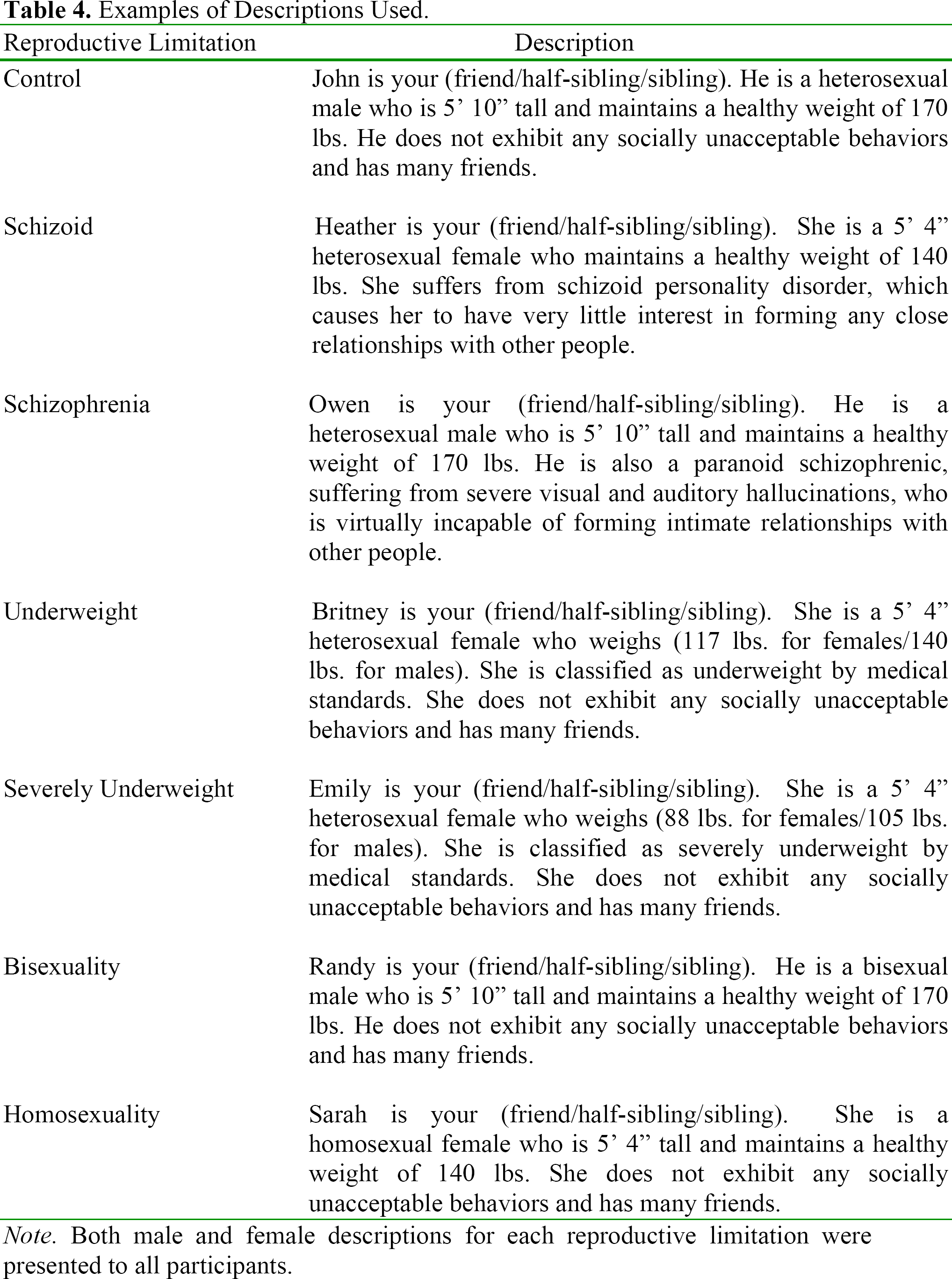
| Reproductive Limitation | Description |
|---|---|
| Control | John is your (friend/half-sibling/sibling). He is a heterosexual male who is 5′ 10″ tall and maintains a healthy weight of 170 lbs. He does not exhibit any socially unacceptable behaviors and has many friends. |
| Schizoid | Heather is your (friend/half-sibling/sibling). She is a 5′ 4″ heterosexual female who maintains a healthy weight of 140 lbs. She suffers from schizoid personality disorder, which causes her to have very little interest in forming any close relationships with other people. |
| Schizophrenia | Owen is your (friend/half-sibling/sibling). He is a heterosexual male who is 5′ 10″ tall and maintains a healthy weight of 170 lbs. He is also a paranoid schizophrenic, suffering from severe visual and auditory hallucinations, who is virtually incapable of forming intimate relationships with other people. |
| Underweight | Britney is your (friend/half-sibling/sibling). She is a 5′ 4″ heterosexual female who weighs (117 lbs. for females/140 lbs. for males). She is classified as underweight by medical standards. She does not exhibit any socially unacceptable behaviors and has many friends. |
| Severely Underweight | Emily is your (friend/half-sibling/sibling). She is a 5′ 4″ heterosexual female who weighs (88 lbs. for females/105 lbs. for males). She is classified as severely underweight by medical standards. She does not exhibit any socially unacceptable behaviors and has many friends. |
| Bisexuality | Randy is your (friend/half-sibling/sibling). He is a bisexual male who is 5′ 10″ tall and maintains a healthy weight of 170 lbs. He does not exhibit any socially unacceptable behaviors and has many friends. |
| Homosexuality | Sarah is your (friend/half-sibling/sibling). She is a homosexual female who is 5′ 4″ tall and maintains a healthy weight of 140 lbs. She does not exhibit any socially unacceptable behaviors and has many friends. |
Note. Both male and female descriptions for each reproductive limitation were presented to all participants.