



Abstract
How do our facial expressions affect the credibility of our words? We test whether smiles, either uninhibited or inhibited, affect the credibility of a written statement. Participants viewed a confederate partner displaying a neutral expression, non-Duchenne smile, Duchenne smile, or controlled smile, paired with a written statement. Participants then made a behavioral decision based on how credible they perceived the confederate’s statement to be. Compared to a neutral expression, Experiment 1 found that participants were more likely to believe the confederate’s statement when it was paired with a deliberate Duchenne smile and less likely to believe the confederate’s statement when it was paired with a deliberate controlled smile. Experiment 2 replicated these findings with spontaneously emitted expressions. These findings provide evidence that uninhibited facial expressions can increase the credibility accompanying statements, while inhibited ones can decrease credibility.
Facial expressions are often taken at face value. For example, the warm smile of a cooperative partner can engender more trust than words alone. On the other hand, the veiled smile of a selfish partner can betray words of assurance. Interestingly, this value is retained despite the awareness that people often voluntarily control their facial expressions, such as when posing a smile for a camera or greeting an airline passenger. Given the value placed on facial expressions, to what extent can they increase or decrease the credibility of our words?
It has been argued that the value placed on facial expressions results from the difficulty in voluntarily controlling them (Frank R., 1988; Pinker, 1997). Darwin initially suggested that specific facial actions would be both (a) difficult to voluntarily activate and (b) difficult to inhibit or mask (Darwin & Prodger, 1998). These two ideas were later coined the inhibition hypothesis by Ekman (2003).
Recent research has tested the inhibition hypothesis by engaging participants in directed facial action tasks under neutral, unpleasant, and pleasant conditions. Regarding the ability to voluntarily activate facial actions, Gosselin, Perron, and Beaupre (2010) directed participants to imitate videos and pictures of 20 specific facial actions with guided instruction. They found that more than 70% of participants were able to activate target facial actions but often coactivated other facial actions. For example, they found that only 35% of participants could activate the lip corner puller (smile) in isolation; however, an additional 65% were able to do so while activating other facial actions.
Looking specifically at voluntarily produced smiles, several studies have examined voluntarily produced Duchenne and non-Duchenne smiles under pleasant, unpleasant, and neutral conditions (Gunnery & Hall, 2014; Gunnery, Hall, & Ruben, 2013; Krumhuber & Manstead, 2009). These studies find that Duchenne smiles are common in all conditions, though only occur in a minority of participants (see Krumhuber and Manstead, 2009 for a notable exception). Results from other investigations also indicate that expressions are common in the absence of emotion, demonstrated in studies of actors (Carroll & Russell, 1997; Gosselin, Kirouac, & Dore, 1995) and in data sets of posed and spontaneous expressions (Kanade, Cohn, & Tian, 2000; Krumhuber & Manstead, 2009; Schmidt, Ambadar, Cohn, & Reed, 2006).
The ability to inhibit expressions in the presence of emotive stimuli has also been examined. Porter and ten Brinke (2008) directed participants to respond either genuinely or deceptively (with a simulated, masked, or neutralized expression) to the International Affective Picture System (IAPS) slides (Lang, Bradley, & Cuthbert, 2008). Across conditions, they found that 25–40% of expressions were inconsistent with the directed facial action. Moreover, inconsistent expressions occurred at least once in 100% of participants. In a follow-up study using more intense emotional stimuli, it was again found that expressions inconsistent with the directed facial action were common, occurring at least once in 98% of participants (Porter, Ten Brinke, & Wallace, 2012). Here, inconsistent facial actions in both genuine and deceptive conditions are consistent with the inhibition hypothesis and suggest limits on the ability to voluntarily inhibit facial actions.
Taken together, this suggests that some factors may limit the voluntary control of facial actions that may include, but are not limited to, individual differences (Ekman, Roper, & Hager, 1980), the intensity of the emotive stimuli (Porter, Ten Brinke, & Wallace, 2012), and/or the isolation of specific action units (AUs; Gosselin, Perron, & Beaupre, 2010).
As others have noted, factors limiting the voluntary control of expressions may have conferred a fitness benefit upon the signaler (Dezechache, Mercier, & Scott-Phillips, 2013; Fridlund, 1994). One hypothesized benefit is the added credibility that expressions give to emotional commitments (Frank, 1988; Nesse, 2001; Pinker, 1997). A commitment ties oneself to an action, leaving a partner with the last opportunity to decide the outcome of an interaction (Schelling, 1960). In an emotional commitment, the tie is enforced by an internal emotional and motivational state. Such commitments can, paradoxically, improve one’s bargaining position, but only if they are honestly communicated to others. The idea is that facial expressions function as guarantors of emotional commitments because of the limits in our ability to voluntarily control them independently from our emotional and motivational states. This has been referred to as the credible signaling hypothesis (Reed, DeScioli, & Pinker, 2014).
The credible signaling hypothesis is consistent with findings relating facial expressions to action tendencies (Fridlund, 1994). It is also consistent with evidence that spontaneous and deliberate expressions emanate from separate neurological mechanisms (Rinn, 1984), of which those controlling voluntary movements are phylogenetically older (Sherwood, et al., 2005). In support of the credible signaling hypothesis, several studies have found that smiles increase the credibility of promises (Brown & Moore, 2002; Brown, Palameta, & Moore, 2003; Reed, Zeglen, & Schmidt, 2012). Furthermore, other studies found that angry expressions increase the credibility of threats (Reed, DeScioli, & Pinker, 2014), sad expressions increase the credibility of statements of loss (Reed & DeScioli, 2017a), and fear expressions increase the credibility of warnings of danger (Reed & DeScioli, 2017b).
These findings suggest that limits on the voluntary control of expressions can benefit a signaler by increasing the credibility of accompanying statements. However, the same limits may cost a signaler by decreasing the credibility of accompanying statements when the signaler aims to conceal an emotional state that motivates an action opposing that of the receiver. That is, because of the relationship between emotion, expression, and social context (i.e., when a signaler and receiver have shared or opposing interests), receivers may be able to deduce the social context by appraising the presence and type of expression. More specifically, a smile displayed by a partner with shared interests would indicate an emotional commitment to act in a way that is beneficial to the receiver, such as when a spouse smiles while promising to stay home to watch the child one evening. On the other hand, a smile displayed by a partner with opposing interests would indicate an emotional commitment to act in a way that would be costly to the receiver. This might be the case when a shady insurance salesman or car mechanic lets a smile escape while attempting to con a customer into wasting their money on worthless goods or services.
The nature of these benefits and costs may be elucidated by examining reactions to smiles. As other have noted, smiles differ in the configuration of their facial actions as well as how they are perceived (Ambadar, Cohn, & Reed, 2009; Frank & Ekman, 1993). All smiles are defined by the contraction of the zygomaticus major, which pulls the lip corners upward and away from the mouth (Ekman, 1989). In isolation, it has been argued that this expression is not indicative of genuine enjoyment and has been termed a false, social, nonfelt, or non-Duchenne smile (Frank, Ekman, & Friesen, 1993). According to some, the smile of enjoyment is reliably indicated by the simultaneous action of the zygomaticus major muscle and the more difficult to control (Ekman, 2003; Gosselin, Perron, & Beaupre, 2010) orbicularis oculi, a circumferential muscle surrounding the eye. Its contraction draws skin toward the eye from the temple and the cheeks constituting the so-called Duchenne marker (Ekman, 1989; Ekman, Davidson, & Friesen, 1990).
In comparison to non-Duchenne smiles, Duchenne smiles are perceived to be more positive, spontaneous, authentic, and intense (Del Guidice & Colle, 2007; Gunnery, Hall, & Ruben, 2013; Hess & Kleck, 1994; Krumhuber & Manstead, 2009; Mehu, Mortillaro, Banziger, & Scherer, 2012). Individuals expressing Duchenne smiles are also attributed to be more amused (Ambadar, Cohn, & Reed, 2009; Frank, Ekman, & Friesen, 1993; Gosselin, Perron, Legault, & Campanella, 2002; Gosselin, Beaupre, & Boissonneault, 2002) and interpersonally positive (Harker & Keltner, 2001; Messinger, Cassel, Acosta, Ambadar, & Cohn, 2008). Duchenne smiles have even been found to affect perceiver’s attributions of signaler’s intelligence (Otta & Abrosio, 1996; Otta, Lira, Cesar, & Pires, 1994) and social status (LaFrance & Hecht, 1999). In addition, Duchenne smiles are shown more often than non-Duchenne smiles in response to pleasant stimuli (Ekman, Davidson, & Friesen, 1990; Soussignan, 2002) and when genuine positive emotions are reported (Ekman, Friesen, & O’Sullivan, 1988; Frank & Ekman, 1993).
Consistent with these findings, the presumed function of the Duchenne smile is to signal cooperative intent to receivers in order to elicit cooperative behavior in return (Centorrino, Djemai, Hpfensitz, Milinki, & Seabright, 2015; Reed, Zeglen, & Schmidt, 2012; Schug, Matumoto, Horita, Yamagishi, & Bonnet, 2010). This function has been demonstrated in several studies of cooperation (Brown & Moore, 2002; Brown, Palameta, & Moore, 2003; Centorrino, Djemai, Hpfensitz, Milinki, & Seabright, 2015; Krumhuber E. , et al., 2007; Reed, Zeglen, & Schmidt, 2012; Scharlemann, Eckel, Kacelnik, & Wilson, 2001; Schug, Matumoto, Horita, Yamagishi, & Bonnet, 2010).
A third, more dynamic smile is the controlled smile. Here, we defined a controlled smile by the contraction of the zygomaticus major directly followed by facial actions that obscure the smile by counteracting the upward pull of the lip corners, termed smile controls (Keltner, 1995; Keltner & Buswell, 1997). Smile controls are most notably an element of embarrassment displays. However, smile controls have been seen among a subset of individuals in response to stimuli intended to elicit positive emotion (Reed, Sayette, & Cohn, 2007). Here, the authors interpreted these actions as voluntary attempts to inhibit involuntary spontaneous smiles of genuine positive emotion. That is, the presence of a voluntary action that functions to counteract the initial action suggests the initial action could not otherwise be inhibited. Although the motivation to inhibit a smile remains unclear, it could function to regulate one’s own emotions and/or to manipulate the beliefs of others. Only empirical tests can establish what effect controlled smiles have on the credibility of accompanying statements.
Here, we attempt to expand upon the credible signaling hypothesis by examining the ways that these expressions might increase or decrease the credibility of accompanying statements. We placed participants in a social situation in which their partners’ interests were either shared or in opposition. Participants were instructed to assess the credibility of a written statement when paired with a neutral expression or one of three types of smiles: non-Duchenne, Duchenne, or controlled. By comparing each of these smiles to a neutral expression, we were able to examine the effects of both uninhibited (non-Duchenne and Duchenne) and inhibited (controlled) smiles. It was hypothesized that participants viewing the Duchenne smile would perceive the expression as a genuine signal of positive emotion. In response, these participants would be more likely to believe and act in accordance with the written statement in comparison to participants viewing the neutral expression. In addition, we explored whether participants viewing the controlled smiles would perceive the expression as a voluntary attempt to inhibit the expression of positive emotion in order to manipulate the receiver. We also explored whether participants viewing the non-Duchenne smiles would perceive the expression as a voluntary attempt to imitate an expression of positive emotion in order to manipulate the receiver. In response, participants viewing both clips would be less likely to believe and act in contrast to the written statement in comparison to those viewing the neutral expression.
Experiment 1
Method
Participants
Two hundred and seventy-six participants (143 males and 133 females) were identified and recruited using Amazon’s Mechanical Turk (MTurk), a crowdsourcing web service that coordinates the supply and demand of human interaction tasks. MTurk has been used in previous research in psychology and provides a supportive infrastructure for participant recruitment, screening, payment, and cultural diversity (Buhrmeister, Kwant, & Gosling, 2011; Horton, Rand, & Zeckhauser, 2011). Participants’ mean age was 21.31 (standard deviation [SD] = 11.95), and their racial distribution was as follows: 86.2% Caucasian, 9.4% African American, 3.6% Asian American, and 2.9% other. In a between-subjects design, participants were randomly assigned to view the neutral (N = 69), non-Duchenne smile (N = 70), Duchenne smile (N = 68), or controlled smile (N = 69) clip in a single trial.
Credibility Assessment Task
We modified an incentivized lie detection task used by Reed and DeScioli (2017) to examine the effects of each expression on the credibility of a written statement. Participants viewed a prerecorded video of a confederate actress (see below) paired with a written statement placed directly below the video. Participants read that the confederate’s message could be true or false and their task was to assess the credibility of the message and to decide based on that assessment. Participants were also told that if they accurately assessed the credibility of the confederate and decided accordingly, they would earn additional bonus money (50 cents). In reality, the confederate’s message was neither true nor false and participants were always paid the bonus.
Participants were first oriented to the interaction: In this interaction, you will play the role of the gold miner and another participant will play the role of the scout. Although this story is fictional, the earnings are real. Any money you earn in the game will be paid to you in MTurk bonus payments. You’ll be matched with an actual participant who has been recorded and has had their data collected. You are a gold miner in the North area of a foreign land accompanied by a local scout. You know that there is gold somewhere in this land. You can dig either in the North or the South, but do not know which location the gold is. The scout, however, has a metal detector and can find the location of the gold easily. But, you cannot be sure whether the scout is loyal and will help you find the gold or is a traitor and wants all of the gold for themselves. The scout learns if they are loyal or a traitor (50%) chance of each. You won’t know whether the scout is loyal or is a traitor. The scout uses their metal detector to find where the gold is and decides what to report to you. You receive the scout’s report and choose which area (North or South) to dig.
Finally, participants read the earnings from the game, based on their decision to dig in the North or the South: You will earn 50 cents if you dig in the area with the gold and 0 cents if you dig in the area without the gold. If the scout is loyal, then they earn the same amount as you: 50 cents if you dig where the gold is and 0 cents if you dig where there isn’t gold. If the scout is a traitor, then they earn the opposite of you: 0 cents if you dig where the gold is and 50 cents if you dig where there isn’t gold.
Facial Expression Stimuli
Participants viewed the facial expression stimuli directly following the description of the interaction. For each expression clip, we instructed the actress to use facial actions described in the Facial Action Coding System (FACS; Cohn & Ekman, 2005). The FACS is a comprehensive, anatomically based system for describing and measuring facial movement. The FACS allows for the creation and coding of facial muscle configurations as combinations of individual AUs; Ekman & Friesen, 1978; Ekman, Friesen, & Hager, 2002), providing an objective and reliable description of facial behavior. Individual AUs were coded independently by a certified FACS coder (L.I.R.). Comparison codes of another FACS coder were used to quantify κ, which corrects for chance agreement. Agreement between the two coders was almost perfect (κ = .832; Landis & Koch, 1977).
Each clip was 6 s in duration and began with a neutral expression. Using an audible metronome (unrecorded), the actress produced each expression at exactly the 1 s mark and continued for the remaining 5 s. In the neutral clip, the actress did not produce any expression. The non-Duchenne smile expression consisted of AU12, lip corner puller. The Duchenne smile expression consisted of the simultaneous action of AU6, cheek raiser; AU12, lip corner puller; and AU25, lips part. The controlled smile expression consisted of the simultaneous action of the AU6, cheek raiser and AU12, lip corner puller followed directly by movements counteracting the outward pull of the lip corner, AU24, lip presser and AU28, lip suck. The intensity of AU12 was similar across non-Duchenne, Duchenne, and controlled smiles.
Each clip was recorded at 30 frames per second in full color at a resolution of 1260 × 1080 pixels. At 6 s in duration, these clips were similar in length to the average 4 to 6 s reported for spontaneous expressions (Frank, Ekman, & Friesen, 1993; Schmidt, Ambadar, Cohn, & Reed, 2006). We used video clips rather than static images because they provide more information to perceivers (Ambadar, Schooler, & Cohn, 2005) and would seem more authentic to participants. The text “This is a previously recorded video of the participant playing the scout.” was placed above each clip. Each clip was paired with the written statement “The gold is in the North” placed directly below the video. Participants were able to replay the video after viewing it an unlimited number of times.
After viewing the video and reading the written statement, participants decided whether to dig in the North or South. After making their decision, participants rated how happy, sad, angry, fearful, and disgusted the scout felt on 7-point Likert-type scales (1 = not at all and 7 = extremely). Participants could replay the video during their ratings. Finally, participants reported their demographic information and received a debriefing statement.
Results and Discussion
As a manipulation check, we first examined participants’ emotion ratings for the neutral, non-Duchenne smile, Duchenne smile, and controlled smile clips. Regarding happiness ratings, a one-way analysis of variance (ANOVA) found a significant difference between clips, F(3, 272) = 106.28, p < .001. Post hoc tests using the Bonferroni correction determined that ratings were significantly lower in response to the neutral clip (M = 2.07, SD = 1.19) in comparison to the non-Duchenne smile (M = 4.76, SD = 1.51), Duchenne smile (M = 5.70, SD = 1.09), and controlled smile (M = 4.96, SD = 1.28) clips. Ratings for happiness, sadness, anger, fear, and disgust for each clip are shown in Table 1.
Participants’ Emotion Ratings of Scout Expressions, Experiment 1.
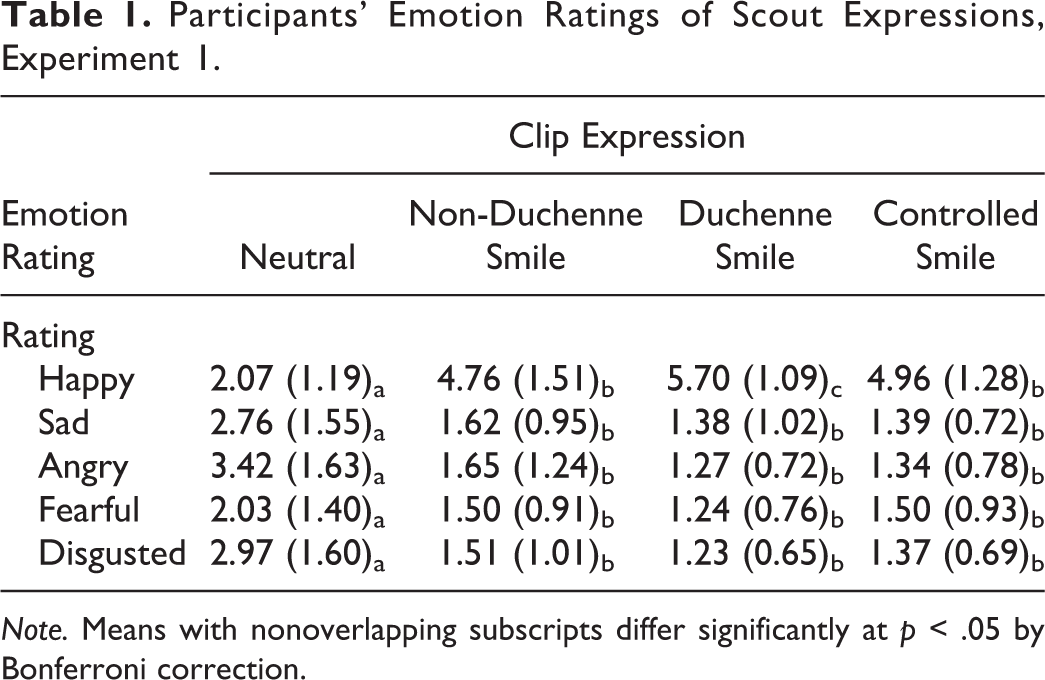
Note. Means with nonoverlapping subscripts differ significantly at p < .05 by Bonferroni correction.
The primary results are shown in Figure 1. We used a binary logistic regression to examine the effects of clip on the likelihood that participants would dig in the North (see Table 2). The model was significant, χ2 (3) = 28.871, p < .001. More specifically, the expressions depicted in each clip had varying effects on the likelihood participants would dig in the North. Participants were not significantly more or less likely to dig in the North if they viewed the non-Duchenne clip (37/70) than if they had viewed the neutral clip (40/69), β = −0.207, p = .544, odds ratio [OR] = 0.813. As hypothesized, participants were significantly more likely to dig in the North if they viewed the Duchenne clip (52/68) than if they had viewed the neutral clip (40/69), β = 0.857, p = .023, OR = 2.356. Furthermore, participants were significantly less likely to dig in the North if they viewed the controlled smile clip (22/69) than if they had viewed the neutral clip (40/69), β = −1.081, p = .002, OR = 0.339.

Percentage of participants who dug in the north by expression, Experiment 1.
Binary Logistic Regression or Participants’ Likelihood of Digging in the North, Experiment 1.

Note. Digging coded as 0 = south or 1 = north.
In sum, the data support the credible signaling hypothesis. Duchenne smiles, though not non-Duchenne smiles, increased the credibility of the accompanying statement. Furthermore, the data extend the credible signaling hypothesis in finding that controlled smiles decreased the credibility of accompanying statements. Together, these findings suggest that the value receivers place on facial expressions is high enough to affect their interpretation of a signaler’s words.
Experiment 2
Experiment 1 found that Duchenne smiles increased the credibility of a written statement, while controlled smiles decreased the credibility of the same statement. These effects were found using stimuli created using a directed facial action task. Previous research has shown that deliberately and spontaneously produced smiles differ in dynamic characteristics (i.e., timing and movement) (Schmidt, Ambadar, Cohn, & Reed, 2006). Furthermore, it has been shown that these dynamic characteristics influence receiver judgments of smiles (Ambadar, Cohn, & Reed, 2009). In Experiment 2, we examined whether the effects found in Experiment 1 would generalize to spontaneously emitted expressions. Here, we elicited spontaneous non-Duchenne smiles, Duchenne smiles, and controlled smiles to examine their effect on the credibility of accompanying statements. As in Experiment 1, we hypothesized that Duchenne smiles would increase the credibility of the statement, while controlled smiles would decrease the credibility.
Method
Participants
A separate set of four hundred and six participants were recruited using MTurk (220 males and 186 females) and randomly assigned to view the neutral clip or the spontaneously emitted non-Duchenne smile, Duchenne smile, or controlled smile clips. Their mean age was 34.83 (SD = 10.88), and their racial distribution was as follows: 77.1% Caucasian, 12.6% African American, 10.6% Asian American, and 6.7% other. As in Experiment 1, we used a between-subjects design in which participants were randomly assigned to view the neutral (N = 70), non-Duchenne smile (N = 105), Duchenne smile (N = 104), or controlled smile (N = 100) clip in a single trial.
Facial Expression Stimuli
The procedure was the same as in Experiment 1 with one exception: Rather than viewing deliberately produced expressions, participants viewed spontaneously emitted expressions. Expressions for each smile condition were elicited using audio from comedy clip of the comedian Chris Rock, entitled “Chris Rock: Bring the Pain,” selected based on criteria outlined by Gross and Levenson (1995) and used in previous research (Reed, Sayette, & Cohn, 2007) to reliably elicit pos itive emotion. The actress was first instructed to respond naturally to the comedy clip. After listening to the clip, we chose a representative (i.e., of similar intensities and without extraneous AUs) non-Duchenne and Duchenne smile to use as stimuli. In order to capture the controlled smiles, the actress was instructed not to smile in response to a different portion of the clip. As with the non-Duchenne and Duchenne smiles, we chose a representative controlled smile to use as a stimulus.
The spontaneous expressions in each clip consisted of the same AUs as those deliberate expressions in Experiment 1. The non-Duchenne smile expression consisted of AU12, lip corner puller. The Duchenne smile expression consisted of the simultaneous action of AU6, cheek raiser; AU12, lip corner puller; and AU25, lips part. The controlled smile expression consisted of the simultaneous action of the AU6, cheek raiser and AU12, lip corner puller followed directly by movements counteracting the outward pull of the lip corner, AU24, lip presser and AU28, lip suck. As in Experiment 1, the intensity of AU12 was similar across non-Duchenne, Duchenne, and controlled smiles. Comparison codes of another FACS coder were again used to quantify κ. Agreement between the two coders was almost perfect (κ = .890; Landis & Koch, 1977).
However, the spontaneous expressions differed slightly in length from the deliberate expressions used in Experiment 1. Both the neutral expression and the non-Duchenne smile clips were 4-s long. The Duchenne smile clip was 3-s long and the controlled smile clip was 5-s long. Furthermore, these spontaneous expressions likely differed from the deliberate expressions used in Experiment 1 regarding timing (Schmidt, Ambadar, Cohn, & Reed, 2006) and asymmetry (Hager & Ekman, 2005; Skinner & Mullen, 1991). For these reasons, we did not compare results across experiments.
Results and Discussion
We first examined participants’ emotion ratings for the neutral, non-Duchenne smile, Duchenne smile, and controlled smile clips (see Table 3). Regarding happiness ratings, a one-way ANOVA found a significant difference between clips, F(3, 405) = 90.95, p < .001. Post hoc tests using the Bonferroni correction determined that ratings were significantly lower in response to the neutral clip (M = 2.81, SD = 1.53) in comparison to the non-Duchenne smile (M = 4.84, SD = 1.24), Duchenne smile (M = 5.44, SD = 1.10), and controlled smile (M = 5.28, SD = 1.16) clips. Ratings for happiness, sadness, anger, fear, and disgust for each clip are shown in Table 3.
Participants’ Emotion Ratings of Scout Expressions, Experiment 2.

Note. Means with nonoverlapping subscripts differ significantly at p < .05 by Bonferroni correction.
The primary results are shown in Figure 2. As in Experiment 1, we used a binary logistic regression to examine the effects of clip on the likelihood that participants would dig in the North (see Table 4). The model was significant, χ2 (3) = 18.187, p < .001. Participants were not significantly more or less likely to dig in the North if they viewed the non-Duchenne clip (63/105) than if they had viewed the neutral clip (64/97), β = −0.257, p = .380, OR = 0.773. As hypothesized, participants were significantly more likely to dig in the North if they viewed the Duchenne clip (82/104) than if they had viewed the neutral clip (64/97), β = 0.653, p = .042, OR = 1.922. Additionally, participants were significantly less likely to dig in the North if they viewed the controlled smile clip (51/100) than if they had viewed the neutral clip (64/97), β = −0.622, p = .034, OR = 0.537.

Percentage of participants who dug in the north by expression, Experiment 2.
Binary Logistic Regression or Participants’ Likelihood of Digging in the North, Experiment 2.

Note. Digging coded as 0 = south or 1 = north.
As in Experiment 1, the data support the credible signaling hypothesis. In comparison to neutral expressions, Duchenne smiles increased the credibility of the accompanying statement, while controlled smiles decreased the credibility of accompanying statements. This suggests that the effects of Duchenne smiles and controlled smiles remain when these expressions are spontaneously emitted.
General Discussion
We examined the effects of neutral expressions, non-Duchenne smiles, Duchenne smiles, and controlled smiles on the credibility of a written statement. Results from two experiments supported the credible signaling hypothesis: In comparison to neutral expressions, deliberately posed Duchenne smiles increased the credibility of a written statement. This finding is consistent with previous research showing that smiles increase trust and credibility (Brown & Moore, 2002; Brown, Palameta, & Moore, 2003; Reed, Zeglen, & Schmidt, 2012). We also found that deliberately posed controlled smiles decreased the credibility of the same statement. This novel finding suggests that receivers may interpret a signaler’s attempt to inhibit an expression as a means of manipulation, raising doubts about the credibility of the accompanying statement. These effects were found whether perceivers viewed deliberately posed (Experiment 1) or spontaneously emitted (Experiment 2) expressions. Taken together, the results suggest that accompanying statements were relatively more credible when paired with Duchenne smiles and relatively less credible when paired with controlled smiles.
Preliminary analyses in both experiments found that participants rated the non-Duchenne smile, Duchenne smile, and controlled smile clips as very happy, with each smile clip rated as significantly happier than the control clip. This is consistent with previous research showing that smiles that differ in configuration also differ in how they are perceived (Ambadar, Cohn, & Reed, 2009; Frank & Ekman, 1993). Interestingly, the pattern of differences in perceived happiness ratings between clips was not consistent with the effects that each clip had on participants’ behavior. As such, it is possible that participants based their decisions not on the perceived happiness of the confederate but on whether the confederate attempted to control the expression of their perceived happiness. Future research might benefit from examining the relationship between a smiling confederate’s perceived emotion and behavioral responses.
The results speak toward the costs and benefits associated with limits on the voluntary control of facial expressions. The credible signaling hypothesis suggests that factors limiting the voluntary control of expressions can benefit a signaler by increasing the credibility of accompanying statements. Data from both experiments support this hypothesis with the addition of a critical condition: The limits on the voluntary control of expressions can also cost a signaler by decreasing the credibility of accompanying statements in situations of opposing interests when they are attempted to be inhibited. Furthermore, an attempt to control an expression may be maladaptive within social contexts in which the signaler and receiver share interests. Future research could further examine these benefits and costs as well as the ways they are related to the limits on the voluntary control of facial expressions.
These findings provide further support for the idea that facial expression can increase the credibility of accompanying statements (Reed, Zeglen, & Schmidt, 2012; Reed, DeScioli, & Pinker, 2014; Reed & DeScioli, 2017a; Reed & DeScioli, 2017b), while also providing evidence that they may also decrease the credibility of the same statements. This has several implications. For example, face-to-face negotiations may be preferred in potentially adversarial interactions over audio or written exchanges. This would provide receivers with sensitive information not only about a signaler’s emotional and motivation state but also how a signaler might attempt to manipulate the perception of their emotional or motivational state. On the other hand, the similar effect sizes found for Duchenne smiles in the two experiments suggest that a deliberate expression can have similar effects to a spontaneous expression. Furthermore, dynamic analyses of facial expressions may be critical in future research investigating the perceptual and behavioral responses to facial expressions. Finally, future studies might benefit from considering the voluntary control of spontaneous expressions in social situations, particularly those in which individuals may hold either opposing or shared interests.
Footnotes
Acknowledgments
The authors would like to thank Ashley Meyer for providing comparison FACS codes and an anonymous reviewer for their helpful feedback.
Declaration of Conflicting Interests
The author(s) declared no potential conflicts of interest with respect to the research, authorship, and/or publication of this article.
Funding
The author(s) received no financial support for the research, authorship, and/or publication of this article.
