



Abstract
The provision of information appears to be an important property of self-esteem as evidenced by previous research concerning the status-tracking and status-signaling models of self-esteem. The present studies examine whether there is an implicit theory of self-esteem that leads individuals to assume targets with higher levels of self-esteem possess more desirable characteristics than those with lower levels of self-esteem. Across 6 studies, targets with ostensibly higher levels of self-esteem were generally rated as more attractive and as more desirable relationship partners than those with lower levels of self-esteem. It is important to note, however, that this general trend did not consistently emerge for female targets. Rather, female targets with high self-esteem were often evaluated less positively than those with more moderate levels of self-esteem. The present findings are discussed in the context of an extended informational model of self-esteem consisting of both the status-tracking and status-signaling properties of self-esteem.
Introduction
“Confidence is very sexy, don't you think?”
-Jack Palance in a television commercial for Skin Bracer aftershave from 1975
An implicit theory refers to a set of beliefs concerning the covariation of characteristics (Asch, 1946; Bruner and Tagiuri, 1954; Dweck and Leggett, 1988; Heider, 1958; Jones and Thibaut, 1958; Kelly, 1955; Kelley, 1973; Rosenberg, Nelson, and Vivekananthan, 1968; Ross, 1989; Trope and Higgins, 1993; Uleman, Saribay, and Gonzalez, 2008). Stereotypes, for example, are implicit theories in which the characteristic of group membership is assumed to be associated with specific personal attributes (Ashmore, 1981). The importance of implicit theories stems from the influence they exert with regard to the processing of information about targets. For example, if I have an implicit theory that characteristics X and Y are associated, then I may be more likely to infer that a new target possesses characteristic Y when I learn the target has characteristic X. Importantly, an implicit theory may lead me to make this inference even if I have not actually observed the target demonstrating characteristic Y. The result of an implicit theory such as this is that information about one characteristic may have an impact on whether a target is judged to possess other traits that are believed to be associated with the initial characteristic.
A variety of implicit theories have emerged for characteristics ranging from relationship status (Conley and Collins, 2002) to alcohol consumption (Jones and Rossiter, 2003). One of the most widely examined implicit theories concerns physical attractiveness. In one of the best known studies of this phenomenon, Dion, Berscheid, and Walster (1972) asked participants to choose which personality characteristics applied to photographs of attractive and unattractive targets. The results of this study showed that participants selected more positive traits for attractive targets than were selected for less attractive targets. These findings, along with those of many other studies, demonstrate that attractive individuals are assumed to possess an array of positive personality characteristics (e.g., social competence) simply because of their appearance (Eagly, Ashmore, Makhijani, and Longo, 1991; Feingold, 1992; Jackson, Hunter, and Hodge, 1995; Langlois et al., 2000; Snyder, Tanke, and Berscheid, 1977). That is, there is an assumption of covariation that leads to the belief that what is beautiful is good. Implicit theories such as the halo effect surrounding attractiveness are believed to be useful because they conserve cognitive resources by making interpersonal perception more of an automatic process (Ashmore and Del Boca, 1979). The implicit theory concerning physical attractiveness appears to have its basis in the direct observation of attractive individuals exhibiting positive characteristics as well as cultural messages associating beauty with good qualities and ugliness with bad qualities (Adams, 1977; Eagly et al., 1991; Feingold, 1992).
The present studies examine the possibility that there is an implicit theory concerning self-esteem that functions in a manner similar to that of the halo effect for physical beauty. That is, these studies examine the possibility that learning someone has high (or low) self-esteem may influence how that person is viewed on other dimensions. Initial research supports the existence of such an implicit theory and suggests that individuals who are believed to possess high levels of self-esteem may be thought to possess other desirable traits. In a recent pair of studies, Zeigler-Hill and Myers (2009) found that participants were generally more willing to consider voting for the political candidates they believed to possess higher levels of self-esteem during the 2008 presidential primary contests. This basic effect emerged whether participants were simply asked to report their perceptions of the self-esteem levels of the candidates (Study 1) or if the ostensible self-esteem levels of the candidates were manipulated by assigning self-esteem designations to the candidates that were supposedly derived from “extensive linguistic analyses of speeches made by each of the candidates” (Study 2). It is important to note, however, that the advantages associated with perceived high self-esteem did not always materialize for candidates. The most striking exception to this general pattern emerged for Hillary Clinton such that participants were often less willing to consider voting for her when they believed she possessed higher levels of self-esteem. One potential explanation for the reluctance of individuals to consider voting for Clinton when she was thought to have high self-esteem is that she may have been viewed as violating prescriptive norms concerning female modesty and niceness (e.g., Rudman, 1998; Rudman and Glick, 1999, 2001). This explanation seems especially likely if the meaning of high self-esteem is different for women than it is for men. For example, it may be the case that women with high self-esteem are assumed to be at least somewhat narcissistic, whereas the same assumption may not be made for men with comparable levels of self-esteem.
The implicit theory of self-esteem is consistent with the idea that self-esteem may play a role in transferring information about social status between the individual and one's social environment. The most widely studied informational model of self-esteem is the sociometer model developed by Leary and his colleagues (Leary and Baumeister, 2000; Leary and Downs, 1995). According to the sociometer model, self-esteem has a status-tracking property such that an individual's self-esteem is dependent on his or her level of relational value. The sociometer model proposes that self-esteem is an evolutionary adaptation that allows individuals to monitor the degree to which they are valued by others (i.e., information is being conveyed from the social environment to the individual; Leary, 1999, 2005; Leary, Haupt, Strausser, and Chokel, 1998; Leary and MacDonald, 2003). According to the sociometer model, self-esteem is analogous to a gauge that alerts the individual to either gains in his or her relational value (accompanied by increases in self-esteem) or losses in one's value (accompanied by decreases in self-esteem; Leary, 2004). Leary and Downs (1995) suggest that our level of self-esteem serves as an indicator of our current level of relational value in much the same way that the fuel gauge on the dashboard of our car provides us with information concerning how much fuel remains in our fuel tank. If our relational value decreases, then we should also experience a decrease in our state self-esteem that motivates us to engage in compensatory behaviors (e.g., being nicer to those in our social environment) in order to increase our relational value and, consequently, our self-esteem. Importantly, the sociometer model suggests that people do not care about self-esteem for its own sake. Rather, self-esteem is important because of what it indicates about the degree to which the individual is accepted and valued by others (Leary, Tambor, Terdal, and Downs, 1995). Consistent with the sociometer model, an impressive amount of empirical support has demonstrated that self-esteem is responsive to social acceptance and rejection (Downie, Mageau, Koestner, and Liodden, 2006; Leary, Cottrell, and Phillips, 2001; Leary et al., 2003; Lemay and Ashmore, 2006; urray, Griffin, Rose, and Bellavia, 2003; Nezlek, 2001; Srivastava and Beer, 2005).
Building on the foundation provided by the sociometer model, Kirkpatrick and Ellis (2001, 2006) have suggested that this model should be expanded to incorporate additional sociometers that monitor dimensions other than relational value. This proposed extension is consistent with the work of other researchers linking self-esteem with domains such as dominance (Barkow, 1989; Gilbert, Price, and Allan, 1995), prestige (Henrich and Gil-White, 2001), and mate value (Brase and Guy, 2004; Dawkins, 1982; Kenrick, Groth, Trost, and Sadalla, 1993; Kiesler and Baral, 1970; Shackelford, 2001; Tooby and Cosmides, 1990; Trivers, 1972; Wright, 1994). An example of support for extending sociometer theory beyond relational value was provided by Brase and Guy (2004) who found that indicators of mate value (e.g., self-rated mate value, age, marital status) were associated with self-esteem. That is, individuals with higher mate value – or, at the very least, those who perceived themselves as possessing higher mate value – tended to report higher levels of self-esteem.
The status-signaling model of self-esteem (Zeigler-Hill, Besser, Myers, Southard, and Malkin, 2011) was recently developed as a complement to status-tracking models such as the sociometer model. The status-signaling model refers to the possibility that an individual's level of self-esteem may influence how he or she presents oneself to others and, as a consequence, how that individual is perceived by those who constitute his or her social environment. According to this model, an individual's level of self-esteem may influence how one is perceived on dimensions relevant to evolutionary outcomes (e.g., romantic desirability). A basic prediction of the status-signaling model is that individuals who convey high levels of self-esteem should be viewed more positively than those with low self-esteem on a wide-array of dimensions. As initial support for the status-signaling model, Zeigler-Hill et al. (2011) found that the perceived self-esteem levels of targets fully mediated the association between their self-reported levels of self-esteem and perceiver ratings of their interpersonal behavior (e.g., social dominance). This suggests that the ability of individuals to convey certain levels of self-esteem may play an important role in how individuals are viewed by their social environments.
The status-signaling model of self-esteem is derived in large part from similar status-signaling models developed for non-human species. These models concern the fact that a wide array of organisms use signals of quality to communicate information concerning their phenotypic and genetic qualities to their social environment (Anderson, 1994; Dale, Lank, and Reeve, 2001; Grafen, 1990; Zahavi, 1975). For example, Rohwer (1975) proposed that conspicuous color traits serve as signals of dominance in a variety of species. These signals are advantageous because it allows individuals to assess the likely outcome of conflict and avoid unnecessary confrontations that may prove costly to one or more of the participants. The use of coloration as a “badge of status” has been shown in various animals including birds (Senar, 2006), lizards (Martin and Forsman, 1999), and insects (Tibbetts and Dale, 2004). Of course, color is just one of the many signals that have been found. Other signals include physical characteristics (e.g., size, odor) and behaviors (e.g., vocalizations, aggressive displays; Bergman et al., 2003; Bokony, Lendvai, and Liker, 2006; Fossey, 1983; Preuschoft, 1999). Although it is certainly possible for organisms to engage in deception by producing false status-signals, many of these signals are costly to produce and carry a social (or maintenance) cost incurred through repeated challenges from other individuals (Gonzalez, Sorci, Smith, and de Lope, 2002; Jawor and Breitwisch, 2003; Johnstone and Norris, 1993; Owens and Hartley, 1991; Rohwer and Rohwer, 1978). The costs associated with falsely producing signals of status lead to more “honest” signals by increasing the probability that only those individuals who actually possess the qualities associated with the signal will actually display the signal (see Hurd and Enquist, 2005, for a review).
The inherent ambiguity of many indicators of social value among humans suggests that an individual's perceived level of self-esteem may have an influence on how that individual is viewed by the social environment. For example, individuals who appear to possess high self-esteem are assumed to have other desirable characteristics in the absence of contradictory information (political competence; Zeigler-Hill and Myers, 2009). As a result, the ability to convey signals about one's feelings of self-worth may be vitally important to forming and maintaining social relationships as well as establishing one's social standing (see Kurzban and Aktipis, 2007, for a similar argument). The implicit theory of self-esteem is an important element of the status-signaling model because it serves as the process that links perceived levels of self-esteem with inferences concerning other desirable characteristics. According to the implicit theory of self-esteem, learning that someone possesses a certain level of self-esteem should influence how that individual is evaluated on other characteristics believed to be associated with self-esteem. For example, individuals with high levels of perceived self-esteem may be viewed as being more desirable romantic partners than those with low self-esteem.
Previous research examining the link between an individual's level of self-esteem and how he or she is perceived by others has produced mixed results (Adams, Ryan, Ketsetzis, and Keating, 2000; Bishop and Inderbitzen, 1995; Bond, Kwan, and Li, 2000; Brockner and Lloyd, 1986; Buhrmester, Furman, Wittenberg, and Reis, 1988; Heatherton and Vohs, 2000; Hermann, Lucas, and Friedrich, 2008; Srivastava and Beer, 2005; Taylor and Brown, 1988; Taylor, Lerner, Sherman, Sage, and McDowell, 2003). It is important to note, however, that these previous studies were based on the assumption that one's actual level of self-esteem is readily apparent to others. This assumption does not appear to be warranted given that self-ratings of self-esteem are, at best, only modestly associated with observer ratings of self-esteem (Buhrmester et al., 1988; Watson, Suls, and Haig, 2002; Zeigler-Hill et al., 2011). Importantly for the implicit theory of self-esteem, observer ratings of self-esteem have been found to be more strongly associated with observer ratings of personality traits (Watson et al., 2002) and interpersonal behaviors (Buhrmester et al., 1988; Zeigler-Hill et al., 2011) than were self-ratings of self-esteem. That is, the self-esteem level that an individual is believed to possess may actually be more important for how others perceive him or her than the level of self-esteem that the person actually reports for themselves.
Overview and Predictions
The primary goal of the present studies was to examine whether a target's perceived level of self-esteem influences how he or she is evaluated by others on dimensions relevant to romantic desirability (attractiveness). The domain of romantic desirability was selected for the present studies because of the important link between self-esteem and romantic relationships (Anthony, Holmes, and Wood, 2007; Murray, Bellavia, Feeney, Holmes, and Rose, 2001; Neff and Karney, 2005). The prediction for the present studies was that individuals would possess implicit theories concerning self-esteem that would lead them to evaluate targets with ostensibly higher levels of self-esteem as more desirable than targets with lower levels of self-esteem. To examine this prediction, a series of studies was conducted to determine whether a target's ostensible level of self-esteem had an effect on how he or she was perceived. Study 1 was designed to examine whether imagined targets with higher levels of self-esteem would be assumed to possess more positive attributes than targets with lower levels of self-esteem. In Study 2, participants were asked to rate their willingness to engage in relational activities with imagined targets possessing low, moderate, or high levels of self-esteem. Study 3 asked participants to rate other-sex targets with randomly assigned self-esteem designations on dimensions relevant for selecting relationship partners in order to examine the effect of self-esteem on a target's desirability as a potential mate. In Study 4, participants were asked to rate the desirability of targets after learning these targets had ostensibly selected a T-shirt adorned with either “I Love Myself” or “I Hate Myself.” Participants in Study 5 were asked to rate the desirability of participants when their photographs were accompanied by e-mail addresses intended to convey either low or high levels of self-esteem. Finally, participants in Study 6 were asked to rate the desirability of each target after reading personality profiles designed to convey levels of self-esteem ranging from extremely low to extremely high.
Although it was expected that targets with higher levels of self-esteem would generally be viewed more positively than those with lower levels of self-esteem, exceptions to this basic pattern for targets from certain social groups were expected given that the only previous research concerning the implicit theory of self-esteem found sex differences such that some participants were actually less likely to consider voting for Hillary Clinton when they thought she possessed higher levels of self-esteem (Zeigler-Hill and Myers, 2009). The fact that participants were less likely to consider voting for a female presidential candidate when her ostensible level of self-esteem was high is consistent with studies showing that women are often caught in the dilemma that displaying agentic qualities is important for communicating competence, yet women who display these qualities often suffer interpersonal and employment costs (Rudman, 1998; Rudman and Glick, 1999, 2001). These social costs are thought to be the result of violations of prescriptive norms of female modesty and niceness (Daubman, Heatherington, and Ahn, 1992; Gould and Slone, 1982; Heilman and Okimoto, 2007; Janoff-Bulman and Wade, 1996). This led to the speculation that women with high self-esteem may receive negative evaluations on some dimensions associated with romantic desirability because their high levels of self-esteem could be viewed as violating these prescriptive gender norms. The negative consequences for women possessing high self-esteem may be especially likely to emerge for communal qualities that are more closely associated with these norms (e.g., warmth). To account for the possible role of gender as a moderator of the implicit theory of self-esteem, sex was incorporated into the design and data analytic strategy for each study.
Study 1: Attributes Relevant to Mate Selection
The purpose of Study 1 was to examine whether an imagined target's level of self-esteem would influence how the target was evaluated by participants on attributes relevant to the selection of a potential mate. The present study asked participants to create mental representations of targets with various levels of self-esteem (e.g., “Imagine a member of the opposite-sex who has low self-esteem…”) and evaluate these imagined targets on dimensions relevant to their mate value.
Materials and Methods
Participants
Participants were 168 heterosexual students (69 men and 99 women) enrolled in undergraduate psychology courses who participated in return for partial fulfillment of a research participation requirement. Only heterosexual students were included in the present studies because each study concerned evaluating the romantic desirability of other-sex targets. The mean age of participants was 20.11 years (SD = 1.86). The racial/ethnic composition was 62% White, 35% Black, 2% Asian, and 1% Other. Participants were asked to imagine other-sex targets who possessed low, moderate, or high levels of self-esteem (i.e., each participant was asked to imagine three separate targets). Participants were then asked to indicate the extent to which they believed these targets would possess attributes relevant to the selection of a potential mate. The order of these targets was counterbalanced across participants.
Measures
Attributes. The attributes used in the present study were taken from Ben Hamida, Mineka, and Bailey (1998). Responses for these attributes were made using scales that ranged from 1 (unlikely to possess this attribute) to 7 (likely to possess this attribute). Based on the sex differences that emerged in the importance of these attributes for the selection of potential mates (Ben Hamida et al., 1998), three composite measures were constructed. The first composite consisted of the 5 attributes that were more important to men than women: attractive face, not envious, narrow waist, thin, and younger or looks younger than me (α = .74). The second composite consisted of the 26 attributes that were more important to women than men: appears to be in love, sincere, desires home and children, kind, considerate, expresses love, pleasing disposition, hardworking, cooperative, sympathetic, intelligent, sensitive, educated, level of education similar to mine, generous, disciplined about career, ambitious, respected by others, high earning potential, religious beliefs similar to mine, good job prospects, tall, physically strong, strong shoulders, pays for entertainment, and older or looks older than me (α = .95). The third composite consisted of the 31 attributes that were equally important to men and women: warm, sexually faithful, exciting personality, emotionally stable, physically healthy, sociable, energetic, relaxed and nonanxious, conscientious, intellectual, creative, talkative, assertive, not insecure, bold, profound, not moody, organized, careful, good cook/housekeeper, introspective, neat, refined, artistic, similar political background to me, dependable, no sexual experience, emotionally faithful, some sexual experience, wealthy parents, and much sexual experience (α = .95). The internal consistency estimate for each composite was calculated across the Self-Esteem Conditions.
Results
Data from the present study were analyzed using a series of 2 (Sex: Men Rating Female Targets vs. Women Rating Male Targets) × 3 (Self-Esteem Condition: Low vs. Moderate vs. High) mixed-design ANOVAs with Self-Esteem Condition as a within-subjects factor. The purpose of these analyses was to examine whether the self-esteem level of an imagined target influenced how the target was evaluated on attributes relevant to selection as a potential mate. To control for the number of analyses, a modified Bonferroni correction was used for each study that accounts for the degree to which the outcome variables are correlated (Simes, 1986). This modified Bonferroni correction controls Type I error without being overly conservative. As a result of this correction, the only results that are reported as reaching conventional levels of significance across these studies are those for which p < .02. The results of the analyses for Study 1 are presented in Figure 1.

The effects of self-esteem level on attribute ratings for male and female targets (light = low self-esteem, striped = moderate self-esteem, and dark = high self-esteem)
Attributes More Important to Men than Women
The main effect of Self-Esteem Condition was significant for attributes more important to men than women, F(2, 334) = 176.39, p < .001. Post hoc tests revealed that targets in the Low Self-Esteem condition were rated less positively than those in the Moderate Self-Esteem condition (t = 7.99, p < .001) who were, in turn, rated less positively than those in the High Self-Esteem condition (t = 14.04, p < .001). The main effect of Sex also reached conventional levels of significance (F(1, 334) = 11.94, p < .001) such that men rated female targets more positively on this composite than women rated male targets. The interaction of Self-Esteem Condition and Sex did not approach conventional levels of significance (F(2, 334) < 1, p = ns).
Attributes More Important to Women than Men
The main effect of Self-Esteem Condition emerged for attributes more important to women than men, F(2, 334) = 66.33, p < .001. Post hoc tests revealed that participants rated targets in the Low Self-Esteem condition less positively than targets in the Moderate Self-Esteem condition (t = 6.54, p < .001) who were, in turn, rated less positively than those in the High Self-Esteem condition (t = 7.45, p < .001). Neither the main effect of Sex (F (1, 334) < 1, ns) nor the interaction of Self-Esteem Condition and Sex approached conventional levels of significance (F(2, 334) < 1, p = ns).
Attributes Equally Important to Men and Women
For those attributes found to be equally important to men and women, the main effect of Self-Esteem Condition emerged (F(2, 334) = 128.81, p < .001) but the main effect of Sex did not reach conventional levels of significance (F(1, 334) = 3.56, ns). The main effect of Self-Esteem Condition was qualified by the interaction of Sex and Self-Esteem Condition that emerged (F(2, 334) = 5.96, p < .01). Post hoc tests showed that male targets in the Low Self-Esteem condition were rated more negatively than their female counterparts (t = 2.93, p < .01). However, it is important to note that each successive increase in self-esteem level led to more positive ratings on these attributes for both male targets (ts > 7.72, ps < .001) and female targets (ts > 5.33, ps < .001).
Discussion
The self-esteem levels of imagined targets were found to influence how these targets were rated on various attributes relevant to mate value. More specifically, targets were rated more positively on each of the composite measures of mate value for each successive increase in their self-esteem level. For those attributes equally important to men and women, this general pattern was qualified by the sex of targets such that men with lower levels of self-esteem were evaluated more negatively than women with lower levels of self-esteem. This suggests that possessing lower levels of self-esteem may have a greater impact on the desirability of men as potential relationship partners than it has for women.
Study 2: Willingness to Engage in Relational Activities
The purpose of Study 2 was to examine whether the self-esteem levels of imagined targets would influence the willingness of individuals to consider engaging in relational activities with these targets. The relational activities were taken from Clark and Hatfield (1989) and varied in terms of intimacy from a single date to sexual relations. The various levels of relational intimacy were included to examine whether the effects of self-esteem level would vary with the degree of intimacy. For example, a potential partner's self-esteem may exert greater influence on the willingness of individuals to engage in intimate activities such as sexual relations in comparison with less intimate activities such as going out with someone on a single date.
Materials and Methods
Participants
Participants were 182 heterosexual students (60 men and 122 women) enrolled in undergraduate psychology courses who participated in return for partial fulfillment of a research participation requirement. The mean age of participants was 20.26 years (SD = 2.88). The racial/ethnic composition was 58% White, 37% Black, and 5% Other.
Procedure
As a conceptual replication of Clark and Hatfield (1989), participants were asked to imagine that a moderately attractive member of the other-sex approached them and said he or she had noticed them around campus. This was followed by the imagined individual issuing one of the following invitations: “Would you go out on a date with me?” (α = .91); “Would you come back to my apartment with me?” (α = .93); and “Would you have sex with me?” (α = .96). Participants were asked to report how they would respond to each of these three invitations using scales ranging from 1 (I would definitely say NO) to 9 (I would definitely say YES). The self-esteem levels of the imagined targets were manipulated such that each participant was asked to provide their response to each invitation from targets with low, moderate, and high levels of self-esteem. That is, each participant was asked to imagine nine separate scenarios that included someone with low self-esteem asking them out on a date, someone with low self-esteem asking them back to their apartment, someone with low self-esteem asking them to have sex, and so on. The order of these scenarios was counterbalanced across participants. The internal consistency estimates were calculated across targets.
Results
Data from the present study were analyzed using a series of 2 (Sex: Men Rating Female Targets vs. Women Rating Male Targets) × 3 (Self-Esteem Condition: Low vs. Moderate vs. High) mixed-design ANOVAs with Self-Esteem Condition as a within-subjects factor. The purpose of these analyses was to examine whether an imagined target's level of self-esteem influences the willingness of participants to engage in relational activities with the target. The results of these analyses are presented in Figure 2.

The effects of self-esteem level on the willingness of participants to engage in relational activities with male and female targets (light = low self-esteem, striped = moderate self-esteem, and dark = high self-esteem)
Go Out on a Date with the Target?
The main effect of Self-Esteem Condition emerged for the willingness of participants to consider going out on a date with the target (F(2, 362) = 63.21, p < .001). Post hoc tests revealed that participants were less willing to go out on a date with targets in the Low Self-Esteem condition than targets in the Moderate Self-Esteem condition (t = 6.33, p < .001). In turn, participants were less willing to go out on a date with targets in the Moderate Self-Esteem condition than those in the High Self-Esteem condition (t = 7.63, p < .001). The main effect of Sex (F(1, 362) = 8.62, p < .01) also reached conventional levels of significance such that men were more willing than women to agree to a date regardless of the self-esteem level of the target. The interaction of Self-Esteem Condition and Sex (F(2, 362) < 1, p = ns) did not approach conventional levels of significance which suggests that the greater willingness of men to agree to a date was not moderated by the target's level of self-esteem
Go Back to the Target's Apartment?
The main effect of Self-Esteem Condition emerged for ratings of the willingness of participants to go back to the target's apartment, F(2, 362) = 40.44, p < .001. Post hoc tests revealed that participants were less willing to go back to the target's apartment when the target was in the Low Self-Esteem condition than when the target was in the Moderate Self-Esteem condition (t = 4.66, p < .001). Similarly, participants were less likely to consider going back to the apartment of a target in the Moderate Self-Esteem condition than those in the High Self-Esteem condition (t = 6.10, p < .001). The main effect of Sex also reached conventional levels of significance (F(1, 362) = 97.56, p < .001) such that men were more likely than women to agree to go back to the target's apartment regardless of the self-esteem level of the target. The interaction of Sex and Self-Esteem Condition (F(2, 362) = 1.20, p = ns) did not approach conventional levels of significance which suggests that the greater willingness of men to go back to the target's apartment was not moderated by the target's level of self-esteem.
Have Sex with the Target?
The main effects of Self-Esteem Condition (F(2, 362) = 28.25, p < .001) and Sex (F(1, 362) = 82.33, p < .001) reached conventional levels of significance for ratings of the willingness of participants to consider having sex with targets. However, these main effects were qualified by their interaction which also emerged (F(2, 362) = 7.47, p < .01). This interaction shows that changes in the self-esteem level of targets had a greater impact on the willingness of men to have sex with the target than it did for women. However, it is important to note that each successive increase in the target's self-esteem level resulted in significant increases in the willingness of both women (ts > 2.21, p's < .05) and men (ts > 3.45, ps < .001) to consider having sex with the targets.
Discussion
Participants were more willing to engage in all levels of relational activity with targets possessing higher levels of self-esteem. Although men were more willing than women to engage in each type of relational activity, the sex of the participant was only a significant moderator of this effect for sexual relations. That is, the willingness of both men and women to have sex with the targets increased as the self-esteem levels of the targets increased but these changes in self-esteem had a greater impact on the willingness of men to consider having sex with targets. It is important to note that the results for the sexual invitation may have been influenced by a floor effect for women. That is, the relative unwillingness of women to agree to the hypothetical sexual invitation appears to have been at least partly responsible for the greater impact of self-esteem on the willingness of men to agree to a sexual encounter.
Study 3: Romantic Desirability
The purpose of Study 3 was to examine whether the ostensible self-esteem levels of targets would influence their desirability as potential romantic partners. Unlike the previous studies that relied on imagined targets, the present study manipulated the self-esteem levels of the targets by asking participants to rate the romantic desirability of target photographs that were accompanied by the target's ostensible level of self-esteem.
Materials and Methods
Participants
Participants were 193 heterosexual students (52 men and 141 women) enrolled in undergraduate psychology courses who participated in return for partial fulfillment of a research participation requirement. The mean age of participants was 20.71 years (SD = 3.84). The racial/ethnic composition was 61% White, 34% Black, 2% Asian, and 3% Other.
Procedure
Participants were asked to view a series of color head and shoulder full-face photographs from the Productive Aging Laboratory (Minear and Park, 2004). Participants viewed photographs of 15 other-sex targets between the ages of 18 and 29 with a neutral facial expression. Participants were told that these photographs were of targets who had participated in a separate study concerning self-esteem. The photograph of each target was accompanied by a randomly assigned self-esteem designation ostensibly based on the target's actual level of self-esteem. Each participant rated the photographs of five targets with ostensibly low self-esteem, five targets with moderate self-esteem, and five targets with high self-esteem. Photographs were presented to the participant in a random order on a computer monitor (each image was 150×190mm). Participants were asked to evaluate the desirability of each target as a potential relationship partner.
Measures
Partner Ideal Scales. The Partner Ideal Scales (Fletcher et al., 1999) consist of 17 items that assess three dimensions shown to be important for evaluating potential partners. The Warmth-Trustworthiness dimension consists of the following attributes: understanding, supportive, kind, good listener, sensitive, and considerate (α = .97). The Attractiveness-Vitality dimension is comprised of the following attributes: sexy, nice body, attractive appearance, good lover, outgoing, and adventurous (α = .93). The Status-Resources dimension consists of the following attributes: successful, nice house, financially secure, dresses well, and good job (α = .93). In accordance with previous research (e.g., Overall, Fletcher, and Simpson, 2006), the phrase “potential to achieve” was added to the items from the Status/Resources dimension (e.g., “good job [or potential to achieve]”). Participants were asked to evaluate each target using scales ranging from 1 (Does not appear to describe this person very well) to 7 (Appears to describe this person very well). The internal consistency estimate for each composite was calculated across the various targets. For example, an internal consistency estimate was computed for the Warmth-Trustworthiness dimension for the first target and averaged with the internal consistency estimates for the remaining targets. Each of these scales has demonstrated good internal reliability, test–retest reliability, convergent validity, and predictive validity (Campbell, Simpson, Kashy, and Fletcher, 2001; Fletcher et al., 1999; Fletcher, Simpson, and Thomas, 2000; Fletcher, Tither, O'Loughlin, Friesen, and Overall, 2004).
Overall Mate Value. Participants were also asked to evaluate the overall mate value of each target (i.e., “This person's overall attractiveness” and “This person's overall value as a potential relationship partner”; α = .86) using scales ranging from 1 (very low) to 7 (very high). As with the Partner Ideal Scales, the internal consistency estimate for overall mate value was calculated across the targets.
Results
Data from the present study were analyzed using a series of 2 (Sex: Men Rating Female Targets vs. Women Rating Male Targets) × 3 (Self-Esteem Condition: Low vs. Moderate vs. High) mixed-design ANOVAs with Self-Esteem Condition as a within-subjects factor to determine whether the ostensible self-esteem levels of targets influenced their desirability as potential relationship partners. The results of these analyses are presented in Figure 3.

The effects of self-esteem level on the romantic desirability of male and female targets (light = low self-esteem, striped = moderate self-esteem, and dark = high self-esteem)
Warmth-Trustworthiness
For the Warmth-Trustworthiness dimension, main effects emerged for Self-Esteem Condition (F(2, 384) = 10.60, p < .001) and Sex (F(1, 384) = 7.01, p < .01). These main effects were qualified by their interaction (F(2, 384) = 17.23, p < .001). This interaction showed that male targets in the Moderate Self-Esteem condition were rated as possessing less Warmth-Trustworthiness than those in either the Low Self-Esteem condition (t = 8.85, p < .001) or High Self-Esteem condition (t = 6.37, p < .001). In contrast, female targets in the High Self-Esteem Condition were rated as possessing less Warmth-Trustworthiness than those in either the Low Self-Esteem (t = 2.52, p < .001) or Moderate Self-Esteem Conditions (t = 3.58, p < .001).
Attractiveness-Vitality
The main effects of Self-Esteem Condition (F(2, 384) = 113.79, p < .001) and Sex (F(1, 384) = 16.88, p < .001) emerged for the Attractiveness-Vitality dimension. However, these main effects were qualified by their interaction (F(2, 384) = 19.71, p < .001). This interaction showed that male targets in the Low Self-Esteem condition were given lower Attractiveness-Vitality ratings than those in the Moderate Self-Esteem condition (t = 8.78, p < .001) who were, in turn, given lower Attractiveness-Vitality ratings than those in the High Self-Esteem condition (t = 10.61, p < .001). In contrast, female targets in the Low Self-Esteem condition were given lower Attractiveness-Vitality ratings than targets in either the Moderate Self-Esteem (t = 8.16, p < .001) or High Self-Esteem conditions (t = 5.62, p < .001).
Status-Resources
For the Status-Resources dimension, main effects emerged for Self-Esteem Condition (F(2, 384) = 72.71, p < .001) and Sex (F(1, 384) = 6.86, p < .01). However, the main effects of Self-Esteem Condition and Sex were qualified by their interaction (F(2, 384) = 11.26, p < .001). This interaction showed that male targets in the High Self-Esteem condition were given higher Status-Resources ratings than targets in either the Low Self-Esteem (t = 9.40, p < .001) or Moderate Self-Esteem conditions (t = 11.75, p < .001). Female targets in the Low Self-Esteem condition were given lower Status-Resources ratings than targets in the Moderate Self-Esteem condition (t = 4.59, p < .001) who were, in turn, given lower Status-Resources ratings than targets in the High Self-Esteem condition (t = 2.87, p < .01).
Overall Mate Value
The main effects of Self-Esteem Condition (F(2, 384) = 78.98, p < .001) and Sex (F(1, 384) = 10.54, p < .001) emerged for Overall Mate Value. These main effects, however, were qualified by their interaction (F(2, 384)=) = 25.77, p < .001). This interaction shows that male targets in the High Self-Esteem condition were given higher ratings of Overall Mate Value than targets in the Low or Moderate Self-Esteem conditions (ts > 10.54, ps < .001). In contrast, female targets in the Low Self-Esteem condition were given lower ratings of Overall Mate Value than targets in either the Moderate Self-Esteem (t = 10.99, p < .001) or High Self-Esteem conditions (t = 6.13, p < .001).
Discussion
The results of the present study suggest that a target's ostensible level of self-esteem is an important determinant of one's desirability as a potential mate. For males, each successive increase in self-esteem level was accompanied by higher ratings of Attractiveness-Vitality and Overall Mate Value. Male targets with high self-esteem were rated more positively than targets with either low or moderate self-esteem on the Status-Resources dimension. Unexpectedly, the male targets given the lowest ratings on the Warmth-Trustworthiness dimension were those with moderate levels of self-esteem. The difference between the results for the Warmth-Trustworthiness dimension and the other dimensions in the present study appeared to be due to the ratings of low self-esteem men. More specifically, men with low self-esteem were perceived as possessing higher than expected levels of warmth and trustworthiness. This view of men with low self-esteem may stem from the assumption that these men lack alternative relationship partners and that they may use this dimension to compensate for deficits on other dimensions such as attractiveness.
The pattern of results for female targets differed from those of male targets for each of the dimensions measured in the present study. Ratings of female targets on the Status-Resources dimension became more positive as their self-esteem increased. For the Attractiveness-Vitality and Overall Mate Value dimensions, female targets with moderate and high levels of self-esteem were perceived more positively than those with low self-esteem. This suggests that the desirability of women may be more closely tied to the avoidance of low self-esteem than the possession of high self-esteem. For the Warmth-Trustworthiness dimension, female targets with high self-esteem were actually given lower ratings than those with low or moderate self-esteem. This suggests that women with high self-esteem may not be seen in a uniformly positive manner in the way that men with high self-esteem are viewed.
Study 4: Choice of T-Shirt
A limitation of the previous studies is that the self-esteem manipulations were overt (e.g., participants were simply told the target's ostensible level of self-esteem). The purpose of Study 4 was to examine whether similar effects would emerge if the self-esteem manipulation was somewhat more subtle. To accomplish this goal, the ostensible self-esteem levels of targets in the present study were manipulated through their selection of rewards intended to reflect either low self-esteem or high self-esteem.
Materials and Methods
Participants
Participants were 201 heterosexual students (72 men and 129 women) enrolled in undergraduate psychology courses who participated in return for partial fulfillment of a research participation requirement. The mean age of participants was 20.71 years (SD = 3.84). The racial/ethnic composition was 58% White, 34% Black, 3% Asian, and 5% Other.
Procedures
Participants were asked to view a series of color head and shoulder full-face photographs from the Productive Aging Laboratory (Minear and Park, 2004). Participants viewed photographs of 8 other-sex targets between the ages of 18 and 29 with a neutral facial expression. Participants were told that these photographs were of targets who had participated in a separate study. The cover story also told participants that as a reward for their participation, the targets had been allowed to choose T-shirts adorned with either “I Love Myself” or “I Hate Myself.” The photographs of the targets were accompanied by a randomly assigned photograph of the T-shirt they ostensibly selected. Each participant rated the photographs of four targets who selected the “I Love Myself” T-shirt and four targets who selected the “I Hate Myself” T-shirt. Photographs were presented to the participant in a random order on a computer monitor (each image was 150×190mm). Participants were asked to evaluate the desirability of targets as potential relationship partners.
Measures
As in the previous study, the Partner Ideal Scales (Fletcher et al., 1999; αs > .95) and the measure of Overall Mate Value (α = .93) were used to measure the desirability of each target.
Results
Data from the present study were analyzed using a series of 2 (Sex: Men Rating Female Targets vs. Women Rating Male Targets) × 2 (Self-Esteem Condition: Low vs. High) mixed-design ANOVAs with Self-Esteem Condition as a within-subjects factor. The results of these analyses are presented in Figure 4.

The effects of self-esteem level on the romantic desirability of male and female targets (light = low self-esteem, dark = high self-esteem)
Warmth-Trustworthiness
For Warmth-Trustworthiness, a main effect emerged for Self-Esteem Condition (F(1, 200) = 44.04, p < .001) such that targets in the High Self-Esteem condition received higher ratings on this dimension than targets in the Low Self-Esteem condition. The main effect for Sex (F(1, 200) < 1, p = ns) and the interaction of Sex and Self-Esteem Condition (F(1, 200) < 1, p = ns) failed to reach conventional levels of significance.
Attractiveness-Vitality
For Attractiveness-Vitality, main effects emerged for Sex (F(1, 200) = 8.96, p < .01) and Self-Esteem Condition (F(1, 200) = 158.14, p < .001). The main effects of Sex and Self-Esteem Condition were qualified by their interaction (F(1, 200) = 37.36, p < .01). This interaction showed that male targets in the High Self-Esteem condition received higher ratings on this dimension than their female counterparts (t = 5.10, p < .001), whereas no difference emerged between male and female targets in the Low Self-Esteem condition (t < 1, p = ns).
Status-Resources
For Status-Resources, a main effect emerged for Self-Esteem Condition (F(1, 200) = 140.02, p < .001) but not for Sex (F(1, 200) = 2.54, p = ns). The interaction of Self-Esteem Condition and Sex failed to reach conventional levels of significance (F(1, 200) = 6.46, p = ns). This pattern indicates that targets with high levels of self-esteem were rated more positively in terms of status-resources than low self-esteem targets.
Overall Mate Value
For Overall Mate Value, main effects emerged for Sex (F(1, 200) = 13.12, p < .001) and Self-Esteem Condition (F(1, 200) = 145.76, p < .001). The main effects of Sex and Self-Esteem Condition were qualified by their interaction (F(1, 200) = 30.26, p < .001). This interaction showed that male targets in the High Self-Esteem condition received higher ratings on this dimension than their female counterparts (t = 4.98, p < .001), whereas the difference between male and female targets in the Low Self-Esteem condition was not significant (t = 1.91, p = ns).
Discussion
The results of the present study suggest that self-esteem effects similar to those observed in the earlier studies emerged even though the manipulation was less direct. As in the previous studies, the advantages of high self-esteem were typically stronger for male targets than for female targets. The exception to this pattern was the Warmth-Trustworthiness dimension. Although the previous studies have consistently shown that female targets with high self-esteem are given relatively low ratings on the Warmth-Trustworthiness dimension, this was not replicated in the present study. The positive evaluations for female targets with high self-esteem in the present study may have been due to targets communicating their self-esteem by choosing T-shirts saying “I Love Myself.” It is possible that the self-liking component of self-esteem that is communicated by this reward choice may not have been viewed as violating prescriptive gender norms in the same way as global self-esteem which also includes feelings of self-competence (Tafarodi and Swann, 2001). However, it is also possible the extremely low levels of self-esteem conveyed by the “I Hate Myself” T-shirts may have been responsible for these results. For example, women selecting T-shirts proclaiming that they hate themselves may not be viewed as particularly warm and trustworthy whereas women with low self-esteem – but who do not hate themselves – may be viewed in this manner.
Study 5: E-Mail Address
The purpose of Study 5 was to examine whether the self-esteem effects found in the previous studies would emerge using an even more subtle manipulation. To accomplish this goal, the ostensible self-esteem levels of targets were manipulated through the use of e-mail addresses that were intended to reflect low or high levels of self-esteem.
Materials and Methods
Participants
Participants were 283 heterosexual students (93 men and 190 women) enrolled in undergraduate psychology courses who participated in return for partial fulfillment of a research participation requirement. The mean age of participants was 20.01 years (SD = 3.34). The racial/ethnic composition was 60% White, 35% Black, 2% Asian, and 3% Other.
Procedure
Participants were asked to view a series of color head and shoulder full-face photographs from the Productive Aging Laboratory (Minear and Park, 2004). Participants viewed photographs of 9 other-sex targets between the ages of 18 and 29 with a neutral facial expression who had ostensibly participated in a separate study. Based on a manipulation used by Chang and Swann (2011), each of these photographs was accompanied by a randomly assigned e-mail address that was intended to convey either low self-esteem (
Measures
As in the previous studies, the Partner Ideal Scales (Fletcher et al., 1999; αs > .96) and the measure of Overall Mate Value (α = .94) were used to measure the desirability of each target.
Results
Data from the present study were analyzed using a series of 2 (Sex: Men Rating Female Targets vs. Women Rating Male Targets) × 3 (Self-Esteem Condition: Control vs. Low vs. High) mixed-design ANOVAs with Self-Esteem Condition as a within-subjects factor. The results of these analyses are presented in Figure 5.
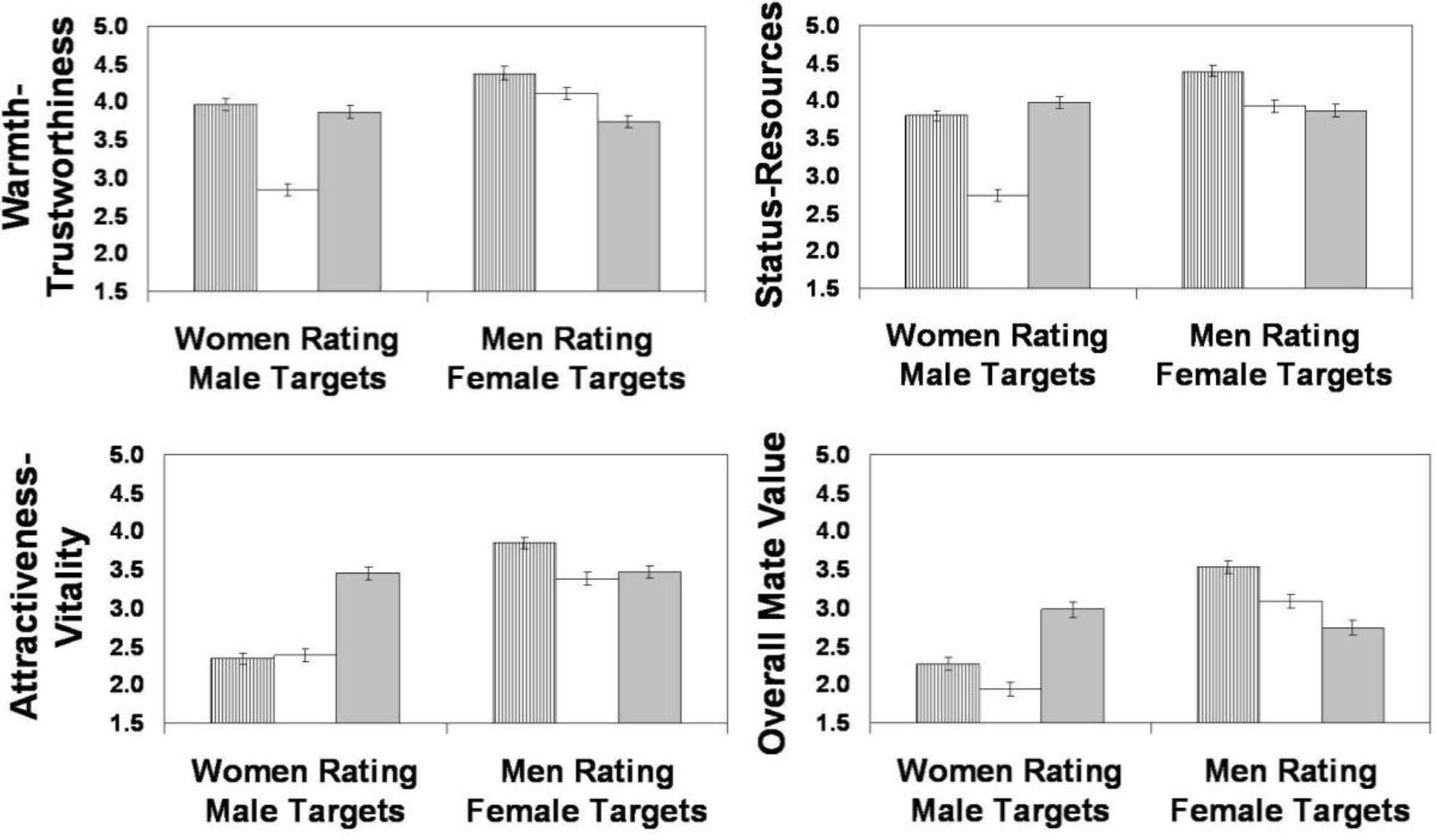
The effects of self-esteem level on the romantic desirability of male and female targets (light = low self-esteem, dark = high self-esteem, vertical striped = control)
Warmth-Trustworthiness
For Warmth-Trustworthiness, main effects emerged for Sex (F(1, 564) = 33.12, p < .001) and Self-Esteem Condition (F(2, 564) = 69.62, p < .001). However, these main effects were qualified by the interaction of Sex and Self-Esteem Condition that emerged (F(2, 564) = 63.44, p < .001). This interaction showed that male targets in the Low Self-Esteem condition received lower ratings on this dimension than male targets in either the High Self-Esteem (t = 14.11, p < .001) or Control conditions (t = 14.42, p < .001). In contrast, female targets in the Control condition received higher ratings of Warmth-Trustworthiness than those in the Low Self-Esteem condition (t = 3.13, p < .01) who were, in turn, rated more positively than targets in the High Self-Esteem condition (t = 3.52, p < .001).
Attractiveness-Vitality
For Attractiveness-Vitality, main effects emerged for Sex (F(1, 564) = 73.04, p < .001) and Self-Esteem Condition (F(2, 564) = 60.61, p < .001). However, these main effects were qualified by the interaction of Sex and Self-Esteem Condition that emerged (F(2, 564) = 101.30, p < .001). This interaction showed that male targets in the High Self-Esteem condition received higher ratings on this dimension than male targets in either the Low Self-Esteem (t = 19.19, p < .001) or Control conditions (t = 17.71, p < .001). In contrast, female targets in the Control condition received higher ratings on the Attractiveness-Vitality dimension than those in either the Low Self-Esteem (t = 4.41, p < .001) or High Self-Esteem conditions (t = 4.49, p < .001).
Status-Resources
For Status-Resources, main effects emerged for Sex (F(1, 564) = 34.78, p < .001) and Self-Esteem Condition (F(2, 564) = 114.33, p < .001). However, these main effects were qualified by the interaction of Sex and Self-Esteem Condition that emerged (F(2, 564) = 76.07, p < .001). This interaction showed that male targets in the Low Self-Esteem condition received lower ratings on this dimension than male targets in either the High Self-Esteem (t = 20.63, p < .001) or Control conditions (t = 14.64, p < .001). In contrast, female targets in the Control condition received higher ratings on the Status-Resources dimension than those in the Low Self-Esteem (t = 8.21, p < .001) or High Self-Esteem conditions (t = 5.69, p < .001).
Overall Mate Value
For Overall Mate Value, main effects emerged for Sex (F(1, 564) = 46.08, p < .001) and Self-Esteem Condition (F(2, 564) = 87.41, p < .001). However, these main effects were qualified by the interaction of Sex and Self-Esteem Condition that emerged (F(2, 564) = 59.85, p < .001). This interaction showed that male targets with High Self-Esteem received higher ratings on this dimension than male targets in the Control condition (t = 16.17, p < .001) who, in turn, received higher ratings than targets in the Low Self-Esteem condition (t = 5.91, p < .001). In contrast, female targets in the Control condition received higher ratings of Attractiveness-Vitality than those in either the Low Self-Esteem or High Self-Esteem conditions (ts > 4.02, ps < .001).
Discussion
The results of the present study were similar to those of the previous studies. That is, high self-esteem was viewed as being consistently beneficial for male targets, whereas high self-esteem was actually associated with negative consequences for female targets in terms of their perceived Warmth-Trustworthiness and Overall Mate Value. These results emerged even though the ostensible self-esteem levels of the targets were manipulated by assigning these targets e-mail addresses intended to convey either low or high levels of self-esteem. It is important to note, however, that some of the e-mail addresses may have conveyed information that was less central to the ostensible self-esteem of the target. For example, “happyguy97” may be more directly tied to affect than it is to self-esteem.
Study 6: Personality Profiles
The purpose of Study 6 was to examine whether the self-esteem effects observed in the previous studies would extend to extreme levels of self-esteem. For example, are men with extremely high levels of self-esteem viewed even more positively than those with levels of self-esteem that are moderately high? Or, in contrast, are there negative consequences associated with possessing self-esteem that is so high that it begins to resemble narcissism? To address this issue, personality profiles were used that described targets with self-esteem levels ranging from extremely low to extremely high. After reading each personality profile, participants were asked to rate the desirability of each target as a potential romantic partner.
Materials and Methods
Participants
Participants were 355 heterosexual students (87 men and 268 women) enrolled in undergraduate psychology courses who participated in return for partial fulfillment of a research participation requirement. The mean age of participants was 20.10 years (SD = 3.03). The racial/ethnic composition was 64% White, 30% Black, 3% Asian, and 3% Other.
Procedure
Participants were asked to read four, 75-word personality profiles taken from Bosson, Brown, Zeigler-Hill, and Swann (2003). These profiles were ostensibly written by clinical psychology graduate students about participants in a previous study. The profiles described other-sex targets who possessed Very Low Self-Esteem (e.g., “I suspect this person has a fairly negative attitude toward himself a lot of the time”), Somewhat Low Self-Esteem (e.g., “It seems to me that maybe this person has some difficulty with liking himself – perhaps he tends to have a negative attitude toward himself at times”), Somewhat High Self-Esteem (e.g., “It seems that this person feels pretty good about himself, and he probably feels deserving of the affection of others”), and Very High Self-Esteem (e.g., “I get the feeling that this person thinks extremely highly of himself, and possesses a very positive attitude toward himself”). Participants were asked to evaluate the desirability of each of these four targets as a potential relationship partner.
Measures
As in the previous studies, the Partner Ideal Scales (Fletcher et al., 1999; αs > .82) and the measure of Overall Mate Value (α = .89) were used to measure the desirability of each target.
Results
Data from the present study were analyzed using a series of 2 (Sex: Men Rating Female Targets vs. Women Rating Male Targets) × 4 (Self-Esteem Condition: Very Low vs. Somewhat Low vs. Somewhat High vs. Very High) mixed-design ANOVAs with Self-Esteem Condition as a within-subjects factor. The results of these analyses are presented in Figure 6.

Results of 2 × 4 mixed-design ANOVAs demonstrating the effects of self-esteem level on the romantic desirability of male and female targets (vertical striped = very low self-esteem, light = somewhat low self-esteem, diagonal striped = somewhat high self-esteem, dark = high self-esteem)
Warmth-Trustworthiness
For Warmth-Trustworthiness, a main effect emerged for Self-Esteem Condition (F(3, 1062) = 114.66, p < .001). Post hoc tests revealed that targets in the Very Low Self-Esteem condition were rated as lower in Warmth-Trustworthiness than targets in the Somewhat Low Self-Esteem condition (t = 14.33, p < .001), who were, in turn, rated lower than targets in the Somewhat High Self-Esteem condition (t = 11.79, p < .001). Targets in the Very High Self-Esteem Condition received lower ratings of Warmth-Trustworthiness than targets in the Somewhat High Self-Esteem condition (t = 17.72, p < .001).
Attractiveness-Vitality
For Attractiveness-Vitality, a main effect emerged for Self-Esteem Condition (F(3, 1062) = 636.07, p < .001). Post hoc tests revealed that participants rated targets in the Very Low Self-Esteem condition as lower in Attractiveness-Vitality than targets in the Somewhat Low Self-Esteem condition (t = 13.20, p < .001), who were, in turn, rated lower than targets in the Somewhat High Self-Esteem condition (t = 31.04, p < .001). As with the Warth-Trustworthiness dimension, targets in the Very High Self-Esteem condition received lower ratings of Attractiveness-Vitality than targets in the Somewhat High Self-Esteem condition (t = 2.68, p < .01).
Status-Resources
For Status-Resources, a main effect emerged for Self-Esteem Condition (F(3, 1062) = 653.05, p < .001). Post hoc tests revealed that participants rated targets in the Very Low Self-Esteem condition as lower in Status-Resources than targets in the Somewhat Low Self-Esteem condition (t = 14.01, p < .001), who were, in turn, rated lower than targets in the Somewhat High and Very High Self-Esteem conditions (ts > 32.51, ps < .001).
Overall Mate Value
For Overall Mate Value, main effects emerged for Sex (F (1, 1062) = 25.67, p < .001) and Self-Esteem Condition (F (3, 1062) = 443.97, p < .001). However, these main effects were qualified by the interaction of Sex and Self-Esteem Condition that emerged (F (3,1062) = 8.97, p < .01). This interaction showed that targets in the Somewhat High Self-Esteem condition received the highest ratings of Overall Mate Value for both male and female targets (ts > 13.89, ps < .001). For male targets, the condition with the next highest ratings on Overall Mate Value was the Very High Self-Esteem condition which was followed by the Somewhat Low Self-Esteem condition (t = 12.13, p < .001). This condition was followed, in turn, by the Very Low Self-Esteem condition (t = 11.56, p < .001). For female targets, the condition with the next highest ratings on Overall Mate Value was the Somewhat Low Self-Esteem condition which was followed by the Very High Self-Esteem condition (t = 7.12, p < .001). This condition was followed, in turn, by the Very Low Self-Esteem Condition (t = 13.60, p < .001).
Discussion
The results of the present study show that targets with extremely high levels of self-esteem were viewed less positively on some dimensions than targets with more moderate levels of high self-esteem. That is, targets who were described as “thinking extremely highly” of themselves were given lower ratings on Warmth-Trustworthiness and Overall Mate Value than targets who were described as “feeling pretty good” about themselves. It is important to note that this pattern emerged for both male and female targets. This has two important implications. First, it suggests that there is a point at which extreme levels of high self-esteem may be assumed to be associated with less positive qualities. Although the underlying reason for this association is unclear, one possibility is that individuals with extreme levels of high self-esteem may be assumed to be at least somewhat narcissistic because they appear to “think extremely highly” of themselves. Second, it suggests that high self-esteem may be interpreted quite differently for male and female targets. Female targets with high self-esteem in the previous studies were evaluated in a manner that is consistent with the extreme high self-esteem targets in the present study. In contrast, the views of male targets with high self-esteem from the previous studies were similar to those of the moderately high self-esteem targets in the present study. This may suggest that women with high self-esteem are often viewed as possessing feelings of self-worth that are more extreme than those of men with similar levels of self-esteem. In essence, women with high self-esteem may be perceived as somewhat narcissistic whereas men with high self-esteem are not regarded in this negative light.
General Discussion
The present results provide additional support for the existence of an implicit theory of self-esteem. Across the present studies, the perceived self-esteem levels of targets were found to have an impact on judgments concerning their romantic desirability. Studies 1 and 2 found that participants rated imagined targets with higher levels of self-esteem more positively and were more willing to engage in relational activities with these targets. In Study 3, women rated male targets with high self-esteem as possessing desirable characteristics, whereas female targets with high self-esteem did not receive consistently positive ratings from men across these dimensions. For example, female targets with high self-esteem received lower ratings on the Warmth-Trustworthiness dimension than those with low or moderate levels of self-esteem. In Studies 4 and 5, male targets with high self-esteem were evaluated more positively than those with low self-esteem even though the self-esteem manipulations were more subtle (i.e., the T-shirt the target selected as a reward or the e-mail address belonging to the target). However, the results for female targets differed in these studies such that those with high self-esteem were evaluated more positively than those with low self-esteem in Study 4 but not Study 5. This difference may have been due to different interpretations of these less direct self-esteem manipulations. For example, men may interpret a woman wearing a T-shirt that says she loves herself as an indicator of her warmth, whereas a woman who displays her high self-esteem by having an e-mail address that suggests she is sexy because she is confident may not be viewed as particularly warm. In Study 6, targets with extremely high levels of self-esteem were evaluated somewhat negatively on dimensions reflecting communal concerns (e.g., Warmth-Trustworthiness) but not those dimensions aligned with an agentic focus (i.e., Status-Resources and Attractiveness-Vitality). The results of Study 6 suggest that it is possible for individuals to possess levels of self-esteem that are high enough to have negative repercussions for how they are viewed by others on certain dimensions.
It was expected that those with higher levels of self-esteem would generally receive more positive evaluations than those with lower self-esteem. Although the results of the present studies supported the existence of an implicit theory of self-esteem, there were important exceptions to this basic pattern. More specifically, evaluations did not become increasingly positive at each successive level of self-esteem for all of the outcomes examined in the present studies. One of these exceptions was that men with moderate self-esteem were not always viewed more positively than those with low self-esteem. For example, men with moderate levels of self-esteem were given ratings similar to men with low self-esteem on the Status-Resources dimension (Study 3). Further, men with moderate self-esteem were actually rated lower on the Warmth-Trustworthiness dimension than men with low self-esteem (Study 3). Overall, the pattern of results suggests that the perception of men with moderate levels of self-esteem may not be very positive. That is, men with moderate self-esteem were often evaluated less positively than those with high self-esteem and, in some cases, were viewed no more positively than those with low self-esteem. These findings suggest that the primary focus for men may be on attaining (or, at the very least, conveying) high self-esteem rather than avoiding low self-esteem. The desire among men to convey high levels of self-esteem may provide at least a partial explanation as to why they tend to report higher levels of self-esteem than women (Kling, Hyde, Showers, and Buswell, 1999).
The exceptions to the general pattern appear to have different implications for women than for men. The first exception was that when men rated female targets, self-esteem had an impact on attractiveness ratings such that women with moderate self-esteem were perceived to be more desirable than those with low or high self-esteem. That is, moderate levels of self-esteem may be optimally attractive for women. One possible explanation for this pattern is that men may be somewhat intimidated by women with high self-esteem. The second exception was that women with high self-esteem did not receive more positive evaluations than women with moderate self-esteem on the dimensions of Attractiveness-Vitality and Overall Mate Value (Study 3). In contrast to the findings for men, this suggests that the avoidance of low self-esteem may be more important for women than the attainment of high levels of self-esteem. This may result in women being less selective than men with regard to the effect that a potential romantic partner may have on one's self-esteem. That is, men may be looking for partners who enhance their self-esteem, whereas women may simply be trying to avoid partners who make them feel bad about themselves. The third exception for women was that those with high self-esteem were given lower ratings on the Warmth-Trustworthiness dimension than women with either low or moderate levels of self-esteem (Study 3). One implication of this finding is that women with high self-esteem may actually be perceived somewhat negatively on certain dimensions. This is consistent with the results of Zeigler-Hill and Myers (2009) which found that a subset of participants were less likely to consider voting for Hillary Clintons during the 2008 presidential primary contests if they believed she had high levels of self-esteem. Taken together, the present studies suggest that self-esteem may have different implications for the perception of men and women such that men with high levels of self-esteem are generally assumed to possess a range of desirable traits, whereas women with high self-esteem may tend to receive somewhat mixed evaluations.
The existence of an implicit theory of self-esteem may have a number of implications for the understanding of self-esteem. The present findings suggest that perceived self-esteem may play a more important role in how individuals are perceived by their social environments than is commonly recognized. This is consistent with the status-signaling model of self-esteem (Zeigler-Hill et al., 2011) which proposes that self-esteem may serve as a means for individuals to communicate their standing on various dimensions to those constituting their social environments. The implicit theory of self-esteem explored in the present studies suggests that individuals who are seen as possessing certain levels of self-esteem may be assumed to possess other characteristics believed to be associated with that particular level of self-esteem. Further, the present results suggest the possibility that one reason individuals are motivated to maintain and enhance their self-esteem may be to communicate to others that they possess desirable characteristics. These results also complement previous findings concerning the sociometer model (Leary and Downs, 1995) by suggesting that self-esteem is not simply responsive to how an individual is evaluated by the social environment but actually influences how the individual is perceived by others. The fact that self-esteem has the capacity to serve as both a cause and a consequence of social evaluation suggests the need for an extended informational model of self-esteem that incorporates both the status-tracking and status-signaling properties of self-esteem.
One limitation of the present studies concerns the manner in which the self-esteem levels of the targets were conveyed to participants. In daily life, self-esteem is likely communicated through a combination of verbal and nonverbal behaviors. Unfortunately, very little research has been conducted on this topic and surprisingly little is known about the communication of self-esteem in interpersonal situations. As a result, it was decided that the present studies would begin by employing unambiguous indicators of self-esteem (e.g., labels indicating the target's level of self-esteem) to avoid confounding self-esteem with constructs that may have similar interpersonal expressions (e.g., social dominance). Of course, the ecological validity of these studies was relatively weak because individuals do not go about their daily lives wearing nametags proclaiming their self-esteem levels. To address this issue, the later studies employed self-esteem manipulations that were at least somewhat more subtle (e.g., selecting a T-shirt). Although these more subtle manipulations addressed the limitations of the earlier studies concerning ecological validity, they had their own limitations. For example, the e-mail addresses that were intended to convey low or high levels of self-esteem may have been perceived as indicators of related features such as social dominance or positive affect. Thus, a trade-off exists with these subtle approaches in that they are more similar to the ways in which self-esteem is likely communicated in daily life but they allow for somewhat less control to be exerted over what is being communicated through the manipulation. As researchers develop a better understanding of the behaviors used to convey self-esteem (e.g., verbalizations, eye gaze, body posture), future research should manipulate these features in order to convey the desired levels of self-esteem. The consistency of the results between the studies employing overt and more subtle manipulations of the ostensible self-esteem levels of the targets suggest that both manipulations were successful despite their limitations.
The present studies suggest a number of possible avenues for future research. For example, previous research has discussed the possibility that self-esteem is a “negotiated asset” in romantic relationships (Murstein, 1970, as cited in Dion and Dion, 1975) and the present findings suggest that an individual's perceived level of self-esteem may influence the expectations, choices, and satisfaction of one's relationship partner. Future researchers may wish to examine the role of perceived self-esteem with regard to initial attraction and satisfaction with existing relationships. It may also be important to examine whether an individual's perceived level of self-esteem influences how he or she is viewed beyond those domains related to romantic desirability. For example, are individuals more likely to hire job applicants believed to possess higher levels of self-esteem? Are individuals with high self-esteem assumed to have different personality characteristics than those with low self-esteem? Another direction for future research concerns domain-specific self-evaluations which have emerged as an important area of study within evolutionary psychology (Hill and Buss, 2006; Kirkpatrick, Waugh, Valencia, and Webster, 2002; Webster and Kirkpatrick, 2006). It may be beneficial to consider domain-specific implicit theories of self-esteem in the same way that Kirkpatrick and Ellis (2001, 2006) have suggested extending the sociometer model to specific domains. For example, important differences may emerge with regard to how individuals who feel good about themselves because of their intelligence are perceived compared with those who derive their feelings of self-worth from being physically attractive. Also, examining the role that deception may play in the status-signaling model of self-esteem (e.g., attempting to convey higher levels of self-esteem than one actually possesses) may be an interesting area for future research.
Conclusion
The present studies provide additional support for the existence of an implicit theory of self-esteem such that an individual's level of self-esteem influences how he or she is perceived by others. The results of the present studies found that individuals with ostensibly higher levels of self-esteem were generally viewed more positively on domains related to romantic desirability than those with lower levels of self-esteem. However, important exceptions to this pattern emerged such that women with high self-esteem were not always viewed positively on dimensions such as Warmth-Trustworthiness and attractiveness.
Footnotes
Acknowledgements
We would like to thank David Marcus, Carolin Showers, and Bill Swann for their extremely helpful advice and suggestions as we conducted these studies.