




Abstract
We compared the ability of models based on evolutionary economic theory and Life History (LH) Theory to explain relations among self-reported negative affect, mate value, and mating effort. Method: Two hundred thirty-eight undergraduates provided multiple measures of these latent constructs, permitting us to test a priori predictions based on Kirsner, Figueredo, and Jacobs (2003). We compared the fit of the initial model to the fit of five alternative theory-driven models using nested model comparisons of Structural Equations Models. Rejecting less parsimonious and explanatory models eliminated the original model. Two equally parsimonious models explained the data pattern well. The first, based on evolutionary economic theory, specified that Negative Affect increases both Personal Mate Value and Mating Effort via the direct effects specified in the original model. The second, based on LH Theory, specified that Negative Affect, Personal Mate Value, and Mating Effort relate spuriously through a common latent construct, the LH Factor. The primary limitation of the present study is generalizability. We used self-reports taken from a young, university-based sample that included a spectrum of affective states. We cannot know how well these models generalize to an older population or to actual behavior. Both models predict the presence of a rich pattern of mate acquisition and retention behaviors, including an alarming set of behavioral tactics often not considered or targeted during treatment. Moreover, each model suggests a unique set of problems may arise after an effective intervention. We describe several ways to distinguish these models empirically.
Introduction
Both affect and behavior play a central role in human short-term and long-term sexual relationships. Personal experiences, as well as evidence from the humanities and the various social sciences, clearly support this assertion. Our purpose is to contribute to this knowledge base by estimating the causal structure and importance of a subset of these relationships—those among negative affect, mate value, and mating effort—using a Structural Equations Model approach. To move us toward this goal, we must first familiarize the reader with a few terms.
Mating Strategy refers to a coordinated set of behaviors that evolved to solve the adaptive problems of selecting, attracting, and retaining sexual partners (e.g., Buss and Schmitt, 1993; Eibl-Eibesfeldt, 1970; Gangestad and Simpson, 2000). Consistent with social exchange and evolutionary economic theory (Converse and Foa, 1993; Huston and Burgess, 1979; Kelly and Thibaut, 1978; Thibaut and Kelley, 1959), people tend to mate with individuals who possess similar overall value as mates (Kirsner, Figueredo, and Jacobs, 2003; Miller, 2000), leading some to suggest that relationship partners exchange valued resources, and that the overall perceived value of these resources must be relatively similar for each party to remain in the relationship (Cosmides and Tooby, 1992). The mate value of potential (attainable) partners must be approximately equal to one's own mate value (e.g., Buss and Schmitt, 1993; Gangestad and Simpson, 2000; Kenrick, Sadalla, Groth, and Trost, 1990). A potential partner with too little mate value is an unacceptable long-term partner choice, whereas one with too much mate value might not be attainable or retainable as a long-term mate. The image of the “ideal” and “attainable” partner should therefore correspond closely (Kirsner et al., 2003).
Mating Effort is the total time, energy, attention, and other resources expended in attracting or retaining a mate (Rowe, Vazsonyi, and Figueredo, 1997). The value of investments of time and attention received from any given partner depends partially on the partner's mate value. One can (to some extent) increase one's value as a mate by increasing one's efforts to provide the mate with valued resources. To preserve an unequal relationship, one may compensate for an imbalance in mate value, whether real or perceived, by increasing (or decreasing) mating effort.
Self-perceived Mate Value is an estimate of one's bargaining power in the mating marketplace. Unbiased self-perceived mate value must closely reflect the value conspecifics place on particular attributes for social exchange to proceed equitably. Negative Affect is associated with lower estimates of one's own value as a mate (Kirsner et al., 2003), perhaps resulting from systematic biases in the estimation of personal mate value. In keeping with evolutionary economic theory, lower estimates of one's own mate value predict lower self-reported expectations for the mate value of potential partners (Kirsner et al., 2003).
We expect negative affect to have differential effects on mate attraction and mate retention. Though negative affect may decrease mate attraction efforts by encouraging avoidance of social situations (Johnson, Aikman, Danner, and Elling, 1995; Lesure-Lester, 2001), negative affect should increase efforts to retain existing mates for several reasons. Negative affect may: (1) increase desire to have a mate, to the extent that one believes a mate will lessen one's negative affect (McNeill, Rienzi, Butler, and Doty, 1996), (2) decrease confidence in one's ability to attract new or alternative mates (Smith and Betz, 2000), and (3) decrease desire to accept risks (Yuen and Lee, 2003), such as the risk of giving up a current mate in hopes that a new mate might be an improvement. Finally, depression is associated with lower self-perceived mate value (Kirsner et al., 2003); if negative affect decreases self-perceived mate value relative to its level at the onset of the relationship, it would require one to invest more to equalize the product of mate value and mating effort between existing partners (Cosmides and Tooby, 1992).
Life History (LH) Theory (MacArthur and Wilson, 1967; Figueredo et al., 2006b) provides an alternative interpretation of the relationships among Negative Affect, Mate Value, and Mating Effort. LH Theory is an evolutionary theory that describes the strategic allocation of an organism's resources among the competing demands of continued survival versus reproduction. Applied to humans, a “slow” life history strategy entails slower development and delayed reproduction, indicators of the latent variable called the LH Factor, all of which reflect a devotion of resources to parental effort and high offspring survival. Conversely, a “fast” life history strategy entails faster development and earlier reproduction, reflecting a devotion of resources to immediate and frequent reproduction (i.e., mating effort).
Convergent lines of evidence suggest a positive association among a fast LH strategy, Negative Affect (Figueredo, Vásquez, Brumbach, and Schneider, 2004; 2007b; Sefcek, 2007), and Mating Effort (Figueredo et al., 2005). Further, a fast LH strategy predicts both low personal and partner mate value (Figueredo, 2007; Figueredo, Sefcek, and Jones, 2006a; Figueredo and Wolf, 2009). Fitness Indicator Theory (Miller, 2000) predicts that mate value is an outward manifestation of enhanced phenotypic quality, perhaps suggesting a higher genetic quality (when considering heritable phenotypic traits). Strategic Sexual Pluralism Theory (Gangestad and Simpson, 2000) also predicts a positive association between sexually-selected “good genes” and perceived mate value. LH Theory predicts that fast LH individuals have received a lower quantity of parental and nepotistic effort from genetic kin during development, and furthermore invest a lower quantity of somatic effort in their own growth and maintenance throughout their lifespan (Ellis, Figueredo, Brumbach, and Schlomer, 2009). This leads us to predict that faster LH individuals will manifest a lower degree of phenotypic quality, as indicated by poorer physical and mental health, than slower LH individuals, regardless of their underlying genetic quality. Thus, faster LH individuals will manifest a decreased mate value (as perceived by either self or others) as a result of this basic physiological condition. Indeed, a slower LH strategy has been positively correlated to better physical and mental functioning, as indicated by the well-validated RAND SF-36 Short Form (Wenner, 2009). Strategic Sexual Pluralism Theory (Gangestad and Simpson, 2000) is a subset of LH theory and would also predict a positive association between “good genes” and mate value. These findings may also account for the association of a faster LH strategy with negative affect and depressive symptoms. These data suggest that a single latent common factor, representing a coordinated life history strategy, the LH Factor, underlies the relations among Negative Affect, Mate Value, and Mating Effort.
We use our previous work (Kirsner et al., 2003), evolutionary economic theory, and LH Theory to guide our design, data collection, analyses, and interpretation of those analyses in the present manuscript. We compared six structural models, starting with one based closely on the structural model described by Kirsner et al. Both the primary theoretical model (Model 1.0), based on evolutionary economic theory, and the reinterpreted theoretical model (Model 2.0), which also incorporates LH theory, share the following hypotheses:
Personal Mate Value positively influences both Long-Term Partner (LTM) Mate Value and Short-Term Partner (STP) Mate Value, as a product of matching on overall mate value;
Both LTP Mate Value and STP Mate Value positively influence Mating Effort, because the better the partner, the more one would presumably do to attract or retain him or her;
Sex correlates positively with negative affect, reflecting the well-documented higher rates of depression and anxiety among women (Kessler et al., 2005).
Sex predicts higher levels of both LTP and STP Mate Value because women are more selective than men when choosing short-term partners (Kenrick, Sadalla, Groth, and Trost, 1990). Counterintuitively, theory predicts that women and men will be equally selective when choosing long-term partners. Therefore, we specified a model predicting that women will be more selective, following the intuitive model.
In addition, the primary theoretical model (Model 1.0) proposes that both direct and indirect causal relationships exist between Negative Affect and Mating Effort, generating the following predictions (see Figure 1):

Primary theoretical model (1.0).
Negative Affect negatively influences Personal Mate Value, as documented in Kirsner et al. (2003), reflecting biased self-estimation;
Negative Affect positively influences Mating Effort, because it may: (a) increase desire to have a mate because, as stated above, obtaining a mate might decrease negative affect (McNeill, Rienzi, Butler, and Doty, 1996), (b) decrease confidence in one's ability to attract mates (Smith and Betz, 2000), (c) and decrease risk-taking (Yuen and Lee, 2003). We expect the effort to retain an extant relationship to outweigh the effect of Negative Affect on reduced efforts to attract a mate.
In contrast to Model 1.0, the reinterpreted theoretical model (Model 2.0) proposes that negative affect, mating effort, and personal mate value are correlated because they are convergent indicators of LH, generating the following prediction (see Figure 3):
The LH Factor negatively influences Negative Affect and Mating Effort and positively influences Personal Mate Value, all of which are indicators of LH, as discussed above.
Materials and Methods
Participants
The participants were 238 undergraduates, 99 male and 139 female, enrolled in introductory-level Psychology courses at the University of Arizona. All participants were at least 18 years old at the time of participation (mean age = 19.3).
Measures
Depression. The Beck Depression Inventory-II (BDI-II) provided a self-reported estimate of the severity of depressive symptoms in the past two weeks (Beck, Steer, and Brown, 1996). The inventory exhibits sound psychometric properties (Dozois, Dobson, and Ahnberg, 1998).
Anxiety. The Trait form of the State-Trait Anxiety Inventory provided a self-reported estimate of the severity of chronic symptoms of anxiety. This inventory also shows sound psychometric properties (Spielberger, Gorsuch and Lushene, 1970).
The Mate Retention Scale (MRS; see Appendix D) provided subjective estimates of the frequency with which the participant engaged in behavioral tactics designed to keep a partner from leaving an extant relationship. We derived the items in the MRS in part from Buss' (1988) taxonomy of mate retention tactics. We added items designed to measure overtly manipulative tactics, such as threats to harm self or partner if the partner leaves. We obtained separate reports for the past year and prior to the past year; the figures reported for these two time frames were averaged after determining that they were highly correlated.
The Sexual Situations Scale (see Appendix C) provided subjective frequency estimates of the physical and psychological contexts surrounding the participants' sexual activity during the past year. This includes, for example, having sex to attract or retain a mate, having sex while intoxicated, having sex out of a sense of obligation, or having sex in an attempt to regulate mood. The participants indicated what activities constitute “having sex” elsewhere in the survey (see Appendix A).
The Cumulative Sexual Frequency scale (see Appendix B) provided subjective estimates of how many times a participant “had sex” with male and with female partners in his or her lifetime. Because of the restricted age range of participants, the models did not control for current age of the participants.
The Mate Value Inventory (MVI; Kirsner et al., 2003) provided subjective estimates of personal and partner mate value from five perspectives. Personal Mate Value measured self-perceived mate value. Attainable Short-Term Partner Mate Value measured the mate value of the best partner participants thought they could realistically attract to a brief relationship. Ideal Short-Term Partner Mate Value measured the mate value of one's ideal partner for a brief fling. Short-Term Partner Mate Value was the average of these two measures. Attainable Long-Term Partner Mate Value measured the mate value of the best partner participants thought they could realistically attract for long-term relationship. Ideal Long-Term Partner Mate Value measured the mate value of one's ideal partner for a long-term relationship. Long-Term Partner Mate Value was the average of these two measures.
On all five forms of the MVI, participants indicated how the relevant person compared to the participant's peers, using a scale from −3 (extremely low on this characteristic) through 0 (don't care/average on this characteristic) to +3 (extremely high on this characteristic).
Procedures
While completing a set of questionnaires during class, students were asked to indicate whether they would be interested in participating in a study that involved questions about romantic relationships and sexual behavior. They also completed screening instruments to permit over-sampling of respondents with high scores on the BDI-II. Interested students were contacted by phone to arrange appointments to participate.
During their appointments participants were seated in a room alone. After each participant completed informed consent procedures, he or she completed a packet of questionnaires and returned them to a box to maintain anonymity.
Statistical Analyses
We constructed our scales, measurement, and structural models using the procedures detailed in Kirsner et al. (2003).
Balancing explanatory power with model parsimony, we used hierarchically nested model comparisons (Widaman, 1985) to determine which of the alternative models produced the best fit to the data as measured by practical fit indices and Chi-squared.
Practical fit indices, such as the Normed Fit Index (NFI) and the Comparative Fit Index (CFI) estimate how successfully a proposed model describes observed relations among measured variables. Practical indices of fit compare the proposed model to a complete “independence” model, a model that does not reproduce any of the observed correlations. In other words, practical fit indices tell you how much better than nothing your model performs.
In contrast, Chi-squared takes the opposite approach; it tells you how much less than perfect your model is. Chi-squared estimates the extent to which a structural equations model replicates the observed relations among variables (i.e., covariances in the data collected) by statistically comparing a proposed model to a completely “saturated” model, a model that reproduces the observed correlations perfectly.
When significant, Chi-squared indicates that the proposed model did not reproduce the observed correlations among the variables within an acceptable margin of sampling error. When non-significant, Chi-squared indicates that a model perfectly reproduced the observed relations among the variables. An acceptable margin for sampling error is conventionally defined as a 95% confidence interval around a discrepancy of zero between the observed correlations and those predicted by the proposed model.
In addition to describing the acceptability of a model on its own, Chi-squared can compare related models, using a technique known as Nested Model Comparisons (NMC). In this context, one compares models in terms of the most parsimonious yet complete explanation of the observed data. Using NMC, one can compare the fit of any two models with hierarchically nested relations. Two models are hierarchically nested if they have identical specifications except for one or more parameters that have been omitted in the restricted model. In short, one can compare the fit of models with and without the pathways whose necessity is being examined (James, Mulaik, and Brett, 1982).
When conducting a NMC, we make tradeoffs. Our scientific goal is threefold: a) to propose parsimonious models that b) permit us to predict patterns of behavior and, under the right circumstances, c) control or influence those patterns of behavior.
If we proposed a “saturated” model, with paths between every possible pair of variables, the model explains 100% of the observed relations among the measured variables. Such a model is of no practical use because, in effect, it says that everything directly affects everything else—it merely restates the data contained in the covariance matrix. Because perfect prediction of behavior is infinitely costly, we initially attempt to get the most value out of the smallest possible number of structural pathways. As researchers, we are generally interested in including only those variables and pathways among them that surpass a threshold level of explanatory power. If we can eliminate a particular pathway without losing significant explanatory power, we do so.
It is important to keep in mind, however, that the observed covariance among measured variables includes error specific to the particular sample of the population. This leads to a second tradeoff. Parsimony may suggest that a particular pathway does not provide enough additional explanatory power to warrant inclusion in a model, whereas a priori theory may lead one to conclude that the pathway only appears to be unnecessary due to sampling error. In this case, it is necessary to devise true experiments to settle the question.
To compare two models, one of which has fewer error degrees of freedom (i.e., more model degrees of freedom representing pathways) and a lower Chi-squared than the other, NMC involves three steps. First, subtract the smaller number of degrees of freedom from the larger number; second, subtract the smaller Chi-squared from the larger Chi-squared. Third, locate the resulting Difference Chi-Squared (DCS) figure in a Chi-squared table and determined its significance level. If the DCS is significant, the dropped pathway(s) produced a significant loss of explanatory power. In other words, it is better to leave those pathways intact. If the resulting DCS is not significant, the dropped pathway(s) produce no significant loss of explanatory power. Hence, the more parsimonious is preferable to the less parsimonious model.
The Measurement Model. We are interested in examining causal relations among Negative Affect, Mating Effort, and Mate Value. To that end, we measured Negative Affect using standardized measures of depression and anxiety. We measured Mating Effort using three custom-designed measures: the Mate Retention Scale, Sexual Situations, and Cumulative Sexual Frequency. We measured mate value using five forms of the Mate Value Inventory, Personal Mate Value, and both Realistic and Idealized versions of both Long-Term and of Short-Term Partner Mate Value. In so doing, we created the following measurement model: (1) Depression and Anxiety are indicators of the latent construct, Negative Affect; and (2) The Mate Retention Scale, Sexual Situations, and Cumulative Sexual Frequency are indicators of the latent construct, Mating Effort.
The Structural Models. We used a Structural Equations Model approach to examine the relative explanatory power of two conceptually distinct sets of models. The first set consisted of the initial structural model described above, which we numbered Model 1.0, and two variants of it. The second set of models consisted of the reinterpreted model described above, which we numbered Model 2.0, and two variants based on that reinterpretation.
The first restricted model, Model 1.1, eliminated two of the causal pathways proposed in Model 1.0: the pathways from Short-Term and Long-Term Partner Mate Value to Mating Effort. Model 1.1, therefore, proposed a single direct causal pathway from Negative Affect to Mating Effort.
The second restricted model, Model 1.2, eliminated the causal pathway from Negative Affect to Mating Effort, but retained the causal pathways from Short-Term and Long-Term Partner Mate Value to Mating Effort. Model 1.2, therefore, proposed two indirect causal pathways from Negative Affect to Mating Effort.
The reinterpreted model, Model 2.0, replaced the causal pathway from Negative Affect to Mating Effort with the LH Factor, a latent common factor representing LH strategy. Model 2.0 also dropped the direct pathway from Negative Affect to Personal Mate Value and, to explain the correlation between them, substituted a functionally equivalent pathway from the LH Factor to Personal Mate Value. Model 2.0, unlike Models 1.0 through 1.2, specifies that the correlations between Negative Affect and Mating Effort, as well as the correlations between Negative Affect and Personal Mate Value, are spuriously produced by the latent LH Factor. Model 2.0 retained the causal pathways from both Short-Term and Long-Term Partner Mate Value to Mating Effort.
As in Model 2.0, the first restricted variant, Model 2.1, retained the direct causal pathways from the LH Factor to Negative Affect, Mating Effort, and Personal Mate Value and removed the direct pathways from Negative Affect to both Mating Effort and Personal Mate Value. Model 2.1 also retained the causal pathway from Long-Term Partner Mate Value to Mating Effort, but dropped the causal pathway from Short-Term Partner Mate Value to Mating Effort.
The second restricted variant of Model 2.0, Model 2.2, is identical to Model 2.1 except for having eliminated the causal pathway from Long-Term Partner Mate Value to Mating Effort. This eliminated both of the pathways from Short-Term and Long-Term Partner Mate Value to Mating Effort specified in Models 1.0 and 2.0.
Results
Descriptive Statistics
Mate Value Inventory. The Cronbach's alphas and standard deviations of the five versions of the Mate Value Inventory reported here (see Table 1) were equivalent to those described in Kirsner et al. (2003), Study 2.
Psychometric properties of the Mate Value Inventory (MVI).

Notes. STP = Short-Term Partner, LTP = Long-Term Partner.
Depressive and Anxious Symptoms. Scores on the Trait form of the State-Trait Anxiety Inventory ranged from 24 to 72 (M = 45.86, SD = 9.94). Scores on the BDI-II ranged from 0 to 48 (M = 14.50, SD = 9.44). Table 2 displays the frequency distributions of BDI-II scores for the female and male participants. Due to oversampling, a large proportion of both sexes exceeded thresholds generally accepted as indicating the presence of depression.
Frequency Distribution of Beck Depression Inventory-II (BDI-II) Scores by Sex.

Note. By research convention, a BDI-II score exceeding 13 indicates the presence of depression (Beck, Steer, and Brown, 1996).
Multivariate Analyses
Goodness of Fit. Table 3 displays the Chi-squared, NFI, and CFI for the six tested models. Each tested model showed a reasonably good fit to the data 1 . Table 4 displays the hierarchically Nested Model Comparisons.
Statistical and practical fit indices for alternative structural equations models.

Hierarchically nested model comparisons.

Comparisons against the Primary Theoretical Model. In this section, we compare the goodness of fit of the primary theoretical model, Model 1.0, against variants of it, seeking to determine the most explanatory, yet parsimonious, model among them. The nested model comparison between Model 1.0 (Figure 1) and Model 1.1 (Figure 2) examined the contribution of the two pathways from Long-Term and Short-Term Partner Mate Value to Mating Effort. Model 1.1 gained two degrees of freedom by eliminating the indirect pathways from Negative Affect to Mating Effort mediated by Personal Mate Value, Long-Term Partner Mate Value and Short-Term Partner Mate Value. Dropping the direct paths from Long-Term Partner Mate Value and Short-Term Partner Mate Value to Mating Effort eliminated these indirect pathways. The difference Chi-squared was not statistically significant, X2 (2) = 4.433, p = .109, indicating no loss of explanatory power when the indirect pathways were dropped. Hence, we prefer Model 1.1 because it is as powerful as, but more parsimonious than, Model 1.0.
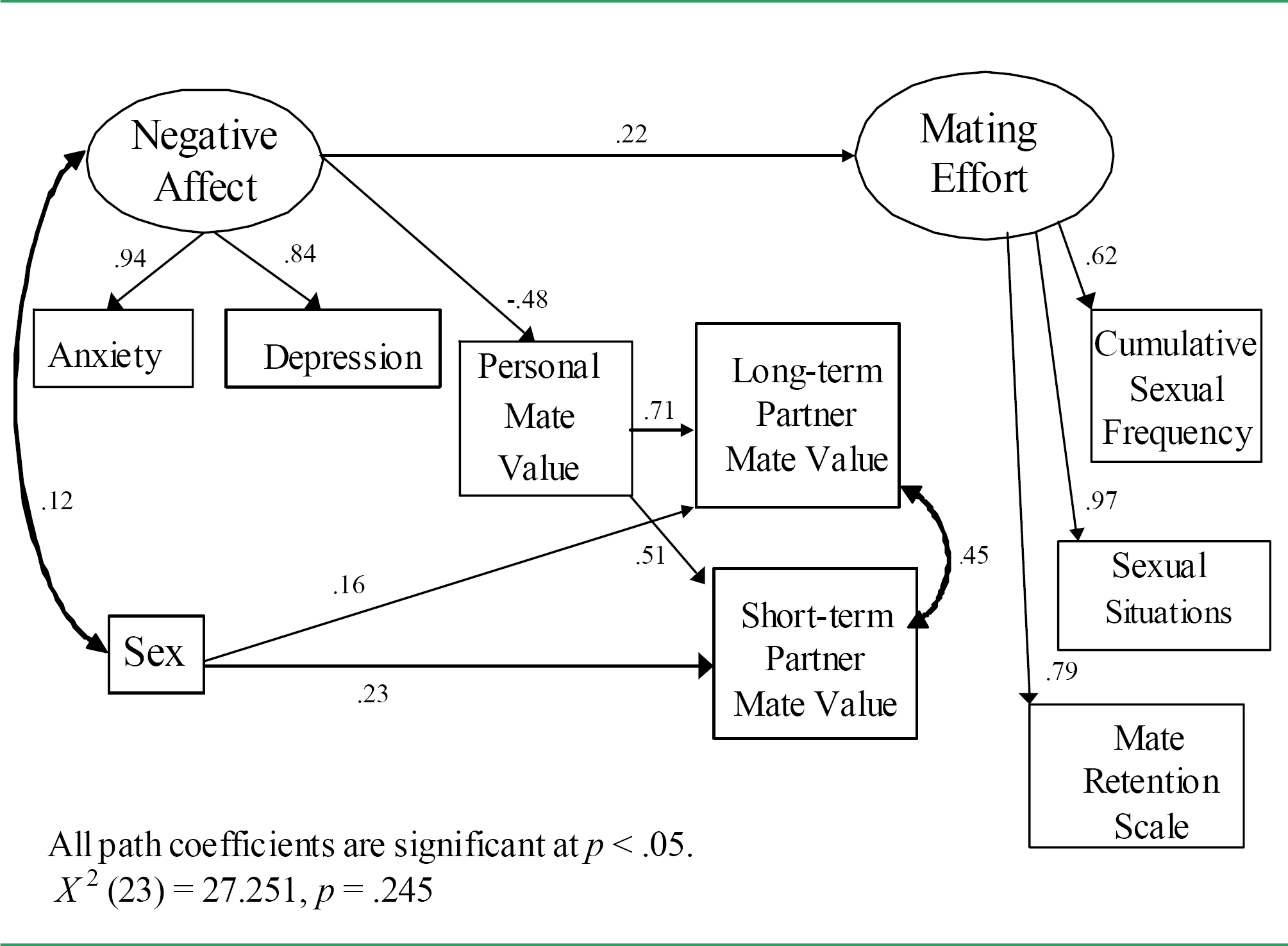
Restricted model (1.1).
The nested model comparison between Models 1.0 and 1.2 examined the contributions of the direct pathway between Negative Affect and Mating Effort. Model 1.2 gained one degree of freedom by eliminating the direct pathway between Negative Affect and Mating Effort. The difference Chi-squared for the comparison was statistically significant, X2(1) = 11.115, p = .001, indicating a loss of explanatory power when the direct pathway was dropped. Hence, we prefer Model 1.1 because it is more powerful than Model 1.2, and more parsimonious than either Model 1.0 or Model 1.2.
Comparisons against the Reinterpreted Theoretical Model. As described above, Life History Theory suggests that a single latent construct, the LH Factor, directly affects the level of Negative Affect, Mate Value, and Mating Effort, predicting that the observed correlations among these three factors are spurious. We examine this assertion using Model 2.0. In contrast to Model 1.0, Model 2.0 adds pathways from the LH Factor to Negative Affect, Mating Effort, and Personal Mate Value and eliminates the direct pathways from Negative Affect to Mating Effort and from Negative Affect to Personal Mate Value.
The nested model comparison between Model 2.0 (Figure 3) and Model 2.1 (Figure 4) examined the contribution of the pathway from Short-Term Mate Value to Mating Effort. Model 2.1 gained one degree of freedom by eliminating the indirect pathway from the LH Factor to Mating Effort mediated by Personal Mate Value and Short-Term Partner Mate Value. Dropping the direct path from Short-Term Partner Mate Value to Mating Effort eliminated this indirect pathway. The difference Chi-squared was not statistically significant, X 2 (1) = 0.790, p = .374, indicating no loss of explanatory power when this indirect pathway was dropped. Hence, we prefer Model 2.1 to Model 2.0 because it is as powerful as, but more parsimonious than, Model 2.0.
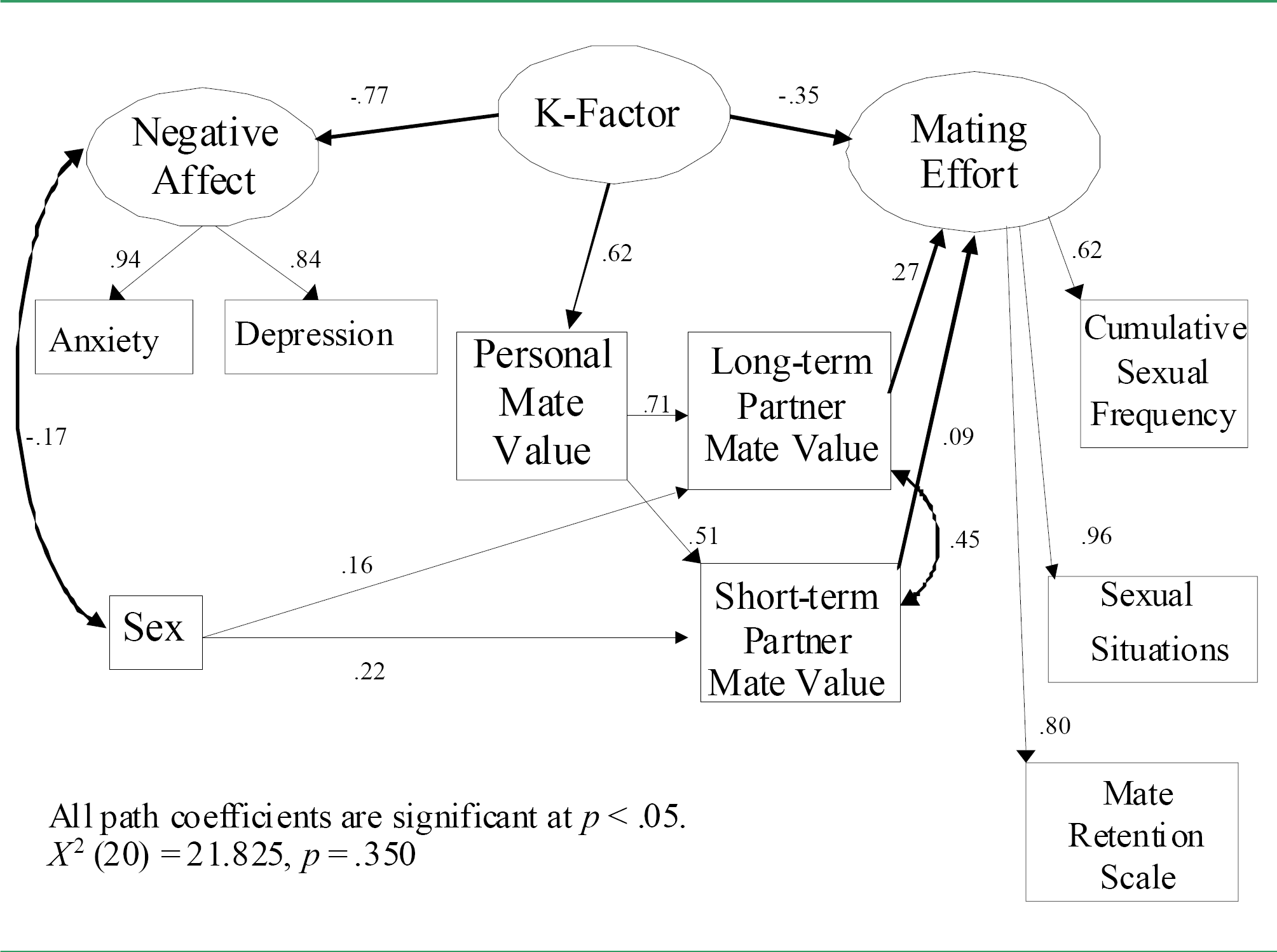
Reinterpreted model (2.0).

Restricted reinterpreted model (2.1).
The nested model comparison between Model 2.2 and Model 2.1 examined the contribution of the pathway from Long-Term Partner Mate Value to Mating Effort. Model 2.2 gained one degree of freedom by eliminating the indirect pathway from the LH Factor to Mating Effort mediated by Personal Mate Value and Long-Term Partner Mate Value. Dropping the direct path from Long-Term Partner Mate Value to Mating Effort eliminated this indirect pathway. The difference Chi-squared was statistically significant, X 2 (1) = 7.790, p =.0053, indicating a significant loss of explanatory power when this indirect pathway was dropped. Hence, we prefer Model 2.1 because it provides a better fit to the data than Model 2.2.
Comparing the Preferred Models. Comparing the explanatory power and fit indices of the most powerful and parsimonious model based on evolutionary economic theory, Model 1.1, to the most powerful and parsimonious model based on Life History Theory, Model 2.1, permits us to compare these theoretically distinct models indirectly. 2 When we do so, we find that the models fit just about equally well by all statistical and practical criteria. The squared multiple correlation for the Mating Effort construct, which was the primary endogenous variable of theoretical interest, was .046 for Model 1.1 and .103 for Model 2.1. This comparison favors Model 2.1 somewhat by the more conventional criterion of explanatory power.
Discussion
We used a structural equations model approach to examine the empirical plausibility of hypothesized causal relations among Negative Affect, Mate Value, and Mating Effort. Using these methods, we arrived at two equally parsimonious models, Model 1.1 and Model 2.1. Model 2.1 was favored by a higher squared multiple correlation for the Mating Effort construct, although it was not favored by any of the statistical and practical criteria of model fit unique to structural equations modeling.
Both models measured three indicators of Mating Effort. Each indicator assessed a slightly different aspect of behaviors in which people might engage for the purpose of attracting a partner or keeping a partner from exiting an extant relationship. The majority of the items contained in Sexual Situations (Appendix C) and the Mate Retention Scale (Appendix D) might be labeled “Risky Mating Effort.” Cumulative Sexual Frequency and Sexual Situations assessed the use of many potentially high-risk sexual tactics as instruments to attract or retain a partner. The Mate Retention Scale assessed many high-risk but non-sexual tactics as instruments to retain a partner. Of these self-reported sets of tactics, both Model 1.1 and Model 2.1 identified Sexual Situations, how often one engages in sexual behavior under 36 sampled social situations, as the strongest indicator of Mating Effort. The very high loading of Mating Effort on Sexual Situations suggests that the measure captures an essential aspect of efforts to attract and retain mates. This finding does not diminish the importance of Cumulative Sexual Frequency or non-sexual mate retention tactics, both of which show remarkably strong relationships to Mating Effort in Model 1.1 and Model 2.1. By both models, it appears that people willingly admit the instrumental use of a wide variety of risky sexual and non-sexual tactics to attract or retain a partner.
The detrimental impact of using sexual, psychological, or physically violent behaviors to manipulate one's partner is obvious. Less obvious are the dangers to the partner who uses those tactics, perhaps because of fears that his or her mate will defect. The present study demonstrated that experiencing persistent Negative Affect is associated with greater use of risky mate attraction and retention behaviors. Those behaviors include having sex when fearing that your mate will leave if you do not, having sex even though a partner refused to use protection, and agreeing to sexual behaviors you would rather not do in order to keep the partner from leaving. Engaging in sex primarily for the purpose of attracting or retaining a partner may thereby expose one to several possible dangers. Clearly, having sex without using protection exposes both parties to the possibility of STD transmission and pregnancy. The potential consequences of unsafe sex may increase the anxiety experienced by people prone to anxious symptoms. Engaging in behaviors viewed as unpleasant or undesirable, be they sexual or not, also maintains Negative Affect in general (Grosscup and Lewinsohn, 1980); At a minimum, engaging in instrumental sex or other manipulative behaviors is, for most of us, unpleasant for both the manipulator and the manipulated.
Turning to the structural models, the primary theoretical model, Model 1.0, which is based on evolutionary economic theory, predicted a set of causal pathways from Negative Affect to Personal Mate Value, from Personal Mate Value to Short and Long-Term Partner Mate Value, and from both Short-Term and Long-Term Partner Mate Value to Mating Effort. The best-fitting and most parsimonious models, Restricted Model 1.1 and Reinterpreted Model 2.1, disconfirmed this prediction.
Model 1.1 specified a direct effect, from Negative Affect to Mate Retention Efforts; but no indirect effect, whereas in Model 2.1, which is based on LH Theory, the indirect effect from the LH Factor to Mating Effort via Personal Mate Value and Long-Term Partner Mate Value was at best negligible. Whether Negative Affect is seen as the ultimate cause, or as an indicator of an underlying “fast” life history strategy, these findings imply that greater Negative Affect is associated with: (1) a lower threshold for accepting a either a short- or long-term partner; and (2) greater effort to attract or retain a partner. In short, Negative Affect is associated with exerting increased sexual efforts that produce fewer benefits in reproductive fitness.
Although there was very little mathematical basis on which to decide between Models 1.1 and 2.1 based on the current cross-sectional, correlational data, we can do so experimentally. Each model predicts a unique set of relations among measures of Negative Affect, Personal Mate Value, and Mating Effort. For example, Model 1.1 predicts that changes in Negative Affect will produce large and easily detected changes in a person's estimated Personal Mate Value and less easily detected changes in Mating Effort through direct causal links (see Figure 2). To be more specific, Model 1.1 predicts that significant increases in Negative Affect will cause large decreases in Personal Mate Value and smaller but detectable increases in Cumulative Sexual Frequency, Sexual Situations, and Mate Retention tactics, the three indicators of Mating Effort. In contrast, Model 2.1 predicts that changes in Negative Affect will produce no changes in a person's estimated Personal Mate Value or Mating Effort. That is, any empirically observed relations among Negative Affect, Personal Mate Value, and Mating Effort will be mediated by the common causal influence of the LH Factor. A simple power analysis indicates that the data patterns predicted by Model 1.1 can be detected, with a standardized regression weight of 0.85, by taking appropriate measures from 102 participants. Hence, a study taking appropriate measures from about 100 participants should provide a critical test of the unique set of predictions generated by Models 1.1 and 2.1. Such a study is now in progress.
By either account, the explanatory power and fit of the preferred Models 1.1 and 2.1 pose a serious challenge to the predictive power of evolutionary economic theory. By Model 1.1, there is no indirect effect of Negative Affect on Mating Effort; thus, the expected lower mate value of partners of those with greater Negative Affect is not predicted to lower the effort expended to attract or retain them. By Model 2.1, the correlations between Negative Affect and Mating Effort and between Negative Affect and Personal Mate Value are both spurious. Both models thereby contradict basic tenets of evolutionary economic theory.
Summary
The present study examined relations among Negative Affect, Mate Value, and Mating Effort. An a priori model (Model 1.0), based on evolutionary economic theory, predicted that Negative Affect simultaneously increases Mating Effort directly, and decreases it indirectly by reducing the expected mate value of one's partner. The present results support the first and disconfirm the second prediction. Two alternative models, Model 1.1, based on evolutionary economic theory, and Model 2.1, based on Life History Theory, described the data almost equally well. These models, however, predict different suites of behavior in the face of changing levels of Negative Affect. Model 1.1 predicts a dramatic change in Personal Mate Value and a less dramatic but detectable change in Mating Effort when Negative Affect changes. In contrast, Model 2.1 predicts that both Personal Mate Value and Mating Effort will remain stable when Negative Affect changes. Although we briefly discuss several pragmatic implications of these models, we stress the theoretical importance of examining the empirical veracity of these models carefully.
Footnotes
1
Model 1.2 may be rejected by a strict statistical (Chi-Squared) criterion.
2
Because the preferred primary model, Model 1.1, and the preferred reinterpreted model, Model 2.1, are not nested, we could not pit them against one another directly.
Had Sex Questionnaire
The following questionnaire was based on Sanders and Reinisch (1999).
Would you say you “had sex” with someone if the most intimate behavior you engaged in was…?
According to your definition of having “had sex” above, at what age did you first “have sex”?
Cumulative Sexual Frequency
Please answer the questions based on how you defined “having sex” (see Had Sex questionnaire in Appendix A).
If you have never “had sex” according to your definition, please skip this and the next page.
If you have ever had consensual sex in your life, please answer the following:
I have had consensual sex with men approximately __________ time(s) in my lifetime, with approximately ______ different partners.
I have had consensual sex with women approximately _________ time(s) in my lifetime, with approximately _____ different partners.
Sexual Situations
The following questionnaire was based on taxonomic work reported by Figueredo et al. (2007a).
Based on how you defined “having sex” (see Had Sex Questionnaire in Appendix A), please answer the following. If you have never “had sex” according to your definition, please skip this and the next page.
About how many times have you done these things in the past year? (Note: Please use a number, not words, to answer this question.)
I have had sex with someone when I wanted their attention.
I have had sex with someone when they were drunk or high.
I have had sex with someone when I thought it would keep them from breaking up with me.
I have had sex with someone when I felt good about having sex.
I have had sex with someone when I wanted affection.
I have had sex with someone when I thought I would lose them if I didn't.
I have had consensual sex with someone when they refused to use protection.
I have had sex with someone when I wanted to get revenge on someone else.
I have had sex with someone when I specifically decided beforehand that I would not do so.
I have had sex with someone when I was uncomfortable saying no.
I have had sex with someone when I wanted to get pregnant/to get my partner pregnant.
I have had sex with someone when I drank more than I intended.
I have had sex when it seemed like the easiest thing to do under the circumstances.
I have been sexually unfaithful to a romantic partner.
I have had sex with someone to help me stop feeling lonely.
I have had sex with someone after we ended a romantic relationship with each other.
I have had sex with someone when I felt obligated after my partner became excited.
I have had sex when I felt anxiety about what I should do.
I have had sex with someone when I thought they would enjoy it even though I might not.
I have had sex with someone when I thought they expected me to.
I have had sex with someone when I wanted to avoid having to do something else with them.
I have had make-up sex with someone after an argument or verbal fight with them.
I have had sex with someone when I thought they would leave me if I didn't.
I have had sex with someone when I wanted to release sexual tension.
I have had sex with someone when I wanted to get something from them.
I have had sex with someone when I was drunk or high.
I have had sex with someone when I wanted to get rid of a bad mood I was in.
I have had sex with someone when I wanted to make myself feel attractive.
I have had sex with someone when I wanted to feel good.
I have had sex with someone when I felt obliged after they spent a lot of money on me.
I have had sex with someone when I thought my partner would be unsatisfied otherwise.
I have had sex with someone I was not in a committed relationship with.
I have had make-up sex with someone after a fight in which one of us physically hurt the other.
I have had sex with someone when they would not take no for an answer.
I have had sex with someone when I wanted to feel close to them.
I have had sex with someone when I wanted to get them interested in me.
Mate Retention Scale
Past year:
In the past year, how many romantic/sexual partners have you been involved with? ___________
In the past year, how many times have you gone through what you consider a break-up?
______
If you have answered 0 to both of these questions, please skip this and the next page.
In the past year, about how many times did these things happen?
(Note: Please use a number, not words, to answer this question.)
1a. I insisted that my partner spend his or her free time with me
1b. My partner insisted that I spend my free time with him/her
2a. I did not let my partner go out without me
2b. My partner did not let me go out without him/her
3a. I became angry when my partner flirted with someone else
3b. My partner became angry when I flirted with someone else
4a. I made my partner feel guilty about talking to other girls/guys
4b. My partner made me feel guilty about talking to other girls/guys
5a. I pleaded with my partner not to leave me
5b. My partner pleaded with me not to leave him/her
6a. I threatened to hurt myself if my partner left me
6b. My partner threatened to hurt himself/herself if I left him/her
7a. I made my partner feel badly about her/his chances of finding another partner
7b. My partner made me feel badly about my chances of finding another partner
8a. I intentionally or unintentionally put my partner down to his or her face
8b. Intentionally or unintentionally my partner put me down to my face
9a. I intentionally or unintentionally put my partner down to others
9b. Intentionally or unintentionally my partner put me down to others
10a. I offered to be more committed to my partner
10b. My partner offered to be more committed to me
11a. I gave my partner presents I could not easily afford to give
11b. My partner gave me presents he/she could not easily afford to give
12a. I prepared or took my partner out for a romantic meal
12b. My partner prepared or took me out for a romantic meal
13a. I gave in to my partner's sexual requests
13b. My partner gave in to my sexual requests
14a. I expressed more enthusiasm about sex than I really felt at the time
14b. I think my partner expressed more enthusiasm about sex than he/she really felt
15a. I did something my partner asked even though I did not really want to
15b. My partner did something I asked even though he/she did not really want to
16a. I went along with my partner's opinions even though I did not agree with them
16b. I think my partner went along with my opinions even though he/she did not agree
17a. I told my partner he/she would never find anyone as good as me if they left me
17b. My partner told me I would never find anyone as good as him/her if I left him/her
18a. I threatened to do something to hurt my partner if he or she left me
18b. My partner threatened to do something to hurt me if I left him/her
19a. I flirted with someone other than my current partner when my partner was present
19b. My partner flirted with someone other than me when I was present
20a. FEMALES: I may have, or did, get pregnant
20b. MALES: I may have, or did, impregnate a woman
Prior to Past Year:
Before the past year, how many romantic/sexual partners were you involved with? _____
Before the past year, how many times did you go through what you consider a break-up?
______
If you have answered 0 to both of these questions, please skip this and the next page.
Before the past year, about how many times did these things happen?
(Note: Please use a number, not words, to answer this question.)
The same items were administered for the time frame Prior to Past Year as for Past Year.