



Abstract
This research focuses on mating-relevant judgments within an evolutionary framework. Using a methodology that employs personal ads as stimuli, the current study tested predictions from Error Management Theory (Haselton and Buss, 2000) suggesting that males will oversexualize females' desires, showing a tendency to think women are more interested in unrestricted sexual encounters than is warranted. This work further tested whether women's judgments represent an oversexualization of males' desires, which may reflect the adaptive bias of commitment skepticism. This work also tested whether overall accuracy in these judgments was sex-differentiated. 481 young male and female heterosexual adults judged which personal ads (written by opposite-sex individuals) were most desirable as short and long-term mates. All participants then engaged in a cross-sex mind-reading task by guessing which ads were most strongly endorsed by opposite-sex individuals. Males were more accurate than females in guessing long-term desires; females were more accurate than males in guessing short-term desires. Male oversexualization of females' desires was not pronounced in these data. However, female oversexualization of males' was quite pronounced for both short and long-term judgments. Discussion addresses how the sexes may be tuned into different strategic mating cues in the domain of cross-sex mind-reading in addition to how oversexualization of opposite-sex judgments may serve discrete adaptive functions across the sexes.
Keywords
Introduction
Armed with the toolbox of evolutionary psychology, mating psychologists have been wildly successful in demonstrating how so much of human mating can be understood in light of evolutionary principles. Work in this burgeoning field has shed light on such processes as mate attraction (e.g., Pipitone and Gallup, 2008), sex-differentiated competition for mates (Buss, 2003), and the effects of ovulation on mate-choice (Miller, Tybur, and Jordan, 2007).
The current research is part of a new trend within the field of mating psychology that looks toward relatively complex cognitive processes. This area, which may be broadly construed as pertaining to mating intelligence (Geher and Miller, 2008), generally takes an adaptationist approach to such cognitively laden processes as assessing one's own mate value in a localized mating market and the use of creative behavioral displays involving language and humor to attract mates. In short, this area looks to relatively higher-order psychological processes as they bear on mating success from an evolutionary perspective.
One such cognitive task that fits within this framework is cross-sex mind-reading. Among heterosexual adults, figuring out the desires of opposite-sex individuals is crucial to mating success. Failing to know what members of the opposite-sex want in a mate will lead to nearly certain failure in courtship. Further, within the confines of an existing relationship, such an inability would certainly make for difficulty in maintaining harmonious relations.
The ability to read the emotions and thoughts of others seems to be a basic part of our psychology (Ekman and Friesen, 1968). Recent evidence suggests that these skills may comprise a unique portion of human intelligence that may represent emotional intelligence (Salovey and Mayer, 1990). From an evolutionary perspective, it makes sense that these kinds of social-cognitive skills should be particularly crucial in the domain of mating which directly corresponds to the reproduction of genes. As such, mating-relevant cross-sex mind-reading should be a crucial part of human mating intelligence.
Indeed, prior work on cross-sex mind-reading has found evidence for sex-specific adaptations in this process. In a set of studies designed to test Error Management Theory, Haselton and Buss (2000) found evidence that males tend to over-infer sexual interest on the part of females in making cross-sex mind-reading judgments. The authors portray this bias as akin to a false positive in decision-making — with potentially large reproductive payout which outweighs potential reproductive costs. Specifically, these authors argue that ancestral males who oversexualized women's desires would have taken steps to produce more mating opportunities than other males — a tendency that would ultimately increase sexual opportunities. Costs associated with such a strategy would likely include embarrassment at rejection — minor costs in the grand scheme of the evolutionary competition to reproduce (see Haselton, 2007).
Haselton and Buss (2000) describe a different adaptive bias in the cross-sex mind-reading judgments of heterosexual women. Given the high evolutionary costs associated with an inability to secure a faithful male to help with childrearing, these authors argue that women should demonstrate a strong tendency to make a particular false negative in their judgments when it comes to assessing a man's willingness to commit. The costs associated with erring in this judgment could lead to desertion and a future of parenting without paternal support — a huge evolutionary tax. Thus, consistent with their reasoning, they provide evidence that women do, in fact, demonstrate a degree of commitment skepticism in making cross-sex mind-reading judgments.
The Current Study
Haselton and Buss' (2000) work on adaptive biases in cross-sex mind-reading provides preliminary evidence of evolutionarily shaped biases in mating-relevant judgments. One limitation of their work pertains to the fact that their stimuli were relatively generic and self-report in nature. For instance, participants were asked to think about the statement:
“… on the first day of work, approaching a male [female] co-worker, smiling brightly, and striking up a friendly conversation” Participants were then asked to consider how much sexual interest is represented by this statement in a somewhat abstract sense.
The current research was partly designed to replicate the effects obtained by Haselton and Buss (2000) using more ecologically valid stimuli. Drawing on the methodology used by ability-based emotional intelligence researchers (see Brackett and Salovey, 2004), the current study employed relatively genuine mating-relevant stimuli — in the form of actual personal ads — as stimuli to be used in a cross-sex mind-reading task. The ability-based indices of emotional intelligence (e.g., the Emotional Accuracy Research Scale; Mayer and Geher, 1996) include emotionally laden items presented to a large group of participants, asking them to make quantifiable judgments regarding emotional stimuli. The current work included similar stimuli, but ones that were reflective of mating desires (as opposed to emotional states). This use of personal ads as ecologically valid and rich data has been used successfully by many mating researchers to address a host of questions regarding human mating (see DeBacker, Braeckman, and Farinpour, 2008).
Based on previous work on human mating behaviors conducted by evolutionary psychologists (e.g., Buss, 2003), separate measures of cross-sex mind-reading were designed to tap the ability to know the short-term versus the long-term desires of potential mates. Further, given that heterosexual desires were examined in this research, separate tests were made for males and females. As such, four indices of cross-sex mind-reading ability were created in this work (males' abilities to know the short-term desires of females, males' abilities to know the long-term desires of females, females' abilities to know the short-term desires of males, and females' abilities to know the long-term desires of males).
Research Questions
The primary purpose of this study was to replicate the error management effects documented by Haselton and Buss (2000) using more ecologically valid stimuli. Further, this research examined:
whether sex differences exist in cross-sex mind-reading abilities
whether cross-sex mind-reading abilities are affected by temporal context of judgment (short-term versus long-term mating judgments)
whether participants' sex and temporal context interact with one another in regard to accuracy in cross-sex mind-reading
whether participants across both sexes make errors in cross-sex mind-reading judgments that consistently reveal oversexualization (a pattern which might reflect sexual over-perception on the part of males and commitment skepticism on the part of females)
Materials and Methods
Participants
Four hundred eight-one young heterosexual adults (329 females and 152 males) participated in this research. For females, the mean age was 22.17 (SD = 4.48). For males, the mean age was 24.58 (SD = 7.65). Participants were predominantly college students at SUNY New Paltz who volunteered to participate after receiving an email invitation asking them to be part of this research. Some received partial credit for their psychology classes. The web-based nature of the data collection allowed for the subject pool to go beyond the confines of New Paltz students. Additional participants were friends of New Paltz students who were invited by email to participate. While this sampling strategy does have some potential issues, this kind of sampling has the capacity to draw on a wider sample than samples comprised exclusively of college students — and this kind of “snowball” sampling, in which participants are asked to distribute advertisements to individuals in their own social networks for a study so as to increase both the n and the diversity of the sample, is commonly employed in internet-based studies (see Browne, 2005).
Materials
For each sex, a measure of long-term mating judgments was implemented. For this measure, participants were first presented with 10 items that included clusters of three real personal ads written by members of the opposite sex (See Tables 1 and 3). Within each cluster, they were asked to choose which ad represented the person they would most want for a long-term mate. Next, participants made cross-sex mind-reading judgments; they were presented with the long-term items that were given to members of the opposite sex for judgment. Participants were asked to guess which ad within each cluster was most commonly chosen by members of the opposite sex as most desirable for a long-term mate (specifically, the wording was “long-term, marriage partner”). These personal ads were collected by a team of research assistants from online dating-service sites (including match.com and similar sites) and were modified so that demographic information such as data regarding ethnicity and religion were deleted.
As is true in the real world, personal ads varied quite a bit from one another in terms of writing ability, kinds of information presented, use of humor, etc. Removing information about important demographic features (e.g., Jewish Seeking Same) allowed for participants to focus on details of the ads that were not biased by such important screening factors. The creation of each cluster of three ads was determined by randomly selecting three ads from the total pool of ads. This process ensured that no a priori biases of the researchers were driving the placement of ads within clusters.
Each participant also completed a sex-appropriate short-term judgment task. The algorithm described in the prior section regarding the measurement of long-term judgment was used to assess short-term judgments, with the exception that these items revolved around participants being asked to make short-term ratings (See Tables 2 and 4). Additionally, different personal ads were used in the short-term measures than in the long-term measures. For this task, participants were asked to choose which ad the opposite-sex most preferred for a “short-term, sexual partner.”
Procedure
A web-based survey was created for the purposes of data collection (using Flashlight survey software). After participants read a document providing informed-consent information, they completed the cross-sex mind-reading measures. The completion of these measures (both long and short-term) each included two phases. In the first phase of the long-term judgment task, participants read 10 clusters of three randomly chosen ads written by members of the opposite-sex; their task was to indicate which ad most represented the person they would want for a marriage partner. In phase two, participants viewed the ads that were presented by members of the opposite-sex initially — here, their goal was to guess which ad (within each cluster) was most highly endorsed by the members of the opposite-sex in the sample.
This same algorithm was applied to address short-term judgments. Participants first were presented with 10 clusters of ads and they were then asked to report which ad they would most prefer as a short-term, sexual partner within each cluster. They were then presented with the ads that were initially presented to members of the opposite-sex with the charge of guessing which ads were most strongly endorsed by those opposite-sex participants as most desirable for a short-term, sexual encounter.
Coding for Sexual Content. To address the questions associated with the adaptive bias hypotheses suggested by Error Management Theory, the content of each ad was coded in terms of whether it included sexual content. Having such information would allow us to see if participants' errors reflected oversexualization. Two trained judges (one male and one female) independently coded all 120 ads (60 written by males and 60 written by females) for presence of sexual content. The judges were asked to make dichotomous decisions, addressing the question: “Does each ad have sexual content or not?” Their total level of agreement was 99.96%. The few disagreements were worked out by a third (male) judge. Of the 120 total ads, 22 were coded as having sexual content present.
Results
For each of the four kinds of judgments, there were 10 items – 40 total. To examine the degree to which participants' guesses of the desires of the opposite-sex matched the reported desires of the opposite-sex, each item was subjected to a chi-square test of independence. In each case, the analysis addressed whether the guesses of one sex were significantly discordant from the actual reported desires of the opposite sex.
Given the analytical strategy employed here, it is important to note that while the chi-square test provides a straightforward way to test the issue of discord in cross-sex judgments, it is the case that hyper-accuracy on the part of one sex would, in fact, lead to a significant chi-square. Thus, for instance, if 40% of women really liked Option B and 100% of males thought that women liked Option B, the chi-square would be large and significant. An analysis of the extent to which significant chi-squares corresponded to instances in which the “correct” choice (most highly endorsed by the opposite sex) was overestimated was conducted. For males, of six significant chi-squares, five corresponded to cases in which the “correct” answer (based on females stated desires) were underestimated. Thus for males, significant chi-squares did not correspond to hyper-accurate judgments. However, for females, of 19 significant chi-squares, 10 represented instances in which females underestimated the correct answer (and nine represented instances in which females overestimated the correct answer). As such, it seems that this chi-square analysis addresses phenomenological discord (differences between desires of one sex and the guessed desires made by the other sex) more than accuracy. In some cases, particularly for female participants, it seems that significant phenomenological discord may have, indeed, represented hyper-accuracy. As such, the chi-square analyses presented here are best conceptualized in terms of addressing phenomenological discord in cross-sex mind-reading.
Assessing Phenomenological Discord in Cross-Sex Mind-Reading
To understand the nature of the chi-square analyses, consider the example delineated in Table 1, which presents a male long-term judgment item. It includes three ads written by men. Women were asked to choose which man they would prefer for a long-term relationship. Then, in the cross-sex mind-reading task, men were asked to make their best guess as to whom women chose. The chi-square test for independence addressed if males' guesses of females' desired choices were significantly discordant from the pattern of females' actual choices. Note that due to the issue of unequal Ns across the sexes, the frequencies for females were adjusted so as to be on the same scale as the observed frequencies for males.
Male Long-Term Judgment Example. For each of the 10 clusters of personal ads, a chi-square test of independence was computed to see if males' guesses regarding what females wanted in long-term mates were significantly discordant from females' actual reported desires. Below is one of these 10 examples.
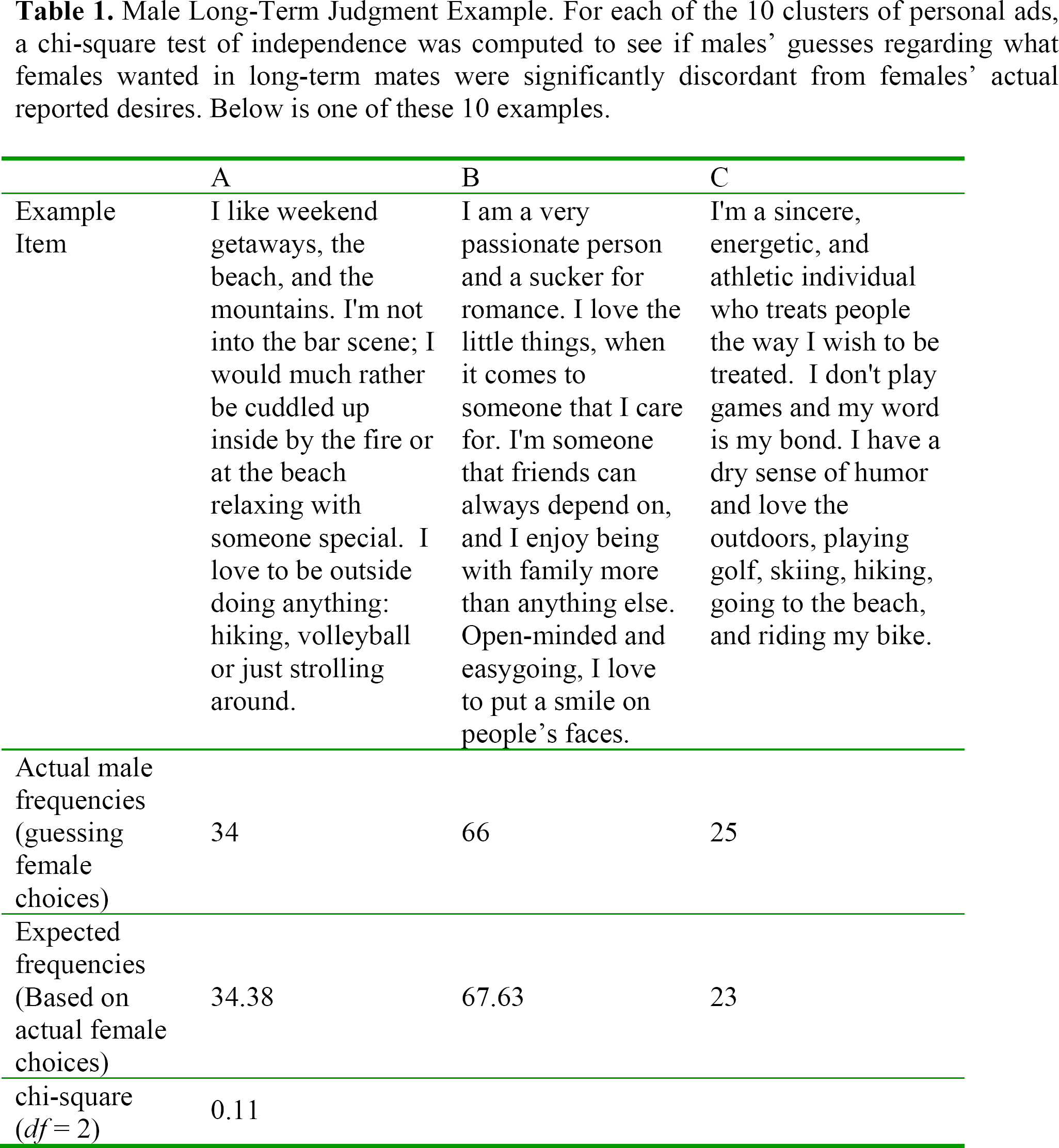
For this particular male long-term item, option #2 (“I am a very passionate person and a sucker for romance …”) was the most popular choice among the 329 women in the sample; 178 reported liking this male the most for a long-term relationship. Correcting for unequal ns across the sexes, that number converts to 67.63. In other words, if the n for females in the study were equal to the n for males included in this analysis (125), 67.63 of the females would have chosen option #2. Of the 125 males in this analysis, 66 thought that women would choose option #2 (leading to an expected/observed discrepancy of 1.63). In light of this analytical paradigm, a significant chi-square would mean that there was significant discord between the actual reported desires of one sex and the guesses of those desires by the other sex. For the specific example given here, the chi-square was not significant (χ2(2) = 0.11, ns). Thus, males' guesses did not differ significantly from females' reported desires in this case.
In all, 40 such analyses were conducted. Examples of each class of judgment are presented in Tables 1–4 (representing male long-term, male short-term, female long-term, and female short-term items, respectively). Given the large number of analyses conducted here, a conservative alpha of .01 was used to determine statistical significance.
Male Long-Term Judgments. Each of ten items representing male long-term judgments was analyzed using the chi-square test of independence described in the prior section. To provide a general comment on the abilities of males in the sample to accurately guess the options within each item that females endorsed as most attractive for long-term mating, an average of the 10 chi-square tests was calculated. Overall, male judgments of females' long-term desires were not significantly discordant from females' actual reported desires (mean χ2(2) = 3.09, ns). The range of chi-squares was from 0.03 to 10.08. See Table 1 for an example item and for information used in the analysis.
Male Short-Term Judgments. The same analytical algorithm described for male long-term judgments was used for male short-term judgments. On average, males' judgments were not significantly discordant from females' reported desires (mean χ2(2) = 6.49, ns). These chi-square values ranged from 0.26 to 15.87. See Table 2 for an example item.
Male Short-Term Mating Judgment Example. For each of the 10 clusters of personal ads, a chi-square test of independence was computed to see if males' guesses regarding what females wanted in short-term mates were significantly discordant from females' actual reported desires. Below is one of these 10 examples.

Female Long-Term Judgments. To examine overall concordance in female judgments, the same procedures were implemented. For female long-term judgments, results suggested that female judgments of males' long-term desires were significantly discordant from males' stated desires (mean χ2(2) = 18.97, p < .01). These chi-squares ranged from 0.31 to 59.91. See Table 3 for an example item.
Female Long-Term Mating Judgment Example. For each of the 10 clusters of personal ads, a chi-square test of independence was computed to see if females' guesses regarding what males wanted in long-term mates were significantly discordant from males' actual reported desires. Below is one of these 10 examples.

p < .01
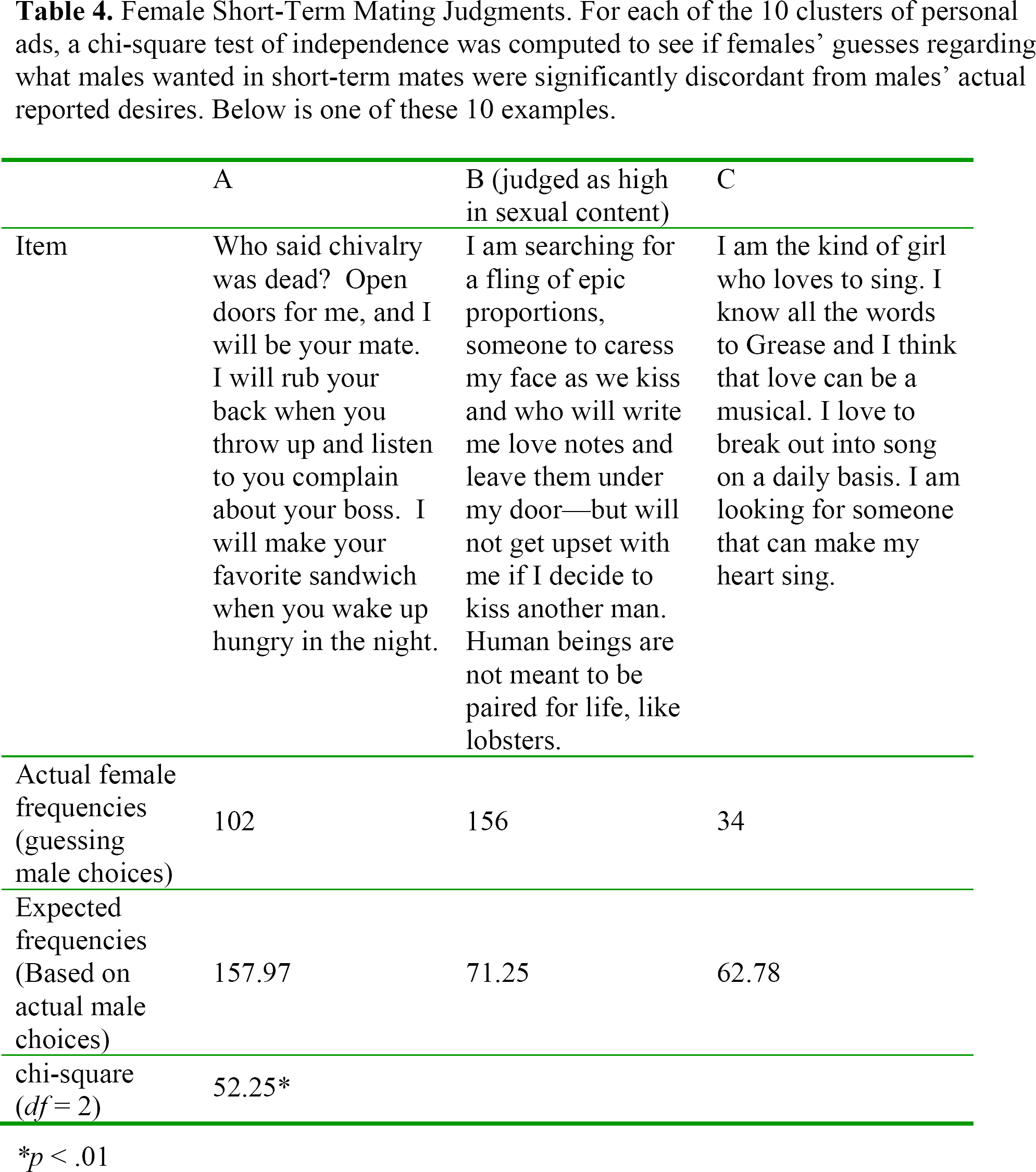
Female Short-Term Judgments. Finally, this same kind of chi-square test was used to examine concordance rates for female's guessing the short-term desires of males. Results revealed that these judgments were significantly discordant from males' reported short-term desires (mean χ2(2) = 27.59, p < .01). These chi-square values ranged from 3.34 to 56.24. See Table 4 for an example item.
Female Short-Term Mating Judgments. For each of the 10 clusters of personal ads, a chi-square test of independence was computed to see if females' guesses regarding what males wanted in short-term mates were significantly discordant from males' actual reported desires. Below is one of these 10 examples.
p < .01
Operationalizing Adaptive Bias
Recall that judges coded all ads for the presence of sexual content. This content analysis was conducted for the purposes of operationalizing sex-specific adaptive biases as possible causes of phenomenological discord in cross-sex mind-reading. For the three kinds of judgments that demonstrated significant discord in cross-sex mind-reading judgments (males making short-term judgments of females, females making long-term judgments of males, and females making short-term judgments of males), a system was developed to see if phenomenological discord could be accounted for by the tendency to overestimate interest in sexual advertising on the part of the opposite-sex.
Given that only 22 of the 120 ads were coded as having sexual content present, only a subset of the items from the different subscales were used for these analyses. Results were as follows:
Male Short-Term Judgments. In five items included in the male short-term stimuli, at least one ad was judged by the independent judges as having sexual content present. In only one such case (1 of 5), males tended to overestimate the degree to which females would endorse the sexually oriented ad as a desirable short-term mate. These data do not provide evidence for a trend in males' judgments regarding oversexualization.
Female Long-Term Judgments. In four items included in the female long-term stimuli, at least one ad was judged by the independent raters as having sexual content present. In each such case (4 of 4; 100% of cases), females tended to overestimate the degree to which males would endorse the sexually oriented ad as a desirable long-term mate (see Table 3 for an example). Given that there are three options within each of these four items, the binomial probability of this outcome occurring by chance is low (p = .01).
Female Short-Term Judgments. In five items included in the female short-term stimuli, at least one ad was judged by the independent judges as having sexual content present. In 4 of 5 such cases (80%), females tended to overestimate the degree to which males would endorse the sexually oriented ad as a desirable short-term mate (see Table 4 for an example). As with the female long-term judgments, the binomial probability of this outcome by chance alone is low (p = .04).
Addressing Accuracy in Cross-Sex Mind-Reading across the Sexes
Given that the chi-square analyses address phenomenological discord between the sexes rather than accuracy versus inaccuracy per se, an alternative strategy was needed to address issues of accuracy. The strategy employed here borrows from the extensive literature in the field of emotional intelligence (see Geher, 2004). Specifically, a modification of the consensus-based method of operationally defining emotional intelligence (Mayer and Geher, 1996) was employed. For each participant, a long-term mating intelligence score was computed by summing the weights (representing the proportion of opposite-sex individuals who actually endorsed a particular item as most attractive) associated with that participant's guesses regarding the long-term choices of the opposite-sex across all ten items. Thus, for instance, if for a particular long-term item, a male guessed that option B was the most attractive option to females in the study and 52% of females actually chose option B, that participant's score would increase by 0.52. Participants who scored relatively high on this scale tended to guess that the opposite-sex participants endorsed items that actually were endorsed by many such opposite-sex participants. This same algorithm was used to compute indices of accuracy regarding short-term desires of the opposite-sex.
A mixed ANOVA, with sex as a between-subjects factor and temporal context (short-term accuracy versus long-term accuracy) as a within-subjects factor, was conducted. Interestingly, there was no significant main effect for sex (F(1, 414) = 0.10, ns) nor was there a significant main effect for temporal context (F(1, 414) = 0.07, ns). There was, however, a substantial interaction between these variables (F(1, 414) = 41.73, p < .01; η2 = .09). As presented in Figure 1, this interaction is accounted for by the facts that (a) males' accuracy scores for long-term judgments (M = 3.72, SD = 0.42) were significantly higher than their accuracy scores for short-term judgments (M = 3.54, SD = 0.41; t(124) = 3.76, p < .01; Cohen's d = .43), (b) males' long-term judgment scores were significantly higher than females' long-term judgment scores (M = 3.56, SD = 0.28; t(421) = 4.04, p < .01; Cohen's d = .46), and (c) females' short-term judgment scores (M = 3.72, SD = 0.43) were significantly higher than their long-term judgment scores (t(292) = 5.89, p < .05; Cohen's d = .45). Taken together, these data paint a picture of males excelling at guessing females' long-term desires and females' excelling at guessing males' short-term desires.

Interaction between sex and temporal nature of judgment.
Discussion
For the past few decades, the psychology of human mating has been moving toward center stage in much of psychology writ large (see Buss, 2005). While most of the work in this field has documented myriad basic, low-level psychological processes that have a major impact human functioning — such as processes that underlie physical attraction (see Pipitone and Gallup, 2008) and emotional underpinnings of reactions to infidelity (see Buss and Haselton, 2005), a recent trend in this field has been to explore higher-order cognitive processes connected to human mating within an adaptationist framework. This trend, which bears on the idea of mating intelligence (Geher and Miller, 2008), focuses on relatively high-level psychological processes such as the use of other versus self-deprecating humor in the domain of courtship (Greengross and Miller, 2008) and the economic allocation of mating-relevant budgetary resources in the implementation of an optimal mating strategy (Li, 2008). The current work, focusing on the nature of mating-relevant cross-sex mind-reading processes, fits within this broader framework of cognitive processes that underlie human mating. The research described here allows for an assessment of sex-typical patterns of both accuracy and error in cross-sex mind-reading judgments.
Phenomenological Discord in Cross-Sex Mind-Reading
The chi-square test of independence analyses allowed for an examination of phenomenological discord in cross-sex mind-reading. These analyses specifically allowed for a description of the degree to which four kinds of mating judgments of the desires of potential partners tended to be relatively concordant with criteria representing actual opposite-sex desires. These analyses reflected males' judgments of female long and short-term desires and females' judgments of males' long and short-term desires. As per the findings presented in Tables 1–4, male long-term judgments were generally more concordant with opposite-sex desires compared with female judgments. Importantly, however, high concordance rates here do not necessarily correspond to high levels of accuracy — an issue that is addressed in a subsequent section. This discordance analysis does, however, provide an opportunity for examining biases across the sexes in cross-sex mind-reading.
Error Management in Cross-Sex Mind-Reading
In light of error management theory, it was predicted that oversexualization biases would emerge for both males and females. It was predicted that males would overestimate the degree to which females chose sexually charged ads as a marker of males' tendency to oversexualize females desires, which may be an adaptive bias designed to turn up short-term mates. However, this prediction was not supported by the current data. Males only oversexualized female desires for one of the items (of five) that had a sexually charged ad. Females, on the other hand, showed a very strong oversexualization bias in judging males' desires — overestimating the sexually charged ad in eight of nine possible instances.
This tendency to overestimate males' focus on sexuality may be the flip side of the commitment-skepticism bias documented by Haselton and Buss (2000). This bias is exactly the kind of psychological proclivity that would reduce the likelihood of costly mate-choice errors for females. If females tend to employ this bias very strongly and consistently, it makes sense that their judgments of males' desires would be discordant from males' actual desires. This bias would lead to overestimation of males desiring highly sexually charged ads.
In fact, when considering females' patterns of errors in the current study, one might say that they demonstrated a “males are always pigs” bias. Regardless of whether they were making judgments of males' long or short-term preferences, they showed a strong tendency to overestimate the degree to which males desired the relatively sexual and promiscuous option (see Tables 3 and 4). Such a bias is consistent with the idea that women may be employing a simple heuristic suggesting that males “just want sex” – regardless of the temporal context. In other words, females tend to think that men predominantly care about sex for both short-term casual partners and for long-term partners. This bias may well be an adaptive strategy in the long run — women using such a decision-making rule may be more likely to actually end up with honest, committed, and long-term-seeking males (an outcome that would be very beneficial for women given the asymmetry in parental investment that typifies our species).
Many evolutionists who study human mating have focused on sex-differentiated asymmetries in costs associated with making poor choices in mate selection. Due to internal fertilization and relatively high costs associated with parenting that necessarily tax females more than males, female mating psychology should be particularly designed to reduce errors in choosing poorly in the mating domain. In short, it may pay females to overestimate the degree to which “men are all pigs.” Males, compared with females, are more likely to demonstrate short-term strategism in mating. For instance, males are more likely to report wanting many sexual partners and are more likely to enter short-term relationships with partners that they judge as less desirable for long-term mating compared with females (Schmitt, 2005; Penke, Todd, Lenton, and Fasolo, 2008). Given these features of male mating psychology, females may be more able to rely on a simple heuristic such as “only cares about sex” compared with males in making opposite-sex judgments.
The fact that the oversexualization bias emerged so strongly for females but not for males suggests that commitment skepticism may be more adaptive for females than overestimating sexual interest is for males.
Sex Differences in Accuracy in Cross-Sex mind-Reading
Based on the concordance analyses alone, one might think that males are demonstrating better skills in mating-relevant cross-sex mind-reading than females. Such a trend would be highly inconsistent with the vast literature on sex differences in social-cognitive skills. Females traditionally score higher than males on myriad areas of social functioning such as emotional intelligence (Mayer, Salovey, and Caruso, 1999), social intelligence (Connellan, Baron-Cohen, Wheelwright, Batkia, and Ahluwalia, 2000), interpersonal intelligence (Rammstedt and Rammsayer, 2000), non-verbal reading ability (Nowicki and Duke, 1994), and communication-decoding ability (Noller, 1986) – among others.
In fact, the accuracy analyses paint a considerably more complex picture of male/female differences in cross-sex mind-reading. While the chi-square analyses allowed for an examination of sex-specific concordance trends in cross-sex mind-reading, as well as an examination of error management biases, these analyses do not allow for an assessment of sex differences in accuracy in cross-sex mind-reading per se. The mixed ANOVA, which examined sex differences in actual accuracy in judgments (for both short and long-term judgments), allowed for an examination of this issue.
Interestingly, the answer to the question of which sex is better at reading the mating-relevant desires of the opposite-sex is “it depends.” A substantial interaction between sex and temporal context showed that males seem to excel at guessing the long-term desires of females whereas females seem to excel at guessing the short-term desires of males (see Figure 1).
Regarding males' abilities to guess the long-term desires of females, given the notoriously discriminating nature of females' choices in mate selection (in humans as well as most other sexually reproducing species — see Trivers, 1985), coupled with strong tendencies for females to pursue long-term mating strategies (see Buss, 2003), there may be particularly strong pressure on males to essentially get it right when it comes to long-term desires of females. That is, it should be particularly useful for males (more so than for females) to be accurate in their judgments of the long-term desires of the opposite sex.
While it may be relatively adaptive for males to understand the long-term desires of females, it may, on the other hand, pay females to best understand the short-term desires of males — particularly given the relatively short-term nature of males' general mating strategies compared with females. While females tend to show a bias toward oversexualizing males' desires across both short and long-term contexts, this phenomenological strategy seems to lead to accurate results when it comes to males' short-term desires.
In short, the results of this ANOVA suggest that each sex is particularly adept at guessing the other sex's desires regarding the dominant mating strategy of the opposite-sex.
Future Research and Limitations
This research was partly designed to elaborate on Haselton and Buss' (2000) methodology for examining adaptive mating-relevant biases using relatively ecologically valid stimuli. To be sure, real personal ads are more like the real-world than simple one-sentence statements about hypothetical mating-relevant situations. However, clearly, personal ads are not fully ecologically valid. They lack a host of details such as information about facial features, bodies, scents, voice, etc. Future research into cross-sex mind-reading would certainly benefit from using materials that include the broad array of stimuli found in real mating contexts. The use of such enriched stimuli would allow for an assessment of whether the findings from the current research generalize across stimuli that tap different sensory domains, or whether the effects found here are limited to stimuli that bear important similarities to written personal ads.
Another limitation of this research pertains to the fact that individual differences in cross-sex mind-reading abilities were not sufficiently addressed. In fact, the ability-based model of measuring emotional intelligence cited here (Mayer and Geher, 1996) was designed to measure individual differences in cognitive-emotional skills. The adaptation of this paradigm to the mating domain in the current study did not successfully address mating-relevant cognitive processes in an individual-differences-based manner. To measure accuracy in mating judgments across the sexes, accuracy scores were created for each participant (for both short and long-term judgments). However, an internal reliability analysis demonstrated poor internal reliabilities (ranging from .03 to .30). Future research could be done to better examine these kinds of skills within an individual-differences framework — and, in fact, a separate line of research taking just this approach is currently under way (O'Brien, Geher, Gallup, Kaufman, and Garcia, under review).
Conclusion
The ability to know the mating-relevant thoughts of the opposite-sex underlies nearly all aspects of mating in our species. To be successful in the mating domain, one needs to cross-sex mind-read at several levels. The current work sheds important light on the nature of this ability in humans. Demonstrating that males actually seem to be more accurate at this skill than females when making long-term judgments and that, conversely, females excel when it comes to short-term judgments suggests that cross-sex mind-reading skills may partly be shaped to help individuals figure out the opposite-sex in terms of the dominant mating strategy employed by the opposite-sex. Surely, this sex-differentiation makes adaptive sense — although its etiology awaits future research. Finally, the tendency for females to so strongly oversexualize the desires of males tells an interesting story of social-perceptual bias that may be deeply rooted in our evolutionary history. Based on the data presented here, this tendency on the part of females to oversexualize males' desires is only sometimes accurate, but is likely always adaptive.
Footnotes
Acknowledgements
Much of the work here was assisted by undergraduate and graduate students at SUNY New Paltz who worked on the SUNY New Paltz Mating Intelligence Research Project at varying stages. These students include Eli Boyle, Mike Camargo, Michelle Coombs, Elisabeth DeWispelaere, Jason Diffenderfer, Kelly Fairweather, Warren Greig, Krystle Hearns, John Johnson, Jill Lavallee, Justin Lee, Heather Mangione, Nilerisha Mollette, Jeremy Murphy, Regina Musicaro, Erin Stenglein, and Erica White. I additionally thank several others whose ideas have helped shape my thinking on the work presented here — including Alice Andrews, David Buss, Kathleen Geher, Scott Barry Kaufman, Jack Mayer, Geoffrey Miller, Kaja Perina, and David Sloan Wilson as well as two anonymous reviewers who provided excellent comments.