




Abstract
This paper extends insights from sonic and animal geographies to the question of how planetary crisis can be heard in a series of sonically resonant narratives of red-billed leiothrixes (Leiothrix lutea) singing outside of their original range. First, the paper situates the case study within the broader field of work by cultural and animal geographers on the sonic registers of birdsong, setting out what is added to these fields by attending to the red-billed leiothrixes’ case. It then traces the story of red-billed leiothrixes’ transportation around the world through the circuits of colonial-capitalism, zooming in to the impacts of leiothrixes in Hawaii to show how the emplaced specificities of colonial violence and plantation afterlives are obscured by colonial-capitalist ways of listening to birds. Subsequently, the paper shifts to centre the sonic worlds of songbirds themselves, thinking with philosopher Vinciane Despret and others about the sung relations of place and planet in the Anthropocene, before moving to reflect on the recombinant ecological relations that can be heard as red-billed leiothrixes and European blackcaps adjust their songs in response to one another. The paper argues that listening capaciously to red-billed leiothrix songs connects planetary change to changes in place, decentres purely human concerns for survival and (re)tunes the ear to ways of negotiating ecological crisis within more-than-human communities. It concludes by advocating for expanding what we might hear in red-billed leiothrixes’ singing outside their original range, listening for sounds of planetary crisis as well as modes of survival with/in the relations of place.
In 2022, ecologist Richard Broughton and colleagues published an article in the ornithological journal Ibis documenting several small clusters of red-billed leothrix sightings (Leiothrix lutea) in England and Wales.
1
Whether these sightings signal a naturalised population (rather than first-generation escapees) remains uncertain, but their successful naturalisations elsewhere around the world, along with Britain’s increasingly mild winters and high levels of garden bird feeding make naturalisation a strong possibility.
2
Highlighting why this is cause for concern, Broughton et al. write:
Where it becomes established, the species can reach high breeding densities, with potential effects for native birds, and its loud and frequent song could significantly alter the soundscape of Britain’s dawn chorus.
3
Unusually for a small ornithological study, the paper was covered widely in the British press, with headlines ranging from the nativist overtones of ‘“The next parakeet”: Britain’s dawn chorus at risk from Asian songbird’ 4 and ‘Loud chirp of a new invasive Asian songbird threatens to dominate the dawn chorus of native robins, blackbirds and warblers in Britain’, 5 to the more neutral, ‘Could the red-billed leiothrix join our dawn chorus?’ 6 and ‘Asian songbird could change Britain’s dawn chorus’. 7 Despite this difference in tone, all of the major news outlets covering Broughton et al.’s study focused on red-billed leiothrixes’ potential impacts on the dawn chorus, the collective singing of birds at daybreak. This is notable given that the article reports on a series of sightings, rather than soundings, of red-billed leiothrixes, 8 basing its conclusion on potential soundscape impacts on studies from continental Europe. 9 Broughton et al.’s evocation of the dawn chorus can be taken as an example of effective science communications, drawing public attention to a topic that might otherwise be overlooked amidst the crowded field of contemporary threats to wildlife. At the same time, the effectiveness of this strategy highlights the continued resonance of birdsong as a longstanding signal of ecological health or harm in Western environmental imaginaries. Though the story of these little songbirds potentially naturalising in Britain is a minor one, it opens up wider stories of how the multivalent planetary crises of the Anthropocene can be heard with/in the more-than-human relations of place. 10
This paper extends insights from sonic and animal geographies to the question of how planetary crisis coalesces with/in emplaced encounters 11 and modes of attention, 12 through a case-study of red-billed leiothrixes singing outside of their original range. For this task, I expand from Gallagher et al.’s concept of ‘expanded listening,’ 13 following its call to attend to the wider ‘registers of sound’, including its ‘capacity to produce knowledge of events and processes; and the semiotic associations produced by listening’. 14 By attuning to the wider sonic registers of red-billed leiothrixes singing, the paper argues for hearing beyond the headlines of ‘Asian songbirds’ out of place, for instead listening attentively to the affectively charged attachments, colonial-capitalist mobilities, anthropogenic pressures and avian capacities that sound planetary ecological changes within the less-than-planetary relations of birds singing in place.
I develop the argument and contributions of the paper through the following sections: first, I situate the importance of this case within the broader field of work by cultural and animal geographers on the sonic registers of birdsong. I then proceed to unfold a series of sonically inflected narratives of red-billed leiothrixes: the first of these explores how red-billed leiothrixes’ mobilisation through the routes of colonial-capitalist trade has been inflected by Euro-centric ways of listening, broadly and in the particularly consequential case of their introduction to the Hawaiian Islands. This first narrative thread expands from geographical interest in the politics of sound 15 to attune to the ways in which hearing ‘invasive species’ rather than colonial violence sounds wider structures of eco-historical ruin. 16 The paper then turns to a less anthropocentric set of narrative stands, responding to Lorimer et al.’s call to centre animals’ own experiences of sonic atmospheres 17 by focusing on the ways that red-billed leiothrixes and other songbirds dynamically attune and adapt to the changing soundscapes in which they find themselves. In these latter narratives, the paper expands geographic thinking on recombinant ecologies, 18 first relating the ways in which songbirds’ sung relations are being reordered by various anthropogenic impacts on soundscapes, and subsequently reflecting on the adaptive capacities of birdsong signalled by emerging evidence from Italy that red-billed leiothrixes and European blackcaps are modifying their songs in one another’s presence. A concluding section reflects on what the reader might take away from these different iterations of listening for the relations of planetary crisis in the singing of red-billed leiothrixes.
Listening for place, change and belonging in birdsong
While Rachel Carson’s foundational mid-century text Silent Spring may have fixed the absence of birdsong as the central signal of anthropogenic environmental damage in Euro-American environmental imaginaries, it did not itself invent the association of birds with place, nor the concern that human activities were ruining ‘natural’ soundscapes. 19 Notably, Silent Spring is not a book about birds, which are the subject of just one of its seventeen chapters, but rather an account of the devastating environmental damage caused by the widespread use of pesticides. That Carson chose the absence of birdsong, ‘a spring without voices’, as the titular synecdoche 20 of the wider ‘shadow of death’ caused by widespread spraying of pesticides 21 is testament to pre-existing affective associations of birdsong with place and changing seasons. 22 On this matter Hayden Lorimer’s close reading of – and listening to – Ludwig Koch and Max Nicholson’s early 20th century collaborations in recording and writing on birdsong is instructive. After quoting Nicholson and Koch’s proclamation that ‘Birdsong is the most universal voice of the earth’, 23 Lorimer writes that ‘Although an oft overlooked feature of our ordinary habitats and environments for living, once noticed, birdsong has the easy capacity to charm’. 24 In juxtaposing these two ways of hearing birdsong – as the universal voice of the earth versus a charming everyday background – Lorimer signals the same extraordinary-ordinary dynamic underlying the affective power of Carson’s Silent Spring: namely the ways in which birdsong can draw the listener into wider concern for the Earth not despite it ordinariness, but because of it. 25
Andrew Whitehouse’s 26 work on listening to birdsong in the Anthropocene draws this relationship out more explicitly, showing how the centrality of birdsong’s affective resonances with place and seasons imbue it with the power to signal wider environmental changes and, consequently, infuse the act of listening to birdsong in the Anthropocene with anxiety. Even when no changes to the volume or content of birdsong are perceived, Whitehouse finds that the ‘anxious semiotics’ of the Anthropocene give rise to actively ‘listening for discordance, disruption and absence’ regardless of whether such qualities can be detected. 27 And while birdsong has a particularly wide affective resonance, the sonic atmospheres of listening to birds are not limited to those effected through song. Feelings of environmental loss, for example, can also be heard in the absence of once cacophonous seabird calls; 28 the non-vocal sounds made by birds evoke senses of changing seasonality; 29 and, in a different affective register, feelings of annoyance or disgust are sometimes elicited by the noisy calls of species figured as ‘trash birds’ like gulls 30 and ibises 31 living in cities. Moreover, while the loss or quietening of birdsong remains the iconic mode of hearing anthropogenic environmental damage, returning to Whitehouse’s findings, other sonic changes, including ones registered through amplification of sounds, are increasingly taken as signals of planetary crisis.
The case of naturalised ring-necked parakeets in Britain is illustrative of the affective resonances of amplification in avian soundscapes, as the noisiness of their calls is amongst the top complaints raised against them. 32 In an exaggerated expression of this sentiment, an open letter published in The Guardian concludes its case against parakeets in Britain with a play on Orwell’s famous line from 1984, writing ‘If you want a vision of the future for our parks, imagine a parakeet shouting in a robin’s face – for ever’. 33 Though certainly not representative of the prevailing view on Britain’s parakeets, 34 this letter writer underlines a sentiment that has been documented amongst a wider set of listeners in the UK 35 and elsewhere in Europe, 36 namely that the sounds made by naturalised parakeets do not belong in European soundscapes. And while, as Sarah Crowley points out, there is no evidence that parakeets ‘are louder, more persistent or more disruptive than other bird species’, 37 it is true that parakeets are vocal birds, loudly chattering in large groups. By contrast, however, red-billed leiothrixes are less easily heard as out of place. For a start, red-billed leiothrixes sound – at least to the casual human listener – like they belong in European soundscapes: their songs can be mistaken by non-expert listeners for the familiar songs of native European blackcaps, blackbirds or robins. 38 So, where it may be difficult to disentangle the perceived noisiness of naturalised parakeets from more nativist-charged feelings of their being ‘out of place’, red-billed leiothrixes effect no such ‘sonic dissonance’ 39 for the non-specialist listener. As such, the case of red-billed leiothrixes singing outside of their original range presents a distinct opening for an expanded listening to birdsong that goes beyond silencing or amplification, inviting more attentive modes of listening, with curiosity, for the sonic signals of place, change and belonging.
Planetary songbirds
Red-billed leiothrixes are small songbirds, similar in size to European robins, and similarly feeding on invertebrates and fruit in a variety of wooded, agricultural and residential garden habitats. They have bright yellow throats and wing feathers punctuating primarily olive and grey plumage and, as their name suggests, red bills (see Figure 1). Common anglophone names for red-billed leiothrixes include Pekin robins, Japanese hill-robins, Pekin nightingales and Japanese nightingales, despite red-billed leiothrixes being neither closely related to robins or nightingales, nor native to Japan or the Beijing region (their original range being in southern China and the Himalayas). In her account of how the name ‘robin’ has been used to designate unrelated avian kinds around the globe, Helen Wilson writes that this repetitious naming practice reveals ‘the complex webs of relation that living birds are drawn into’. 40 Indeed, their common Anglophone names tell the story of red-billed leiothrixes’ enrolment in the global songbird trade: naming first the major ports of departure from where red-billed leiothrixes were shipped to the United States and Britain in the 19th and 20th centuries and, second, marking them to buyers as having a singing voice resonant of beloved European songbirds. 41 This section traces the shifting sonic relations through which red-billed leiothrixes and their songs have been dispersed around the planet.
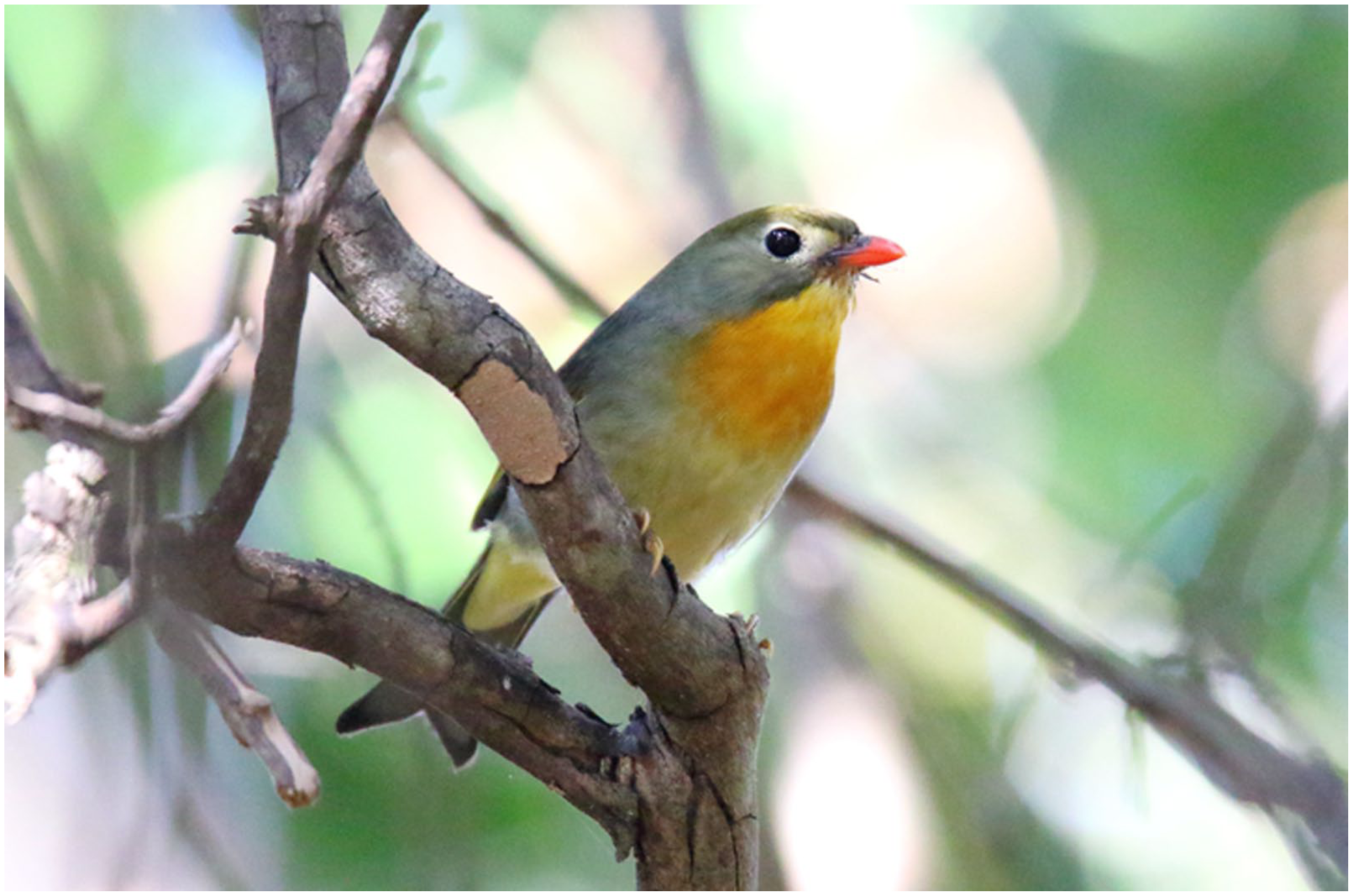
Red-billed Leiothrix.
Favourites of the ‘foreign’ songbird trade, ‘pekin robins’ were described in the mid-20th century by the prominent British aviculturalist Edward Boosey as ‘probably the most best-known and most widely-kept of all the foreign insectivorous species’.
42
Explaining their appeal, the ornithologist Douglas Dewar described them as follows:
This truly admirable bird is a songster of no mean capacity. Small wonder, then, that it has long been a favourite with fanciers. Moreover, it stands captivity remarkably well.
43
Notably, for both Boosey and Dewar, foreign songbird keeping was enabled by ties to empire. Boosey’s uncle was a well-known field naturalist collecting bird specimens in Borneo. 44 Dewar’s interest in songbirds, meanwhile, flourished during his employment in the Imperial Civil Service of the British Empire, as a barrister and later Accountant General of Punjab. These individual connections reflect the wider patterns of relations between foreign bird keeping and the circulations of empire that are discernible today in the ‘non-random’ distribution of naturalised birds around the world. 45
For most of the 20th century red-billed leiothrixes were readily available in pet shops in Europe and North America, comparatively cheap, and relatively easy to keep alive in captivity, making them popular choices for beginner songbird keepers. 46 Notably, before US and European bans on importing wild-caught songbirds in the 1990s and 2000s, respectively, almost all traded red-billed leiothrixes were wild-caught, as the cheapness of wild leiothrixes disincentivised attempts at captive breeding. 47 This is notable because the popularity and cheapness of a species in the pet trade increase the likelihood of individuals escaping into the wild, both because there is a larger pool of potential escapees 48 and because birds that are cheap and readily available are more likely to be carelessly kept, heightening the chances of escape or release. 49 In addition, the same traits that made red-billed leiothrixes good ‘starter’ songbirds – flexibility and resilience – make them more capable of surviving in novel environments 50 and, further to this point, wild-caught birds are significantly more successful at naturalising than birds bred in captivity. 51 It is unsurprising, then, that today significant naturalised populations of red-billed leiothrixes have been documented in Hawaii, Réunion, Japan, the contiguous United States, France, Italy, Portugal and Spain. 52
The predictability of their widespread naturalisation aside, it is perhaps more surprising that red-billed leiothrixes appear on a list of ‘invasive birds’ with the greatest negative impacts on local ecosystems, 53 a designation frequently repeated in research on their naturalisation in Europe. 54 This is surprising because, although red-billed leiothrixes have been shown to perform dominant territorial behaviour in staged confrontations with other songbirds in laboratory experiments, 55 they have not been observed engaging in such behaviour in the wild, 56 nor amongst avian communities composed primarily of fellow opportunistic-generalist species such as those found in Japan 57 and Spain. 58 Indeed, red-billed leiothrixes’ inclusion on a list of the most damaging invasive birds is based almost entirely on evidence of their impacts in the Hawaiian Islands, which include their resistance to avian malaria, which makes them a vector for a disease which has devasted native Hawaiian birds, 59 indirect competition with native species from niche overlap 60 and their role in dispersing non-native plant seeds. 61 That these have been very serious impacts on Hawaiian ecologies is undoubted, but, as I argue in the next section, these impacts cannot be understood outside of the particular eco-historical context, including the strucures of ‘sonic coloniality,’ 62 in which red-billed leiothrixes where brought to Hawaii.
Colonising the ‘avian desert’
In the early decades of the 20th century, red-billed leiothrixes were imported and intentionally released by the hundreds in the Hawaiian islands.
63
Intentional releases where orchestrated by both private and governmental actors seeking to increase the population of insectivorous songbirds to benefit the rapidly expanding plantation economy and to bring ambient birdsong to fill what settlers perceived as ‘avian deserts’
64
in the islands’ burgeoning lowland towns and tourist spots. In a 1911 report prepared for the Territorial Board of Agriculture and Forestry on the introduction of birds to Hawaii for the purposes of insect control, Prof H. W. Henshaw recommended red-billed leiothrixes, noting that, conveniently, it ‘would be easy to obtain this bird from San Francisco bird dealers’.
65
Official records suggest the first intentional releases of red-billed leiothrixes occurred in 1918 on the island of Kaua’I,
66
though as ornithologists Fisher and Baldwin later wrote, ‘some of the long-time residents believe Leiothrix was established in the Hawaiian Islands before 1918 by escapees from cages’.
67
Indeed, as Fisher later noted, intentional releases of imported songbirds in the Hawaiian islands were a frequent and poorly documented occurrence in the first decades of the 20th century, writing
it is worthy of mention that in many instances no one even knew at the time what was being liberated here; the records of the territorial agency concerned often simply state “500 small birds,” or list little-used colloquial names, or those used by dealers in birds. Furthermore, the home locale of the bird is not generally recorded
68
This passage reveals something more salient than the question of when exactly red-billed leiothrixes were first introduced in the Hawaiian islands, namely the extent of unrestricted and poorly documented releases of imported songbirds to the Hawaiian Islands in the early 20th century.
Significantly, the timing of this mass introduction of species – not only songbirds, but also mammals, invertebrates and innumerable plants – followed the illegal (under international law) annexation of the Hawaiian Islands by the US government at the end of the 19th century in service of strategic US military and business interests. 69 Within this context Kanngieser’s concept of ‘sonic colonialities’ as ways of listening that ‘are incribed . . . through fantasies of terra nullius’, enacting an imaginary that ‘supercedes very situated and site-specific relations of place’, 70 is intructive. In Hawaii, settler colonisation entailed the mass destruction of large swathes of the islands’ existing ecosystems, clearing forests first for plantation agriculture and housing for its associated labourers, and later for US military installations and tourist infrastructures. 71 Accordingly, hearing ‘avian deserts’ in need of songbirds can be understood as an effect of the sonic biases of Anglo-European listening, attached to particular types of birdsong and predisposed by settler colonial imaginaries to hearing space in need of populating. Moreover, hearing avian deserts in the Hawaiian islands depended on a mode of listening to nature that obscured the violent processes of colonisation responsible for creating these deserts. 72
The dispossession of native ecologies through which avian deserts were made on the Hawaiian islands is evident not only in hindsight, but in historical communications from the time. As Henshaw wrote in his 1902 account of Hawaii’s endemic birds:
it is not to be overlooked that the forest upon this and the other islands is being rapidly destroyed. Large areas are now falling before the axe preparatory to cultivation, and the birds that once inhabited them are being hemmed into tracts of constantly diminishing size . . . This wholesale destruction of forest will soon materially diminish the number of Hawaiian birds—nay, already has done so—and in a few years the opportunity to study the habits of some of the unique bird forms which have been developed upon these islands will be lost forever.
73
The demands of plantation agriculture thereby created the conditions of avian absence which red-billed leiothrixes and other songbirds were imported to fill such that their impacts on Hawaiian ecosytems must be understood through the wider ‘afterlifes’ of colonisation’s plantation logics. 74 Native Hawaiian birds ‘hemmed into’ ever diminishing habitat were made more vulnerable to the competitive pressures of niche overlap and introduced diseases. Replacing complex ecologies with monocultural plantations and ornamental plants created the conditions for red-billed leiothrixes to disperse the seeds of introduced plants. As such, focusing today on the impacts of red-billed leiothrixes as a damaging invasive species misses the larger drivers of ecological damage. As Audra Mitchell argues, focusing on invasive species as the cause of ecological harm is a distraction from the primary threat to native ecologies, namely the ongoing ‘structures of invasion.’ 75 Native Hawaiians have been actively resisting colonisation since annexation by the US 76 and while this resistance includes caring for native ecologies, 77 it is notable that the targeting of introduced species for removal remains a project of the settler state. 78
Kanngieser’s sonic colonialities and Mitchell’s invasive state underline the eco-historical specificities, indicative of wider colonial-capitalist processes of dispossession, that have engendered red-billed leiothrixes’ impacts on Hawaiian ecologies. To put this differently, the impacts of red-billed leiothrixes on Hawaiian ecologies cannot be understood outside the emplaced relations of colonial-capitalist dispossession in Hawaii. Scientific research on red-billed leiothrixes in Europe, however, continues to reference their presence on Martin-Albarracin et al.’s list invasive birds with the highest impacts as indicative of the risks they might pose to European ecologies, evidencing an assumption that the behaviour of a species is independent of the web of relations in which members of that species grow and live. 79
While a picture of their sonically driven impacts in European ecologies is starting to emerge (as discussed in the next section), these are of a different order to the devastating impacts that red-billed leiothrixes have had on the sensitive ecosystems of the Hawaiian Islands. The latter, moreover, are unlikely to be replicated to anywhere near the same extent in Europe, where native songbirds are also resistant to avian malaria, 80 niche overlap is a less immediate threat 81 and emerging evidence suggests red-billed leiothrixes are unlikely to play a significant role in seed dispersal. 82 Critiquing the assumptions driving the elision between the impacts of introduced species in one place with those they might have in another place, Laura Ogden writes that, instead of thinking about introduced wildlife through the limited lens of their biological species, ‘perhaps we should be considering, with wonder, how plants, animals and people become through their relations with other beings and things’. 83 Responding to this call, I turn now to the question of how red-billed leiothrixes are relating to other birds and wider ecologies in Europe, without presuming a replication of their relations within Hawaii. And, for songbirds, ecological relations in place are negotiated through song.
Singing the relations of place and planet
Birdsong, as Whitehouse has written, is not only central for humans’ sense of place, but also to how birds make places for themselves by ‘making relations with other birds and continually re-weaving the context of their lives’. 84 Songbirds sing during the nesting season, 85 enacting sonic territories within which they attract mates, build nests and raise their young. As Vinciane Despret unwinds in her extended exploration of birdsong in Living as a Bird, human observers have repeatedly filtered their understandings of these sung territories through anthropocentric, mostly Eurocentric, ideas about territory – alternately figuring it as property, finite resource, a check on population, a matter of market logics and so forth. 86 Despret troubles these modes of anthropocentric thinking about avian territories, highlighting ornithological studies that have attended more carefully to the lifeways of their avian subjects and setting these into conversation with a series of philosophical reorientations. Following Deleuze and Guatarri, for example, she directs attention away from territory as a defined thing and towards territorialisation as an ongoing, creative act that, for songbirds, involves the sonic intensities and rhythms of birdsong. Such intensities and rhythms, moreover, are not fixed through an abstract evolutionary process contained within the species but are enacted by individual birds in relation to other birds and the wider soundscapes in which they sing. Given this ‘endless inventiveness of bird behaviour’, Despret writes that the task for ornithologists and others is ‘not simply seeking to formulate different theories about territory but to observe and record the multiple different ways of territorialising’. 87 This varies across species of course, but also within species across places and shifting sonic relations.
Here, Despret picks up on sound artist Bernie Krause’s work on what he calls the ‘orchestration’ of ecological sounds 88 in which he argues that the sung territories of birds are not only spatial, but also sonically defined, with each species occupying a different sonic niche within the soundscape, singing in the intervals when others are quiet or at different sonic frequencies when singing at the same time, in orchestration with one another. 89 As Despret puts it, ‘living in a sung territory is also about accommodating to other birds, about being attuned to their songs’. 90 But while Krause argues that such intricate orchestration depends the longue durée of co-evolution within place, Despret remains ambivalent on the temporalities required for such sonic attunements (a matter to which I return in the next section).
As both Krause and the research of scholars in the transdisciplinary field of bioaccoustics have shown, ‘natural’ soundscapes increasingly involve anthropogenic sounds. 91 Beyond any aesthetic or affective resonances of this change may have for human listeners, for birds and other wildlife, anthropogenic sounds effect acoustic signal masking. That is, by overlapping other sound frequencies and/or increasing background noise, anthropogenic sounds can make it difficult for wildlife to hear sounds that they use for intraspecific communication and predator detection. 92 Unsurprisingly, given their dependence on sonic communication, songbirds are amongst the species most highly impacted by this anthropogenic ‘sound masking’. 93 Based on the established impacts of anthropogenic sounds on wildlife, Hopkins et al. call for more research on the impacts of sounds made by ‘invasive species,’ 94 arguing that such sounds could potentially have even greater impacts on local soundscapes than anthropogenic sounds due to animals’ higher levels of attunement to sounds made by similar animals and the higher probability that such sounds will overlap in frequency. 95 To support this last point, the authors cite, amongst other emerging work in this area, bioacoustics research conducted by Farina et al. 96 on red-billed leiothrixes in Italy.
In their analysis of soundscape recordings made in an Italian forest over the course of a year, Farina et al.
97
found that red-billed leiothrixes not only sang over other species of songbirds – singly louder and in overlapping frequencies to other birds in the area – but that they also sang for longer durations than other birds. That is, they sang throughout the day rather than only, or mostly, at dawn and they started singing earlier in the year, before other birds started singing in April, as well as singing on through August, well after other birds stopped singing in June. Given these findings, Farina and colleagues conclude that,
With its loud vocalizations uttered over the course of the majority of the year, this species can be seen as a new acoustically dominant species that broadly overlaps with the acoustic performances of the indigenous species, at least during the breeding season. Consequently, it is a potential modifier of the soundscape patterns of the local bird community.
98
This conclusion is the one echoed in Broughton et al.’s conclusion that, were red-billed leiothrixes to become naturalised in Britain, ‘its loud and frequent song could significantly alter the soundscape of Britain’s dawn chorus’. 99 While the press coverage that opened this article interpreted this conclusion in essentially anthropocentric terms – a threat to the beloved human experience of listening to British birds singing – a closer reading of Farina et al.’s 100 conclusion (and by extension the meaning of Broughton et al.’s cautionary statement) suggests something different. Their findings clearly show that the experience of listening (by humans, birds or others) is already changed by the addition of red-billed leiothrix songs. What they leave as a ‘potential’ is that this change will modify ‘soundscape patterns of the local bird community’. In other words, the addition of red-billed leiothrix songs is likely, in their view, to increase competitive pressures on other birds in the area, potentially reducing their numbers and therefore singing and/or prompting other birds to change their singing patterns in response. Consequently, the songs of red-billed leiothrixes are changing avian soundscapes in Europe (and in other places where they have naturalised), adding new strains and durations, interrupting other birds’ established patterns of singing. To put it glibly, from the perspective of Europe’s other songbirds, it is the red-billed leiothrixes, rather than the parakeets, who are ‘shouting in the face of robins’ (see above), though not, as the next section unpacks, ‘forever’.
Re-sounding spring in times of ecological crisis
In the summer of 2021, ornithologist Samuele Ramellini recorded a Eurasian Blackcap (Sylvia atricapilla) mimicking a red-billed leiothrix song in a response pattern to a singing red-billed leiothrix on Monte Artemisio in Rome. 101 Blackcaps were previously recorded singing their own songs in the gaps between red-billed leiothrix songs in Italian forests 102 and once previously observed in Italy partially mimicking a red-billed leiothrix song. 103 Accordingly, in place of the longue durée of evolutionary time required by Krause’s imaginary of ecological orchestration, Ramellini’s observation points to a much shorter timeframe of relational adjustments. Evocatively, preliminary research has also identified geographic variations in red-billed leiothrix songs between different locations in Italy, hinting that red-billed leiothrixes too are adjusting their songs in negotiation with different ecological communities. 104
In some ways, these findings should come without surprise. It has long been observed that the songs of conspecific birds vary geographically. 105 In addition, although the discovery of avian ‘dialects’ does not preclude that this could be the result of long periods of co-evolution within a given place, bioacoustic studies on the impacts of anthropogenic sounds on songbirds have unambiguously documented songbirds adjusting the frequency or volume of their singing to avoid having their signals masked by these novel sounds. 106 And, even in proposing that introduced species will have greater soundscape impacts that anthropogenic noise, Hopkins et al. concede that existing research papers on this matter ‘have observed that vocal adjustments reduce the masking . . . and concluded that vocal plasticity is the native species’ response’. 107
Foregrounding the capacities of songbirds to learn and adapt through lived experience rather than singing only along evolutionarily determined lines, Despret highlights research showing that individual songbirds adjust their repertoires in response to the particular songs of their neighbours. 108 We can understand these adjustments, according to Despret, as constitutive of communities wherein ‘melodies become signatures indicating that the birds belong in the same place, the same neighbourhood, thereby enabling them to recognize one another’. 109 Rather than singing according to evolutionarily defined species’ behaviour, then, we might understand blackcaps and red-billed leiothrixes in Italy as singing, in Despret’s terms, in response to their changing community of neighbours.
In Europe, Red-billed leiothrixes offer a sonically attuned example of recombinant ecological relations, 110 one that can be heard in the re-sounding relations of avian soundscapes. Like the contrast between territories and territorialisation made by Despret, recombinant ecologies move away from thinking about ecologies as settled states of relation and towards thinking of ecologies as processes of constantly becoming in relation. Research on red-billed leiothrixes in Europe has tended to emphasise their potential to rapidly spread and colonise the continent based on their successful naturalisation in Japan and Hawaii as well as early signals from research in western Europe. 111 It’s notable though that in the Hawaiian Islands, where red-billed leiothrixes have been naturalised for far longer than in Japan or Europe, their spread has not proceeded in such a linear manner. Rather, populations of red-billed leiothrixes in Hawaii have fluctuated dramatically over the decades, from being amongst the most commonly recorded birds in mid-20th century surveys on the islands of O’ahu, Kauai and Hawai’i to becoming rare or undetectable in the same areas only a few decades later, with populations currently seeming to have disappeared entirely from Kauai, remaining uncommon or rare in many areas of Hawai’i, and creeping up again on O’ahu. 112 What factors have contributed to these changes in fortune, and the difference in trajectories of populations on different islands, meanwhile, is unknown. 113 While maintaining that red-billed leiothrixes’ Hawaiian story cannot be transposed to their European one, I raise this point to underscore that ecological recombinance is not a new equilibrium, but something that is always ongoing.
Conclusion
This article opened with the prospect that red-billed leiothrixes might change Britain’s dawn chorus, a likelihood supported by emerging bioacoustics and ornithological evidence from Europe. But in the Anthropocene, Britain’s dawn chorus has already been changing – with or without the addition of red-billed leiothrix songs. Parts of the chorus are falling silent in the face of cascading anthropogenic threats to songbird survival, principal among which are not introduced species but climate change, pollution and human destruction of habitat. 114 Other parts of the chorus are getting louder, as songbirds raise their voices to be heard over anthropogenic noise or sing longer in areas where artificial lighting lights up the night. 115 Other naturalised species like ring-necked parakeets are already adding new chords in Britain’s urban and suburban soundscapes, joined by native birds like kittiwakes 116 and peregrines 117 as they move into cities from the sea- and countryside, respectively. This paper advocates for expanding what we might hear in red-billed leiothrixes’ singing in Europe and Britain beyond the ‘invasion’ of an Asian songbird, and toward a more attentive mode of listening to birds, hearing planetary crisis as well as modes of living together with/in the relations of place.
The sonically inflected stories of red-billed leiothrixes recounted above each open up expanded ways of hearing the Anthropocene within the singing of birds in place, listening beyond the iconic sonic register of avian voices falling silent and Whitehouse’s ‘anxious semiotics of the Anthropocene,’ 118 though both remain important registers of hearing ecological crisis in birdsong. The first set of narratives above listens for the webs of relations in which red-billed leiothrixes have been transported around the world through the circuits of colonial-capitalism and how the emplaced specificities of colonial violence and plantation afterlives are obscured by colonial-capitalist ways of listening. The second set of narratives considers how songbirds themselves listen to one another in places sonically marked by the Anthropocene, including through the amplification of anthropogenic noise and the introduction of new species, as well as how red-billed leiothrixes and their neighbouring songbirds are remaking their sonic relations as a means of surviving planetary crisis.
The observation of blackcaps and red-billed leiothrixes sonically attuning to one another’s songs, adjusting their own singing in response to the other, does not carry any assumption of harmoniousness in either the sonic or normative sense of the word. Relations, sung or otherwise, can be good or bad or both or neither, they carry no inherent normative valence. The meaning of this re-sounding of avian soundscapes – for blackcaps, red-billed leiothrixes and other avian and human listeners – remains uncertain. Yet, the sound of European blackcaps adjusting their songs to those of red-billed leiothrixes invites us to hear the dynamic sonic capacities of songbirds in the remaking of sung relations as a way of surviving planetary crisis – at least for now – with/in the sonic relations of place. The dawn chorus is changing; this paper calls for listening, with curiosity, to what we can hear in that change.
Footnotes
Ethics statement
This article is based on archival and desk-based research that, although exempt from review by a research ethics committee, was conducted in full compliance with the University of Manchester’s research ethics guidelines.
Funding
The authors disclosed receipt of the following financial support for the research, authorship, and/or publication of this article: The research, authorship and open access publication of this article was supported by internal funding from the University of Manchester.
