




Abstract
This paper explores the potential of sketching as a vehicle for ethical observation, or an ethical quality of attention, through research involving marginalised individuals. Sketching is a form of drawing, distinguished by immediacy and speed. As such, it has scope for observation of people and places, which navigates the ethical risks and opportunities of research by looking with a light touch. This means paying attention (not blanking or unseeing people) without looking too hard or for too long (staring or scrutinising others). Observational sketching can be distinguished from some forms of drawing, which involve more sustained, concentrated observation. This paper explores the ethical challenges of visual research where looking is particularly fraught – research involving homeless people at a major transport hub: Termini Station in Rome. It is very difficult, not only for researchers but also for others who move around the city, to know where to look when they encounter homeless people. These encounters bring risks, for example of staring at or conversely blanking homeless people. We propose a way of seeing, practiced through sketching, which steers between these problematic poles. Through a series of sketches, we explore different ways of using sketching as a vehicle for ethical observation. We argue that sketching can be ethical, helping to guide the observations of the researcher, cultivating their ability to notice, while collecting data about the experiences of marginalised urban lives. But the ethics of sketching are not simply a fait accompli. Rather, sketching challenges us to ongoing ethical reflection and responsibility, while leaving space for judgement and uncertainty about whether we have got it right.
Introduction
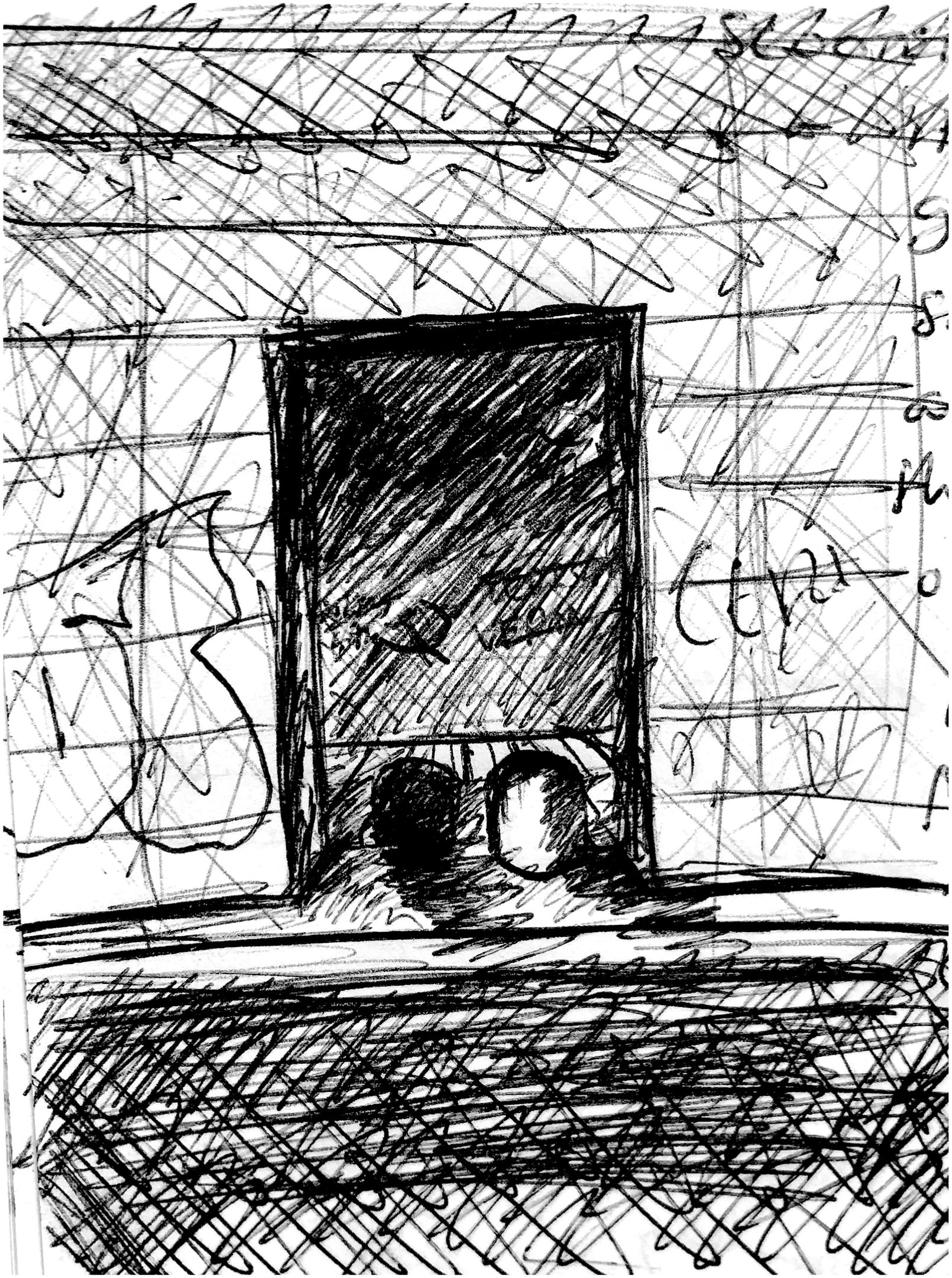
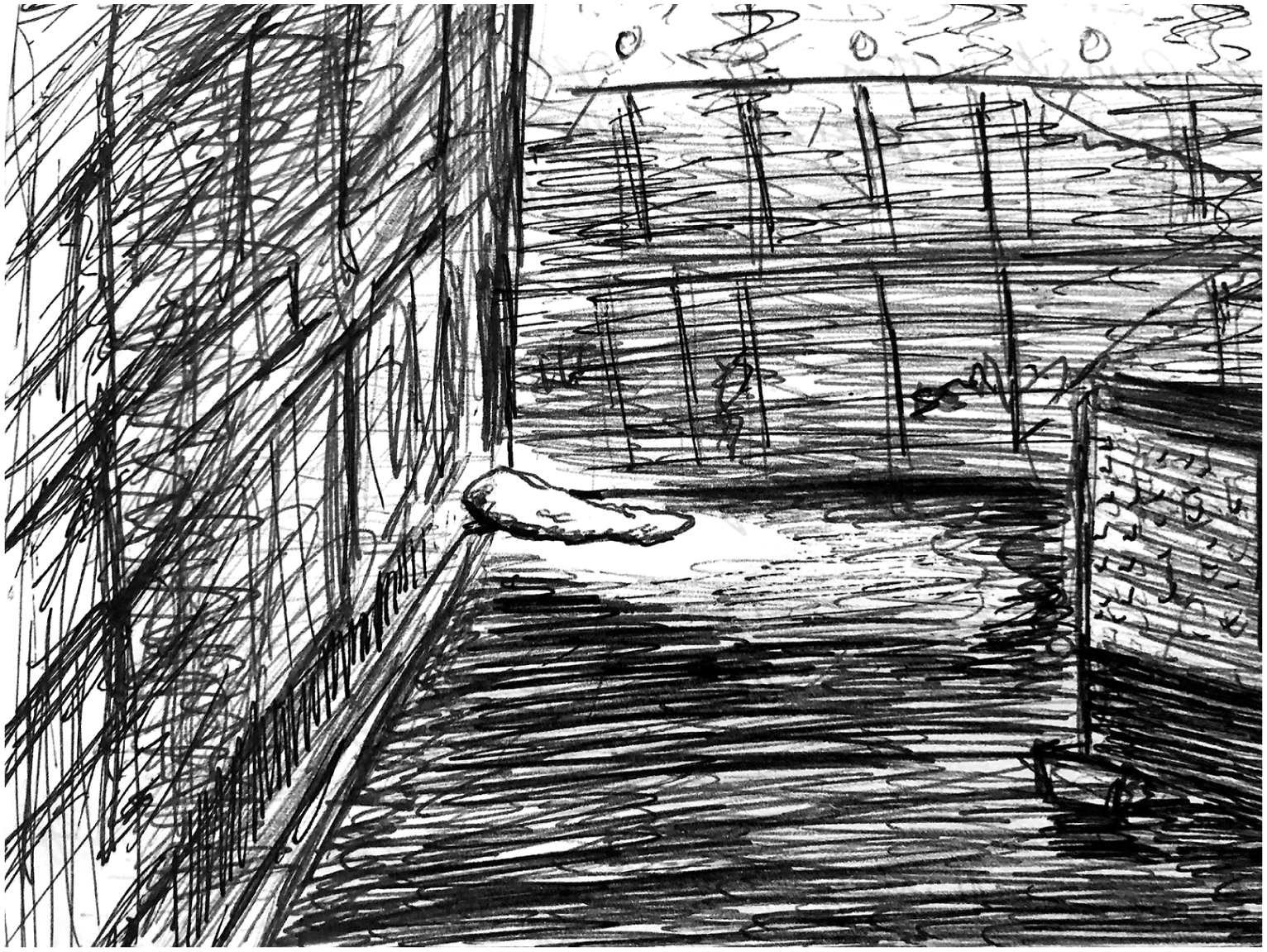
The sketch shown in Figure 1 is taken from fieldwork in Rome’s Termini Station. Termini is a transit point for commuters and travellers and is also where many homeless people live and sleep. The sketch is part of a visual research project exploring the visual encounters with homeless people in and around the station. The project was doubly visual in that it involved visual research methods but also paid attention to visual encounters, for example between homeless people and other users of the station.
Sketch showing bollards in the underpass where people rested and slept. Image by Will Haynes.
We have chosen to start with this sketch because it is so . . . sketchy: preliminary and quickly made, rather than artistically or technically accomplished. We will say more about this sketch later, exploring what it shows and the visual encounter it captured, but the value of the sketch begins with the questions it raises, the issues it prompts us to be curious about. 1 First, why might a field researcher make sketches? What might researchers choose to sketch or not to sketch? What can sketching reveal or help the researcher to notice? And what are the ethics of sketching – the ethical responsibilities and possibilities? How might sketching – and the visual encounters that revolve around sketching – make a positive difference to those involved, both the sketchers and the sketched?
But first it is necessary to take a step back, to ask a more fundamental question: what is a sketch? And what quality of attention does sketching enable? Sketching is a form of drawing, distinguished by immediacy and speed and by a particular quality of attention on the part of the person sketching. Though sometimes used interchangeably, the terms sketching and drawing can be distinguished. 2 Sketching is usually understood as a particular kind of drawing. 3 Drawing is a contested term, defying any simple definition, hence Tim Ingold’s less-than-straightforward description of drawing in the context of research as the act of producing ‘knowledge from the inside’. 4 Another way of putting this is as a sustained encounter between a researcher and their subject, expressed through marks made on a page, canvas or screen. Sketching, in contrast, is speedier, more provisional and impressionistic than (other forms of) drawing, with an unfinished quality. 5 Crucially, this distinctive way of making marks on the page is connected to visual encounter that involves observation with a light touch: looking (so not ignoring or blanking a person or subject) but doing so relatively quickly and indirectly (so not staring or visually scrutinising).
We compose the paper around a series of sketches, through which we build up a more distinctive approach to sketching as a vehicle for ethical visual observation or attention. Subsequently we make two main contributions. The first is to develop a methodology for ethical observation through sketching, and to share this in the hope that it may be helpful to others. The second is to develop this methodology through a series of field sketches from Rome. These sketches provide catalysts for methodological ethical reflection throughout the paper. Through them, we distinguish forms of ethical attention which are variously: interactive and up close; unobtrusive and from a distance; directed at things rather than people; concerned with fleeting, everyday moments and open to multidirectional encounters. In short, we seek to open up a new set of reflexive, ethical and methodological discussions on the practice of sketching at the urban margins.
We should also note the perspective from which we are interested in the visual and the boundaries of our analysis, in the context of the broad scholarship on the ethics of looking which is written about extensively elsewhere. 6 This paper asks questions about the ethics of sketching specifically and seeks to advance an emerging ethics in visual geographical research. It does this by exploring and critically reflecting on the conditions under which research develops 7 – the methodological practicalities, choices and consequences of sketching in and away from the field.
Though this paper is primarily methodological, it revolves around a substantive context and research project concerned with visual encounters between homeless people and others in Rome’s Termini Station. On a typical night, between 150 and 200 people sleep in and around the station. Many of them are migrants who have come to Italy from North Africa, West Africa and the Middle East, while others are Roma and white Italians. 8 Many of these people who sleep at and around Termini are homeless as a result of a number of factors including high land-rent costs, restrictive migration conditions, financial crises and general housing precarity in the city. 9 We use the term homeless (rather than alternatives such as unhoused or un-homed) because it comes closest to the term used by those who live in and around Termini, and also by local organisations who work with them, and others in Rome. Though this term – senzatetto – transliterates at roofless, it is usually translated as homeless.
This is a collaborative paper, involving a team of researchers working together. As we explain below, sketching involves a series of stages – we identify four – which begin before fieldwork and end afterwards. Will Haynes made the observations and field sketches while Richard Phillips and Ryan Powell were central to reflecting on experiences of observation and sketching, and interpreting the sketches, and also the process of writing this paper.
Visual encounters, ethics and sketching
In social research and in everyday urban life, visual encounters are important, filled with possibility and yet fraught with risks, which are particularly acute where the visual encounter is asymmetric, involving people who are socially marginalised or minoritised. For example, risks of seeing badly, perhaps intruding into the space or dignity of a homeless person if the researcher looks too intensely or directly, but also opportunities of sparking a positive and productive encounter if the researcher gets it right, as Sarah Pink has argued in the wider context of visual ethnography. 10 Conversely, not looking at all can also be thorny, bringing the risks that one is refusing to recognise another person, and actively ignoring them, though in other circumstances not looking can be tactful and respectful.
The challenges of visual research resonate with wider debates about how to engage with strangers, and about the risks and opportunities of civil and uncivil attention and inattention. 11 Many scholars in geography and visual social research more generally note the ethical challenges of working with marginalised populations, grappling with the potential risks involved and acknowledge that ‘doing’ geography can be risky. 12
Navigating these challenges is complex, but at best it can mean seeing better, seeing more and seeing ethically. Sketching can help the navigate the risks and opportunities of visual research, and in this paper we illustrate how, addressing taken-for-granted notions that visual methods ‘tell their own stories’. 13
The challenges of seeing well reach from research and fieldwork to everyday life. In large cities, for example, where encounters are well-explored, 14 people are far more likely to encounter each other through their eyes – glimpsing, noticing, staring and looking at each other – than by direct contact. Visual encounters matter, particularly where they reach across differences and inequalities and where social relations can be tense and awkward. At a railway station, for example, glances and other looks between homeless people and others – including commuters, police officers, restaurant staff, cleaners, security guards and tourists – are both strained and significant. This tension is two-fold: the awkwardness experienced by many people, which arises when they encounter others begging or sleeping outdoors; and the impact of these awkward exchanges on those who are observed. Many people react by looking away or blanking others. China Miéville, the urbanist and novelist, calls this unseeing. 15 These brief but harmful visual encounters raise questions – pertinent both to research and to urban life – about how to look differently.
Visual encounters with homeless people in railway stations and other public places can be empirically elusive, fleeting, ambiguous and hard to be certain about. We can never be sure how other people experience the moments when we make eye contact with them, or when we avoid doing so. Here, we take inspiration from Rosemarie Garland-Thomson, whose research examines and seeks to shift the everyday visual practice of staring. 16 Garland-Thomson argues that, though staring may begin as an involuntary and unintentional, awkward, asymmetric, even voyeuristic visual exchanges, those who find themselves staring or being stared at can steer this exchange, and in so doing shift its power relations and ethics. If Garland-Thomson holds out the hope that we can augment our ways of seeing, both in research and in life, we argue that sketching is one way in which we can do this.
Navigating these empirical challenges is complex, but for social researchers it might mean seeing better: seeing more and seeing ethically. Here, it is important to briefly explain what we mean by ethics and how our approach to ethics is novel. Research ethics are concerned with two issues: the intrinsic moral qualities of research, on the one hand, and its impacts and consequences, on the other. 17 Ethics are more than just the ‘do no harm’ approach of medical science. Instead, we can take a more pro-active social justice approach that addresses inequalities and vulnerabilities. 18 Geographers have situated ethics around tenets of care and responsibility, as well as a commitment to praxis that strives for ‘affirmative social transformations’. 19 Ethics are processual: what Elizabeth Olson defines as leading toward more robust engagements that can ‘better take account of times and spaces that we still struggle to incorporate into frameworks of responsibility’. While social researchers have produced diverse, rich insights on ethics, they might continue to think and explore research ethics to ‘help better understand and explain things such as inequality or unnecessary suffering’. 20
While we suggest that sketching is a potentially ethical methodology for visual research and fieldwork, it is not intrinsically or necessarily ethical. Like all other social research methods, it presents ethical risks and opportunities. Some might even say that there can be no ethical looking or obtaining of visual data from vulnerable people, due to issues related to privacy, institutionalisation or matters related to researcher vulnerability – even if the researcher strives to be responsible in doing the research. 21 Helen Kara however stresses that research ethics are iterative, involving continual reflection and judgement about potential for the harm that research can do and the benefit it can bring. 22 She argues that research ethics revolve around anticipation and judgement, ‘learning to think and act ethically’. 23 Some social researchers have criticised the ethical regulation of social research in the sense that it places unnecessary limitations on the process of research. 24 So, though we sought and obtained ethical clearance from our institution before beginning fieldwork, we saw that as the beginning rather than the end of our ethical reflections and responsibilities.
Sketching connects to questions about how we might anticipate, approach and enact an ethics of recognition in social research. 25 It can be used to address three sets of ethical considerations. First, how might researchers affect the people they are interested in, and how might the latter experience and be affected by their fieldwork? For example, how might a homeless person (or anyone for that matter) feel if a stranger gets out a notebook and writes or draws while looking in their direction? Or, if they are not aware they are being observed, as for example when a person is glimpsed sleeping outside, or when their images are viewed through a CCTV camera, how might data collection affect them, and is this data collection ethically responsible? We pick up these questions later in the paper, discussing our considerations of whether and how to sketch a person seen sleeping in a public place. Reflecting on how someone might experience or be affected by the act of fieldwork prompted us to develop methods that might in each case be positive and beneficial. Honneth has called for researchers to engage in and with struggles to be listened to or seen differently, for example. 26 Conscious that some visual research is experienced as intrusive or extractive, we sought to develop observational methods that could come across more positively. Sketching, as we explain and illustrate in this paper, involves looking with a light touch and making an equally fleeting visual record. In contrast with drawing, sketching is distinguished by brevity, immediacy and by making and recording visual observations without looking too hard or too long.
A second set of ethical questions are concerned with how to represent a person or scene. As an ethical minimum, social researchers typically seek to ensure the anonymity both of participants and also – where it is not realistic or meaningful to secure formal consent – ‘non-consenting others’. 27 Anonymity is particularly important in research involving marginalised and minoritised individuals, who may be deemed ‘vulnerable’ and not wish to be identifiable in any outputs. Representational questions then extend to the depiction, framing, languages, symbolic and affective aspects of images and objects. Homeless people and homelessness are frequently depicted through damaging and limiting stereotypes, 28 for example in clichéd pictures of dishevelled figures, drinking and taking drugs. 29 The challenge for more searching and critical research is to check such tendencies, counter dominant narratives and unsettle their blind spots. 30
A third set of ethical questions are concerned with the consequences of representing a person, group or place in a particular way. What are the risks of producing and sharing visual data that could be used to identify individuals, to authorities such as police and immigration officers for example? Conversely, might visual research be used to benefit participants and their communities? Exploring this possibility, Günter Gassner presents drawing as an ‘ethico-political practice’ of imagining alternative futures and possibilities, which reach beyond contemporary blind spots and explore new connections. 31
These three sets of ethical questions, which we continually revisited in the course of our work, guided our research design, explained in the next section. We present this methodology as one of the key contributions of the paper – not simply the method we adopted, but an approach we wish to share with other researchers.
Attention, inscription and interpretation: ethically driven methodology
Sketching, as an ethically driven visual research method, involves four stages, which are broadly chronological: observing; making a sketch; noticing experiences of observation and sketching; interpreting a sketch. We explain how we practised these stages in our research. The stages overlap practically and share some common threads including continual attention to cross-cutting ethical challenges.
The first stage involves preliminary Observation. There is a decision whether to observe and sketch people. An alternative, which may avoid being intrusive – may be to sketch things (like objects or animals). The next decision is how to observe or pay attention – whether to make eye contact, for example, and how long to look in the direction of another person or thing. We do not always like to be looked at, particularly if we sense some kind of threat or intrusiveness – someone ‘gawking’ at a disabled person, as Tom Shakespeare describes 32 – though we sometimes welcome attention and are happy to be acknowledged and recognised. It is important to reflect on the amount of time one can spend observing. Where it feels right to briefly observe and make a visual record, sketching can be an effective and ethical alternative to drawing, which demands more sustained attention. 33 Academics typically endorse the ‘attentive observation’, 34 care or ‘precision or exactitude’ 35 that is conventionally associated with practices such as drawing, regarding this as more disciplined and scholarly than the fleeting nature of sketching. Discussing this in terms of curiosity, philosopher Ilhan Inan distinguishes between ‘conceptual curiosity’ and instinctive or ‘behavioural’ curiosity, characterised by restless ‘novelty seeking, sensation seeking, or exploratory behaviour’, and argues that only the former belongs in academic scholarship. 36 Questioning this orthodox wisdom, other contemporary commentators ask whether sustained concentration is more insightful and recognise that for better or worse our minds and eyes wander, flicking between screens, things, ideas and people. 37 Psychoanalyst Adam Phillips suggests that we can learn from this rather than fighting it. 38 Sketching presents opportunities to do this, to seek deep insights in relatively brief encounters. 39 Finally, visual attention can instigate conversation, rather than merely observing. This can involve explaining the nature of the project or seeking permission to make observations. This was how Will began fieldwork at Termini, establishing relationships, long before getting out a field notebook. Having introduced himself to Termini-based organisations, while allowing those who lived around the station to get used to his presence, he sought explicit and implicit permission to remain there and make observations, eventually making notes and sketches.
The next stage in fieldwork involving sketching is of course to make sketches. This can be done in different ways, like sitting while overtly sketching someone or something. Other approaches include making traces in situ and refining these later on 40 ; at home or in a discrete spot. We could also sketch things or animals, using these to tell human stories. Urban sketcher Lynne Chapman suggests sketching telling details such as shoes and hands. 41 Focussing on non-human subjects can circumvent some ethical risks, but not all. Those researching homelessness must be mindful of stereotypes and clichés in their choices. Chapman adds that, when we do decide to sketch people, the next question is concerned with who to sketch, advising that it can be easier to sketch people on their own than those in groups because they tend to be more settled. 42 She likes to draw people who are absorbed in activities such as reading, sleeping or texting because they tend to be unselfconscious and still. These decisions are, in part, ethical, concerned with the impact of being seen to observe and to sketch others, as are decisions about asking permission. Chapman ‘never, ever’ asks permission. If you do that, she advises, ‘you’re stuck drawing a portrait’ and may feel obliged to achieve a likeness and flatter the subject. 43 Chapman is not alone in this; many human subjects of observational sketches are ‘non-consenting participants’; and this increases the researcher’s moral responsibility to them. 44 But sketching, like observation, can spark friendly and reciprocal urban encounters and dialogues. From these, other observations can flow. 45 It is not unusual for subjects – when they realise that they are being sketched – to come over for a look and a chat. 46
We agreed to experiment with sketching because we felt photography would be too intrusive alongside making our observations. With his first marks on the page, Will quickly overcame inhibitions about his technical and artistic ability, especially as sketching was helping him to focus, picking out telling details in an overstimulating environment:
Sketching emerged as a way of ‘attuning’ in.
47
I sat in a station café surrounded by moving bodies, lights, and a mishmash of architectural styles, materials and textures. But the atmosphere was more than just visual: coffee machines screeched, and holdall wheels clicked over paving stones. I smelt perfume, sweat, cleaning products, train tracks.
Other social researchers have come to similar conclusions 48 : ‘You are drawing to see, not seeing to draw’, as Andrew Causey puts it. 49 For Raymond Williams, ‘we learn to see a thing by learning to describe it’ and learning to describe it can involve learning to describe in words, through techniques such as photography, and through sketching. 50 Bringing these observations to sketching as a geographical fieldwork practice, for Tatiana Thieme, sketching became ‘a way of taking notice of details that might otherwise be fleeting, go unnoticed, or seem too ordinary to matter’ and a means of paying ‘really close attention to one’s surroundings’. 51 Through sketching then, we can learn to do these things better, though this is not necessarily or simply a matter of developing technical and artistic skills. 52 If we approach it as a form of research practice – collecting and interpreting data; disseminating findings and exchanging knowledge – we can measure our sketching practices and sketches by their ability to deliver on each of these objectives. 53
With these considerations in mind, around 30 preliminary sketches were made. Some of these rudimentary marks or scribbles were the basis for more sustained and annotated sketches, completed later on.
The third of the overlapping stages in fieldwork involving sketching is to notice what we are observing and to notice how we are doing it: noticing reflexively and recording all this in the form of field notes. A diary was kept to reflect on observations and on the sketches keeping a record of what helped us to notice and how. 54 These handwritten observations stand, alongside actual sketches, as data collected in the field (Figure 2). Mirroring how sketching and writing helped us to notice, 55 Sue Heath and co-researchers describe their observational sketching and drawing (terms they use interchangeably) as ‘concentrated seeing, an intense and immersive form of scrutiny’, that helps them to ‘really look’ at the world around them. 56
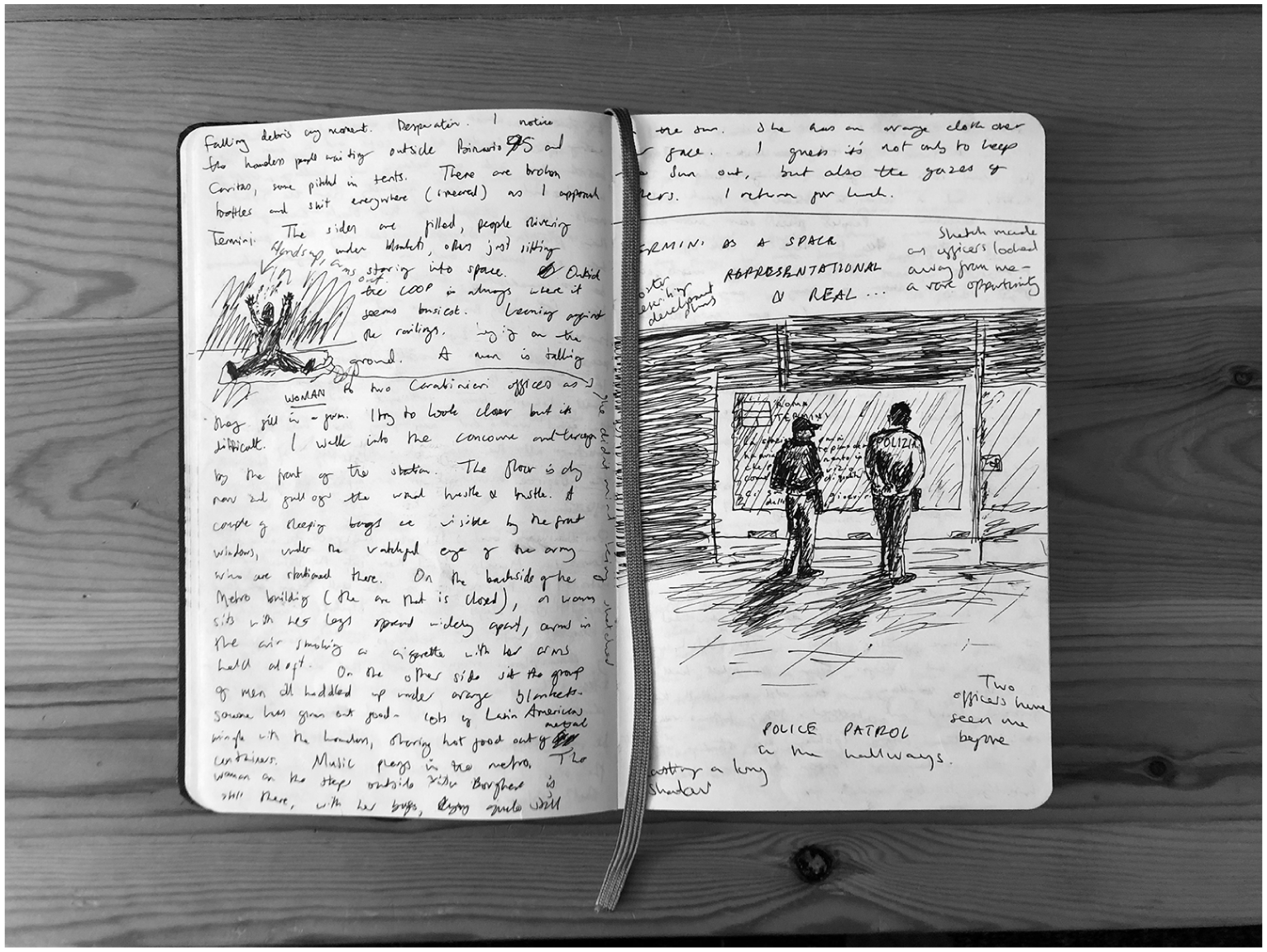
Notes from the field diary, recording experiences of noticing while sketching. Image by Will Haynes.
The fourth stage of field research that involves sketching is interpretation. We initially viewed the sketches as a byproduct of research, an object to be developed into research dissemination: shared in an exhibition, or a website, for example. Of course they still could be. However, what became interesting were the ethical navigations that accompanied the sketches via their interpretation. Once a sketch has been drafted or completed, questions arise about what it shows or means. Gillian Rose’s ‘critical visual methodology’ provides a useful guide, which applies to sketches as it does to other visual materials. Selected questions are particularly relevant, which we discuss in the next section presented alongside a series of sketches:
What is being shown? What are the components of the image? How are they arranged?
Where is the viewer’s eye drawn to in the image, and why?
What is the vantage point of the image?
What do the different components of the image signify?
Whose knowledges are being excluded from this representation? 57
Sometimes the interpretative stage meant returning to a sketch or adding to it after consulting Rose’s visual methodology. Having been initially sketched in pen, additional pencil marks to finish the sketch were made later (see Figure 3). Beforehand, this sketch of the homeless person was ‘floating’ on the page, not contextualised in a wider scene. Adding detail was concerned with research ethics and questions about inclusion: homeless people are not separate from the city but are an important part of it.
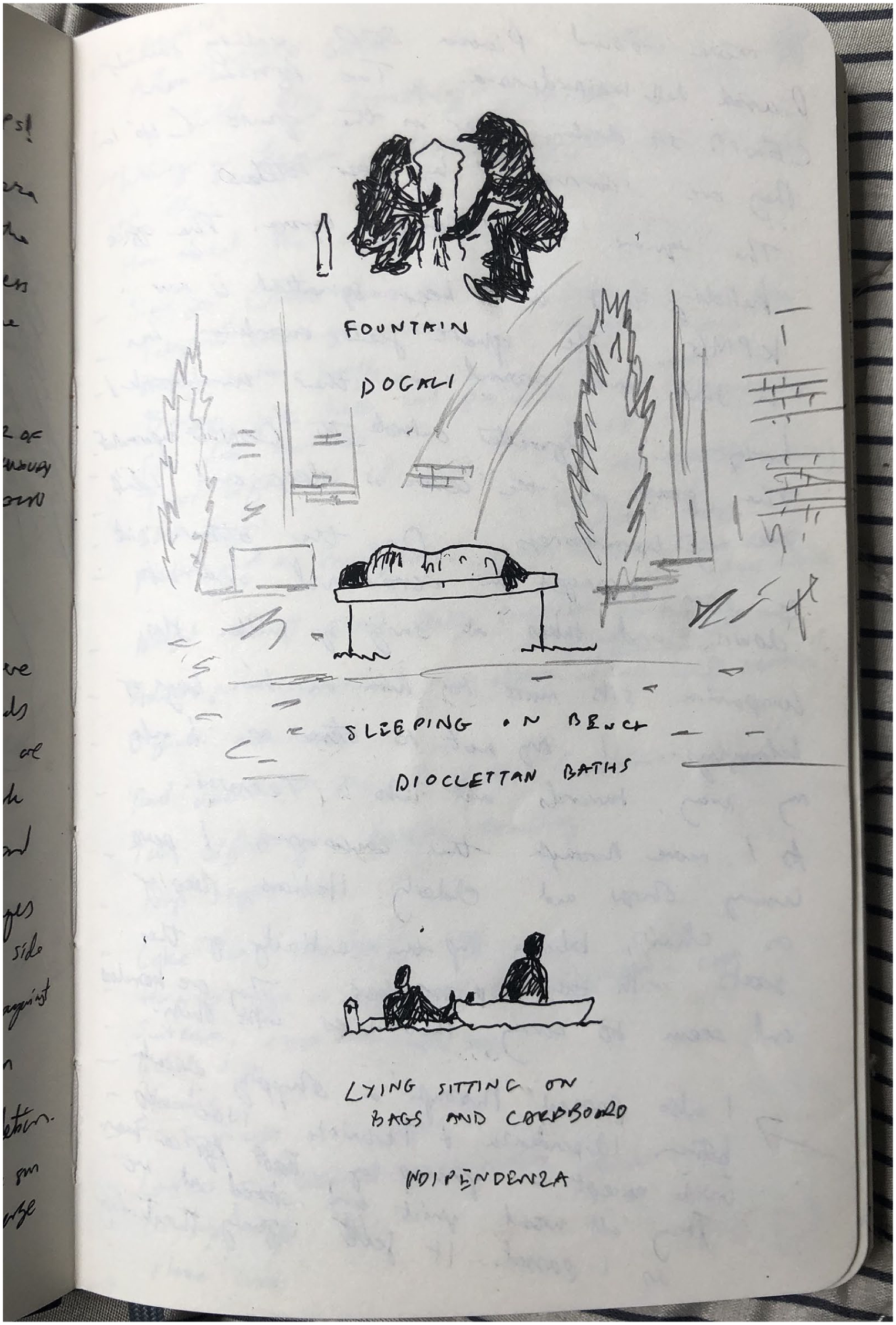
Three quick sketches showing retrospective amendments. Image by Will Haynes.
Ethical noticing through field sketches
We are now ready to develop the argument that sketching can be a vehicle for ethical visual research through five sketches, made during and after fieldwork around Termini Station in Rome. Some were drafted in real time in the field site, others from a discrete spatial or temporal distance. Sketches were also made following subsequent reflection and discussion involving the team. Through discussion of these images, we identify five ways in which sketching can be a vehicle for ethical research. These are: (1) sketching close-up encounters; (2) distant and unobtrusive observation; (3) sketching things rather than people; (4) capturing fleeting, everyday moments and lastly, (5) how these come together through wider visual encounters with others. We adopted and adapted these approaches for ethical reasons, which begin with anticipating and avoiding potential harm, and more positively seek to involve participants on their own terms and situated within their urban environments.
Sketching up-close
Sketching can elicit more equal visual encounters with homeless people, letting the researcher to notice people ‘up close’ without intruding or risking voyeurism.
As we explained in the previous section, the first step in field sketching is to observe. Visual ethnographers, working with photography, have noticed that it can help to be seen with a camera and notebook before taking any photos or making any notes; this can help people get used to the researcher’s presence and can also provide cues for people who may be curious and want to ask about the research.
58
This approach proved effective in our project. A man noticed and approached Will, as he describes in his field diary:
I sat down on a café chair. Three Carabinieri were drinking coffee on the next table. I was soon joined by a man with a long white beard wearing a bulky coat, holding a sleeping bag, with the carrying string wrapped around his shoulder. He sat opposite and pulled out a pile of crumpled paper and a pen. He looked at me, asking questions. As I answered, he busied himself, putting pen to paper. I already had my notebook out.
This incident illustrates how a notebook – doubling as a sketchbook – initiated an encounter that would eventually make it ethical and possible to make close observations. The man had invited contact whilst being occupied with his own sketching and writing. As noted above, Chapman advises that we sketch people on their own (rather than in groups) because they tend to be more settled, especially when engaged in activities of their own.
59
So, having established contact, permission to sketch was asked for.
So I asked, can I draw you? He nodded. Yes. Scribbling together in the upstairs food court in Termini, the Carabinieri next to us seemed mildly intrigued at first, but quickly returned to the coffees in front of them.
By mutual agreement, the researcher and the homeless man sat together, encountering and documenting each other, providing some reassurance about the power relations and thus the ethics of this exchange.
60
I was able to slow-down and ‘see’ the man in front of me. I noticed the details in his clothes, on his furrowed brow, and how he wrote furiously on the pages in front of him.
Rose’s framework for interpreting visual images helps us to interpret this sketch (Figure 4), which appears rough and unfinished. 61 It excludes a lot, for example the Carabinieri’s reaction, and the contrast of the hyper-commercialised environment. But despite simplicity, the sketch holds insights. With no backdrop: the sketch is all about the encounter. It centres the man writing about the researcher; it captures some visual tropes associated with homelessness; it documents a moment in time. Most importantly perhaps, it underlines the two-way (although not necessarily symmetrical) exchange that was taking place: the man was asking questions, ensuring that this would not be an extractive encounter and that the researcher would not be in charge.
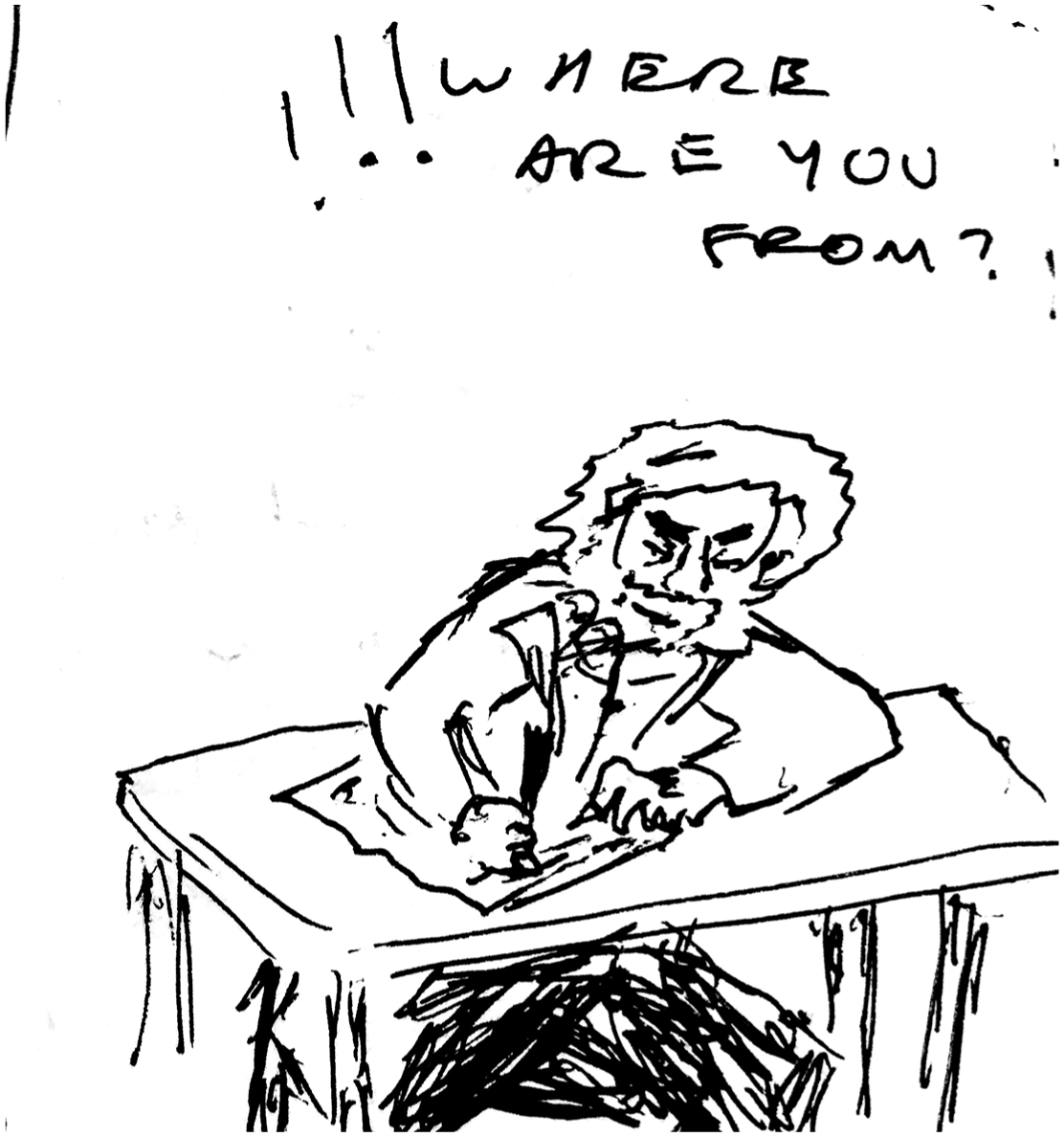
Sketch showing a homeless man writing in Termini. Image by Will Haynes.
Another ethical imperative was to reflect upon our visual and verbal language and resist harmful stereotypes. Those on the margins of the city are too often represented and viewed one-dimensionally and rendered hyper-visible against the backdrop of social and cultural norms. 62 In some respects, the sketch and its accompanying diary extracts echo visual tropes that are commonly applied to homeless people, carrying clothes and a sleeping bag and having an untidy appearance. And yet, this sketch is counter-stereotypical in other respects. The sketch, removing a homeless man from the station, from the watchful eyes of the Carabinieri and from the incongruous spectacle of consumption, humanises him as a writer, a conversationist and someone who is curious about others. This, at least, is what we have tried to ensure throughout this research.
Sketching from a distance
One solution to the challenge of conducting ethical visual research is to make observations and sketches from a spatial or temporal distance, where it is possible to be unintrusive. It can also help the researcher to ‘see’ or ‘notice’ differently. But how? The story of how we made a second sketch (Figure 5) offers a clue.
Sketch showing a person sleeping next to Termini station. Image by Will Haynes.
I turned a corner from the bustling station and found a sleeping person in an opening. Wanting not to be intrusive on what felt like a private, intimate act (albeit in an extremely public place) I only stayed long enough to glance and sketched at home.
63
As noted above, some researchers advise against asking permission to sketch. 64 Though we acknowledge this reasoning, we would normally ask, except where there is a good reason for not doing so. In the case described here, it would have been inappropriate and awkward to wake a sleeping person, attempt to explain the project and ask permission to sketch them. Since it was not possible to ask, we had to make a judgement about whether, when, where and how to make a sketch. We decided it would be ethically responsible to do so, committing to respect privacy and personal space and preserve anonymity and dignity. The sketch would not include any identifiable features and was then made later, at home.
The sketch depicts a solitary sleeping body in a vast open space with little to no shelter or protection. In contrast with the man, shown in Figure 4, this sketch includes contextual details. It situates the sleeping figure among shining lights and construction works and alludes to the choices that homeless people must make when deciding where to sleep. It gives the feel of a place where homeless people are left to sleep in public, against a backdrop of uncertainty and unpredictability about whether they will be moved on or disturbed. 65 Lying against the glass walls of the station, this figure appeared vulnerable, surrounded by a strange mix of darkness and nocturnal lighting, isolated in a hostile environment, lacking and in need of protection (or shelter or privacy). 66
We felt unsure about whether to sketch a figure at their most vulnerable, in sleep. We made, retained and finally share this image subject to the safeguards we have described. We discussed this sketch as a team, expressing views on either side, and questioned whether it was appropriate to include it in this paper. Though we collectively agreed that this would be appropriate, we wanted to share these uncertainties and the ways in which our ethical reflections and responsibilities followed us through the project.
It is worth mentioning that sketching from afar due to ethical considerations might not only concern the safety of the observed- and might extend to vulnerabilities of the researcher. 67 Researcher safety, relating to what Thieme calls the ‘vulnerable ethnographer’, 68 often takes a backseat to the safety concerns for the researched. Still, it is important to know when to sketch (or collect any kind of data, however speedily), when to observe or when simply just to glance or walk away. Aspects of researcher safety in ethnographic research can also demonstrably gendered 69 – here we must acknowledge our positionality and relative privilege in conducting this kind of research in a position of relative vulnerability. Standing alone outside a railway station at night time is not necessarily the safest environment – particularly when sketching can draw attention even if efforts are made to be relatively discreet.
Sketching things, not people
Where sketching people is not deemed justifiable, another approach is to sketch things or places instead. In the context of visual research with homelessness, sketching can not only sidestep certain ethical risks, but it can also help us to notice aspects of life that might otherwise have gone unnoticed. We might think of this, more formally, as the materiality of everyday life and inhabitations at the urban margins. This includes things, animals and places. Sketching this materiality and the changing cityscape might highlight the processual and dynamic nature of environments of displaced and mobile people (like the homeless people at Termini). Subsequently, this is suggestive about how individuals negotiate and change their surroundings.
To revisit the sketch introduced at the beginning of this article, Figure 1 depicts an archway in a subterranean tunnel that goes behind the station. Primarily a busy dual carriageway, the tunnel was adopted by homeless people as a place to sleep, rest and use the toilet. This remained the case for several years until the archways were concreted up in late 2023. Wanting to pay sustained attention to this important site without intruding into the lives of its homeless occupants, and rather than focussing on people living in the tunnel – and showing them eating, sleeping or resting against the bollards – sketching a ‘vacant’ scene allowed Will to stay for (a bit) longer and notice more.
70
Here he reflects on what and how he noticed, in the act of sketching the scene:
The sketch is an expression of what I was comfortable capturing at the time. To capture the sense of darkness, I pushed the pen down hard. In the next nook there were empty sleeping bags, blankets, and even tents. It felt invasive to sketch homely items without their owners here to speak for themselves, so I depicted an empty arch.
As these reflections explain, sketching things rather than people does not eliminate all ethical dilemmas, even if it can sidestep the most serious risks of intrusion. Even without the residents of the tunnel present at the time of sketching, we knew from our longer-term project at Termini that each archway had personal significance as a place of safety and rest – even if on the surface it seemed rather inhospitable. Archways were filled with personal items, small ornaments, blankets, food and drink.
Beyond its dark forms and shapes, this sketch is developed and detailed, echoing Thieme’s reflections on sketching as ‘a way of taking notice of details that might otherwise be fleeting, go unnoticed, or seem too ordinary to matter’. 71 The tunnel is dark, graffitied, artificially lit, its archways (seen in the sketch) interrupted with concrete bollards placed as an initial attempt to discourage sleeping. These are examples of defensive architecture and urban furniture (benches, bollards etc.) to control public space and its users. 72 A purposefully inhospitable place was nevertheless an important dwelling place for many homeless migrants.
This sketch can be contrasted with other depictions of the same place. Quoted in Corriere della Sera – the Italian newspaper – the municipality president stated in 2022 that, ‘Finally we bring the Turbigo tunnel back to conditions of safety and decorum’ revealing official responses to what is desired in public space. 73 Ultimately then, the sketch serves as a historical trace of a place that no-longer exists, a site of supposed discomfort and ‘unhomeliness’, which was nevertheless a dwelling space for some of Rome’s most marginalised people. In this sense it captures the dynamic relationship between homeless people and the built environment that they shape.
This sketch illustrates a potential to open up wider empirical and ethical questions. It raises questions about how to investigate everyday practices that are conventionally expected to take place in private and behind the scenes of public life. 74 In this sense the sketch connects us to the unwritten codes and regulations on conduct which shape homeless behaviours and the desire not to offend in public space. This invites new questions and avenues of enquiry. And the sketch raises questions about how it is possible to investigate such private acts while maintaining rigorous research ethics.
Sketching and noticing fleeting moments
Even though sketching begins with the act of observing, sketching and observing were almost simultaneous in the case of Figure 6 – a sketch of two homeless people posing in a theatrical, silly way. Capturing everyday encounters like this – and even in some cases eliciting them – can for example conjure a more nuanced view and appreciation of the everyday lives of people experiencing homeless. For example, we can notice something like humour pulling ‘people out of everyday life into a more playful’ atmosphere. 75 This also supports an epistemic reflexivity that questions and challenges established research instruments and lines of reasoning, like interviews or participant observation. 76 The ethical point is here is how sketching can help us to notice, capture and share details that reject the common narrative in which homelessness is a monolithic experience devoid of joy.
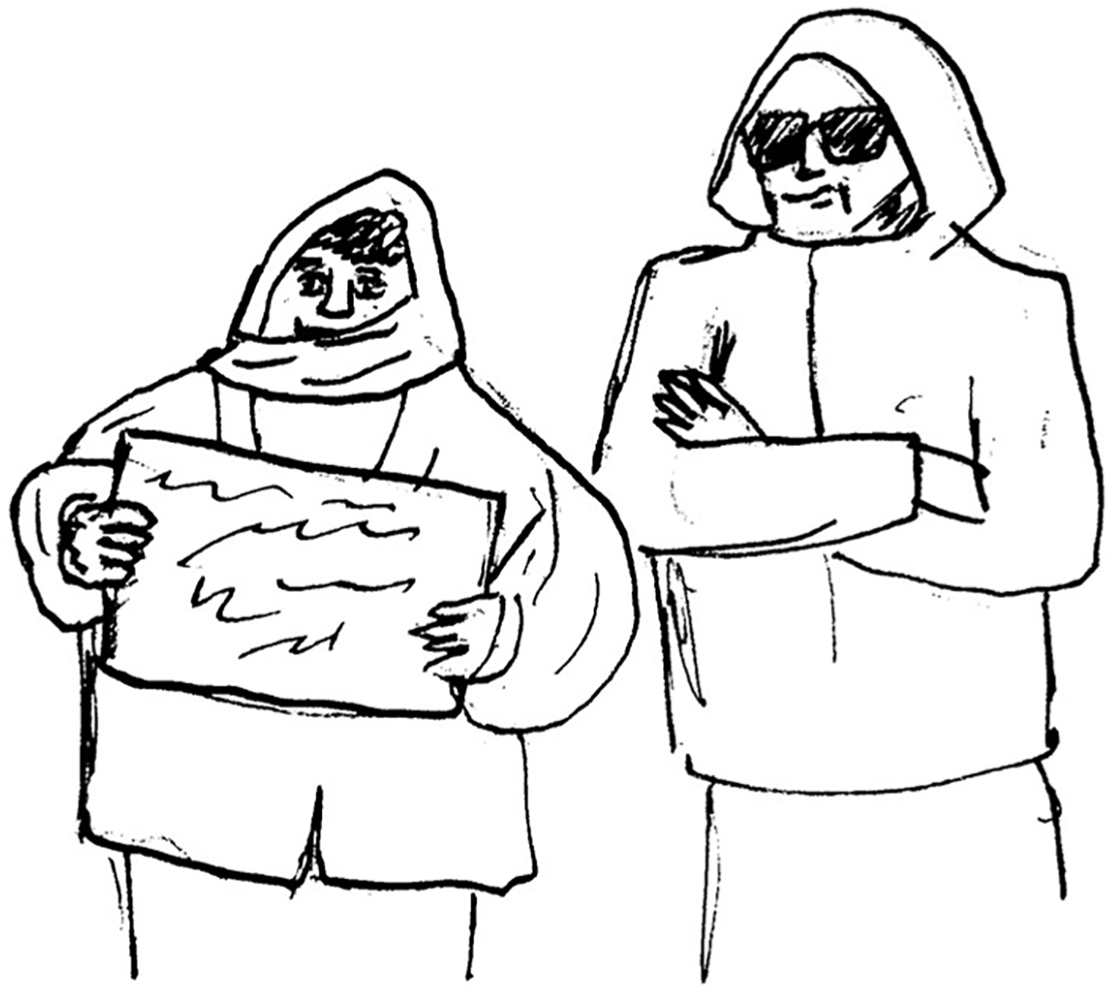
Two people pose on the street in a ‘silly’ way. Image by Will Haynes.
The two people in the sketch are distilled to just a few black and white lines on a page, although the theatrical expressions are plain to see. Far from being reductive, avoiding details, like a backdrop, or dialogue, or even colour remained a conscious choice.
77
Will reflects on the reasoning for this decision and the technical procedures we followed to achieve it:
I was challenged by a visually (over)stimulating field site. I wanted to be speedy and unawkward. Therefore, flattening the images to a rawer, monochromatic form seemed sensible. I was inspired by sketches from urban transit sites
78
and relied less on visual replication and aesthetic quality, and more on capturing feeling or atmosphere.
This sketch helps us to notice the relationships and solidarities between different characters who socialise together in Termini
79
:
The two people posing were joking around, showing a sense of camaraderie (although I suppose we don’t know exactly what was being felt). The man on the right in the sketch pulled up his hood and crossed his arms, looking tough in a theatrical manner. It was a small, fleeting moment but I felt it demonstrated a lighter side of life. Moments like this - seemingly frivolous in the context of some difficult experiences - can be difficult to document. Many happy moments do therefore go undocumented and perhaps under-represented.
This image illustrates a pro-actively ethical approach to researching homelessness, one in which we actively resisted tropes and stereotypes that portray homeless people in a negative and dehumanising light.
Sketching multidirectional visual encounters
As explained above, this study of homelessness in Termini was doubly visual in that it involved visual research but also investigated visual encounters, for example between homeless people and other users of the station. A final sketch (Figure 7) brings these themes together by exploring multidirectional visual encounters. It centres on a single figure, who seems close and in detail, yet also zooms out on a wider scene.
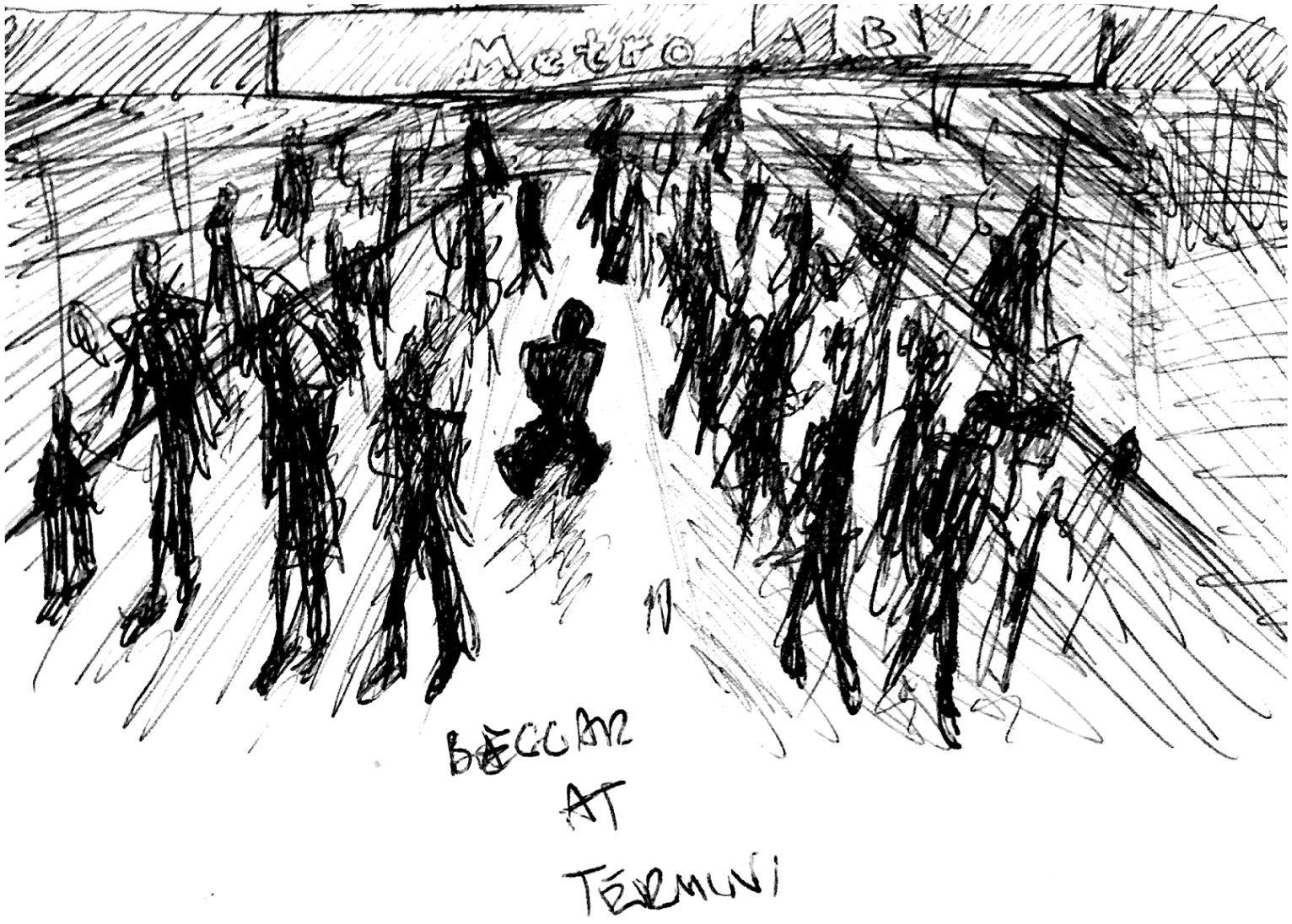
Sketch showing a beggar being bypassed by users of the Termini Metro. Image by Will Haynes.
At rush hour I turned a corner from the shopping mall and found a man on his knees looking down at the floor with his hands open. Hundreds of people were passing him, parting around his body, and no one seemed to look at him.
In a matter of seconds, from a nook by the entrance to the Metro, a quick trace of the image was made with pencil and finished on the Metro ride home. The sketch is rough and dynamic, distilling the scene to a central figure of the beggar and the faceless pedestrians rushing by into silhouettes.
This figure appeared vulnerable, surrounded by a complex interplay of affective responses of those rushing past him: perhaps shame, embarrassment, indifference, impatience, hunger. We can’t know what was going in through others’ heads in that moment. What we can observe is that the central figure appears isolated in a hostile environment and hyper-visible.
80
Much like the sleeping figure in Figure 5, we felt unsure about including an image of someone appearing comparatively powerless: on their knees begging for spare change. We recognise there were elements of judgement involved, and judgement negotiates rather than eliminates uncertainty. But rather than exceptionalising the beggar, the sketch suggests the act of collective unseeing among the crowd, so this image is more about the passers-by, parting and looking through the begging figure, than it is about the latter. It explores the complex and powerful atmosphere of separation and alienation, and captures something profound, yet difficult to capture empirically, in a fleeting moment of unseeing, which resonates beyond this immediate moment.
Conclusion: leaving a trace
When sketching, we leave a trace – on the page and on other people. We begin with a trace on the page of notebook, a mark or inscription, recording an observation of someone or something. But our sketches can also leave a trace on others through the impressions we make on others during fieldwork, and through our findings, which generate new knowledge and inform ways of doing research. In each respect, traces are tentative, lacking the certainty of bold outlines and hard data but, precisely because of this gentle approach, retain a sensitivity towards others, which may be both insightful and ethical.
While we could claim to have clear answers to ethical dilemmas, we acknowledge loose ends and uncertainties. Ethics involve ongoing and iterative reflection and decision making which begin rather than end with obtaining ethical clearance from institutions and from funding bodies. Likewise, social researchers are often encouraged to affect certainty about their ‘water-tight’ ethical approaches and whilst fully embracing the imperative goal to do-no-harm, we encourage openness to ethical uncertainties. Like a trace – research ethics are perceptible, and sometimes fragmentary, but not always sharply defined. But they should always guide us, and we should strive to do things better. Rather than a solution to ethical challenges, sketching may be seen as a vehicle for ethical reflection and decision making, reminding the researcher of their responsibilities to others and of the ethical potential of their efforts.
To take sketching seriously as an ethical approach is to recognise the value of a quality of attention that may be fleeting rather than sustained, involving indirect visual contact rather than staring at others. As we have shown with reference to sketches from Rome, without intrusion or voyeurism, sketches can facilitate interactions up-close but also help us notice complex urban atmospheres, materialities, processes and fleeting moments from afar. As a method that can also capture the materiality of everyday urban life, sketches can allow researchers to document ongoing changes in the built environment and landscapes used by homeless people. This can help reveal how they inhabit these spaces and how, in contrast to dominant narratives of nuisance, vice and anti-social behaviour, their behaviours are often (self-)regulated by the unwritten codes governing urban space. Sketching can also trace subtle details and fleeting expressions, offering insights into ordinary experiences that shape daily life for people experiencing homelessness, reaching beyond stereotypical and monolithic representations.
But how might sketching – and the visual encounters that revolve around sketching – leave traces on people and places? How might it make a positive difference to those involved, both the sketchers and the sketched? First, the ethically driven sketching practices which we have shared in this paper are transferable, adaptable to other settings involving sensitive visual research, where it is important to navigate the risks and opportunities of paying visual attention to others without looking away, but also without looking too hard.
Second, the implications of this paper reach from visual research to an observation that visual encounters matter. In life, as in research, we might learn from sketching and the quality of attention it teaches us, disrupting and shifting some ways of seeing and being seen that can be harmful to those involved. For example, while visual encounters between homeless people and others are often awkward, uncomfortable or harmful, they might be different, if we can learn to look differently, unlearning and relearning visual habits. This is a complex challenge but, as Garland-Thomson argues through her work on staring at visibly disabled people, 81 it is possible to disrupt habits and learn to see each other differently, and to apply these principles to our daily lives. So sketching has lessons for life, and for improving non-verbal relationships. Taking a first step towards this wider challenge, sketching in Rome precipitated a series of small, fleeting moments and seemingly trivial encounters. Sketches acted as catalysts for interpersonal contact that would not have happened otherwise. These humanising exchanges challenged stereotypes and led to mutual understandings. Sketching defused some of the awkwardness of these encounters, and opened channels for empathy and brought some closeness. Seemingly small steps such as these can take on greater significance, as sketches become an invitation to alternative futures in the felt and muddy experiences of urban life.
Footnotes
Acknowledgements
Firstly, a special thanks all those included in the sketches from Rome. We also extend our thanks to Harriet Hawkins and the anonymous reviewers whose thoughtful comments pushed us to refine and strengthen our ideas. Thanks also to the community of creative geographers at the Nordic Geographers’ Meeting 2024 in Copenhagen whose positive engagement gave us encouragement to develop our ideas and to be open to observational uncertainty.
Data access statement
The sketches associated with this study are publicly available and can be accessed via the following DOI: 10.6084/m9.figshare.28651646. Please contact the corresponding author for any additional inquiries.
Ethics statement
Ethical approval for this study was obtained from the University of Sheffield’s University Research Ethics Committee (UREC).
Funding
The authors disclosed receipt of the following financial support for the research, authorship, and/or publication of this article: This research was partially funded by the Arts & Humanities Research Council [grant number AH/R012733/1] through the White Rose College of the Arts & Humanities.
