




Abstract
This paper investigates ‘AI refusal’ by analysing how colonial and racialised logics inform the surveillance and representation of Mexicans through facial recognition technologies. Blending conventional academic analysis with a fictional vignette and a visual triptych, the paper offers a creative-critical approach to resistance. The vignette evokes the emotional and embodied impacts of surveillance, while the triptych employs visual metaphors to challenge reductive representations and affirm selfhood across the lifespan. Together, these methods provide cultural geographers with tools to examine the affective, symbolic and material dimensions of surveillance, resistance and collective memory.
Keywords
Introduction
Recent reports in the Mexican press have indicated the deployment of AI-based facial recognition technology by Chinese companies in various Mexican states. 1 Originally optimised for East Asian features, these AI-based facial recognition systems had to be, according to their developers, ‘tropicalised’ to recognise Mexican faces. The concept of ‘tropicalisation’ underscores how these technologies continue to reinforce and reproduce settler imaginaries – structures of colonial knowledge and power that shape how Mexican people are perceived and represented in technologies of identification. 2
The paper opens with a fictional vignette and a visual triptych, each playing a distinct role in a creative-critical engagement with the geopolitics of algorithmic surveillance in Mexico. The vignette, through speculative narrative, emotionally engages with the racialised impacts of machine vision, exploring how surveillance technologies misread and erase culturally specific identities – especially those shaped by colonial histories and Indigenous worldviews. The visual triptych, in contrast, uses visual metaphors to critique these technologies, while also acting as a form of resistance by reasserting identity through self-representation. Together, these methods respond to a shared question: how does machine vision fragment, misread or erase identities, and how can creative methods reimagine these processes? The face, represented in both the narrative and the imagery, emerges as a contested surface: rendered legible by biometric systems, yet reimagined as a site of refusal and relational meaning. This pairing unsettles the boundaries between fact and fiction, visibility and erasure, presence and loss.
What follows is a hybrid mode of inquiry that weaves together academic analysis with creative practice. This creative-critical methodology is intended to generate a space in which multiplicity, contradiction and ambiguity can emerge as valid epistemological positions. By deliberately blurring the boundaries between the real and the speculative, this approach resonates with ongoing concerns in cultural geography around extending more-than-representational thinking by foregrounding how knowledge can be enacted, felt and performed as much as articulated. 3 In settings shaped by AI surveillance and algorithmic abstraction, creative-critical practices provide a means to interrogate how power operates across uneven terrains of recognition and control, 4 while foregrounding how meaning is produced, contested and felt. 5
The hole in my soul, the whole of our face
Dawn breaks in Ciudad de México. A woman wakes up abruptly, as if pulled from a grim dream. Her head feels emptier, like that of a puppet, una marioneta. Looking for a mirror, she finds, to her disbelief, she has lost the south of her face! One could see the room through the hole, across the skull – a chunk in the shape of a country, it seems, a hollowed cornucopia, long, large and curved. What nameless terror could have caused this? Was it permanent? Could it be mended? She needed help.
The woman rushed to the street, eager for answers. A small crowd gathered in wonder, staring at the emptied part of her face, the invisible truth. Look, someone said, a thin straight line is appearing across her face! That’s a phrenology line. I saw one just like it on a museum, on a plaster cast head. No, said another, that’s the line of a border! La frontera nos cruzó, dividing our bodies from head to toe, erasing memories, perhaps the south of a face, we never know.
This is something different, said a third person. The hole and the line are machine-made, with a precise intention and cut. This was made by the eye of a camera, a face taker, a video maker, a lens of control. They say they are intelligent now, that machines can learn. But they have to be fed, swallowing all kinds of people, young and old, even the children if you let them. They just take what they want, ears, eyes, noses, mouths and chins, the distance between them, the geometry of life, the name of each soul.
An elder replied – Machines are not that clever, you know! They confuse our faces with Catrinas, the eyebrows of Frida and sugar skulls. Can machines learn the story of the Olmec, Maya, Zapotec, Teotihuacan, Purepecha and Aztec? Can they comprehend our land, our pueblos, our empires, our struggles for independence, the revolutions? Can they learn of our writers, our painters, our heroes, our migrants? Can machines understand our languages – Nahuatl, Yucatec, Tzeltal, Tzotzil or Mixtec? Machines do not know the South, so they have to steal it or dare to invent it, risking getting it wrong.
I refuse to live incomplete, asserted the woman. Take my pencil, said a little girl. You can draw your own face and teach the machine to respect our rights. There’s a camera right here. You can speak to the owners and make them understand. The woman faced the camera and spoke – Do you see this pencil, this hand of mine? Watch as I fill the hole, the part that you stole. Do you see us now? Can you recognise the power of the many, the shape of a crowd? Look closer. You will never take the South from my face again, because it is not in my head, it is in all that I am, in everything I do. My face belongs to them – the community standing behind me, not to you!
The fictional vignette was developed as an imaginative intervention to explore the affective, racialised and geopolitical dimensions of facial recognition technologies in contemporary Mexico. The story resonates with non-representational and more-than-representational approaches that foreground affect, storytelling and sensory geographies as critical modes of inquiry. 6 The vignette also draws inspiration from speculative traditions in Chicana feminist writing 7 where storytelling becomes a means of refiguring dominant epistemologies and asserting alternate ways of knowing and being.
For the visual section of our creative exploration, we employed the text-to-image generator Midjourney, an AI-powered tool, writing the prompt – ‘realistic image of a Mexican woman, seventy years old, expressionless, wearing a simple black t-shirt, in front of an empty grey wall’. We repeated the process to generate images of a forty-year-old woman and a six-year-old girl (Figure 1). The resulting images, realistic in appearance, are nevertheless fictional characters. Intending to disclose algorithmic stereotypes, we aimed to have the generator focus on the facial and phenotypic characteristics of a hypothetical Mexican woman, ensuring consistency in the setting by standardising the space, attire and stance. To enhance the heuristic potential of metaphor in these portraits, we downloaded the image files and edited them using digital collage. We added the outline of Mexico’s map, an Olmec jade mask, marigolds, a jaguar’s head and a huizache branch. Additionally, we inserted a fragment of Diego Rivera’s Vendedora de Flores over the girl’s shoulder.
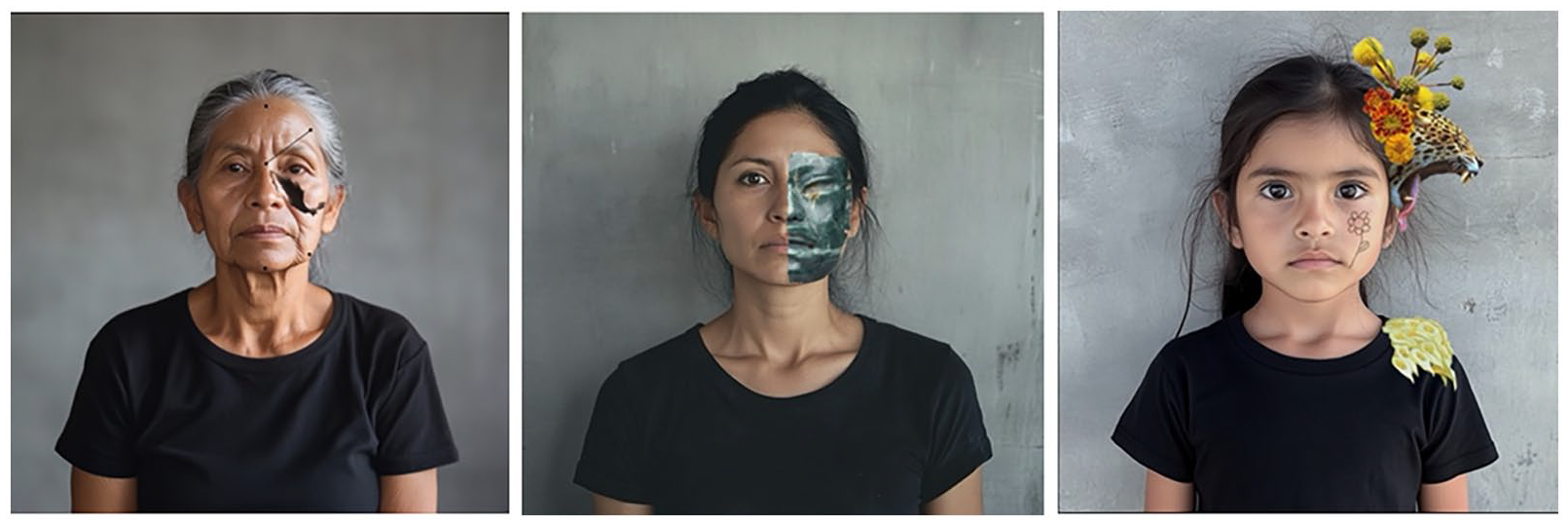
Triptych. The Hole; Our Soul; Whole (2024) Midjourney AI-generated portraits reworked by the Noronha with digital collage.
Collective refusal of the algorithmic gaze
Our fictional vignette and visual triptych together present an alternative reality where the tangible consequences of extractivism are made visible and felt on the body. The vignette explores the implications of surveillance, using the woman’s altered face to symbolise the erasure of cultural and political identities. In a moment of collective reflection, an observer notices a line emerging across the woman’s face, identifying it as a ‘phrenology line’ – a metaphor for how biometric technologies extend colonial techniques of classification, inscribing racialised borders onto the body in the name of security and legibility. In a later scene, an elder and a young girl – figures representing generational continuity and cultural resilience – urge the woman to redraw her face. This act of self-inscription becomes a refusal of machinic abstraction and a reclamation of agency, resonating with decolonial and feminist reimaginings of nationhood as a relational, more-than-human formation grounded in land, memory and reciprocity. 8 Rather than a singular act of resistance, this gesture exemplifies refusal as redirection – a turning away from dominant logics and a movement toward alternative ways of being, sensing and imagining collective futures.
In parallel, the visual triptych provides a more analytical representation of the generational impact of facial recognition technologies. Through the three panels, each depicting different life stages – childhood, adulthood and old age – the triptych critiques how biometric technologies reduce complex, culturally embedded identities to data points. In the first panel, the hollowed shape of Mexico’s map signifies the erasure of personal identity, while the second incorporates the Olmec jade mask, underscoring the deep cultural and historical roots that AI systems fail to recognise. In the final panel, visual fragments of Mexico’s flora, fauna and iconic art represent the land’s cultural and territorial significance – an element facial recognition technologies cannot capture. The hand-drawn flower on the girl’s cheek further symbolises an act of ontological self-definition, resisting the reduction of identity to external control. Together, the vignette and the triptych offer complementary methods – emotional engagement through speculative narrative and visual critique – to expose the intersection of the personal, the political and the technological. Through these methods, the paper explores the embodied effects of surveillance, the potential for resistance and the reassertion of collective memory, while blurring the boundaries between the ‘real’ and the ‘imagined’. In doing so, it offers cultural geographers new tools to understand the affective and symbolic dimensions of biometric control and its contestation.
Conclusion
This paper has explored how creative-critical methods – particularly fiction and visual experimentation – can intervene in the politics of algorithmic surveillance. Rather than offering a straightforward critique, this work stages refusal as an imaginative, place-based practice: one that disorients extractive and data-driven epistemologies and reclaims the right to narrate, represent, and be seen differently. By treating fiction and visual methods not as illustrative but as constitutive of critical knowledge, this work invites cultural geographers to engage with the politics of storytelling and image-making as essential tools to interrogate the spatial politics of AI and to envision alternative epistemologies that resist dominant representational regimes.
Footnotes
Acknowledgements
The authors would like to express their sincere gratitude for the inspiration and insights gained from the seminars organised by the AIDA Social Sciences Research Network, an independent group focused on exploring the social, cultural and political implications of Artificial Intelligence, Data, and Algorithms (AIDA).
Ethics statement
The authors declare that they have no personal or professional conflicts of interest that could have influenced the research or the writing of this article.
Funding
The author(s) disclosed receipt of the following financial support for the research, authorship, and/or publication of this article: This paper benefits from resources provided by the Advanced Grant ‘fAIces - Facial Recognition Technologies: Etho-Assemblages and Alternative Futures’ (grant agreement number 101140664), funded by the European Union, European Research Council and awarded to Helena Machado. Views and opinions expressed are however those of the author(s) only and do not necessarily reflect those of the European Union or the European Research Council Executive Agency. Neither the European Union nor the granting authority can be held responsible for them.
