




Abstract
In research on public art, there is a tendency to link art’s transformative potentialities to its temporal dimensions, namely duration, rhythm and the type of social relations they produce. However, beyond acknowledgement of what it might do, temporality received little conceptual attention. Using The Garden Library as a case study, this article foregrounds temporality as a theoretical and methodological framework to examine public art’s performative and structural patterns. The Garden Library is a multi-lingual and cultural space for refugees and migrant workers founded by the art group Arteam in the southern neighbourhood Neve Sha’anan, Tel Aviv in 2009. This article traces the project’s changing temporalities and considers how they create an inclusive time-space that is largely unavailable for the migrant communities living in Israel. It largely draws from art history and human geography scholarship to conceptualise time and temporality in relation to space, practice, and displacement and to further deepen our understating of the unique modes of knowledge and socio-political critique public art enables. The article also brings forth the entanglement of multiple oppressed temporalities, including native Palestinians and non-Jewish refugees, and reads the Garden Library against the background of Israel’s settler-colonial and ethnocratic state. Centring temporality, therefore, has two goals. The first is to examine the usage of time, alongside space, as a control mechanism and to draw links between shared experiences of dislocation and dispossession that are often studied separately. The second is to amplify the occasional collisions and intersections of marginalised temporal landscapes, including that of the Mizrahi (Arab-Jews) working class residents of Neve Sha’anan, and the possibility of such moments to produce counter-temporalities that adjust and resist forms of spatio-temporal power.
Introduction
The Garden Library was built for the foreign communities in Israel, a population the Israeli society refuses to open the door for them. They are not foreign for an hour, but are obsolete strangers, representing the opposition of everything that is settled and integrated: They are transient people, depended on temporary work permits, deprived from housing, eternal candidates for deportation and wandering. They are foreign not only in their origins and mother tongue, but in their being a prosthetic to society, for living outside the social pattens of their environment.
1
The Garden Library for Refugees and Migrant Workers (hereafter, The Garden Library) is an educational and cultural centre located in the Neve Sha’anan neighbourhood, south Tel Aviv. It was founded in 2009 by Arteam, a multi-disciplinary group consisting of established art professionals Romi Achituv, Marit Benisrael, Yoav Meiri, Hadas Ophrat and Tali Tamir. The library contains about 3,500 books in 18 languages and organises a range of events, workshops and educational programmes. Since its opening, The Garden Library has faced multiple challenges including a lack of funds and municipal support, evacuation threats, and a hostile environment that does not acknowledge nor accommodate the needs of the migrant communities living in Israel. In 2013, The Garden Library underwent organisational changes when a new professional team with training in social and humanitarian work was recruited to continue and expand the library’s activities.
The Garden Library is an example of an urban art intervention that appropriates public space and time for the purpose of socio-political critique and direct action. Recent cultural geography studies have highlighted the transgressive potentiality of art interventions to question prevailing social categories. 2 They join an extensive, cross-disciplinary scholarship linking public art’s subversive capacity to its temporal dimensions, namely duration, rhythm and the type of experiences and social relations temporality enables. 3 However beyond the acknowledgement of what temporality might do, there has not been a nuanced discussion of the various forms temporal interventions might take.
Using The Garden Library as a case study, this article foregrounds temporality as a conceptual and methodological framework to examine public art’s performative and structural patterns. It builds on other strands in geography and artistic research that have contributed to the theorisation of time and temporality by offering a complex reading of time-space relations 4 and displacement. 5 Analysing public art’s temporality in tandem with this scholarship will enable an evaluation that teases out the ways public art challenge dominant modes of knowledge production and spatio-temporal organisation.
While the immediate context to which The Garden Library responds is Israel’s migration policy, it is one that derives from Israel’s settler-colonial and ethnocratic state model. 6 As such, The Garden Library’s temporal modalities are analysed against the ways time is used, alongside space, as a control mechanism of minoritised groups. 7 In doing so, this article contributes to scholarship on diverse settler-colonial states by bringing together ‘the relational dynamics between settler, indigenous and exogenous people’ that are often discussed separately. 8 Here, oppressive temporalities, such as suspended, regulated and interrupted time, are used to draw links between experiences of dislocation and dispossession amongst non-Jewish migrant communities, Palestinian natives and racialised settlers, namely Mizrahim (Jews of Middle Eastern descent). Within this complex setting, I enquire public art’s role in producing counter-temporalities that challenge the temporal conditions allocated to these communities. I examine how The Garden Library and adjacent grassroots initiatives work alongside to create an inclusive time-space where a shared sense of belonging and existing might be possible.
This article presents a ‘theoretically driven argument’ 9 that will contribute to a nuanced understanding of art’s unique and temporal modes of knowledge production, as well as a critical lens form which to evaluate public art’s spatio-temporal claims. The first three sections introduce the theoretical and methodological framework, followed by an analysis of the project’s structural and performative elements. Although I focus on the period during which the Garden Library was run by Arteam, I argue that the time-space that has been produced in the first few years continues to shape the library’s activities. The analysis concludes by reflecting on temporality as a conceptual framework and creative methodology.
Time-space relations in public art
When discussing public art’s transformative potentialities, there is a tendency to attribute such qualities to the artwork’s temporal dimensions. Informed by the legacy of revolutionary and Avant-garde movements, art and performance scholars have credited disruptive temporalities with the capacity to provoke strong emotional responses that will lead to self-reflection and political action. 10 In cultural geography, the temporality of public art interventions has been positioned against the rigidity of exclusionary politics and segregated spaces. ‘Artivist works’, argues Mekdjian, ‘may have a practical potential for political change and urban transformation, when they are ephemeral and “ordinary”, disrupting the materiality and representations of everyday urban realities’. 11 According to Zebracki, the mobility and visuality of public art interventions play a role in destabilising the social status-quo by configuring and politicising the refugee imagery. 12 Zebracki relies on Rancière’s theorisation of the politics of aesthetics as ‘a space of potential’. 13 Aesthetic praxis, such as art, is always temporal because of its capacity to suspend conventional relationships and categories and to offer an alternative sensorial experience. 14
Similarly, Wright and Herman propose that short-lived urban art is an efficient way to overcome legal obstacles concerning permits and ownership and resist gentrification. 15 Here the tension between provisional and permanent duration is discussed at length when they compare a series of grassroots public performances in Huston, Texas to the institutionalised long-term Project Raw House. The latter, a highly acclaimed restoration and communal art project, is criticised by Wright and Herman for its role in facilitating the neighbourhood’s gentrification and ghettoisation. 16 By contrast, Thompson argues for a more sustained approach to socially engaged art. The reason for that is the market’s incorporation of Avant-garde’s instant and shocking temporalities. 17 According to Thompson, artworks, such as Project Raw House, introduce slowness as a ‘strategy for resisting the consumable flow of information and developing a form of social cohesion’. 18
This debate reveals some of the oversights in the ways temporality has been discussed in relation to public art. Privileging one temporal modality over the other appears futile as both of them can either be utilised by processes that deepen social exclusion or contribute to social change. 19 Additionally, by focusing on what different temporalities can do, less attention has been given to the range of temporal articulations that public art produce. 20 This discussion is crucial because it enables us to understand exactly how these articulations operate as a critical mode of knowledge production. This article thus offers a different understanding of change, longevity and durability of public art. It foregrounds temporality as an analytical category to examine how public art reciprocally shapes and responds to the tempo-spatial conditions of its surrounding environment. Following Phillips’ calls to embrace public art’s contradictions, it remains within the tension of temporal durations and experiences that visualise, express and examine ‘the dynamic, temporal conditions’ of public life. 21
Employing a temporal approach to study processes and practices in the public space does not negate the spatial but rather conceives it as ‘an object in motion or rather an object with time’. 22 Such understanding is largely influenced by Lefebvre’s theorisation of space as ‘nothing but the inscription of time’. 23 In human geography, it has prompted a more complex and intertwined conceptualisation of time-space relations. Crang, for example, draws our attention to the every day’s ‘multiplicity of temporalities’, in terms of their duration and frequency. 24 Wunderlich brings forth the aesthetic dimension of temporal experiences, or how time is sensed and perceived through the encounters of objects, places and people. 25 Consequently, Kern shows how the constitution of new temporal landscapes through practice and performance generates ‘new geographies of recognition and exclusion’. 26 The multiplicity of temporal experiences, their aesthetic dimension and socio-political implications provide guidelines to explore The Garden Library’s performative and structural patterns as they evolve in tandem with a precarious socio-political space. This article therefore examines how The Garden Library’s materialised temporalities are positioned against the spatio-temporal power that is exercised on migrants and other vulnerable communities living in south Tel Aviv.
Migration, marginality and temporality – south Tel Aviv
But what is the difference between them? If I walk in the middle of the desert but then again I return to my prison. I can’t go to Be’er Sheva and Tel Aviv because I don’t have permission. You understand? I am almost in prison, but a long prison. [. . .] All this desert – they say, “this is yours, live here, don’t come to Be’er Sheva, don’t come to Tel Aviv. Don’t come to south Tel Aviv”. Ok, ok. But for how long will I live here? Without time.
27
Without time. This is how an asylum seeker described the life in Holot Detention centre to the film director Avi Mograbi. During its active years, between 2013 and 2018, asylum seekers who entered Israel via the border with Egypt or reported to the Ministry of Interior Affairs to renew their stay permits were arrested and sent there. 28 Living without time encapsulates the experience of disruptive and suspended time caused by the dislocation of refugees from their home and the new spatial confinements they often find themselves in when seeking asylum. 29 Holot is located in the Negev desert and in proximity to a closed military training zone and two other incarceration facilities for Palestinian prisoners and asylum seekers. Although the detainees can go in and out of Holot, their movement is restricted due to the centre’s isolated location and the detainees’ requirement to stay in Holot overnight. 30
The routine arrest of asylum seekers was codified into the Prevention of Infiltration Law (1954), which originally targeted Palestinians who attempted to return to their home after the Nakba in 1948. 31 As with the spatial juxtaposition of incarceration facilities for Palestinian prisoners and asylum seekers, this law ties together two shattered and criminalised temporalities; of the native and of the non-Jewish refugee, respectively. Furthermore, it is positioned against the linear and recuperative temporality that is expressed through the Law of Return (1950) which grants entry and citizenship rights to any Jewish person who wishes so regardless of their personal status or intentions. According to Hawari, such ‘temporal re-ordering’ seeks to indigenise the settler and foster its claim to the land by creating a temporal line that links ‘the ancient Jewish past and the modern Zionist present’. 32
Oppressive temporalities continue to follow asylum seekers after the detention period in Holot is over. 33 Following their release, asylum seekers are given by the state one-way bus tickets to the new Central Bus Station (CBS) located in the Neve Sha’anan neighbourhood, south Tel Aviv (Figure 3). Most of them remain in the neighbourhood due to its affordable rent, central location and proximity to humanitarian NGOs and migrant-led businesses. 34 The neighbourhood has already been a central site for migrant workers who arrived to Israel since the 1990s. Their arrival story is also tied to Israel’s war on Palestine. The closure policy Israel imposed on Gaza and the West Bank during the first and second Palestinian Intifada interfered with the cheap Palestinian labour force that crossed Israel’s checkpoints daily to work in underpaid construction projects. 35 Additionally, the privatisation of health services around that period prompted Israel to begin recruiting workers from abroad. 36 Migrant workers in Israel face considerable discrimination because their legal status is tied to their employer. As a result, they are subject to exploitative conditions, including excessive working hours, mistreatment at work, delays in payments and working while heavily pregnant and immediately after giving birth. 37
The concentration of migrant worker and asylum seekers in Neve Sh’anan is not coincidental. 38 The neighbourhood where many of its Jewish residents are working class Mizrahim has been neglected long before the arrival of non-Jewish migrants and refugees. 39 Neve Sha’anan’s demographic, as with other southern neighbourhoods, unravels the racial markings and ideological framings that define the south-north divide in Tel Aviv since its establishment in the early 20th century. 40 These neighbourhoods’ proximity to the Palestinian city of Jaffa have turned south Tel Aviv into an enclave which supposedly protects the mythical and historical boundaries of Tel Aviv, particularly its origin story of a Hebrew modern city that was born, ex nihilo, out of the sand of the Mediterranean Sea. 41 As Sa’di Ibraheem describes, such separation produces a fragmented city operating ‘according to different temporalities’. 42 Neve Sha’anan is positioned in adjacent to the erased time-space of Jaffa that was ethnically cleansed and since 1948 has become a reserve that nourishes Tel Aviv’s real estate market. 43 Its Mizrahi residents, although enjoying the national privileges of Israeli-Jewish citizens, share cultural affinities to Palestinians which deem their own time-space as ‘unmodern and a threat to the ordered and planned Tel Aviv’. 44 As a result, one can find similar temporal modalities between Jaffa and south Tel Aviv, most notably the experience of a suspended time.
Like other neighbourhood in south Tel Aviv and Jaffa, Neve Sha’anan helps to preserve Tel Aviv’s low-rise urban fabric, that in 2004 received the title ‘the white city’ by UNESCO due to the large concentration of International Style architecture. 45 It does so by relieving the central-northern parts of the city from ‘undesirable’ populations, such as rough sleepers, sex workers, migrant workers and asylum seekers, and from the ‘inconvenience of metropolitan infrastructures’, including dense residential areas, industries and two large central bus stations that have turned Neve Sha’anan into one of the most polluted areas in Israel. 46 For three decades its residents have been fighting to shut down the new CBS that recently has been declared an illegal business by the local court. 47 However, despite the court’s ruling, the new CBS closure has been postponed by Israel’s Ministry of Transport and Tel Aviv-Jaffa Municipality. 48 Shula Keshet, a Neve-Sha’anan based artist and Mizrahi feminist activist told me during an interview how this decision felt like a return to the starting point of their struggle, as if the CBS has been rebuilt all over again. 49 I find similarities between the temporal experience Keshet describes and the one presented in Sa’di Ibraheem study on Palestinian residents of Jaffa that live under the constant threat of evacuation. 50 This experience is paradoxical as it is simultaneously characterised by a frozen and accelerated time; the former caused by the material neglect and the latter by the intensifying redevelopment of south Tel-Aviv and Jaffa that becomes another means of displacement and exclusion.
Neve Sha’anan reveals the co-existence of several temporal experiences that have been excluded from the temporal flow of central-north Tel Aviv. As Huss recently articulated, while each experience might appear distinct and foreign to one another, ‘they are entangled with the local multi-layered map of historical and ongoing economic, racial, and ethnic divisions, and associated memory cultures’. 51 This study’s analysis primarily focuses on the temporalities of non-Jewish migrants. In describing the migrant’s time, Guha notes that one of the implications of their spatio-temporal dislocation is being positioned ‘in the immediacy of the present’. 52 The migrant is only known through their arrival point, and when engaging with the host community the migrant ‘has nothing to show [. . .] except that moment of absolute discontinuity’ 53 . In this flattened present, the migrant is emptied out of the past and future. 54 Or in other words, without time in any of its progressive or developmental movements. The Garden Library does not resolve the sense of dislocated and fragmented time. In fact, it maintains them, but in ways that reframe the migrant’s time differently relative to the geopolitical and legal contours that have been outlined here. Analysing The Garden Library’s in relation to the migrant’s time and occasionally in conjunction with other marginalised temporalities will shed light on the possibilities of fragmented counter-temporalities to adjust and resist forms of spatio-temporal power.
Temporality as methodology
My research on The Garden Library started as a case study analysis to examine public art’s complex relation with social change. 55 The temporal persistence of The Garden Library (2009–) and its managerial shift were used to evaluate public art’s critical claims under conditions of institutionalisation. 56 I drew from sources that documented The Garden Library’s activities, and conducted in-depth interviews (n = 4; 60–120 minutes each) with The Garden Library’s staff members, including one of the co-founder artists, the current manager, and former volunteering and children activities coordinators. These materials provided knowledge on the formation and the chronicles of the project and individual interpretations regarding the changing functions of the library. A broader spatio-temporal and aesthetic appreciation for The Garden Library’s everyday routine was gained while volunteering with children in the library’s summer programme during July-August 2018. I also conducted walks around the neighbourhood and held additional interviews (n = 3, 120 minutes each) with local artists-activists and scholars to make broader connections between different experiences of marginalisation. I also consulted the few but significant publications studying The Garden Library from urban studies and architectural perspectives. 57
Whilst analysing the materials, I gradually became aware of the recurrence of time as a subject of artistic enquiry and a political and bureaucratic obstacle. Although my study is not ethnographic, I found that an iterative-inductive analysis is useful in centring my argument around temporality. 58 I specifically drew from Higgins’ approach that involves revisiting findings and notes to teas out recurrent patterns and position them in dialogue with relevant literature. 59 A theoretically driven analysis therefore served several methodological purposes. First, it enabled me to address the primary limitation of my research, which is the lack of first-hand accounts from the migrant communities. The staff I contacted for my research were careful about circulating contacts and burdening the migrant communities with interview requests. They passed a message from me through the library’s WhatsApp group, but no one replied. Although this study is limited in providing a rich account of the ways the migrant communities have made use of the library, studying The Garden Library’s changing structural and performative patterns elucidates their imprint. Second, by examining The Garden Library’s temporal modalities I was able to position this project not just as an object of study but a mode of visual enquiry that produces knowledge, generates experiences and shapes communities. 60 Lastly and returning to my initial research motivation, temporality serves here a conceptual framework, as outlined in the previous sections, from which to evaluate public art’s transformative claims within a specific spatio-temporal landscape.
A library without walls
The Garden Library is embedded in Levinsky park in such a way that it seems like it was always an integral part of the place. Each of the Library’s white rectangular parallel structures, a larger one for the adult library and a smaller one for children’s books, are attached to the public bomb shelter, another white quadrangular building (Figures 1 and 2). Together they become one of the many other International-styled structures that are scattered throughout Tel Aviv-Jaffa. However, the Library’s mechanics and its conceptualisation reveal different spatio-temporal relations. According to Arteam member Meiri, the library was designed as a mobile and temporary structure to fit a ‘transitory population’ and a changing landscape. 61
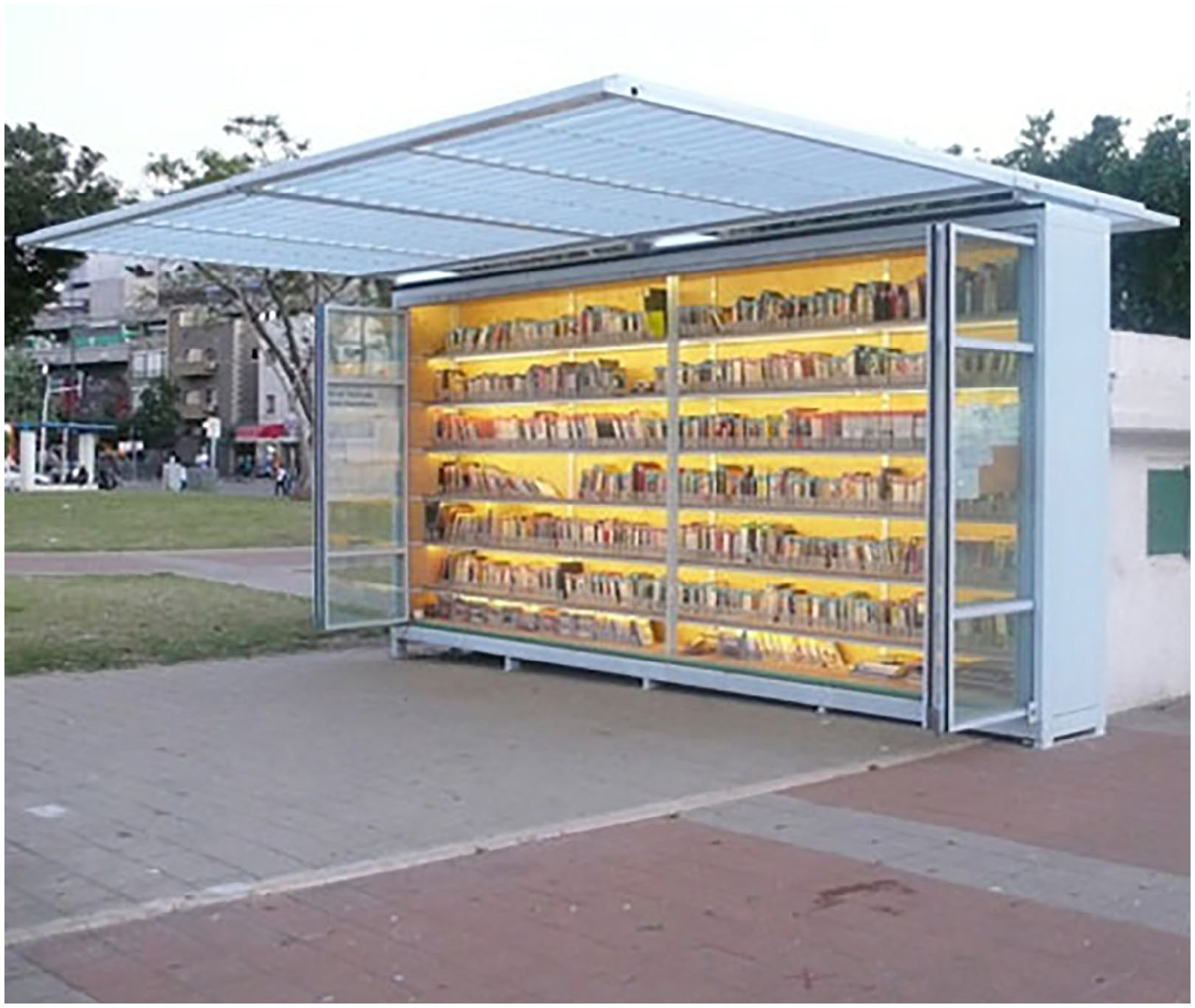
The Garden Library in 2009. Photo by Roi Kuper.
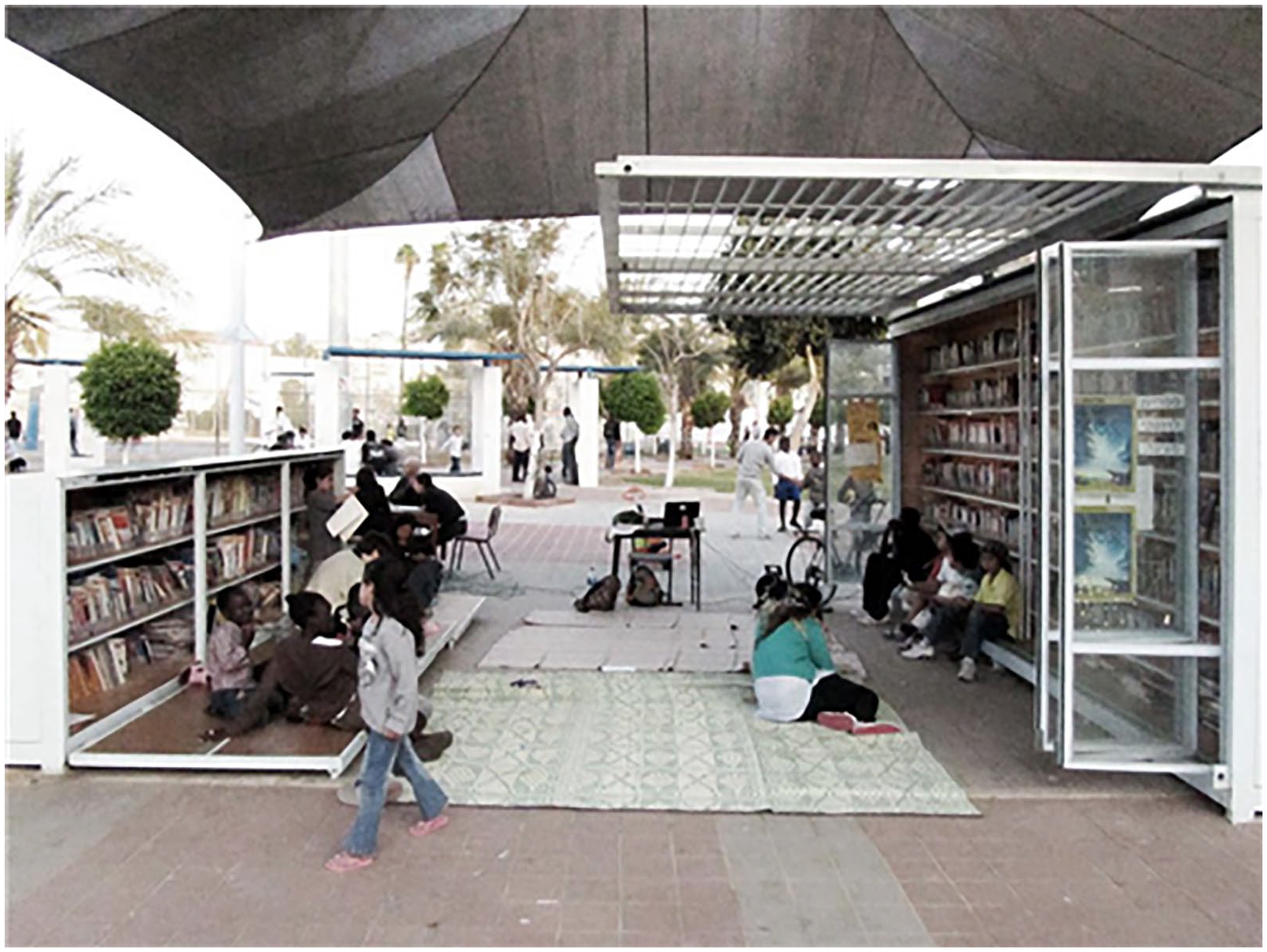
The Garden Library. Photo by Yoav Meiri.
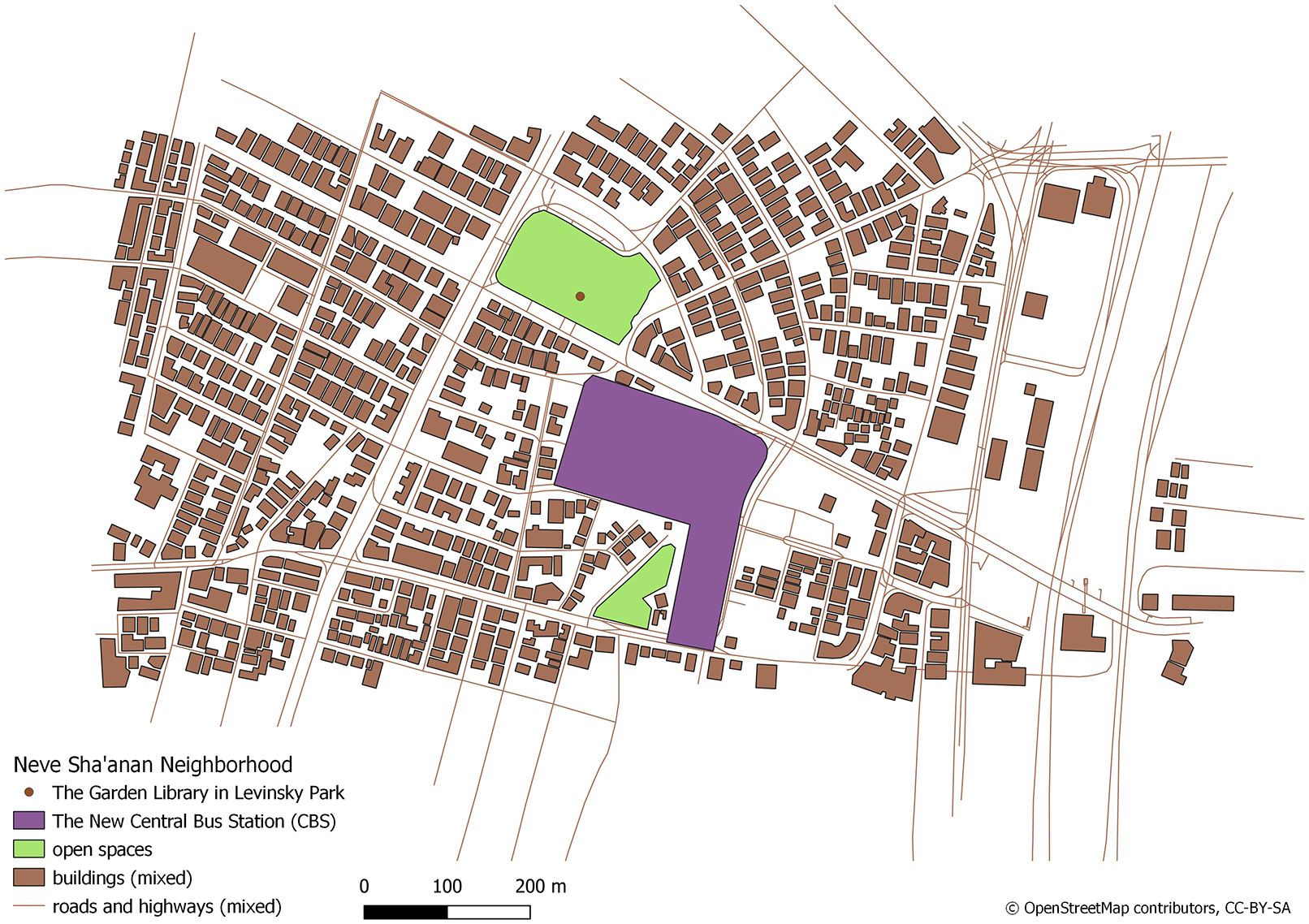
Neve Sha’anan neighbourhood map. OpenStreetMap contributors CC-BY-SA. Image by author.
Conceiving the library as a mobile structure links this project with other interventionist art projects that were created as ad hoc responses to problems faced by displaced people. One can think of Krzysztof Wodiczko’s Homeless Vehicle (1987–1988), ‘a modified shopping cart which facilitates bottle and can collection as well as provide a temporary shelter’, 62 or Lucy Orta’s Refuge Wear Series (1992–1998, 2002–2007), a set of portable habitats that are worn as garments and provide shelter in a range of emergency situations. 63 Both examples are perceived by the artists as tactical or poetic interventions that make visible the needs of vulnerable populations rather than long-term solutions. They resonate with Meiri’s view that permanency does not necessarily lead to optimistic results. 64 Temporality then is not only functional but is used as an operating mode that acknowledges the dynamic state of places and people and as such carries the capacity to adjust with them.
In the case of The Garden Library, I argue that such understanding of temporality can endure precisely because the project remained in-situ. One can see it in the way the project became an inseparable component of the Levinsky park while configuring its modes of usage and perception. Prior to the installation of the library, the Levinksy park was already a meeting and a dwelling space for the migrant communities. Moreover, during the installation of the Garden Library, the public shelter served as an art studio for the artist Lior Waterman who rented it for a subsided price from the municipality. 65 The co-existence of these distinguished temporal functions constructs a sense of place that is characteristic to areas undergoing gentrification. 66 Here is a place that is perceived hostile by the Israeli-Jewish public due to the concentration of ‘undesirable’ populations who made it, given the lack of other options, their home. 67 Simultaneously, these are the exact features that might lead to a place to be considered ‘edgy’ and ‘unique’, as evidenced by the range of studios, galleries and art tours that take place in the Neve Sha’anan neighbourhood. 68
The Garden Library intervenes in this tempo-spatial constellation by absorbing the park’s layers of use – a shelter, an art studio, a dwelling area and an assembly point – and changing them. In doing so, the Garden Library did not beautify the area in a way that accommodate a market-driven and consumption-oriented taste. 69 Rather, it reaffirmed the presence of the migrant communities and privileged their own experience of place and belonging. More than a default location, The Garden Library became a place the migrant communities want to go to and feel safe doing so. This feeling resonates with a testimony of a Philippine migrant worker and an active user of The Garden Library: 70
I used to go [to museums and libraries]. But it takes time and sometimes they ask an ID [. . .]. For me it is uncomfortable, but I can’t blame them. It’s in the law. [. . .] And here if you want to you can take [a book] home, they give you something like a member card.
Through the transformation of use patterns, it is possible to trace the evolving sense of a place. 71 And while The Garden Library has remained in-situ, it is flexible and dynamic and as such, can accommodate the needs of a transient population. Furthermore, these layers do not only change to fit the users’ needs, but the needs change in relation to what the place has to offer. We can see it, for example, through the gradual transition of the public shelter turned into an artist studio turned into an extension of The Garden Library where migrant communities themselves become creators and performers. 72 Following Crang, I understand this evolution as an ‘experimental time-space’ where time and space are not merely the background against which an action occurs, but are rather constitutive parts of this action. 73 Here, I see it as a simultaneous action that fixates the Garden Library to its particular location, while remaining flexible and in tune with the emerging and unforeseen needs of its users and other socio-material circumstances.
The right to time
During the interview with Ophrat it was important for him to emphasise that the Garden Library was perceived as an ‘artistic solution’ for the migrant communities. One possible interpretation is that the library provides a slow time-space for needs that are perceived less urgent by humanitarian organisations, namely a space to read, to create and to reflect. 74 Yet the term ‘artistic solution’ prompts us to think about the modes artistic practices enquire into a ‘problem’ and the centrality of temporality as a methodology within this process.
In The Garden Library manifesto, it is stated that reading is ‘an intimate and liberating space to which every person is entitled’ and that ‘a book is an object of personal passion that offers escape routes to worlds of inspiration and imagination’. The spatiality and materiality that are defined in the manifesto implicitly raise the right to idle time. 75 In contrast to both waiting and labour time, two temporal modalities so central to refugees and migrant workers, idleness here is derived from the leisure of allowing a specific reading experience to shift oneself into other times and spaces. Through this conceptualisation of time, we come to understand books as aesthetic objects. Following Rancière’s understanding of the aesthetic experience of art as being ‘something else than art’, 76 the books configure a sensorial dimension that is both grounded in the present moment whilst holding the promise of another world. In The Garden Library manifesto, the books are acknowledged for their sensuality, being described as an ‘object of passion’, and reading as a ‘democratic pleasure’. Here Rancière’s terminology can also help us in deciphering this meaning. Rancière associates democracy with a state of equality that stands behind any political and/or aesthetic act of redistributing the sensible. Democracy therefore exposes the arbitrary nature of any socio-temporal order and the way it identifies and classifies its subjects. 77
It is perhaps why Arteam members chose a unique method for cataloguing the books that reflects the temporal experience offered by The Garden Library. This is how Arteam member Achituv describes the cataloguing system: 78
The books are not catalogued according to genre or author name, but dynamically, according to reader input. On the inside back cover of each book is a sticker that asks, “How would you describe the book?” and offers seven subjective characterisations that a book may evoke: amusing, boring, bizarre, depressing, exciting, inspiring, sentimental. When returning a book, the reader is asked to choose the fitting emotional descriptor, and the colour-coded judgment is added to the past history of responses on the spine of the book. The book is then placed on the shelves according to the latest emotional classification.
The aesthetic experience offered by the books is described here at its best. The books are agent-like objects that are defined through their capacity to prompt the reader ‘to have emotional sensory, intellectual, and memory-based responses’. 79 Simultaneously, they are described as ‘something else’ than objects. Their materiality is also discursive, capable of generating knowledge about the emotional history of books and their readers which perhaps cannot be expressed otherwise. 80 One of Arteam’s plans was to produce a website that would visualise in real time the books’ ‘wandering map’. 81 Although this plan was not realised, there are several documents available online that offer a glimpse of such visualisation. 82 The maps vary and include the emotional movement of each book throughout time, or a panoramic view of the emotional responses of books in specific languages. The timeline is constructed out of events that affected the migrant communities, such as the completion of the border fence between Israel and Egypt, the expansion of the Holot detention centre or the 2012 deportation of Sudanese asylum seekers, and their correlation with readers’ choices of books and responses. 83
This is where the database stops from being only a visual representation of the books’ movement on the physical shelves and begins to narrate new stories. As with the public shelter, this database acts as another spatio-temporal extension of the original project, a kind of time-travel object, built on a ‘non-linear, algorithmic logic [. . .] that is continuously restructured on the basis of user input’. 84 This extension challenges the flattened present that have been described by Guha as characteristic of the migrant’s time. 85 It does so by relocating the migrant into complex temporalities which tie the migrant with other pasts, presents and futures. Such avenues illustrate the place of temporality within an artistic enquiry and the type of knowledge the latter generates. The emotion-based cataloguing system becomes a method from which to externalise ‘personally situated knowledge’. 86 The digital dissemination however is itself a form of critical intervention, capable of making connections and enabling exchange between otherwise anonymous and disparate readers.
Performing public
Temporary public appearances are recurrent rhythmic patterns in The Garden Library and in the Levinsky park more generally. They include routinized and more eventful activities, such as story-time, creative workshops, sport and film screenings, festivals, and ceremonies. The frequency of these activities makes it possible for new identities to be ‘witnessed, performed and incorporated into the community’. 87 Multicultural events, such as Ballet in Levinsky Garden (2010), bring together traditional performances and original productions into a new shared space and experience that help overcome cultural and national boundaries and biases. 88 These events also provide a meeting point between the migrant communities and Israeli-Jews. Artistic Picnic (2012), for example, was a curatorial event composed of dozens of artworks scattered on picnic blankets. According to its organisers, it sought to create an alternative setting from which to examine the hospitality/collaboration and foreign/local dynamics and tensions that very much shape the spatio-temporal experience of the area. 89 Unexpectedly, Artistic Picnic was scheduled to commence a few days after the beginning of the deportation campaign targeting South Sudanese asylum seekers. The decision to move forward with the event was made jointly by the library team and the migrant communities, who expressed the need for a solidarity gathering. 90
Beyond these short-term encounters and dialogues, The Garden Library spatio-temporal demarcation is unique in its critical capacity to foster transnational and cross-cultural alliances, and ultimately a new public. When Arteam began researching the area of Neve Sha’anan for their project they discovered that the reason the neighbourhood did not have a public library was the lack of official records of the numbers of residents. 91 The large number of undocumented non-citizens who lived in Neve Sha’anan, alongside its Jewish Mizrahi residents, did not make a public for which to build a library. This discovery which prompted the construction of The Garden Library, reveals the material and symbolic means used to construct an uneven and racialised public landscape. Nonetheless, the absence of an officially recognised public in the neighbourhood opened the possibility for re-evaluating the meanings of ‘the public’, ‘publicness’ and ‘the public sphere’.
The Garden Library activities were largely centred around the migrant communities. Yet, its location within the only green space in Neve Sha’anan and in adjacent to the new CBS, made The Garden Library’s time-space intersect with other marginalised temporalities. One of these instances happened during the 2011 nationwide protest against Israel’s high cost of living and housing shortage. As part of the protest, the Neve Sha’anan-based Mizrahi feminist movement Achoti (my sister in Hebrew) erected a protest camp in the Levinsky park. The Garden Library provided equipment and wi-fi access for the protest camp, and many of its members participated in its organisation and demonstrations. The Levinsky protest camp was more than a mere representation of the crippling dream of convenient middle-class life that was amplified in the mainstream encampment in central Tel Aviv. 92 It was the reality of many who gathered in it, be it sex workers and rough sleepers with no safe roof on their head, asylum seekers living daily with the fear of deportation or incarceration, and single-mothers under eviction threats from their council housings. 93 The collision of multiple precarious temporalities is far from being a common and simple recurrent, due to the ways they are often positioned against one another in everyday life. 94 However, by bringing these temporalities together as a resource for a common struggle, one might grasp the meaning of counter-temporalities as the promise of a shared future for those whose time has been flattened, accelerated or frozen.
The Garden Library, and Levinsky park more generally, remains a key site for working towards such promise by making possible an alternative public time-space. This time-space provides both an everyday materialisation of the public as shared spaces, facilities and resources, and a more politicised understanding of the public as a collective formation with shared claims and vision. In the Levinsky park there is not a separation between these, as one might encounter children reading and playing between the bookshelves, migrant parents and Israeli volunteers conversing alongside them, performers practicing in the underground public shelter, residents voting for the Neve Sha’anan committee election, 95 and organising campaigns and protests against deportations and the neighbourhood’s neglect. 96
The Levinky park’s multiple functions illustrate the challenges of navigating between temporal landscapes, from maintaining an everyday routine to transforming it into something better, but also the possibilities of alternative urban relations and politics that can be made in such spatio-temporal constellations. One can draw inspiration from the 2020 campaign against the ruination of the Levinsky park in favour of a new educational complex. This municipal decision was not only going to destroy the only open library and green space in the neighbourhood. It was bound to deepen the racial segregation in schools by allocating to the new complex children of migrant workers and asylum seekers. 97 A collaborative struggle between The Garden Library, the municipal council opposition, and the Neve Sha’anan neighbourhood committee, has put an end to this decision. As of now The Garden Library still stands.
Conclusion
This article foregrounded temporality as a conceptual and methodological framework from which to examine public art’s critical and transformative potentialities. It argued for the limited ways temporality has been considered so far in public art research, in terms of binary and over-generalised assumptions. More crucially, this article called for a more nuanced discussion around the ways temporalities are materialised and performed in a specific spatio-temporal setting. Other strands in arts and geographical scholarships that theorise time and temporality in relation to urbanicity and migration patterns, provided the conceptual basis with which to think about these issues. In particular, how public art’s multiple temporalities, the aesthetic experiences they produce and the socio-political critique that derives from them response, adjust, and modify racialised and marginalised landscapes.
By studying The Garden Library’s evolving structural and performative components, I was able to show how what appears to be contradictory temporal conditions not only co-exist together but enable one another. The Garden Library, despite being initially designed as a mobile temporary structure, remains in situ because it attunes to the ways its location already functions as a default assembly and dwelling space for the migrant communities. Yet by responding to the unforeseen needs and circumstances of its users and immediate environment, The Garden Library changes how the space is perceived and experienced. It therefore informs a new sense of belonging and aesthetic appreciation to the Levinsky park that were not available before. While such insights elucidate how temporality is always place-specific and intersubjective, 98 the underpinning arguments of this study can be useful when exploring art’s critical engagement with other public time-space.
Methodologically, a temporal lens illustrated how public art can operate as a creative, practice-led mode of enquiry as well as the place of academic research to reflect on the knowledge such mode produces. Taking the emotional-based cataloguing system as an example, one can see the material, discursive and virtual forms temporality might take; an intimate and transformative reading experience generated from the engagement with books; a database storing knowledge on migrant communities’ reading preferences and responses in light of an unstable socio-political climate; and an interactive online visualisation of the books’ emotional history and movement that is fed by additional reading experiences from users in other locations. 99 The latter unfortunately was not realised and the cataloguing-system is no longer in use, since most of the Library’s users do not go there to borrow books anymore. 100 It is the unpredictable temporal nature of public art as a mode of enquiry that makes additional outputs, such as academic publications, integral to the dissemination of critical knowledge that otherwise might be at risk of anonymity.
Lastly, a theoretically driven analysis of The Garden Library highlighted other related temporal experiences that have been overlooked by the artists. These experiences are crucial, because they inform the library’s possibilities and limitations as a political and poetic intervention within a diverse settler-colonial space. By reading together The Garden Library’s concerns with the migrant’s time in tandem with the temporal conditions of Palestinians (natives) and Mizrahi working class (racialised settlers), the article offered an avenue from which to discuss the entanglement of migratory and colonial temporal discourses that have largely been studied separately. 101 In the case of Israel’s settler-colonial ideological structure, oppressive temporalities are used not only to delegitimise and criminalise the native Palestinian and the non-Jewish refugee, but also to obscure the shared experiences of dislocation, dispossession and marginalisation, including that of working class Mizrahim, that are caused by the state regime. The Garden Library and this article might be insufficient in equally attending to all these marginalised temporalities with the same complexity and nuance. However, this article illustrated how a combined reading of them helps identifying the moments where they can intersect and form counter-temporalities. These moments therefore teach us not only about the relationality of marginalised experiences, but how they can be overcome by those who have been pushed outside the settler-colonial informed public time-space.
Footnotes
Acknowledgements
I would like to thank Dr Jessica Dubow for her insightful comments and for helping me bring this paper into its current shape. I would also like to thank the following mentors and colleagues who read earlier versions of this paper: Dr Simon Faulkner, Dr Danielle Child, Dr Holly Eva Ryan, Dr Noa Roei and Dr Maayan Ravid. The gathering of research materials would not be possible without the generosity of talented, devoted, and inspiring people I had the pleasure to talk to and work with. I would particularly like to acknowledge Hadas Ophrat, Dafna Lichtman, Eden Vaknin, Shula Keshet and Sharon Rotbard. Lastly, I would like to acknowledge the wonderful and life-saving work of The Garden Library that remains a bright and guiding watchtower in what often seems to be a sea of hate, despair and pessimism.
Funding
The author(s) disclosed receipt of the following financial support for the research, authorship, and/or publication of this article: This work was supported by the Leverhulme Trust [grant number ECF-2022-024].
Ethics statement
Not applicable.
