




Abstract
This article investigates the role of scenographics in staging climate crisis cultures. The art collective SUPERFLEX’s installation It Is Not The End Of The World (Copenhagen 2019) explored human-world relations through techniques of set design, lighting, sound and costume. Central to this was a detailed 1-to-1 scale replica of the UN Building toilets re-imagined as an archaeology of a future without humans. While described as an ‘installation’, It Is Not. . . is adopted as a case study that exemplifies the role of scenographics in irritating a sense of place and is argued as affording insight into the assemblages of place, world and atmosphere. Drawing upon Global South philosopher Arturo Escobar’s ‘pluriversal design’, I offer an argument for scenographics as a methodology when investigating world feelings in an era of climate crisis. ‘Pluriversal scenographics’ is proposed as a critical framework for the staging of nondualistic, relational and more-than-human ‘possible reals’. Pluriversal concepts are proposed as a model for renewing the political purpose of scenographic practice as a methodology for investigating world feelings. I conclude with a call for a renewed political task of scenography and the value of this perspective for theatre makers, arts professionals and cultural geographers.
How is a feeling of world produced through staged material cultures? This question provides the through-line to my argument for this article. In an era of climate crisis, acts of representation that enact, invite or irritate conceptual models for ‘world feelings’ are increasingly urgent. The cultural and political systems of the Global North are ill-equipped to adapt to and fully accept the environmental changes predicted for the 21st century. Literary theorist Ursula K. Heise observed a similar tension when suggesting that the ‘challenge for environmentalist thinking, then, is to shift the core of its cultural imagination from a sense of place to a less territorial and more systemic sense of planet’. 1 Yet, this ‘sense of planet’ is at odds with the binary models of aesthetics that have defined Euro-centric conventions of artistic and material analysis. Scenographic practices – from theatre staging to exhibition design, gardening to interior design – have been duly conceived and practiced in relationship to binary aesthetics. Actors perform on stages. Scenic practices provide backgrounds for action. Stages are epistemologically detached from world. While contemporary scenography scholarship has offered useful rebuttals to these dichotomies, 2 a division between human and world continues to form a foundational pillar of scenographic practice.
My objective for this article is to reconsider the political task of scenographic practice through the prism of ‘pluriversal’ models of world. Anthropologist Arturo Escobar proposes that the ‘pluriverse refers to the idea of multiple worlds but also to the idea of life as limitless flow’.
3
Escobar calls into question the ‘Cartesian license’ that ‘not only placed “man” on the highest rung of the ladder of being but led science to investigate reality by separating mind and matter, body and soul, and life and nonlife’.
4
The binary models of world as enshrined within Global North philosophies and aesthetics (such as object-subject, nature-culture, mind-body, human-nonhuman, female-male, etc.) require pluriversal approaches that question the cosmological assumptions of the Global North. Indeed, Escobar argues that ‘the environmental crisis is a design crisis and that humans need to change their practices radically to avert it’.
5
In practice, this means the task of design is to ‘unfold the political capacities of design by going against the analytical tendency in critical design studies to examine primarily how design, through its very materiality, “hard-wires” particular kinds of politics into bodies, spaces, or objects’.
6
Escobar has argued that concepts of ‘the World’ as singular and definitive stems from a historical narrative, which positions the Global North as the centre of humanity’s intellectual and cultural growth. ‘The notion of a “One-World World” (OWW) is predicated on the West’s ability to arrogate to itself the right to be “the world” and to relegate all other worlds to its rules, to a state of subordination, or to nonexistence. It is thus an imperialist, colonial notion’.
7
This ‘One-World’ narrative provides the political basis for colonialism, globalisation and unfettered capitalist growth. Escobar states that pluriversal studies ‘require new media and communications strategies’
8
to confront the pervasiveness of the One World world (OWW) political vision of the future:
Contemporary media are the most effective purveyors of the OWW vision. Pluriversal communications strategies would serve two main purposes: to construct narratives that persuade people into thinking about why the One-World story no longer quite makes sense; and to contribute to make visible the projects by which other practices attempt to persevere and perform themselves into worlds (including social movements).
9
Pluriversal approaches seek to acknowledge and ‘make visible’ multiple ideas of world that co-exist and thrive with one another. As the staging of places and atmospheres, scenography and scenographic practice are well suited to this political task.
Foremost for a discussion on scenography, the pluriverse as a proposition acknowledges the strategic colonial interests of rendering experiences of ‘nothing’, ‘neutrality’ and ‘empty’. The overlapping and interspersed spatialities of pluriversality are antithetical to colonial concepts of ‘empty space’. Escobar argues ‘All living, human or not, takes place within a relational matrix. The forgetting of this fact led to the development of patriarchal cultures’. 10 Following Escobar’s position that patriarchy (as projected ownership) is formative to coloniality, empty space imaginaries afford permission to the act of colonising. Where the concept of empty space (as void) gives political consent to the washing away of past places and species to build anew. Paul Kingsbury and Anna J. Secor argue that ‘the void generates as much speech as silence’ 11 oscillating as it does the between the unrepresentable (as zero or without form) and a spatial paradox that warrants description (the in-between as form or ‘zero field’ as the cancelling out of two forces). Indeed, the notion of ‘the void’ is a spatial technique of, what I term, ‘empty space scenographics’. The void is a technique insomuch that as a mode of spatial practice it offers description, and spatial materiality, to the otherwise epistemologically (in Global North terms) unrepresentable. Influenced by a mixture of medieval 12 and high modernist 13 notions of neutrality, Euro-centric theatre practices have historically been a site for void techniquing; where ‘an act of theatre’ is narrativised as emergent from a formless nothingness, the unconscious made form.
Empty space scenographics and the void as technique in theatre are not to be confused or conflated with the arguments found in Peter Brook’s The Empty Space. 14 Where, as Dorita Hannah puts it, ‘Brook’s demand was not for a modernist tabula rasa in which architecture and its history are obliterated [. . .] Instead, his Empty Space challenged us to regard any space (with its intrinsic character) not only as a site for performance, but also as a performer in waiting’. 15 With its ‘found’ architectural status and scarred walls, Brook’s preferred theatre the Bouffes du Nord (1974) in Paris is representative of Hannah’s reading. The void is a technique of an altogether different order. The empty space as void obliterates, overwrites and vanishes. It is these traits that define the coloniality of empty space scenographics. The storying of the void and an imagined nothingness is a technique of colonial spatialisation, which is implicated within notions of discovery (of already peopled places), expansionism (of nation, ideology, humanity) and neutrality (in aesthetics). Scenographers have historically been complicit, if not always explicitly cognisant of, this political task through the experiential affirmation of an empty space cosmology (black box studios, backouts between scenes, etc.). However, scenographic practices also highlight the processes through which stories of world are practiced and staged, again and again. From the performative politics of cartography 16 to cinema as a world-building machine, 17 the critical role that scenographic tactics play in affirming, complicating and practicing certain world ideologies, cosmologies and narratives over others is underwritten and undertheorised. Escobar’s call for a pluriversal new media seems a timely opportunity to revisit the scenographic tactics that perform or complicate Global North orthodoxies of world.
Environmental politics offer an apt context for investigations of the pluriverse. More directly, I contend that the current climate crisis is felt culturally and politically as a world feeling. The proposition of ‘world feelings’ is my political interpretation to Kathleen Stewart’s ‘worlding’.
18
While introduced by Martin Heidegger
19
in German as welten, Stewart argues that worlding emphasises world as process and stresses how multiple thresholds of world processes are encountered dependent on attunements. Stewart frames this notion of worlding in terms of compositional theory:
Here, compositional theory takes the form of a sharply impassive attunement to the ways in which an assemblage of elements comes to hang together as a thing that has qualities, sensory aesthetics and lines of force and how such things come into sense already composed and generative and pulling matter and mind into a making: a worlding.
20
The attunement that Stewart describes is predicated on how a worlding assemblage operates as a generative force that orientates moments of action, reflection and worldly experience. Equally, Donna Haraway 21 has used the concept to describe more-than-human worldings, which acknowledge how multiple species experience world processes at different scales and through distinct sensory matrixes (such as Octopuses). In relation to scenography, Stewart argues that these multiple perceptual worldings are encountered as momentary ‘scenes’, where ‘Scenes becoming worlds are singularities of rhythm and attachment. They require and initiate the kind of attention that both thinks through matter and accords it a life of its own’ (Stewart 2014: 119). There is some similarity here with how scenes are defined in cultural geography. Influenced by Lauren Berlant’s modelling of ‘scenes of attachment’, 22 Ben Anderson suggests that what ‘defines a “scene” is that some kind of excess is present that reveals or exposes the limits’. 23 McCormack offers a similar reading, suggesting that ‘the scene becomes a way of gathering the sense of worlds that matter while also posing the question of how the force of these worlds might become part of their stories’. 24 For both Anderson and McCormack, scenes are intensities of attachments/forces (of life, materiality, sociality) that are performed through multiple agents. Scenographics positions ‘scene making’ as a process, or sceneing, 25 and a formative condition to how human narratives of world and experiences of worlding become intertwined. Consequently, scenes as worlding processes highlight – irritate, underline, reveal – orders of world. This process of attunement, or what I describe as orientation, is equally evident at land borders between nations, the attentiveness of stage geographies, or the imposition of a crime scene. Scenography as a crafting of scenes is directly concerned with how worlding as an ongoing process is independent from, but politically narrativised by, the political orders of world. Understanding how worlding processes are co-opted, obscured or affirmed by political narratives and felt as world feelings (both of and with world) is a distinct concern of this article. Overall, I am interested in the material and technological techniques that trigger, reinforce and articulate world feelings.
I adopt the framework of ‘pluriversal scenographics’ to argue how scenographic practices stage world feelings. The pluriversality of scenographics is, I suggest, bound to their potential to reveal and negotiate how everyday places are organised and rendered through ideological or cosmological world lenses that may be obscured or simply favoured. If climate crisis is felt and politically practiced as a world feeling, pluriversal techniques and media afford insight and social platforms that bear witness to competing orders of world obfuscated by, what Escobar describes as, the ‘One-World World’ story. Likewise, scenographics are pluriversal in that they offer techniques for reordering, re-placing and re-crafting place orientations that emerge from and interweave with pre-existing worlding expressions, even if figuratively only. This builds upon Sara Ahmed’s 26 argument that orientations are ‘different ways of registering the proximity of objects and others. Orientations shape not only how we inhabit space, but how we apprehend this world of shared inhabitance, as well as “who” or “what” we direct our energy and attention toward’. 27 Accordingly, my reading of scenographic orientations extends to atmospherics such as scent, temperature and belongingness. The last of these, belongingness, isolates how scenographic encounters ‘irritate’ the typical flow of relations in a certain place and time. Borrowing from Alan Read’s idea that performance acts as a ‘foreign body, as a third person, always at odds with those things upon which it does its work’, 28 I frame scenographics as ‘hypertrophic’ insomuch that they tinker, reshape or reorientate the traits of a place. As with hypertrophic cells, scenographic traits irritate (aesthetically, socially, politically) before receding back into the locale’s typical state. Scenographics come and go. However, following Rebecca Schneider’s 29 argument that ‘performance remains’, this temporality does not rob them of the potential to alter the future flow of a place. Once a place has performed otherwise the affective legacies of that event are recalled, remembered and re-enacted as a ‘charged place’, if only indirectly. Finally, the orientations of scenographics are always plural. The additional ‘s’ stresses that place orientations – whether in terms of stages, scenes or worlds – are produced through multiple agents and emerge from multiple contexts. Scenographics is my proposal for identifying and arguing how these place orientating agents are evoked, designed or encountered through staged material cultures. Pluriversal scenographics is my framework for investigating the role scenographic practices do and can play in rendering world ideologies possible.
To plot my argument for pluriversal scenographics in practice, I first recount my experiences of the Danish artistic collective SUPERFLEX’s installation It Is Not The End Of The World (2019) as a case study in staging world feelings. I then outline the value of pluriversal thinking and scenographic theory for cultural geography to propose scenographic practices as an answer to Escobar’s call for a pluriversal new media. The overall intention is to promote a shift from ‘empty space scenographics’ to ‘pluriversal scenographics’ as starting points for rethinking the political task of scenography. I conclude by offering initial criteria for charting the renewed political tasks of scenography as a tool for speculating future human-world orientations.
Superflex
SUPERFLEX is an artistic collective founded originally in 1993 by Danes Jakob Fenger, Rasmus Nielsen and Bjørnstjerne Christiansen. They operate as an ‘expanding collective of humans and non-humans working with an expanding idea of art’. 30 The collective aim to embrace non-human perspectives ‘in an effort to move society towards interspecies thinking and living, beyond the end of the world as we know it’. 31 In particular, the studio describes their artworks as ‘tools’. Barbara Steiner outlines how these ‘tools invite people to do something: to become active’. 32 Always focused on a specific social and/or local situation, SUPERFLEX’s tools ‘attempt to create conditions for the production of new ways of thinking, acting, speaking and imagining’. 33 Their tools have included the creation of a portable bio-gas unit for cooking in Tanzania (SUPERGAS, 1997), a digital copy of the city of Karlskrona, Sweden (SUPERCITY/Karlskorna2, 2001), and a crowd sourced interactive artwork based around three ‘SUPERTOOL’ colours (SUPERCOLOURS, 2002). This last tool invited participants to use three colours (orange, white and black) as parameters for open-source activities, which was a key starting point of their SUPERDESIGN collaboration with design studio Koch&Täckman. Investigation through set parameters is a key feature for SUPERFLEX’s tools as techniques for investigating challenging or contested subjects.
It Is Not The End Of The World (hereafter referred to as It Is Not . . .) was installed at the Cisternerne, Copenhagen, in the summer of 2019. Originally built between 1856 and 1859, the Cisternerne is now part of Frederiksberg Museums and is a former subterranean reservoir under Søndermarken park. In 1996, Copenhagen was the European City of Culture and the Cisternerne was reimagined as an exhibition space having ceased its function in 1933. A unique feature of the structure is naturally formed ‘dripstones’ that form large stalactites, enabled by the decades without human intrusion. Today, the Cisternerne hosts ‘one annual site-specific total experience’ 34 with commissioned artworks that embrace how the ‘Cisternerne surrounds you, you are not simply looking at art – you are completely immersed in art’. 35 The context of a ‘total experience’ and the idea of not looking at, but being with, an art experience is critical to understanding SUPERFLEX’s interventions within the space.
I visited the installation in August 2019. This was during an unseasonable heat wave (27°), which resulted in the ninth warmest summer in Copenhagen since records began. Indeed, I had been on holiday and planned to attend the Cisternerne partly for respite from the heat. This context, of seeking relief from a heat wave, frames my experience of It Is Not . . .. In this regard, there were four distinct phases to my experience: ‘preparation’; ‘wayfinding’; ‘toilets’; ‘blue’.
Preparation (Figure 1): My experience began by walking down into the Cisternerne from the heat outside into a holding area. Here I was invited to select Wellington boots and to prepare my body to navigate the partly flooded former reservoir. This act of costuming, of changing my appearance for the experiential contexts of the artwork, framed my bodily engagement with the exhibition throughout.
Wayfinding (Figure 2): As I took my first steps past the 19th Century archways and into the flooded area, a range of additional scenographic techniques became evident. Low level directed spotlights oriented the direction of travel. A soundscape was amplified throughout the ‘dripstone cave’ providing a sonic interpretation of the dimly lit environment. I proceeded slowly at first, gauging the water’s depth and the firmness of the floor beneath. The splashes from the boots of those in my group further orientated by wayfinding with the structure.
Toilets (Figures 3 and 4): As I travelled into the Cisternerne, I noticed vertical slits built into a structure that cast a wall of bright light across my darken path. I approached cautiously to peek between the walls of a cuboid structure. Through the slit, no more than a hand’s width, I could see a somewhat typical office bathroom. Long wall mirror. Sinks with taps. Highly detailed recreations that, unless I had known otherwise, I would have taken for the ‘real thing’. Yet, the structure was all at a slight angle and submerged to around thigh height. In the water internal to the room, plastic items floated.
Blue (Figures 5 and 6): I could see in the distance that a blue colour wash lay in my future. I moved toward this markedly othered atmosphere to the rest of the Cisternerne. I felt as if the soundscape changed, subtly. Between a series of columns supporting the concrete ceiling, neon letters emerged from the blueness. I had to reorientate myself to read the full message, as the some of the words were always slightly masked by one of the columns. IT IS NOT THE END OF THE WORLD. I dwell for some time in this atmosphere. Then, hearing the splashes from my group’s boots, I turn and repeat the previous three phases again. As I looped back alongside the opposite side of the Cisternerne, I encountered different slits, toilets and wayfinding spotlights before entering back in the holding area to remove my now wet boots.
The installation incorporated two discrete tools that built upon SUPERFLEX’s other work: (1) a large blue light slogan sign and (2) a reworking of an older tool entitled Power Toilets (2011). The collective described this latter tool as consisting of an ‘exact replica of the interior of a toilet found within an iconic political or corporate site of power, the work confronts power structures by taking an everyday site of waste–the toilet–and reimagining it as public domain’. 36 The initial aim was to investigate the redistribution of power by making some of the world’s most inaccessible places open to the public. In collaboration with architects NEZU AYMO, the first Power Toilets exhibitions were based upon bathroom facilities at the United Nations Security Council headquarters in New York, the New York JPMorgan Chase headquarters or the Executive Board of the UNESCO headquarters in Paris. Their aim for the project is to invite its ‘users to question the relationship between original and copy, exclusivity and inclusivity, and, ultimately, the infrastructures of power and its every day manifestations’. 37 Importantly, the orientations that produced these slippages are, I argue, both ontologically and politically scenographic. The power of the Cisternerne installation was bound to its scenographic status.
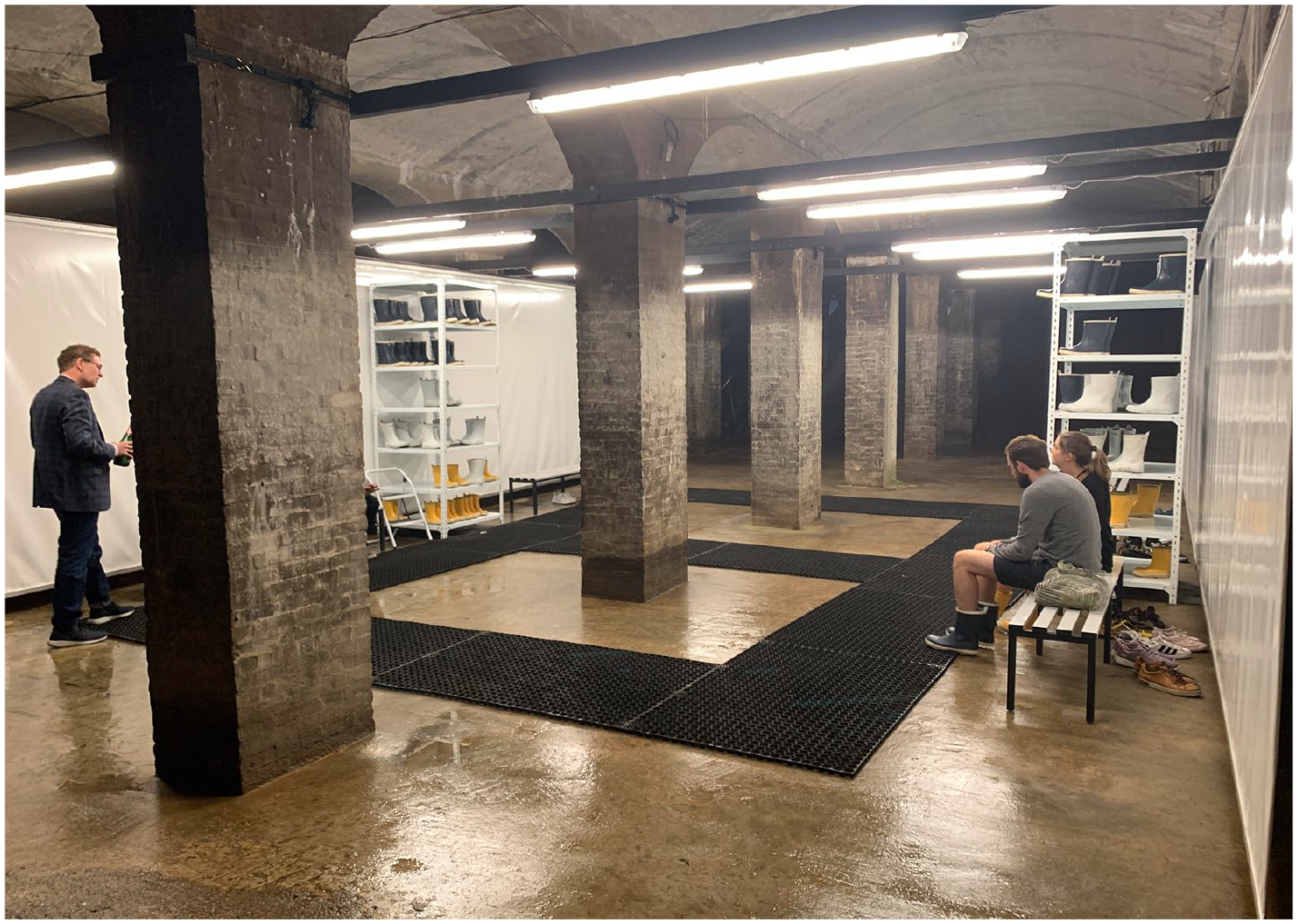
Preparation. Author: R. Hann.
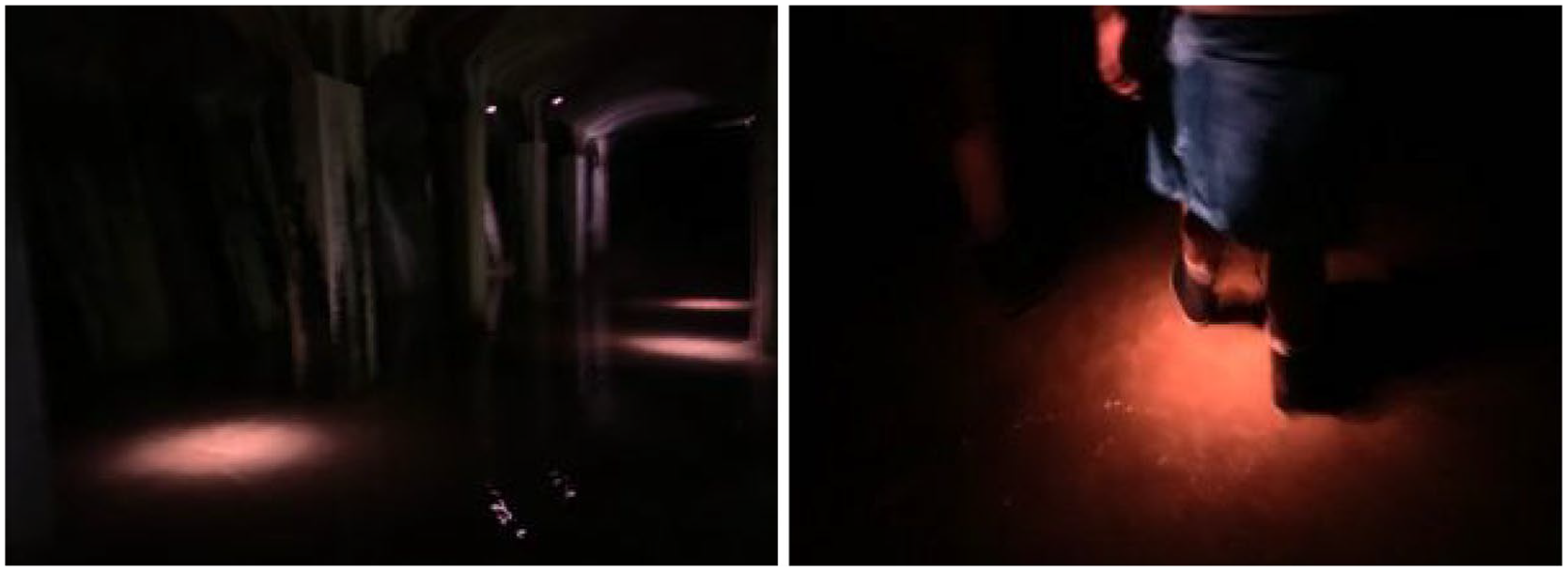
Wayfinding. Author: R. Hann
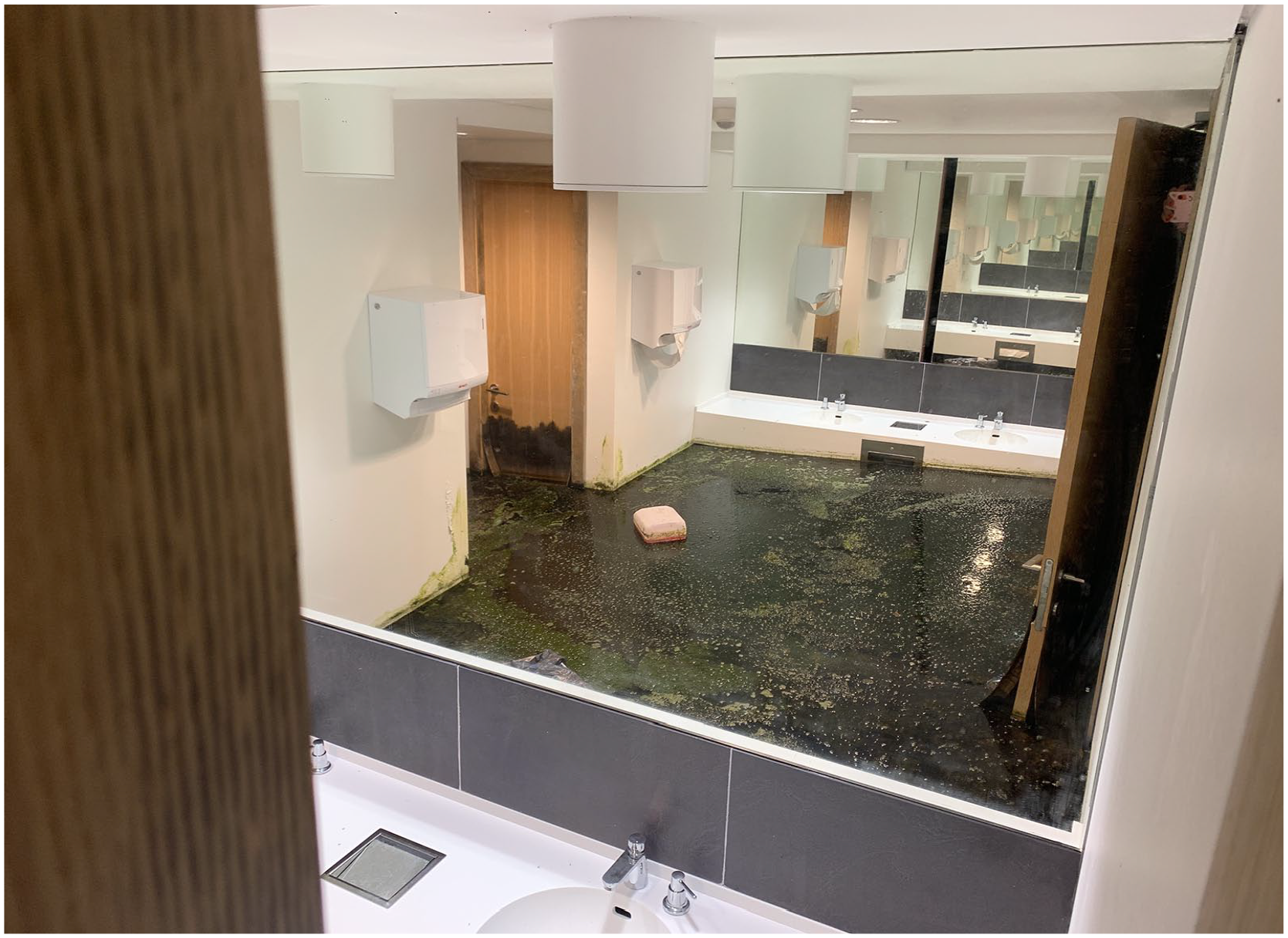
Toilets. Author: R. Hann.
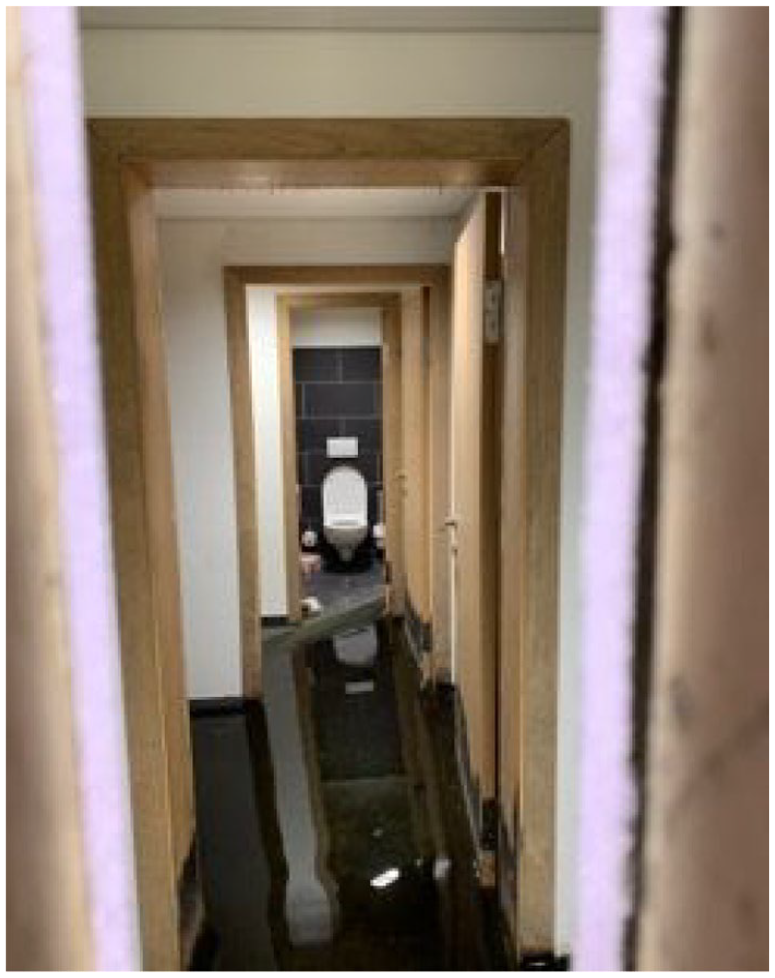
Toilets. Author: R. Hann.
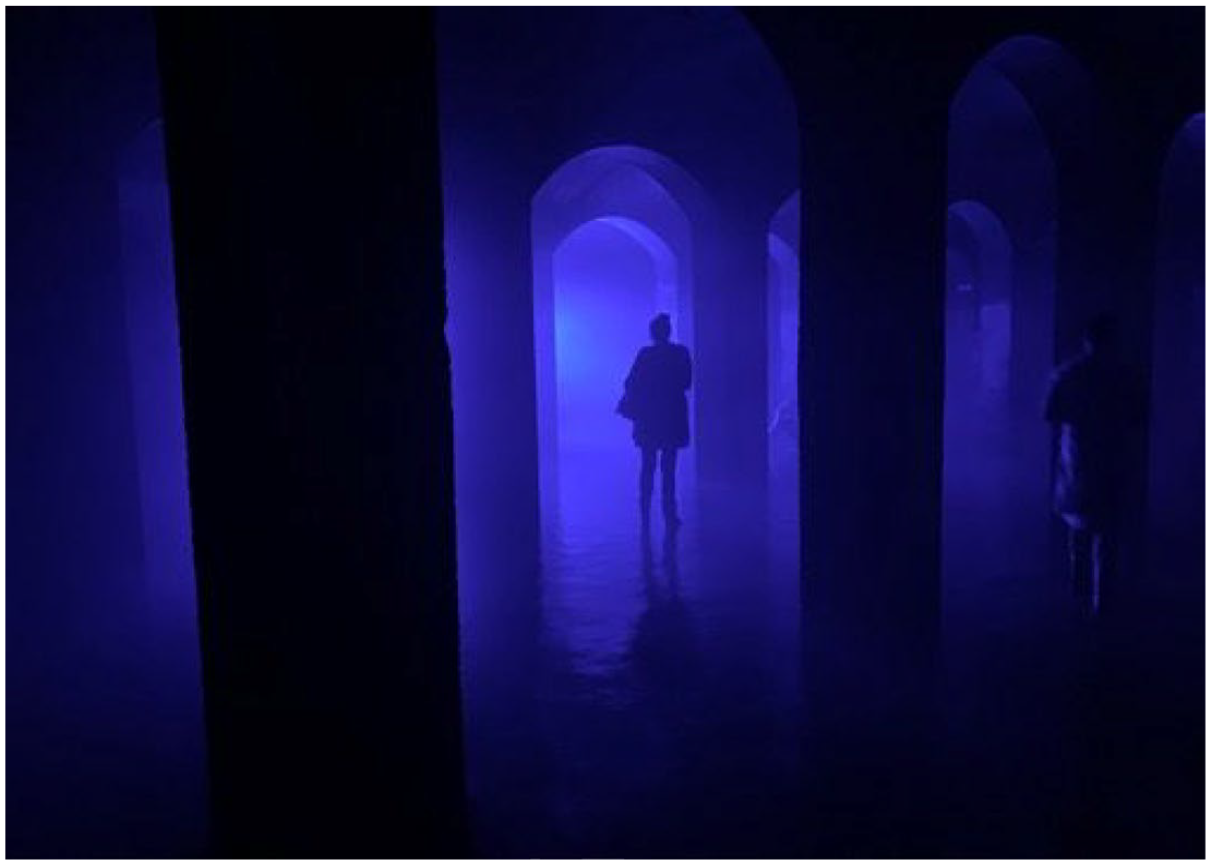
Blue. Author: R. Hann.
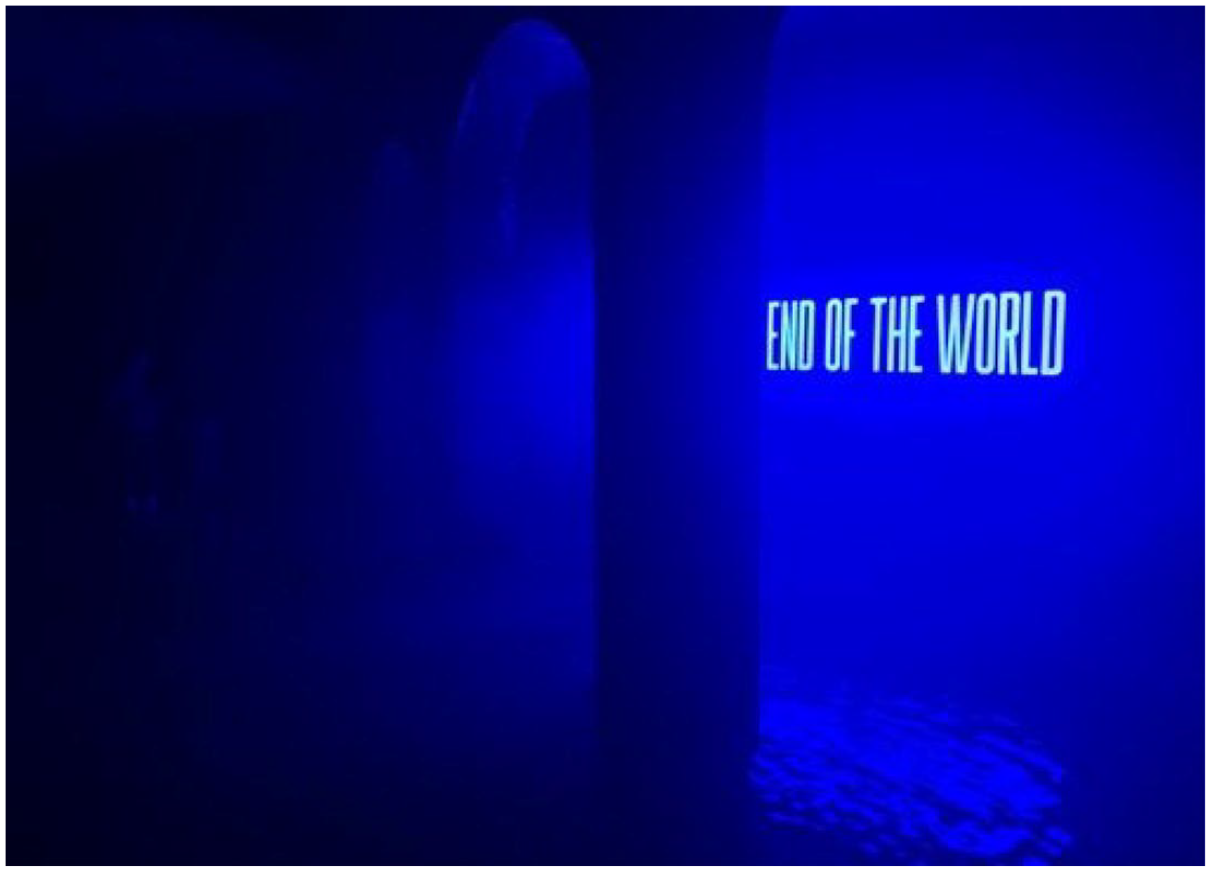
Blue. Author: R. Hann.
In Aesthetics of Installation Art, Juliane Rebentisch uses the terms ‘stage set-likeness’ 38 and ‘stage-like’ 39 to outline inherent qualities attributed to the work of installation artists. Rebentisch concludes that the ‘“total” installation is comparable to a stage set whose fourth wall closes behind the viewer—a “total” closure that may well feel quite oppressive. It is accessible only from within; it cannot be viewed from some neutral position outside of it’. 40 I argue that installation art practices are conceptually complementary to and materially akin with scenographic practices. While emerging from different histories of creative practice, materially and politically scenography and installation art perform through the same techniques and methods of place orientation. Whether directed lighting, constructed sets or amplified sounds, installation art is scenographic in practice and concept. For instance, the role of scenographic techniques within the Cisternerne exhibition are self-evident. The press release described how the ‘artist collective SUPERFLEX has staged a time travel into the future in the dark’. 41 The staging of future scenarios through replica sets, colour washes and soundscapes are all foundational techniques of scenographic practice (as practiced within theatrical contexts). While scholars such as Rebentisch imply a distinction through notions of ‘the real’ (being inside) and ‘the theatrical’ (watched from outside), I argue that this binary model imagines scenography as a strictly visual object that does not acknowledge the sensory experience of being with staged atmospheres. Art historians Astrid von Rosen and Viveka Kjellmer have argued that scenography is an agent in ‘the end of the visual’, where ‘scenography is conceptualized as a holistic event, it moves from being a primarily visual and distanced phenomenon into a multisensorial experience’. 42 Yet, I also propose, that installation practices evoke, through the act of having been ‘installed’, the same place orientating scenographics that irritate normative flows of place and world that define acts of staging. Consequently, this article approaches It Is Not . . . as a scenographic encounter that provides an apt case study for plotting the intersection of climate crisis (as a world feeling) and scenographics (as place orientating traits).
Pluriversal techniques beyond the void
It is Not . . . is a speculative attempt at imagining world otherwise, or more directly a world that is ambiguous towards humanity. Yet this otherwiseness is predicated on the assumed cosmological assumptions and experiences of those who travel through its passages. The centrality of humanity to world futures is the narrative of the One-World story. It is a story predicated on human agency, control and management of life processes. What makes It Is Not . . . a useful case study for this article is that it relies on weaving previous world experiences and narratives into the experience itself. It does not emerge from ‘nothing’. It is also an attempt to employ the techniques of scenographics to complicate assumed narratives of world (as human-centred) and model of the future (with humans as world guardians). While possibly conceptualised as an exercise in revealing world perspectives as discrete from world ontologies, SUPERFLEX’s work affords an insight into the politics of staging of world feelings more generally. Pluriversal thinking and politics are one route for accounting for the focus and, in turn, reimagining the political task of scenography.
SUPERFLEX’s installation assumes a something before. Another world feeling or orientation somehow adrift, but yet connected to that which is now past. While there was darkness, there was not an outright void-ing of the Cisternerne textures, histories and atmospherics. Typically, theatre-based scenography has orientated itself towards the genesis of space/place through, what I argue, to be empty space scenographics. The Czech scenographer Joseph Svoboda, with whom the argument for the use of ‘scenography’ in English is undoubtedly bound too,
43
proposed that:
When I sit alone in a theatre and gaze into the dark space of its empty stage, I’m frequently seized by fear that this time I won’t manage to penetrate it, and I always hope that this fear will never desert me. Without an unending search for the key to the secret of creativity, there is no creation. It’s necessary always to begin again. And that is beautiful.
44
In terms of European theatre, this notion of a stage as a neutral or empty place can be aligned with the usage of ‘plateau’ in medieval theatres. Glynne Wickham states that ‘platea in Latin means simply “the place”, no more, no less’. 45 Wickham equated the concept of the plateau with the contemporary usage of ‘acting-area’, which is functional above all else. 46 High modernism founded practices such as the white cube 47 that, in the words of Henri Lefebvre, ‘offered - as an ideology in action - an empty space, a space that is primordial, a container ready to receive fragmentary contents, a neutral medium into which disjointed things, people and habitats might be introduced’. 48 Contemporary scenography in the Anglo-European context has for the most part adopted the stage as void metaphor to be a formative condition of theatre making. This is the basis for empty space scenographics. Pluriversal scenographics, on the other hand, invite an antithesis to the proposition of emptiness as a starting point for scenographic practice. Pluriversal scenographics adopt a more blurry and less finite starting point. One useful technique for exploring pluriversal scenographics is that of atmospherics.
Staging atmospheres is arguably the major emphasis of current contemporary scenographic practices and theory, especially marked by the work of scenographers such as Katrin Brack, 49 David Shearing 50 and Yaron Shyldkrot. 51 Art philosopher Gernot Böhme’s argues contemporary art can be understood as exercises in producing atmospheres that are ‘indeterminate above all as regards their ontological status’. 52 Yet, it is ‘the art of the stage set which rids atmospheres of the odour of the irrational: here, it is a question of producing atmospheres’. 53 While the entire event of It Is Not . . . could be conceptualised as an atmosphere, I am particularly interested in how discrete thresholds of atmospheric encounter were staged within the exhibition. I describe the techniques and tactics of staging atmospheres collectively as ‘atmospherics’. 54 While already used in technical quarters to describe the use of smoke and haze machines on stage, atmospherics is my proposal for identifying and mapping the staging of atmospheres through scenographic techniques. This builds directly from McCormack’s use of atmospheric ‘envelopment’ as a ‘process through which atmospheres are disclosed and become palpable as elemental conditions of experiences via different configurations of bodies, materials and devices’. 55 To investigate envelopment, McCormack adopts the ‘speculative device’ of the balloon as a figure for ‘doing atmospheric things’, as ‘objects, processes, or events that in some way disclose, generate, or intensify the condition of being enveloped by the element force of atmospheres’. 56 For the purposes of this article, I have adopted the tools of SUPERFLEX’s It Is Not . . . as a speculative device that does atmospheric things.
Atmospherics relates explicitly to the tactics and techniques employed within the broader remit of scenographics to stage atmospheres as envelopes of ‘elemental conditions of experience’. Accordingly, scenographic practice is a useful method to investigate worlding processes (as a generative rather than strictly representational act) that exceed dualist ontological models of experience. The most overt example of atmospherics in It Is Not . . . was the blue light sign. This is a technique that SUPERFLEX have used for other tools, such as for the exhibition We Are All In The Same Boat (2019) at the Museum of Art and Design @ MDC, Miami. All within a building previously used for immigration processing and exploring the past, present and future of Miami, the exhibition included several interventions on the themes of migration, financial crisis, climate change and corruption. The blue light sign at the Miami exhibition acted as the name of the exhibition. It also marked the exhibition’s entrance and sought to emphasise the central metaphor of connection and interdependence. Yet, the blue light signs in Miami and Copenhagen also exceeded their linguistic meanings to produce an atmosphere. An atmosphere that marked a felt distinction between the everyday and the othering contexts of the exhibitions. It is this staging of a distinct atmosphere that, I argue, is scenographic.
The atmospherics of It Is Not . . . stage a future possible that irritates hegemonic politics on what is possible and impossible. The politics of ‘the possible’ is a critical line of investigation within Escobar’s mapping of the pluriverse. Central to this model is challenging the binary divisions between the real (the only possible) and beliefs (the improbable). Escobar argues that ‘we base our conventional notions of what is real on a belief that we interact with the world as individuals separate from that world; the world seems external, outside of us, a predictable context within which we move about freely’. 57 Observing numerous symptoms of ‘dualist ontology’ neatly summarised by the object-subject binary, Escobar suggests that this ‘objectivizing stance leads to the ethos of human dominion over nature [and ultimately] creates a single reality from which all other realities and senses of the real are excluded’. 58 Instead, Escobar argues that pluriversal practices can evidence how ‘another possible is possible’. 59 In particular, he maps how the ‘Western realist episteme translates non-Western reals into beliefs’. 60 Pluriversal practices are, therefore, committed to ‘showing ethnographically how a variety of realities are canceled based on the assumption of a single “external reality”, we can begin to counter these ontological politics with a different politics based on multiple reals – that is, on radical ontological difference and pluriversality’. 61 In investigating how ‘relational’ or ‘nondualistic’ (in Escobar’s terms) philosophical positions are practiced through staged material cultures, this article provides an initial map for pluriversal scenographics as a complicating of binary models of world. It also serves as a study on how to stage experiential glimpses of multiple reals and multiple possibles – which is especially urgent in an era of climate crisis.
The politics of the possible are indelibly bound to pluriversal scenographics. The staging of multiple reals has always been the task of scenography, albeit often used to reinforce colonial spatial imaginaries of empty space. In this regard, scenographics as irritants to orders of world have significant overlap and conceptual alliance with several other world concepts. SUPERFLEX’s approach certainty has some correspondence with Gayatri Spivak’s argument for ‘planetarity’. This approach highlights the interconnectivity of all planetary subjects to shift beyond categories of difference innate to Global North imaginaries (human-world, human-animal, sentience-insentient): ‘If we imagine ourselves as planetary subjects rather than global agents, planetary creatures rather than global entities, alterity remains underived from us; it is not our dialectical negation, it contains us as much as it flings us away’.
62
Unlike globalisation’s focus on increased resource access to all humans, planetarity puts front and centre the commonalities of all species, worlding processes and climates as the political object at stake in discussing world relations. Yet, Spivak’s conceptual reorientation of world is still predicated on a union of political purpose. Pluriversal approaches stress the co-existence and cooperation of different models of unity, purpose and species co-dependence. John Law describes the ontological tensions produced in this model as the ‘fractiverse’. As with pluriversal thinking, the fractiverse is based on challenging the cosmological ‘universe’ as singular and external to experience to instead obverse how multiple cosmologies have and are already practiced. Law takes the Aboriginal people as a case in point:
The idea of a reified reality out there, detached from the work and the rituals that constantly re-enact it, makes no sense. Land does not belong to people. Perhaps it would be better to say that people belong to the land. Or, perhaps even better still, we might say that processes of continuous creation redo land, people, life, and the spiritual world altogether, and in specific locations.
63
Notably, a world cosmology based on participation excludes the potential for distant governments and corporations to perform their own models of essentialised land ownership, which privilege legal and logistical oversight over and above cosmological difference. Yet, the fractiverse does not call for the rejection of competing world models, but rather observes how they interact. It is Not . . . possibly assumes a fractiversial dramaturgy to its encounter (of independent world realities), but is also strategically and scenographically pluriversal in terms of mapping the politics of the possible. Whether the muddling of fictive spaces and ‘the real’ or challenging the human-centric models of the future, SUPERFLEX’s installation tinkers with the spatial fissures between orders of world that afford insight into the world-building narratives and cultural imaginaries that regulate what is possible, affordable or acceptable.
What connects the arguments for planetarity, fractiversal and pluriversal approaches is the (re)ordering, decoupling or queering of the colonial techniques of world. I suggest that this queering of world feelings is a distinct political task of pluriversal scenographics. It is important to note that the argumentation for this article could equally have been framed in terms of planetarity or fractiversal scenographics. Yet, it is the pluriversal stress on the politics of the possible that renders it distinct from planetarity or the fractiverse. My adoption of pluriversal, consequently, is to stress how the staging of possible reals and the affective qualities of scenographics can act as a methodology for investigating the production of world feelings. To further reflect on how possible reals are navigated within It Is Not . . ., I draw upon Ahmed’s arguments on the queer orientations as a phenomenological ordering of difference. Ahmed builds upon Edward Said’s position that humans ‘have always divided the world up into regions having either real or imagined distinctions from each other’. 64 Queer orientations draw attention to the divisions of world, and in a pluriversal model, mark the intersections of possible reals. In terms of It Is Not . . ., water performed as a queer media. While a physical feature at the Cisternerne, the tool of flooding was first explored by the collective in Flooded McDonald’s (2009). Described as a ‘convincing life-size replica of a McDonald’s fast food restaurant gradually floods with water’, 65 the slow flooding of this surrogate McDonald’s is all captured through a film rather than being experienced as an installation as with It Is Not . . .. Climate change and the role of multinational companies are writ large within the project. Yet, it is the activation of the Ronald McDonald sculpture by the flood water that shifts the orientating from one of the mundane to the extra-daily. As the figurine starts to slowly drift across the camera’s viewpoint while still standing, a queering of the normative McDonald’s architecture begins. Along with the swilling and bobbing of the Happy Meal boxes or the burger wrappers, I argue that the water in Flooded McDonald’s and It Is Not . . . produced queering place orientations within the installations. Yet, it is a weak queering that decentres or troubles the centrality of human subjectivities within encounters of otherwise politically inanimate objects. SUPERFLEX outline how through ‘the use of heavy symbolism and humour, Flooded McDonald’s hints at the influence and inaction of large multinational companies surrounding climate change, questioning with whom ultimate responsibility lies’. 66 It Is Not . . . uses much of the same conceptual set up to activate the Power Toilets tool. Their aim was to speculate beyond present power structures to those of the future.
Water, in SUPERFLEX’s work, I argue acts as a more-than-human orientating device that projects/connects/entangles humans to a possible real they will not experience. Experientially and ecologically, water will exceed the human. SUPERFLEX cite a similar conclusion within their online description of It Is Not . . .:
An omnipresent force, water is found within our own bodies and is essential to our survival. It is a crucial actor in the story of humanity and all life on Earth, but powerful enough to determine the fate of our species. Thus far, we have perceived ourselves to be the protagonists in the story of Earth’s life–but we are not in fact needed for this story to continue. Though often a nurturing and loving force, water may soon put an end to our destructive hubris and have its revenge.
67
I suggest that the tool of flooding arguably underlines the political power of pluriversal scenographics in staging more-than-human possible reals. The water’s motions and wave forms are place orientations that respond to, but is not defined by, human control mechanisms. As a form of media assemblage, water works upon and with the other media of the scenes in question to perform an otherworldliness that is agonistic to the human. Of course, I acknowledge that the threat of flooding by climate change is undoubtedly the symbolic starting point for these interactions, but the atmospherics of It Is Not . . . exceeds the logocentric position of ‘another flood’. SUPERFLEX’s installation invites participants to a staging of a possible real after the human. Where the human experience is felt as a history, a past. This historicising affect is achieved through dwelling with the place orientating atmospherics of the wayfinding lights, the Wellington boots as they pick up and slash the water, the soundscape, the queering surrogacy of toilets and the bathing of an alien blue light. Yet, these are weak affects. I stress here the weakness of this affect following Carl Lavery’s argument for ‘weak performance’. Lavery proposes that, as distinct from strong performance that claims its critical importance to global issues, weak performance ‘holds out the possibility of an alternative kind of eco-practice, rooted in a recognition of limits and capacities’. 68 There is some similarity here with Thomas Jellis and Joe Gerlach’s argument on ‘the minor’ in geographic research, where ‘Micropolitics and the minor attend to and work at the edges of knowing, at the register of the sensibility minus a sensible normativity’. 69 Weak performances, therefore, are practices that trouble claims or assertions on theatre/art making’s importance to dealing with climate crisis and instead offer ‘weak tools’ for reflection. Consequently, I contend that pluriversal scenographics can reimagine the political task of scenography as a weak producer of world feelings.
The weak performance of water is a question that scenographer Minty Donald has argued in relationship to her collaborative practice. Donald suggests that ‘performing with rivers and other watercourses allow us to attend to and understand better the specific characteristics of human-water interdependency in diverse contexts as well as what is common in human-water interrelations’.
70
Similarly with It Is Not . . ., Donald recognises the tension between attempting to challenge models of human exceptionalism through a conscious acknowledgement of, what Jane Bennett terms, ‘strategic anthropomorphism’.
71
Donald concludes that:
Anthropomorphizing helped us to become more attentive to the other-than-human matter, such as water, which surrounded us, and which constitutes us. It allowed us to engage seriously with the idea that stuff that is not human, like water, has vitality, force, and an agency. [. . .] But anthropomorphizing also revealed the inescapability of human exceptionalism. In speaking and listening to water, we treated it as if it were human: we cast it in our likeness.
72
The strategic anthropomorphism of It Is Not . . . fails in much the same way as Donald’s attempts to talk with water. Yet, it is the failure of this weak staging that glimpses the underlying philosophical projects that reinforce the politics of the possible. For Escobar, making visible the limits of human worldings are equally productive in demarking ontological junctions of multiple reals and multiple possibles. Just because humans cannot perceive or measure a potential real, in Escobar’s model, this does not preclude it from being real. Rather this possible real becomes a wayfinding devise within a navigation of other possible reals.
The intersection, overlapping and interweaving of multiple possible reals is critical to pluriversal scenographics. Indeed, I argue that scenographic practices such as It Is Not . . . afford a method for socially and experimentally investigating the production and affects of world feelings. Similarly, Law’s argument for the fractiverse observes the assumption that the ‘Northern world is multicultural, not multi natural’.
73
Yet, Law argues that there already exists multiple natures and metaphysics in the Global North, and that ‘though the one-world metaphysics of the North are powerful, they are not as powerful as they imagine themselves to be’.
74
A fractiverse would sustain multiple natures, cosmologies and truths without asking for agreement or consensus. As part of this proposition, Law asks:
What would become possible if its practitioners were to say to one another – and to those who use it – that their particular truths were indeed truths, but particular truths about and in particular worlds? [. . .] If they were cheerfully to recognize that there are other truths and other worlds, and then to ask, quite practically, how they might go on together well alongside those other truths and worlds.
75
In terms of pluriversal scenographics, the frames for devising ‘truth’ claims are always front and centre. The mechanisms for performing place and world are presented, as with It Is Not . . ., as formative to that particular experience, that particular world feeling. Scenographics as agents in the performance of worlds have the potential to offer an experiential glimpse of other (possible) world orders. Likewise, Denise Ferreira da Silva proposes that the difference in ontological concepts of ‘nature’ and ‘truth’ does not necessitate separability. Critical to this position is the argument for ‘nonlocality’ as ‘a kind of thinking that does not reproduce the methodological and ontological grounds of the modern subject, namely linear temporality and spatial separation’. 76 This commitment to nonlocality untangles what is possible from Global North criteria for assessing ‘the real’, as predicated on separability (of agents and subjects), determinacy (of material universality) and sequentiality (of progress and intellectualism). Pluriversal approaches challenge these same ontological criteria. Whether the Global North’s assigned regressionism of indigenous cosmologies or the political projects that present essentialism as a non-negotiable criteria for social harmony, pluriversality argues for connectivity of all life forces without erasing the possibility of difference (of practice, cosmology, ontology). As with Spivak’s argument for planetarity or Law’s observations on the fractiverse, pluriversal models of futurity privilege the possibilities of multiple reals and multiple cosmologies. Importantly, pluriversality does not exclude the reality assumptions of the Global North, but rejects the political mechanisms that perform a one-nature, one-cosmology, universe. As arguably a craft devoted to the staging of human-world relations, scenography is well placed to investigate how political narratives perform themselves into worlds.
Pluriversal scenographics and cultural geography
I offer scenographics more generally as a critical intervention into cultural geography discourses on theatrical stagings as a methodological tool, along with approaches to performative research and the study of ‘scenes’. Amanda Rogers addresses this tension directly when suggesting that ‘geographical engagements with research in theatre and performance studies have not kept pace with the broader field of performance and performativity’. 77 Rogers proposes that ‘geographies of the performing arts’ encompass ‘examining the mobile migratory geographies in which the various materialities of the performing arts (bodies, techniques, scripts, costumes, sets, whole performances) are imaginatively and physically situated, and through which they are constituted’. 78 This approach extends to community theatre-based engagements of narrativising place 79 to theatre as a tool for investigating the micro-intensities of felt nationality. 80 Indeed, Angharard Closs Stephens argues that in ‘turning to artistic works, my point of departure is that social science’s explanations of the world are often inadequate in addressing political life as it is experienced’. 81 Theatrical stagings, for Closs Stephens, offer a technique for studying political atmospheres ‘by asking how we build spaces where other forms of being-with-others can emerge, through movement, postures and styles’. 82 Harriet Hawkins echoes this line of thought by stressing that creative geographies more generally ‘proffers the means to grasp the messy, unfinished and contingent – in every thing from spatial imaginaries to knowledge-making practices – that a more scientifically inclined geography might orient us away from’. 83 Collectively, there is agreement that theatrical stagings offer geographers a means of investigating ontologically diffuse subject matter – from atmospheres to personal narratives of place – that may otherwise be unintelligible or decentred through other approaches. And while the techniques of costume and set design are noted within these discussions, there has to date been no precise study in cultural geography on the potential of scenographic theory and practice in critiquing how broader political systems are performed into worlds.
I adopt pluriversal scenographics as one reply to McCormack’s argument that a ‘stage or a set is a machine for producing the aesthetic scenographic affects of a world and, what is more, those who witness the production of these affects often know it: they are not dupes’. 84 This is a direct retort to ecological theorist Timothy Morton’s position that ‘the idea of world depends on all kinds of mood lighting and mood music, aesthetic effects that by definition contain a kernel of sheer ridiculous meaninglessness’. 85 Interestingly, Morton’s critique of world is founded on the disguised theatricality of world narratives. The ‘kernel of sheer ridiculous meaninglessness’ observes how narratives of world – such as country, globalisation, human exceptionalism – exceed any material measure of world. While Morton argues this narrativisation of world renders the concept meaningless, McCormack suggests that scenographic practices can investigate the constructions of world affects. This, in turn, positions scenographics as a tool for revealing or exposing how worlds are felt in relationship to border political positions (globalisation and growth) and aesthetic systems (human-world binary).
SUPERFLEX’s design and conception for It Is Not . . . operates scenographically, I suggest, as an othering or complicating of a hegemonic world feeling that narrate human centrality to notions of the future, and the possible. In this regard, I argue that scenographics can study, reveal and complicate the mood lighting and mood music of world narratives through, as McCormack implies, the double negative of scenographic experience. Yet, scenographics are not bound to a strict theatricality (of doubleness). Indeed, my argument for scenographics conceptually augments approaches to performativity (of utterance). I contend that the umbrella rubric of performativity flattens the affective and tactical complexities of place utterance. Non-representational theory has largely occupied this conceptual territory within cultural geography, with Hayden Lorimer calling for ‘diverse work that seeks to better cope with our self-evidently more-than-human, more-than-textual, multisensual worlds’.
86
Philip Vannini, in the tradition of non-representational theory,
87
identifies performativity as one of five qualities of ethnographic enquiry. Vannini is keen to stress, however, that this is a performativity that exceeds the theatrical techniques and metaphors of staging:
Performativity does not mean, exclusively, that life is a stage – in the dramaturgic, Goffmanian sense. Non-representational ethnographers are not necessarily interested in going behind the ‘masks’ the subjects wear or in digging out authentic meanings hidden behind stage. While interaction at times does have dramatic qualities, the idea of performativity underlines the broader relevance of concerted actions – or ‘events’ – in our mundane existence and their fragility and – at times – inscrutability.
88
Vannini provides the example of Eric Laurier and Chris Philo’s 89 study of passing by a café, in which ‘the performative nature of ordinary speech challenges non-representational researchers to inhabit an aporetic space marked by doubt and possibility’. 90 The performativity of It Is Not . . . is of a different order to that of a café. Yet the café is also experienced through scenographic means that are aporetic in technique. I stress the ‘also’ here to pinpoint that the aporetics of scenographics is not to exclude and replace, but rather witness the processes through which possible reals are performed. It is this element of possibility, of difference without (Global North models of) ‘rational’ or ‘logical’ ontological certainty, that non-representational theory binds to performativity. This approach privileges the experiential action as an object of study without first establishing an assessment criteria of knowledge certitude.
My own approach to scenographics neatly compliments non-representational theory’s stress on performativity as possibility. A critical part of this complementarity is the centrality of scenographics to encounters of the ‘real fake’. Edward Soja outlined how a thirding of the ontologically real and the contrived, the authentic and the inauthentic, has been conflated in a contemporary culture of ‘real fake’ environments:
We no longer have to pay to enter these worlds of the “real fake” for they are already with us in the normal course of our daily lives, in our homes and workplaces, in how we choose to be informed and entertained, in how we are clothed and erotically aroused, in who and what we vote for, and what pathways we take to survive.
91
Soja’s argument is that humans continually intervene and maintain our immediate environments in a manner that renders them as real as they are fake, as actual as they are contrived. I argue that the ontological slippages of scenographics, as ‘real-fake’ actions of place orientation, extends non-representational theory’s focus on possibility towards the potentiality of possibilities. Berlant envisages objects (political, material) as ‘scenes’ to stress the potentiality for many possibles in how an object/scene might perform within certain situations governed by certain attachments (emotional, affective). It is only in the event, in the affective actions of a situation, that an affirmed possible presents itself (at least in terms of an individual’s sensory experience). However, Escobar’s argument for pluriversal politics is explicitly concerned with navigating the politics of ‘the possible’, where what is rendered possible (realistic, feasible, true) is explicitly managed by broader ontological, cosmological and social assumptions. My positioning of scenographics as marking the potentiality of possibilities intentionally highlights how certain ontological frameworks render some possibles as lesser and others as feasible. This is critical in understanding the political tasks of pluriversal scenographics. Indeed, I argue that pluriversal scenographics give legibility to the felt orientations that render sensitivity to the many possibles of worlding processes. I suggest that the ontologies of possibility assigned to performativity are, at least in part, bound to the potentiality of scenographics as agents of place orientation. The potential of scenographics to render sensitive processes of performativity, from the contrived techniques of appearance/dress to the atmospherics of a winter’s day walk, are critical to their potential as tools for investigating worlding processes.
The scenographics of the Power Toilets installations are founded on an epistemological surrogacy, or the real-fake. Performance theorist Richard Schechner has described this tension through the double negative framework of ‘not not’. Schechner outlined how actors perform within an anti-structure, where an actor ‘no longer has a “me” but has a “not not me”’. 92 This double negative of performing character, while still being a recognisable individual, stresses an inherent duality that is symptomatic of structures of theatricality. In relationship to scenography, the double negative of the not not provides a useful framework for investigating the political tensions and opportunities afforded by surrogate stagings of other places. SUPERFLEX describe the installations as ‘copy-toilets’ and for the Cisternerne installation based them on the Bonn headquarters of the United Nations Framework Convention on Climate Change (UNFCCC). Importantly, from the outset it is evident these were not the UNFCCC toilets, but they were also not not the UNFCCC toilets. The team, supposedly through subterfuge, gained access to these toilets to take photos and measurements to ensure as exact a recreation as possible. The Power Toilets at the Cisternerne are materially and physically performing as-if-they-were the UNFCCC toilets. It is this act of being materially aligned yet political distinct that I assign the quality of scenographic surrogacy. They were surrogate UNFCCC toilets because they were not not toilets. This ontological slippage is precisely one of the worlding irritants that scenographic practices, as a staging of world feelings, are well placed to study.
The social and political orientating traits of scenographics are evident in Rogers’ assertion that the ‘performing arts are thus fundamentally embroiled in competing politics, working as one site that curates and conceptualizes geopolitical orders through particular narratives and actions’. 93 The agents for performing these geopolitical actions, at least in terms of how they are manifest in spacetime, are, I argue, scenographic in technique and execution. Scenographics practically and conceptually negotiate the ontological slippages produced through varying orders of world. Critical to this proposition is understanding that scenographics are predicated on negotiating the many potentials and possibles of preexisting worlding processes. Of fictions made real and reality fictionalised. Indeed, the argument for scenographics challenges the determinist assumption that stages (as places of action) precede scenes, where there are no stages without scenographics. While not all scenes are manifestly ‘scenography’ (as a crafted scene), all scenes are performed through scenographics. More radically, scenographics can be adopted as a lens for identifying world processes that are otherwise obscured by competing ontologies of world that obfuscate their own contrivances. It is this final radical reading that my argument for pluriversal scenographics as a framework seeks to exemplify and plot. Consequently, scenographics offer cultural geographers a critical framework and practical set of techniques for investigating the ontological slippages of world orders.
Conclusion
My argument for pluriversal scenographics is part of a general observation on the surprising absence of scenography from cultural geographic enquiry and non-representational theory. The underwriting of scenographic perspectives for cultural geography is, I suggest, a symptom of a broader anti-theatricality that positions scenographic practices as ‘fake’, ‘folly’ or ‘pretend’ (for more detail see Hann 2019). Instead, I argue that scenographics are a collection of place orientating traits that irritate flows of place and, in turn, manifests felt intensities of being placed (as in feeling out-of-place, askew or favourably in-place). This is not to suggest that scenographics are separate from everyday experience, on the contrary. From the stage-like qualities of a garden to the use of scent in visual merchandising, scenographics amount to the techniques and processes through which scenes (as assemblages of feeling and materiality) are performed. My own approach names the collective affect of these agents as scenographics. Critically, scenographics are inclusive of a multitude of orientating traits from spatio-physical techniques (raised stages, lines on ground, spatial arrangement), technological processes (directed light, amplified sound), environmental qualities (temperature, scent) and crucially socio-political frames (belonging, political privileges, familiarity).
When I state that scenographics irritate orders of world, my overall objective is to stress how world feelings are ordering. World feelings affirm a felt relationship to a macro world that, as a hyperobject, resists observation. Pluriversal politics and the staging of possible reals is an apt framework for identifying, describing and investigating the world projects that underwrite the political structures of colonisation reimagined as globalisation. In this way, a pluriversal approach to world feelings stresses the political techniques that order some human-world orientations as more possible, useful or reliable than others. Importantly, my critical of empty space scenographics obverses that these techniques and worlding orientations can obscure, erase or render void competing cosmologies. In this regard, scenographics are agents for performing supremacies of world feeling, such as the World World Story and globalisation, as well as offering a methodology for critique. The toolkit of scenographics is not without politics.
The framework of pluriversal scenographics is not a call for a certain type or form of scenographic practice. All scenographics are pluriversal in that all scenographic practice calls attention to the performances of world. Here ‘world’ is taken as a verb and an ongoing practice of experience that is narrativised by political agents to orientate and place human (also a verb) into a cosmology. In this regard, world and human as verbs overwrite these categorical units with conceptions of worlding and humaning. Performances of world are not to imply a strict contrivance (fake, unreal, fictitious) – to which I would assign the theatrics of world – but instead how cosmological orientations and assumptions are uttered into being through cultural systems (media, stories, language). Pluriversal scenographics describe the techniques of these cosmological orientations, which straightforwardly amounts to how scenographic encounters are simultaneously ‘real’ and contrived. This ontological slippage affords a useful tool and methodological for, as McCormack puts it, investigating the scenographic affects of world.
If we are to investigate pluriversal new medias, othering techniques of imagining and practicing humanity’s relationship to world are vital. The model of pluriversal scenographics that I offer is part of a larger argument on renewing the political task of scenography. I argue that scenographics provides a methodology and critical framework for investigating worlding processes. Scenographic encounters simultaneously enact and reveal how worlds are manifested through political and material devices. I also propose that this perspective marks a radical shift within the history of stage design to reposition the political task of scenography. Long considered an illustrative practice, the techniques of stage designers have become integral to the material cultures that reinforce deterministic worldviews. Now is the time to argue the role of scenography in celebrating pluriversal feelings of world that challenge, augment or irritate world narratives founded on units of categorisation. Scenographers are well placed to offer weak cultural resources that invite or host competing world feelings in an era of climate crisis.
Footnotes
Funding
The author received no financial support for the research, authorship, and/or publication of this article.
