




Abstract
Cultural geography has a long and fruitful tradition of working at the intersections between geography and performance art: in this piece we build upon this by considering how artistic practice can shed light on the housing crisis via a focus on quotidian practices of housing design. Here, we focus on Anne Tallentire’s exhibition Material Distance, which took place in 2022–23 at the John Hansard Gallery, Southampton, UK. A conceptual artist working with moving image, installation, performance and photography, Tallentire’s work has frequently addressed issues of spatial cognition, homemaking and transience. Material Distance extends this interest by foregrounding issues of housing size, adopting the abstract forms of representation – floorplans, measurements, technical drawings – which professionals use for determining the material and physical requirements of domestic inhabitation. Contrasting abstract and lived experiences of home, and comparing housing constructed on post-war council estates with some of the smaller homes recently converted from industrial or retail premises, Tallentire’s work invites us to develop a critical awareness of dimensionality through an embodied encounter with art that is relational, performative and experiential.
Throughout the urban West, housing is said to be in crisis. The financialisation of housing is a key contributing factor, with waves of property investment fuelling new rounds of corporate gentrification and displacement. 1 In the UK, many inner city post-war housing estates have been stigmatised as ‘dysfunctional’, their residents ‘decanted’ before their homes are demolished to be replaced by a mix of market-rate and ‘affordable’ housing, typically smaller units built at higher densities than before. 2 These small flats and studios are often promoted as providing cheaper homes in an ever-spiralling rental market, yet, as Harris and Nowicki argue, the promotion of ‘micro-living’ arguably makes a virtue of necessity. 3 Tellingly, these small dwellings are, on average, more expensive per square metre than larger homes. 4 As such, developers often aim to maximise the number of residential units on expensive city centre land via densification and subdivision, with the smallest homes seemingly ever-shrinking.
How can the housing crisis be traced and represented? How can artistic practice bring to life the embodied experience of living in a small home? Here, we draw on our encounter with Anne Tallentire’s Material Distance exhibition at the John Hansard Gallery, Southampton (Oct 2022–Jan 2023), as well as a conversation with the artist, to outline how her work on domestic space stimulates critical reflections on the shifting dimensions and size of UK housing. In doing so, we seek to highlight how art-based and creative methods, and collaborations with arts practitioners, might further enrich our understandings of the spatial dynamics, and dimensionality, of embodied experience. 5 Here, Tallentire’s work resonates with geographical attempts to both flatten and unfold the nature of domestic space, not least because it questions the everyday techniques and measurements that determine how much light, space and air is deemed sufficient to provide for human needs. 6
Tallentire was born in 1949, in Armagh, Northern Ireland. 7 Often working with mundane materials, including found objects and images, her work has become increasingly concerned with the visual syntax of space and how it is made il/legible. 8 Conceptually and materially, this has involved a shift from photography towards more sculptural and abstract installations which reference the shapes, volumes and dimensions of housing. Tallentire frequently uses ‘to scale’ installations to encourage gallery viewers to experience the materialities of these spaces, often making use of the ubiquitous and cheap materials used in construction: chalk and plumb lines, gaffer tape, tarpaulin, wooden joists, screws and so on. These remind us that home can be assembled from mundane and even temporary materials, and that homemaking is a suturing of social relationships, identities and materialities. 9
Tallentire often adapts her work to new exhibition contexts and locations, relocating and reconfiguring installations as they move from city to city, and from street to gallery. For example, in 2016, Tallentire used pieces of hardboard and gaffer tape found during Walk, an outdoor performance work, to replicate at scale in a gallery space the minimum size for bedrooms stipulated in England & Wales’ 2015 Nationally Described Space Standards. 10 In Shelter (2016), she addressed ‘emergency’ accommodation by laying out the materials necessary to build a temporary structure in diagrammatic street configurations, before these were dismantled, relocated and installed as sculptural ‘stacks’ in a gallery. 11 Area (2018) likewise explored dimensionality by transposing one physical space onto another, with MDF boards mounted on gallery walls referencing the dimensions of the furniture found in the common area of a ‘sustainable’ social-housing development. 12 Some of this work featured in Material Distance, alongside new works developed during the COVID-19 lockdown which explicitly considered national space standards.
Room to live
The John Hansard Gallery itself is something of a metaphor for the state of the UK property market. Opened in 2018, the city-centre gallery is part of a £30 m arts centre located in a multi-use development, with much of the exhibition space on the first floor: the development’s ground floor is mainly given over to a ‘sports bar’, and space above to residential flats, both of which helped to subsidise the much-delayed gallery (originally mooted in the early 2000s). This means that after passing through the Gallery shop, and a small mezzanine gallery, Material Distance begins, unannounced, in a stairwell leading up to the main exhibition hall. Small screws protrude from grey rawl-plugs on the white stairwell walls, just out of reach, arched above our heads. Different coloured luminous post-it notes – small page markers – have been attached to each, splayed in different directions. Arriving at the top of the stairs we can take in the whole, a seemingly aleatory array that invites interpretation but evades meaning (Figure 1).
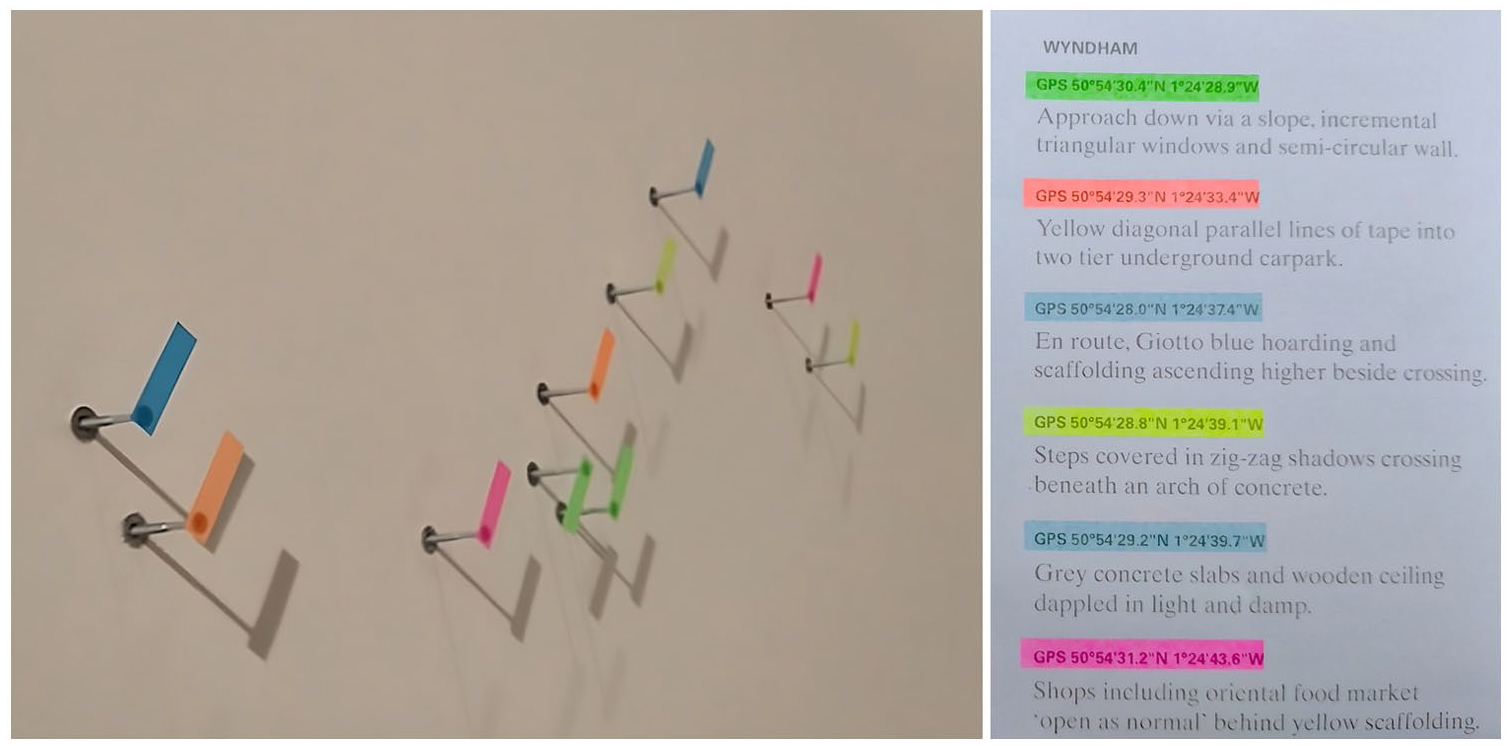
Outermost 2 and accompanying exhibit notes. Photographs by Phil Hubbard.
On a bench outside the main exhibit room, however, we find an explanatory leaflet: Tallentire’s Outermost 2 is an exploration of the potential of the ‘under-used’ spaces encountered by the artist via a series of walks in Southampton. These walks were then ‘mapped’ on the walls of the gallery’s stairwell using screws, the distances between them corresponding to their location in the city. The post-it notes thematically indicate Light, Company, Movement, Structure and Garden, each referring to part of the urban infrastructure that could be used differently: an accompanying guide reveals the observations made by Tallentire on the walks (Figure 2). The walks are mapped as an east-west transect that incorporates four well-known post-war council estates in the City. This focus on often-maligned post-war council estate housing could be read as an attempt to make us consider the deficiencies or strengths of the ‘rational’ modern living environments architects and planners provided in an era when the state often sought to provide for human needs at minimum cost. 13
One of the estates explored by Tallentire in her transect was Wyndham Court in Southampton, completed in 1966, and designed by Lyons Israel Ellis. This is a low-rise Brutalist housing development linked by concrete walkways above shop units and windswept plazas. Wyndham Court, like other UK council estates, is now often spoken of through discourses of stigma, and is home to a marginalised and often precarious working-class population. Yet its flats are relatively spacious, considerably larger than newer city centre flats marketed to young professionals and ‘post-students’. Here, Tallentire’s work is seemingly encouraging us to reflect on the value of this nearby and often stigmatised housing development.
Tallentire’s work prompts us to think about the urban spaces most often described as ‘under-used’: the voids on council estates often figured as indefensible, wasted space in contemporary urban policy circles, identified as ripe for additional housing development. But such discourses of waste ignore the ways these spaces are inhabited and co-opted by estate residents. During the COVID-19 lockdown, for example, those living in flats often needed respite from continual entrapment in the home. 14 Private activities spilled over into surrounding public space with plazas, decks and stairwells becoming outdoor gyms, workspaces or simply places to talk and exchange information. 15 In some neighbourhoods this liminal use of surrounding space was well-established, but in others this emergent use of communal space encouraged new thinking about the social infrastructures supporting urban life.
Entering the main gallery space, we immediately see a related piece, Setting Out 4. Here, Tallentire has tautly wound lengths of builder’s string around flathead screws on the wall of the gallery. Again, the piece evades immediate comprehension, but exhibit notes suggest the length of the string represents the dimensions of homes in Wyndham Court, red marks along the string indicating the placement of doors and windows (Figure 3). This reduction of volumetric, lived space to simple linear measures hints at the potential of inhabitation, but also a real estate industry that is gradually reducing room sizes in the interest of profit. As Tallentire has noted elsewhere: A lot of what I do involves meticulous measuring. I don’t know why I am measuring so much, when I find maths so challenging, or why I have ended up with this kind of practice! It is very strange. . .We live within a matrix of measurements. They can at times be seen as an instrument of power through building regulations and health and safety or the lack of such applications.
16
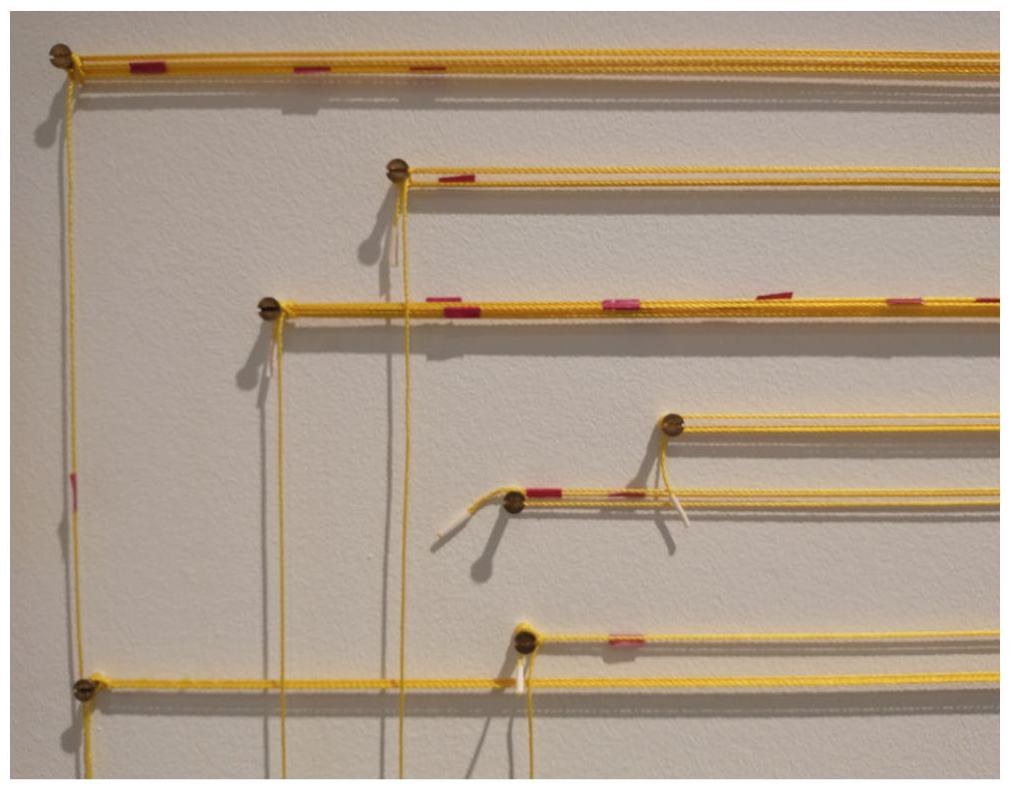
Setting Out 4. Photograph by Phil Hubbard.
The entire real estate industry revolves around room measurement and house size, with estate agency listings liberally illustrated with floorplans that invite calculation of how much space one is getting for the price of the property. In Tallentire’s installation, these abstractions of space are made strange, and the biopolitical role of space standards bought into question: Wyndham Court, like many other 1960s estates, was designed according to the Parker Morris 1961 space standards that used anthropomorphic data to determine the minimum space needed to use and move furniture about in the home.
Lockdown living
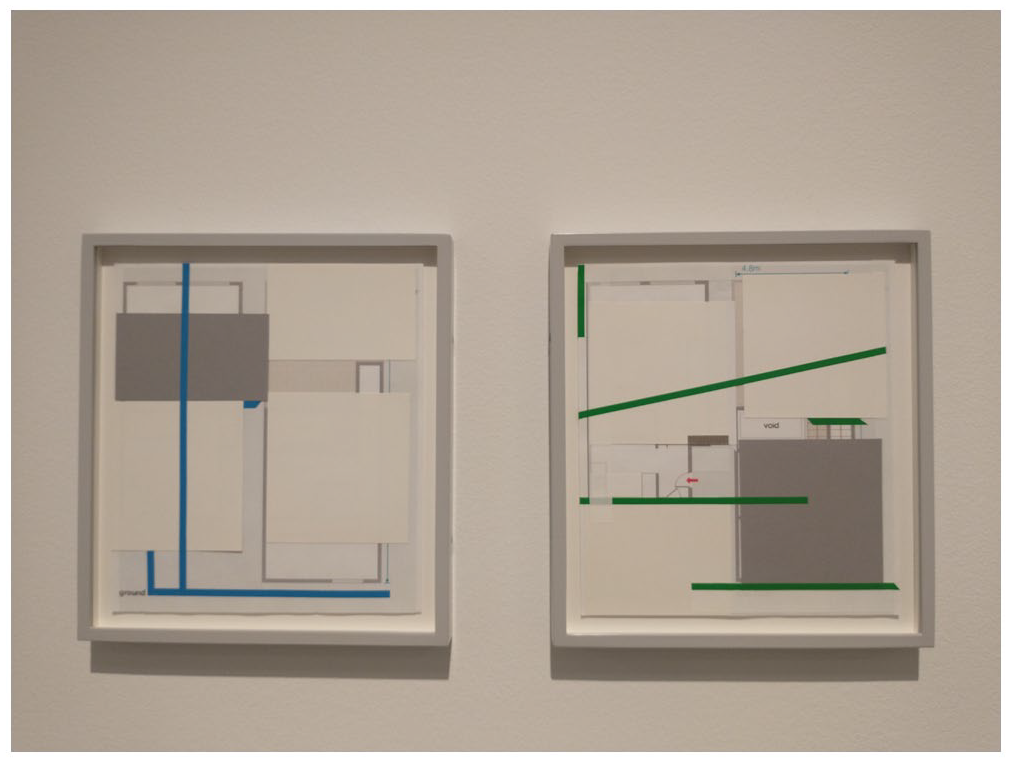
Opposite Setting Out is a new wall piece by Tallentire, Lintel (2022), which is based on a technical drawing of a small window on the Milbrook housing estate – another neighbourhood often vilified as a ‘problem estate’. The wall also featured Material Condition (2018), an earlier work involving a pile of materials (tarpaulin, polystyrene, gaffer tape and MDF sheets) used to construct temporary housing. Alongside are two new works about the experience of domestic life under lockdown (Figure 4). As Tallentire notes: Recent social distancing rules means we are all beginning to manage a specific measurement as a parameter of and for life. This raises issues have been concerning me for some time regarding how legislation and economics decree what space citizens can take up in the world. . .I have been interested in how over the period of lockdown we have had to come to know, use, and adapt to our homes and places of work differently.
17
The word fragment implies and The question arises here. Photograph by Phil Hubbard.
During lockdown, Tallentire drew scale plans of her own house (part of a 1970s modernist development near Hampstead) superimposing on them white blocks mirroring the size of the paragraphs of the books she was reading in lieu of work in her studio. Again, while there are clues that this is a floorplan, the white blocks obscure the images to the extent that the familiar abstraction of a home is made strange. Tallentire’s aim here appears to be encouraging us to reflect on the way private living spaces became both smaller and larger during lockdown: smaller in the sense that they had to accommodate work and leisure activities usually carried out elsewhere, but larger in that they encouraged thinking about overcoming the confines of domestic space. 18
This is there
Moving from the main exhibit gallery we enter a large, enclosed room with a single entrance. Inside, we find different coloured tapes and string arranged on the floor. These could easily be overlooked, misread as marking out an exhibition yet to come. Yet on examining more closely we can discern a doorway, windows, the proportions of a bathroom, all marked out at 1:1 scale. As we walk around, a woman and man also enter, with two small children. The (assumed) parents begin to point out doorways marked on the floor to their children, who run round playing ‘house’, trying to find the edges of this imagined property. What looks to be a simple architectural floor plan opens-up a performance, with participants physically moving between imagined rooms, tracing out their dimensions.
Exhibition notes explain there are actually two buildings traced on the floor, one superimposed on the other. One is an office space in the former Tyrell & Green department store, a building located opposite the John Hansard Gallery, mooted for conversion to residential accommodation. On top of the office layout is the outline of another building, a double studio converted from an office in Redbridge, London. At only 14.7 m2, this is just 29% of the recommended space for a couple under the Nationally Described Space Standards (which, significantly, have not yet been adopted by Southampton City Council). 19 Initially, the visual tangle of string and taped lines is difficult, near impossible, to interpret as two separate properties (Figure 5). At first, we assume the home is the extensive skein of tapes and string that fills the room, not the smaller property marked out. The floorplan of the studio is at first misread, dismissed as too small to possibly be a self-contained dwelling. Yet the dimensions of the small property mapped out in this piece are typical of many of the office to residential conversions currently carried out in the UK under Permitted Development Rights. 20
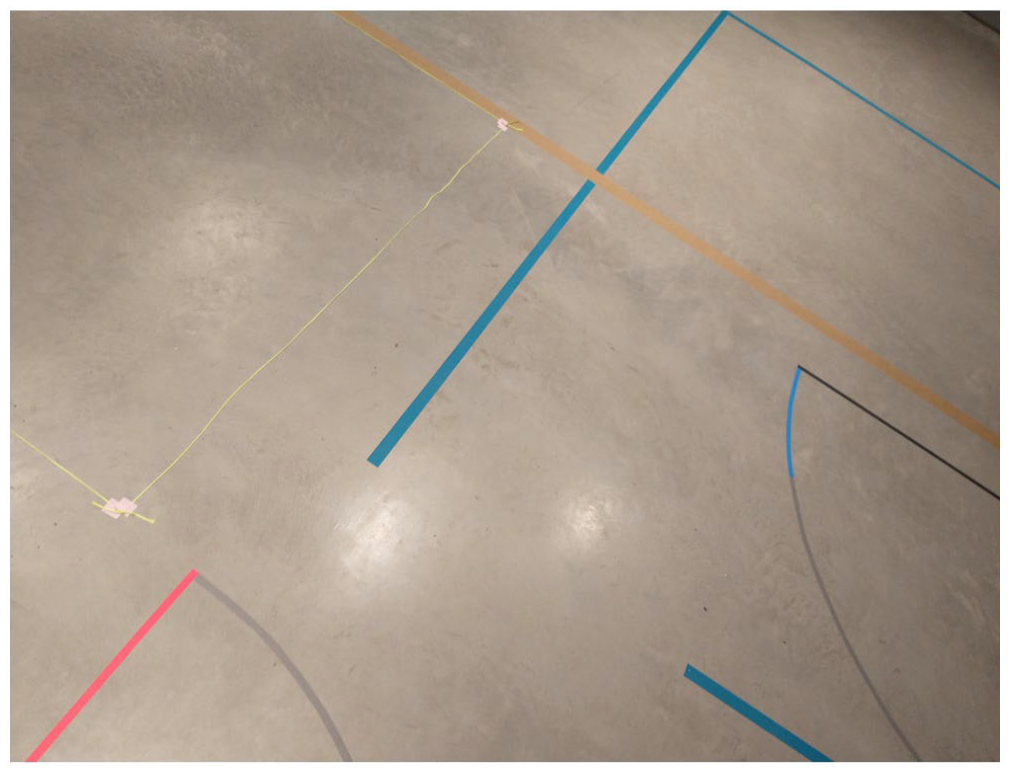
Look Over 2. Photograph by Phil Hubbard.
The viewer hence becomes part of the installation, walking through the measured floorplans trying to make sense of what is mapped, trying to disentangle where the edges of one space ends and another begins. Tallentire reflects: You can choose to stand outside, at the edge of the work, or to look at it from a distance. When you enter you might, once you are inside, recognize some of the familiar proportions delineated, such as a doorway or a bed. What you might not immediately realize is that you are standing in a drawing based on two floorplans, one an office and the other an incredibly small home. . . The recyclable parcel tape delineates the outer dimensions of a bedsit in a converted office block, hinting at the sense of impermanence that so many people suffer in terms of unsuitable housing.
21
The installation hence challenges assumptions about property size and liveability, the embodied experience of tracing these dimensions highlighting the parsimonious nature of much contemporary housing. And when the tapes and strings on the floor of the gallery are taken up, publicly, on the final day of the exhibit, we are reminded of the trauma of housing dispossession, often precipitated by the state-led demolition that displaces people from their homes and communities in the name of ‘regeneration’. 22
Concluding thoughts
Tallentire’s work draws our attention to issues of housing dimensions and layout, and the economic rationale for producing homes that can feel constraining and temporary, with little space for storing belongings or socialising with others. Yet Tallentire’s work is ambiguous: some of the installations suggest that small space can at times be creatively stimulating, rather than necessarily inhibiting, insinuating there are ways we might overcome the confines of domestic space, particularly via the use of communal, outdoor spaces. Her ‘meticulous measuring’ is therefore never simply about mapping the limits of domestic space, and the way it disciplines the inhabitant, as it also encourages us to step ‘outside the grid’. Rather than simply mapping, measuring and foreclosing these spaces, Tallentire’s installations are open to multiple forms of recognition: she creates a codification that exceeds normative practices of spatial cognition, creating moments of profound disorientation. These moments of spatial disorientation might lead viewers to question whether current building practices are creating homes fit for living. Ultimately, then, Material Distance’s mundane presentation of home as spatial abstraction helps make the familiar strange. Indeed, Tallentire has cited Rancière’s argument that critical art ‘aims to produce a new perception of the world, and therefore to create a commitment to its transformation . . .[through] the conjunction of three processes: first, the production of a sensory form of “strangeness”; second, the development of an awareness of the reason for that strangeness and third, a mobilization of individuals as a result of that awareness’. 23
Tallentire’s practice hence has much to offer cultural geographers interested in the potential of art-based creative methods to provoke an embodied exploration of domestic space: seemingly disembodied, flat, architectural floorplans, grids and measurements are ‘unfolded’ in the gallery, stimulating a kinaesthetic exploration of the limits of space. Tallentire’s work thus opens-up important political questions about how we might begin to (re)imagine the ‘adequate’ home beyond, and through, the imposition of space standards. Crucially, in an age when multi-national property developers promote ‘micro-living’ as a desirable urban lifestyle, her work stresses the restricted domesticities that many are forced to endure during the current housing crisis.
Footnotes
Acknowledgements
With thanks to Anne Tallentire, and to the John Hansard Gallery for allowing the authors to take photographs. Thanks also to Caleb Johnston for his thoughtful comments on the first draft of this piece.
Funding
The author(s) received no financial support for the research, authorship, and/or publication of this article.
