




Abstract
This response to ‘The Work of Repair: Land, Relation, and Pedagogy’ engages with the authors’ cases of Black Mesa, Port Arthur, Dzongu, and the University to further advance how the working of repair among geographers must be undertaken with greater assertiveness if the discipline of geography will be able to produce a reparative effect in its scholarship. Ultimately, the response asks what is repair, a question that this paper encourages geographers to boldly ask and answer.
Keywords
As geographers, we have long brought our methods of analysis to bear on understanding human relations to place. In that endeavor, we have thought critically about human and geological history, considering how the effects of colonialism, slavery, and profit motives have, over the past several centuries, become the dominant means by which those relations have been coordinated. At this juncture, where we have come to fully recognize the injuries produced in this history, we must strive for reparations and theories of repair that attend to a politics of material redistribution and restructured power relations, as well as just relations.
The four authors of this paper delve into diverse landscapes like Black Mesa, Port Arthur, Dzongu, and the University setting to provide a much-needed perspective into the multifaceted dynamics of repair in these precise areas. They reveal a harrowing narrative encompassing environmental degradation, intricate socio-political relationships, and the deep-seated imprints of historical dispossession. Through these varied settings, they illustrate the enduring specter of colonialism, warning against the gaps in our frameworks of advancement and the limits of any remediation efforts without adequately and righteously addressing the pressing need for a discerning, context-specific approach to redress through restoration.
The discussed sites, with their unique stories and shared struggles, spotlight the global and intergenerational ramifications of the colonial order we’ve inherited, the indomitable spirit of communities who have endured within it, and the overarching need for justice if we are to have a world to pass on. To our benefit and challenge, the paper situates geographers as being able to play a pivotal role. Equipped with their interdisciplinary outlook and keen spatial understanding, the focus on these four sites shows the near universality of these dispossessive histories and those histories’ narratives. But with each writer’s grounded expertise, they enable a nuanced understanding of degradation’s spatial and temporal facets and unravel the overdetermination of that degradation’s socio-political influence to help chart a course toward an equitable and sustainable horizon through repair.
While offering invaluable insights into the manifold challenges and limitations of repair, in this response, I want to make more apparent the reparative avenues with which the paper provides us. This is necessary because, as with much of our challenging discourse on injustice and reparation, it is often difficult to see through the former to appreciate the latter fully.
Black Mesa repair
Andrew shares the challenges at Black Mesa, a testament to the ongoing environmental exploitation that disproportionately burdens Indigenous peoples. Andrew notes that for years, the Diné have witnessed their ancestral lands being altered by the corporate greed of the coal mining industry, resulting in environmental degradation. According to Andrew, the catastrophic impacts have reverberated for generations. He informs us that using Navajo aquifer water, Peabody Coal once transported coal in slurry form over 273 miles from Black Mesa to Laughlin, Nevada. This process resulted in irreparable damage to the aquifer, draining millions of gallons of water accumulated over millennia. Here, convenience and waste laid the foundation for harm.
The subsequent air and water contamination from coal-burning power plants and other nearby industrial activities compounded the harm of the water loss. Such pollution wreaks havoc on the local ecosystem and directly compromises the health of Diné community members.
Despite the cessation of mining activities, the Diné are grappling with the aftermath – from health ailments afflicting miners who dedicated their lives to the mines to enduring land degradation. However, in the wake of the industry’s cessation are the economic repercussions for the Diné community, for whom coal once represented 25% of the non-federal revenues for the Navajo Nation. These funds were instrumental in facilitating job creation, supporting education, and developing infrastructure. Now, the community is exploring alternative sources of income, including helium and uranium mining, both of which carry their distinct environmental perils.
The paradox illustrates the tenacity of colonial harm. It is also the first indication of the group of writers’ insinuation that repair must be thought through carefully as it, too, can lead to the reproduction of injury. Despite the colonial bind that the Diné people endure, Andrew has shown us some pathways for repair. These appear as revamped governance models, innovative techniques to rejuvenate the aquifer, and the formulation of sustainable economic ventures. Moreover, Andrew stresses the importance of further actions to ensure that the rights of Indigenous communities are upheld and that their lands and resources remain shielded from the ongoing exploitation of corporate predation.
Port Arthur repair
Similarly to Andrew, Tianna provides keen insights regarding repair and remediation in Port Arthur, Texas. For Tianna, addressing the challenges begins with valuing and reconstructing the Port Arthur Black community that has borne the brunt of environmental degradation and displacement, primarily due to the Motiva Refinery’s presence. Tianna believes that any genuine attempt at repair mandates the active involvement of the Black population in decision-making processes pertaining to the environment, encompassing both environmental remediation and the restructuring of storm infrastructure. She also underscores the imperative of understanding the economic implications of these choices as Tianna emphasizes that the city must prioritize engendering economic opportunities and fostering self-reliance within the community.
Additionally, Tianna highlights the urgency of concentrating on social and reparative justice, especially for those adversely affected by environmental vulnerability and displacement. Her recommendations encompass providing comprehensive health care and mental health services, fortifying educational and cultural institutions, and directing investments into infrastructure projects to enhance living standards and the environment. Furthermore, she is adamant that such endeavors should involve the local community and offer them substantial employment opportunities.
Tianna underscores that the long-term and comprehensive repair of Port Arthur transcends mere environmental cleanup. She stresses the necessity to recognize that enduring restoration of the land and its inhabitants involves remediation and a radical transformation of the socio-economic dynamics that continue to inflict damage. For Tianna, this implies the adoption of community-centric planning methodologies and the inception of environmental governance structures that champion local voices and participation. She advances that the proper repair of Port Arthur necessitates a departure from conventional environmental restoration paradigms and a shift toward understanding the intricate interplay between land, its people, and their shared history.
Dzongu repair
Through Mabel’s insightful observations in Dzongu, Sikkim, India, we understand that the Indigenous Lepchas of Sikkim are at the forefront of an anti-dam movement. They actively resist the state’s developmental impositions and fervently demand the safeguarding of their ancestral lands. Mabel highlights the Lepchas’ struggles with the Indian government and private entities and how Indigenous conceptions of the landscape and the social histories of generations of Indigenous communities have been frequently disregarded. Mabel importantly draws attention to the paradox wherein post-colonial nations can operate as colonizing forces toward their Indigenous populations. Mabel urges the identification and dismantling of these colonial frameworks underpinning the policies and agendas of the Indian state, especially regarding development projects in Sikkim.
She also emphasizes remembering that, despite the region’s seismic activity and vulnerability to landslides, which justify the state rendering it as a blighted space, it remains the cherished home to generations of Indigenous communities who depend on the land and rivers for their sustenance and way of life. For a comprehensive grasp of the reparative work needed in this region, Mabel suggests we embrace the ‘alternative encounters with history and geology’ epitomized by the Lepcha community. This involves safeguarding the spiritual, cultural, and tangible resources that have fortified their resilience and allowed them to prosper in a landscape some label as ‘uninhabitable’.
Mabel points out the powerful counter-narrative the Lepchas provide. In defiance of oppressive descriptors for their homeland, the Lepchas are ardently revitalizing their Indigenous wisdom, heritage, and time-honored practices. As Mabel notes, true resistance and repair manifest not merely as protests but also through the revival of traditional rituals and ceremonies. These rites serve as vital links, binding the people to their terrain and rekindling ties with their spiritual and ancestral origins. Mabel emphasizes that through traditional farming, harvesting wild medicinal herbs, and prayer, the Lepchas reclaim their cultural heritage and staunchly assert their land rights.
University repair
Sarah’s concerns move away from the harmed community perspective represented by Andrew, Tianna, and Mabel to raise valid and vital questions about the role of academic institutions in acknowledging and addressing their historical and ongoing perpetuation of systemic inequities.
Sarah argues that the omission or lack of proactive understanding of these entwined histories within academic institutions is emblematic of a larger issue in which this oversight, whether intentional or not, mirrors societal tendencies to either erase or overlook uncomfortable truths about their past and the complexities of the present. This erasure perpetuates the cycles of marginalization and dispossession that academia should challenge.
Sarah’s offers the term, ‘extractive university’, to get right at the heart of the process. Indeed, many universities have historically benefited from practices exploiting people and land. Recognizing this requires introspection and the commitment – or, quite frankly, bravery – to reorient institutions toward reparative justice. Sarah suggests moving beyond mere, often conveniently performative, land acknowledgments to tangible actions of repair, restoration, and redistribution, which is commendable.
It’s encouraging for Sarah to reflect upon the years of ignorance about these profound histories in her institution, especially when teaching in a discipline intrinsically tied to land, space, and power dynamics. Acknowledging this quiet form of complicity, practiced by most in university spaces, as ‘grotesque and a malpractice’ is a brave admission on her part. Still, it also beckons a call to action.
Sarah’s proposition to utilize available resources to work toward reparation is admirable. She suggests securing university resources to delve deeper into these histories; making research public-facing and accessible is an excellent way for her to hold institutions accountable and maintain transparency. From small acts like class assignments and service work to the (unfortunately) more recognizable impact of academic writing, promoting this cause creates a dual effect. Not only does it act as a form of restitution, but it also educates and raises awareness among students and faculty alike.
Actively collaborating with affected communities not only in community work but also in research is not only comprehensive but also attuned to the perspectives of those directly impacted. However, as Sarah rightly points out, the path to repair is complicated. As illustrated by her co-authors, there is a fine line between genuine reparative actions and actions that might inadvertently perpetuate harm or become exploitative. Academics must navigate this path with sensitivity, as reparation is deeply contextual and requires that we acknowledge the unique histories and needs of affected communities and that those histories are still in progress.
Tulsa repair
I want to throw in with Andrew, Tianna, Mabel, and Sara, and think (again) from Tulsa, but about something I was not fully comfortable discussing in my book Violent Utopia: Dispossession and Black Restoration in Tulsa.
1
The above discussion and the paper it responds to highlighted the difficulty in navigating repair and restoration at the risk of re-injury, especially as historical harms are ongoing, and the pursuit of repair can indeed repeat them. The potential for this was at the front of my mind when, in writing my book on the history and consequences of the 1921 Tulsa Race Massacre, I was unwilling to discuss the ongoing search for the mass graves of those African Americans brutally murdered in the 2 days of riotous violence. In Violent Utopia, I wrote: [A]t the heart of the current efforts toward reparations and community healing [in Tulsa] is the location and excavation of the mass graves of the victims of the 1921 race massacre. The purported sites and the bodies contained therein have been the subject of much media attention. That recovery is taking place for the first time in earnest, and too little is formally known about the recovery process yet. . .. However, I neither speculate nor theorize about the lives lost. Instead, I extend my respect and reverence to the families who have been in suspended mourning for a century. Indeed, those families and the Black community of Tulsa continue to struggle to demand dignity for those lost lives. I offer the descendants of those victims compassion rather than conjecture. To some, this may present as a compromised analysis, but there are limits to commitments to analysis and empirics, and we must recognize them.
2
Since the massacre, the site shown in the image (Figure 1) was known by community members to be the burial site of their slain ancestors. For a century, the state denied that fact as well as all requests to confirm. However, a few years ago, the mayor of Tulsa and the city council agreed to investigate. And indeed, the site was confirmed to contain the remains of some of Greenwoods’s massacred. However, for over a century, that truth was denied, it was silenced. And so, for the descendants of those Tulsans murdered, repair begins with simply telling that truth.
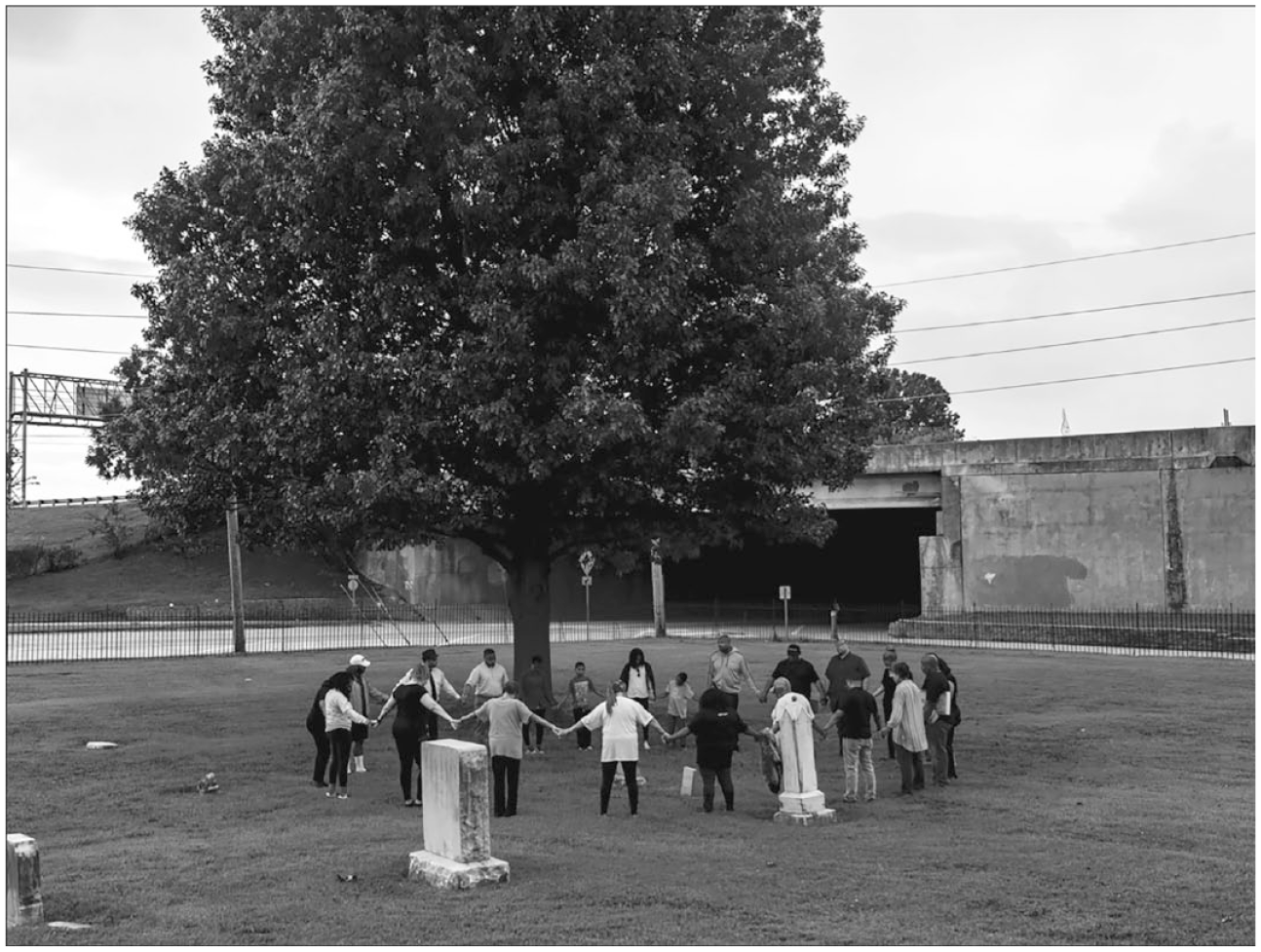
Tulsa residents in Oaklawn Cemetery. Credit Joseph Rushmore, photographer. Permission Acquired.
I mention this history and my own history of (not) speaking to it because these authors rightly state that approaching repair is fraught with complication and, I would add, even danger.
In these brilliant scholars’ testament, not only to the ongoing effects of colonial harm but the promise of repair, is a cautiousness that, in my reading, is a hesitance to mostly assertively declare what is repair. It is the reason why in my response, I wanted to simply highlight what they offered, and productively so. In their paper, there is a fear of injury. I know that they are asking for us – especially as academics – to be mindful of how we may reproduce the historical courses of injury, though in new forms. To be sure, the words of academics have consequences. However, I want them to be bolder and more declarative. They don’t have to be sure about what repair is. They don’t have to guarantee an outcome. But the communities they work with do know. Just like the community in Tulsa knew. But we can no longer afford to hedge. To say what it might be. When dealing with the kinds of resistance or obstruction, like Black Tulsans have with the city and the judicial system that denied the three surviving victims of the massacre, who lived over a century each, just to be denied their reparations, we cannot hesitate. We must lead with the knowledge and confidence of the communities with which we work.
To be sure, when the bodies in Tulsa were recovered, there was pain and injury. But I would argue that there was also healing, there was relief in knowing what was already known. I did not speak about the burial. I did not think it to be my place. I was afraid and contributing to the harm. But I have since wondered what my voice would have added. Perhaps the dead might have appreciated that I spoke for them and taken a position on their lives and deaths. Their descendants who, still mired in the same albeit differently presented structures of antiblackness, may have wanted me to speak, too.
With this point now made, I will end my response with what I believe these writers have shown to be repair. From Andrew, Tianna, Mabel, and Sarah, we gain a profound understanding of how to approach repair, especially in contexts of environmental degradation, Indigenous rights, and the historical complicity of academic institutions. While the path to repair is intricate and fraught with complexities, it is a necessary process – these four writers have made that clear.
What is repair?
Both Andrew and Tianna emphasize the significance of recognizing past transgressions. The environmental exploitation at Black Mesa and the challenges in Port Arthur serve as potent reminders that acknowledging historical wrongs is the first step toward addressing them. Furthermore, Tianna accentuates the need for the active involvement of affected communities in any genuine repair effort, echoing Mabel’s emphasis on the Lepchas’ resistance against state developmental impositions. Their voices and perspectives are paramount for any meaningful reparative action.
On the economic front, Andrew and Tianna underline the importance of seeking sustainable alternatives and remedies. For the Diné, this means exploring other income sources, and for the Port Arthur community, it translates into ensuring accessible capital for collective economic development. Tianna also brings to the fore the critical aspect of holistic well-being by stressing the importance of providing comprehensive health and mental health services.
Mabel’s narrative about the Lepchas showcases the vital role of cultural and historical narratives in the reparative process. The revival of traditional rituals and practices serves as a form of resistance and a pivotal means of reconnection to ancestral roots.
Sarah’s apprehensions about the ‘extractive university’ model highlight a pressing need for institutions to be reflective and proactive. The move should be from acknowledgment to tangible actions promoting repair and restoration. Indeed, Sarah’s emphasis on the limitations of symbolic actions such as land acknowledgments underscores that recognition, while essential, must be accompanied by substantive efforts like research, service work, and outreach. At the same time, these institutions should remain committed to collaborating with communities that have been affected, ensuring that their reparative actions are grounded in shared experiences and insights.
Together, the group provides a series of steps and terms to progress along the path to reparations. The potential complexities and risks are evident, but a fear of inadvertently causing harm can lead to hesitation. To counter that we only need an openness to feedback, critique, and continuous dialogue. Reparations, and thus repair, begin with acknowledgment, active community involvement, economic strategies, prioritization of community well-being and cultural narratives, academic accountability, tangible action, and a commitment to transparency. These insights, drawn from these diverse contexts, represent brilliant and attainable principles for a repaired future. Let us be bold enough to pursue and defend them.
Footnotes
Funding
The author received no financial support for the research, authorship, and/or publication of this article.