




Abstract
This article explores the role of walking and storytelling as a mode of memory-making in Belfast’s City Centre, a ‘shared space’ that has largely been emptied of reminders of the 30-year conflict in Northern Ireland known as the ‘Troubles’. Memorialization remains a divisive and contentious process in Northern Ireland with two opposing narrative traditions and a lack of shared collective memory. In the absence of state-led and officialized memorials to the ‘Troubles’, I explore how urban heritage can be expressed in motion, through spatial stories told by place-based professionals (urban planners, architects, heritage practitioners, arts and community groups) in the City Centre. In particular, I employ David Lloyd’s idea of ‘melancholy survivals’ to describe the ways in which memories of conflict persist in the narratives we tell and in the small physical residues scattered throughout the City Centre, which we encounter through walking and spatial stories. I argue that walking go-along interviews with place-based professionals elicits storytelling that evokes a mobile mode of memorialization. I begin by discussing the context of memorialization in Belfast’s City Centre, its role during the ‘Troubles’, and its subsequent urban redevelopment as a ‘shared space’. I then map out critical discussions around my methodological framework, which considers spatial storytelling, geographies of affect and walking methods as ways to engage urban heritage in cities that have experienced conflict. This is followed by observations from the walking go-along interviews, which include stories of physical residues, the psychosomatic legacies of conflict and ways the difficult memories factor into narratives in Belfast’s City Centre.
Introduction
Memorials and urban heritage tend to focus on the material and built environment, with stories told through placards, interpretive boards and monuments that mark out urban space. The process of memorialization, however, is more complex in cities that have experienced conflict, violence and that grapple with ‘difficult heritage’.1,2 The purpose of this paper is to explore narratives of memory in cities that have experienced sectarian violence and the ways in which these stories are shared by walking with ‘place-based professionals’. 3 In particular, I focus on the narration of memories of the ‘Troubles’ in Belfast’s City Centre. As a result of three decades of conflict known as the ‘Troubles’ (1969–1998), memorialization in Belfast and Northern Ireland remains contentious and divisive. Many residential areas outside of Belfast’s City Centre are dominated by murals that tell separate and competing stories based on two distinct ethno-cultural and political identities: Irish republicanism and Ulster unionism. The disparate and antagonistic narratives derive from a lack of a shared collective memory between the two communities, beginning with Northern Ireland’s long colonial history up to more recently, the ‘Troubles’. 4 Following the Good Friday Agreement (GFA) in 1998, Sir Kenneth Bloomfield released his report ‘We Will Remember Them: Report of the Northern Ireland Victims Commissioner’, which included recommendations to memorialize the legacies of the conflict and commemorate the victims. However, as of 2023, there is still no state-sanctioned ‘Troubles’ memorial. Since the City Centre is considered a neutral space unaffiliated with a particular community, the memories of conflict are even less visible.
Through walking go-along interviews, I explore spatial stories and walking as forms of memorialization, which I argue helps investigate the ways in which difficult histories are narrated by a diverse range of place-based professionals: urban planners and architects, heritage practitioners and walking tour guides and artists and community organizations. As I discuss, moving through urban space elicits spatial stories that enables mobile memory-making in cities, which counters erasure and silence, as well as static memorials. I focus on place-based professionals rather than sectarian-driven narratives in order to better understand how professionals who deal with urban space in their daily work engage with memories of conflict and narrate the City Centre, an area of Belfast that has witnessed transformative urban development in the last few decades. 5 Here, I use David Llyod’s ‘melancholy survivals’ 6 to explore the spatial hauntings that are revealed through embodied, affective place-based memorialization, which is particularly important in cities that have experienced sectarian violence and have undergone significant redevelopment. For the purpose of this paper, ‘spatial’ in ‘spatial stories’ refers to the ongoing construction of space through multiple coexisting narratives and representations. 7 ‘Place’ in ‘place-based professionals’ is practiced space, and considers the ways in which meaning is ascribed to a city through discourse, as well as modes of knowing and experiencing an urban environment. 8
This article focuses on the first part of my dissertation research. From late October to early December 2022, I conducted field work in Belfast, Northern Ireland, which comprised of archival research, as well as 15 walking go-along interviews with place-based professionals around the City Centre. In this article, I begin by describing the City Centre context, its role during the ‘Troubles’, its redevelopment, and the state of urban memory in the city. This is followed by a discussion of melancholy survivals and urban hauntings and how they are drawn out through walking interview methods. By conducting walking go-along interviews with professionals who work on urban and heritage issues, we can develop an understanding of how their spatial stories sketch out residues of the conflict and offer a mobile mode of memorialization in the City Centre in response to the absence of an official narrative of remembrance and the process of erasure through urban redevelopment.
Belfast City Centre context
The focus on Belfast’s City Centre is significant because it has been emptied of the scars of the ‘Troubles’ through reconstruction and extensive urban development since the 1990s. During the height of the ‘Troubles’, Belfast’s City Centre was continuously targeted through bombing campaigns due its concentration of significant commercial and institutional spaces. 9 In the 1970s, this resulted in the ‘destruction of 300 retail outlets and over one quarter of the total retail floorspace’ in the City Centre. 10 Over the course of the conflict, many areas within the City Centre became blighted, with damaged buildings falling into decay and disrepair. In response to the attacks, authorities erected a gated security barrier, ‘the Ring of Steel’, which engulfed the City Centre and contributed to the area’s stagnation. The Ring of Steel was meant to protect the commercial and institutional heart of the city from further attacks, but it also added a layer of securitization in the City Centre with curfews and bag searches that impacted both pedestrian and vehicle circulation. 11 Urban development at the time also reflected considerations for public safety and segregation. In the late 1970s, the Westlink, a high-grade motorway was constructed north and west of the City Centre, thus severing pedestrian connections between communities and impacting accessibility to the City Centre, 12 which became ‘guarded by heavily fortified police bases almost like bastions in medieval walled towns’. 13 In addition to the conflict, these urban interventions had devastating effects on the everyday life in the City Centre – places of leisure and commercial areas became violent sites of death, increased securitization, suspicion and anxiety. The impacts of this 30-year prolonged violence continue to shape the experiences of those with living memories of the conflict as they move through the city.
Philip Boland and Stephen McKay 14 explore Belfast’s transition from ‘pariah city’ 15 to ‘post-conflict city’ 16 and the ways this has altered the city’s identity for a globalized market. The City Centre became a focal point for regeneration and flagship projects such as the Laganside and Victoria Square transformed the area into a culturally vibrant, tourist destination throughout the 1990s and 2000s. This process of redevelopment has arguably turned the City Centre into a neutral space. In cities that have experienced conflict, local governments often seek to transform the city’s identity in order to promote it as safe and welcoming to investors and visitors. 17 In the ‘quarterization’ of Belfast, the city’s urban heritage and memory are engaged in specific ways. For example, along the River Lagan, the Titanic heritage walking trail has interpretive boards telling the story of the city’s shipbuilding industrial past. Within the efforts to demarcate the City Centre a ‘shared space’ 18 that is safe, inclusive and welcoming, certain local histories and narratives are deemed more palatable to engage with and publicly acknowledge (i.e., shipbuilding) than those that are more traumatic and contentious (i.e., the ‘Troubles’). The shared city framework has thus led to a state of forgetting around Belfast’s recent violent history rather than a movement towards official remembrance. This commitment to political forgetting is closely linked to the urban redevelopment of post-GFA Belfast narratives and the city’s rebranding process.
Liam O’Dowd and Milena Komarova 19 discuss the ways in which narrative constructions of urban regeneration present Belfast as an exemplar, ‘post-conflict’ success story and a city readied for capitalist urban transformation. While the struggle over memory of the ‘Troubles’ is evident in the territorialized sectarian enclaves marked by ethno-nationalist narratives, the City Centre is characterized by slick retail development, a reimagined waterfront and a focus on the tourist gaze, which engages with only certain historical threads of the city.
Belfast City Centre and Memory
The process of taming a city’s image impacts how we contend with memory and urban heritage, especially in cities that have contentious and violent histories. 20 Kenneth Foote has developed typologies of remembrance for places that have experienced tragic events, ranging from the sanctification of sites with officialized memorials to obliteration and the desire to forget shameful events. 21 In Belfast’s City Centre, there has been an ‘obliteration’, or an active effacement of ‘Troubles’-related memories. As Nagle argues, the process of erasing the city’s conflict structures an absence causing memories to resurface in ghostly ways that resist state-led amnesia. 22 The residual urban hauntings are carried by residents and their own memory maps of the City Centre that cannot simply be elided by urban regeneration. 23 While place-based professionals such as urban planners and architects are tasked with reimagining urban space and focusing on possible futures, walking and storytelling in the City Centre helps to draw attention to the material residues of conflict, engage with memories of conflict and open ways for place-based professionals to rethink memory-work in post-conflict reconciliation. 24
For Karen Till, engaging with a city’s ‘open wounds’ helps to encourage important memory-work needed to imagine more just urban futures. 25 While this article does not focus on residents’ memories or activist work, I turn to the spatial stories of place-based professionals and the ways in which wounds of the past weave their way into their narratives and movements, and allow them to reflect on their work.
In my approach, the psychic, somatic, affective geographies in post-conflict urbanscapes are significant to consider when conceptualizing memorialization, especially where there may be material discontinuities of inscribed memory. 26 Similar to physical memorials, mobile memorialization and spatial stories allow us to (re)order and make sense of a traumatized city, 27 bring attention to residues of conflict and resist full obliteration. The architectural and material interventions in contemporary urban and heritage practices should pursue more self-reflexive relationships with place and consider the immersion of a ‘temporal, kinesthetic and embodying experience’. 28 As I argue, moving through the City Centre elicits a mode of memorialization through storytelling that offers insights into how we can navigate memories of conflict and questions of urban heritage in a space that largely encourages forgetting.
This concept is similarly explored in Kate Catterall’s performance and design-based intervention, Drawing the Ring of Steel: a Mnemonic Device for Belfast. The project redrew the outlines of the Ring of Steel in the City Centre, and evolved to include workshops, a walking tour and a performance component that invited residents to share memories and stories about the Ring of Steel where it was once located. This project, while ephemeral, enables a collective remembrance of everyday experiences of the ‘Troubles’ in the City Centre and offers a transgenerational experience for residents to reinscribe their memories in their ever-transforming City. 29 Similarly, I am interested in the ways place-based professionals situate themselves, their work and their stories/memories, within the City Centre. Just as residents map their memories of conflict onto urban spaces, how might the spatial stories and walking patterns of place-based professionals reveal the ‘melancholy survivals’ that exist in tension with state forgetting?
Methodological framework
Even as cities are subject to redevelopment, small material reminders and memories of the past linger and persist. These melancholy survivals may be physical, immaterial or bodily. They are spatialized stories, which exist in footsteps, walking patterns, bodily movements and in the memories shared along a streetscape that may no longer hold those physical reminders of the past. They are the remnants of violent histories that go unnoticed by the passerby.
By applying David Lloyd’s idea of ‘melancholy survivals’, I explore how walking through the city with place-based professionals creates spatial stories that reveal residues of conflict and allows for mobile memorialization. In his article ‘Colonial Trauma/Postcolonial Recovery?’, 30 Lloyd examines ideas of recovery and decolonization, and argues there are forms of ‘living on’ that exist in the postcolonial condition that have the potential to refuse capitalist and colonialist prescriptions of modernity and progress. While the modern state is defined by narratives of capitalist development, Lloyd is interested in understanding the modes of ‘living on’, what he terms ‘melancholy survivals’, which represent alternate, often pre-colonial narratives, practices, memories that ‘athwart modernity’. 31 I read Lloyd’s work as an articulation of the struggle over storytelling that asks: what spatial stories and memories are bracketed out of the accepted, officialized narrative forms? I propose that melancholy survivals can include the persistence of spatialized memories of conflict in tension with ‘post-conflict’ urban development that is entangled with state discourses of amnesia, modernity and regeneration. I explore these expressions of memorialization that cannot be eradicated, forms of melancholy survivals or living/remembering on, which are presented and articulated through walking and storytelling. In tension with state forgetting and urban redevelopment, there exists forms of remembering inscribed onto or attributed to the urban fabric – these are held onto memories and stubborn residues of violence and trauma that refuse complete erasure. The discursive and material become co-constitutive through movement. By applying Lloyd’s concept to cities that have experienced conflict, we recall that urban spaces are palimpsests etched by memories of sectarian violence. Melancholy survivals persist in our footsteps and stories, and the material residues that cannot be fully defined or enveloped by urban (re)development and heritage practices that seek erasure or forgetting in the absence of state-led remembrance.
In this mode of storytelling, movement and the body are articulations of a narrative process. As we move through the urban environment, we become enmeshed in a process of narrating ourselves, our memories and the city’s stories. Emma Waterton and Steve Watson 32 ask us to move beyond the textual or discursive registers of heritage and consider how it moves and circulates. By drawing on geographies of affect, we shift attention to the movements and experiences that shape urban form and memory. In expanding heritage ‘beyond its things’ and ‘its representations and the discourses that use it’, the inclusion of embodied, non-representational states of being helps to reframe spatial stories and remind us of the dynamic interfaces of the spatial, the body and the social. 33 In cities that have experienced conflict and urbicide, we also negotiate place-based grieving processes. In such spaces, we can use walking and storytelling to navigate absence-presence in a way that brings together material sites and embodied-emotional experiences in place-based grief. 34 Walking reconstructs the wounded city and stitches memories of the urbanscape that may be otherwise invisibilized by redevelopment and modes of urban heritage that curate select narrative threads in post-conflict spaces.
As part of the recruitment process, I researched Belfast-based place-based professionals who work on the broad themes of heritage, architectural preservation, urban history and development, tourism and community engagement. I provided prospective participants with an informed consent form and a pre-interview package with a project brief and a guide for our discussion. For the interviews, I used a go-along format, and asked participants to ‘guide’ the walk and take me to places they felt were significant for their work and that would allow them to touch upon the themes of urban heritage, memorialization and collective memory. I aimed to pose few questions in order to allow participants to narrate the urban spaces as we move through them at their own accord.
In these interviews, I focus less on land-use policies and regulations and more on how these place-based professionals narrate stories of their cities and engage with urban memory in their reflections. By interviewing participants while walking, storytelling becomes an embodied form of memory-making. Through their stories, we can observe the residues of conflict in the City Centre, the melancholy survivals, which assert themselves and emerge in an urbanscape that has undergone ‘post-conflict’ regeneration.
The walking go-along method helps to draw out the complex connections that are formed between people and place and allows for urban ethnographers to examine those ‘hidden or unnoticed habitual relations with place and the environment’. 35 For my interviews, I delineated the study area to Belfast’s City Centre, which gave participants a geographical parameter for our walks. 36 I wanted to ensure that the walk prioritized the ‘momentum in [the] narrative about the interviewee’s experiences of the place’. 37 Further, while walking interviews help develop ‘spatial and locational discourse of place’ that is ‘structured geographically rather than historically’, 38 my research focuses on narratives of memory in which the spatial and the temporal work in tandem. In other words, the geographical and the historical hold equal importance in the walking interview, as participants shift through temporalities as we move across space.
In a Northern Irish context, Joseph Robinson and Andrew McClelland similarly discuss how walking can reveal the ‘storied depth, multi-temporality, and the alternative narratives of the past that frequently remain hidden in places touched by violence’. 39 They explain that walking methods in ‘troubled places. . . dig into the reservoirs of emotion, affect, vitality, and multi-temporality people experience in post-conflict landscapes, thus opening up new research vistas. . .’. 40 In short, walking methods can be productive and generative in post-conflict cities that are constrained by dominant narratives (or even a lack of an official narrative), as the practice sketches out how place is remembered in situ, bringing to light what is unseen, the ‘spectral traces of contentious past[s]’ and the ‘often-unnoticed microfeatures of the built environment’. 41 Affective heritage becomes a way to explore tensions between the ‘enshrined in official designations by heritage agencies’, which may focus on the built environment, and the embodied, sensory experiences of place and history. 42 While it was not a criteria to participate, all interviewees were from Belfast or the surrounding area. Two of the participants could be classified as early-stage professionals who had no direct memories of the conflict, while the remainder were mid-to-late-stage professionals who had living memories of Belfast’s worst moments of the ‘Troubles’ in the 1970s and 1980s. Most interviewees noted that they had post-secondary education. Interviewees were not asked about their ethnic, religious or political backgrounds – although a few volunteered some of that information in their interviews. As part of the pre-interview procedures, I reviewed the informed consent form with participants, which emphasizes that the interview can be paused or stopped if they feel any moments of discomfort. In this process, interviewees are also assured that their identities would remain anonymous in publications. In the Discussion section, I refer to participants by their broad professional title.
Discussion
By walking with participants, experiences, stories, memories and perceptions of urban space are expressed in a fluid way that cannot be articulated in a sedentary interview. Walking and talking with research participants brings needed nuance and texture to spatial stories and memories of conflict. Tim Ingold and Jo Lee Vergunst 43 liken the footsteps in walking as a form of storymaking, offering traces of memory for people as they move through the urbanscape. The residues of conflict – the otherwise unnoticed spatial features and stories of the past – haunt the city and ‘the idealistic visions of planners, promoters and entrepreneurs’, refusing to be fully conscripted into or effaced by urban redevelopment. 44
The physical residues of the conflict are interwoven into the spatial stories of the City Centre and through the walking patterns of the interviews, as participants bring me to seemingly mundane or hidden features of the urbanscape that have some associations with the ‘Troubles’. For instance, a walking tour guide shows me to a small memorial in the City Centre: ‘It seems quite shocking that there can be sites in the City Centre where there isn’t overt commemoration. There is one hidden ‘Troubles’ memorial in Belfast. . . [it] looks like a bricked-up wall but it simply reduces every victim to a simple number. Even that memorial is forgotten about’. Tucked away along a busy Victoria Street in Jubilee Square, this small piece of wall is etched with fading numbers, codes for each life lost as a result of the conflict up until 1976. The wall is slightly defaced and set far back from the sidewalk along a noisy arterial road and is unnoticeable to a passerby. It is not a prominent feature in Belfast’s memoryscape, and indeed is also absent from tourism brochures, images and narratives (Figure 2).
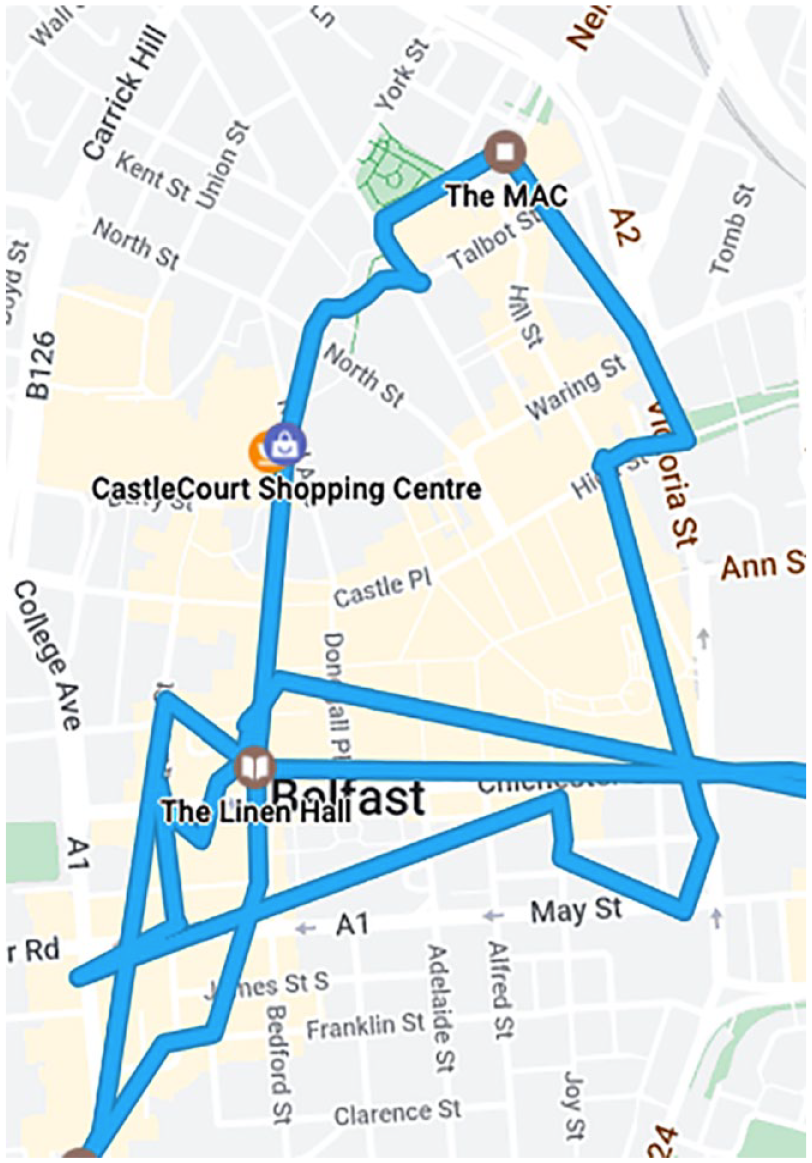
Walking route from an interview with a walking tour guide, 2022, Image.
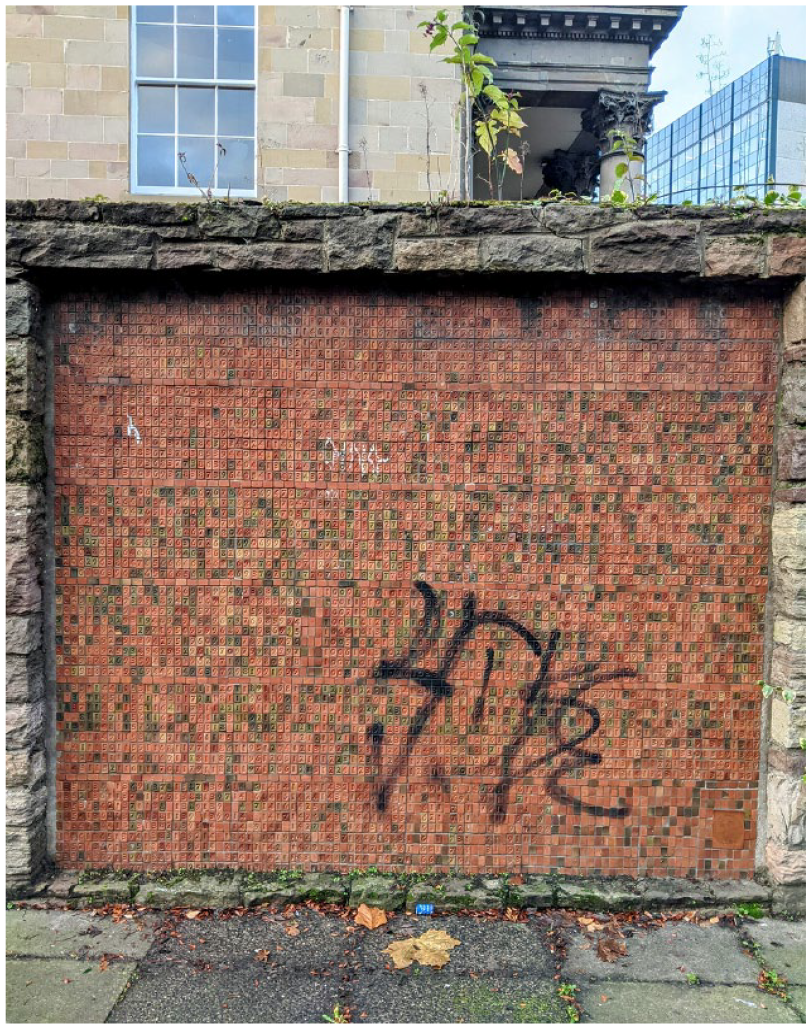
Troubles memorial in City Centre, 2022, Image.
While many interviewees brought me to the Europa Hotel, one of Europe’s most bombed hotels during the ‘Troubles’, one walking tour guide tells me about a memorial inside the building. From outside the Europa, there are no such markers. The placement of the memorial wall inside the hotel lobby, which tells the story of the ‘Troubles’ and the resilience of staff at the time, is not centralized, but is designated to the corner and needs to be actively sought out (Figure 3). The visibility of the Europa memorial in a semi-privatized space signifies an effort to obliterate its violent history from the public sphere. However, for most interviewees, walking by the Europa itself is enough to conjure memories of its history during the ‘Troubles’.
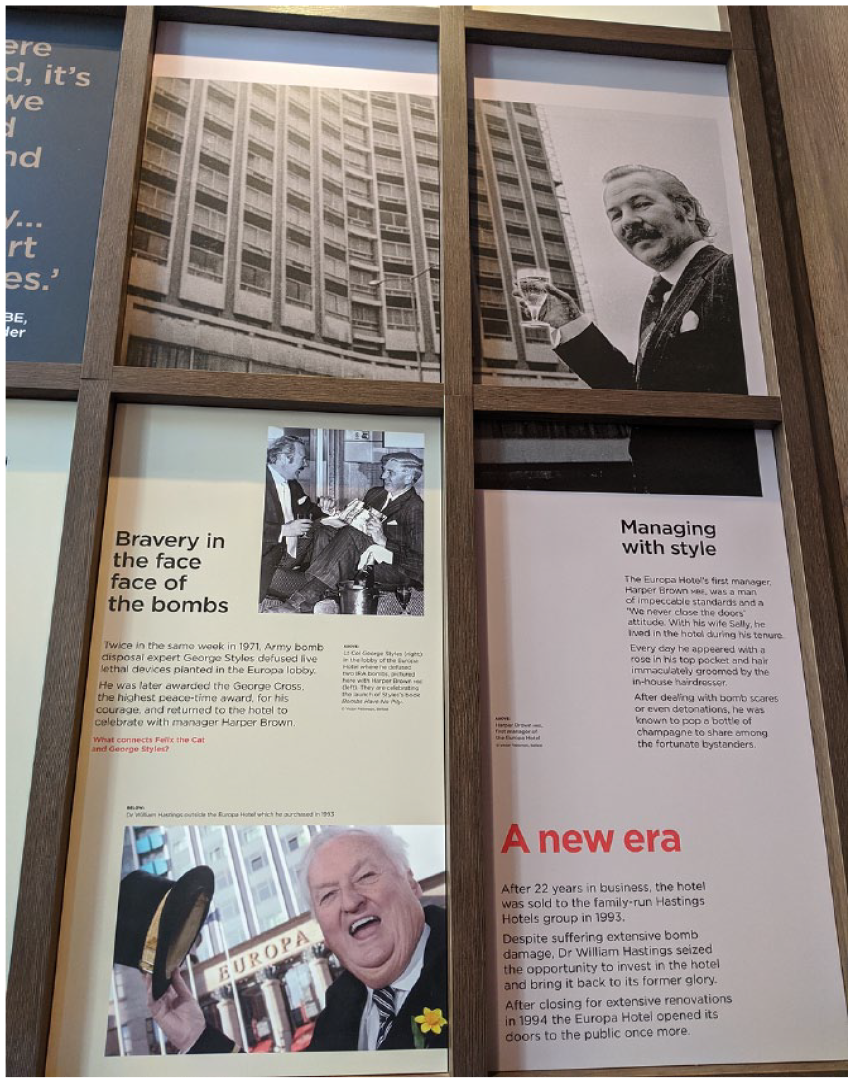
History wall in Europa Hotel lobby, 2022, Image.
The walking method also encourages conversations about what we value in heritage preservation. Many interviewees bring me to the security cage at the Sunflower Public House, which might be the last of its kind of the city (Figure 4). A heritage preservationist uses it as an opportunity to open a discussion about how built heritage can be reconsidered in the city: ‘The Sunflower Pub tried to get itself listed not because the building is particularly interesting but because it’s the last of those barriers outside the building [. . .] it’s a historical thing, you could list for historical reasons or architectural reasons’. One architect notes that these security barriers were commonplace at the entrances of bars and pubs during the conflict as a way to prevent sectarian attacks: ‘We’re coming to Sunflower bar, there’s the cage. These would have been a common fixture on pretty much every bar in Belfast during the ‘Troubles’. So there’s no need for it to be there now to be honest, so it’s just there for memory’. As the story of the Sunflower’s security cage becomes narrated by interviewees, this seemingly inconspicuous vestige from the past becomes a sort of ‘memorial’ to the ‘Troubles’. After the Sunflower, this architect walks me to Castle Street, which leads into the Falls Road, a predominately republican area and continues sharing her thoughts about different forms of conflict-related ‘memorials’: ‘This is Castle Street. It doesn’t really have anything to do with built heritage, but the Black Taxis. . . For some reason, buses going up and down the Falls Road and certain parts of North Belfast, because they were getting burnt out so much in the ‘Troubles’, they just stopped going up and down. There’s a Black taxi industry and it worked a bit like a bus. So you didn’t hire a taxi for yourself. You just kind of flag it down on the side of the road and you could be sitting beside five strangers and you just rapped the window when you wanted to get out’.
As we walk, this architect considers the residues from the ‘Troubles’, the Sunflower and the Black Taxis on Castle Street, as part of the story of City Centre. These sites, too, are attached to memories of movement, safety and thresholds – entering a security cage, entering/leaving the City Centre – underlining the harrowing melancholy survivals that linger inconspicuously.
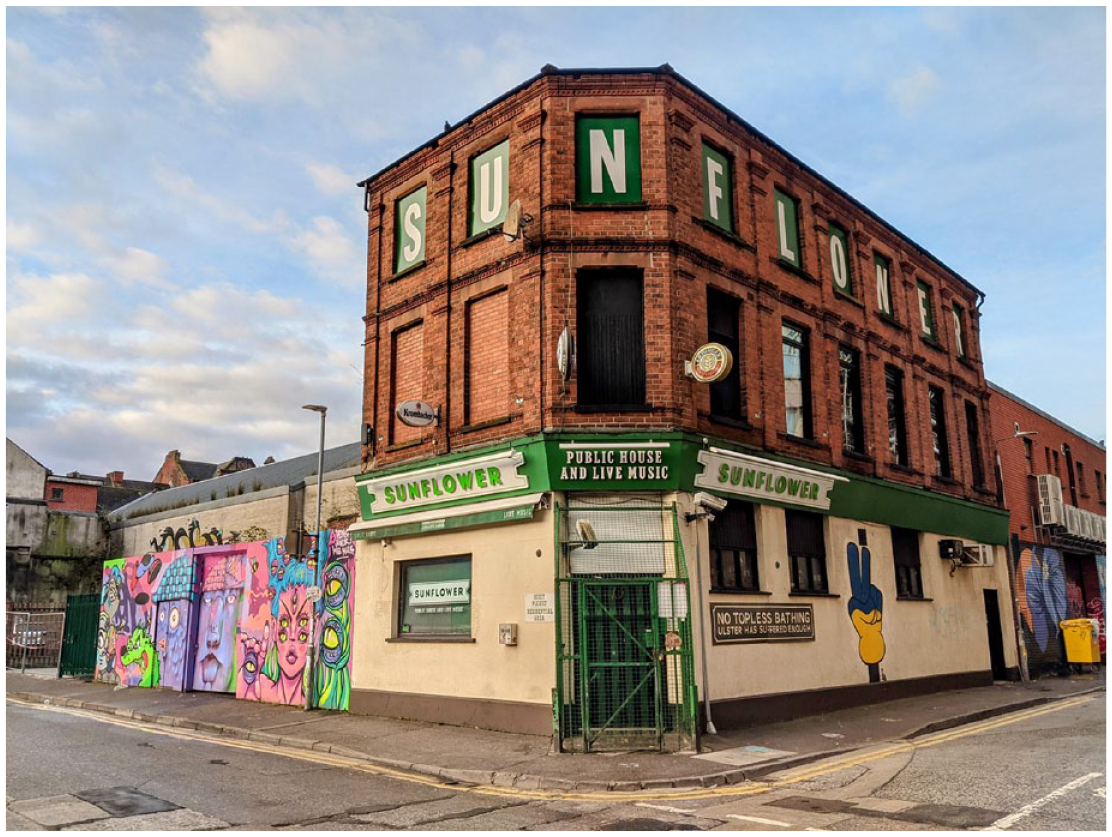
Sunflower Pub, 2022, Image.
Similarly, another architect brings me to the former site of the Abercorn, a popular City Centre restaurant that was bombed in 1972. At the current site, now a sportswear store, the interviewee points out the original pillars from the Abercorn somewhat visible from the street through the window (Figure 5). While not completely obliterated from the urbanscape, walking enables interviewees to draw attention to small material reminders of the conflict that may go unnoticed: ‘The Abercorn was one of those ones early on which would have hit everyone. . . [it] carried on and opened up again after that and remained in business for a number of years. But the building has now been rebuilt. There is still a trace of the building in it. There were these columns in front of the building that are still there, hidden behind glass, not as a memorial, it just happens to be what remains of the old building. . .So there are lots of things like that. Everywhere, there were so many bombs in the City Centre’.
Finally, another architect brings me to a large concrete wall along the eastside of the Royal Courts of Justice: ‘I wanted to stop here because I find this a very interesting corner of the city. There are so many layers of history’. As a passerby, the wall is rather inconspicuous and it blends well into the surrounding urban environment, but it had a specific purpose during the conflict: ‘They had to build this enormous blast wall because they were leaving so many car bombs to try to kill the judges. . .It’s still needed for security reasons, but even if it wasn’t, I would struggle to justify removing it because it’s so important’. The blast wall remains a physical residue, a melancholy survival and as this architect’s narration suggests, should remain part of the urbanscape (Figure 6). From his position as a conservation architect, the wall’s historical significance is just as important as the architectural value of the neighbouring Royal Courts of Justice. Across the road is the site of one the worst bombings of Bloody Friday at the Oxford Street Bus Station. The only physical remains from that event is a non-descript water pumping station, sitting in the middle of the Waterfront Hall redevelopment: ‘The fact that such horror happened here and that’s the only marker left for it. . . it’s not an architecturally noteworthy building’ (Figure 7). As an architectural professional, this interviewee has the tools to research and delve into the histories of these residues in the built environment. However, as he does not have a living memory of Bloody Friday himself, he reflects that he does not have a psychosomatic response to the space that others may have by walking: ‘I think a lot of citizens of Belfast would have very different experiences walking through different spaces. . . it depends on the walker. I suppose if you have an experience in a place that will colour it. People who were there on Bloody Friday at the Oxford bus station, would have different experience walking down Oxford Street than I do. I am aware of them now because I’ve read about it but I don’t have a strong emotional reaction to it’.
Once the interviewees’ stories are shared, these physical residues and vestiges act as reminders of the City Centre’s violent history and become melancholy survivals in the urbanscape. Through their walks, the place-based professionals reflect on how these material reminders encourage conversations around memorialization. Importantly, there are also temporal and ephemeral dimensions to this mobile memorialization. These melancholy survivals, articulated through spatial stories, are presented as moments in situ. For the visitor, these residues may not be registered as memorials or even urban heritage at first glance, but once the stories are narrated around them and memories are imparted upon these otherwise unassuming urban features, the material, temporal and discursive converge, and these residues become visible as markers of conflict, refusing obliteration.
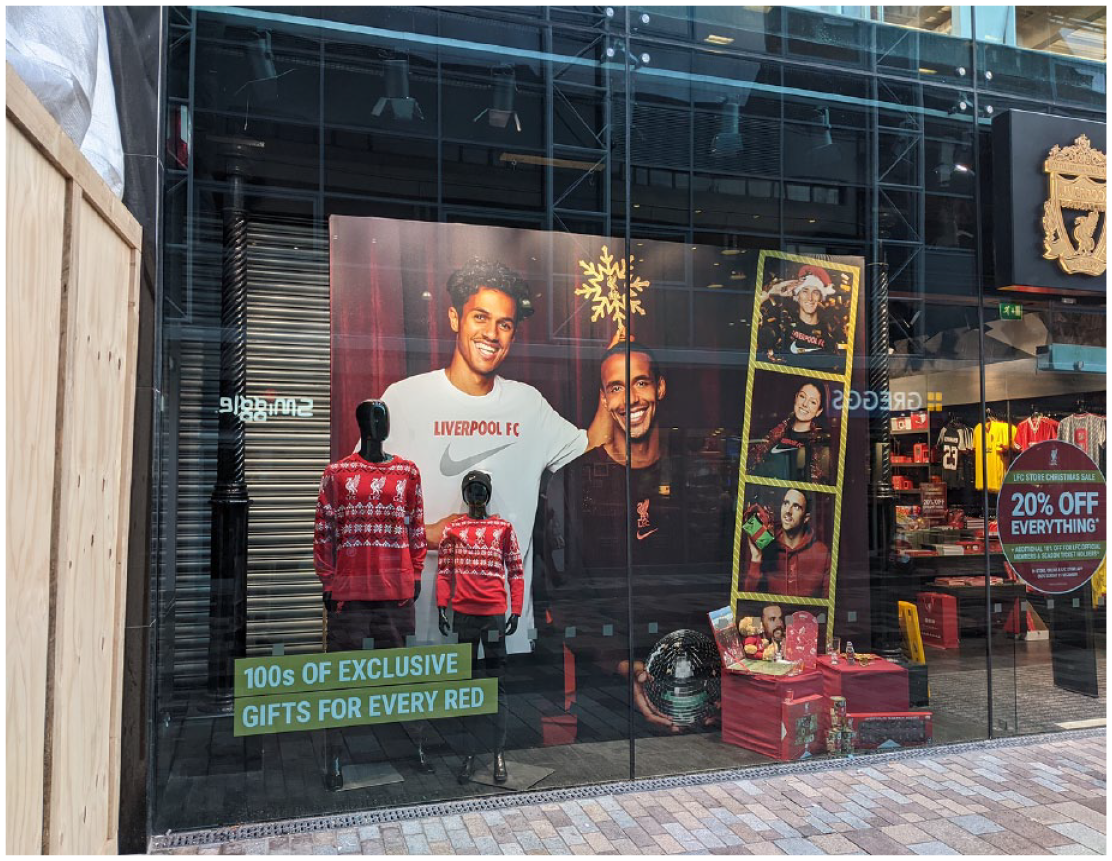
Pillars from former Abercorn restaurant in current store, 2022, Image.
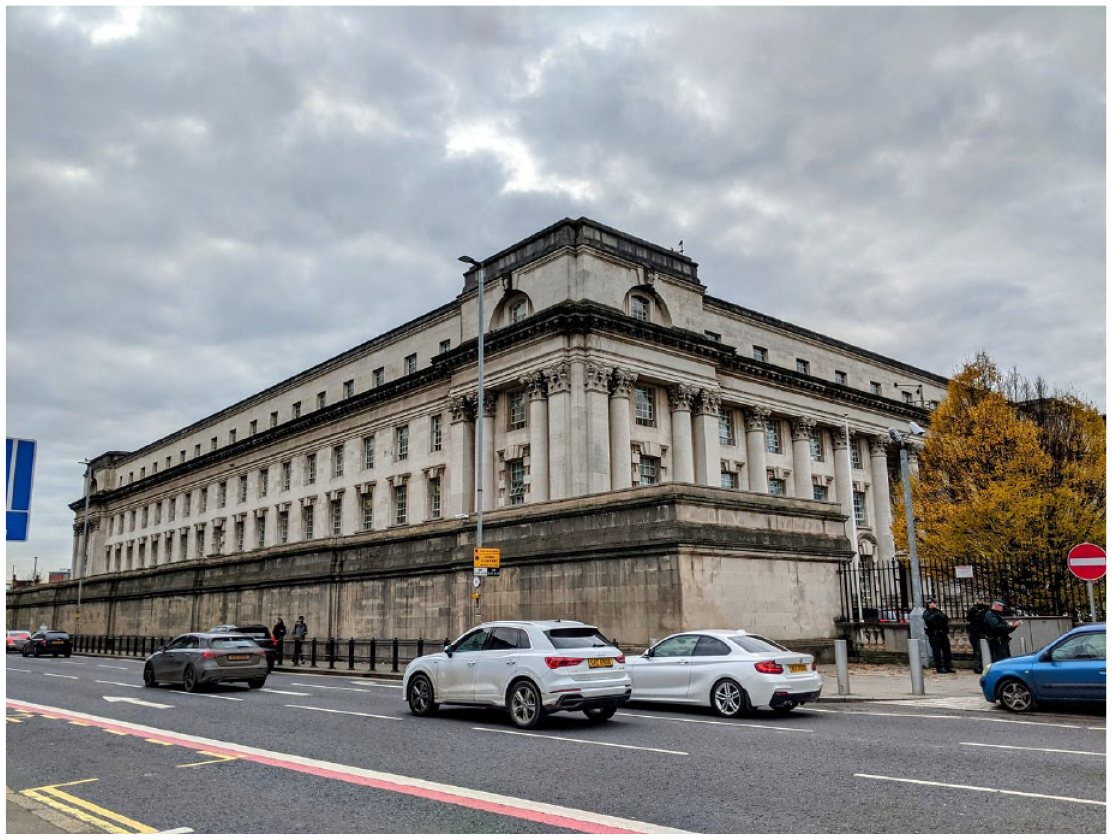
Blast wall on the east side of the Royal Courts of Justice, 2022, Image.
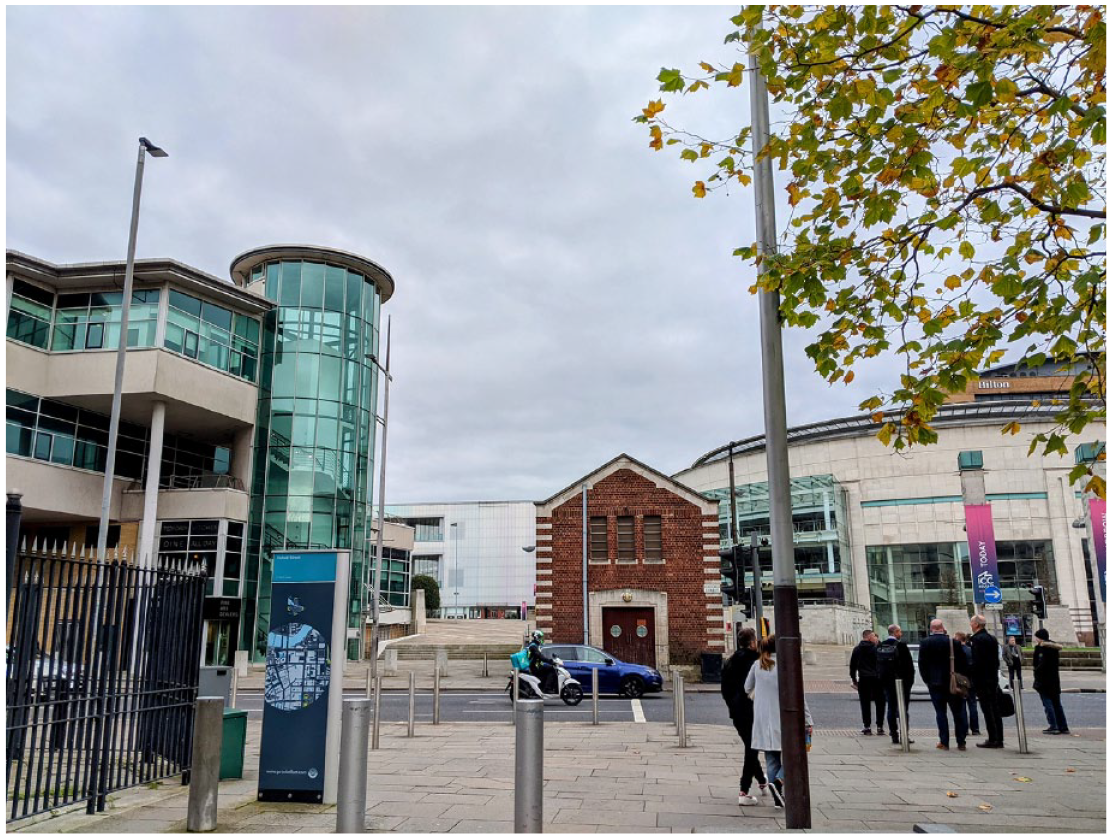
Old water pumping station, 2022, Image.
For walking tour guides, spatial storytelling plays a central role in their work. Walking tour guides narrate and interpret urban spaces for visitors, selectively curating scenes and geographies. All but one walking tour guide indicate that they deliberately do not focus on the ‘Troubles’ or the politics of Northern Ireland because they want to tell a different story of Belfast. However, memories of the conflict inevitably emerge through their stories, sometimes in subtle or surprising ways. One walking tour guide focuses on telling entertaining stories of the City Centre. As we walk, he threads a story of a well-known local pantomime performer who keeps experiencing near-misses with bomb attacks in the City Centre. situating the story as simply a tale about an entertainer with good luck, rather than focusing on the political events surrounding the attacks or the more harrowing memories of conflict. Near the Grand Opera House, however, he reflects on the ways in which memories of the conflict may re-emerge for his audience: ‘At the opera house, I am telling the story of [John] in the bar, and one of the ladies, she just walked away. I thought, she’s getting bored here. No. I finished the story and we’re moving on and she came up to me and says, ‘I just want to apologize to you. I didn’t want to hear you talking about that because I lived across the road from there. And I saw all that carnage that day.’ I thought, wow, holy shit, she had seen it. And she just didn’t want to bring the memories back. . .You forget with the local people, you know’.
While this participant prioritizes the humorous, lesser-known stories of Belfast, the shadow of the decades-long conflict can become activated in certain spaces through storytelling, reminding us of the relationship between place and residents’ lived memories. Even as urban redevelopment has substantially transformed the area around the Grand Opera House, material obliteration cannot entirely elide the visceral and traumatic memories of conflict that residents carry with them over time.
Walking interviews also build social networks that are developed through a cast of local characters as we move through urban space. In one interview, a walking tour guide constantly runs into, engages with and interacts with his acquaintances and friends throughout the City Centre. This participant weaves in different actors into the walking interview who all contribute to his story of the City Centre. Walking allows him to facilitate and curate social networks on the move, with impromptu interactions with locals along the streets and businesses of City Centre. When we go into a local bar, his bartender friend, ‘Story Stuart’, becomes a part of the narrative and begins talking about urban infrastructure in Belfast and the ways it was used to divide communities. When we are back to walking, the interviewee notes that tour groups often draw attention from locals, who will stop and listen to what he is telling tourists. Even in the shared space of the City Centre, telling stories in the public sphere can be contentious: ‘Because it’s an open space, it doesn’t belong to anyone. So your narratives that you’re trying to tell or the history, someone will say. . .why are you telling that?’ Indeed, he mentions the need to lower his voice while discussing political issues in certain areas of the city. On such one occasion, an older man stopped the interviewee and asked him: ‘Getting the whole story right?’ Another walking tour guide who does engage with the ‘Troubles’ on his tour notes the power of ‘unscripted interactions’ with spatial storytelling: ‘Particularly [at] sites such as the Abercorn. The event affected everybody in the city and what we found on a regular basis is that we would have older women in particular walk past and then interrupt us and tell the group, that they were in the city that day or that they were nearby that day, or even god forbid, they knew someone who as in the Abercorn that day’.
For this particular guide, spatial storytelling helps to ‘change the perception of the street for people’ as he ‘ask[s] people to shut their eyes, listen, activate their senses and engage with the stories of the past in place’. Even in the hyper-developed City Centre that has been emptied of visibly contentious histories, the ways storytelling shapes the place remain important. The constant movement of people moving through this primarily retail and shopping district, perhaps facilitates these conversations and interactions, and instigates memories of conflict to resurface. The above examples with walking tour guides demonstrate the ways movement enables a performative aspect of spatial stories that involve chance encounters with passersby who contribute to the construction of this memory-making. These melancholy survivals, or ruptures in narrative, help to signify the importance of spatial stories to engage with a mobile form of memorialization that refuses to be completely eradicated from the City Centre. These interactions and exchanges bring ‘shading’ 45 to memories of conflict and the ‘Troubles’ within the City Centre, an area that has physically been emptied of conflict. Urban space then becomes striated with dynamic memories and stories, across time and generations, refusing to be static.
The experiences and legacies of sectarian violence also persist within our bodies. These psychosomatic memories of ‘Troubles’-era City Centre are difficult to remove from spatial patterns. One artist discusses how ‘muscle memory’ guides the way she walks through the City Centre even to this day. For her, the body still recalls the almost automated movements passing through the Ring of Steel security barriers to enter the City Centre, a process that involved a series of checks and frisks. In addition to moving through the barriers with its airport-style security checks, the affective experience of feeling on edge within the City Centre remains etched into spatial memories. Residents knew their particular security checkpoint into/out of the City Centre and did not meander too far from it in case there was a bomb scare. As we walk along the edges of City Centre, one architect shares: ‘I’m from the north of the city. . .if you were coming into town, it was kind of a risk. . . so people tended to come in from the north and not go much further than here at Castle Court. And that would have happened from the west, they would have just come as far as Castle Street’. As this interviewee explains, crossing the threshold into the City Centre shaped how people moved through and experienced the space: ‘There was a psychological aspect to them. . .you were really taking a risk that something could be bombed while you were shopping. I have an uncle who got one half of his haircut and then had to leave [because of a bomb scare]. They had to evacuate. So he came home with half a haircut. As extreme as that, you just have to drop everything and go home’.
Participants who lived during the height of the violence in the 1970s and 1980s carry their own personal memories of the ‘everydayness’ of bomb scares, near-misses and hijackings that get evoked as we walk through the city and talk about memorialization. While walking along Wellington Place, another architect strays in his narrative and walks towards where he was once hijacked as a student by car bombers: ‘I can remember as a student, coming into Belfast. . .I parked my car, oh maybe about half a mile out that way, came to the athletic store, bought my snooker cue, and went back. When I got into my car, it was my mother’s car, there was a tap at the window and someone was pointing a sawn-off shotgun at me. They wanted my car. And I got out, let them take the car. . . it was a two-door car, so presumably they were going to lay a bomb’.
The story is mentioned casually as an aside to emphasize the everydayness of violence in the City Centre at the time. Similarly, walking towards Dublin Road, an artist recounts a moment in the early 1980s when a bomb went off: ‘I walked straight past here and up to the corner where the BBC is and onto Dublin Road and I just turned the corner when the bomb went off and I remember flying through the air and hitting a lamppost and sliding down and these guys on the other side of the road came out and they said, ‘you alright love?’’ By walking and spatializing their memories, those physical remembrances linger and are recalled for interviewees throughout the City Centre. It was common, too, that interviewees gravitated to the edges of the City Centre on our walks, where the boundaries are clearly marked by wide arterial roads and motorways. As we move along the peripheries, some interviewees tell stories about sites just beyond the City Centre, some of which are visible in the skyline, such as the Divis Tower at the entrance to West Belfast, which was a key site of conflict during the ‘Troubles’. Their memories cannot be contained within the confines of City Centre – the movements and spatial stories of place-based professionals often extend out to other geographies, pointing to the need to consider the relationships between the redeveloped urban core and the surrounding areas. In tandem with the peace process, urban development in Belfast has created ‘bubbles of peaceful space’, while also demarcating liminal spaces that draw attention to the city’s fractured and divided geographies. 46
In arts-based initiatives, storytelling and walking are clear mechanisms to grapple with and work through memories of the conflict. One artist describes how her organization works with local community partners and residents to fictionalize memories of the ‘Troubles’ to curate stories of the city through performance pieces. The result is that the stories are not overtly individualized or personal, but still recognizable for those who lived through similar circumstances. In this way, fiction creates a distance between hardline sectarian and politicized narratives, while also honouring and respecting residents’ lived experiences. On the walk, this interviewee takes me into a small entry-way in the Cathedral Quarter where she asks me to consider the acoustics of the small space in order to notice minute details of the urbanscape: ‘I think that so often when it comes to urban heritage, we all keep our eyeline at the same height and I think one of the big things that I would talk about whenever we’re at an urban space specifically is how do we encourage an audience to look up. How do you encourage an audience to see nooks and crannies but also how do you give them nuggets of information about place that they then become the keepers of?’
Through storytelling and movement, arts-based interventions have the ability to critically engage with ideas of memorialization to process fraught histories in post-conflict societies. This relationship between story, the body and built form evoke these melancholy survivals that stubbornly evade the narratives of City Centre as a neutral, consumerist space.
Conclusion: The City Centre and remembering on
It has been 25 years since the signing of the Good Friday Agreement and in that time, Belfast has experienced transformative change. Even so, stories and memories of the ‘Troubles’ in the City Centre abound, facilitated by movement and footsteps. Most interviewees are skeptical about the idea of officialized memorials, noting that the City Centre was so heavily damaged during the ‘Troubles’ that if placards were to be put up at every site of tragedy, there would be one everywhere. As one heritage preservationist notes, memories of conflict imbue urban space: ‘Should you wipe it off the face of the earth and forget about it?. . . I don’t know whether you need a memorial to the ‘Troubles’. It’s all around us’. Another heritage practitioner emphasizes: ‘Spaces like this punctuate the city. . .I certainly don’t believe we should forget the past but do we have to mark down every single spot?’ With a walking tour guide, I am taken to Castle Lane, close to Arthur Square in Cornmarket, a busy shopping area in the City Centre. We stand outside the former site of the Abercorn restaurant, but instead of a story about the 1972 bombing, the interviewee tells me a story about a building we are standing opposite to, the former site of Mooneys Bar. It was in that building in March 1971, the interviewee explains, where three young Scottish soldiers were drinking and ultimately lured to their murders by the IRA. For this walking tour guide, this building and the events that surround it, signify a turning point in the conflict that made the ‘Troubles’ unavoidable: ‘That event is kind of the absolute trigger for the descent into full violence’. The Victorian-era building, which now houses a clothing store, has architectural significance for the city, but it also carries this other darker story for Belfast. To the visitor in the City Centre, the built environment may not immediately tell us stories about the conflict or the ‘Troubles’. It is through storytelling and sharing memories, and seeking out residues and clues, while moving through the space that those legacies or remnants are found (Figure 8). The Belfast City Council is currently developing a new landmark visitor centre, Belfast Stories, which will be opened in the City Centre in 2028. While specific details remain unknown to the public, this ambitious project will need to tap into the complexities of how stories and memories are narrated in Belfast. As explored in this article, walking go-along interviews elicit spatial stories that underscore the importance of mobile memory-making. While walking through the City Centre with place-based professionals, memories of conflict surface, revealing urban hauntings and pointing to the ephemeral moments in which memories are recalled through movement, through the act of articulating spatial stories and engaging with the psychosomatic experiences of navigating urban space. Indeed, the melancholy survivals, the modes of remembering on, are evoked through footsteps, by walking with, walking through, and drawing attention to physical residues and the ways in which the body, the narrative and the built environment all collide in memory-making. These melancholy survivals refuse to be completely obliterated and obscured by the narrative of urban regeneration that shrouds the City Centre. In the absence of official directives for remembrance and in understanding the limits of static memorials, these spatialized stories and mobile memories by place-based professionals open discussions for reconceptualizing approaches to heritage practices that may bring together the material, the temporal and the discursive. This process also allows place-based professionals to reflect on their own memories of and connections in the City Centre, merging professional and personal narratives. Moreover, the reflexive process of walking and storytelling encourages place-based professionals to explore their roles in grappling with ‘Troubles’ memories in the context of peace and reconciliation processes. Going forward, for example, it will be important to understand the potential synergies between place-based professionals – that is, how might architects, planners and heritage groups engage with creative and arts-based organizations to collaborate on projects that may draw attention to different modes of memorialization that avoids a forced forgetting in the City Centre?
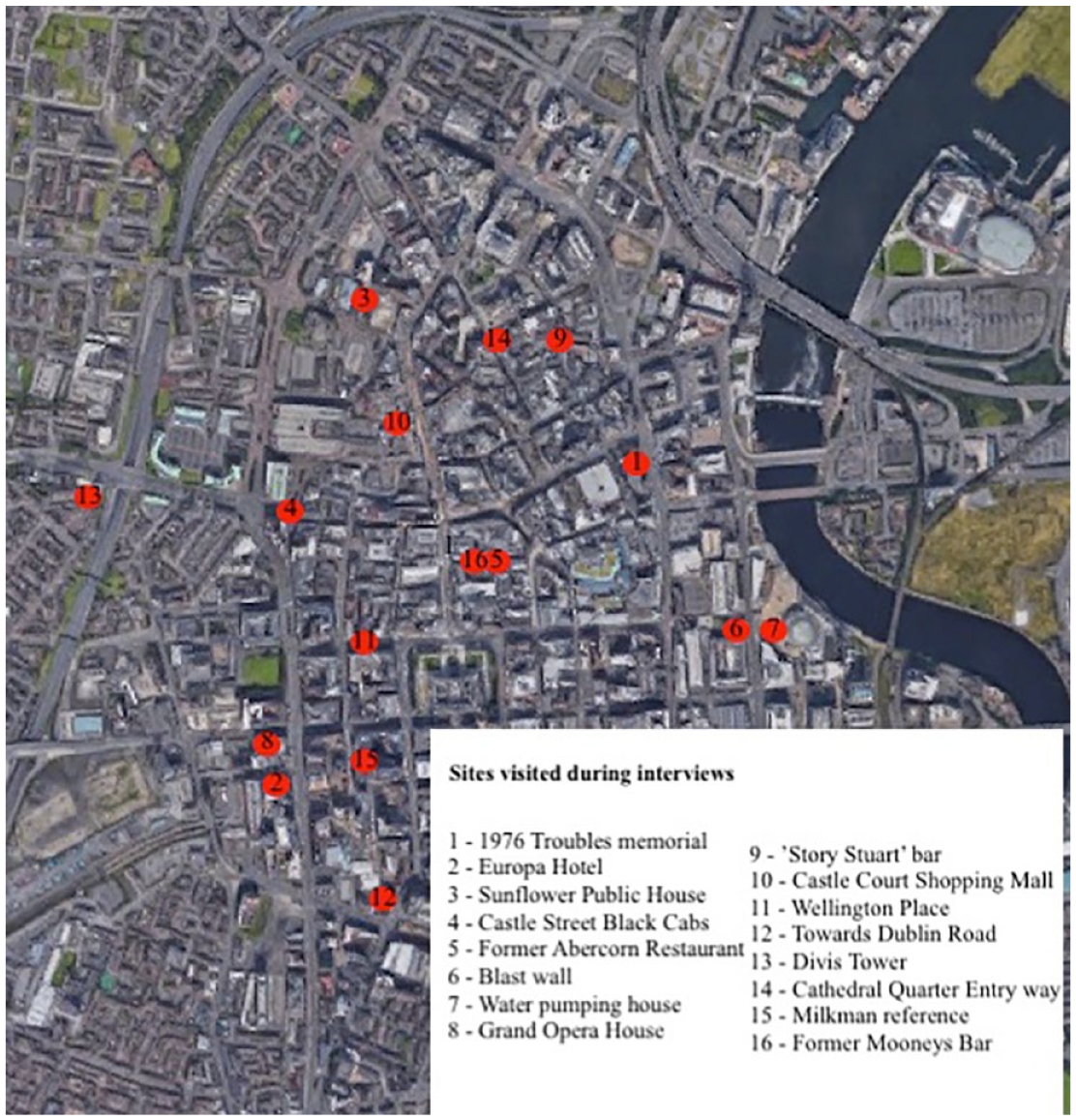
A map indicating the sites discussed in this article, 2022, Image.
Footnotes
Ethics statement
The author received ethics approval from the Concordia University Human Research Ethics Committee to conduct this research.
Funding
The author(s) disclosed receipt of the following financial support for the research, authorship, and/or publication of this article: The author would like to acknowledge the support of the Social Sciences and Humanities Research Council (SSHRC), Canada Graduate Fellowship – Doctoral (CGS-D) program.
