




Abstract
The academic gaze, often, seems unable not to look directly at places, as if transfixed, unable not to fix them into all-constraining definitions that exclude all that remains blurred or unclear as redundant noise. How to engage with this excess without putting it into focus – that is, by keeping it blurry? This is the question this paper seeks to address. Simone’s recent reflection on ‘the surrounds’, and Tsing’s well-known work on ‘friction’, are the conceptual levers deployed to do so. Walking and writing are the practices mobilised for this purpose. First, I draw from Critical Walking Studies, and particularly psychogeography. The goal, here, is that of unpacking walking’s potential to enact an embodied and non-representational engagement with place by attending simultaneously to the phenomenological here-and-now and its ecological prolongations into other spacetimes. Second, I take writing seriously, as a methodological necessity to relate with, and translate, the surrounds qua surrounds – the blur qua blur, that is. Recent reflections on ‘writing place’ in the field of geography and anthropology are helpful here, as is Masciandaro’s provocative reading of the commentary as geophilosophy. The result is a proposition for a writing that is able to walk, that is to evoke the embodied, non-representational experience of walking the urban surrounds ‘without assassinating’ it (Les Back). The main body of the paper, comprised by seven self-sustaining sections, seeks to perform this proposition, by mimetically re-presenting the several walks I carried out through the East Side of Lisbon, Portugal, in the last 10 years. This is done by juxtaposing text, titles, images, theoretical reflection, archival research and psychogeographical perambulation. The conclusion reflects on the implications of this approach to walking-writing place, finding resonance with Kathleen Stewart’s concept of immanent critique.
In order to hear a bare sound we have to listen away from things, divert our ear from them, i.e., listen abstractly.
1
Prologue: peripheral vision
The academic gaze, often, seems unable not to look directly at places, bodies and cities, as if transfixed, unable not to fix them into all-constraining definitions that routinely exclude all that remains blurred or unclear as redundant noise. In a recent intervention, Simone has provided a useful concept to attend to this domain ‘beyond capture’. The surrounds, he explains, is that ‘something that eludes coherent narratives of development and prospective futures’. 2 If the definition (from de-, ‘completely’; and finis, ‘boundary’, ‘end’) is what delimits, determines and encloses, the surrounds (from super-, ‘over’; and undare, ‘to flow’ – from unda, ‘wave’) elude definitional fixation by a constant overflow. It encircles, without ever coming full circle. 3 Perpetually decentred, perpetually peripheral, the surrounds, ‘like the apertures of cameras, fundamentally disturb the image of something that may have been otherwise taken “for sure”’. 4 Rather than a matter of sharpening the gaze, attending to the surrounds may require a peripheral vision, that is, the vision of an unfixed gaze, embodied rather than ocularcentric: an ‘atmospheric perception’ that belongs more to the absorbing stance of immersion than to the projective attitude of observation. 5
Seen from the last two decades of geographical thinking, the concept of surrounds emerges from the epistemological uneasiness with social constructionism and revelatory critique that, propelled by the post-structural adventures of Deleuze, Guattari, Latour and others, has converged into Non-Representational Theory.
6
Among the variegated number of approaches inspired by the latter, a guiding concern has been the attempt to engage with the ‘manifold of actions and interactions’ that exceeds representational modes of perception and categorisation.
7
A ‘background’, following Anderson and Harrison, that has been foregrounded as active, affective, ‘geo-historically specific and generative’.
8
The notion of surrounds resonates with this non-representational background, while also pointing beyond, by tracing a tentative path of urban speculation that seeks to articulate, at the same time, the epistemological, the ontological and the historical. The concept, in fact, questions the way we seek to observe and know the urban; addresses the ontological peculiarity of the urban itself, as a socio-material complexity that necessarily frustrates attempts at definitional consistency; and reflects on the contemporary urban condition, in which all sorts of financial, sociocultural, economic, technological and geopolitical forces increasingly compress and prolong, stretch and bend, fold and hollow urban spaces at scales and paces that are less and less fathomable. We can begin to see, then, how the notion of surrounds is also, and fundamentally, a way to capture the consistency of the urban, that is, the ‘strange’ ways in which the urban holds together somehow.
9
Let’s hear from Simone once more: Such spaces are replete with gaps, interstices, breakdowns, contested territories, and sediments of dissonant tenure regimes, financing, legalities, and use. Instead of being able to discern legible articulations among the details of composition, these proliferations of housing, commercial, industrial, logistical, recreational, entrepreneurial, and governmental projects are less subsumed into overarching logics of capital accumulation or neoliberal rationalities than they are “strange accompaniments” to each other.
10
Accordingly, for instance, the value of a controversial notion like planetary urbanisation is often missed when, in the contemporary debate, it is reduced to the dialectical problem of deciding which scale or perspective is more effective, important or determining, between global and local, North and South, structures and assemblages. It is more promising, I think, to operationalise the multi-scalar insights the theory provides by exploring the ‘disjunct fragments’ and lived atmospheres through which it unfolds. 11 That is, its surrounds.
For instance, how to explain what has been happening to Lisbon, Portugal, in the last decades, that saw her rapidly transforming from a peripheral European capital to a sought-after destination and ninth most expensive city in the continent for what concerns rent – while being only in the 119th position in the average monthly salary chart? 12 A political economy analysis can surely provide a useful starting point, explaining the case of Lisbon vis-à-vis the process of neoliberal urbanisation that is dramatically reshaping cities worldwide. Of course, in this case there are significant differences and peculiarities, and there is a growing field of literature that is extremely useful to begin making sense of them. 13 Yet, ‘if we only pay attention to the rollout of contemporary spatial products as exemplars of urban neoliberalism’, argues elsewhere Simone, ‘we might miss opportunities to see something else taking place, vulnerable and provisional though it may be’. 14
Attending to this ‘something else’ requires an effort that is speculative and corporeal at the same time, simultaneously attuned to the phenomenological here-and-now and its ecological prolongations into other spacetimes. 15 As psychogeography has shown, walking can be useful in this sense, as ‘a method for dialogical, cognitive and empirical mapping [. . .] a tool for activating thought and unlocking knowledge’ by attuning to the multi-layered temporalities, elusive forces, planetary processes, conflicting imaginaries and everyday atmospheres that compose the urban at its intersecting scales. 16 The ‘speculative walks’ that this text accounts for, carried out in the east end of Lisbon in the last 10 years, are ways to attend to this uncapturable ‘something else’ by conceptually unpacking and methodologically unlocking this potency of walking. In the following introductory sections, first, I situate my approach in the context of psychogeography and recent ‘critical walking studies’ and, second, I reflect on the thorny question of how to translate walking into a writing that is able to walk, too. Subsequently, I speculatively walk through the east side of Lisbon through seven sections. Finally, a conclusion wraps up this effort.
Introduction: walking
With the growing popularity of notions such as the 15-minute city and other urban liveability catchphrases, walking has lately become central, at least rhetorically, to urban planning and policy worldwide. More generally, a renewed concern for mobility, movement and the body has sparked a novel attention for walking as methodology and object of research. 17 More subtly, walking has also been understood as a less obvious, unapparent condition of possibility of much urban reflection, sociality and life at large. 18 What some refer to as ‘critical walking studies’ includes an ensemble of works such as theoretical reflections on walking; walking interviews or so-called walk-along 19 and the use of walking for teaching, walkability evaluation or as an artistic/experimental practice. While a review of this recent direction of research is beyond the scope of this paper, in this section I focus on its ambiguous relation with earlier experiments on walking at the intersection between literature, theoretical speculation and the urban, particularly drawing from psychogeography, a term allegedly suggested to Guy Debord by his Algerian pusher, 20 and most notably revamped at the end of the century in the British context. 21
For all its relevance for the field, psychogeography entered the radar of geography relatively late. 22 The academic requirements of methodological rigour and epistemological efficiency did not fit well with psychogeography’s idiosyncratic, literary and ‘dreamy’ style. 23 However, the late emergence of a novel sensibility to body, affect and movement prompted a reconsideration of its methodological value, while its unacknowledged positionality and overindulgence in nostalgia underwent critical examination. 24 Today, psychogeography remains an eccentric methodology, one that still harbours ‘untapped potential for new ways of exploring the connections between ontology, epistemology and the politics of knowledge production’, as Sidaway recently suggested. 25 This is particularly the case for the challenge of exploring the contemporary urban space, increasingly fragmented and prolonged elsewhere by all sorts of forces, structures and power relations, at paces and scales that far exceed local situatedness, and yet are experienced and endured through the latter. This is why, Sidaway hints, there are promising, implicit synergies between psychogeography and planetary urbanisation that remain to be unpacked. 26 More recently, Wilson picked up this suggestion by making a stronger case for deploying psychogeography to ‘capture planetary urbanization in the mundane and catastrophic process of its everyday becoming’. 27
Walking, at first, may appear as a counterintuitive strategy. How can such a ‘localised’ perspective be of help vis-à-vis the scale, speed, and abstraction of planetary urbanisation? Is not the case, as Feldman noted, that in an increasingly deterritorialised ‘world of apparatuses’, the methodological value of the bodily and sensorial ‘being-there’ has begun to wane? Whereas it is not possible to understand a place without considering the extent to which it is constantly pulled away by planetary processes – rebutted Rahola – there still remains an ‘actual immanent moment, and an actual site wherein the apparatus’ efforts precipitate or insist’. 28 Planetary urbanisation always takes place in the contingent and turbulent materiality of concrete relations, generating frictions that ‘still requir[e] a specific, almost literal, way of being there’. 29
Psychogeography, accordingly, allows to explore the planetary within and through the local, that is, to explore the complexity of global forces by attuning to their singular instantiation, where urban imaginaries, political economy and lived atmospheres meet. 30 Psychogeography’s ‘speculative’ attention to the prolongations of sites into other spacetimes, moreover, provides an antidote against the temptation of fetishising proximity per se, by also attending, in Pohl’s words, to that ‘another “spectralized” materiality taking place next to matter as such’. 31 As Derrida’s hauntological speculations – and the spectral geographies they inspired 32 – have taught us, urban spaces are incessantly haunted by what is not there, what is no longer and what is not yet. 33 This is not only an epistemological problem – it is also an ontological one. It is not only a matter of our incapacity to know: there is ‘something about matter (understood as “spacetimematter”) itself that prevents it from reaching equilibrium’. 34 In other words, it is not only our position vis-à-vis the urban to be always unavoidably partial and limited: it is the urban itself to be out of joint. 35 This is what the notion of surrounds points towards, expressing that ‘something else’ that is not simply there, that is, those spaces and times ‘that didn’t quite fit with what was happening around them. Spaces ever so slightly out of joint, where the anomalous, the marginal, while clearly visible, remained so slightly undetectable’. 36 The surrounds are, so to speak, a blurry haze that cannot be explained through the visible, the measurable and the rational, and yet cannot be explained without them either.
Addressing this ‘slightly undetectable’ blur requires epistemological modesty, that is, avoiding to assume walking – or any empirical method for that matter – as a privileged gateway to an immediate, ‘richer’ and ‘deeper’ access to the world.
37
Rather than a knowledge-enabling tool – and a problematic one at that, given its inescapable situatedness –, walking is more promisingly understood as having the potential to queer taken-for-granted assumptions about methodology and knowledge in the first place.
38
This is how Debord understood it: not so much a way to disclose knowledge, but a strategy of de-familiarisation, that can be deployed against the academia’s own methodological standards and ‘rituals of explanation’.
39
An attitude that we can see resonating within Non-Representational Theory’s intention to ‘escape from the established academic habit of striving to uncover meanings and values that apparently await our discovery, interpretation, judgement and ultimate representation’.
40
As Strohmayer puts it: ‘the creation of “knowledge” does not exhaust the contribution of walking to our engagement with world, not even in realm customarily associated with knowledge, ie. academia’: it could be more promising, it follows, to understand walking as being ‘less about “knowledge,” “epistemology” and “method” and more about the conditions of possibility of these to emerge’.
41
This is not an injunction to abandon method altogether, to be sure. 42 It is rather a call to mobilise walking as a non-procedural and non-extractivist methodology, consistent with Springgay and Truman’s call ‘to shift from thinking about methods as processes of gathering data towards methods as a becoming entangled in relations’. 43 This is not an injunction to resist meaning per se either, but rather to resist the ‘desire for decontaminated “meaning”’ we often fall prey of. 44 This is not, finally, an injunction to abandon the attempt to ‘know’, but rather, as Strohmayer proposes, an invitation ‘to allow for epistemic practices that acknowledge forms of “not-knowing” (by literally turning our backs) to have a place in our repertoire of engagements [. . .] to broaden the scope of knowledge about likely encounters with “world” emanating from a differently mobilised practice’. 45 This is the gist of recent interventions, that directly or indirectly operationalise psychogeography’s insight about walking’s capacity to ‘reveal present absences’ by means of intersecting an embodied experience with a ‘speculative sensibility’ to the layers of time that are sedimented and entangled in the space we walk through, without seeking to entrap them into rigid categories, definitions or conclusions. 46 The problem of translation remains in place, however. ‘How can we attempt to document this often non-verbal, felt element of landscape experience and convey it to research audiences’, as Macpherson asks? 47 If, as Carter evocatively writes, although ‘the dark writing of the world cannot be represented, its absence can be registered’ 48 – then how to translate this ‘registering’, how to make it communicable? How are we supposed to be ‘engaging with and writing about landscape, moving away from the representation of a supposedly external landscape through photographs, maps and text’? 49
Introduction: writing
In the same way as walking potentially allows for an embodied exploration of the urban fabric that is not captured by the mechanical account of how the human walks; the experience that emerges as-one-goes is not necessarily captured by the passive and instrumental use of writing as ‘a simple, even almost mechanical act that comes (often hurriedly) at the very end of research’. 50 ‘The written work, after all’, DeLyser continues, ‘is not just a product of research, but is also a physical trace of an embodied act and process, that of writing’. 51 ‘The act of writing’, echoes Creswell, ‘is part of the process of relating to place – not just a record of it’. 52 ‘Writing could be a way of thinking’, adds Stewart: ‘an attunement, a response, a vigilant protection of a worlding’. 53 Dynamic, embodied, continuous, in these reflections, writing is imbued with a complexity and power that are usually concealed when reduced to mere writing up. In fact, while it is often scorned, implicitly and explicitly, as secondary, superfluous and even distractive vis-à-vis the ‘content’ of ‘proper’ academic research, a karstic line of geographic thought has for long time argued that how we write – that is, style – is no supplementary concern but ‘a pressing issue’ for the quintessential geographic task of how to relate to and express – that is how to write – place. 54 This is especially the case for non-representational geographies, and their apparently contradictory challenge of translating the non-representational into writing. ‘Rather than viewing writing only as representational product – Delyser suggests – we can also engage writing as part of an embodied practice that actively shapes both our lives and our research (both the practice and the product)’. 55 This is a particularly promising recommendation to think the relation between writing, body and place, and, more specifically for our concerns, the relation between writing and walking, writing of and through walking, with a view to addressing that exquisitely Benjaminian challenge of seeking to capture ideas arising from – rather than formulating ideas about – place. 56 This requires understanding writing as constitutive of – and constituted by – walking. Walking, on its part, should be translated by a writing that is somehow able to walk, too.
A precious suggestion in this sense has been provided by Wark’s recent exploration of another embodied practice: raving. Dancing among the sweaty, smoky and bouncy post-industrial spaces of Brooklyn’s contemporary rave scene, and looking for a way to translate them through ‘a practice of writing that is more adapted to the rave situation’, Wark ‘throw[s] [herself] into experiences, felt as sensations, parsed as perceptions – out of which might emerge concepts. Let’s think of concepts as resonant abstractions’, she proposes: ‘Like diagrams, they gather perceptions into fields, patterns, rhythms, under a name’. 57 A proposition follows, namely, assuming writing as not only a tool to account for the experience of raving – or walking – but also and most importantly to mimetically and rhythmically re-present it. 58 A writing that walks, accordingly, is a writing that oscillates between representation and re-presentation, a writing that tries ‘to stick with something becoming atmospheric’, as Stewart muses, ‘approaching the thing that is happening by attuning to it’. 59 Such a complex ‘approach manoeuvre’, where body and place tentatively meet through walking-writing, is intriguingly similar to that which the commentary entertains with the text.
In its traditional connotation, a commentary glosses, scribbles, reflects, expands and encircles a text. It is a direct confrontation that, ideally, must leave neither winners nor losers: a commentary should neither disappear nor substitute the text. It must remain by its side, literally so, adapting to its rhythm and flow, in a mimetic exercise that does never produce a mere copy of the text and yet does never transcend it either. As Masciandaro suggests, the commentary is both parallel and perpendicular to a text: in the first sense, ‘it moves with or runs alongside it, following the flow of reading it’; in the second sense, ‘it pauses or breaks from reading it in order to comment on it’. 60 Through such go-and-stop rhythm, the commentary keeps itself lateral and contiguous to the text without ever collapsing onto it. 61 ‘Commentary stays with its text’, Masciandaro argues, without getting stuck in the text, by means of inhabiting its surrounds, filling up its margins: ‘The place of digression is the margin, the space into which commentary moves simultaneously away from, toward, more deeply into, and far beyond its text’. 62
We find this dynamic negotiation between representation and the non-representational, content and rhythm, object and its surrounds, when walking-writing place. This is, in fact, how ‘writing place’ is discussed within cultural geography, namely as a ‘two-step process’ which shuttles between close description and critical reflection, ‘self-reflexive awareness’ and ‘engagement with place’, rhythmical embodiment and textual translation. 63 Go-and-stop, back-and-forth, the syncopated rhythm of walking-writing expresses and embodies the same conundrum the commentary encounters, namely how to both move and stay, digress and remain. How to translate that dynamic, fluid, and spectral quality of place into a communicable and representational form without ‘assassinating’ or ‘mummify[ing]’ it. 64 This is especially relevant, it goes without saying, when the task is that of engaging with the surrounds, that blurred domain that appears so recalcitrant to being described – that is written [scribere] down [de] – without being lost.
In the next pages I sought to walk-write a part of Lisbon’s east end accordingly, developing a commentary, walked-written on its margins, or surrounds. Among the brilliant attempts to merge writing and walking, within and beyond geography, that I have been mentioning so far, a particularly important inspiration for my effort has been Wilson’s recent exploration of Iquitos, Peru. Wilson mobilises surrealist writing as a technique to disentangle social fantasies from the built environment and to explore the postapocalyptic landscape of a city as if it were already in ruins. 65 Rather than the use of surrealism, however, I followed Wilson in the movement he gave to his writing, a rhythmical attempt to adapt to and bodily engage with the materiality of urban sites in and through the intangible prolongations – the ‘plots’ – into which they proliferate through space and time. 66 Sure, this is easier said than written, and it would be preposterous to suggest that there is a unique recipe for that. 67 Particular attention, in the next pages, has been given to the attempt to convey in the written page the juxtaposed experience of walking-writing Lisbon’s east end through the spectral spaces and layers of history that invisibly haunt it. For instance, by ‘making links between that sensuous lived encounter and the dusty official record archived in the library’. 68 For instance, rhythmically juxtaposing different elements, reflexive and descriptive, theoretical and historical, visual and textual, in the attempt to attune to these sites’ movements and flows, compressions and prolongations, as I bodily penetrated them. This montage, of obvious Beniaminian influence, has entailed mixing theoretical reflection, archival research and psychogeographical perambulation in a series of self-sustaining sections corresponding to as many stages of a speculative walk in the east side of Lisbon. By re-enacting speculative walks through the text’s juxtaposed structure, moreover, the possibility to ‘anarchive’ those very places is foregrounded, possibly releasing uncharted readings from your side, dear reader, in the spirit of polysemic proliferation that the commentary expresses. 69
Fading
Olaias’ underground station is a grand, spacious, colourful affair. Above it stands the Olaias Complex (OC), built by the same notorious architect in a curious postmodern blend of new brutalism and new classicism. Its apartments, hotel and commercial centre tower above Bairro Portugal Novo (BPN). They screen it from the street. ‘They conceal the misery’. 70 To get to BPN, a steep set of stairs cuts through the OC’s underbelly, growing dirtier as one climbs. The colours of o bairro azul (the blue neighbourhood) have since long faded, or have been painted over, clumsily patched with other dyes. They clash with the bright and glossy flamboyance of the OC. They signal an abrupt shift in the atmosphere. The body feels it, switching automatically on ‘alarmed mode’. 71
When BPN was conceived, in the hopeful atmosphere that followed the 1974 revolution, a quarter of the country’s population lived in informal settlements. 72 The infrastructural degradation it exhibits today is a material testament to decades of corruption, mismanagement and institutional forgetfulness. Already in the early 80s the clogged drains were spitting waste back onto the surface, the communal spaces had been turned into drug and prostitution spots, the apartments keys were being sold illegally, and the houses of those who left it vacant since hospitalised or dead, were occupied abusively. 73 The ‘law of the strongest’ is in place. 74 The ‘power of weapons, drug and money’ runs the place. 75 These are the sentences that usually frame BPN in the media. Drug seizures are frequent and well-advertised. The recent homicide of an old dweller, allegedly for refusing to sell his house, further tainted the area’s reputation. I sit for a while. The air feels denser under the weight of this imaginary. Few men congregate around a street corner. The pigeons are fighting with the seagulls over uncollected rubbish.
BPN sits within the freguesia (district) of Arreiro, ‘one of the best areas of the capital’, a TV reportage states, adding that in Arreiro the average price per square metre is 4,575€. In BPN that very same price would buy you a whole apartment, albeit no formal institution would certify the purchase. As the journalist speaks over pristine images of Arreiro, Frank Sinatra’s That’s Life joyfully vibrates in the background. Then, abruptly, a gloomy string section cuts into a dolly shot that takes you straight into BPN’s belly. 76 This is how the place figures in Lisbon’s imagination: the faded ruin of the post-revolutionary dream, hidden within the urban unconscious as a repressed aberration, a frightening and uninhabitable space that even researchers struggle to makes sense of: ‘Strangely enough, residents like to live there’, two architects write, puzzled. 77
What does it mean to live, survive and thrive within an expanded space of forgetfulness? On the 13th of May 2021, a resolution to regularise and revitalise the area has been voted by the municipality. Little has been happening since. The place seems to be caught within a temporal hiccup, between the project and its postponement, the law and its application, a blurry zone that keeps expanding: new people arrive, other leave, new associations are born, others close. While an attempt to rework BPN’s image from within is in place, from the outside the place looks stuck: ‘everything remained frozen in time’. 78 Obviously, BPN is much more than the way in which it appears, and disappears, in the urban imaginary. Yet, how do you write the frictional imaginary these people, birds, and things breathe through daily, without fetishising it? How do you engage with the same imaginary, that is, how do you understand it as being shaped by structural forces, while at the same time, at least partially, accepting to ‘submit to its fetish-powers’? 79 I walk past a building where tough-looking guys are occupying the external staircase in its entirety, acting shady, looking around nervously, looking at me suspiciously. This is often the way drug distribution works: a building is temporally ‘seized’, its inhabitants stuck inside or outside, until the business is over. Is this the case? Or am I just prey of media-induced paranoia? I walk quick, quicker, through the street that separates the BPN from the OC. Seagulls and pigeons are still quarrelling amidst abandoned furniture.
Cul-De-Sac
Outside the BPN a massive roundabout organises a flow of traffic, pollution and noise. A two-way-three-lane road links it southwards to another roundabout. Close by, just off this chaotic stretch, a mural reproduces a picture of old Quinta da Curraleira: kids and hanging clothes amidst the shacks. The informal settlement where more than half a thousand families used to live was demolished in 2001. A video from 1975 shows a fire at Curraleira. The flames in the background, while inhabitants and firefighters try to demolish a shack to contain them. ‘That’s the legacy of fascism’, a voiceover observes. ‘Everything is destroyed’, a woman cries. 80 From the mural, a steep, muddy path leads back to the main road. There’s a donkey, tied on a rope, gazing expressionlessly. By the road is an empty parking lot. It has been opened recently, but it seems to have been left unfinished. It has a parking metre, yet the asphalt has not been compacted. It feels like walking on a dirt road. At its side, a barren mound rises. I reach it walking over plastic bottles, car tyres, broken glasses. Dirt. On its top sits a metal cross. It commemorates a kid who died here in that 1975 fire. Standing on the cross I can see the Avenida Marechal Francisco da Costa Gomes diving eastwards towards the Chelas valley, only to end abruptly, with a loop, just before the slope. A two-way-three-lane cul-de-sac, an urban glitch that trucks and buses do driving lessons on. In front, the buildings of Quinta do Lavrado (QDL), one of the social housing complexes where the former inhabitants of Curraleira have been relocated.
On the edge of Chelas valley, QDL is sunk between the grotesquely oversized dead-end road, a sewage treatment plant (ETAR), an electric station, and the back wall of a monumental cemetery. The whole of QDL feels like a cul-de-sac, a ‘forgotten hole’. 81 The main doors are looking at the cemetery’s back wall. ‘It is to hide us, no’? 82 In the first shot of Thiago Hespanha’s short documentary titled Quinta da Curraleira (2006), pigeons fly over QDL and then flock back to their lofts, just by the cemetery. 83 I walk parallel to the Avenida, on a tract of dirty road. Bored dogs barking, pigeons herding above. Training pigeons is a national passion, and a local obsession. In 2015, the construction of ETAR led to the violent demolition of 12 dovecotes. 84 Novel ones have been arranged soon after. The notoriously stigmatised bird seems to share this fate with the local inhabitants: demolitions, relocations and violence. 85
Many things aren’t working here. Services are insufficient, common spaces are lacking, and the new, atomised apartment building lifestyle has severed much of the social infrastructure that held the Curraleira together. There is no point in romanticising the life in the shacks. Yet, among these buildings, as in those of the surrounding area, often still covered with asbestos, the nostalgia of Curraleira still lingers, especially amid the oldest inhabitants, who barely adapted to the secluded life in these crumbling high rises, whose elevators often break up, leaving them stuck. 86 In an old TV reportage dated 1992, under the caption ‘drug in the Curraleira’, a female journalist pries through the shacks, asking the locals where and who is selling drug. 87 Various people are shown while exiting their taxi at Rua do Sol a Chelas, entering the maze of corrugated roofs, and then going to shoot heroin in the surrounding wheat field. Then, as now, the area had a bad reputation and was, as it is now, the theatre of police operations and violence. As I cross the road where the sun-scorched wheatfield once were, I imagine this same wind cooling off those young heroin addicts while they calmly shot themselves in front of the camera, at the height of Portugal’s ‘heroin crisis’. The post-Curraleira urbanisation has been a brutal affair of oversized lanes that chopped the body of Rua do Sol a Chelas. Only two bits remain. The first, south-west, starts off Rua Morais Soares, running for a few hundred metres parallel to a big Avenida. Then, it suddenly ends, in another cul-de-sac, where an abandoned building crumbles. From there to QDL, Rua do Sol a Chelas unfolds invisibly, a ghostly infrastructure only visible through ‘deep topographical lenses’. 88
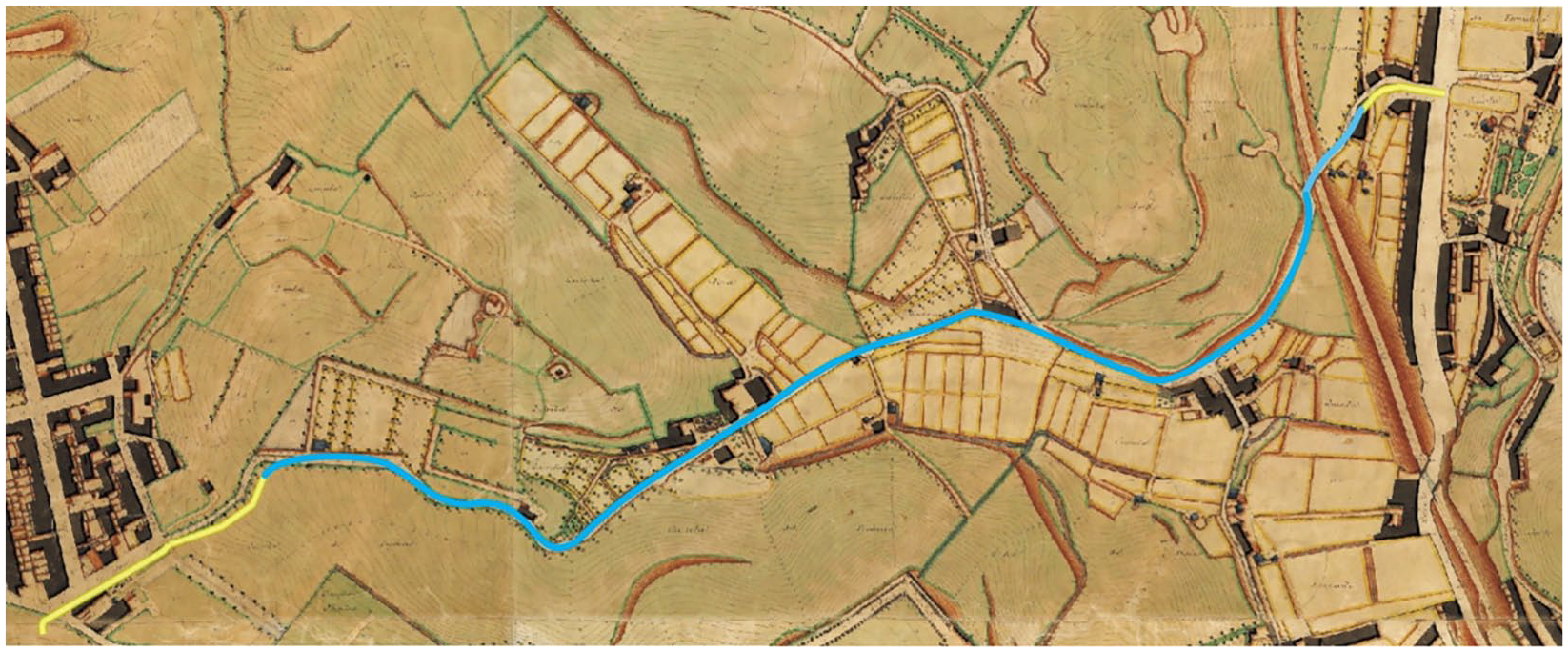
In this 1911 map we can see the two tracts of Rua do Sol a Chelas, still visible, in yellow – the first few hundred metres beginning from busy Rua Morais Soares, the last few metres flowing onto a Estrada de Chelas – and the removed body, in blue, today spectrally traversing the buildings of Quinta do Lavrado.
A steep footpath behind a bus stop dives on the barren side of the hill onto the valley of Chelas, edging the ruins of a former factory, through a railway underpass, before a dog barking angrily from behind a fence. Careful not to step on broken bottles. Two concrete jerseys prevent cars from reaching the underpass. This shady interstice is populated by slow-paced people going back and forth a hole in the wall leading to the back garden of a ruined palace, most likely to get a fix. Say hi to those you meet, and they will usually answer politely, slightly wary, their eyes focused elsewhere. Waste, ruins and more waste, all around. Few steps before reaching Estrada de Chelas, the plaque reads Rua do Sol a Chelas. This is the second chunk of the street, where it ends, about a hundred metres of patchy asphalt and scattered waste. A momentary synchronisation between the different temporalities its spectral body traverses.
Unicorns
Once a rural landscape of quintas, palaces and convents, the Chelas valley has been urbanised and industrialised by the end of 19th century, when many factories have come to populate the riverfront of its two main districts (Beato and Marvila), west of the railway, while workers migrating from the rest of the country came to settle in self-built settlements, east of the railway. Both the rural and the industrial past of the valley reverberate in the patchy juxtapositions that compose its landscape, made of social housings and scrubland, old palaces and crumbling factories. Walking through these transitions, the body adapts to the uneven surface and the shrinking pedestrian infrastructure. A big pile of bricks, some debris, yet another barking dog behind a fence, all the way to a former Carmelite convent known as Convento das Grilas. It is from here that the first bridge over the Tagus River hypothetically took off, in the visionary plan drawn in 1876 by Miguel Carlos Correia Pais. Although the project was incompatible with the engineering capabilities of the time, its dream kept lingering in the urban imaginary, inspiring writers, engineers and politicians belonging to a rising bourgeoise that wanted to raise Lisbon’s international profile to the level of other European capitals, and saw infrastructures as the most eloquent way to do so. 89
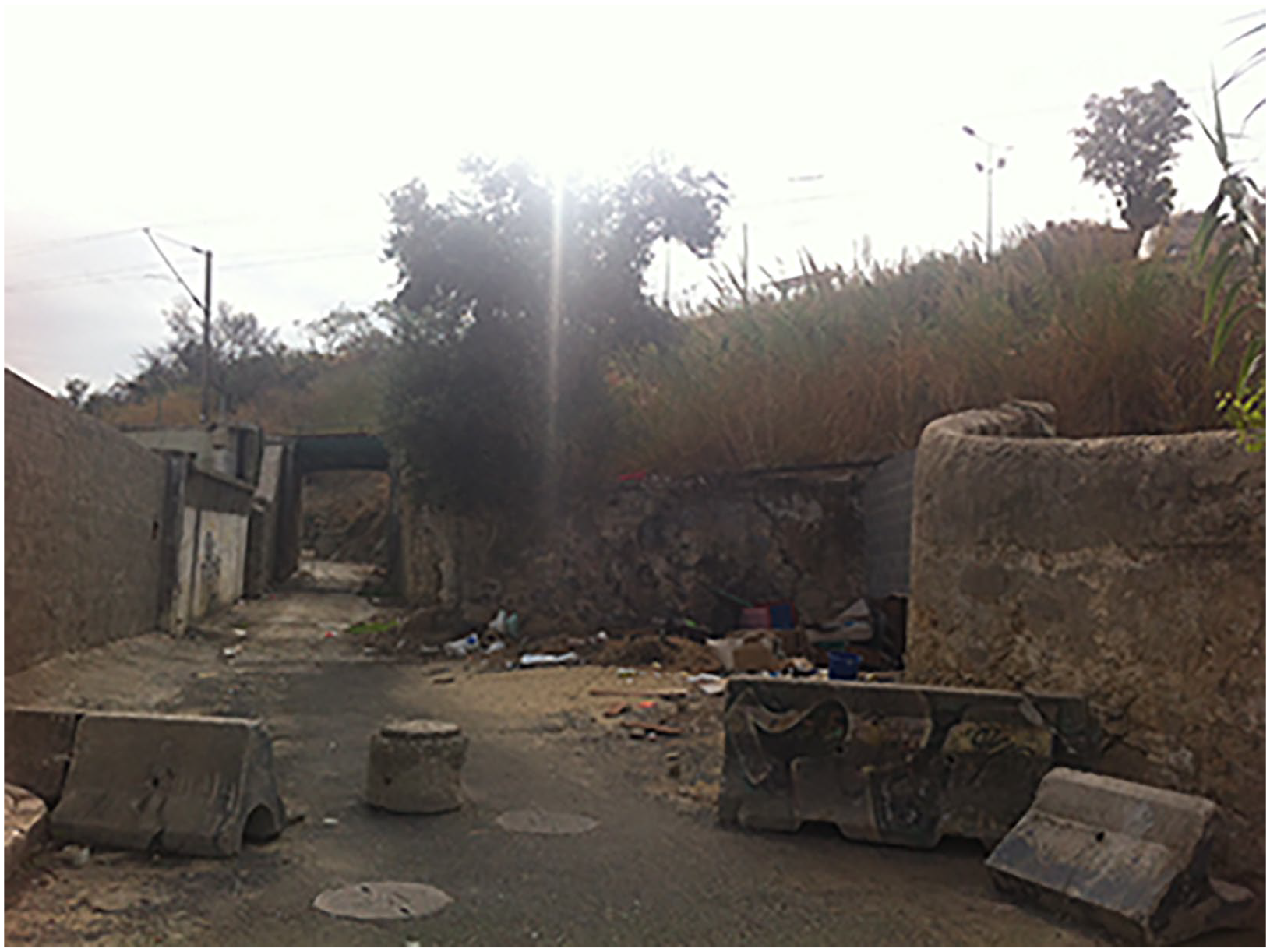
Photo by the author.
In 1897, after the death of the last nun, the dormitory and the other structures of the convent were repurposed into the Manutenção Militar, an army bakery that, in the optimistic socio-technical imaginary of the time, was hailed by its own chief engineer, Joaquim Renato Batista, as a means for Portugal to ‘stand shoulder to shoulder with the “civilised populations”’. 90 The factory shut down by the end of last century, leaving space to the Hub Criativo do Beato (HCB). It is now the future that is being baked here. 91
Since more than a decade, Lisbon has sought to position herself as ‘a key agent of the creative economy in Portugal, in Europe and throughout the world’, as the by then Deputy Mayor for Economy and Innovation put it, 92 with an aggressive start-up urbanism strategy mixing marketing and the law in order to attract foreign capital, investors, and expats. 93 Thanks to its logistical advantages – low rent, vast disused spaces, attractive riverfront and post-industrial aesthetics – the Marvila and Beato riverfront (MBR) provides the appropriate ‘ecosystem’ and, in turn, is presented as the strategy’s first beneficiary. In the words of a manager at StartUp Lisboa, the HCB will catalyse a ‘positive social contamination’ that will be able to turn the ‘Bermuda Triangle of inner-city Lisbon’ into a new ‘Brooklyn’. 94
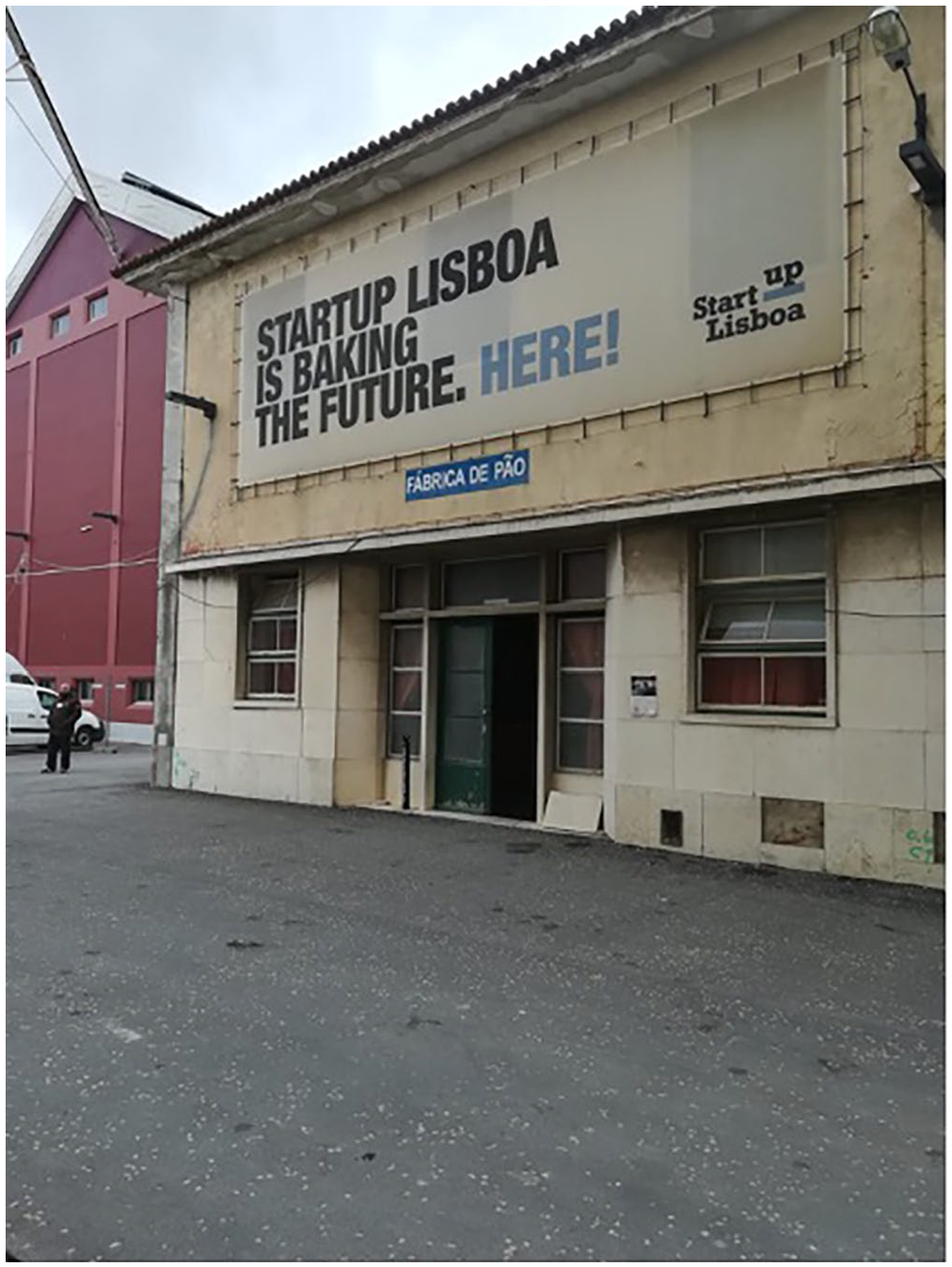
Photo by the author.
Bermuda Triangle. New Brooklyn. The labels perfectly express the juxtaposition between the imaginaries through which this area is perceived today by media, real estate investors and a good chunk of the public: the far bigger and stigmatised part of Marvila and Beato, west of the railway; and the hyped and heavily valorised MBR, east of the railway. In 2001 the mood was different, judging from Campos’ observation, in the catalogue accompanying a programme of art interventions that took place in Marvila for over a month. It was titled, tellingly, ‘Capital of Nothing’ (Capital do Nada): In the mental geography of Lisboetas (the people of Lisbon) it [Marvila] functions somewhat as a hole, a fracture of the city, a collection of wasteland, farms, convents, industrial buildings, decaying neighborhoods, council housing, railways . . . a place where nothing happens.
95
Bypassed by the grand urban regeneration that took place few kilometres north as part of the 1998 Expo, seemingly stuck into an invisibility sporadically interrupted by blips of media-inflated moral panic, the area seemed to be under the spell of a urban fado, a nostalgic mourning for the febrile social and communal life of the industrial past, in the midst of the present alienation, and before a seemingly bleak future. 96 Today, while west of the railway the ‘influence of the Expo’ is still found wanting, 97 the riverfront, rebranded ‘as a tech-oriented hotbed for entrepreneurs, digital nomads and global capital’, and hyper-valorised by a host of luxury real estate projects, is socio-economically, financially, and aesthetically drifting away. 98
So far, few offices and venues have opened, and most of it still feels under construction. Just outside, stamping among the rubbish and the debris of a collapsed house, I can see the HCB’s main façade. It’s only a myth until you make it true, it reads. Perhaps the opposite is the case. Born as a start-up incubator, the HCB has today been upgraded into a Unicorn Factory. In the business sector, a unicorn is a private start-up company that is valued over US$1 billion. ‘We have to get the country growing, we have to have the courage, the audacity to get the country growing’, claims the mayor, before adding that technology and innovation is the way to go. 99 With their colonial background as global explorers, the narrative goes, Portuguese people have a unique curiosity and a creative capacity to improvise, which make them perfectly equipped for the task. 100 I wander around the half empty structures of the HCB, silently vibrating with the ghostly noise of a century-long milling and baking activity. Exiting from the other side, I climb up through Calçada do Duque dos Lafões. Halfway through, I enter the garden of Palacio do Grilo, the 18th century palace named after the insect the duke loved to collect. Today, o Palacio do Grilo is a quirk restaurant-cum-performance space-cum-queer dance venue. Julien Labrousse, the French millionaire who bought it few years ago, discovered a diary belonging to the duke. There, Pedro Henrique de Bragança Sousa Tavares Mascarenhas da Silva wrote how he wanted the palace to be ‘a place that is also not a place, and that can allow any soul the flight that suits her best’. 101 This is the libertine spirit Labrousse says he wishes to keep alive. 102 I walk inside. The empty rooms still resonate from the energy of the bodies that were dancing here the night before, a memory of wood, flesh and marble that vibrates with my corporeal recollection as the low afternoon light reverberates through the mirrors, illuminating a white tiger sitting over a cube by the dancefloor, looking back, as a dialectical image, in which an enigmatic sentence of George Bataille seems to be materialising: ‘The sexual act is in time what the tiger is in space’. 103
Soap
Climb again, all the way to the Industrial School Alfonso Domingues. The windows are broken, debris and trash fill the courtyard, but the pink façade is still relatively fresh. Renovation works had been carried out in 2009, just a few months before the school was shut. In 2007, the plan for a third bridge over the Tagus was announced: by then Europe’s longest, it would connect the Chelas valley with the municipality of Barreiro, and Lisbon with the Trans-European high-speed network. It would take off approximately from where Pais had imagined his bridge would, 131 years earlier, just over the Manutenção Militar. In the grainy urban radiography that accompanies the law decree, the bridge’s inland expansion takes the shape of a three-fingered cloud hovering over the riverfront’s future.
Under its shadow, ‘important alterations [. . .] to the general configuration of the territory’ were to take place (Art. 1: 1.d). The school was to go. In 2012, however, the global financial crisis brought the plan to an end. The unrealised bridge keeps haunting the area ever since, as an uncanny phantom limb. 104 In 2013, the Minister of Education announced there was no need to reopen the school: the students were not enough. 105 Since then, most of the furniture have been vandalised, or stolen. People occasionally inhabit this gaping interval between the project and its un-realisation, one that keeps expanding, between occasional announcements and silent turnabouts. They gather and sleep inside the abandoned structure. Sometimes, they light a fire to warm up. I come across a video on Instagram. A bare-chested man dances around the crumbling interiors. He spits dust as he swirls with two huge ram’s horn. The video, directed and soundtracked by the transgender artist Puta da Silva, ends with a superimposed text reminding that many empty buildings in Lisbon are crumbling, while transgender and gender-nonconforming immigrants are looking for a place to stay. 106 I walk around the school. I see clothes hanging to dry. I do not intrude. On the back, a muddy path between the school and a line of shacks – improvised gardens, tool-sheds, dog kennels – leads to an empty stretch of weeds and waste, a moor (Marvila, comes from the Arabic marbala, meaning moorland) delimited by the railway line.
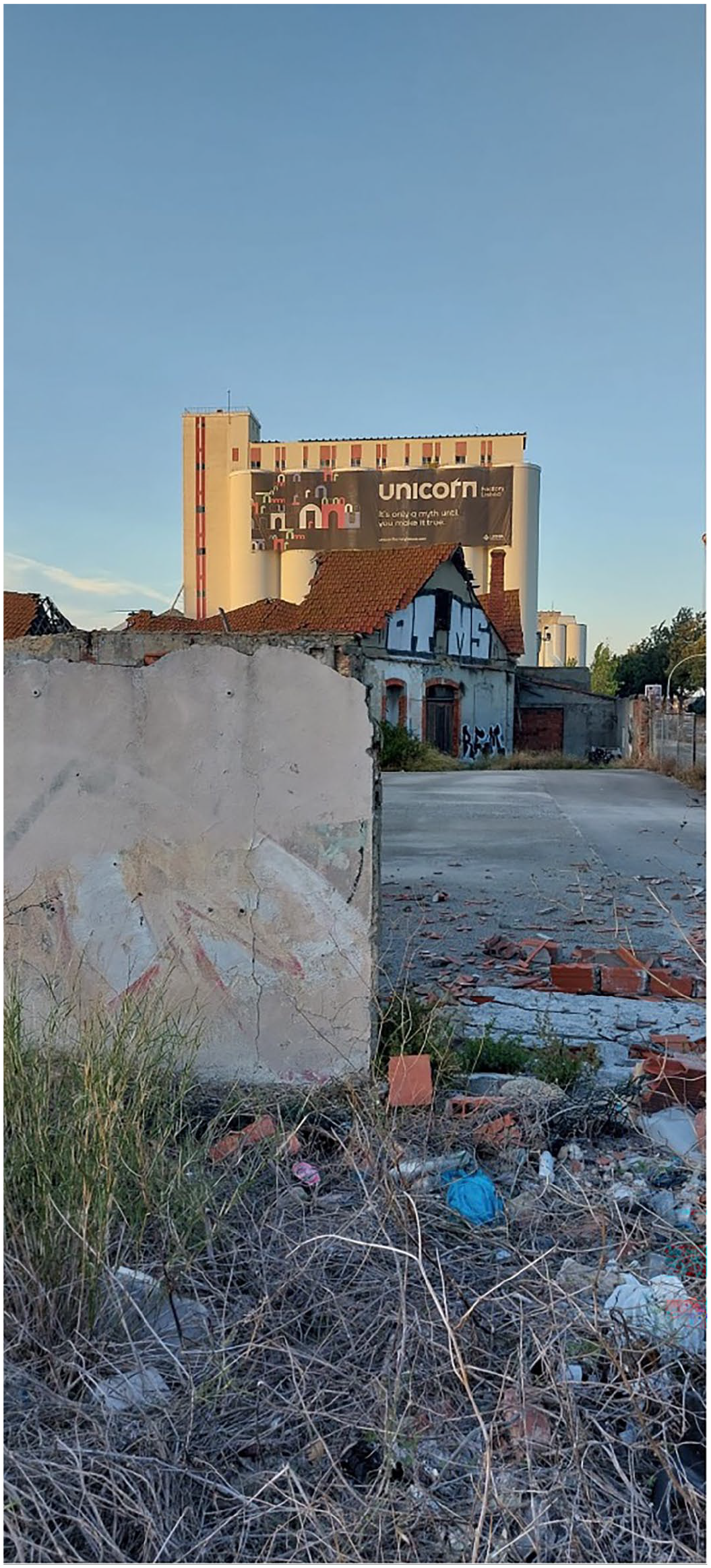
Photo by the author.
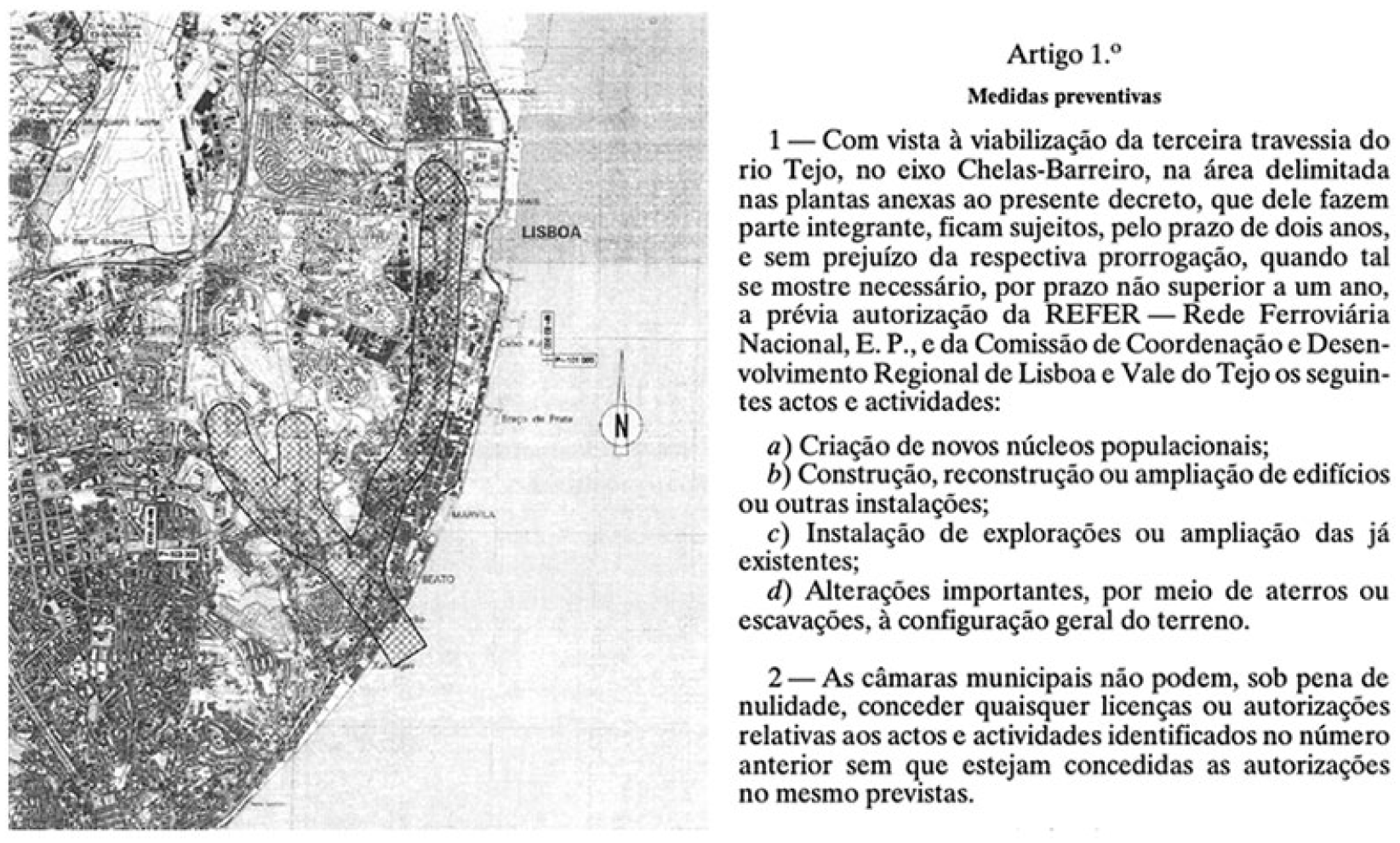
Map of the projected, inland expansion of the bridge’s infrastructure in the area of the MBW. Any alternation and construction in this area, the decree states, requires authorisation from REFER — Rede Ferroviária Nacional, E. P., and the Regional Coordination and Development Commission of Lisbon and Tagus Valley.
In this barren plot of land once stand the Sociedade Nacional de Sabões (National Soap Society), founded in 1919, and become one of the country’s biggest companies. After its closure by the end of the century, in the span of 5 years this land was bought and sold for more than double the price. Then, in the span of few weeks the promise of real estate development had to be scrapped, halted by the bridge’s. 107 When the bridge idea dissolved, the factory had already been demolished, leaving a patch of uneven scrubland behind. I sit for a while on a block of concrete among the weeds observing a flock of goats slowly pacing away as the trains rapidly pass by. On the horizon, the tower of Marialva, the last standing remains of the 16th century estate that went by the same name. Surrounding this plot of land are invisible plots ramifying through financial flows, political hesitations and bureaucratic intricacies, a messy complexity that generates unrealised projects whose imperceptible infrastructure spectrally fills the space, nonetheless. Around an oil pond, under a centennial fig tree, plant and animal life inhabits the polluted soil of this seemingly uninhabitable interval of suspended temporality. 108
Mirante
Inaugurated in 1856, the railway I sit by was the country’s first, a slit cutting in half the two sides of Marvila and Beato, and splitting their futures ever since. I traverse the railway back and forth, around Marvila’s tiny train station, little more than a train platform. Few projects are fermenting around this critical frontier, setting its territory into a pulsation that at the moment can only be detected within the sphere of media and, at times, in the political discourse. In the rendering of the plan for the Parque Urbano da Quinta do Marquês de Abrantes, the train station is shown in a cosy vintage vibe, including the mobile stands of popcorn and ice cream sellers.
Another announcement, far more ambitious, promises a ‘mega-urbanisation’ plan that will ‘radically change [. . .] a deeply depressed area, and its decaying public space’. 109 The huge project, still under discussion, will include almost 1,500 apartments, 120,000 m2 green area, and the entombment of a chunk of the railway for about 400 metres, suturing its more-than-secular wound. The pink school is another time under threat of demolition, as the plan for a third bridge has been resuscitated, triggered by the project for a novel airport in Montijo, on the other side of the Tagus – that too, announced, and scrapped, many times already: a pattern deeply ingrained in the socio-material fabric of this area. A zombie infrastructure indeed. 110
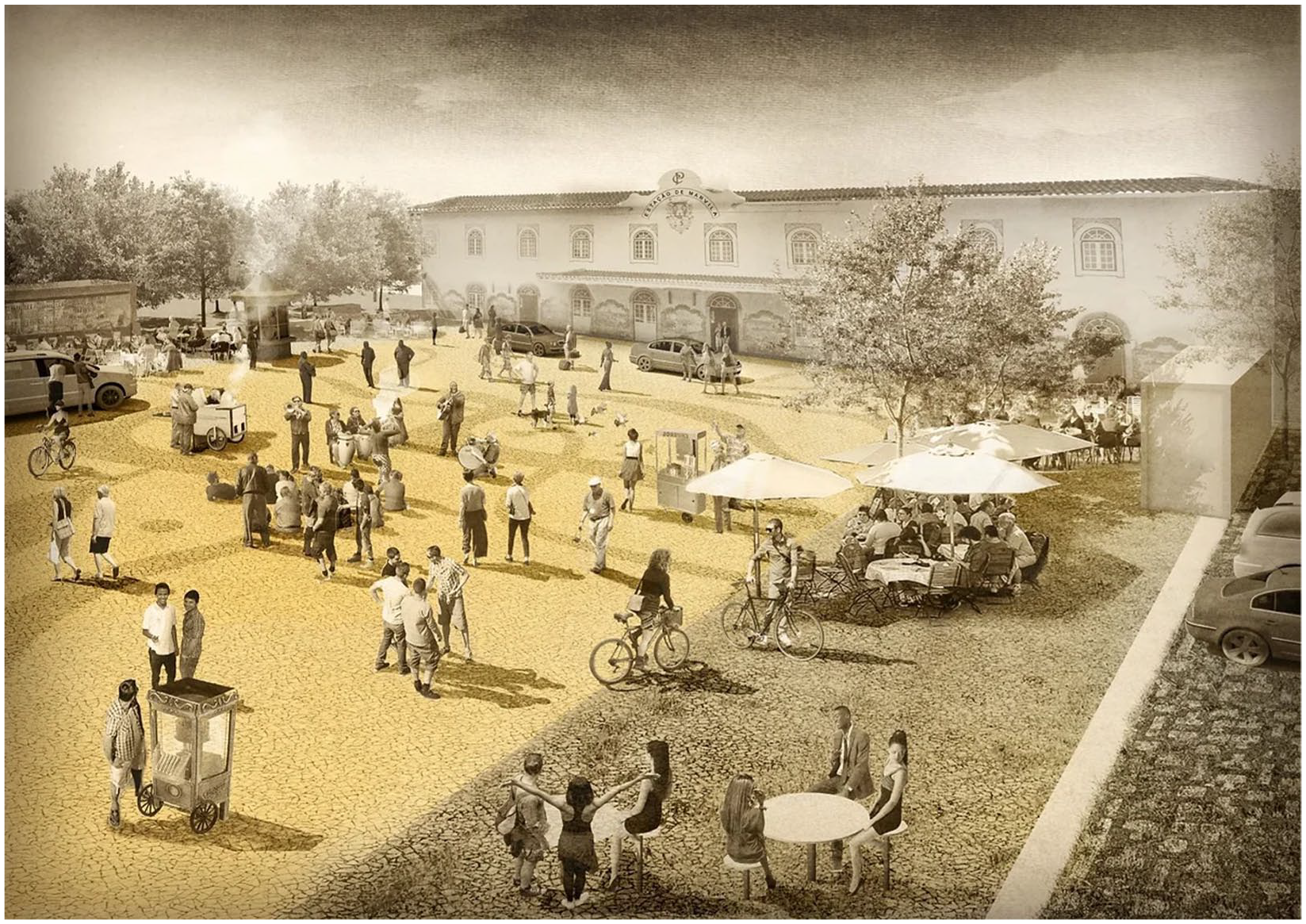
Rendering of the Quinta Marquês de Abrantes Urban Park, by PROAP (Landscape Architecture studio). Project commissioned by the Lisboa Ocidental SRU – Sociedade de Reabilitação Urbana, E.M., SA.
It is hard to express the extent to which the multiple temporalities of promise and abandonment materialise in the experience of walking through this site. Dialectical images, Benjamin proposed, are able to produce constellations in which the past flashes into the present and the linear progress of history is shown as a frozen bundle of contradictions. 111 In them, the spatio-temporal stratification that constitutes the urban is translated in allegorical and emblematic fashion. 112 The tower of Marialva is one of such emblematic bundles. It emerges through a jumble of wires, hanging clothes and the corrugated roofs of low-income houses – once, the shacks where the soap factory workers lived. The tower’s romantic balcony testifies for the refashioning it underwent in the 19th century, the tags and the cemented entrance for its last, turbulent decades, when it became a convenient hideout for shady activities. The tower hangs perilously on a cliff just over the railway. Some say that on the 28th of October 1856 the young king Dom Pedro V observed the train’s inaugural journey from the Marialva tower. In 2018, at a Lisbon City Council meeting, two deputies from the Popular Monarchic Party (PPM) submitted a proposal for carrying out renovation works on the tower. 113 ‘For us, being monarchic means building a unified national project’, reads the PPM’s ‘Who We Are’ page, ‘protected and promoted by a monarch whose main function will be to unite the Portuguese and remind them that together we make up a great nation that has nine centuries of History and had a tremendous impact on Universal History’. 114 The proposal was voted and accepted. No work has been carried out since.
MAD
I walk on the railway overpass and wander for a while on the small patch of weeds and rubble just behind. The short wall is covered with graffiti. Under the tree, a mattress suggests a recent sleep. A spiral of stairs seems to stem seamlessly from the rubble, descending elegantly to Rua do Capitão Leitão. A craft brewery and few high-end art galleries signal the change of setting. It is east of the railway now. I walk through ubiquitous construction sites: Atelier, Alba, Prateato, and the scaffolding of other luxury apartment projects in the making. Outside, glossy posters promise a future life of comfort and style. In 2019, Little Brooklyn (sic) was said to have one of the lowest prices per sqm in Lisbon (1,500 euro). According to The Times, it was a ‘no man’s land [. . .] ripe for regeneration’. 115 At the time, a 17m investment had just turned a whole block into a luxury development project, Marvilla Collection, whose apartments were set to sell at about 7k-to-10k euro per sqm. 116 The renovation works have not started yet. Upon walking on the leafy David Leandro da Silva square, a big poster announces the bright life to come. In the square the old buildings of José Domingos Barreiros and Abel Pereira da Fonseca wine companies face each other, their flamboyant architecture a reminder of their past relevance, when the logistical advantage of the river and the railway made the MBR a wine distribution hub. The Barreiros building, the cornerstone of the Marvilla Collection project, for the time being hosts the Marvila Art District (MAD), series of ateliers artists enjoy for free, until the construction works will begin. As I walk through the ateliers I compare what I see (Figure 7) with what will supposedly be, in the pictures I find in the Marvilla Collection brochure, conveniently available at MAD’s reception (Figure 8).
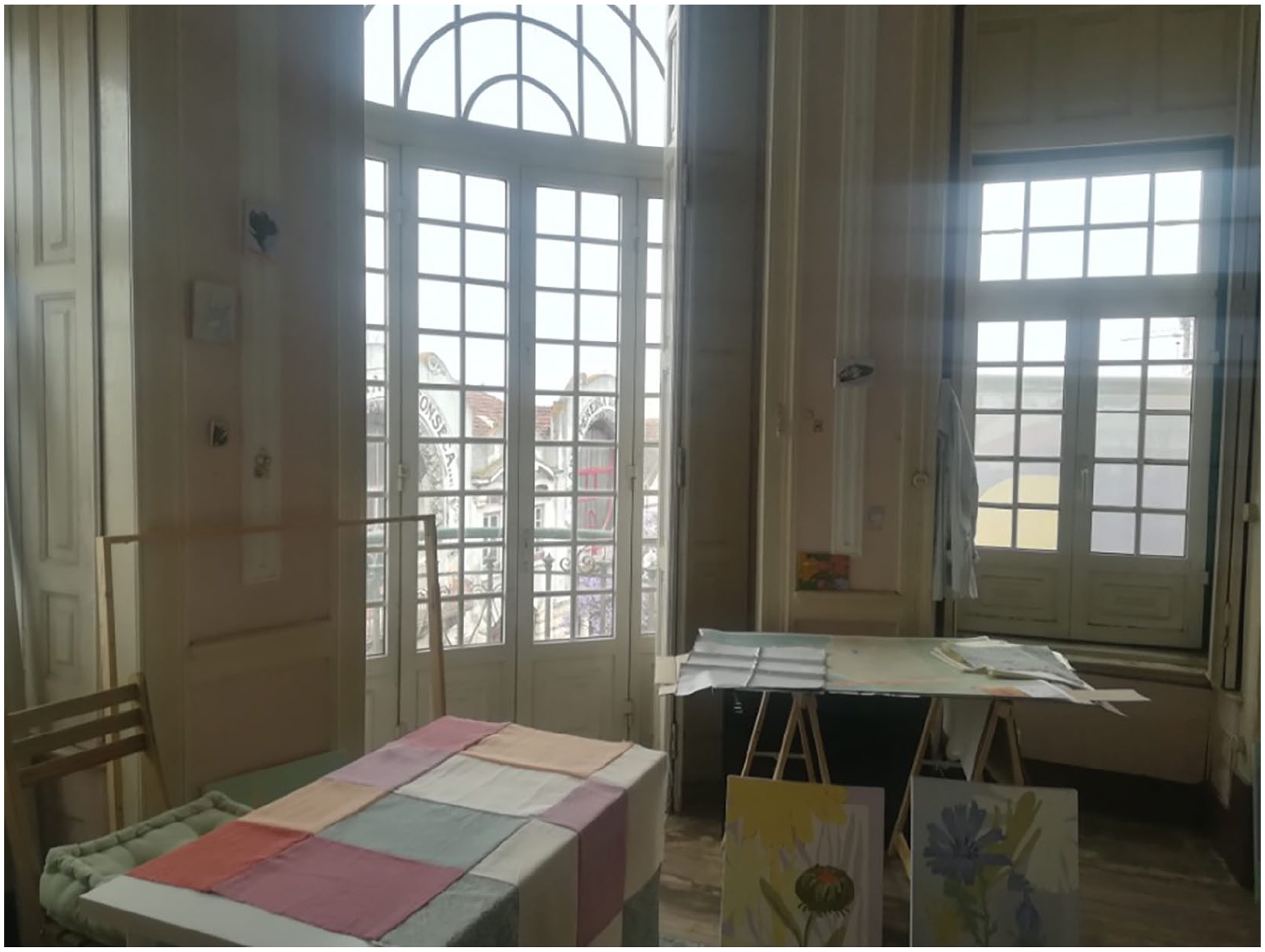
Photo by the author.
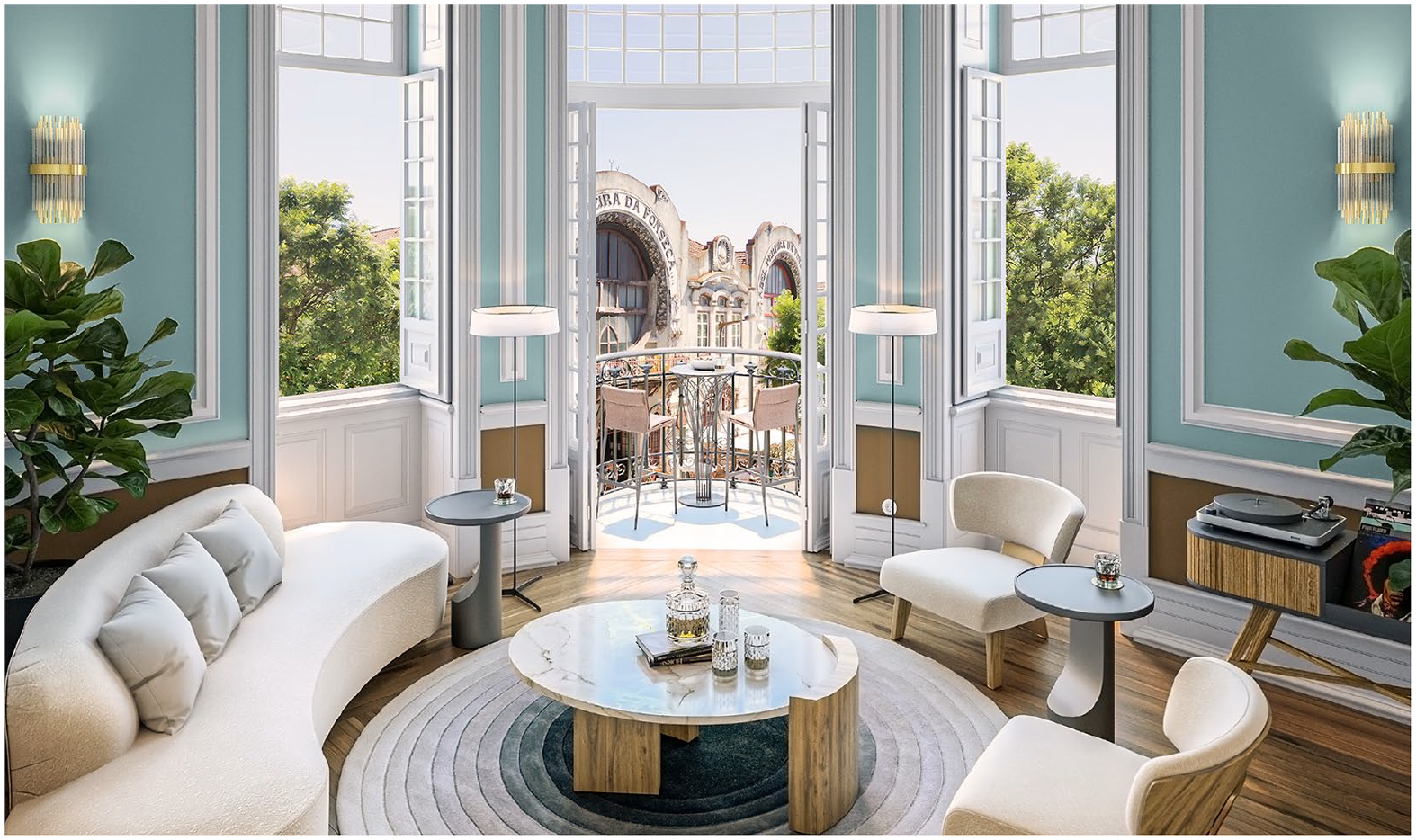
Source: Marvilla Collection Brochure, [REWARD Properties].
The Fonseca building dwells in a similar interval. At the moment, it is Marvila 8, a 22,000 m2 space with restaurants, shops, galleries, music venues and, they say, at some point, padel fields too. In three years, theoretically, it will have to make space for a property development. Until then, as those responsible for Marvila 8 candidly observe, the project ‘aims to be an example of reutilisation, of a Lisbon that utilises its spaces as a showcase for an alternative and entrepreneurial city’. 117 I walk inside its beautiful interior, still in many parts incomplete. Everything is perfectly curated to an adequate post-industrial vibe: stone and iron, wood and glass, plants and craft. In this interval of time between a project and its implementation, a host of opportunities for cultural and commercial entrepreneurs emerge, albeit the expiry date betrays the pact’s Faustian quality. Pacts do not always work out as planned, however, especially here, where nothing seems to.
Prata
Why workers in a weapon factory never strike? At the time, when Saramago was learning locksmithing in the Industrial School Alfonso Domingues (1935–1940), 118 the Braço de Prata artillery factory (FBP), about 2 km north, was ‘the dream of every school’s pupil’. 119 Saramago built his last, unfinished novel, published posthumously, around that question. 120 The inspiration came from a story about the Spanish civil war he once heard. It was the story of an unexploded bomb that carried inside a message: this bomb won’t explode. This act of sabotage could have been easily carried out by a worker at FBP, he once said. 121 The factory, opened in 1896, produced weapons, artillery and ammunitions for over a century. When it closed down, in 1998, the area was being eyed for real estate investment. At the time, the companies Somague and Obiverca joined to form the Jardins do Braco de Prata, bought the land with the intention to build a luxury apartment complex, and hired starchitect Renzo Piano to draw the project. The local temporal quicksand slowed down the process, however. As the regularisation of the project lagged behind, the philosopher Nuno Nabais saw an opportunity to fill this temporal interval. Using the influence of his relatives – João Nabais, a lawyer, and Paulo Castro Nabais, a civil engineer with links with Somague – he managed to have the place in loan for use (bailment) in 2005. In 2007, he relocated there his Bairro Alto bookshop, the ‘Eternal Return’, and began to organise cultural events in the abandoned factory. A year later, he was given a month notice by Obriverca, who was eager to begin the construction works. The FBP was beginning to gain attention, however, all the way to the New York Times. 122 This sudden visibility, and the consequent pressure of Nabais to local politicians, gained him more time, until Obriverca began to have more serious problems to deal with. First, the 2008 economic crisis, and, then, its own financial troubles, eventually leading it to bankruptcy. 123 The FBP has been inhabiting this unexpected interval for almost 20 years, organising courses, concerts, talks and festivals, offering its library free to use, and hosting a bar and restaurant that still remain ‘proudly illegal’. 124 Today, it is surrounded.
In 2018, VIC (Valuable Investment Capital) Properties bought the surrounding land to build the Prata Riverside Village (PRV) – the name finally given to the 499-apartment complex designed by Renzo Piano two decades earlier – for 150m euros. PVR has the ambition to become a novel riverside town, and to ‘create a new community’. 125 The flats are being sold between 700,000 and 2m euros. That alone triggered the remarkable 80% rise in Marvila’s house prices since 2019. 126 It is slightly disconcerting, walking through these half-finished buildings, across sanitised alleyways, the body still remembering the uneven terrain negotiated so far, the polished façades eerily reflecting their emptiness on the streets. ‘The new neighbourhood’, as the development’s official magazine proudly states, ‘has revolutionised one of the most undervalued areas of the city [. . .] the memories of a depressed Marvila, hidden from the eyes of Lisbon’s citizens and its visitors, are now distant’. 127 ‘Prata Riverside Village’, we read few pages below, ‘has been the driving force behind the revitalisation of Lisbon’s eastern area’. 128 PVR, as the promotional material makes clear, means a novel atmosphere, a novel lifestyle: it invites ‘to breathe a new way of life’. 129 In the same magazine, VIC Properties’ COO observes, somewhat less romantically, that VIC’s investments in artistic projects in the area – a programme that is ‘opening Marvila to the world’ – ‘has bred a unique energy in the neighbourhood, with a remarkable surge in demand from economic agents’. 130 The waterfront is pristine, just renovated by the municipality into a novel park. So far, it often appears empty, even in the magazine’s pictures. ‘One might say’, Pra.Te.Ar says, ‘that VIC Properties’ strategic vision for Prata Riverside Village is paying off: whoever passes by is hooked’. 131 Rose’s work comes to my mind. In particular, his attempt to explore landscape without seeking to explain, unpack or decode it. Rose looks at the way in which landscape holds together and remains in place: the manifold ‘investments’ it generates, the ‘sense of rhythm to everyday life’ it provides, not as a result of ‘deeper cultural forces but rather as a consequence of the various practices surrounding and investing in the resources it provides’. 132 How does an imaginary hold together regardless of its truth value? That is the question I find myself ruminating on, while walking through the construction sites and the billboard announcing of the coming ‘new life’. The place still maintains an appearance of transiency, an uncanny fragility, one that the financial reshuffling occurring beneath the surface implicitly confirms. 133
Conclusion
At some point in the introduction of his book, Simone gestures towards an ‘urban ethnography of what has already been completely changed even as the conditions for empirically verifying such transformation are not presently possible’. He then continues: This ethnography is not just a phantasmagoric redescription accomplished through an inventive poetics (although it is partially that). Rather, it is a way of thinking incipience not simply as sign of what is to become or could become but as an actual experience of unsettling, a moment of diffracted sense, where things could go many different ways, where life at the moment is staked on the maybe—where every available means of calculation goes no further than “maybe it will, or maybe it won’t.”
134
The present text, emerging from a series of walks carried out in the span of 10 years, profoundly resonates with this evocation. The intervals that I have been traversing appear to be immersed on such an indefinitely deferred condition, a maybe that keeps being expanded, diffracted, prolonged and precipitated in often unfathomable ways, where expectation and nostalgia assume a solid, viscous consistency, a spacetimemattering that for all sorts of (legal, political, bureaucratic, financial etc.) reasons keeps swelling into a zone of procrastination, a transition that does not come to pass, an excess that is both planned and unplanned, as if it were the ghostly residue of a planning that never took place, of a financial speculation that was merely aimed at gaining more time, of an unrealised future that keeps haunting the present where people live, an endless build-up which never quite kicks in. 135 Of course, each place has its own history, and precise causes that can be deployed to explain its present condition. And yet, causal explanations are not sufficient. In each place – especially between and within each place – there is ‘something else’ that is worth exploring. This is what these walks sought to listen to, and this text sought to attune to, unavoidably remaining themselves stuck in this maybe, irrevocably failing to make sense of those places. In fact, also refraining from doing so in the first place. The guiding intention was that of seeking to attend to the affective oscillation between the ‘psychogeographical contours’ through which the Lisbon’s East side appear to be split, that is, the ‘constant currents, fixed points and vortexes’ through which its spatiotemporal heterogeneity is patched together, without a clear plan, or outcome. 136 This is not an abdication of research, as explained above, but rather a deliberate attempt at defamiliarisation, allowing a thick description to emerge – one that attunes to and writes, rather than explain, place. The aim, following Rose, was ‘to suspend our theories of culture in order to reopen ourselves radically to the range of possible things the world can tell us’. 137
This is not an abdication of critique either, to be sure, but rather an instance of the ‘immanent critique’ Stewart seeks to develop, that is, ‘a cultural critique that is not so much a decoding as an engagement, not so much a hermeneutical interpretation as a crafted mimesis or re-presentation’. 138 A critique that stays with its object in the way a commentary does, renouncing to the dialectical movement of resolution by instead remaining at its margins, in a similar way to Rose’s reflection on landscape, or Pohl’s suggestion, as regards ruins, to resist the impulse to de-fetishise them in order to explore instead the way in which they appear, the way their imaginary holds together, the way they are perceived as such. ‘Here’, writes Pohl, quoting Dolar, ‘it is only “the blur itself, the distortion, the break, the crack, the division of the visible and the intelligible” that matters’. 139 Keep it blurry. 140
It is again Stewart that provides a useful way to summarise this methodological proposition, in her own commentary to Agee’s Let Us Now Praise Famous Men: ‘Agee proposed an ethnographic account to be read not for its truth value and congruence with fact but for its tense, halting evocation of difference and desire at the very heart of a doubly constructed “real”’. 141 The present text looked for evocation too. This is, I believe, something that a writing that is able to walk appears to be particularly appropriate for: namely, seeking to convey what in a place is ghostly, affective, dynamic, what escapes its representation and archive, while constituting it, nonetheless. Hence the priority given to the interspersion and frictions over the collection of specific accounts from both the inhabitants of each place and the powerful political and economic actors that shape them. This is not, of course, because I do not consider important such accounts, such experiences. Nor is it because I believe that cities unfold by chance, that structural processes are unimportant or secondary, that power relations do not ultimately shape the urban. Yes, they are, and they do. Yet, quite a lot remains blurred, out of focus, in the surrounds of these more defined aspects, in the spatiotemporal transitions, thresholds, and interstices that weave the urban fabric. How to engage and convey the atmospherics these overlapping generate – how to engage with the blur qua blur: that is the question that inspired this text, and its attempt to link body, movement and writing to do so.
Refraining from drawing conclusions from my experience, I rather sought to experiment with thinking, moving and writing as a way to attend and attune to urban sites as they are being plotted way. 142 A final qualification, then. My use of walking as a methodological device has not been reflected on an extensive account of my own experience of walking: my intention has been that of drawing from, rather the accounting for, my physical and speculative walking, which I implicitly assumed as the silent condition of possibility for this text to unfold.
Footnotes
Ethics statement
Not applicable.
