




Abstract
In 2021 and 2022, we engaged in a collaborative filmmaking project at Maple Farm, a rewilding site in Southeast England. The project resulted in After Wilding, a speculative documentary film that explores different perspectives on rewilding and the future of Maple Farm and natures in the United Kingdom more broadly. After Wilding envisions what it would be like to visit Maple Farm in June 2042; to do so, we used 360° imagery of the present site and computer-generated visualisations of possible future landscape features. These visualisations were underscored by three narrative vignettes reflecting on different interventions and perspectives on the site. This article describes creating After Wilding as a three-part process – attunement, perspectives and synthesis. We then reflect on the potential opportunities that digital technologies offer for collaborative speculations between researchers, artists and practitioners for geographical praxis and conservation activities.
Introduction
After Wilding 1 is a short speculative documentary film exploring how environmental practitioners, volunteers and landowners are reimagining the future of nature in the United Kingdom. The film imagines a visit to a rewilding project in June 2042, visualised by overlaying 360° imagery taken on site with machine-learning-generated images of potential future landscape features. This imagery is accompanied with narration offered by three fictionalised characters based on interviews conducted at the farm. The subject of the film is Maple Farm, a 30-acre site in Southeast England which has historically functioned as a small pastoral farm and more recently as a refuge for unwanted and abandoned grazing animals. The farm borders areas of ancient woodland and is intersected by hedgerows, scattered trees and a small river. In 2020, motivated by a desire to improve biodiversity on the farm, the landowner contacted Youngwilders, a youth-led nature recovery collective which we have worked with in the capacities of co-founder (Oscar) and a resident artist and designer (Joe). Youngwilders have since initiated a plan with the landowner to transform Maple Farm into a semi-natural ecosystem comprising shrub, riparian, wetland, woodland and rough grassland habitats through a range of rewilding interventions. 2
In recent years, rewilding has emerged as a powerful new paradigm shaping conservation which aims to improve biodiversity and restore species and ecological processes. Whilst its early manifestations in North America and Europe focused on landscape-scale initiatives and keystone species reintroductions, particularly large herbivores and predators, it has recently become a more flexible term used by practitioners, researchers and publics to describe a range of land management practices operating at different spatial and temporal scales. 3 Maple Farm demonstrates a novel rewilding approach that Youngwilders terms ‘DIY-ilding’. DIY-ilding is youth-led and tends to focus on small rewilding sites near urban areas. The approach and method encourage broad participation, and view embodied, creative and experimental engagements with the landscape as integral to rewilding practices. 4
After Wilding is one such engagement, which has helped to bring together multiple perspectives on Maple Farm into a coherent narrative and visualises the effects of different rewilding interventions in a manner that reflects the inherent uncertainty of future ecological trajectories. The film frames rewilding as a complex, open-ended set of practices in which land management and more-than-human agencies are entangled with the stories told by practitioners about the environment’s past, present and future. In this article, we describe creating After Wilding as a three-part process of attunement, perspectives and synthesis. Our work responds and adds to ongoing interest among human geographers in speculative practices, 5 and in film as both a focus of inquiry and increasingly as a method and research output. 6 Moreover, we build on recent affirmative geographical engagements with digital technologies used in environmental practice. 7 We offer After Wilding as an experiment in ‘situated co-speculation’ 8 between geographers, artists and environmental practitioners, and we consider the possibilities that film and digital technologies offer for these different actors to co-imagine the uncertain future landscape of Maple Farm.
Attunement
After Wilding was initially conceived when Joe, who is interested in developing artistic practices in and for nature recovery projects, contacted Youngwilders to arrange a visit to the site and formulate a collaborative project. We developed the ideas informing the film during our first site visit together in October 2021, where we practically attuned to the social and ecological features of Maple Farm and developed a shared lexicon between artist and conservation practitioners.
Our creative collaboration and process was shaped by a specific practical task on the day. We were looking for appropriate locations to place camera traps for monitoring wildlife. We asked: where would animals move through the site; which features would they pause by, and which would they avoid; and where would camera views be least obstructed? This task involved careful observation and assuming uncomfortable positions – kneeling to peer into the scrub for impressions left by animals. In doing so, we were also attuning to the histories of the site, its present use by various other-than-human beings and engaging in discussions about its future. For instance, existing fences initially installed for livestock shaped wildlife movement through the farm and thus where we placed the cameras. We noticed impressions in the vegetation where badgers and roe deer had moved repeatedly along and around fence lines. These fences would soon be removed, and Youngwilders members speculated on how this would enable ecological connectivity. We also walked past dense patches of invasive giant hogweed plants along the riverbanks, which threatened to disrupt plans to restore riparian habitats. Discussing these landscape histories, presents and futures informed the direction of Joe’s artistic engagement with the site (Figure 1).
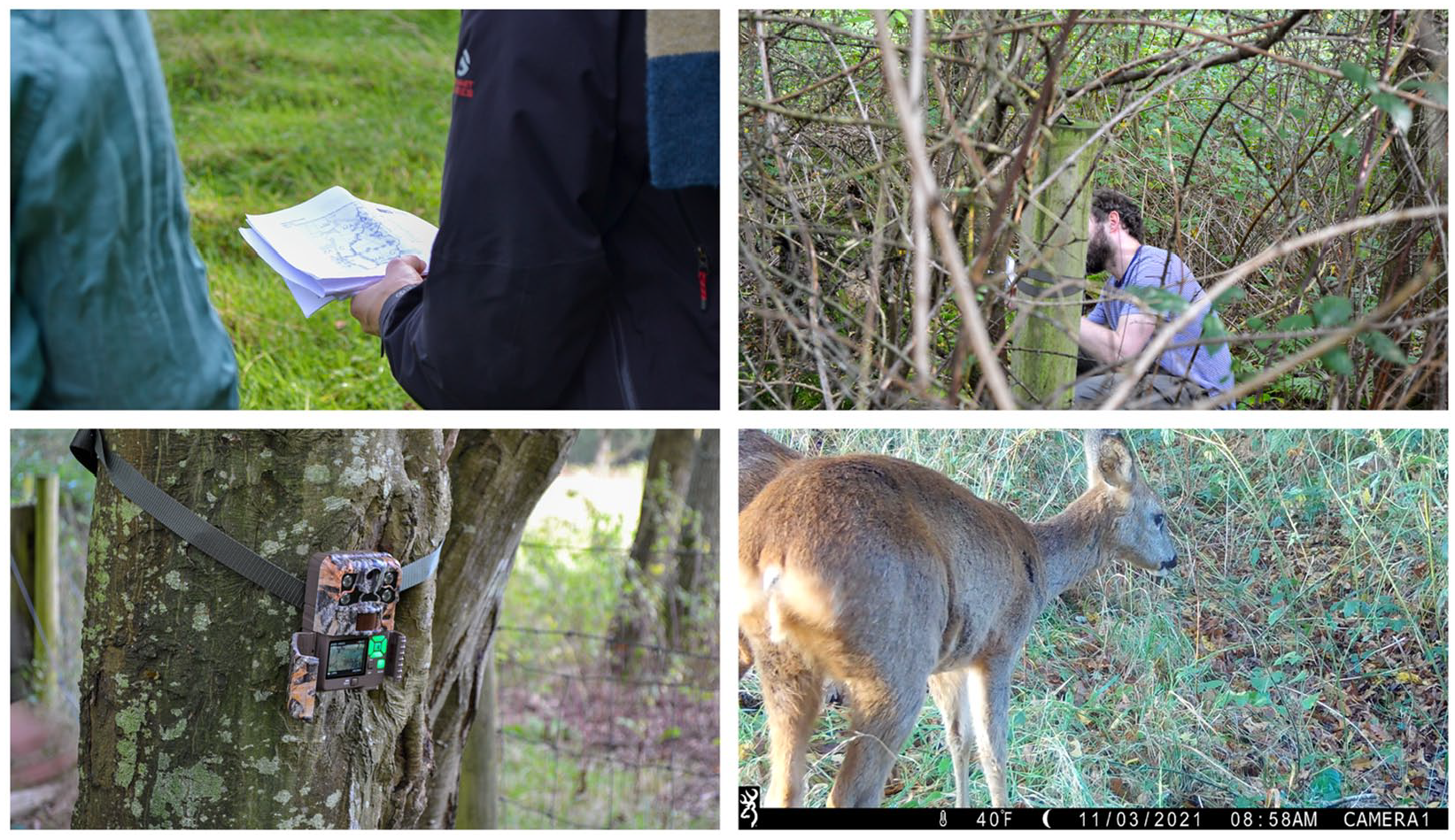
Photos from the ‘attunement’ site visit to Maple Farm and an image of a deer captured by one of the wildlife cameras we installed (bottom right image courtesy of Carbon Rewild; all other images by authors).
Perspectives
Attuning to the context of Maple Farm directed us to gathering perspectives on the imagined futures of the site. Over 6 months in 2021–22, we gathered maps, planning documents, audio and video recordings, 360° photographs, and Joe also conducted 19 semi-structured interviews with the Youngwilders team, 14 volunteers and the landowner. These interviews asked participants to speculate on the future of the site. What did people imagine? What was possible? What would the landscape resemble in 20 years’ time? (Figures 2 and 3).
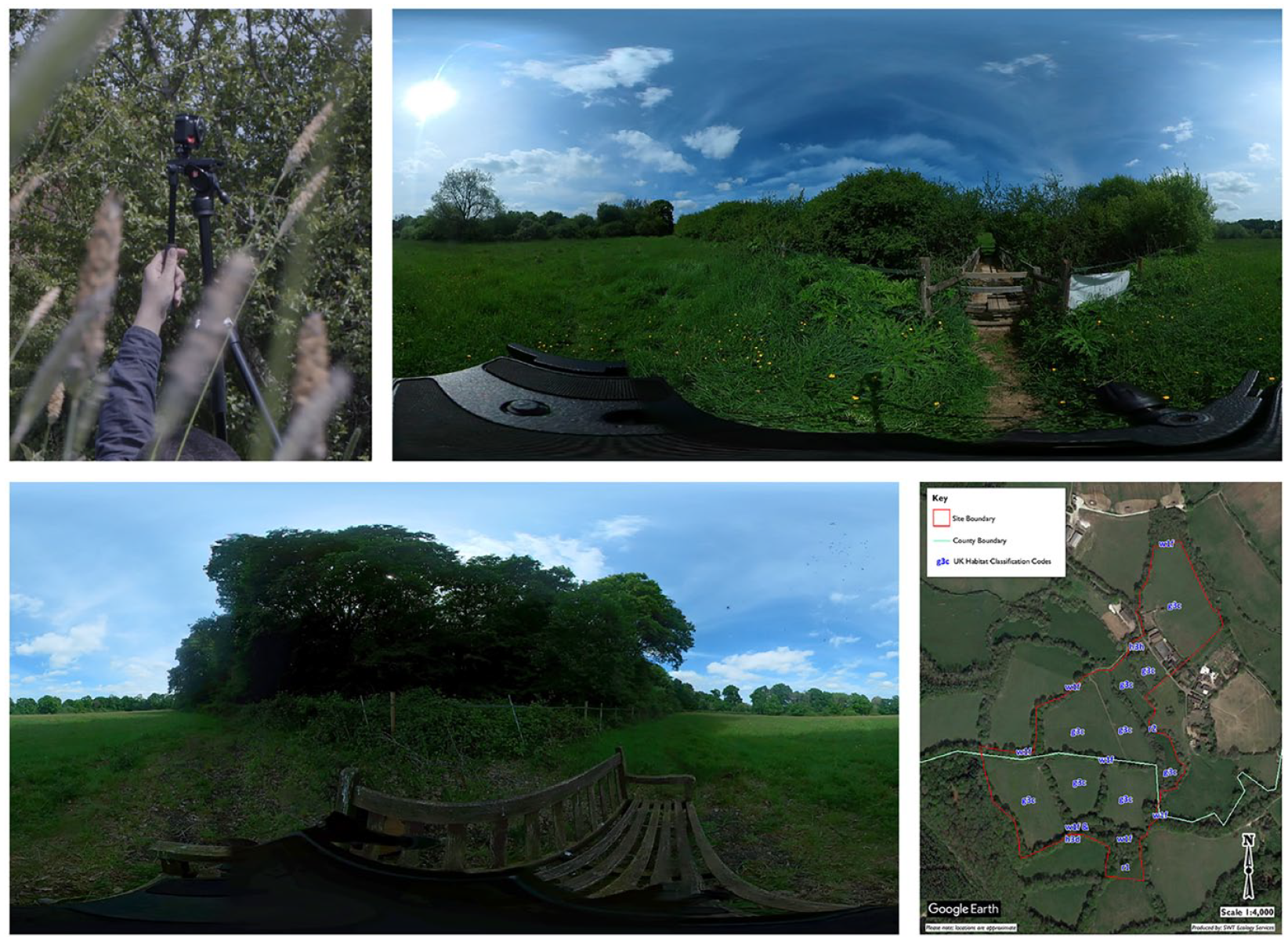
Capturing 360° perspectives of different areas in Maple Farm, and a habitat map of the site (top left image courtesy of Maël Henaff; bottom right image courtesy of Surrey Wildlife Trust Ecology Services; all other images by authors).
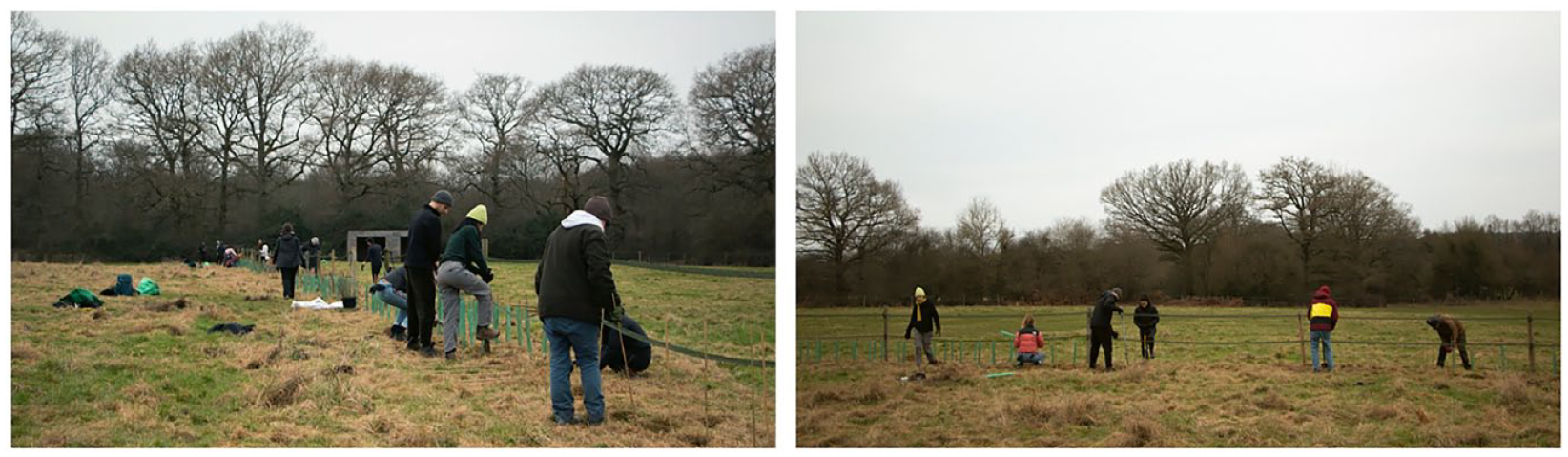
Photos from the hedge planting volunteer day, during which the interviews took place (images courtesy of Kaye Song).
We coded interview transcripts thematically and identified several themes pertaining to speculative rewilding futures. These related to multisensory aesthetics, for example, one interviewee suggested: ‘if we’re walking down in the summer, I want to literally hear it buzzing with life’. Interviewees also imagined greater species diversity and connectivity across the site, and a feeling of coherence stemming from the removal of fences and the spatial extension of currently isolated pockets of habitat. Finally, a recurrent theme related to the role of humans and other-than-humans in the landscape. Interviewees highlighted the potential value of a rewilded landscape for humans. We heard from one: ‘I would love for this to be a space where people can come and understand that there’s just so much depth and richness that we can easily brush over’. Participants also emphasised the importance of the project for other-than-humans, with activities such as hedge planting, wetland creation and natural regeneration of woodland creating habitat and space for other beings where there had previously been little. The futures envisioned by interviewees are articulations of the ideas, ideals, hopes and fears that motivate their participation in the Maple Farm project. 9 Read together, participants’ perspectives describe a plural, negotiated vision for the site’s future that is both radically hopeful and grounded in realism.
Synthesis
In creating the film, we drew on participants’ testimonials and synthesised these into a central narrative based around three fictional visits to Maple Farm in summer 2042. In each vignette, The Researcher visits a different area of the site and interviews a community member about how rewilding has changed them, the site and the wider socio-ecological landscape. Each character in the story is an archetype based on interviewees’ perspectives, with characters’ dialogue drawing on interview transcripts. In part 1 of the film, the Wilder talks about the ephemeral wetland that they helped to restore and the ways that more-than-human agency is centred in rewilding. This is accompanied by a visualisation of the part of the Maple Farm site that borders a river turning from a grassy field into a muddy, flooded wetland. In part 2, the Volunteer talks about the hedgerow that they helped to plant and how rewilding has changed their relationship with the environment. This is accompanied by a visualisation of fences that once divided a large field being replaced by thick, verdant hedges. Finally, in part 3, the Researcher interviews the Landowner who talks about their observation of natural forest regeneration and how rewilding has changed their understanding of care. This is accompanied by a visualisation of a heavily grazed field that borders an ancient woodland becoming reclaimed by the woodland.
To create the visualisations of characters’ environmental speculations, Joe experimented with the OASIS machine learning model, which can generate digital, synthetic photographs of non-existent landscapes from rough sketches using semantic image synthesis. 10 The system maps the brightness of each image pixel to a semantic label describing the desired contents of the image (e.g. pixels with a brightness of 97 describe a ‘bush’ and pixels with a brightness of 142 describe a ‘plant-other’). The resulting synthetic images are uncanny. Whilst they seem initially realistic, closer inspection reveals strange digital artifacts that suggest their synthetic nature: areas of the image are smudged or pixelated, reflections do not match the environment, tree trunks and crowns are misaligned, and the sky is crisscrossed with black fractures (Figure 4).
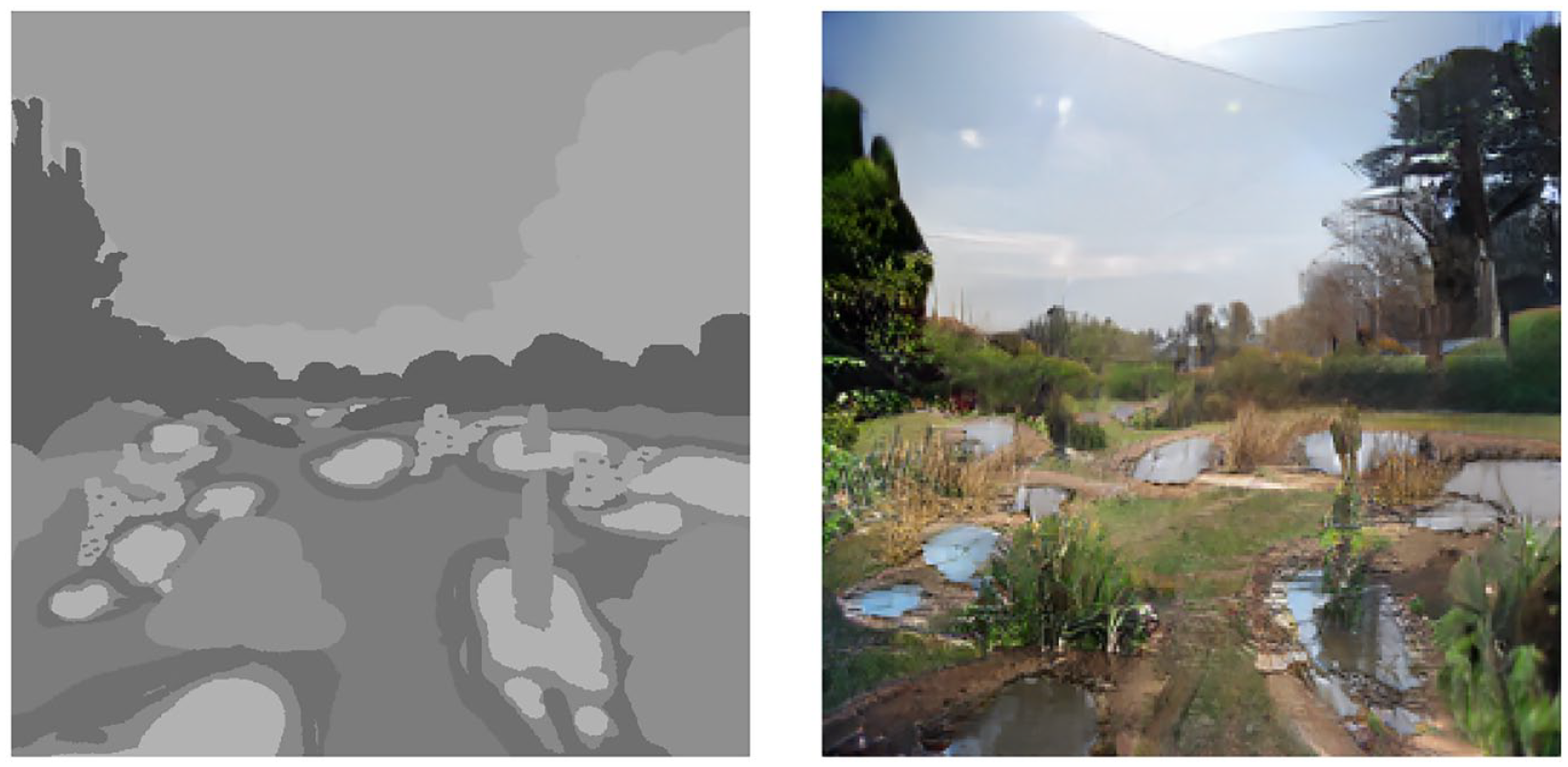
An example of OASIS image synthesis – on the left is the input semantic image sketch and on the right is the output synthetic photograph that was generated by the model (images by authors).
Joe also built custom rendering tools in Unity, a videogame creation engine that provides tools for building and rendering 3D environments. This allowed the synthetic images of speculative landscape features to be layered on top of 360° photographs of Maple Farm. 11 A virtual camera rig was then used to film inside this space, visualising the potential future landscape from the first-person perspective. Because each frame is rendered in isolation from the previous and next frame, the resulting animation is noisy, textured and unstable. This means that the speculative landscape features visualised in the three parts of the film never settle into a final, coherent form. The uncertainty and ambiguity of futures-thinking are embedded in the medium itself (Figures 5 and 6).
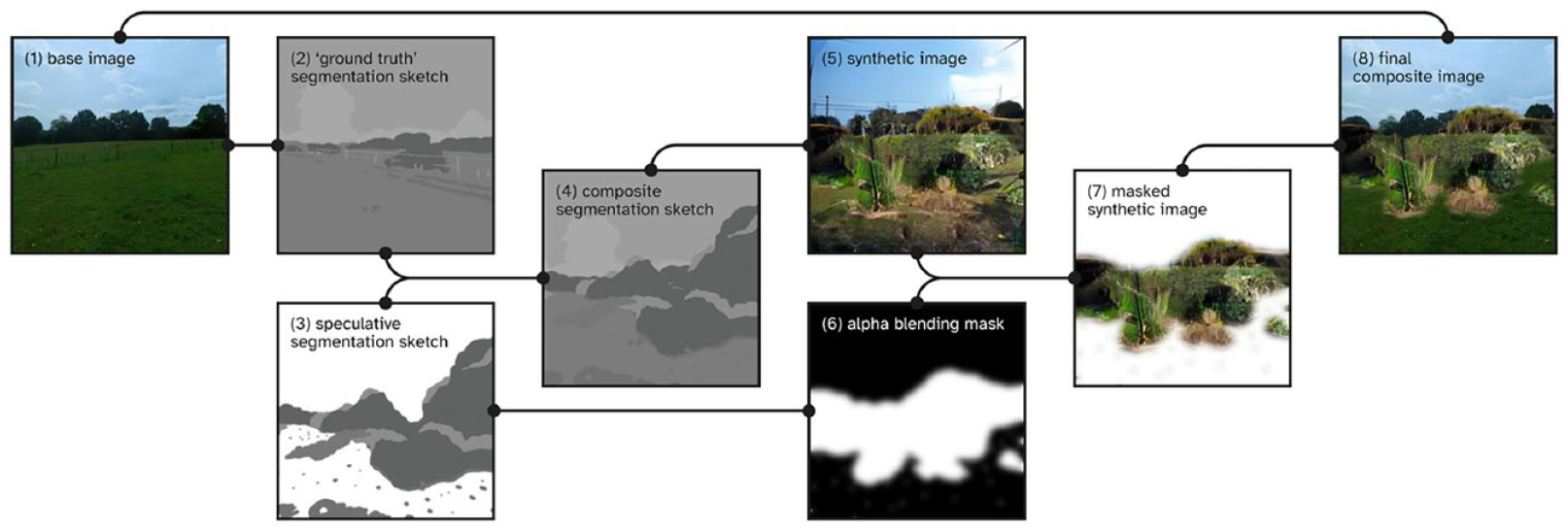
A flow diagram of the film’s ‘render pipeline’ for each frame of the film. Footage of the site is used as a base image (1) and is ‘sketched over’ using custom drawing tools: one sketch semantically describes the ‘ground truth’ of the site (2) while another semantically describes the speculative landscape features envisioned for the site (3). These sketches are then combined (4) and fed into the OASIS image synthesis model to produce a synthetic photograph of the future landscape (5). Using the speculative segmentation sketch as an alpha mask (6), this synthetic photograph is then composited back on top of the original base image (7) to produce the final image (8) (image by authors).
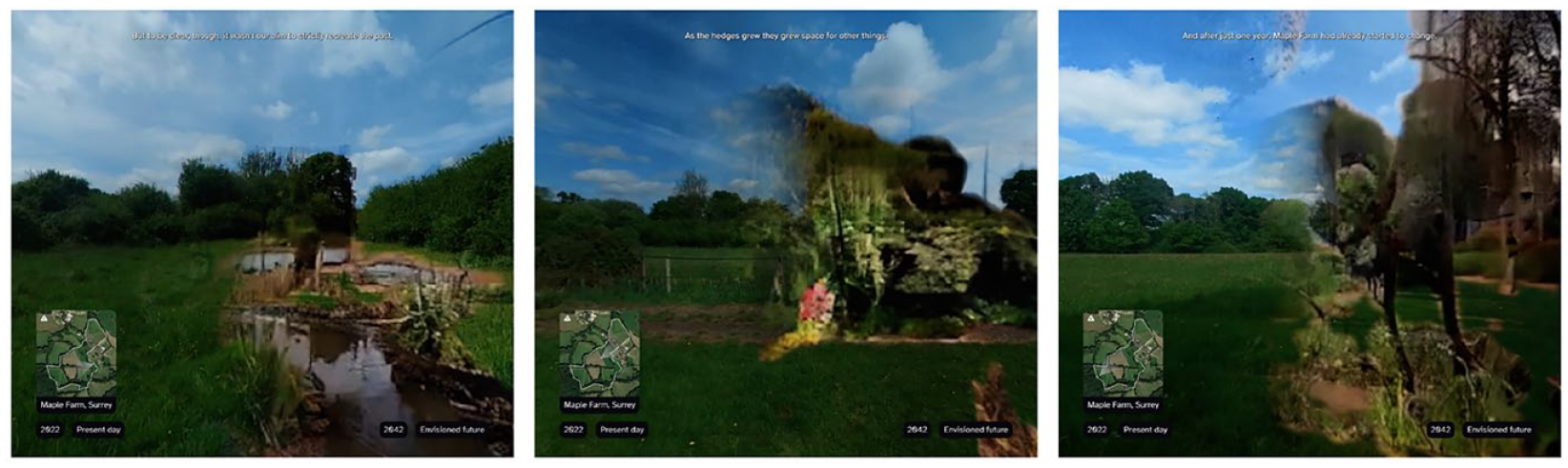
A still from each of the vignettes in After Wilding – (from left to right) ‘Interview with The Wilder: Repairing a Wetland’, ‘Interview with The Volunteer: The Hedgerow We Planted’; and ‘Interview with The Landowner: My Bench in the Forest’ (images by authors).
Situated co-speculations
In rewilding and ecological restoration, ‘before/after’ images are commonly presented to visualise stark differences between degraded pasts and restored presents. These are often used to make definitive claims about the futures of currently degraded sites if they were to be rewilded. This collaboration has sought a different approach. After Wilding does not seek to make a settled ontological claim about the near future. Rather, the unstable, shape-shifting visuals of the film evoke a sense of multiple possible ecological trajectories whilst each vignette offers a complementary, but not singular or wholly coherent vision of the future. We thus see the film as both a stand-alone artwork and an exercise in ‘situated co-speculation’ 12 between artist, researcher and environmental practitioners. We understand this co-speculation to reside in multiple locations. It is evident in the creation of the film in which situated perspectives came together to discuss the site and multinatural futures in the United Kingdom. 13 Co-speculation is also embedded in the aesthetics of the film itself, which invites the possibility of experiencing and imagining rewilding as an inherently speculative, open-ended practice. This aesthetic, achieved together with the OASIS machine learning algorithm, speaks to recent interest amongst human geographers in affirmative engagements with digital technologies, such as Sophia Maalsen’s call to consider algorithms as ‘collaborators (that) can help geographers understand spaces in new ways and encounter new spaces’. 14
The collaborative production of After Wilding functions further as an invite to cultural geographers and artists engaged with nature recovery projects, as well as conservation practitioners themselves, to engage with creative methods of co-speculation such as experimenting with novel digital image-making technologies. Doing so, we suggest, offers opportunities for creative geographical praxis as well as new ways to creatively represent the effects of rewilding interventions and the multiple perspectives and values which shape them (Figure 7).
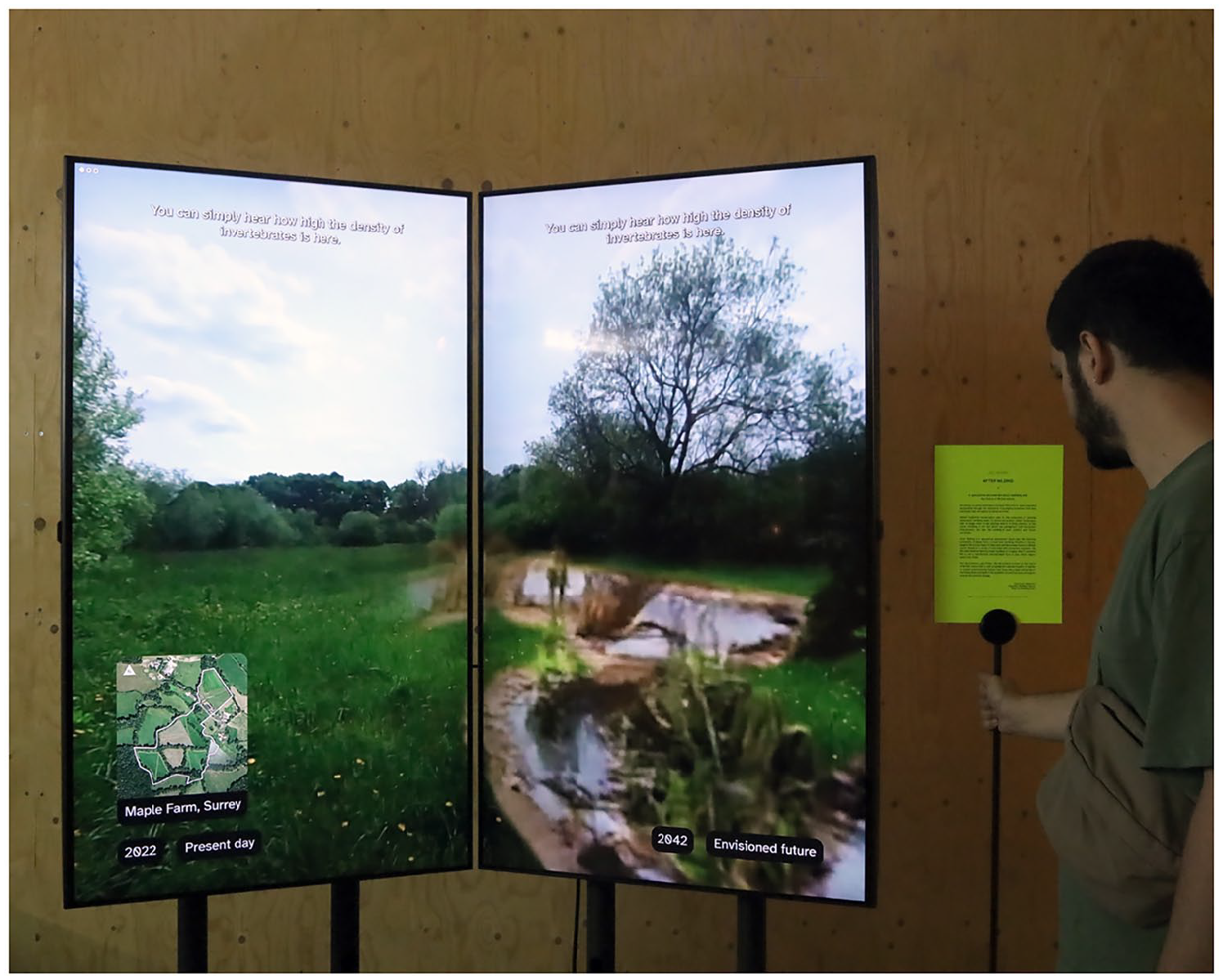
After Wilding in exhibition at the 2022 Central Saint Martins graduate showcase (image courtesy of Ece Tan).
Footnotes
Acknowledgements
The authors thank the other members of Youngwilders, Jack Durant, Molly Easton, Noah Bennett and Anya Doherty, for their kind support with this project, and Charity Buddy for allowing us to conduct this project at Maple Farm. We also thank volunteers for contributing to the project, Maël Hénaff for additional cinematography, Florian Payen for production assistance, and Henry Anderson-Elliott for his thoughtful comments on a draft of this manuscript.
Funding
The author(s) received no financial support for the research, authorship, and/or publication of this article.
Notes
Author biographies
 .
.