




Abstract
This article engages with the material geographies of colonialism in Israel/Palestine by looking at the site-specific cultural activities in Iqrit (Israel), a Christian-Arab village depopulated during the 1948 war in the region. We investigate the importance of material infrastructure – and material, bodily encounters with the site – as a basis for the place-based activist memory-work, as well as exposing the ways in which such activities contribute to the advancement of ‘the politics of presence’, understood as a manifestation of a continuous resilience vis-à-vis the discriminatory policy of the state. Our argumentation focuses on the importance of physical presence in specific geographical areas, shedding light on how place-based activities may contravene the expressed state policy by increasing the fluidity of the territory, creating spaces of contestation in which the traditional understandings of state authority partly dissolve. It also explores how the material reconfigurations of the place, and emotional-bodily investment in it, contribute to the semantic instability of the site, turning the place-based memory-work into a future-oriented project with important political aspirations.
Keywords
Return to Iqrit: an introduction
Not much has been left of Iqrit, an Arab-Christian village located in the mountainous Upper Galilee, near Israel’s border with Lebanon. Today a visitor would only encounter the rebuilt St Mary’s Church with its blue dome and a cross crowning the limestone walls, along with the figure of the Holy Virgin overseeing the surrounding orchards from the building’s roof (Figure 1). A sign on the site reads ‘Iqrit Church’ in Arabic, Hebrew and English to attract visitors’ attention and celebrate the memory of the ruined village. Near the church is a small cemetery which, since the 1970s, has been used as a burial place for those forced to leave the site decades earlier, during the violent events accompanying the establishment of the State of Israel in 1948. Forcibly relocated, the community of Iqrit, however, has never fully abandoned the place. Members have continued visiting the site, engaging in informal place-based cultural activism.
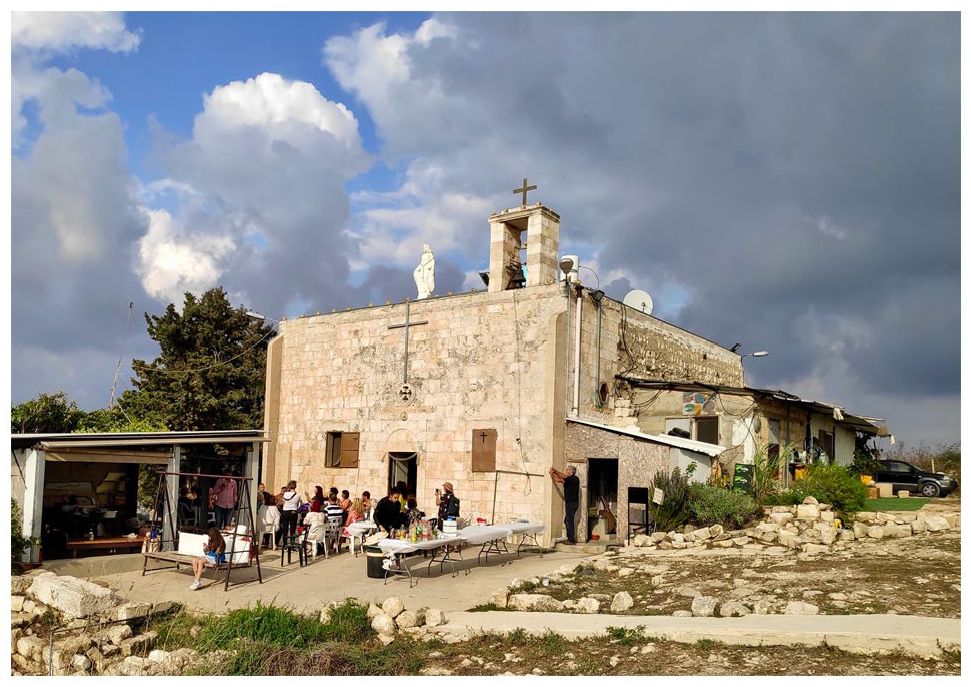
Iqrit Church and the representatives of the Iqrit community.
The church-centred activities organized in Iqrit include collective prayers, gatherings with relatives and friends, baptizing newborns, celebrating weddings and cultivating the memory of those who symbolically ‘return home’ after death. 1 But onsite events are not limited to religious rituals. Every summer, an annual youth conference is organized in the churchyard, while representatives of the third generation of the exiled meet for a week at the so-called Roots Camp to learn about the community’s heritage and engage in site-related cultural undertakings. 2 In 2012, a group of youth connected to Iqrit decided to stay on the spot permanently, acting as regular villagers committed to the idea of a genuine renewal of the site. Through a rotating system of shifts, they are involved in keeping a continuous presence in Iqrit, 3 a practice understood as a temporary substitute for their formal right to return. Since the beginning of the action, their makeshift material arrangements – tents, beds, facilities, personal belongings – have been frequently confiscated or destroyed by the Israeli administrative units, and those engaged in non-violent forms of anti-state resistance have repeatedly been arrested by the local police. Nevertheless, despite being regularly harassed by the state, the activists remain involved in the politics of presence, an activity which is aimed at highlighting Iqrit’s original Arab-Christian identity, practicing place-based ethics of care, cultivating the memory of the village’s tragic past and reclaiming the community’s political rights.
In this article, we engage with the cultural-material geographies of colonialism in Israel/Palestine by looking at the site-specific informal activism in Iqrit. We investigate the importance of material infrastructure – and material, bodily encounters with the site – as a basis for the place-based memory-work, 4 as well as exposing the ways in which such activities contribute to the advancement of the politics of presence understood as a manifestation of resilience vis-à-vis the ‘ethnocratic’ 5 state policy. Even though, recently, much attention has been paid to the post-violence memory politics and its various intersections with art and activism, 6 the analysis of difficult legacies of urban destruction and forced relocation, as well as of place-based memory practices related thereto, remains modest. Similarly, whereas formalized forms of Palestinian (memory) activism in Israel/Palestine have already attracted researchers’ attention, 7 little has been written about non-institutionalized, community-based, spontaneous undertakings. By looking at the case of Iqrit, we aim to partly fill this gap. The discipline of cultural geography can benefit from critically engaging with such site-specific forms of grassroots involvement, exposing how expelled communities remain conditioned by the troubling past of the places of their origin, as well as how they tend to mobilize these experiences for the advancement of struggles for cultural and political recognition. Such investigations, focused on the importance of physical presence in specific areas, could also shed light on how place-based activities may partly contravene the expressed state policy by increasing the ‘fluidity of the territory’. 8 Relying on materialities of the site, grassroots strategies, we argue, appear especially subversive in situations in which the formal ownership of land continues to be questioned, as is the case of land-centred Israeli settler politics in Palestine.
We begin by outlining the methodological background and introducing the theoretical developments on which we draw. Next, we present our empirical contribution by discussing the politics of presence in Iqrit, approaching the case from the perspective stemming from our engagement with such concepts as fluidity of the territory and more-than-human relations of care. This framing clearly manifests our interest in the importance of materiality (land, infrastructures, dwellings) for both the state’s investment in constructing territorial policies (aimed at consolidating the control of land) and a minoritarian community’s commitment to activist politics of resilience (aimed at loosening the state’s control). By analysing the case from a materiality-informed perspective, we embrace the broad and diversified tendency to ‘rematerialize’ cultural geographies 9 by exploring the nexus of geo and social life. 10 Our case study is discussed in three steps, all of which are clearly related to the different aspects of the politics of presence. First, we analyse the logic of political struggles in which the evicted inhabitants of Iqrit are engaged. Second, we examine the partial shift from political to cultural place-based activities, and how it intersects with the caring investment in material infrastructure on and around the site. Third, we discuss the spaces of fluidity and the critical potentials they create for sustained resilience. In conclusion, we summarize the contribution of our research to the discipline of social and cultural geography, indicating the new conceptual terrains it potentially opens across the field.
Background and approach
Our analysis is rooted in a multidisciplinary scholarship. On the one hand, we draw inspiration from the literature tackling place-based cultural activism 11 to investigate the importance of grassroots practices and their investment – as well as embeddedness – in specific sites. On the other hand, we engage with theorizations of issues of territorial control, 12 originating in the domains of political geography and political science, as well as of settler colonial studies, 13 with an aim to contextualize the importance of space-based policies articulated within the land-centred colonialism in Israel/Palestine. Our approach is based on the relatively old, yet still insufficiently explored, work of Baruch Kimmerling, 14 produced to describe the Israeli colonial project in the region. 15 Drawing on his developments, we connect our interests in the legal aspects of the functioning of a state (such as sovereignty or ownership of land) to the analysis of cultural practices (physical presence, memory-centred activism) mobilized for contesting state control of sites whose historical and legal ownership continues to be challenged. We combine these investigations with approaches – positioned within the area of social and cultural geography – to the importance of matter and material infrastructures, 16 and the relations of more-than-human care 17 involved in the practice of dwelling in and using a place.
Pioneering in analysing Israel as a settler colonial society, 18 Kimmerling’s work – exploring the topic from the point of view of the Israeli authorities – aims to explain the nuances of the state policies of land acquisition and denial of Palestinians’ right to return to these lands. Conversely, in this analysis we apply Kimmerling’s theory à rebours, by reading his approach from the position of the Palestinians from Iqrit. Such strategy endeavours to illustrate how, in certain cases, when political and legal means fail, non-institutionalized (cultural) activism – or what Asef Bayat calls ‘the art of presence’ articulated through ‘the ordinary practices of everyday life’ 19 – can offer an appealing alternative, contributing to creating spaces of territorial and semantic fluidity, in which minoritarian identities can be voiced, partly undermining the state’s formal control over the land. For this, however, it is necessary to develop and sustain mutual relations of care rehearsed within the material encounters with the concerned site, so that what we refer to as the politics of presence remain intense and contingent on the place. Considering these complex entanglements, our conceptual elaborations and discussion of the case study draw on a critical literature review, historical and archival research, ethnographic observation, analysis of the online and onsite undertakings related to the discussed case, and interviews conducted in 2022 with Amir Toumie and Shadia Sbait, 20 the two activists who have for years been engaged in the production of the politics of presence in Iqrit.
Fluidity of the territory
Our investigations’ focus on presence is by no means accidental. Space remains a central concern in Israel/Palestine and land ownership should be seen as the core of the Israeli settler colonial strategy. In the light of Kimmerling’s theory, the juxtaposition of (Israeli) legal efforts and (Palestinian) physical presence seems commonsensical in the context of Zionist politics implemented in Palestine. As he explains, given the situation of the newly established political organism consolidating in the region (i.e. the State of Israel), the pattern of actual rule over the territories (large parts of which were under different forms of Arab control) ‘was a function of the interaction of three components: ownership, “presence”, and sovereignty’. 21 Legal ownership of land – advanced in Israel mostly by means of the land acquisition policy undertaken via the Jewish National Fund – was meant to guarantee the legal title to territorial expanses, which, through nationalization, 22 were to be placed under the collectivity’s control. After the proclamation of Israel in May 1948, regardless of this fact being contested internationally, sovereignty was spread over the land now owned by Israel and a formal authority consolidated. The issue of presence, however, seems to remain most problematic, albeit also of utmost importance for diminishing the territory’s fluidity, to which Israel has traditionally aspired.
For Kimmerling, the different relations between the three elements of territorial control – that is, the different combinations in which some of these elements are present or absent – create seven patterns differing in degree of fluidity. 23 Figure 2 illustrates the possible variants. While pattern 7 is the least fluid one (as the three elements are present), all the other patterns display different degrees of fluidity, depending not only upon the presence or absence of a particular element but also upon its nature (e.g. type or intensity of presence). Once ownership of and sovereignty over Israel’s territory had been secured in the 1940s and 1950s, activities were undertaken to intensify the Jewish presence on these lands. From the state’s point of view, this was vital in the areas in which the Jewish presence was sparse and Arab presence was significant (e.g. the Galilee). 24 Moreover, according to regional tradition – systemized in the 1858 Ottoman Land Code (e.g. articles 78 and 105), whose remnants still remain in force in Israel – the ownership of land has typically been considered insufficient to secure control over it, and physical presence was encouraged to ‘validate’ ownership. 25 As emphasized by researchers working within the settler colonial paradigm, ‘property in land as an assertion of a self-constituting, self-realizing connection to the land cannot be completed solely by means of the law – using the land, and inhabiting it, being essential to the creation of substantive belonging’. 26
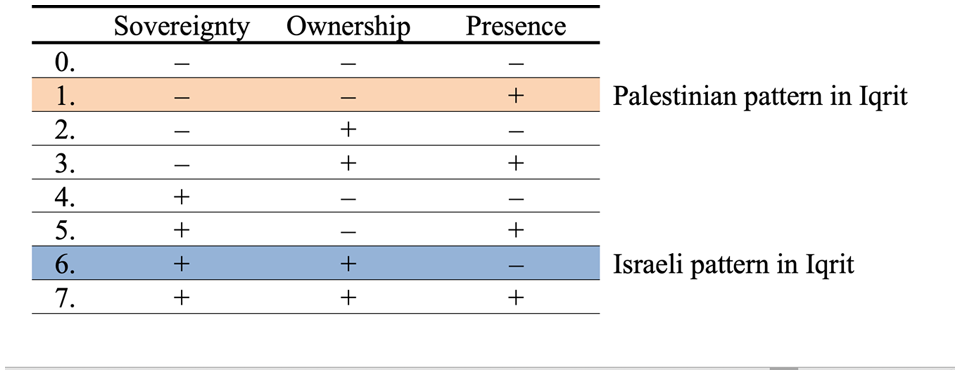
Patterns of control of territorial expanses according to Baruch Kimmerling.
Historically, different strategies have been used in Israel to display presence on and use of land. ‘Politics of planting’ has been mobilized by both Jews and Palestinians to underline their belonging in particular areas. 27 A policy of renaming towns, sites and regions, as well as of inventing their new genealogies – known as the strategy of de-Arabization – has been undertaken to establish the Jewish character of the territory, 28 symbolically accentuating Jewish presence there. The ideology-infused project of ‘making the desert bloom’ – consisting in heightening human presence and effective management of the chaotic ‘counter-space’ 29 of the desert – has relied on representations of Jewish community as progressive and hardworking 30 as contrasted with the backward and undeveloped practices of Arab populations in the region. 31 The advancement of such (state-sponsored) policies attests to the fact that the legal struggles conducted within the Israeli territory in connection to the ownership of land have typically been also preoccupied with the issue of who is, or could be, physically present on this land. Thus, the denial of the Palestinians’ right to return to the terrains from which they were evicted has been usually motivated by the state’s fear that the factual presence on land could potentially secure a legal title to it, which – given the Palestinians’ aspirations for self-governance – has been considered a potential threat to state’s integrity. All of these factors create the context in which the Iqrit informal activism is situated. While currently, from Israel’s perspective, the situation in Iqrit can be depicted with pattern 6 of Kimmerling’s proposition (state sovereignty over land and its legal ownership is secured, but the land is not fully settled by Jews), from a Palestinian viewpoint the situation can be defined through pattern 1 (neither Palestinian sovereignty over nor ownership of land is in place, yet presence is ensured) (Figure 2). Our interest is in both the means and the meanings of advancing such activist strategies.
Presence
Even though the issue of physical presence on a particular land appears as crucial in the context of the Israeli settler colonialism, the genealogies of our engagement with this idea extend to theorizations of everyday activism and contentious practices of resilience, often performed ‘in a quiet and unassuming illegal fashion’, 32 and through mundane acts. Given a situation in which Israel invests in advancing the project of constructing its territoriality while Palestinians mobilize to counter the state’s efforts, aiming to establish their own presence on the expropriated land, the act of being present can be interpreted as deeply political. Whereas, within Israeli ‘ethnocracy’, 33 Palestinian formal attempts to reclaim their rights often prove unsuccessful, other strategies – consisting of daily resistances and struggles – tend to be mobilized to advance their cause. In such cases, as Bayat suggests, ‘the art of presence’ – a ‘difficult strategy’ that demands ‘sharp vision, veracity, and above all endurance’ – holds the most promise. A sustained presence in social space (both physical and symbolic) is, Bayat continues, ‘ultimately about asserting collective will in spite of all odds, circumventing constraints, utilizing what is possible, and discovering new spaces within which to make oneself heard, seen, and felt’. Such forms of ‘active citizenry’ have a power to gradually ‘refashion state institutions into their sensibilities’, 34 assuming far more resilience than conventional activism. 35
As several researchers underline, 36 engagement of this kind, based on sustained politics of practice – ‘of redress through direct and disparate actions’ 37 – constitutes a common strategy for Palestinians. Nevertheless, our employment of the concept of an ‘art of presence’ differs from most of its other applications. For Bayat, such politics typically refers to activities primarily displayed in urban settings and performed by large numbers of people who are unrelated to each other. 38 Our case study reveals how such politics can also be effectuated on a smaller scale and by people tied by transgenerational communal bonds. It also points to the process of de-centring contentious practices in Israel/Palestine, creating new ‘geographies of protests’ 39 which stretch outside the city, including into rural contexts. 40 The informal place-based activism in Iqrit clearly demonstrates that a physical presence on an expropriated land (crucial, given the Israeli settler colonialism preoccupied with land acquisition and removal of existing populations), together with a mundane performance of ‘normalcy’ 41 in the ruined village, can count as a political act. Thus, our understanding of the politics of presence proposed in this article refers to both the physical dimension of being in a particular place and the everyday anti-colonial resistances in which disadvantaged communities engage.
Relational ethics of care
Another angle from which we approach the politics of presence in Iqrit pertains to the theorizations of the ‘caring capacities’ 42 of material infrastructures and how they condition place-based activism. While the strategies employed by Iqrit activists involve practices of caring for the place – in both symbolic and material terms – they are also premised on the agential capacity of the site to ‘care back’ for the bodies of, and political ideas articulated by, those involved in these activities. Since complex economies of caring and being cared for include both human and non-human agents and forces, geographies of presence – or practices aimed at cultural and political intervention – remain contingent on the ‘vibrancy’ 43 or ‘liveliness’ 44 of the land(scape) and infrastructures within which they are situated. As Emma Waight and Kate Boyer observe, ‘caring work is not an exclusively human practice but rather one that is actualised through socio-material assemblages’. 45 Thus, site-specific activism – and especially that which is focused on the restoration of community’s memory and (material) heritage – involves dynamic entanglements of human and non-human parts and practices, all active in the process of producing ‘material-semiotic’ 46 presence. Inspired by the ‘materialist turn’ in cultural geographies, 47 we understand social activities as embedded in material places, considering matter as active and agential, 48 thus believing that ‘things do far more than represent’. 49 Aware of the role the material infrastructure plays in the Iqrit activism, we conceive of relational ‘ethics of care’ 50 as necessarily more-than-human, arguing that although things/infrastructures require care, they are also themselves actively involved in care-giving processes, creating complex socio-material entanglements.
Caring is deeply relational. 51 Thus, even the practices of performing ‘labors of mundane maintenance and repair’ must be understood as ‘more-than-human entanglement’. 52 Such caring efforts are meant to maintain the object/infrastructure in the shape in which its performances are smooth and invisible, so that it can accomplish (albeit unintentionally 53 ) its functions regarding human bodies and the diverse activities in which they engage. So, although material infrastructure typically seems to be black-boxed and relegated to the backstage of social/cultural/political life, in fact it actively participates in more-than-human assemblages constituting the everyday practices. In the case of Iqrit, the current materiality of the village (partly restored and repaired) and the facilities installed there by the activists enable the strategy of permanent presence on site, thus co-producing spaces of territorial and semantic fluidity within which the political cause of the villagers is articulated.
The politics of presence in Iqrit
Political struggles
In 1948, Iqrit was inhabited by 500 people and covered 21,711 dunums of land. 54 The villagers – Melkites belonging to the Greek Catholic Church – used to make their living by raising crops and herding animals. Since prior to the Nakba 55 they were friendly to the Jewish settlers, they expected to face no fear during the 1948 war in Palestine. On 5 November 1948, however, once Israeli soldiers entered the village, the inhabitants of Iqrit were instructed to leave their homes for 15 days ‘for reasons of public security’, 56 as an Arab counter-offensive was anticipated. They were transferred by army trucks to the nearby village of Rama. 57 Although they were then promised they would be able to go back to their homes soon, the Israeli military has effectively prevented their return.
Frustrated with their protracted displacement and the Israeli authorities’ delay in keeping the given promise, in 1951, the people from Iqrit – now holders of Israeli citizenship – brought their case to the High Court of Justice (the Supreme Court of Israel), which ruled in support of the villagers’ right to return. Nevertheless, ignoring this ruling, the military fabricated a formal order of expulsion 58 and retroactively declared Iqrit, along with a large area of the Galilee, a closed military zone. While the villagers’ appeal was still in the court, on 24 December 1951 the military dynamited all buildings in Iqrit (except for the church, whose walls, however, cracked due to explosions). 59 ‘That was the “Christmas gift” that we got’, says Amir. His use of first person stresses his rootedness in the community, even though he was born long after these events had taken place. 60
Cleared of the material traces of human inhabitance, the land around Iqrit, once cultivated by the villagers, was officially declared an ‘abandoned area’ and placed under the auspices of the Custodian for Absentees’ Property, to be subsequently transferred to Jewish settlers. By employing such means, not only did Israel ensure sovereignty over and legal ownership of these areas (fragile as this could be in the context of a newly established state), but also tried – albeit with mixed results – to safeguard a considerable Jewish presence there. The situation clearly showcases the state’s preoccupation with the patterns of spatial distribution of Palestinian-Arabs, rather than the purely demographical data: whereas the people of Iqrit were allowed to live in other Arab villages (now as Israeli citizens), return to their homes has been systematically prevented. It seems that it was more acceptable for Israel to concentrate Palestinians in fewer sites rather than allow their sparser allocation across larger areas. Thus, the argument of ‘security reasons’, regularly articulated by the state, was used to ‘re-engineer spaces of human settlement’ for the purpose of implementing ‘ethno-territorial visions’ 61 according to which, typically for settler colonial policies, material presence on land was considered a crucial factor in ensuring its actual control.
These devastating events fuelled intense political activism among the people of Iqrit. While a few families accepted the compensation offered by the Israeli government, others engaged in systematic peaceful endeavours to reclaim their rights. These activities included petitioning the prime minister, mobilizing the attention of local and international media, ensuring the support of Israeli intellectuals and undertaking a series of sit-down protests in the ruined Iqrit church. The situation reached its climax on 23 August 1972, when the Greek Catholic Archbishop Raya of Haifa, a leading figure in Iqrit political activism, led several thousand Palestinians and Jews in a protest march in front of the Israeli government buildings in Jerusalem.
62
Neither the demonstrations nor the two other attempts at bringing the case of Iqrit to the court (undertaken in 1981 and 1988) generated positive results. The return of Iqrit villagers to their land has systematically been deflected by the military, even though several institutions have acknowledged their rights. The Israeli authorities proved unwilling to withdraw once they had acquired the land; neither did they wish to create a precedent, anticipating similar demands voiced by other Palestinian communities forcibly relocated from the 500 villages razed during the 1947–1948 campaign.
63
For Iqrit, the most substantial achievement of this period, however, was the permission acquired in 1972 from the Israeli Minister of Defence Moshe Dayan to rebuild the church, along with the authorization for villagers to visit the site (although their permanent presence there was still considered a breach of military orders). Even though it may appear insignificant, this was a major accomplishment. Says Amir, In the 1970s, it was the first time when we could actually go back to the land of Iqrit. And renovate the church and start (. . .) rebuilding the community. (. . .) The church and the cemetery saved us in terms of keeping our community together (. . .) [They are] the main focus of the struggle, even if it’s not a religious struggle. But these are the religious places that we still have that sort of connect us to each other.
64
The possibility of using the church added to the consolidation of place-based activism, further integrating the community and their land. While later attempts at reclaiming the villagers’ rights to their property – regularly undertaken until the 1990s – proved to be futile, they nevertheless ensured the broad visibility of the Iqrit case, which contributed to the village not being erased from official Israeli maps.
As the story of Iqrit demonstrates, Israeli policy, in a purely settler colonial fashion, has been explicitly concerned with physical presence, understood as an important aspect of territorial control. Since (ethnic) communities typically define themselves through connection to specific places, 65 exclusionary ethno-territorial state policies tend to rely on the strategy of purposeful displacement, aimed at depriving people of their embeddedness in particular material contexts. In Israel/Palestine, this thinking was clearly articulated through discriminatory spatial manipulations embodied in the policy of internal displacement of Palestinian-Arabs. Not only did it strive to eradicate the Arab character of strategically located areas; it also aimed to disrupt the indigenous community’s land-centred ‘lived experience of everyday life’. 66
Material encounters
The restoration of the Iqrit church has had a substantial impact on the evolution of the villagers’ resistance, which now predominantly takes the form of a place-based cultural activism intergenerationally engaging individuals related to the village, in both political and personal terms. The development of church-centred activities has been of tremendous importance for advancing resilient politics of presence, while countering – at least locally, and only to a certain extent – the ethno-territorial endeavours regularly undertaken by the Israeli state.
As Shadia explains, When you have access to your land and it’s not a fairy tale that your parents tell you, it’s different. We pray in the Iqrit church; we visit the Iqrit cemetery. It’s not that we are more patriotic than Palestinians from Al-Bassa or other villages. But those Palestinians don’t have access to their lands. They can’t see the ruins of their villages because they were covered by Israeli settlements, by Israeli factories. (. . .) We are lucky to have this option open and to practice our being ‘Iqritian’ on the land of Iqrit. I think it’s a privilege.
67
Shadia thus underlines how the possibility to partly rebuild and regularly visit the site has consolidated the community around it, across generations. The Iqrit church frequently hosts a range of activities, providing a palpable, material link to the village’s tragic past; it functions as a space for articulating – symbolically, bodily and materially – the Iqrit people’s intense connection to their indigenous land and identity. Such material encounters with place make up a part of everyday grassroots ethno-territorial politics, which include, inter alia, ordinary bodily actions (e.g. participation in public rituals) and material settings (e.g. design of infrastructure). 68 In Iqrit, both these strategies have been mobilized to enunciate land-based ethnic belonging, as well as to reclaim political agency by intervening in the Israeli ongoing discriminatory arrangements of social and material practices. 69 The viability of the cultural place-based activism has been made possible by systematic investment in the production of basic infrastructure capable of providing a material anchorage for the activities organized on site.
The caring engagement in reconstruction of the church and installation of basic facilities in Iqrit reveals the more-than-human dimension of community-building processes, drawing attention to how material objects actively participate in the entangled networks within which minoritarian struggles for political agency consolidate. The central role the Iqrit church performs in activism is enabled by both the building’s material presence and the fact that it remains connected to broader infrastructural networks facilitating basic care for the bodies acting on site – a kind of care whose importance becomes visible only when it is missing. ‘The church isn’t only for praying. It’s the place where kids sleep during the summer camps. It’s the place where children change their clothes because it’s the only building. (. . .) It’s where we cook sometimes’, Shadia points out, accentuating the material – rather than purely symbolic – role of the church in their grassroots activism. 70 Emphasizing the building’s multi-functionality, Amir explains that ‘if we wanted to keep some stuff, we used to take it back to the church’, where it was sheltered from the risk of confiscation by the Israeli Land Administration. 71
The Iqrit activists engaged in legal struggles to ensure access to electricity
72
and potable water onsite, as they considered them crucial for practicing continued politics of presence. A road paved by the former villagers
73
facilitates access to the site. As Amir explains, We do more stuff [than the displaced from other villages] because we have the permanent structure. And everybody who comes to Iqrit, they know that they will have a place to sleep. They know that they will have the bathroom.
74
Thus, the ongoing presence in Iqrit remains premised on, even conditioned by, the continuous operations of care for, and of, the buildings and material infrastructure. In such a context, the church emerges as ‘a relational effect’, 75 binding together human and more-than-human parts and agencies in the ongoing performance of care.
Recontextualized, from the ruin embodying traces of its devastating past to a vehicle for intergenerational transfer of identity and intimate attachment to the land (‘It’s the home’, as Shadia insists 76 ), the Iqrit church figures as a crucial agent in community-building processes. For the people of Iqrit, the opportunity to cultivate religious rituals (weddings, funerals, religious ceremonies) in and around their church has been considered a means of maintaining, against all odds, very close relations with the place. Since 1972, important moments have been typically celebrated there, displaying the personal connectedness of the community and its land. This seems to be most clearly manifested in burial politics, an act that ensures a ‘magical’ posthumous communion of human body and native soil, 77 caring for and nurturing each other through the organic entanglement of their metamorphous material becoming. As Amir notes, ‘we have very real connections to Iqrit as our home, especially because we also get buried there. (. . .) Even people who sold the land and got reparations, they still have the right to be buried in Iqrit’. 78 Thus, through ‘politicization of dead bodies’, 79 by means of rituals, communal identity is re-enacted as embedded in specific places – both symbolically and materially. It seems that in Iqrit, the villagers’ regular participation in church-centred activities works as a means of bringing the life of the ruined village back into peoples’ actual existence, integrating them closely around their perennial political cause. But it also works to consolidate the identity of the villagers’ descendants: ‘I’m from Iqrit, even though I wasn’t born there’, 80 says Amir, currently in his twenties, highlighting his own affectionate, almost ‘natural’ connection to the destroyed village of his grandparents.
Apart from those connected to religious rituals, a variety of social and cultural activities are organized in Iqrit (Figures 3 and 4). These include summer camps, volunteer work camps, artistic and folklore performances and community-engaging activities, all of them oscillating around the village’s difficult past and participating in the process of enlivening its memory. Children and youths – the third generation of displaced inhabitants of the village – are intensely engaged in these onsite activities, generating a feeling of a strong emotional and bodily attachment to the place. Ritualized in everyday life, these visits to Iqrit animate the spirit of belonging, producing deep connection and affectionate commitment to the land. Iqrit not only lives in the villagers’ memory but remains present in their regular activities. As Shadia explains, when you go to this land and you touch the walls of your grandparents’ home and you pray in the church, it makes a difference. It empowers you, your way, your relationship with your history, with your heritage.
81
The systematic bodily and material investment in the ruined village enables a qualitatively rich, transgenerational cultivation of ethnic identity as practiced in concrete spaces. This strategy allows the materialities of Iqrit to become generative of both specific modes of conduct and forms of engaged political consciousness, 82 invigorating the community’s spirit.
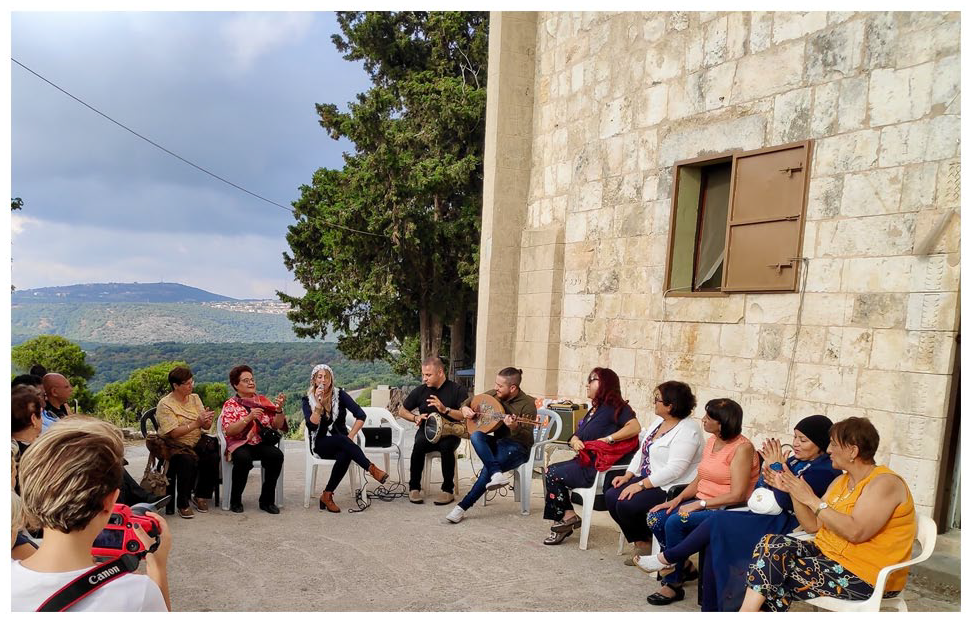
Cultural activities organized in Iqrit.
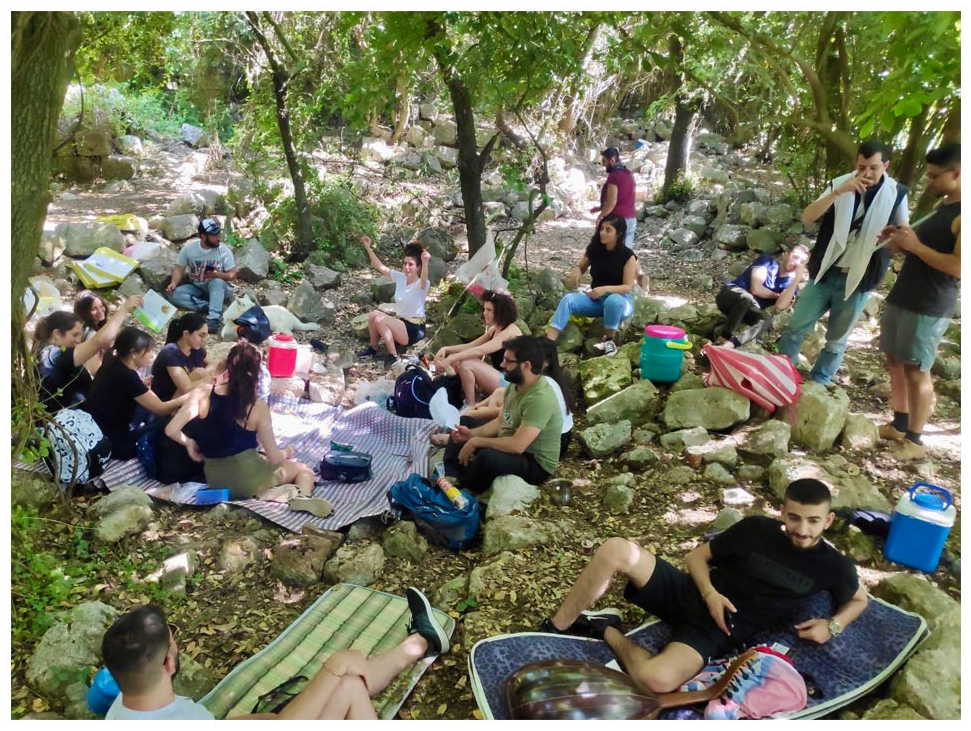
Cultural activities organized in Iqrit.
Celebrated through regular presence on the spot, the cherished attachment to the materiality of Iqrit – caring for the bodies of people present there and cared for by them in return – triggers incorporation of the notion of land into the intimate fabric of visitors’ corporeality as much as into the cultural fabric of the community’s ethnic identity. Speaking about the young participants of the Roots Camps, Shadia reveals that ‘they started living in Iqrit from before the destruction (. . .) They started to know the names of the families and where each family lived: “next to the house of Sbait family”, “next to the house of Khoury family”’. 83 Such complex entanglements attest to the ongoing emmeshed co-production of the material and the social 84 within the space of Iqrit, bringing the village back to community’s current life.
Spaces of fluidity
The informal cultural activism practiced in Iqrit carries political meanings. Through sustained peaceful engagement with the place, it works toward advancement of at least two important objectives. The politics of presence are crucial for – as well as facilitated by – both.
First, physical presence on site contributes to the partial implosion of the Israeli system of control, by increasing fluidity of the territory via continuous Palestinian presence on land from which this Indigenous population was evicted. This is effectuated by a series of (occasionally illegal) ‘quiet encroachments’,
85
such as planting trees or building a football pitch on the expropriated land (even though the trees were later uprooted and the pitch demolished by the Israeli Land Administration), enabling gradual increase of the community’s material presence in Iqrit. Amir explains how it looks in practice: We do have water [in Iqrit]. They had to connect us, because of the church and because of the cemetery. So, we use our religious status and places to get stuff.
And then he gives another example: With time, Land Administration officers were like: ‘You know what, if you want this very tiny room next to the church [earlier demolished by the same agency several times], just have it and it’s fine’. It’s still illegal for us to be there but the rooms themselves, they just became part of the status quo.
86
Thus, through minor reconfigurations of the site’s infrastructure, as well as thanks to the activists’ endurance in rebuilding the damaged premises and ensuring access to infrastructure networks, the intensity of presence of the expelled villagers in Iqrit steadily increases.
As a result, in Iqrit, place-based cultural activism figures as an important tool for recalibrating – albeit only locally – the oppressive policies of the Israeli state. Insisting on physical onsite presence, enriched with regular community-sustaining activities manifested in such ordinary practices as gathering together, collective singing and religious rituals, the activist project in Iqrit clearly undermines Israeli control of territory in this small area, resisting the policy of a state aimed at establishing the unwavering Jewish belonging to this region (through sovereignty, land ownership and presence). While Israel continues to act as a sovereign agent in Iqrit and currently owns most of the land formerly belonging to the villagers, it nevertheless fails at eliminating persistent Palestinian presence in the area, which, as Kimmerling explains, translates into a higher degree of territorial fluidity there. 87 In such a context, the Iqrit church – sheltering the site-specific cultural practices as well as the bodies of those who engage in them – figures as an epicentre of an Indigenous ‘art of presence’, 88 bearing traces of the painful past while nurturing hopes for a brighter future.
Second, it fuels the sustained cultivation of local community-building processes, stimulating the semantic fluidity of the site enabled by its agential material reconfigurations. The instability of meanings generated within the material encounters with the place allows for gentle reorientations of the narratives and understandings associated with it. On the one hand, the ruins of Iqrit expose the sedimented meanings of painful memories and the tangible traces of ferocious material reconfigurations; on the other hand, however, the sustained caring investment in the site signals the community’s invincible lifeforce, stimulating material-cultural renewal, even though the goals of the third generations of the expelled have already been partly redefined. Says Shadia: I believe (. . .) that there’s a practical solution for a Palestinian-Israeli conflict. (. . .) But practical return [to Iqrit] doesn’t mean that you go back to 1948 and ‘press the play [button] again’. No. Life has changed. Also, the needs of the community have changed. Clear. It is 1500 people. It was 400-500 people who had a huge amount of land because they had sheep and cows. Today we have doctors, lawyers and engineers. So, our needs for land are different, our needs for buildings are different. We need more Internet than land.
89
Importantly, grassroots activities organized in Iqrit generate meaningful opportunities for transgenerational integration around a shared community heritage, ensuring both the symbolic and the material presence of the Indigenous population in concrete geographical areas, adding to efficient consolidation of the community’s political struggle. Such politics of presence, however, must necessarily be understood in terms of dynamic, caring transactions of people, infrastructure and land, in which the materiality of site and the ways in which it co-constitutes the activists’ site-specific endeavours contribute to the transformation of meanings and experiences associated with the place. It seems that the physical presence on site, enabled by (re)constructed material infrastructure, embodies not only the community’s resilience vis-à-vis the state, but also the passionate investment in the site’s ‘material-semiotic’ 90 renewal. ‘[T]he minimum thing that we can do all the time and what we need to do is to stay on the spot’, Amir underlines; ‘This is a fight. We are not leaving’, he insists. 91 Continuous presence in Iqrit, however, is only made possible by the caring operations of infrastructural facilities installed there by the activists. Not only do they serve as a material anchorage for activist practices; they stand as a symbol of community’s transgenerational endurance.
In her analysis of place-based activist memory-work, Karen Till draws attention to the process of establishing ‘active places of memory’ which have potential for engaging communities on a most fundamental, affective level. 92 Memory-work in the Iqrit activism – animating intense social involvement – mobilizes people to cultivate the memory of the village through regular bodily encounters with the site, as well as through active practices of caring for it. This affective-emotional investment in the place has important consequences for community-sustaining processes. As Till underlines, ‘As humans move through and come to inhabit local worlds, bodies are connected to other bodies (including non-human lives and matter) in complex ways’, 93 closely integrating the materialities of place within the social fabric of the community’s life. Such a strategy contributes to bringing the material and mental worlds into conjunction with each other, creating a situation in which the materialities of the site actively circulate within the economy of identity-sustaining processes, while identity itself is practiced through active, bodily involvement in material activities. The emotional commitment to the place, expressed in the practices of care for and attachment to the site, becomes a pivotal part of the identity of the villagers’ descendants, ensuring the vitality of the community’s spirit. But whereas Till’s work explores projects focused predominantly on symbolic redress of the past events, Iqrit activists’ goals are different. They rehearse a memorial strategy, which – through constant presence on site – turns the place not only into a meaningful thing of the past, but positions it as the community’s present reality, with considerable aspirations and ambitions for the future. Thus, Iqrit operates in two different registers: as a place located within the complex materialities of colonialism in Israel/Palestine and as an important element of the Indigenous community’s intimate affective-emotional landscape. Due to such motility of meanings and associations, the memory-work cultivated in Iqrit, even though nourished by the recollections of the village’s dramatic past, must be understood as a truly imaginative project envisioning a thorough rebirth of the village. As such, quite untypically for memory-based undertakings, cultural activism in Iqirt remains methodically future-oriented: ‘I believe in a practical return. (. . .) One day we will return’, Shadia contends 94 ; ‘There is always the dream, even if people do not actively work to return to Iqrit, there is always a dream that Iqrit will return. (. . .) The return is possible and we have high hopes’, Amir insists. When asked if he would consider building his own house in Iqrit, he enthusiastically replies: ‘Yes! Absolutely!’ 95 Given its embeddedness in specific material place, this form of spontaneous, non-institutionalized activism displays radical political potential.
Conclusions
Our analysis contributes to the broadening of understanding of the site-specific informal activism, or ‘art of presence’, 96 and its role in preserving cultural heritage and cultivating memory, as well as advancing the political agendas of communities whose rights have been systematically violated by state policies. Our aim is also to expand knowledge about the crucial meaning of material (infra)structure present on site, serving as a physical anchorage for place-based practices and a necessary condition for moving forward the subversive politics of presence, crucial for the advancement of the strategy of contesting state control over land and discriminatory spatial strategies. By exploring the character of cultural activities in Iqrit, we draw attention to the complex work of ‘assemblages of care’ 97 involved in site-specific practices, exposing the politics of presence’s crucial reliance on infrastructure and materialities. Analytical attention to the role of non-human agents and forces in place-based activities, we argue, reveals that presence should be understood as a more-than-human relational practice, in which matter’s intensities and capacities matter in the continuous work of local world-making.
At the same time, such projects cultivate the community’s lived heritage, activating its current political potentials and offering chances for increased transgenerational relatedness. They also enable continuity of political struggles as well as sustain everyday practices of resilience, partly dissolving the state’s control over the land while inscribing the place with transitional understandings and uses. Rather than remaining enclosed within the dialectics of dominance/resistance, 98 this kind of activism must be positioned in a fragile and unstable territory situated in-between the legal attempts, partly expressing complicity with the state authority (‘We should do whatever we need to do as legal citizens of Israel to return to Iqrit (. . .) because the state is not going to go away’, Amir underlines 99 ) and contentious ‘art of presence’, through both legal and illegal onsite (cultural) activities and material reconfigurations of the place. It appears to us that these seemingly ingenuous, localized, community-based practices, through the creation of spaces of territorial and semantic fluidity, can offer instances of what Till calls ‘political witnessing’, 100 while opening possibilities for meaningful intervention.
Footnotes
Acknowledgements
We would like to thank Amir Toumie and Shadia Sbait, as well as other activists from Iqrit, for sharing their experiences and thoughts with us. We are also grateful to the three anonymous reviewers for their valuable comments on the earlier version of this manuscript.
Funding
The author(s) disclosed receipt of the following financial support for the research, authorship, and/or publication of this article: The research for this article was funded by National Science Centre in Poland, under grant number 2020/37/B/HS5/00837.
