




Abstract
This article contributes to work in creative geographies through the lens of river spaces and a multimodal practice among an ensemble of artists/poets/scientists. The collaboration created two collage series with both planned and unplanned visual, textual, and audio-visual media. Orchestrated in a time of global pandemic, learnings from the ensemble’s online creative practice are shared and discussed, including: the methodological possibilities of online collaboration and the Internet’s ability to facilitate distanced and sustained co-creation, as well as the potential of collage and poetry to reimagine relationships with rivers.
Water’s edge, a gateway Of dappled light Of tumbling tones I cast myself stone-like How many skims? Before calm yet turbulent Eddies sweep me Past the case builders Clingers, burrowers Time and disarray, lost Among shimmering shoals Swarming, tiny drifters Helter-skelter surface dwellers . . .The minute hand falters1
Introduction
In 2020, Ioanna Giannoulatou (a visual artist/educator) and Stephanie Januchowski-Hartley (an environmental scientist/writer) began a collaboration exploring arts-based methods that they and others could use to express river experiences and representations (e.g. memories or imaginaries). Recognizing that creative practice can help people know and share about hidden spaces, 2 and that rivers are often unseen, unseeable, and modified, 3 Ioanna and Stephanie were interested in designing creative interventions to stimulate imaginations and to foster more entangled ways of communicating about rivers. 4
The collaboration grew to include colleagues Asha Sahni (poet), James White (ecologist), and Sayali Pawar (geographer) and later expanded to include all authors of this paper. Most of the ensemble identify as artists/poets/scientists both within and outside the academy. Ioanna, Stephanie, and Asha initially designed an Underwater Haiku Exquisite Corpse intervention that invited and encouraged people to contribute a line of words formed of five or seven syllables in response to a single written prompt: rivers and their underwater environments. 5 From that initial project, Ioanna and Stephanie purposefully moved beyond a single mode (words) to a multimodal (images, words, sounds, video) intervention to encourage themselves and others to imagine and experience rivers through (non)dominant modes of knowing and communicating. The collaborations and creations that led to this paper formed through a fortuitous combination of circumstances: funding secured prior to COVID-19 to explore people’s relations with rivers and workshops through the Indisciplinary Poetics Group at Bristol University and Poetry School, United Kingdom (UK), as well as social media.
This article charts the creation of two collage series – Underwater Realm and Our Story – that share single compositions of different river experiences and knowledges. Collage, originating from the French word collé – meaning glued, can accommodate multiple understandings by binding different media and was used for Underwater Realm and Our Story to blur visual/textual, art/science, and academic/non-academic ways of knowing and expressing above/underwater river spaces. In the sections that follow, actions that led to the Underwater Realm and Our story are described to share the ways that knowledge was produced and circulated by the ensemble, including the un-planned directions of the creative practice and how changes were embraced as part of knowing and living river spaces. Three key learnings from the ensemble’s online and blended creative work are shared and discussed.
Making collage series #1: Underwater Realm
In 2020, ideas for the Underwater Realm initially formed in discussions between Ioanna, Stephanie, and Asha. The ideas centered around the binding or blending of visual and textual media; for example, through Arabic calligraphy, where text is arranged in a way that forms a thematically related image, and Haiga, a Japanese artistic practice that combines poetry and painting. Ioanna and Stephanie wanted to create visual prompts to be located on walls or large (>2 m high) windows within specifically designed spaces for creative writing events planned in Wales and England, UK. However, a few months into the collaboration, the COVID-19 pandemic struck, and plans of bringing people together to write haiku in specifically designed spaces had to be abandoned. The ideas of large visual artwork on walls and windows were adjusted and re-scaled to designs for remote on-line engagement. Collage was ultimately chosen for the collaborative project because it could bound and stitch together different people’s knowledge and understandings of river spaces to stimulate new meanings.
Collage was used to connect land, river, lake, sea, and to juxtapose and combine materials to forge new connections and meaning. The collages of the Underwater Realm (Figure 1) were created as visual prompts designed to stimulate audiences’ imagination by drawing connections between different fauna that were (i) less known, such as the Common mayfly (Ephemera danica) or Butterfly blenny (Blennius ocellaris); (ii) common in people’s day-to-day lives, such as the Blackbird (Turdus merula); or (iii) encountered through media, such as Common octopus (Octopus vulgaris) or the Salmon (Salmo salar) of Welsh mythology’s Llyn Llyw. 6
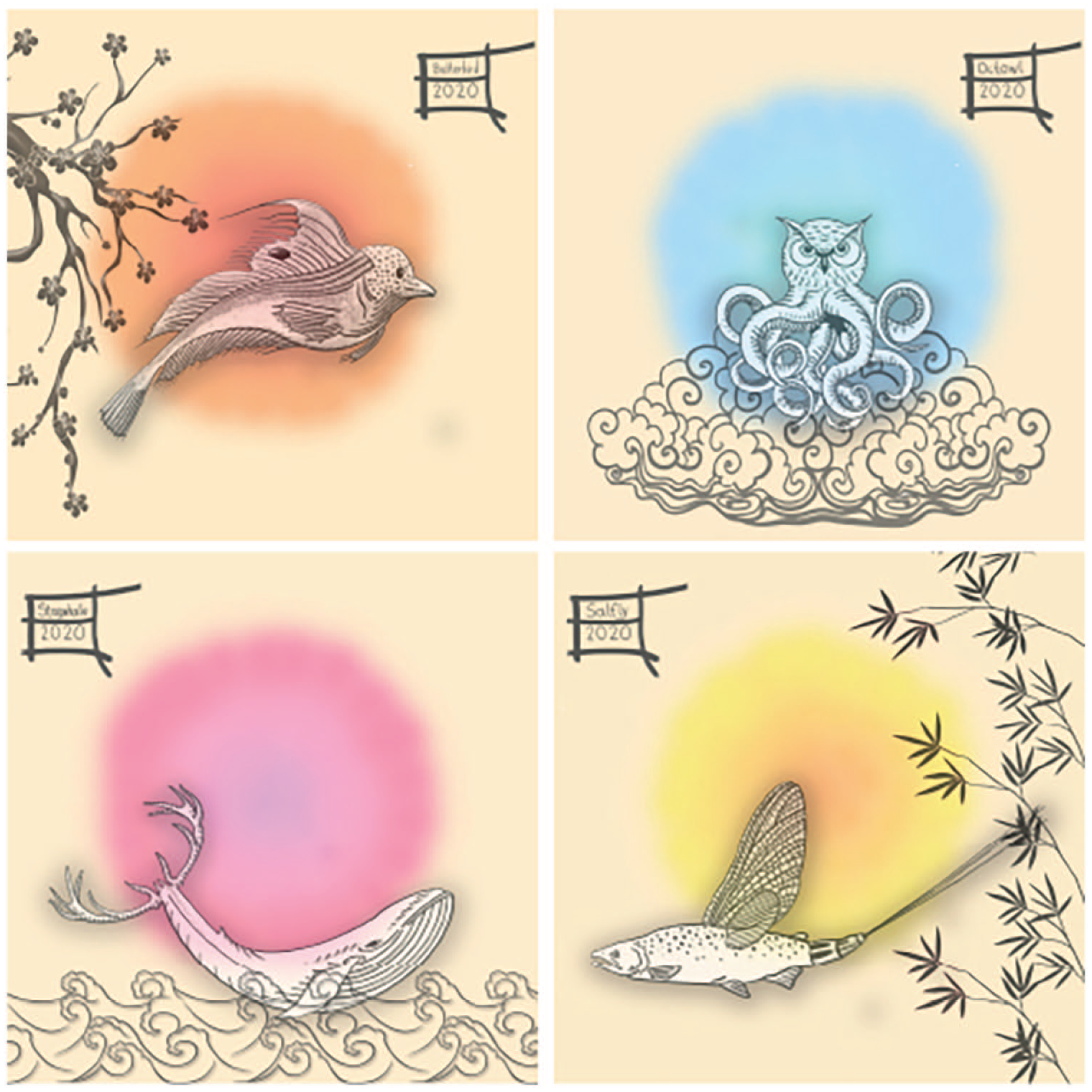
Underwater Realm from top left, clockwise: Butterbird, Octowl, Salfly, and Stagwhale. Photo by Ioanna Daphne Giannoulatou.
Each of the four collages of the Underwater Realm were circulated online along with accompanying text that invited people to write a haiku (a three-line poem of five, seven, and five syllables) in response to each collage. The invitations to contribute included a link to a Google document through which people could read about the project, agree to share their writing, and upload their haiku. The visual images and textual invitation were shared via professional and personal Twitter, Facebook, and Instagram pages of Ioanna, Stephanie, and Asha, as well as by e-mails, and posts to the Poetry School, the United Kingdom’s largest provider of poetry education. Thirty-three people 7 responded to the call, and eight people agreed to be co-authors 8 on this article and to continue the creative work together. All haiku written by respondents were curated with the collages into a digital and printed booklet. 9 The next section details how the Underwater Realm and the creative and peer-review process prompted a new collage collaboration between the authors of this article.
Making (more) poetry and collage series #2
Rich in philosophy of deep land, sea, do you know I’m here? I fly, swim, dive, from the safety of my perch. Gravel-origin energies entwined. Shimmer. Shammy. Soar. I spread my wings as your eyes leak salt, my tentacles weave night to day, sea to sky. I dance on water, blue mythical creature, puddled cold and bleak, I will guide you. Truth is lost. Life is found. Splash! Now fly!
10
In 2022, a second work of collage was initiated to animate and circulate learnings from the ensemble’s creative practice. Lines from haiku written by eight co-authors 8 in response to the Underwater Realm were brought together in the poem: Our story. Two additional written pieces (a prose and poem) were created by collaging existing texts and conversations from the ensemble’s reflections on creative process and collaboration. These new writings were then recorded and became part of a single audio-visual production that animated Our Story collages. 11 This work was composed from Underwater Realm, haiku, textual and visual media contributed by co-authors, as well as found elements such as cotton, dried herbs, and plant material (Figure 2).
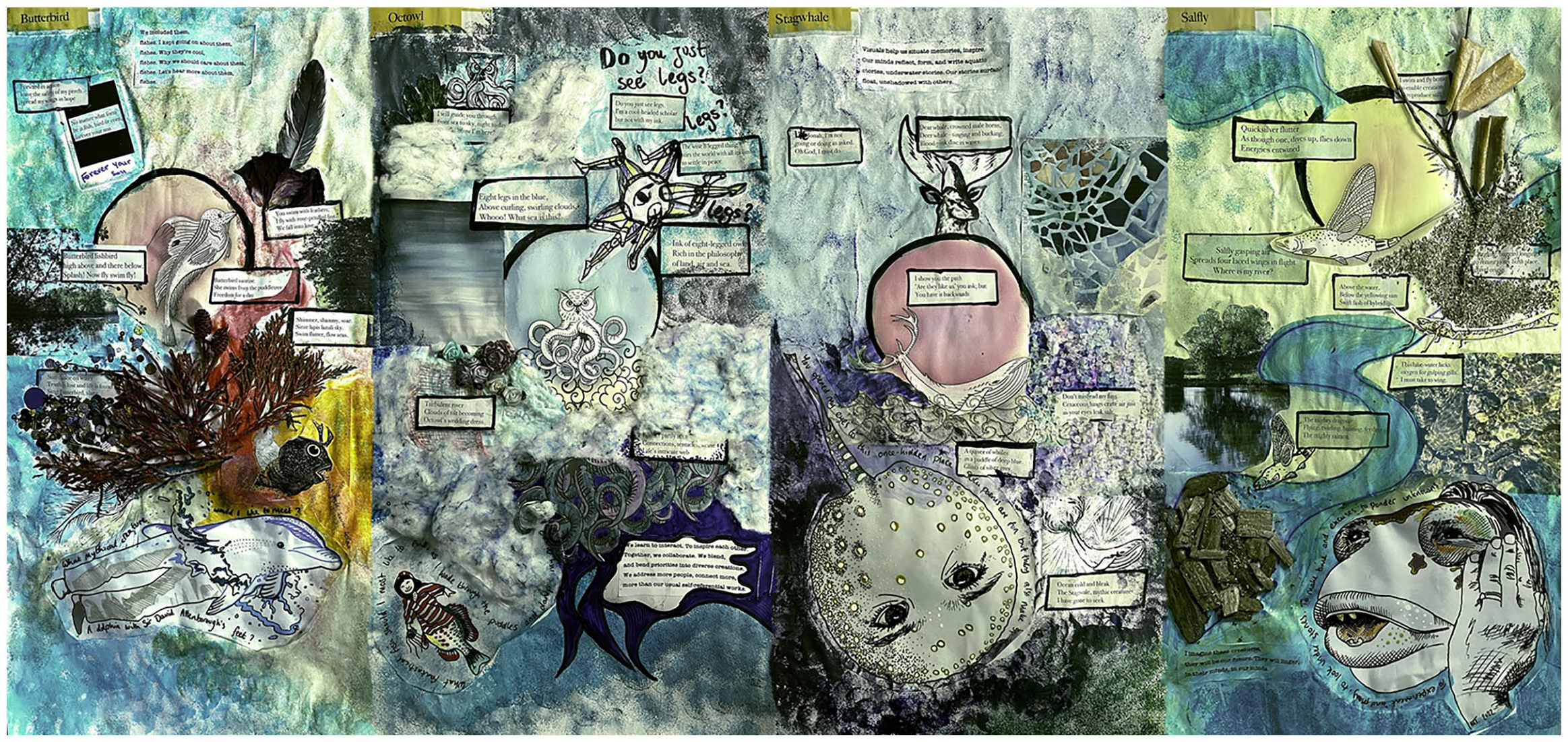
Our Story collages. Photo by Ioanna Daphne Giannoulatou.
Surfacing someplace new
The Underwater Realm collages are metaphors, maintaining a tension between the abstract and concrete, inviting people to express human/river relations. The collages depict fauna from different dwellings bound together to share understandings of rivers as shaped by non-humans. In turn, those collaged understandings facilitated people’s (re)imagining of what rivers mean to them. For example, those who responded to the Underwater Realm with written haiku did so based on their distinct experiences and memories, or with a desire to establish relations with rivers through creative writing. Some of those authors also noted that resulting collages conveyed connectedness and inspired a greater depth of thought about river stories. The Underwater Realm provided a starting point for people to write about, with, or through rivers and, at least for those who became authors of this article, with awareness of (dis)connections with river spaces in a time of pandemic.
Ioanna and Stephanie were apprehensive about moving the project’s engagement and creative practice online, particularly because it proved very difficult to connect and build relations with people in specific locations along rivers in Wales during the COVID-19 pandemic. The need to shift online led to an active decision to be less focused on who was engaged and instead on how and what could be created together with others in response to river spaces being unseen, unseeable, and modified. Ioanna and Stephanie learned several things by working creatively online and at a distance together and with others. Below are three learnings related to creative practice that Ioanna and Stephanie had not anticipated at the beginning of the journey – learnings that could be useful to researchers or artists exploring online or blended approaches to creative practice.
First, moving online meant that anyone could encounter and respond to the Underwater Realm collages, and they did. Submissions came from beyond the UK (e.g. United States, Greece, Canada) and were written in languages other than English. Several of this article’s authors who contributed haiku appreciated the open and transparent approach enabled by social media networks which encouraged participation and collaboration by anyone, anywhere. Others felt that the response by 33 haiku writers residing in different places around the world offered a community activity and brought with it a sense of togetherness and a shared love, concern, and intrigue for rivers. The opportunity for collective creative practice made possible by the Internet and digital communication and collaboration was appreciated during that time of pandemic (and beyond).
Second, there was a sense of freedom that came with the distanced and online creative practice. Everyone who contributed to the creative process chose when and how they did so, including the decision to connect the project to their broader creative practice. For example, co-author Doryn Herbst contributed photos and pieces of her existing visual artworks to Our Story collages. In this way, the creative practice of Our Story collages reached deeper and wider than the initial haiku written in response to Underwater Realm because collaborators had more time to think and gather pieces to expand and build connections between their personal creative practice and what was pursued collaboratively between all authors. These online and distanced creative experiences extended beyond a single encounter or workshop to grow and strengthen relations between people.
Third, collage, as a medium, facilitated the distanced collaborative process of making and sharing the co-created artwork of Our Story. The collage started in a physical form, as Ioanna first created a frame of elements on four sheets of paper synced to each of the Underwater Realm collages and corresponding haiku responses. She made the physical collage frames digital and circulated to all collaborators for their contributions of depth, texture, and color to Our Story collages. Keeping with the relational call-response in the creative process, Ioanna shared digital collage frames as prompts and guides for collaborators while also leaving white space and inviting others to contribute text, photos, or drawings that they connected with Our Story. Additions from all collaborators arrived in a digital form and were integrated back into the collage’s physical form by Ioanna. Collage can facilitate a supportive and guided, as well as open, co-creative process from a distance.
In an increasingly urbanized world, rivers are often unseen, unseeable, and in modified forms to support human dependencies, and with that in-mind, Ioanna and Stephanie intended to create interventions to stimulate imaginations and to foster more entangled ways of knowing and communicating about rivers. Original ideas of what those interventions could look like and how they would be brought to people changed, and through adaptation brought about different creative works and collaborations that could not have been anticipated at the start. Through this article the authors wanted to share how creative practice can be adaptive as well as deliver on original intentions. Embracing change helped the authors to continue to maintain creativity in time of pandemic and to produce a second collage series that interwove processes of making, relational call-responses between collaborators, and ways of knowing rivers. The authors hope that by sharing this work it inspires cultural geographers (and others) to take advantage of multi-sited creative collaboration made possible by the Internet and to continue exploring the media of collage in their spatial imaginings.
Footnotes
Acknowledgements
Thanks to everyone who engaged with and helped to support this project and to Dr Caleb Johnston for his encouragement with this article.
Ethical approval
The right to conduct research with human subjects was granted by Swansea University’s College of Science Human Ethics Approval SU-Ethics-Staff-020320/212 (2 March 2020).
Funding
The author(s) disclosed receipt of the following financial support for the research, authorship, and/or publication of this article: This work was possible thanks to funding from the Welsh Government, European Regional Development Fund, and Swansea University under Project Number 80761-SU-140 (West).
