




Abstract
This article shares and reflects on Underwater Haiku Exquisite Corpse – a playful approach to writing and enquiry about rivers and their underwater environments. The Underwater Haiku Exquisite Corpse was an adaptation of the Surrealist exquisite corpse concept – a collaborative game in which each participant wrote or drew in response to a prompt and kept their contribution concealed until the end, when the full corpse was revealed to all contributors. We consider how our approach to exquisite corpse fostered playful co-creation and community and contributed to better understanding people’s experiences with and intuitive responses to river environments. This article blends academic writing and found poems (existing words or phrases reframed into a poem) from Underwater Haiku Exquisite Corpse, in response to calls for more creative and entangled ways to write about the world. We applied this technique, using lines of text by different Underwater Haiku Exquisite Corpse contributors and reordering lines into poems that illustrated how contributors intertwined notions of humans, rivers, and what lies below the surface. We hope that by sharing our experiences with the Underwater Haiku Exquisite Corpse, we encourage more playful approaches to geopoetics, to foster conversations across disciplines, as well as within and outside the academy.
The exquisite corpse concept was initially brought about by the Surrealists (circa 1920s Europe), who believed that non-competitive play and use of imagination could reveal neglected associations that are unimaginable by one mind alone. 1 The Surrealists also maintained that the creation of exquisite corpses, a series of words or images collectively assembled by a group of people through a game-like sequence, induced a poetic attitude and a commitment to people’s spontaneous existence over and against conventions. 2 Such a poetic attitude to collaboration and creating can allow exploration of complex or unfamiliar topics through wordplay, sound, formal constraints, and aesthetics. 3 In the broadest sense, the only overarching rule of exquisite corpse, then and now, is that each person taking part in the game is unaware of what others have contributed until the end. Otherwise, the implementation of exquisite corpse is open to interpretation. What the exquisite corpse produces are traces of the process of creating, along with an artistic result. 2
The game-like and artistic features of exquisite corpse made the concept particularly appealing to us for our project, which focuses on dialogue and interactions between self and other to bring what lies below rivers’ waters to the surface. To create the Underwater Haiku Exquisite Corpse, we followed the exquisite corpse concept: each person who responded to our calls to collaborate and co-create the corpse shared lines of words in response to our prompt (rivers and their underwater environments) without knowing what other contributors had written. Our approach to the Underwater Haiku Exquisite Corpse deviates from the original exquisite corpse concept because we organized the activity but did not contribute to the corpse text. Traditionally, the prompt for the game comes from an active contributor to the corpse creation, but here, we (the authors) provided the prompt while other people who agreed to contribute made the corpse. We also adapted the exquisite corpse concept for Underwater Haiku Exquisite Corpse so that the lines and words shared by contributors co-created multiple haiku about rivers and underwater environments. Haiku is traditionally a three-line poem with seventeen syllables (five, seven, and five). 4 It is a poetic form that one of us previously used in a collaborative writing project, Conservation Haiku, 5 and that we all believed would complement the game qualities of exquisite corpse.
In this article, we reconstruct the creative process of Underwater Haiku Exquisite Corpse that started with our own interests in collaborating, playing, and experimenting together and with others about rivers. We blend academic writing with found poems from the Underwater Haiku Exquisite Corpse to extend the collaborative geopoetics about rivers. Found poems are the literary equivalent of collage: text collected from other sources such as books, newspapers, blogs, and even other poems are reordered to create a poem. 6 We use found poems from the Underwater Haiku Exquisite Corpse to exemplify how contributors intertwined notions of humans, rivers, and what lies below the surface and to collage academic writing and poetry as an example of how these forms can interact and foster conversation within and outside the academy. 7
Our geopoetic practice did not start with the exquisite corpse concept. Instead, in early 2020, we developed in-person immersive experiences that were addressed to all people about rivers and underwater environments in Wales to write and create collaboratively. However, due to the COVID-19 pandemic onset in March 2020, we could not host in-person events. In response, we revised and broadened our initial ideas and approach and, in April 2020, set out to work collaboratively with different publics to write about rivers and their underwater environments in different geographic locations through digital means (e.g. social media, email, forums). We decided on Underwater Haiku Exquisite Corpse, adopting a playful approach to co-creation to encourage experimentation and self-discovery among contributors to the project, including ourselves, to both inspire and broaden contributions beyond those already comfortable with creative writing or poetry. 2
We sent invitations and announcements about the Underwater Haiku Exquisite Corpse to our professional and personal networks – those of an interdisciplinary researcher studying rivers, a visual designer, and a poet – via emails, posts to national and international creative writing listservs, Twitter, Instagram, and Facebook, and personal communications. We designed digital collages of hybrid creatures and haiku to accompany our invitations and reminders for people to contribute their words (Figure 1). We included the digital collages and haiku to stimulate people’s imagination through existing connections, experiences, or knowledge they might hold for land and marine dwelling fauna that they were more likely to encounter, either physically or through different media, than of river-dwelling fauna alone.
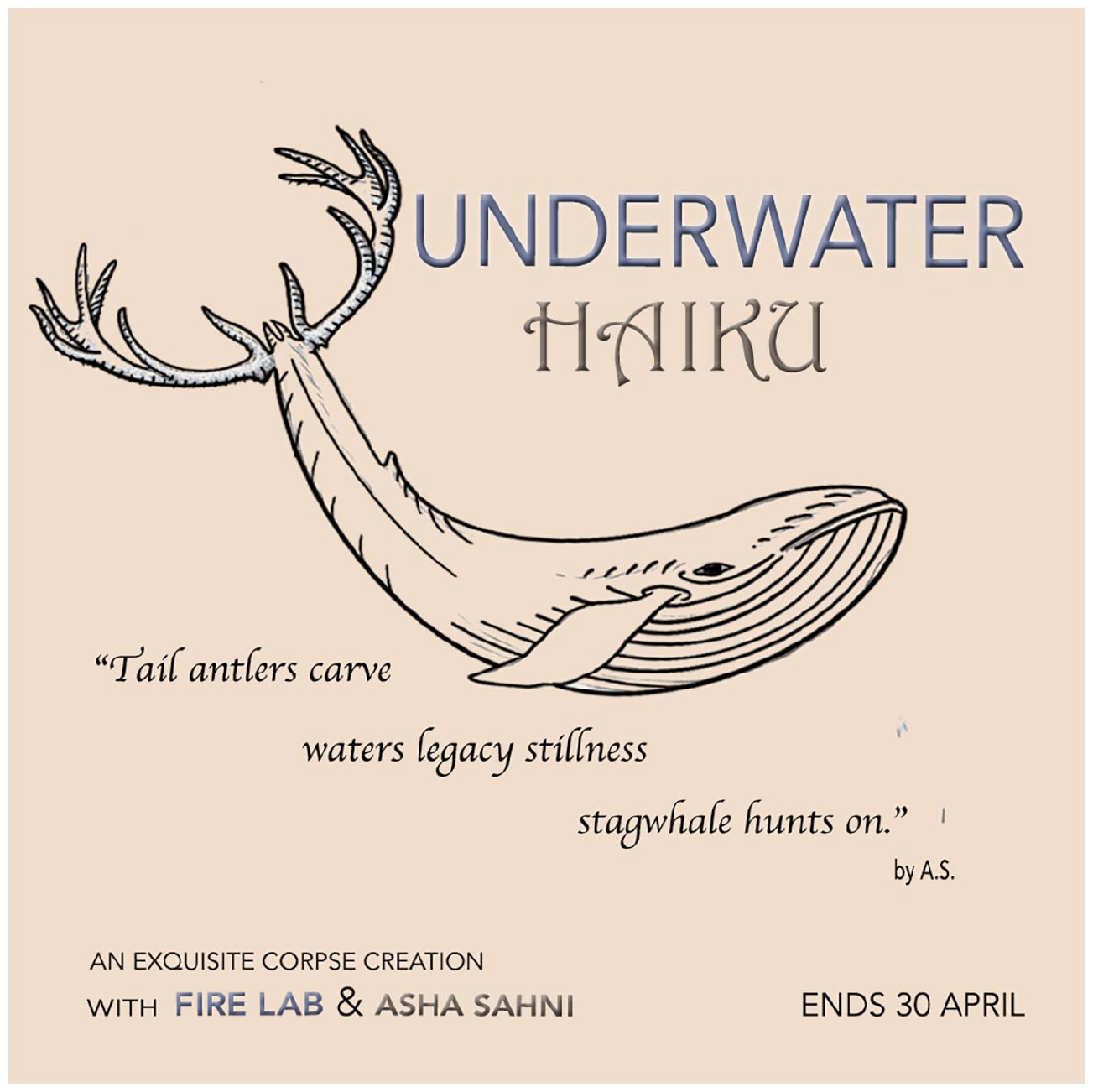
Stagwhale and Haiku.
Contributions to the Underwater Haiku Exquisite Corpse were made online via two Google Forms (one for those with visual impairment). We provided a single text prompt on the Google Forms – “rivers and their underwater environments” – and invited people to submit a single series of words formed of five or seven syllables in response to the prompt. In keeping with the exquisite corpse concept, contributors were unable to see others’ contributions. The Google Forms also included a description of the broader Underwater Haiku project, what we were asking contributors to do and commit to with regards to the project, participation details, and information about our collaborative team and research interests (Figure 2). The Google Forms were open five days for contributions to the Underwater Haiku Exquisite Corpse, and we encouraged contributions in any language, alongside an English language translation, so that we could understand the words that were shared.
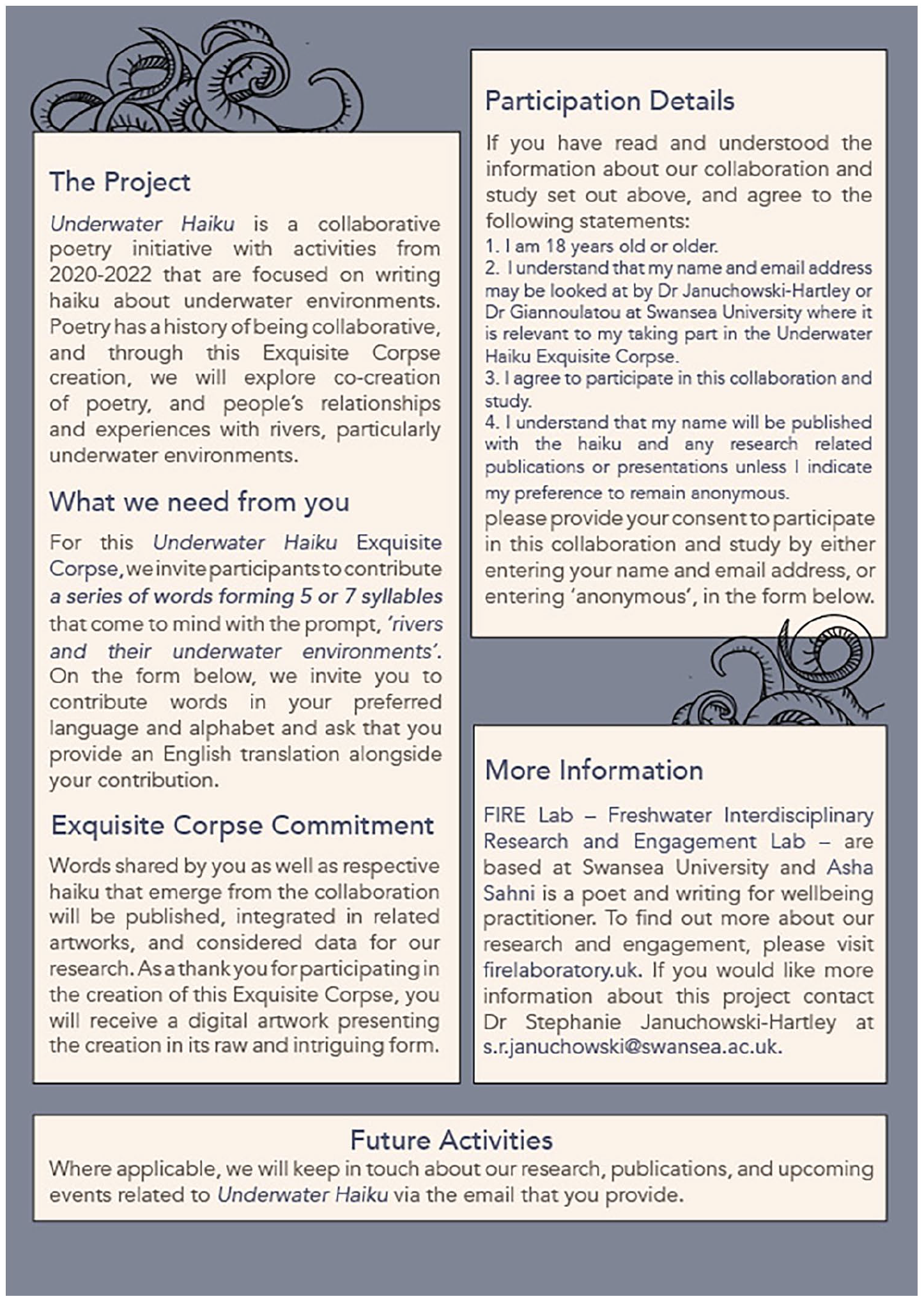
Underwater Haiku Exquisite Corpse description.
The Underwater Haiku Exquisite Corpse attracted 106 contributors from Europe, Africa, Australia, Asia, and North America. Most lines submitted by contributors were in English, but there were also contributions in French, Greek, Japanese, Marathi, and Spanish. We compiled lines submitted by contributors – in some instances, people had written more than a single line, and we selected the first line that was either five or seven syllables to include in the corpse. We did so to ensure that the Underwater Haiku Exquisite Corpse text complied with our project description and that each person contributed a single line to the corpse. The Underwater Haiku Exquisite Corpse text was presented in the order that contributors submitted to it (in Latin alphabet for readability) and collaged with the Octowl digital drawing (Figure 3). This first digital artwork bearing an inscription of the complete Underwater Haiku Exquisite Corpse text was distributed to contributors and the broader public via our social media accounts and the Underwater Haiku project webpage. 8
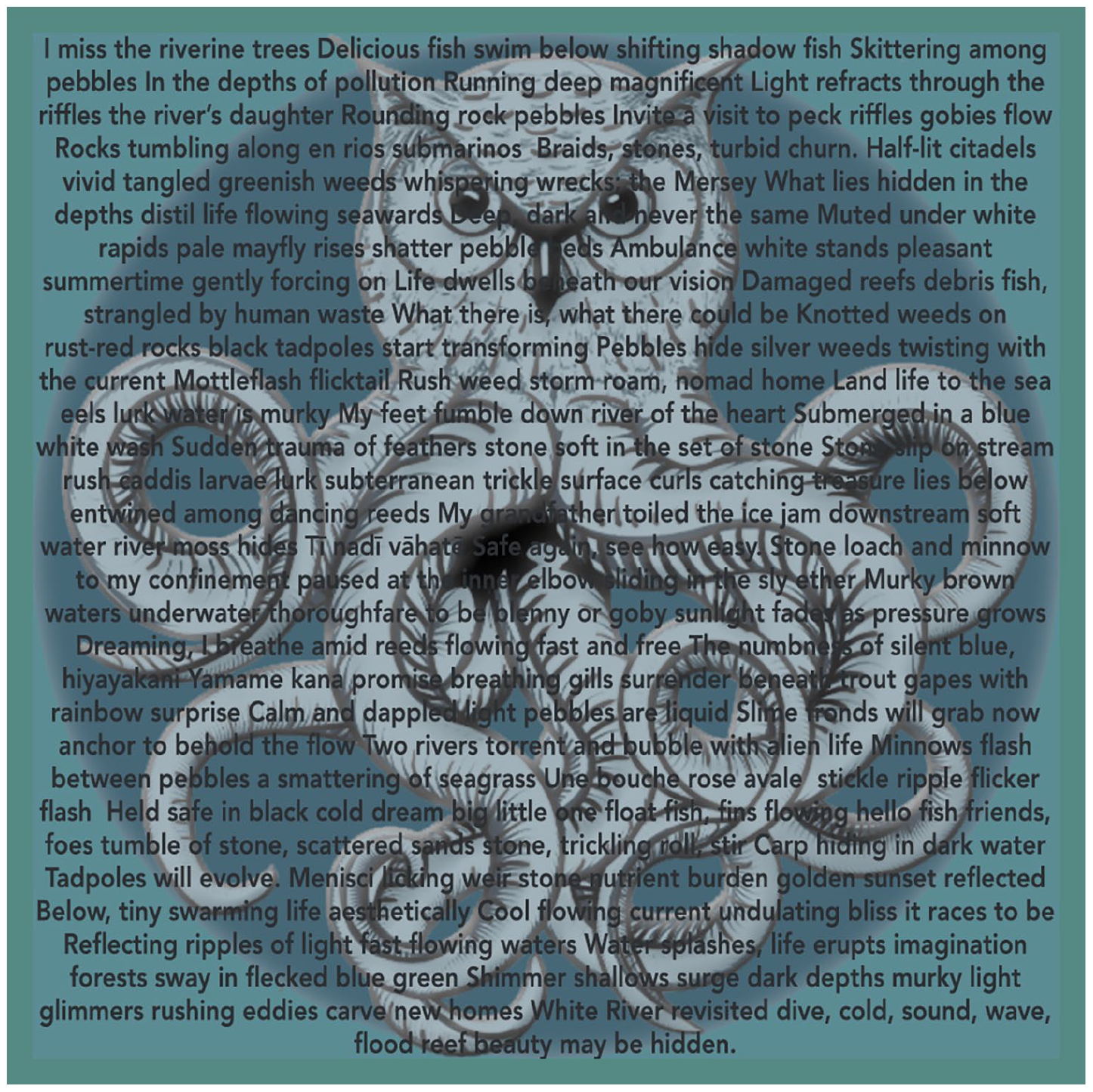
Underwater Haiku Exquisite Corpse collaged with Octowl.
The Underwater Haiku Exquisite Corpse is central to a digital artwork, Underwater Words I & II, 9 based on ideas of collective thinking and examining the notion of underwater from different perspectives. The artwork is a digital diptych and consists of two independent videos sharing one screen. The two videos are complementary: one presents the written words of the original Underwater Haiku Exquisite Corpse combined with audio of a found poem from the corpse, and the other is its reverse with the found poem written and the original words spoken. Both videos include a series of visual and audio fragments connected to underwater environments.
In keeping with our playful approach, we present found poems alongside prose in this article to exemplify how contributors intertwined notions of humans, rivers, and what lies below the surface. In reading the corpse, we encountered vivid underwater imagery shared by contributors.
pebbles hide silver in the depths of pollution caddis larvae lurk promise breathing gills entwined among dancing reeds tadpoles will evolve
This found haiku reveals an intertwining of human and nature conveyed both within and across contributors’ lines. Rivers and other freshwater ecosystems support billions of people and are home to an extraordinary diversity of life. 10 Our dependencies on freshwater ecosystems for food production and security, drinking water, and transport all drive changes in these ecosystems, such as those caused by pollutants, 11 that have consequences for both people and nature. At the same time, as reflected in the lines shared by contributors, life continues within and alongside these rivers, even as we pollute, channelize, and dam these habitats.
The Underwater Haiku Exquisite Corpse captured an element of possibility and perhaps hope that life will continue and evolve in face of human disturbances. The act of reflecting on our surrounding environments, while neither fully pristine nor fully defined by human presence, can help us tap into the agency of landscapes, encountering a sense of wonder wherever we might be. 12
Rivers’ energetic, connecting, and shaping nature was also conveyed, perhaps in part because of the playful approach used to conjure words in the Underwater Haiku Exquisite Corpse.
subterranean trickle pebbles are liquid braids, stones, turbid churn two rivers torrent rushing eddies carve new homes distil life flowing seawards
These lines shared by contributors highlight the value of wordplay for approaching complex topics, such as geological or hydrological processes that operate at spatial and temporal scales beyond the day-to-day or immediate observation. With this second found poem, we have taken individual human-environment relationships shared by contributors and mapped a shared aesthetic that evokes water’s continuous movement through Earth’s hydrologic cycle. 13
The nonhuman animals represented in the Underwater Haiku Exquisite Corpse spanned insects, fishes, amphibians, and birds. Contributors gave a view into the rich lexicon about fishes (e.g. gobies, blennies, eels, carp, minnows, trout), also reflecting the diversity of geographic locations and experiences from or about which they were writing. Imagery and imagination entangled nonhuman bodies, movements, and interactions above and below water.
pale mayfly rises invite a visit to peck trout gapes with rainbow surprise riffles gobies flow mottleflash flicktail eels lurk water is murky below, tiny swarming life sudden trauma of feathers
Within this third found poem, we give emphasis to the volume and diverse life underwater that contributors linked to human identity and cultures. We invite readers to further attend to the diverse lexica of rivers so as to maintain, build, or restore continuity between spaces and nature that we might consider home (i.e. above water) and that we might frequently ignore (i.e. under water).
Links to underwater identity and culture were also captured through the spontaneous, raw, and intriguing sequential lines shared by contributors to Underwater Haiku Exquisite Corpse. We present these spontaneous lines as a found poem below and invite readers of this article to find or write new haiku or other poems, if inspired by this project, and to upload their creations to share with us on the Underwater Haiku project webpage. 8
en rios submarinos braids, stones, turbid churn half-lit citadels my feet fumble down river of the heart submerged in a blue white wash treasure lies below entwined among dancing reeds my grandfather toiled
The words and lines of the Underwater Haiku Exquisite Corpse present contributors’ worlds as intertwined with rivers and their underwater environments, either metaphorically or as experienced. The collective creation of Underwater Haiku Exquisite Corpse also fostered a community and captured people’s experiences and intuitive responses in relation to river environments. Our goal is to maintain a playful approach to the broader Underwater Haiku project and emergent creations or poems – be they new, found, collaged, or otherwise. We hope that sharing this project and creations inspires more engagement with playful approaches to knowledge production and sharing as part of the doing or practice of cultural geographies.
Footnotes
Acknowledgements
We thank Professor Jamie Winders for feedback that helped to improve the quality of this manuscript. We also thank the 106 contributors who wrote the Underwater Haiku Exquisite Corpse, and the Indisciplinary Poetics Research Cluster at Bristol University for facilitating our collaboration.
Underwater Haiku Exquisite Corpse contributors: Tim Gardiner, Svetli Dubeau, Trish, Helen Scadding, Fiona Taylor, Anonymous, Kelly Diamond, Lisa Watkins, Emma Tracy, Ellen Graubart, Roz Mascall, Ewan Armstrong, Richard O’Rorke, Marta Aarli, Stephen Thackeray, Robiu Salisu, Ros Hitchen, Laurel Clark, Elizabeth, Ali Birkett, Angharad Griffiths, Michiel Jorissen, Jayne Celeste, Emeliana Palk, Kathy Finney, Polly Gitsham, Corinna Chandler, Tioma Fern, Zahra Kosar, Irena Iaskowska, Cycling Tiger, Rebecca Kosick, Emma, Sayali Pawar, Ian Roderick, Julia Giles, Mimi Thebo, Rachel Goodman, Τζωρτζίνα Μαντέ, Taryn Murray, John Chisholm, Isabelle Côte, Michael, Sally Hare, Chiara Singh, Chandra Moon, Misa Tsuruta, γιώργος μπέτσος, Kerryn Alt, Barbara, Dani Rabaiotti, Dimitra Kondylatou, Helen C. A. Rowlands, Richard Bonk, Mary Warner, Andrea Corpolongo, Helen Whitehead, Doryn Herbst, Tom Burgess, Elvire Roberts, Susan Harrow, Tom Richardson, Sarah Rowland Jones, Roger Hare, Ronne Randall, Lytisha Tunbridge, Jose V (pipo) Roces-Diaz, Robert Catt, Davina Lee, Fleur Beckwith, Kenjiro Van Malder, Hilary Williams, Gwen Katz, WordFiendess, Holly English, Beth Steger, Helen Larson, aMan Bloom, Sukhmani Mantel, Steve Lockett, James, Jami West, Rob Henley, M a Marvan, Jacqui Stearn, Michael Manson, Nina Marvan, Susan J. Tweit, Fraser Januchowski-Hartley, Natasha Bojanowski, Kherlen Shinebayar, Sarah Erskine, Tara Sahni, Linda Sawdy, Frankie Sahni, Andreas Tsanakas, Naresh Sahni, Claire Collison, Rachel Hale, Diana Humphrey, Anna Powell, Heather Moorhouse, Stephen Burrough, Colette Mills, Kate Pawsey, Justine Gillan.
Funding
The author(s) disclosed receipt of the following financial support for the research, authorship, and/or publication of this article: Funding from the Welsh European Funding Office and European Regional Development Fund; Project Number 80761-SU-140 (West) supported the making of Underwater Haiku Exquisite Corpse and associated creations.
Ethical approval
The right to conduct research with human subjects was granted by Swansea University’s College of Science Human Ethics Approval #STAFF_BIOL_85188_100220090502_2 (2 March 2020).
