




Abstract
This artistic research reflection explores Sweden’s legally-mandated ‘tourist-release’ at the Ångermanälven River’s storied site of Nämforsen. Against World Wars and calls for energy independence of the mid 1940s, the iconic Ångermanälven River was industrialised from a free-flowing salmon river to eventually a series of 44 dams and hydropower plants. Later, a unique environmental court legal judgement resulted in ‘tourist-water’ at Nämforsen that gives the illusion of a free-flowing river during summer months. Existing for solely aesthetic purposes, tourist-water is an unexplored example of the (in)visible powers perpetuating myths associated with hydropower and place in Sweden. Through text and images, this piece reflects on witnessing this tourist-water phenomena through place-based documentary arts practice. The fieldwork is part of a doctoral project in artistic practice focusing on how photography can mediate complex issues in places of environmental change through the case of Nämforsen. Strategies such as framing, time-scaling and montage have emerged from this practice at the same time as ethical concerns related to representation are raised. This case is especially pertinent as hydropower in Sweden comes under increased scrutiny, simultaneously as it is marketed as a sustainable energy solution. The piece furthermore highlights the lasting implications of conservation efforts centred historically on aesthetic rather than ecologic values.
Keywords
“. . .to see a river was to be swept up in a great current of myths and memories that was strong enough to carry us back to the first watery element of our existence in the womb.”
1
I first witness the river being turned off at Nämforsen at 10 p.m., a day after the 2021 summer solstice. This is a sacred site, once one of the greatest waterfalls in Sweden. Its mist believed to have been the breath of the river. 2 Along the shores, one of Europe’s largest collections of Stone and Bronze age rock art engravings remind of the place’s sacred past. The Swedish midsummer evening light allows the mind to imagine wild salmon passing by this place; silver flashes in the dark water, summoning their energy in the seemingly impossible journey past the Nämforsen rapids to spawn in their places of birth upstream. My imagining is interrupted by a warning signal indicating the beginning of the draw-down of water. The flood gates are closing.
I return regularly to witness the gates closing, and my camera becomes heavier with each visit. Each time the water is turned off, the waters slowly recede into pools of memory carved in the rock. After more than an hour, the river (if one can call it that) becomes still in places. I imagine the first draw-down of water during building of the dam in the 1940s. Did the locals, unaccustomed to a quiet river valley, hear the roar of the river ringing in their ears? What of the salmon trying to swim home to make nests in the precious, perfectly sized gravel where their lives began? Did they leap into the dam or succumb in shrinking pools? How long before they stopped trying? Water pours over the waning waterfall until sometime in the middle of the night only a whisper of an outlet remains in a field of rocks spanning the humiliated ghost-river’s breadth. I have witnessed a death and it feels as such (Figure 2).
In the years since the controversial building of the Nämforsen dam in Sweden in 1944–1947, the battle over the river’s flow between the then state-owned Vattenfall power authority, and local landowners, timber-floating associations and local fishing interests has continued. In 1973, after decades of debate regarding the addition of a third turbine, Sweden’s environmental court issued a unique judgement – it ruled that a third turbine would be activated, but with the stipulation that between June 15 and August 15 the waters ‘in the riverbed past the hydropower plant be released at the minimum of 125/m3’ daily from 8:00 to 22:00, and later on the Swedish national holiday of Midsummer’s Eve. 3 This legally mandated release solely for aesthetic purposes became known as ‘turistvatten’, 4 turistsläpp or ‘turistspill’, 5 translated, ‘tourist-water, release or spillage’. Otherwise, the riverbed below the dam is mainly left dry as the water is routed to subsurface turbines creating electricity. Below the dam, the river re-emerges from the tunnel in swirling unnatural currents and irregularly surfacing boils.
Myths written in stone and witnessing the waters
The introduction of dams like Nämforsen were part of Swedish modernism that integrated aesthetic and utopic ‘welfare ideas’ into the landscape, and where associated infrastructure such as worker housing and schools apeared alongside the power plants in the landscape. 6 While there was resistance, and even regional pleas for a Nämforsen National Park, 7 war-era arguments to secure energy independence prevailed. 8 Vattenfall’s first plan would have drowned Nämforsen’s two-to-six-thousand-year-old Stone and Bronze-age rock carvings if not for advocacy to move the dam upstream. Vattenfall describes revised placement of the so-called ‘cultivated powerplant’ as an ‘early environmental protection’ success story, 9 but the focus was on aesthetic appeal and cultural significance rather than ecological consequences. The dam choked Ångermanälven all the same, severing salmon migration routes active for at least some 10,000 years. 10
Sweden, a large producer of hydropower, regularly ranks high on sustainability indexes, although as Stacy Alaimo points out the term ‘sustainability’ requires asking ‘what it is that sustainability seeks to sustain and for whom?’ 11 Hydropower is often termed ‘green’ despite causing extensive ecological damage exasperating the ‘global freshwater crisis’. 12 With climate emergency, false dichotomies between lowering carbon footprints and protecting biodiversity have emerged. These politically useful and industrial-friendly narratives serve ‘the hydropower myth’ that treats the industrial energy extraction as synonymous with sustainable development despite its sociological and ecological impacts. 13 Against this uncertain future, storied past and Nämforsen’s unique relationship with the presence and absence of water, I chose the site as the focus of my practice-led doctoral work at the Department of Design at Mid Sweden University in collaboration with the HDK-Valand Academy at the University of Gothenburg. My artistic research is concerned with how photography and film can mediate complex issues relating to climate and biodiversity and energy emergencies. In the work of representing environmental issues, in/visibility is a recurring concern for photographers attempting to bring attention to them. In/visibility affects how we perceive the environment and our role in it. 14
My engagement with the damming of Nämforsen draws on my history with photojournalism and long-standing interest in ‘concerned photography’ and ‘social documentary’ where documentary photographs are believed to help create knowledge, understanding and encourage empathy for a subject – through a combination of ‘fact and feeling’. 15 Place has figured centrally in my practice as both muse and method – I channel memories of a specific place through a variety of materials and experiences on a spectrum of the personal and collective. 16 At times I directly involve place through the anthotype process using plant-based emulsion. I am interested in photography and film as artistic mediums intertwined with spatial and temporal understandings of place, and my artistic investigations engage with medium and place through acts of witnessing and reimagining environmental change, visible or not.
Return of the water
In the morning, I return before the water is turned on. I am sceptical because starting at 8 a.m. Nämforsen becomes what they want me to see. I am reminded of political photo-assignments from my newspaper days where each handshake, smile, wink and charming encounter was carefully planned by whole teams of public relations professionals leaving the photojournalist little room for a ‘real’ moment. The flow of images (and their framing) is a recurring subject of control. Approaching the overlook above the riverbed, I am struck by the stillness cut by what sounds like seagulls, an electric hum, and that whisper of a stream I left the night before. It is shocking, but places like this 500-m dry-riverbed exist all up and down Ångermanälven; all over Sweden. The pools have become stagnant, the shoreline rocks and air are dry and warm in the sun. I am photographing and filming, working my way around different parts of the area over several mornings, finding sites to set up my tripod and wait for the release. The water-carved dry rock formations catch my eye and for a while I am lost in a flow of making photographs. A Vattenfall worker dutifully comes out of the power station to check if anyone has wandered into the spillway. Sirens sound ominously as the water begins to be released until the gates are opened the prescribed amount and the Nämforsen rapids appeared to return – all promptly by 8 a.m.
As much as I am trying to resist being manipulated by this orchestrated spectacle, that is meaningless as far as the ecological health of the river is concerned, the return of the water is mighty. One morning, I focused my lens on the dry falls close to where two footprints are engraved long before. It takes a while before a trickle starts to enter the right side of my frame (Figures 1 and 4). And more and more and more until the water fills the frame and the invisible mist fills my lungs. This unexpected moment when the quality of the air went from dry to filled with life took me by surprise. The sensation of rebirth is not an exaggeration. The breath of the river was being breathed into me – and I can’t fight it. I feel joy! This is what it will be like someday when the river returns! This is where I found a breath of hope against this great myth, and conviction to photograph more of the tourist-water.
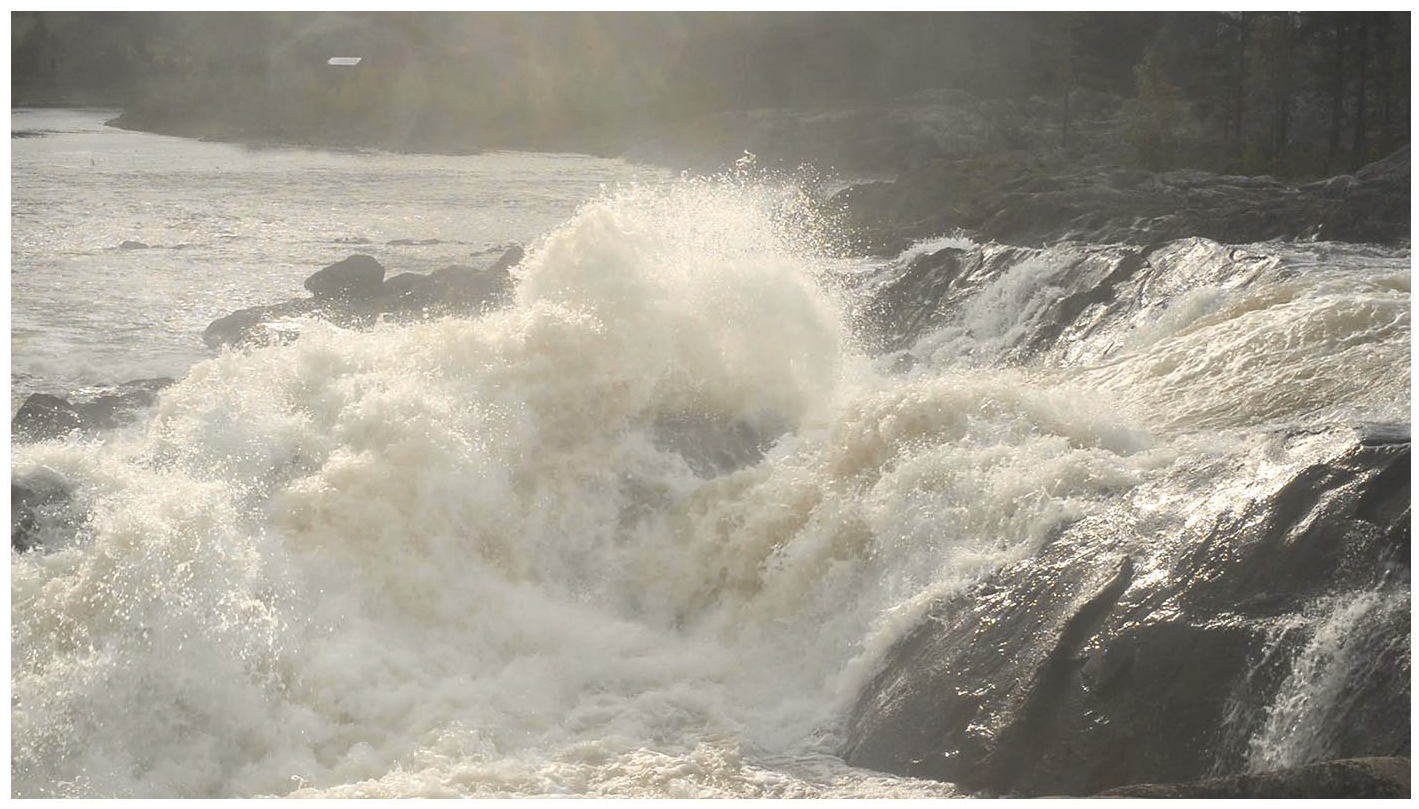
Film still from Tourist-water at the Nämforsen area: turning on August 6, 2021 (59 seconds). Nämforsen, Västernorrland County, Sweden.
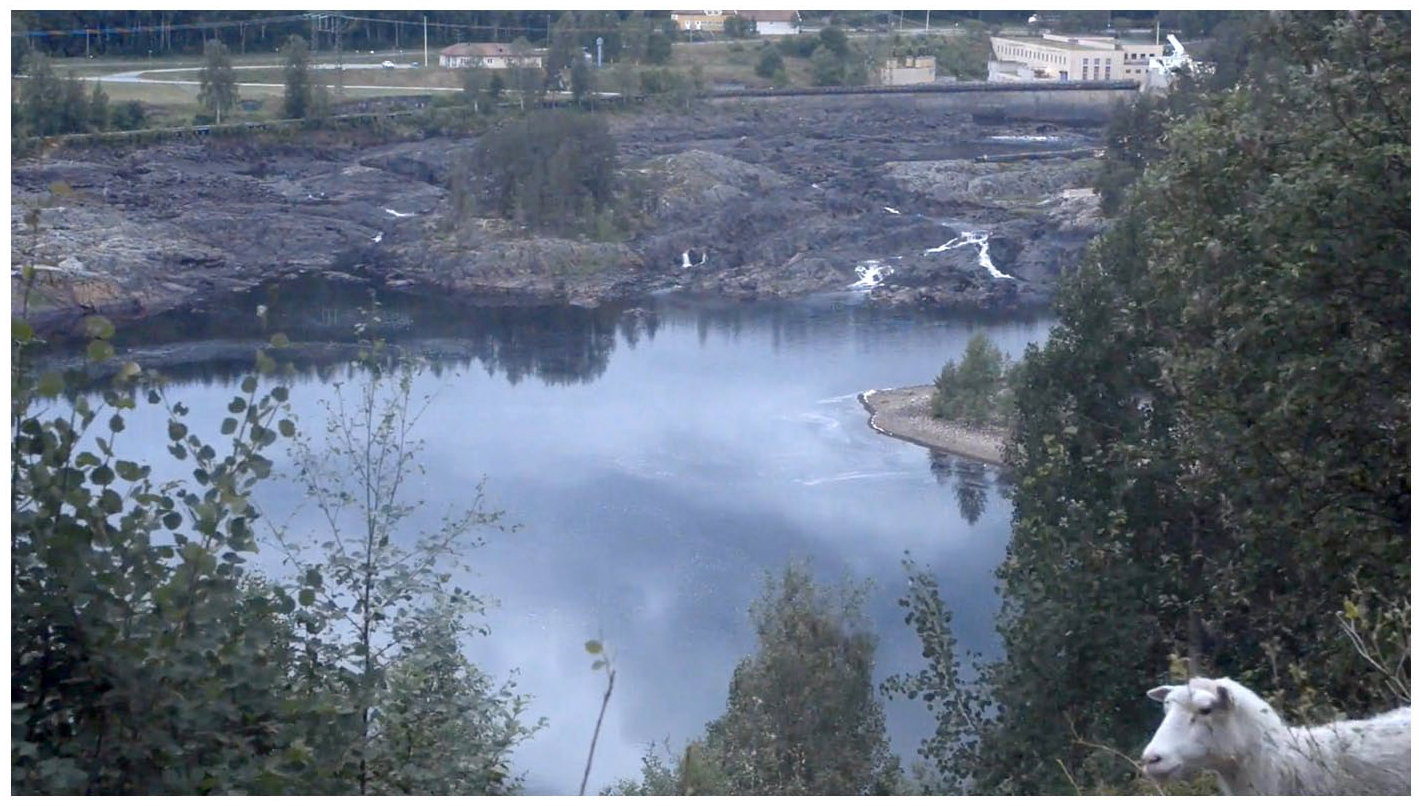
Film still from Tourist-water: turning off July 25 2021 (15 seconds). Nämforsen, Västernorrland County, Sweden.
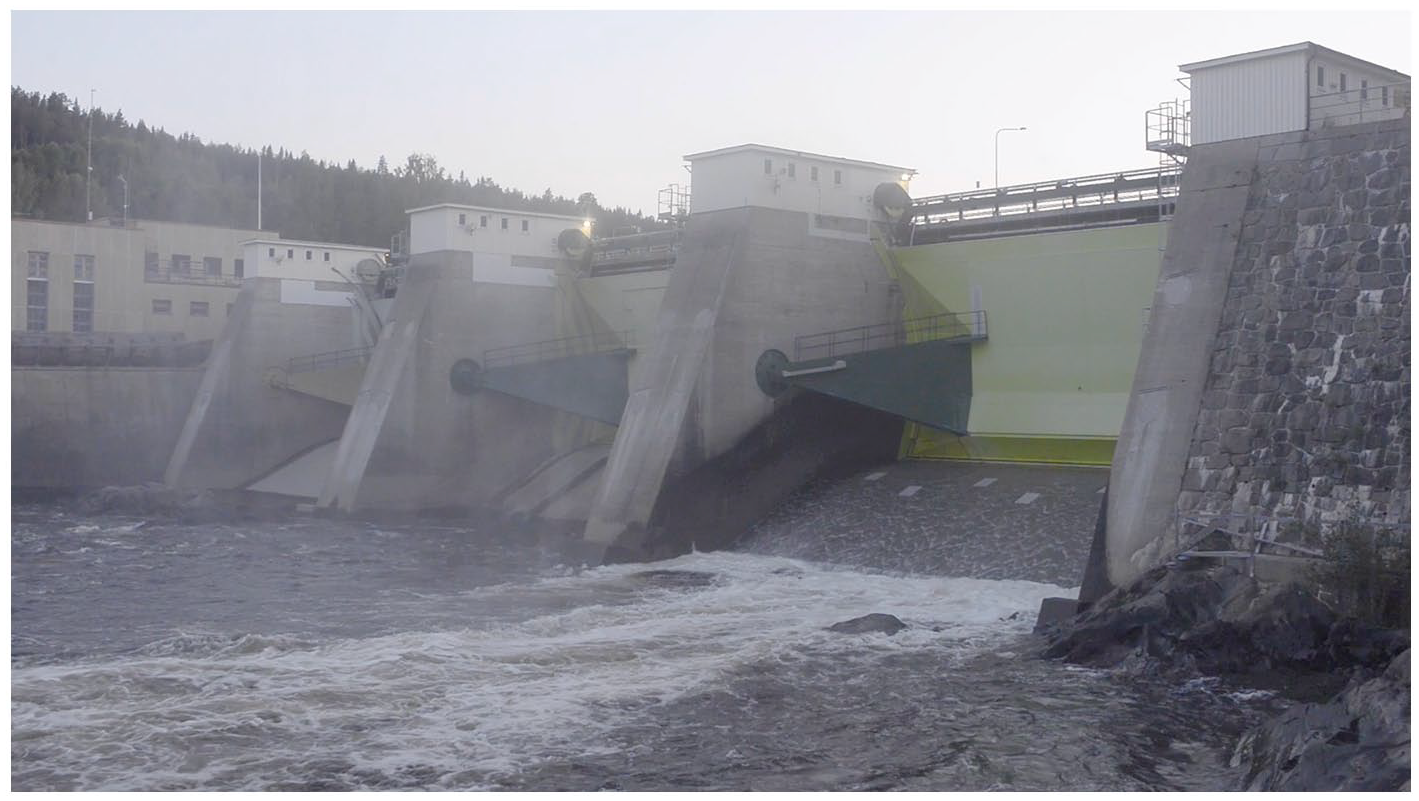
The view of the water turned off framed to include the dam as the last tourist-water of the day passes through before the gates close. Film still from Tourist-water: turning off July 26, 2021 (60 seconds). Nämforsen, Västernorrland County, Sweden.
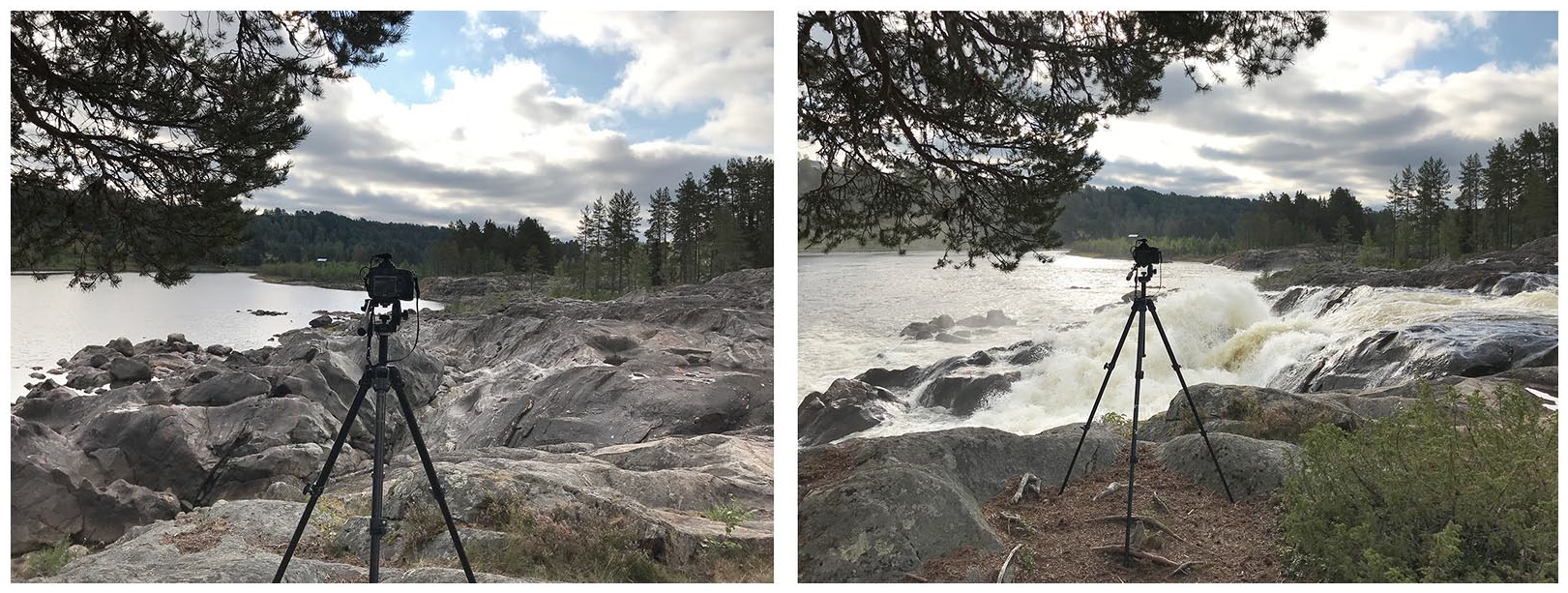
Two views of fieldwork at Nämforsen from Laxön; before tourist-release and after the floodgates are opened at 8 a.m.
Looking downstream
If Nämforsen is a living, breathing body of water, then I have witnessed the daily asphyxiation/resuscitation of the river. The river’s elemental capacity to return us to our origins can be harnessed to feed, cleanse and sanctify; water can be made to create power on a spectrum of visibility. When Vattenfall suggested decreasing tourist-water to increase production in 2006, locals understandably rallied to the defence of the flow. That said, I wonder if orchestrated displays such as tourist-water might simply empower the status quo? Do these aesthetically potent yet ecologically empty waters risk offering just enough for tourists to temporarily bask in the river’s life-giving breath while perpetuating and sustaining hydropower infrastructure and mythology? Images of tourist-water mask ecological destruction with the fundamental aesthetics of life-giving water. Its quench is hard to resist. It is an ethical issue for the documentary photographer. I think of Donna Haraway’s words, ‘Renewed generative flourishing cannot grow from myths of immortality or failure to become-with the dead and the extinct’. 17 In this light, is the seemingly restorative aesthetic displays of tourist-water are a manifestation of a myth of immortality where we deny the death of the river? Or perhaps preserving (albeit artificial) flows through tourist-water can also be seen as caring for place as a site for memory and radical imagining? How does the informed witness address being ‘swept up in a great current of myths’? 18 Rebecca Solnit offers a hopeful reckoning: ‘Joy doesn’t betray but sustains activism’. 19 I want to see potential for subversive power in this manipulation. Can this breath of possibility be the type of hope, which, as Solnit writes, ‘demands we take action’?
A couple of hours away geographically from Nämforsen, I process and reflect upon the photographic and film recordings that I have gathered. The fact that I am documenting the effects of hydropower with a digital camera powered by electricity from hydropower has not escaped me. It’s tempting to return to analogue photography and the wet darkroom. But the chemicals. . . These choices can be paralysing, and yet these aspects and questions of materials and practice must not be ignored. For now, it is unresolved with the knowledge that my actions will shape the testimony of each image. The task of bearing witness inspires me to react with interventions to the raw material. Considering audience attention span, I experiment with the scaling of time, shortening film clips of more than 20 minutes down to no more than a minute in length (Figures 2, 3 and 5). The results are compact and emphasise drastic differences between the water’s presence and absence. Perhaps proposing a choice between two future landscapes.
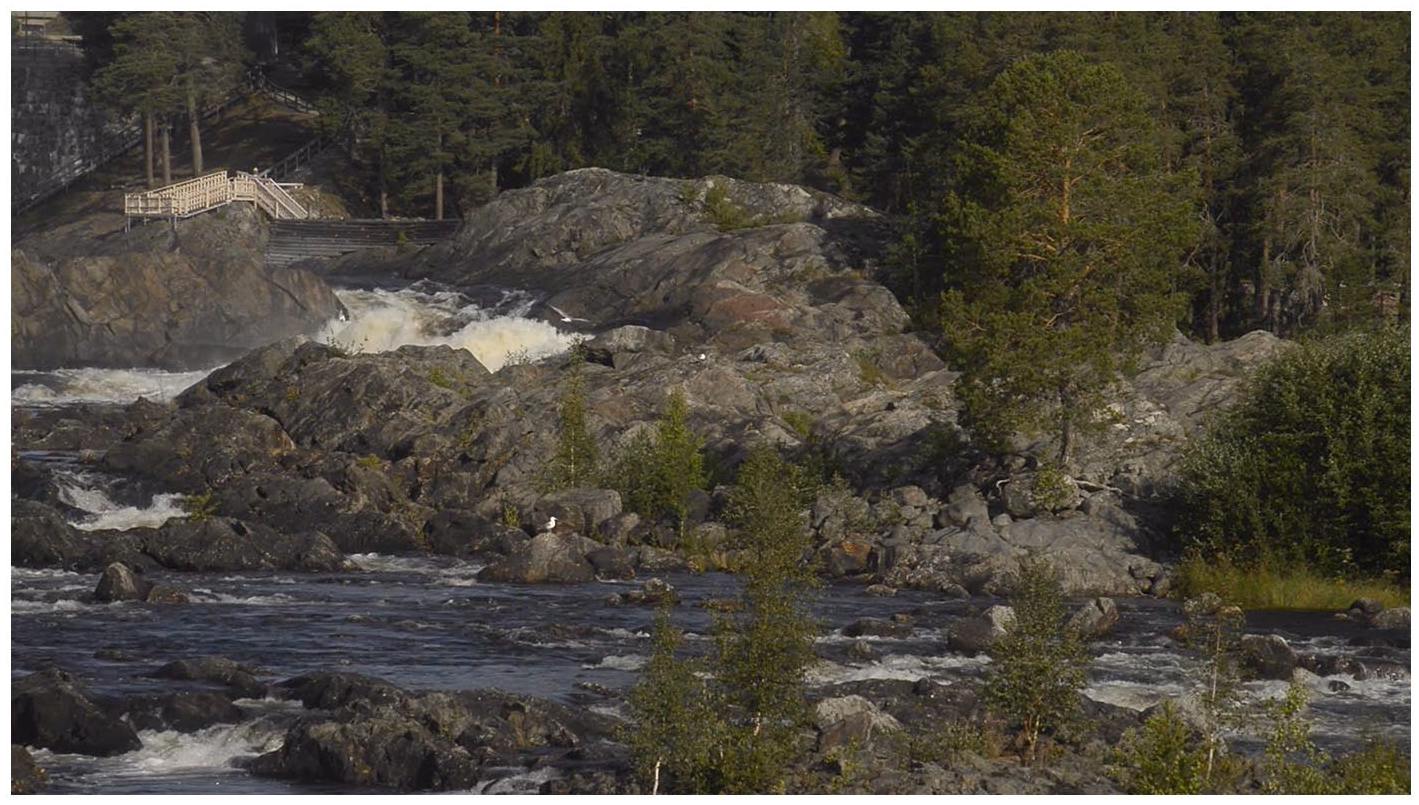
The view of the return of the water framed without the dam visible. Film still from Tourist-water: turning on July 27 2021 (60 seconds). Nämforsen, Västernorrland County, Sweden.
Editing the still images of the dry riverbed, I was frustrated by their silence. The river valley’s famous painterly light was obscuring the ecological disaster. I imagined the salmon in the stagnant pools in their final moments in the water’s first draw down. Their plight invisible. The only salmon I have witnessed at Nämforsen are written in stone. I retrieve photographs I made of them. I start carefully with one copy-paste action but am soon montaging multiple red-ochre-stained salmon into the sublime dry riverbed photographs (Figure 6). My revisions to the image pay special attention to the imagined contortions of each dying fish. Altering the image in this way may be considered antithetical to a photojournalistic upbringing, but the resulting montage speaks to an otherwise invisible truth about the place.
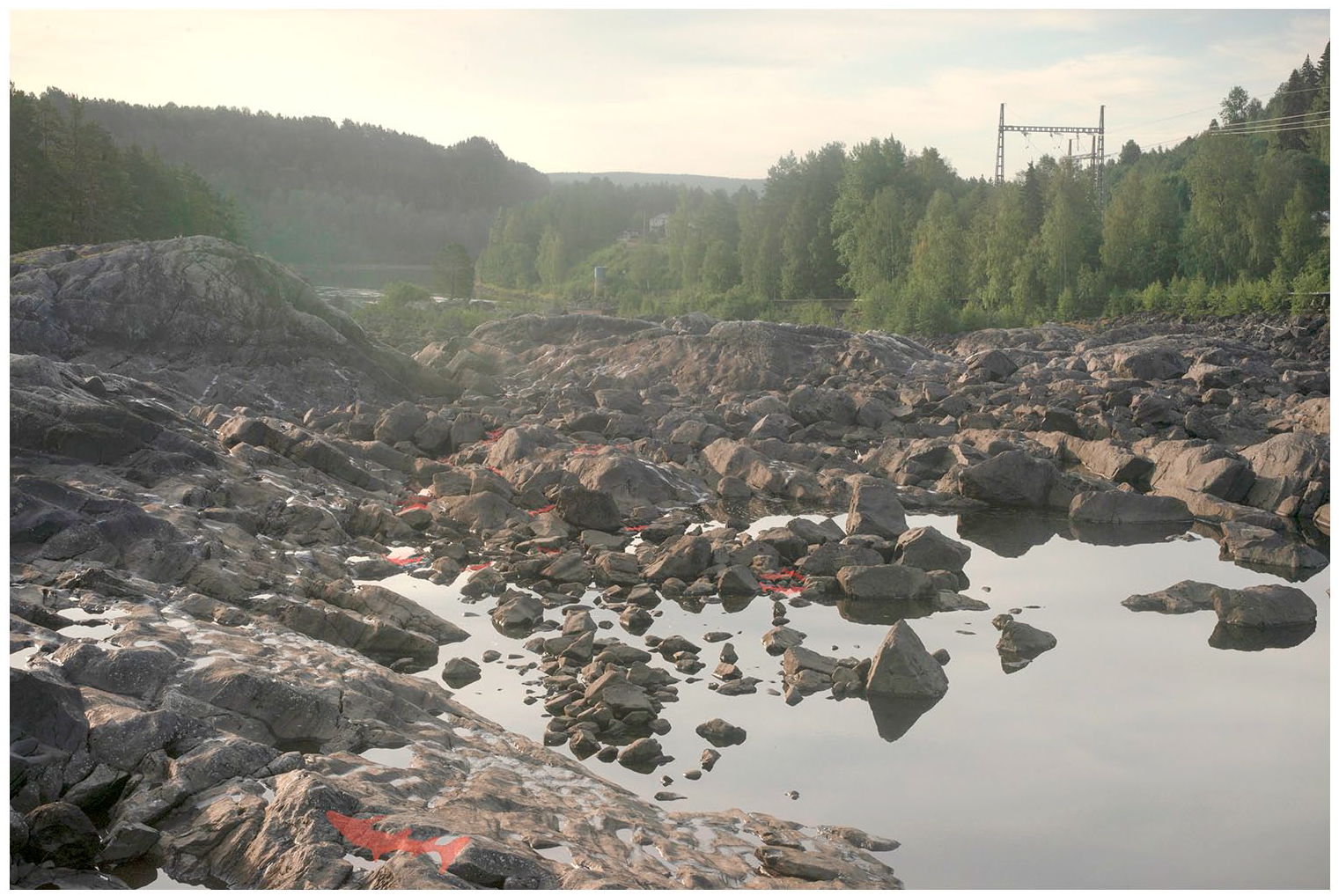
Untitled, Montage of digital images from still series with working title: Written in Stone.
(In)visible powers
For the length of an average human lifetime, Nämforsen waterfall has been replaced by an unnatural and opaque landscape. Conservation efforts focusing on the aesthetic over the ecological have produced tourist-waters that both obscure and inspire. A few empowering revisionist strategies have emerged early on in this artistic research such as time-scaling, framing and montage, but more unforeseen to me is the power of the tourist-water on my practice. These false waters exist solely to be witnessed highlighting ethical concerns and challenges for photographers representing places of complex environmental issues. Simultaneously, the more time spent in this riparian place, the more embracing flow becomes central to understanding Nämforsen as well as my practice. I proceed placing my trust in both ‘facts and feelings’, aware that there are in/visible powers in Nämforsen’s great current of myths.
Footnotes
Acknowledgements
I would like to thank Meike Schalk, Cecilia Åsberg, Marietta Radomska and Janna Holmstedt for their encouraging feedback to an earlier version of this text. Thank you to Caleb Johnston and an anonymous reviewer for insightful comments.
Funding
The author received no financial support for the research, authorship, and/or publication of this article.
