




Abstract
Turning to the concept of plasticity in the philosophy of Catherine Malabou, this article traces an approach to urban change as a volatile movement of giving, receiving and exploding form. It diverges from lines of thinking within cultural geography that affirm lively processes and relations, instead calling attention to the finite and fragile morphologies of cities and their exposure to the threat of destruction. The article examines a planning programme in San Francisco which invites local groups to craft and care for temporary street furniture. Intended to facilitate civic engagement, such artefacts acquire plastic properties that further divide and disrupt populations, particularly those experiencing homelessness. Attuning to this negative power of form illuminates an emerging hostile urbanism that utilises provisional structures to irreversibly alter the constitution of places.
Cultural geographers often insist on the abundance of ‘agencies’, ‘forces’, ‘materialities’ and ‘relationalities’ within the city, rendering it as ‘forever in formation’ 1 and ‘constantly subject to being imagined or lived differently’. 2 Asserting vitality has certainly served as a critical gesture against attempts to capture and control urban space by revealing its ‘infinite creative possibilities’ and encouraging ‘subversive’ action and thought. 3 And yet, assumptions that the city ‘never quite reaches closure’ 4 overlook, as Rose, Bissell and Harrison write, the ‘brute reality of finitude’ 5 and the seizure of citizens by forms that hold them in a position of persistent debilitation and displacement. 6
This article sets imaginaries of an endlessly dynamic and malleable city in counterpoint to plasticity, a concept that derives from the philosophy of Catherine Malabou, where it denotes a distinctive morphology conditioning the changeability of being. 7 Plasticity refers to the propensity of matter to give, receive and explode form 8 in ways that make bodies, objects and spaces both ‘fragile and finite’. 9 For Malabou, form is a site of tension between conflicting determinations that negate entities and expose them to the unpredictable disruption caused by the ‘pressures [they] cannot accommodate’. 10 Stressing the volatile power of form, then, plasticity can bring attention to morphology as an area of cultural geography and offer a corrective to narratives of the city as a domain of ‘ceaseless becoming’. 11
The operation of plasticity will be investigated here through a series of urban prototypes 12 in San Francisco – provisional, ‘living’ artefacts that are claimed to allow for collaborative adaptation, 13 while remaining ‘easily reversible’. 14 This language is integral to Groundplay, a programme overseen by the Planning Department that gathers artists, businesses, citizens, designers, funders and officials to work on a ‘radically bottom-up approach’ 15 for the ‘testing of new innovations in everyday situations’, 16 such as pavement extensions with greenery and event-based uses of vacant land. Groundplay therefore contributes to the diverse ‘temporary urbanisms’ – whether defined as DIY, experimental, guerrilla, makeshift, meanwhile or tactical – that have ramified through Euro-American cities of late, 17 with the primary aim of expanding civic involvement around renewal schemes across San Francisco.
Applying the concept of plasticity, the article will demonstrate how Groundplay conflates with planning and policing in a manner that considerably dampens the potential of the programme. As hostile design, from spiked ledges that prevent sitting to slanted benches that deter sleeping, has become embedded within the infrastructure of cities, 18 the prototypes speak of nascent policies and practices that accelerate temporary interventions to constrain how bodies encounter and engage. 19 Rather than facilitating novel forms, these artefacts are deployed to uphold a plastic urbanism that reinforces dominant divisions and threatens to further unsettle public life.
This argument will take shape across four sections, the first describing how the planning officials of San Francisco manage temporary projects under Groundplay and promote them as a catalyst for change. The second section follows the concept of plasticity through the writings of Malabou, where it acquires deconstructive and dialectical inclinations. Plasticity is then juxtaposed with geographical scholarship to yield ideas for the empirical discussion in the third section, which interrogates the workings of urban prototypes, particularly in connection to the sizeable homeless population of San Francisco that constitutes a regular target for interference by authorities. Finally, the article rehearses its key claims and proposes directions for research into plastic urbanism.
Urban prototypes
Among the prototypes in San Francisco are Sound Commons at the Civic Center (2016–2019), which contained instruments, from chimes to xylophones, inviting passers-by to communicate musically (Figure 1), and The Pause on Yerba Buena Lane (2014–2017), which involved, for instance, two opposing concrete parabolas that focussed sound to enable conversations between strangers above the surrounding noise levels (Figure 2). Designed by the Studio for Public Spaces, such structures have become foundational to Groundplay and tie into ongoing large-scale projects. 20 One is the Civic Center Public Realm Plan for a 15-acre section of a prominent district encompassing the City Hall, the Main Library, the Asian Art Museum and several court buildings, music venues and theatres. Another is Better Market Street, covering 2.2 miles of a major artery stretching from the Embarcadero at the waterfront, via the Civic Center, to the neighbourhood of Twin Peaks. The two schemes rely on a combination of activation, stewardship and upgrades to infrastructure and streetscape to turn sites into ‘inclusive gathering place[s]’ 21 with improved accessibility and security. 22 To gather further support for these interventions, a number of ‘Prototyping Festivals’ 23 have also been organised, with the 2015 edition resulting in 50 objects selected from hundreds of proposals. 24 Gehl, an international urban design agency contracted by the city, reported that the event allowed people to envision new modes of rearranging public space and ‘experience those possibilities in real life’. 25
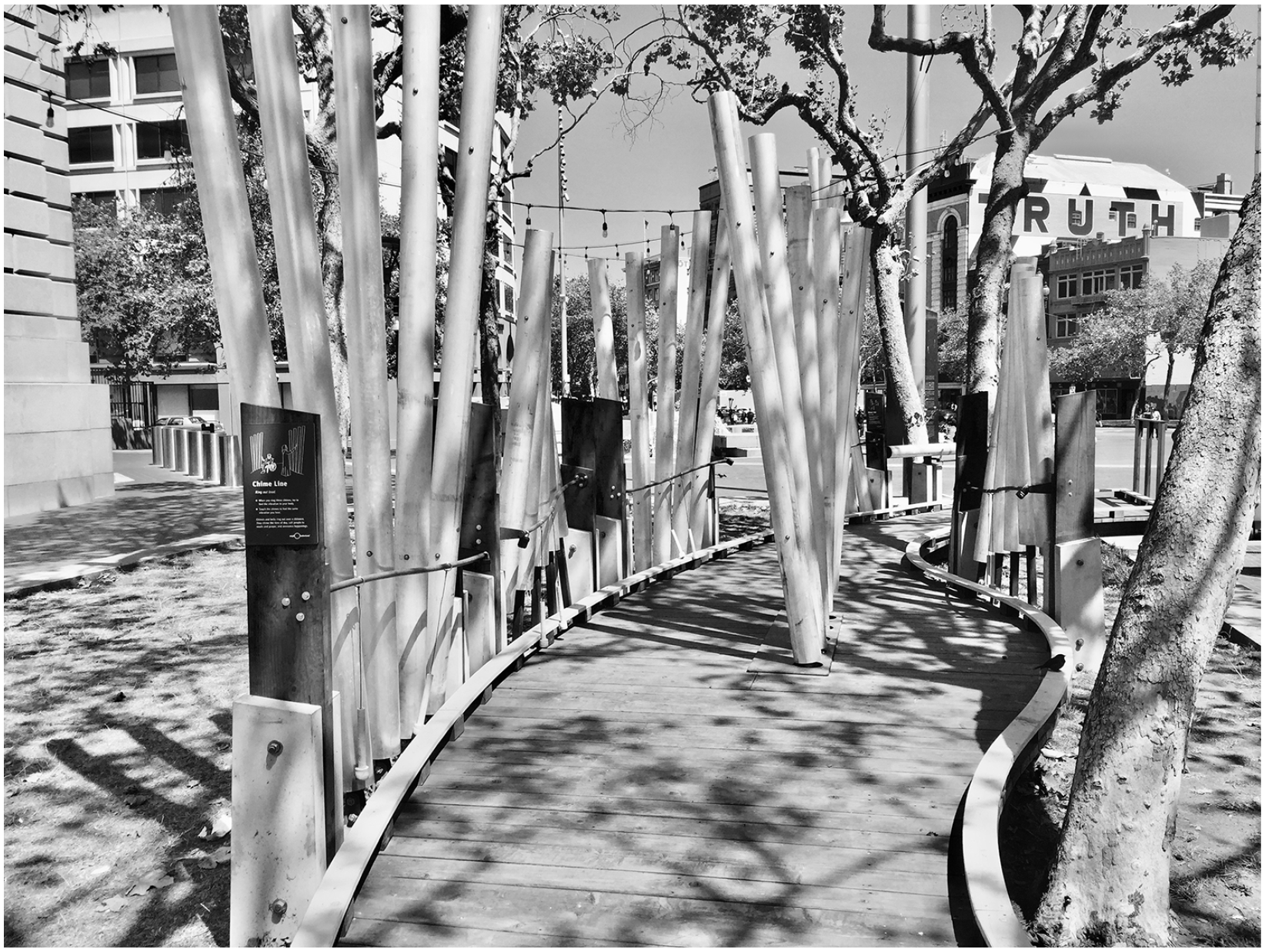
‘Sound Commons’ by Studio for Public Spaces. All images by author.
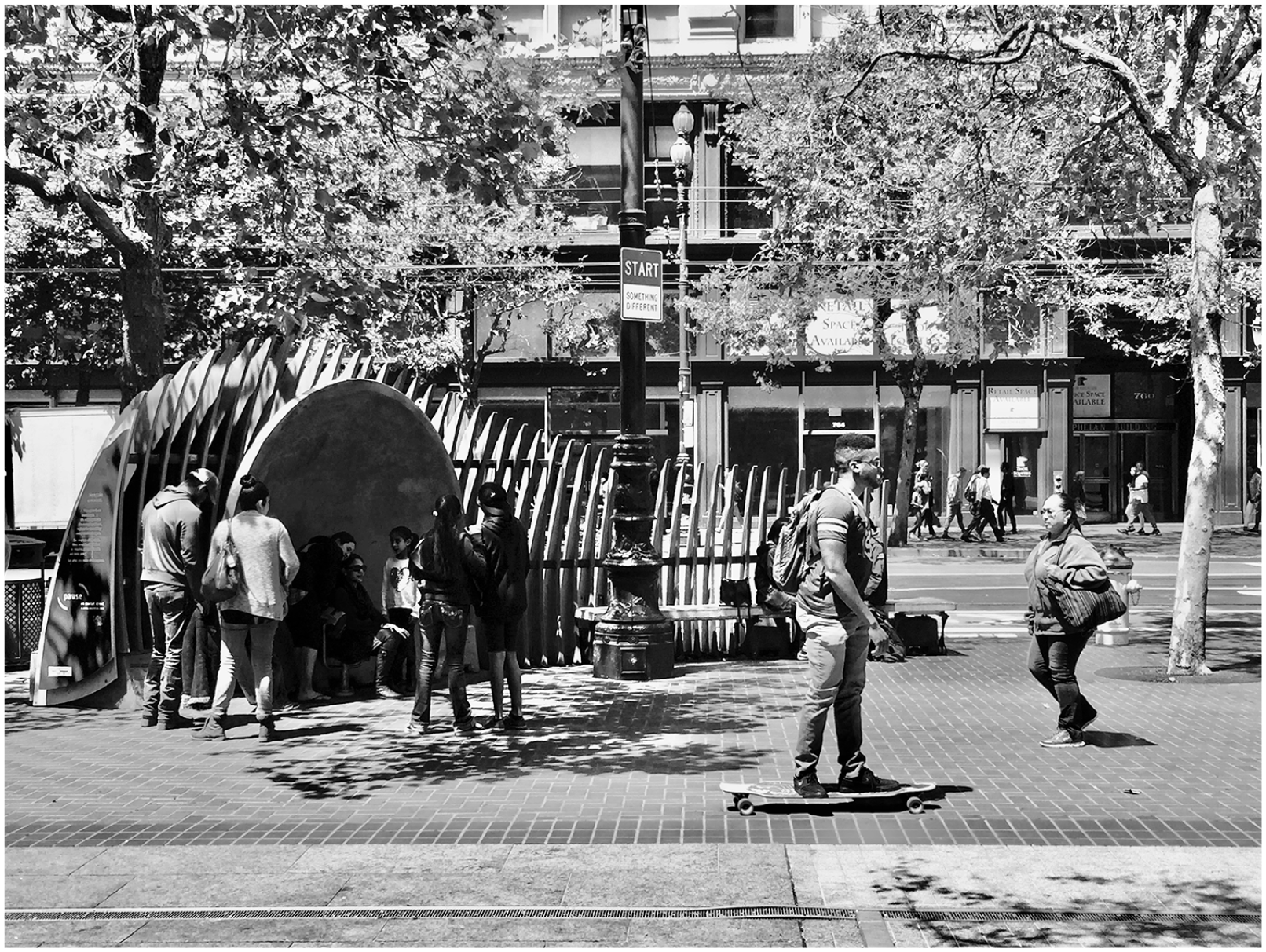
‘The Pause’ by Studio for Public Spaces.
Regardless of their ostensible informality, the prototypes are expected to follow an application process developed by the City and County of San Francisco. 26 As a way of ensuring compliance and feasibility, submissions by sponsors (often a local business, neighbourhood group or non-profit organisation) need to adhere to set procedures and complete a design, funding and maintenance plan. The official manual is crucial to the prototyping and stipulates the composition and placement of installations in close detail, for example, by recommending the use of ‘concrete pavers mounted on a metal frame’ as an ‘alternative to poured concrete as they are durable, easy to de-install, and permit water flow’. 27
This orchestration of temporary urbanisms has provoked remarks that the unsanctioned styles of community action widely associated with such approaches lose their ‘subversive potential’ when appropriated by authorities. 28 Although formal and informal practices have always amalgamated in cities, 29 it is argued that officials are neutralising grassroots initiatives by taking their perceived affordability, creativity and flexibility as a leaner method of testing designs and preparing sites for eventual redevelopment through making them attractive to investors and raising land and property value. 30 Temporary urbanism has consequently been described as complicit, under the guise of participation, in neoliberalist configurations of power, said to increase precarity and erode public space through encouraging economic speculation, deregulation and the withdrawal of state support for essential services. 31
Accounts of neoliberalist city-making are compelling, yet often assume a context for urban life where power is ubiquitous and functions ‘efficiently, predictably and homogenously’. 32 Rose, Bissell and Harrison note that cultural geographers tend to ‘exaggerate power’s efficacy’ by understanding it as a relational field of ‘interacting forces’, which permeates all entities, constantly producing and modulating their capacities of action. 33 As the remainder of this article will indicate, the concept of plasticity tempers such ideas with its erratic and explosive morphology that illuminates the accidental agency of urban form and how it occasionally evades control and thereby reveals as much about the inefficacy of power as its efficacy. 34 But before continuing to explore these themes, it is necessary to elucidate the main vectors of Malabou’s thought.
Malabou and plasticity
Malabou develops a ‘post-deconstructive’ 35 orientation that extends Derrida’s investigation of the difference and deferral of meaning within Euro-American systems of knowledge. Although seeking to expose an ‘originary crack’ 36 that undermines any foundation from the inside, Malabou describes less a graphic operation across a field of signification than a plastic process, 37 or ‘changes of form’. 38 Malabou is wary of confounding form with ‘presence’, such as the contour of an object, which would replicate the conventional distinction between form and matter, where an external shape is imposed on a passive, undifferentiated substance to define an entity and its properties. 39 Instead, Malabou conceives of matter as plastic, possessing an unpredictable power of self-formation that renders it ‘simultaneously resistant to and open to change and capable of annihilating itself’. 40 Plasticity names the constrained mutability of things – how matter acquires a form and preserves it until exploding due to the tensions it is unable to assimilate. 41
The concept of plasticity stems from Hegel, where it refers to a dialectics of subject-formation that negotiates divergent influences from the world. 42 Malabou imbues this movement with deconstructive sensibilities, arguing that it does not delineate a progression from contradiction through synthesis to enlarged rationality, but ‘displaces itself without resolving anything’ 43 and exposes the subject to the accidentality of existence. 44 Far from infinite malleability, plasticity marks the capture of life by opposing determinations that impel it into an endless confrontation with the ‘closure of the world’. 45 Plastic entities can never ‘escape’ the finitude of form 46 by way of a transcendent intervention that would offer access to some unformed exteriority. 47 And yet, the unavoidable pressures of plasticity sustain a ‘point of sheer randomness’ within all bodies, objects and spaces 48 that may spark a sudden transformation enabling a new ‘future within closure’. 49
From Hegel, Malabou turns to the question of change in the writings of Heidegger, demonstrating that his method, although upholding an ontology of openness and withdrawal, remains committed to uncovering, James notes, ‘a more ‘authentic’ thinking or saying of Being’. 50 In response, Malabou approaches Heidegger’s concept of essence as plastic, understanding it not as the ‘ideal pattern of things’ but as the ‘fragile point, the incision of the other in them’. 51 Malabou, then, refashions a theory of transformation from Heideggerian elements that, once again, aligns with her deconstructive notion of change as caused by fissures and frictions immanent to being, which together serve as a ‘dislocating force’. 52 Life always unfolds within form, but every form is also ‘self-deconstructive’ 53 and so remains caught in a ‘restless motion’ towards potential dissolution and emergence as another form. 54
Malabou pursues additional articulations of plasticity through neuroscience, exploring the development and modification of cerebral connections. 55 Adopting fluctuating degrees of permanence and impermanence, ‘solidity’ and ‘suppleness’, the brain is a plastic ‘template’ that allows for ‘constant self-reworking’, without, however, dispersing in complete ‘polymorphism’. 56 Malabou highlights the brain as ‘an agency of disobedience’ 57 in struggle with other forms, such as prevailing modes of economic and social organisation that seek to shape neuronal processes – as evidenced, for instance, by the Euro-American language of flexibility that appeared during the latter part of 20th century, valorising adaptability to relations of production through the ceaseless optimisation of personal performance. Unlike brain plasticity, flexibility cannot be a prompt for action, because it is docile and ‘lacks [. . .] the resource of giving form, the power to create, to invent or even to erase an impression’. 58 There is thus a need to practise ‘resistance to flexibility’ by using the volatility of plasticity to reveal the conflictual in entities: ‘every form carries within itself its own contradiction [that] makes transformation possible’. 59
Malabou continues her investigation of plasticity by bringing neuroscientific and psychoanalytic concepts of trauma into conversation with each other. She describes a ‘destructive plasticity’, 60 an ‘explosive power [that] is virtually present in each of us, ready to manifest itself’. 61 Sometimes such disruptions can be ‘formative’, 62 as suggested, for example, by the lesions of Alzheimer’s patients, which might give way to a novel personality that is entirely unrelated to its predecessor. Explosions may also support the flourishing of life, as indicated by the ‘cellular suicides’ in human embryos, which allow digits to separate by erasing one form (webbing) to facilitate the emergence of another (fingers). 63 Often, however, plasticity attests to the constant possibility of violence and the contiguity of ‘organic’ and ‘socio-political’ trauma, 64 as people, from unhoused citizens to refugees caught in a war zone, are forced to endure a world with a deeply alienating impact on their constitution. 65 Such instances of trauma are seldom traceable to past experience or the repressed as in Freud, nor are they singular events, but, as Žižek remarks, ‘the permanent state of things’. 66 This ‘formative-destructive’ power of plasticity 67 stresses the ‘threat of the explosion of form [that] inhabits every form’. 68
Geography and morphology
Transplanted to cultural geography, plasticity lends a certain directionality and tonality to the thinking of form. According to Malabou, form is commonly eschewed as an essentialist category, turning it into a ‘skin, vestment or finery [. . .] one can always leave’ behind. 69 Form is ‘determined’, 70 whereas the dynamism of life necessitates a vocabulary describing an open ‘arrangement’ 71 of heterogeneous components, as evidenced by the widespread concept of assemblage, which, for Dovey, portrays the city as ‘a result of complex forces [and] connections’. 72 Nonrepresentational accounts in particular treat matter as ‘live, active, agentic and powerful’, 73 as ‘perpetually beyond itself’, 74 as well as possessing a ‘vitality’ that is ‘shedding its previous incarnations as it becomes [. . .] resituated within a host of changing co-constituents’. 75 Such lines evoke Deleuze’s notion of transformation, which holds that to ‘become is not to attain a form [but rather] to find the zone of proximity, indiscernibility, or indifferentiation’ that outstrips existing limits of being. 76
While not opposed to vitalism, Malabou avoids equating it with the ‘positive, productive power’ 77 that has led cultural geographers to privilege the intensity of matter over form, with the latter incessantly surpassed by processes of continuous creation. 78 Instead, Malabou views the closure of being as intrinsic to life, calling attention to the ‘negative possibility’ of form and its delimitation and disruption of entities. 79 This negativity is ‘neither affirmed nor lacking, [but] a power that forms’, if form is understood less as an observable contour, or a ‘designer add-on’, 80 than a set of tensions that govern the emergence, evolution and explosion of bodies, objects and spaces. 81 As such, plastic thought marks a departure from the area of urban morphology 82 and especially its investigation of form as ‘types’ – for example, as particular street layouts that have solidified over time. 83 Although Malabou shares with this field an interest in form as a contingent ‘pattern of opportunities and constraints’, 84 plasticity is not concerned with the mere production and preservation of form but its operation as an accidental power defined by inherent pressures and their ‘work of destruction’. 85
Plasticity also complements enquiries into urban precarity and specifically experiences of ‘permanent temporariness’ among citizens enduring insecure employment and housing. 86 Points of contact may be found with Puar’s account of ‘debilitation’, or the ‘slow wearing down’ of populations through the systemic bodily harm inflicted by the denial and eradication of resources, 87 as well as with Pain’s description of ‘urban trauma’ as a condition of sustained stress that incapacitates communities neglected by the state and forces their lives onto an ‘unpredictable non-linear trajectory’. 88 Plasticity expands on these arguments through illuminating urban morphology as a debilitating and displacing power that exacerbates fractures within bodies, objects and spaces, raising questions about whether prevalent forms of closure are becoming even more entrenched.
The below sections continue to chart the variable agency of plasticity within the prototyping practices of Groundplay. The first, Misfitting form, explores daily uses of installations, suggesting that their presence may perpetuate incompatibility, or ‘misfits’, between people and places that amplify exclusionary tendencies in the urban environment. 89 The second section, Fragile form, demonstrates that the artefacts are susceptible to breakage and vandalism, which leads to practices of stewardship that often preserve marginalising modes of care. And lastly, Destructive form addresses the disruption caused by the removal of installations and the erasure of the tentative attachments that have taken shape around them.
Hostile form: misfitting, fragile, destructive
The following discussion draws on two sets of data, 90 the first comprising published content on temporary urbanism in San Francisco, including news items, minutes of community meetings and documents by city departments, such as action plans, guidelines and evaluations. The second set consists of fieldwork materials, among them notes, images and interviews pertaining to the creation and utilisation of prototypes by designers, planners, policymakers, stewards and diverse local groups, especially unhoused people. 91 These data reflect deep inequalities in a city with a large homeless population (8,000) of which, for instance, 36% are provided shelter (less than other regions) 92 and a disproportionate 37% are Black or African American (6% of the total number of inhabitants). 93 Disparities recur among urban activists and practitioners, who, despite programmes like Groundplay, are mainly white, male and educated, serving as a reminder of the uneven distribution of the means required to bring about change through temporary interventions. 94
Misfitting form
Sound Commons, funded by the California Department of Housing and Community Development, was located on the 2.5-acre United Nations Plaza within the Civic Center (Figure 1). It contained wooden boardwalks meandering among trees on raised stone planters, and instruments, such as echo tubes and pendulums that, as the designers explained, enabled the site to be layered with ‘sound-making [. . .] experiences’ 95 to strengthen ‘people’s sense of safety and encourage them to engage with others’. 96 The project was guided by the Civic Center Public Realm Plan and its mission to ‘activate’ citizens and envision a ‘welcoming’ place 97 – aims that were informed by a Gehl study arguing that the ‘wide-open nature’ of the area and the ‘the associations that many [. . .] have with homelessness and drug use’ might be ‘deterring [. . .] people from spending time’ there. 98
The Civic Center borders Tenderloin, a dense low-income neighbourhood with affordable single room occupancy hotels and non-profits assisting persons blighted by addiction, crime and poverty. 99 Often regarded as a ‘containment zone’ for urban issues, the mobility of its perceived ‘problem populations’ attracts extensive policing. 100 Accordingly, the Civic Center is strained by a history of homeless control strategies 101 that rely on ‘quality of life’ legislation preventing ‘acts of living on the street’, from sitting to sleeping, while compelling people, ostensibly for their own wellbeing, to obtain access to oversubscribed social services. 102 Apart from law enforcement, visitors have been managed with barriers, signs, pressure washing and the erasure of features, including the 24 benches that were sawed off one night, leaving behind ‘bronze stumps’. 103 Authorities have also threatened to demolish the fountain to dissuade groups from congregating around its granite slabs, 104 and even to construct a street to ‘break up the space’. 105
These menacing undertones imply a plastic morphology, 106 where urban form is deployed, as Puar writes, to debilitate and ‘precaritize populations’ by disrupting their everyday conditions. 107 Irrespective of the design intention, Sound Commons was absorbed into this order, leading many visitors to experience an intensification of ‘misfitting’ – a process that ‘occurs’, Garland-Thomson suggests, ‘when the environment does not sustain the shape and function of the body that enters it’. 108 Andre, an unhoused person, observed how the prototype covered the informal seating on the planters – ‘how much space those [. . .] installations take up, [. . .] the bulk of all the grassy areas [. . .], which is where all the homeless people used to [. . .] be’. Another unhoused individual, Levi, commented on how, prior to Sound Commons, the plaza was ‘less regimented, [. . .] more free-flowing’ and allowed for undisturbed resting. Levi would, for example, enter the fountain, where he withdrew from the ‘hierarchy’ and surrounded himself with the ‘motion of the water’, while remaining visible and thus safer than in ‘darker areas’. And Nia, also homeless, appreciated the layout of the plaza, which provided plenty of options for parking her cart, whose unwieldiness made other nearby places unreachable: ‘there’s really nowhere else to go’.
Andre, Levi and Nia illustrate how bodies, as Malabou contends, may utilise their own plasticity and ‘refuse’ to become flexible 109 by forging an ‘escape within closure’ 110 and carving out a margin of agency amid conflicting urban forms. However, such attempts to attenuate the inhospitality of the Civic Center were destabilised by Sound Commons, which proliferated misfits and limited the scope to resist them. The prototype, after Doherty, privileged ‘circulation’ over ‘inhabitation’ 111 through its forced vitality that enticed people to engage with ‘programming’ in concordance with the Public Realm Plan. 112 Excessive demands were consequently imposed on vulnerable groups, who would normally abstain from structured activities in search of a site to sit or sleep – groups who then suddenly found themselves incongruent with the plaza and replaced, as Stehlin notes, with ‘more valued bodies and practices’. 113
The situation was exacerbated when stewards arrived to assist visitors, reduce substance abuse and safeguard the installation (Figure 3). Supplied by a non-profit organisation offering job training for disadvantaged people, the stewards were receptive to the homeless population due to personal encounters with hardship, 114 yet their presence coincided with escalating control, as indicated by the stationing of a mobile police unit on the plaza, along with the fencing that emerged around the fountain. 115 The next section demonstrates that these divisive efforts, which caused the Civic Center to appear uncharacteristically empty at times, 116 were especially tangible in the contradictory modes of care invited by the prototypes.
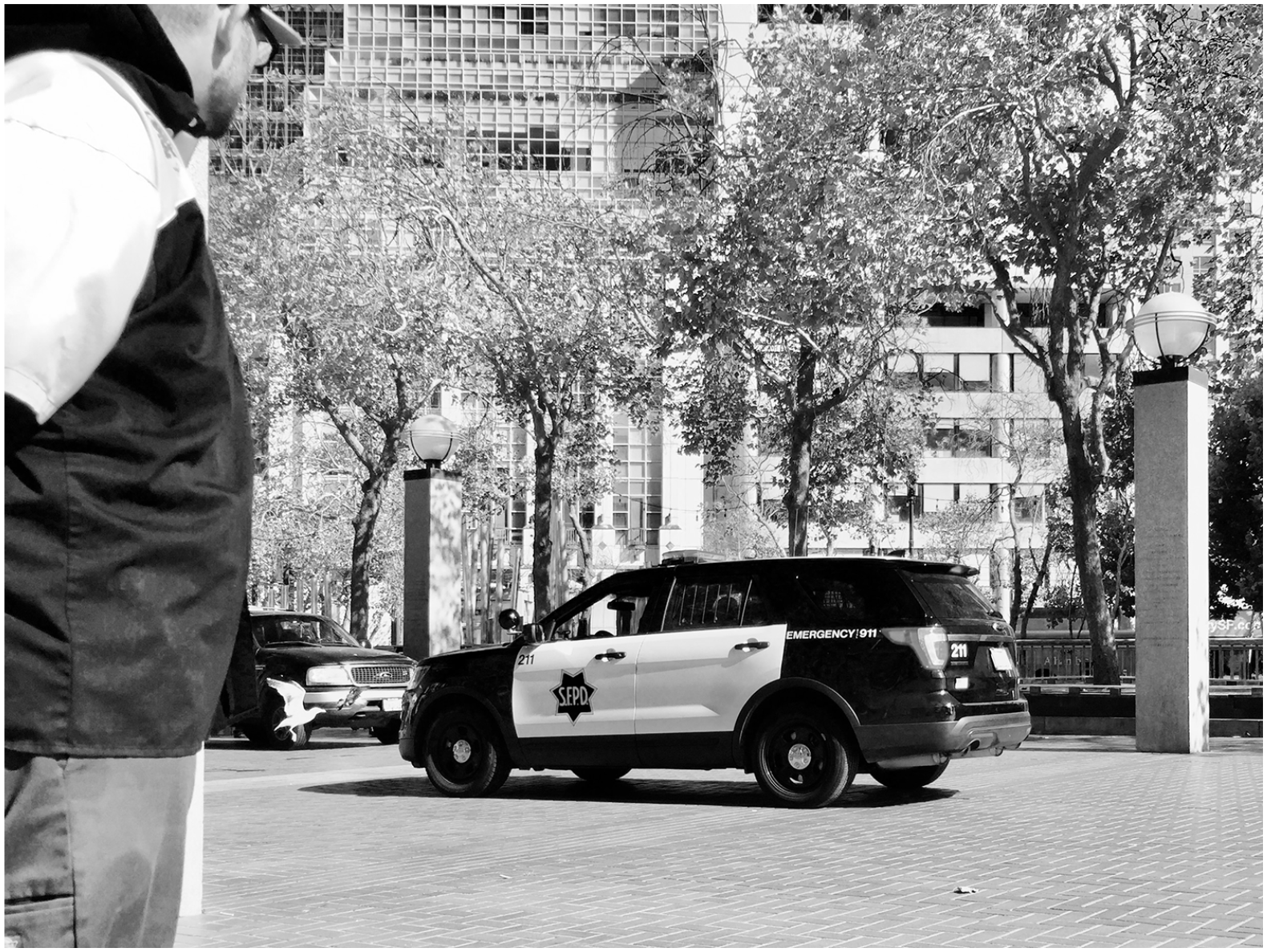
A steward and police car in the Civic Center.
Fragile form
Accounts of hostile urbanism often revolve around an imagery of obdurate artefacts, whose power derives from the capability to ‘close off’ 117 or ‘lock down’ 118 sites. For Malabou, plasticity certainly restricts deformation, 119 but there are ‘lines of fracture already inscribed within’ 120 that render things susceptible to the accidental – plastic entities carry clashing features that can be ‘both resistant and fragile, solid and ready to break up’. 121 This applies also to the prototypes, which are composed of affordable and removable parts prone to abrupt disintegration. Even so, their brittleness is less a limitation than an instigation to tighten control over places.
The design guidelines issued by the Planning Department state that permit holders for temporary installations should remove ‘debris, grime, and graffiti, and [. . .] keep all plants in good health’. 122 Handling the inevitable fragility of prototypes presents endless difficulties and leads to deteriorating and malfunctioning objects (Figure 4). Amira, a director at a local Community Benefit District – one of 16 non-profit organisations 123 funded through mandatory taxes paid by property owners to manage public spaces – emphasised that installations can turn into a significant expense and needlessly ‘complicate’ everyday pedestrian mobility: ‘we’re trying to help improve how people move on sidewalks and not [. . .] make it more challenging’.
The ongoing trouble of maintaining temporary structures is illustrated by the ‘guides’ of the Yerba Buena Community Benefit District (YBCBD), a sparsely inhabited, middle-income neighbourhood encompassing an assortment of hotels, restaurants and cultural institutions, including the San Francisco Museum of Modern Art and the Museum of the African Diaspora. Reminiscent of the stewards in the Civic Center, the guides have been hired with the purpose of ‘fostering a safer and more secure community’. 124 They perform a range of tasks, from assisting tourists and collecting rubbish to implementing the Street Population Outreach agenda 125 that steers unhoused individuals to social services. 126 The latter, following Hennigan and Speer, reflects the ‘ambivalent nature of care’ in responses to urban marginality, which sometimes combine ‘criminalisation’ and ‘compassion’ 127 to convince homeless people to ‘move along’ 128 and look for support in spaces away from the public realm.
The prototypes and their fragility aggravate these tendencies of displacement. Jamal, a guide, declared that he refrains from anything that ‘escalates into a problem’, although when requesting a person to leave it may be necessary to ‘irritate them, but in a nice way’. Among the sites overseen by Jamal and his colleagues was The Pause at Yerba Buena Lane, funded by the Summit Foundation, the YBCBD and the Exploratorium. 129 The installation consisted of seating areas, Whispering Dishes (Figure 2) and the Musical Bench (Figure 4), the latter inviting strangers to hold hands in order to complete a circuit activating piano keys in the armrest. According to the guides, The Pause attracted people who preferred ‘staying on’, disrupting its delicate plasticity by urinating, storing things inside and detaching components. The guides consequently engaged with individuals perceived as interfering with the artefacts, as suggested by a conversation Jamal initiated with Joe, who had been resting quietly by The Pause with his eyes closed and who, to avoid being asked to give up one of the few public seats in the neighbourhood, assured that he was not sleeping (Figure 5).
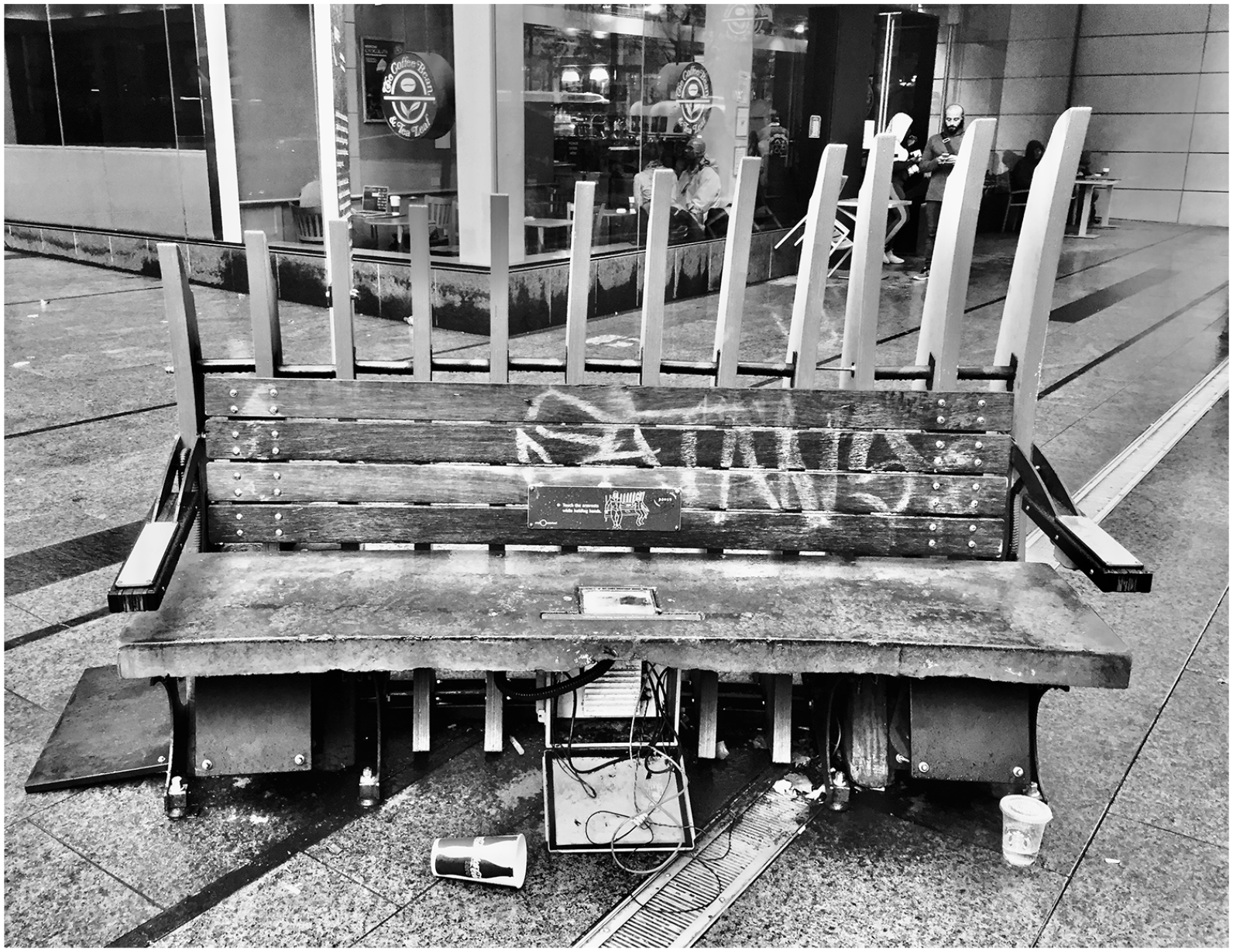
‘Musical Bench’ by Studio for Public Spaces.
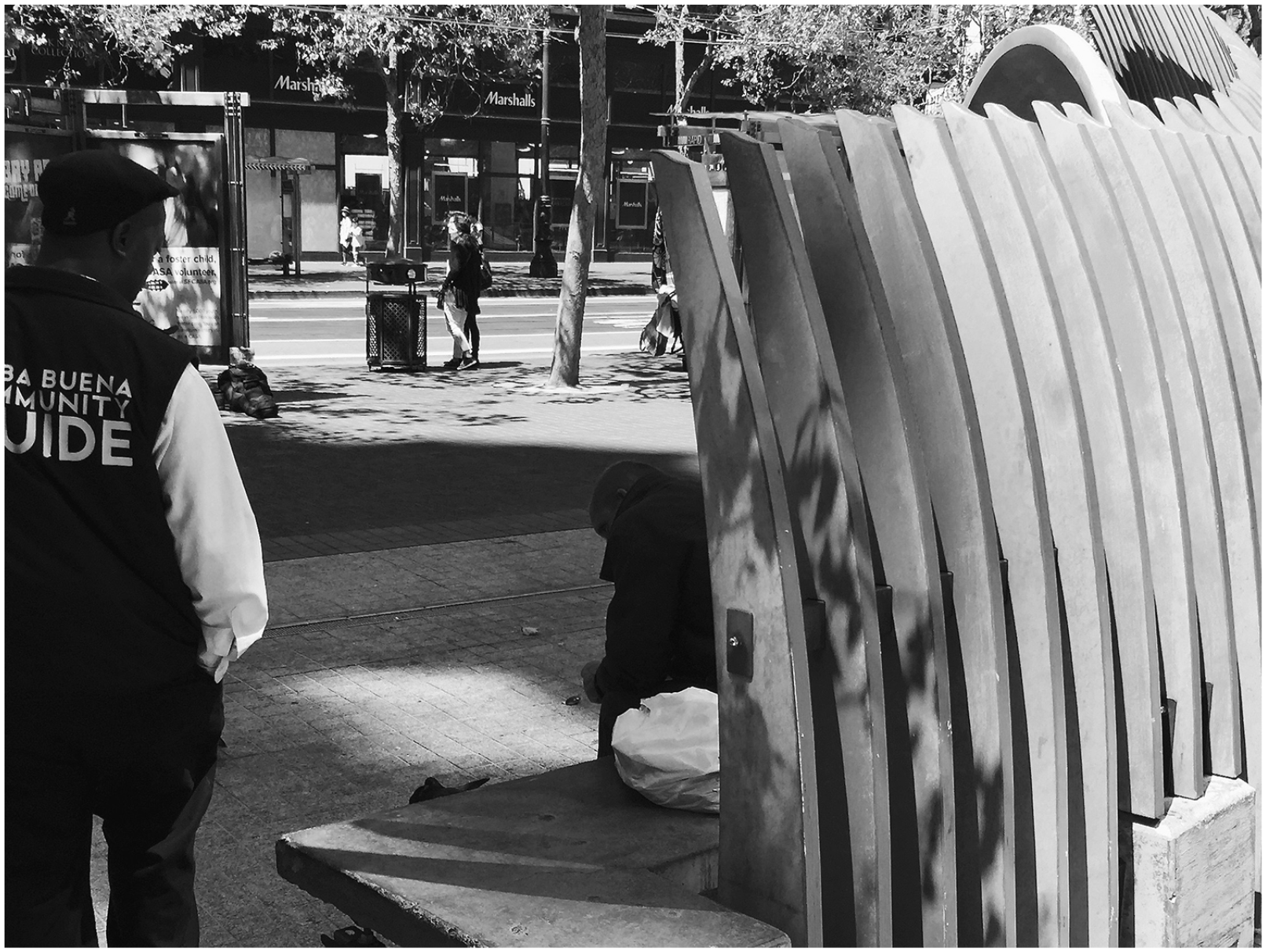
A guide talking to a person sitting at ‘The Pause’.
The housed residents of the district were equally invested in caring for space through a free application for reporting issues, from graffiti and rubbish to disturbance. 130 They shared comments and images with guides, who responded promptly and sent updates of completed tasks. While promoted as ‘participatory urbanism’, such platforms, as Gabrys notes, usually perpetuate ‘preidentified categories’ that limit attempts to solve abiding problems. 131 The housed residents, for instance, routinely adopted a comparable approach to unwanted persons as to any other inconvenient element on the street, occasionally circulating images of homeless individuals sleeping on the ground with belongings scattered around them. This distancing facilitated by an interface that labelled and listed cases with seeming neutrality – as ‘encampment’ or ‘blocked pedestrian walkway’ – turned unhoused people into obstacles and delegated the daily challenge of negotiating difference to actors other than the housed residents.
Evoking the call by Jacobs to ‘take care of the streets’ through increasing the ‘number of effective eyes’ to enable a ‘network of voluntary controls’, 132 these efforts revealed, after Tronto, how care can be utilised to ‘reinforce patterns of subordination’, 133 thus undermining narratives confusing care with ‘positive affect’. 134 Rather than widening concern for the city as a shared infrastructure, the prototypes and collaborative maintenance advocated by Groundplay directed community sentiment inwards by bolstering existing regimes of surveillance and construing homelessness as an ‘aesthetic’ issue of ‘disorderly’ behaviour assumed to endanger private property. 135 The frailty of temporary artefacts, then, served to legitimate particular claims to place and renounce others as threatening. As the section below demonstrates, when control over prototypes and thereby specific bodies eventually falters, the underlying destructiveness of installations manifests itself.
Destructive form
The lifespan of prototypes fluctuates, as ‘stewards in good standing’ can apply for an extension to the maximum term of 24 months and some objects disappear unexpectedly. 136 Apart from decay and vandalism, an installation may be eliminated when it seems beyond the grasp of influential actors, as indicated by Annie Street Plaza (2014–2016), an array of concrete blocks, chairs, tables and a stage for live events in an alley temporarily closed for traffic. The designer CMG Landscape Architecture and the funder YBCBD regarded the plaza as conducive to ‘permanent improvements’, such as ‘accessible and comfortable’ spaces and fewer cars, 137 as well as fostering a ‘sense of community’ and making the passage between Market and Mission Street safer. 138 In 2016, however, Annie Street Plaza was demolished, resulting in the suspension of long-term plans to redesign the alley (Figure 6). This was at odds with a report commissioned by the city 139 and a YBCBD consultation, which revealed strong support for retaining the plaza. 140 Factors behind the decision included complaints from housed residents about congestion and obstructed entry into parking garages – claims that conflicted with a traffic circulation study indicating a negligible rise in car numbers since the installation and the availability of alternative routes. 141 Another motive for animosity, as became evident at a public Board Meeting in 2016, 142 was the ‘filth’ and ‘stench’ around the structure and seeing ‘needles [and] men who are not clothed from the waist down. [. . .] No one is going to go there for a community event’. 143 Such criticism was disputed by a minority of attendees, whose statements echoed the above studies and their description of the tentative relations that had evolved around the prototype and pointed towards its civic potential. 144
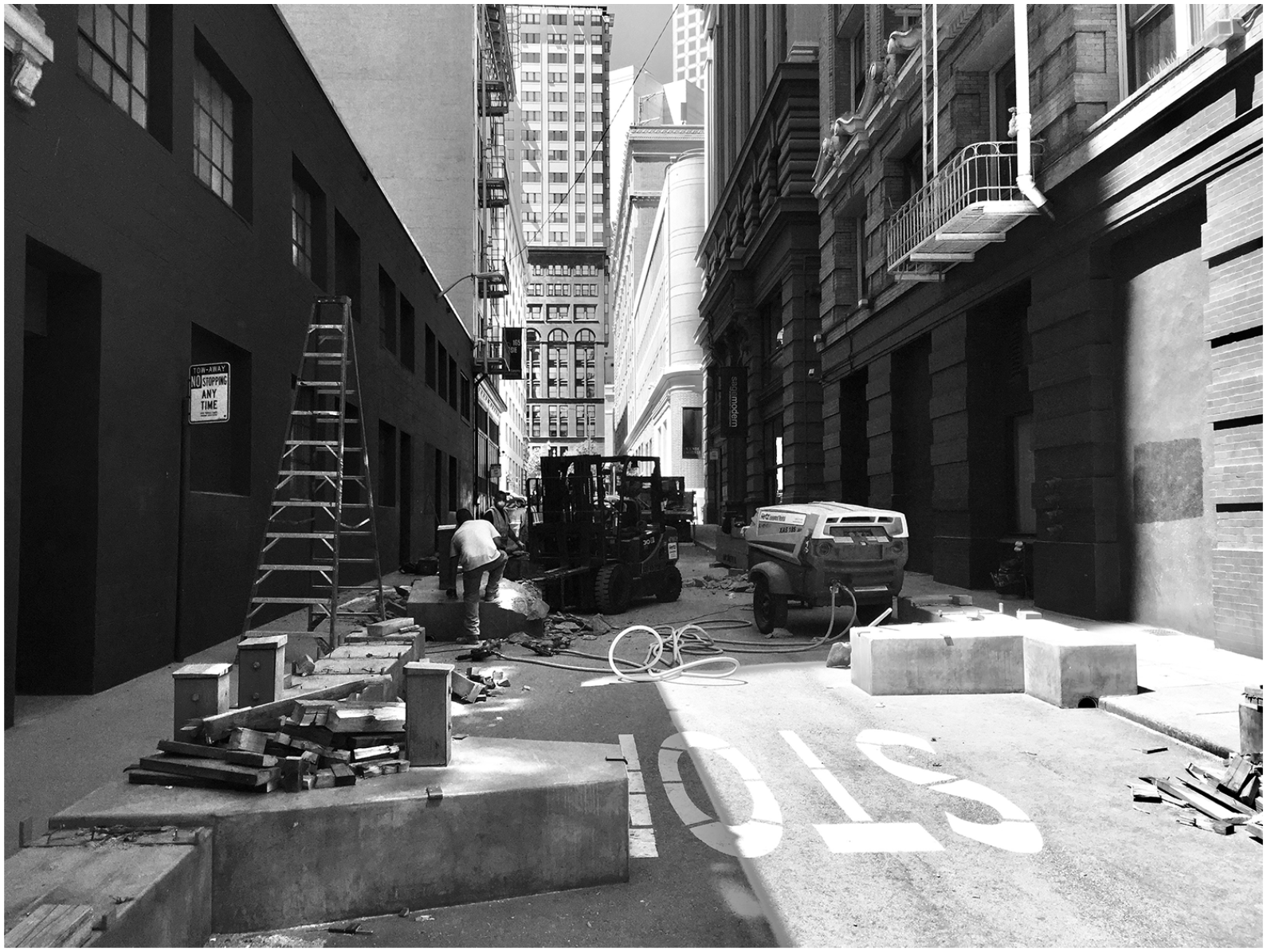
‘Annie Street Plaza’ by CMG Landscape Architecture under demolition.
While proponents of temporary urbanism often valorise disruption as a method of innovation, 145 the removal of Annie Street Plaza illustrates how plastic objects always contain the possibility, as Malabou writes, of ‘the violence of a gap that interrupts all continuity’. 146 Plasticity therefore diverges from the event-thinking of nonrepresentational orientations, 147 which prioritise the generative dimension of sudden destabilisations of reality, instead revealing the prolonged situations of vulnerability that occur as one form explosively changes into another. Against Groundplay’s normalisation of the rapid construction and destruction of places, plasticity brings into relief the damaging effects of such an accelerated process. For housed residents, removing Annie Street Plaza seemed a straightforward attempt at restoring order, but for homeless people this added to the irregular, yet persistent breaches that interfered with their ability to act and associate. 148
A similar dynamic hastened the demise of Block by Block (2015–2016), plastic and timber modules on Market Street that could be ‘stacked, swung, or pivoted’ for ‘performing, protesting, playing’.
149
Created by Hyphae Design Laboratory and funded by the Kenneth Rainin Foundation, the structure was dismantled without forewarning by the Department of Public Works on the assumption that it appeared unsanitary, attracted drug crime and caused noise disturbance – criticisms that were later moderated by Wayne from a nearby single room occupancy hotel: ‘I have back problems. I wish there was somewhere to stop and sit on Market Street, but I have to force myself to keep going [. . .] [Block by Block] was a needed convenience [. . .] There was some hostility against [it] that I didn’t feel was deserved [. . .] This neighborhood is a dumping ground, man. This is where you go when you ain’t got nothing’.
150
Such comments, stemming from a series of conversations among stakeholders, expressed frustration at the removal. 151 A designer referred to the general unwillingness to address the fractured reality of Market Street. 152 For a local gallery curator, Block by Block demarcated a unique place for interaction across difference, where ‘everyone sits together’, 153 while a business owner noted how the structure offered a marginalised, mainly Black or African American population a ‘safe haven’ from the tensions of the street. 154 Contrary to Groundplay’s vision of flexibility and reversibility, the dismantling entailed less a return of the site to its original state than a deepening of the ‘chronic’ trauma that, after Pain, has ‘layered up’ 155 in this setting, ‘where you go when you ain’t got nothing’, as Wayne observed. 156 For Pain, trauma may become ‘hard-wired’ in place through repetitive experiences of harm and the impossibility of escape. 157 The withdrawal of Block by Block thus allowed the surrounding hostile morphology to tighten its grip over dispossessed bodies by denying them rest and any sense of stability within the public realm. 158
Although the explosiveness of prototypes was converted to strategic ends by authorities, their actions betray flailing attempts to control the plasticity of the urban environment. Removing Annie Street Plaza and Block by Block appears a reactive gesture that hints at the unending struggles of managing the restless prototypes under the Groundplay agenda. Couched in a vocabulary of temporary urbanism, such endeavours have not redressed the anti-homeless manoeuvres that shape space in San Francisco. Rather, their destructive impact, following Bhandar and Goldberg-Hillier, ‘cuts [. . .] time from its mooring’ 159 not simply by interfering with present efforts of unhoused people to inhabit specific locations, but by erasing the past and the future of places – for instance, through obliterating attachments that diverse groups have cultivated to a site over time or through hindering the concerted mobilisation of prototypes for imagining and encouraging other urban forms.
Discussion: plastic urbanism
The objects described in this article have since disappeared, but the menacing plasticity of urban policies and practices persists, its erratic and explosive power heightened by the Covid-19 pandemic that drastically worsened the conditions for the unhoused population of San Francisco in 2020. As an alleviating measure, authorities initially established a set of ‘sanctioned encampments’, notably at the Civic Center, where a number of tents were allowed inside a fenced area offering basic services, such as meals, toilets and showers. 160 Alongside these restricted and transient areas, however, ‘sweeps’ of unofficial encampments proceeded unabated, suggesting, in a telling parallel to the prototypes, a further strengthening of the closures that delimit and disrupt the existence of marginalised bodies. 161
A plastic reading, then, directs attention to the capture of place by contradictory determinations that render urban entities finite and fragile. 162 The concept of plasticity calls on cultural geographers to qualify narratives that affirm the city as suffused with amorphous vital forces undergoing endless modulation – an assumption that has also insinuated itself into critiques of neoliberalist urbanism, which often regard power as omnipresent and productive. Instead, Malabou maintains the negativity of being, or the inevitable ‘limits of capacities [. . .] and relations’ 163 that may detract from rather than add to the world. 164 As such, her thought indicates a connection between plasticity and ‘urban trauma’, providing useful resources for exploring how place can become, as Pain demonstrates, a perennial ‘source of violence’, 165 sustained, as in San Francisco, through artefacts that appear benevolent, while really carrying the constant threat of explosion and lasting damage.
Admitting to a plastic urbanism involves neither resignation nor, as Malabou emphasises, a ‘terrorist conception’ of the city. 166 It requires vigilance for lines of fracture embedded within urban form that might deepen due to a triggering event and thus lead to a ‘retraumatisation’. 167 The prototypes, for example, largely overlooked the history of economic and social divisions in the public realm of San Francisco and their regular manifestation as callous acts, from the elimination of seating to the escalation of policing. Although not necessarily intended as exclusionary, Groundplay seemed oblivious to these morphologies of victimisation and notably their uneven impact on Black or African American people. Accordingly, the floundering attempts by policymakers, practitioners and other privileged agents to control the prototyping process by way of design guidelines, stewardship work and participatory monitoring only managed to intensify prevalent closures.
And still a plastic urbanism and its destructive propensity could counteract excessive control and facilitate alternatives. While the language of disruption figures widely in temporary interventions across Euro-American cities, its potential is subsumed by capital and engrained modes of governance. 168 Malabou implies an orientation that might deploy plasticity as a ‘critical test’ of the dominant order, if allowed to evolve through ‘ruptures and resistance’ 169 that eradicate harmful objects – as Crowley remarks, ‘sometimes [. . .] destruction is the only transformation’ possible. 170 This demands a willingness from authorities to welcome the accidentality of urban form, whether its effects appear desirable or not, rather than an endeavour to suppress challenging encounters, which diminishes opportunities for a collective appraisal of planning schemes seeking to shape civic futures. Above all, such an approach needs to be grounded in an acute sense of the finitude and fragility of place and consequently a commitment to mitigate the disproportionate violence and vulnerability caused by urban change.
Footnotes
Acknowledgements
I am grateful to the San Francisco-based participants, who gave their valuable time to the study. I also want to thank Noel Cass, Harriet Hawkins, the Editor of cultural geographies, and the three referees, whose astute comments have considerably enhanced this article. Except for publicly available material, for which sources are provided, the data have been anonymised. All remaining errors and omissions are mine alone.
Ethics Statement
The project obtained ethical approval from the host institution, whose procedures concerning participant consent and confidentiality, as well as data management and storage, were followed rigorously.
Funding
The author disclosed receipt of the following financial support for the research, authorship, and/or publication of this article: The study was conducted as part of a European Research Council project (323777).
