




Abstract
Food banks are a growing feature of austerity Britain. Despite this, little research has focused on the object central to their operations: the food they provision. In charting an attempt to “open” food bank parcels to greater scrutiny, this article highlights the need to take back taste from predominantly nutritionist framings of food. Drawing on recent work in more-than-representational and visceral geography, it is argued that taste must be understood as an embodied, sensorial and social phenomenon. However, this article highlights the ethico-political dilemmas that accompany such an undertaking, and the wider implications raised by studying the tastes of socially and economically marginalised groups. These tensions are explored through recourse to the political, ethical and epistemological stakes of auto-corporeal methods – in this case, employing my own tasting body in consuming a “food bank diet.” In arguing that such an approach is necessarily wedded to forms of failure and privilege, this undertaking reveals the need to scrutinise the more-than-tasted features of power and space that shape the relational landscapes of Food Bank Britain. By working with these failures, this article concludes that the potential of such corporeal methods lies not in producing “data,” but instead in unlearning and scrutinising one’s embodied privileges in the face of poverty.
Keywords
Introduction
‘You discover that a man who has gone even a week on bread and margarine is not a man any longer, only a belly with a few accessory organs.’
1
A memoir of his experiences “on the breadline,” George Orwell’s Down and Out in Paris and London provides an experiential account of impoverishment during the Great Depression. Through investigative ‘tramping expeditions,’ periods spent living in dilapidated housing, and casual work as a dishwasher, Orwell’s method is what we might now describe as auto-ethnographic. In aiming to learn the carnal, sensual, visceral, and material aspects of poverty, Orwell’s approach also prefigured the more-than-representational scholarship that has proliferated recently in cultural geography.
Food was a prominent feature of Orwell’s work: the writer tasted poverty to learn about the lives of the immiserated. But given Orwell’s self-professed “lower-upper-middle class” background, tasting poverty required him to experiment with food – where “experiments involve. . . a purposeful changing of state, to push towards a point of transition, or passing of a threshold, in order to explore how thresholds are produced that demarcate one state from another.” 2 Orwell sought to change the state of his own body and pass his embodied thresholds of taste to demarcate his privileged lifeworld from the poverty he sought to learn about. The outcomes include evocative accounts of embodied effects. Amongst a range of striking observations, Orwell 3 tells of how the diet afforded by poverty “reduces one to an utterly spineless, brainless condition,” as though “one had been turned into a jellyfish, or as though all one’s blood had been pumped out and lukewarm water substituted.”
Placing poverty through the language of bodily feeling and function creates an uncomfortable effect upon the reader. Orwell’s ambition was to use this discomfort politically: by learning and communicating these embodied features of poverty, Orwell sought to build consensus for structural change. The lengths the writer was willing to go to achieve this seems worthy of our respect: so too is the legacy of a book that continues to be widely read nearly a century after its publication. But the dilemma Orwell’s approach raises – and the question that animates this article – is: can, and should, the tastes of a privileged body function as a way of learning about impoverished worlds?
Critically, any attempt to occupy the position of the Other – to eat like them, to taste like them, to experience being and becoming Other – produces a dangerous sentiment: that one can, and should, experiment with lifeworlds. It assumes that one can demarcate one’s Self from the privileges afforded by life history, occupy a particular portion of space and time, and emerge from this enterprise with the resources to apparently speak of this position of Otherness. In such an undertaking, the lives of others are reduced to encounters to be consumed by those with an apparently superior ability to interpret such worlds. The auto-ethnographic approach practised by Orwell risks speaking for and over those in poverty: the voyeuristic point of view is reified at the expense of the vernacular.
It is, of course, harsh to single out Orwell in this fashion (who was, after all, writing as a journalist and commentator rather than academic researcher). Nevertheless, his work demonstrates that even those accounts that seem most empathetic and politically progressive still raise thorny relationships between knowledge and experience, Self and Other, power and privilege, that define the conceptual, political and ethical limits of what it means to learn.
This article explores the stakes of learning through an attempt to “take back taste,” a conceptual endeavour defined as “a daily project of illuminating the mechanisms through which power surrounds and penetrates the human relationship with food.” 4 Grounded in the case study of Food Bank Britain, it proceeds from the uneasy position the author holds as both food bank volunteer and researcher – a dual position that compromised the traction of “traditional” methods for taking back taste. In responding to this failure, this article traces the potential of auto-corporeal methodologies by reflecting on the author’s attempts to eat a “food bank diet.” Rather than offering epistemological claims about the tastes of food bank users, it is argued that auto-corporeal methods provide a route for unlearning the tacit, everyday and embodied privileges that exceed those described by abstract signifiers of class, ethnicity, gender, and so on. 5 It is concluded that understanding the relations between taste, food and power can help to better attune to research by scrutinising one’s privilege in the face of poverty.
Taking back taste in food bank Britain
Food banks are charitable organisations that receive and sort food donations before distributing these items to those they deem to be hungry. Whilst well established elsewhere (notably North America), their rise in the UK has been more novel. Intertwined with a decade of austerity, the growth of food banking has correlated with cuts to public spending and the welfare state pursued by successive Conservative-led governments since 2010. 6 The reach of these institutions is evidenced in figures from the Trussell Trust, a Christian charity who operate around half of the country’s over 2,000 food banks through a franchise system. 7 In 2019, Trussell Trust food banks alone distributed 1.6 million packages of 3-days-worth of emergency food 8 – a 26-fold increase on figures from a decade previous. 9
Striving to map the quantitative reach of food banks, scholars have identified national and regional trends, 10 highlighted the social groups more likely to receive provisions, 11 and scrutinised broader geographical developments. 12 Running parallel have been efforts to gather qualitative insight into ground-level operations. Here, geographers have been concerned with unpicking decisions made over provisioning, 13 the political technologies exercised by those manning food banks, 14 the life histories and geographies of their users, 15 and the fundamental political questions food banks raise. 16 Despite the sophistication of this literature, one central feature remains under-explored: the food itself. Studies have tended to map food bank parcels or analyse the operations of power they underpin without ever “opening” their contents to more direct scrutiny. Moreover, where food bank parcels are “opened” by researchers, they are treated through a particular lens: nutritionism. 17
Nutritionism privileges a certain geographical framing: of a particular scale (the molecular, rather than the wider materiality of food), space (laboratories and academic institutions, rather than intimate, everyday spaces), and way of knowing food (the expertise of nutritional scientists, rather than the vernacular feelings of eaters). Whilst measures of molecules provide insight into the relationship between the biological body and provisions, this approach produces a “nutritional gaze” that “overwhelms other ways of encountering and sensually experiencing food.” 18 The growing field of more-than-representational geographies signals a way of engaging with food that challenges these limits 19 – and which holds the potential to see “eating as something other than a passive transference of energy from eaten to eater,” 20 through an appreciation of the cultural, experiential and bodily politics of taste. 21
Taste exists within a social ontology of the body – where the body is not a closed system but constituted by, and constitutive of, normative scripts. 22 Food acts as a vehicle for distinguishing and differentiating bodies and spaces. This is in the sense of personal biography, as foods are intertwined with our social identity and position in space, 23 and also how relationships with food are open to judgement and regulation through which markers of class, gender, ethnicity, sexuality and location are performed through hierarchies of taste. 24 This politics of taste demonstrates how “food is an active inducer-producer of salient, public effects, rather than a passive resource at the disposal of consumers.” 25
But bodies are more than products of social norms. As Slocum 26 has argued, “eating is a social and biological process, but the emphasis given to discerning the power of the social to form food and bodies directs attention away from the materiality of both.” Bodies play an active role in a further meaning of taste, then: one that is visceral. 27 In its most literal form this is through our taste-buds – the sensations, affects and processes that unfold as food enters our bodies. However, taste is something that is multi-sensorial and takes place not only in the mouth: it is intertwined with the nose and ears, the fingers and hands, the eyes, the brain, and so on. This second notion of taste is an understanding of food “from the body out” 28 – within the “bodily realm where feelings, moods and sensations are manifest.” 29 Through its permeability, openness and agency, the visceral body demonstrates how we are simultaneously meaning, matter and molecule. 30 Food banks cannot be understood by counting the calories their users receive, then. Failing to account for the sociality and viscerality of food, in understandings of food banks at least, means “the power of taste has not been merged with a discussion of the broader politics of food.” 31
The challenge of taking back taste
As food bank numbers escalated, I was undertaking doctoral fieldwork in the Valleys of south Wales – one of the most deprived regions in western Europe.
32
The project constructed a “people’s geography” of poverty through the vernacular testimonies of those experiencing immiseration.
33
Upon contacting the local food bank, I was invited to attend a session. Seeking to take back taste, I arrived with the intention of being an observer to what would unfold. However, as I noted in my fieldwork diary, this illusion of the objective, distinct researcher was soon broken: “There’s no way I can sit and observe in a place like this, amongst the urgency of volunteers and the tension of those coming in. People here urgently need food, and as the donations come in, they weigh a ton. . . None of the volunteers are any good with computers, the system is a mess and there’s work to be done all the time” (September 2014).
I was inducted as a volunteer upon my next visit and worked in this capacity twice weekly for 15 months. However, rather than a “perfect fit” between research and volunteering, 34 my experience was marked by constant tension with the principles of the Trussell Trust model and its complex vital politics of provisioning. 35 Underpinning this model was a metric that measured and mapped those in receipt of food as matters of grams over time and space. The symbiosis between this model of charity and the nutritionist framing of food critiqued earlier was more than incidental. Emphasising forms of rationing, 36 the voucher system employed meant receipt of food was contingent upon clients providing details including age, address, work situation, ethnicity, and their reason for needing food – data which was recorded electronically and used to determine future provisioning.
The hunger presented by potential food bank users was something I was expected to (and increasingly did) treat with suspicion. As I came to “see like a food bank,” my volunteering felt not a service to those who were hungry, but to the Trussell Trust system itself. Rather than providing a position from which to consider taste, I was obliged to enact the technical renderings of food I was attempting to critique. My desire to take back taste became more than an attempt to learn about food banks, then: it was also about scrutinising these uneasy, embodied relations. In response, I embellished my ethnography by interviewing food bank users. But whilst this elucidated some of the contexts felt and performed,
37
the topic of taste was harder to discern. Responses to inquiries about the food bore the imprint of gratitude in a hermeneutic where I was inevitably viewed as both an interviewer and as a volunteer with the power to provision. This meant that food bank comestibles were described primarily through their alternative: the absence of food: “It’ll mean we’re able to eat, and for that I am very grateful. At least we’ll be able to eat now, which will be absolutely wonderful. Thank you so much.” “It’s so humbling. . . Is that the word? It just makes you feel so grateful. It will make a hell of a lot of difference. It means that I can have a dinner tonight.” “The food is fine, it’s either that or nothing so yes I’m happy with it. . . It’s basics, but it’s something. It will mean we get supper tonight.”
Where I was able to elucidate further response, interviewees treated food in a self-referential manner through comparative reference to comestibles not as sustaining or palatable: “My daughter will be able to come home from school and there’ll be something there to eat for her. Last night she had tea and biscuits for tea. All she could do is dip the biscuit in the tea.” “It’s a great help. I’ve spent the last weekend just living off sandwiches alone.” “I’ll be able now to go and have a decent meal instead of just having toast again.”
These responses evidence the limits to methods that emphasise talk and speech, where the bodily, sensory and visceral aspects of taste are difficult to re-present. 38 Efforts to deepen my engagement through other methods were similarly fruitless, for two reasons. This firstly related to the wounding effects of shame widely reported to accompany food bank usage, 39 which risked compromising ethical principles of “do no harm.” During initial attempts to recruit participants into further research (specifically, food diaries), individuals appeared flushed and struggled to find excuses as to why they could not take part. Expecting participants to further dwell on the source of this shame – to write and record it over a longer period, and to have this process enter the intimate spaces of their lives – created a tension between desired privacy and the sense of obligation for having received a food package. It felt unethical and inappropriate to further (re)produce this tension.
Secondly, there was no guarantee that longitudinal methods such as food diaries would have broken this cycle of self-referential responses ultimately tied to my dual volunteer-researcher status. As I found on occasions when I did encounter people outside of the food bank, I was still recognised through my institutional identity. In different settings and spaces, there may have been better routes to achieving this work. But for the purpose of my project, where I inhabited a compromised position and where I, an inexperienced social researcher, was particularly conscious of the risks of doing harm to participants, I was instead left to dwell on my failure to take back taste.
(Un)learning with the tasting body
Auto-corporeal methodologies
Despite such moments of closure being constitutive steps in the production of academic knowledge, in geography, as with academia more widely, there is little space afforded for reflecting on failure. 40 Moreover, when failure is scrutinised, it is often through the rubric of “overcoming,” rather than trying to learn from, its existential, epistemological and ethical underpinnings. 41 Failure portends the more fundamental question of what it is to learn. 42 In my case, learning was distinctly limited by virtue of my situated relations in the field. But my twin desires to take back taste and to better relate to those I was provisioning remained. Indeed, the contradictions of my situation were felt more keenly following this failure. I was unable to ascertain the tastes of food bank users yet was directly determining their outcomes as a volunteer; I desired to challenge nutritionist framings yet was actively reproducing these logics as I embodied and exercised the food bank system; and rather than finding better ways of relating to those I was provisioning my approach had left me feeling even less informed.
If method is a “way of being,” then all research necessarily involves the social and symbolic insertion of ourselves into the universes we study. 43 Given these tensions related primarily to issues stemming from my position in the field, I decided to turn my critical attention to my own body, and ask: what could I learn with my own tastes? I wagered that inserting my body more squarely into a world where I was already embodying the food bank system might allow me to scrutinise the aspects of taste that defy textual representation, without risking harm for research participants. I was already sorting, handling, and provisioning these food items: tasting them seemed like a progressive act in this context.
Despite its potential, writing through and about the self has been historically under-utilised in geography, 44 where the body of the researcher has, until recently, been marked by a “ghostly absence.” 45 This deficiency is understandable: writing about myself in the lines that follow has felt self-obsessive, arrogant, and un-academic. This perceived disconnect between writing about the self and “academic rigor” stems from the longer history of a discipline marked by dualisms: between researcher and researched, interpreter and interpreted, feeling and knowing, subject and object. 46 When it comes to the topic of food, though, these dualisms quickly collapse. We all eat, hence there is no objective position from which to study food. Both the feminist and more-than-representational “turns” in cultural geography have therefore been influential in shaping recent work that has examined embodied approaches to eating. 47 These studies have developed methodologies for studying the tastes of others that are attuned to the “mutually constitutive relationships between bodies and food.” 48 Yet, as my failures demonstrate, learning about these constitutive relations in the lives of food bank users has distinct limits.
Alternatively, a smaller (but growing) body of literature advocates using the researcher’s body as a methodological “instrument.” 49 Envisaging research as “body work,” this has focused on scrutinising “bodily becoming as a kind of research technique.” 50 Such an approach is necessarily experimental, taking as it does an interest in how researchers can change their corporeal realities to learn afresh. 51 Wacquant describes work of this nature as underpinning a “carnal sociology” of “flesh and blood” built on an appreciation of humans “as a sensate, suffering, skilled, sedimented and situated corporeal creature.” 52 His is a vision of social inquiry grounded in the belief that “every social agent. . . comes to know his object by body,” so that the corporeal presence of the researcher itself might grant novel insight through its “social and symbolic insertion into the universe he studies.” 53
The potential of such “auto-methods” lies in their ability to “trail pathways through one’s own inhabitation” that provide situated theorisations of experience in order “to analyze the complexities of power.” 54 But if auto-corporeal methodologies are to be anything more than “an endless and politically empty process,” then the impetus must be on situating our bodies within structures of inequality and relations of exploitation. 55 This is because food is more than fuel, just as bodies are more than machines. Tasting and consuming food are irresistibly relational acts that connect citizens, states and markets, social order, and affective and biological life. 56 Could my own body, therefore, truly tell me anything about taste in Food Bank Britain? Researching and writing with, rather than merely about, the body necessitates that I situate my own corporeality within these relations of food, power, time and space.
(Un)learning the tastes of privilege
My taste is not natural but shaped by structural advantages that in turn determine my position in systems of classism, patriarchy, racism, heteronormativity, ableism, and so on. 57 As a white, able-bodied, middle-class male, I have maintained a privileged relationship with these systems that has shaped how I have been able to eat through my lifecourse. Growing up, my entitlement to food was secured through parental provisioning. When I left home to attend university, I was in receipt of means-tested bursaries, academic scholarships and government loans that enabled me to purchase food without the worry of where and when my next meal would arrive. 58 As importantly, during the time this research was undertaken I had no direct duties of care, so faced no conflicts between my own desires and ensuring the subsistence of others. In other words, any times I have felt pangs of hunger have been temporary, and personally rather than structurally imposed.
However, placing myself within relations of taste necessitates treating privilege not merely as an abstract signifier of difference or as dichotomous to disadvantage, but as something that seeps into the microgeographies of my everyday life. 59 This is a challenge, precisely because my own relations with food appear to me as natural and mundane. Whilst “privileges are tangibly felt in everyday lives,” as Twine and Gardener 60 note they are “often masked” and “by no means a fixed relation.” In shaping our existence in tacit ways, the normalisation of privilege is a central tenant of its operation. Scrutinising the politics of my own tastes is therefore a necessary first step in pursuing auto-corporeal methodologies.
On a regular day, I eat three meals: breakfast, lunch and dinner – a routine I have followed for as long as I can remember. But this regularity is also complemented with snacks I consume to stave-off a rumbling stomach and shifting moods. This mixture of routine and responsive tailoring reveals the extent to which my tastes emerge in constellation with the changing wants of my body. Illustratively, my breakfast remains more-or-less consistent: cereal with milk. But the type of cereal I consume is shaped by market (which cereals are on promotion at my local supermarket) and social pressures (to eat “healthily,” namely a low sugar and high fibre option), as well as habits and preferences of taste. Whilst I mostly have bran flakes, the portion size will vary based on my sensed hunger. Moreover, oftentimes I’ll have an alternative cereal precisely because I feel like something different. I might opt for something with a higher sugar content, desirous of the “kick” in energy and mood that comes from something sweet. 61 Then there is the question of accompanying beverage – a strong black coffee for when I know I have a busy morning, or tea with milk for a day I think will be less hectic.
Lunch plots a similar route through the pressures and forms of agency that pattern my tastes. When undertaking fieldwork, my priority is for food to consume “on the go.” Thus, along with sandwiches I prepare in the morning from bread and cheese bought at the supermarket and transported in an air-tight box, crisps and bars of chocolate are my preference: items that fit efficiently into a rucksack without refrigeration. Crucially, their mobility is more important than their cost (offset by buying “own brand” items in large multipacks) and notorious nutritional contents.
My evening meal unfolds differently, mostly taken as it is at home. Whilst sometimes a “quick and easy” meal is a preference – especially after a long day, or when experiencing a general mood of tiredness – my dinner is often a moment of creative expression. I enjoy preparing food: the pairing together of different flavours, ingredients and dishes provides a sense of craftsmanship which stands in counterpoint to the often-cerebral nature of my workday. My dinner is therefore a ritual for transitioning from work to leisure, day to evening, labour to indulgence. 62 During the time this article was conceived, and the fieldwork underpinning it completed, cooking was also an important ritual in performing my embodied connections and performances of place – where following familiar recipes helped me feel more “at home” whilst living alone in a new town. 63
It would, of course, take up the entirety of this article (and more) to give a full account of taste. But even in this short exegesis, its microgeographies are shown to be marked by a set of market, social and individual pressures – of having to fit food relationships around work and social reproduction. My agency is also clear in navigating these pressures, most squarely through my enactment of choice – my ability to influence what, when and how I eat, to attune my habits with my carnal and affective wants, and to use my tastes as a site of creativity, pleasure and expression. The nature and extent of such choice is not universally accessible to all. It is also fashioned by the social boundaries of taste, where different bodies are open to variegated forms of judgement. 64 Privilege shapes taste not merely as a matter of quantities and qualities of food, then, but influences the processes of power that frame everyday eating.
If privilege is so thoroughly and differentially embodied, then an initial response might be to brand any auto-corporeal investigation a further instance of research failure. But, in again seeking a broader reckoning with failure, another avenue is to consider taste through the wider stakes of learning. For Spivak, education is a dialectic between learning and unlearning – where to learn anew requires us to scrutinise what we have already come to know. Spivak contends that our engrained privileges prevent us from understanding the lifeworlds of others, leading us to certain forms of “loss” (including lost understanding, lost empathy, lost appreciation of what constitutes knowing). Unlearning, then, necessitates a scrutiny of the self – where understandings of “over there” require contemplation of the “here,” and where claims made in the process of “fieldwork” must in turn be grounded in “homework.” 65 For Kapoor, this means “casting a keen eye on the familiar and the taken-for-granted.” 66
To “analyze, illuminate and challenge power” relationships by bringing into relief the workings of privilege is therefore in tune with the project of taking back taste. 67 Rather than substituting my body in place of that of a food bank user, an examination of my own tasting body might navigate learning and unlearning through my compromised and contested experiences of taste. It asks: what tastes do I take for granted? What are the unarticulated privileges in my relations with food? And, by examining how these relations are exposed when consuming food bank comestibles, what might this approach reveal about the politics of taste?
Tasting food bank Britain
The “food bank diet”
Utilising the Trussell Trust’s set menu for an adult, I purchased items to fit a “food bank diet” (Figure 1). To best reflect the types of food distributed, I bought the cheapest (“budget range”) products (Figure 2). 68 I followed a pescatarian diet (a level of tailoring built-in to Trussell Trust set menus) for thirty consecutive days, comprising ten packages of produce that were consumed sequentially (meaning I did not transfer surplus items between 3-day periods).
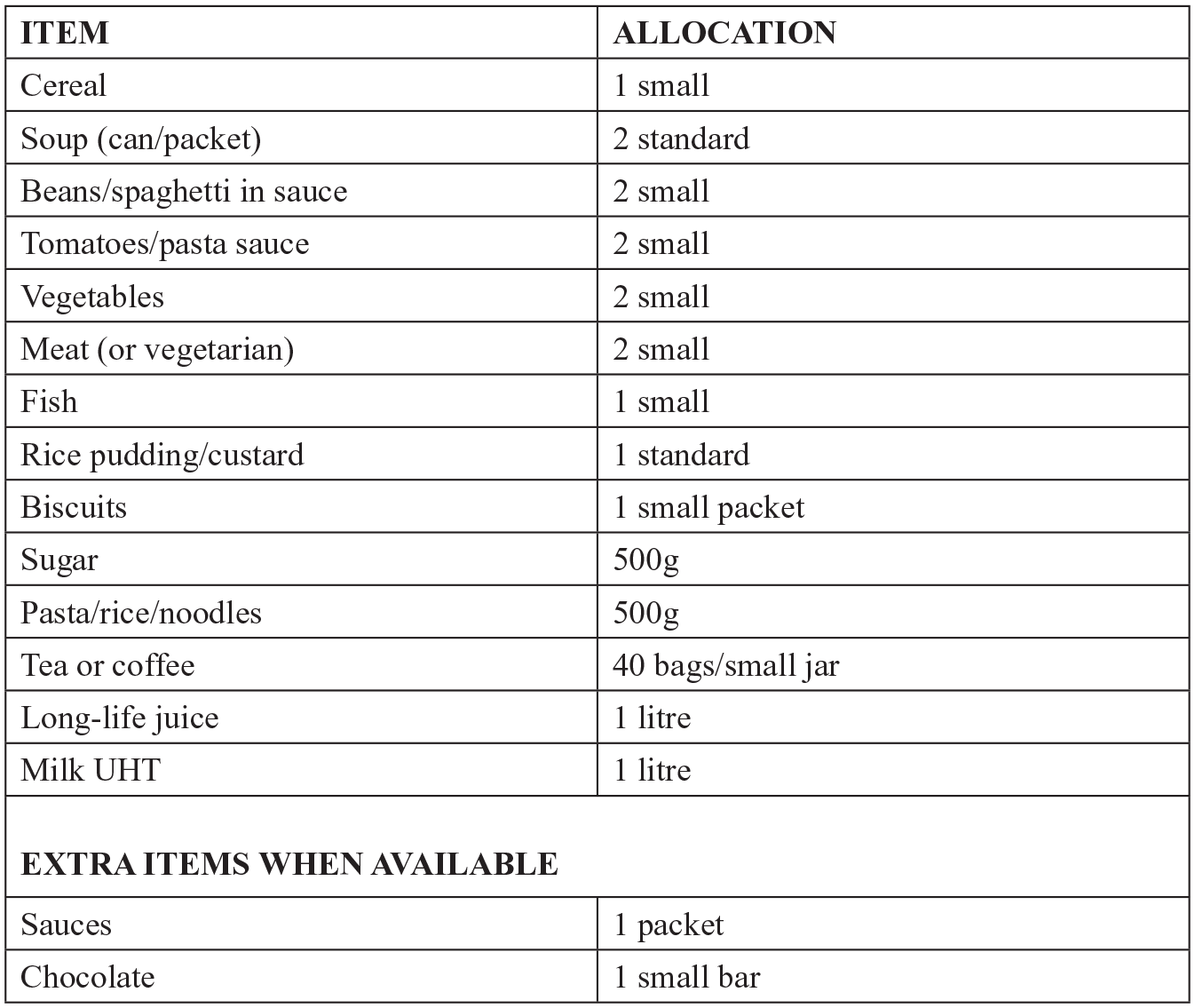
Trussell Trust foodbank menu for 3-days subsistence for a single occupancy household.
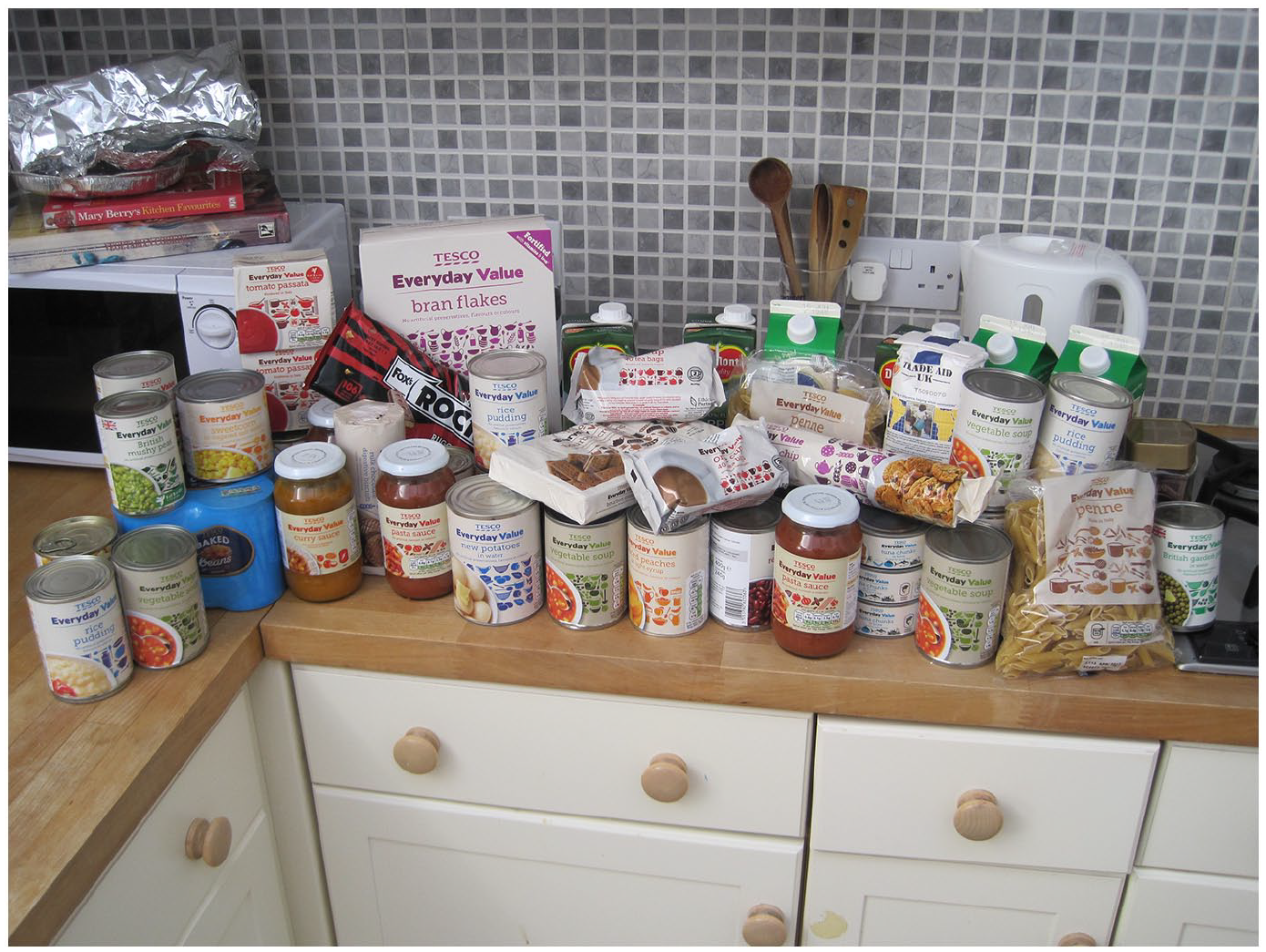
The contents of three packages of food bank provisions, designed to last for 9 days. Photo by Samuel Strong.
I opted for a calendar month because this is the average length of time new claimants of Universal Credit must wait before receiving their first payment. 69 When this diet was consumed (in 2015), Universal Credit was being rolled out in my field-site, and these delays became the most frequent reason given for needing food bank provisions. 70 Nevertheless, there are issues with this temporal scope. Whilst benefit delays and changes drive two-thirds of food bank use, 71 this is not a uniform pattern of time for all. Furthermore, people would not necessarily eat food bank provisions over consecutive days, especially if the Trussell Trust policy of distributing only three packages of 3-days’-worth of food every 6 months was being strictly followed (which is by no means always the case 72 ). Moreover, people using a food bank will likely have some ability to supplement their diets, whether through market-based or informal means 73 – which is not reflected in this undertaking. Finally, I did not constrain other social, material and economic aspects interwoven with one’s experience of taste (see 5.3).
To track my experience, I kept a fieldwork diary and photographic log. This included reflections not only on consumption, but also preparation, storage and transportation – as well as the moments I felt the effects (and affects) of food. Here, I sought to capture my changing taste beyond eating alone, and into my lifeworld.
Sensuous disposition, social distinction, sedimented privilege
The taste of food bank provisions was apparent through its interplay with my bodily senses. But this was neither a linear nor straightforward process. “Taste,” as Hayes-Conroy and Hayes-Conroy 74 note, “will always be differential and particular,” interwoven as it is with one’s lifeworld. Eating a food bank diet therefore progressed through my existing “sensuous disposition” 75 – a historically sedimented disposition marked by the aforementioned privilege of choice that was compromised by my new relations with food.
Previously I took pleasure in purchasing, preparing and consuming foods to match my moods and desires. But the food bank diet seemed to highlight functionality over sensory diversity. There was less variety – both in the items I consumed and the array of sensory characteristics stimulated (its taste in the mouth as well as the smell, look and feel of the food) – than my previous eating habits. I was struck by certain features I was unfamiliar with: foods that seemed too dry, watery, thick, bland, or bitter, compared to my sensorial expectations: “This meal is the worst I’ve had so far. The sauce is like water and there isn’t anywhere near enough to cover the rice. . . it’s actually a struggle to chew, despite my hunger” (DAY 5).
Consumption often entailed discomfort eating, indicating how “a visceral response like that of disgust gives clues to how a person inhabits the world”
76
(Figure 3a and 3b). Distaste, then, was not a property of food bank provisions themselves, but emerged from the conflict between my existing sensuous disposition and the stimulation of these new comestibles. This conflict was not merely cognitive: it was also present in my body’s changing processes. Sedimented over time, the expectation of three daily meals and snacks presented as an embodied rhythmic habit of eating – one that my body reminded me of frequently. That I did not find these foods as “filling” was confirmed by the hunger pangs of the mid-afternoon, a period in-between my (pre-food bank diet) lunch and dinner timings. My stomach would rumble, my mouth would fill with saliva and, on occasion, I experienced headaches that would compromise concentration: “It is making me feel tired and I have a headache, which I think might be linked but I’m not sure. The food is just not sufficient to fill me up” (DAY 11). “2:30 pm. I am really hungry. I think it has a noticeable impact on my driving even” (DAY 7).
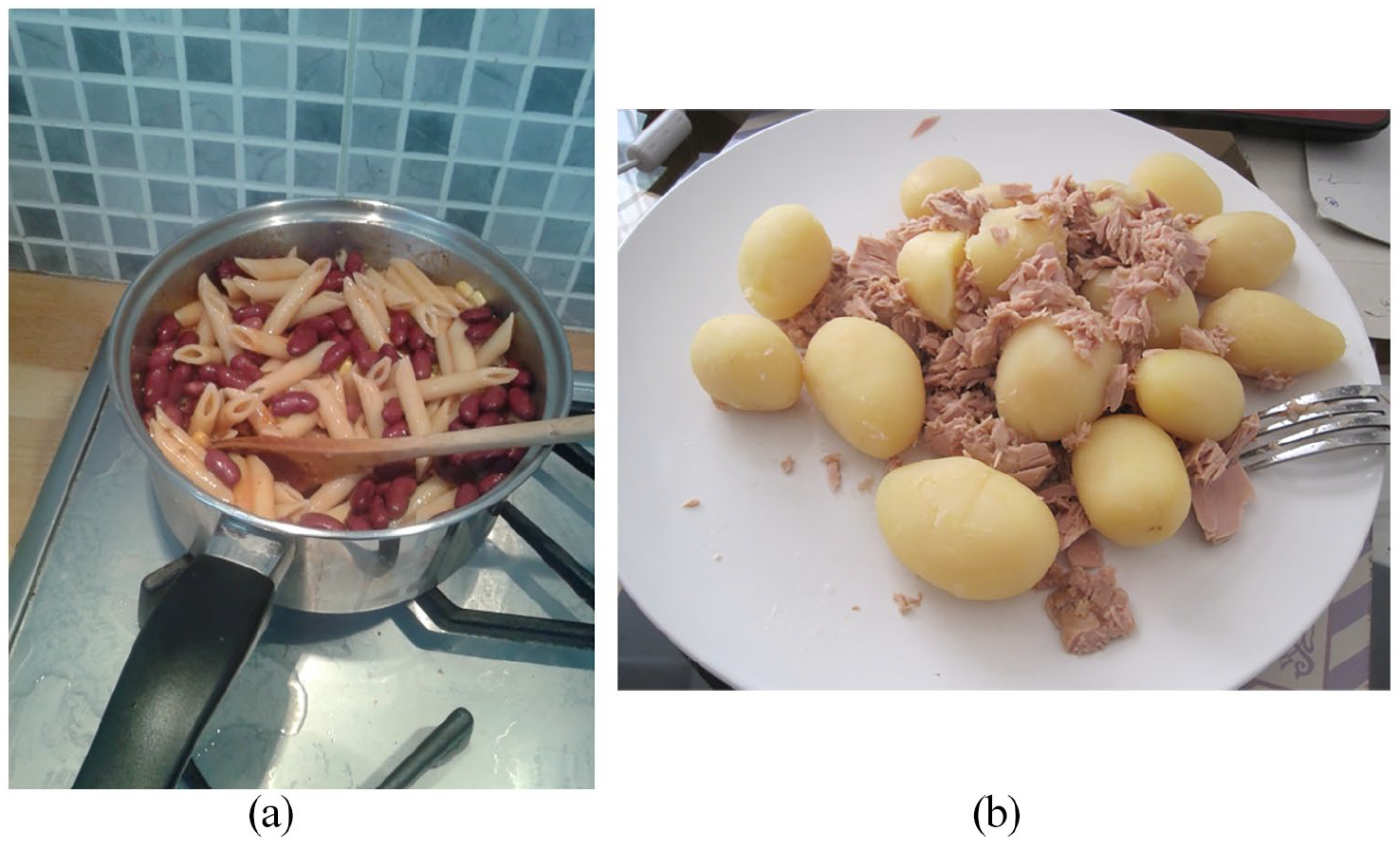
A pair of images illustrating the cooking and consuming of some typical meals during the undertaking. Photograph (a) shows preparation of a mixture of dried pasta, tinned sweetcorn, and tinned red kidney beans and (b) a plate of tinned tuna and tinned potatoes. Photos by Samuel Strong.
This reveals how “the boundaries between the carnal and the visceral, and the mental and emotional, are actually quite porous”
77
– where food actualities were thoroughly intertwined with my emergent moods and states of being.
78
As I became familiar with these embodied rhythms, I began to ration items – a technique for fooling the senses towards more positive dispositions through adjusted grammars of eating. Illustratively, hunger was combatted by spreading the food consumed more evenly over the day, often eating five (as opposed to three) meals to engender more consistent energy levels, and saving “high energy,” “high mood” snacks: “Planning has to go into everything. For instance, not using all the pasta sauce, and especially the milk and juice which easily runout. I’m saving certain things which I know are “treats” (the biscuits, chocolate bar) for when I might need them” (DAY 15).
Exercising these strategies required flexibility, but this was in turn compromised by the dried and tinned nature of food bank comestibles. Whilst cheaper and easier to store, these food items are indicative of the “assumptions about people’s capacity to cope, plan and organise a daily routine” that is built into the Trussell Trust menu.
79
Even in this undertaking (where I had access to a refrigerator, gas stove, microwave and kettle, as well as necessary storage utensils and cutlery
80
), there was a consistent tension between adapting to new embodied temporalities and my necessity to eat “on the go” (Figure 4a and 4b): “It is not even feeling hungry that is the biggest issue. It is the practicality of it, how you go about your daily life. Eating a food bank diet seems to throw up lots of barriers: practically, emotionally, physically” (DAY 17).
Taste also emerged through the spectacle of eating. Consuming meals of cold tinned potatoes, soup or beans when in public places would often evoke comments concerning my inability to cook tied to an infantilization of myself in the eyes of others. This was particularly the case in research settings where people were aware of my apparently “high” symbolic capital, as a PhD researcher, which jarred with the food items I was eating. This did embarrass me, in a way that my aforementioned consumption of “unhealthy” snacks did not, though always tempered by the fact I could explain my chosen diet: “Today Barry laughed when he saw my lunch of cold baked beans and rice. It was an interesting dynamic (and a little uncomfortable?), as being a PhD student, I am usually seen as the “smart one” at the drop-in” (DAY 22).
Taste, as Hocknell 81 argues, “becomes present not simply as a ‘yuck’ response to the unfamiliar, but something. . . simultaneously material, cultural, social, and political.” Eating a food bank diet revealed a set of broader issues than captured by a nutritionist framing alone, including the challenges of managing visceral feelings, limits placed on mobilities, the wider capabilities afforded by such a diet, and the social positions produced through the mutual constitution of body and food. 82
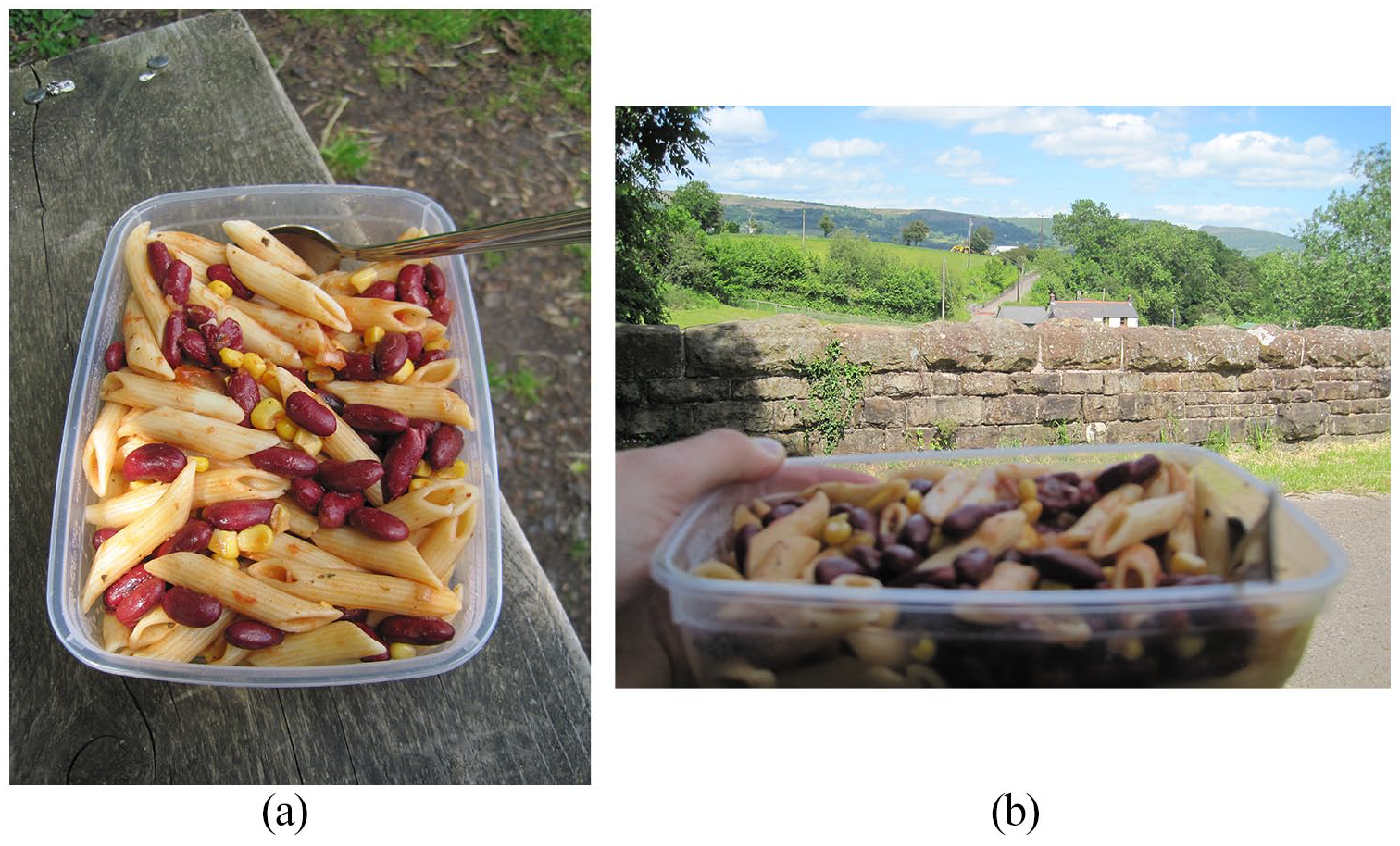
The necessity and challenge of transporting food whilst “on the go” during fieldwork. Photograph (a) shows a boxed portion of the meal of dried pasta, tinned sweetcorn, and tinned red kidney beans being cooked in figure 3a; photograph and (b) shows the site where this meal was consumed during fieldwork in the Valleys of south Wales. Photos by Samuel Strong.
The relationality of the more-than-tasted
Eating food bank comestibles enabled a keener appreciation of my taste as a set of previously unarticulated relations. This was instructive in exploring what food bank provisions do to, in and through the body. But epistemological claims to learning about food bank usage itself through my own tastes are highly attenuated. Despite consuming food items that were materially identical to the parcels I was provisioning as a volunteer, my tastes were refractions, reflections and (re)productions of my privileges. Even the recognition that this diet prevented the realisation of these privileges – in the loss of choice, disrupted rhythms of hunger, social spectacles and changed moods – itself reveals the workings of my past and present relationship with eating. Critically, the food I consumed was de-anchored from the food bank system. I did not: navigate the institutional architecture of referral processes, 83 experience the emotional wounding that accompanies declaring need and receiving charity, 84 have to transport food from the food bank to my home, 85 or feel truly anxious as I was safe in the knowledge that I could end the experiment at any point. My undertaking also did not include electricity payments, cooking facilities and storage utilities.
Reflecting on the potential of auto-corporeal methodologies, Latham and Wagner 86 note that “novelty is realised as the degree to which elements other than simply the researcher’s body are pulled into the space of experimentation.” My experience demonstrates how these other elements to which the writers refer are not only difficult to reach but, given the subjective and situated nature of taste, will always bear the imprint of the researcher themselves. Learning with taste is not enough, precisely because food bank comestibles become present through a distinctly relational world – in other sensed feelings that might include tiredness, coldness, loneliness, pain, and depression; in the wider materialities of utensils, utilities, public transport, computer databases, and institutional spaces; and in the social, spatial, political and economic processes that shape lifeworlds. 87 Taste is, therefore, neither simply a feature of the body, nor is it reducible to food items themselves. Instead, taste is emergent in the changing relations between people and places, structures and senses, bodies and worlds. Taste is not just a product of the body and society, then: it is also formative of these relations. 88 These recognitions have two important implications.
The first is for the conceptual endeavour of taking back taste – specifically, how we “take back” something defined by relations that surpass the object under investigation. Whilst these relations are nebulous and subjective, what ties them together is a critical appreciation of power. This is in keeping with the aforesaid definition offered by Hayes-Conroy and Hayes-Conroy, 89 for whom taking back taste “mean[s] a daily project of illuminating the mechanisms through which power surrounds and penetrates the human relationship with food.” This article has illustrated why scrutiny of our own tasting bodies must form part of such a “daily project.” Whether we take on a more “direct” position in the field (as in my case of being a volunteer-researcher) or strive for more “distant” relations, we remain situated within geographies of taste. Being folded into these relational geographies of food and power therefore requires careful attention to our own experiences and normative values. Recognising that our presence amidst certain places and practices can reproduce, as well as challenge, realisations of taste therefore has methodological implications. Taking back taste requires not only committed fieldwork: it also requires us, as researchers, to be engaged in critical and careful “homework” that scrutinises our own place in these relational landscapes – where research itself establishes, breaks and alters relations with tasting bodies. 90
Secondly, we must read back these relational features of taste into the geographies of food banking. A focus on what food does in and with bodies – how it shapes, and is shaped by, the relations it takes on after provisioning – is key to working with a relational approach. Most obviously, my consumption of this diet has revealed the need for food banks to move beyond the nutritionist frames that determine the types and amounts of food they provision, and to complement this with keener appreciation of issues of mobility, capability, feeling, and mood. So too does it indicate the need for more tailored approaches than afforded by a set menu.
But the distinct relations between power and food signalled in this article mean merely tinkering with the contents of food packages is insufficient. The charitable provision of food alone will not solve food poverty. This is not to dismiss the work that food banks do, but to signal that they are limited to treating the consequences of structural inequalities, rather than their causes. What is needed is a more radical approach to altering human-food relations that are presently marked by anxiety, shame, pain, embarrassment, and discomfort for many. 91 If people are not equipped with the capabilities to transport, prepare and consume food in a dignified, safe and affordable way, then even the availability of food deemed nutritionally adequate is not sufficient. 92 Instead, greater attention to the relations that surround food is necessary – one that might only be possible through a more radical reframing of the social contracts between citizens and states that might include, for example, provisions for a universal basic income or similar mechanism for enacting wider capabilities and socially just relations with food. 93
Conclusion
“I should like to understand what really goes on in the souls of plongeurs and tramps and Embankment sleepers. At present I do not feel that I have seen more than the fringe of poverty.”
94
Orwell’s desire to know poverty led him to use his own tasting body as a tool of research. But he was also frustrated by this approach, limited as it is to a view of the mere “fringe” of impoverished lives. This article has cut a similar path, navigating the tension between a conceptual desire to take back taste and the practical and ethical limits of studying others. Working with this tension has signalled the wider stakes of learning, unlearning and failing to learn with taste. This has highlighted three avenues.
The first is the potential of auto-corporeal methodologies. In charting the limits of spoken methods and my own compromised position in the field, this article has attempted to produce a more fully-fleshed geography of food banks by learning with my own tasting body. This approach opened new vistas onto food bank items, highlighting the visceral, affective and social life of comestibles that exceed the parameters of a nutritionist lens – demonstrating the importance of mobility, materiality, sociality, and capabilities when evaluating the efficacy of food bank provisions.
Secondly, surveying these wider issues signals the limits to which I could learn the relational nature of food banking with my own tastes. This recognition stemmed from the position from which I was undertaking this research. I was not provisioned with these items but was instead in the privileged position of choosing to consume them. Whilst the material items may be consistent, the relations between these provisions and one’s lifeworld are entirely different. The food I consumed was thus de-anchored from its social and spatial coordinates in the food bank system, and instead unfolded through my sedimented sensuous disposition, embodied rhythms, and social relations of eating.
Thirdly, this article has considered the wider question of how we learn the lives of others. Although I undertook this experiment in the hope of getting “closer” to those I was researching, if anything, it confirmed just how distant I remain from my participants. It is for this reason that reflecting on the researcher’s own tastes can be part of a wider project of unlearning that highlights the variegated features of taste as it shapes, and is shaped by, lifeworld.
Together, these issues raise one final line of discussion. What if we take seriously parts of research that are not merely about producing data but excavating the “becomings of our own bodies?” 95 Here, it is vital to note the ontological politics that underpins all research. This is not just recognising that the personal is political but exploring ways of politicising the personal. Such political ontologisation, as pursued in this article, has entailed scrutinising my own tastes to better understand my position amongst the places and people I was researching. 96 In this sense, it has met Law’s 97 call to “teach ourselves to know some of the realities of the world. . . through the hungers, tastes, discomforts, or pains of our bodies.”
Whilst sceptical about the data such approaches produce, learning with our own tastes maintains a wider utility in “working on our own affective stance. . . so that we may better perceive the complexity of the realities we are researching.” 98 Such pursuits are aligned with achieving “attunement,” or the “capacity to sense difference.” 99 This article has demonstrated how examining our sensory capacities can lead to novel ways of relating to our research topics. Concurrently, it has revealed that we can never truly be “in tune” with social phenomena as they come to actually exist in the world around us. Recognising these limits and reflecting on the ways we as researchers are often out-of-tune with our subjects thus remains as crucial as ever.
Footnotes
Acknowledgements
The author would like to acknowledge Dr David Nally for supervising and guiding the critical ideas developed in this paper, and Professor Phillip Howell and Professor Don Mitchell for examining and commenting on earlier iterations of the arguments made herein whilst still in thesis form. Thanks also to Dr Francesca Moore for comments on an early version of this piece, and to Dr Sarah Marie Hall for a supportive reading that pushed me to engage with the more-than-tasted aspects of austerity. This paper was greatly improved by the critical engagement of two anonymous reviewers and editor Professor Anna Secor. Any remaining faults and errors are, of course, my own.
Contribution
Food bank provisions are (over-)determined by nutritionist frames that privilege spaces, languages and methods of technical experts over vernacular experiences of consumers. Food bank provisions signal a wider set of relational geographies that require attention – including questions of mobility, mood and capabilities. This article makes space for critical discussion of embodied privilege and research failure through personal reflection. Auto-corporeal methods for engaging with food can provide insight into the politics of taste, privilege and learning more broadly.
Declaration of conflicting interests
The author declares no conflict of interest.
Funding
The author disclosed receipt of the following financial support for the research, authorship, and/or publication of this article: Economic and Social Research Council (studentship number 1226049).
