




Abstract
This paper examines the curation of a month-long public exhibition titled #AanaJaana [#ComingGoing] in one of New Delhi’s busiest metro stations, as a form of self-authorship by young women from its digital and urban margins. #AanaJaana [#ComingGoing] is a metaphor for journeys, communications, connections, associations, interceptions, social networks and individual/collective behaviours, that is curated as women ‘see’ and ‘speak’ with/through their mobile phones. Using Marie Louise Pratt’s notion of ‘contact zone’, we examine #AanaJaana as a space of encounters that emerges by visually ‘composing-with’ as well as ‘learning-with’ the realities and constraints of space, technology and power. Based on self-authorship over a period of 6 months within a ‘safe space’ of a WhatsApp group of young women living in the urban margins, we draw attention to #AanaJaana as a set of crosscutting networks of power dynamics over women’s bodies across the home, mobile phone and the city. #AanaJaana refers to how young women in the margins negotiate the ‘freedoms’ of moving (aana) in online space with the ‘dangers’ of going out (jaana) into the city, or the restrictions of entering (aana) online space with the freedom of leaving (jaana) home. We argue first, that #AanaJaana is a space of confinement because of the infrastructural paralysis in the peripheries. Second that it is also at the same time translocally produced by referencing several textual, digital and material spaces of self-realisation. Finally, we argue that #AanaJaana is a space of intertextuality through encounters between emojis, shorthand, voice notes on the mobile phone, with parody and dark humour of their gendered experiences that can transform shame, humiliation and fear into reflection, resistance and agency. The paper concludes that as a polycentric practice, #AanaJaana offers an appropriate metaphor to expand the ‘contact zone’ in order to decolonise gendered knowledge and power across digital-analogue margins.
Keywords
Introduction
On 1st January 2019, we launched a month-long public exhibition in the main concourse of Mandi House, one of the largest metro stations in Delhi, India, which sees an average daily footfall of around 11,000 commuters (see Figure 1). Titled “#AanaJaana” [#ComingGoing], the exhibition presented a genre of authorship that was almost exclusively from WhatsApp diary entries made by young women living in a slum resettlement colony in Delhi’s periphery. Evoking a creative practice of authorship that was simultaneously collaborative as well as intimate and embodied, the exhibition once installed also turned the gaze of the women onto themselves, reflecting upon the intersection of structural, infrastructural and gender-based violence that had kept them excluded from urban development and infrastructural planning alike. As one of the women said when she came to see the exhibition.
I am really loving this day very much. I feel so happy, I cannot imagine what I have achieved, I never thought I would be able to do this. But I accepted this challenge and completed this. I learnt so much as well. This is only an example, a trailer, the whole film is yet to be done. We have just touched the tip. More power to you sister. [Asha, 1 January 2019]
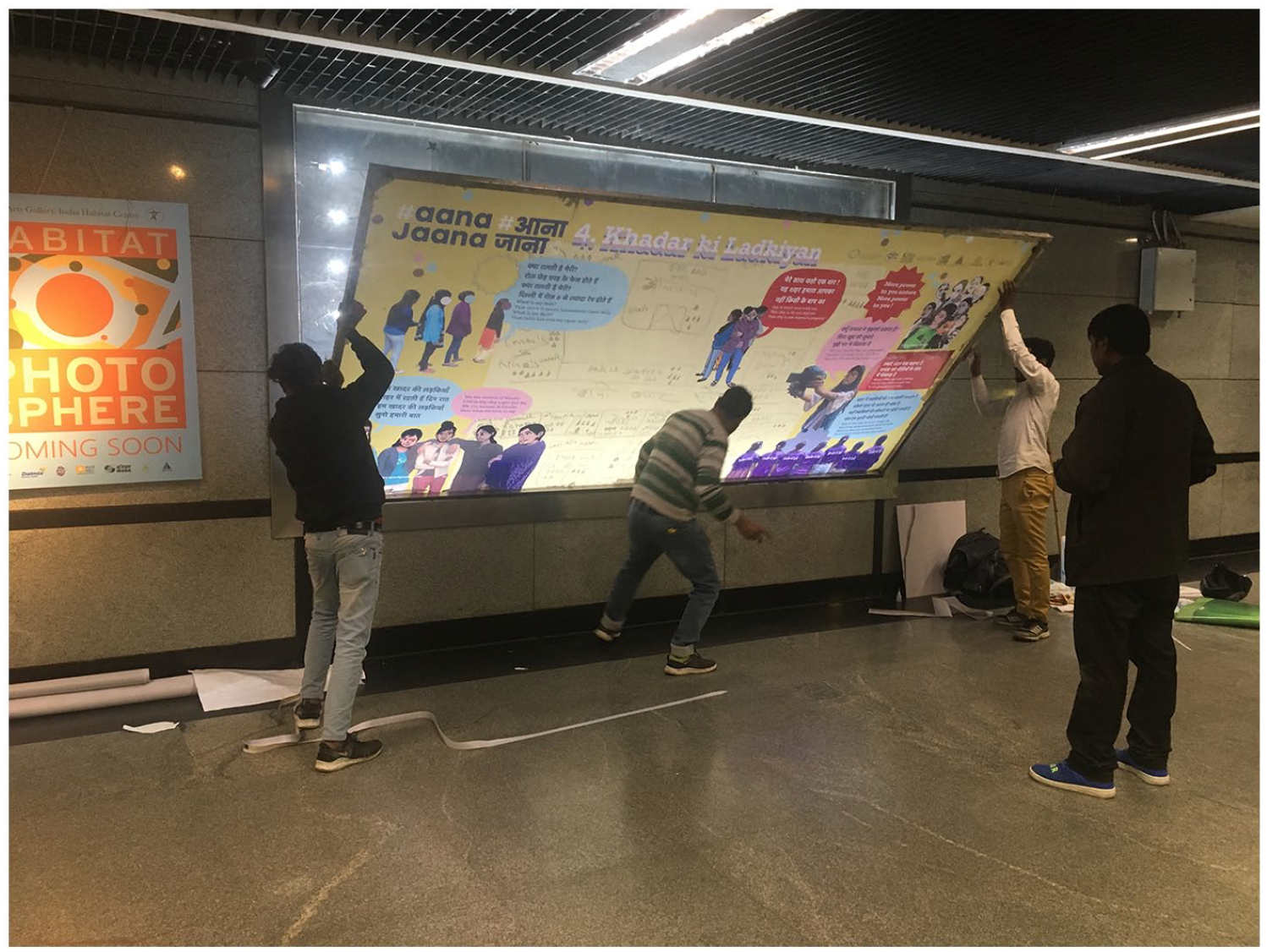
Exhibition being installed in Mandi House. Photo: Datta.
As one of the participants and co-authors of the WhatsApp diaries, Asha evoked the idea of the exhibition as a ‘contact zone’ 1 – a space where a stable sense of representation, knowledge and communication was inverted through a hybridity of languages, shorthand, emojis and images about everyday gendered lives in the margins. Asha noted how her co-authorship in the #Aanajaana exhibition produced an ‘example, a trailer’ of the possibilities of gendered power to be claimed by young women in the urban and digital margins of Delhi. This evoked Mary Louise Pratt’s description of intertextuality in the contact zone – ‘Autoethnography, transculturation, critique, collaboration, bilingualism, mediation, parody, denunciation, imaginary dialogue, vernacular expression’, 2 and presented the exhibition as a contact zone between the women and the gendered city. But the contact zone went deeper than the exhibition. Asha’s words evoked the notion of #AanaJaana as a contact zone between the city and its margins, between the digital and material, between histories of exclusion and possible emancipatory futures of poor communities.
In this paper, we examine #AanaJaaana as a shifting, ambiguous and intimate ‘contact zone’ that emerges by visually ‘composing-with’ as well as ‘learning-with’ the realities and constraints of space, technology and power. Through #AanaJaana, we ask what happens when women ‘see’ and ‘speak’ with their phone, and how that shapes the cultural geographies of the city across its digital and urban margins. While gender empowerment is noted as ‘freedom’ and ‘choice’, 3 we argue that in the context of limited choices, digital technologies have the potential to reveal new emancipatory contact zones between young women and the city. The widespread use of information and communication technologies (ICT) by young women in the margins is an embodiment of significant socio-cultural transformations taking place in the Indian sub-continent 4 that have important consequences on the ways that women write about themselves, their lives and their experiences in/through the digital. We argue that women living in the urban margins negotiate not one, but many contact zones as they co-produce #AanaJaana through the ‘freedoms’ of entering (aana) online space, or the ‘dangers’ of leaving (jaana) home, or the freedom of entering (aana) the city with the vulnerabilities of being excluded (jaana) from digital information and communications. These continuous movements produce multiple contact zones between the mobile phone and digital spaces, between urban, digital and social infrastructures, and between different kinds of social and urban texts. Through these diverse contact zones, we draw attention to #AanaJaana as a set of crosscutting networks of power dynamics over women’s bodies and spaces across digital, physical and social spaces of the home, family, neighbourhood and city.
#AanaJaana as authorship in contact zones
Literally translated from Hindi, ‘Aana Jaana’ means ‘Coming Going’. Its meaning and use as a cultural metaphor, however, extends far beyond this literal translation. Aana can mean - reverting or to occur. Jaana can mean – to pass or to cease to exist. Aana Jaana is a metaphor for journeys, communications, connections, associations, interceptions, social networks and individual/collective behaviours. We created the hashtag #AanaJaana to also represent how gendered power is normalised and routinised over women’s bodies and spaces across digital and material spaces. It provokes us to rethink the contact zone in a context where social media provides real time information on the dangers and freedoms located in the metro, bus, auto rickshaw, and walkways as well as the opportunity to express this in creative and poignant ways.
We draw upon Mary Louise Pratt’s seminal work on transculturation to frame #AanaJaana as overlapping layers of multiple ‘contact zones’. 5 For Pratt, the contact zone is a space of struggle, a space where ‘cultures meet, clash and grapple with each other’ under conditions of ‘extreme disbalances of power’. 6 As a contact zone, #Aanajaana enables women in the urban peripheries to express their frustrations with an exclusionary urban culture right at the heart of the city. In the exhibition, ‘anything goes’ as far as syntax is concerned – WhatsApp screenshots, emojis, shorthand and grainy images taken by women with their mobile phones were presented within panels highlighting their historical struggles. They represented as Pratt noted – ‘rage, incomprehension, and pain, there were exhilarating moments of wonder and revelation, mutual understanding, and new wisdom – the joys of the contact zone’ 7 – in short, #AanaJaana presented the complex dynamics of gendered transculturation across social, physical and digital realms of the city and its peripheries.
Several geographers 8 have recently extended Pratt’s literary contact zone between the European core and its non-European periphery to the spatial and material sites of urban encounters, particularly across multi-ethnic groups. Geographically understood, the contact zone is produced in the material encounters between host communities and migrants in urban spaces that lead to transculturation. Here transculturation is taken to mean not just appropriation of cultural symbols, metaphors and languages, rather the instability of meanings and their origins, as a relational phenomenon that transforms all those in the contact zone. 9 The gendered city becomes a contact zone, because poor women’s persistent presence in cities defy the dominant cultural hegemonies in urban policies, laws and their implementation that tend to exclude women from the public sphere of participation and visibility the city. 10 As Butcher 11 argues in the case of Delhi, these ‘have created a city of threat and discomfort that problematises women’s access, be it for livelihood or leisure, enclosing women within coordinates not of their making’. These limitations are further pronounced for poor women, whose entry into these spaces are mediated through intense power differentials across social and material spaces of the home, family, neighbourhood and community.
Current geographical or literary conceptualisations of the contact zone, however, are incomplete in a digital ‘era of instant authorship’ 12 where for young women, much of their struggles simultaneously occur in and through digital spaces. As the governance of Indian cities are increasingly contingent upon surveillance technologies such as CCTV cameras, GPS enabled response vehicles and safety apps pushed to smartphones, 13 digital technologies are also conceived with cis-gendered male middle-class residents as their main beneficiaries. 14 Young women in the peripheries find themselves unable to benefit from top-down technological solutions – not least because these technologies do not reach the peripheries which are characterised by fragmented and disconnected digital infrastructures, but also because these construct surveillance as a solution to violence against women. 15 To put it bluntly, young women in the peripheries are further marginalised by digital technologies that extend the surveillance of their bodies by their families to urban governance at large. 16
In the digital age then, #AanaJaana extends Pratt’s notion of the contact zone as a literary encounter, to a hybrid geography of urban encounters across textual, digital and material spaces. Following Crang’s call to analyse born digital objects through a ‘materialist semiosis’ 17 attending to the aesthetic, affective and meaningful technologies of the digital era, we argue that the proliferation of digital messages between young people shed important insights into the transformation of knowledge through digital and textual contact. Crang notes that as more people maintain contact over social media, there is a convergence of different forms of knowledge into digital formats, changing the ways in which we now deal with existing problems via digital technologies as well as the ways in which literary geographies may themselves be reconceptualised. Indeed, not only do digital texts have their own performativity 18 in the contact zone, but they also make the technologies and spaces that they operate in/through more meaningful. Seen through this lens, #AanaJaana evokes multiple contact zones that enable spaces of authorship as well as spaces of realisation and fulfilment through the mobile phone.
In this paper, we argue first that the contact zone is a ‘cultural interface’ 19 between the mobile phone and a range of social and symbolic meanings associated with it. This can be simultaneously confining and open-ended because of the way that digital devices are acquired and used by marginal and gendered social groups. 20 While scholars have challenged the policy conflation between mobile phones and gender empowerment, 21 it is still largely understood that mobile phones have not been harnessed sufficiently by historically disadvantaged communities to ‘empower’ themselves. 22 Examining #AanaJaana as a contact zone between the mobile phone and the community highlights how patriarchal norms around gender mobility and employment travel in/through digital technologies. As Gurumurthy et al. 23 note, on one hand women’s access to digital technology is not in itself a sign of empowerment, but on the other hand, when given the opportunity to use technology to articulate their struggles in a supportive and safe space, the experience itself can be empowering. For example, mobile phones as spaces of ‘perpetual contact’ 24 produce as Hoan et al. suggest – ‘their aspiration for individual changes, autonomy, and more powerful decision-making roles in domestic and social domains’. 25 As Archambault 26 notes, mobile phones embody ‘the potential to shift, albeit in contested and imperfect ways, the interface between daydreams and reality, between mental trips and trips in the material world, by expanding the possible in more palpable ways’. Rethinking the contact zone between the mobile phone and wider social worlds that women occupy thus draws attention to the embodied nature of encounter with everyday technological objects by the urban poor as compared to the existing focus on algorithms, platforms and data in current scholarship on the digital age.
Second, #AanaJaana stands as a metaphor of translocality 27 across social, digital and literary texts, and thus embody the possibility of authoring far more non-conventional encounters that are simultaneously textual, visual and auditory. This is particularly relevant in a context where in the absence of physical spaces of transformative encounters, digital messaging provides the potential to explore more intimate and personal forms of self-authorship that can be transformative. 28 The choice of apps to download on mobile phones, their use and messages shared on these makes them what Poggiali 29 calls a ‘bridge to people and information worlds far away’. Closed messaging platforms in the mobile phone can decolonise power dynamics, by redefining the norms of writing, representation and authorship through what Pratt calls ‘selective collaboration with and appropriation of idioms of the metropolis’. 30 In the hands of young women in the margins, the mobile phone can author meaningful texts on the gendered city through the front-facing camera and built-in microphone, through regional language keyboards, emojis, slangs and puns, voice notes and videos. Messaging platforms also have a dynamic sociality in facilitating real-time conversations and co-writing – they capture interpersonal relations of friendship, affect, trust and solidarity – relations that produce transculturality in the contact zone. Messaging platforms radically shape a genre of multimedia authorship among poor women that is no longer limited to textual and literary genres of testimony. 31 This form of authorship uses self-generated as well as annotated and forwarded messages, shifting from what Giannini and Bowen call a ‘gatekeeping model to an open model steeped in digital relationships’. 32
Finally, #AanaJaana stands as a contact zone between a digital public sphere and the urban public realm. 33 For poor women who cannot participate in the dominant cultural idioms of the city, #Aanajaana becomes a method of documenting and articulating their everyday struggles in the city in digital space, while at the same time negotiating their own translocality between the home, phone and the city. In doing so, the contact zone becomes both a praxis of technology limited by the algorithms of platforms and apps and simultaneously a craft of ‘everyday dwelling’ which is ‘constitutive of a felt-life of being together with those close by’. 34 Authorship with digital tools connects the praxis and politics of embodiment in the city with the transculturation of texts as experience of the city. This curation has endless possibilities that are contingent upon how users want to tell their stories through a range of tactile positionings that cut across the personal and social, public and private, home and city, offline and online spaces.
WhatsApp ethnography
The research that informs this paper began through seed funding in 2017, when we conducted semi-structured interviews and mental mapping with over 30 women in a slum resettlement colony in South Delhi. Through subsequent UK Research Council funding we recruited 12 women from amongst the earlier group to participate in an in-depth and extended research into gendering the top-down vision of a smart city. As we began this phase of work, we immediately came across a set of challenges around the distances of geographical time and space between the UK and India. Because we wanted to examine their digital lives, it was also not possible to use conventional methods of ethnography and interviews. We agreed to set up a closed WhatsApp group that would instead enable real-time free flowing conversations that could somewhat address the challenges of physical distances. We therefore requested WhatsApp diary entries from participants to document their daily experience of the city. While this addressed the challenges of organising regular face-to-face interviews or mobile observations of their journeys in/out of the city, we also simultaneously scheduled face-to-face workshops between participants and the research team during key stages of the project. This closed WhatsApp group was the start of what developed into a ‘WhatsApp ethnography’ over 6 months.
Our decision to use WhatsApp as a platform was in the context of its popularity in India, which has the highest number of WhatsApp users in the world today. The popularity of the App in the country crossed 15 million active users in 2014, a year after the company dropped its subscription model (charging users a dollar per year after first year of use). It’s easy usability, inbuilt characteristics to make private groups and it’s add-free nature makes it a highly popular medium across all ages in India. This is especially true for the youth, who have been at the forefront in easily adapting to these transformations. This has also been made possible due to the availability of cheap smart phones and cheaper data packs. WhatsApp was and continues to be the most popular, widely used social messaging App in India in the last 5 years.
Initially the WhatsApp diaries consisted of loose and irregular entries – a shortened text message, captioned photo, or an audio file, and sometimes even a video. These would illustrate the positive or negative aspects of their journeys to the city and back home. The absence of locative media within WhatsApp also meant that multimedia diary entries often had to be geographically annotated by participants. Eventually, the entries began to show more structure and pattern – there was a flurry of entries during festivals or during particularly difficult moments in their daily commute such as monsoon rains that led to traffic congestion and delayed journeys. There were also several entries highlighting the prevalence of violence – whether gender based or otherwise.
Slowly a dynamic relationship began to emerge within the group with some of the participants becoming more regular contributors while others remaining quieter and needing more encouragement to send in their entries. These power relationships diversified over time, when few participants began to post fake news or forwarded messages while others called them out. In that sense, our small, closed WhatsApp group became a reflection of wider power dynamics in society. WhatsApp could not totally replace the corporeality of face-to-face contact, which was still maintained from time to time, but the WhatsApp entries made moments of physical contact more meaningful and exciting as we recounted and reflected upon them. The WhatsApp group itself became the site of knowledge exchange and co-production, sometimes participants putting up pleas for job opportunities, or circulating information on government schemes, or organising Women’s Day marches, or watching out for each other and sometimes even falling out through disagreements.
In was during one of our workshop sessions that one participant described her photo entry as – ‘it shows the aana jaana of people in the city’. This notion of aana jaana came up repeatedly in the diary entries and led to the conceptualisation of a hybrid contact zone made of a colloquial cultural metaphor which stood for the visual and digital lives of women in Delhi’s urban peripheries. In this way authorship of the city emerged organically in our group – first in the discussions on why participants authored particular experiences as digitally significant enough to upload on the group as images, audio or text, and second when they participated in identifying the theme of the exhibition as #aanajaana and provided feedback on the kinds of entries that could be included in the physical space. The final physical format of the exhibition was undertaken directly by a graphic artist who curated the entries in collaboration with the researchers and project partners.
Globally, there is an emerging research interest in WhatsApp 35 as an essential tool of communication and social mobilisation but also of misinformation leading to large-scale violence. 36 That this was a ‘new’ kind of online contact zone was both exciting and came with an added sense of responsibility, especially when the conversations on ethics on digital methodologies are still under-going. 37 We follow Winter and Lavis, who note online ethnography of ‘listening as a mode of participating in, as well as observing, online spaces’. 38 This method enabled diverse interactions, spread across time and space between our different temporalities across geographies and continents. We were wary of the possibility of ‘excess circulation’ or ‘leakages’, when digital content, specifically images get ‘forwarded’ into online networks where they take a life of its own. However, these concerns were often shared by the participants themselves who have participated in workshops on digital privacy and have experienced sexual harassment in the online spaces, where their images were previously morphed or circulated without their consent. Similarly, as researchers, we had access to diverse mediums and information from the web which could be used in these conversations. Occasionally, WhatsApp also suppressed the physical embodiment of class or caste backgrounds in the conversations as we all became ‘digital texts’, using the same languages and idioms (emojis or shorthand) that was enabled by the platform. This absence of a face and the easily accessible limited features of the social media app afforded everyone a modicum of equalising space in self- authorship, even though there were vast differences between us in our agencies within digital and urban spaces.
Madanpur Khadar: the contact zone across digital and urban margins
Madanpur Khadar, where our participants lived is a slum resettlement colony in Delhi’s South-eastern periphery with a history of migration into and out of the city. Rural migrants who came to ride Delhi’s prosperity through the 1960s, 1970s and 1980s settled in its many slum and informal settlements – a process that has been well documented as Delhi’s urban history, but were forcefully evicted in waves of city beautification schemes since the late 1970s. 39 Madanpur Khadar was created after a judicial ruling in the early 2000s transformed Delhi’s slum dwellers radically into ‘pickpockets of urban land’, as illegal citizens’ 40 that then led to a spate of slum demolitions across the city. This literally ‘swept off the map’ 41 all material evidence of slums from Delhi’s cartographic representation to then relocate them in Madanpur Khadar and other locations in the outskirts of the city.
Madanpur Khadar then is a contact zone – first by being constructed without history and context close to the village of the same name, whose residents were antagonistic about the introduction of ‘outsiders’ within long-standing local kinship networks; second by being ‘urbanised’ through their inclusion into Delhi’s formal planning frameworks, within the orthogonal planning model, within typologies of incremental building and formal access to urban basic services, that were still denied to the villagers. New residents however faced many challenges when they arrived in the 2000s, with no electricity, no sewage lines, unpredictable supply in public water taps and no public transport. Since the land was low-lying and on the Yamuna river floodplain, building byelaws prohibited the construction of more than three floors, which often put severe space and economic pressures on larger families. Over a period, infrastructural, economic and social conditions improved – electricity was provided after 5 years, public toilets were built, and new transport links were made with the construction of two metro stations in 2010. Still, much of the basic infrastructural transformations have been through residents’ claims for water, public toilets, electricity, sewage connections that forced the municipality to recognise their status and provide better amenities. They transformed the local economy by setting up daily fruit and vegetable markets, meat and fish shops, bakeries, restaurants and food kiosks as well as a weekly ‘Shani bazaar’ [Saturday market] that caters to its current 25,000 population.
Physical connectivity remains a challenge for residents in Khadar since they are mostly employed in low-wage jobs as peons, drivers, domestic workers, security guards, rag pickers, vendors, and construction, industrial and commercial workers across the city. Young women in particular are engaged in service sector jobs across the city in business process outsourcing, data entry operations, in shopping malls and also as factory workers, taxi drivers and NGO workers that requires them to commute everyday despite the disconnected transport infrastructures between their homes and the city. Madanpur Khadar then becomes significant as a contact zone since this is where its geographic peripheralisation transforms into a ‘networked marginalisation’ 42 across physical and digital infrastructures. Authoring #AanaJaana across Madanpur Khadar and Delhi then produces a diversity of stories of resilience and survival in the contact zone.
#Aanajaana: authoring contact zones
What does it mean to author gendered urban texts in the contact zone when there are no clearly defined boundaries between the physical and the digital, social and political, personal and collective? Authorship is not an isolated practice, nor does it have stable meanings in the contact zone, rather it must be understood within the cultural contexts, temporalities, infrastructures of communication and subjectivity across several contact zones of confinement, translocality and intertextuality.
Confinement: #AanaJaana between the mobile phone and digital space
The mobile phone as a contact zone between material and digital worlds was a site of confinement across social, physical and digital spaces. This confinement began with difficult negotiations for possession of a mobile phone, which were particularly significant in a context where other material infrastructures of accessing digital spaces such as – internet cafes, laptops or desktops were absent. Participants argued that they needed the phone to stay safe and keep in touch while they went out for ‘legitimate’ work into the city. Often, they would have to borrow the phone owned by a family member – their brother or father, only if they went out of the home for ‘legitimate’ reasons.
Participants constructed the phone as an aspirational commodity, because it would connect them to people and networks that they had so far been excluded from. When they started earning, their first salary was usually spent on a new phone. They chose a cheaper model of Samsung, Xiaomi or Huawei android phone, costing between Rs. 5,500 and 7,500 (£55–£75) which had the capacity to provide them access to different apps – YouTube, Facebook, WhatsApp and so on. For some, this was more than their monthly earnings, but the proliferation of mobile phone shops offering phones by instalment made it possible to get one of their preferred brands. Data was relatively cheap at about £5 a month for 2GB, and connectivity was almost instantaneous if they could provide ID verification. Through these social and financial negotiations and compromises, the phone became the conduit to digital and personal space, and therefore to freedom and safety.
However, despite possessing the phone, accessing digital space proved to be far more challenging due to poor network connectivity. Women often talked about their inability to upload their diary entries or the inability to make phone calls unless they moved to their roof terrace. In most cases, it was a continuous switch between different mobile phones and service providers to find the best connectivity. As one participant noted,
I have to keep two phones, one small one [featurephone] because I can’t dial emergency calls on touch phones, so for my ease, I have kept a keypad phone too, I took a Jio later, so that I can call quickly. [WhatsApp diary entry]
Participants also had to constantly negotiate between using and sharing mobile phones and personal hotspots with their children or other family members during different times of the day. Others mentioned how they had to be vigilant about receiving important phone calls.
I keep taking tension if someone would’ve called or not, and if I know that I am going to get a call, then I keep going to check even if I have to hear it from the boss, because I know I am to get a call. I feel tensed, thinking whose calls I must’ve missed or all those messages. [WhatsApp diary entry]
Stories of #AanaJaana with the mobile phone thus contributed to a wider feeling of being under confinement. Maintaining connectivity was neither straightforward nor predetermined – it was constantly negotiated through the real encounters of participants with their social worlds across public and private spaces. Network was unavailable when they needed it most – getting late from work, from the metro station or even just to reassure themselves that they could make emergency calls.
See this happens when we tell our family that we would be back by 5 o’clock, but then we get late, by 8 pm, there is no bus or auto, it could get late by more than 30 minutes again, and we don’t have network, so they take tension, and we can’t call them neither can they, and we don’t remember numbers now. [WhatsApp diary entry]
Confinement therefore worked across social, physical and digital spaces reinforced by patriarchal norms and controls over women’s bodies, by broken transport networks and dead air on the mobile. These spaces of confinement were never predetermined or permanent – they shifted with the shifting and intersecting geographies of #AanaJaana to produce an uneven patchwork of connectivity across the neighbourhood lanes (see Figure 2). As one participant noted,
It’s not places without network, rather there are lanes without network, sometimes some homes don’t have it [network] but the one right next to it will have, that’s how it is. [WhatsApp diary entry]
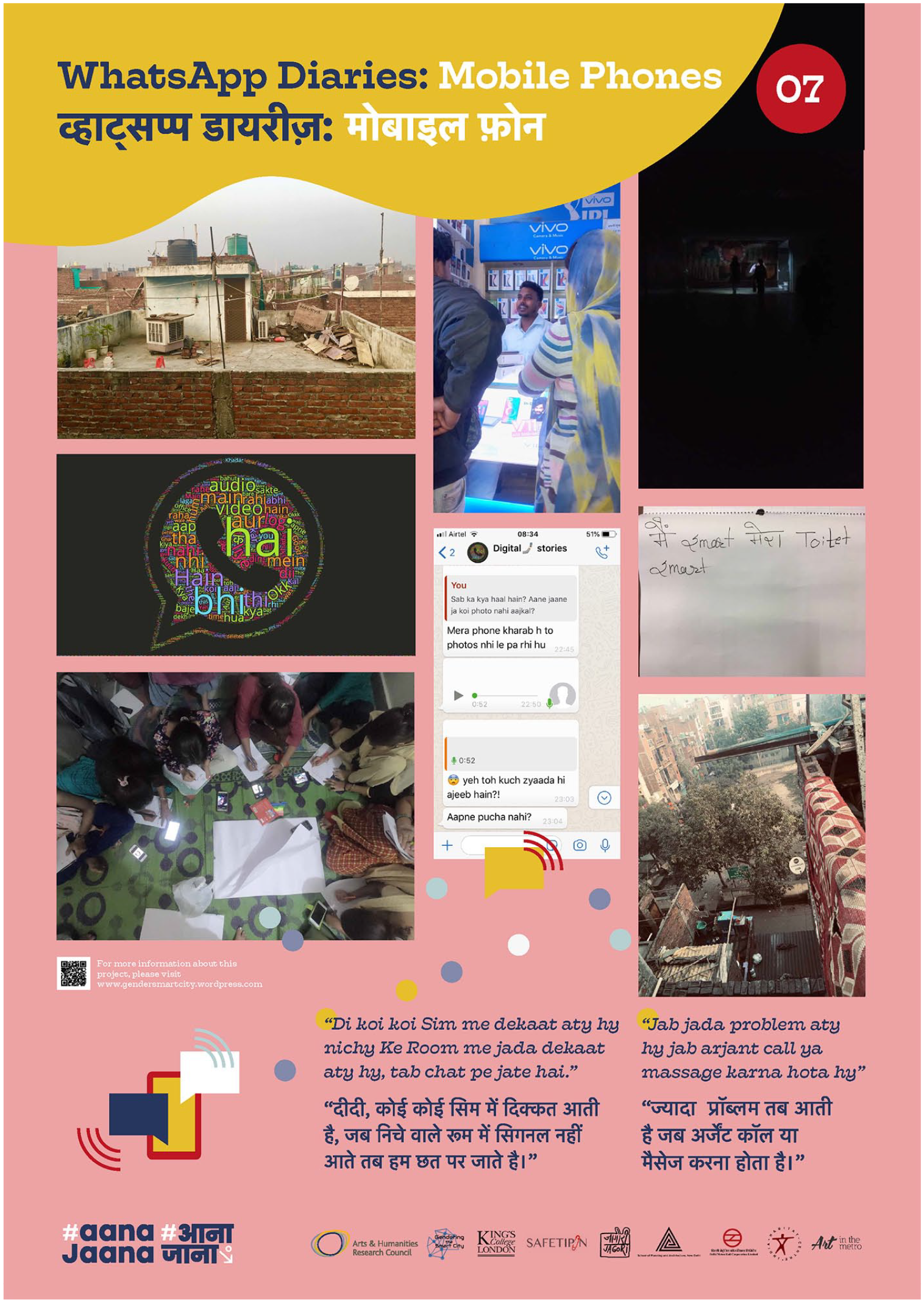
WhatsApp diary entries on mobile phones. Panel designed by Kruttika Susarla.
Translocality: between digital information and the gendered city
One morning there was a flurry of messages in the WhatsApp group. It emerged that the previous evening, a young man was murdered under the watchful eyes of the CCTV camera on the main street. This was the most crowded and watched space with each moment of the murder recorded by the CCTV, which ultimately led to police arresting the suspects. Fear across the group was palpable, and the women shared newspaper cuttings of the story in the group. Texts forwarded the CCTV clips of the murder and newspaper cuttings reporting the stabbing. By drawing on available information about the murder on the internet and then engaging across the group on the localised meanings of danger, safety and fear participants mutually constructed knowledge about Madanpur Khadar.
“There are different views in the newspaper. But I am not feeling good to think about how unsafe it must be for women if this market road is this unsafe for men.” “We should do something in Khadar. It’s becoming scary to stay here, and these days it’s scary to say anything to anyone!” [WhatsApp diary entries, 22 July 2018]
A translocal 43 contact zone emerged between the digital information shared across the group and the actual experiences of the gendered city. In the messages shared across the group, participants constructed what it meant to them to be sexually harassed everyday during commutes to the city and back, as well as within their neighbourhoods and homes. The murder of a man under the gaze of the CCTV produced new multimedia texts and notes on gender safety. Some of the participants also circulated images of celebrity gender role models encapsulating resilience and strength under adversity. But this was not confined only to the WhatsApp messages – participants actively joined campaigns and demonstrations on safe cities, participated in the safety audit of their neighbourhood and participated in Women’s Day rallies and in One Billion Rising (OBR) day organised by several NGOs in the heart of the city. In this way participants constructed not just a digital self in WhatsApp groups, rather also an embodied self across digital and material worlds (see Figure 3).
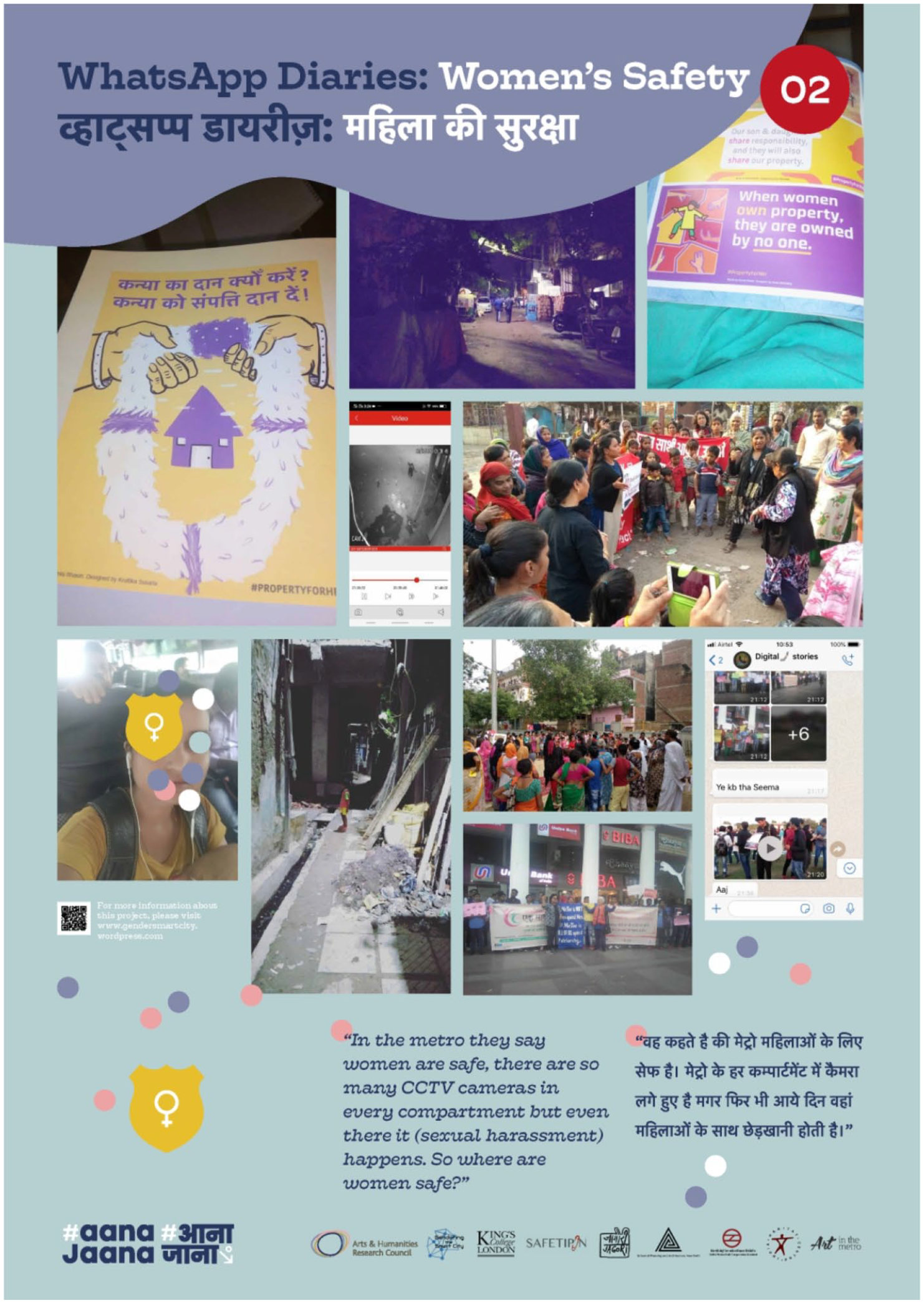
WhatsApp diary entries on women’s safety. Panel design by Kruttika Susarla.
The embodied #AanaJaana between digital and material spaces was pronounced during infrastructure fails. Between June and August, the WhatsApp group was flooded with images of water logging in the city giving a scathing critique of the state of public infrastructure and lacunas in urban planning.
Today while returning from office in a bus, I got stuck in a traffic jam, so much so that the route which takes 10 minutes to cover, it took me 1.5 hours to get back. I got on the bus at 4.15 and got out at 5.30. The jam was because of the rainwater flooding the street; there was so much water that only the handles of the bikes were visible, and one bike in front of me fell into the water. The bus was moving so slow, I felt impatient and felt like getting out, but because of water, I didn’t.” [WhatsApp diary entry, 10 August 2018]
Such moments of critique and vulnerability would spur several emojis from other participants. The diary entry was accompanied by numerous images of water in the city which were compared and debated, continuously revealing new meanings and nuances, as well as fresh contexts through which to understand them. These kind of authorship practices were more about self-documentation, in a context where the ‘paralysis in the peripheries’ were never documented in the public domain, whether by state-planning agencies or media. The diary entry (as image, voice notes, videos entries or text) then was a translocal prop, curating experiences that occurred outside the digital but were nonetheless authored in digital spaces.
Intertextuality: between emojis, voice notes and free verse in the margins
The mobile phone enabled participants to become digital author-curators giving voice and narration to their own experiences across physical, digital and social spaces. Navigating and using mobile phone as a curatorial device authored a mediated city that raised important questions around cultural production and self-representation. This curation was always incomplete but held endless possibilities contingent upon how users wanted to tell their stories.
One of the key aspects of this author-curator position was in the production of selfies. Selfies were not only for the ‘wild and everyday’ as Rangaswamy and Arora 44 found of digital leisure in Indian slums; they were also an analogue format of ‘geotagging’ participant locations in the city. Selfies were rarely inside the home; they were primarily outside, when they got dressed, and were with their friends. These selfies represented their identities as young urban women travelling in the metro or bus, going out with friends, eating out or going to women’s day marches. Right after our workshops, our phones were inundated with innumerable selfies with us and the places where these workshops were held. Participants authored the city through selfies – any place they visited would be immediately documented with them in the foreground and the city in the background. These selfies represented a framing of the gendered self as well groomed, smart and well located. And they tagged the city literally at arm’s length, staging it as a backdrop in the front facing phone cameras. The selfies represented their #AanaJaana – leaving home, coming of age in the city, framing their friendships, networks, solidarities and expressing affection for each other (see Figure 4).
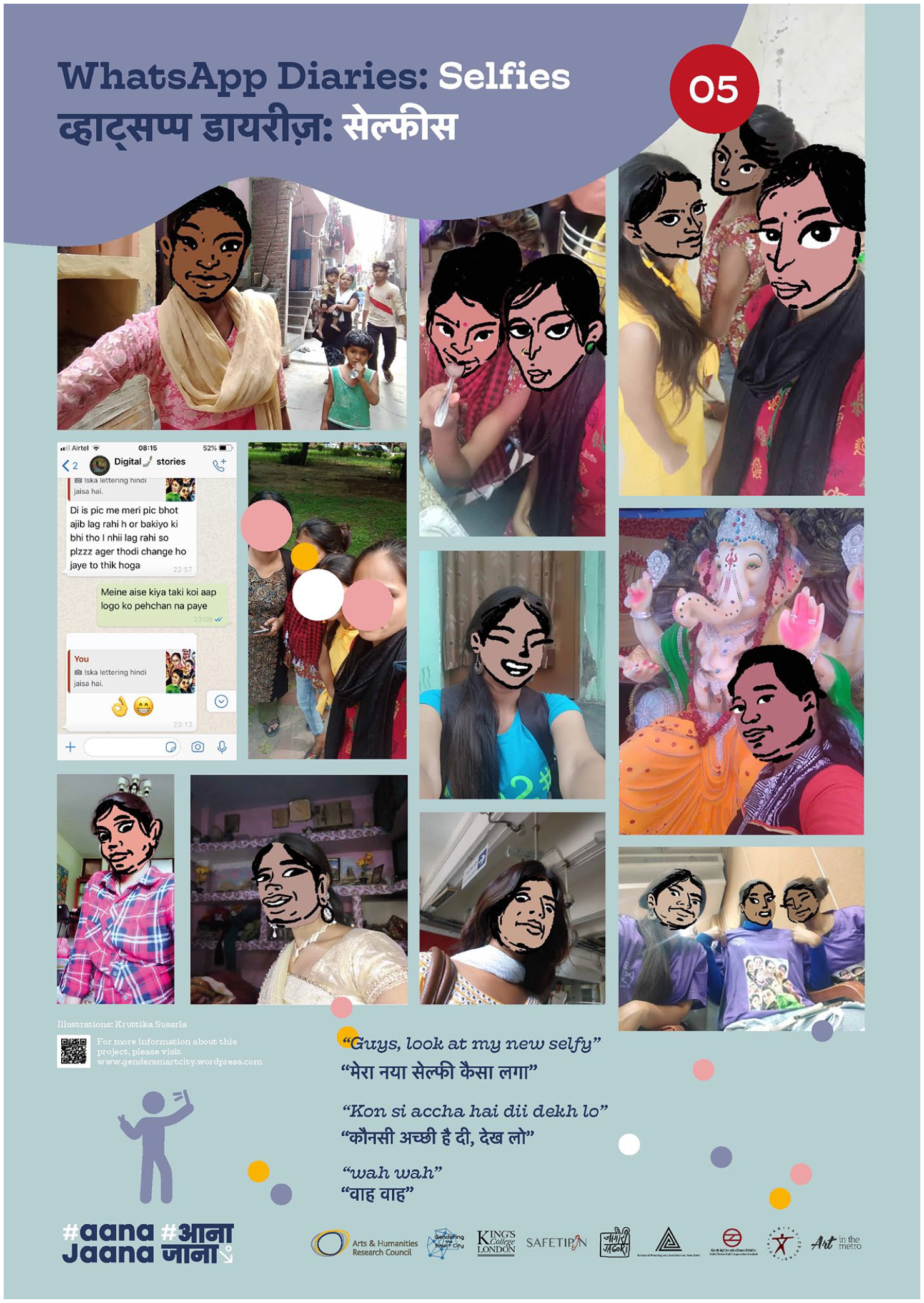
WhatsApp diary entries of selfies. Panel design by Kruttika Susarla.
Selfies were significant in a context where networked violence was the pervasive experience and vulnerability of coming to the city. They marked their ‘freedoms’ as small moments during the continuous anticipation of violence during their #AanaJaana in the city. They also enabled witnessing of potential danger, or intense vulnerabilities and fear of violence. In this context safety was not seen through the geolocational capacities of Google or other safety apps; rather in using the mobile phone for writing the texts on violence and confinement experienced in the gendered city.
I had to go from Jasola School to Badarpur village to my office just now. I wasn’t able to get a bus, and then suddenly a private bus came which was headed for the border. The moment I got inside I saw there were only men inside. I got scared because everyone was staring at me.” [WhatsApp diary entry accompanied by selfie, 7 September 2018]
Analogous to the selfies, authorship also occurred in the textuality of emojis, which stood as a shorthand for feelings, emotions and experiences. Emojis were particularly significant since they were rarely used to initiate discussion, rather they were almost always used to respond quickly to voice notes, pictures or texts. The emojis were basic forms of semiotic texts, which enabled participants to signal their emotions through predetermined codes. They constructed a sense of digital self 45 by doing identity and constructing collective memory through incomplete and fragmented expressions, and they took shape with/through the technologies of intertextuality in the WhatsApp platform (see Figure 5).
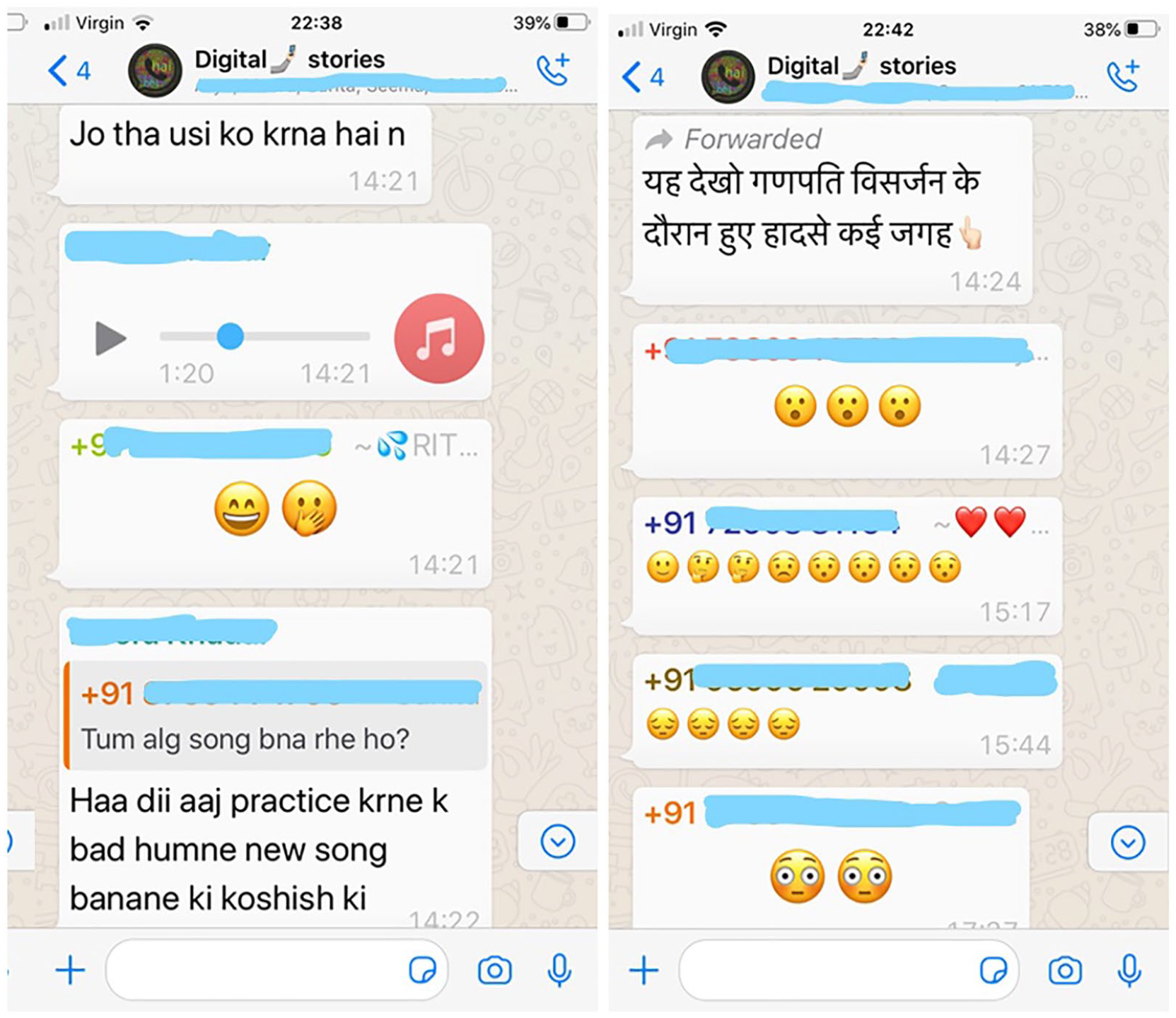
WhatsApp diary screenshots of emojis.
Authoring was not just a process of digital exchange; it was also established through intertextuality across multiple media in the contact zone. This notion of intertextuality became evident much later when participants met to write about their experiences in the workshops. While in digital platforms much of the text had been shorthand, images or voice notes, the text that emerged during the workshops produced a set of tongue-in-cheek verses. As a collective exercise which sought to document the sexual harassment they face in the streets, participants quickly turned these abuses on their head by appropriating offensive phrases within a word play of free-flowing verses (see Figure 6).
Khadar girls are no less than others
We are item bombs
Small packet but big explosions
I may be cute, but I am not mute
Selfie, selfie I may say, but why do selfies make me
Coming on WhatsApp, going to Facebook
This is the Smart generation
This is the chance for a smart city
Khadar girls are ready for the opportunity.
Writing about their experiences in this way was a form of parody, a dark humour of their vulnerabilities. This was an ‘auto-ethnography’ which as Pratt describes, is ‘one of the literate arts’ of the contact zone – ‘a text in which people undertake to describe themselves in ways that engage with representations others have made of them’. 46 The free verses moved across the ‘boundaries of mode and media’ 47 utilising the syntax of the abuser and a response within the same verse and thus challenging assumptions about victimhood of women who lived in the peripheries. The free verse created an intertextuality between lived experience and the social construction of gender roles across digital and material spaces, thereby reconceptualising #AanaJaana as a contact zone where shame, humiliation and fear can be reflected upon, resisted and transformed.
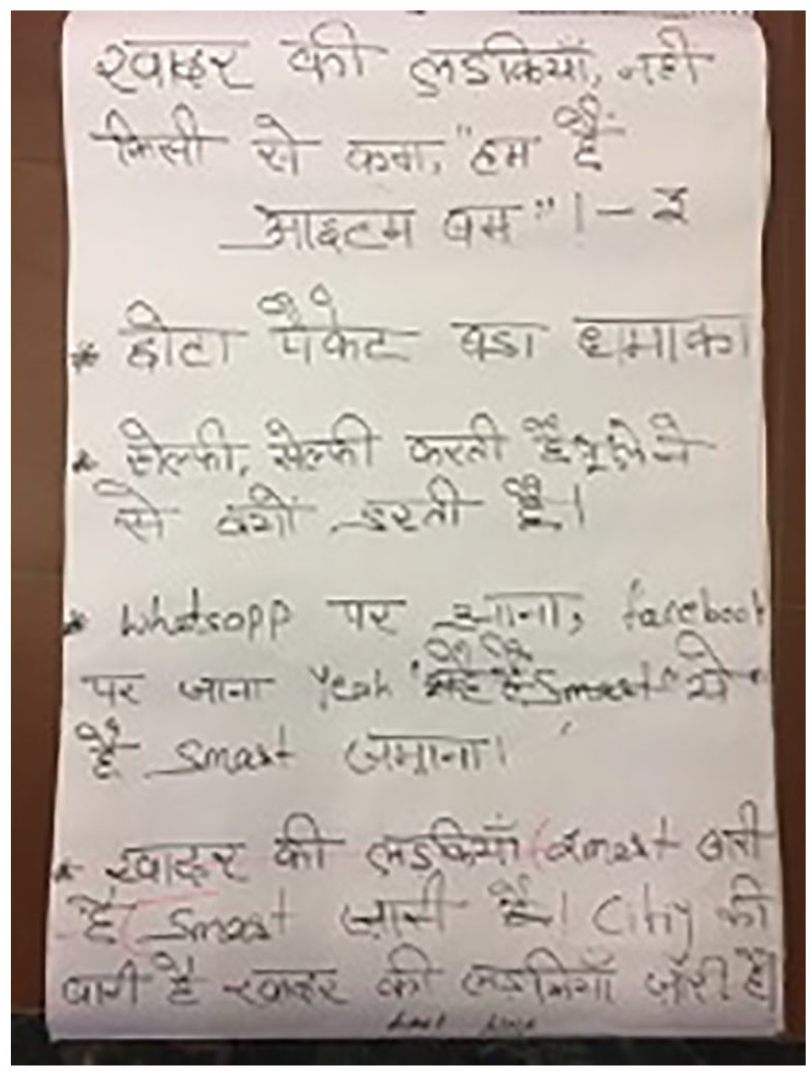
Images of free verse composed by the young women.
Authoring as a practice of #AanaJaana
#AanaJaana as an embodied practice, captures the ethos of Mary Louise Pratt’s ‘contact zone’ as encounters between analogue and digital spaces, city and its peripheries, intimate and public – encounters not just of gendered bodies and experiences, but also of the texts and cultural artefacts that they produce. As both a metaphor and an embodied practice, it reflects the pervasiveness of gendered marginalisation across home, city and the digital realm at large. As an authorial practice, #AanaJaana shows how in a digital age, young women in the urban margins can narrate, augment and annotate their embodied experiences of multiple struggles using just a mobile phone. Their words, language and expression, their histories and struggles captured as social ‘texts’, destabilised commonly held ‘realities’ of marginal lives. Their self-authorship on a messaging platform were not simply ‘speech acts’ enacted by ‘saying things by doing things’ 48 with technology. These were in fact acts of witnessing, documenting and speaking about all forms of structural, infrastructural and gender-based violence through technology 49 akin to what Bell notes as a ‘form of juris-writing, a writing that concerns and aims at justice’. 50
As one of the young women said at the start of this paper, the #AanaJaana exhibition was only a ‘trailer’. Its transculturality emerged in the multiple ways that issues and themes raised in the exhibition began to contour public campaigns for the ‘safe city’. 51 Beyond its very public coverage by national media which gave space to young women to ‘speak’, it provoked a public consciousness in the city through calls to include violence against women as an agenda in local elections. The participants were invited to join ongoing consultations organised by feminist NGOs towards a new gender sensitive masterplan for Delhi. This highlighted the need for critically rethinking the encounters between the centre and peripheries, across digital, physical and social spaces with all their messy power dynamics, in order to find new openings for transformative change. Although the project has involved only a small group of women, but their motivation in taking part in this ‘trailer’ was driven by the need to self-author their stories and curate them for the benefit of others like them far beyond the confines of Delhi and its margins.
#AanaJaana thus presents new and hybrid contact zones of confinement, translocality and intertextuality where personhood and subjectivity take renewed significance in an era of #metoo, #blacklivesmatter and several current social justice movements that span across digital and analogue spaces. These are contact zones that are produced relationally across the ‘transculturating elements of metropolitan discourses’ 52 to imagine new spaces of ‘self-knowledge and historical consciousness’. 53 This is particularly significant in a context where intertextuality between social, literary and multimedia texts enables women to bring forth important questions around the semantics of violence. Here the contact zone becomes a ‘site of intellectual and manual labour’, 54 where feminist urban futures are negotiated from within the power structures where women are embedded. Authorship in this contact zone is no longer a form of ‘artistic’ production; rather it is the possibility to transform ordinary and everyday stories of struggle into cultural artefacts through reflection and critical consciousness.
This raises an important question of the relevance of the contact zone in the digital margins. While geographers have extended Pratt’s literary contact zone through renewed understanding of the transculturality of geographic encounters, is the contact zone still an appropriate lens through which to understand the hybridity of gender power dynamics across digital and analogue spaces? If transculturation, intertextuality and translocality emerge from digital and embodied encounters, is the lens of ‘contact zone’ adequate to capture the emancipatory potential of digital ‘safe’ spaces? And if not, then what should take its place? Can #AanaJaana potentially reorient the significance of contact zone in a digital urban age?
While #AanaJaana reworks gender power across digital, cultural and social spaces, its enduring significance lies in its potential in decolonising the power dynamics vested in western forms of knowledge and consciousness across these spaces. #AanaJaana offers an ‘epistemic disobedience’ 55 in refusing to be confined by the terms and conditions of social, physical and digital power dynamics because it captures the conflicts and contradictions of a decolonising encounter in a digital age. As Mignolo notes, this means the ‘unveiling of epistemic silences of Western epistemology and affirming the epistemic rights’ 56 of those in the margins. This means poor women are no longer bound by the limits of epistemological learning as subjects of state patronage, which constructs the significance of digital space as the ability to access welfare and programs of the state. Rather #AanaJaana redefines the contact zone to highlight indigenous forms of expression and knowledge, not only by presenting new forms of literary ‘innovation’ in the digital-analogue margins, but also underlining its affective and resistant potential through the anger, joy, freedom and despair that emerges therein. #AanaJaana is a transcultural artefact of multimedia encounters across digital and urban spaces that are archived and curated through digital and social texts, and therefore reflects an extension of the contact zone in a digital age that is at the same time fluid and amorphous, shifting and diverse, translocal and multiscalar.
This decolonising potential has many limits, in that #AanaJaana is also bound by the power dynamics and constraints of social media platforms and digital technologies. However, even as social media platforms have come under increased criticism of being complicit with state surveillance, 57 they can and do offer ‘safe spaces’ from the oppressive panoptics of family and community. Self-authorship in #AanaJaana enables us to reimagine transcultural encounters across digital-analogue spaces as non-foundational and open to other knowledge systems and approaches. #AanaJaana’s decolonising potential lies not only in exposing the structural and symbolic legacies of power that have oppressed poor women, but also in tracing the intertextuality of gendered digital experiences. It offers a networked approach to decolonising gender power by directing focus on the transformative potential of a mobile phone with its front facing camera in the hands of poor women. If Pratt’s contact zone presents the transformative potential of the encounter between the coloniser and colonised, #AanaJaana offers a polycentric way of rethinking the contours of colonisation and decolonisation across digital-analogue spaces.
Footnotes
Acknowledgements
This project would not have been possible without the participation and enthusiasm of the young women in the low-income settlements in Delhi who were part of this research. We are grateful to Jagori and Safetipin for partnering on this project, and providing support and access to the community, recruiting participants, organising the workshops and feedback on this research as well as to graphic artist Kruttika Susarla for curating the exhibition panels. Finally, we are grateful to the anonymous reviewers and to Dydia DeLyser for her thoughtful and constructive feedback, which have all vastly improved this paper. All other errors are our own.
Funding
The author(s) disclosed receipt of the following financial support for the research, authorship, and/or publication of this article: This paper has been made possible through an Arts and Humanities Research Council (AHRC) funded research network titled ‘Gendering the Smart City’ (PI Datta ref: AH/R003866/1). Earlier seed funding was provided by King’s College London.
Notes
Author biographies
