



Abstract
Smart city initiatives are mushrooming across the Global South, yet their implications for urban informality – a distinct challenge of planning in the cities of the Global South – remain overlooked. Using the Indian case as a focus and drawing upon empirical studies in three cities of Bhubaneswar, Pune, and Chennai, which are among the first 20 smart cities prioritised for implementation in the Smart Cities Mission, we show how informality challenges the understanding of the smart city. We analyse how this phenomenon is framed in smart city planning, focusing on the three domains of affordable housing, infrastructure services, and citizen engagement. We argue that using informality as a lens of critical analysis offers a new perspective on the ‘Southern theory’ of smart cities. In doing so, we highlight the disregard of informality at the cost of socio-spatial division – as a significant challenge for smart city development in India.
Introduction
Smart city initiatives are mushrooming across the Global South, yet their implications for urban informality – a distinct challenge of planning in the cities of the Global South – remain overlooked. Considering the fast-growing smart city landscape in the Global South (Alizadeh, 2021), there is a need to understand it through the lens of informality. Rao's (2012) ‘slum as a theory’ or as imaginary, Roy's (2011) informality as a critical epistemology for planning, Benjamin's (2008) ‘occupancy urbanism’ and Robinson's (2002) ‘off the map’ cities, and others are all theories and frameworks highlighting the need to understand informality at the centre of urban development and practice in the context of the Global South. Furthermore, informality appears to be the core of urban theories coming out of the Global South, framing from the point of view of planning: highlighted as the ‘state of deregulation’, where the state itself is an informalised mechanism, regulating various strategies and processes on informality from the above (Roy, 2009b), as well as the ‘state of exception’ from the formal order of urbanisation generated by diverse planning approaches on informality from below (Roy, 2005). This critical line of literature argues for rethinking informality and formality as a set of ‘practices’ and understanding the different ways they correlate to one another in the conception and contestation of spaces (McFarlane, 2012). It further warns against the elitist view of planning and building norms that overlook the urban poor's demands, forcing them to violate law and order (Watson, 2009). Therefore, acknowledging the Global North's dominance of urban theories, models, and solutions, these critics call for a ‘Southern theory’ in urban studies. This paper takes up this call to further examine the ‘smart city’ in the Global South; to contribute to the distinct ‘Southern theory’ of smart cities by recognising how ‘informality’ challenges the smart city conceptualisation and implementation. Although this study focuses on the Global South – where informality is dominant and mainstream – what we learn from this context can help transform smart urbanism discourse globally, focusing on equity and equality implications.
There are reasons to expect that smart city planning, aligned with traditional strategic planning, lacks a constructive way of dealing with informality. Previous research articulates the relative exclusions of urban informality in smart city planning, with attention to the patterns of exclusions, such as the privatisation of basic services and displacement of informality from the centre to the periphery (Willis, 2019), joined by investigations of the consequences of smart city imaginaries and policies on urban informality (Breslow, 2021; Parida, 2021). More recently, there has been an emerging debate on the socio-spatial implications of smart cities and, particularly, the extent to which smart city place-based outcomes are executed in a fragmented manner, disregarding informality (Prasad et al., 2022). This paper, however, takes a step back and focuses on understanding why and how certain smart city planning practices emerge and highlights some distinctive challenges smart city development poses to informality – and we do so through a focus on India.
India is home to one-fourth of the Global South population (approx. 1.4 billion) (World Population Review, 2020), with an aspiration to build 100 smart cities through a central Smart Cities Mission (SCM) program announced in 2015. Although this notion is ambitious, it is essential to recognise that Indian society (one of the oldest civilisations in the world) has developed organically over the last centuries; therefore, considering the complex governance and the drive for neo-colonial and pro-western ideologies in the country's planning strategies, this sudden transition towards a smart city could be challenging. Moreover, according to the Government of India, the SCM aims to ‘…improve quality of life, create employment and enhance incomes for all, especially the poor and the disadvantaged, leading to “inclusive Cities”’ (MoUD, 2015: 7). In particular, SCM strives for inclusive development by providing core infrastructure and services (such as public transport, affordable housing, water, electricity, and solid waste management, to name a few), and the application of ‘smart’ solutions (such as IT connectivity & digitalisation and e-governance & citizen participation) to upgrade the infrastructure and services (MoUD, 2015). Despite SCM's emphasis on inclusivity, the perception of the ‘smart city’ unfolded quite differently on-the-ground in India; as a combination of (a) fragmented infrastructure projects such as IT hubs, high-end residential, commercial, and entertainment facilities; (b) technology and data-enabled ‘smart’ solutions, such as internet-based citizen engagement, smart meters for basic services and mobile applications for public transportation; and (c) heightened regulations, relocation, and removal of the informal economy, settlements, and livelihood – that does not ‘fit’ into the inclusivity narration promoted by the Government of India. More specifically, this paper demonstrates two crucial patterns. Firstly, it reveals an understudied feature of the Indian planning system – where the system tends to stay unchanged despite the constant introduction of new policies, such as the SCM. Secondly, the paper documents how informality is framed in the SCM, focusing on the three domains of affordable housing, infrastructure services, and citizen engagement. It asks the critical question: Who will benefit from ‘affordable housing’? Who will use infrastructure services? Who is involved in citizen engagement? More explicitly: for whom is the smart city being developed?
The paper begins with an overview of relevant scholarly debates on urban informality and smart city planning responses to informality. It then examines how informality is framed in India's SCM, using an extensive analysis of the smart city planning strategies, processes, and mechanisms undertaken across Bhubaneswar, Pune, and Chennai. Finally, in the conclusion section, we summarise emerging discussions from our empirical investigations (e.g., interviews and site visits) and propose future research directions.
Urban informality and smart city planning
Urban informality tends to be assumed as an indicator of uncontrolled illegal activity, as a sign of poverty and marginalisation, usually displaced due to urbanisation (Davis, 2006). In contrast, an established body of critical literature provides an alternative understanding of the phenomenon: Robinson's (2006) ‘ordinary cities’, McFarlane's (2008) ‘urban shadows’, Yiftachel's (2009) concept of ‘gray spaces’, Roy's (2013) ‘worlding’ approach, and others, are all theories and frameworks emerging from the Global South contexts which offer insights to urban informality. As Roy points out, [Informality] is not a set of unregulated activities that lies beyond the reach of planning; rather it is planning that inscribes the informal by designating some activities as authorised and others as unauthorised, by demolishing slums while granting legal status to equally illegal suburban developments (Roy, 2009a: 10).
This paper seeks to contribute to the increasing awareness of the widespread and overlooked challenges of informality in ‘smart city planning’. To understand how it impacts informality, we first acknowledge some of the broader arguments on smart city planning and its fragmented nature. Although conventional strategic planning is top-down with well-defined master plans and actions, ‘smart city planning’, in many cases, is developed piecemeal by multiple private and public stakeholder agencies and is at the mercy of the fast-evolving smart city technologies. Komninos et al. (2019) describe this piecemeal nature as ‘planning without a plan’ or planning cities by ‘evolution’ rather than through detailed design and rigid plans. On a similar note, Cowley and Caprotti (2019) describe the smart city as a form of ‘anti-planning’, where smart city planning is ‘opportunistic’ rather than the outcome of a deliberate strategy. More recently, Dowling et al. (2019) flagged that most ‘smart solutions’ are being delivered at the local scale ‘without a strategy in place’. However, such smart city initiatives are integrated awkwardly into existing configurations of the built environment (Shelton et al., 2015): either in the form of opportunistic ‘new’ greenfield cities (Datta, 2015) or piecemeal infrastructure-oriented smart city projects (Angelidou, 2014). Besides, such a fragmented coalition of smart city initiatives often results in social and spatial fragmentation and divisions, deepening the challenges of inequity and inequality in smart cities (Prasad et al., 2022).
Therefore, this paper recognises the need to understand the challenges of ‘inequity and inequality’ in smart cities – displayed explicitly as ‘informality’ in the Global South, and the role of planning strategies, mechanisms, and practices utilised in shaping the development of actually existing smart cities (Kitchin, 2015). Thus, rather than approaching the challenges of informality as an extensive, industrialisation-led change in smart city development (as illustrated clearly in experimental ‘new’ greenfield smart cities like Dholera in Gujarat, India, see (Datta, 2015)); it is necessary to examine informality under the smart city as a mundane, dealing with subjects such as informal housing, economies, and activities on-the-ground (Singh and Parmar, 2019). We argue that a genuine gap exists in what is regarded as mainstream informality theories and trends, with inadequate attention paid to the smart cities in the Global South – where the cities are rapidly growing, informality is ‘mainstream’, and scholarly interest is still relatively marginal. This gap raises the need and opportunity to contribute to the ‘Southern theory’ of the smart city, to reflect Connell's (2007) and Comaroff and Comaroff's (2012) proposal for ‘Southern theory’ in social sciences. Using informality as a lens, this paper questions the relationship between smart city planning and ‘inequity and inequality’ challenges in smart cities – a universal problem.
Context and methods
Despite several attempts at pre-planned cities (such as Jaipur and Chandigarh), urban planning across India takes place mainly in an unplanned manner, with the fragmentation of responsibilities at each level of government (national, state, and local) and more significant fragmentation within each state government (Ahluwalia et al., 2014). Planning mechanisms such as policies on land use and zoning, urban design and renewal, and transport and other infrastructure have operated in isolation in India, and they are often conflicting (Ahluwalia and Kanburand, 2011) – resulting in various development policies that are not inclusive of the urban poor, generating social inequalities, and developing segmented cities (Mahadevia et al., 2009). Therefore, the challenge of informality in India affects all stages of urban development – dividing the cities spatially (formal vs informal settlements), socio-economically (street vendors vs established formal businesses), and in knowledge and practices (citizen engagement) (Singh and Sethi, 2018).
Nevertheless, the Government of India (GoI) has a long history of initiating nationwide schemes targeting the urban poor in cities, but these plans ended abruptly due to severe funding deficiencies and were relatively averse to informality. One such model is the Jawaharlal Nehru National Urban Renewal Mission (JNNURM), launched by the GoI in December 2005. JNNURM operated on affordable housing, infrastructure/basic service provision, and citizen engagement issues. It included a significant component for upgrading/improving the conditions of slum settlements and supporting basic services for the urban poor under its Basic Services for the Urban Poor (BSUP) sub-Mission. However, in practice, several limitations of BSUP led to processes of exclusion of informality: First, the emphasis shifted from basic services to housing-only; the reach of this housing supply was minimal and selective; and, more importantly, it involved the demolition of existing slums for site redevelopment and, in turn, provided medium-rise apartment blocks in relocation areas which were poor quality and not appropriate for the community's sustenance (Burra et al., 2018). Moreover, in 2015, the Ministry of Urban Development, Government of India, announced a new national initiative called the SCM, replacing the previous government's JNNURM, which had ended due to extreme funding shortages (Singh and Parmar, 2019).
The SCM had a grand vision to develop 100 smart cities in India within an ambitious five-year time frame. The Mission is predominantly nationally funded and co-funded by the state and local governments, with the Special Purpose Vehicles (SPV) appointed at the city scale to attract funds from auxiliary sources. Although the national government outlines the smart city policies and planning strategies, the SPVs implement the smart city projects, creating an ambiguous delegation of duties between the state and the local governments and, thus, highlighting the multiscalar smart city governance in India (Prasad et al., 2021). In particular, the Mission's policies and planning strategies build on some broad urban development features such as: (a) promoting mixed land use by planning for ‘unplanned areas’; (b) expanding housing opportunities for all; (c) creating sustainable transport options (cycling, walking); (d) improving open spaces; (e) developing Transit-Oriented Development; (f) providing on-line governance services; (g) giving an identity to the city (based on economic activity, arts, craft, etc.); and (h) implementing ‘smart solutions’ to infrastructure and services (MoUD, 2015: 7). SCM has two main strategic components: First is the Area-Based Development (ABD) strategy, which centres on three models: (1) ‘Retrofitting’ or city improvement (of existing built-up areas) focusing on infrastructure services and smart applications; (2) ‘Redevelopment’ or renewal (of existing built-up areas replaced with a new layout) focusing on applying mixed land use and increased density; and (3) ‘Greenfield development’ or extension (of the previously vacant areas located in the city fringes) focusing on smart technology, with a requirement for affordable housing. Second, the Pan-city development strategy considers smart solutions using technology, information and data for the existing city-wide infrastructure and services (such as intelligent traffic management systems, smart metering, and wastewater recycling). Furthermore, during the Smart City Proposal (SCP) preparation, the Mission expected the participating cities to prepare their proposals based on citizen engagement and incorporate a large number of infrastructure and housing projects (with 15% allotted to affordable housing for the poor) (MoUD, 2015: 8). Consequently, this paper analyses the three central smart city planning domains – affordable housing, infrastructure, and citizen engagement – detailed in the next section of the paper.
To capture how informality challenges the conceptualisation and realisation of the ‘smart city’ in India – as part of the SCM – we conducted fieldwork in three cities of Bhubaneswar, Pune, and Chennai. These cities were chosen based on their rank in the first list of 20 smart cities prioritised and financed for implementation (Bhubaneswar, Pune, and Chennai placed #1, #2, and #18 sequentially). Additionally, the diversity in population size across the three case studies provides a better understanding of the diversity of smart city development practices across India. Figure 1 maps the three cities chosen for the study.
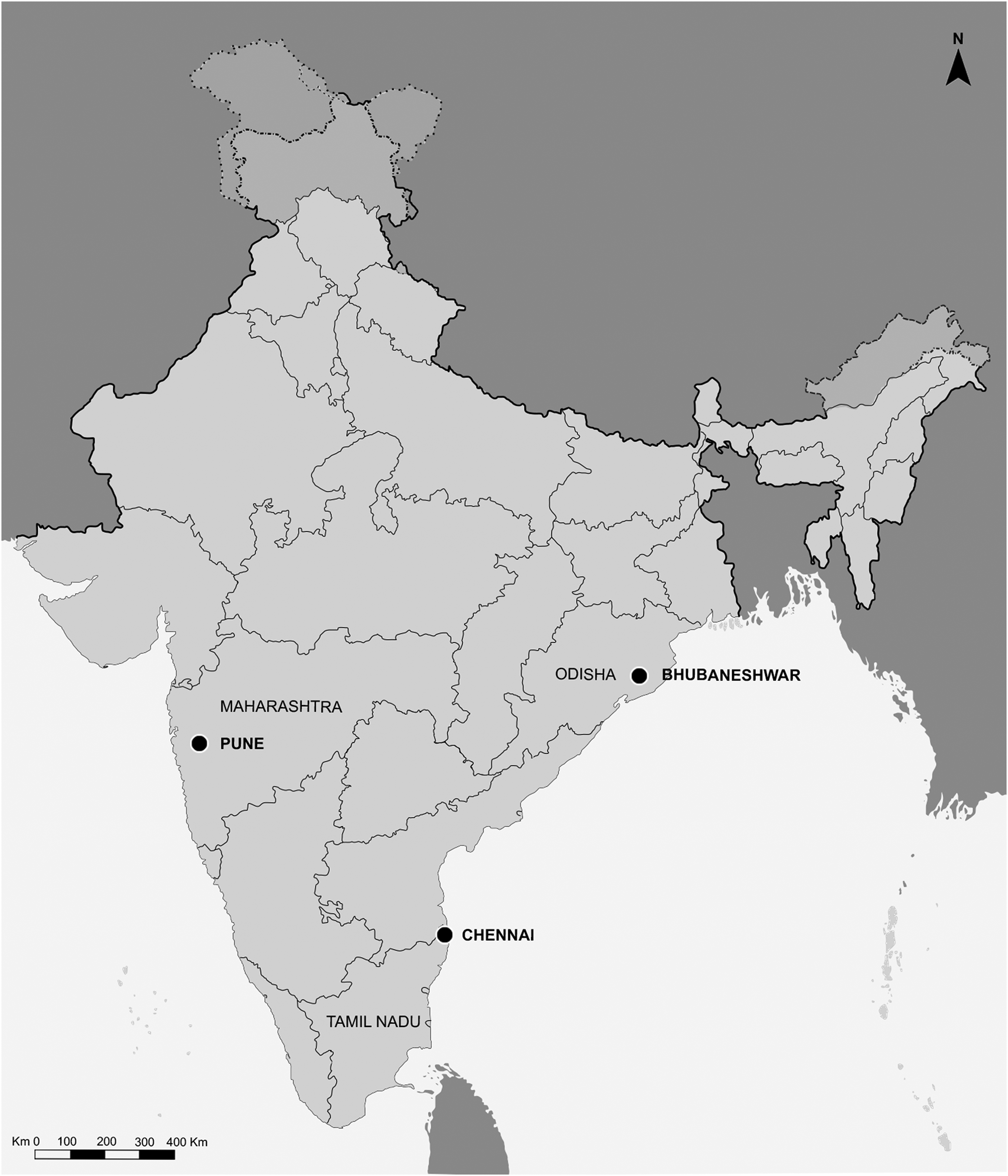
Location map of the three cities – Bhubaneswar, Pune, and Chennai.
Bhubaneswar, the capital of the East Indian state of Odisha, is a small-sized city covering 161 sq. km (Census, 2011) and a population of 1.19 million (UN, 2020). The city is one of India's newly planned cities in the post-independence era, designed to function as an administrative cum IT service centre, and aims to attract knowledge economy investments and a tech-savvy workforce. Additionally, it has a vast population of low-income communities, such as street vendors and informal settlements (approximately 18.5% of the city's population) (Anand and Deb, 2017). However, Bhubaneswar's current urban development has several gaps, including weak urban land management procedures, piecemeal and ad hoc urban planning, and ineffective coordination between the state and local government urban departments – all impacting the city both environmentally with periodic floods and physically with the rapid growth of slum settlements (Chatterji and Maitra, 2018; Routray et al., 1996). Through its smart city plan, the city envisions adopting key urban planning strategies focusing on integrated land use and transport planning, infrastructure planning, and socio-economic planning (MoUD, 2016a).
Pune, the second-largest city in Maharashtra, is a medium-sized city covering 276.4 sq. km (Census, 2011) and a population of 6.8 million (UN, 2020). The city is emerging as an industrial and educational hub, attracting massive urban growth, including a large migrant population. This influx of rural migrants to the city for job opportunities has led to a growing number of informal settlements (home to approximately 36% of the city's population) (Krishnamurthy et al., 2016). Spatially, the city is segregated into four distinct zones (old-inner city historical zone, British-initiated large cantonment zone, new-industrial economic zone, and outer-urban fringe with a mix of housing and informal economy) – leading to increased social fragmentation (Butsch et al., 2017). Pune is retrofitting and renewing existing informal settlements to develop residential townships and IT parks through public–private partnerships in its quest to be a ‘world-class city’. Additionally, the city's current urban development is unstructured and scattered, with its urban planning system being inequitable and ineffective due to its uncoordinated planning activities at various local government departments and failure to include the poor in the mainstream policies (Sen et al., 2003). However, Pune's smart city plan seeks to repair its core urban infrastructure and leverage funds to meet infrastructure demands, transform it into the most livable city, create high-end IT jobs, and enhance the city through riverfront development (MoUD, 2016b).
Chennai, Tamil Nadu's capital, is a megacity with an 11.02 million (UN, 2020) population and 426 sq. km in area (Census, 2011). The city is the largest industrial and commercial centre in South India, resulting in large-scale population growth straining its urban infrastructure. Moreover, the urban population in Chennai living in informal settlements (approximately 28.5% of the city's population) exists in hazardous circumstances with limited access to basic amenities and high exposure to pollution, natural calamities, and other disasters (Krishnamurthy and Desouza, 2015). Although Chennai has adopted several slum policy approaches ranging from slum upgradation to reconstruction, these efforts have had a limited impact, mainly due to shifting political coalitions (Saharan et al., 2018). Recently, Chennai has aspired to adopt strategies focusing on transport infrastructure, open spaces, safety, physical infrastructure, and e-governance as a part of its smart city plan (MoUD, 2016c).
Therefore, the current planning processes in Bhubaneswar, Pune, and Chennai have several gaps and reflect the fragmented nature of urban planning. The lack of an integrated and comprehensive plan and weak coordination between various urban development departments resulted in a fragmented and complicated planning process. In simple terms, due to rapid urbanisation plus failure in planning; all three cities experience crucial informality challenges, such as (a) intensified unplanned urban sprawl; (b) rapid growth of slum and squatter settlements; (c) lacking basic amenities (such as water, electricity, and waste management); and (d) increased social fragmentation.
The empirical fieldwork in the three cities of Bhubaneswar, Pune, and Chennai included a range of site visits, semi-structured interviews with over 37 diverse respondents, and over two field trips in June 2019 and December 2019. Interviewees for the study ranged from national, state, and local governments, smart city corporation officials, private consultants, non-government organisations, independent urban planners, researchers, and activists. We used a mix of background and scoping research (using publicly available documents) and snowballing techniques to determine the appropriate interviewees. The interviews were open and in-depth, and the questions covered informality themes and adjusted to the interviewee's capacity and position in India's smart city planning processes. The interviewees were identified by codes throughout the data analysis to guarantee non-disclosure. For example, we classified interviewees in Bhubaneswar as ‘B’, Pune as ‘P’, and Chennai as ‘C’, followed by a classification number. Additionally, we conducted extensive policy analysis on smart city planning and smart city development in India; and visited several smart city project sites in all three cities.
In the following section, we demonstrate the nature of smart city planning in the SCM to guide our investigation of how informality is framed in the smart city planning strategies, processes, and mechanisms in Bhubaneswar, Pune, and Chennai. We do so through a thematic analysis of the interviews outlined above.
Smart city planning and informality in Bhubaneswar, Pune, and Chennai
In India, SCM started as a top-down national plan with policies primarily directed at the city level. However, the Mission's strategies do not necessarily align with the previous planning documents, making them counterproductive, at least at times, as detailed below:
Urban planning in India has a long history of planning in a fragmentary fashion, even before the SCM. One such example is the City Development Plan (CDP) – the first strategic plan introduced in India under the former city-modernisation scheme, Jawaharlal Nehru National Urban Renewal Mission (JNNURM) in 2005 (GoI, 2012). JNNURM made it mandatory for cities to prepare a CDP and demand specific projects against the CDP's frame. As a result, the rushed CDPs for JNNURM in many cities resulted in a list of fragmented projects instead of an integrated strategy document (Ahluwalia and Kanburand, 2011). However, with the SCM's launch in 2015, the CDP was backdated, and cities implemented individual smart city projects without integrating both plans. Therefore, the actual smart city projects are not explicitly mentioned in the CDPs, and additionally, some sit outside the broader metropolitan statutory plans and strategies. This omission resulted in various city, state, and local government authorities working on multiple smart city domains (such as land use, transport, housing, water, and sanitation) without a holistic view of how the (smart) city operates and how these specific projects mesh into each other. According to Roy (2009b), this is a prime example of the ‘idiom of urbanization’ prevalent in cities of the Global South; also explicit in our interviews, as stakeholders were consistent in their view that smart city planning was not fundamentally strategic: Smart City lacks the strategy; it neither has the budget nor had the time to implement, so everything is pretty much rushed through to get the type of projects…the major funding for the CDP under JNNURM was for hardware infrastructure, which is not part of the SCM. So, the CDP and Smart Cities do not align (B2). Urban Planning [in India] was in a slumber for a long time, and now that smart city has woken up, it is broken, and it needs integration (P6). The CDP and Smart City Plan are not linking well…There is an issue of policy incoherence. Various departments own a part of the urban agenda, which may not necessarily align. For example, the Chennai Metropolitan Authority [the nodal planning agency of Chennai] owns the CDP. Chennai Smart City Limited [the smart city governance at the city-scale] owns the Smart City Plan…These are parallel plans in the same area for developing Chennai, and they do not necessarily integrate. This policy issue is not Chennai specific; it is pan India (C5).
Carrying forward this critical reflection on the fragmented nature of smart city planning in India, in the sub-sections below, we illustrate how informality is (or is not) framed in the smart city planning strategies, processes, and mechanisms in Bhubaneswar, Pune, and Chennai. The SCM claims to include informality in its planning strategies, such as affordable housing, infrastructure (basic services), and citizen engagement. This paper focuses on affordable housing and citizen engagement strategies from a policy design perspective. In contrast, in infrastructure strategy, the focus is on the impact of the implementation process as smart city projects began to unfold on-the-ground at the time of fieldwork.
Affordable housing and informal housing
SCM's affordable housing strategy does not have definite specifications or budgetary requirements; yet emphasises developing housing opportunities, especially for the poor. Nonetheless, ‘affordable housing’ under the smart city is mostly an alternative term for ‘slum clearance’ – it is about the displacement of informal housing to cater to the middle/elite income residents – as evident by the data gathered in the three case study cities.
Despite the Mission's lack of description of the ‘type’ of housing developments, the housing component covers the highest single-item expenditure under smart city projects proposed by individual smart cities. This strategy builds on several parallel initiatives, including the Pradhan Mantri Awas Yojana (Urban) PMAY (U) Mission, launched simultaneously with the SCM by the Modi government. Although PMAY (U) follows a project-based approach, the SCM follows an area-based approach to affordable housing. Based on the ABD strategy, cities individually propose two housing projects. First, the ‘brownfield’ projects include retrofitting and redeveloping existing slums (in the core-city region) into ‘better planned’ high-rise residential complexes close to IT hubs, shopping centres, and entertainment facilities. Second, the ‘greenfield development’ projects develop ‘new’ luxury townships (in the city peripheries) and provide 15% of its total housing quota to the affordable housing category (MoUD, 2015).
However, the affordable housing strategy was conceived and implemented differently in the three cities, with similar impacts on informal housing. For example, Bhubaneswar's strategy builds on several previous initiatives, such as PMAY (U) and JAGA mission (a state government initiative for slum land titling), to achieve its affordable housing goal. The convergence of funds helped the city list a substantial portion (approx. 28%) of its smart city funds under various sub-schemes – such as Mission Abaas (slum redevelopment projects), Rental Housing for construction labours, Project Kutumb (social equity centres) and Janpath government housing redevelopment. One of the schemes, Mission Abaas, included four slum redevelopment projects in the core-city region with 6000 Economically Weaker Sections units and 1200 Higher Income Group and Middle Income Group units for cross-subsidisation (MoUD, 2016a). Similarly, Pune's affordable housing strategy intends to redevelop 486 slums in convergence with another scheme called Housing for All (MoUD, 2016b). In both Bhubaneswar and Pune, these ‘slums’ in the core-city region (see Figure 2(a) to (c)), mostly well-maintained neighbourhoods by the residents, are listed under ‘affordable housing’ projects for smart city development. Such slum settlements (often lacking basic infrastructure facilities such as 24/7 water, power, toilets, and drainage) are to be relocated to the outer city peripheries to develop the existing land for commercial use. Substandard housing and basic services are given to the slum dwellers in return (see Figure 2(d)). This viewpoint was made evident in our interviews, as detailed below: Mission Abaas [in Bhubaneswar] under the SCM is the relocation of existing slums…slum dwellers will be relocated from the existing areas and moved elsewhere…then the land will be given to builders or developers for commercial purpose…later, the slum dwellers will be compensated with land or a house with nominal charge (B9).
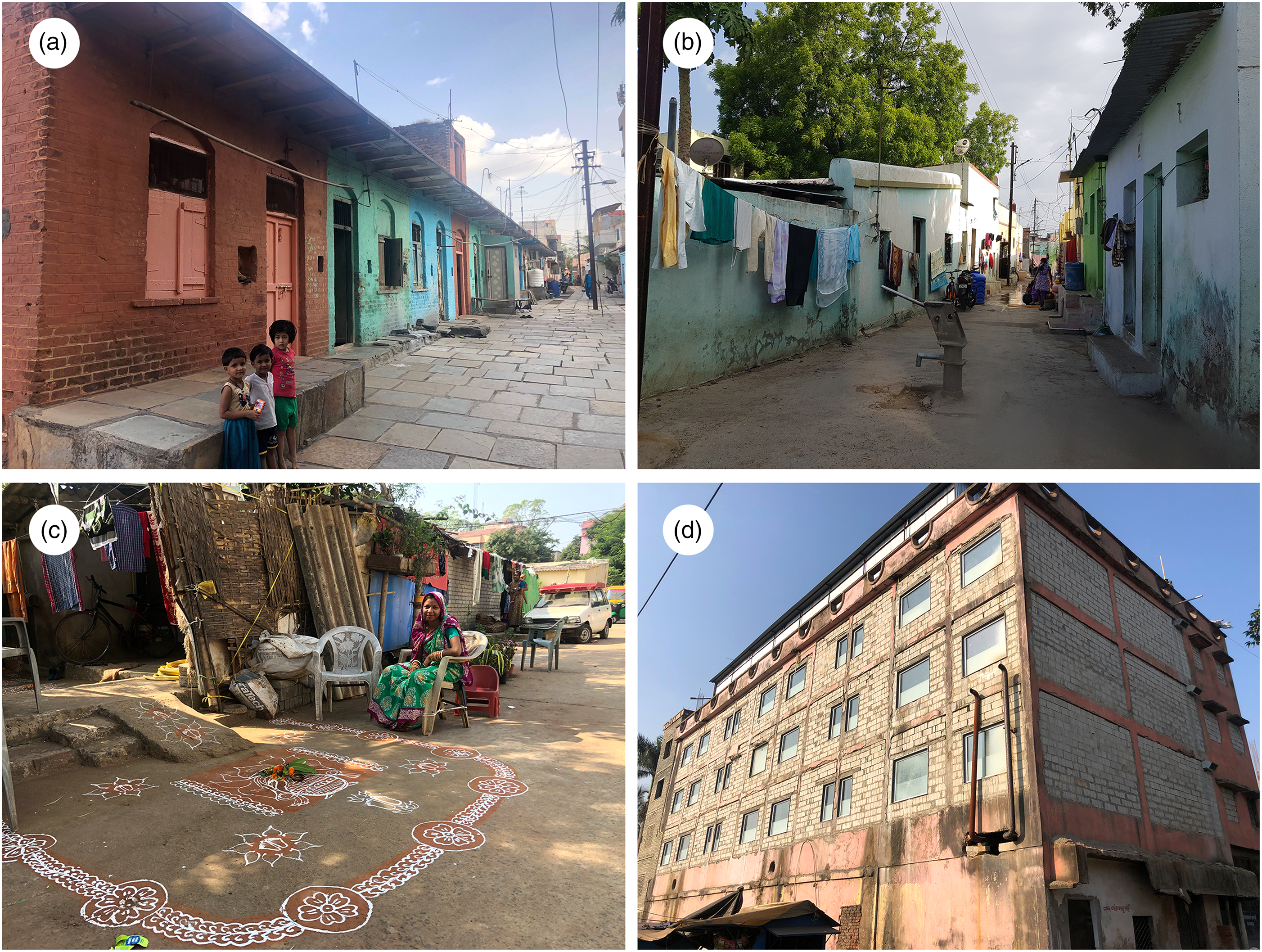
Neighbourhoods that will be lost (demolished) under Smart City slum redevelopment projects in Pune 2(a) and 2(b) and Bhubaneswar 2(c). Example of a former vacant affordable housing project in Bhubaneswar 2(d). Date: June and December 2019 (Source: Photos by authors).
Affordable housing always has loopholes…there are rules that you should have tenement, which is no bigger than a certain size, implying that the poorer people will buy them…They end up building eight-nine story buildings for the slum dwellers…elevators stop working…The water does not go more than the second floor…Once they [slum dwellers] have shifted in the new house, they say that ‘probably, we were better off earlier, although we had tin sheds’…So, it failed (P3).
When you remove a slum area and give them [slum dwellers] houses some fifty kilometres away from the city, they lose their livelihood, the sense of community is lost…it is impractical to live in the city's outskirts and commute every day for work (P8).
Conversely, Chennai decided not to include an affordable housing strategy under the SCM. This omission is due to the vast population living in slums (more than one-fourth of Chennai's population (which is above 11 million)), the significantly low housing quality, and the lack of basic services (Krishnamurthy and Desouza, 2015). In such a case, ‘…a small team of Special Purpose Vehicle [smart city governance at city-scale] will not have the capacity to manage such an enormous scale of housing or slum redevelopment’ (C2). Therefore, the Housing and Urban Development department and the Tamil Nadu Slum Clearance Board (both state government authorities) handle affordable housing independently and differently.
Therefore, the SCM's affordable housing strategy lacks a clear plan and varies in implementation, resulting in the displacement of informal housing to accommodate the elite- middle class. The findings confirm that the small- and medium-sized cities’ aspiration (Bhubaneswar and Pune) to become ‘world-class’ smart cities results in the development of high-rise residential complexes and luxury townships at the expense of restriction, displacement, and dispossession of informal settlements (Huchzermeyer, 2014; Sheppard et al., 2020). A lot could be said about the corruption in the building industry that allows for the highly questionable quality of housing provided for the displaced informal settlement residents. However, as the focus of this paper is on urban planning and governance, we join Roy (2009b) in calling out the regulatory system's failure that is determined to remove the informal settlements – to open space for the middle-class catered developments – and yet fails to protect the impacted communities’ right to dignified housing. The rise and expansion of the elite- and middle class in the city core and the distancing of the urban poor into substandard housing in the city peripheries contribute to the smart city's socio-spatial division through housing supply (Willis, 2019; Samara et al., 2013). Additionally, the SCM lacks a housing strategy for megacities (such as Chennai) as it is incapable of dealing with massive informality issues and neglects to offer an equitable response. Therefore, this haphazard amalgamation of multiple housing projects under the SCM is evidence of the ‘informal state’ or the ‘deregulated state’ (Roy, 2009b), where we consider informality not just as an exclusion of the poor from the purview of the state policies but also as the state itself as informal.
Infrastructure at the cost of the informal economy
SCM's infrastructure and basic service strategy have specific budgetary requirements, prioritise sustainable transportation (such as cycling and walking), and emphasise applying technology to provide basic services. However, despite limited social infrastructure projects aiming to uplift the low-income informal communities, the majority of ‘upgrading’, ‘beautification’, and ‘redevelopment’ infrastructure projects cater to the elite- and middle-class citizens and materialise at the expense of dispossession and displacement of existing informal economies, as detailed below:
The Mission's infrastructure and basic service strategy have a detailed list of smart initiatives and allocated funds. In specific, transport systems (including roads and rail transit) constitute 45% of the overall infrastructure costs, followed by basic amenities (such as water, electricity, and sewerage) (MoUD, 2015). As per these requirements, the cities individually announced street redevelopment projects with dedicated footpaths, bike lanes, and e-bike facilities (accessed by smartphone apps); and executed them in small sections in their respective ABD projects (e.g., in a single commercial street) – without any expansion plan. Additionally, the cities adopted tech-oriented basic services such as water-supply monitoring meters, sewerage sensors, stormwater management sensors, solid waste management sensors, and e-toilets that involve added expenses and smartphone applications. As recorded in our interviews, some smart cities prioritised supplying basic infrastructure while others focused on delivering tech-oriented infrastructure solutions: Chennai used the smart city vehicle to push basic urban infrastructure needs…it was compulsory to use the funds mainly on basic amenities such as water supply and water metering…If you do not meet your basic needs, it is difficult to go for more advanced systems (C5).
Smart city does not respond to the city's [Bhubaneswar] extreme emergency or disaster situations…the city lacks basic infrastructure…and the tech-based infrastructure added in the name of smart city development does not address these issues (B11).
The infrastructure initiatives were mostly executed similarly in the three cities, with comparable impacts on the informal economy. In Bhubaneswar, for example, the street redevelopment project ‘Janpath People's Smart Path’ developed dedicated bike lanes and footpaths on either side of the 60 m wide road. This infrastructure project resulted in the relocation of street vendors into iron structures/kiosks (sized 6′ × 6′ or 8′ × 6′). Due to the space constraint for the types of goods the street vendors trade, they illegally occupied the back lanes as a marketplace (see Figure 3(a) and (b)). Similarly, in Pune's ‘DP Road’ (a commercial street chosen as a street redevelopment project), the vendors were unaware of the displacement required to expand the footpaths and bike lanes. The inadequate consultation with the street vendors ended in local protests, and some street fragments were left undeveloped (see Figure 3(c) and (d)). In Chennai's ‘Pedestrian Plaza Project’ on Theagaraya Road (one of South India's busiest commercial streets), the street redevelopment project displaced thousands of vendors (all trading commodities affordable to low-income groups) into a multistorey shopping complex and developed footpaths with seating facilities (see Figure 3(e)), conveniently located outside branded stores. The existing parking and street vendors were pushed to the side lanes with a lowered floor height with restricted access (see Figure 3(f)). According to the interviewees, the street redevelopment infrastructure initiatives under the smart city impacted the informal economy adversely: But, it [Chennai's Theagaraya Road] was a place bustling with street vendors…now, they’ve all just vanished…Today, all the hawkers are given one small government building, and they’re given stalls inside…It doesn’t look as fancy and glitzy as a private mall…The street vendors have to be on the street to vend the kind of things they vend…That is the nature of their work…The cultural aspects and the rights of street vendors have been completely eroded in this process of smart cities…The vision of a smart city is of a first world, fancy, glitzy, swanky, showy…A particular view of urban development underpins the Smart City Development, which is very upper class (C3).
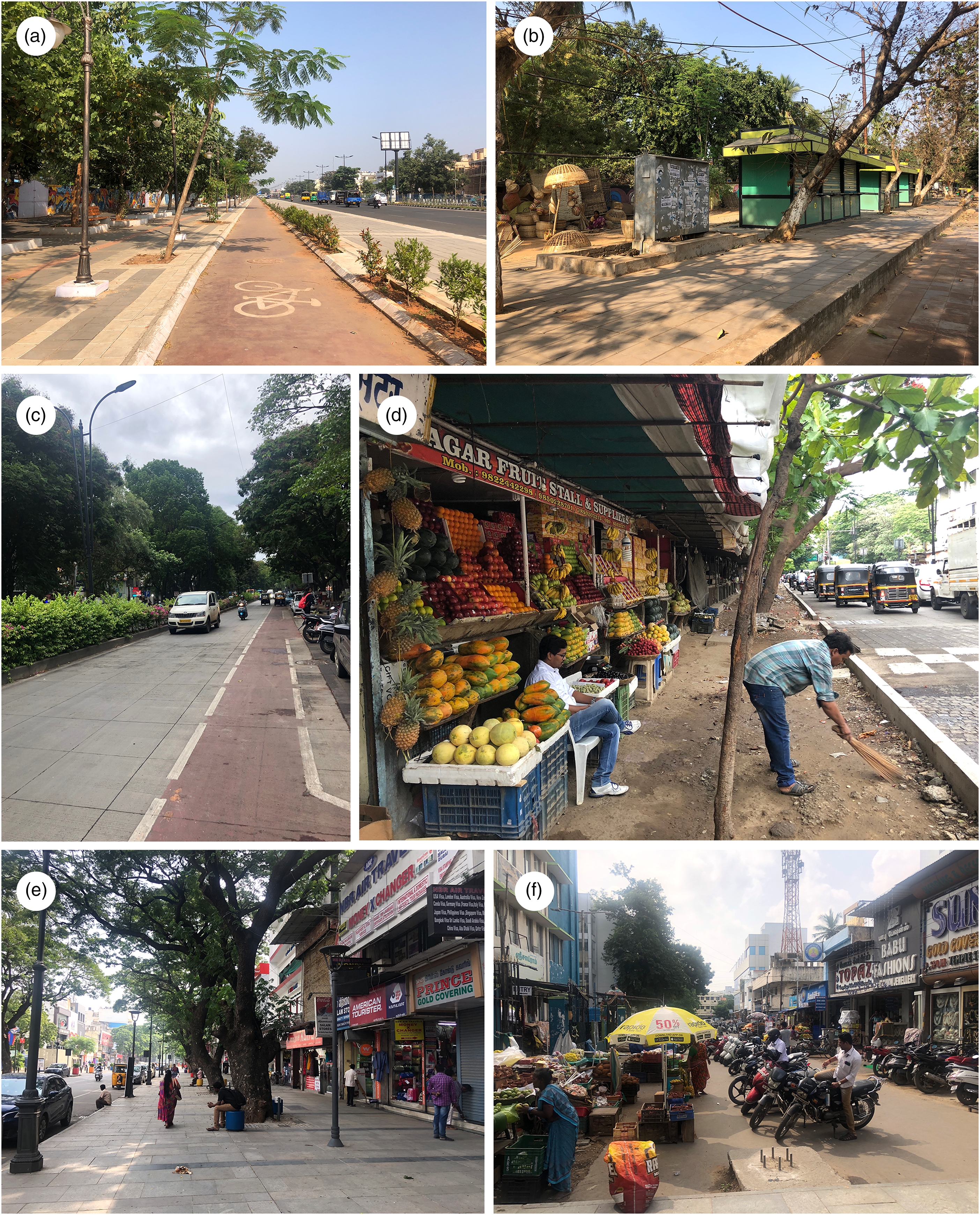
Bhubaneswar's Janpath Road and street vendors occupying back lanes for vending 3(a) and 3(b). Pune's DP Road and sections of the street left undeveloped 3(c) and 3(d). Chennai's Theagaraya Road and its unplanned side lanes 3(e) and 3(f). Date: June and December 2019 (Source: Photos by authors).
We cannot have a tech-driven perspective that works equally for everyone. Who has access to that tech? Who has access to the App? That is an important question in India, where access to basic services like water, sanitation and solid waste management are not addressed completely. And then people end up paying much more…Living in informal settlements and struggling for these services on an everyday basis, how can the ‘Smart App’ help ease the struggles these citizens go through? (P5).
Therefore, the SCM's infrastructure strategy has a consistent implementation in the three cities, resulting in the displacement of the informal economy and the loss of income and livelihood for the urban poor. The findings suggest two features of the SCM: first, the upside of infrastructure initiatives, such as street development projects, is marginal. The bike lanes, footpaths, and e-bike facilities are ‘opportunistic and piecemeal’ projects that do not connect to the broader transport network (Cowley and Caprotti, 2019) and rarely benefit anyone. Such fragmented projects threaten the informal workers’ livelihoods, including street vendors – arousing local protests, large-scale evictions, and street vendor displacement (Chen and Skinner, 2014). Additionally, these ‘upgrading’ infrastructure initiatives require ‘cleaning up’ streets to provide decorative spaces for commercial centres and comfort for the elite- and middle-class shoppers (Sheppard, 2014; Watson, 2014). This finding resonates with Fernandes and Heller's (2006) study of the emergence of the ‘new’ middle class, as the more affluent citizens refuse redevelopment projects that affect their quality of life yet commit to promoting ‘beautification’ projects that further insecurity for informal workers. Second, the smart city's basic amenities are elite-centric and do not cater to the urban poor's needs. Smart services, such as reading meters and sensors, gain more influence in planned colonies and other higher-income areas, not in slum clusters and more impoverished parts. Although these findings imply an oversight of informality in the SCM's infrastructure and basic service strategy, there are some favourable interventions on-the-ground (although minimal) targeting informality, as described next:
Smart social infrastructure
SCM's infrastructure and basic service strategy include smart social infrastructure initiatives to develop schooling, participation, safety, and well-being for low-income residents, especially in slum communities, such as ‘lighthouse projects’ (Prasad et al., 2022). However, while these are positive activities, they have a marginal impact. This is the case in small- and medium-sized cities. For instance, Bhubaneswar (see Figure 4(a) and (b)) took up a social equity lens in planning by setting up Project Swabhiman, a multi-skill centre connected with micro-business incubation facilities, focused on improving employment opportunities and self-defence training for young women and girls in slum communities. Likewise, Pune (see Figure 4(c) and (d)), in its drive for inclusive development through its ‘slum-free’ policy, focused on skilling slum youth by setting up multiple lighthouse centres across the city. One such project used mobile digital classrooms – a ‘bus’ – to extend its reach to the neighbouring slum communities. Such examples show that SCM's infrastructure and basic service strategy (partly) included informality; however, they are small in scale and reach and fail to influence the smart city significantly. If the opportunity to scale up such initiatives was provided, they could improve the equity and equality implications on-the-ground.
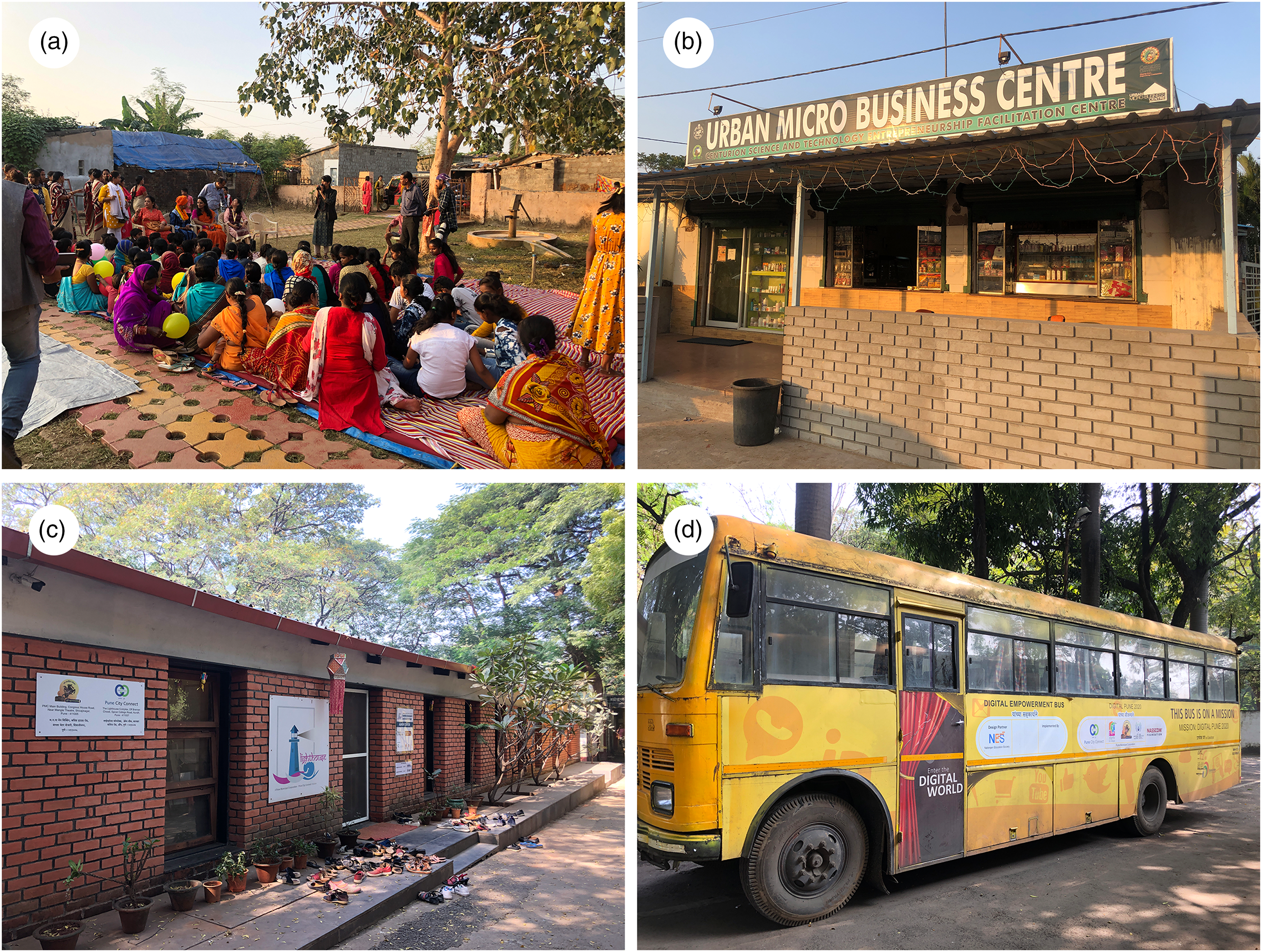
Bhubaneswar's Youth training centre in Pokhariput slum community 4(a) and Urban Micro Business Centre 4(b). Pune's Centre for Skilling and Livelihood 4(c) and Digital empowerment bus 4(d). Date: June and December 2019 (Source: Photos by authors).
Citizen engagement strategy and exclusion of informality
SCM's citizen engagement strategy was a requirement for all smart cities. This is a positive change at the heart of the national mission, potentially transforming the relationship with the local governments and the people they ought to serve (pointed out by some of our interviewees). In reality, however, SCM's citizen engagement was rushed and not comprehensive. More importantly, it overlooked informality and promoted the elites’ view of a smart city.
The Mission's community engagement strategy has detailed requirements and scoring categories that determine the smart city ranking for funding procurement. The strategy requires citizens and stakeholders to ‘drive’ the SCP documents. According to the SCM, The [Smart City] Proposal will be citizen-driven from the beginning, achieved through citizen consultations, including active participation of groups of people, such as Residents Welfare Associations, Taxpayers Associations, Senior Citizens, and Slum Dwellers Associations. During consultations, issues, needs and priorities of citizens and groups of people will be identified, and citizen-driven solutions generated (MoUD, 2015: 22).
It is important to note that this is the first time (in India) citizen engagement became the ‘basis for the proposal’ – quite different from the conventional process, where the engagement came too late in the planning process and left citizens with a little motive to give feedback on plans that had already taken shape (Coelho et al., 2011). However, under SCM, the cities had a limited three-and-a-half-month time to carry out the process. Such a push was challenging for many cities that did not have previous community engagement experience and started the process from scratch. Therefore, this strategy produced questionable data, as the goal was on the documentation level rather than understanding the citizens’ demands. Interviewees were universal in their view on the rushed nature of the community engagement process, which did not allow inclusive participation: In the SCM, there are deadlines, and there is a competition…So, there is a need to hurry up…a need to rush…there is an urgency, and that urgency, in most cases, does not allow an honest participation process (P7).
The people's participation under SCM was just a tick box and not effective… Citizens are clueless about what is happening under SCM, which indicates that people had nothing to do with the SCPs (P8).
Moreover, the three cities pursued the community engagement strategy differently – mostly overlooking informality. For example, Bhubaneswar launched a ‘Citizen's Connect Initiative’ (a community engagement program) that reached about 52% of the city's population; thus, it ranked #1 for its SCP (MoUD, 2016a). The strategy involved low-tech engagement programs (such as household surveys and street plays) and tech-based programs (on websites and social media platforms), addressing mainstream participants and the slum communities. Therefore, ‘Bhubaneswar's community engagement was somewhat inclusive; however, it had a short time-span’ (B2). On the contrary, Pune's community engagement strategy included the mainstream stakeholders (elected representatives, urban planners, tech providers, NGOs, and a few select community representatives), neglecting the city's informal sections. There is also a lack of enthusiasm in the smart city officials at the city scale to include the informal sector in the engagement process: It is easier said than done to take these [informal] citizens along. Different people have different points of view, and if you want to follow the citizen engagement crowd and be inclusive, it is not easy to make progress then (P1).
Citizen engagement was a good way to say…‘I gave you a chance to comment. Since you did not give me your valuable suggestion, I could not really act upon it’ … It is a headache for the city administration to be constantly told of whether he is doing something right or scrutinised on why the projects are delayed (P6).
The citizen group tend to be largely the elite citizen, and they are more articulate than the groups which are fractured and fragmented: the informal sector (P7).
Hence, the SCM's community engagement strategy disregards the views of the informal communities, despite its explicit prerequisite. The findings determine that the small-sized cities (Bhubaneswar) better arranged the engagement than the larger cities. Two reasoning are crucial here: first, a lot of community engagement in the cities (especially the larger ones) happened through online channels despite the disparity in digital infrastructure between different socio-economic demographics (Praharaj et al., 2017) and the low mobile phone ownership percentage (24% of the total population) in India (Poushter et al., 2018). Second, education is a significant factor in community engagement, indicating the middle- and elite-class representation of a smart city (Peck, 2012). Such patterns suggest that middle-class, educated urban India (e.g., those employed in the IT sector) are privileged to use the smart citizen engagement platforms. However, the concerns over the further marginalisation of the primarily illiterate urban poor remain true more than ever. Consequently, our findings reinforce Chakrabarti's (2007) claim that a disproportionately high percentage of people participating in these engagements are middle-class, educated and professional citizens who strongly influence public policymaking, directing their self-interest against the urban poor.
Conclusion
Critical urban studies from the Global South highlight the need to understand informality in urban development and planning practices (Benjamin, 2008; Rao, 2012; Robinson, 2002; Roy, 2011). The articulation of current smart city planning strategies, the translation of these strategies into smart city projects, and the implication of these initiatives on urban informality on-the-ground – are all associated with the smart cities’ socio-spatial dimensions but are largely neglected in current research. This paper contributes to the ‘Southern theory’ of the smart city by centring on the challenges of informality in smart city discourse. The theoretical contribution is informed by intensive empirical investigation using the planning domains – affordable housing, infrastructure, and citizen engagement – in three different smart cities of Bhubaneswar, Pune, and Chennai. In doing so, we answer the following questions through our analysis: Who will benefit from the so-called ‘affordable housing’? Who will use infrastructure services? Who is involved in citizen engagement? More specifically: for whom is the smart city being developed?
Not only is there a disregard for ‘informality’ in smart city planning in India, but our analysis demonstrates that the SCM does not have an equitable solution to urban informality. The paper reveals two crucial patterns: First, the significant feature of the Indian planning practice remains unchanged despite the continuous introduction of new policies, such as the SCM – a feature not being examined enough. The second pattern responds to the questions above. Whether it is pushing the informal settlements to the city peripheries and replacing them with ‘planned’ housing, eradicating the informal economy from the streets to build unevenly distributed decorative infrastructure, or dismissing the voices of the urban poor in engagements to limit their access to urban spaces – the disregard of informality in the smart city is apparent, and it comes at a cost – the cost of socio-spatial division.
The research findings are predominantly critical of the smart city approach in these three cities. Some positive interventions were identified in the research, such as those targeting slum neighbourhoods. Nevertheless, these were few in number and narrow in scope, and thus keep the thematic conclusions of the paper the same. It is important to acknowledge that the analysis and findings in this paper are based on a rich and intensive analysis of three Indian cities. Although this case study approach has facilitated the gathering of robust evidence of relationships between informality and smart cities, further research across the diversity and complexity of Indian cities and the Global South more broadly remain required, in particular, to refine understandings of the links between informal and formal practices (McFarlane, 2012) in developing the ‘actually’ existing smart city. As part of this broadening of case studies, specific attention could be paid to identifying how, and under what conditions, smart city processes enhance social equity. Such a research program, with its diversity of cases across the Global South and richer understanding of equity and inequity, provides a way forward – informed by mutual efforts across the South. Future research should investigate this social equity stance and the emerging political dynamics of smart urbanism.
Footnotes
Declaration of conflicting interests
The author(s) declared no potential conflicts of interest with respect to the research, authorship, and/or publication of this article.
Funding
The author(s) received no financial support for the research, authorship, and/or publication of this article.
