




Abstract
When we started teaching English in the university context, perhaps none of us expected to be teaching it online: in hybrid, hyflex, or asynchronous modes. But by the 2020s, this is where we find ourselves. Coming from a reading-rich discipline where classroom reading, often interpreting collectively, remains the core practice, many English teachers may have felt quite unprepared for what has happened next. This paper presents an investigation of teaching English in the asynchronous mode. It offers some reflections on ours and students’ experiences of teaching and learning English asynchronously. It provides evidence for how we might best respond to student needs for flexibility, while retaining our commitment to the core skills and practices of English Literary Studies.
Keywords
Introduction: Can university English be taught asynchronously?
English remains a staple subject at most Australian universities. However, the pandemic forced some significant changes to university English and its traditions, particularly, through the demand for flexible approaches. We are not the first scholars to comment on the lasting impact that the COVID-19 pandemic had on university teaching (Awajan, 2022; Campillo-Ferrer and Miralles-Martínez, 2021; Douglas et al., 2024; Mpungose, 2020; Quezada et al., 2020; Stuart et al., 2022). For Humanities disciplines such as English, online learning and teaching was much less common practice, especially in Australia (Milthorpe et al., 2018). The learning curve was an incredibly steep one.
This paper offers an investigation of teaching English in the asynchronous mode. Our study presents some reflections from students and teachers on their experiences of learning and teaching English asynchronously. The paper argues that offering English asynchronously is an inclusive strategy: it has become an increasingly important approach to recognise the diverse learning contexts and needs of our students. Teaching English asynchronously demonstrates English’s capacity to offer and measure a diverse range of learning and teaching activities. However, such approaches are not without challenges. There is still much work to be done (on the part of teachers and students) to make asynchronous teaching and learning successful in the disciplinary context of English. This work relates to cultural shifts as well as practical adjustments, and the resources required to ensure best practice when teaching English asynchronously. This paper offers recommendations for ways to navigate and improve asynchronous learning and teaching in the English classroom.
English teaching in transition: The possibilities and challenges for teaching core practices online
Archer-Lean et al. (2024: 75) note that English (at the secondary and tertiary level) continues to experience a useful level of cultural cachet. They explain, English is the only compulsory subject of study from year 1 to year 12 across all Australian states and territories, so a common key learning area of pre-service teachers. It, like music, is exempt from recent degree cost doublings across the Arts, a decision likely aimed at increasing teaching trained graduates, and possibly also linked to conservation hopes for more ‘civilised’ anglicised citizens. Despite such conservative external goals for the discipline, English continues to innovate through more inclusive pedagogy.
Smith (2016: 57) describes Literary Studies as a discipline “notorious for its succession of new ‘approaches.’” While Smith seems to be stating this pejoratively, English’s changeability might also be seen as one of its most positive features. As Douglas et al. (2024) explain, English, Literary Studies, or English Literary Studies as it is variously titled in Australia is a subject that is committed to representing itself as a broad church when it comes to genres, texts, and literary periods explored. English has developed significantly as a discipline, notably over the past three decades. The influence of postcolonial theory and the rise of cultural studies and creative writing has positively contributed to making English a more diverse, inclusive discipline (Archer-Lean et al., 2024).
When it comes to skills, the core business of English is literary analysis and interpretation, while also encouraging students to hone high-level written and oral communication skills alongside critical thinking. “Students must learn how to get things wrong. Only one subject does that,” claims Princeton English Professor Sophie Gee, in an opinion piece published in the Sydney Morning Herald in 2023. She explains that defenders of English claim, “literature and the humanities immerse us in a rich, deep sense of what it means to be human.” Gee goes on to emphasise, “Literature and other humanities subjects are important because they teach us how not to be right […] Literature is all about learning to work well with uncertainty and discomfort.”
Reading, and more particularly, “close reading” remains the central, signature practice of English Literary Studies. Smith (2016: 58) offers this definition, The term close reading refers not only to an activity with regard to texts but also to a type of text itself: a technically informed, fine-grained analysis of some piece of writing, usually in connection with some broader question of interest.
Heinert and Chick (2017: 321), in their discussion of “the tasks of a literature classroom” explain that what distinguishes English from some other Humanities disciplines is the practice of “literary criticism.” This differs from “critique” in that it is not an assessment of quality, rather, an assessment of meaning and significance (Heinert and Chick, 2017: 322). Teaching students how to find meaning in literary works conventionally involves explaining the concepts we use and also the texts chosen; supporting students to select textual evidence; exploring the relationship between textual evidence and interpretation; discussing the importance of context in interpretation; considering perspective and the possibility of multiple interpretations of texts (which include their own as well as diverse theoretical lenses) (Heinert and Chick, 2017). Literary criticism involves students using “empathy” to “set aside concerns of quality or personal taste, and step inside the world of the text—as unfamiliar and uncomfortable as that may be” (Heinert and Chick, 2017: 326).
These core practices speak to the intellectual richness and complexity of English as a discipline concerned with, and engaged in, the affective and ethical dimensions of reading. The value and relevance of English for students is borne out in their meaningful encounters with texts and each other in ways that affirm “literary reading is still fundamentally relational, or intersubjective: a self-to-other, self-to-world, and even self-to-self experience” (Federico, 2015: 10, original emphasis). Yet this value is overlooked or underestimated considering the pressures faced by English in the institutional setting. Like other Humanities disciplines, English has experienced a decline in enrolment numbers over the past decade or so. Giles (2023: 1) explains, “Australia, like many other countries, has suffered from the declining prestige and status of English studies that has been widely reported in recent years by many universities in Europe and the Americas.” The possible reasons for this are too numerous to explore in this paper, but seem to relate to the pressures of our economic climate that compels many young people to enter the workforce earlier and therefore pursue degrees thought to lead directly to employment (Giles, 2023: 1). Melbourne University’s Taking the Pulse of the Nation (2023) report identified financial barriers as the most cited factors deterring young people from pursuing higher education, with particular concerns around expensive tuition fees, high levels of student debt, and the rising cost of living. Growing doubts about whether a university degree led to better employment outcomes also ranked highly. Compounding this are policy-driven increases in the cost of Humanities degrees—aimed at steering students toward degrees in education, STEM, and nursing—amid the broader cultural devaluation of the Humanities as a discipline with clear career outcomes (Allahyari, 2021; Macdonald, 2025).
Concurrently (and not unrelatedly) to disciplines in the Humanities, English educators remain committed to wider participation agendas that have characterised university access in Australia in the 2000s. As Douglas et al. (2024: 25) note, “Our student population, their skills, their needs, and their capacities, are also rapidly changing and we need to adjust our teaching to accommodate a more diverse student group.” Though moves towards online teaching might not be the solution to English’s declining enrolments, and could well be an exacerbating factor, they are nevertheless presented as the somewhat inevitable response to shifts in students’ needs. That is to say, positioning online and/or asynchronous study as a fix for low enrolments likely obscures some of the broader structural issues at play in students’ decisions to defer or withdraw from university. For example, if students are increasingly drawn to online study because they must balance paid work or caring responsibilities, then offering more online options addresses the symptom, not the cause. While a full exploration of this is beyond the scope of this paper, it is worth considering what would be possible if those constraints, like the financial pressures that push students out of full-time study, were addressed directly through policy rather than accommodated for through pedagogy.
Since Open Universities was established in Australia in 1993, there has been a developing momentum for and understanding of the benefits of making university studies available to a wider number of students, despite obstacles such as distance and cost. In the wake of Open University, many Australian universities have increased their distance learning availabilities, and internationally, the rise of MOOCs and so-called mega-universities has been a notable trend (Daniel, 2023; George, 2022). However, as Milthorpe et al. (2018: 346) note, In Australia and internationally, the relatively slow uptake of technology for teaching by English academics is mirrored by a significant lack of research and scholarly reflection on blended learning in the English discipline, in which discussion, either in tutorials or in online forums, still dominates teaching delivery.
English teachers, as a collective, have had to reflect upon the potential need for asynchronous teaching, especially since the pandemic. Asynchronous learning describes a context where students engage independently in their own time with learning materials or activities created for them by teachers and made available online (Watts, 2016). It is a more specific learning mode than what might have once been referred to as “distance learning” or “distance education,” because of its focus on self-paced, independent learning as the signature practice (Flynn-Wilson and Reynolds, 2021; Varkey et al., 2023). This is not to suggest that various forms of asynchronous learning are entirely new to the teaching of English. English has long been engaged in technology-driven approaches such as the flipped classroom, which relies on students’ self-directed engagement—for instance, requiring them to watch recorded lectures and/or participate in online discussion forums before attending tutorials or seminars (Campillo-Ferrer and Miralles-Martínez, 2021; Douglas et al., 2024). The expectation that students read the assigned texts prior to class is another strategy of the flipped classroom employed by English teachers, which then allows the classroom to operate as a space for collaborative and social meaning-making. Asynchronous learning that occurs in the absence of tutorials or seminars, as described by Watts (2016), is differentiated by the lack of face-to-face or live online instruction where teachers and students work together to understand the meaning of texts and what matters to us about them. It is this loss of the shared classroom space—and the opportunities it provides for students to test their ideas in dialogue with their teacher and peers, and respond to these different perspectives—that significantly alters the way English is taught and understood in asynchronous mode. As English teachers, we have been challenged to think about how the core skills of interpretation, reading, and analysis, as well as the social environment of the classroom, can be supported when students are no longer present.
Students choose to take subjects and courses asynchronously for a variety of reasons including distance, costs, work commitments, mental health benefits, neurodivergence needs, and caring responsibilities (Douglas et al., 2024). Students’ needs are not static. And since the pandemic we have witnessed students shifting between different learning modes depending on their needs. Now, many universities have encouraged or required staff to continue offering subjects asynchronously on equity grounds. Though there is mixed data on the successes of asynchronous teaching modes, as Milthorpe et al. (2018: 347) note in their research in the Australian context, university courses that “adopt blended modalities” tend to have higher student success. An investment in flexible delivery usually derives from a belief that it will result in better inclusivity and access for students, and for increased teaching efficiency for academics (Milthorpe et al., 2018).
Perhaps the main reason why English was not a wholesale early adopter of online learning and teaching modes was because of its central focus on the core skill of “close reading,” which has traditionally been a practice that teachers could observe their students completing in the classroom. What happens to close reading when we teach English asynchronously, for instance, without face-to-face conversations about concepts, strategies for reading, and practices such as shared reading? As previously flagged, Open Universities has been teaching English for many years. But these courses and subjects are well-oiled machines compared to what many of us experienced after COVID: fast, reactive moves to online teaching by under-trained, under-resourced staff, teaching inexperienced students. As Milthorpe et al. (2018: 346) note, online, blended, e-learning, or technology-enhanced learning remains an area of significant challenge for humanities disciplines that prize traditional face-to-face pedagogical methodologies such as the lecture, and small group discussion and debate. With a growing cohort of students accessing education off campus, and recognising the importance of e-literacy for the 21st-century student, understanding e-learning and fostering equivalencies across distance and face-to-face modes is crucial for English studies.
Even before the pandemic, pedagogical discussions in the Humanities, Arts and Social Sciences were suggesting that the rise of the digital was bringing necessary changes to Literary Studies. Abblitt (2019: 104) writes of the need for our pedagogies to “codeswitch” between “the close and the distant, the near and the far.” Abblitt (2019: 103) explains how new reading practices have emerged via the digital turn: “hyper reading hermeneutic strategies and techniques such as filtering, skimming, pecking, fragmenting, de-authoring.” Borràs-Castanyer (2010: 87) has similarly commented on the incorporation of new technologies in the teaching of literature, which allows us to “rethink the literary phenomenon from new textual, critical, and hermeneutical perspectives.” For those in English wanting to see students engage in close reading, these forms might immediately seem problematic. But they need not be.
Abblitt (2019: 98) explains, “the human reader is entangled in complex, motile, mutable networks of socio-material and technical relations that foreground the reading experience.” In our English classrooms, during our careers we have witnessed the rise of the non-material book: students reading books on their laptops, or even listening to audiobooks as cheap and accessible alternatives to paperbacks. But perhaps more recently, since the pandemic, we also see a turn back to the material book. This comes as digital book cultures and communities emerge on social media (specifically, “Bookstagram,” “BookTube” and “BookTok”) to re-contextualise the consumption of books in the twenty-first century. What we are learning is that students’ relationship to “the digital” is not at all fixed nor uniform. But it would benefit us to have open conversations about these developments and practices with our students, and be a part of their training in this. Students are more engaged in understanding the role of stories and technology in their lives. Some students are very comfortable and competent working in online spaces with Learning Management Systems (LMS). Others are not, and the students who choose online, asynchronous learning are not always those who are most competent with it.
After the pandemic, we found that an increasing number of students wanted asynchronous learning modes. Whatever the reason (and this is something this study aims to explore), there was a need and a potential value in us offering English in this mode. Milthorpe et al. (2018: 345), in their study of blended learning and teaching in the English context, drew on students perspectives (via surveys and focus groups) and staff reflections, and found that the blended approach “has the capacity to enhance disciplinary learning; increase accessibility for students in remote and regional areas; facilitate deeper scholarly enquiry; and encourage staff to develop innovative, collaborative, and flexible teaching and learning practices.” It has the potential to develop students’ skills in online learning and engagement with, for instance, communication technologies which may be positive for future employability. As Milthorpe et al. (2018: 357) found, The affordances of technology can bring about innovative classroom and online teaching strategies and can help students reconnect with literary texts in a way that runs counter to alarmist narratives about ‘switching off.’ Moreover, blended learning technologies provide new opportunities to prepare students for an increasingly technologised workplace and can enable students to develop new capabilities that will enhance the traditional work skills that they garner from their study of English, such as writing, problem solving, and abstract thinking.
Colbert et al. (2007) argue that “online teaching and activities only have value if they allow students to develop key skills, abilities and interest that we regard as the heart of university English” (75), and that the use of online and mobile technologies “must extend the possibilities for this in ways that go beyond what is achievable within a more traditional classroom” (346). The increasing demand for online learning offers opportunities to think carefully about what we want from students and how we understand the practices of our discipline. An important part of this work is identifying how reading can be best demonstrated by students and measured by teachers.
While our universities engage variously with asynchronous learning and teaching, we know very little about students’ and teachers’ experience of this model, a model which seems to create overt challenges to many of the traditions and core practices of English Literary Studies, namely, shared close reading and the visibility of reading skills and outputs for students. This study aims to seek feedback from students taking Flinders University English subjects asynchronously during 2023, the last year our subjects were run “unofficially” as asynchronous offerings. 1 We sought to understand the student experience of asynchronous learning as well as their reasons for electing to study online instead of in-person. As such, we aimed to conduct a critical exploration of how English Literary Studies, a discipline conventionally associated with shared, close reading activities in the classroom, might respond to demands for asynchronous learning and teaching.
Context: Flinders University and the discipline of English
Flinders University is a partner in the Innovative Research Universities (IRU) group, affectionately referred to as Australia’s “gumtree universities,” built in the suburbs and regions in the mid-20th century to service a wider student population (in contrast to Australia’s older “sandstone” city-based universities). 2 The IRU universities, in their mission statements and strategic plans, assert the value of innovative approaches to learning and teaching, and to expanding access to education.
Flinders University has a small English ‘discipline’ (five staff members) within the College of Humanities, Arts, and Social Sciences. Our English subject offerings include Medieval Studies, 18th Century Literature, the Gothic, Life Narrative Studies, and literature for children and young adults. Though, as previously flagged, English (along with other Humanities disciplines) has experienced a decline in enrolments over the past decade, at Flinders, English is currently holding its place as one of the leading disciplines in the College, and the top three disciplines in the Bachelor of Arts in terms of enrolments. Enrolments have stayed stable or have risen slightly between 2022 and 2025 (Flinders University, August 2025). This is likely due to English servicing the Bachelor of Education and Bachelor of Creative Writing degrees, as well as the Bachelor of Arts.
At Flinders, though we had begun to incorporate recorded lectures into our subjects pre-pandemic, in 2020, we offered online, synchronous tutorials during the pandemic, and continued to do so thereafter. We soon began to offer asynchronous learning as a staple mode (to supplement our on-campus version of a subject) as demand for online synchronous waned but the need for flexible online learning continued to increase. Four years later, we are offering students the opportunity to study entire subjects asynchronously.
For this research, online, asynchronous students from five English Literature subjects: one first-year (120 enrolled students), two second-year (50 enrolled students) and two third-year subjects (50 enrolled students), were invited to participate in the study. Information from staff teaching these subjects suggested that (on average) asynchronous students represented approximately 20% of enrolled students.
Staff reported that online students were mostly required to complete the same assessment pieces as face-to-face students, as well as participate in equivalent or similarly styled but distinct weekly learning activities which included: • Weekly online forum posts (written, audio, and video forms were used variously across different subjects) as part of participation grades. These posts usually involved students responding to readings via set questions, or to peer comments. Student posts would be responded to by the teacher and peers, mostly in very scaffolded and sequenced ways that were able to be easily assessed using FLO metrics (our LMS) and evaluated by teachers using rubrics. • Social reading activities such as posting comments or annotations to shared reading documents (Word online and/or Google Docs, as the university does not yet subscribe to other social reading tools). These have been very effective tools in building reading communities for students via small group reading activities, especially for second- or third-year student groups. • Weekly self-evaluation activities where students had to account for their engagement (for instance, readings and posts completed). These proved to be a very positive tool. Students were quite honest in self-reflections and teachers were able to communicate their learning expectations through these self-evaluation activities. • Formative quizzes to assess ongoing learning and to encourage accountability. These quizzes also proved to be an effective way of encouraging students to keep pace with the subject requirements. However, in the age of AI, these quizzes require careful design. For instance, asking for very specific textual analysis that would require students to demonstrate this skill alongside broader knowledge of the text; questions that asked students to make comparisons between ideas posed in two different secondary readings; and embedding a creative or personal reflection in some of the quiz questions.
One colleague reported that they did not make weekly tasks compulsory but regretted this afterwards. Another colleague set up a separate LMS page for asynchronous students. This colleague explained, “I hoped I could also do things like slightly modify content/deadlines/tasks in order to improve flexibility” (October 1, 2024, personal communication). In all instances, online students had access to the same readings and lecture recordings as face-to-face students, but face-to-face tutorials were not recorded for asynchronous students. 3
Approach: A snapshot of the student experience of asynchronous learning in English
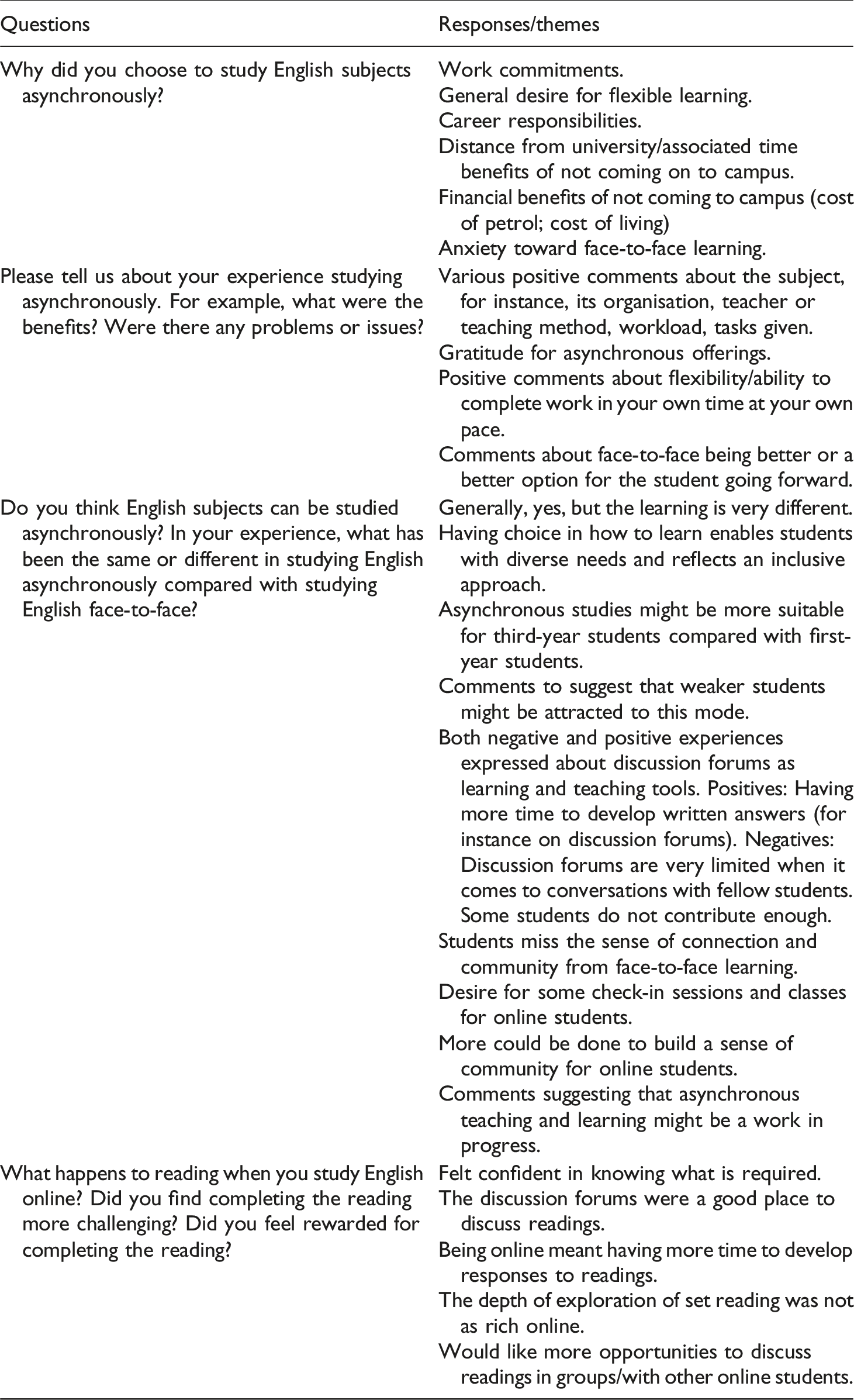
Students who studied English subjects asynchronously during 2023 were invited to complete an anonymous online questionnaire (via Qualtrics). Posts were made on all English LMS subject sites between semester one and two, inviting student responses. Students were not asked to identify which English subject they studied to further guarantee anonymity. There were five questions in the survey: • Why did you choose to study English subjects asynchronously? • Please tell us about your experience studying asynchronously. For example, what were the benefits? Were there any problems or issues? • Do you think English subjects can be studied asynchronously? In your experience, what has been the same or different in studying English asynchronously compared with studying English face-to-face? • What happens to reading when you study English online? Did you find completing the reading more challenging? Did you feel rewarded for completing the reading? • Is there anything else you would like to tell us about your experience of asynchronous studies?
23 students responded to the survey (out of a pool of roughly 64 students). Though this is a small sample size (considering, for instance, how many asynchronous students might be studying English Australia-wide, or world-wide) this qualitative study, through its focused questioning, and the depth in which we reflect on these responses, aims to provide some useful insights and entrées for further research. A further goal of this study is for us to improve our own teaching and the student experience around asynchronous learning and teaching, and to provide evidence and tools for other educators to do the same. And it is likely that this number of students will provide some representative indicators of the reasons why students choose to take English subjects asynchronously.
Findings: What do students think about learning English online?
Discussion: Flexibility, inclusivity, and a desire for community
Four themes emerge strongly from these responses: 1. The importance of flexibility to students and the value of self-paced learning. 2. The feasibility of asynchronous learning and teaching from the students’ perspective. 3. Reading methods for asynchronous studies and acknowledgement that this reading may be different. 4. The stated loss of some social aspects of learning.
These themes encourage us to think about ways we might work more strategically with and for asynchronous students. As we suspected, flexibility is clearly valued by students, and this need should continue to be supported. For instance, students mentioned the distance they lived from campus as an impediment to attending, and the need to work to earn money to support life and study and/or to build career connections in the field they were planning on working in (for example, teaching): I live over an hour’s drive away from the Flinders campus. As someone who lives rurally, it helped me to manage my time more efficiently. As someone who has to travel for over an hour (2+ h for a round trip for a potentially 50-min lecture, for example) it not only helps with time management, but is also beneficial financially (cost of fuel, the ability to squeeze in extra hours at work between study, etc.). I was working full-time in a regional area. I currently have a part-time teaching job. Because I had a contract as an ESO on the day that classes were on. I studied asynchronously due to heavy commitments outside of university. I was provided a job opportunity in my final year of study.
Other students mentioned having career responsibilities as driving their need for flexibility, while others spoke of health reasons: Online studies suit me due to the intensity of my other commitments, i.e. work and parenting. I have social anxiety.
These students are what Kadmos and Taylor (2023: 91) describe as “the precarious student”: encouraged by the neoliberal institution to attend university, and then given very little recognition or support in this pursuit. We want a diversity of students in English; as Humanities teachers, access should always be at the forefront of our thinking. Distance, finances, work, and carer responsibilities should not be barriers to education. The comments from students in this study revealed a deep gratitude for the availability of asynchronous options and how these subjects allowed students to successfully continue their learning: I really appreciate that it was offered and how well structured it was. I still enjoyed the class very much and all the content was very engaging! It was my only experience and found it to be the most enjoyable of all my subjects. I really enjoyed both subjects that I undertook asynchronously and found this method of study best for me. I’m excited to see how these modes develop over time, as I think these options really open doors for people who live remotely and can’t always make it to campus for whatever personal reasons. So, thank you for making university a more inclusive experience! I feel extremely privileged it was an option that was provided for me.
One of our main challenges when teaching asynchronously is the obvious tension between students’ desire for and appreciation of the time and thinking space that asynchronous learning allows, but also the loss of some sociality within the learning experience.
Students valued the temporal pace of asynchronous discussion because it allowed them to do something we really want them to be doing: thinking carefully and articulating their interpretations with deep consideration. One student expresses this: “Being able to respond to reading online meant I got time to consider what I wanted to say,” and another writes, “I liked that I had more time to write about what I had read. I find tutorial discussions hard sometimes because I only think of what to say later.” Another student: “Talking about books online really suits me better. I have more time to think about what I want to say.” And, finally, “I am not great at spontaneous thinking, so being able to think and form a response in my own time, as well as look closely at the source material while forming a response, was great.” This data suggests that students recognise deep thinking and reflection as essential ingredients for close reading and discussion of literary texts, and identify the more rapid temporal unfolding of the live tutorial setting as less conducive to this task.
This could indicate the social demands of the tutorial setting (such as reading and interpreting nonverbal cues, performing active listening through nonverbal communication like smiling, nodding, and eye-contact, for example) present an additional burden for some students that impedes their ability to think slowly and clearly. This may also be related to needs around mental health and neurodiversity that some students identify as reasons for their preference to study asynchronously, although the students in our study did not explicitly link these elements.
Importantly, the students who identified time as an important factor in engaging in discussion about texts all indicate that they experience written discussion forums as experiences of “talking” rather than writing. This is fascinating! Perhaps this indicates a certain level of comfort with the conventions and (less formal) style of discursive writing in comparison to the more formal academic conventions of essay writing. Because online cultures in which many (although not all) of our students are embedded involve some level of “commenting” as a form of conversation (for example, on YouTube, TikTok, and Instagram). This may suggest we could better utilise conversational modes of textual analysis to exploit the lower barrier to entry afforded by students’ comfort level with the form of the “online comment.” This relates to our earlier discussion of the diverse ways we might (and should) think about English now.
The data, however, also reveals that discussion forum engagement is missing a key ingredient of live discussion, and some students desire opportunities to engage synchronously. One student says, “I do miss being able to sit and talk about the book with a group,” and another says, “I dearly missed the in-depth personal face to face conversations.” Other students noted a difference of asynchronous learning being that they do not have the same opportunity to “mingle” or to “meet new people.” There are a couple of ways we interpret this data. One way is to consider that there are students for whom the asynchronous mode is appealing, but who still desire an in-person, social element to their university experience. As one student put it, “one difference that makes face-to-face better in my experience is the social aspect. Being on campus allows you to meet new people and get a different experience from the class.” This reminds us that our English classrooms are but one part of a broader university experience, and that the brick-and-mortar campus which allows for chance encounters, spontaneous sociality, and peer connection remains important to some of our students. This student emphasized that having the choice is important, and we think this might be because students want the flexibility to manage their time by choosing a mixture of on-campus and online learning, but that they have likely chosen to complete their degree at a physical university and not through Open Universities (or otherwise via an online degree) for reasons that include a vibrant campus life.
Relatedly, some students indicated that the social “sacrifice” of asynchronous learning was less about the site of the university campus and more about connections with other students in informal settings, even if online. One student says, “the only thing that is sacrificed is the ability to mingle with your peers. However, this can be curbed by letting asynchronous students engage with one another in their own space.” Another writes, “I wonder if there might be more opportunities to work with online students in small groups to talk about reading whether live or asynchronously.” These practical suggestions, also offered in similar terms by other respondents, indicate that online sociality suits some students and can amend a perceived lack of sociality in asynchronous learning environments. As mentioned above, the English academics referenced in this study have attempted to create these social opportunities for online students with some success, especially when such communication is required as part of assessment (online posts, comments or annotations, etcetera). However, the diversity within asynchronous cohorts is a barrier to community-building. Where some asynchronous students want online community, connection to the face-to-face classroom and cohort, and a weekly-paced approach, other students want to be left to work independently at their own pace (and have learning activities and assessment built accordingly). Academics often do not have the time to offer each of these learning approaches to online students; those in our study have defaulted to the former and this feels more in the spirit of online learning as a positive, inclusive addition to the primary site of classroom learning, than a dedicated online learning pathway (such as Open Universities).
So, if we stick to a particular model when it comes to teaching English online, what are some of the approaches we might share and focus on as a collective? As flagged throughout this paper, reading competency is vital to an English major. Assessing the reading and interpretive capacities of online students is an ongoing challenge for those teaching English asynchronously. However, as Kadmos and Taylor (2023) discuss, we do not want the practice nor the measurement of students’ reading to become too instrumental, related to measurements of associated skills and job-readiness. They observe that reading has long been associated with building students’ critical capacities, encouraging public engagement, developing empathy, understanding their place in the world, and learning to navigate ambiguity with confidence (Kadmos and Taylor, 2023). For Kuhn et al. (2022: 3) “reading is becoming progressively defined by outcome and less by experience.” And as Kadmos and Taylor (2023) argue, this is a problem affecting both students and academics, who are each dealing with precarity in the contemporary university. The answer, then, may not lie in finding more or new ways to measure students’ uniform reading outcomes, but in considering ways to build better communities of reading that make reading visible and meaningful to our students. Achieving this is cohort dependent: it may require developing an understanding of who your cohort is, and what times they might have available to work in more communal ways, for instance.
When it comes to the practice of reading, there is more we might do to both build and support students’ reading and enhance the social aspects of studying. For instance, we might be more deliberate in facilitating reading groups for shared reading and annotation exercises which encourage students to interact more frequently with each other. Social annotation has been identified as a particularly promising pedagogical approach that supports engaged and reflective reading practices based on changes to how students and teachers read and understand texts together online (Clapp and Banerjee, 2024; Clapp et al., 2020). Collaborative documents such as ‘live’ PDFs or Google Docs as well as dedicated social reading/social annotation tools like Perusal or Hypothes.is can be effective in this space (Pianzola, n.d.; Vasinda, 2020). The affordances of such tools empower teachers to promote close engagement with different kinds of literary texts—and in textual, visual, and other formats—and suggest the viability of approaches to reading and writing that draw on Digital Humanities (Kilner et al., 2018). But as Manarin (2019) reminds us, such approaches are not valuable in themselves and reading can be a time-consuming and risky choice for a very busy, and often risk-averse, student body: “We are asking a lot of students when we ask them to risk reading in our classes if we cannot demonstrate that reading is necessary” (18). So, if we want to encourage students to read and interpret readings communally, we need to do so using accessible tools and activities that make the learning outcome seem obviously valuable to the student. There may need to be more overt coaching strategies around how to read and what sorts of interpretations we are looking for.
Insofar as engagement, particularly in terms of motivation, is also supported and determined by accessibility, video or audio annotations might also cater for students requiring flexible approaches while making close, critical reading more visible and meaningful to students. This would encourage students to see both their own progress and that of their peers more clearly. Douglas et al. (2016) in their “Building Reading Resilience” project, explore the ways in which the skills and rewards of reading might be made more visible to students in the classroom. Though reading does not always look the same in its approach and its outcomes, it might always be conscious and deliberate in the way it is “seen” as valuable work by students and teachers, and variably measured as an outcome of students’ engagement with literary texts.
The value of peer teaching, or peer-to-peer learning, has grown from an interest in involving students as “partners” in higher education (Stigmar, 2016). This approach also holds potential to enrich learning in the English classroom, and how this is impacted by the uptake (or lack thereof) of discussion forums was another key theme emerging from the data. One student writes, “it would have been nice to have a recording of the tutorial in addition to the lecture, to at least hear the opinions of more people which could be helpful for responding on the forums, or even help to develop an understanding of the texts being discussed.” Others emphasized that discussion forums, and similar peer-to-peer learning strategies, required regular engagement from students to be effective. As one student notes, “I did miss the sense of dialogue due to low participation and students not responding to each other on canvas.” Another writes, “The workshopping part for one of my assessments probably wasn’t the best as some people didn’t participate and there was no way to communicate with them other than canvas.” And another: “We had some great discussions in online forums about readings. Sometimes there weren’t many people involved, but those who were really good.” A staff member at Flinders offers this comment regarding engagement in online discussion forums, Participation has really dropped off towards the end of semester. I think the issue is both cultural/social (they are petrified of saying the ‘wrong’ thing…) and maybe structural/platform too: so, even though I’d go on and post a comment or ask a question, no-one ever ‘came back’ to their posts … and it just seemed really hard to get them participating with each other (I do somewhat blame the format of Canvas ‘discussion’), So, this has become a ‘post and drop’ task and it’s not interesting, for them or for me. Given that the Canvas discussion group platform is what we have, I think I’d have to set about re-thinking this in future. In first year, we want students to demonstrate they are keeping up with content, but I’m not sure this is the best way … (October 1, 2024, personal communication)
There was broad consensus among students that discussion forums provided a rich and collaborative space to share and refine their ideas in dialogue with their peers, but the meaningfulness of these interactions for their learning was impacted by low or inconsistent participation. Alternatively, one student proposed that the forums become student-led spaces for exploration and discovery, suggesting the addition of “options to post questions that could be considered rather than being reactive.” Echoing the earlier call for students to “engage with one another in their own space,” we observe some implicit demand for the asynchronous mode to offer students opportunities to direct and initiate their learning as well as receive scaffolding from teachers. The LMS plays an important role in this as more than an administrative tool for grades management and assignment submission, but with learning applications and functions designed to support student learning (Koh and Kan, 2021). Our findings show that teachers need to be more definitive in how they structure and present asynchronous subjects (via available LMSs and the integration of other technologies) to foster student-centered online learning experiences that correspond with student desires for collaborative and adaptive learning.
Conclusion
Going forward, we do not see our English departments as becoming specialised in asynchronous online learning and teaching. Most of our students are not learning in this way. However, with an increasing number of students requiring flexible options, we are working towards ensuring this is a positive and successful experience for all. The findings speak to issues and strategies for asynchronous learning that are relevant for teachers, particularly as this and other alternatives to traditional in-person education are likely to continue in the years to come.
A significant element in learning objectives for most if not all English subjects at university level is the ability to read critically. So, what we do when we teach online must attend to this. But now, we are not mapping reading in a singular way. English has a broader purpose than perhaps was once thought. There are many things we might want to look at when it comes to measuring students’ reading. The online space offers many and varied affordances that, we argue, should enhance what we do when we teach students to read critically. For example, the potential for self-pacing in close reading can result in students reading with more care and depth. We might look to ways to further promote this as a genuine advantage of asynchronous learning in English, and more overtly celebrate independent learning practices for those who learn best in this mode. There are numerous online tools we might draw on to practice and measure reading with online students, and the technologies for this are rapidly evolving and developing. We might look to some of the social affordances of the online space to promote social cohesion between students, for instance, through shared reading practices, especially for those who strongly desire it.
Just as we accept differences in engagement and participation for face-to-face students and account for these in the way we assess students, we need to do so for asynchronous students. We see this as part of teaching students how to read and learn in the online mode, and such strategies are a part of the range of practices we have set out as desirable in this paper.
Getting this right will not happen overnight. But a commitment to the “tasks of the English classroom,” drawing on the work of Heinert and Chick (2017), and confidence in the adaptability and social power of English as a discipline, coupled with robust knowledge of digital tools and affordances, makes teaching English asynchronously an exciting prospect going forward.
Footnotes
Declaration of conflicting interests
The authors declared no potential conflicts of interest with respect to the research, authorship, and/or publication of this article.
Funding
The authors disclosed receipt of the following financial support for the research, authorship, and/or publication of this article: The project has been approved by Flinders University’s Human Research Ethics Committee (Project ID: 6334).
