




Abstract
While the word ‘creativity’ is used liberally in contemporary discourse, some studies show that creativity has been in steady decline for decades, particularly within the education system. This paper addresses the reason for this decline, focussing specifically on the teaching and practice of creativity in the visual art studio setting at the tertiary level. A case is presented by way of a pedagogical structure – broadly informed by constructivist principles – and an assessment regime that can facilitate a different way of engaging artistic creativity in the classroom. The assessment regime is formalised through a schema designed to illustrate the ‘play with determinants’ delivered through the pedagogical design. This approach provides a space for ‘play’ between the assessment criteria, the pedagogical setting and course materials, institutional determinants and the developing creative interests of the student. Such an approach offers a new way to encourage and formally capture creativity in the tertiary visual art classroom.
Introduction
Creativity has been in steady decline for decades (Kim, 2011; Yue and Rudowicz, 2011). Utilising Torrence Tests data, Kim (2011: 285) for example, has argued that levels of creativity, are at best “static” and even “decreased” in recent years. Kim covers K – 12 education, but the problem may be worse in the tertiary sector, with Yue and Rudowidcz (2011: 1) suggesting results from tested students in tertiary institutions indicate a “trend of monotonic decline in creativity with years of study at university”. Cropley (2016: 216) has come to a similar conclusion stating there “seems to be no dispute: creativity, with rare exceptions, is not being adequately or appropriately nurtured in … education”. Cropley works in the engineering sector, but arguably the problem is much worse in the discipline of visual art, at least so far as tertiary level visual art education is concerned. This is because creativity was not so much neglected in the visual art education setting at the tertiary level, but rather systematically challenged by both theory and practice (Barthes, 1977; Benjamin, 1992; Danto, 1964; Eagleton, 1990; Foucault, 1980; Haeffner, 2008; Krauss, 1986; Nelson, 2010). The challenges to creativity in tertiary level visual art education come from a variety of sources, but common to all these challenges is the repudiation of creativity as both a marker of quality, and a source for the development of artistic content for the contemporary art world. Given the OECD (Creative Thinking - PISA (oecd.org)) has focused on creative thinking through the PISA (Programme for International Student Assessment) innovation domain test in 2022, and determined such skills will be essential, that “organisations and societies around the world increasingly depend on innovation and knowledge creation”, these concerns about inadequate levels of creativity need addressing, particularly at the tertiary level, since the decline has not come about from neglect, but rather as part of a broader strategy in visual art practice and theory aimed to escape the theoretical, practical and historical clutches of formalist modernism.
It might seem strange that creativity is denounced by the creative industry, but in the discipline of visual art at the tertiary level, this decline comes as no surprise due to the myriad challenges to the discipline. Some of these challenges come in the form of conceptual approaches to art making, some from anti-aesthetic theory, and others from the broader disciplines of Continental and Analytic philosophy, Marxist theory, and Cultural Studies approaches to art criticism and theory (Barthes, 1977; Benjamin, 1992; Danto, 1964; Eagleton, 1990; Foster, 1983; Foucault, 1980; Krauss, 1986; Nelson, 2010). In the tertiary level creative industries educational setting, more specifically visual art education, creativity has seen its fortunes slowly wain over the course of the last few decades as cultural theory, and theory more generally, has been deployed in the classroom to challenge the concepts of creativity and originality. Haeffner (2008: 173), refers to what he calls the “hegemony of theory” noting the “dominance of theory has led to a downgrading of the importance of creativity”. These ideas are largely associated with a repudiated formalism found in modernist art, and along with it, the Kantian formal legacy such modernist approaches claimed to reflect. From the side of analytic philosophy, Danto (1964: 580) concluded that after the pop art manifestations of the Duchampian readymade in the 1960s, to “see something as art requires something the eye cannot decry – an atmosphere of artistic theory, a knowledge of history of art: an artworld”. The point Danto is making is that art does not need aesthetics; that it is no longer visual art, but rather an exercise in theoretical discourse, much like philosophy.
From an art history perspective, Smith (2019: 9) dismisses aesthetics as nothing more than “conservative fables of aesthetic feeling”. For Smith (2019: 9) these fables are associated with “master narratives of great art, by great men”, promulgated to “perpetuate established power and hierarchical values”. This is unquestionably true, but does this repudiation of elitism and conservative hierarchical values and attendant discrimination necessitate a repudiation of creativity tout court? To answer this question, the discussion of the origins and critical context driving the anti-aesthetic agenda in both art practice and theory will now be addressed.
Origins of the decline in creativity
The decline in interest of creativity and originality as an aspiration for artists and art students can be traced primarily to developments in art practice in the early to later period of high modernism, and to the theory developing in Europe and North America during the latter part of the 20th Century. Principal among these developments was the advent of Dada and the post-war developments of pop art and conceptual art – both of which downplay creativity and originality and emphasise the readymade. Examples of such developments are the images pilfered from popular culture in the art of Andy Warhol and Roy Lichtenstein, and the found or readymade phrases and dictionary definitions of Joseph Kosuth’s conceptual practice. The most salient example is the origin story of conceptual art itself – the works of the Dadaist, Marcel Duchamp. Duchamp’s conceptualism – his use of so-called “readymades” that are simply “chosen”, as he put it, rather than created – set the tone for a lot of what followed in the ‘artworld’ (Danto, 1964; Duchamp, 1973). The appropriation art of Sherrie Levine and Neo-Geo, or new geometric conceptual art of Peter Halley, both of whom avail themselves of images in common circulation, readymade as it were, denied the idea of originality. Theorists like Roland Barthes (1977) deployed semiology against creativity and originality in his essay ‘The Death of the Author’. For Barthes, “works” become “texts”, and the artist or “author” is produced by language and broader cultural codes, rather than the producer of language and cultural objects. The author or artist appropriates from the “innumerable centres of culture”, rather than from some capacity for divergent thinking or creative play, for instance. Barthes (1977: 143, 146) argues we should ‘substitute language itself for the person’ concluding that “language itself speaks, not the author”. Artworks become codified texts and artists, a function of language, with language itself coming readymade as it were.
Camilla Nelson (2010) coming from a cultural theory perspective, is perhaps the most radical of these authors challenging the idea of creativity. Nelson, reacting to the linguistic milieu, reduces the practice of creativity to a mere noun. This noun ‘creativity’ is a name that has an historical development rather than the designation for an actual property or natural endowment of individuals or a process undertaken by them. After locating the “origins” of the noun “creativity” in works that predate Shakespeare and tracing the modern origins to Immanuel Kant (1987) and the works of the Romantics that followed, Nelson (2010: 66) settles on the idea that “it is from this … cultural matrix that the concept of creativity actually emerges” with the discourse being fully “codified” in the 20th century. However, Marcel Duchamp beat Barthes and Nelson to the punch by substituting the so-called readymade for the handmade or work of originality, by placing a common urinal in a fine art context in 1917. Despite the oft-mentioned lament that the “original” urinal is lost (see the TATE Gallery website, ‘Art Term, Readymade’, for example), the whole point was, due to its mass manufacture and the fact that it is already made – not requiring an author or artist – there was no original. The implication is the artist does not need to create the work, they can simply choose objects readymade from those “innumerable centres of culture”, to draw again on Barthes (1992: 146). To press his point further, Duchamp signed the work ‘R. Mutt’ (an informal noun signifying mongrel dog) not ‘Marcel Duchamp’, the author of the idea, thus repudiating the need for an author or creative thinker behind the art.
The point made by Duchamp plays out in the writing of Walter Benjamin, in particular, his essay on reproduction. Benjamin (1992) was keen to dismiss originality, associating it with conservative values and capitalist imperatives. Benjamin (1992: 214) embraces the new “progressive” technologies of photography and film, explaining reproductive technologies are missing one element, the work’s “unique existence” (Benjamin, 1992: 214). By “making many reproductions [these technologies] substitute a plurality of copies for a unique existence” (Benjamin, 1992: 215), thus he was able to argue for a rejection of both originality and the ‘aura’ or aesthetic qualities associated with it. The art critic and theorist Rosalind Krauss (1986) deploys Benjamin’s theory of reproduction or the copy, against the novelty-promoting avant-gardes in her account of the end of the Kantian notion of the genius and associated claims to originality in later, postmodern art. Krauss (1986: 155, 156, 277) echoing Benjamin, suggests “the ideology of the new” or “cult of originality” is replaced in postmodern times with objects that are “reproductions without originals”, much like a photographic negative. This emphasis on reproduction over production or creativity is found in pop art, appropriation art, Neo-Geo, minimal art, ‘new media’, and of course conceptual art in general. Here art is determined by, rather than simply inclusive of, concepts. This emphasis on frontloading art with concepts undermines the Kantian (1987: 202) emphasis on creative, ‘free play’ between concepts and imagination.
The analytic philosopher, Arthur Danto (1964) was quick to note the conceptualism lurking behind the shiny surface of pop art’s images of Hollywood stars, pop music icons and comic strips. Drawing on Hegel’s (1998) aesthetic theory and conceptual teleology – in particular, Hegel’s so-called “end of art” claim – Danto sidelines aesthetics, arguing that art after pop cannot be approached in modernist, aesthetic terms, since vision alone will not allow us to discriminate between works of art and objects of ordinary life. Under the weight of this claim art, at least in the modernist, formal or aesthetic sense, is “dead”, leaving only theory in the guise of art (Danto 1964). Art produces theory, or, as Atkinson (2002, as cited in Salaman (2015)) put it, ‘theory = art’.
Kantian aesthetics and the backlash against creativity
The root of the discontent with creativity can be found in the artworld’s reaction to Immanuel Kant’s (1987)18th Century aesthetics, or interpretations thereof, and found throughout the modernist art criticism and theoretical essays of the American art critic, Clement Greenberg (1986). Greenberg drew on Kant’s broader aesthetic theory, rather than his more pointed theory of art. Kant’s general theory of beauty, while not irrelevant to the topic of fine art, is more concerned with formal beauty found in nature, rather than an account of beauty in fine art. Costello (2007: 115) notes, “Greenberg mediated the art world’s subsequent rejection of both aesthetics in general and Immanuel Kant’s aesthetics in particular”. Costello (2007: 115) also notes the role “anti-aesthetic figures like Marcel Duchamp” played in this assault on aesthetics and conceptions of fine art. Duchamp’s artistic provocations, rather than his written reflections on his art, cast a long shadow over subsequent generations of artists.
Mazlow (1967) and Schank (1988) caution about accepting notions of creativity as a natural endowment. Likewise caution needs to be applied when accepting some of Kant’s 18th Century contributions to cultural discussions, such as the assumption that creativity is a kind of gift that a very small number of individuals possess. Kant’s (1987) argument, broadly conceived, is not necessarily the problem. The problem is the focus of the critics of Kant and subsequent literature and art based on Greenberg's (1986) reading of the primary source material, in particular, his emphasis on “free beauty” (Brandt, 2023). There are two principal types of beauty for Kant – “free beauty” and “dependent beauty”. For Kant (1987: 76) “free beauty does not presuppose a concept of [what] the object is meant to be”. Dependent, fixed or “conditioned beauty”, by contrast, is “attributed to objects that fall under the concept of a particular purpose” (Kant, 1987: 76). They are conditioned or determined by the concept of their actual purpose. Greenberg’s focus was on “free beauty” which is associated by both Kant (1987) and Greenberg (1986) with pure judgements of taste. The critic is arguing that just like modernist formal works of art, his critical judgments are also free, that is, free of bias, and therefore also pure judgments of taste. But as Costello (2009: 118) has noted, “Greenberg’s focus on Kant’s theory of taste, at the expense of his theory of art, continues to overshadow art world receptions of Kant”. This focus on fine art by Costello engages a notion of limited freedom, namely, Kant’s “dependent beauty”. Yet, it must be countered that Kant (1987: 188) does not neatly divide taste and fine art, stating “insofar as art shows genius it does indeed deserve to be called inspired, but it deserves to be called fine art only insofar as it shows taste”. Taste, or referred to here as one of a number of “determinants” that play a role in determining what is of contextual value in an artistic work, is experience of the work of other artists. It would be hardly conceivable to imagine an artist with no prior experience of art. As Kant (1987: 188) notes “taste, like the power of judgment in general, consists in disciplining (or training) genius”, making it “fit for approval”.
This emphasis on training and consideration of the end user or audience will become important to the argument and pedagogic design as we will see below, however, to return to the distinction made above between dependent and free beauty, dependent beauty is more appropriate to our enquiry as it was aligned for Kant (1987: 188) with products of fine art, and he insists that in the creation of fine art, untrammelled freedom of thought or “lawless freedom” produces “nothing but nonsense”. Despite the apparent need for correctives to Duchamp’s allegedly untrammelled avant-gardism as assumed by Krauss (1986), Duchamp understood that the reception of such ideas is vital to assigning value to creative output. Duchamp (1973: 138), not unlike Kant in this respect, stated “the artist may shout from all the rooftops that he is a genius; he will have to wait for the verdict of the spectator in order that his declarations take a social value”, or, as Kant (1987: 188) put it, the art must be ‘fit for approval’. The “creative act”, according to Duchamp (1973: 138), requires a receptive context to assign value to original ideas. The relevant context in this paper is the assessment design discussed later. This context is analogous to Kant’s dependent beauty.
Dependent or “fixed” beauty is a formal arrangement fixed by concepts or the purpose, determination or motivating factor driving the creative decisions of the artist. It is organised and purposeful creativity, rather than lawless freedom. For Kant (1987: 172), “fine art” is “fixed” because it requires a broad knowledge of a range of contextual determinants such as “ancient languages… history…etc”, as well as broad knowledge of art itself. This is the link between taste and fine art for Kant. To this list of determinants, other cultural factors that better reflect the complexities of our contemporary world need to be added. For example, Crowther’s (2008: 1) “managerialism” or the phenomenon he describes as the “intersection of those critical, historical, curatorial and administrative interests that are parasitic upon art practice”. Therefore, to Kant’s determinants of “ancient languages…history” and taste, we could add Crowther’s determinants, that is, the “intersections of … historical, curatorial and administrative interests”. Characterised this way, as Crowther (2008: 1) does, one might want to dismiss the “administrative interests”, presumably to get at the “pure” art or judgment of that art that Greenberg claimed to access through his pure judgements of taste. Rather than resile from this apparent impediment, it is more effective to expand these determinants as enabling conditions rather than handbrakes on creativity. Fine art, for Kant, requires the determinants that Crowther objects to, and Greenberg ignored. Art, unmoored from determinants or a purpose for the production of such works, would lack direction and a suitable audience. For Kant (1987: 178) “directing the work to a purpose requires determinate rules that one is not permitted to renounce”. However, while the artist cannot renounce such determinant rules, including assessment criteria, they can manipulate them, or choose which to follow and which to ignore, and what artistic outcome results, if the right pedagogical design is deployed. The pedagogical design we have in mind (discussed at length below) accommodates these apparent constraints on creativity toward the production of purposeful outcomes.
While Kant (1987: 174) has made the claim that the “genius” demonstrates a “natural endowment”, it does not mean the genius, or a creative artist expressing such a capacity, is without constraints, or rather, determinants. He suggests (Kant, 1987: 178) “shallow minds believe that the best way to show that they are geniuses in first bloom is by renouncing all rules of academic constraint”. On the contrary, Kant (1987: 178) concludes that a “genius requires a talent that is academically trained”. Academic training is not restricted to the teaching of skills for Kant (1987), it also requires training in the history and cultural contexts of art. The pedagogical context can play this educative role. While the “genius” for Kant (1987) creates original works, the origin of such creative output is the result of academic training and exposure to broader historical ideas, cultural conditions and other contextual factors that lend focus and purpose to creative efforts. The art school has been too beholden to theoretical trends and conceptual fashion that enters and leaves the classroom with metronomic predictability. This explains Crowther’s desire to move beyond managerialism. The pedagogic conditions of the tertiary level art school are set up for such a quick turnover of trends and the matching of the creative output of students with industry expectations or the demands of the “managerialist” artworld. We are by-and-large testing for the student’s knowledge of these trends, or, at best, their overt and well-signposted rejection of them. For example, postmodern irony against modern earnestness; soft minimalism against the hard, industrial forms of classic minimalism; conceptualism against formalism; anti-aesthetic against the aesthetic, and appropriation, pastiche and citation against originality and creativity. However, rather than reject these challenges to traditional aesthetics and the academic training associated with them, and assume we can free the artist from all constraints, including assessment criteria, the solution might simply require a different pedagogical design. The design we have in mind does not assess knowledge by testing for a direct correlation of theory and practice, or history and practice, or practice and the latest industry trends, but rather opens the space for a kind of determinant play between the pedagogical context and the student’s creative capacity to play with received ideas in order to form new ideas. The list of determinants include judgment by academic criteria expressed in a task sheet, rubric or similar marking regime, as well as the student’s prior learning, along with historical, theoretical and cultural ideas from the course, where these are appropriate to the purpose determined by the student in consultation with the lecturer and the student’s peers. These determining factors are not designed to limit creativity, but rather provide the enabling conditions for contemporary creative outcomes that are purposeful and directed. To apply Kant’s (1987: 172) words to the present context, these factors “constitute the foundation and preparation for fine art”.
Creative thinking skills alone will not suffice. We are not in need of creativity or new ideas per se, but rather creative output that is important to the artworld or the employment aspirations of the student. What is needed is a pedagogical framework that encourages play between educational and broader determinants, including course materials, task sheet, criteria and rubric, knowledge of the broader culture and politics, the artistic and administrative context. The pedagogical design should also reward the student’s capacity to play with these determinants; to find their own creative response to those determinants through the production of an assessable outcome. The end result is not marked on alignment with concrete facts or expectations but rather how well the student was able to playfully engage with the course materials and other relevant contextual determinants, to produce an outcome of value to the student’s intended audience or career aspirations.
The practical and pedagogical solution to the decline in creativity in the tertiary arts sector
Tam (2023: 16) points out that the emphasis on creativity in the educational setting has largely “focussed on enhancing students’ creative thinking skills” rather than “how these skills can be integrated into the teaching of subject disciplines”. Teaching creativity in and of itself is arguably of value, but in the present context it is the intersection of creative thinking skills and the contextual conditions or determinants, in particular, the artworld or industry expectations, that is vital if we are to promote what might be called contextualised creativity, that is, creativity focused on a desired context for critical reception. Creativity that engages an appropriate context or set of determinants to produce creative outcomes of use value to the target audience is the focus of this paper. Such determinants might include art history, art theory, cultural theory, feminist or Marxist theory, politics or political theory, gender theory, curatorial ideas and a broad range of historical and contemporary art practices. Other determinants include the course materials and the assessment design and marking rubrics. Feedback from peers and the lecturer through class discussion and assessment is also important.
The proposed practical solution to the problem identified will take the form of a year-long course that has three summative assessments that provide a scaffold for learning, each building on the learning objectives and outcomes of the one preceding it, and terminating in a resolution driven by student engagement with the determinants. Due to practical constraints, this paper will focus on the final piece of assessment and the desired graduate attributes housed, particularly in the third of the three pieces of assessment. While the focus here will be on this final assessment, it is useful to give a brief outline of the two preceding assessments for context. The first assessment will be concerned with ensuring the student has a broad knowledge of the arts industry and the key stakeholders – art galleries or state funded museums, potential employers, and the broader professional and artistic fields. The second assessment will cover the historical, cultural, political, creative and theoretical foundations of contemporary art and curatorial trends. This will include a broad range of contemporary artists that engage a number of common themes in art and associated disciplines. These themes include, but are not limited to, the following: gender and identity; the body; trauma and memory; temporality; genealogy; site and place; language and conceptualism; materialism and spiritualism. Technical learning and support are offered by technicians with expertise in traditional and digital technology, while the artistic deployment of technique through the production of works of art is covered by the lecturer. Possible additions to the thematic list are the various interdisciplinary fields such as art and architecture, art and science, art and design, and so forth. This is a year-long course designed to accommodate such an expansive field of creative approaches. These learning contexts provide scaffolds for the third and final piece of assessment. The final piece of assessment will cover the creative play of these themes, course materials and the interests of the broader industry and associated stakeholders. These are the determinants or contextual factors the student needs to consider when creatively thinking and making works of art for this course of study, but also for the broader artworld and the student’s creative career.
The process requires both ‘convergent’ and ‘divergent’ thinking, with the ultimate emphasis placed upon ‘divergent’ forms of creative thinking. Convergent thinking is more useful for the first and second assessments, while divergent thinking applies largely to the third assessment, although some overlap is likely to occur. As Cropley (2006: 392) notes, convergent thinking, among other qualities, involves “being logical” and “combining what ‘belongs’ together”, while aiming to produce the “single best (or correct) answer to a given question”. This linking of associated ideas can provide the foundation knowledge for creative play and deployment of that knowledge through the assessment tasks. Divergent thinking, on the other hand, “involves producing multiple or alternative answers from available information” (Cropley, 2006: 391). Against the orthodox view, Cropley (2006: 391) argues “creative production does not derive from divergent thinking alone but also requires convergent thinking”. The student undertaking this course requires both convergent and divergent thinking capacity, with convergent thinking providing more concrete knowledge of art and industry, and divergent thinking
Teaching creativity in isolation from these determinants, or “managerialism” as Crowther (2008) dismissively put it, potentially leaves the graduate unprepared for further study within the specific field of their choosing, let alone the expectations of the artworld upon graduation. If an artist graduates with creative thinking skills that are not wanted by the artworld because they do not reflect, or indeed challenge, the artworld’s expectations, their education is possibly in vain. But equally, to reduce art to theory or the ‘managerial’ context is also to do the student a disservice since all they can do is appropriate, or copy received models rather than iterate or create new ones. What is needed, and proffered in what follows, is a pedagogical structure that allows for the ‘play’ between these conditions, with the student’s creative decision making at the centre of this play. Constructivist principles operate in the ‘background’ of such a context because of the central place of knowledge construction it offers. Constructivist approaches (Kaufman, 1996; Kelly, 1955; Piaget, 1970; Piaget and Kamii, 1978; Vygotsky, 1978) allow learners to organise, manage and manipulate knowledge in such a way that knowledge is meaningful, and useful, to the learner themselves, as much as it might extend to employment opportunities, sociocultural or artworld applications. According to Kelly (1955) the learner brings their own “personal construct” to the task of gathering, reflecting, evaluating and interpreting experiences. Taking this into account is vital, but while the focus is on student-centred learning in what follows, the student is not on their own, nor entirely responsible for their own learning. Vygotsky’s (1978) sociocultural approach to learning emphasises the supportive and guiding role of the educator. This is how the task design and rubric, as much as the reflections of peers and lecturer in the classroom, can assist. Vygotsky’s (1978) “zone of proximal development”, or ZPD, would include these contextual or determining factors mentioned above. ZPD refers to the relationship between what a learner can achieve independently of the educator and what the educator can contribute through guidance, encouragement, feedback and application of knowledge to the classroom. ZPD represents the tasks that are at present beyond the learner’s current attainment, but with guidance and support from the teacher, the learner can accomplish and thus progress.
This leads us to the idea of play and play-based learning in creative pedagogy, developing, in no small part from Vygotsky research. There has been a lot said about the role of play in learning (Kant, 1987; Froebel, 1885; Schiller, 1795, 1954; Piaget, 1970; Piaget and Kamii, 1978; Vygotsky, 1978; Beghetto and Kaufman, 2009) but this paper focuses on what we call ‘playing the field’. This is a reference to Rosalind Krauss’ (1986) notion of the “expanded field” of art. The notion of an expanded field was the recognition by Krauss that Hegelian inflected art history as a linear form of art development has come to something of an end. That end of course was understood to be postmodern art. The problem of postmodern art was its repudiation of creativity through the use appropriation, citation, and pastiche. We, in turn, expand the field to accommodate a playing field, with the student at the centre of the field of play. Playing the field refers to the play or interaction with the various determinants at play by the art student, under the guidance of the lecturer, the pedagogical setting and the engagement of the student’s peers. The intention here is to focus on a pedagogical structure that reflects the determinants at play which allow for creative engagement with those determinants, rather than restricting creative play to early learning or the K-12 context, often the focus of play-based learning. Education NSW, in Australia for example, refer to “age-appropriate pedagogy that supports continuity and learning for all early years students” (https://education.nsw.gov.au/teaching-and-learning/curriculum/professional-learning/play-based-learning-as-an-age-appropriate-pedagogy). What we propose is a “continuity” into the tertiary level. Play-based learning might be emphasised in the tertiary context with the right pedagogical setting – a setting that encourages play within that context, and toward a determined end. For Bondi and Bondi (2020: 27) “creativity can be conceived as freedom in the limits of rules/constraints”. It is the contextualised play or creativity that is of interest here. As Bondi and Bondi (2020: 27) note, “turning the rules and constraints to her/his own advantage” is a useful characterisation of creative freedom within rule governed boundaries – the field of play. To illustrate what we mean by this kind of play it will be helpful to look toward models that organise the curricular through helpful graphics.
Belluigi (2018) emphasises the importance of critical judgement in creative arts disciplines. Belluigi created a schema (see Figure 1) that illustrates a particular approach to curricula and its deployment that avoids perceived problems with some conventional approaches that “unwittingly underprepar[e] their graduates for operating with agential criticality as they enter the uncertain context of contemporary art” (2018: 305). The schema compartmentalises the various qualities sought in the undergraduate student to meet the industry expectations, whilst accommodating creative enquiry and critical reflection. Belluigi’s (2018: 307) schema organises the ideas logically, saying “these demarcations were helpful for the analytic purposes”. However, Belluigi (2018: 307) admits “fluidity with other related components of the triad, and the larger environment within which it is situated” are not captured by the graphical presentation. Belluigi’s schema for the conditions for creativity in fine art practice education.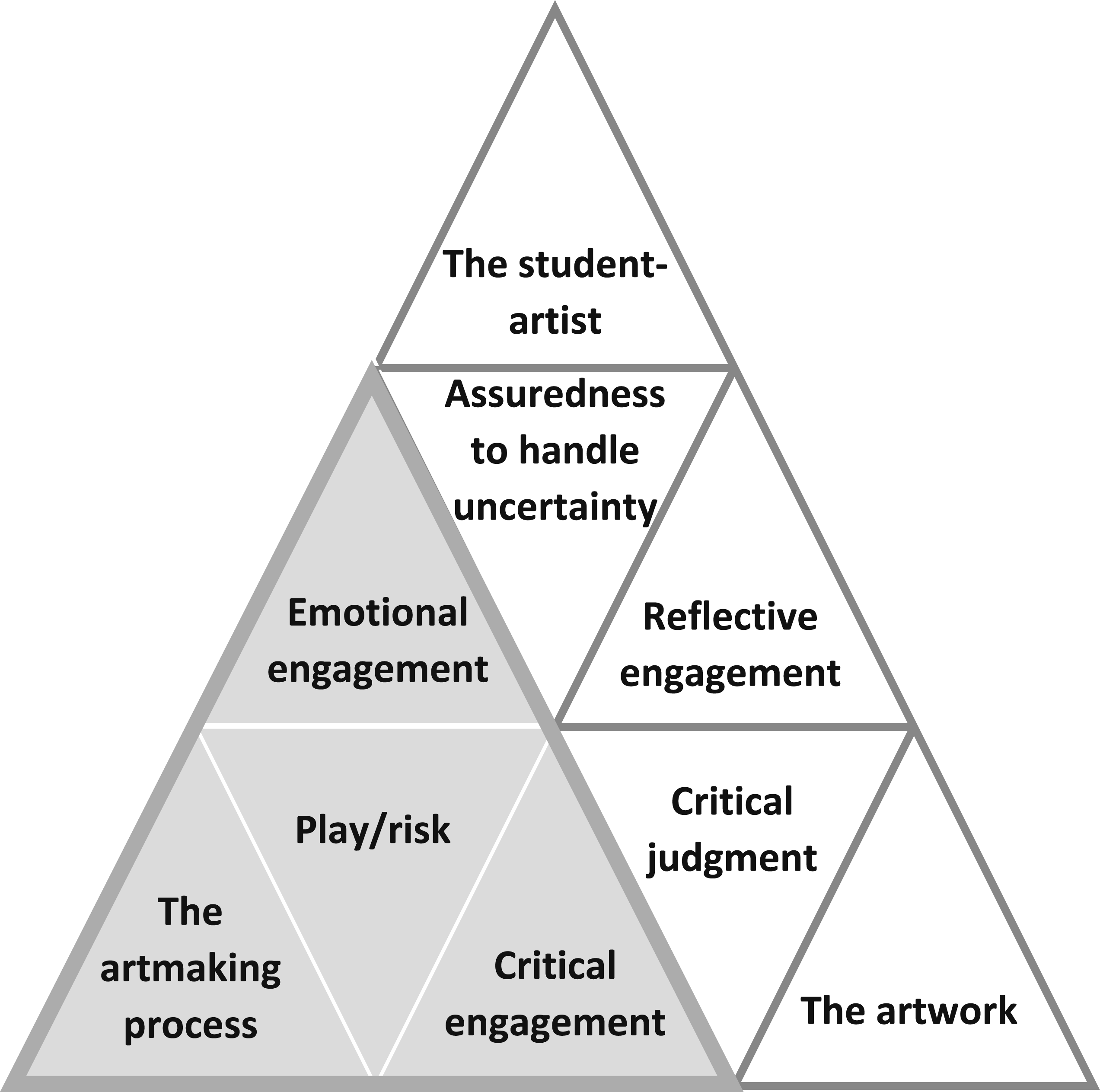
The author gives a compelling account of the intersection of the artist, artwork, and viewer through the schema, as capturing the conditions for creativity in the fine art studio. Nonetheless, the schema is reconfigured in this paper to accommodate the present proposition for rethinking the intersection of artist/student, studio practice, employment opportunities, art institutional expectations, the pedagogical setting and broader political, cultural and critical contexts at play. We use the common child’s toy, the paper fortune teller (Figure 2), to serve as a concrete metaphor to illustrate the concept of the student at play with the determinants of the field. The student is assessed on relevant knowledge, their capacity for reflectively play with that knowledge to produce creative outcomes of value to their intended audience – both the course assessment criteria and the broader audience determined by the student’s developing interests as artists or employed professionals in related occupations. A paper fortune teller used in children’s play serves as a concrete metaphor for play with given determinants.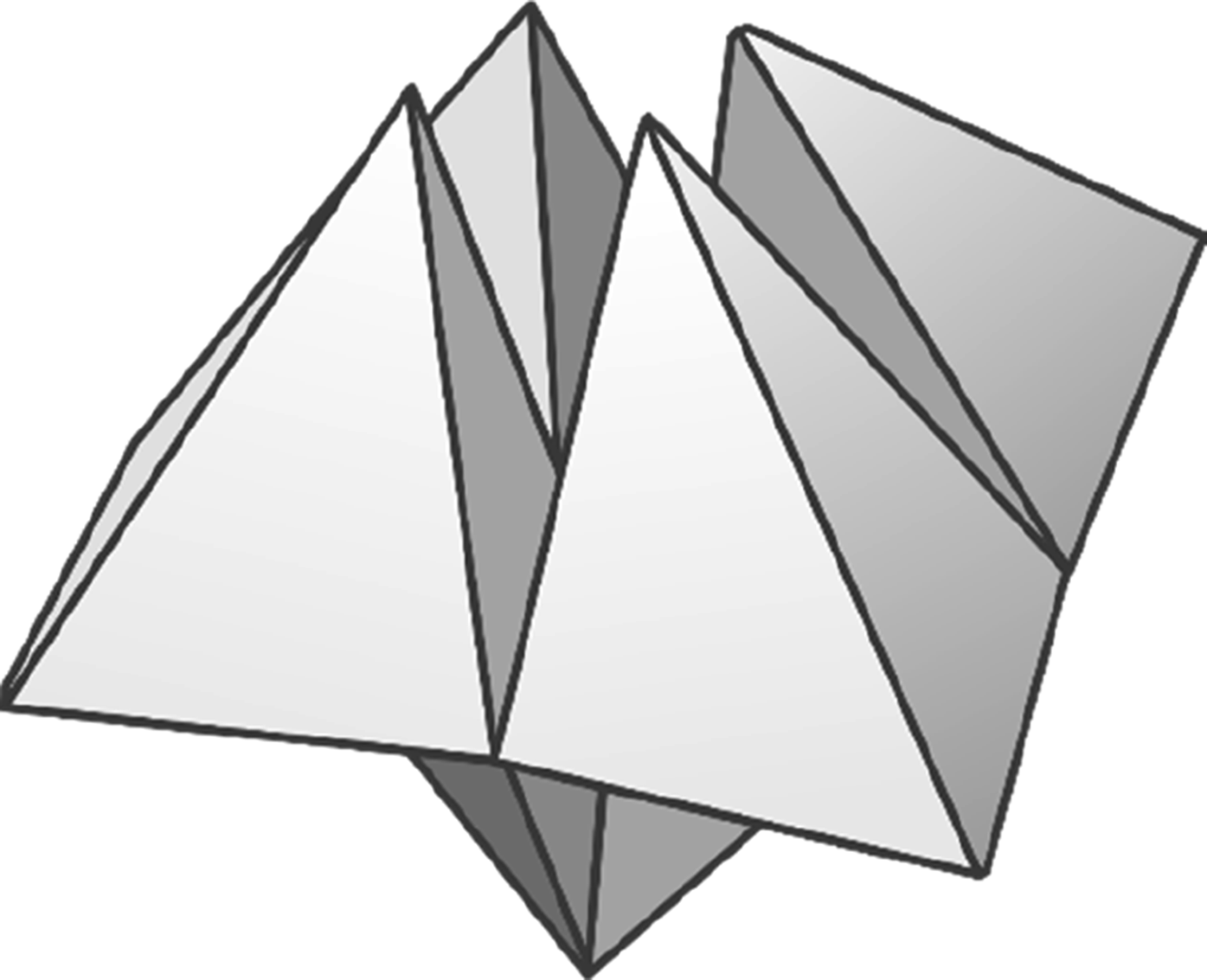
The student occupies the centre of the new schema we present here (Figure 3), actively engaging the pedagogical context which includes the determinants or contextual factors around the centre or location of the student and their play with those determinants. For some students, skill and art history might be the focus, with politics and art theory playing a relatively marginal role. This student might be aiming to become an art historian or artist engaging art history and its critiques inflected by cultural studies’ critiques of art history. Another might be interested in politics and gender, with a view to becoming a curator of contemporary queer art, identity art or political art, perhaps recontextualising these thematic categories for a new audience. Yet another might be engaging technology to develop a body of work focussed on “new materialism” for an anticipated “posthuman” world (Vint, 2020). The aim of the paper fortune teller metaphor is to capture, in visual form, the sense of play within a broader creative context or field. It cannot capture all variables due to the breadth of contemporary art and employment opportunities – both of which are in constant developmental flux. Instead, it aims to capture a broad, but incomplete set of contributing components of a course designed to promote play-based, student-centred learning. Our schema is an unfolded paper fortune teller that serves as a concrete metaphor showing potential career paths that might result from the creative play with given determinants.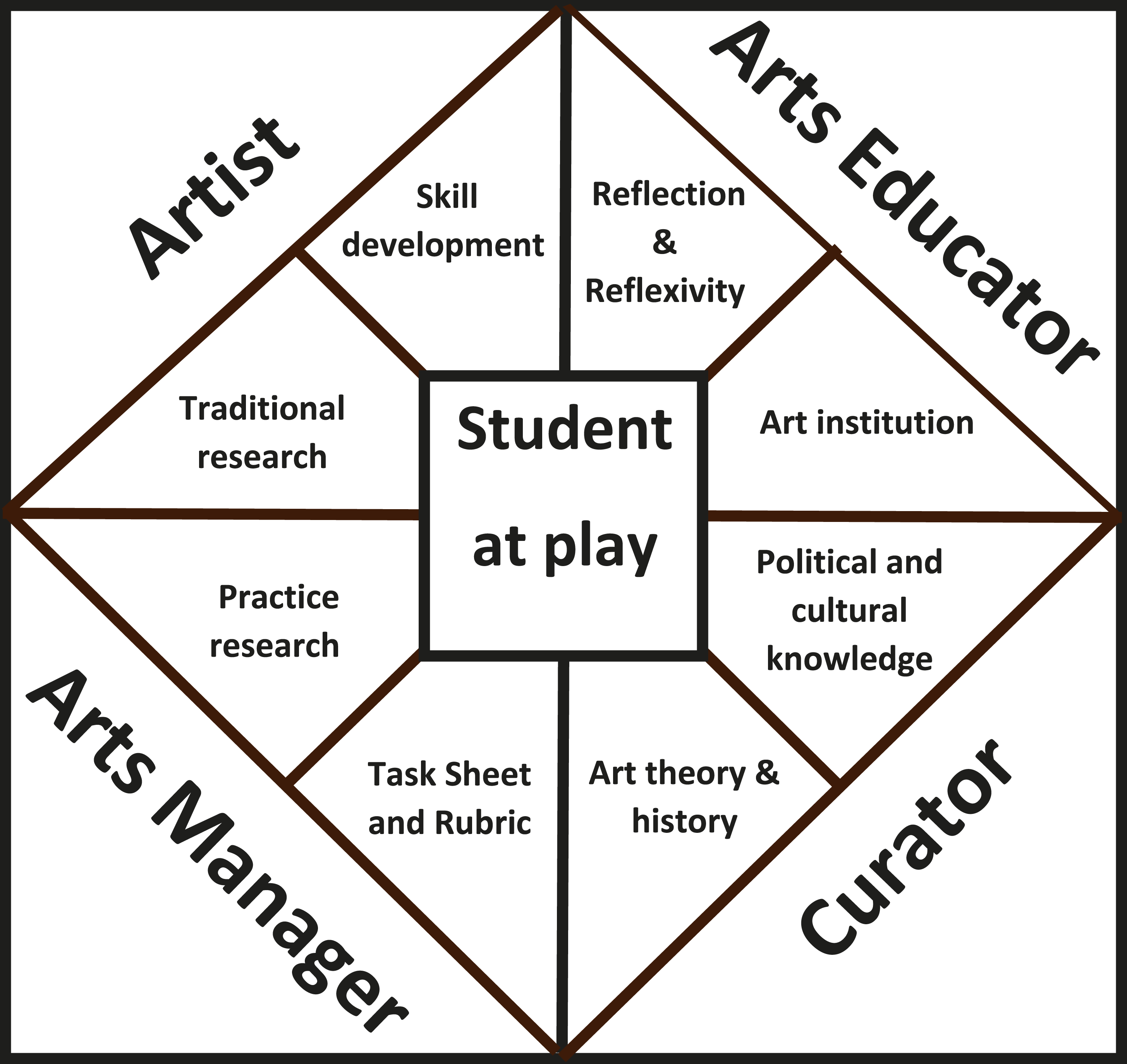
The student gains familiarity with the various components such as art history and theory, traditional or new media, practical, political and cultural knowledge, curatorial knowledge and knowledge of the art institution, and plays with this knowledge to produce outcomes of value to the intended audience. Over the course of learning and self-directed play, the student narrows their interests and focus, and solidifies their understanding of their place in the contemporary art world and world of work. While this is a metaphor, the aim is to provide something of a visualisation of the course design and desired leaning outcomes through the schema shown in Figure 3.
Implementation of the course and assessment design
The course of study which includes the proposed assessment as presented here, is to be a final year capstone course offered as a year-long, 4 credit unit, forming a substantial part of a 24-credit undergraduate program. This is now possible due to a new, flexible learning structure being offered in 2025, by our tertiary institution. The course aims to provide a range of materials that covers the contextual factors usually associated with a broad range of creative outcomes by both modern and contemporary artists. The aim of the course is to expose the student to relevant cultural, political and social history, art history, art theory and criticism, cultural and political knowledge, technological and traditional skill, and of course art practice covering a wide variety of media and themes. Along with the student’s prior learning and creative predilections, the course aims to place the student at the centre of learning, not by inverting the role of teacher and student, but by rethinking the factors contributing to a dynamic pedagogical exchange between student, course materials and broader contextual factors such as artworld and industry expectations. Prior to this point, the student at the tertiary level is best served by more conventional instruction, providing a foundation level of knowledge and practical competence in their first year of study, and developing this foundation in second year, with the gradual introduction of divergent forms of thinking to compliment the earlier focus on convergent forms of knowledge acquisition.
Figure 4 gives an example of a task sheet for a final year visual art student undertaking such a year-long course. This level is chosen because this is the point at which many students will then go on to graduate from the program and assume full time work in the industry as creative artists or as other industry professionals, or continue to undertake an Honours degree to which the course under consideration would serve as a bridge. The knowledge provided by the course is most appropriate at this point in the student’s learning journey. The student is, by this point in their studies, becoming aware of their role in creatively organising the materials provided and acquired, and how their interests and knowledge might be received by the broader artworld. In other words, the student is, by their final year of study, beginning to understand the assessment task, less as a set of criteria to serve if one wants to get good marks, and more of an enabling set of criteria and a pedagogical setting for the expression of creative thinking that happens to be assessed. While the course is focussed on summative assessment, the intended year-long course provides several points where formative review and associated peer and lecturer feedback, which are not assessable, should also remove the pressure to ‘get it right’, and instead provide the space to explore creative play toward an intended end. Task sheet.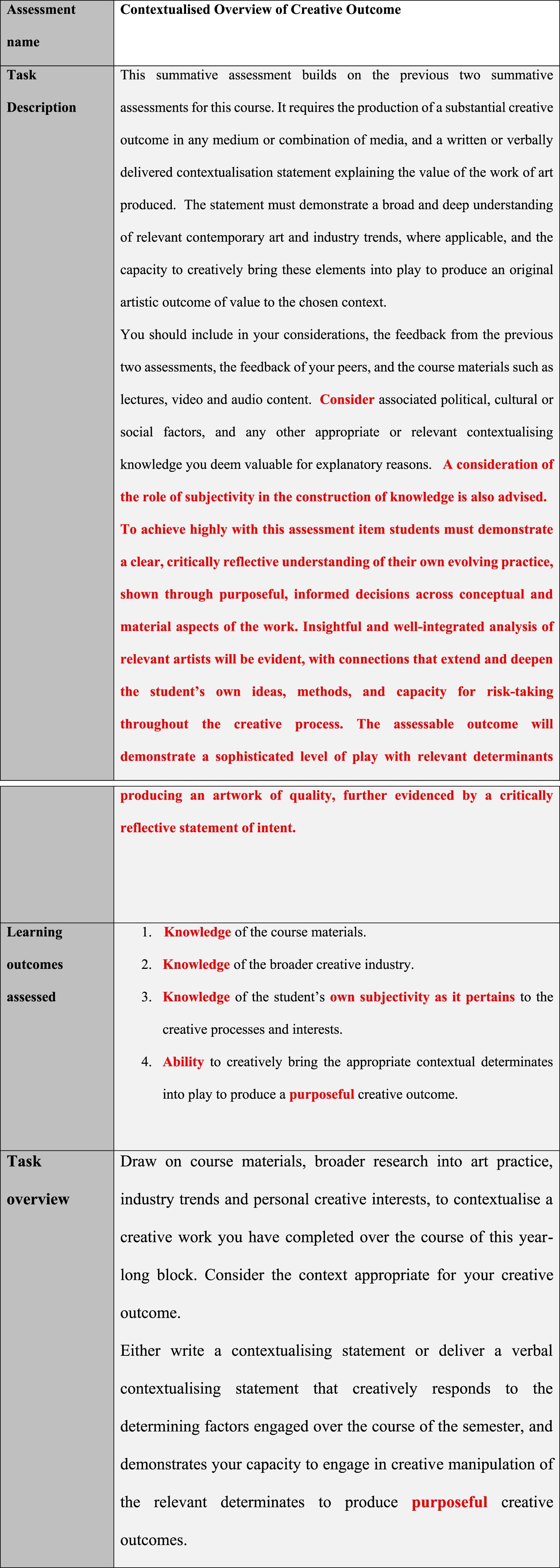
The assessment task builds on the previous two assessments and forms an important part of the knowledge required to successfully complete the degree. It provides the pedagogical setting that aims to facilitate the development of creative capacity and provide the requisite industry knowledge and confidence the student needs to assume their chosen professional role beyond university. To facilitate these outcomes, the final assessment represented by the task sheet and rubric provided below, builds on the previous two assessments, with a focus on the creative play with the determinants provided largely by the course, but also, by the student’s own research and prior learning. The overarching intention is to provide a pedagogical context where critical and creative play are facilitated in such a way that creative play is ‘free’, but also, to invoke Kant (1987) “fixed” or “determinate” forms of play where such freedom is contingent upon a broader pedagogical and industry context, that both engenders it and measures its value to the contemporary art world and employment sector.
The determining context reflects artworld expectations, but these should not be seen as Crowther (2008: 1) does, as “managerialism” or obstructions to creativity. On the contrary, they should be seen as enabling conditions for creativity. It is, as Cropley (2008: 394) has argued, the “prepared mind” that is equipped to recognise and exploit intuited phenomena. This is not unlike Kant’s (1987: 172) insistence that “fine art requires much science: e.g., we must know ancient languages, we must have read the authors considered classical, we must know history”. The course materials, both online and on-campus delivery, are just such determinants in expanded form, referenced in both the task sheet and marking rubric. These do not just test for knowledge, more importantly, they test for creative play or divergent thinking. They are “producing multiple or alternative answers from available information” requiring the “making of unexpected combinations” and “recognising links among remote associates” and finally, “transforming information into unexpected forms” (Cropley, 2006: 392).
What the student is permitted to do by the pedagogical design is to decide what interests them; what they want to be assessed against; what they want to focus on, move toward, reject or accept as formative or determinative for their desired assessable outcome. This is akin to what Bondi and Bondi (2020, p. 12) call “manipulating the constraints”. The student avails themselves of the course materials, their own prior learning, further research and aesthetic interests, and within that context, creates work and presents it for assessment. The task and assessment rubric are aimed at reflecting this student-centred approach – an approach that is facilitated by the course materials and navigated according to the student’s interests. The student’s knowledge is assessed for its utility to their stated interests and desired creative outcomes, rather than knowledge for its own sake or knowledge more suitable to another student with different interests or creative outcomes.
Accompanying the task sheet above is a rubric that captures the requirements of the task and assigns value to each component (see Figure 5). It essentially rewards the student’s capacity to creatively manipulate the acquired knowledge and the particulars of the assessment task. The student is not marked on accuracy or knowledge per se, but rather their creative play with the various determinants and an understanding of the destination or audience for their creative output. The student is not learning about creativity and being tested on their knowledge, thus replicating courses our institution already offers, or perhaps better, but rather the process is itself creative, including the convergent stage of the first and second assessments. The student engages in creative activity through the process. What Beghetto and Kaufman (2009: 1) call “mini-c” or a form of creativity associated with “creativity inherent in the learning process” is applicable here. Teaching about creativity, as we do in other courses, is useful and complimentary to the present course, but providing for creativity that is inherent to the learning context is of more use to the design considered here. Courses on offer at our institution, consist of theory courses, courses covering industry employment, studio practice courses or creativity courses, but no combination of these in a single course. Furthermore, no single course allows for the creative play with the course materials in the way proposed here, where the student is at the centre of decision making and creative direction. The present course outlined here, proposes the combination of these approaches in the one course, with the student’s active participation being the focus of the design. It is offered as a year-long, capstone course at a point in the learning journey where the student is best equipped to exploit its offerings. Rubric.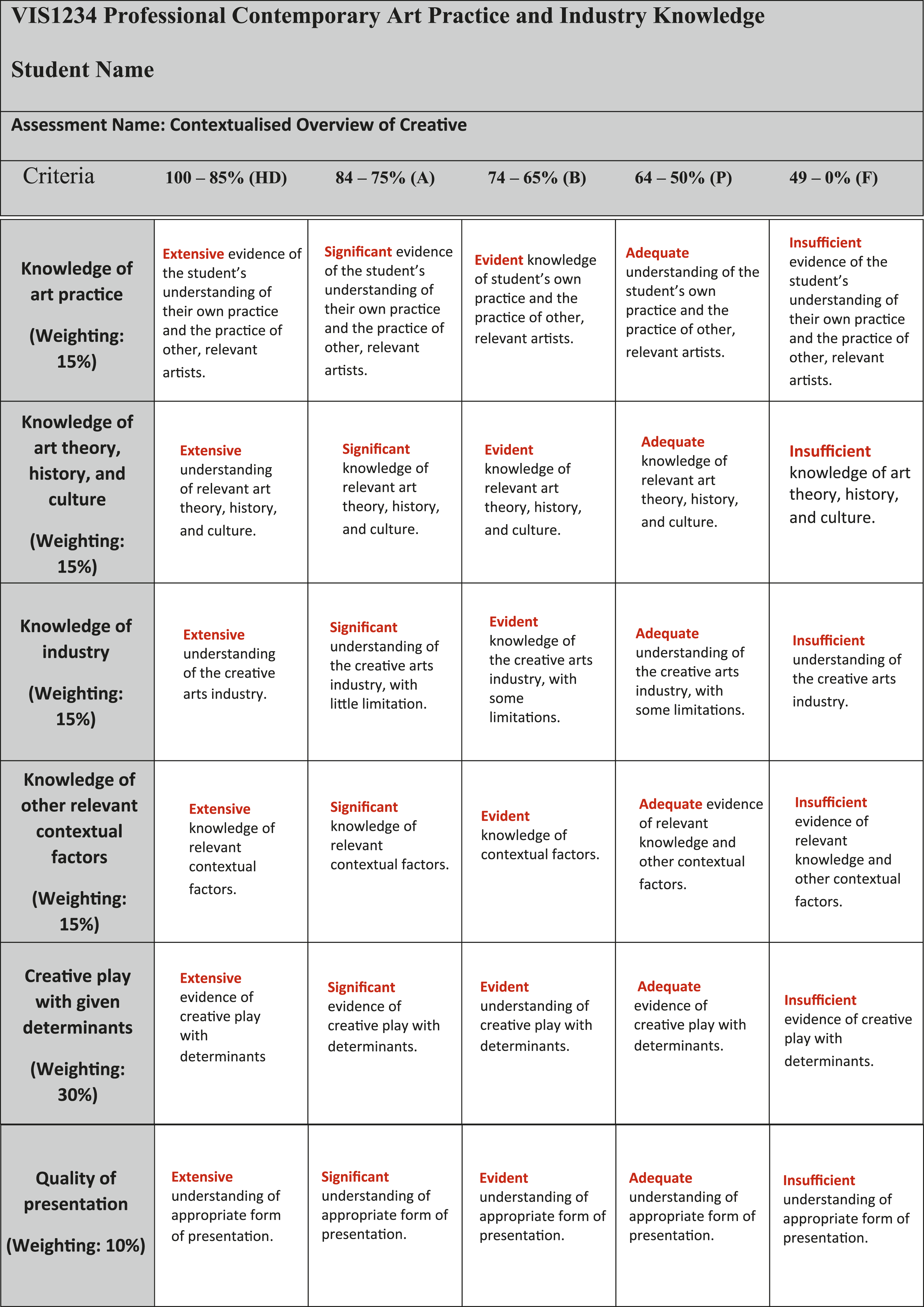
This emphasis on combination is not too dissimilar to what Green (2016: 1) calls “creative relational thinking”. The use of reason and conceptual thinking in visual art discourse are usually pitted against creativity or originality. The challenge to creativity we began this paper with – challenges from Danto (1964), Foucault (1980), Barthes (1977), Eagleton (1990), Foster (1983), Benjamin (1992), Krauss (1986), and Nelson (2010), can be considered in contrast to this “creative relational thinking” of Green (2016), or what we are calling ‘play with the given determinants’. The student is encouraged by the design to look for compatibilities, synergies, correlates, analogies and other associations between the different materials of the course, and the student’s own research, knowledge and interests, toward a purposeful outcome. While Green’s position and what we are proposing here are not strict correlates, both positions allow, indeed encourage, creativity as a playful connection exercise. The use of our concrete metaphor - the paper fortune teller discussed above - allows us to visualise how the relation between assessable elements can be manipulated by the student, who constructs or creates new knowledge through this creative manipulation. The capacity to find relational qualities between given determinants places the student at the centre of the learning and creative process, determining what is relevant and what is ancillary to their creative requirements and industry expectations.
Concluding remarks
Notions of creativity in the visual art industry is associated with a questionable reading of the aesthetic theory of Immanuel Kant, and conceptual or anti-aesthetic practices that came to dominate the artworld. The point of the course design and assessment regime discussed in this paper is to offer a solution to the problem of waning creativity in the tertiary visual art sector, as reflected in the common assumption of the industry that creativity is passe and the assumption of the broader community that creativity is an expression of limitless freedom – a quality that assessment cannot capture (Benedek et al., 2021). Creativity in this context is purposeful novelty that can be both encouraged and captured through pedagogical design and the assessment regime. Creativity has been the subject of an overt challenge from both the theory and practice of art from the late modern era to recent years. This paper does not seek to malign conceptual or anti-aesthetic art, nor to challenge the dominance of artworld narratives and influence, but rather include these challenges alongside other determinates in the course and assessment design. As tertiary educators it is important to incorporate the contextual constraints, as enabling determinants, along-side aesthetic, and in particular, creative approaches in the pedagogical design to facilitate the play between the enabling determinants. This puts the student at the centre of learning. Freedom from all constraints may produce originality, but it is originality with a purpose, or a creative output that serves an industry need that will produce a graduate with knowledge and creative capacity that can open a creative career path for that graduate. What is permitted by the pedagogical and assessment design doubles as a horizon of creative possibility.
Building on Bondi and Bondi’s argument (2020), what is needed to address contemporary creativity is dependent, fixed or conditioned beauty (Kant, 1987: 76). Kant (1987: 76) refers to this kind of beauty as determinate beauty, that is, a beauty that is not completely free, but rather, up to a point “determined by concepts” – a “purposiveness” that has a purpose or intended audience for the creative output. In the present learning and teaching context, these determinants are the course materials, task sheet and rubric, but also the student’s own creative interests and prior knowledge. Knowledge of these contextual determinants enable a creative output that is of value to the target audience, in this case, in the first instance, the assessment criteria, but upon graduation, the broader creative industry context. Having the student at the centre of learning means they decide what interests them; what course materials they want to be assessed against; what they want to focus on, move toward, reject or accept as formative or determinative for their desired creative response to the given determinants. The student avails themselves of the course materials, their own prior learning and aesthetic interests, and within that context, creates work and presents it for assessment against those indicators. Creative practice in this context is the application of creative play within given constraints that act as enabling conditions for creative output, rather than either handbrakes on creativity, or unfettered, but unfocussed creative freedom.
Footnotes
Declaration of conflicting interests
The authors declared no potential conflicts of interest with respect to the research, authorship, and/or publication of this article.
Funding
The authors received no financial support for the research, authorship, and/or publication of this article.
