




Abstract
The role of tertiary music performance education is to prepare students for professional performance. Professional performers demonstrate stage mastery, and their concert preparation transcends the score to equip them for the concert stage. Music educators must translate professionals’ insights into performance education. This study developed, trialled and evaluated two learning modules for performance students, based on expert strategies. In Module 1, students engaged in a backstage immersion task. In Module 2, students roleplayed as expert performers and audience members. Participants reflected on their experiences in interviews. Workshops and interviews were recorded, transcribed, and coded thematically. Students analysed the concert environment critically and observed their performance mindset. Emulating expert performers prompted compelling stage presence and students observed the effects of stagecraft on audiences. Peer-to-peer learning facilitated critical reflection on professional practice and students resolved to apply these skills to concert preparation. Future studies will develop these tools for pedagogues and students.
Introduction
Tertiary music performance education aims to equip students for professional performance. Professional performers demonstrate expertise that is inaccessible to performance students in training and have advocated for the inclusion of specialised performance training in music performance education (Urbaniak and Mitchell, in review). The challenge for music educators is to create meaningful learning experiences for professional performance preparation. While students receive ample feedback on their musical interpretation, they may receive limited guidance on the nuances of stage performance to develop their stage skills, especially in comparison to drama (Ford, 2013). New learning and teaching strategies are needed to equip students for the realities of professional performance, where showmanship is key. This study aimed to translate professional performance preparation into novel educational strategies for performance mastery.
Professional performance
In the 1800s, legendary pianist Franz Liszt revolutionised the role of the performer. Liszt was the quintessential celebrity performer who knew how to create an entire show, not just play the music (Gooley, 2004a, 2004b). Liszt performed with such effortless bravura that his performance style became legendary (Hilmes, 2016). His indomitable ego monopolised audiences’ attention, and his soloistic persona evoked awe: “how powerful, how shattering was his mere physical appearance” (Heinrich Heine, in Hilmes, 2016: 43). Liszt’s self-awareness that ‘le concert c’est moi’ (Hilmes, 2016: p. 72) paved the way for modern stagecraft and changed audiences’ expectations of performers.
Today’s performers follow the Lisztian tradition of showmanship and stagecraft. Professionals hone stagecraft to direct the audience’s attention, through expressive gestures and a captivating stage presence (Davidson, 2014). Performers and audiences agree that facial expression and body movement are important to musical communication (Kawase, 2014). How a performer walks on stage – with confident or nervous body language – has an immediate impact on audiences’ perceptions (Platz and Kopiez, 2013; Waddell and Williamon, 2017). Exaggerated gestures (Davidson, 1993) and confident facial expressions (Waddell and Williamon, 2017) can convince the audience of a successful and expressive performance. Audiences are transfixed by soloists’ decisive body language (Küssner et al., 2020). Expert performers are acutely aware of the impact of performance visuals on the audience and choreograph their performances (Urbaniak and Mitchell, 2024b).
Performers translate rehearsal in the studio to performance on the concert stage. The majority of professional musicians use visual imagery to prepare for their concerts (Roland, 1994). Professional performers imagine specific concert halls (Sinnamon, 2020), practise in full concert attire (Urbaniak and Mitchell, in review), and develop pre-performance routines (Geeves et al., 2016; Kaleńska-Rodzaj, 2021). Common pre-performance strategies include scheduling the concert day, using positive visualisation, and having a mantra (Sinnamon, 2020). Mantras that focus on excitement are more effective than attempting to calm down (Brooks, 2014), and professional performers focus on mantras such as ‘I am the greatest pianist alive’ or imagine themselves as ‘king’ of the concert stage (Urbaniak and Mitchell, in review). On stage, professionals concentrate on thoughts that give confidence and focus on the task at hand (Buma et al., 2015).
Developing performance skills
The music studio presents an isolated environment when compared to the concert stage (Burwell et al., 2019). Indeed, piano students struggle to recall memorised excerpts when playing unfamiliar pianos in different locations (Mishra and Backlin, 2007). Music students can feel nervous and uncomfortable on stage (Kokotsaki and Davidson, 2003). However, individualised pre-performance routines can enhance students’ self-efficacy (Tief and Gröpel, 2021), and high school singers who breathed and repeated the words “bold, confident and free” performed more expressively and felt less inhibited on stage (Broomhead et al., 2012).
Music performance students flourish when introduced to novel performance activities. Students benefit from experiencing concert environments as a part of performance training, which presents a challenge to music educators (Bissonnette et al., 2016; Williamon et al., 2014). Peer learning encourages students to reflect critically (and kindly) on others’ performances, and develop a sense of autonomy over their learning (Hanken, 2016). Students acquire transferable skills when collaborating in music ensembles, including leadership, conflict resolution, and balancing individual and group goals (Gaunt and Treacy, 2020). Students can learn through performing for their peers and receiving feedback on performance style (Hastings, 2017), and can even learn stage skills by working alongside acting students (Ford and Sloboda, 2016; Rea, 2015).
Professionalising performance education
Performance skills are vital to the professional musician. Expert performers view their performances as learning opportunities, as there are specific skills and experiences that can only be realised through hands-on performance experience (Doğantan-Dack, 2012). Traditional models of music learning may not equip students to thrive in the modern music industry (Myers, 2016) where industry experts and music employers value those who can connect with audiences over just technical proficiency (Ingram, 2023). When music students enter the professional concert community of practice (Hewitt, 2009), they may face challenges rarely addressed in standard one-to-one tuition (Zhukov and Rowley, 2022).
Performance education in the twenty-first century should prepare students to engage in the music performance industry, including attire, self-image, and a focus on artistic outcomes (Dalagna et al., 2020). Music teachers seek to develop their students’ creativity beyond just reproduction of the score (Schiavio et al., 2023) and expert performers advocate the inclusion of stage training in tertiary music training (Urbaniak and Mitchell, in review). The tacit knowledge of experts and their artistic process can be translated into pedagogy (Kanno, 2019) including professional performance training for stage charisma (Platz and Kopiez, 2022).
Audiovisual performance perception has utilised empirical paradigms which can be complex for students to interpret and employ in their own practice. Music students appreciate the roles of sight and sound in performance after reviewing peers’ audition trials (Mitchell and Benedict, 2017) and trialling different styles of stage entrance can translate empirical research on stage demeanour into practical exercises (Urbaniak and Mitchell, 2024a). The challenge for performance education is to translate these findings into teaching activities which are meaningful and actionable.
The aim of this study was to develop, trial and evaluate two learning modules with students to develop concert stage confidence.
Method
Study design
Recent performance graduates participated in a workshop on translate experts’ insights into stage preparation through experiential learning (Kolb, 2014). The first Module ‘Backstage immersion’ used multiple senses to describe and simulate the feeling of performing. The second Module ‘Trialling the expert concert’ encouraged performers to trial performers’ strategies by roleplaying as expert performers. Following the modules, participants discussed their observations and strategies.
Demographics
Three recent performance graduates participated in the workshop and interviews. ‘George’ was a current Master student, ‘Claudia’ held a Master degree and ‘Michael’ was a candidate for the Doctor of Musical Arts. George, Claudia, and Michael had been performing for between 13 and 20 years (mean = 17) and George and Claudia also had several years’ teaching experience. Participants were familiar to each-other prior to the study. This workshop was undertaken during the COVID-19 pandemic, where social distancing limited the number of participants able to take part.
Materials
Module 1 was designed to develop students’ awareness of the concert environment. In an immersive task, participants experienced the sights, sounds, and sensations of the green room. They were guided by a series of prompts which explored sight, sound, touch, smell, and feelings experienced in the backstage environment (Figure 1). Process and prompts to explore the concert environment through sight, sound, touch, smell, and feeling (Module 1).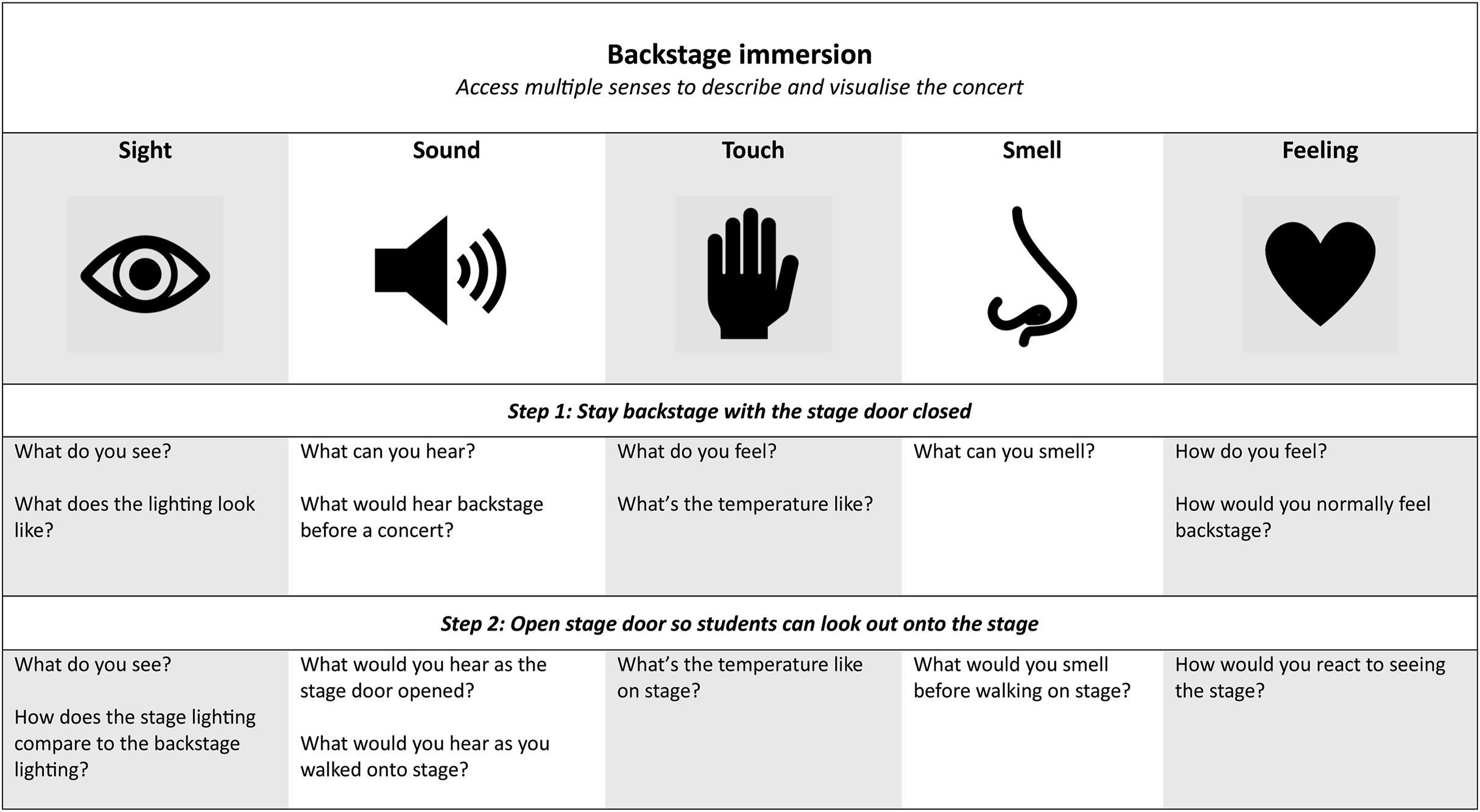
Module 2 was designed to guide students through some of the key strategies and prompts based on expert pianists’ real practice (after Urbaniak and Mitchell, in review). The aim of the exercise was to understand and trial expert methods for backstage preparation including visualising the concert, adopting a stage persona, and maintaining a confident demeanour, as summarised in Figure 2. Process guide and strategies for trialling the expert concert using expert stage strategies (Module 2).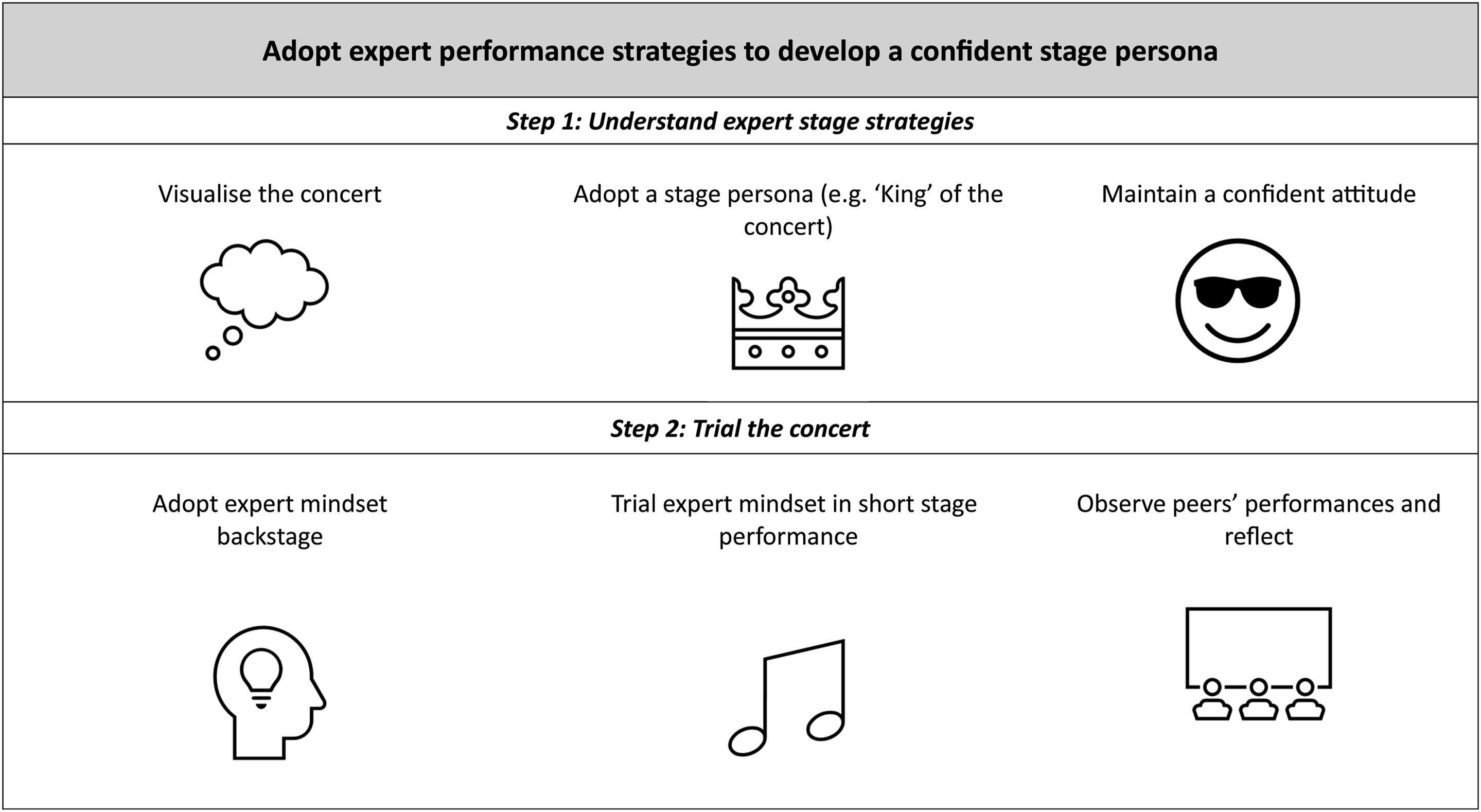
Semi-structured interviews explored the themes raised in the workshop. The questions were open-ended and focused on subjective experience. Prompts included topics such as whether anything surprised the students, whether they had trialled this kind of experience before, what they learned about themselves or about performance, and how they could integrate these strategies into regular practice.
Procedure
Ethical approval was granted by the institutional Human Ethics Committee. Participants took part in two 1-h workshops in a performance space at a tertiary music institution. The concert hall had a capacity of around 200 people, with elevated audience seating and a separate green room. Stage lighting was used to mimic an evening recital.
In Module 1, participants entered the Green Room adjoining the concert hall. The doors were closed completely, to mimic a pre-concert atmosphere. In the Green Room, participants described their surroundings by sight, sound, smell, and sensation (following the prompts in Figure 1). The stage door was then opened to reveal the concert stage with concert hall lighting (a bright spotlight on centre-stage). Still backstage, participants described the stage through all senses, and imagined what they would see and hear in a real concert situation. Participants reflected on their experience in a free-flowing group discussion. This exercise took approximately 15 minutes.
In Module 2, participants roleplayed as expert performers or as critical audience members. First, they were introduced to strategies used by professional performers to adopt a confident stage persona, which included imagining themselves as ‘the world’s best pianist’ or the ‘king/queen’ of the concert stage. Participants prepared for a few minutes backstage, before trialling this mindset performing a short excerpt from repertoire of their choice. Participants roleplayed as audience members and observed their peers’ performances. Finally, the group discussed their impressions and reflected on their experiences.
Participants were interviewed following the workshop and follow-up discussions were conducted in the months after the workshop. In interviews, students were encouraged to discuss the workshop experience, exploring how experts’ strategies impacted mindset and demeanour, and participants’ ideas for how to integrate these new skills into regular practice. Workshops and interviews were recorded.
Analysis
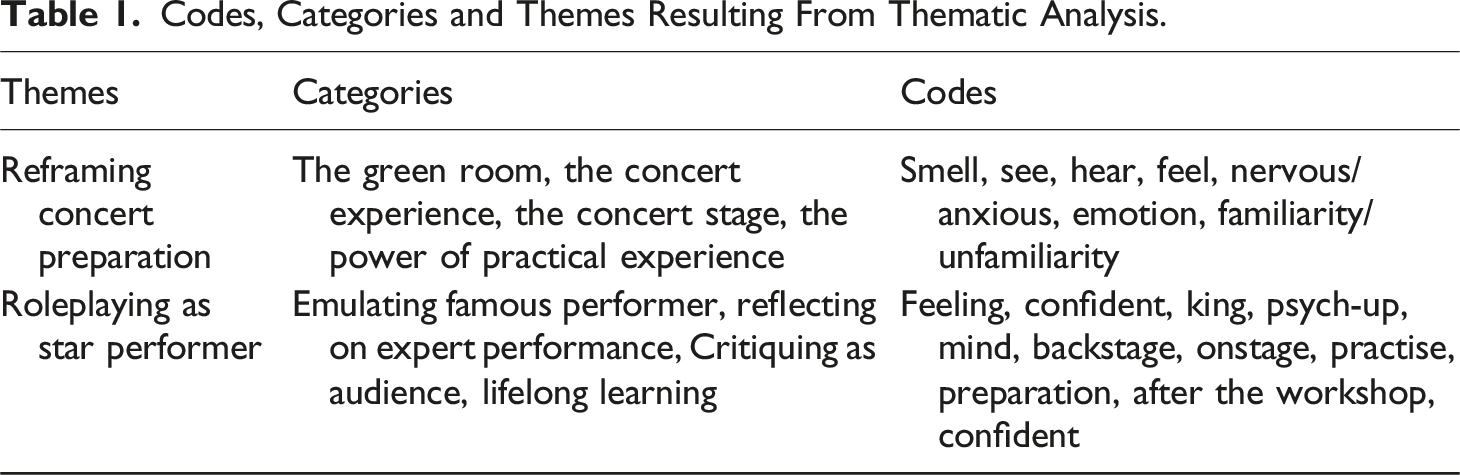
Codes, Categories and Themes Resulting From Thematic Analysis.
Results
Reframing concert preparation
The green room
The group enjoyed the experience of being able to experience and describe their backstage surroundings in this focused session. The Green Room was sound-locked, with dark lighting and minimal furniture. It was quiet, private, and secluded. Participants reacted viscerally to the physical experience of being backstage. The closed doors made them feel “closed off to the world” (Claudia), “claustrophobic” (George), and cramped: “I don’t really have a lot of space to move around in here” (George). The temperature was “hot actually, it’s pretty stuffy for me” (Michael) or “comfortable” (Claudia), and the sound of the “air conditioning” (Michael, Claudia) was prominent. The Green Room had a particular “musty” (Claudia) smell: [Claudia]: It’s a carpet smell, or something, or something woody. [Michael]: I can smell a slightly sweaty smell which is probably my own.
Participants imagined being backstage before a performance. They predicted they would hear the “rustling of papers and like quiet chatter from the inside [the hall]” (Claudia), and be aware of their performance attire, which “always feel different to casual clothes because they're ‘suity’” (Michael) or “silky” (George).
The concert experience
Participants’ physical description of the space prompted a psychological description of their “realistic” (Claudia) pre-performance mindsets: Claudia: It’s very sad lighting. [The] dark spotlight and just the general colour of the walls is very dark as well. Michael: I’m already starting to feel nervous again.
Performers experienced “heightened emotion, fearful, giddy” (Claudia). They realised that simply by “being backstage,” they were able to “associate the kinds of feelings that do come with being backstage” (George). The “mixture of memory and also anticipation” (Claudia) of being backstage simulated pre-performance sensations, such as feeling “slightly ‘adrenalined’, slightly buzzy” (Michael) and “slightly uncomfortable” (Claudia). Participants’ hands felt “cold and a little bit sweaty” (Claudia), “clammy” (George) or “shaky” (Michael). They saw the backstage environment as a liminal space before the act of performance: I feel everything about this room is kind of like a sense of repression or suppression or oppression, in the sense that the doors are closed and the door on this extraordinary well of emotion. (Michael)
The concert stage
The stage was “the opposite” (George) of backstage, and the “warm […], bright” (George) lighting caught immediate attention. Participants were acutely aware that the bright stage lights directed the audience’s attention to them as performers: The lighting is heightened in the sense [that] it’s focused on you, which mirrors how you're feeling. You feel that there's a heightened awareness, heightened sensation. (Michael)
Participants interpreted the contrast between backstage and onstage symbolically, with the lighting mimicking the “extreme clarity and the extreme focus” (Michael) of performing. Seeing the stage simulated pre-performance nerves, “I’m already starting to feel a bit nervous when you [open the door]” (Michael). Participants could imagine the audience sitting in the stalls, a “sea of energy” (Claudia). They were surprised by how “nerve-wracking” (Claudia) the experience was, as all the individual performance elements contributed to the performance simulation. All the sensations, all the things that come into your mind, all the things that you notice, all the things that you feel when you’re about to play – when you add up all those thoughts; when you think all those thoughts in succession, then the mental picture you’d have is of the concert. (Michael)
Power of practical experience
The experiential learning workshop was a novel experience for participants. They appreciated the practical and hands-on nature of experiential learning, including how they could replicate real-life concert sensations: Michael: I love the backstage thing. Claudia: I like the backstage thing; I would do that again! Michael: It made me nervous; it was awesome.
The group was able to recreate a performance mindset accurately, which they had only experienced when “actually giving a performance” (Michael). They were amazed by the “reproducibility of the performance experience” (Michael) and surprised that they got “nervous […] while not actually performing” (Claudia). Michael likened the experience to a “vaccination; a little tiny dose of [performance]”, which allowed him to look forward to future performances: It really made me so much more enthusiastic – it made me miss performing. […] It brought back all the kind of vivid sort of elements of the process. (Michael)
Roleplaying the star performer
Emulating famous performers
Participants were fascinated to learn that professional performers adopted a stage persona. Participants roleplayed as expert pianists, imagining “I’m the king, I’m the great virtuoso” (Michael). Michael adopted the persona of an “emperor” or a famous performer playing for “a really packed hall with a big audience”. Onstage, he felt empowered with an “I can do it” attitude, and as a result he felt braver on stage, “the performance took risks, it had spontaneity”. George used the ‘king’ mantra to “psych [himself] up” for the performance. Backstage, he made a conscious effort to recreate the “kind of energy that you bring onto a stage” and visualised the entire concert experience, “you hear that silence… it’s almost like a pregnant silence, with all the possibilities that could happen”. Claudia was “surprised by how quickly [she] managed to get to a certain focal point” and calm any intrusive thoughts. On stage, Claudia felt comfortable, and “was happy with how I felt when I sat down, because I didn't feel frazzled or anything like that”. Students enjoyed adopting a king/queen attitude, as it boosted their confidence: Michael: [I valued] putting myself in the space of… maybe not a specific person, but the figure, a really authoritative performer who has lived with this music – Claudia: Like a king. Michael: Like a king, like a king.
Reflecting on expert performance
Performers reflected on how their experiences with roleplay related to their prior knowledge of expert performers. They talked about their favourite performers and how they displayed a “certain charisma, or a certain communicative flair” (Michael). They considered performers whose “onstage persona” was entirely different to their “offstage persona” and brainstormed why this could be the case (Michael). The group also considered performers whose stage persona appeared to undermine the effect of the performance, for example over-exaggerating nonverbal communication “to the point where I’ve stopped listening and I’m just absorbed by the visual element instead; maybe that’s what bothers me about it” (Claudia). Several months after the workshop, Michael and Claudia particularly praised the success of the ‘king’ mindset, which forced them to re-evaluate the relative roles of performers and composers: So often, what you’re told is that you need to somehow be secondary in importance to the music or to the composer. […] But actually, the technique that I think made the biggest difference to me was the one where [I think] “I am the king” before I walk on, or some variation of that. Imagine yourself as some incredible superstar who is just unarguably phenomenal before they set their finger on a key. (Michael)
Critiquing as audience
Participants valued the opportunity to roleplay as audience members and see whether they could identify the effects of the stage persona. Participants perceived professionalism from the performance trials, and agreed that everyone “uniformly improved - everyone looked better” (Michael). They were able to pinpoint specific elements of each performer’s stage presence, and their confidence was notable: Michael was “very confident and sort of serious, […] very in control, very grounded” (George), while Claudia was “very confident” (George), and George “walked onstage with a kind of mystery” (Michael) “confident […] very live” (Michael). By “internalising” (Claudia) expert confidence, participants adopted projected yet “natural” (Claudia) demeanour. They considered varying their approach for different scenarios, such as “I'm the greatest actor in the world” (Michael). Participants were familiar with the concept of maximising performance to “get it across the footlights” (Michael), and could recall moments in childhood where they felt like kings on stage. This experience empowered students to adopt a more confident, professional approach for the first time: I haven’t gotten to that headspace as I’ve gotten older as a musician. And I think the reason for that is because we are always […] inculcated with this idea of artistic humility. We’re inculcated with this idea that nothing you can do can ever be as good as Beethoven. (Michael)
Witnessing the impact of stage charisma encouraged these participants to appreciate the impact of nonverbal communication on the audience’s perceptions. They realised the impact of sight on the audience’s perceptions: I think you need to magnify everything in the performance, not only in the playing but also the gesture. (Michael)
Lifelong learning
The group was excited about the experiential learning process and recommended younger students take part in similar activities: “I wish that this was a mandatory course in first year under-grad” (Michael). After the workshop, performers continued enacting their own experiential learning. After the workshop, Michael exclaimed “you better believe I’ll be thinking I’m the king before I walk onstage!”. His response to the expert mindset was particularly noticeable as he had initially been sceptical, as he believed their humility would be compromised. Michael continued to adopt this stage persona: I really like the ‘I am the king’ stuff. I mean, I hated it at first. That’s why it sticks with me, because when you first [explained] it, [I thought,] “That’s a terrible approach. Like that’s awful, that’s ego, that’s everything we don’t want.” […] And then I tried it, and it actually works, so I ate my words. So, I’ve remembered it ever since. (Michael)
Claudia replicated the entire experiential learning exercise before a major recital. She described how she replicated the process, and focused her attention on specific elements: I stood in front of the audience – or in front of the seats – pretending that I had walked onto the stage, and I was going to be facing the audience. And I just listened to the sound of the hall and just the air temperature, and imagined the people clapping – or the sound of clapping I suppose – and whoever was next to me – I imagined who would be next to me [in a duet]. And then I practised walking on as well. And like I opened the door and I just like got scared because I imagined like seeing faces. So, I closed the door and I did it again a few times until I was more comfortable with it.
George also visualised the entire concert experience to promote automaticity with the process. Visualising the entire concert experience promoted confidence even in high-stress situations and promoted professionalism in performance preparation. When I got onstage, I felt really good. I sat down and I took all the time that I had prepared for in my head - all of the pre-performance stuff I had planned. (George)
All performers applied the insights they had gained into regular concert practice and reported long-term benefits from these strategies.
Discussion
This study developed, trialled and evaluated two learning modules with a small group of students to develop concert stage confidence. In Module 1, students had limited experience analysing a concert environment, other than immediately preceding concerts. Students were able to describe the concert environment in multisensory detail. Their descriptions of the Green Room and the concert stage led organically to descriptions of the concert experience. In Module 2, students welcomed the experience of roleplaying as expert and as audience. They were encouraged to hear that experts used mantras to boost their confidence and promote a compelling stage persona, and felt comfortable on stage imagining themselves as kings/queens of the stage. By roleplaying as audience members, students were able to witness the effects of professionalism and stage charisma firsthand. Peer feedback reflected a keen understanding of performance visuals. These three participants praised the practical experience and were able to distil long-term skills for practising performance and commanding the stage.
These students had little experience with tailoring practice in concert environments (including backstage) to optimise their stage preparation. Guided observation of the concert environment and experiences enabled students to familiarise themselves with the stage, and gain a multimodal understanding of a concert hall (Sinnamon, 2020). They identified unique features of the concert environment, and were able to incorporate this knowledge into regular concert preparation (Kaleńska-Rodzaj, 2021). Students continued observing and visualising concert environments before performances to gain familiarity with the space (Geeves et al., 2016). Students were able to replicate visceral pre-performance sensations in a positive setting.
The three students optimised pre-performance routines to achieve stage confidence. The ‘king’ strategy was based in expert practice (Urbaniak and Mitchell, in review). Students gained an enhanced sense of confidence for the stage, and were able to emulate a Lisztian stage demeanour. When using this mantra, performers felt empowered to take artistic risks, which translated into more exciting performances (Broomhead et al., 2012). On stage, they were able to focus their thoughts on confidence (Buma et al., 2015), and began to feel more prepared and more comfortable in performance (Kokotsaki and Davidson, 2003). Trialling experts’ methods for stage confidence enabled these music graduates to develop their own pre-performance routines (Tief and Gröpel, 2021).
Students realised the importance of showmanship to professional performance (Dalagna et al., 2020) and how to use a stage persona to create a connection with the audience (Ingram, 2023). Here, roleplaying as expert performer enabled students to act professionally on the stage, and adopt an exaggerated stage persona (Davidson, 2014). Close examination of these participants’ experiences suggests that emulating expert performers resulted in exciting stage presence, in the Lisztian tradition of stagecraft (Hilmes, 2016). Meanwhile, roleplaying as audience members enabled students to appreciate about the impact of sight and sound (e.g., Platz and Kopiez, 2013, 2022) firsthand, and analyse the effects of stage demeanour on the audience.
These graduate music students welcomed professionals’ performance strategies. They accessed confidence by emulating expert strategies (Urbaniak and Mitchell, in review), and created a sense of theatre through expert stagecraft and performativity (Davidson, 2014). They refined their own performance and pre-performance routines (Ford, 2013), and relished the opportunity for hands-on experience and peer feedback (Hastings, 2017). All three performers agreed that emulating experts’ confidence optimised their demeanour and nonverbal communication to transfix the audience’s attention (Kawase, 2014). Like Liszt, they were able to frame themselves as stars of the show through charismatic nonverbal communication (Hilmes, 2016).
The hands-on format of the modules promoted peer-to-peer learning and critical reflection within the small-scale workshop format. Students respected their peers’ opinions, and felt a sense of autonomy over their learning (Hanken, 2016). The three individuals worked as a focused team to develop their performance style, and offered their feedback generously (Hastings, 2017). Positive and constructive feedback fostered a supportive team dynamic (Hanken, 2016). The opportunity to engage in group discussion encouraged critical reflection on own and others’ performances. These participants even began to brainstorm alternative models for performance training in higher education that move away from a score-centric model (Schiavio et al., 2023).
Experiential learning modules transformed these students’ understanding of the realities of professional performance (Kolb, 2014). This workshop presents an exciting addition to the existing body of experiential performance training (Williamon et al., 2014). Roleplay facilitated a real-world understanding of professionalising stage demeanour from both performers’ and audiences’ perspectives (Mitchell and Benedict, 2017). This workshop also enabled students to self-reflect on performance skills and learning styles. This experiential learning experience provided these early-career performers with the opportunity to enhance their performance preparation and stage presentation. Students agreed these modules promoted self- and peer-reflection and could benefit all music students as they prepare for a professional music career.
Footnotes
Declaration of conflicting interests
The author(s) declared no potential conflicts of interest with respect to the research, authorship, and/or publication of this article.
Funding
The author(s) received no financial support for the research, authorship, and/or publication of this article.
