



Abstract
The purpose of this study was to examine the intersections of experiential learning and critical reflection within the unique context of the Accademia Europea dell’Opera (AEDO), a music performance summer program specializing in opera. Researchers explored the development and implementation of a responsive model of reflection and considered the impact this model had on helping music students shift between multiple spaces of musical performance and skill development. Data were analyzed through a communities of practice framework, and findings drawn from the analysis are explored through the following themes: the complexities of building a new community, synergy between intrapersonal and interpersonal engagement, and participants’ processes of reflecting and learning together.
Keywords
Introduction
Postsecondary music performance studies programs strive to prepare the next generation of performers, researchers, and pedagogues for musical engagement beyond the university. Yet recent literature suggests that these spaces of study do not always lead to a sense of readiness for potential professional worlds (Freer & Bennett, 2012; Rowley et al., 2017). Experiential learning may be one way to enhance meaning making for those in the performing arts (Bennett et al., 2017; Dullea, 2017; Kindelan, 2010). Increased opportunities for experiential learning may help students cultivate their musical identities and support the development of skills such as leadership, communication, collaboration, and flexibility in multiple settings (Bennett et al., 2017; Reid et al., 2018).
In order to help students shift between multiple spaces of musical practice, opportunities and guidance for in-depth, critical reflection within experiential learning are needed (Carey et al., 2017). Reflection is understood by scholars as an integral element of experiential learning in which knowledge is processed and understood in connection with individual experiences (Allison & Seaman, 2017; Fenwick, 2001; Russell, 2005). This follows the work of Dewey (1933), who urged learners to “reflect in order that [they] may get hold of the full adequate significance of what happens” (p. 119). We, as music education and music performance researchers, sought to more deeply understand how reflective practice could be designed and implemented to respond to student needs within particular experiential learning environments. Specifically, we explored the role reflection may play within the unique context of a music performance summer program as this is one of the most common settings for experiential learning in post-secondary music performance. We were interested in how participants conceptualized reflection and reflexivity, if at all, as well as how reflection might be best supported in such a context.
This article considers the development and implementation of a responsive model of reflection in the Accademia Europea dell’Opera (AEDO), an intensive summer opera program for postsecondary, graduate, and pre-professional musicians. We begin by outlining literature surrounding experiential learning, performing arts, and reflective practice. We then describe Wenger’s (1998) communities of practice theory which was utilized as the framework for this study. Following an explanation of our methodology, we present our reflective model, describing how we sought to design it in a way that was flexible and responsive to participants and the particular environment of AEDO. Finally, our findings are explored through three main themes: (1) the complexities of building a new community; (2) synergy between intrapersonal and interpersonal engagement; and (3) reflecting and learning together. We close with conclusions and implications for future research.
Review of literature
Experiential learning and reflective practice
Experiential learning opportunities are designed to place learning within one’s lived experience and participation in the world (Wenger, 1998). These opportunities consist of systematic approaches that apply theory to practice (Beck et al., 2017). Experiential education both immerses learners in an experience and encourages reflection on the experience for the development of new ways of thinking, skills, or attitudes (Lewis & Williams, 1994). Student ownership is also a key characteristic of experiential learning wherein the learner identifies the knowledge they require and, with guidance from an educator, engages in the processes needed to acquire it (Moon, 2004). In contexts such as fieldwork, practicum placements, and internships, an emphasis on student ownership has been seen to encourage the development of communication skills and self-awareness alongside subject-area knowledge (Allison & Seaman, 2017).
Theorists such as Rousseau (1712–1778) and Dewey (1859–1952) saw reflection as a critical element in experiential education, arguing that it helped people move from routine thinking, based on tradition or external authority, toward reflective action, conceived of as careful consideration of knowledge (Fenwick, 2001; Finlay, 2008; Lewis & Williams, 1994). Following Rousseau and Dewey, Kolb’s (1984) four-step learning cycle of experiential practice also brings reflection to the forefront, moving through processes of concrete experience, reflective observations, abstract conceptualization, and active experimentation. Numerous researchers have utilized this model in higher education, arguing that utilizing this cycle can increase the impact of experiential learning on student career readiness, self-awareness, and social consciousness (e.g. Healey & Jenkins, 2000; Smith & Rayfield, 2017). Kolb’s learning cycle continues to be cited in a variety of educational research areas such as pedagogy (Gibbs & Priest, 2010), lifelong learning (Richards, 2018), and educational management (Tomkins & Ulus, 2016), among others.
The seminal work of Schön (1987) is often cited in reflective practice literature, as well. In this model, reflection outside of the action (reflection-on-action) is married to the immediate, instinctive reflection that occurs during the action (reflection-in-action). The partnership of these two forms of reflection can help practitioners and learners investigate and develop new conceptions of practice to be considered and operationalized. Scholars have suggested implementing similar approaches to reflection in one-to-one teaching and learning environments (Carey & Coutts, 2018; Carey et al., 2017), through reflective journals and critical response processes. More generally, studies have called for a greater consideration of why one-to-one pedagogical practices occur as they do, encouraging pedagogues to critically reflect on assumptions and theories underpinning their practices and adapt as a result (Carey et al., 2013; McPhail, 2013; Triantafyllaki, 2005).
Several scholars have also critiqued set models of reflection, stating that they tend to be too reductionistic and methodical, not fully accounting for the holistic learning process. Seaman (2008) argues that, in reflection models, a variety of complex social, cultural, and physical processes during experience “are reduced to a rational, excessively cognitive, individual phenomenon” (p. 3). Further, Seaman (2008) asserts that Kolb “narrow[ed] ‘experience’ to fit preconceived institutional categories and instructional methods” (p. 10). When reflection is simply understood as part of a linear, step-by-step process, it tends to be conceived as a means to an end. In addressing such concerns, Russell (2005) argues that more scholarship is needed to consider how individuals might engage in reflective processes, both alone and with others, as well as models that incorporate an individual who acts as a guide to facilitate reflection that is responsive to each unique setting.
Theoretical framework
In order to consider how collective and independent reflective practice impacted the particular experiential learning context of AEDO, we framed this research with communities of practice (CoP) theory (Lave & Wenger, 1991; Wenger, 1998). CoP theory suggests that learning is social; people engage in a process of collective learning through (1) a shared domain of interest, (2) a space (broadly understood) where members act as a community in the domain of interest, and (3) participation as practitioners in and with the domain. When participating in the community, members often develop a shared set of resources such as stories, tools, and experiences (Wenger, 1998). Since social participation is seen as central to learning, over time individuals engage in identity construction through these communities, continuously developing a shared identity according to the domain of interest.
CoP theory has been extended to musical environments (Barrett, 2005; Kenny, 2016), where musical communities are created through various rules, ways of engaging, roles, and identities. An examination of such communities can be understood “as a means of exploring the link between music, the individual and the social world where one exists” (Kenny, 2016, p. 23). Music is both a shared domain of interest, and part of participants’ identity formation, as it is intertwined with the people who are engaging with it, “[with] the potential to create spaces for transformation to occur” (p. 131). In the case of our study, we understood the community of practice as the AEDO community, where shared music performance was the domain of interest. Other factors defining the community of practice included the unique Italian context of the program, daily musical and reflective activities, and students’ continuous interaction with one another musically and socially over five consecutive weeks.
Transitioning between communities
Musicians often move between multiple spaces of study, including experiential learning opportunities. As they do so, they become part of multiple, uniquely complex communities of practice, engaging in several changing roles within and beyond music. Transferring between communities may be challenging, yet opportunities to engage in reflection can help students learn about their identity as musicians, musicianship, communication styles, and more (Reid et al., 2018). Students can become “experts” at learning within each community (Bennett et al., 2017), and for higher music education to support students in their transitioning between spaces there needs to be an “a dynamic interplay between the two notions of who the person is becoming and what they are coming to know” (Reid et al., 2011, p. 15).
Developing a disposition of self-reflection can help students negotiate the transition from study to work. Bennett et al. (2017) argue that this reflexive career modality needs to develop during studenthood as an ongoing, cyclical process among various communities, moving outside spaces of formal study and “back to an individual’s future-oriented practice and goal setting” (p. 466). There is not, however, a significant body of literature that suggests how members might use reflective practice to help balance different communities in which they hold membership, particularly in terms of experiential performance arts-based contexts.
Method
The purpose of this study was to examine the implementation of a responsive reflective model within the context of AEDO. This article is primarily concerned with the following research questions: (1) What role, if any, did the implementation of a responsive reflective model play in the context of a music performance summer program? (2) How did participants conceptualize reflection and reflexivity in this context?
We used a qualitative interpretive phenomenological methodology to align with our context and theoretical framework. Phenomenological research, as a qualitative strategy of inquiry, places emphasis on the human lived experience of a phenomenon, drawing from participants’ perspectives (Creswell & Poth, 2007). Case study was implemented as our methodological approach, aligning with Yin’s (2014) description of the case study as “an empirical inquiry that investigates a contemporary phenomenon (the case) in depth and in its real-world context” (p. 16). Through use of a range of data sources, qualitative case study helps “ensure that the issue is not explored through one lens, but rather a variety of lenses which allows for multiple facets of the phenomenon to be revealed and understood” (Baxter & Jack, 2008, p. 544).
Prior to beginning data collection, approval was sought from Western University’s Research Ethics Board. Following approval, all musicians taking part in AEDO 2019 were invited to participate in the study. Musicians were provided with a description of the project and were ensured that their participation was completely voluntary. AEDO music faculty were not made aware of which participants were participating in the study. Once participants expressed interest in participating and signed consent forms, they were given pseudonyms for the remainder of the research study.
Context
AEDO is a unique 5-week European opera experience based in Lucca, Italy. Throughout their time at AEDO, internationally diverse music performance students work with renowned directors, conductors, and pianists to focus on the preparation, creation, and performance of full operatic roles. The program is a realistic, intense environment of musical performance study, where participants engage in Italian language courses, lessons, coachings, and daily music and staging rehearsals, preparing them for their final operatic performances. AEDO has been operating since 2010 and has welcomed over 400 participants, yet no research on the program has taken place to date. Participants for this study included 19 students and 8 faculty members from 5 countries over the course of 7 weeks (1 week pre-departure, 5 weeks on-site, 1 week upon return) in June to August 2019.
Design and description of reflective activities
Drawing from previous scholarship on reflective practice, we sought to develop a three-facet model of reflection that was (1) flexible and responsive to this developing community of musical practice, (2) intertwined and embedded with the musical experiences of AEDO, and (3) adaptive toward these individual musician-participants, their experiences, and their goals. We aimed to address concerns related to set models of reflection by deliberately designing the model as a responsive and flexible reflective framework according to the participants and particular context of AEDO. This means that the model is not intended to be identically reproduced but to be used as an entry point to aid others in their development of models for use in other specific contexts.
Central to this model was the role of a broker (Davies, 2005), similar to a facilitator, who assisted in members’ learning and integration in and between different communities of practice as they operated in tandem with one another. We explore the role of the broker elsewhere (Bylica et al., 2021), highlighting the interactions between the broker and participants, as well as the impact of such interactions on participants’ development of reflective practices and personal agency in the AEDO context. As articulated by Wenger (1998), brokers can help implement change within communities of practice while aiding members in making connections across learning environments. In the case of our study, the broker assisted in the planning and facilitation of all reflective exercises to aid participants in their negotiation of multiple communities of practice. The broker’s presence also helped cultivate a culture at AEDO where faculty both engaged and responded to the reflective processes.
Our initial reflection session opened up a space of conversation for participants to consider their early experiences in the program. In this first session, participants expressed a range of feelings, from trepidations and concerns about workload, stamina, context, and preparation to excitement about new experiences and opportunities. As researchers, we gathered participants’ comments and our observations of their musical engagements. While artistic faculty did not sit in on the reflection activities, we participated in in-depth conversations with them, sharing comments and themes that arose from the reflection sessions. We found that as we progressed through the program, a cyclically responsive relationship between musical engagements and reflection sessions emerged. Our reflection sessions were inspired by the musical interactions that were occurring in the rehearsal room and, in turn, the artistic faculty often adapted their pedagogical practices in response to our reflection sessions. The faculty’s teaching continued to adapt in conjunction with participants’ learning journeys, both individually and as a group. In this way, both the reflection sessions and musical engagements were equally important and interconnected elements of this experiential learning space. The responsive nature of reflection sessions allowed participants to be actively engaged in the planning process as well, contributing to the overall direction of the sessions.
The reflective activities varied, but on a macro level they were designed to offer multiple entry points into personal or communal reflection. They were meant to help participants process and problematize their experiences and connect those experiences with past and future actions. These reflective activities ranged from improvisatory acting (participants responded to prompts about challenges faced as musicians living abroad), to photo journals (participants documented opportunities and challenges through photographs which were then collated into mind maps that helped the whole group trace independent and communal experiences), to participant interviews (participants interviewed one another about their experiences), to one-on-one dialogue sessions with the broker (the broker sought to help individual participants think through musical, personal, and cultural inquiries and challenges), among others.
All reflective activities were audio and video recorded. Together, we generated questions that arose from each reflection to inform the next session: What issues emerged repeatedly? How were participants interacting with one another? What were participants’ perceptions of the purpose and possibility of the activity? What was important for us to consider in the next activity? How was this connected or disconnected from participants’ musical experiences? We then communicated with the music faculty and observed rehearsals in order to build connective tissue between the subjects and themes of the reflection sessions and the participants’ musical experiences.
In general, reflection sessions took place on Wednesdays and each cycle lasted approximately 1 week with microcycles of reflection and discussion among the researchers occurring on an almost daily basis. This cycle meant that the reflection sessions were neither pre-scripted, nor were they “in-the-moment” decisions. As each cycle progressed, communication between the various members of the research team, music faculty, and participants was key in developing reflective sessions that held both the individuals and the community as central.
The following figure (see Figure 1) demonstrates how reflective activities were conceptualized in conjunction with other participatory elements at AEDO.
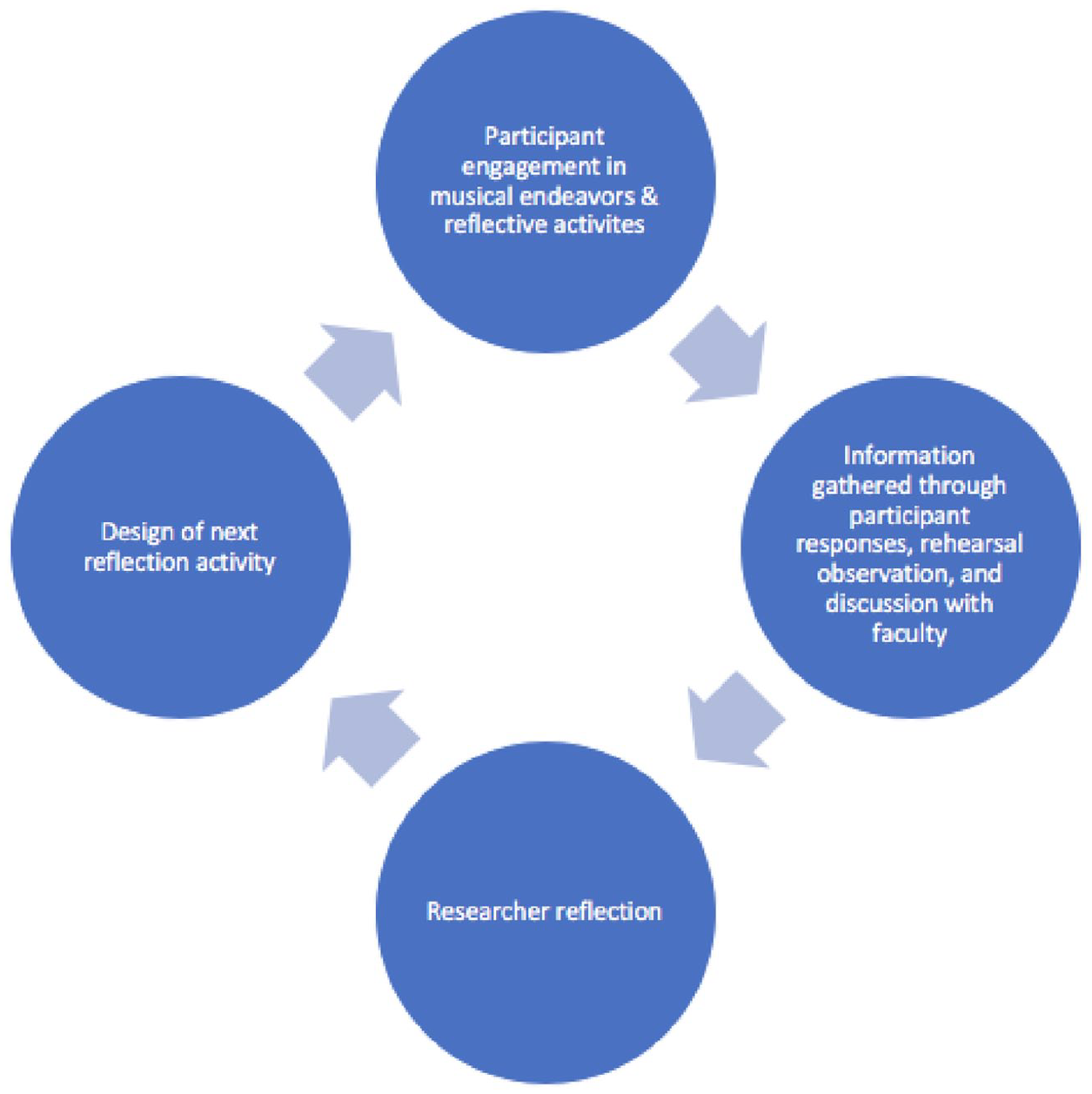
Reflective activities at AEDO.
Data collection and analysis
To achieve triangulation, multiple methods of data collection were employed including audio- and video-recorded reflection sessions, participant journal entries, individual interviews with participants and faculty, and field notes. Each of these methods of data collection were designed to be open-ended to ensure that the phenomenon was understood through the participants’ perspectives (Patton, 2015). As data were collected and transcribed by the researchers, Thematic Analysis (Patton, 2015) was ongoing to inform further data collection. This form of data analysis allowed for common themes and threads to be addressed across interviews and reflection sessions. Both semi-structured interviews and reflection sessions were informed by participants’ previous responses. As interviews and reflection sessions were transcribed, informal notes and ideas were added to the text before the process of formal coding occurred. To minimize the possibility of confirmation bias, we constantly communicated as researchers, noting all perspectives and ideas that arose from the transcriptions, and attempted to challenge any pre-existing assumptions and hypotheses that we held in relation to the data.
Following data collection, we used open, descriptive coding from which overarching themes emerged (Saldaña, 2009). We then engaged in pattern coding (Saldaña, 2009), which allowed us to look for relationships in the data. Core codes and categories were identified and the relationships between core codes and others emerged. Once we reached a point of saturation where no new overarching themes or patterns emerged in the data, all three researchers agreed that the themes were representative of the transcripts. We then moved forward in integrating the themes to form elements of our data findings. In analyzing and comparing data, various questions arose and gaps in the categories appeared, allowing us to address specific questions.
Findings
This analysis draws from participant interviews, researcher journals, and reflection session transcripts to explore emergent themes related to researcher and participant engagement in and with the reflective activities utilized in this study. In what follows, we discuss three themes that emerged from the data: (1) The complexities of building a new community, (2) Synergy between intrapersonal and interpersonal engagement, and (3) Reflecting and learning together.
The complexities of building a new community
During the first week of AEDO, our aim was to begin building a community of reflection together. We acknowledged that participants would likely be feeling a sense of uncertainty, having entered a new musical, cultural, and physical environment. Recognizing that we needed to begin to cultivate a community of trust, we encouraged the participants to share together, offering a space for them to explore their trepidations and feelings thus far. In the process, several main topics emerged, most of which were related to concerns about personal preparation and navigating a new musical environment:
I think the gala [performance] is something I’m a little bit worried about and something I wish I’d had more time and even given myself more time to prepare for those scenes, and I think, I wonder, if most people are feeling similarly?
[. . ..]
Well, it’s definitely right up there with a lot of the stuff that professionals have to do on a daily basis. . .[but] if this is our very first program or interaction with a full opera or a full character that you’re having to develop, it’s a lot to have to [manage].
Although some participants noted that they carefully tried to manage their time, others arrived seemingly unsure of the level of expected personal pre-program preparation. AEDO participants all have previous formal education in performance, yet it appeared that many found it difficult to make connections across various settings, applying the skills they learned in university settings to this experiential context. In particular, the ability to learn and process quickly, as well as the depth of personal preparation needed for such a context emerged as areas to be addressed. The artistic faculty agreed, noting that participants were often unsure of how to implement their musical training in such an intensive context. In responding to some of these needs, faculty members expressed their openness to help, offering individual time to participants when needed for extra preparation and sharing their own experiences of preparing to work on the professional stage.
Reflecting on some student-generated concerns, participants were encouraged to explore how they might reframe their frustrations in order to manage their time and prepare for the weeks to come. As the conversations progressed, it became clear that the issue of preparation was made more complex by participants’ lack of confidence in their own musical abilities:
It’s a mental game. We have to just be able to block things out, block those voices out that tell us that we’re not good enough to do these scenes because those were given to us. People listened to us in our recordings and our auditions and they, you know, they had an idea that maybe this person could pull this off in a little bit of time. [. . .]
I think also this is such a great way for us to bond. Like, we’re all stressed about this and we all can hold each other accountable for learning things. . . but we can all help each other. . .get together and speak through things.
Near the end of the project, several participants recalled the comments made here by Michael and Richie, as well as others, as crucial for setting the tone for the community of practice that was cultivated in this space:
To hear everybody else at that first session be like “I’m really nervous about the gala,” I was like, it’s not just me, you know this is great, because instead of being terrified, we can work through this together and you know, it’ll be a more positive experience. . .my [castmates] were so supportive and I’ve never had that before. . .we were able to learn from each other.
Future dialogue and reflection sessions often built upon the foundation developed in this first interaction. Building trust and openness while also addressing the realities that participants were facing in their musical rehearsals and interactions was key in developing a new community.
Synergy between intrapersonal and interpersonal engagement
As the reflection sessions continued and the program progressed, many participants displayed an increased awareness and critical understanding of their sense of self. This awareness was evident both individually and communally, as participants reflected upon how their decisions could impact both their own personal practice as well as the greater musical community of AEDO. Reflection sessions often served as an opportunity for participants to consider how they might grapple with current and future challenges related to being a working musician. These challenges included living and working in an unfamiliar cultural context, quickly developing quality and productive rapport with castmates, taking care of one’s own physical, mental, and emotional self, and finding ways to learn and practice without the resources offered by a postsecondary institution.
Some participants began to consider how the emotions and dispositions they displayed in navigating these challenges impacted other members of the community. For example, following a reflective activity in which participants engaged with a challenge through improvisatory acting, they noted:
I think. . .since it’s such a small group, that one or two people’s energy can really affect the rest of the group. So. . .we all need to keep that in mind that you can bring that negativity into the room and a lot of the people can be affected by it, and vice versa with positivity.
And I think depending upon how you’re feeling, what you need to know for the next day, how tired you are, you need to do what’s right for you in that moment. So maybe just to be more mindful of balance and keep yourself accountable for what you have to do, rather than being overly agitated or feeling negative about something that you’ve done that hasn’t been 100% versus having the motivation to fix it.
I think it’s also looking forward one step beyond tomorrow and saying “ok, I know [the music for] today and tomorrow, so I’m going to go out tonight.” And then there’s “ok I need to spend two nights studying.” There’s always just a little bit more thinking ahead and not just exactly in the moment.
Here, critical understanding of self is being amplified in order to consider how one’s choices and dispositions impact others. For Elena, the recognition that her own energy can impact everyone’s rehearsal experience appeared to be an important shift. Many participants agreed with Elena’s thinking. Similar moments occurred in reverse as well, with participants examining how their own performance and dispositions were impacted by the personal and professional choices made by their colleagues. Opportunities for one-on-one reflections or personal photo journaling often helped participants unravel these ideas.
Several participants explained in more detail how these increased opportunities for intrapersonal engagement contributed to changes in their personal practice. Some participants appeared to approach interactions with colleagues with more awareness:
[. . .]My, like, bad attitude was reflecting on others . . .[Eventually] I was like okay, it’s go time. . .But it really took, it did take some self-reflection for me to realize what I was doing to myself and to others and I didn’t want to do that to anyone else.
Responding to the broker about the applicability of reflective activities, Elena noted that this particular moment of intrapersonal awareness regarding her attitude affected how she approached the rest of her time at AEDO.
Other participants gained an increased awareness of how much emphasis they were placing on comparison with other participants. Through reflection, these participants recognized an increased sense of self and personal understanding.
[. . .]So [I] feel limited in terms of quality of sound because I know my legato is not so perfect and I don’t have the vibrato I want, and also in terms of fatigue and endurance. . .So I had to struggle with this at the beginning. . .and I think what I did is just to care less, to be, like, okay. . . I learned through a couple of days to come at myself and be more gentle with myself and forgive more.
In both cases, participants came to think differently about their relationships with others, making changes to how they interacted with their colleagues. However, for Elena, reflection led to greater awareness of her impact on her colleagues, whereas, for Nicolette, reflection created space for her to focus on her own personal goals and growth. These findings suggest that participants’ engagement in regular reflective exercises may have contributed to their increased sense of self-awareness, thus leading to changes throughout their completion of the program.
Reflecting and learning together
During interviews and reflection sessions, participants often referred to the value that they found in the AEDO community when reflecting and learning together. Learning alongside others is an integral element of collaborative music-making, foundational to the development of a community of practice, and was also a focus in the design of reflective interactions among participants. In speaking and planning with the faculty it became clear that reflection sessions could help support the sense of community and collaboration that is often at the heart of an ensemble production. Several of the reflection activities described above, as well as peer interviewing and group discussion, were implemented with this idea in mind.
In their individual interviews, participants often brought up the collegiality element of reflection sessions, noting that opportunities that invited them to explore, problematize, and navigate challenges together were particularly impactful for their own growth:
I feel like since being here in this environment, it really is collaborative, like I care about how other people are doing and how we’re working together and kind of just like being open minded to have different ideas for each other and make art.
Participants like Richie, however, struggled with the communal nature of reflection, noting that it was initially challenging to share his thoughts and ideas:
I think I’m reflective naturally, but it’s not natural for me to share it. So, I didn’t do the first post. I had lots of things [to contribute], but it felt very weird for me to post them.
Over time, Richie came to value the experience of reflecting with others:
And then I saw other peoples’ and I was like “ok, it’s not weird to put this out there”. . .and I felt like [Peter] gave a very honest reflection and I found that very nice to hear from someone. . .and it made me realize what I’m going through [as well].
Several participants specifically credited the first reflection session where they were encouraged to openly explore, reflect upon, and reframe their frustrations and concerns with their colleagues as essential in creating opportunities for vulnerabilities to be shared and for these interpersonal relationships to develop:
I think [the first reflection session] set up everything to be honest and it set up people being able to talk about what they’re feeling to each other. . .like, we’re all human, we’re all having similar issues, and let’s just, you know, do it together. And I would definitely credit that to the first [reflection] session.
At the conclusion of the program, many participants articulated how they were able to see their colleagues in a different light, as complex human beings to engage and relate with both within and beyond this community:
But I think. . .what I’ll take from [the AEDO program] is just the importance of genuinely supporting people around you. . .and really thinking of them as individuals, as actual humans. Not just somebody who is either good at playing music or good at singing or not good at singing, talented or not talented. Because I think that starts to be the only thing you see when you’re in music. You see them as a musician only.
Most notable for us in these reflections is the sense of care and relationship that seemed to develop among participants. These were not communal activities that were removed from the realities of their everyday experiences. Rather, they were intimately connected to their daily experiences as performers. As they continued to reflect together, it is possible that this sense of care affected their ability to interpersonally engage in the context of their musical interactions, thus suggesting that these reflection sessions may have had a direct impact on the final performances in this immediate context, as well as their overall personal growth.
Discussion and conclusions
One of our goals in this study was to explore the unfolding of a model of reflective practice that was designed to be responsive to in-the-moment participant experiences, intertwined with musical engagement, and adaptive toward both individual and collective goals. We understood reflective practice not as something that follows an experience, but as something that is embedded within a series of experiences in an ever-evolving community of musical practice. Throughout our data collection, we found that, over time, participants became invested in and even began to crave this reflective process, noting the ways in which it impacted their current states of being, as well as their futures. We posit that there is potential for such a model to be adapted in various forms of experiential learning settings, aiming to aid students as they move between communities of musical practice in both university and professional contexts.
The reflection activities in this study were initially designed to be responsive and flexible to individual participants’ needs and challenges. It was therefore critical for us as researchers to be comfortable with letting the nature of the reflection sessions take shape over time. This meant that, while an initial outline was established, questions and activities were not predetermined. We worked alongside the AEDO faculty to develop activities that responded to the needs and complex experiences of the students as we came to know one another. This can be a challenging and time consuming process, but we suggest that our focus on flexibility and response to participants in the moment was paramount in helping them draw connections to their musical engagements throughout the program, as well as their overall experience in the AEDO learning context.
This sense of flexibility also led to an increased awareness of various gaps and concerns participants faced as they navigated between multiple communities of practice. Through reflective practices, participants often became more cognizant of issues related to professional expectations in the performance domain. In particular, we noted that participants often seemed frustrated with their own understandings of personal preparation and seemed to face difficulties transferring skills between learning contexts. This led us to wonder about their educative experiences prior to attending AEDO. How had different universities prepared participants for experiences such as these and, more importantly, for professional experiences beyond these spaces? Had students been encouraged to cultivate an on-going, deliberate personal practice of self-reflection (Reid et al., 2018) in which they drew connections between their experiences and examined their own paths of learning? What role did access and privilege play in participants’ ability to secure coachings, lessons, and rehearsal time prior to their participation at AEDO? How might the implementation of a responsive model, such as the one in this study, have impacted student engagement in this setting? We suggest that future studies examining these questions would be of benefit to music performance students, experiential learning programs, and university programs.
We also noticed the significance of both interpersonal and intrapersonal reflection on participants’ overall learning experiences at AEDO. Often, reflective practice in the performing arts is primarily focused on the individual experience, with participants examining their own professional practice through the completion of post-performance reflective journals or video screenings (Esslin-Peard et al., 2016; Nicol & Macfarlane-Dick, 2006). The use of reflective activities that were interpersonal in nature appeared to expand upon these introspective practices, creating opportunities for participants to engage as a community. Although some participants did not always feel comfortable at first in sharing during the reflections, many later cited the importance of these spaces as opportunities to cultivate care and trust, which, for many, then transferred to their experiences on the stage. Participants highlighted the importance of knowing that others were struggling with similar challenges, vulnerabilities, and insecurities, recognizing the importance of having a space where they could think through these issues together with a facilitator or broker. Reflection sessions appeared to encourage students to consider their multiple social and culturally defined identities (Reid et al., 2018) as well as their own development and growth in the AEDO community. We wonder if these same opportunities for both intra- and interpersonal reflection might be beneficial in university-based settings as well and believe that future studies might consider the role of such models in these contexts.
Finally, our study included several limitations that should be considered. While we suggest that the implementation of reflective practices is integral within experiential learning summer programs, we understand that the ongoing development of a flexible, responsive reflective model is difficult to embed and we do not expect this model to be identically replicated. Faculty within an experiential learning program and university educators do not necessarily have the time or resources in terms of a broker to help develop and implement such a model which also responds to individual participants’ suggestions and needs. However, we believe that the information gleaned from this study may help pedagogues in both music education and performance explore a variety of possible reflective pathways both within and outside of experiential learning environments.
There are inevitable challenges that arise when one seeks to navigate amongst multiple communities of practice, particularly when moving between university and professional contexts. In the performing arts, scholars suggest that engaging in experiential practices and opportunities can ease this transition and support and guidance can be offered as students grapple with how to make meaning in these contexts (Bennett et al., 2017). In this study, we sought to explore how students engaged in and conceptualized guided, responsive reflective practice while participating in a performing arts-based experiential learning environment. Based on our findings, we suggest that reflection is an integral element in such an environment and, when implemented in a manner that is responsive to and deeply connected with performance practice, can facilitate pedagogical practices that help students better understand their own learning both in the immediate present and in their multiple, possible futures. Further, by encouraging opportunities to engage both intra- and interpersonally, such practices may also support students’ on-going awareness of both personal understanding and interpersonal relationships in the professional world.
Supplemental Material
sj-docx-1-ijm-10.1177_02557614211043224 – Supplemental material for The complexities of meaningful experiential learning: Exploring reflective practice in music performance studies
Supplemental material, sj-docx-1-ijm-10.1177_02557614211043224 for The complexities of meaningful experiential learning: Exploring reflective practice in music performance studies by Laura Benjamins, Sophie Louise Roland and Kelly Bylica in International Journal of Music Education
Supplemental Material
sj-docx-2-ijm-10.1177_02557614211043224 – Supplemental material for The complexities of meaningful experiential learning: Exploring reflective practice in music performance studies
Supplemental material, sj-docx-2-ijm-10.1177_02557614211043224 for The complexities of meaningful experiential learning: Exploring reflective practice in music performance studies by Laura Benjamins, Sophie Louise Roland and Kelly Bylica in International Journal of Music Education
Supplemental Material
sj-docx-3-ijm-10.1177_02557614211043224 – Supplemental material for The complexities of meaningful experiential learning: Exploring reflective practice in music performance studies
Supplemental material, sj-docx-3-ijm-10.1177_02557614211043224 for The complexities of meaningful experiential learning: Exploring reflective practice in music performance studies by Laura Benjamins, Sophie Louise Roland and Kelly Bylica in International Journal of Music Education
Supplemental Material
sj-docx-4-ijm-10.1177_02557614211043224 – Supplemental material for The complexities of meaningful experiential learning: Exploring reflective practice in music performance studies
Supplemental material, sj-docx-4-ijm-10.1177_02557614211043224 for The complexities of meaningful experiential learning: Exploring reflective practice in music performance studies by Laura Benjamins, Sophie Louise Roland and Kelly Bylica in International Journal of Music Education
Footnotes
Declaration of conflicting interests
We have no known conflicts of interest to disclose.
Funding
The author(s) disclosed receipt of the following financial support for the research, authorship, and/or publication of this article:This study was funded in part by the Western University Teaching Fellows Program.

References
Supplementary Material
Please find the following supplemental material available below.
For Open Access articles published under a Creative Commons License, all supplemental material carries the same license as the article it is associated with.
For non-Open Access articles published, all supplemental material carries a non-exclusive license, and permission requests for re-use of supplemental material or any part of supplemental material shall be sent directly to the copyright owner as specified in the copyright notice associated with the article.
