




Abstract
This scoping review paper explores skills gaps for graduates in creative industries as identified and discussed in global industrial and education contexts. Adopting the Preferred Reporting Items for Systematic Reviews and Meta-Analyses extension for scoping reviews (PRISMA-ScR) system, our review presents findings from 63 texts published from 2007 to 2023 that were located via five databases. These findings suggest that the top-ranked hard skills gaps for graduates are digital or related skills, such as those related to marketing and data analysis. The top-ranked soft skills are communication and collaboration, both of which are cited more frequently than any hard skill gap and appear key for graduate employability. Factors identified as contributing to these skills gaps include higher education offerings, industry needs and cultural policy. These contributing factors are correlated to the rise of creative industries, shifting values in cultural sectors, change in governments in western influenced cultures and digital transformation.
Introduction
In the 21st century, creative industries have experienced significant change and growth due to technological advancements, globalisation and changing consumer demands. Their rise as an increasingly important element of contemporary economies is related to that of the cultural industries as well as to the growth of the services sector (Flew, 2022). The spread of the Internet and other digital technologies over recent decades has enabled new platforms for content creation, distribution and consumption (Mangematin et al., 2014), while the integration of data and analytics has provided new business tools for creative enterprise. The opening up of global markets has created opportunities for collaboration and cultural exchange across borders, leading to debates on ethical trade (De Neve et al., 2008). Ongoing developments in these areas have generated the need for expanded skill sets for practitioners and professionals across creative industry sectors. In response, universities and other training organisations have responded by adapting their curricula to align with these evolving needs.
In mid 2022, the research team from the University of South Australia (UniSA) was commissioned by the South Australian Government Department of Innovation and Skills (DIS) to undertake a research project investigating skills gaps for creative graduates entering the advertising and design sector in South Australia. Multiple factors provided the impetus for this study, however, it was noted that the COVID-19 pandemic had impacted upon employers’ desired graduate skillsets, as well as teaching and internship opportunities at local Universities. Moreover, the Australian ‘Jobs Ready Graduates’ legislation introduced by a Liberal Government in 2020, had increased the cost of arts and humanities degrees and thus impacted on student enrolments in the creative arts. A further consequence of these factors was closures and/or reviews of creative programs at several Australian Universities (Del Favero, 2021).
To provide context to our study, the core research team conducted a scoping review of literature on skills gaps for graduates in creative arts sectors. The data collected and analysed in this review speaks to the creative industries more broadly, as identified and discussed in global industrial and academic contexts. In this article we use the term ‘skills’ to refer to ‘the level of performance of an individual on a particular task or the capability to perform a job well which can be divided into technical elements and behavioural elements’ (Noe et al., 2015). Our initial, informal investigation of the area recognised that, firstly, literature on skills gaps in the specific area of advertising and design was scant, and secondly, that a wider review of literature from adjacent creative sectors would provide a comprehensive picture of skills deficits. The review seeks to isolate both hard and soft skills gaps. Following Patacsil and Tablatin, we define a ‘hard skill’ as a technical skill while a ‘soft skill’ includes an individual’s approaches and attitudes to work and covers areas such as collaboration and teamwork (2017). In the literature review to follow, we expand on these terms, noting debates that problematise the language of ‘skills’ and ‘employability’ as well as the creative industries more broadly. Following the literature review, we further outline our scoping review methodology, before presenting our findings.
Literature review
The creative arts encompass a broad range of expressive, communicative, and cultural human practices that are conducted using a variety of media. For Hartley and Cunningham, they are associated with ‘subsidised or sponsored “public” arts’ (2002: 20), while in an academic context they might be ‘linked to practice’ (Abreu and Grinevich, 2014: 452). In the context of Australian standard classifications of field of education, ‘Creative Arts’ is defined as encompassing the performing arts, visual arts and crafts, graphic and design studies, communication and media studies and ‘other’ creative arts (Australian Bureau of Statistics, 2001). These areas might be studied as part of a specialised ‘Creative Arts’ or ‘Creative Industries’ degree or within a broader communication, media or arts-focused programme at an Australian university.
The creative industries, as a concept, has featured in academic and policy literature since the 1990s (Potts et al., 2008, p. 20). For Hartley and Cunningham, the term ‘creative industries’ conceptually combines and transforms the creative arts with ‘cultural industries,’ offering new, productive ways to consider creativity (2002, p. 20). Like the term ‘cultural industries,’ ‘creative industries’ refers to ‘how cultural goods are produced and disseminated in modern economies and societies’ (Hesmondhalgh, 2008: 552); however, one must note the difference between the two notions. For Hesmondhalgh, they represent opposing modes of theoretical policy analysis. The concept of ‘cultural industries,’ he suggests, is tied to notions of a political economy and complex thinking about cultural production that considers issues of power and inequity (Hesmondhalgh, 2008: 554). On a related note, O’Connor defines the cultural industries as dealing ‘primarily in symbolic goods – goods whose primary economic value is derived from their cultural value’ (2000: 19). On the other hand, the term ‘creative industries,’ which is widely used in cultural policy and higher education spheres, can be associated with neoliberalism, as a sector of the economy that is key to future employment growth and export opportunities (Garnham, 2005).
Definitions of the creative industries, like that of the cultural industries, vary across territories and time frames based on public policy approaches and academic research. An initial approach taken by the UK’s Department of Culture, Media and Sport (DCMS) in a mapping document involved an extended definition of cultural industries to address creative inputs and intellectual property outputs. Featuring 13 different creative industry sectors from advertising (including client marketing activity) to TV and Radio, this document concerned ‘activities which have their origin in individual creativity, skill and talent, and which have the potential for wealth and job creation through generation and exploitation of intellectual property’ (DCMS, 1998). This approach that sees creative industries classified according to industrial sectors received some criticism for its inclusions and exclusions ( Galloway and Dunlop, 2007; Potts et al., 2008: 168). Notably, it included computer software within its scope, which boosted the perceived value of the creative industries to the economy. This inclusion of a broad range of industrial sectors under the banner of ‘creative industries’ raises questions as to the definition of a ‘creative worker,’ and their desirable skills and attributes, considering the breadth of areas that are involved. For example, a software developer will possess quite different skills to a film director or theatre performer. Yet individuals occupying these roles might all be considered ‘core’ or ‘specialist’ creative workers (Goldsmith and Bridgstock, 2018).
In Australia, significant research into the creative industries has been undertaken at the Queensland University of Technology, which collaborated with the Queensland State Government to develop a Creative Industries Precinct in inner Brisbane. Researchers from QUT propose a definition of ‘creative industries’ based on ‘markets characterized in both supply and demand as (complex) social networks’ (Potts et al., 2008:182). More recently, the South Australian Government DIS strategy describes the creative industries as ‘a broad ecosystem of sub-sectors linked by their ability to use design-thinking, or creativity, to develop and produce unique, innovative and highly sought-after intellectual property’ (DIS, 2020). We have taken these definitions into consideration when analysing data produced in our scoping review, noting evolutions in points of emphasis and the categorisation of sectors over time.
Many universities responded to shifts in policy at the turn of the century by introducing creative industries faculties and degree programs and one can note an increasing discourse of ‘skills development’ in the context of academia and educational policy at this time. For example, Hartley and Cunningham urged arts and humanities faculties to focus their efforts on training of students to enter creative industries, this involving ‘the analysis and creation of code and content in the new economy’ (2001:16). Their suggestion followed the Queensland Premier Peter Beattie’s $15 million investment in the development of a ‘Creative Industries Precinct’ in partnership with the Queensland University of Technology in 2000, as part of a ‘smart state’ strategy. Hartley and Cunningham’s line of thinking aligns with that of Muller et al., who suggest that creative industry innovation is drawn from ‘individual creativity, skill and talent, i.e. factors of production for which high-income countries have a comparative advantage’ (2009: 149).
The discourse of ‘skills development’ has given rise to debates about ‘skills shortages’ and ‘skills gaps’ in the creative industries. Definitions of the former term vary but one might refer to Richardson’s description of a ‘market disequilibrium between supply and demand in which the quantity of workers demanded exceeds the supply available and willing to work at a particular wage and working conditions at a particular place and point in time’ (2007: 11). In other words, a skills shortage can be defined as a lack of workers available to fill a role. The latter, which we investigate in this article, refers to ‘a situation where employers are hiring workers whom they consider under-skilled’ (Fitzgerald et al., 2013: 5). Bridgstock cites two UK national reviews that took place in the early 2000s as evidence of ‘continuing mismatches between the skills and abilities of creative industries graduates, and those required in the workforce’ (2011: 11). On a related note, Huddleston and Branch-Haddow observe that ‘policy directives over the past 30 years, at least, have seen employer engagement in education and training as the panacea to cure all the alleged ills of the system – skills shortages, poor quality vocational and educational training, and low levels of qualifications’ (2022: 8). This line of thinking opens debates at to the purpose of employer engagement within the education sector (Huddleston, 2020) and the role of higher education more broadly.
Before presenting our investigation of ‘hard’ and/or ‘soft’ skills gaps, we acknowledge that these terms that have been critiqued and contested in terms of their definitions and value as a means of categorisation (Hora et al., 2018). Commonly cited soft skills include ‘teamwork,’ ‘communication,’ and ‘problem solving,’ which may be differentiated from personal attributes such as ‘loyalty’ or ‘honesty,’ under the banner of ‘employability skills’ (Taylor, 2005). Sung suggests that thinking around the centrality of soft skills to employment opportunities emerged in the 1990s, and that these ‘employability skills’ have more recently been linked to the notion of ‘lifelong learning’ (2013: 179). For Hora et al.,‘soft skills’ have a tendency to be viewed as ‘generic, discrete, context-free, and universally applicable’, which is inadequate when considering discipline-specific and/or culturally determined practices and contexts (2018: 33). We remain mindful of these debates when discussing our scoping review data.
When deciding upon the start date for literature to be profiled in our review we considered our Australian context and choose the year 2007, this marking the election of a Labor government and consequent introduction of an education policy known as the ‘Education Revolution’. This comprehensive reform agenda aimed at improving the quality and accessibility of education across different levels, from early childhood education to higher education, and fostered significant consideration of the skills needed for a rapidly changing world. The research question that drives this scoping review is thus: What hard and soft skills gaps for graduates entering the creative industries have been highlighted in studies published since 2007?
Methodology
Scoping reviews involve a systematic approach to gathering information or evidence on a topic, which might identify main concepts and/or gaps in knowledge. The method applied for our scoping review was based on the Preferred Reporting Items for Systematic Reviews and Meta-Analyses extension for scoping reviews (PRISMA-ScR) system developed by Tricco et al., in 2018 (see Figure 1 below). This considered method, which was developed in the context of the health sciences, presents a protocol to improve scoping review reporting and methodological conduct (Khalil et al., 2021). It begins with the identification of the scope of the research area and a search for texts across selected databases. Additional texts from outside of these databases may also be identified and added at this stage. Search results are then screened for duplicates and all texts are reviewed for eligibility with reference to the research question. Those falling outside the scope of the review are excluded. The remaining texts are then reviewed as full-texts and grouped into subsets based on theme. The scoping review process based on the PRISMA-ScR method (Tricco et al., 2018).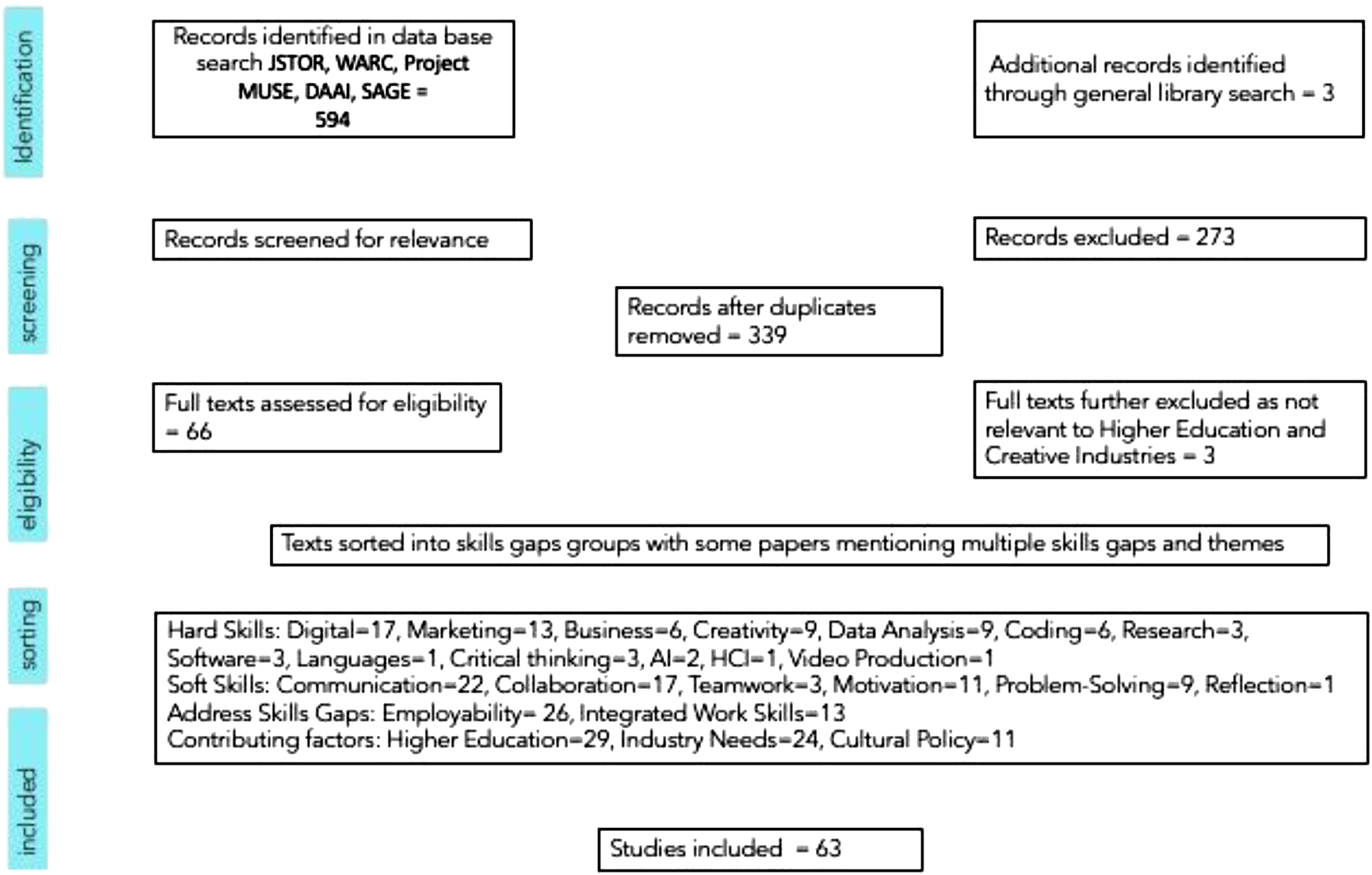
Search Terms and Initial Results.
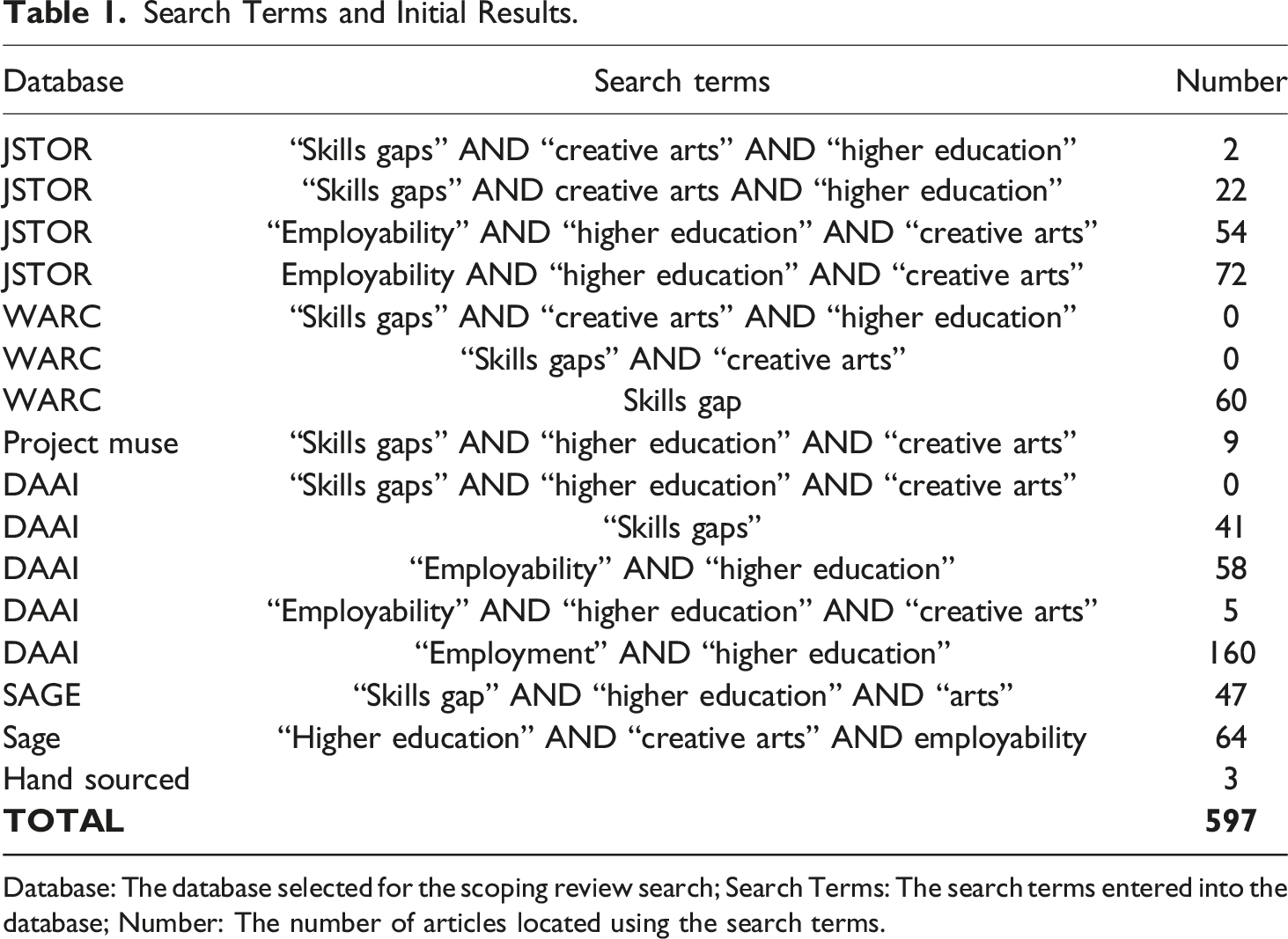
Database: The database selected for the scoping review search; Search Terms: The search terms entered into the database; Number: The number of articles located using the search terms.
All of these texts were logged with the software referencing tool, Endnote, and screened for duplicates, resulting in 339 texts (journal articles; books; book sections; conference proceedings; theses; grey literature) remaining. All 339 texts were checked for relevance. Relevance was defined by mention of graduate’s skills gaps in creative industries, (the latter being defined against the original DCMS mapping document). At this stage, 273 items were excluded as not relevant when reviewed, leaving 66 texts. The remaining texts were exported into Covidence (software for assisting with systematic reviews) and assessed in a full-text review. At this stage a further three articles that were deemed to be situated outside the scope of the study were omitted as they didn’t address creative industry aligned subjects with reference to Higher Education. At final count this scoping review has thus identified 63 texts that mention skills gaps for graduates entering the creative industries. These texts were sorted into groups according to categories of identified skills gaps or associated themes across hard and soft skills.
Findings
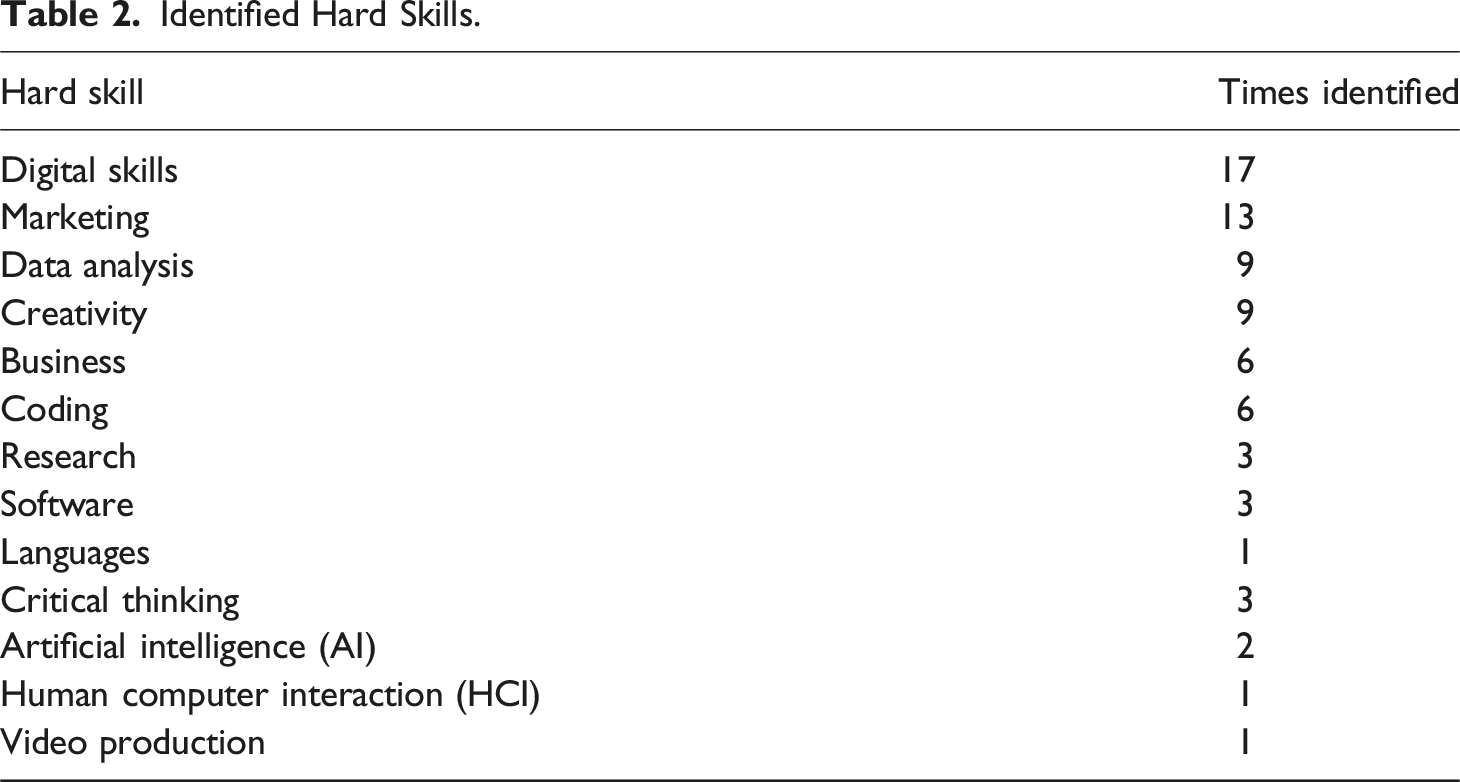
Identified Hard Skills.
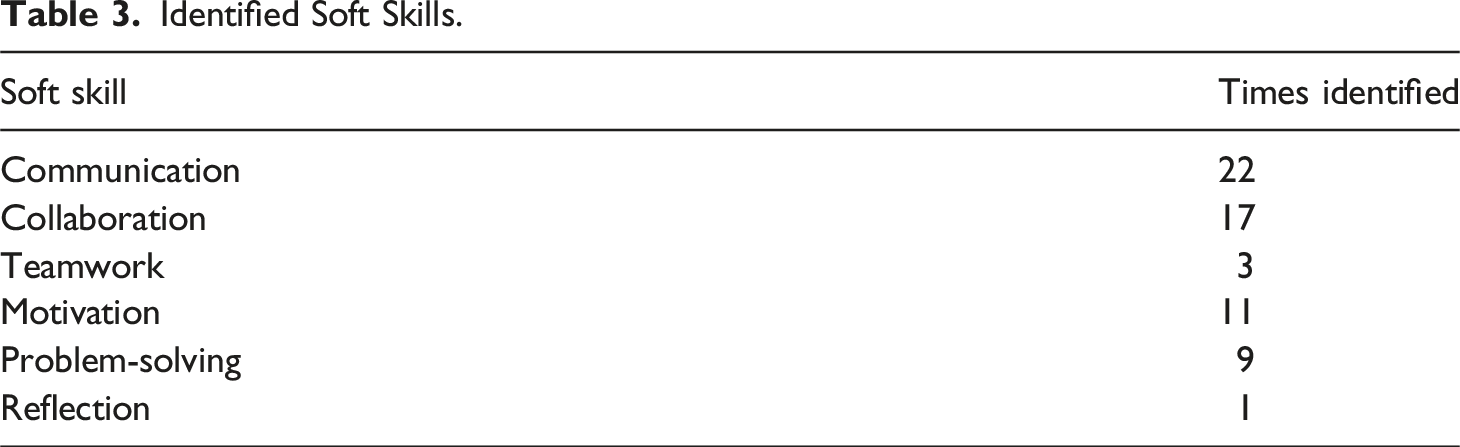
Identified Soft Skills.
The 63 texts were representative of a number of territories: Australia, UK, US, Canada, Amsterdam, China, South Africa, Nigeria, India, Sri Lanka, Bangladesh, Taiwan and Malaysia. Creative industries disciplines that are featured in the review varied across papers, consisting of: Arts Management, Design, Fashion, Film, Game Design, Graphic Design, Industrial Design, Information Technology, Marketing, Media, Performance, XR, Visual Art and the general creative arts.
Hard skills
As mentioned above, hard skills are defined as those classed as technical skills, which can be learnt within course work in a higher education institution. These can be acquired directly through assessed course work within a tertiary environment and are not identified as personal attributes or those learnt through work experience and/or work-integrated skills building.
The most cited hard skills were recognised as ‘digital skills’, which were sometimes described generically (Zeleza and Okanda, 2021) but in other cases, included references to specific software (Keith and Collins, 2022). There was some crossover in this category with texts specifically citing ‘marketing’ and ‘data analysis’ skills, but the foci of these 17 texts also included digital literacy in education and case studies in the development of e-portfolios. Those creative industries that identified a lack of digital skills in their industries were most heavily in the marketing area but also included media (XR), design and fashion. Although the 17 texts citing digital skills gaps date from 2013 to 2022, it is notable that nine of them were published in or after 2020. These texts recognised digital transformation as the key driver of skills gaps in higher education and industry training. Other hard skills mentioned were more specifically linked to discipline defined industry needs and include coding, research, software, languages, critical thinking, AI, HCI and video production.
The lack of digital skills as applied to marketing was a major theme across the US, UK and Australia, with the WARC database returning a result focussed on the digital skills gap in data analysis for marketing (Feldman, 2016). An additional nine texts that were retrieved from other databases also addressed this skills gap in graduates. One can note that advanced analytics and data management analytic skills were sort after by employees (Barometer Report, 2020; Nunan, 2015; Schlee and Karns, 2017; Vriens et al., 2019). Other texts recognise that marketing skills are changing with the advancement of machine learning and AI (Hosford, 2018) and that 3-year degrees were struggling to keep up with rapid change (Anonymous, 2014). There is also a recognised gap in understanding between skills development in a tertiary environment and real-world application (McArthur et al., 2017; Smith and Van Hamersveld, 2007). Given the broad scope of marketing as an industrial sector we note the relevance of these findings for graduates of Business as well as Creative degrees.
Digital literacy in marketing and data analysis included software familiarisation with the intention to be skilled at an industry standard for entry level jobs as reflected in advertisements for media jobs in Australia (Keith and Collins, 2022). It was also noted that in Australia, skills gaps were a result of the “lack of a sector-wide professional accrediting body and resulting variation in graduate skills: the incursion of specific proprietary technologies into higher education curricula: and the changes to the media environment wrought in recent years” (Keith and Collins, 2022:121). Such gaps in digital skills acquisition and talent are also recognised in the fashion sector in the UK (Georghegan, 2016). On a related note, scholars in an African context suggest that digital skills gaps could be counterplayed by higher education institutions developing “meaningful partnerships with external constituencies and stakeholders including digital technology and telecommunication companies” (Zeleza and Okanda, 2021). Support for e-portfolios generated as education tools and utilised as employment tools is also suggested as a global solution (Kelly and Le Rossignol, 2022; McDermott-Dalton, 2022).
Hard skills mentioned with less frequency include Business Skills (6) and Creativity (9). In an Australian context, the business skills mentioned by Bridgestock and Cunningham are connected to understanding the markets within creative industries (2016). Meanwhile, business experience, to develop business skills, is mentioned by US marketing experts (Vriens et al., 2019). Creativity was identified as a wide-reaching skill that should be taught in a higher education context. This was identified by Australians McWilliam and Dawson (2008) and mentioned in several other papers in the context of employability in discipline specific contexts in media, film and TV, design and marketing as well as in a general creative arts context, in Australia, Ireland the UK and the US (Doloswala et al., 2013; Dziobczenski and Person, 2017; McDermott-Dalton, 2022; Vriens et al., 2019; Walmsley, 2013). The varied dates of these texts (from 2008 to 2022) demonstrate a regular foregrounding of creativity over time in the texts that were reviewed. Coding and software skills required by media, marketing, design and XR technology companies, were also mentioned in relation to job requirements (McArthur et al., 2017; Schlee and Karns, 2017).
Soft skills
The soft skills gaps that were identified in this scoping review were sometimes referred to as gaps in education experience or, in other words, as pertaining to skills that were difficult to acquire through course work. A common school of thought was that graduates’ soft skills are often developed through on the job training and work experience. As mentioned above, the review found that communication, collaboration, motivation, and problem solving were the most commonly identified skills gaps and moreover that these are key skills related to employability. Notably, communication (22) and collaboration (17) skills gaps were cited more often than the top-ranking hard skills gaps.
Communication skills gaps were identified in two articles found through a search for “skills gap” in the DAAI database and two articles were found in a search for “skills gap” AND “higher education” “arts” in the Sage data base. Communicating ideas confidently was identified as a missing skill by US based writer Julia Sagar (2018). Written communication skills were identified by Sherman et al. (2022) and general people skills were identified as a gap for graduates in Brazil and China (Goulart et al., 2022; Hora and Blackburn Cohen, 2018). Communication skills in marketing were mentioned in articles in combination with other work integrated skills (McArthur et al., 2017; Smith and Van Hamersveld, 2007). Communication skills gaps were cited somewhat consistently over time in articles dating from 2007 to 2015 (6), from 2016 to 2019 (7), and from 2020 to 2023 (9), although one can note increased volume within the last 5 years.
Collaboration skills gaps were mentioned in texts sourced across several databases. Searches in the JSTOR database for “Employability” AND “higher education” AND “creative arts” found one article while two articles were found in the DAAI data base searched as “skills gap”. A further one article was found in the Sage data base searched as “higher education” AND “creative arts” AND employability. On collaboration skills gaps we note texts that explore models for work-place training, such as a studio-based learning environment, as promoted by educators in Malaysia (Kumar et al., 2021). The scholars of this article, ‘Implementing studio-based learning for design education: A study on the perception and challenges of Malaysian undergraduates’, felt that the outcome of this program was that students became, “more independent towards their learning outcome” (2021). The authors also observed improvement in students’ communication skills through collaborative learning (2021). Collaboration is also mentioned in regard to multi-disciplinary teamwork built into learning methodologies in Spain (Blanco et al., 2017) and double degrees in Australia, which provide the potential for transdisciplinary education (Russell et al., 2008). Empathy and emotional intelligence is mentioned in several papers related to collaboration and teamwork (Blanco et al., 2017; Edmondson et al., 2020; Kumar et al., 2021; Russell et al., 2008).
On the subject of addressing skills gaps in communication and collaboration, there were four papers focused on work integrated skills (Butcher and Schaber 2013; Chad 2020; Phillipov, 2022; Ryan, 2020) that also mention soft skills gaps in creative industries education courses. These papers representing creative industries disciplines across fashion, design and marketing in the UK and Australia demonstrate the benefit of learning skills in the field. Also addressing work integrated skills and crossing over into the category of ‘Digital Skills Gaps’, was a paper titled ‘An examination of skill requirements for augmented reality and virtual reality job advertisements’, which discusses identified skills gaps across time management, attention to detail, independence and basic communication skills at some length (Verma et al., 2023).
Related to communication and collaboration, but mentioned separately are problem solving skills, as featured in nine papers. Problem solving skills are mentioned in texts from the DAAI database under the search for “employability” AND “higher education” or “skills gap.” This category elucidated the need for better collaborative relationships between industry and educational bodies in digital media design in Australia (Doloswala et al., 2013) and the need for better staff-student collaborative relationships in design education in the UK (Gale, 2015). The idea of activating problem-based learning as a type of action research strategy that puts learners at the centre of their arts management education (Chung et al., 2016) positions problem solving as a key skills gap in a paper from Taiwan. Most papers across a variety of creative areas listed problem solving as a skills gap alongside communication and collaboration (Chung et al., 2016; Doloswala et al., 2013; Dziobczenski and Person, 2017; Kumar et al., 2021; McDermott-Dalton, 2022; Pillai et al., 2019; Rios et al., 2020; Ryan, 2020; Verma et al., 2023). Within this selection, motivation was identified in marketing and media papers from Australia, US, UK and India, as well as in papers focussing on games from the UK (Ashton, 2010), fashion from Australia (Bridgstock and Cunningham, 2016), design from the UK (Butcher and Schaber, 2013) and media from Bangladesh (Chowdhury and Miah, 2019). This term can be related to self-control that results in the direction of attention or organisation of actions to interact with the environment (McCombs, 1984). Motivation was observed to be lacking in graduates who did not have the opportunity to undertake programs that fostered work integrated skills.
Addressing skills gaps
The two sub themes related to addressing skills gap that are discussed in several of the 63 papers are (1) work integrated skills and (2) employability. Work integrated skills were mentioned in 13 articles from our search. These skills were attained through internships instigated by higher education institutions. In one Australian paper, the motivation for these programs is increased employment possibilities for graduates (Jackson and Collings, 2018). Articles covered design, fashion, performing arts and film and television from Australia and the UK. Soft skills gaps were mentioned by most papers in connection with work integrated skills that were learnt on the job. Several articles suggested that the benefit of the workplace training programs was to develop skills such and communication and collaboration, that were not necessary taught in education environments but picked up through teamwork and relationship building with clients (Butcher and Schaber, 2013; Chad, 2020; Phillipov, 2022; Ryan, 2020). One text stressed that people focussed skills are valued in the workplace and set the student up to be better self-managed in the future (Phillipov, 2022).
A paper by Burbidge (2015) emphasised the centrality of relationships and communication between educational institutions and industry. Writing in the context of a fashion and technology course in the UK, the author notes the dual benefits for university students and research staff when an internship goes well and feeds back knowledge into the education system (Burbidge, 2015). Across the 13 papers addressing work integrated skills, a number of models of work integrated training were mentioned, from part-time work, tiered student – industry relationships and internships. It was suggested that in Australia, tiered student/industry involvement in the performing arts could look like a “formalization of first-year observations of industry practice, that then leading into supervised internship-style experiences in second year, culminating in intensive and student-led capstone experiences in the final year,” (Daniel and Daniel, 2013). In contrast there is consideration of hierarchical relationships and rite of passage pathways, especially in film and television in the UK when there might be the, “need to prepare higher education students for the inevitability of starting as a runner and then working their way up the ladder” (Ashton, 2015). A further text suggests that part-time work may be a better motivator for students learning on the job as they attain work-place skills and are using them in a demonstrated capacity to earn money, thereby removing the gap between education and industry knowledge (Evans et al., 2015). All of these texts recognised the need for educational institutions to assist students to clearly express the skills they had gained to enable them to advance their employment opportunities.
The theme of employability (this being the outcome of reducing skills gaps in creative industries graduates) was mentioned in 26 of the 63 papers that receive analysis in this scoping review. Texts suggested that, overall, programs that introduced work integrated skills as mentioned above led to graduates being better prepared for employment. The work integrated skills that were most valued were discipline specific hard skills (such as data analysis or digital skills) and soft skills, such as communication in teams and with clients as well as collaboration, problem solving and motivation to drive their own career path. Many papers featured a discussion of how skills gaps are recognised by industry stakeholders seeking work ready graduates.
Factors contributing to skills gaps
Several factors were suggested in the scoping review texts as contributing to graduates’ skills gaps in creative industries. These include the availability of skills-specific teaching and learning in higher education (29 papers), different nations’ cultural policy at any given time (11 papers) and industry needs (24 papers). Whilst these factors were discussed in relation to specific fields, places and times, there were similarities across creative industries, borders and time periods since the start date of the scoping review (2007).
In higher education, the availability of specific courses and types of education were mentioned across 29 papers. The nine papers written on Australian, US, and UK higher education focussed on a variety of models connecting education with industry needs. The papers addressed the hard and soft skills gaps mentioned above and provided recommendations towards work-place training, internships and industry experience. Cultural policy in Australia was highlighted in a paper published in 2012, marking a time when the value of arts education was defined as less important than skills gained in creative industries (Cunningham and Bridgstock, 2012). Contrary to popular views, in this article Cunningham and Bridgstock suggest the value of general critical skills are transferable across creative industries more than discipline specific skills. Similarly, in Nigeria, there is a call for more generic skills to be taught in higher education, so that students have transferable knowledge and remain adaptable to change (Okolie et al., 2020).
Articles citing cultural policy sometimes did so in relation to graduates’ employment opportunities. One text emphasised a lack of employment opportunities for creative arts graduates in Sri Lanka (Mncayi and Dunga, 2016) and called for a review of cultural policy to support employment in the arts. The gap between graduate skills and employment opportunities is also noted in a second Sri Lankan study which suggested that ‘there is a need for significant structural reforms on both the supply side and the demand side to make graduates more employable and employed’ (Dayaratna-Banda and Dharmadasa, 2022). On a related note, writers in Spain stressed a need for more technical skills to be taught at university in the context of industrial design (Alonso-García et al., 2021) and also recognised that creative design processes have value outside the arts (Blanco et al., 2017).
Discussion and conclusion
This scoping review isolates a variety of skills gaps for graduates of creative industries courses. Some of these gaps result from changing industry needs, while others relate to more broadly desired soft skills. We have not identified any particular geographic patterns but rather, observe common themes across territories. In times where digital transformation across platforms enabling creative processes, content building and analysis defines creative industries, hard skills related to digital expertise and marketing knowledge present unsurprisingly highly ranked gaps. Other less cited skills gaps in artificial intelligence (AI) or Human Computer Interaction (HCI) areas are paralleled by the emergence of immersive technologies and an increased awareness of user experience (UX) design. The identification of hard skills gaps such as these reflect changes in consumer behaviour, UX and innovations in the global economy that are aligned with the rise of the creative industries. The ability to know how to gain such skills is more important than gaining specific skills through a HE course (Huddleston, 2020). The ‘know how’ combined with creative abilities will help young people to lead a fuller life and contribute to their communities.
While these technical skills might be approached as part of course curriculum in a straightforward way, the sought after skill of creativity is perhaps more challenging to address. Based on a UK study, McWilliam and Dawson suggest that educators agree with the premise that creativity can be taught but hold differing definitions of what the term refers to (2008). Similarly, in an Australian university context, they note a commitment to creativity in course learning outcomes but an absence of definitional clarity in policy documentation.
While technical expertise and knowledge remains crucial, one can observe a foregrounding of soft skills in the texts that were surveyed. The most often cited skills gaps relate to the communication and collaboration, which might be viewed as generic skills that are not particularly aligned with the creative industries. We would argue, however, that within the context of creative sectors, these soft skills do involve specific disciplinary cultures and practices, as noted in existing literature (see e.g., Cohen, (2010) on theatre making or Dooley and Sexton-Finck, (2017) on screen production). The articles surveyed in the review suggest that gaps between educational experience and industry needs are best managed through courses and programs that involve internships or work integrated training, so that these soft skills might be developed in job-like environments. The development of graduates’ soft skills could therefore be seen to be the responsibility of both educational institutions and industry bodies, as suggested by Jackson and Collings, (2018). These writers suggest that higher education providers should work in collaboration with industry to develop graduates who can identify suitable career opportunities and then successfully apply their skills and knowledge to these opportunities. Overall, the review suggests that graduates’ soft skills gaps (more so than hard skills gaps) are a key factor affecting employability. Questions remain as to how higher education providers might best work with industry partners to address these and develop a holistic training package for students.
This scoping review, while covering a broad array of creative areas, is limited to texts generated by the five chosen databases. The inclusion of material from the industry focused WARC database has revealed significant skills gaps in marketing areas but perhaps skews overall results in favour of this creative industry. A further scoping review might seek out additional industry databases. We have noted that some of the marketing-focused texts hold relevance for graduates of Business degrees as well as Creative Industries. Further work is needed to drill into these results, noting the place of marketing within the creative economy, as well as creative industries. It is acknowledged that a study of skills gaps in the creative economy, will likely yield different results.
Moreover, while a scoping review of skills gaps from the year 2007 is pertinent for the context of our contemporary Australian study, a broader review might look at literature from the release date of the initial DCMS mapping document in the UK in 1998, so as to capture skills gaps identified from the genesis of the creative industries.
Footnotes
Declaration of conflicting interests
The authors declared no potential conflicts of interest with respect to the research, authorship, and/or publication of this article.
Funding
The author(s) disclosed receipt of the following financial support for the research, authorship, and/or publication of this article: Funding: This work was supported by the South Australian Government Department of Industry, Innovation and Skills.
Ethical Statement

Data availability statement
The data that supports this study is available from the University of South Australia, Adelaide, on request.