




Abstract
Globally, the issue of research impact has grown as governments articulate policies around research as a contributor to economic and societal development, often through an econometric justification. This has triggered much discussion amongst humanities scholars in public formally-reasoned peer-reviewed texts that are rarely empirically-based. This Denmark-based empirical study used an individual biographical and historical structural framework to explore how humanities academics in face-to-face semi-formal interactive interviews viewed this issue. The results highlighted a nuanced understanding of what we call the humanities-impact landscape, with three potential interactions falling along a continuum suggesting further inquiry is warranted. The study contributes a rich tapestry of the interwoven individual and structural elements at play when academics articulate how they locate themselves within the landscape, ones that might not be seen in more conceptual arguments.
Keywords
Context
National policies are calling universities and academics to account for the societal ‘impact’ of their research. While national regimes vary in the specifics, knowledge and research become potential sources of economic and political power, leading to negotiations between institutions, governments, corporate stakeholders, and the public sphere (Benneworth et al., 2016, in an analysis of Ireland, Netherlands, and Norway). This influences how particular universities and academics frame their research as well as how they are viewed by other societal actors. In these society-university-researcher negotiations, economics often predominate leading to quantifiable measures of university research (Belfiore, 2015, UK Research Excellence Framework). Of course, these notions of ‘impact’ are not neutral, rather aimed ultimately at creating a hierarchical ranking of different forms of knowledges and research approaches, whether intentional or otherwise (McCowan, 2018). In other words, the chosen measures become normative as to how ‘impact’ is perceived (Fecher et al., 2021; Pedersen and Hvidtfeldt, 2023).
These arguments often seem to rest on treating universities as separate worlds from society. Yet, this overlooks the embeddedness and thus connection of universities and those within them to particular societal spaces/communities and times in which there is constant interaction (Bulaitis, 2024; McAlpine and Amundsen, 2018). Thus, universities are rarely viewed as microcosms (McAlpine, 2021) of the societies in which they are rooted, with multiple constant interactions between the two, ranging from policy requirements through social practices to daily movements of individuals. 1 In other words, perceptions and practices around societal impact are bio-geo-historically enacted by individuals, given each comes with different experiences, values and intentions and is embedded in a specific university and country with specific impact regimes at particular times.
Beyond national and institutional regimes and practices, disciplinary cluster also plays a role in how impact is enacted and perceived. Generally, those in sciences, technologies, engineering, mathematics and medicine (STEMM) are viewed as more successful at meeting these economic demands for evidence (Bonaccorsi et al., 2021) – perhaps due to their often close connection to pressing societal issues, e.g., climate crisis, alongside highly empirical and limited theoretical stances. For instance, potential users are well defined in STEMM, e.g., companies, health care system. Further, the impact time scale on users while often long is well defined (many observable discrete often controlled events), such as industrial R&D cycles and time-to-market drug development.
The same cannot be said for social sciences and humanities (SSH 2 ) with the latter particularly challenged in meeting the economic indicators that normatively proxy research impact (Budtz Pedersen and Hvidtfeldt, 2023; McCowan, 2018; Muhonen et al., 2020). Notably, SSH users tend to be drawn from all societal actors; the time scale is uncertain, unpredictable and highly variable, and there may be many small unobservable steps, as well as socially diffused communication patterns (McCowan, 2018). Often, extended case studies, narratives, cyclical and multi-dynamic assessment, and mixed-methods approaches better suit (Bonaccorsi et al., 2021; Budtz Pedersen et al., 2020; Fecher et al., 2021). Thus, impact in SSH may effect change as a series of micro-impacts in a way that is fuzzy – making it difficult to assign attribution (Pedersen and Hvidtfeldt, 2023; Sigurðarson 2020).
Notably, discussions around impact in the humanities-impact landscape 3 are often argued around the notion of ‘crisis.’ Such a stance (Hazelkorn, 2015) can suggest potential defensiveness – a need to justify, rather than a more relaxed neutral articulation or rationale 4 (Bulaitis, 2024). Such ‘crisis’ arguments generally take place in academic or public formal spaces, for instance, peer-reviewed articles, and are rarely empirically-based or elicited in more interactive discussion. 5 Bulaitis (2024) has argued in the context of UK Research Evaluation Framework that neither adopting an economic approach nor refusing such a stance will serve humanities, so humanists must engage in the debate around valuation methods and assessment. What might be the outcome if other assessment measures were used – ones focused on assessing dialogue/engagement or commitment/responsibility (Bengtsen, 2022) – with emphasis, for instance, on frequency, diversity and specificity of user expressions (Bonaccorsi et al., 2021)? In the Nordic countries, national pressures for change are creating richer and more complex images of quality in humanities (Sorlin, 2018).
These issues led us to ask: How can we better understand the features of the humanities-impact landscape? So, we undertook this empirical study situating it in Denmark seeking responses to this question in private face-to-face semi-formal interactive interviews. By examining the interactions between shifting policies/regimes and their past-present biographical experiences, we aimed to generate a nuanced multi-faceted image (Morse, 2010) of the interwoven ways in which academics pictured humanities in relation to societal demands for impact.
Goal
We asked: How do established humanities academics 6 describe the humanities-impact landscape? How do they articulate the interaction between their own views and specific national policy impact regimes and institutional expectations?
Framing the study
We intended to explore the ways in which national regimes interacted with individuals’ perceptions of impact, taking a conceptual stance that did not over-privilege either individual
Denmark as a case
A perceived need by successive governments for universities to cater to the ‘global knowledge economy’ (Carney, 2007; Wright et al., 2019) has led to ‘reforms’ in Danish higher education and research policy. Notably, in 2003, government policies named a third mission for universities, framed as ‘contribut [ing] to promoting growth, prosperity and the development of society’ (Folketinget, 2019, §2.3). Notably, what counts as ‘surrounding society’ (‘omgivende samfund’ is the Danish phrase used) is very narrow – arguably not representative of what most individuals would imagine (Gibson and Bengtsen, under review). It refers to large companies in the private-sector, private research-funding foundations (e.g., The Velux Foundations, Carlsberg Foundation), non-research HE colleges, and other state organisations (i.e., the Ministry) – thus, excluding individuals/citizens; civil society; charities; cultural entities (e.g., music and art academies, theatres); media; public organisations (e.g., art, design, archaeology, history museums); libraries (both public and research); and even small and medium private enterprises (e.g. publishers, software-developers, consultancies). This definition privileges STEMM fields, ignoring contexts in which humanities (and social sciences) often shine. Given the difficulty of balancing private sector commercialisation and broader societal considerations (Gregersen et al., 2009), this contributes to the sense that humanities in Denmark are precariously positioned (Brøgger and Bengtsen, 2023).
Humanities Fields in Aalborg, Aarhus, Copenhagen, Roskilde and Southern Denmark.
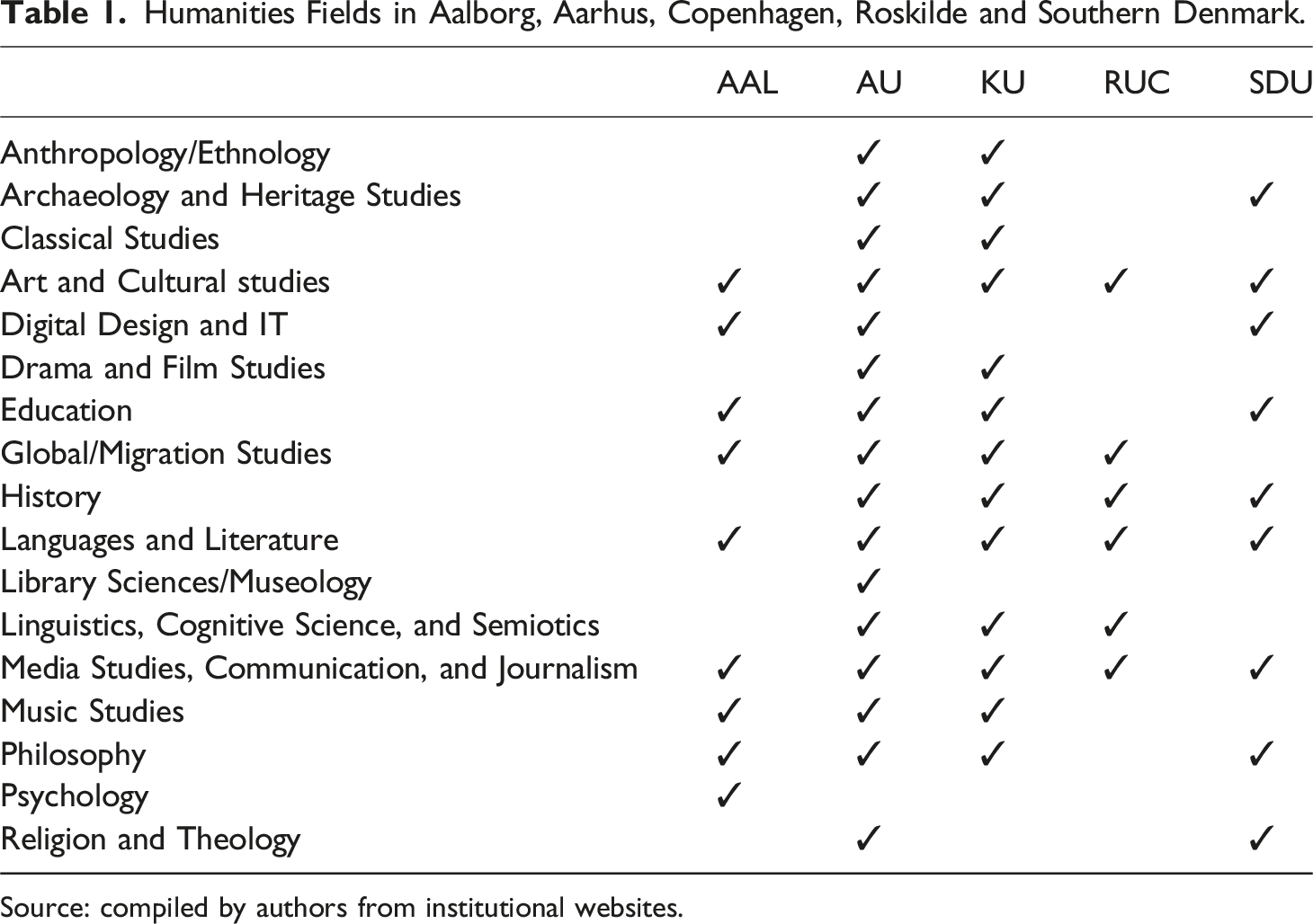
Source: compiled by authors from institutional websites.
The five universities vary in (a) location from rural through urban; (b) size of humanities faculty; and (c) nature/history of internal mergers – so structurally different based on distinct historical and current trends. Thus, despite the shared national policy context, the manifestations of national policies varied in how they were played out. For instance, Gregersen et al. (2009) compared two of the five universities, both medium-sized (turnover, number of staff and students) and showed the perception and implementation of ‘third mission’ activities varied through the interaction of both internal (new resource structures) and external (distribution of R&D resources) factors.
Research design
Our exploratory multi-modal qualitative two-phase design empirically enacted the conceptual framework: retaining the separability of structure and agency for analytic purposes (Archer, 2000) while examining the interplay amongst pertinent national Ministerial regulations, institutional regimes and the perceptions of established humanities academics. The first phase, a critical review (Grant and Booth, 2009) of national and institutional documents, characterised the policy context of PhD education and humanities in Denmark. The resulting account of the nested structural contexts in which individuals were embedded provided the foundation for the second analysis, a naturalistic narrative analysis (Riessman, 2008) of the interviews that documented how each individual characterised his or her lived experiences within his/her particular context as well as patterns of similarity across cases (McAlpine and Amundsen, 2018). All the authors had a well-established understanding of the data drawn on through earlier joint analyses.
Policy documents
The critical review of the policy documents involved the collection, analysis and synthesis of national policies relating to humanities, and the societal impact of research (more aspects of the methodology are outlined in Gibson and Bengtsen, 2023). The policy data represented international, regional, national and institutional dimensions and a range of actors and the analysis focused on the complex, frequently non-linear interactions in HE policy. For the purposes of the interviews with humanities leaders, national and institutional policies were given a special focus. These institutional and national policy texts were read, in English and Danish (but primarily English, the language in which they were generally published) and analysed to create a ‘profile’ of ‘impact’ expectations, as well as ‘institutional profiles’ of each of the universities. These served as the foundation for questions around the nature and value of humanities in the semi-structured interviews. In line with the study’s framing, this created a policy backdrop for the interviews, such that the researchers were very familiar with the wider policy context, and would be able to identify implicit or passing references to policies and policy terminology, if these were not explicitly referred to by participants.
Interviews
After ethical registration at Aarhus University, in 2020-2021 we approached six university humanities leaders, four females and two males. These were established individuals: (a) 20+ years from PhD graduation (five completed in Denmark); (b) at least 10 years in their present universities; and (c) extensive teaching, research and leadership experience. Given their time since graduation, their time in the institutional context as well as their leadership roles, they were deemed knowledgeable and likely comfortable in expressing their views.
Each participated in a 1-1.5 h semi-structured interview 7 that started with the interviewees’ own career experiences; then their views on their leadership roles; ending with their perceptions on the humanities-impact landscape – with the first and last parts the basis of this study. Occasionally, participants used a Danish term which they (or the Danish interviewer) then translated.
We analysed each participant’s experiences separately to preserve the uniqueness of the experiences and perceptions within their view of the institutional context. Specifically, the first author created a low-inference (open coding) account of each individual’s narrative which was reviewed and critiqued by the other authors. This analysis ensured we did not overlook unique or rarely-mentioned dimensions that might be missed in a cross-case analysis which tends to similarity. The next step, a relatively close textual analysis, focused on their views of the nature and value of humanities, to create textual images of the landscape as each perceived it (Riessman, 2008). After the first author did this for one case, the other co-authors again reviewed and critiqued the results. Next, the first author completed the other five analysis, and these were again critiqued. Then, a cross-case analysis sought patterns of similarity, with the results again critiqued by the other authors and then the interpretations created jointly.
Given the results represent the landscape (five universities in Denmark) and individual perspectives (six established academics) in a particular time and place, preserving anonymity was crucial. Thus, while the analyses examined the interactions between biographically and historically-situated individual accounts and specific university contexts within the shared national regime, in our reporting we carefully excluded information that might reveal the institutional-individual case. This, of course, means a loss of detail in the reporting of the results, but we believe our robust joint analysis processes offer assurance as to our interpretations.
Limitations
Any case-based study is designed to capture what is specific/unique to that case, not to be more generally applicable. However, we believe that the research design and the patterns of similarity can sensitise researchers in undertaking other similar studies.
Variation and patterns of similarity
Our analysis of the six academics highlighted a rich kaleidoscope of the humanities-impact landscape. The differences emphasised the influence of biographical and historical-structural influences on the views they held. We show this variation to highlight how individuals created multi-faceted representations of their stances through historical-biographical time. We end with patterns: what the results collectively told us about the dimensions of the humanities-impact landscape.
Variation
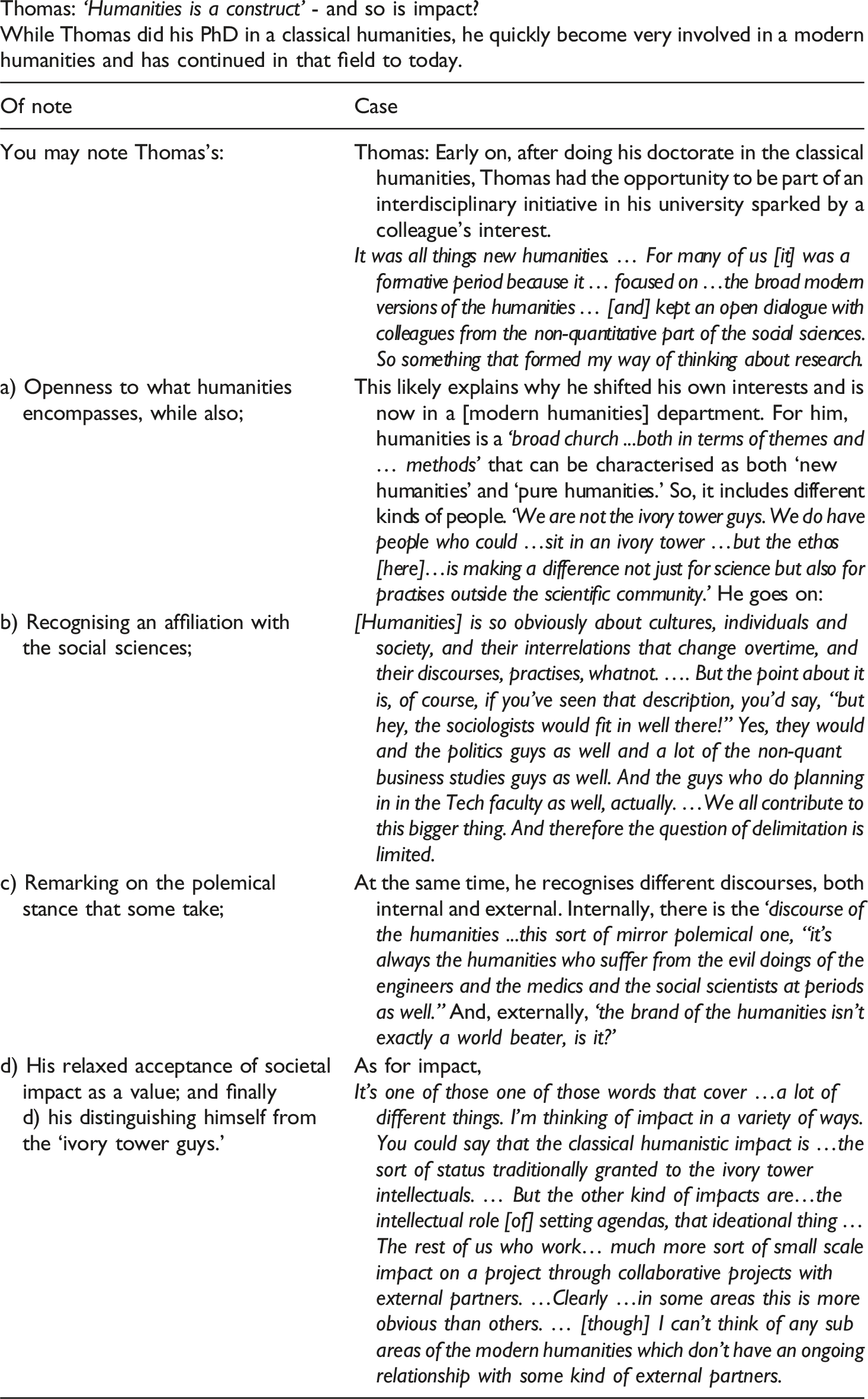
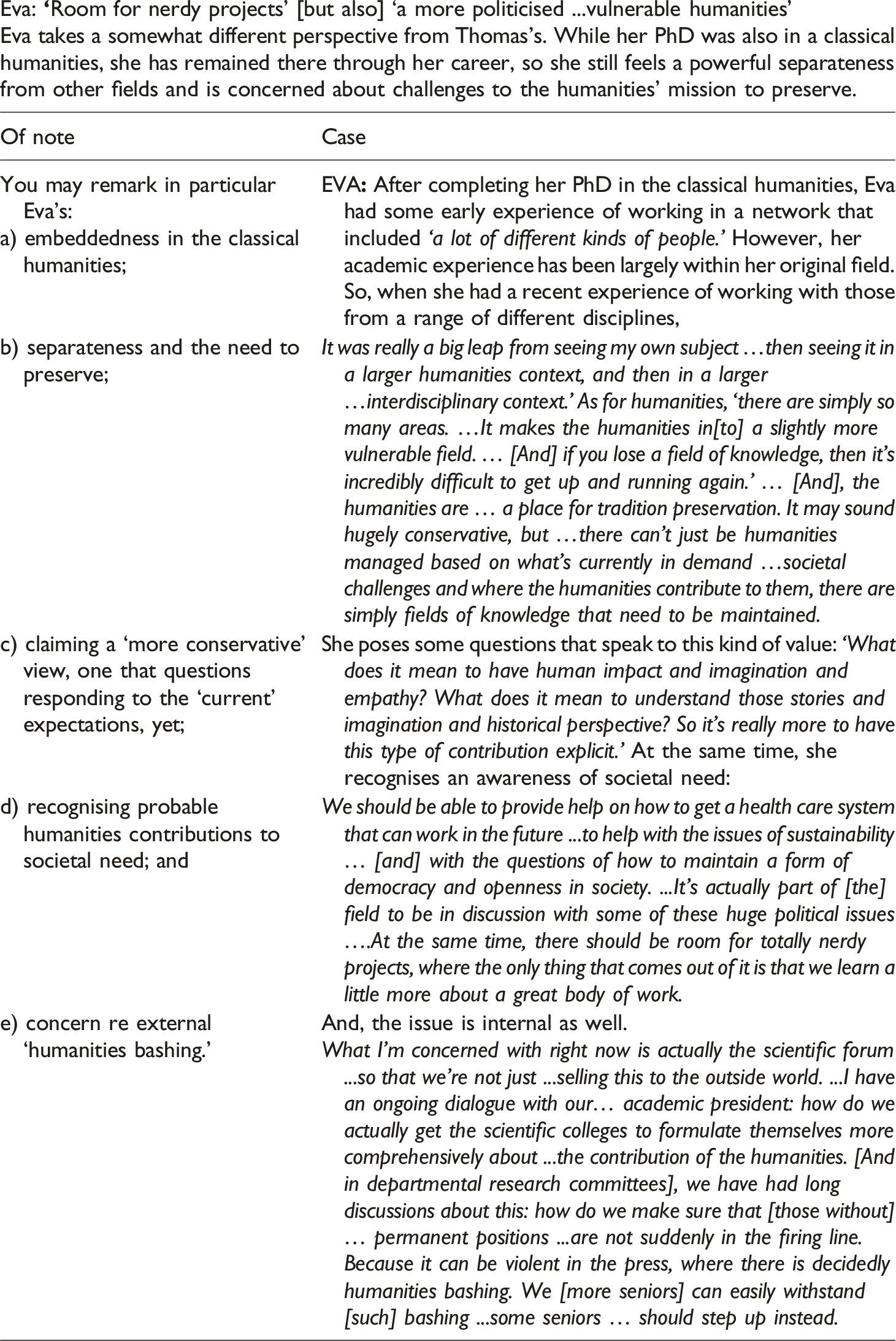
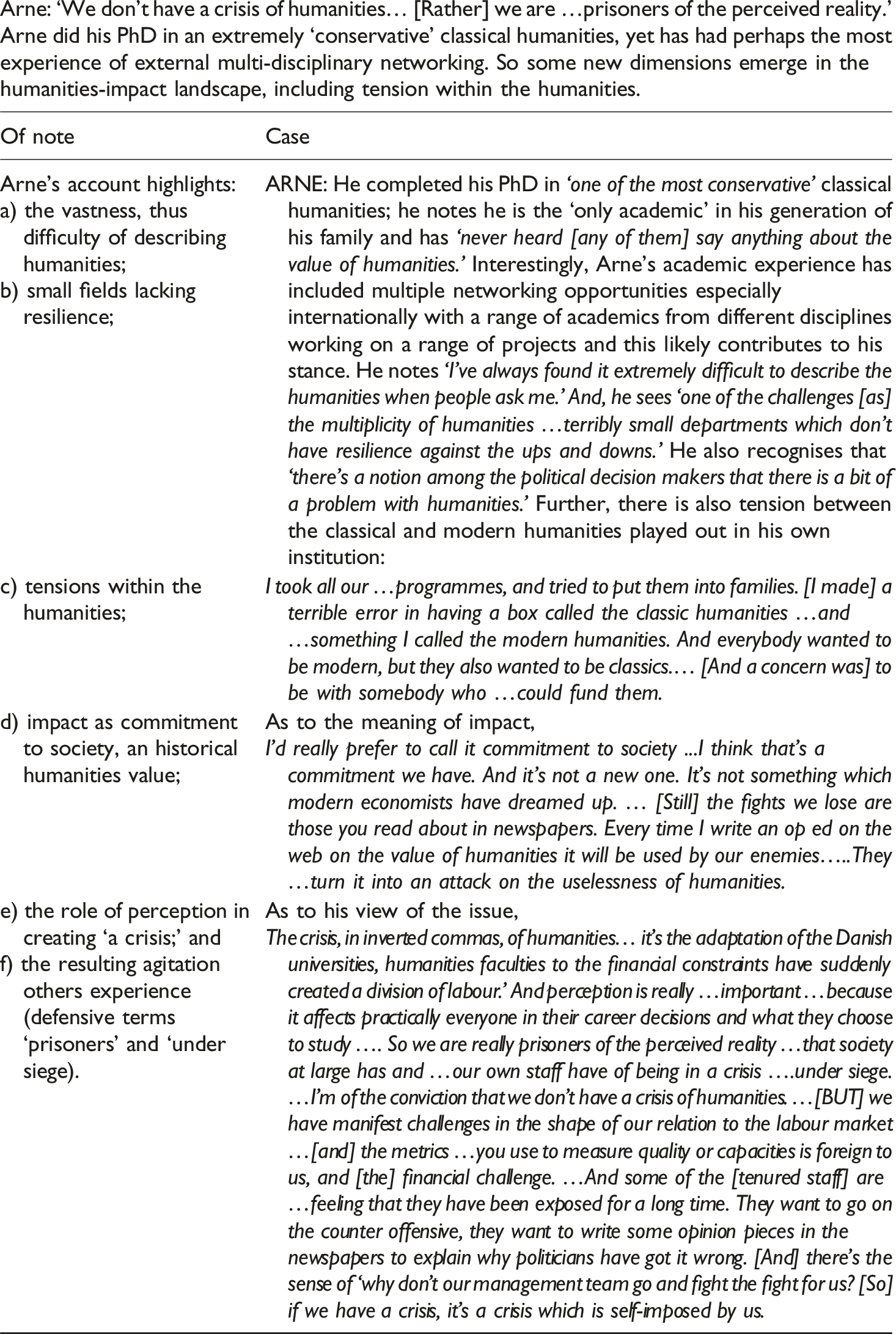
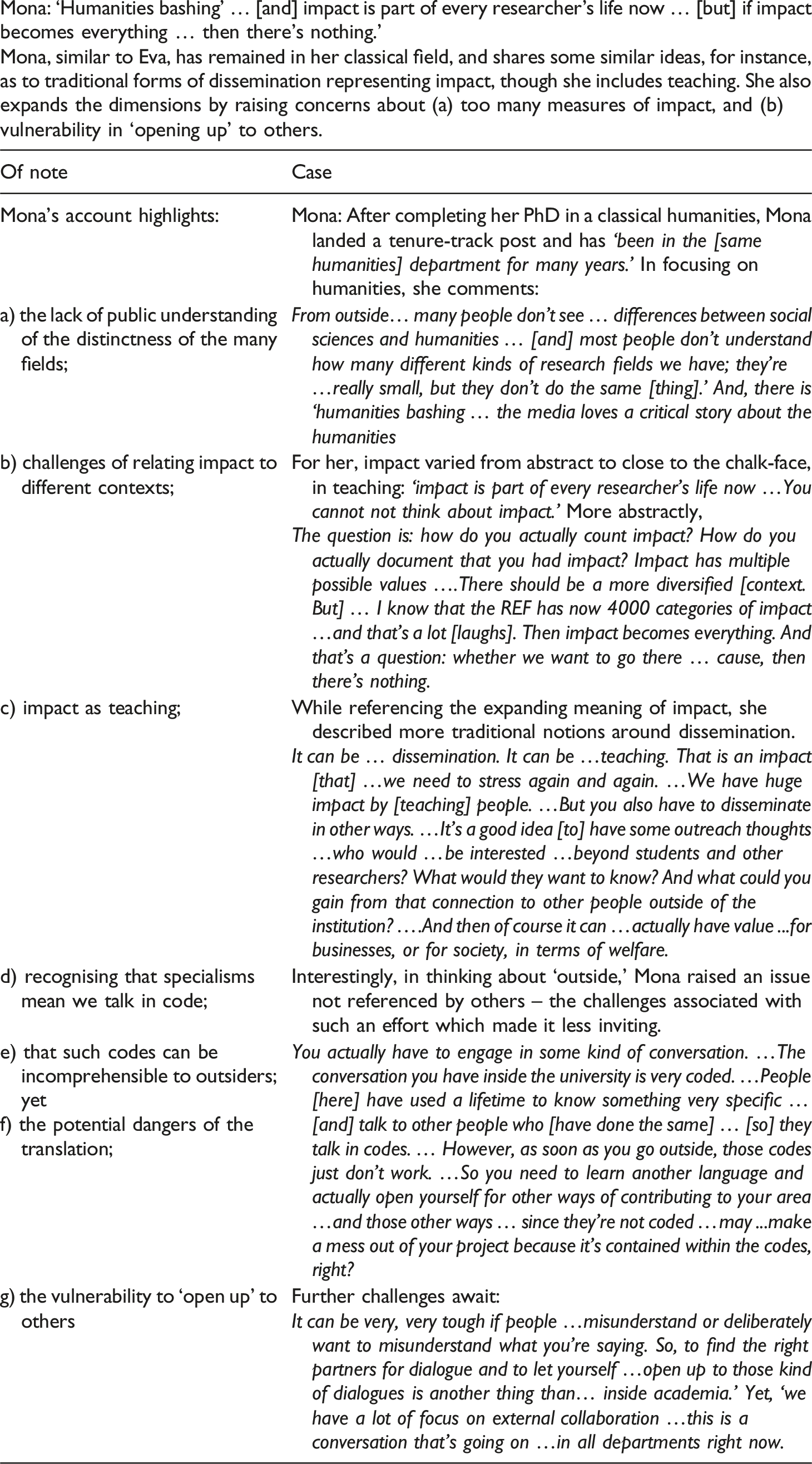
The six individuals each nuanced different aspects of the humanities-impact landscape in describing their views. In the accounts below, the right column is a low-inference account of what the individual said, and the left our interpretation.
The full accounts of the other two are in the Appendix, but we include below our interpretation of their perceptions.
Henriette: ‘Humanities [is] ‘what it means to be human’ …‘we need to prove we are important.’
Thomas: ‘Humanities is a construct’ - and so is impact? While Thomas did his PhD in a classical humanities, he quickly become very involved in a modern humanities and has continued in that field to today.
Eva:
Arne: ‘We don’t have a crisis of humanities… [Rather] we are …prisoners of the perceived reality.’ Arne did his PhD in an extremely ‘conservative’ classical humanities, yet has had perhaps the most experience of external multi-disciplinary networking. So some new dimensions emerge in the humanities-impact landscape, including tension within the humanities.
Mona: ‘Humanities bashing’ … [and] impact is part of every researcher’s life now … [but] if impact becomes everything … then there’s nothing.’ Mona, similar to Eva, has remained in her classical field, and shares some similar ideas, for instance, as to traditional forms of dissemination representing impact, though she includes teaching. She also expands the dimensions by raising concerns about (a) too many measures of impact, and (b) vulnerability in ‘opening up’ to others.
Edith: ‘Knowledge for knowledge sake … [yet our] research questions are really influenced by the society we live in.’
Edith also completed her PhD in a classical field, but has moved into a modern field (like Thomas and Arne). She is very comfortable in this university with its ‘institutional support’ for the kind of research she does. She also recognises the university as a societal microcosm and her research as ‘really influenced’ by society. Still, disciplinary tensions in the humanities-impact landscape mean ‘the challenge is …actually bridging [and]…insisting …that both … have equal value.’
Overall, we hope you see how individual disciplinary biographies within institutional contexts contributed to intriguing variation in how individuals positioned themselves; (a) within the humanities and in relation to ‘outsiders;’ (b) as to what they viewed as ‘impact’ measures; and (c) regarding their sense of personal strength through vulnerability within the humanities-impact landscape. What you cannot see as we may not reveal it was how their particular institutional contexts influenced their stances – though you may have a sense of that from Edith’s comment. Recall the variation in institutional histories, missions, and structures noted earlier.
Patterns of similarity
All were articulate about the humanities-impact landscape in Danish society and their own location within it. All drew on their personal experiences which contributed to the variation in elaborating their views of the humanities-impact landscape. They all referred to institutional influences on how humanities were constructed, not just in their own universities but also academies and funding councils – and that there were both inward and outward ongoing exchanges about the issue. Further, they all distinguished between classical and modern humanities, usually locating themselves in one or the other. As well, they generally noted the latter had more potential to engage directly with societal concerns – with the former having a more difficult case to make. While none referred specifically to the narrowness of the legislation that limited the notion of society, there was a general sense that the humanities-impact landscape had internal-humanities/STEMM and external-society/press/policy-makers tensions.
We also noted an interesting pattern, a continuum, in how their prior research histories influenced their stance. While all did their PhDs in classical fields, their varied experiences of engagement with modern fields and inter-disciplinarity appeared to influence how they viewed the humanities-impact landscape. At one end were Thomas and Arne, who from PhD graduation had lived experiences of the modern humanities and the social (and other) sciences; they expressed a more expansive, relaxed view of the humanities-impact landscape. At the other end are Eva and Mona, who had remained in their PhD classical fields until today. They expressed ‘more conservative’ ideas, and concerns about the shift towards a more engaged societal stance, given the preservation function of the classical humanities, the value of knowledge for knowledge’s sake, noting teaching and other academic dissemination as important forms of impact. Midway on the continuum were Henriette and Edith who strongly valued classical humanities’ notions of impact like Eva and Mona, but also recognised the university as a microcosm of the society in which it is embedded – and research emerging from society. Henriette’s 8 comment summarises this ambivalence: ‘You have all kinds of society represented in the university.’ At the same time, ‘impact … doesn’t have to be applied research… It can mean… my public lectures … my… citations or quotations …‘you do not have to invent a machine ...simply ...write a textbook.’ We wonder the extent to which their stances suggest breaking/disrupting the boundaries of the policy concept with their own approaches or setting aside/limiting its (unwelcome) influence.
The dimensions of the humanities-impact landscape
Our study empirically embodied the conceptual framework to examine the interaction between national regimes and individual perceptions (Jiang et al., 2019), while retaining the separability of structure and agency for analytic purposes (Archer, 2000). The results contribute a rich tapestry of the interwoven individual and structural elements at play when academics articulated how they located themselves within the humanities-impact landscape in a particular time and place (2021–22, Denmark). Their perspectives offered a bio-historical palimpsest of their thinking at that time, when engaged in discussion with a particular set of individuals (Riessman, 2008). The six generally elaborated a relatively nuanced rather than an argumentative view (Bulaitis, 2024). These views highlighted a range of dimensions in play, thus making clear, either implicitly or explicitly, that ‘impact’ was not a neutral term (McCowan, 2018). Further, they described multiple ways in which impact might be understood – though with frequent reference to traditional forms of dissemination. Also noted was a concern, rarely reported in the literature, that the expectations of societal engagement could make those more junior, without tenure, vulnerable, more at risk, this was accompanied by a call for the more secure to step up.
The framing of the study separated structure (in terms of policy) and agency (of the humanities leaders). This was done in order to allow for the possibility that findings from the research might emerge to represent an integration of these perspectives, if it was the case that leaders framed their leadership in terms of the policy. In a somewhat unexpected consequence of this methodological separation, however, policy was largely absent from the discussion. So, even though explicit references to policy were not made, we are reminded that policy texts are also actors (Actor Network Theory, e.g., Latour, 1987) as they influence how individuals, groups, and organisations might make sense of the denoted meaning and negotiate responding. The general absence of policy emphasis points towards the fact that the policies we identified at the national and institutional levels were not as relevant for the stratum of leadership considered.
Equally, ‘the humanities’ is not a neutral construct given its multiple small fields addressing a vast array of interests but divided into two distinct clusters, classical and modern (rather than an array across a continuum) thus likely exacerbating tensions (Williams, 2019). One participant noted the difficulty of moving beyond ‘our own’ specialised fields and codes to engage with others; not to be forgotten here is the underlying principle that our discourse frames our ways of thinking (e.g., Vygotsky, 1978).
Turning to organisations, structures and time, the evidence supports the view that the university is a microcosm of the evolving society in which it is embedded (McAlpine, 2021), In other words, Gregersen et al.’s (2009) findings that variation in implementation of third mission activities emerged through the interaction of internal and external factors should not be surprising. Internally, the differences in response to the landscape between STEMM and SSH, and the attention these fields attract from policymakers, creates tensions in which SSH fields and individuals may easily feel challenged (Bonaccorsi et al., 2021) and engage in polemical (often non-productive) arguments. Not to be overlooked is that the internal and external tensions might often be linked to power, for instance, influencing access to limited funding, or directing negative attention at politically ‘sensitive’ research. So those who didn’t feel influential felt more at risk. Thus, perception of influence played an important role in whether or not the issue was perceived as a crisis.
So, stepping back a bit, we also analyse the landscape through the lens of change. Changes in thinking and action, especially if perceived as imposed, are often difficult to achieve given such change requires a willingness to invest knowing that disruptions will follow in one’s life, including one’s values and behaviours (Tough, 1979). Further, even with commitment, diverse prior life histories mean individuals in the same workplace will change how they think and act differently and to different degrees (Billett, 2001). Thus achieving organisational change can be even more difficult (Sannino and Engeström, 2017), requiring as it does a shared commitment and members’ confidence in their collective abilities to achieve the change (Weiner, 2009). So, in addressing the ‘wicked problem’ represented in the humanities-impact landscape, one can imagine varied levels of readiness and commitment amongst the range of actors with differing experiences and interests.
Thinking more on this point, we are reminded of the calls to engage in the conversation (Bulaitis, 2017) which means creating richer and more complex images of quality and evaluation of quality in humanities (Sorlin, 2018; Spaapen and Van Drooge, 2011) – further, that perception is at the heart of all social issues and individual and societal readiness to change (Weiner, 2009). We see it mirrored in our world today in stances towards Covid vaccinations, the climate crisis, and current and ongoing wars. In a less critical way, the humanities-impact landscape is representative of these dissensions and sense of crises. However, if we could move beyond arguing for/against different positions and build on the fact that universities are microcosms of the societies in which they are situated, could we then view the landscape as a permeable ongoing relationship? From this perspective, emerging societal trends along with their perceived value flow into university fields of research and study with the benefits accruing back to society. Such a movement is easy to see in the growth of the modern humanities. At the same time, older societal concerns may transform or become less pertinent and so their fields of research will also change – either develop in the direction of travel or slowly wither.
Conclusion
How do humanities academics articulate relations between societal impact and humanities? The results individually and collectively highlighted a rich nuanced representation of the humanities-impact landscape than often seen in more formal arguments. They suggest possibilities to create more open dialogue if (a) we are attentive to the emotions that often underlie our own and others’ perceptions, and (b) the multiple actors with varied purposes engaged in the dynamic within and beyond the academy.
We can view the Danish humanities-impact landscape as an example of the shift occurring over the past 60-70 years from a Mode 1 perspective on research (disciplinary knowledge) towards greater expectation of demonstrating Mode 2 knowledge claims (Gibbons et al., 1994). In contrast, Mode 2 knowledge (Nowotny et al., 2003) values application, flexibility, and responding to external demand (as in the EU call for research in and for society). In the social science context, it has been argued that such an expectation need not mean giving up a focus on basic research, but rather broadening the scope of what is seen as research (Watts, 2017): by ‘seek [ing] to advance theory specifically in the service of solving real-world problems’ (p. 1), we can improve the coherence of social science given the many collectively incoherent theories to explain one phenomenon. Our study makes clear that if more fruitful university-society relationships are to be forged in humanities, new and different language and vocabularies around societal value need developing. Further, that humanities are searching for their own language/vocabulary to make the discussion of societal value their own.
Footnotes
Declaration of conflicting interests
The author(s) declared no potential conflicts of interest with respect to the research, authorship, and/or publication of this article.
Funding
The author(s) disclosed receipt of the following financial support for the research, authorship, and/or publication of this article: Research partially supported by Sapere Aude: 0163-00003A.

Notes
Appendix
Author biographies
Lynn McAlpine is Professor Emerita at University of Oxford and McGill University. Her research interest in PhD careers has evolved over time. Her early research in this area followed scientists and social scientists longitudinally as they navigated their careers and personal lives during and after finishing the PhD. A key interest is how PhD graduates navigate their desires amidst global trends for highly skilled workers, national policy regimes and institutional affordances and constraints.
Andrew G Gibson is Assistant Professor in Philosophy of Education at Trinity College Dublin, where he is Co-Director of the Cultures, Academic Values in Education (CAVE) Research Centre. His research interests are in the area of the philosophy of higher education, theories of the humanities as a meta-discipline, and critical policy studies.
Søren SE Bengtsen is Associate Professor in the Department of Educational Philosophy and General Education, Danish School of Education, as well as Co-Director of the Centre for Higher Education Futures (CHEF) at Aarhus University. He is Co-Editor of two book series: ‘Debating Higher Education: Philosophical Perspectives’ (Springer) and ‘World Issues in the Philosophy and Theory of Higher Education’ (Routledge).
Tessa DeLaquil is a postdoctoral fellow in the Department of Educational Philosophy and General Education, at the Danish School of Education at Aarhus University. Her research interests include theory, values, and ideas of the university in the areas of philosophy of higher education, international higher education, and international development.