




Abstract
This research sought to explore how creative writing university students’ knowledge aligned with published authors and marketing professionals within the publishing industry. Participants from all three groups were recruited for semi-structured interviews, and the transcripts were analysed using thematic analysis. Overall, both published authors and creative writing students’ knowledge was misaligned with industry perspectives, practices, and expectations, despite both authors and students generally believing marketing was important. Both the authors and students overall possessed a limited understanding of marketing and so their marketing knowledge did not appear to greatly increase after graduating. Given that authors found it difficult to build their marketing knowledge and skills due to time constraints, it would appear useful to embed marketing and entrepreneurial knowledge in creative writing university curricula to ensure students graduated with knowledge that would enhance their entrepreneurial and marketing skills and their income opportunities.
Introduction and background
This research aims to address the research gap concerning authors’ and aspiring authors’ marketing knowledge, skills, and practices. It explores and compares the marketing knowledge of published authors and aspiring authors, specifically creative writing university students, and perspectives from marketing and publicity specialists in the publishing industry. The utility of creativity (Celly, 2009; McIntyre, 1993; Ramocki, 2014) and entrepreneurialism (Marin et al., 2023; McCartan et al., 2023) in university marketing education has been established. However, the value and importance of marketing knowledge within Creative Industries university education remains less explored and understood. The Creative Industries encompass a variety of fields from arts to heritage and media (Gouvea and Vora, 2018) and includes the creative writing and publishing industry (Driscoll et al., 2018; Li, 2020). In Australia, the publishing industry is highly significant culturally and financially (Crosby et al., 2022). The Creative Industries have long been recognised as having insecure employment (Bridgstock and Cunningham, 2016; Crimmins et al., 2022) with economic opportunities often being short term contracts found via informal networks or freelancing found via self-created projects (Daniel and Daniel, 2015; Larson, 2020). Indeed, the precarity of employment within the Creative Industries means that transition from study or training into the workforce can be more difficult than for other disciplines and industries (Bridgstock and Cunningham, 2016; Phillipov, 2022). As such, creative practitioners can find economic sustainability difficult (Salder, 2021) and their motivation to continue in the Creative Industries comes from intrinsic factors such as passion for their creative practice and independence (Comunian and England, 2020; Daniel and Daniel, 2015).
It has been proposed that business and entrepreneurial skills are valuable for practitioners in the Creative Industries and should be embedded into university degrees (Beckman, 2007; Bridgstock and Cunningham, 2016) to ensure practitioners can run their businesses and projects, seek out new opportunities, and be able to capitalise on them (Daniel and Daniel, 2015). Although such approaches can be contentious (Bridgstock, 2012; Craig, 2022), the embedding of these business and entrepreneurial skills is also likely partially being driven by the focus of universities and governments on the employability of graduates (Crimmins et al., 2022). However, it is complicated by the fact that practitioners in the Creative Industries can feel tension between their creative and commercial personas (Bridgstock, 2012; De Klerk, 2015).
Various related and interrelated terms within the Creative Industries such as creative entrepreneurship and arts entrepreneurship (Douglas, 2022) have been used to encompass the behaviours utilised by creative practitioners to share and distribute their creative work (Bridgstock, 2012). A synthesised definition (Douglas, 2022) is that creative/cultural/art entrepreneurship is ‘a management process through which cultural workers seek to support their creativity and autonomy, advance their capacity for adaptability, and create artistic as well as economic and social value’ (Chang and Wyszomirski, 2015: 24). As such, these activities encompass various business activities and knowledge including strategy, finance, and marketing (Bridgstock, 2012). Such knowledge is important for creative practitioners, who can and often do become the managers of their own creative-focused businesses and need to juggle their creative and commercial priorities (Bridgstock, 2012; Eigler and Azarpour, 2020). The output of creative practitioners and their businesses has economic implications beyond their own economic sustainability by increasing local culture and innovation, enhancing local wealth creation, and talent cultivation, and providing competitive advantage to their regions (Gouvea and Vora, 2018). Thus, by enhancing creative practitioners’ economic sustainability, there are many flow-on benefits.
The evolution of technology has been a factor that has impacted the precarity of employment in the Creative Industries (Bartleet et al., 2019; Larson, 2020; Li, 2020). Creative writing and self-publishing authors are able to use technology to self-publish and directly distribute their books (Matulionyte et al., 2017) as in the music industry where technology has allowed artists to more easily directly share their music with their audiences (Bartleet et al., 2019). The traditional model of publishing meant that the author and the reader were separated by the agent, publisher, printer, distributor, wholesaler, and retailer (Thompson, 2012; Wilkins, 2019). Now, by using technology, authors and readers can directly communicate. However, just as technological advancements and changes have allowed for more control and independence, they also require entrepreneurship and business skills, such as marketing, to fully take advantage of them (Bartleet et al., 2019; Larson, 2020). Creative practitioners who utilise technology to communicate with audiences directly, and independently distribute and share their work, must undertake all of the activities associated with publication including marketing.
Given the multitude of books published each year, marketing would appear an essential activity for authors so they can promote their novels, attract readers, and more easily achieve financial sustainability (Ohlsson et al., 2014). Authors also possess their own human brands and reputations that they can use to attract readers (Criswell and Canty, 2014; Parnell and Driscoll, 2023), so they should not be just the propagators of marketing activities but can also be their subject (Braun, 2016). However, to build strong brands, skilful marketing activities are necessary (Thomson, 2006). Traditional publishing houses used to offer many in-house services to their authors, but they have been increasingly reducing them, including marketing, thus making authors responsible for these important tasks and activities (Matulionyte et al., 2017). Whether authors publish traditionally via a publishing house, or self-publish, marketing remains an important skill for them if they want to earn a sustainable living from their creative work by attracting audiences and sharing their work (Bridgstock, 2012). However, practitioners first entering the Creative Industries may only retrospectively realise how important entrepreneurial and business skills, such as marketing, are for their careers and economic sustainability (Bartleet et al., 2019).
While marketing freelancers and agencies can be hired for help, they would likely remain financially out of reach for most authors given the precarity of their employment and incomes in the Creative Industries. Australian authors earn on average $18,200 per year from their writing (Crosby et al., 2022), which means that authors must take on their own marketing activities and devote time to them to be successful. However, the results of the 2022 National Survey of Australian Book Authors found that spending time on marketing and promotion activities was the fourth most likely factor preventing Australian authors from spending more time writing with 31.9% of respondents nominating it (Crosby et al., 2022). The top three were a lack of income, demands of another job, and caring responsibilities (Crosby et al., 2022), which are not as easily addressed by outside interventions as creative practitioners’ marketing knowledge and skills’ gaps. Interestingly, creative practitioners have been found to have a natural propensity for the skills required to market and run a business or enterprise (Bridgstock, 2012). Prior research has also found that students of Creative Industries at university feel that business skills and thinking are important, and they want more of them in their studies (Bennett, 2007; Daniel, 2016; Daniel and Daniel, 2015). This highlights the importance of creative practitioners being equipped to undertake both creative and commercial activities and step into both personae. Thus, it is important that if authors are spending a significant amount of their time on marketing activities, they are using that time valuably and need to be confident in their abilities.
There has been a body of work exploring the marketing activities undertaken by publishers including their social media strategies (Criswell and Canty, 2014; Murray, 2016), publishing processes and eco systems (Driscoll et al., 2018; Matulionyte et al., 2017), and the impact of customer reviews on sales (Chevalier and Mayzlin, 2006). However, research into the labour of authors outside of their writing, including their marketing knowledge, skills, and practices is an acknowledged research gap (Larson, 2020). By comparing established authors, creative writing students, and industry practitioners’ perspectives and understandings will contribute to the literature on financial sustainability and labour in the Creative Industries. Interdisciplinary research bringing together creative writing and marketing perspectives will reveal insights into the creative capacity, behaviours (Wilson, 2009), and labours (Larson, 2020) of authors. This new knowledge can be used to guide efforts to enhance authors’ business and entrepreneurial knowledge, skills, and practices, specifically marketing, and suggest potential educational and industry resources and interventions necessary to increase and improve these skills and thus practitioners’ financial sustainability.
Method
Data was collected via semi-structured interviews with established authors, creative writing students, and marketing and publicity workers in the publishing industry using a qualitative approach to help understand the participants’ thoughts, feelings, and attitudes regarding their marketing activities (Guest et al., 2012). This method was appropriate as the research was exploratory (Eriksson and Kovalainen, 2008). Semi-structured interviews allowed for the gathering of rich insights and data via follow-up questions, probing, and clarification (Van de Weerd et al., 2016) and are considered an efficient and effective data collection method for creative practitioners’ production and labour practices (Jørgensen, 2019; Jørgensen et al., 2017) were interviewed. Creative writing educators were not included in the research given the aim of the research was to explore the marketing knowledge of established authors, creative writing students, and industry perspectives.
To ensure the interview participants were sufficiently relaxed, and to assist with gathering rich and high-quality data, the interviews all commenced with ‘grand tour’ questions (Leech, 2002). Grand tour questions ask participants about situations they are very familiar with, and thus help them to feel comfortable, which primes them for more cognitively challenging or reflective questions (Leech, 2002). Grand tour questions also helped to gather background information on each participant such as the number of years they had worked in the industry, the number of books they had published if authors, or if they had published anything if students, before eliciting insights into their marketing knowledge. The interviews were transcribed using an artificial intelligence powered software, and then checked and edited manually to ensure accuracy.
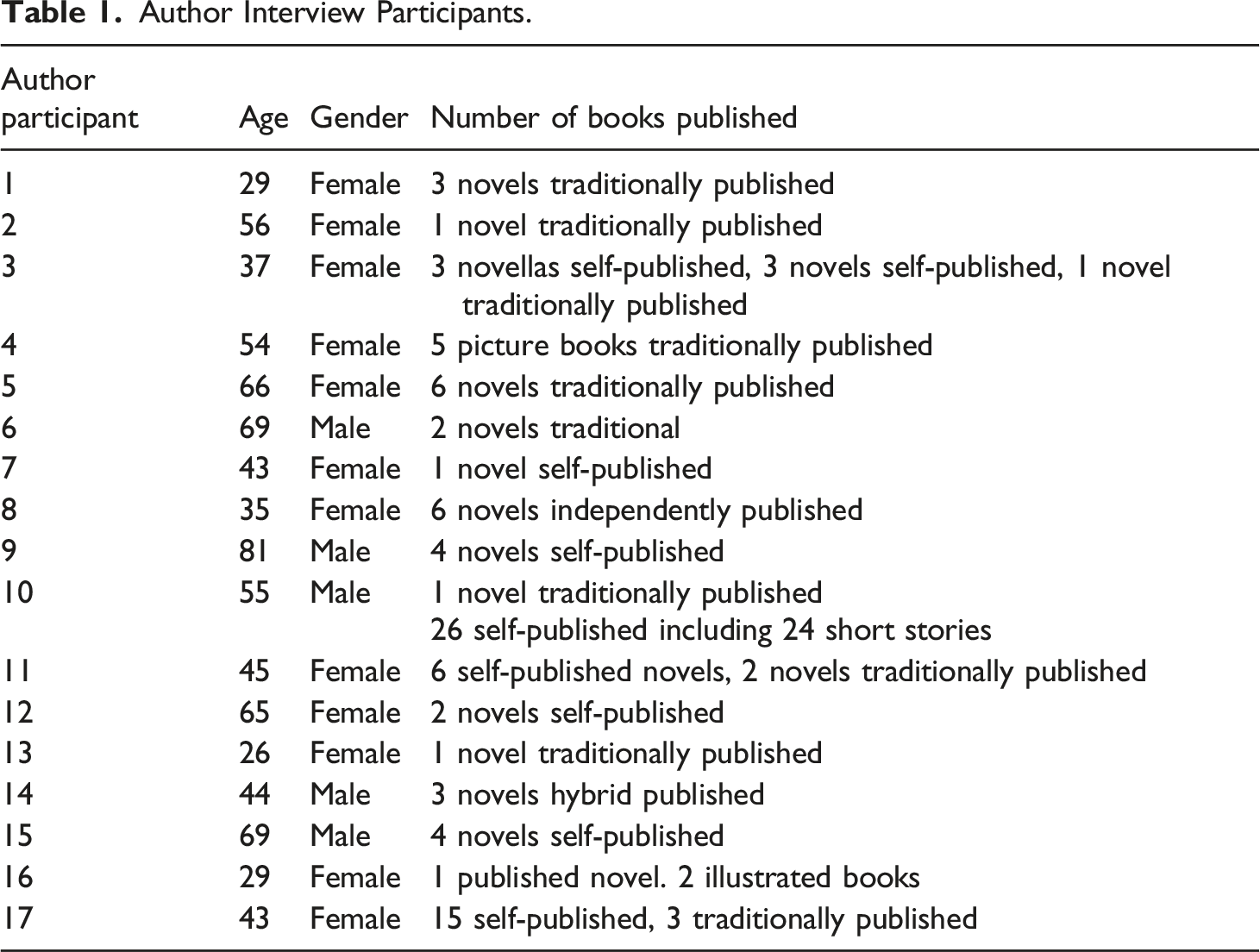
Author Interview Participants.
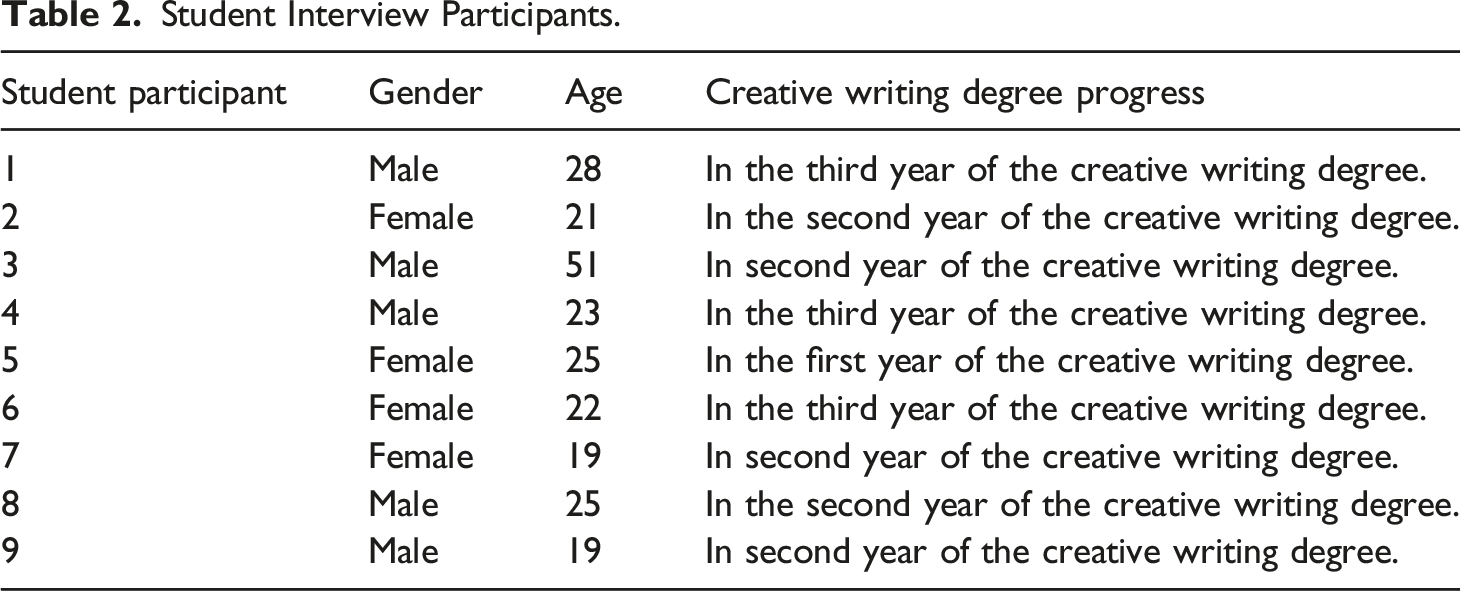
Student Interview Participants.
Industry Interview Participants.

The authors and creative writing students that participated were all located in South-East Queensland, Australia, which is known to have a strong literary culture, associations that support creative writers, and also has many higher education institutions that offer creative writing degrees and courses (Frank, 2016). Given this was an exploratory study, an examination of a specific geographic region was expected to deliver rich information. However, the two Australian publishing industry workers, who worked in marketing and publicity, were based outside of this area due to the national and international nature of the industry.
This research utilised thematic analysis to analyse the data (Braun and Clarke, 2006) using a traditional human interpretative approach in combination with the software program, NVivo 12 plus, to allow for greater accuracy of the participants’ meaning (Arvidsson and Caliandro, 2016; Kozinets et al., 2018). All of the analysis was manually coded by the first author to ensure accuracy and that industry slang and in-jokes were accounted for and understood, and to maximise the information extracted from the data (Scholz and Smith, 2019). The data analysis process was iterative and continuous, and the transcripts were returned to and re-examined to refine codes and groupings as the analysis progressed (McCosker et al., 2004). All the transcripts were read prior to the analysis commencing to ensure familiarity with them. The analysis and coding were an iterative process drawing upon the phenomenographic approach, which involves iterative familiarisation, analysis, and then interpretations to consider the collective meaning (McCosker et al., 2004; Åkerlind, 2012). Peer debriefing with the other two authors was then used to validate the thematic analysis (Creswell and Miller, 2000).
Results
Participants
Five of the author participants were male and 11 were female. Participants ranged in age from 26 to 81 with the average age being 50. All 17 participants had published novels, and some had published other forms of creative writing. Ten participants had published via a traditional publisher, ten had published independently via self-publishing or e-books, and some had published via both methods.
The student participants ranged in age from 19 to 51 but most (n = 7) were 19-25. Five were male and four were female. All but one student participant was in the second and third year of their degrees. Several students had published poems or essays as a result of winning or performing well in competitions, but none had published full-length books yet.
Two publishing industry workers, who worked in marketing and publicity, were recruited. Both participants had worked for multiple national and international publishing houses in Australia and had 11- and 20-years’ experience respectively. Their other demographic details are withheld to protect their anonymity.
Marketing knowledge
All of the participants were asked how they would describe marketing and its purpose. When examining the results of the authors and the creative writing students, there were some synergies and similarities. The students all described marketing as selling and promoting themselves, for example: ‘it’s like the advertisement of like a product’ and ‘a way to promote myself’, although student participant 6 noted it involved making your work ‘appealing’. The authors also focused on how marketing could make people aware of their books and their writing and thus generate sales: ‘it is everything that you do to promote a book, promote anything really, in hopes that it will gain recognition’ and ‘to get your product in front of buyers’. However, four novelists did note the importance of understanding and engaging a target market to build a relationship and get the target market excited about their novels. Thus, despite the authors all having published at least one book, and in some cases many more, there seemed to be a similarity in both groups’ perceptions of the focus of marketing. However, the publishing representatives provided quite a different understanding. Both noted that one aim was to achieve sales and awareness, but representative 1 noted that was a ‘rudimentary’ understanding. Representative 2 went further and noted that focusing on marketing in that way was ‘baloney’. They further explained that marketing focused on the ‘brand’ of the author and their values and vision. Interestingly, none of the author or student participants mentioned brands or value, although as noted, one student did note that marketing meant promoting themselves as an author.
Also, when the creative writing students were asked about market research and if they felt it might be useful, their responses reflected a more holistic view of marketing and aligned more to the industry representatives’ perspectives. While two students admitted they did not know what market research involved, seven all felt using it would be beneficial. As a student explained: ‘market research is finding your target audience and then if it matches up with your work’ and another said: ‘it goes to knowing your audience and then being able to write to that because there’s no point writing to something that doesn’t exist.’ Interestingly, 11 authors had never considered using market research as they felt it would not be relevant or accurate. However, six authors found it very informative in terms of identifying ‘who my potential buyers are’. Both publishing representatives noted that market research and data was key to publishing houses when deciding upon acquisitions and evaluating their marketing activities. As representative 1 explained: ‘before publishers acquire a book, they always look at sales data on comparison titles’, and if the book was accepted that would inform the marketing strategy: ‘It kind of just gives the entire sales staff an idea of like, okay, what are we pitching this as?’.
Seven of the creative writing students desired more marketing knowledge, including in their studies, while one did not, and one wanted very specific knowledge concerning connecting to readers online. Students who did want more knowledge felt ‘it would definitely be good to learn about it’ and wanted to: ‘(…) to learn more about options you have to market’ and ‘how to reach different audiences’. Likewise, 13 novelists noted that they wanted to improve their marketing knowledge and saw this as a beneficial activity. Four even felt that this was a constant process because marketing was so broad and dynamic. However, ten authors were not able to improve their knowledge as much as they would like as they were constrained by limited time. As one explained: ‘I think time is the big one for me, because there’s always something to do so I’m always juggling projects along with work’.
However, the authors were using a variety of platforms to market their work with most having both a Web site and one social media account and half also using platforms such as Amazon and Goodreads. The students were engaging in very few marketing activities. For example, most were not using social media to actively promote their writing, or were sporadic, or did not feel they were using it effectively. As several students explained: ‘I don’t really use Facebook to promote my writing or anything’ and ‘I don’t really use it right now because I haven’t got anything done or finished enough to put up there’. One student, who had been using social media, included ‘Instagram and a platform called Patreon. But it was really hard to do that while studying, so I’m kind of just put that on hold at the moment and focusing on my studies’. Another used ‘LinkedIn because I did a course at the university that told me to have a LinkedIn, but it’s very outdated so I need to go over it and re-edit it and add some more stories’. The publishing representatives were surprised to hear about students’ lack of social media use. As Representative 1 put it: ‘Yeah… that’s who might be coming into the industry in five 8 years time… Yeah, man.’ Representatives worked ‘with the author’s very heavily on promoting via their channels’. Representative 2 also noted that establishing the brand and vision of an author involved using their communication channels so authors could make ‘sure that you’re part of that public conversation’.
Importance of marketing
The authors and creative writing students also expressed similar perspectives regarding the importance of marketing for authors and creative writing practitioners. Fourteen authors expressed the view that marketing knowledge and skills were important for authors and helpful for their success. As one author noted: ‘I think it’s the most important thing for a book, except, of course, the actual book being written.’ Three authors qualified their answer by noting it depended on the financial goals of the author and if they wanted to make a living or income from their writing. Likewise, seven students felt that marketing was important to authors: ‘It’s pretty important because we need to be able to sell our work. So, yes, it’s very important.’ However, two students were honestly not sure if it was or was not.
Unsurprisingly, both publishing representatives strongly agreed that marketing was important for authors that wanted to be published and sell their work. They also noted that it was useful for authors to have an understanding of how traditional publishing houses would view the market and marketing to better pitch and conceive their work. Representative 1 noted that there were the resources to fully promote only a fraction of a debut for unknown authors and thus it was useful to already have a platform or audience. Representative 2 explained how publishing houses’ analysis asks: ‘who’s the audience’, ‘how many copies were going to be sold’, and ‘how much is this book going to cost to produce’ in acquisition meetings. Thus, an author who was pitching a full-colour picture hardback book was pitching something that would be very expensive to produce and the ‘author was looking at me in horror’ when that was explained. Another example representative 2 used when explaining why it was important for authors to have an understanding of marketing was the case of an author who was writing in a totally different genre to their previously published book and had been focusing on the small details of the writing, rather than the fact their prior audience might not read the new work.
Discussion
Overall, both the authors and the creative writing students tended to focus on selling and promoting when describing marketing, which is only a small aspect of the American Marketing Association’s widely cited and accepted definition of marketing: ‘Marketing is the activity, set of institutions, and processes for creating, communicating, delivering, and exchanging offerings that have value for customers, clients, partners, and society at large’ (American Marketing Association, 2017).
This more holistic definition and approach was alluded to by the two publishing industry workers indicating a mismatch of knowledge and approach between the industry and authors. Interestingly, students’ conceptualisations of market research aligned more closely to marketing and so might indicate their confusion is related to a specific name. The creative writing students were also more unsure than the authors when answering questions, were noticeably tentative in their answers, and struggled somewhat to explain what marketing activities they would use. However, there did not appear to be a substantially increased difference between the marketing knowledge of the students and the published authors suggesting authors are not increasing their knowledge as they establish and publish in the industry. Furthermore, both the creative writing students and the authors’ marketing knowledge is misaligned with the publishing industry workers’ expectations and publishing industry practice. Thus, the creative writing students in this research likely lacked the entrepreneurial and marketing skills that would assist them to attract followers, build and understand their brands, publishers’ expectations, and to undertake self-publishing activities.
Both the marketing and publicity publishing industry workers noted how important it was for authors to understand the marketing decisions and expectations within publishing houses. If aspiring authors did, then this would increase their likelihood of being able to successfully pitch their work and help them to write something attractive for a publisher. Thus, having a deeper knowledge of marketing and entrepreneurial knowledge (Beckman, 2007; Bridgstock and Cunningham, 2016) would likely help authors to take advantage of opportunities (Daniel and Daniel, 2015), which may help address the precarity of their incomes, and would assist them to be able to self-publish.
If both authors and students are focused on the selling and promotion aspects of marketing as was their main understanding of what marketing is, then they most likely do not understand the benefits of building a brand. Brands exist in the minds of consumers and audiences and can be highly influential. Strong brands confer a range of positive effects including increased loyalty, engagement, and emotional attachment from consumers and audiences (Burgess and Jones, 2020). These benefits have been captured by popular and well-known novelists (Braun, 2016), and are necessary for successful authors.
Prior research has found that students wait to commence entrepreneurial and employability activities, such as networking and connecting via social media, until after they have finished their studies, even if they have been introduced to potential employers or industry contacts (Caldwell and Cattermole, 2015). The creative writing students in this study displayed a similar approach. The benefits of marketing knowledge and activities would thus need to be made explicit to them in courses during their studies and thus be embedded into the curriculum. Given that the authors interviewed expressed it was difficult to build marketing knowledge while working and writing, by ensuring students graduated with some marketing knowledge would likely give them an advantage in terms of identifying financial sustainability and entrepreneurial and marketing opportunities. Authentic and industry-focused activities such as creating artefacts and industry guest speakers and panels have been used successfully to enhance entrepreneurial and employability in Creative Industries university courses (Crimmins et al., 2022). Thus, utilising similar approaches, but with a focus on building marketing and entrepreneurial skills, could be utilised successfully. While university curricula suffer from the perennial problem of overstuffing and covering too much content, authentic marketing content could be added as small activities, guest lecturers, or as extracurricular workshops. Future research could investigate the activities that embed marketing and entrepreneurial knowledge in creative writing curricula, their effectiveness, and their reception by students.
Interestingly, the creative writing students did not struggle with the idea of marketing their work, despite prior research (Bridgstock, 2012; De Klerk, 2015) finding Creative Industries’ practitioners can feel tension between their creative and commercial personae. However, students self-selected for the interviews in this study, and although those who did not like or believe in marketing were encouraged to take part, it could be that only students who already had an interest or belief in the importance of marketing participated in this study. Furthermore, it should also not be assumed that just because younger university students make extensive use of social media in social situations (Carmack and Heiss, 2018) that they will be able to easily cultivate an online audience and following for their writing. Indeed, this study found few students interviewed were using social media to promote themselves and their work, which parallels research that has found students make little use of professional social media such as LinkedIn (Carmack and Heiss, 2018). Although several authors interviewed noted that some writers might not desire to make a living from their writing, the hesitations the creative writing students displayed towards marketing stemmed more from a lack of knowledge. While not all aspiring or published authors are university students, students who enrol in creative writing degrees frequently have aspirations to be published authors. Thus, including marketing in university creative writing curricula would assist at least some aspiring authors. Future research could explore such curricula interventions and the perspectives of creative writing and marketing educators.
Conclusion
This research interviewed authors and creative writing university students to address the knowledge gaps concerning their marketing knowledge, skills, practices, and labour. Marketing and publicity workers in the publishing industry were also interviewed to ascertain practises in the industry. In doing so, this research contributes to the knowledge gap concerning the labour authors undertake outside of their writing (Larson, 2020) including their marketing knowledge and activities. While a body of work has explored the marketing activities undertaken by publishers (Criswell and Canty, 2014; Murray, 2016), the marketing knowledge of authors is a sparse research area. Additionally, this research has contributed to the literature on financial sustainability and labour in the Creative Industries by bringing together creative writing and marketing perspectives (Wilson, 2009).
Overall, the findings reveal that both established authors and creative writing students’ knowledge is misaligned with marketing and publicity workers’ expectations in the publishing industry, despite both authors and students generally believing marketing was important. Furthermore, there was not a great difference between the marketing knowledge of the authors and students, despite all of the authors having published works. Given that authors found it difficult to build their marketing knowledge due to time constraints, it would appear useful to embed marketing and entrepreneurial knowledge into creative writing university curricula to ensure students graduated with knowledge that would enhance their entrepreneurial and financial sustainability opportunities. Providing workshops and materials to authors to assist them to improve their marketing practices would also be beneficial to improve the precarious nature of their work.
Footnotes
Declaration of Conflicting Interests
The author(s) declared no potential conflicts of interest with respect to the research, authorship, and/or publication of this article.
Funding
The author(s) disclosed receipt of the following financial support for the research, authorship, and/or publication of this article: The authors acknowledge the funding support of the Youth Engaged in Sustainability (YES) Research program, led by Associate Professor Retha de Villiers Scheepers, School of Business and Creative Industries, University of the Sunshine Coast, and the Queensland Department of Environment and Science. The authors would also like to acknowledge the in-kind support offered by the Australian Society of Authors and Fellowship of Australian Writers Queensland.
