




Abstract
Debates continue about the positioning of design within research-driven universities. While the idea of autonomy has had a strong appeal, it is the bridging across established academic cultures that has proved especially effective for legitimizing design research and research education. Revisiting a conception of design as a ‘Third Space’ and drawing on a case – the Swedish Faculty for Design Research and Research Education (2008–2015) – we discuss what ‘thirdness’ can entail in context. Our account of this case reveals the unsettled dynamics of navigating in, between and across academic cultures. Design research education, we argue, has prospects to cultivate a critical space within academia, in which its ‘thirdness’ entails sensitization and agitation of the territorial conditions of knowledge. There is a need for a reconsideration of design – and academia more generally – not as a static disciplinary order but as a contested archipelago that opens for alternative orientations.
Introduction
The story of how the practice-based field of design, along with the arts in general, has found itself within research-driven universities may be told in many ways, from one of disciplining or adaptation to one of democratization. In an attempt to map the history of design research, Cameron Tonkinwise (2017) distinguishes three narratives that, in different ways, account for the “academization” of what has historically been characterized as a vocational knowledge domain. According to the first, design enters a university system that is dominated and divided up into siloed disciplines in order to meet a need for a new kind of disciplinarity applicable to increasingly socio-technologically tangled and practice-oriented research problems. In the second narrative, design-as-research provides a key ingredient in the repurposing of higher education in service of an innovation-thirsty “knowledge economy.” His third narrative, potentially more wishful than descriptive, presents practice-based design research neither as discipline nor as utility, but as part of a larger “post-normal” shift, aimed to “create knowledge about preferable futures in an era of complex risks” (Tonkinwise, 2017: 38).
Through Tonkinwise’s narrative distinctions, we recognize the struggle with ‘disciplinarity’ within the design research and education field. We also note the extent to which these stories are inextricable from a larger questioning of the structure and role of institutional knowledge practices, given the troubling unknowns brought to the fore by an increasingly pressured socio-ecological climate. While the narratives aim to explain the increasing recognition of practice-led arts and design-led research, they implicitly hint at reactions, including harsh resistance (Batorowicz et al., 2022; Haseman, 2007). The effects of subjecting art and design education to an academic research logic have been seen as “grave,” imposing a proceduralism that quells original exploration and a “nose-in-paper” logocentrism that purges the inherent vitality and criticality of the field (e.g., Candy and Edmonds, 2018; Maksymowicz and Tobia, 2017). Art as “peer-reviewed” and “validated”, producing “data and statistics” that can be “harvested” for “enterprise Research and Development” within a neoliberal idea of academic research has been dismissed as “dead on arrival” (Cramer, 2021: 19), and has been met with a proposition that the arts should instead claim their value as explorations of a “post-research condition” (Slager, 2021).
In this light, we align with Lange (2016) who has argued that the current remodeling of academia at large as a societal appliance in the service of the global market economy calls on us as researchers both to retrace our engagement with knowledge and to engage critically with pathways for its development. For us researchers within the creative fields, this inevitably means stepping out of skill-based bubbles and taking on a new and more decisive role in in relation to varied academic ideals, commitments, powers and stakes. Indeed, in relation to knowledge writ large, the very subject matter of design is at stake, Meredith Davis suggests. The new research-oriented context prompts crucial queries about what might constitute a theoretical foundation in design, she argues, potentially raising “topical and methodological challenges more demanding than those of historical design practices” (Davis, 2020: 206).
The struggles around academic disciplinarity constitute an ongoing debate that we, following Lange, can engage with as design researchers and educators from a critical perspective and in terms of wider institutional and societal resonances. Is the advancement of disciplinarity an important success criterium for design research? Or is the academic relevance of design instead dependent upon its capacity to engage across an increasingly specialized and divided academic system? The idea of design as a particular way of knowing and doing, hence a discipline in its own right, has without doubt had a strong appeal historically (e.g., Biggs and Karlsson, 2011; Cross, 2006; Sanders and Stappers, 2012). While scholars may attempt a synthesis of these competing ideas (Biggs and Büchler, 2011), complementarity rather than disciplinary autonomy has arguably proved a powerful and popular rhetorical device for legitimizing design research and research education. These competing ideas about the value of design research suggest the need for a more profound confrontation with what is considered normal, and hence also ‘post-normal’, within a ‘disciplinary’ paradigm (indeed, along these lines, why disciplinarity still seems to constitute ‘the normal’ within the logic of academia).
In the terms suggested by Tonkinwise, design does present a special case. Framed as an expression of fundamental human adaptability, design has been proposed as a way to bridge that ‘disciplining’ abyss between the sciences and the humanities that has for too long characterized academia. Famously described in CP Snow’s mid 20th century essay The Two Cultures (2001 [1959]: 4) as “a gulf of mutual incomprehension, […] hostility and dislike” this abyss was again brought into the discussion around the turn of the millennium, and then in the context of soaring research investments in ICT. In terms of the “university’s ‘Design Turn’” (Tonkinwise, 2017: 36), this was a significant historical shift in which design research was launched as a bridging and instrumental approach lacking in the academic system. A convenient means not only for working out the neglected relationship between hard science and soft humanities, design research also facilitated the integration of academic and economic values (Barry et al., 2008; Tonkinwise, 2017). Design researchers came to see themselves as the proponents of an emergent “third culture,” whether consisting of pragmatism-inspired reflective practitioners as famously suggested by Schön (1983), a new cultural avant-garde of “nerds and digirati,” as optimistically suggested by design researcher Ehn (1998), or as sensitive “catalysts of social and cultural transformation,” as argued by design scholar Kemp (2007). While their references to Snow’s “gulf” were obvious, so was their confidence in the potential of design research to span the divide in more than cultural terms.
But what does design research education in terms of ‘thirdness’ entail, and what are implications in the turn toward design within the wider knowledge landscape? To explore these questions in some detail, we turn our attention to one attempt to span academic disciplinary gaps with design research and research education, namely “Designfakulteten,” or The Swedish Faculty for Design Research and Research Education, in short referred to as D!, a noted national research educational scheme active between 2008 and 2015. We provide an account of this case from multiple perspectives, including our own ‘insider’ view, 1 glimpses of the experiences of doctoral candidates participating in D!, and a critical-historical lens on the narratives of which it formed an active part.
Despite echoes of ‘thirdness’ in its ethos and operation, our account reveals far from friction-free dynamics of this instance of design research education positioned across and in-between several academic and societal gulfs. In an attempt to engage with these dynamics and respond to the epistemological complexity surfacing through our account, we problematize and delve further into “thirdness” and related concepts in cultural studies that also have some prior traces within design education theory. With D! as a point of departure, we conclude by speculating on the role of higher education in arts and design as complexity, risks, crises and incomprehension continue to grow. What the exclamation mark of D! brought to the fore, we argue, is not necessarily an epistemologically straightforward imperative but, rather, an agitated and agitating space that affords room for ontological unsettlement.
Revisiting “thirdness”
Thirdness, third culture, third space – these concepts have been activated in various discursive spheres to challenge dominant orders and open for alternative orientations or routes forward. In terms of graduate education a decade ago, Colleen Tremonte interrogated disciplinarity through identifying a third position within a highly regulated and, furthermore, siloed and hierarchic academic territory. Yet, “merely identifying a third space... does not magically reshape the topography of doctoral education,” argued Tremonte (2011: 393–394). Against the globally polarized knowledge landscape, which continues to reproduce colonial, gendered and otherwise divisive structures, ‘third space’ has to be more than “a clever trope” (Tremonte, 2011: 394). Drawing on Homi Bhabha’s concept and his political geographical discourse, Tremonte insisted on “third space” as “a critical space and a discursive terrain for action that allows graduate students to occupy multiple subject positions simultaneously” (Tremonte, 2011: 394).
More than a decade later, and given enduring fixations within the debate over design disciplinarity, conceptions of thirdness must be engaged in relation to the expanded range of multi-, inter-, trans-, and cross-disciplines on offer within academia. A welcome multiplication and differentiation is evident in this phraseology, in which the spatial connotations of each prefix can help to more precisely position design research in relation to others. There is, however, a worrying tendency to co-opt the relational potentials of design practice, for example as diverted to broker or hasten entrepreneurial solutions in ways that prevent critical engagement with knowledge foundations and subject positions. According to architecture theorist Rendell (2013), what is needed is a profound and spatial sensitivity as concerns the relational differences between different forms of “between and across,” including their different transitional and transformational potential. From a design and architecture perspective, Rendell also turns back to the critical spatial thinking of Homi Bhabha and his constructive critique of the institutionalizing of relations, i.e., of disciplinarity.
For Bhabha, the transformation of knowledge cultures depends on a locating of the ambivalent spaces that challenge our senses and make us aware of those homogenizing and unifying forces, “authenticated by the originary past” (Bhabha, 2004 [1994]: 54). This includes recognizing that interdisciplinarity can be either solidifying or agitating. Interdisciplinarity may be established to reinforce a common, solid base dependent on a proximity that allow for different foundational truths to interact, borrow from and strengthen each other. It can, however, also emerge out of agitated difference, intensifying the very edges or limits of the disciplines involved. According to Bhabha, such agitating interdisciplinarity is a relation not set “to strengthen one foundation by drawing from another,” but “a reaction to the fact that we are living at the real border of our own disciplines, where some of the fundamental ideas of our discipline are being profoundly shaken” (Bhabha in Mitchell, 1995: 83). For interdisciplinarity to have an impact, it depends on “the formulation of knowledges that require our disciplinary scholarship and technique but demand that we abandon disciplinary mastery and surveillance” (Bhabha in Mitchell, 1995: 83).
Bhabha’s knowledge critique aimed to locate that paradoxical moment of culture, which “opens up a space of translation, a place of hybridity” (Bhabha, 2004 [1994]: 37). These are moments where “the transformational value of change lies in the rearticulation, or translation, of elements that are neither the One […] nor the Other […] but something else besides, which contests the terms and territories of both” (Bhabha, 2004 [1994]: 41, original emphasis). Third space is hybrid and hybridizing; rather than an abstract negation it presents a spatio-temporality for negotiating conditioning forces. While targeting colonial forms of disciplining through discourse, Bhabha’s thinking is closely aligned with various interrogations of the ethico-political dimensions of interdisciplinarity and the ways in which encounters between disciplines are not only encouraged but required.
Such encounters will remain entirely powerless unless mediated through radical transformation and differentiation of both social orders and mentalities. Félix Guattari referred to this differentiaion not in terms of hybridization or cross-breeding, but in terms of “ecologization” (Guattari, 2015 [1992]). Once ecologized, or transformed towards a higher degree of reciprocity, the question of interdisciplinarity “shifts from the cognitive to social, political, ethical, even aesthetic domains” (Guattari, 2015 [1992]: 131). Guattari further elaborated trans-disciplinarity in terms that, by necessity, had to become trans-versality: As cognitively grounded, disciplinarity is limiting and needs to be replaced by the responsivity generated through activity crossing specific positions and locations; i.e., a researching “[not separated] from the political practices associated with the reinvention of democracy” (as expressed in the commentary by Goffey, 2015: 125).
In her attention to the epistemological and political dimensions of disciplinary relationality, Rendell similarly emphasizes the spatial reconfiguring implied in different takes – from the vertical to the horizontal and from a situated standpoint to an active and activating movement, “a diagonal axis” both ‘between and across’ (Rendell, 2013: 130). Indeed, we recognize that the power relations and dynamics in the knowledge landscape are not flat and orderly nor equal and symmetrical. Further, and building on this, we note the etymological resonance of Guattari’s transversal; the challenge implied to transvertere – from the Latin – to “turn astride” – with edge-agitating and hybridizing “third space”. When Guattari claims that “transdisciplinarity must become transversality between science, the socius, aesthetics and politics” (Guattari, 2015 [1992]: 134), it is therefore a call not only to move beyond disciplinarity but also, through interference, to sensitize the very edges or limits that Bhabha identifies, those cultural demarcations that constitute a disciplinary mentality.
When turning to D!, it is not only as an instance of the ‘Design Turn’ within universities, through which design was (stereo)typically cast as an integrative, productive and performative instrument within a broader neoliberal shift, but also as an extensive and tangible case of an ambiguous ‘thirdness’ incident to specific historical and ideological conditions, furthermore one with which we had the opportunity to engage from within.
A telling story: The Swedish faculty for design research and research education (D!) 2007–2015
“Designfakulteten,” or The Swedish Faculty for Design Research and Research Education (below referred to as D! according to its acknowledged logotype), was founded in the millennial spirit with the ambition to reach across an expanse of disciplinary heterogeneity. As a national initiative for research education within the field of design, its formation also reflected the rise of design in the political and public imagination as an innovative and competitive force. When the idea of a national doctoral platform first took shape, intensified exchange between design-related competence areas had already transformed the business and research spheres beyond educational institutions. With the early arrival of the internet “revolution” in Sweden (Findahl, 2010), a research infrastructure of geographically-distributed and locally-embedded ‘studios’ and ‘labs’ had been established, intensifying innovation across digital technologies, art, design and architecture. 2 And while the first dot-com bubble burst in 2000 might have given rise to certain prudence, it also spurred new ventures, among others leading up to the announcement in 2003, by the Swedish government, of the “Design Year 2005,” which drove numerous initiatives directed at design policy, business and innovation, as well as education and research. These and other phenomena amplified and challenged aspects of design disciplinarity through increased attention to and interaction between the profession and more scientific and technical fields as well as the cultural sector and creative industries.
Within the higher education sector, design had already become the subject of university reforms. In Sweden, as elsewhere, design as a professional field had historically developed in many different industrial, artistic and crafts contexts, and formal design education was situated in a variety of different institutions and departments across the university system as well as in independent academies. Yet, across this multifarious field, ideals of connectivity and interaction had emerged and networks had been set up. 3 In parallel, the so-called “Bologna process” educational reforms were underway across Europe, aiming to ‘harmonize’ methods, outcomes and quality (European Commission, 2015). In part this was motivated by the pan-European ideal to facilitate mobility, and free movement within the common market of goods, services, capital, ideas and people.
The formation of D! in the form of a national research education initiative was made possible through ear-marked governmental means coming out of the Design Year 2005, specifically a dedicated 5-years grant from the Swedish Research Council (Vetenskapsrådet) awarded in 2007, 4 but also on ‘in-kind’ financing from around 20 universities in Sweden where the doctoral candidates were recruited, enrolled on a part- or full-time basis, and supervised as well as employed with generous conditions. 5 Gathering doctoral candidates and their supervisors from across the country, D! was conceived as a unifying and supportive framework; indeed a ‘faculty’ in the sense of an empowering facilitator. The governance was largely distributed across this network, with a small core consisting of a steering group, administrative support, and a doctoral student representative formally coordinated by the KTH Royal Institute of Technology. Without explicit domicile, it was through its ‘program’, consisting of colloquia, courses, special interest groups, research initiation, summer school and conference, that D! was choreographed and further evolved over time.
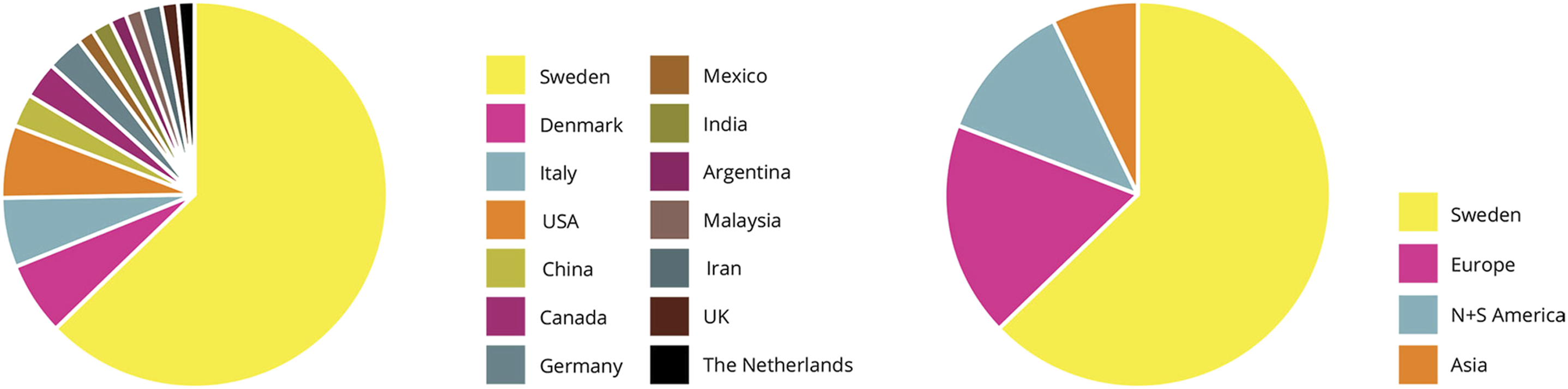
D! got off to a flying start in 2008, immediately gathering around 20 diverse and highly-qualified doctoral candidates. Additional doctoral candidates joined each year, with about 30–50 active at any given time. Participants in D! represented diverse specializations spanning from conventional industrial design for the automotive industry and service design within the health sector to aesthetic experimentation in material science and ‘norm-critical’ design closer to art and cultural studies (Figure 1). Diversity of background knowledge was also a factor, as doctoral candidates came from varied disciplinary, geographic and cultural backgrounds (Figure 2). Many would be the only design researchers in their institution, or they would be part of small or new research units with limited possibilities to engage in advanced ontological, epistemological or methodological development. In D!, they were not alone in such advanced discussions, in relation to which they were asked to position, articulate and question their own research as well as that of others. Their common denominator, through D!, was a faculty, a program and cohort peer-learning through which to interrogate and deepen their understanding of ‘design.’ Disciplinary backgrounds of the doctoral students participating in D! (reprinted from Helgeson, 2014). Representing a wide geographic spread, this graph accounts for where doctoral students came from prior to enrollment in their respective Swedish universities through which they participated in D! (reprinted from Helgeson, 2014).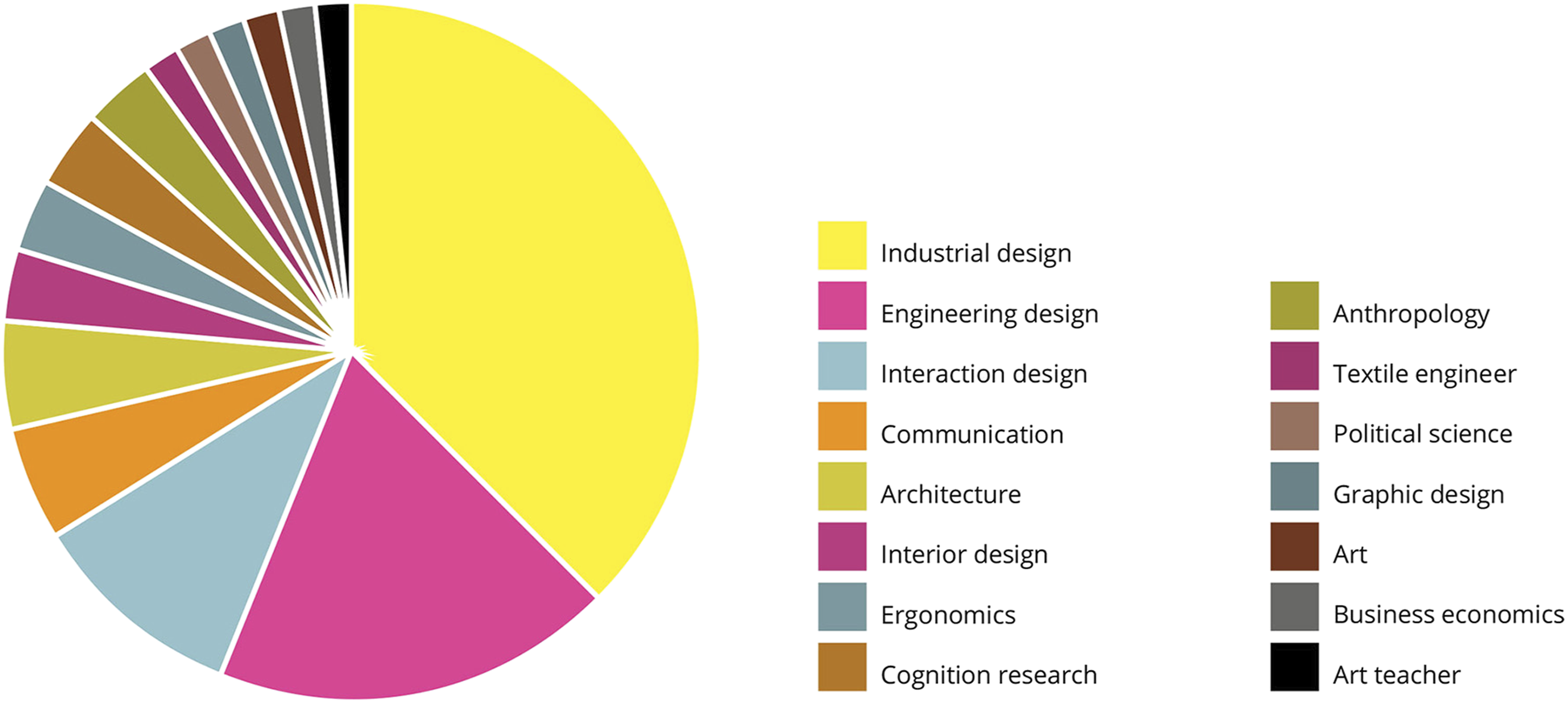
When D! ended in 2015, after 8 years, it had contributed to guiding around 30 candidates to completion of their doctoral degrees within the funding period and 42 to date. Within an account of the completed theses (see Appendix), titles reveal the wide diversity of research topics. While a longitudinal study of alumnus career development is beyond our scope here, we note that the professional accomplishments of alumni are considerable, with a number holding senior positions and all in positions that are related to the subject of their completed theses. The subsequent accomplishments of alumni arguably reflect knowledge and experience of design and design research as evolving, heterogeneous, multi-sectoral and transdisciplinary. 6
Returning to the original funding application, D!‘s negotiation of its position within a changing knowledge landscape is evident. On the one hand, design research is described as a specific discipline in need of its own basic research. On the other hand, the application claims that the only way “to establish design as an academic discipline,” is by “relating to both other disciplines and to the specific ability of design practice to handle complex and dynamic problems and possibilities considering and bringing together technical, social and aesthetical aspects” (Kungliga tekniska högskolan, Application, 2007: 4747). The positioning of D! reflected not only the neo-liberalizing dynamics and tropes of the time that were transforming design and higher education – the hitherto “[l]ess noticed […] innovative ability of design” – but also historically and politically rooted ideals, with design in the Nordic countries having “a strong position in user aspects and participation” (Kungliga tekniska högskolan, Application, 2007: 4747).
The collaborative and distributed setup, including the spread of participants and the resulting pattern of infrastructure, followed from Sweden’s research and education policy that provides a relatively high proportion of funding allocated directly to universities (Zacharewicz et al., 2019), a policy motivated by a persisting, redistributive social welfare paradigm. The funding application not only relied on the idea of D! as a “democratic network,” with implicit references to visions of democratizing learning (Buchanan, 2001; Nowotny, 2003), but also built on more directly design-related ideas of social justice as a historically-grounded right to “useful and attractive products, systems and environments” (Kungliga tekniska högskolan, Application, 2007: 4747). The application here echoed the imperative merging of beauty and functionality “for all” as formulated in founding texts of Swedish Modernism by Ellen Key, Gregor Paulsson and Uno Åhrén et al. already in the first decades of the 20th century (reprinted in Creagh et al., 2008). With reference to these diverse narratives, the D! initiative aimed to negotiate certain historical-ideological interpretations of practice-based design research with emerging ideas of innovative, networked and participatory frontier research. 7
It is at the crossroads of neo-liberal entrepreneurialism and welfare-related ideas of participatory democracy that we situate our story of D! Structured as a platform or program of activities, it negotiated a balance between achieving more critical mass through centralization and facilitating horizontal circulation of knowledge and participants across a field of design that was spread institutionally and geographically across Sweden. Indeed, this balancing act within D! could be seen as a reflection of the contemporaneous pan-European synchronization of curricula and prioritization of mobility. In the Swedish context, the D! program constituted a key element of larger investments in specific knowledge domains as well as in the format of ‘the research school,’ with several related initiatives to follow, including the National Research School in Fine Arts, active between 2010–2014 (Gislén, 2015), and the National Research School in Architecture ResArc (2022) ongoing since 2012. As for higher education in design, art and architecture, these investments aimed at strengthening national competitiveness and democratic ideals in one go.
In the following, we will approach the idea of D! as an epitomizing ‘thirdness’ in particular ways. On the one hand, we will look closer on how the network structure of D! bound together a field of design research education throughout Sweden, providing a common ground across institutions and regions to be surveyed and navigated through mechanisms of collaboration and mobility. On the other hand, we will review how D! facilitated critical engagement with the epistemological complexity and topographical heterogeneity and ask to what extent the program resisted becoming a homogenizing entity with defensible boundaries. These points are elaborated below in two parts, in which we first lay out and elucidate how the D! structure materialized and evolved. Further, we disclose and draw together some accounts from D! alumni, which might – if not contradict, then at least further complicate – a synthetic and stable notion of ‘thirdness’ of D! as it evolved and was experienced in between the Welfare-ist and entrepreneurial shores of design research education.
The D! program and course structure
D! needed to account for the particular geographical and epistemological dispersal of design and research in Sweden. Relevant existing expertise, resources and infrastructure was spread across regions, universities and sectors (including, for example, in research institutes, companies, cultural and other organizations). The initial challenge was therefore to respond to heightened and high-level calls while at the same time building up from an existing situation that was dispersed and uneven, in which there was need and potential for unformulated or suppressed positions to emerge. In a retrospective account of their own experiences of setting up D!, its founding director Peter Ullmark and steering group member Pelle Ehn (Ehn and Ullmark, 2017), comment on the high expectations of design research at the time. In their recollection that politicians and industry were hoping for “breakthroughs,” we might hear the echoes of the millennial rhetoric and the increasing valorization of research and innovation paradigms. They also identify a new kind of call for “creative input to the strategic discussions of our time” (Ehn and Ullmark, 2017: 77), which resonates with the notion of ‘societal challenges’ rising at the time within EU policy discourse and funding priorities.
These were conditions and forces clearly reflected in the D! ‘program,’ a term we use to characterize the relatively loose curricular framework offered by D! that complemented other doctoral study options within universities. In Sweden, a total of 240 study credits are required to complete a doctoral degree 60 of which normally should be earned through courses. For participating universities, the D! program offered additional credit-bearing study options through the thematic Basic Course in Design Research (Figure 3). Participating students joined for 2 years, during which attendance in eight of the intensive periodic colloquia comprising the Basic Course fulfilled a fourth of their total required course credits. Thus, beyond the supervision and courses provided by their own universities, D! expanded the options that students could negotiate within their individual study plan. The “archipelagic” structure of D! describing a 2-year cycle of the program.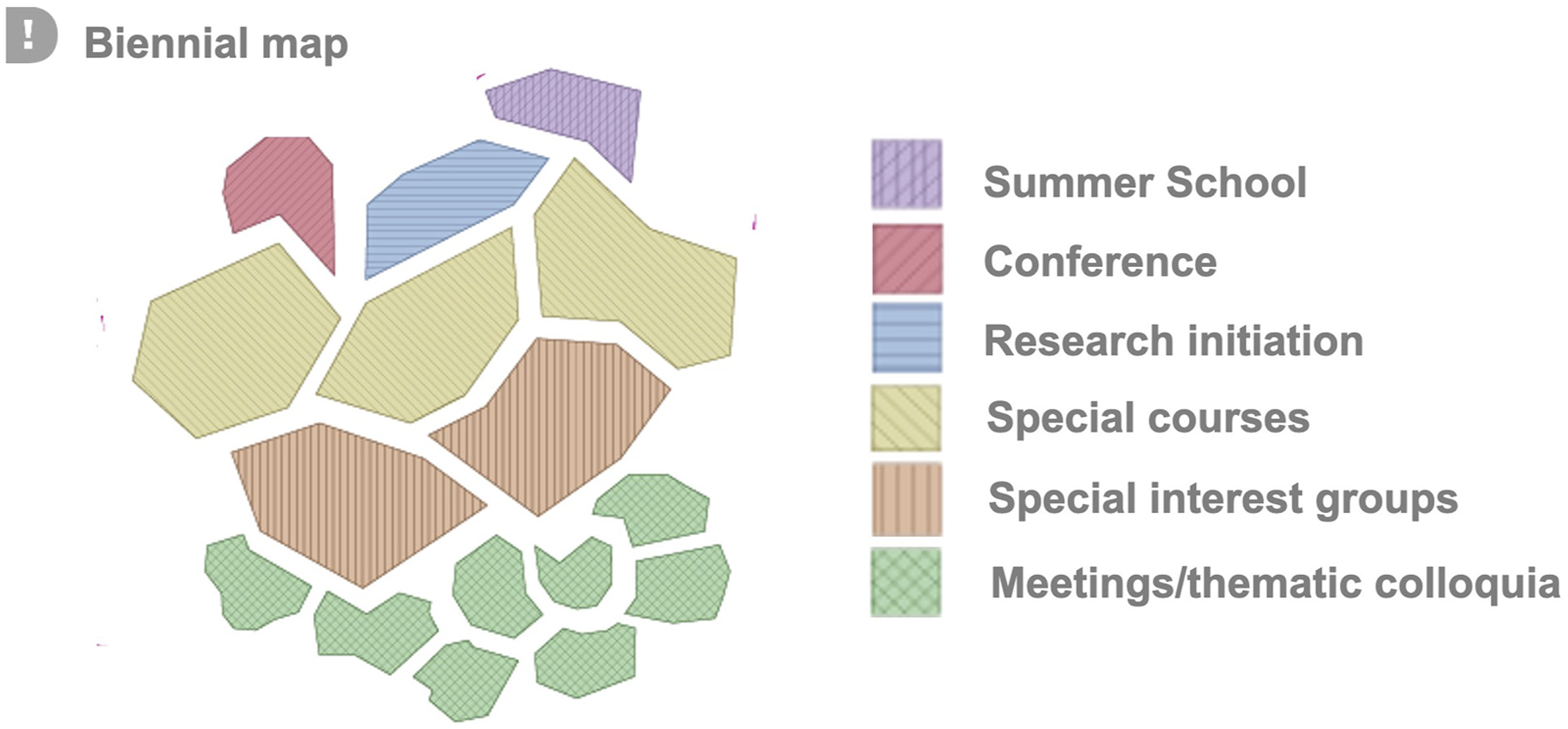
Over D’s 8-year existence, a total of 36 colloquia were held within the Basic Course (Helgeson, 2014). Each colloquium lasted two to 4 days and was hosted at and organized by one of the partner institutions spread around the country. Each thus departed from the special expertise, local situation and research challenges of the host institution. While all colloquia included lectures, readings, seminars, excursions, workshops, and student presentations, each had a different theme and often a distinct pedagogical approach depending on the host. Themes and hosts were determined on a termly or annual basis, thus new proposals or protagonists could be incorporated over time, for example reflecting natural turnover within D! and university faculties or new research collaborations or regional developments. Through its program setup, D! thus acted opportunistically and interactively to navigate the dispersed, uneven and evolving landscape.
For D! and its students, this meant that the subject positions in the design field also varied, emerged and evolved. For example (see Helgeson, 2014): the first colloquium was hosted by Malmö University and focused on participatory design; colloquium 13 at the Business Design Lab of the University of Gothenburg queried design as a ‘science of the artificial’; colloquium 25 at Linköping University explored relations of design and cognitive science; ‘futures studies’ was the theme of colloquium 29 at Umeå Institute of Design, and; colloquium 31 themed ‘the material turn’ was hosted by the Swedish School of Textiles at the University of Borås. In addition to the colloquia, special interest groups (SIGs) and research initiatives were self-organized by doctoral students. D! also promoted further training and networking opportunities through the bi-annual research conferences and summer schools of the affiliated Nordic Design Research (NORDES) network. Thus, participating students were introduced directly to both the breadth of the design field and to various specializations, as well as to related theoretical and methodological territories, and several research communities.
Not only did subject-related knowledge vary but also sources of knowledge. Within colloquia, active learning meant that students also brought knowledge produced within their other relevant experiences and their own research into activities such as presentations, seminars and workshops, in which they taught others as well as learned in a collaborative way along with other students and faculty. 8 Nor were colloquia confined to university premises, as pedagogic activities included workshops in other local organizations, which ranged from public authorities and cultural institutions to manufacturers and design consultancies, and site visits to relevant urban or ecological places and local communities. For example, exploring ideas of design practice and ‘the professions’, participants engaged with design managers and production staff in colloquium 16, which took place at Materia, a leading office furniture firm in the town of Tranås within the carpentry region of Sweden. Visiting Goldsmiths, University of London, participants in colloquium 20 engaged directly with sources of research in “critical design,” whereas colloquium 22 addressed design in “complex environments” with some activities located at Backa Kulturhus, a suburban culture center in Göteborg. Thus, design-relevant knowledge was exposed as context specific and as situated in a variety of ways.
Ehn and Ullmark retrospectively articulated design research pedagogy in D! in terms of a practice-based and arts-oriented learning-by-doing, based on a Deweyan premise of everyday practical experience, creative processes and controlled inquiry. Their foundational narrative was underpinned by trust and an ideological view of education in society, in which learning experience “generates a degree of felt wholeness and aesthetic quality that makes it possible for the individual to participate in creative democratic practices” (Ehn and Ullmark, 2017: 77–78). Although the remit of D! (and thus also our scope here) focused on doctoral candidates, their idea of the experiential impacts of such education included not only doctoral candidates but their supervisors and colloquia hosts as well as their affiliated research cultures. Faculty members in D! were “traveling with the PhD student” along their learning journeys, such that senior academics should not determine the destination but rather guide the tour “so that important places and experiences are not missed” (Ehn and Ullmark, 2017: 85). In their notion of co-learning and ‘traveling with,’ they were however also careful to emphasize that, while a conversational and reflective approach was necessary, it was not sufficient for a design research education that also had to claim some independence from market-oriented modes of knowledge production within the Swedish historical context discussed above. To more fully address our starting questions about what is entailed within design research education conceived in terms of ‘thirdness,’ we delve further below into how this ‘travelling’ was experienced and negotiated by doctoral students.
Accounts of travel
As D! drew to a close, we were keen to better understand how the programmatic and pedagogical learning journey had been experienced from a doctoral student’s perspective. From the start, the D! program was a clear alternative to other possible models – it was set against the prior situation of more narrowly specialized versions of design scattered within diverse faculties and cultures across the country, and it was in contrast to a top-down and centralized disciplining pediment in which design might be treated as unified and bounded. Upon reflection, the metaphor of an archipelago comes to our minds, as D! seems legible within our experiences as an itinerary through a series of “mobilities and moorings” (Hannam et al., 2006), many of which appeared on the horizon as we moved closer, taking shape as local faculty extended their hospitality and formulated their position in relation to design research education with us. Naturally, students would have their own experiences, having participated in a subset of D! activities and integrating this with the other environments and activities within their own research.
To expose and explore student experiences, a final colloquium, themed ‘Design Disseminations’ was held in 2015 in conjunction with the large international Gothenburg Book Fair. Two public focus group discussions took place there, each including four D! alumni and with one still-enrolled student acting as moderator. Loosely framed around notions of ‘innovation’ and ‘experiment,’ both discussions soon came to circulate around more complex issues. Recordings of the focus group discussion were later transcribed and analyzed by us, with selected quotes translated for purposes of this paper. Since the D! course selection and sequence would have been different for each student and, in addition, integrated differently by each into the overall and extended arc of their doctoral experience. We were mainly interested in how alumni might position themselves in relation to ‘design’ and ‘design knowledge’ and, further, how they might articulate their relation to others. Arguably, the ability to do this is necessary in any doctorate, though we attended keenly to how the ‘traveling’ sensibility and pedagogy of D! might somehow surface within their experience.
One relevant theme within the alumni discussions was the difficulty of trying to pin down the nature of design and design knowledge. An alumnus in industrial design seemed to be grappling with this, expressing a wish for “more designated orientations, and above all that they become more specialized.” This kind of insecurity also surfaced regarding the position of design, including ‘core’ competencies and skills. Yet the alumnus argued that there are contradictory risks: on one hand a risk in disregarding valued traditional skills, but also “the risk […] that you lose quite a lot if you build on the traditional role of the designer.” Evident in this articulation is an awareness both of the indefinite boundaries around design and the stakes involved in setting limits or centering a particular definition.
Further relevant issues emerged within a discussion concerning knowledge claims – including dilemmas of disciplinarity and territorialization. One alumnus referred to the often fixed roles and hierarchies in R&D settings, in which technological competences are often prioritized: “What happens if I allow for the designer to share his or her ways of working in a more technical context? What kind of knowledge will emerge and possibly also what kind of conflicts and frictions in such a situation?” – alumnus in industrial design
His own research experimented with the integration of design at an earlier stage in R&D processes, in the process of which he discovered the need to reconfigure the settled power dynamics between disciplinary roles and knowledges in R&D. As a further consequence of this redistribution, he recommended that argumentation must be one of the core competences of designers, implying particular changes in design education and training. Argumentation, within the ensuing discussion, could be understood as articulation of one’s own position as situated within a heterogeneous context and as informed by self-reflexivity about values and power.
Further ways of articulating the need for positioning and reflexivity emerged. In one of the focus groups, an alumna stated: “The challenge is not only to identify what design knowledge consists of but to interpret in relation to a specific experience […], and there is a role there for the designer; how do I interpret this, what does this mean in a wider setting?” – alumna in service design
According to her, the key was to remain “in-between” and, on the basis of this, propose possible significations. Several of the other alumni also spoke about a kind of interpretative ‘in-betweenness,’ also in terms of engagement over time. Drawing upon a concept from feminist technoscience, one expressed this as a personal commitment to “staying-with” and within a specific context. In relation to an ever-changing world, rather than traveling, the establishment of a standpoint gains in importance. While orienting to “an area of curiosity rather than a question,” as one of the alumni put it, the idea of being exposed to a field of forces and “living with” a context over time was considered to be crucial. An alumna associated this with the notion of relevance: “We actually need time […] ‘cause we wondered ‘how could this stay relevant?‘. Apparently, it did stay relevant and we still get invitations to set up [our workshop], and that of course also gives insights into how the living-with-technologies changes, […] so if you stay with something, you can see change over time.” – alumna in design-based media and communication studies
This reveals sensitivity to positioning both in terms of self-reflexive relation to existing roles or hierarchies within a context. Further, it expresses this kind of positioning in terms of proactive and persistent activity, including through direct engagement over time in a changing context.
In these alumni articulations, the difficulty of pinning down design was met neither with efforts to define and defend containing boundaries nor with attempts to expand and replace existing or other knowledges. There were traces of insecurity that these were not given and might not be possible to provide. Instead, and beyond this insecurity, alumni revealed their sensitive and reflexive positionality to the situatedness of design knowledge and the stakes involved in such situations. Indeed, this seemed to have informed their epistemological and methodological choices as researchers, such that negotiating these dynamics were engaged directly within research work through critical observation and through active intervention within contexts across various timescales.
In both focus groups surfaced further issues related to knowledge-production with others and beyond academic contexts. Alumni working with participatory design at the intersection of high technology and folk crafts, for example, argued for a relational view of knowledge production within rural communities. This alumna, who had defended a co-authored cross-disciplinary thesis together with a fellow candidate, expressed this in methodological terms: “We had our method, it turned out, to take what is at hand and put it into new relations [and] we realized that this way of working, we could find support for that in literature […] and we articulated this [as] ‘patchworking ways of knowing’; […] you take a patch and you put it together; in the overall pattern you can so clearly see that a thing is both aligned and separate […] and that becomes this idea of how the world is always relational [and that it] can always be put together differently.” – alumna in design-based media-and communication studies
Not only had the venture of co-authoring a doctoral dissertation actualized questions and propositions about alternative ways to stage knowing activities. It had also extended the very inquiry to include questions about the wider context within which their research evolved. Within their practice-based research, “patchworking” emerged as a concept adapted from literature to address what one of them explicitly addressed as “the power issue” at stake among the various knowledge domains, sources and parts of society pertinent to their work. Specifically, they developed the concept further to articulate how, through engagement in participatory and collaborative ways of working, these might be put together alternatively and in new ways. From their contribution in the focus group, a strong argument was made that a notion of “juxta-positioning” was more suitable for such contexts rather than assuming a symmetry or smoothness that might be implied by notions such as co-learning or co-traveling.
For several in the focus group, including those mentioned above, design research involved staging collaborative and participatory events, which was understood as a move out of the protection and privilege of conventional research environments. In relation to this move, a point was made in the focus group about the interpretative prerogative implicit in ‘design.’ For example, an alumna in information design, who studied innovation labs in industry as “emergent places,” emphasized the importance of acknowledging stories and taking story-telling seriously. For her, this brought the researcher “very close to the user,” in her case the often voiceless “worker.” This proximity or intimacy was not simply about generating ideas alongside or collecting data about the user, but also about recognizing knowledge as produced within other significant situations and sources, some of which would have a disturbing or even “explosive force.” In contrast to more corporate contexts for innovation, she argued: “I believe that the places that emerge, those created by people themselves for this explosive force, that is, the emergent places for innovation, those are supposedly more threatening for the companies than the ‘innovation labs,’ which are disciplining in a different way as they are part of the story we want to present of our company as successful and innovative. But then there is a real innovative power in those [emergent] places, as they are threatening.” – alumna in information design
Discussions further explored the role and responsibility of the design researcher when knowledge production was conceived as beyond the remit of a single individual and designed research environments – in the case of this alumna, in ways beyond that which directly challenged (“threat [ened]”) the idea of knowledge as production. Evident in this and other perspectives in the focus group, situatedness and positioning regained significance outside of academic disciplines and contexts, and evoked ethical as well as political concerns and tensions.
Through these brief excerpts of alumni discussion, glimpses of a D! experience and ethos might be discerned. These glimpses surface the problematics of disciplinarity, including variations of cross-, multi- inter- and trans-disciplinarity, which resonate with the multi-sited and transitional set-up of D! Querying the boundaries and hierarchies of disciplines, societal sectors and social groups, the alumni surface the effects of these once understood as indeterminate, as research topics, or topoí, in themselves, with boundaries that may be transgressed. In the terms of our own archipelagic imagination of D!, the student researcher is revealed neither a docile passenger nor even an equanimous travel companion – rather they articulate and argue, they are migratory agents that cross borders and reroute their travel and ours.
The alumni accounts exemplify an explicit attention to the power dynamics of knowing practices. In retrospect, perhaps the D! experience conceived as ‘travelling,’ ‘mobilities and moorings’ conveys a sensibility that is too flat, smooth and predictable. Alumni accounts reveal an awareness of the exposed role of the design researcher in having to negotiate the relationship between different knowledge paradigms, which are sensitivities also inherent in the piecing together of learning experiences through the D! program. There are also glimpses of situatedness and positioning as a pervasive issue in both their learning experience and as a topic in their design research, which we might articulate within the terms of our interpretive lenses here as the development of a territorial and transversal awareness. The student researcher’s role is revealed as not only as that of an interdisciplinary traveler in-between differently situated knowledges but primarily as an active agent, criss-crossing and intensifying borders and limits between science and the socius, aesthetics and the political.
Discussion: In open waters
By reflecting upon design research education in terms of ‘thirdness,’ it has become evident to us that change and expansion within academia requires us to critically rethink issues of territoriality. The incorporation of art and design within higher education institutions involves much more than identification of knowledge foundations and incorporation of research skills, whether these are seen as coming from within or outside the discipline. Beyond these kinds of disciplinary concerns, the stakes are high for institutions navigating the contemporary ‘knowledge economy.’ Art and design have become a kind of ‘poster child,’ backed by a lot of hope (and sometimes resources) in initiatives to bridge the ‘gulfs’ between silos and cultures in the higher education system. An expanding range of prefixes (multi-, inter-, trans-, etc.) has helped to draw attention to the borders and abysses, to the spatial and hierarchical dimensions of relations “between and across.”
Critically examining these relations through conceptualizations of ‘thirdness,’ we can better articulate the challenges for design research education. For one thing, the challenge is not only about knowledge production – whether conceived as knowledge of the discipline or of relating between disciplines – it is also and unavoidably about relating to the positioning and politics of knowledge more generally. Further, while it may be evoked as a mere buzzword in university communications or in a technocratic sense by managers seeing to ‘join up’ and integrate the university, design researchers and research students must engage with ‘thirdness’ beyond the hype to the knowledge work involved in a radical onto-epistemological “turning astride.” This dimension of knowledge work is perhaps not always made explicit, indeed it may well be that there is less investment and commitment below the surface of institutions into a serious and reflexive remodeling of academic power geometries. Nor is this dimension easy to grasp within design research education, especially for doctoral candidates.
The case of Designfakulteten, or D!, offers an example of a deliberate attempt to constructively stage and institute reflexivity regarding ‘thirdness’ in the context of high-level demands and desires for design research education. Rather than a definitive response to an explicit problem, D!‘s evolution can be characterized as ongoing and unsettling processes of questioning “in-between” within but also well beyond D! itself. In the Swedish context, D! was situated in relation to multiple and perhaps incommensurable forces: it was part of high-level political investment in innovation and competitiveness; yet, it relied on welfarist ideas of distributed agency and situated forms of learning as fundamental to democracy, and; it unfolded the fluid and turbulent aftermath of the millennial moment. Within this ambivalent and dynamic context, the D! learning experience was inevitably more complex than a straightforward knowledge journey or ‘traveling with.’ Several of the participating doctoral candidates in retrospect shared accounts of their D! experience as a kind of political awakening, including a positioning of both their design practice and their knowledge work in relation to disciplining powers. The deliberate distributed setup of D! was important, as it exposed a large extent of the design field not only in geographical terms but also in terms of the ‘agitated’ borders and cultures within and beyond disciplines. Indeed, this exposure is significant for design in particular, given contemporaneous and enduring debates over design in particular as a fundamentally open and even “nomadic” field without a place proper or topic of its own (e.g., Dilnot, 2013). In the case of D!, thirdness was not just ‘a clever trope,’ but a cultural and spatial figuration to be situated, tested and tried out again and again, in different settings, in relation to different edge conditions or disciplinary shores. Rather than an agile streamlining or compromising in-between, D! provided openings to explore a field of tension that demanded what one of the D! candidates would describe in Harawayan terms as “staying with the trouble,” or repeatedly returning to the trouble, all in order to propose “a needed third story, a third net bag for collecting up what is crucial” (Haraway, 2016: 55).
The case enables us to reconsider not only the often-trivial positioning of art and design research as a cultural bridge or productive middle ground but also, and in more concrete terms, to problematize the often-superficial harmonizing policies that dominate current higher education discourse. In Sweden, as elsewhere, such policies include the educational reforms involving formalization of vocational education including introduction, through the Bologna process, of third-cycle doctoral degrees. In actuality, formalization was not merely an administrative procedure – in determining levels and types of degrees, territorial struggles involving disciplinary knowledge claims unfolded, as some were prioritized and others shrunk or marginalized. With its mandate for design research education, D! conceived a particular strategy in relation to the dynamics of disciplinary territorialization. Itself an offspring of the Bologna process and spurred on by the government initiated ‘Design Year’ to stimulate business and innovation, D! can be seen as an exponent of a hurried and entrepreneurial thirdness specific to the post-modern “age of delegitimation” (Lyotard, 1984), a ‘start-up’ kind of thirdness bound to perish.
Yet the D! experiences as expressed by alumni were more complex, most notably revealing ways that we can understand or explore third space as a liminal passage for dislocation and transformation – as an instance of an educational terrain in the process of re-territorialization. This is also the reason why we have chosen to describe the pedagogical logic of the D! structure as archipelagic rather than holistic, and the particular mobility in D! as transversal rather than transdisciplinary. This said, we want to stress that D! is neither an ideal nor a model, but rather a topos that makes visible and tangible also the extents and edges, shallows and reefs of design research education, including the risk of being stranded in “defensive insularity” (Tonkinwise, 2017: 30). Whether consciously shaped or evolving incidentally, the archipelagic curriculum and governance of D! supported a shift away from an understanding of design research and research education as merely complying with compromising expectations and as merely instituting the start-up idea. Evading the traps of insularity and wholesale rejection of everything academic, D! instead unfolded as a third space based on continuous displacements and consideration of the itinerant, the relevant and that which is juxta-posed.
As the end of its time-limited funded period approached, we and many others associated with D! sought and proposed new governance and resource models. One particular and insurmountable obstacle proved to be the increasing competitiveness and the rise of ‘profile funding’ in our higher education institutional landscape. For D! university partners, this appeared to manifest in building own, separate and differentiated brand identities. For associated supervisors and faculty, it meant rapidly increasing workloads at the same time as the rise of performance-based metrics were often premised on building expertise, structures and careers inside rather than across universities. This meant that, while still attracting a steady stream of new PhD candidates, D! had to cease its operations and cancel its moorings.
What the revisiting of D! brings, therefore, are not specified lessons, but an understanding of the historical repositioning of design research education and potentially also of its continuing displacements within the university system. In relation to our starting questions, we have developed a particular argument about what design research education in terms of ‘thirdness’ can entail, and some of the implications in the turn toward design within the wider knowledge landscape. First of all, what we have tried to highlight through the notion of ‘thirdness’ is the possibility within design research and research education to relate critically to narratives of disciplinary knowledge cultures, to consider how these might be reflected in pedagogical policies and instituted through educational programs. Secondly, what we also have stressed is the necessity to approach research and research education from a cultural point of view, with a sensitivity as concerns cultural differentiation, transformation, and hybridization. Lastly, what has also become clear to us in retrospect, is the importance of our own critical institutional practice, not the least the revisiting and historical contextualizing of those initiatives that can point the way towards profound and recursive structural change.
Concluding remarks
Having seen the light of the day around the time of 2008 financial crisis, D! ended its activities by the end of 2015 around the time of the so-called European ‘migrant crisis,’ culminating in November, and the Paris Agreement, adopted in December. Over the course of the 7 years that have passed, other major societal challenges have emerged such as ‘post-truth’ politics, the Covid-19 pandemic, intensifying environmental crises and outbreaks of major military conflicts. These have continued to radically affect our views on design research and, indeed, on design research education. And so the need is still there: If at some time along the course of an academic career, we should be able unconditionally and attentively to explore not only the disciplinary mainland, but also the depths, shallows and reefs of a field, it is in research training.
Today’s design discourse is, however, more critically and ontologically concerned than a decade ago. Ontological challenges and changes within the knowledge landscape are evident within universities and beyond, for example in some of the new activist-oriented interest groups emerging at research conferences and in sharply themed publications. For example, articulations of ‘more than design’ – whether through engagement with “decolonizing” (Mareis and Paim 2021; Tunstall, 2023), “ecologizing” (Ávila, 2022; Forlano, 2017), or “politicizing” (Keshavarz, 2018; Von Busch, 2022) – are profoundly unsettling our Swedish and European design research landscape. Openly contesting binary or reactionary disciplinarity, these articulations exemplify not only changes in the knowledge landscape but constitute action spaces for profoundly and practically engaging with cultural reformation. We see the D! story told here as just one among many such mobilizing design research platforms that can signal some prerequisite qualities necessary for a wider ‘post-normal’ shift within and across academia. We argue specifically here that these are not necessarily bridging, harmonizing and integrating qualities, but qualities that make us sensitive to the foundational conditions, tensions and limits of knowing.
Through our account, we have aimed to situate the development of design research and research education in relation to an emergent, explicitly relational and therefore also discursive knowledge paradigm, challenging given epistemological matrices and recognizing instead the sui generis puzzles generated by all knowing endeavors. The main challenge today, not only for design research and research education, but for the entire creative and academic field, is how to enact ‘‘flection’ despite-all, in face of the ‘wickedness’ of our times, across established borders and frontiers. What we also self-critically point out is the ambiguity and struggle of this kind of knowledge work, the lingering fear of unsettling familiar path dependencies and of losing the perceived privilege associated with the status belonging to a particular cultural enclave; a fear that tends to lock potentially creative practices onto an originary past. While advantaged, context-specific and, furthermore, limited in time, we believe that the experience of D! as retold here may contribute to a critical discussion of how design researchers-to-be, through their specific thirdness, might contribute to the formulation of knowledges that (paraphrasing Bhabha) require our topical scholarship and technique but demand that we leave behind our insular fear of open waters.
Supplemental Material
Supplemental Material - Stories from third space — A case and considerations of design research education from a Swedish vantage point
Supplemental Material for Stories from third space — A case and considerations of design research education from a Swedish vantage point by Maria Hellström Reimer and Ramia Mazé in Arts and Humanities in Higher Education
Footnotes
Acknowledgements
This work would not have been possible without D!, the Swedish Design Faculty for Design Research and Research Education, and we gratefully acknowledge all the doctoral candidates and our former colleagues, especially former Directors Peter Ullmark (2008–2011) and Bo Westerlund (2012–2013). We also acknowledge the universities within the D! network, those that hosted colloquia, and, most importantly, the KTH Royal Institute of Technology in Stockholm for hosting the funding bid and the administration of D! for all those years. Thank you especially to the doctoral student moderators and alumni participants in the Gothenburg Book Fair event in 2015.
Declaration of conflicting interests
The author(s) declared no potential conflicts of interest with respect to the research, authorship, and/or publication of this article.
Funding
The author(s) received no financial support for the research, authorship, and/or publication of this article.

Supplemental Material
Supplemental material for this article is available online.
Notes
Author biographies
References
Supplementary Material
Please find the following supplemental material available below.
For Open Access articles published under a Creative Commons License, all supplemental material carries the same license as the article it is associated with.
For non-Open Access articles published, all supplemental material carries a non-exclusive license, and permission requests for re-use of supplemental material or any part of supplemental material shall be sent directly to the copyright owner as specified in the copyright notice associated with the article.
