



Abstract
The reform landscape of teacher education in the United States is both complex and rapidly evolving, and reforms to teacher education have emerged as a contested site of struggle between diverse political and ideological camps in education. In this qualitative multiple case study, I investigate the extent to which the underlying logics of these reforms to teacher education shape teacher education programs as organizations. Drawing on semi-structured interviews with 74 program leaders, teacher educators, and teacher candidates across three U.S. teacher education programs, I find that each program is organized around multiple competing reform logics. Each program draws upon two “logic constellations”—democratic professionalism and corporate marketplace—which both shape and constrain programs’ enactment of their organizational missions.
Keywords
O
Policy implementation scholars have long argued that educational reforms often fall short when they focus on surface-level, structural shifts, rather than deeper shifts to the “shared norms, knowledge, and skills of teachers” which underlie those structures (Elmore, 1995, p. 26). This literature suggests that reforms which fail to attend to the organizational contexts in which teachers work, as well as the broader professional, field-level norms that guide practice, often struggle to take root (e.g., Cohen & Ball, 1990; Cuban, 1990; Datnow, 2020; Little, 2003). Thus, reforms require parallel transformations to the underlying cultural conditions that sustain them to create lasting change. Yet, conventional approaches to teacher education reform continue to emphasize shifts to program structures—for example, calling for particular program models, such as teacher residencies (Guha et al., 2016; Papay et al., 2012) and Grow Your Own programs (D. S. Edwards & Kraft, 2025; Gist et al., 2019); changes to assessments (Hutt et al., 2018); and shifts in the structures of teachers’ fieldwork (Goldhaber et al., 2021)—without necessarily considering the cultural conditions that may mediate their enactment. As a field, we do not know the extent to which structural reforms in teacher education might also demand shifts in the deeper cultural beliefs and norms for those within teacher education programs to take root.
To grapple with this puzzle, I follow the tradition of institutional theorists, who argue that whether or not reforms “stick” depends not only on shifting organizational structures but also on transforming the deeper belief systems and cultural institutions that shape a given field, such as teacher education (Colyvas & Jonsson, 2011; Cuban, 1990; Meyer, 1977; Meyer & Rowan, 1977). From this perspective, what matters for teacher education reform is not simply which new program models are introduced, but whether these initiatives shift the deeper, taken-for-granted cultural narratives of teaching and teacher education guiding the field. Teacher education programs operate within a contested policy environment with competing pressures that can pull programs away from their espoused missions (Boyd et al., 2008). Within this context, programs and the actors within them may encounter multiple, potentially competing institutional logics—that is, deeply embedded cultural belief systems and taken-for-granted assumptions about what constitutes legitimate and effective practice (Thornton et al., 2012). At the organization level, teacher education programs may be guided by particular logics—for example, those emphasizing efficiency and competition, versus those emphasizing professional expertise and standards—but actors within programs may be responsive to other logics in their work. How individuals and programs take up such logics matters because logics set the “rules of the game” for teacher education (Thornton & Ocasio, 2008, p. 112); they can determine which goals are valued, which forms of knowledge are privileged, and which practices are seen as legitimate. Understanding the logics guiding teacher education programs can therefore help illuminate why teacher education reforms have been slow to transform the field.
This paper grapples with the puzzle of why teacher education reforms may fail to take root by considering the extent to which the competing logics driving each of these reform agendas compete and/or coalesce to shape teacher education programs. I study these dynamics through a case study of three teacher education programs, each aligned in its mission and program structure with a particular reform agenda in teacher education. By studying the logics guiding each program, I investigate the extent to which program structures are aligned with the deeply ingrained cultural beliefs and norms guiding each program. More specifically, I ask: To what extent, and in what ways, do teacher education program leaders, teacher educators, and teacher candidates across the three studied programs draw upon institutional logics to rationalize their work? By considering how teacher education programs respond to competing institutional demands, this study provides a more nuanced understanding of why reforms in teacher education have been slow to transform the field. This study offers several important contributions to the field. First, this study offers the first in-depth qualitative study of a for-profit teacher education program in existing scholarship, to my knowledge, shedding light on how the contested institutional landscape of teacher education has paved the way for new organizational forms in this critical sector of the education system. Second, the paper theoretically extends institutional logics by applying them to the underexplored domain of teacher education and by exploring how individuals’ positions and identities mediate their alignment with particular logics. Together, the findings suggest the need for an institutional perspective to better understand how deeply ingrained beliefs and norms within the education system both enable and constrain the possibilities of transforming the teaching profession through policy.
The Reform Landscape of Teacher Education
To situate this work, I briefly describe the four respective reform agendas in teacher education: professionalization, deregulation, accountability, and democratization (Cochran-Smith, 2001; Cochran-Smith, 2021b; Darling-Hammond & Berry, 1995; Milner, 2013; Zeichner, 2006). Each of these reform movements is organized around distinct theories of change for how to structure teacher education programs and calls for differing stakeholders to be involved in the work of teacher education. I use the term “reform agendas” to refer to the field-level policies, accountability systems, funding initiatives, and broader professional discourses that characterize the field of teacher education policy. This environment is defined by both external policy pressures—such as state licensure and accreditation policies—and internal field-level movements that (re)define what counts as legitimate practice within teacher education. These dynamics jointly structure how programs respond to reform pressures and mediate the translation of policy into practice. Although I describe each agenda separately, they have co-existed with other over time. In some cases, multiple different reform agendas have coalesced—for example, the professionalization agenda has relied on increased accountability systems to ensure that teachers are held to professional standards. In other cases, these reform agendas have contended with one another—for example, the professionalization and deregulation agendas have largely worked in opposition to each other. The goal of this piece is to disentangle how different teacher education programs internalize, and potentially reconcile, multiple reform pressures.
In what follows, I briefly provide an overview of the major reform movements of teacher education, focusing on summarizing the underlying theories of change espoused by each reform agenda, and how it either overlaps with, or responds to, other reform agendas.
Professionalization Agenda
Calls to professionalize K–12 teaching emerged as a dominant thread of American education reform in the mid-1980s, following a series of major philanthropic investments by the Carnegie Corporation, Ford Foundation, and Rockefeller Foundation, among others (Labaree, 1992). These initial investments resulted in the historic publication of field-level reports by the Holmes Group and the Carnegie Task Force on Teaching as a Profession, and the creation of the National Board for Professional Teaching Standards (Labaree, 1992). Collectively, these initiatives were grounded in the theory of change that maintaining high standards for entry into the profession and investing in university-based teacher education is necessary to ensure that all students have access to high-quality teachers (Darling-Hammond, 1985; Grossman, 2008; Ingersoll & Perda, 2008; Mehta, 2015). Education scholars have argued for modeling teaching after professions, such as medicine or law, by requiring master’s degrees for entry into the profession to enforce common standards of practice (Grossman, 2020).
Reform efforts to professionalize teaching have historically focused on building the professional knowledge base for teaching (Shulman, 1986), controlling entry into the profession (e.g., through increased licensure and credential requirements), and establishing shared professional norms and standards of practice (Labaree, 1992). These efforts were codified in a range of state and national policy mechanisms, including the development of professional standards for teaching (e.g., the Interstate Teacher Assessment and Support Consortium [InTASC] standards), the creation of national teacher education accreditation bodies (e.g., the National Council for Accreditation of Teacher Education [NCATE] and the Council for the Accreditation of Educator Preparation [CAEP]), and the development of performance assessments for teacher candidates (most famously, the edTPA). While this emphasis on professionalization dominated the field through the early 1990s, the subsequent rise of market-based reforms in the education system in the 1990s introduced a competing reform agenda of deregulation: one that sought to loosen professional controls and introduce competition among the “marketplace” of teacher education providers.
Deregulation Agenda
Largely in response to these professionalization efforts, the deregulation agenda emerged in the 1990s and early 2000s to “break up the monopoly of the profession” (Cochran-Smith & Fries, 2001, p. 3). These reforms built off of the persistent public narrative of the public educational institutions as “failing” (Chubb, 2012) and positioned teacher education programs and teacher unions as central to their failure (J. Scott et al., 2016). The rise of market-based reforms in teacher education emerged as part of a broader shift toward privatization in the field, triggered by significant philanthropic investments and the creation of new private actors in the education space—most notably charter networks (J. Scott, 2009). Within this broader field-level shift, teacher education emerged as the “next frontier” for market-based reforms (Childress, 2016, p. 26). Market-based reformers argue that “opening the gates” into the profession and reducing barriers to entry is necessary to quickly fill teacher shortages and improve the quality of teacher education (Cochran-Smith & Fries, 2001). These market pressures are further compounded by growing teacher shortages and steep declines in enrollment across university-based teacher education programs (Engledowl & Rutledge, 2020). The turn toward deregulation aligned with investments in charter networks, which have historically relied on a greater share of uncredentialled teachers (Bodine et al., 2008). In this landscape, university-based teacher education programs emerged as the “scapegoat” for reform (Keefe & Miller, 2021, p. 39), largely in response to research which suggested that these programs were ineffective (Hanushek & Rivkin, 2006; Hess, 2001). This increasing focus on “efficiency” rationalizes a view of teacher education as a marketplace, wherein programs should compete for potential teachers.
This shift toward deregulation marked the introduction of new actors in the field of teacher education—most notably, alternative certification programs, such as Teach for America and TNTP—which have historically advocated for lowering the barriers of entry into the profession to address teacher shortages. Those calling for deregulation position state licensure and credentialing requirements as an unnecessary barrier to the profession, suggesting that they prevent high-quality teachers from becoming teachers (Cochran-Smith & Fries, 2001). Since the introduction of alternative certification programs, the landscape of such programs has continued to evolve. More recently, there has been a rise of what Cochran-Smith terms “new graduate schools of education,” or “nGSEs”: a new organizational form of teacher education, which is disconnected from the university and instead governed by private stakeholders. What makes nGSEs structurally distinct from previous private models of teacher education is that they can confer master’s degrees, despite being disconnected from universities (Cochran-Smith, 2021a; Cochran-Smith et al., 2020). The field has also seen the introduction of a rapidly proliferating new online, for-profit sector of teacher education (W. Edwards & Magill, 2024; Kirksey & Gottlieb, 2026). From 2010–2011 to 2018–2019, national enrollment in teacher education programs declined by 38%, even as enrollment in alternative, non-university-based programs grew by 76% (King & Yin, 2022). The majority of teachers in these alternative pathways are enrolled in for-profit programs, which are rapidly reshaping the teacher education landscape in the United States (King & Yin, 2022). This move toward deregulation has centered on goals of efficiency and competition and has been codified within state and federal policies, which incentivize competition among programs.
Accountability Agenda
Largely intertwined with both the professionalization and deregulation agendas, the rise of accountability reforms in teacher education gave rise to an accountability agenda, which has called for increased bureaucratic oversight and the use of measurable outcomes within the teaching profession and teacher education (Cochran-Smith et al., 2022). These shifts were emblematic of the expanded field-level focus on accountability in the wake of No Child Left Behind, and later by Race to the Top (Wiseman, 2012). The rise of high-stakes accountability policies in teacher education was part of a broader federal focus on “high-quality teaching,” which could be measured and consistently monitored through standardized field-level metrics (Lewis & Young, 2013). In this way, the professionalization agenda has intersected with the bureaucratization agenda, as one of the mechanisms the field has leveraged for codifying professional norms and standards has been expanded accountability systems. However, other reforms aligned with the professionalization agenda have also called for more field-initiated approaches to building professional networks (Grossman, 2020).
The accountability agenda has become institutionalized through a range of state and federal policies requiring that teacher education programs demonstrate their effectiveness through teacher-level outcomes—for example, the increased federal reporting requirements for teacher education programs (e.g., under Title II of the Higher Education Act; Lewis & Young, 2013). Teacher education programs were also a central focus of the Obama administration’s landmark Race to the Top initiative, which asked states to publicly report data on every teacher education programs’ effectiveness, based on their graduates’ impact on student achievement (Crowe, 2011). In one short-lived policy, Race to the Top even called for states to provide a ranking of teacher education programs, based on these achievement-based outcome measures (Von Hippel & Bellows, 2018). States have also developed state-level accountability systems for teacher education, which are commonly organized around assessing teacher education programs by their graduates’ value-added measures (Lewis & Young, 2013). Though there are some ways the professionalization agenda has intersected with the accountability agenda (e.g., through shared calls for professional standards for educators), the vision of teacher quality at the heart of the accountability agenda is in tension with the professionalization agenda’s vision. Whereas the professionalization agenda centers the complex practice of teaching, high-stakes accountability policies focus on the quantifiable outcomes of teaching—emphasizing bureaucratic compliance over a sense of professional accountability derived from within the teaching profession.
Democratization Agenda
Finally, those calling for democratization posit that teacher education programs must be re-structured to more democratically engage the diverse funds of knowledge of the communities that schools serve (Daniels & Varghese, 2020; Zeichner et al., 2015). Whereas the professionalization agenda has largely called for universities to lead the preparation of teachers (e.g., Darling-Hammond, 2005), the democratization agenda calls for engaging local communities in the work of teacher preparation, and re-structuring teacher education programs to work in more close partnership with local communities (McDonald et al., 2011; Zeichner et al., 2015). Central to these calls are epistemological critiques of whose voices have shaped teacher education, and criticisms of the professionalization and deregulation agendas. The democratization agenda calls for a move away from solely relying on professional expertise toward situating school communities as valid knowledge producers; however, some have called for bridging the vision of professionalization and democratization to prepare teachers as “democratic professionals” (Zeichner, 2020). One proposed structural approach to democratize knowledge in teacher education programs is to create venues for teacher candidates to be immersed in the communities within which they teach. Such “third spaces”—that is, “hybrid spaces [. . .] where academic, school-based, and community-based knowledge come together in less hierarchical and haphazard ways to support teacher learning” (Zeichner et al., 2015, p. 124)—reposition the community as experts. Existing scholarship has argued that leveraging community-based organizations for field placements may be one way to foster such third spaces in teacher education (McDonald et al., 2011).
Efforts to democratize teaching have been field-initiated at the program level (e.g., Philip et al., 2022) and have been codified and reflected in policy. For example, one can see the expansion of pathways such as teacher residencies and Grow Your Own (GYO) programs—that is, teacher education programs which aim to recruit and retain teachers from the local community—as emblematic of the democratization agenda’s focus on partnering with the community (D. S. Edwards & Kraft, 2025; Gist et al., 2019). Though there is wide variation in how residencies and GYO programs are structured, both are frequently designed as a lever to diversify the teaching profession (Gist et al, 2019; Shand et al., 2023). While GYO programs first emerged as a more grassroots initiative, more than half of the states had a policy to support the growth of GYO programs as of 2020 (Garcia, 2020). Similarly, one can see the rise of state teaching and teacher preparation Culturally Relevant and Sustaining Education (CRSE) standards as similarly aligned with this focus on integrating community knowledge into teacher education and professional development (Muñiz, 2019). Together, these efforts reflect field-initiated efforts to institutionalize partnerships between local communities and teacher education programs.
Theoretical Framework
At the core of each of these respective reform agendas are distinct normative ideas about the purposes of teaching and teacher education. For example, while the deregulation agenda calls for greater efficiency and competition to drive changes in the teaching profession, the professionalization agenda calls for centering practitioner expertise. In this way, each reform agenda is grounded in different underlying beliefs. However, each of these reform agendas is concurrently operating in and shaping the policy environment, which may create deeper, potentially conflicting, expectations for teacher education programs operating in the field. Although teacher education programs may seek to align themselves with a particular reform agenda, they are still situated within a landscape in which other visions of reform are competing for control over the field. The extent to which the ideas of a reform agenda penetrate the deeper cultural practices within teacher education organizations depends, in part, on how actors in those organizations navigate a complex environment with potentially competing ideas.
To understand the complex interplay between the competing reform logics in the field of teacher education and teacher education programs as organizations, I draw on institutional theory—specifically, the theory of institutional logics. I specifically draw on the idea of “logic constellations” to examine how teacher education programs are oriented to make sense of multiple, potentially competing logics (Goodrick & Reay, 2011). This framework suggests that teacher education programs are nested within a broader environment characterized by competing visions of reform (Figure 1). Institutional logics thus offer a mechanism for tracing how the deeper cultural narratives about teaching underlying each respective reform agenda coalesce, or contend with, one another and become materialized within teacher education programs.
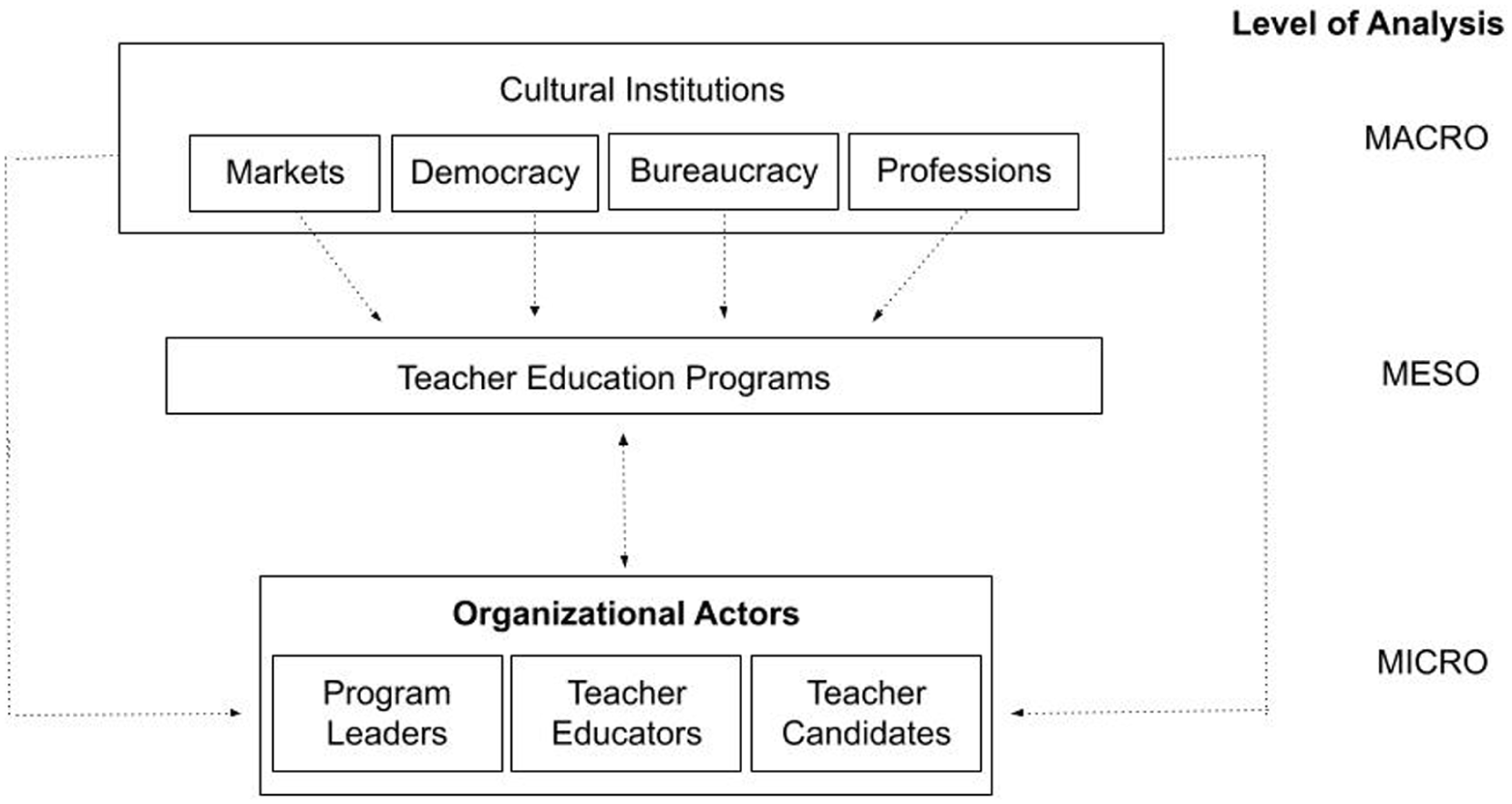
Conceptual framework.
Institutional Logics
Originating in organizational studies, institutional theory has been picked up within education research to better understand how the broader social contexts in education can both shape and constrain individual and organizational action (e.g., Bridwell-Mitchell & Sherer, 2017; Coburn, 2016; Diehl, 2019; Yurkofsky, 2020). This scholarship is organized around the belief that Western society is shaped by central cultural institutions, or the macro-level cultural values, norms, and structures, such as the markets, democracy, bureaucracy, and the professions (Friedland & Alford, 1991), which shape society. Cultural institutions are defined as “constellations of established practices guided by enduring, formalized, rational beliefs that transcend particular organizations and situations” (Lammers & Barbours, 2006, p. 357). Through a focus on cultural institutions, institutional theory provides the ideal framework for situating how the broader reform environment shapes teacher education programs as organizations.
More specifically, I draw on the concept of institutional logics to understand how individuals within teacher education programs draw upon the broader macro-level norms, beliefs, values, and structures of teacher education in the United States to rationalize their work. Institutional logics represent “the socially constructed, historical patterns of material practices, assumptions, values, beliefs, and rules by which individuals [. . .] provide meaning to their social reality” rooted in these broader cultural institutions (Thornton & Ocasio, 1999, p. 804). Logics are constituted of both material aspects (e.g., structures and practices) and symbolic aspects (e.g., normative beliefs, culture, and ideas; Thornton et al., 2012). Logics can shape the issues that individuals in organizations deem as important (Friedland & Alford, 1991) and establish “what is appropriate” in a given field (Rigby, 2014, p. 611). Institutional logics set the “rules of the game” within a given field (Thornton & Ocasio, 2008, p. 112), such as teacher education, and provide organizations and individuals within that field with different frameworks, or “interpretations of reality” (Andersson & Liff, 2018, p. 72), to guide their work.
Leveraging institutional logics as a framework provides a link between institutions and individual and organizational actions (Reay & Hinings, 2009). Organizations and individuals are shaped by the broader logics in the field. At the same time, individuals have agency in how they “selectively draw on, interpret, and enact logics” (Besharov & Smith, 2014, p. 368). Logics persist over time through “carriers”—that is, “individuals and organizations that affirm, embody, transmit, and act in accordance with the principles” (W. R. Scott, 2004, p. 305). The logics that govern any given field are historically contingent and evolve over time (Thornton & Ocasio, 1999)—for example, as institutional actors shift, governance shifts from public to private modes, and funding models shift. Logics can both constrain human action and can be a source of agency (Thornton & Ocasio, 2008). For example, organizations governed by market logics traditionally promote a focus on rational choice, competition, and outcomes, whereas those guided by a democratic logic promote a focus on community, participation, and equity, and those guided by a professional logic promote a focus on prestige and expertise (Bridwell-Mitchell, 2013).
Importantly, while reform agendas describe organized field-level efforts to restructure teacher education, institutional logics refer to the deeper cultural belief systems and norms that underlie those agendas. In other words, reform agendas reflect the field-level theories of change for transforming the profession by elevating particular logic(s) above others. Each of the major reform agendas elevates different institutional logics in their goals and theories of change—for example, the professionalization agenda elevates logics of professions, and to some extent, bureaucracy, whereas the deregulation agenda elevates markets. Together, this suggests that each reform agenda makes different sets of assumptions about how to change the teaching profession. Studying how reform agendas come to shape teacher education through the perspective of institutional logics provides a lens through which to understand how structural changes may or may not lead to deeper shifts to the “shared norms, knowledge, and skills of teachers” which underlie those structures (Elmore, 1995, p. 26). I draw on institutional logics to illuminate how reform agendas are taken up in teacher education programs, and the extent to which individuals within those organizations navigate competing logics.
Logic Constellations
There has been growing attention in institutional theory to the rise of such “pluralistic” institutional fields, wherein multiple potentially competing logics are at play at the field level (Meyer & Rowan, 1977), as is the case in the field of teacher education. Previous organizational scholarship has presented divergent explanations for how such organizations contend with multiple institutional logics: sometimes logic multiplicity can be productive, driving innovation; and in other cases can be destructive, causing conflict (Friedland & Alford, 1991), and even risking the demise of organizations (Besharov & Smith, 2014). Organizational governance structures play a key role in “balancing prescriptions from distinct institutional logics” (Mair et al., 2015, p. 716). Organizational structures may not only be shaped by institutional logics but can also play a key role in mediating how multiple competing logics come to shape organizations. To make sense of how competing logics coalesce at the organizational-level, I draw upon the idea of logic constellations—that is, “the combination of institutional logics guiding behavior at any one point in time” (Goodrick & Reay, 2011, p. 399). Logic constellations provide a lens through which to understand fields where there are multiple coexisting logics, where organizations may face pressure from competing logics over their work.
How Teacher Education Programs Respond to Competing Reform Pressures
While other educational fields have been studied through the lens of institutional logics (e.g., Marsh et al., 2020; Rigby, 2014; Russell, 2011), the field of teacher education has not been studied through the lens of logic constellations. Existing institutional scholarship in teacher education offers two competing explanations for how teacher education programs may reconcile competing reform pressures at the organizational level. On the one hand, programs may face isomorphic pressures to mimic other programs in the field, as a way to preserve their own organizational legitimacy (Boyd et al., 2008). In the tradition of institutional theory, isomorphism refers to the process of organizations in a field, such as teacher education, “develop[ing] startling homogeneity in terms of their formal structures over time” (Boyd et al., 2008, p. 337). In the face of competing reform pressures, organizations may become structured in increasingly similar ways due to institutional pressures. Such pressures may be coercive, that is, rooted in formal policy regulations and structures which incentivize programs to adopt particular structures, normative, that is, rooted in professional pressures to conform to particular notions of legitimacy, and/or mimetic, that is, rooted in organizations’ attempts to look for other models in the wake of uncertainty (DiMaggio & Powell, 1983). For example, in their study of the teacher education landscape of New York City, Boyd et al. (2008) document that, despite the highly varied teacher education landscape in the city, all pathways had developed strikingly similar curricula and structures, due to professional pressures to seem legitimate in the broader field. On the other hand, scholarship has documented that teacher education programs can also innovate to distinguish themselves from other programs in the field. Cochran-Smith et al.’s (2022) study of nGSEs finds that the market-oriented reform environment in teacher education incentivizes programs to work against isomorphic pressures and innovate to differentiate themselves in the marketplace of programs.
However, we do not yet know how these dynamics have evolved across different program types, as the reform environment in teacher education has become increasingly complex and fragmented. Given the emergence of a new organizational form in teacher education—for example, for-profit, online programs—there is a need to examine how the institutional landscape of teacher education is shifting, and how this shifting landscape may be shaping the logics guiding different programs. Understanding how programs navigate these shifting institutional conditions is critical not only for explaining organizational variation but also for illuminating how broader policy reforms in teacher education take root in practice.
Methodology and Design
This study employs a multiple-case design (R. K. Yin, 2009) to examine the extent to which individuals across each of the three teacher education programs draw upon institutional logics to rationalize their work. This paper draws on semi-structured interviews with multiple stakeholder groups (i.e., program leaders, teacher educators, and teacher candidates).
Site Selection
This study draws on data collected from three teacher education programs across the United States. I employed a purposive, criterion-based sampling strategy designed to help capture programs aligned with a range of reform agendas of teacher education (Tashakkori & Teddlie, 2021). Drawing on both a literature review on the institutional environment of teacher education and theory on institutional logics (Thornton, 2004), I developed a set of decision rules to capture the range of logics that undergird U.S.-based teacher education and conducted a broad scan of existing programs in the United States to identify three programs using those decision rules (see Table A1 for decision rules). Because the goal of this study was to examine how competing institutional logics manifest within organizations, I prioritized depth over breadth—selecting a small number of theoretically distinct cases that would allow me to trace how different program types respond to competing reform pressures. Given the 26,000 teacher education programs operating across 2,100 institutions (Wilson & Kelley, 2022), it was not feasible to conduct a systematic scan of the entire landscape of programs. Rather, I conducted a targeted, manual search guided by existing research identifying exemplar programs aligned with each reform agenda. I reviewed public-facing materials (e.g., websites, handbooks) of each potential case to assess its alignment with these logics. I classified each program based on the program characteristics defined by my decision rules, including program type (e.g., university-based, alternative), mission statement, partnership structure (e.g., district partnerships, partnerships with external fellowship programs), fieldwork model, format (e.g., practice-based, synchronous, hybrid, online), and the degree(s) and/or credentials granted. Through this process, I identified a set of potential programs that met my sampling criteria. From this list, I identified the final set of three programs based on those that I was able to obtain access to through my professional network.
Based on these details on each potential program, I identified the logic most closely aligned with each program’s espoused mission and reported structures. Drawing on institutional theory and prior empirical work applying institutional logics to teacher education (e.g., Cochran-Smith et al., 2022), I entered the study with the hypothesis that programs might not neatly align with a single logic in practice. In line with the concept of “logic constellations,” I expected that teacher education programs would reflect multiple, and sometimes competing, logics in practice, given the number of reform pressures shaping the field. To test this hypothesis, I identified three programs that—based on both their espoused missions and program structures—appeared to align most closely with dominant reform agendas in teacher education (i.e., professionalization, deregulation, bureaucratization, and democratization). The goal of this was to illuminate how hybridity emerges and to trace potential gaps between teacher education programs’ espoused missions and the logics that guide their work. Therefore, while I took the mission and structures of each program as an indication of their espoused missions, I followed previous empirical work on logics in education to study these commitments alongside each organizations’ enacted practices to understand the extent to which programs are guided by their espoused missions versus the broader institutional forces governing the field (Marsh et al., 2020). The three studied programs are not intended to be representative of all program types in the field; rather, they are sampled to reflect programs that, based on their espoused missions, appear to align themselves with the three respective major reform movements in teacher education in the United States.
As Table 1 synthesizes, the three sites I study include three teacher education programs that vary widely in their design, structure, and instructional foci. I include two university-based programs—Alcott and Herbert—and one “free-standing” program not affiliated with any university—Porter (all pseudonyms). Notably, Porter is an outlier in total enrollment from the other programs because of its online design; it enrolls over 5,000 teacher candidates per year nationally, whereas the other two programs all enroll approximately 50 to 100 candidates per year. In addition, whereas Alcott and Herbert employ a cohort model, Porter allows teachers to complete the program online and at their own pace, without a cohort. Porter is also an outlier in terms of cost of attendance, not accounting for the potential scholarships Alcott and Herbert offer to offset the cost of attendance. Across the two university-based programs, there were also notable differences: Herbert has significantly lower enrollment costs than Alcott, especially for in-state residents, and, as a public institution, attracted many more local teachers than Alcott. Alcott, on the other hand, is marketed as an “urban” program focused on developing teachers for the local community, but attracts a significant portion of teachers from out of state. Finally, while both programs have missions grounded in educational justice and equity, their instructional foci varied; Alcott has a focus on student-centered teaching and active learning, whereas Herbert has an explicit focus on “decentering Whiteness” in teacher education and a bilingual program. Notably, these initial characterizations are based on the public-facing materials for each program, and the findings explore the extent to which each of these three programs varied in practice.
Site Descriptions

Note. The cost to teacher candidates assumes the teacher candidate receives no financial aid and/or fellowship support. IHE = institute of higher education.
Data Collection
In this study, I draw on semi-structured interviews with 74 program leaders, teacher educators, and teacher candidates across the three teacher education programs. Within each program, I interviewed 4 to 6 program leaders, 7 to 8 teacher educators, and 9 to 15 teacher candidates. I selected program leaders based on their seniority in their programs and worked with program leadership to identify a sample of teacher educators and teacher candidates who constituted a representative sample for their programs. For teacher educators, I was interested in a sample that reflected the range of program course types (e.g., fieldwork, methods, and foundations courses). For teacher candidates, as part of the focus on the broader study, which this paper derived from, I recruited a stratified sample that was demographically representative of the current cohort of students (e.g., based on racial/ethnic characteristics; Tashakkori & Teddlie, 2021). Although I do not analyze differences by race/ethnicity in this paper, this sampling approach may have allowed me to capture variation in teacher candidates’ experiences of their programs, which were likely shaped by their respective positionalities.
I conducted all the interviews from May 2022 through February 2023 over Zoom, and each lasted 45 to 60 minutes. I recorded and transcribed all of the interviews. To acknowledge participants’ time and labor, I offered a small financial incentive (a $25 payment card) to teacher candidates but did not provide compensation to teacher educators or program leaders, whose participation was part of their professional roles. To establish rapport in this virtual setting, I began each interview with an informal conversation, reiterated the study’s purpose, and employed non-verbal cues to affirm that I was engaged in their responses (Roberts et al., 2021). Each of the three interview protocols includes a range of topics, such as the mission and culture of the programs, programmatic performance metrics, and information on program funding and governance (see Supplemental Materials [available in the online version of this article] for all interview protocols). I asked certain questions (e.g., about the mission and culture of programs) to all respondents to triangulate responses and identify any notable variation in responses by respondent type. I asked other questions strategically to particular stakeholders within each program—for example, I only asked program leaders and teacher educators who had been with the program for multiple years about their programs’ history. I grounded all questions related to institutional logics in existing theoretical and empirical work on institutional logics (e.g., Thornton, 2004).
Analysis
To analyze these data, I conducted three stages of analysis. First, throughout the data collection process and my first round of reading interview transcripts, I wrote analytic memos that documented emerging themes, as well as emergent codes related to the key organizational structures of teacher education programs (e.g., field partnerships, program culture, and curriculum). Second, grounded in a pattern-matching approach (Reay & Jones, 2016), I developed an a priori coding framework for institutional logics, grounded in both existing theoretical and empirical work (Hodge et al., 2023; Thornton, 2004). As part of this process, I developed an expanded codebook for institutional logics (Table A2), which builds on Hodge et al.’s (2023) work. I adapted Hodge et al.’s (2023) framework by tailoring the framework to the field-level context of teacher education, incorporating a market logic, and additionally describing the key institutional actors and problem framings associated with each logic (Table A2). Then, I used the full codebook to code the full set of interviews, taking note of any additional codes that emerged throughout the process. Throughout the process of coding, I additionally wrote participant-level memos and took note of themes within and across interviews. To characterize the logics invoked by each individual, I follow prior empirical scholarship on logics (e.g., Muñiz, 2023) and document counts of each time participants call upon “institutionalized rationales”—that is, “reasoned justifications for action that are drawn from the logics of different institutions” related to each of the four primary logics (Bridwell-Mitchell, 2013, p. 183). I double-coded excerpts in cases where individuals invoked multiple institutionalized rationales in the same coded excerpt. I then calculated the proportion of times each individual called upon each logic and averaged those proportions across each role type within each program. Rather than relying on the raw counts, using proportions allows me to equally weight each individual in each program and prevent individuals from disproportionately swaying the findings for their organization. Finally, I generated matrices and meta-matrices summarizing the proportions of individuals’ reliance on each logic within and across programs and individual role types and analyzed those proportions alongside the rest of the coded data (e.g., on organizational structures within each of the programs) to identify patterns between the logics and the organizational responses within and across each of the studied programs. I returned to my data regularly after I reviewed my preliminary findings and adjusted my analyses to account for any disconfirming evidence.
Limitations
This study is not without limitations. First, though I intentionally identified a purposive sample of programs that reflect the range of U.S. teacher education reform visions, these programs are not, nor are they intended to be, a representative sample of all program types in the country. Given the diverse teacher education landscape today, identifying such a representative sample does not lend itself well to conducting in-depth case studies. Rather, the robust sampling strategy results in three teacher education programs that are structured to reflect the major reform agendas of teacher education. There is reason to believe that these programs can inform our understanding of the institutional logics shaping teacher education in the United States more broadly; however, this paper does not attempt to provide a comprehensive view of the institutional landscape of teacher education in the United States. Such a view would also need to take a more historical stance, given that logics are historically contingent (Thornton & Ocasio, 1999), and would need to examine a greater number of programs, which reflect the diversity of program types operating in the United States. Second, though I sought to identify a representative sample of program leaders, teacher educators, and teacher candidates for interviews, it was particularly challenging to identify a representative sample for Porter, where there are over 5,000 teachers presently involved in the program. For this program, my findings may fall short of capturing the full variation in teacher candidates’ experiences across the program. I sought to mitigate these limitations by spending time in the field to have a strong understanding of the local context.
Findings
Together, the findings offer new insights into how different types of teacher education programs negotiate competing logics in their reform environment. I find evidence that the three studied teacher education programs were guided by two primary “logic constellations” (Goodrick & Reay, 2011): (a) a democratic professional logic constellation, which represents a bridging of democratic and professional logics, and (b) a corporate marketplace logic constellation, which represents a bridging of market, professional, and bureaucratic logics (Table 2). Each constellation was grounded in a distinct institutionalized conception of the nature of teaching and purpose(s) of teacher education, which shaped the rationales individuals across each program used to guide their work. However, even though each program was primarily aligned with one logic constellation, the existence of the opposing constellation created institutional pressures for programs to align themselves with the competing constellation to maintain organizational legitimacy within the contested field of teacher education. These pressures impact different role types (i.e., program leaders, teacher educators, and teacher candidates) differently based on their position in their organizations. In what follows, I describe these findings by first describing how each logic constellation was reflected in the studied programs, and then explore how these patterns vary within programs by role type.
Institutionalized Rationales by Program and Role Type

Note. As described in the section “Methods,” to calculate the percentages in each column, I first counted the number of times each individual called upon each of the four logics in their interview. Then, I calculated the percentage of times they called upon each logic. The percentages reported here reflect the average of those percentages across each role type in each program. Due to rounding, rows may not total exactly 100%.
Two Competing Logic Constellations of Teacher Education
Though I purposively sampled the programs whose espoused mission statements and program structures predominantly aligned with one primary logic—the logics of professions, markets, and democracy—the story that emerged was more nuanced in practice. I find evidence that multiple institutional logics coalesce simultaneously within each of the studied programs in one of two “logic constellations.” Both Alcott and Herbert—the two university-based programs—are guided by what I term a “democratic professional” logic constellation, whereas Herbert is guided by what I term a “corporate marketplace” logic constellation (Figure 2). This finding emerges from the patterns in institutionalized rationales leveraged within each program (Table 2). Both constellations are grounded in a professional logic to varying extents, but each took up the idea of professionalism in markedly different ways. Whereas the democratic professional logic constellation is grounded in an understanding of professionalism for social change, the corporate marketplace logic constellation is instead grounded in a view of professionalism for profit. In what follows, I describe each of these constellations and how they manifest across the three studied programs.

Logic constellations.
Democratic Professionalism: Professionalism for Social Change
Both of the two university-based programs, Herbert and Alcott, draw upon what I term a “democratic professional” logic constellation. This constellation integrates both professional and democratic logics, positioning teachers as both experts and community members. Within this view, teacher education programs are both sites of professional socialization, organized around academic knowledge production, as well as centers for the community. Although their espoused missions and program structures suggested that Herbert would be primarily guided by a democratic logic and that Alcott would primarily be guided by a professional logic, both programs adopt a more integrated approach, aligned with more recent calls in the field to bridge the aims of professionalization and democratization and prepare of teachers as “democratic professionals,” such that universities and communities work as equal partners in the preparation of teachers (Zeichner, 2020). In this view, elevating the teaching profession is a lever for social change: by equipping teachers with both a complex knowledge base and deep knowledge of the community, these programs aim to empower teachers as agents of social transformation. In drawing upon the democratic professional logic constellation, individuals in Alcott and Herbert’s position the professional work of teaching in terms of its role in a democratic society.
The democratic professionalism constellation is reflected both in the rationales of actors used to rationalize their work and the organizational practices. For program leaders, the logic constellation of democratic professionalism is reflected in what they see as the missions of their programs and the purposes of teacher education more broadly. For example, Amanda, a program leader in Alcott, shares her vision of the purpose of teacher education programs as deeply grounded in both content knowledge and a commitment to serving the community: I hope that [our teachers] see the young people that they get in front of as their future Because that’s who those children are, you know. They will one day be making decisions on behalf of the country, their communities. And I hope that they are able to always see the possibilities that are in their classroom and not be organized around a deficit lens. [. . .] you can have the best methods in the world and the greatest curriculum but is all for naught because nobody is invested in or buying into what you’re saying.
Similarly, in Herbert, teacher educators position the expertise of children, families, and the community as central to the professional knowledge base of teaching. Herbert’s teacher educator, Sara, blurs the distinction between a professional and democratic logic in describing the purpose of teacher education: [To prepare] critically conscious, politically aware teachers who understood that children and families and communities have a wealth of knowledge that they bring to school and that our job is to see those as assets, as teachers and to organize disciplinary inquiry for kids in ways that help them kind of achieve the potential they all have, and to see them contribute back to a vibrant democracy.
This program-level vision is resonant with how teacher educators in Alcott and Herbert described their own instructional visions. For example, Spencer, a teacher educator in Alcott, describes his instructional vision for teacher candidates in line with this conception of teaching: “I’m hoping that [teachers] see teaching as a profession that is not neutral and is political, and [. . . is] not just conceptual, but also practical. [. . .] what sort of pedagogical content knowledge will help you be able to live that in your instruction?” These rationales were not merely symbolic, but translated into concrete organizational decisions—for example, coursework in culturally responsive teaching, extensive student teaching in the local school district, and opportunities for teacher candidates to learn from their communities through placements in community-based organizations. For example, Cletus, a teacher educator in Alcott who teaches a course on culturally responsive teaching, shares his instructional vision for teacher candidates: I hope that they’ll be culturally responsive educators with a commitment to social justice [and] educators who connect with community and use those connections to inform how they work with students. I want to prepare teachers who are not afraid of urban students—who genuinely care about them and their communities [. . .] and do what’s right by our youth.
In this way, the democratic professional logic constellation foregrounds the importance of learning from the community to foster care for those communities.
The democratic professional logic constellation in Alcott and Herbert is also mirrored in how teacher candidates saw themselves and the purposes of their work. This view often blurs the line that teacher candidates experienced between their university-based teacher education programs and the school communities within which they serve. As Sidney, a teacher candidate at Herbert, reflects: “One of my favorite parts about [Herbert] was that there wasn’t such a fine line between school and community.” Consistent with the democratization agenda’s calls to epistemologically ground teacher education in the knowledge of the community, the democratic professional logic constellation calls for a horizontal understanding of expertise. Aligned with this view, Sidney describes his vision of teachers as “ambassadors of education” for their communities: One of the things that I really enjoyed was seeing just how important of a role we have as ambassadors of education and selling it to the community that this is a place that values you [. . .] and honors all the stores of knowledge that you have. We’re not just the school, and I’m not just the teacher handing out information to everyone, but I’m learning just as much from the family members, the caregivers, and from the students themselves, too, and that they feel empowered to shape and mold education in our classroom, too.
The democratic professional logic constellation positions expertise as highly porous and conceptualizes all community members as knowledge-producers. For many teachers, this vision was rooted in their commitments to social justice. For example, Aurelia, a teacher candidate in Alcott, reflects on her instructional vision: I hopefully can look forward to becoming a teacher that is able to be revolutionary in the classroom. [. . .] I love learning, and I just wanna be able to model that and hopefully cultivate that in my students in the future in a socially responsible way that is rooted in activism.
The democratic professional constellation was reflected in the way teacher candidates internalized a view of themselves as change agents—emphasizing the democratic purposes of teaching.
Corporate Marketplace: Professionalism for Profit
Although I initially hypothesized that Porter would be guided primarily by a market logic given its for-profit orientation and espoused mission focused on addressing teacher shortages, I found that the program draws upon what I term a “corporate marketplace” logic constellation—bridging professional, market, and bureaucratic logics and positioning teachers as both consumers and products. This logic constellation is reflected in the different languages that individuals across each of the three programs use to describe their candidates and the programs themselves. Whereas Herbert and Alcott described themselves as “teacher education programs” and their students as “teacher candidates,” Porter refers to teachers as either “interns” or “customers” and refers to the program itself as “an alternative certification provider” or “teacher certification provider.” As one program leader, Denise, reflects: “[Porter] is trying to build a brand and the brand is that they wanna be the one of the premier alternate paths to certification.” Though subtle, this market-driven language of building a “brand” reflects a more deeply ingrained view of teacher education as a service for purchase, rather than as a site of professional socialization wherein teachers learn how to carry out their democratic commitments. Whereas the democratic professional logic constellation positions professionalism as a lever for social change, the corporate marketplace logic constellation positions professionalism as a means of making a profit. Accordingly, Herbert invokes a professional logic in order to maintain its professional legitimacy as a business.
Importantly, I find that Porter was initially founded primarily around a market logic, but it has since adapted to conform to institutional pressures from the field to maintain its legitimacy (DiMaggio & Powell, 1983). Although Porter was funded as a private company, it is now owned and managed by a private equity firm through a social impact fund. Program leader Becky describes how this shift impacted the program: The company was private for most of its existence, and then it went into a private equity company and got a board of directors. [. . ..] That’s not this group of owners, their interest was more just get people in. [. . .] I believe the new owners are not that way. They are “more get people in, but make sure they’re the right people.”
In response to public criticism of Porter’s professional credibility, the program made material changes and broadened its leadership team—moving from a team composed primarily of members with business backgrounds to hire leaders with substantial educational experience. As program leader Katherine describes, she saw the mission under previous leadership was to “make a lot of money,” but now she sees the mission as being to “produce exceptional teachers for the children in this country” and “make money for our investors.” Another program leader, Pam, describes: “[Porter’s] vision is that we’ll become the premier educator preparation program that prepares a diverse group of teachers who are also learners for the 21st century.” The shift reflects the program’s understanding that making a profit in the educational field requires conforming to the professional standards in the field. Becky, a program leader, speaks to how having a high-quality program, like that of a university, supports Porter’s ability to make a profit: We are gonna make money for our investors, yes, but we’re not gonna lose sight of the fact that, if we don’t offer the very best service and have a service mentality to our clients and offer the very best we can for them from the curriculum to the support systems in place for them—just like a university would do with advisors and all that kind of stuff. But we don’t offer that, then we’re not gonna make any much.
Similarly, Richard, a board member and member of the private equity firm that currently owns Porter, describes Porter’s definition of “impact” sees profit and social impact as intertwined: We define impact in a few ways. [. . .] we are always looking for collinearity—the opportunity to drive impacted scale should be linked to the financial opportunity, not opposed to the financial opportunity. [. . .] But there’s this kind of tension in the model. We wanna find models where, as you scale the impact, that’s also what creates the financial return. [. . .] that’s kind of the doing well by doing good idea that is kind of core to impact investing.
Richard compares the case of teacher education to other commercial companies, such as Warby Parker, a sunglasses company that donates a pair of sunglasses for each product sold. Porter positions the “production” of new teachers as a social good to justify scaling their program. The market logic is core in shaping the work of Porter, but they understand professionalism and bureaucracy as constraints on their ability to scale and make a profit.
The corporate marketplace logic constellation was reflected in individual’s rationales across the program that teacher education is a “service” for purchase. For example, Debbie, a program leader, reflects on what she sees as the purpose of Porter: I’m embedded in a for-profit company [and] their customer is a prospective teacher, and so it is about the bottom line. It’s about making money [. . .] but the work is, you know, wonderful and good and good for society. [. . .] We’re producing a great product: a teacher.
By positioning teachers as the “product,” Porter’s corporate marketplace logic constellation blurs market and professional logics by framing teachers as a social good. Teacher candidates invoked this same logic constellation to position themselves as consumers seeking a product, emphasizing the importance of customer service. Mark, a teacher candidate in Porter who decided to become a teacher after a career in business, speaks to the importance of teacher education programs providing excellent service to their clients: I chose [Porter] for one real reason. [. . .] Because of my business background, I put a lot of emphasis on the idea of putting your money where your mouth is. [. . .] [Porter] did not charge you until you got the job. [. . .] I like a company that is willing to stand behind their product, their service. [. . .] That just comes from my 25 years in management. [. . .] I told my staff, “You stand behind our company.” Whenever I had a company that was standing behind their product and service, I’m like, “Yeah, I’m going there.”
Teacher candidates, teacher educators, and program leaders also cite the growing teacher shortages as a rationale for the need for non-traditional programs like Porter. Many still emphasize the importance of maintaining the quality of new teachers entering the profession, drawing on both professional and bureaucratic logics. Ira, a teacher candidate in Porter, reflects: I believe [Porters’] mission is to just help solve the problem of a shortage of qualified teachers [. . .] but to do that in a way that makes sure that the teachers that they are sending in through this alternative route by the time they’re getting their standard license are fully qualified, so it’s not just a back door a rubber stamp.
The corporate marketplace logic constellation positioned teacher education as a product that could help address the labor market challenge of teacher shortages.
Competing Logics by Role Type
Although each program was primarily organized around one of these two logic constellations, I found evidence of individuals in each program drawing upon competing logics. Even programs aligned with a democratic professional logic are still engaged with market and bureaucratic logics, while the program guided by a corporate marketplace logic also draws, to a lesser extent, on professional and democratic logics. Importantly, I find that these patterns vary based on role-type within each program (i.e., program leaders, teacher educators, and teacher candidates) because individuals’ positions in their organizations expose them to distinct sets of institutional demands. As Table 2 documents, there is significant variation in the logics espoused based upon individuals’ role type, including (a) program leaders and teacher candidates rely more on market logics, (b) teacher educators appear insulated from market and bureaucratic pressures, and (c) teacher educators rely disproportionately more on professional logics. In what follows, I explore each of these points of variation in greater detail to make sense of the role of individuals in shaping the broader logics of their organization.
Increased Reliance on a Market Logic for Program Leaders and Teacher Candidates
Across all programs, I found evidence that both program leaders and teacher candidates draw upon market logics proportionately more than teacher educators. I posit that both program leaders and teacher candidates draw upon market logics for different reasons, shaped by their positions in their organizations. For program leaders, market pressures stem from their responsibility to secure funding, attract prospective students and faculty, and manage the recruitment and retention of teachers in their programs. For teacher candidates, market pressures stem from their view of teacher education as an investment in their longer-term future employment opportunities.
While reliance on market logic is most pronounced in the for-profit program, Porter, it was also salient for leaders in the university-based programs (Table 2). Program leaders in Alcott and Herbert explicitly oppose market-based reforms in education; however, they report feeling compelled to adopt a market-based framework in response to both growing teacher shortages and declining completion rates in university-based teacher education (Engledowl & Rutledge, 2020). This broader institutional environment may force program leaders’ hands, encouraging them to compete with other programs in the field for enrollment. Tim, an Alcott program leader, reflects on how the pressure to enroll teachers undercuts their ability to focus on mission alignment: I think that’s funny, the question is: do you admit people who are aligned with the mission? I mean shouldn’t that be clearly yes? We have to. [. . .] It’s funny just to hear it said back. It is a question mark because you also need students, right? And not every student is going to come in a perfect vision of, “Oh yeah, that’s a social justice educator.”
These market pressures are compounded in Herbert, where program leaders found themselves in direct competition with the other teacher education programs (i.e., “pathways”) operating within the same university. Lindsey, a program leader in Herbert, shares that she has come to see other pathways in their university as a competitor: The fact that we have these three pathways that are sort of constituted differently but are not exclusive of one another is also really difficult. [. . .] we’re starting to encroach on one another and that’s gonna become uncomfortable. I don’t know where we’re headed. I think we have a niche. [The] residency is shiny and new. They get the press, and I feel like, “wait a minute, we’re doing good things over here too.” You know, we’re doing all kinds of stuff with race and identity and reflection.
These market pressures are caused by the mission creep across programs in their university, but are rooted in the deeper, field-level pressure to compete to survive, which all programs face as they contend for teacher candidates to enroll. Given the proliferation of for-profit programs like Porter, university-based programs face increasing market pressures to keep costs low and maintain enrollments. These market pressures are further compounded by the broader landscape of the teaching profession, which is marked by growing teacher shortages and steep declines in enrollment across university-based teacher education programs (Engledowl & Rutledge, 2020). From 2010–2011 to 2018–2019, national enrollment in teacher education programs declined by 38%, even as enrollment in alternative, non-university-based programs grew by 76% (King & Yin, 2022). The majority of teachers in these alternative pathways are enrolled in for-profit programs, which are rapidly reshaping the teacher education landscape in the United States (King & Yin, 2022). As Lindsey notes, this competitive pressure may drive programs toward innovation, to ensure they are distinct from other programs. This finding is salient because it suggests that programs’ abilities to live into their missions are constrained by their broader institutional environments. Even programs that are otherwise opposed to market-based reforms in teacher education are forced to adopt the same frameworks guiding the leadership of their organizations.
Teacher candidates across all three programs, in contrast, view themselves as consumers, positioning teacher education as a service for purchase. For example, Chen, a teacher candidate in Herbert, describes that his peer’s dissatisfaction with one course, rationalizing the problem of the course in terms of its financial cost: “When you do the math, [the course costs about] $300 per person. This is worth, you know, 30 grand with a hundred people. And this is just isn’t cutting it.” Teacher candidates like Chen also invoked a market logic when they shared concerns about their job prospects: I think the defining statistic of a graduate program is the employment statistics. [. . .] We should know where all of our folks are and [Herbert] does not collect data for the past two years for during the pandemic, and that's just not acceptable. [. . .] There are two narratives: “this is a great time to go into teaching and you’re gonna find a job, blah, blah, blah.” And then that doesn’t match reality.
Although the university-based programs typically framed their mission around values and community impact, candidates across all three programs were nonetheless making financial calculations about the value of their tuition costs. Especially in Herbert and Alcott, where teachers were sometimes going into debt to cover the costs of their $40,000–50,000 degrees, teacher candidates viewed their programs as a service. Particularly in a context where student debt shapes teachers’ abilities to pursue higher education (García et al., 2023), market logics can inform how teacher candidates rationalize their experiences within their programs. The pervasiveness of the market logic in the university-based programs is reflective of the broader context of U.S. higher education, which has been defined by growing market pressures over the past several decades (Grossi et al., 2020; Gumport, 2019).
Buffering From Market and Bureaucratic Logics for Teacher Educators
I also find that teacher educators are buffered from both market and bureaucratic logics. As a function of their role, teacher educators are less exposed to program-level decisions around enrollment, recruitment, policy, etc., because their work is more focused on their own classrooms. This suggests that individuals’ positions within their organizations may expose them to a distinct set of institutional constraints. Teacher educators rarely describe market pressures as a constraint on their instruction. In one exception, Molly, a teacher educator in Herbert, reflects: I’ve changed my methods course dramatically every single year, like overhauled, every year—partly response to what I’m learning from my research, [and] in part response to the direction that the program is going. We’re always bending and changing. [. . .] There’s economic factors that we’re trying to consider: [. . .] it’s increasingly hard to go to graduate school and how do we think about offering courses in the evening? Things like that. So we’re trying to think about the economic pieces.
However, Molly’s experience appears to be an outlier, as most teacher educators report minimal interference from external market pressures in their instructional practice. Particularly for teacher educators were tenure-line faculty, they report a great deal of autonomy over their own classrooms—both in terms of what they taught and how they organized their work.
Similarly, teacher educators did not report feeling constrained by a bureaucratic logic. Whereas program leaders were focused on policy because they were responsible for managing things like program accreditation and field partnerships with the district, and teacher candidates were focused on the role of local policy in their work, teacher educators did not report seeing their roles as meaningfully shaped by policy. When teacher educators did call upon a bureaucratic logic, it was framed as a minor consideration in their work. For example, Lara, a teacher educator in Alcott, spoke to how program accreditation requirements took energy away from the program focusing on its actual mission: “They’re not particularly onerous. And I think we can work around them, but they’re like, it's annoying, right? It means that calories that could be spent on building an ideal are instead spent like taking off a box.” Some teacher educators in Herbert spoke to the role of edTPA, the teacher performance assessment system, in their prior work and discussed the role of district instructional policy in how they approached their coursework; however, the state Herbert was operating within had removed the edTPA requirement by the time of this study, so it was no longer a focus of their work.
Increased Reliance on Professional Logic for Teacher Educators
Notably, across all three programs, teacher educators call upon a professional logic the most out of any role type. This was especially true in Porter—the for-profit, online program—where teacher educators called upon a professional logic at nearly the same level as teacher educators in Herbert, one of the traditional, university-based programs. This finding was surprising, given the conventional wisdom that for-profit programs often work to de-professionalize teaching, and speaks to how individuals might bring logics from their previous organizations with them. This finding also suggests that programs may strategically make surface-level changes to their programs to maintain legitimacy while keeping their core values the same (Meyer & Rowan, 1977).
In Porter, program leaders primarily brought backgrounds in private equity and business; however, all of the teacher educators were retired school leaders with decades of experience working in public schools. This difference in experience may explain why teacher educators in Porter primarily drew upon professional logics, despite being embedded in a for-profit company. Previous organizational scholarship suggests that individuals often draw upon “home” logics—that is, the logics of their previous organizations—and deviate from the logics of their new organizations (Andersson & Liff, 2018). At the same time, because teacher educators in Porter were contracted solely to conduct candidate observations and had few other points of engagement within the organization, they were positioned to have limited influence over program operation, such that their professional logics did not deeply shape the core of their organizations. When I asked one Porter teacher educator what they saw the program mission, they responded: “I know there’s a mission. I’ve never looked at it, so I don’t know what their mission says.” Porter’s organizational structures exacerbate the mission incoherence within their program. This disconnect in decision-making structures was perhaps intentional, as bringing in the teacher educators was a strategic decision to garner greater professional legitimacy for the program. In part because the program was initially founded by individuals without educational experience, Porter has historically struggled with being seen as a legitimate program by state policymakers. Katherine, a Porter program leader, spoke to how the intentional hiring of teacher educators (who are referred to as “field supervisors”) supports the credibility of the program: A lot of our field supervisors, in fact most, are retired principals or superintendents [. . .] I’m not hiring anybody for this position unless they’ve been an administrator or currently are an administrator. [. . .] It helps them be a better field supervisor to their interns and it gives them more credibility when they go in and talk to a principal about an intern. You know, they can identify with the principal’s role ‘cause there is nothing as complex anywhere as the school principal’s role. I don’t care if you’re CEO of Exxon.
In parallel, just as the expanding marketplace of teacher education programs compelled Alcott and Hebert’s leaders to draw on a market logic, the field’s growing emphasis on professional accountability compelled Porter to draw on a professional logic. This finding aligned with previous teacher education scholarship on institutional isomorphism—that is, the “formal and informal pressures placed on particular organizations by other organizations on which they are depending for either legitimacy or resources” (Boyd et al., 2008, p. 337). Aligned with prior scholarship (e.g., Boyd et al., 2008), I observe that programs may draw upon logics that are misaligned or in tension with their espoused program missions to strategically garner organizational legitimacy in fields where other logics are valued.
Discussion
For decades, the field of teacher education has debated how to best organize the work of preparing teachers. As the country faces the threat of growing teacher shortages and as more diverse private actors enter the arena of teacher education, these debates will only become more salient. Debates over teacher education extend far beyond the work of teacher education programs; rather, they speak to some of the most central questions driving education reform. Zeichner (2018) posits: Debates over teacher education are, in fact, debates about the meaning of children, families, communities, teachers, the processes of teaching and learning, the ways that classrooms are managed, public schooling, and the place of teachers in the communities in which they work. (p. 15)
The stakes of this debate could not be larger. These debates represent much deeper ideological struggles over what teaching is and ought to be. Despite the magnitude of these questions, the field lacks adequate frameworks for understanding how competing reform agendas come together to shape teacher education programs as organizations. This paper helps fill this gap by more clearly mapping out how the underlying logics of competing reform agendas coalescence, and compete, to shape teacher education programs at the organizational level. In what follows, I describe the major contributions of this study to teacher education research, policy, and practice, as well as conceptual and methodological contributions to organizational theory.
First, this work advances an understanding of how teacher education programs, as organizations, negotiate and internalize competing reform pressures. Specifically, I examine how four major reform agendas of teaching and teacher education—professionalization, deregulation, bureaucratization, and democratization—interact to jointly shape teacher education programs. Rather than adopting the logic of any single reform agenda wholesale, programs assemble “constellations” of logics drawn from their broader institutional environment, bridging ideas from multiple distinct reform agendas. In particular, I find that the current reform environment in teacher education has institutionalized two distinct, competing conceptions of teacher professionalism, which pull programs toward competing aims. Whereas the corporate marketplace logic constellation privileges competition, efficiency, and profit as driving goals for teacher education programs, the democratic professional logic constellation privileges democratic service and expertise as core values of teacher education. These logic constellations matter because they “prescribe what constitutes legitimate behavior and provide taken-for-granted conceptions of what goals are appropriate and what means are legitimate to achieve these goals” (Pache & Santos, 2013, p. 973). Logics shape not only how programs are structured, but also how teachers come to understand their professional roles (Kaul, 2025) and how programs operate in practice. At the organizational level, the field of teacher education has long been interested in the role of coherence in teacher education programs (e.g., Darling-Hammond, 2006; Grossman et al., 2008; Hammerness, 2006). This literature has typically focused on aligning program-level structures and organizational mission to drive alignment within programs. The institutional logics lens provides the field with another way to think about coherence by going deeper into the deeply institutionalized ideas that undergird each reform agenda.
Second, this analysis turns a focus toward for-profit, online teacher education programs, providing the first in-depth qualitative accounts of such programs in existing scholarship to my knowledge. Though the field has devoted significant focus to alternative certification programs (e.g., Grossman & Loeb, 2008), programs like Porter have largely remained outside the purview of teacher education research, even as they come to dominate the landscape of teacher preparation (Grossman et al., 2026). In the last 5 years, enrollment in for-profit teacher education programs has increased by over 500% (Bland et al., 2023). What literature does exist relies on state-level administrative data and has not yet provided a look inside these programs at the organizational level (e.g., Bland et al., 2023; W. Edwards & Magill, 2024; Kirksey & Gottlieb, 2026; J. Yin & Partelow, 2020). As teacher education programs continue to focus at the program level to make change, the landscape of teacher education nationally is experiencing seismic shifts. Given the low cost of enrollment in these programs and the growing teacher shortages (Franco & Patrick, 2023), these programs may pose an existential risk to traditional, university-based programs. Yet, given the higher rates of turnover for teachers who go through these routes (W. Edwards & Magill, 2024) and evidence of weaker outcomes in teacher quality (Kirksey & Gottlieb, 2026), the growing dominance of these programs raises concerns that the field of teacher education must grapple with. And yet, because the costs of higher education remain a significant barrier to developing a more diverse teacher workforce (García et al., 2023), the field of teacher education must take seriously the challenge of better balancing quality and access in teacher education.
Third, this attention to the rise of for-profit programs helps clarify the broader pervasiveness of market logics across the field of teacher education writ large. These findings suggest that market reforms have had a wide-scale impact on the broader frameworks for change in the field of teacher education, far beyond the programs most directly aligned with those reforms. Even teacher education programs operating in public institutions, ostensibly oriented toward democratic or professional aims, increasingly operate according to market imperatives—competing for candidates, focusing on their marketing, and structuring decisions based on efficiency. Situating this market logic as institutional suggests that an individual program’s missions are insufficient to counter these market-based pressures. The dominance of market logics in teacher education is not merely a matter of discourse; it fundamentally shapes how the field understands the purposes of teacher education and how teachers are socialized into the profession. Prior work has documented that teachers who interpret their work through a democratic logic report higher levels of professionalism (Kaul, 2025), suggesting that the institutionalization of democratic logics in teacher education may support the well-being of the teaching profession. As the field grapples with the historically low status of the profession (Kraft & Lyon, 2024), understanding pathways to better support teachers’ sense of professionalism is critical. Therefore, it is essential to understand how this shifting field-level landscape introduces new institutional pressures on other programs in the field, and on teacher candidates being socialized into the profession. The deeply entrenched nature of market logics in teacher education raises, in particular, questions about the possibilities of teacher education as a democratic and/or professional project. Harris (2023) posits: If we design a school system for consumers and firms, then parents and educators will think about themselves as consumers and firms, respectively, focusing on their own individual needs and profits, views that would be passed on to students. Yet any well-functioning society also requires that people think altruistically as citizens and community members.
Without confronting the institutionalization of market logics at the field level, efforts to preserve teacher education as a democratic and professional enterprise will remain fragile.
Methodologically, this paper advances approaches to capture logics across multiple levels of an organization, providing a model for mapping how logics can conflict at both the individual and organizational levels. This analysis develops an approach for documenting individuals’ reliance on “institutionalized rationales,” which is deeply grounded in theoretical work on logics. Furthermore, the field still has a relatively limited understanding of how multiple logics co-exist at the organizational level (Besharov & Smith, 2014) and how decoupling occurs in such contexts (Pache & Santos, 2013). This paper addresses both of those gaps to demonstrate how organizations respond to institutional plurality by relying on logic constellations. In doing so, this analysis extends previous scholarship on logic constellations (e.g., Goodrick & Reay, 2011) by documenting the existence of multiple logic constellations within the same organizational field at the same time. By studying these dynamics in a context relatively understudied within organizational theory, this paper also extends organizational studies in education to examine the role of these critical organizations in the education sector.
Together, these findings offer important implications for policy. Adopting an institutional perspective to studying reform suggests that the reason why changes in the teaching profession have been so slow is that reforms may have only shifted program-level structures, without attending to the deeper institutional conditions that shape teachers’ work. Prior scholarship on institutional change highlights that short-term policy interventions are insufficient to make such deeper shifts; rather, policies must be sustained and coherent over time (Stein & Coburn, 2023). In practice, this means that states should ensure that licensure standards, program approval criteria, evaluation systems, funding mechanisms, etc., related to teacher education are aligned around a shared conception of teacher professionalism if they seek to make deeper field-level transformation. For any given reform agenda to make deeper transformations to the institutional conditions of teacher education, it must be reinforced across policy domains. If the field aims to better center the democratic and/or professional aims of teacher education, then policy should work to align field-level governance structures, professional standards, accountability metrics, etc., around such a conception of teaching. For example, rather than incentivizing programs to compete for funding based on enrollment or short-term outcomes, state and federal policy could structure incentives for teacher education programs to build and sustain district partnerships that support robust clinical preparation and ongoing professional learning. Similarly, funding might be designed to incentivize collaboration across programs, rather than competition, to support collective capacity-building rather than market competition. Finally, institutional scholarship suggests that reform agendas may fall short in transforming the profession if they fail to shift teachers’ own conceptions of themselves as professionals (Kaul, 2025). Accordingly, policy must attend not only to structural redesign but also to the messages reforms convey to teachers about their work. For example, although edTPA was introduced as a lever of professionalization, prior research has found that teachers may experience the edTPA as de-professionalizing (De Voto & Gottlieb, 2021). In this way, the external logic of the reform falls short of how teachers internalize and ultimately respond to reforms in practice. This disconnect underscores that reform coherence depends not only on policy design, but on how reforms are interpreted, made sense of, and enacted by practitioners.
As diverse political and ideological groups seek to stake their claim to control the work of teacher education (Cochran-Smith, 2001), the field must understand how the competing reform logics adopted by these groups shape the work of teacher education programs at the frontline of these reforms. Particularly in this particular historical moment, as the field grapples with the increasing teacher shortages and parallel attacks on the teaching profession (Jayakumar & Kohli, 2023), understanding the underlying values at the heart of each reform call is critical, as what happens in the broader reform environment can significantly shape and/or constrain the work of individual programs. If we seek to work toward transforming the field of teacher education, then we need to be thinking about change at the level of the field—to support the work happening within individual programs.
Supplemental Material
sj-pdf-1-epa-10.3102_01623737261437716 – Supplemental material for Profession or Marketplace? Mapping the Competing Logics of K–12 Teacher Education Reform
Supplemental material, sj-pdf-1-epa-10.3102_01623737261437716 for Profession or Marketplace? Mapping the Competing Logics of K–12 Teacher Education Reform by Maya Kaul in Educational Evaluation and Policy Analysis
Footnotes
Appendix
Codebook for Institutional Logics: Dimensions of Institutional Logics Relevant to Teacher Education
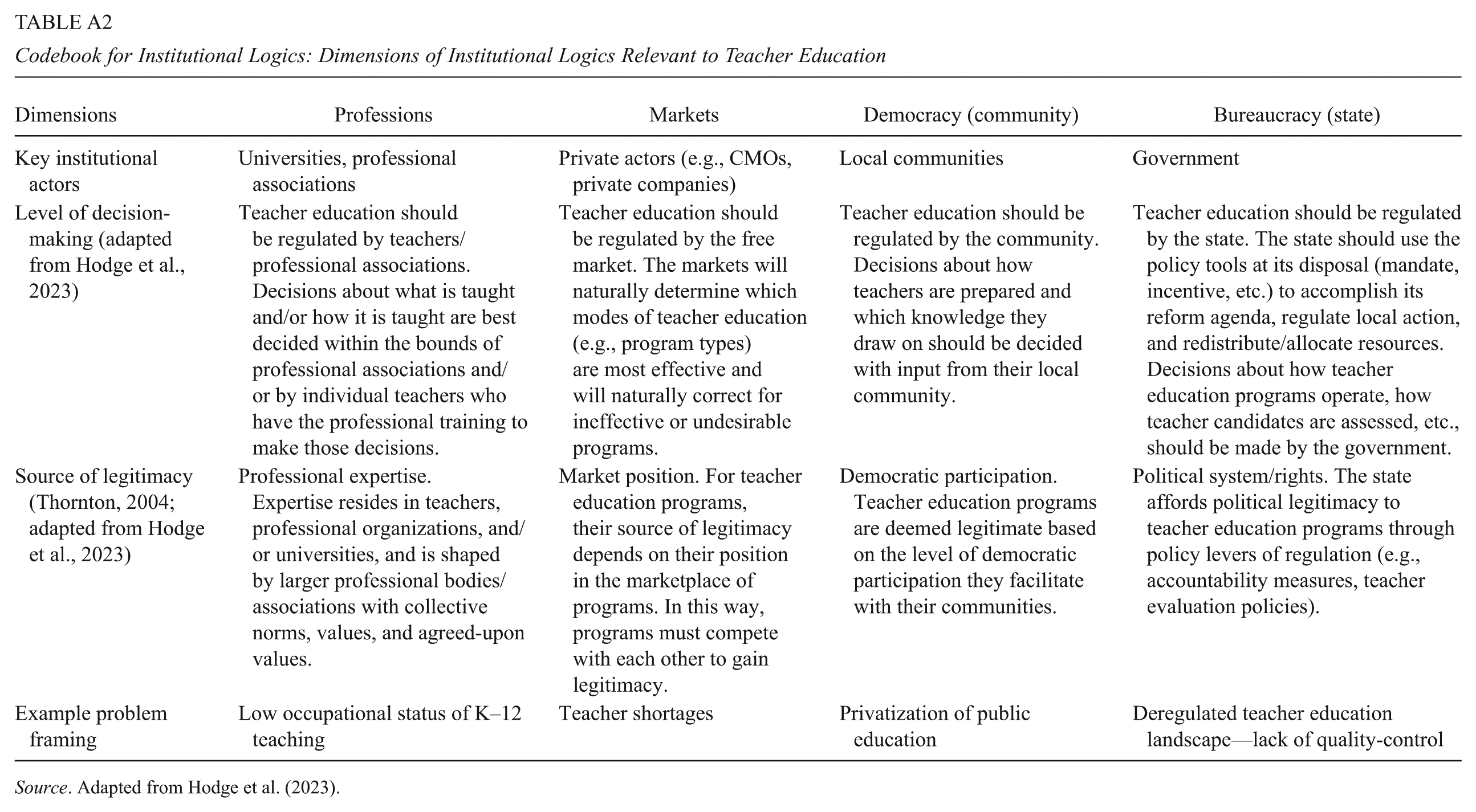
| Dimensions | Professions | Markets | Democracy (community) | Bureaucracy (state) |
|---|---|---|---|---|
| Key institutional actors | Universities, professional associations | Private actors (e.g., CMOs, private companies) | Local communities | Government |
| Level of decision-making (adapted from Hodge et al., 2023) | Teacher education should be regulated by teachers/professional associations. Decisions about what is taught and/or how it is taught are best decided within the bounds of professional associations and/or by individual teachers who have the professional training to make those decisions. | Teacher education should be regulated by the free market. The markets will naturally determine which modes of teacher education (e.g., program types) are most effective and will naturally correct for ineffective or undesirable programs. | Teacher education should be regulated by the community. Decisions about how teachers are prepared and which knowledge they draw on should be decided with input from their local community. | Teacher education should be regulated by the state. The state should use the policy tools at its disposal (mandate, incentive, etc.) to accomplish its reform agenda, regulate local action, and redistribute/allocate resources. Decisions about how teacher education programs operate, how teacher candidates are assessed, etc., should be made by the government. |
| Source of legitimacy (Thornton, 2004; adapted from Hodge et al., 2023) | Professional expertise. Expertise resides in teachers, professional organizations, and/or universities, and is shaped by larger professional bodies/associations with collective norms, values, and agreed-upon values. | Market position. For teacher education programs, their source of legitimacy depends on their position in the marketplace of programs. In this way, programs must compete with each other to gain legitimacy. | Democratic participation. Teacher education programs are deemed legitimate based on the level of democratic participation they facilitate with their communities. | Political system/rights. The state affords political legitimacy to teacher education programs through policy levers of regulation (e.g., accountability measures, teacher evaluation policies). |
| Example problem framing | Low occupational status of K–12 teaching | Teacher shortages | Privatization of public education | Deregulated teacher education landscape—lack of quality-control |
Source. Adapted from Hodge et al. (2023).
Acknowledgements
The author gratefully acknowledges Sarah Schneider Kavanagh, Rand Quinn, Pam Grossman, and Meghan Comstock for their feedback on this study. The author also thanks the editor and the three anonymous reviewers for their feedback on this article, which has significantly strengthened this article.
Declaration of Conflicting Interests
The author declared no potential conflicts of interest with respect to the research, authorship, and/or publication of this article.
Funding
The author disclosed receipt of the following financial support for the research, authorship, and/or publication of this article: This research was supported by the National Academy of Education/Spencer Foundation Dissertation Fellowship, the University of Pennsylvania Collaboratory for Teaching and Teacher Education, and the Institute of Education Sciences, U.S. Department of Education, through Grant R305B200035 to the University of Pennsylvania.

Author
MAYA KAUL, PhD, is a postdoctoral scholar at the University of Pennsylvania. Her scholarship draws on theoretical lenses from organizational theory, political science, and sociological theories of race to explore how educational reforms and the institutional and organizational conditions within schools and teacher education programs shape the K–12 teaching profession.
References
Supplementary Material
Please find the following supplemental material available below.
For Open Access articles published under a Creative Commons License, all supplemental material carries the same license as the article it is associated with.
For non-Open Access articles published, all supplemental material carries a non-exclusive license, and permission requests for re-use of supplemental material or any part of supplemental material shall be sent directly to the copyright owner as specified in the copyright notice associated with the article.
