




Abstract
Have we been teaching reading well? Close reading has been the signature practice in literary studies. More recently, however, postcritique has polemically revised this traditional mode of teaching reading. This essay proposes the initial framework for a novel arts-based pedagogy based on Spoken-Word Song, bridging critical literary interpretation and teacher-student co-created artistic performance. Spoken-Word Song is here cast as a privileged means for allowing university students to become intellectually and emotionally invested in poetry, following precepts of the affective turn in the humanities. Moving from theory to practice, this paper will contextualize Spoken-Word Song within three domains before describing the practical steps of my pedagogy: (1) its relevance to contemporary literary theory, (2) a brief overview of the American Spoken-Word Song and (3) Spoken Word pedagogies currently practiced in the American educational system.
Keywords
This article is dedicated to the memory of Gastão Pereira dos Reis: student, then a member of Walt’z and friend, who died in a tragic gas explosion accident on the morning of December 20th, 2020, in Lisbon.
Poem v. song: Liminality of form
In 2016, the year Bob Dylan was awarded the Nobel Prize for Literature, “for having created new poetic expressions within the great American song tradition,” (Nobel Prize Organization, 2016) a section of the internet lurched in protest. Novelists Irvine Welsh and Gary Shteyngart opposed the nomination in angry tweets (Kean, 2016), in what was regarded as an ill-gotten confusion between art forms. North (2016) wrote for The New York Times that “Yes, it is possible to analyse his lyrics as poetry. But Mr. Dylan’s writing is inseparable from his music.” Metcalf (2016) wrote for online magazine Slate, “Bob Dylan is a musician, not a poet.” Across the aisle, others sang praise. Music critic Pareles (2016) simply asked, “What took them so long?”
The Dylan-Nobel debate reveals how both critics and the public often have modes of interpreting or relating to art forms that depend on underlying formal or categorical expectations about literature. Dylan opponents regard him as a musician first, while proponents believe he is a poet first. Although mostly held in the print media and online forums, this debate exemplifies a larger academic discussion, namely whether an absolute distinction is to be made between literature and music, and more precisely, whether songs should be considered literature.
The Spoken-Word Song (SWS), a rather unique and formally elusive art form, lies at the heart of this schism, since it – like Dylan – intersects song and poem. Simply put, SWS are Spoken Word (SW) poems recited with accompanying music: not exactly songs because they are spoken and not sung; not exactly poems because they are performed with music. The formal liminality of the SWS is useful because it helps lay bare how, historically, criticism has influenced what counts as ‘literature’ based on subjacent beliefs about ‘reading’. The arts-based methodology I propose here explores the practical affordances of SWS liminality by using, in secondary or Higher Education (HE), literary interpretation to inspire co-created performances of spoken-word songs. The SWS, I hope to show, is a prime vehicle for allowing students to become intellectually and emotionally invested in poetry.
As we shall next see, the pervasiveness of close reading (CR) methods in the English class, namely in the teaching of poetry and when applied in strict adherence to certain New Criticism tenets — while avowedly endowing students with valuable reading skills — also runs the risk of teaching students to, in a sense, distrust poetry. Since poetry, the New Critics stated, is inherently ironic and ambiguous, it follows that poetry must be scrutinized. The methodology I sketch here aims to suggest a novel approach to the teaching of poetry by joining certain affordances of ‘text’ (positive attributes of CR) and ‘song’ (affective engagements with words). Before presenting my pedagogy in memoir form, I will offer some contextualization of (1) its relevance to contemporary literary theory, (2) a brief overview of the American SWS and (3) Spoken Word in US educational practices.
Written v. spoken word: Postcritique and affect
Close reading
Sound underpins arguments against Dylan’s right to the Nobel. “To read his lyrics flatly, without the sound delivering them, is to experience his art reduced,” wrote Schnipper (2016) for Pitchfork, expressing how lyrics fall flat unless sung. Metcalf (2016) stresses the diametrical belief that poetry needs to be read silently: “Silence and solitude are inextricably a part of reading, and reading is the exclusive vehicle for literature.” On these views, lyrics require music and poems require silence – wherefore Dylan cannot be a poet, since he sings, and music and literature are opposing forms. The ability to sidestep this opposition requires forfeiting a need (apparently very strong in some critics) to determine that a given genre either is or is not literature. As a form, however, ‘literature’ is always playing against itself, contorting its identity: it should be sufficient, I believe, that – like all manifestations of literature – we may acknowledge SWS as a form of literature, and thus be able to reap its literary, as well as musical, benefits.
The above oppositional bias has historical roots in academic traditions of critique. During the first half of the 20th century, the oral tradition of poetry went through a lull in the Western world. Marc Kelly Smith (aka Slam Papi, given his seminal role in slam poetry) points out two usual suspects responsible for this hiatus in Take the Mic: The Art of Performance Poetry, Slam, and the Spoken Word: the rise of mass media and TV (which stole audience from live performers) and – more importantly for this paper – New Criticism and its CR methodologies that focused almost exclusively on the textual object (2009: 19–20).
Close reading has a lot to offer: its best legacy is surely how it elicits careful attention to each word within a textual organicity. This mode of reading literature can be extremely rewarding. But it does not unlock everything literature has to offer. The influence of New Criticism on closer reading risks disconnecting people from words. A motto of depersonalization that regards the author as a dramatic persona inhabiting the text as an abstract voice or character stands to separate the text from the affective dimension, inculcating a mode of silent and wary reading (see Wimsatt and Beardsley, 1954a). As Love (2010) summarizes, there is no “necessary connection between the capacity to interpret [literary] texts and the ability to respond justly and empathetically to the ethical dilemmas represented in them” (371), indicating that analysing and empathising with literature are two different skill sets. Emotional distance as a form of contemplative attention is often maintained as a requirement in CR practices, even nowadays: “… the opacity and ineffability of the text and the ethical demand to attend to it remain central to practices of literary interpretation today” (Love: 371).
Close reading thrives in HE institutions worldwide. Cobley and Siebers (2021) conducted a survey into contemporary CR practices in HE; its “key finding” was that the “commitment to close reading as a central feature of humanities education does not seem to have waned in the last century” (20). Unfortunately, “neither has it reconceptualised reading as anything other than a cerebral exercise in apprehending ‘meaning’” (1). With these simple facts in mind, the authors conclude with a call to infuse in CR “a rhetoric of embodiment … a pedagogy of affect in which a neutral terrain might be found in the bodily engagement with textuality between … distant and close reading” (21). The pedagogy outlined in this paper offers practical steps in this direction, namely by including orality as a means for affect and embodiment.
Given the requirements of today’s innovation society, Gube and Lajoie point out that “universities are often criticised for not producing graduates with sufficient ability or expertise in creativity or innovation” (2020: 1). Securing the flow of creativity from secondary to HE thus becomes essential: “young adults recover more quickly from rigid thinking … making young adulthood an optimal time for developing novel, flexible thinking skills” (2020: 9). To ensure this, we need to pursue novel forms of teaching that combat rote traditionalism.
Postcritique
A key trait of New Criticism endured in postmodern theories: its obsession with textuality. In Revolution of the Ordinary (2017), Toril Moi traces this lineage within poststructuralist and deconstructionist critique: from the nouveau roman, Derrida and the Tel Quel group to Paul Ricoeur. Like New Criticism, these more recent theories of reading also strived to isolate ‘discourse’ from the personhood of authorial intentionality. Moi summarizes how Ricoeur, following this tradition, disconnects writing from speech: “Written down, discourse escapes its original temporal situation, addresses a universal audience, and no longer refers, but rather, in Heidegger’s term, ‘discloses’ a world. Texts, then, are discourse only in name: in reality, they are the opposite of speech” (199). This separation between text and orality is also present, of course, in New Criticism. The image of the text as a frozen object of silent discourse – the urn – that the critic must ingeniously crack by prying open its secrets has served to protect the textual object from the fallacy of trying to wrench authorial intentions from it (see Wimsatt and Beardsley, 1954b). Texts, in this family of critique, are objects a world apart from their author: try as we may to squeeze original intentions from it, we will not succeed because the mind of the author (the original cause of the text) is inaccessible. This has some truth to it: we can intuitively understand why a lack of response (texts do not answer back) may prompt this picture.
And yet we do ask texts questions, variations of why?: ‘what does this mean here?’, ‘what did the author intend here?’ Trying to pretend we do not ask these questions, as these traditions of critique do, means it has been “difficult for critics to acknowledge the obvious, namely that texts are made by someone” (Moi: 202, my italics). In the mode of critique, the text becomes a mute object: the authorial voice congealed. As Ball, in his 2007 article “Dylan and the Nobel” states, the “vital connection between music and poetry had been especially weakened, at least in the United States, from the 1930s into the 1960s by the application of the New Critical emphasis on poetry as written text to be explicated, thus de-emphasizing its orality” (16). Following Barthes’s killing of the author (see Barthes, 1967), the poststructuralist view upholds that “the speaker is an effect of the language, rather than the other way around” (Moi: 202) – further detaching orality and personal presence from texts.
In The Limits of Critique (2015), Rita Felski showed how critical studies and academic reading have been theoretically grounded in attitudes of suspicion and critical detachment, calling for a revision of how we read. The New Critics’ eschewing of orality in favour of (the frozen static of) text meant that performance and expression were largely elided from the activity of reading. Bringing this back – our attachments to texts – has been the brunt of the recent postcritique movement spearheaded by Felski and Moi.
There has been varied opposition to the postcritique movement. Bruce Robbins (2017), for one, has remarked how Felski’s fault-finding is excessive and chooses to ignore the culture of critical distance we fortunately inhabit, since it “distinguishes academics from fans” (372). My goal here, however, is not to weigh in on the postcritique debate, but to reap from its contributions, which essentially prompt a revision of certain CR practices.
Moi reintegrates intentionality by describing texts as expressive actions: “What is new in recent literary theory is ordinary language philosophy’s distinctive combination of action and expression” (197). For Moi, the text is an expressive act in the sense that authorial intentionality is already there from the start. Moi cites Stanley Cavell: “If we think of a text as something someone has wanted to be precisely the way it is, Cavell argues, there is no difference between “what is intended” and “what is there.” What is there is what is intended” (203). Understanding texts as expressive acts intended by persons helps dissolve a certain “affective inhibition [whereby] critique cannot yield to a text”, a stance that Is “vigilant, wary, mistrustful—that blocks receptivity and inhibits generosity” (Felski, 2015: 188, my italics) – and may recover, I hope, a more central role for orality in our engagements with literature.
From text v. music to performance
Whereas The Limits of Critique is essentially a negative account (how we should not be teaching the reading of literature from an a priori suspicious critical stance), Felski’s most recent book, Hooked: Art and Attachment (2020) focuses on positive methods. Here, the redescription of reading through modes of attention, care and identification with texts clearly recasts Felski’s project within the so-called ‘affective turn’. In Hooked, interestingly, Felski moved from a narrower concern with literature to a broader aesthetic scope. “We now inhabit a multimedia environment where students come to Austen or Shakespeare via their film adaptations, where works of contemporary fiction often deal with paintings or performance, and where music is an inescapable backdrop and reference point in countless lives. Isolating literary from other forms of aesthetic response felt like a missed opportunity” (Felski, 2020: 38).
Adding music to poems is not ‘adding emotion’ to them as if poems or music were pure things of emotion or reason. Aaron Ridley (2004) uses “Jabberwocky” to point out how Lewis Carroll’s poem is already “thoroughly imbued with musical qualities … before anyone has got around to setting it to music” (85). “Jabberwocky” flaunts its formal liminality: its native – albeit a ‘poem’ – musicality. Here is an argument to accept Dylan as both musician and poet – and SWS as both music and literature. Perhaps by looking at specific poems or songs in this way we may attain a clearer grasp not of what something ‘is’, but why I am attracted to it: the nature of my attachments to it. Felski adds that “Critique and interpretation are not opposed to attachment; they are built upon it” (2020: 127).
In Theory of the Lyric (2015), Jonathan Culler asks “What sorts of effects do poems have?” (130), bringing him into line with Felski’s concern with aesthetics in Hooked. The crux of an effective reading – the attachment, the meaningful relatedness of the reader with a text -, falls on the performance of the poem. But Culler distinguishes ‘performance’ from what is, following Austin, commonly referred to as the ‘performativity’ of literature (an ontological status of texts): “Efficacy is not given by virtue of the poem’s formulations but depends on the ways in which its performance is received. It is far better— certainly more accurate—to think of the poem as performance, which may or may not be efficacious, rather than as a performative, which is supposed to bring about, by convention, that of which it speaks” (Culler: 131). It is, in other words, what we do (note that both words are italicized) with a poem – rather than the natural affordances of the form, i.e., its performativity or potentiality – that allows for the relational attachment between reader and poem. Another way of putting it is that poems do not perform on their own. Culler also intends this in opposition to New Criticism excesses: “an unnecessary presumption of much lyric theory and pedagogy: that the goal of reading a lyric is to produce a new interpretation” (5). Before this historical quirk and its effects on the teaching of reading, “readers expected poems to teach and delight; students were not asked to work out the sort of interpretations now deemed proof of serious study … In sum, readers appreciated poems much as we do songs” (5, my italics).
I have attempted to deconstruct the poem-song oppositional schism in order to prepare the terrain for the specific educational affordances of the SWS. But, again, I am not arguing that we should discard CR wholesale to perform texts, given its own affordances of attentive reading. Thus, in my pedagogy, academically-guided reading precedes musical co-creation.
Significantly, ‘interpretation’ means two things in my pedagogy: as in musicology, the word refers both to the acts of reading and performance. Levinson (1993) distinguishes between ‘critical interpretation’ (what musicians often refer to as an ‘analysis’ and is roughly equivalent to literary interpretation, i.e. using words to discuss a work) and ‘performative interpretation’ (how a work is performed musically, i.e. played or sung). My SWS method will use the former sense to inform the latter, so that each piece is born from a collaboration that is simultaneously academic and artistic.
A very brief overview of the American spoken-word song
SWS are poems recited to music that has been written (or improvised or selected) for those poems. The SWS falls under the SW umbrella - which includes other sibling genres, such as text-sound compositions, rap or slam poetry (for musicological distinctions see Lemire, 2021). In 18th to 19th-century America, the “intersection of music and speech”, as recently attested by Marian Wilson Kimber in her illuminating The Elocutionists: Women, Music and the Spoken Word (2017), participated in the emancipation of women, who, as ‘elocutionists’ (professionals of “accompanied recitation”, i.e. SWS), creatively fought in parlours, colleges, clubs, concerts and other forms of public recitations to find a place in a men’s world of oratory. By the early 20th-century women elocutionists like Phyllis Fergus and Frieda Peycke were portrayed as serious artists of a “new art form [that] offers an opportunity to express the pathos or humour of a poem with all the emotional powers of the speaking voice. The musical reader can point his inflections, can vary his tones according to the moods of the texts … and have the accompaniment of music that expresses the same ideas” (in Kimber).
The elocutionist has largely disappeared from our cultural memory. Curiously, the very liminality of SWS may have been responsible for this historical elision: “The history of the intersection of music and elocution in American culture has fallen through the disciplinary cracks between music, theater, dance, speech, and literary history”; “The invisibility of recitation with music is also a product of its historical existence outside the conventions of genre and notation” (Kimber, Preface). Adding to this were “educational reforms that rejected oral repetition, precipitat[ing] the decline in poetic recitation” (Afterword). As the New Critics’ text froze, so did the elocutionary voice.
As Slam Papi pointed out above, American SW poetry experienced a lull - until reawakened by Ginsberg’s 1955 “Howl” at the Six Gallery. Since then, SW has thrived in manifold aesthetic styles. I have but space for a brief ellipsis: classical with Aaron Copland’s 1942 “Lincoln Portrait”; jazz with Jack Kerouac/Steve Allen’s 1959 “Poetry for the Beat Generation”; custom brands of blues/rock with Jim Morrison and The Doors’s 1970 recording of “An American Prayer”, Patti Smith, Lou Reed and John Cale; artists where it becomes hard to discern whether they are ‘singing’ or ‘talking’, such as Bill Callahan and Tom Waits. Kimber notes how “spoken poetry has continued to be heard in various musical incarnations throughout the 20th century, though many of the best-known performers, from beat poets to rap artists, have been male” (Afterword).
A contemporary landmark American female SWS artist is Laurie Anderson, an avant-garde musician who became mainstream with the unexpected commercial success of her 1982 landmark LP, Big Science. Her songs? stories? poems? are a striking example of liminality. As a 2021 article puts it, “she delivers in a voice somewhere between slam poetry, an evening newscast, a final confession and a bedtime story” (Anderson, 2021). Her experimental mixing of upcoming electronics and SW, moreover, was ground-breaking - and influenced the aesthetics of my project.
Finally, Joy Harjo, boasts an impressive and longstanding career in writing and performing SWS. She recently completed an unprecedented third term as U.S. Poet Laureate in September 2022. Harjo patently attests to the present vivacity of the SWS in American poetry. Her influences span jazz (Miles Davis was her “rite of passage into the world of humanity” (Harjo, 2012: 14)), Native American music (a member of the Muscogee Nation) and spoken word to deliver a unique vocal blend of American heritages.
Spoken word in American education
The most popular SW genre since the 1990s has undoubtedly been hip hop. Slam poetry - which is largely based on hip-hop aesthetics and where performers take to the stage to improvise or read their poetry to an audience (often to a jury in a contest) - is currently a thriving movement within education, as the following projects and scholars can attest.
Fiore (2015) notes how high school slam teams, which “arguably began in the early 1990s with June Jordan’s Poetry For the People movement in the Bay Area,” currently spread out across the US “with the help of volunteering poets, openminded teachers, Youth Speaks, Brave New Voices, and citywide competitions” (821). The start of the last decade saw a slew of visual productions testify to the rising popularity of slam, e.g.: from TV series (“Knicks Poetry Slam” and “Brave New Voices”, both 2009) to documentaries (“Louder Than a Bomb”, “To Be Heard”, “We Are Poets”, all 2011).
What Weinstein and West (2012) have called YSW (Youth Spoken Word poetry) encompasses the now “broad, international field” (283) that includes networks of actors, both in schools and communities - youngsters, teachers, poets, artists -, offering “workshops, in-school residency programs, open mic poetry series, and slam poetry competitions” (283). A resounding example is the Chicago-based “Larger Than A Bomb” annual youth poetry festival, which started in 2001, now “hosting over 500 youth poets for 5 weeks of Olympic-style poetry bouts, workshops, and special events,” (see YoungChicagoAuthors.org) where over 90 activities deliver audiences of 5–10 thousand. Portugal, where I live, has a nationwide network called “Portugal Slam”, which has been organizing workshops, performances and annual slam festivals since 2014.
Several scholars, such as Dooley (2014), have focused on how SW and its performative element can help solidify communities: “This element of seeing and being seen, embedded in spoken word poetry, makes this art form ideal for building a true learning community” (84). SW has historically played a key positive role in Black communities. Clune (2013) reminds us how the performative element in SW, which links reciter and audience by cracking the silent cage of the page, has boosted “an awareness of the post-war history of the politics of recognition” given that “rap and hip hop are primarily black forms” (202). The academization of hip hop gained a stronghold since Tricia Rose’s first American PhD dissertation about hip hop in 1989 (subsequently published in 1994 as Black Noise) and was then furthered by scholars such as bell hooks. Hip hop has also been linked by academics such as Söderman (2013), to “the ‘cultural wars’ which emerged as a result of student frustrations, aired in the 1990s” (370) and the themes of racial injustice and racial authenticity so often expressed in hip-hop works.
In terms of practical pedagogies, Keith and Endsley (2020) have recently published a “Hip-Hopography” methodological framework where they use “Blackout Poetic Transcription” as “an anti-racist and decolonizing research method” (57). They ‘Black-out’ (i.e. erasure poetry) transcripts of interviews with the project’s Hip-Hop educational leaders and then stylize them into hip hop lyrics for performative use. While my pedagogy is not centred on identity politics, it does intersect with Keith and Endsley’s on key points: a higher-education arts-based methodology that resorts to artist-scholars as facilitators and uses spoken word as a vehicle for promoting students’ knowledge production and embodied engagement with words. “The embodiment of the lyrics and the risk and rewards of live performance acknowledge and emphasize the relationship between the audience and the performer; the performer is also actively producing knowledge about their own experiences, lived and imagined. At a very foundational level, the spoken word artist and emcee are working to produce new knowledge about themselves and the world around them” (Keith and Endsley, 2020: 65).
Other scholars, such as Ian P. Levy, focus on the therapeutic aspect. Levy has been working on Hip-Hop and Spoken Word Therapy for a number of years, “an innovative approach to counseling in which students engage in counseling interventions through the process of writing, recording, and performing hip-hop music” (2018: 2). Levy (2020) advocates using hip hop therapeutically in culturally sensitive contexts of racial minorities, namely to secure authenticity - a key ethical principle in hip hop, where ‘keeping it real’ is a rule, opposed to ‘selling out’ (44). Here, authenticity is a linguistic-cultural context: hip hop language and the Black cultural associations of hip hop are intended to vouchsafe the counselling relationship by recovering “the lack of realness or authenticity that youth of color feel they perceive when pursuing counseling services” (39), while “prompting youth to write and record emotionally themed hip-hop songs in session created a platform to explore difficult thoughts and feelings and led to youth feeling a deeper connection with their roots” (46).
In line with this therapeutic tradition, SW is often used as a means for individual self-expression – although it sometimes purposefully eschews critical interpretation in favour of the performative aspect: “In spoken word poetry, there are no formal rhyme schemes, textual analyses, or complicated rules of grammar. It is simply you, your pen, and the world. In fact, it is often the case that students who often struggle in English class or find it boring succeed brilliantly in the spoken word format. Relieved of the pressures to follow grammatical rules to perfection, students can more easily slip into a state of flow” (Dooley, 2014: 85).
Such an unbridled focus on self-expression, however, denies dimensions that are crucial in poetry. While formal aspects are not a necessary criterion for poetry, attending to formal aspects in poems secures positive affordances of CR. In the above examples, where I have sought to summarize the principal trends in SW education in the US, SW seems to be a means for facilitating either socio-political or emotional expression. Let me emphatically state that I believe these approaches are fundamental in a world that still has too many prejudices to fight and barriers to overthrow.
My own SW methodology, however, differs from these approaches by having, in a sense, a more delimited focus: not on identity politics but literary uses. I agree with Felski’s view that while “aesthetic attachments can spill out into the political sphere: […] to judge them solely in such terms is to submit them to a narrow and impoverished calculus” (Felski, 2020: 119). In short, whereas an aesthetic approach is open to any ideological persuasion, the opposite does not hold. An aesthetic approach is centred on building from literary attachments to a shared ground, rather than starting directly from the political or ideological. Still, the idea is not to ignore these forms of attachment: “identifications around gender, race, or sexuality, for example, can possess significant force, shaping responses to works of art as well as to the world” (Felski, 2020: 159). But aesthetic attachments (which the addition of music can heighten) can stand to offer much: “other affinities may prove to be equally salient: perhaps to a style, a mood, a tone, a texture, a rhythm, an atmosphere” (159).
My goal, in short, is not to produce texts written or improvised by the students themselves; but simply one of literary or English studies: for students to critically and (thus expanding upon CR) artistically engage with poems of canonical poets. In short, it proposes novel ways of reading, not writing.
This approach should not be understood as restrictive. Quite on the contrary: it proposes an openness to poetic output since one may encompass literary texts of any author. Identity politics, like the SWS, is based on voice: “As identity politics rose as a force for good in the last decades of the 20th century, authenticity was to be achieved by registering and then heeding, the voices of previously marginalized Americans” (Isenberg: 269). An author — conceived as the textual voice that will be realized as aural voice through the spoken word — may either be proposed by the facilitator or collectively by the students at the start of a new series. One series will thus be quite different from the next. While I have selected canonical poems in my own projects, new initiatives may wish to work on other literary genres or even mix selections from different authors, etc. My pedagogy is thus essentially a modus operandi operating within an adaptable framework.
The methodology developed as an art practice-based research. As Ross W. Prior (2018) states, “It is essential that we demand that intellectuality informs … the coexisting process of artistic inquiry … there must also be a clear emphasis upon the artistic research process if we are to create an embedded culture of inquiry. Authentic learning will only arise when students make discoveries for themselves” (48). Fortunately, this aspiration seems to be on the rise: “The growing appreciation of using art as research within higher education is gaining momentum but has been somewhat slow to become widely appreciated and used with confidence” (Prior, 2018: 46). A post-pandemic world, moreover, could do with heightened collaborative discussion and the dissolution of the boundaries sometimes found between teaching and student bodies and art and research. It was in this spirit – of freeing poetry from academia that slam poetry contests arose under the wing of Slam Papi in Chicago in 1984. My pedagogy, however, strives to keep critical reading in place while loosening it from within education and academia.
“Walt’z intrepid sailors”: towards a spoken-word song performance pedagogy
I intend to contribute to the movement of spoken word pedagogy by presenting an innovative project called “Walt’z Intrepid Sailors” I successfully carried out at the University of Lisbon. Walt’z was the first of, hopefully, a series of SWS productions.
The birth of Walt’z
Aesthetically, Walt’z aimed at what has been dubbed ‘poetronica’ in a 2011 The Guardian article in the aftermath of a series of SWS collaborations, including with legendary producer Brian Eno (Yates, 2011). As Josh Idehen explains, poetronica are “spoken-word works with electronica. It can be a lot more accessible; there are less of the conventions found in hip-hop.” An artist I would include as influential within the genre is the aforementioned Laurie Anderson. Electronic music formed the basis of Walt’z not only because it participates in contemporary aesthetics but also (as I will soon explain) due to specific music software that makes musical creation and production more easily accessible to facilitators and students.
Walt’z evolved naturally: the methodology was not planned beforehand but developed out of the Creative Writing in English classes I teach at the University of Lisbon. Creative Writing in English is a semestral class offered to undergraduate students studying at the CEFR C2 Proficiency level of the English language. Each class (usually three to four classes open per year) will have roughly 25 to 40 enrolled students; given such large numbers, we mostly work on flash fiction. Being a class where talent is instigated, it was a natural environment for recruiting participants for Walt’z, since the right mix of reading, creative and performance skills are on display. Among other assignments, students write two original flash fiction stories. We assess craftsmanship through open-class discussions of students’ stories. Students deliver a four-part oral presentation of one of their stories to the class: (1) rehearsed reading, (2) explanation of the creative process and of (3) their crafting of narrative elements, concluding with (4) Q&A from the class and teacher. Having students read out their stories to the class and receive points for their oral performance led to very positive developments: they started paying more attention to the crafted dimension of their sentences and words, understanding where and how mood, pace and intonation matched their story, etc. It therefore also worked as introductory training to spoken word performance. Gauging how students read and presented their own stories (and how creative these were) revealed possible candidates for Walt’z. The selection of students was thus based on my appreciation of the abovementioned presentations, as well as the subjective, overall impression of their joy, seriousness and communication in creative endeavours, since this would affect the group experience that was to follow.
In a survey on the pedagogy of musical improvisation, a participant pointed out “the importance of ‘personal chemistry’” and how “mentors … gravitate towards serious students, and I was always a serious student, you know, so it’s always been about the music … I’m serious about what I do … That’s always a reciprocal relationship.” The student should show “commitment and demonstrat[e] that it will be worth investing time and energy in the relationship” (MacGlone and MacDonald, 2017: 285).
Phase 1: Organisation
At the end of the 2018–19 academic year, I invited four Creative Writing students to collaboratively create with me, then record and perform a SWS each. Walt’z was an extracurricular, enrichment activity, and students did not receive any extra credits for this. Notwithstanding, they were eager to participate, given their obvious enjoyment of literature and the arts. I opted for a small group since I was the sole facilitator, and I knew that composing and managing all the production elements would be very time-consuming. Moreover, this allowed for a less disperse creative space and the development of an informal mentorship and collaborative environment. While I can envision the pedagogy working with larger cohorts in the form of subgroups, I would still think it advisable to have one facilitator per group of 4–5 students because of the one-on-one dedication required. However, another approach could be for groups of 2–3 students to collaboratively work on one poem: groups would discuss readings and co-design their moodboard, then recite as a group (e.g., a section per individual and certain sections as a choir for emphasis).
Phase 2: Readings
Given the theme of the upcoming international “Over_Seas” conference I was helping to organize — held at the University of Lisbon in July 2019 to celebrate the bicentennial of the birth of Herman Melville and Walt Whitman and the poets’ relation to the sea —, I asked each collaborator to choose a ‘sea poem’ from Leaves of Grass. After they had freely chosen their sea poem, we informally discussed Whitman, their choices, and relations between the poems. I then provided some contextualising materials: asked them to watch the Annenberg Learner “Voices and Visions” documentary on Whitman, and then to read the introductory but instructive Preface to our School Library copy of Leaves of Grass (the Jerome Loving, Oxford World’s Classics 1998 edition). The goal was to whet their appetites for researching further contextual materials on their own. No translations were used: poems were read in English.
Phase 3: Moodboards
I then asked them for a ‘moodboard’ (a term imported from the field of graphic design that designates an ‘inspirational palette’): to illustrate a printout of their poem with colours, drawings, words, suggested sounds or other allusions. (Alternatively, they could send audio recordings of their own or retrieved from the internet.) In short, notation to inspire me as musical facilitator.
1
Below is an example of a student’s moodboard (Diogo Pinheiro, the 3rd song on the album: his notes in Portuguese, translated in the boxes). From these springboards, I created the first musical drafts (Figure 1). * echoes/whispers/repetitions.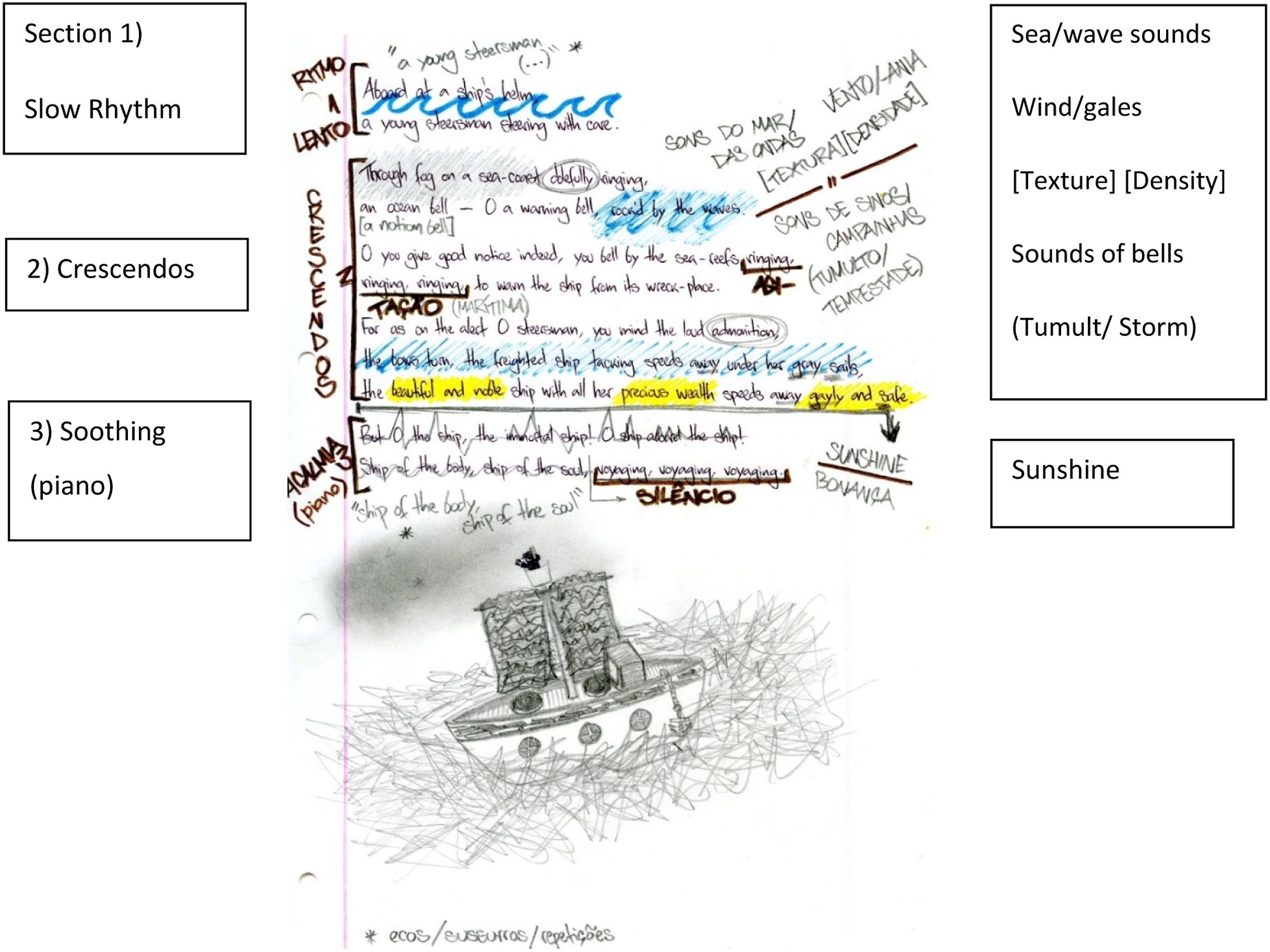
Phase 4: Musical draft
Through this interarts process, each student provided me with a grammar: an inspiration-manual based on their critical interpretation of the poem from which I could compose a sonic platform for the student to later recite over. The Walt’z pieces were thus born out of improvisations over a musical vocabulary set (of sample banks, instruments, effects and synthesized sounds) that had been previously selected to express the moodboards. Having this sonic palette in place allowed for quick decisions and fine-tuning. Once I had created a first draft of electronic music, we then proceeded to work on it together, adapting the musical composition to their performance: to their interpretation, in both senses of the word, of the poem.
At this stage, facilitators may also want to work elocution/recitation with the students. In my case, I prescribed listening to model examples: artists from the “American Spoken-Word Song” section above. Additionally, faculty collaboration can be pursued with colleagues with experience in theatrical performance, possibly from Drama departments.
Phase 5: Comprovisation
The project was based on poetronics partly because of ‘comprovisation’ (Dudas, 2010). In the 1960s, while The Beatles and Jimi Hendrix, for example, could use effects in the recording studio, they were not able to reproduce them live onstage. Technology has helped dissolve the traditional performative gap between composition and improvisation, namely through software that has become ubiquitous in electronic music: Ableton Live. Live combines the editing power of the recording studio, whose focus was mostly on the (logical order of) editing (and hence mostly equated with composition), with the power of real-time audio manipulation. Now one can add effects and processing to recordings or even performances on the fly, making Live a veritable comprovisational powerhouse. Moreover, given the increasing potency of laptops, Live has become a common presence onstage in many genres – including, of course, hip hop. This portability means that rehearsals and recording sessions may possibly take place on campus, provided certain equipment (recording gear: microphones, I/O interface, cables).
Ableton allows the facilitator to swiftly conform the musical dimension of the spoken word to the interpretative intentions of the reciter. This fast response means that we do not need to lose the presence of emotional attachment or flow. We no longer need to record something again (e.g. a faster drumbeat or a differently sounding cymbal): we can quickly effect changes and immediately listen to the result. So, while facilitators of SWS may, of course, choose to pursue a different musical style from electronica, the methodology should secure room for improvisation, since it allows for swift implementation of student response. If using different musical styles/instruments, facilitators can adapt by pre-emptively coming into a session with extra ideas as opposed to a finished piece, e.g. different chord variations, alternative riffs, different arpeggios/voicings; playing a song at a different BPM; resorting to a different instrument if possible (a synth piano instead of a guitar), or to a different melodic scale; etc. As we move from text to music and recitation, it is crucial that facilitators encourage an environment of co-collaboration and informal mentorship to allow students room for adapting their recitation to the music — and conversely, for their asking the facilitator to adapt the music to their literary interpretations. This creative dialogue can be very empowering for students. As MacGlone and MacDonald discuss in their chapter on teaching and learning improvisation: “In a more traditional master– apprentice learning model, teachers usually demonstrate and then encourage imitation … In contrast to this, by ‘embodying’ his musicality to her, [the facilitator] mentored [the student] through playing and creating new music with her. Mentoring through improvising in this way represents a dynamic collaborative process in which the less experienced musician is recognized as contributing creatively, empowering the learner by being inclusive and generous” (285).
An obvious practical advantage of this methodology is that students need not be trained musicians: they ‘merely’ need to (learn to) recite. Naturally, if students are musically talented, they should be invited to collaborate musically – or even write their own musical piece (as happened in two instances in Walt’z), counting on the technical support of the facilitator. Moreover, Zoomers, born in the digital era, are often more prone to easily learning software such as Live, meaning the facilitating cycle can extend itself, as students become potential musical facilitators themselves.
Phase 6: Recording and CD production
Since the faculty did not have access to recording equipment, I did this at home. This was possible because I have the equipment and experience in home recording and production of music. Although I have met several humanities professors who are also musicians, not all facilitators will be in the same situation. Facilitators may thus either learn to work with software such as Live, collaborate with music faculty (perhaps within an interdisciplinary setting), outsource a professional musician/facilitator if funds are available, or even invite one or more students who already possess the musical and production skills.
By the end of Phase 6, our collaboration had resulted in a CD of SWS based on Whitman’s poems. 2 Fortunately, the conference organization was able to pay for the cover illustration and manufacturing the CDs. The CD design was pro bono. Production costs not secured on a volunteer basis (students or faculty) may hopefully be covered by university, research centre, departmental or grant funding (or possibly by charging tickets at the show).
Phase 7: Performance
We first performed on Whitman’s birthday at the National Library of Portugal on May 31st, 2019, for the inauguration ceremony of an exhibition on the reception of Melville and Whitman in Portugal. This served as an early ‘dress rehearsal’. We officially closed the conference on July 5th with a 45-min VJ-ed concert in a closed amphitheatre on campus.
The VJ-ing work was beautifully done by Diogo Pinheiro (the student who displayed the most visual arts skills). Diogo incorporated the poems’ verses into the video, which was projected in real-time, and manually triggered each verse to accompany the elocutionist, facilitating the audience’s sensorial and textual immersion. (While performances should ideally be held in auditoriums and incorporate a video made by one or more students to boost the immersive ‘embodied-reading’ experience, VJ-ing is optional and, again, may be done by students or outsourced to faculty or a professional.)
Performances should be contextualized within academic activities, bridging research and art, teachers and students. Walt’z was integrated in an international conference. An additional idea would be to invite a 12th-grade class from a local high school to attend, so youths may, in an ‘open day’ fashion, experience the sort of literary activities that are possible in HE.
Outcomes
As Professor Teresa Cid (then director of ULICES, our research centre) wrote in an email thanking us, the audience “responded enthusiastically … a most special closing session … a memorable, inspiring moment indeed to watch this highly creative interaction with Whitman’s poetry by the group of students of Bernardo Palmeirim.” The students’ morale was solar. We were later invited to perform at an established national literary festival (FOLIO) - but unfortunately the pandemic struck and the festival was not held that year.
To evaluate outcomes, I asked the students a follow-up question: “You first read the poem silently and alone, then recited it to music inspired by your interpretation of the poem. We normally just do the former. Did your relation to the poem change from the first moment to the next? How so? What did you gain by going through this process?” Below are excerpts. António Graça: “To interpret the poem musically meant allying its original pacing and Walt Whitman's characteristic way of writing with my own sensibility, hence creating something new … I was deeply moved by the final product, as with the collaboration with Bernardo, considering the prior process of analyzing the poet and his poetry.”
António clearly indicates he has moved from a process of analysis to one of affect. Moreover, according to him, it was his being able to “interpret the poem musically” that enabled the creation of the “something new” he was invested in.
Ana expressed how, through this methodology, she was able to access elements that had been hidden by the analytical hermeneutics of CR. Her attentive reading was brought to fruition by embodying the sonic-performative dimension: Ana Antónia Honrado: “Crafting the way in which a text can be recited to music forces a deep understanding of all the sounds, all the quirks, of the full anatomy of the poem. It is impossible to do, unless you let the words live with you for a little while. … It is still reading, nonetheless. Only you get to do it inside out.”
Diogo also pointed out how he was able to engage with the poem differently (“new form of reading”) through sound (“saying,” “hearing”). Diogo Pinheiro: “The poem ceased to be “obra prima” [‘masterpiece’] and became “matéria prima” [‘raw material’]. But my relation to it, the poem, the text, Whitman’s Word, might just have remained intact. After all, the poem sings itself. I have thus gained yet another way of seeing (and of saying, and of hearing) poetry, and not just poetry; a new form of reading.”
Crucially, Diogo insists that what he gained came through the deployment of his aural/oral sense-perception — and not from inferring new ‘content’ in the poem (“the poem sings itself”). Here Diogo is making the same point as Culler (2015) above: the goal is not to “produce a new interpretation.” The relation Diogo established with the poem allowed him to become a knowledge (and artistic) producer, using the poem as a springboard (“raw material”) for his own creation.
Ana was the only member who had already read Whitman in an academic context. Her testimony sheds some light on traditional pitfalls in academic reading. After an exciting summer of discovering Whitman via the Beats: When that summer ended and I started college I brokenheartedly took a class which featured Whitman's poems. I was enchanted by the idea at first. But week after week it become duller — which I thought was impossible to happen. We sat in a small room while everyone took turns reciting the poems, no mispronunciation corrected, barely any attention paid to musicality or rhythm or context. The meaning was taught by a parallel reading of an impersonal essay where a few of the verses were highlighted and vaguely commented on. It was a hermetic, disheartening experience. The time I spent with the Walt’z Intrepid Sailors project felt like paying the ransom for my own Whitman, who had been held hostage in an interpretation of his poems that stripped them out of the richness I held dear. It was a rare feat — an exercise that was academic, yet real.We got to go a lot deeper in the analysis of Whitman's poetry while learning to give it body at the same time. We learned how to make it current, how to make it live in our own time, we pushed it to life. It was wonderful.
Ana bears witness to educational habits this paper aims to avoid by suggesting a different way forward.
Conclusion
This paper has focused on grounding the pedagogy on a conceptual foundation by justifying its relevance within three crucial contexts: literary theory, spoken-word song and education. I hope to have made the case that there is ample room for educators to creatively enhance students’ reading skills by opening text to sound and performance, using music to activate poetry. In the meantime, I have been working on a 2nd series, “4 American Women Poets”, which will allow me to improve my methodology.
Footnotes
Declaration of conflicting interests
The author(s) declared no potential conflicts of interest with respect to the research, authorship, and/or publication of this article.
Funding
The author(s) disclosed receipt of the following financial support for the research, authorship, and/or publication of this article: This work was financed by Portuguese national funds via Fundação para a Ciência e Tecnologia ORCID, I.P. [project UIDB/00114/2020]
