




Abstract
An understanding of the theoretical basis of the design learning process, and the resulting partnership between students and teachers in contemporary design studios, is required to optimise learning. Students’ learning in the architecture design studio has been widely studied, however the specific activities of students and teachers, and the interpersonal interactions between them, have not been investigated in great depth. This research identifies a complex, nuanced situation, one with three consecutive phases of different learning activities and relationships. An undergraduate architecture program at a large Australian university is analysed using a modified Delphi method to investigate the perceptions of staff and students and achieve convergence upon a shared understanding of how the design learning process unfolds through three distinct phases to support learning.
Introduction
While the design studio is a ubiquitous learning environment for architecture students, there is little known about how the students learn the process of design within the contemporary context, how the learning is structured, and how such learning can be facilitated and supported. The design studio, as the signature pedagogy of architecture education (Shulman, 2005), has been well studied from the perspectives of understanding project-based learning (Crowther 2013), and understanding the socio/cultural interactions (Power, 2016; Schön, 1984). Such studies have, however, largely approached the studio as a single type of experience, sustained over time. This research explores how studio activities, participant roles, and interpersonal interactions, change over time. By studying a large Australian school of architecture, it identifies different phases over a semester long duration (13–15 weeks), and demonstrates how this relates to different stages of the design learning process.
Literature review
The design learning process prevalent in design studios – based on the nature of learning
Learning in the architecture design studio is often described as “a student-driven, teacher-facilitated approach to learning” (Bell, 2010: 39). Guided by their teacher, students undertake activities which support the development of a design project; a process of investigation that leads to the expansion of knowledge. Students’ autonomy over the learning process is critical to discovering learning outcomes (Sedaghati and Hojat, 2019). Students receive feedback from their teacher, who guides their choices along their learning journey (Bell, 2010).
The design learning process in architectural design studios, is underpinned by two integrated activities, being: (1) the understanding of the learning processes; and (2) the act of designing. This architectural studio design learning process is characterised by students spending time engaging with their peers and teachers, while developing their design projects (Saghafi 2020; Salama 2015). In existing literature, the design learning process is defined as: (1) problem-based; (2) project-based; (3) process-based; and/or (4) product-based. While each of these can be appreciated as an authentic learning experience, there are subtle differences.
The nature of architectural design learning is both student-centred and problem-based—with students required to actively engage with, and to solve, a specific design problem (Ramaraj and Selvaraj, 2021; Salama, 2015). Students develop design knowledge and skills through a social constructivist form of making meaning, of reality (Powers, 2016). Problem-based learning is limited through framing learning as solving a problem. This is not always appropriate for design education, as the notion of problem solving can oversimplify the design process, especially when the matter being explored may not be a ‘problem,’ as such.
In project-based learning however, the pedagogical framework is broader, and the notion of a project is more closely aligned with professional design practice. In this mode, the project is typically an integral component of the learning context, facilitating learning experiences for students. Design projects integrate the design problem with the necessary demands of the architectural design curriculum (Saghafi and Crowther 2021). While project-based learning has authentic learning advantages which align with design practice, it can also provide limitations through needing to be contextualised in a social or industrial setting, which may constrain purely exploratory learning experiences.
In contrast, process-based learning relies on a collaborative effort between both the design teacher and the student’s peers, to explore issues which do not require a problem or project setting (Schön, 1987; Webster, 2004). This form of learning considers complex and multifaceted perspectives of design, as an ongoing process of investigating, reasoning, and testing—however, in an educational context this is not necessarily constrained by an authentic setting (Cuff, 1991; Salama, 2015).
And finally, product-based approaches adopt teaching techniques which are not necessarily engaged with the realities of design process in practice, providing a greater focus on the quality and characteristics of the end product, rather than the process of getting there (Cuff, 1991). Each of these understandings of the design learning process has impacted the development of the contemporary design studio, and as demonstrated in this research, each may occur at different times and during different phases of design studio education.
Historical transformation of the architectural design studio pedagogical model
Schools of architecture largely adopt design studios as their primary mode of instruction and education. Universal forms of learning and teaching which are associated with professions, are referred to as ‘signature pedagogies’ by Shulman (2005). The signature pedagogy of architecture education, the contemporary design studio, has been developed from and informed by a rich history of design education modes and models.
The signature pedagogy of architecture—the design studio—can been traced back to historical times, and described as a Master Apprentice Model (Mewburn, 2011). In this model, students reflected their ‘master’s’ behaviour and philosophical approach. This model subsequently transitioned to the École des Beaux-Arts, remaining ‘master’ centred, but developing into a form of professional training (Powers, 2016). The second major period in the evolution of studio pedagogy developed in the Bauhaus School, which was established in Germany, in 1919. The Bauhaus integrated industrialisation and the arts and crafts of everyday life, into architectural design learning. This transformed design education through emphasising the process of the design project, which the Bauhaus teachers argued was more significant than the design product (which was considered of primary importance in the earlier École system). This shifted the role of the master from one who is to be followed or copied, to that of a teacher who guides and facilitates, with an expectation that the student is actively involved in the design learning process (Powers, 2016). As explained by Lawson and Dorst (2013: 220) ‘the most revolutionary pedagogical change was to move away from the single pupil–teacher relationships of the École to a community working and learning together environment. One of the key features of today’s design schools, the studio, was born.’
The development of the university model of studio pedagogy during the 20th Century has been described by Donald Schön, and this includes his concept of the ‘reflective practitioner’ (Schön, 1984, 1985, 1987). Schön elaborates on this form of studio pedagogy through his reflection-in-action model of design teaching. This model incorporates aspects of constructivism and student led learning, but it still employs a teacher-centred approach, where academic staff take on the role of instructor, guide, and assessor. Through the shift of design education into a university context, the design studio became a unique physical space where students not only worked and received critique on their design projects, but also where they spent most of their time. This time spent with their peers and teachers, resulted in students learning design while also developing a strong sense of a social culture—a hidden curriculum, which is rooted within social interaction. The significant amount of face-to-face time that teachers spent with each student, served as the primary mode of teaching design (Ciccone, 2012; Schön, 1984, 1985, 1987). Critiquing Schön’s teacher-centred model of the design studio, Webster (2004: 103) highlighted the voices of students, and the increasing recognition of the hidden curriculum along with the potentially constraining aspects of that cultural context. Her pedagogical model was student-centred and supports the avoidance of previous traditional power structures of master to pupil, providing the student with greater agency over their learning.
Following Schön’s work, Powers developed a design studio pedagogical model that made students responsible for their own design studio learning, shifting the teacher’s role to one that creates a social learning environment, which is adapted to the needs of each individual student (Powers, 2016). However, this theoretical model of self-regulated learning it limited. It doesn’t adequately respond to all the contemporary design studio pressures, particularly the reduced contact time between students and teachers and the homogeneity of the design studio project for large student cohorts. Despite this, Powers’ work does point to the transition of thinking in current research that evidences that studio pedagogy must be student-centred. This is supported by quality 21st Century higher education needs, which emphasise a student-centred pedagogy (Harriss and Froud, 2015). However, Powers’ model still represents the signature model of studio pedagogy, by placing emphasis on the design project’s process, and where the teacher plays the same role as the instructor, in Schön’s model of reflective practice.
Shift in signature pedagogy in the Australasian studio context
In Australia, most people seeking to become an architect, do so through a process of 5 years of formal education (typically 3 years of undergraduate and 2 years of postgraduate), a minimum of 2 years of workplace learning or internship, and completion of a government controlled examination procedure (AACA, 2019b, c). The 5 years of formal education are tightly controlled, as Australian university courses are accredited every 5 years by the Architects Accreditation Council of Australia (AACA, 2019b, c).
Four significant studies have been conducted in Australasia during the 21st Century, all defining the studio as an environment with a particular culture that follows a project-centred teaching approach (AACA, 2019a; Ostwald and Williams, 2008a, 2008b; Wallis et al., 2017, 2010; Zehner et al., 2009). In Australasia, architecture design studio teaching occupies about 40% of the overall architecture curriculum (AACA, 2019a), and since 2006, the atelier studio model has shifted into what has been called the contemporary studio model (Ostwald and Williams, 2008a, 2008b; Wallis et al., 2017). The importance of the design studio in architectural education curricula is supported by the result of a survey of academics across Australian universities in 2007 and 2018, where the design studio was the only area consistently rated as ‘extremely important’ (AACA, 2019a; Ostwald and Williams, 2008a). Such a degree of importance awarded to studio teaching highlights its significance in architecture education, and the need to explore the intricate working of learning and teaching experiences in the Australian context. As reported by the AACA (2019a: 44) ‘the primacy of design has not changed over the last decade, and architectural educators are firmly committed to design studio.’
In Australia, changes in the higher education context over the past two decades have resulted in the rapid rise of student admissions, with diverse student cohorts, including mature, international, and full-fee-paying domestic students (Wallis et al., 2017). Teaching weeks per semester for architecture design units have been reduced to accommodate economic constraints of institutes (Ostwald and Williams, 2008a, b; Wallis et al., 2010, 2017; Zehner et al., 2009). While student numbers have increased for each undergraduate year, the face-to-face time between studio instructor and student in design studios has reduced as a result of an increase in student to staff ratios (Tucker and Rollo, 2006; Wallis et al., 2017). There is a strong reliance on part-time sessional academics, employed from the profession, who bring knowledge of practice into studio learning and teaching (Chamorro-Koc and Kurimasuriyar, 2018; Marshall, 2012; Ostwald and Williams, 2008a). The introduction of online learning management systems has brought flexible learning for students, and allowing them to not solely reply on learning from their peers, as was the case in traditional signature design studios. The studio signature pedagogy has hence shifted into a contemporary blended model of design teaching (Crowther, 2013).
These developing changes have had a significant impact on architectural education at a large scale. In Australia, there were 8900 students in total enrolled in schools of architecture in 2014 (RAIA, 2015). By 2019, there were 18 Australian universities offering the Master of Architecture degree through a professionally accredited program (AACA, 2019b, c).
Building on Ostwald and Williams’ study (2008a, b), a more recent Australasian study elaborated on the diversity in the typology of studio models/definitions/approaches prevalent in the Australasian schools of architecture between 2007 and 2011 (Wallis et al., 2017). This study analysed secondary data from 19 schools of architecture in Australasia (collected through Ostwald and William’s (2008a, 2008b) first phase study). Wallis et al. reviewed qualitative data from six different schools of architecture, chosen on the basis of diversity in geographical location, student cohort sizes, resourcing, learning and teaching approaches, and the space allocation/creation of studios. The findings of this study build on the understanding of the diversity of studio models identified in Ostwald’s 2008 study (Wallis et al., 2017). The revealed factors that impact studio models’ diversification in the Australasian context included: the feasibility of access to physical and human resources; the educational institute’s flexibility in accommodating different learning and teaching methods; and how students engage in their learning (Wallis et al., 2017; AACA, 2019a).
Wallis et al. (2017) identified four major studio models prevalent in the Australasian context. The most prevalent studio model of these four, was time-tabled tutorial sessions for students in large (more than 150) cohorts, who don’t have access to dedicated desk spaces, but rather and meet their teachers for three to 4 hours a week in studio tutorial spaces, evidencing a clear shift away from the signature master apprentice studio models. This approach is called the ‘University Studio Model’ by Wallis et al. (2017: 129). This transformation in studio models, and their diverse approaches, suggests the need for new understanding of the nature and structure of design learning, to optimise students’ design outcomes, and to better support and facilitate their learning.
It is beyond the scope of this research study to review the design learning approaches in all four studio models in the Australasian context (Ostwald and Williams, 2008a, 2008b; Wallis et al., 2017). Rather, this study focuses specifically on uncovering the University Studio Model’s (Wallis et al., 2017) design learning process.
Methodology
This research study questions: how design studio participants perceive design learning structures within contemporary social learning environments; what interactions occur between participants; and how their activities and interactions change over time—in particular, through three different phases of learning activities.
To explore these issues, a qualitative case study methodology (Yin, 2009) was implemented, to enable the lived experiences of the design studio stakeholders to be captured, and in turn inform the theoretical basis of learning. The case study was an undergraduate architecture program of a school of architecture in a major Australian university where approximately 200 students are enrolled each year. The undergraduate program was 4 years long, followed by a 1-year postgraduate program. For the architectural design subjects (called ‘units’), the unit coordinator lectures the entire cohort of students in a face-to-face lecture setting, normally for 1 hour each week. These lectures typically offered aspects of generic design knowledge, as well as information specific to the design project and the activities being undertaken each week. After this, groups of 16–22 students learn in face-to-face studio tutorial group settings with their tutors, typically for 3 or 4 h each week. Tutorial activities relate to the stage of the design project, analysis task, or documentation requirements, programmed for that week. The unit coordinator recruits and leads the team of tutors that are typically practising architects or PhD researchers.
Each of the 4 years of design studio were organised by a similar structure and program, over the semester. Typically, this included briefing a design project at the start of the semester, followed by students independently (or in small groups) conducting site analysis and exemplar research for a few weeks. Students would then progress to proposing design options and variants, and after being guided by their tutor, developing a preferred option in detail. Students would finally resolve the design and create finalised drawings and models for presentation and assessment. This typical design studio structure includes aspects of problem-based, project-based, process-based, and product-based learning; each occurring at different stages of the semester.
The case study provided an opportunity to gather interview data from all three major stakeholder groups (i.e. students, their tutors, and their unit coordinators), from all 4 years of the undergraduate program. Given that these three groups may have divergent perceptions of the design studio, a modified Delphi method was considered to be most appropriate, as this allowed the research to conclude with a group opinion, representing a convergence of perceptions (Giannarou and Zervas, 2014; Keeney et al., 2011). As all three groups participated in the design studio, they were considered as ‘experts’ for the purposes of the Delphi study.
The modified Delphi method employed two rounds of data collection and analysis. This involved collecting data from participants in the first round, then re-presenting the consensus findings from that round back to an extended group of participants in a second round, to establish further consensus. In the first-round, participants were invited from all three stakeholder groups, and from all 4 years of the design studios. Four unit coordinators, six tutors, and 12 students (representing a suitable cross section of the stakeholder groups) were questioned about their perceptions of how students learn the process of design, in design studios. Participants were asked to discuss their understandings of design studio learning within the specific contexts of: activities; participant roles; and interactions. The participant responses were thematically analysed to establish several themes and sub-themes. Within this thematic structure, commonly recurring aspects were arranged and recorded.
These recurring aspects were then presented back to both the initial participants, and a group of additional participants (five unit coordinators from first to fourth year, 22 tutors, and 54 students), in the form of a survey using the modified Delphi method. The survey used simple language, and where possible the same terminology that participants had used in round one, to limit misinterpretation. In this survey, the participants were asked if they agreed or disagreed with each of the aspects, being an accurate or relevant description of some facet of the learning process in the design studio. The option to ‘agree’ meant accepting the component if it occurred even once in the participant’s lived experience, while the ‘disagree’ option, meant that it had never occurred.
The analysis of survey options provided by participants in the second round of data collection was based on 75% agreement across the three participant groups; students, tutors, and unit coordinators. The responses from each stakeholder group were analysed separately (in terms of agreement or disagreement), to each aspect/component of the survey. Percentage responses for each of the three stakeholder groups were calculated separately. The three distinct stakeholder group percentages for each component, were then added together and divided by three, to provide an average percentage representing the consensus of the three groups. The reason that an average percentage for each component in the survey was calculated, was to give equal weighting to students’, tutors’, and unit coordinators’ groups, as the number of participants in each group varied. This allowed a convergence and shared understanding of how learning is structured in the architecture design studio, to be achieved.
Findings
In the first round of data collection and analysis, 32 aspects of the design learning process were identified. When these were presented back to the extended participant group in the second round, there was convergence of opinion that supported 15 aspects, representing an accurate account of some facet to the learning process. While the aspects from the first round could be classified into several thematic topics, a more significant finding was that the participants clustered these into 3 distinct, and different phases of the semester, which unsurprisingly relate to the stages of the design studio project (as described earlier). Of interest, however, is the difference in which aspects of design learning were noted for each phase, and how they related to notions of problem-based, project-based, process-based, and product-based learning.
The design learning process enables students to discern and experience the educational objectives of the design project. The findings of this research acknowledge that students’ learning and teaching experiences can vary depending on their specific learning needs, and level of study and challenges. However, certain aspects of the learning process are also similar, in various learning journeys. The similarities in participants’ conceptions have formed the basis for structuring an understanding of the design learning process.
The findings of this research show design learning occurring through a chronological three phase process. Each phase relates to a different period of the design project; each characterised by different activities and interactions, and by different roles (Iftikhar et al., 2021). Different cognitive and experiential aspects contribute, to allow learning to take place in these phases. The design learning phases are dependent upon the design project and the learning settings within which students learn, the process of design. The findings also revealed that the design learning process took place in two learning modes: the face-to-face design lectures and studio tutorials; and the supplementary online resources.
Design learning phase one
Comparison of participants’ perceptions about design learning phase one aspects for first and second round of findings.
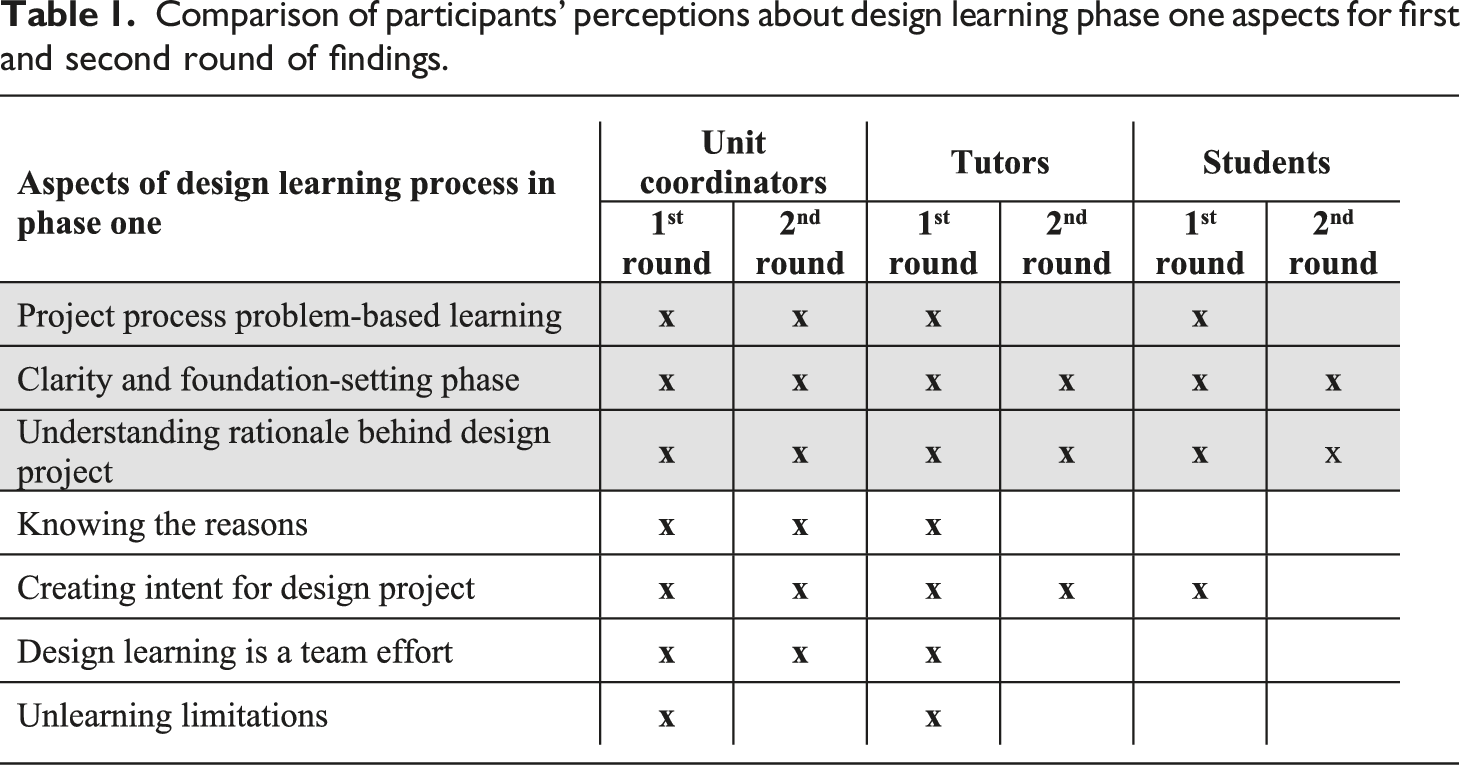
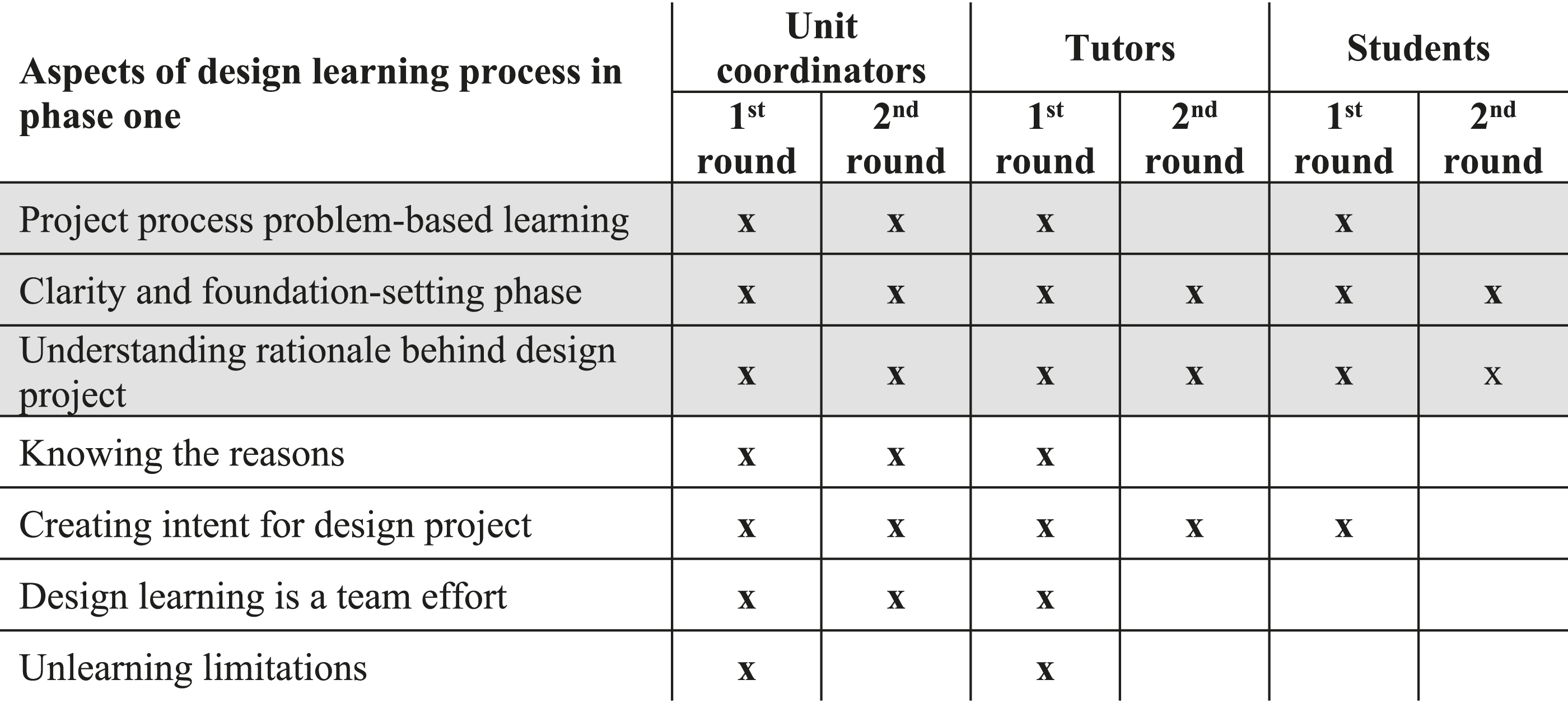
There was consensus among the three participant groups that this phase: • Was a clarity and foundation-setting phase for the academic design project; and • Required team effort by students, tutors and unit coordinators considering the design learning process to be a project process and problem-based form of learning. Furthermore, purpose of this phase was to enable the teaching team and their students to understand the rationale or the major objective behind the project and its execution—knowing the ‘why’ of the design learning process and its importance in professional studies.
Design learning phase two
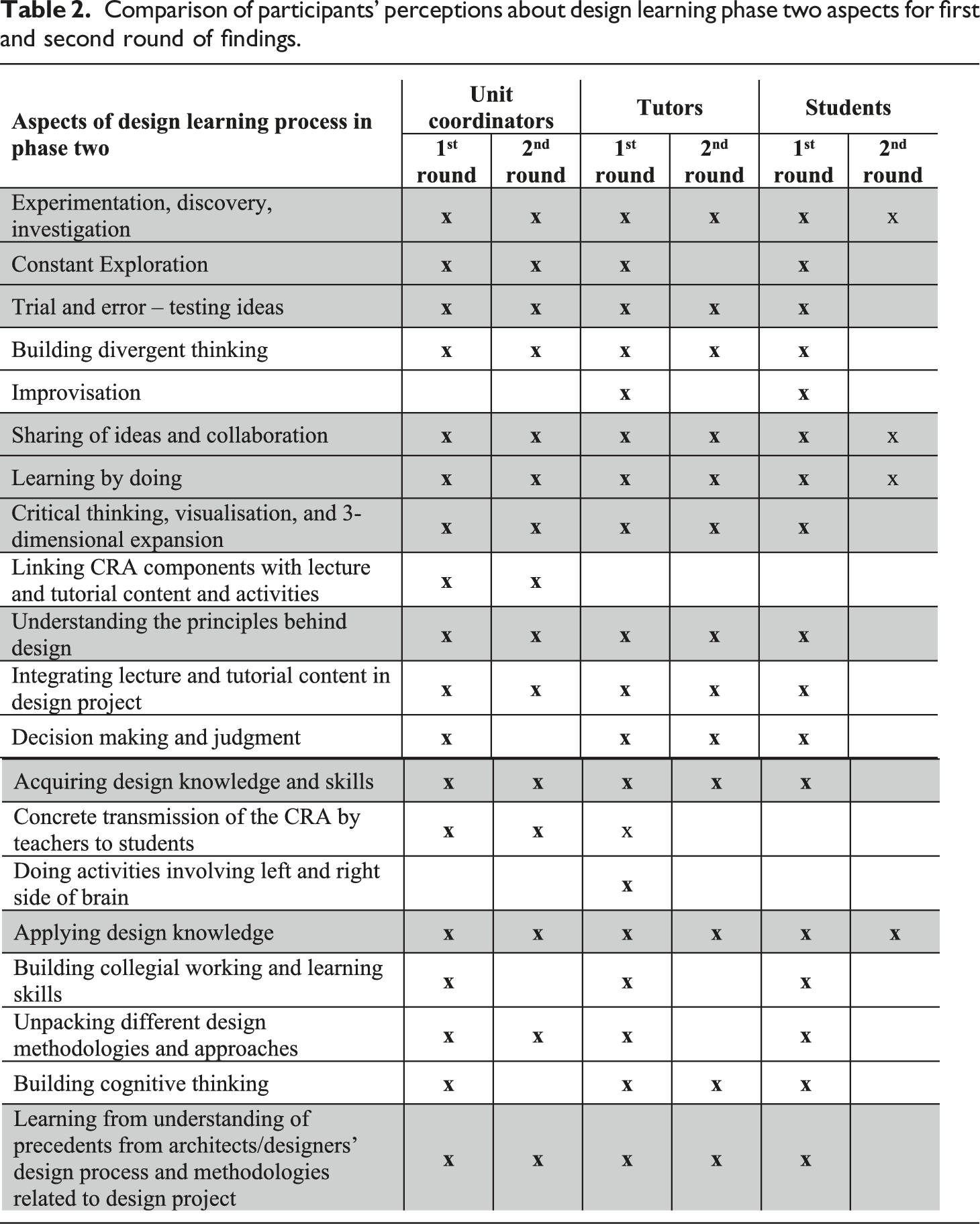
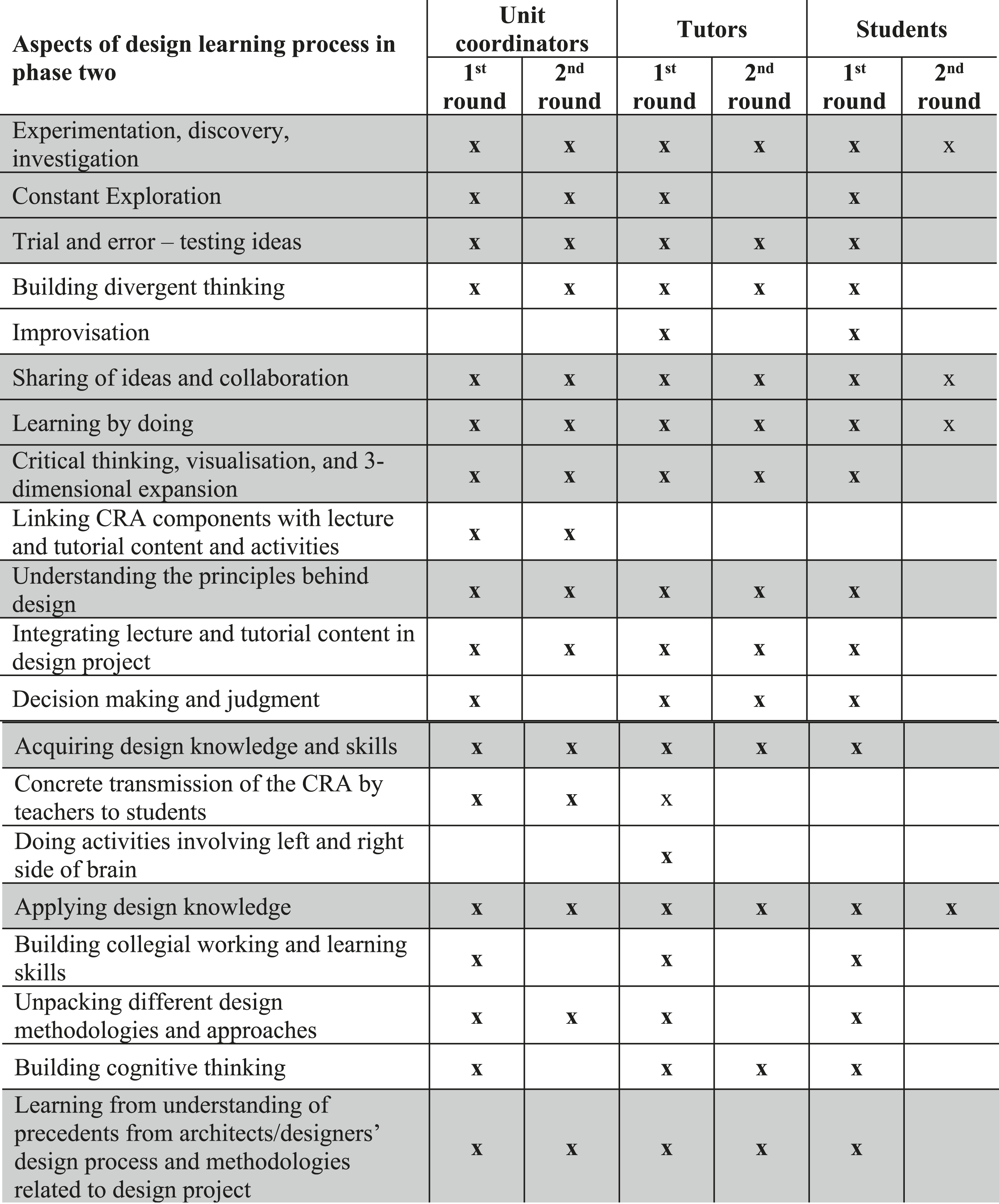
As shown in Table 2, 20 aspects of design learning phase two were identified through the first round of research. Using the Delphi method, these aspects were then re-presented to participants through a survey. The grey banded aspects in Table 2 constitute the final set of findings. According to the second round of data analysis, the second phase of the design learning process was found to: • Constitute a phase of continuous investigation—exploration where students use a trial and error method to solve their design problems and test multiple ideas. Those ideas created by students are then shared for feedback to build students’ critical thinking, expansion of imagination, and their three-dimensional perception of space; and • Be a phase where students require support and need to belong to a learning community, where they acquire design knowledge through understanding approaches of other architects. In this phase, they also learn to apply their design knowledge, with their unit coordinator and tutor’s help. Such acquisition and application of design knowledge helps students to understand the principles behind architectural design and to use these to complete their final design project outcomes. Comparison of participants’ perceptions about design learning phase two aspects for first and second round of findings.
Design learning phase three
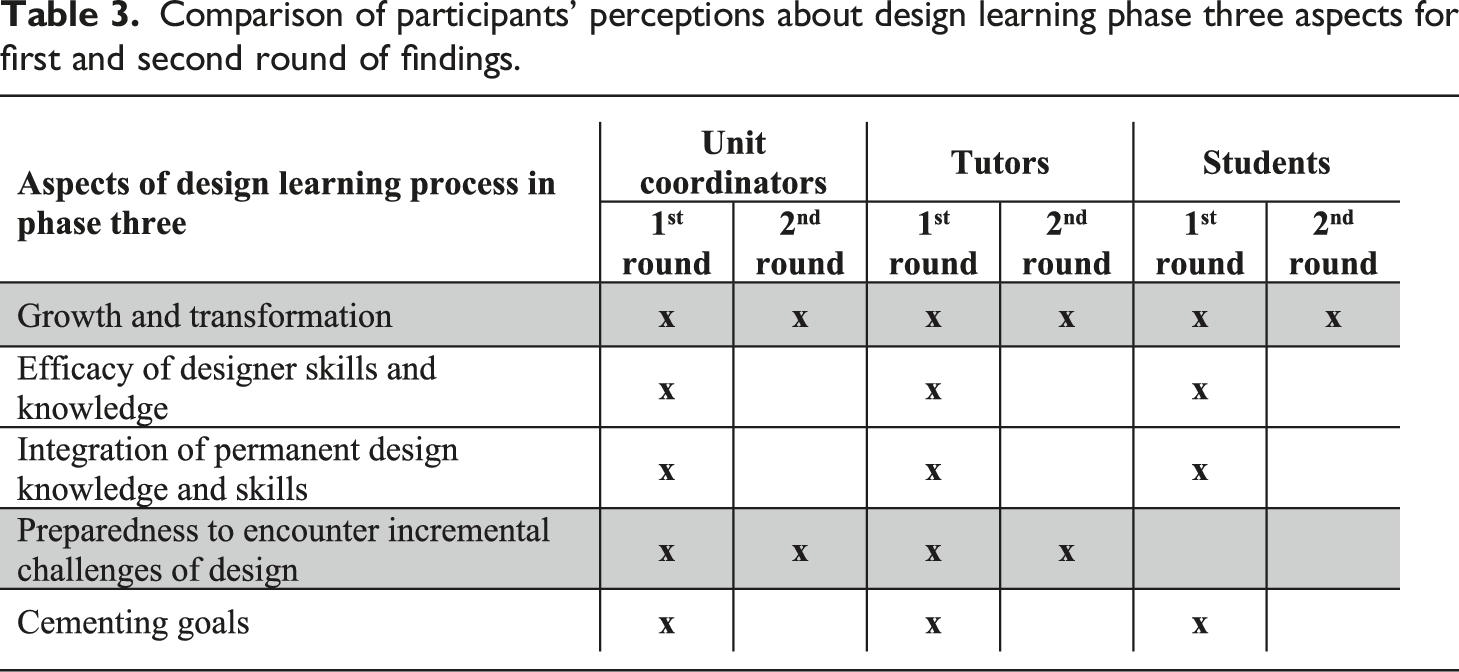
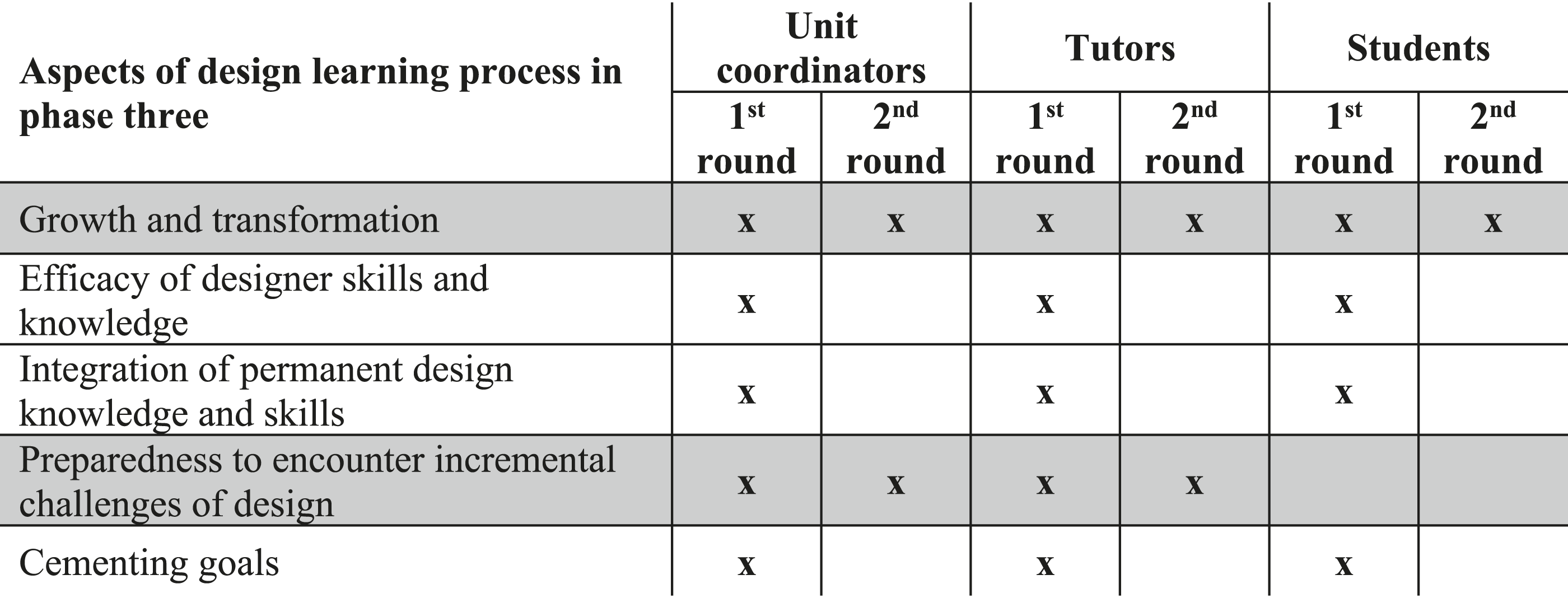
As shown in Table 3, five aspects of the design learning phase were identified through the first round of research. Using the Delphi method, these aspects were then re-presented to participants through a survey. The grey banded aspects in Table 3 are part of the final findings. In this phase only two of the aspects were agreed upon, the others having divergent responses between the participant groups. Here the consensus of the three participant groups was: • Visible growth and transformation in design skills and knowledge was achieved regardless of the grade of the students; and • Students used consolidation of professional learning, expanded thinking, and design knowledge, to apply their acquired skills and to engage with incremental architectural design challenges relevant to their level of study. Comparison of participants’ perceptions about design learning phase three aspects for first and second round of findings.
Discussion
This case study research provides evidence that the design project learning process undertaken by students in this form of studio, has three major phases. An appreciation of these phases has significant implications for understanding how the design studio is best organised, how participants take on different roles at different times, and the nature of design learning itself. An understanding of the phases also supports the implementation of different learning and teaching strategies, throughout the design project.
Importance of the design learning phases and its structure
This research acknowledges that different students learn differently and they are impacted by different levels of prior knowledge, life experiences, and educational backgrounds, which influence how they learn to design and develop their professional identity. However, similar learning processes were also found in various participants’ experiences and may or may not be fulfilled by all students in each design learning phase. These do, however, collectively portray the design learning process. Aspects that contribute to design learning (and found in each learning phase), do not occur linearly, and may not occur for every student. Thus, aspects of learning can overlap between phases and occur cyclically to build layers of design thinking, knowledge, and skills.
The learning phases relate to the intention of learning and the nature of contributing aspects to learning. For example: an explanation of the design project in the first phase adding clarity of intent; precedent study in the second phase adding to design knowledge; and summative feedback in the last phase adding varied degrees of confidence to tackle increasingly complex design challenges. These phases allow design knowledge to be gained through clarity of learning objectives (first phase) and ongoing research (first and second phase) and application through the process of exploring possible solutions to the design problems (second phase). In the process of research and application of design knowledge, students acquire further understanding after reflecting on the completion of the project and its summative feedback (Saghafi, 2020).
Implications for architecture studio education
The different aspects within each learning phase characterise the nature and ontology of design learning. These phases provide different learning aspects that studio teachers must consider, to develop learning strategies accordingly. Based on the findings, the implications for architecture studio education are now discussed.
Role of learning event and learning environment in design learning process
When participants were asked how students learn the process of design, significant factors emerged: • Resolving the academic design project (major factor) • Being a part of the leaning settings (major factor) • Interacting with the tutors, unit coordinators and fellow peers (major factor) • Engaging with the curriculum content • Online learning portals and content • Students’ self-research • Working in the industry (internships) • Applying knowledge across different subjects or units • Organic student groups
While all these factors are crucial in contributing towards a students’ learning, this research identified a focus on the first three factors. The three design learning phases are cyclical and overlap and are dependent on time as the student learns to uncover the complexities inherit in the design project.
Nature of design learning process
The design learning process emphasises the desirability to create architectural design projects which respond to the understanding of these approaches, to design learning. In each learning phase, different factors contribute to the creation of design knowledge, skills and thinking in students. These factors constitute the ontology of design learning. The three phases of this design learning process aim to foster independent design learning skills, as students spend most of their time solving design problems and making decisions about their design projects themselves, with the regular support of their teachers (tutors and unit coordinators). They solve design problems inherent within a project through a process which characterises design learning as problem-process-project based learning, in this studio model (Bell, 2010; Salama, 2015; Schön, 1984; Webster, 2004).
This three phase form of design learning supports students to make independent decisions and design approaches, as an authentically student-centred process. This is similar to the three stages of ‘own it’, ‘learn it’ and ‘share it’ in Lee and Hannafin’s (2016: 724) student-centred learning design framework. Similarities between the ‘own it, learn it and share it’ concepts and these research findings are as follows: • Students own their design learning journey by being clear on the major goal of the design project in phase one; • Then students learn the process of design by looking for resources and skills to build through experience in phase two; and • Finally, students share their learning outcomes with a wider audience in the third design learning phase.
The problem–process–product-based design learning found in this research corresponds to three main learning phases along which different forms of learning happen for learners.
Learning and teaching strategies based on design learning phases
Aspects of the design learning process provide a useful guide to enable academics to understand how students learn, and what roles they need to adopt to effectively interact with their students (Iftikhar et al., 2021). The roles and interactions between students and teachers can become successful when teachers align their teaching strategies with the nature of the learning phases. In the first phase, tutors should provide learning activities which enable students to understand the learning objectives of the design project, before beginning the research process (Saghafi, 2020). In the second phase, tutors should facilitate students’ design approaches and customise their pedagogy to enable students to explore, test, and refine their designs (Salama, 2015). In the third phase, the tutors should build rapport to provide students with a safe space to present their work confidently to both familiar and unfamiliar audiences (Anthony, 1991).
Conclusion
This research provides a case study which shows that architecture design learning occurs in three interconnected phases, when students undertake a design project with the help of their teachers. Each learning phase focuses on different aspects, each required for design learning to be successful. This research argues that the nature of design learning found in this contemporary form of studio is problem–process–project based learning and is consistent with a social constructivist form of learning (Powers, 2016). Ideally design teachers should understand the challenges and opportunities within each phase, to better facilitate architecture design learning experiences and outcomes for their students. This research uncovers the roles and interactions that students, tutors, and unit coordinators can adopt during these three phases, to make design learning more effective. There is also potential to explore whether these learning phases occur similarly in online learning, and how these face-to-face learning implications may provide opportunities for optimising online learning and teaching, in the future.
This research shows that the contemporary design studio is not a simple, static arrangement of activities and stakeholders, but rather an arrangement that changes over time through phases as the semester and design project progress. Educators may benefit from understanding this and adapting their roles and approaches to teaching, to better support and facilitate learning at each phase. Clearer direction and instruction should be offered to tutors, to allow their actions to align with student expectations at each phase, while remaining focused on the important aspects of that phase. Similarly clearer information should be offered to students at key times during the project design, so they are aware of the important aspects of design learning being addressed within each phase.
Footnotes
Declaration of conflicting interests
The author(s) declared no potential conflicts of interest with respect to the research, authorship, and/or publication of this article.
Funding
The author(s) received no financial support for the research, authorship, and/or publication of this article.
