




Abstract
Across institutional settings, people who talk about having committed sexual violence often do so in ways that may neutralize their personal culpability for it. These so-called neutralizations may be part of a pro-social forward-looking narrative, but might also obscure information and strengthen attitudes that enable further violence. In this article, we examine how one such neutralization –excuses – is managed turn-by-turn, in research interviews with 19 young persons who have committed sexual violations. We specifically ask how the interviewers respond to potential ‘excuses’ in interviewees’ talk, and how these responses in turn affect their subsequent conversation. The purpose is to unpack the details of how this is done, and what we might learn of relevance to social work practice. Using conversation analysis, we show how resources of active listening can support and steer interviewee reflections while neither endorsing nor confronting potential ‘excuses’. This way of responding creates room for co-achieving a project of making sense without displacing responsibility. We unpack how the interviewer uses subtle verbal and non-verbal resources to suspend explicitly evaluative responses, enabling gentle negotiations of the interviewees’ accounts and recognition of the interviewees’ sensemaking projects. Three key implications for practice are discussed. First, the importance of supporting the clients’ sense-making; second that subtle nuances in how active listening can both support and put interactional pressure on the client to continue and adapt their story, and third, the potential utility of opening with a non-evaluative, relationally oriented stance.
Keywords
Introduction
There is a growing recognition that working with those who perpetrate violence is a central task in prevention and harm reduction (Marshall et al., 2003; Wild, 2021). However, talking about violence, in particular sexual violence perpetration, is both experienced (Blagden et al., 2011) and oriented to as a threat to the person’s social bonds (Mullins and Kirkwood, 2019). Consequently, even persons who are motivated to prevent (further) sexual violence perpetration, tend to seek help for other issues as they struggle to address it with their social worker (Lindegren, 2025). Due to their broad, front-line presence, social workers hold a key position to address sexual violence perpetration with these clients in the settings they do seek help. Perhaps therefore, researchers, social workers and clients alike call for more specific skill training to handle this topic (Black et al., 2010; Lindegren, 2025; Lundberg and Bergmark, 2021). One recurring phenomenon is how persons often narrate their sexual violence in ways that neutralize their personal responsibility. These so-called neutralizations can be both problematic and constructive to institutional goals of preventing re-offending and supporting reintegration (see section on neutralizations). Therefore, they present a here-and-now interactional challenge: how can we understand and respond to them?
In this article, we employed conversation analysis (CA - Sidnell and Stivers, 2013) on research interviews about sexual violence, to examine this fundamental challenge: responding to so-called neutralizations in a way that encourages continued disclosure whilst not endorsing problematic content. As interviewing clients is a central aspect of social work practice (Ekström et al., 2019) research interviews analyzed with a conversation analytic approach have the potential to enrich our practice (cf. Iversen, 2014; Roulston, 2006). Moreover, the interactional setting of research interviews highlights the subtle nuances of listening as an interactionally consequential activity (see section below).
We therefore examined what resources interviewers use when listening to interviewee talk that can be understood as neutralizations. We found that interviewers varied their often-minimal listening responses in terms of non-verbal features and verbal content, and unpack how this affects the continued interaction, in ways that both align with and nuance the concept of active listening. In our discussion section, we then consider how these specific findings can be relevant to practice.
Neutralizations as social accounts
Neutralizations are accounts that neutralize responsibility for the offence, or its impact on the victim(s) (Hulley, 2016, Ware, et al. 2015). Whilst early conceptualizations (Sykes and Matza, 1957) understood neutralizations as reflecting the person’s pathological, criminogenic thoughts, current criminological literature understand neutralizations as social accounts: stories that are told to an audience with a purpose and an effect (Digard, 2014; Maruna and Copes, 2005). One central question within institutional settings is what effect the client’s neutralizing of responsibility for past perpetration has on their capacity for taking forward responsibility (eg. making amends, preventing further violence) (Maruna and Copes, 2005). Recent research problematizes Sykes and Matzka’s assumptions of etiology and pathology as grounds for practice (Bullock and Condry, 2013), failing to find evidence that neutralizations, even including denial, increase risk of reconviction (Ware et al., 2015). It argues that neutralizations, including denial, may have a helpful or protective role: They managine social implications of accounting for a sexual offence, and support building a desisting identity moving forward (Bullock and Condry, 2013; Hulley, 2016; Maruna and Copes, 2005). However, treatment literature also emphasizes how neutralizations can reflect potentially criminogenic attitudes such as “Women should oblige men’s sexual needs” (Auburn and Lea, 2003: p. 282).
In this article, we focus on a neutralization central to notions of responsibility: excuses. Excuses are accounts that “explain untoward behavior and bridge the gap between behavior and expectation” (Scott and Lyman, 1968: p. 46) in a way that treats the behavior as wrong, but simultaneously diffuses agency of the person who committed it. These agency-diffusing accounts are part and parcel of everyday life (e.g. I was late because the bus was delayed). We are “constantly engaged in reason-giving in our interactions with others, and offenders are no exception” (Bullock and Condry, 2013: p. 585). As with neutralizations in general, accounts that diffuse agency could be problematic (eg. victim-blaming). However, Farmer et al. (2015) found that persons who desisted from sexual offending more often than those who persisted, accounted for ther ióffences in ways that diffused agency to situational factor. They argue that situational accounts support sensemaking that separates the offence from their core self, thus enabling an imagined pro-social future (Farmer et al., 2015; McAlinden et al., 2017). Rather than excusing responsibility, situational accounts can diffuse agency backwards whilst still supporting responsibility for preventing future offending (Friestad, 2012; McAlinden et al., 2017; Mullins and Kirkwood, 2022). These different ways of understanding excuses begs the question of how one can respond to them in a way that pursues their potentially helpful effects whilst avoiding the non-helpful ones.
Using CA to unpick how neutralizations as accounts are co-constructed in interaction
Conversation analytic theory (CA, Sidnell and Stivers, 2013) offers a perspective to understand neutralizations as an on-going interactional achievement: as a result of how we build on and resist each other’s turns of talk to co-constitute the talk’s meaning and effect. For instance, we can look at how interviewees’ turns of talk makes certain responses relevant from the interviewer (eg. response relevance - Sidnell and Stivers, 2013: p. 192), or is designed specifically for the interviewer (recipient design - Sidnell and Stivers, 2013, p. 145). This understanding provides analytic leverage to unpick how neutralizations are negotiated in interaction.
‘Excuses’ are interactionally interesting precisely because of the mismatch between on the one hand being normal and potentially pro-social, and on the other being problematic in the context of sexual offending. When people breach widely endorsed norms, we often attribute their behavior to specific internal traits rather than situational factors (Darley and Cooper, 1998), and expect them people to account for their misdeeds in terms of intentionality (Edwards, 2008). Therefore, a professional listening to an account that diffuses agency for sexual violations might be less likely to accept it as part of a pro-social sensemaking project, and more likely to understand and even confront it as pathological and criminogenic.
Conversation analytic research has unpicked how clients design their talk to not come across as ‘excuses’ to the group therapy members (Auburn, 2005; Auburn and Lea, 2003). Moreover, clients orient to the institutional agenda, both when this is to explicitly challenge neutralizations (Auburn, 2005), to disclose (Digard, 2014) and when it is to build situational accounts to foster desistance (Mullins and Kirkwood, 2021). For instance, Auburn (2005) demonstrates how clients use narrative reflexive devices such as meta-communication to avoid being understood by recipients as minimizing their responsibility. Finally, recipients shape clients’ talk through feedback, again aligning with the setting’s specific institutional goals (Auburn, 2005; Mullins and Kirkwood, 2021).
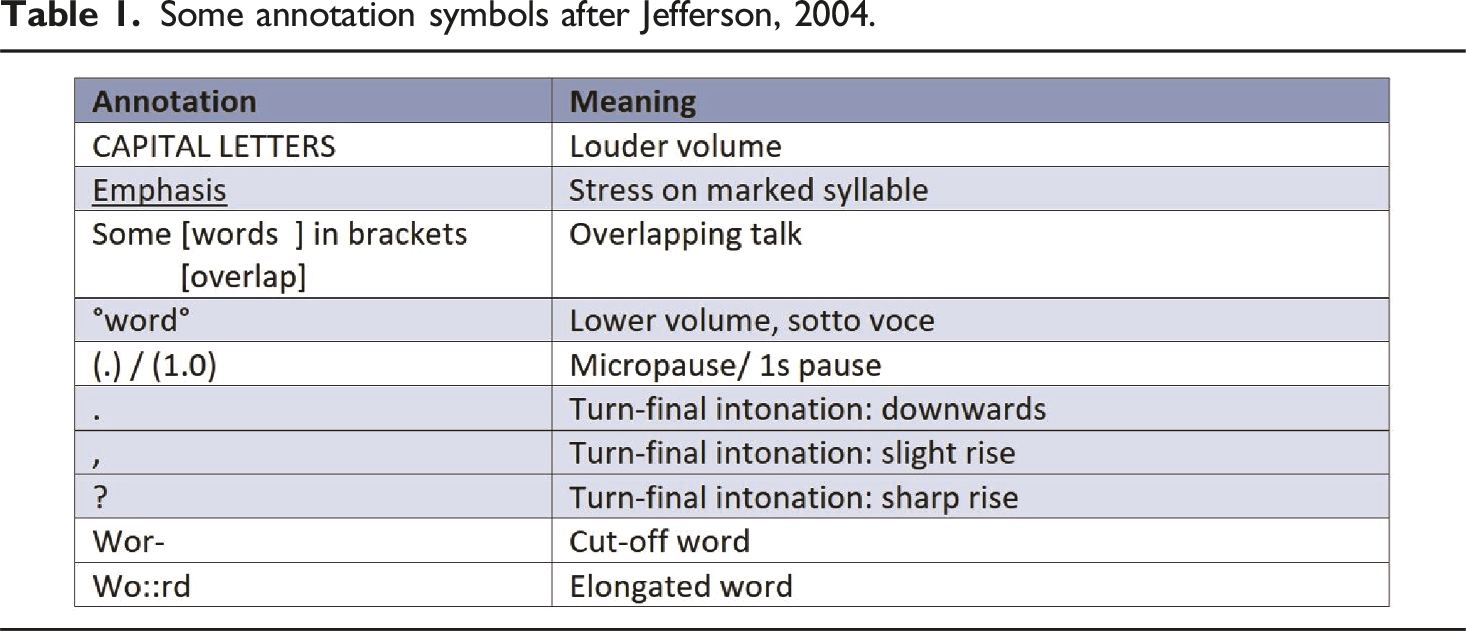
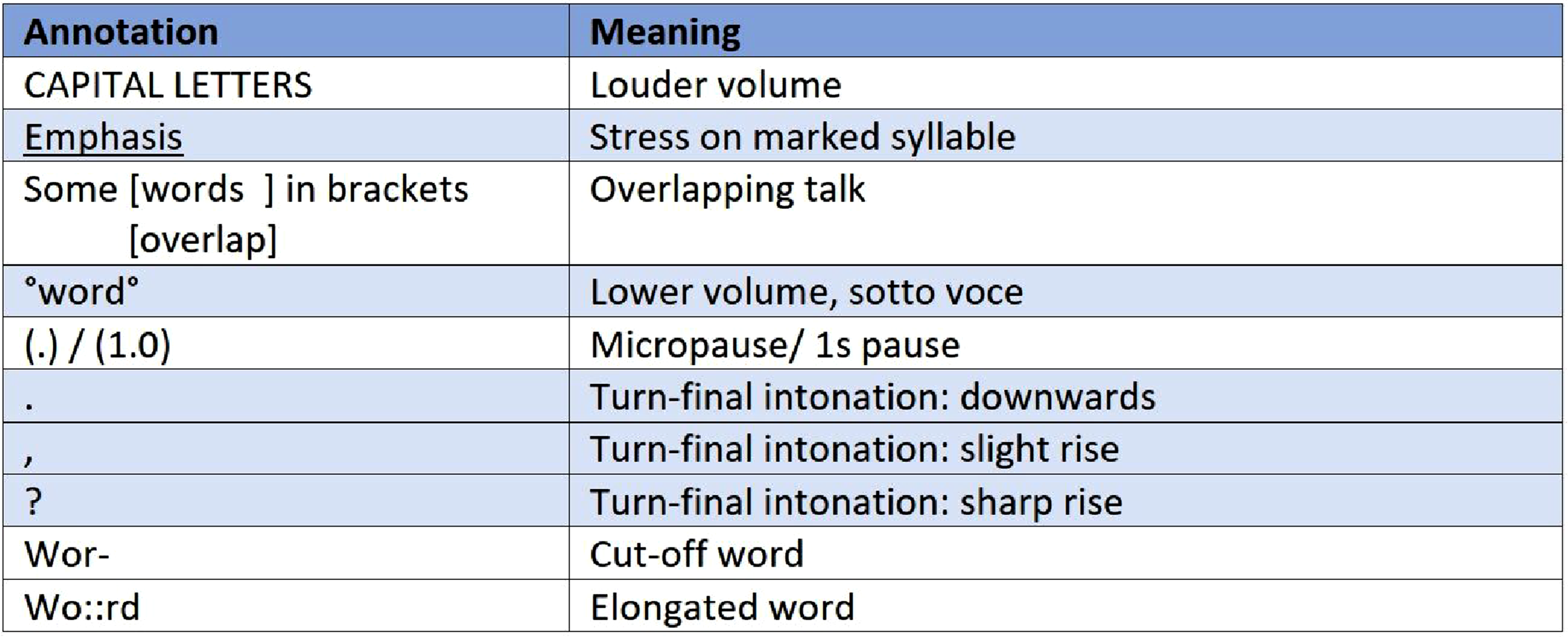
Some annotation symbols after Jefferson, 2004.
The research interview is a fruitful interactional setting for examining active listening
The term active listening describes conversational activities that aim to “show responsivity and empathy” (Hutchby, 2005: p. 303-304), encouraging talk without adding “content” from the listener. Active listening can be done in the form of [re]formulations of client talk (Muntigl et al., 2013; Nugent and Halvorson, 1995), but also as minimal responses such as continuers that “indicate to story tellers that their stories are listened to as they are being told” (Fitzgerald and Leudar, 2010: p. 3188, see also Richards 2011).
Two aspects of the research interview make it a fruitful setting for examining active listening. First, most research interviews explicit aim not to steer the client’s accounting in a particular direction 1 , leading the interviewer to take a “neutralistic stance” (Rapley, 2001: p. 316). Second, the research interviewer has a stake (Potter and Hepburn, 2005) in gaining rich knowledge from the interviewee, often as the main purpose of the interview (as opposed to for instance assessing or managing risk). Therefore, the interviewers’ responses are likely to be designed to the purpose of encouraging interviewee talk.
However, the “complex interactional work” of active listening (Hutchby, 2005: p. 304) is particularly challenged by neutralizations. The interviewees are recruited as “persons who have committed sexual violations”: they are likely to have stakes in this category (Potter and Hepburn, 2005), and do “accounting work” in relation to the identity position it represents (Rapley, 2001). This presents an interactional dilemma for the interviewer, if the client’s accounting is hearable as potentially morally problematic (cf. Presser, 2004; Zhang and Okazawa, 2023). The interviewer’s institutional role and moral stance may exclude them from endorsing such content, but confrontation may challenge the relationship and the interviewer’s neutrality, potentially jeopardizing further disclosure (Prior, 2018; Zhang and Okazawa, 2023).
Moreover, the interviewee may talk in ways that are ambiguous regarding whether they excuse themselves of responsibility, eliciting interviewer responses during this talking. Even when pursuing a neutralistic stance, interviewer responses to on-going, ambiguous interviewee talk will not be neutral (Rapley, 2001). Detailed conversation analysis demonstrates how speakers interpret listeners’ responses as interactionally meaningful. Muntigl et al. (2013) show how formulations do therapeutic work by selectively validating aspects of clients’ talk. Even silences and minimal responses such as “mm” may achieve differential actions in how they vary (Richards, 2011; Sikveland, 2012; Sikveland et al., 2021) and through prosodic features such as pitch, timing and intonation (Fitzgerald and Leudar, 2010; Lee and Bhuyan, 2013; Sbertoli-Nielsen, 2023; Weiste and Peräkylä, 2014). For instance, Jol and Stommel (2021) show how children in police interviews continue pursuing responses to the emotional or normative content of their turn, after “neutral” (silent, minimal) interviewer responses. The children treat the interviewers’ responses as “not responding” - regardless of the interviewers’ attempt to be neutral. That is, whilst the purpose of active listening is to support and show responsiveness, both minimal responses and simple reformulations may also work to direct, disrupt or undermine interviewee talk (Lee and Bhuyan, 2013; Muntigl et al., 2013; Sikveland, 2012; Sikveland et al., 2021; Stivers, 2008).
These three elements: the interviewers’ stake in gaining knowledge and neutralistic stance, leading to extended use of active listening practices such as simple formulations and minimal responses, the interviewees’ stake in accounting to preserve their social acceptability, and the interactional variation and consequentiality (vs neutrality) of even simple formulations and minimal responses, make the research interview fertile ground for studying practices of responding without endorsing or confronting neutralizations. The analysis therefore focuses on the range of actions that interviewer listening responses do, both when they achieve the goals of active listening and when they nuance what such listening can and may do in practice.
Methods
Material
The material is a subset of a data from a larger-scale project on sexual violence among youth 11 . For this analysis, we use 19 (17 male, 2 female) audio-recorded interviews with young persons (18-25 years) from a range of social and cultural backgrounds, who have committed one or several sexual violations. Interviewees were recruited through the prison officer working their case or via social media, and gave written informed consent. About half were convicted of sexual offences and the others self-identified as having committed a sexual violation. 10 Interviews lasted 60-90 minutes, were semi-structured, teller-focused and conducted with the utmost ethical care, considering issues such as ongoing consent, the well-being of the interviewee, and the safety of the interviewer (see Hydén, 2014; Pascoe Leahy, 2022). The interviewers (female) were highly experienced research interviewers in the field and independent to the prison and health services.
A psychologist specialized in sexual violence was employed by the project, for the interviewer or interviewee to talk to after the interview if they required. Only a few of interviewees and interviewers made use of this opportunity. The project was approved by the Norwegian Agency for Shared Services in Education and Research (SIKT) and by the ethics board at the Norwegian Correctional Service. Work on the specific analysis for this article was also approved by the Swedish Regional Ethics Committee.
During preliminary analysis, we noticed reoccurring sequences where interviewees seemed to reflect on their violations in ways that diffused their agency, whilst also maintaining responsibility for them. To get a clearer view of this phenomenon, we selected a subset of six interviews (all male), where the interviewees both explicitly claimed personal responsibility for the sexual violation and took an explicit normative stance against it. These six were both self-identified and convicted, and varied regarding their contact with the health care system. From this, we analyzed sequences of interviewee accounting that was ambiguous regarding whether it was making excuses, and where this was oriented to as problematic. In line with Scott and Lyman’s (1968) conceptualization, ‘making excuses’ was defined as accounts that diffuse the interviewee’s agency. Thus, the specific interactional context we analyzed were research interviews where the interviewer did a neutralistic-facilitative stance (Rapley, 2001), all though from a social position which differed in various ways from the interviewees’. The interviewees all did explicit accounting work relative to the category they were recruited on: person who has committed a sexual violation.
Analysis
Conversation analytic method involves getting familiar with the data through detailed transcription of verbal and non-verbal behaviors of the participants in the conversation, and several rounds of open-ended analysis. In line with CA theory, each turn of talk is analyzed in terms of the turn design (use of resources as intonation, choice of words, pauses, ways in which the turn is specifically designed to the recipient and the interactional setting), what it makes relevant as a subsequent response and how it responds to what the previous turn made relevant. To remain anchored in what the participants themselves are co-achieving in the here and now of their talk, we check our analysis of a turn against how it is oriented to by the recipient in the following turns (e.g. next turn proof procedure, Sidnell and Stivers, 2013: p.79-80).
Central to our analysis is CA terminology describing what responses (including minimal) do. A response may orient to different aspects of the preceding turn, and respond to this aspect in various ways. Orienting to informational or knowledge content, responses can receive (mark information as received and nothing more), acknowledge (treat the information as outside the recipient’s domain of knowledge, and thus not possible to assess), evaluate epistemically (express (dis)agreement), or normatively (provide normative feedback, or respond to the speaker’s display of normative stance). These ways of responding manages the participants’ knowledge positions relative to each other and to the domain of knowledge they are discussing (or epistemic status, see Heritage 2012). Orienting to emotional meaning of the talk, responses can affiliate: endorse, support or respond empathically to the talker’s expressed emotional stance (Steensig, 2020; Stivers, 2008), for instance through validating reformulations or by responding with a softer, lower volume voice (Fitzgerald and Leudar, 2010; Weiste and Peräkylä, 2014). Orienting to the action it ascribes to the preceding talk, a response can align by supporting the talker’s action, such as providing continuers (mhm, yeah) to align with storytelling (by handing the floor back over to the storyteller) (Sidnell and Stivers, 2013: p. 352; Steensig, 2020; Stivers, 2008). Responses are not just social actions by their presence: the absence of a response that has been made relevant (e.g. not affiliating to an emotional stance) is as meaningful in the conversation as presence (Jol and Stommel, 2021). Because we focus on the finer interactional details of active listening, we transcribed relevant sequences using both Jefferson’s (2004) annotation system, and the more phonetically detailed GAT-2 (Couper-Kuhlen and Barth-Weingarten, 2011).
The presented findings are based on analysis of sequences from all six interviews. In order to show detailed analysis representing the phenomenon, we present three longer examples extracted from two of the interviews; with Vegard (convicted, interviewed in prison) and Eivind (self-identified).
We present the translated findings transcribed with some selected annotation from Jefferson (2004) 2 . The presentation of both data and analysis aims to relay conversational detail whilst remaining available for readers not versed in the specific vocabulary and detailed annotation systems used in CA. We describe non-verbal features and non-translatable Norwegian expressions when relevant for the focus of analysis, and have the most relevant minimal turns transcribed with more phonetic detail (using GAT-2) in footnotes 3 (Table 1).
Findings
Our overarching finding was that when interviewees produced turns of talk hearable as potential excuses, the interviewers' listening responses worked to neither confront nor endorse this potentially problematic meaning. What these ways of responding did was open up an interactional space in which the participants could do sensemaking. Doing sensemaking involves allowing diffusion of agency to situational factors whilst making recognizable to both participants that these situational accounts did not excuse the interviewee of responsibility. We present two dynamics where this co-achievement happened. The first addresses content; co-constituting reflections that do sensemaking without displacing the interviewee’s responsibility. The second pertains to the interviewees’ overarching project: co-constituting it a sensemaking, and not an excuse-making, one.
Negotiating content: Tentative telling and gentle steering
In this dynamic, the interviewee designed their reflections to be tentative and adjusted them to the interviewer’s responses. The interviewers’ verbal and non-verbal nuances in active listening worked to gently steer the content of the interviewers’ reflections towards something they both could recognize as doing sensemaking and not excusing the interviewee of responsibility.
In the following extract, about a third into the interview, Vegard has just described his violations. He oscillates between descriptions that diffuses and owns his agency in committing the violations. Central to this oscillation is an addiction analogy, which casts his behavior as coming from within him, and at the same time describes these internal forces as uncontrollable. The inference marker “so” connects his violations to his own, earlier victimization. 4
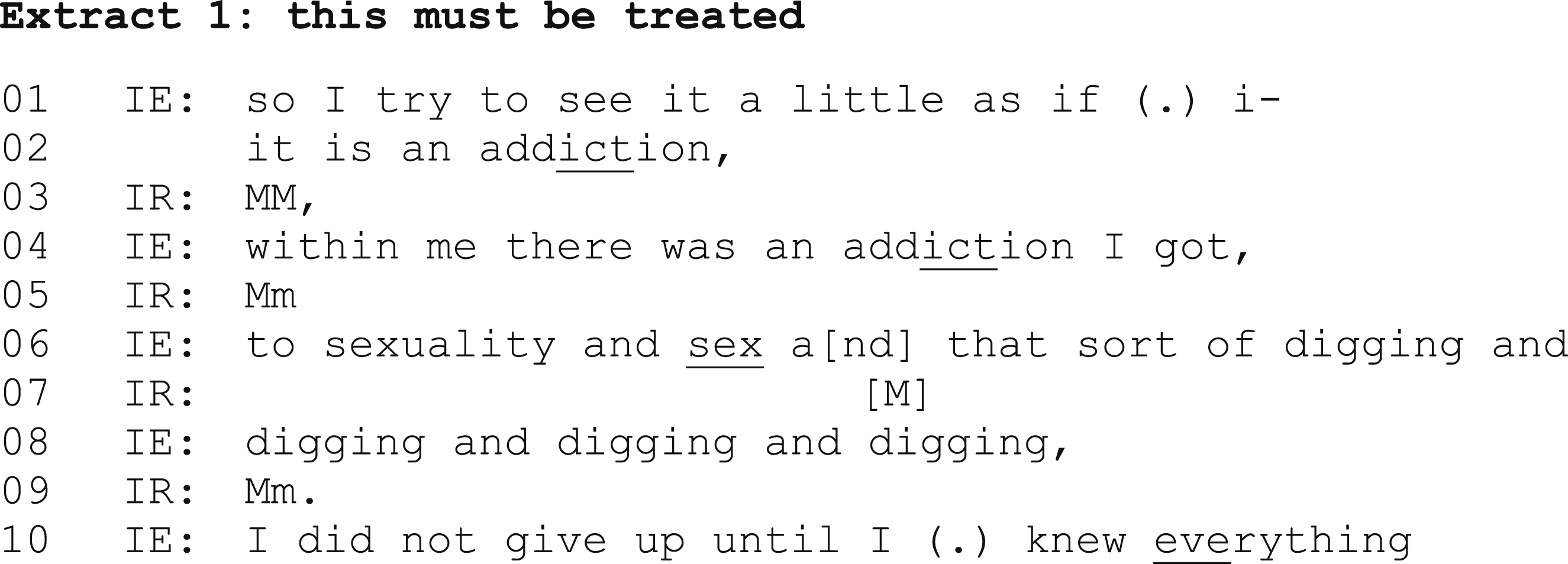
Vegard orients to his addiction analogy as problematic as he introduces it (lines 1-3). The phrase “a little as if” emphasizes its analogic nature, and “I try” emphasizes how this analogy is part of his agenda to understand – positioning him as someone who is not indifferent to what he did. The turn is ambiguous in terms of how it attributes agency. The listener responds with a continuer (03), but a slight increase in volume adds a layer of interactional meaning to it. Such volume increases often precede an evaluative or confrontational turn (Weiste and Peräkylä, 2014). Vegard responds by explicitly positioning the agency within him (04), but uses “I got” indicating that it got inside him from somewhere outside (vs. for instance “I developed”). His lexical choice “digging” (vs. for instance searching), repetition of it (6,8), and the phrase “I did not give up until” (10) casts his experience as being driven almost compulsively by the goal, rather than enjoying the process. These non-agentic elements position him as morally sound, but risk coming across as “making excuses”. Until now, the listener’s responses (e.g. 5,7 and 9) have been similar, short and with a downward pitch – doing receiving of information. Vegard responds by launching an intermediate conclusion (10: a need to know “everything”). As an extreme case formulation (Pomerantz, 1986) “everything” works to signal Vegard’s investment in his point and legitimize the claim of being driven, not simply curious. As such, it can be heard as pursuing a more evaluative response from the listener. However, if she responds by either verbally agreeing or non-verbally expressing more engagement, she risks endorsing a potentially ambiguous account regarding agency. If she produces yet another short “receipt token”, it risks coming across as disengaged (Sikveland, 2012) and an accountable absence of endorsement. The 1s gap (11) indicates responding is not straightforward. 5

The interviewer’s eventual response (12) is another “receipt token”. Vegard treats this as insufficient by adjusting (13): he was not driven primarily by the need to know, but by a need to feel psychologically secure. Now, the interviewer’s response is hearable as expressing more engagement (Ogden, 2006): higher pitch, wider pitch span and ending with an upward intonation (15). This extra layer of meaning works to subtly treat Vegard’s turn as more straightforward to understand as a common experience (Heritage, 2011): psychological security is a universal need (and potentially a more legitimate objective), as opposed to needing to know everything about a specific, sexual topic. Such increased uptake in responses can encourage the talker to further the direction of that turn (Sikveland et al., 2021), and it here spurs Vegard’s elaboration on psychological well-being as driving his behavior. He tentatively re-invokes the addiction-analogy (16): 6
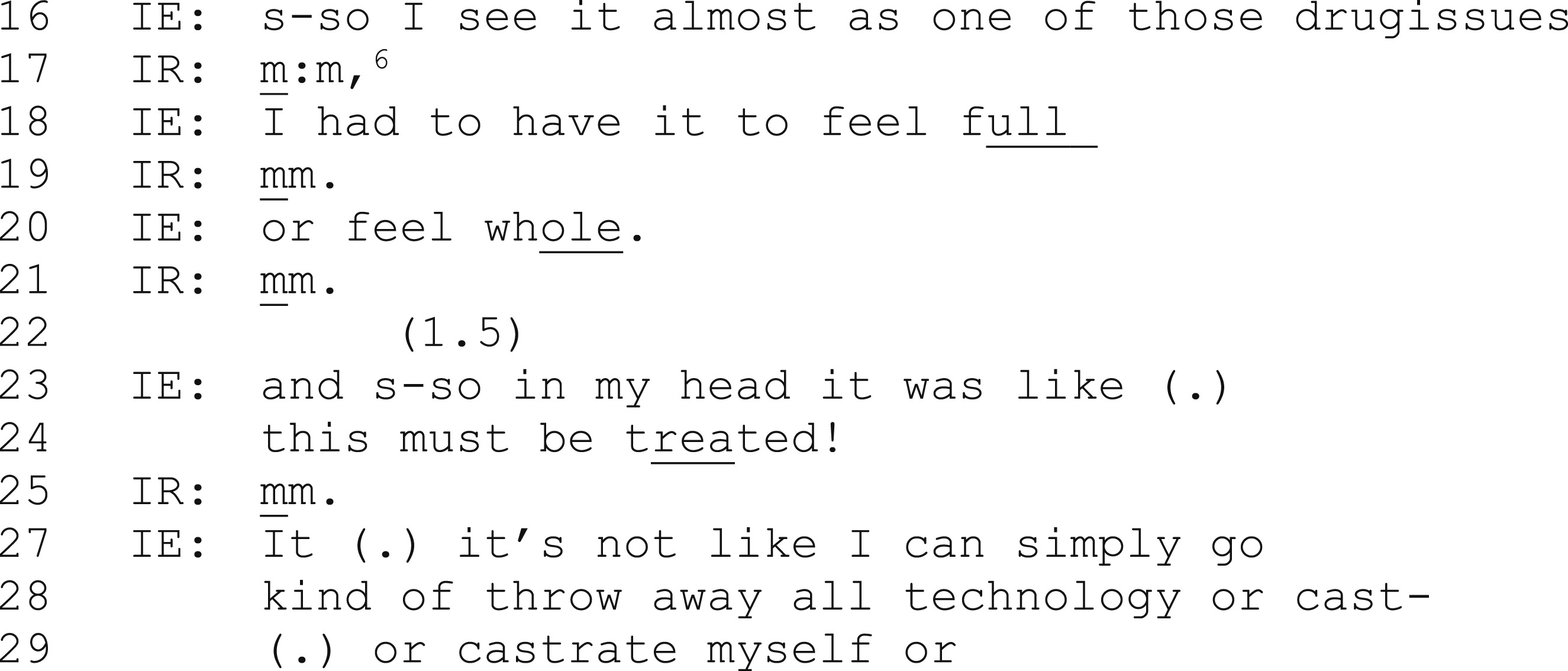
Again, Vegard’s agency is diffused. The phrase “had to have it” (18), re-emphasizes the sense of compulsive necessity, whilst feeling “whole” works to cast the need driving it as existential. To this, after a somewhat marked response to Vegard’s re-invocation of the addiction-analogy (17), the listener’s responses return to short “receipt tokens” (19, 21: downward final intonation and narrower pitch span), followed by a long gap where the floor is open (line 22). These responses treat Vegard’s reflections as unfinished, with two conversational implications. First, treating it as unfinished can invoke a normative expectation to provide more. Second, the less-than-earlier level of engagement can be understood as an invitation to provide something different. Vegard responds to both – he does something more and different by offering the start of a conclusion (lines 23-24). He changes focus from the causes of his violence to making explicit his stance on it. Vegard positions his stance as coming from within him, as a voice of reason (23:in my head). Using the phrase “it was like”, reported speech and past tense, he casts this stance as a real experience there and then – not a post-hoc construction. This works to position him as an unwilling actor in his violations, and thus morally sound. The listener now responds markedly differently (25): lower volume, softer voice and lower pitch-hearable as affiliative to his emotional and attitudinal stance (Fitzgerald and Leudar, 2010; Weiste and Peräkylä, 2014). Vegard treats this affiliation as encouragement to strengthen his stance. The extreme form formulations (Pomerantz, 1986) he provides of other strategies (28-29:castration, throw away all technology) work to cast the behavior as obviously needing to be addressed and the solution (changing himself) as the obvious and even only possible one, thus emphasizing his own responsibility forward. As such, his stance display in lines 23-29 works to make his previous reflections recognizable as doing making sense without excusing responsibility.
Mutual recognition of sensemaking project: Non-evaluative support for continued reflection and explicit stance display
The second dynamic occurred when the interviewee cast situational factors as relevant to their wrongdoings, and the interviewer did listening that maintained focus on the interviewee’s reflections, postponing evaluation and refraining from pursuing a specific response. This is similar to Jefferson’s (1988) analysis of continuers’ role in managing ambiguity in trouble-telling sequences. The continuers worked to treat a turn as potentially trouble-premonitory and “not in itself assessable” (p. 424). In these extracts it supports the interviewees’ disclosure by treating specific turns as not assessable, but parts of larger potentially sensemaking projects (Levinson, 2013). We describe this as “non-evaluative project recognition”. In response, interviewees themselves explicitly displayed a stance making their reflections recognizable as making sense whilst not excusing responsibility.
We return to Vegard, later in the same interview: he has detailed his violence and is working to account for it as a way he managed the consequences of his own victimization. “That stuff” (71) refers to his victimization experience, involving powerlessness.

Vegard starts his description of recreating “that stuff” by making somebody else powerless (72-73), but repairs to focus on himself as the target: to be able to feel powerful (73-74). This account risks coming across as a deterministic excuse: I did it because of what happened to me. Orienting to this, Vegard ends his turn with the Norwegian modal particle “da” (translated here as “I guess”), which often works to display weak epistemic stance (Heritage 2012): claim the conclusion it follows with less certainty (Fretheim, 2020). Here, it marks Vegard’s reflections as on-going and tentative, and thus makes relevant the interviewer’s co-assessment. In other conversational settings, the expected response could be for the listener to participate in this sensemaking work by (dis)agreeing with Vegard’s reflections. However, this would challenge the interviewers’ neutrality. In response, she does not assess, but leaves a 1s gap (75), before she takes an audible inbreath and produces an empathic YEAH. Its non-verbal design makes this “yeah” hearable as acknowledging, not assessing. This works to treat Vegard’s reflections in lines 71-74 as within his epistemic domain, and thus his to assess (Heritage and Raymond, 2005), making the listener’s evaluation irrelevant. 7

Her following turn continues and clarifies this non-evaluative stance (78-79). After a 2s gap, she repeats “yeah” with a lower volume, but similar intonation. She follows with “non-evaluative project recognition”: a simple formulation of his reflections that continues to refrain from taking a stance. Her formulation is tentative, hedges (kind of) and has a question-like turn-final intonation. This weak epistemic stance (eg. expressing her claim with uncertainty) works to explicitly mark her lack of access to Vegard’s personal knowledge (eg. her low epistemic status, see Heritage 2012), and thus conveys recognition of and respect for Vegard’s right to know about and assess himself (eg. his high epistemic status – Heritage and Raymond 2005, see also Lee et al., 2019). By maintaining focus on Vegard’s reflections and designing the response to be epistemically and evaluatively hands-off, the interviewer’s turn creates interactional space for Vegard’s continued reflections, and for treating them as part of a larger sensemaking project. Vegard’s response, however, is ambiguous (80), but with question-like upward intonation. This spurs the interviewer to explain her previous turn re-emphasizing the “non-evaluative project recognition” actions: anchoring her formulation in his talk and emphasizing it as her hearing of it, still refraining from evaluating (81-82). 8
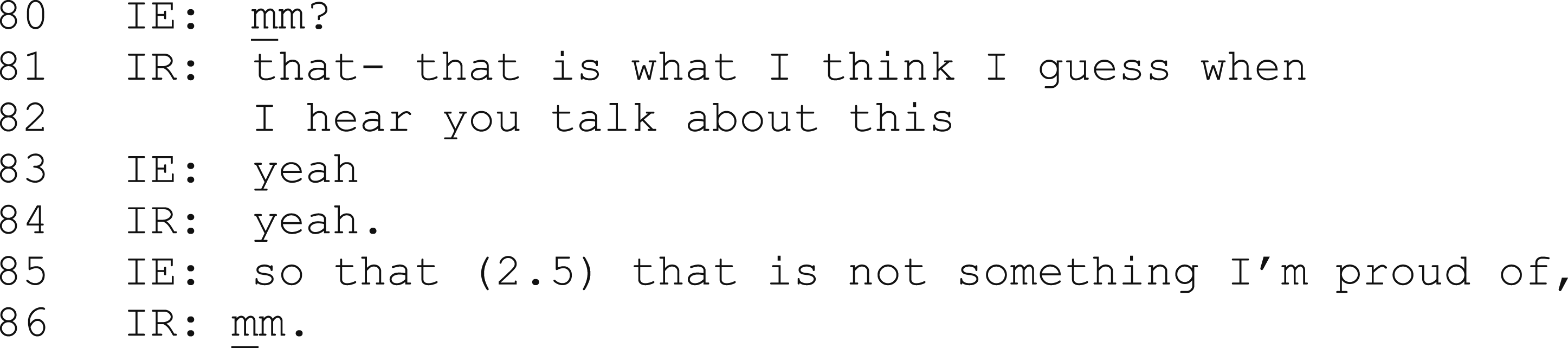
In the latter part of this elaboration (82), her voice softens and the volume decreases, suggesting non-verbal affiliation to an emotional display by Vegard not observable in the audio recording. Evidence of this is Vegard’s soft, low volume confirmation in line 83. Again, the listener’s immediate and affiliative response (84) works to stay with the topic and support Vegard’s telling without taking a stance. The interviewer’s continued absence of evaluation in positions where evaluation is made relevant spurs Vegard to explicitly take a stance by describing how he feels about his actions (85) – making recognizable his reflections as sensemaking and not excuse-making. The interviewer’s subsequent soft-spoken “Mm” with a downward intonation (86), works to recognize Vegard’s stance as a conclusion and affiliate with his stance, thus recognizing his status as a morally responsible member of society (Enfield, 2011).
Non-evaluative project recognition can also be done non-verbally, as in the following extract. We come in about half-way through the interview, immediately after Eivind has described his violation. 9
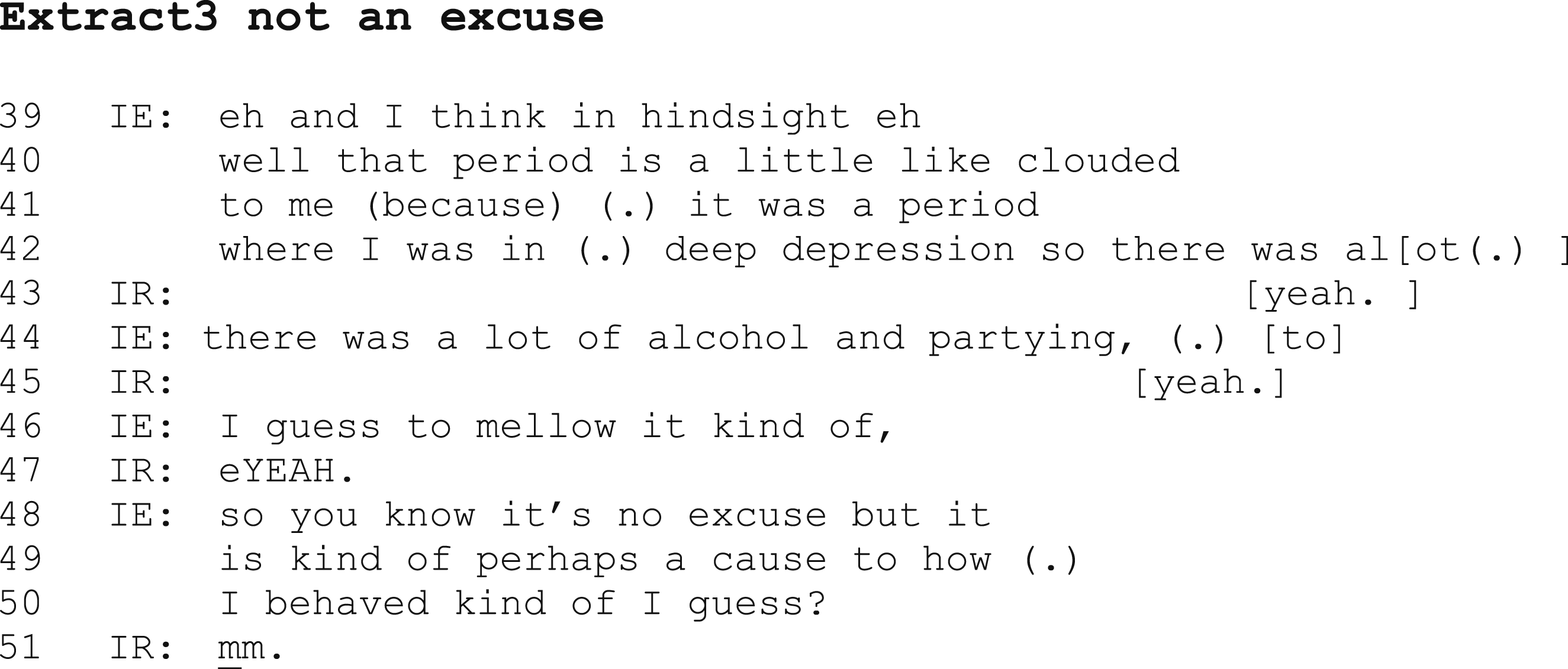
Eivind’s reflections (39-46) can be heard as both making sense of and excusing his violation. The lexical choice “and” (vs. “but”), works to present these situational factors less as ‘excuses’ and more as aspects of the situation to be considered. He describes the period as “clouded” (40), but precedes this assessment with the Norwegian word “altså” (“well”). “Altså” is often used to mark something as true all though expected to not align with the listener’s assumptions (Vaskó and Fretheim, 1996). Here, it presents Eivind as including these situational factors in spite of his awareness that the listener might understand them as ‘excuses’. He continues by evoking a deep depression as causing his excessive alcohol and partying (42-46). Two characteristics of the interviewer’s listening responses work to make them hearable as non-evaluative project recognition. First, their turn-by-turn responsiveness. They change from “mm” in the preceding description of his violation (not included), to “yeah” here (43, 45,47). Such changes can be especially interactionally meaningful with minimal responses (Richards, 2011; Sikveland, 2012), and here they work to align with Eivind’s change from storytelling to explanation. They also non-verbally follow each element in the three-part list constituting Eivind’s conclusion, mirroring their pitch and voice quality. The first two responses (43,45) overlap with his talk, but do not take the floor, and can be heard as acknowledging these elements as meaningful parts of his accounting and thus supporting Eivind’s further talk. The final “yeah” (47) comes when Eivind has finished his conclusion. It has a clearer articulation and slightly higher volume, suggesting that it is marking and acknowledging Eivind’s action of concluding. Second, their non-evaluative nature. “Yeah” as a response token might work to manage the ambiguity in Eivind’s reflections by itself being ambiguous as to whether it displays acknowledgement of or agreement with his conclusion (Gardner, 1997). Moreover, the final yeah (47) comes in a position where an evaluative stance is made relevant (conclusion). It acknowledges his conclusion, but treats it as an interview-answer (Antaki et al., 2000), withholding evaluation rather than co-assessing. Here, everyday and institutional frames of reference collide: whilst the interviewer cannot co-assess with him, her lack of evaluation may also be understood as misaligned by Eivind – suggesting that he should offer something more. What this does, as in the previous example, is place the normative authorship with him. In his next turn, Eivind upgrades by meta-communicating about his accounting in a way that directs the interviewer’s understanding of his talk (cf. Auburn, 2005). The design of this stance display (48-50) aligns with the normative expectation not to make excuses 10 : appealing to common ground (you know), making explicit his understanding of the difference between a cause and an excuse, and hedging (“kind of” “I guess”).
In sum, this section shows how the act of not evaluating is not neutral – it establishes the disclosers’ sensemaking projects as allowable, acceptable and ongoing, whilst avoiding being heard as endorsing them as an “excuse” for their violations.
Concluding discussion
Analyzing research interviews about sexual violence perpetration enabled us to examine and nuance the role of active listening in eliciting and supporting client reflections about their violence perpetration. In this context, the interviewees reflected about their violence perpetration in a way that was tentative and ambiguous regarding their responsibility in it. The interviewers’ responsive variation of verbal and non-verbal aspects of minimal responses placed interactional pressure on the client to adapt their accounting. Moreover, when the interviewees included situational factors in their accounting, the interviewers’ non-evaluative project recognition worked to provide space for the interviewee themselves to claim their accounting as a pro-social project (making sense without making excuses). What can we learn from this that is of relevance to practice?
The research interview differs from social work settings above all in terms of the conversations’ agendas: gaining information alone vs gaining information to achieve for instance risk assessment, and often while simultaneously building alliances towards change. These overarching differences in the participants’ stakes and stances challenges the relevance of our findings to a social work setting (Potter and Hepburn, 2005). Nonetheless, our analysis unpacked detailed, turn-by-turn management of a conversational challenge relevant in social work practice. CA, because of its interactional, detailed level of analysis can enable analysis that “resonate with core interests in front-line social-work” even when found in conversations outside social work practice (De Montigny, 2020: p. 98). For instance, CA analysis of research interviews has demonstrated interactional dynamics that also characterize social work practice, such as how the interviewers’ way of asking, even when open-ended, affect the interviewees’ answers (Rapley, 2001; Roulston, 2006) and how interviewees resist and collaborate with assumptions inherent in interview questions (Iversen, 2014). We therefore lift three specific findings, and discuss their relevance for social work practice in turn.
First, we examined an interactional setting where the interviewee both admitted to and condemned his violation explicitly, where the interviewer took a facilitative, neutralistic stance, and where there were no legal stakes. We found that even in this setting the interviewees nonetheless worked to make sense of their actions by partly diffusing agency to situational factors while working to not appear to the interviewer as ‘making excuses’. This finding suggests we can understand the high prevalence of neutralizations in conversations about both sexual violence (Hulley, 2016) at least partly in terms of the importance for individuals of making sense in a way that preservers their (moral) self-esteem and maintain the social bond to the recipient (Digard, 2014; Gausel 2023; Løkkeberg et al., 2021). Moreover, it speaks to the clinical utility of managing talk about moral transgressions in a way that does not rob the client of their experienced opportunities to repair – both their self-esteem and their social bonds (Auburn, 2005; Gausel and Leach, 2011).
Therefore, one implication of our findings is that creating interactional space where the client is allowed to tell their story and make sense is not only good social work practice (Lee et al., 2019; Martinell Barfoed, 2018), but potentially a necessary prerequisite for facilitating further talk and establishing a working alliance (Løkkeberg et al., 2021, Grönte et al., 2024). Contrary to the interviewers in our data, social workers have a stake in directing the clients’ talk towards enabling social work agendas (such as risk assessment, motivating help-seeking, and challenging anti-social attitudes), and are perhaps therefore rarely afforded an overarching neutralistic, facilitative stance. But stance is displayed and done turn by turn, and in order to build a working alliance towards change with clients who perpetrate violence, Grönte et al. (2024) recommend opening the conversation with a facilitative, relationally oriented stance, to later pursue a balanced introduction of a more exploratory challenging (Trotter et al., 2017) and directive (Marshall, 2005) conversational style. Our second finding speaks to this work: we demonstrated how prosodic features and sequential positioning of the interviewers’ listening responses were used to do both elicit, steer and support the clients on-going accounting. Even minimal responses such as continuers and receipt tokens put interactional pressure on the interviewee to continue and adapt their story, by treating the interviewees’ turns as unfinished and by using subtle prosodic cues to steer and support interviewee talk. A second implication of our analysis is therefore that minimal responses constitute an important part of social workers’ repertoire for doing active listening, and that the social workers’ awareness and deliberate use of these subtle nuances of minimal responses are key to both pursuing institutional agendas and social work values (Lee et al., 2019; Richards, 2011).
Thus, in spite of differences in stake related to outcomes of the interaction, our findings might be relevant for informing process. They can be useful in illuminating how social workers can respond to clients’ on-going accounting in a way that furthers it to the point where the social worker can assess: whether the accounting does reflect anti-social attitudes, whether it is responding to the legal stakes of the social work setting, or whether it is part of a pro-social project of addressing their violence perpetration (Auburn, 2005; Todd-Kvam et al., 2019), and/or building a narrative that enables forward responsibility (Farmer et al., 2015).
Third, we demonstrate how the interviewers’ non-evaluative project recognitions, even if both supportive of the interviewees’ accounting and non-confrontational about the accounts’ content, are not oriented to as an endorsement by the interviewees. Instead, interviewees actively take a stance on their own actions and their accounting for them. On the one hand, this way of responding might be specific to this interview setting. The category “sexual offender” is particularly morally delicate, and likely involves accounting work across institutional settings (Auburn, 2005; Presser, 2004). However, the interviewees here had explicitly both identified and condemned their action as a sexual violation, which might be less common in a social work setting. In addition, the facilitative, teller-focused format of the interview, as well as the lack of legal sanctions, may lend the interviewee more interactional leeway to speak from different footings, meta-communicating about themselves and their storytelling with less risk involved. On the other hand, Auburn (2005) finds similar client talk in a setting with different client stakes: in-prison treatment group, where an explicit agenda is to address and challenge minimizations. In both settings, the fact that the clients both get and take the opportunity to display their stance on their talk explicitly, enables them to claim a status as a morally competent member of society (Enfield, 2011). An interesting common feature is that the client/interviewees’ explicit stance-taking occurs in the context of the recipients not evaluating. What effect non-evaluative project recognition would have in front-line social service settings where clients are perhaps suspected, but neither convicted nor openly self-identified as committing violence is a question for further research. Nonetheless, these findings on non-evaluative stance, when understood as a part of a process rather than an interactional outcome, may contribute to a third implication that opening with a non-evaluative, relationally oriented stance may be useful in a social work setting as well (cf. Grönte et al., 2024).
Contributions and further research
Our analysis unpacks active listening – a central social work skill (Nugent and Halvorson, 1995) – in relation to a topic that is of increasing relevance to social work practice. The central role of neutralization in talk about intimate partner violence (Cavanagh et al., 2001) indicates our findings could be relevant beyond sexual violence perpetration. It adds to a growing body of CA research on interviews as a social practice, developing knowledge of relevance to social work practice (cf. Iversen, 2014). We argue that the nuances this data has offered, whilst not directly transferrable, can respond to social workers’ call for competence development (Lundberg and Bergmark, 2021) through supporting training and reflections (Caswell and Dall, 2022; Mullins et al., 2022; Richards, 2011). CA is still nascent in social work; we need further research to expand our understanding of the professional social work conversation, in particular the role of active listening in conversations about violence perpetration, and thus contribute to practice development (Mullins et al., 2022).
Supplemental Material
Supplemental Material - Making excuses and making sense: The role and nuances of active listening in eliciting and managing accounts of sexual violations
Supplemental Material for Making excuses and making sense: The role and nuances of active listening in eliciting and managing accounts of sexual violations by Mari Todd-Kvam, Nicolay Gausel, Carolina Överlien in Qualitative Social Work.
Footnotes
Author note
The results presented in the study are the result of research unassisted by financial contributions from a funding entity.
Acknowledgements
We would first and foremost like to thank the participants who shared their perspective and experience on a difficult topic with us. We would also like to thank Marja Etelämäki, Clara Iversen and Pia Tham for their really helpful comments on earlier drafts of this article.

Ethical considerations
The project was approved by the national ethics committee, The Norwegian Agency for Shared Services in Education and Research (SIKT) and by the ethics board at the Norwegian Correctional Service.
Consent to participate
Participants in the project provided written consent. The work with this specific analysis was also approved by the Swedish Regional Ethics Committee.
Author contributions
Mari Todd-Kvam took the analytic lead and the lead in writing. Nicolay Gausel and Carolina Överlien provided input on analysis, and contributed in writing and developing the introduction and the method section. Whilst Mari Todd-Kvam took the lead in developing the discussion and overarching structure of the article, it is a result of collaboration between the authors.
Funding
The authors received no financial support for the research, authorship, and/or publication of this article.
Declaration of conflicting interests
The authors declared no potential conflicts of interest with respect to the research, authorship, and/or publication of this article.
Data Availability Statement
Due to the sensitivity of the data, audio files and complete transcripts can not be made available.
Supplemental Material
Supplemental material for this article is available online.
Notes
References
Supplementary Material
Please find the following supplemental material available below.
For Open Access articles published under a Creative Commons License, all supplemental material carries the same license as the article it is associated with.
For non-Open Access articles published, all supplemental material carries a non-exclusive license, and permission requests for re-use of supplemental material or any part of supplemental material shall be sent directly to the copyright owner as specified in the copyright notice associated with the article.
