




Abstract
Interactional closings constitute a crucial aspect of social interaction and, in social work practice, are organized around participants’ orientation to an asymmetrical distribution of tasks between professional and client, informed by a “dialectics of care and control.” Proceeding from a conversation analytic framework, and grounded on video recordings of encounters between social workers and clients in diverse institutional settings in Portugal, the present paper investigates how the routine of closing social work encounters is carried out through professionals’ and clients’ joint and progressive orientation toward bringing the encounter to an end, and examines some of the interactional and embodied practices mobilized by them for accomplishing this task. By providing a detailed analysis of participants’ audible and visible conduct and their interactional practices, this study shows how social workers orchestrate clients’ leave-taking through the concerted mobilization of linguistic, bodily and material resources, shedding light into how the dialectics of care and control are managed in the everyday exercise of social intervention.
Introduction
The interplay between care and control constitutes a general aspect of social work, given the importance of promoting clients’ rights to dignity and self-determination while ensuring their compliance with institutional norms and agendas. While this tension informs social intervention in its wide range of activities and moments (see Hardy, 2015), its local accomplishment can be examined in detail by taking a close look at the social interactions routinely carried out between social workers and clients in institutional facilities and, moreover, at how these are brought to an end by the participants. The present study reveals that the “dialectics of care and control” (Čekaité, 2010) play an important part in social workers’ practices for prompting and assisting clients’ departure from the office room—a seemingly mundane task, yet consequential for managing institutional and interpersonal imperatives.
Closings are a fundamental part of social interaction, accomplished as participants mutually display their orientation to bring an encounter to its end. In a seminal conversation analytic study, Schegloff and Sacks (1973) examine how conversationalists locally prepare the proper termination of the conversation through two sequentially ordered components: a “pre-closing” that foreshadows the closing of the conversation, and a “terminal exchange” that warrants participants’ mutual orientation to terminating the conversation by lifting the relevance of the turn-transition rule. While Schegloff and Sacks investigate how closings are accomplished through “verbal” means, on the basis of audio recordings of telephonic conversations, they suggest that, in face-to-face closings, “a whole range of physical doings and positionings […] become available and/or required upon termination, for example those related to leave-taking” (1973:323).
In encounters between professionals and clients, closings are routinely accomplished through participants’ orientation to an asymmetrical distribution of tasks between them (Drew and Heritage, 1992; Mondada and Keel, 2017) concerning initiation of the leave-taking trajectory and, conversely, alignment or assistance toward the departure of a co-participant. Investigating general practice medial consultations in the United Kingdom, Heath (1986:129) observes that “it is generally the patient who quits the doctor [...] [t]he doctor remains seated whilst the patient stands and leaves”; contrastingly, West (2006:382) notes that “doctors in the United States are typically the ones who depart from their patients’ presence.” The material environment, as well as other closing-related tasks, may also condition participants’ exit-oriented trajectories: for instance, LeBaron and Jones (2002) show that, in beauty service encounters, professionals prompt clients’ exit by showing the way to an adjacent room of the salon, where the cash register is.
Although not specifically concerned with the embodied dimension of closings in social work, the study by Rostila (1995) provides a striking example of how leave-taking is organized around a fundamental asymmetry between social worker and client, based on a normative expectation that clients’ departure follows a professional-initiated move toward closing. The extract below (Rostila, 1995: 3) shows how, upon the emergence of a disagreement between the social worker (S) and client (C), following the confrontational stance and strong disaffiliation of the latter, the professional prompts the premature termination of the encounter by explicitly directing the client to leave the room: 1
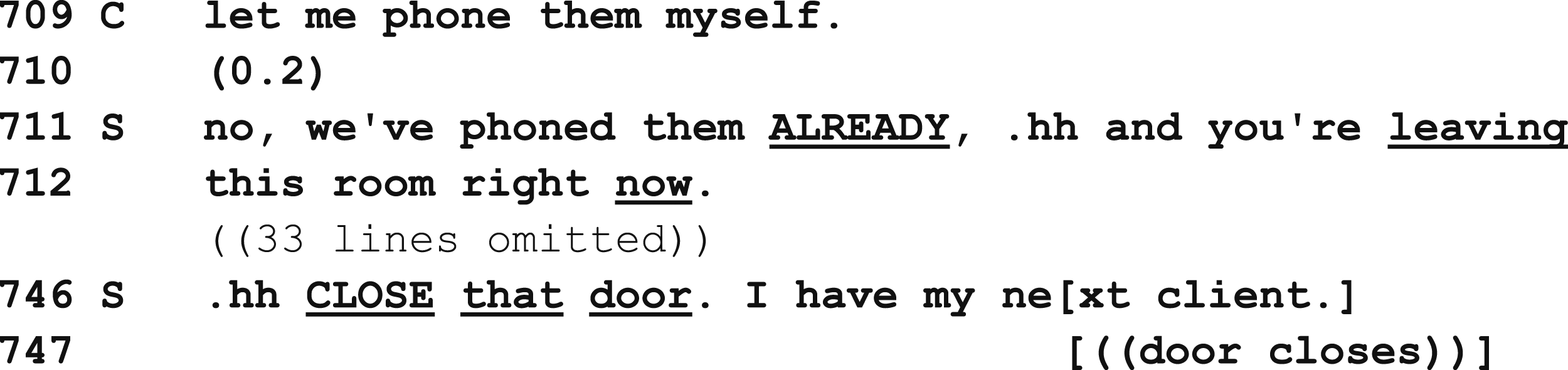
After disaligning with the client’s proposal to make a phone call, the social worker prospectively orients to the next relevant task—the client’s departure from the room where the encounter takes place. Although dramatized by the conflict between the participants, this example formulates the ordinary actions and practical reasonings involved in closing the encounter: displaying orientation to terminating the business at hand (line 709), prompting the client’s departure in order to break from physical co-presence (lines 711–712), and managing the institutional agenda and workflow within the institutional premises (line 746). Furthermore, it shows how participants treat the institutional encounter as a space-bound activity, explicitly referring to boundary-oriented spatial trajectories (“leaving this room”) and manipulating material features of the physical environment (notably, the door) as locally relevant for accomplishing the end of the encounter. As a point of access, the door establishes an “inside” and an “outside” to the ‘furnished frame’ of the social worker’s office and, hence, to the encounter itself (see Goffman, 1971).
Existing studies on professional–client interactions in social work settings show how the praxeological environment of closings provides important opportunities for carrying out important tasks, for example, negotiating clients’ adhesion to professionals’ recommendations (Rostila, 1995), making sense of what was accomplished during the encounter (Kadushin and Kadushin, 1997; Zastrow, 2009), or addressing uncertain scenarios (Noordegraaf et al., 2008). Yet, these studies overwhelmingly focus on participants’ talk—a methodological approach that leaves participants’ bodily conduct largely unaddressed and, as a consequence, obscures the embodied practices that constitute the everyday exercise of social work (see Rawls et al., 1997).
By proceeding within the framework of Conversation Analysis (see Sidnell and Stivers, 2012), with a focus on embodied interaction and its multimodal organization (see Mondada, 2019b; Streeck et al., 2011), the present study examines the sequential and multimodal organization of closings, revealing how this routine is locally accomplished not only through talk but, crucially, through participants’ bodily conduct involving mobility (namely, their walking trajectories toward the exit, resulting in clients’ passage and professionals’ bystanding, that is, “seeing clients to the door”) and tactility (namely, professionals’ gentle patting of clients’ backs, as well as pushing and holding knob and door). Besides further shedding light into the embodied dimension of social work intervention (see Monteiro, 2016, 2017, 2021), this study shows how place, mobility and touch are constitutive aspects of the interactional organization of closings in social work practice (see Bryant and Williams, 2020; Ferguson, 2008; Green, 2017; Stanley et al., 2016), inviting to their ethnomethodological and embodied “respecification” (see Garfinkel, 1991; Mondada, 2013).
Data and method
Data used in this study consists of forty-nine video-recorded encounters between social workers and clients (22 h approximately), organized in four institutions providing social intervention in Portugal (one residence for elderly persons, two community centers and one public hospital). Data collection took place after obtaining formal authorization from each institution as well as from the national data protection authorities, and each encounter was recorded upon obtaining informed consent from the participants, in oral and written form.
The analysis proceeds within the framework of Conversation Analysis (for a comprehensive introduction, see Sidnell and Stivers, 2012); the data was transcribed in accordance with conventions for multimodal transcription (Mondada, 2019a), in order to preserve the sequential and temporal organization of participants’ audible and visible conduct (see Appendix) and, for ensuring data protection, the transcripts and screen captures were duly anonymized.
Analysis
Routinely taking place at a designated “appointment room” (see Figure 1), the encounters under study are brought to an end as social workers orchestrate clients’ departure from the institutional premises. Grounded on three extracts, the analysis will show how this task is locally accomplished by participants through talk and bodily conduct, and around an orientation to an asymmetrical distribution of tasks and responsibilities between them. Figure 1 shows the door of the office room assigned to encounters with clients and, posted at eye level, a sign informing the persons outside of the room about the activity that can be expected to take place inside—designated by the word “atendimento” (“appointment”) and illustrated with the figures of two persons sitting around a table, talking and manipulating written documents: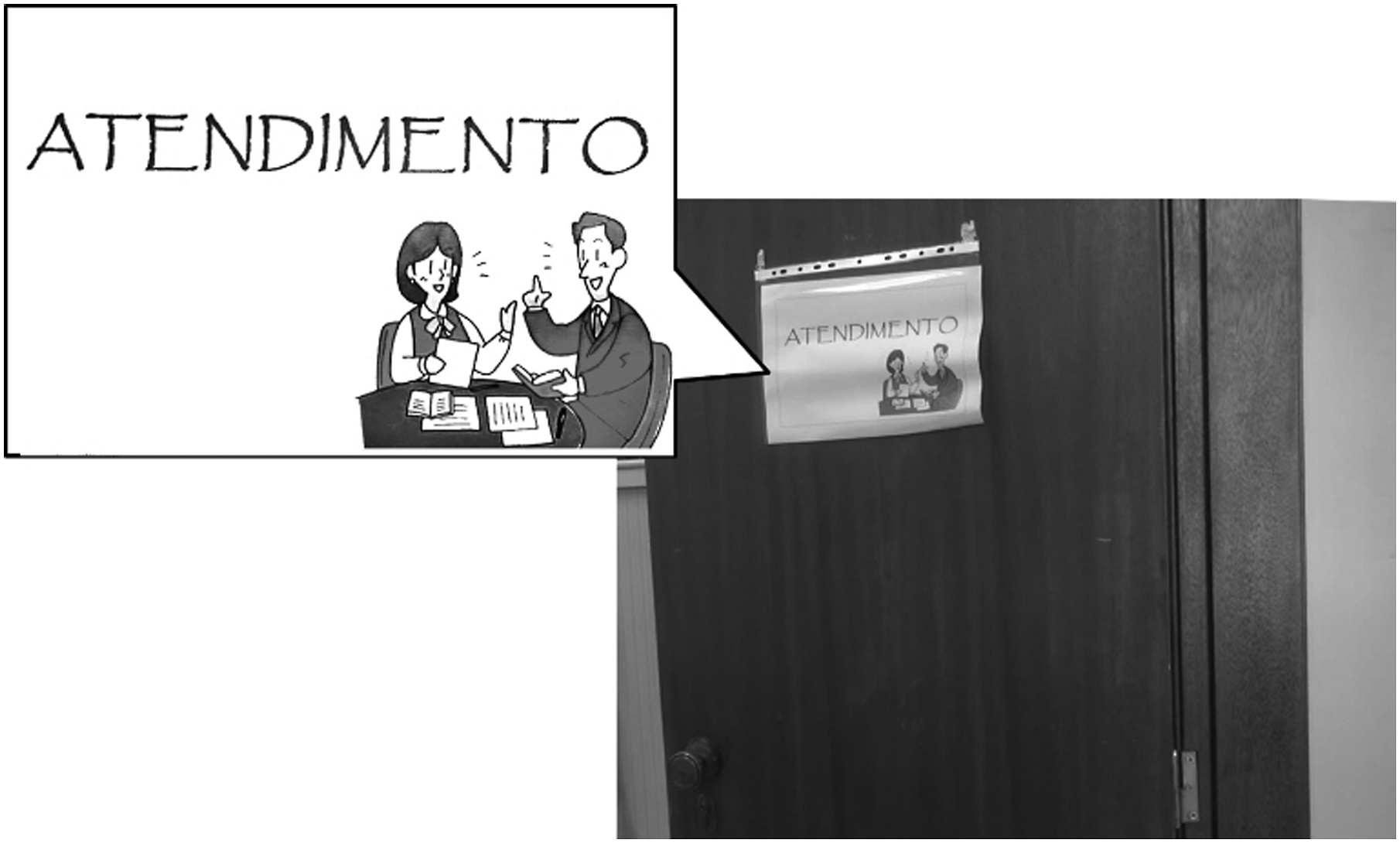
Within the material ecology of the institutional premises in which encounters take place, the door of the office room constitutes a central element and, as will be show, is treated by participants as a central element for organizing closings: opening it allows the transit of participants into and away from the room, and thus delimitates the space in which encounters take place. Moreover, closing the door prevents non-authorized persons to enter and, during encounters, establishes a physical barrier that keeps participants’ talk from being heard outside the room, thus ensuring the confidentiality of the discussion.
A detailed analysis of the data will show how clients’ leave-taking is orchestrated through the mobilization of multimodal practices involving talk, walking and touching bodies and objects (Extract 1); how the preparation of clients’ departure provides for making sense of what was accomplished during the encounter and what is to follow (Extract 2), and how practical problems with opening the door can be exploited as an opportunity for renegotiating participants’ identities (Extract 3).
Moving toward the exit at the end of the encounter
Embodied actions are a crucial aspect of the organization of closings in face-to-face encounters, accomplished as participants orchestrate mutual disengagement and depart from the place where the interaction took place. While closings constitute a basic routine organizing social interaction, a detailed analysis of its local organization shows that it is accomplished by participants through a complex interplay of linguistic and embodied resources. Pioneering the “embodied turn” in CA (Nevile, 2015), early video-based studies of face-to-face interaction show how closings are organize in ordinary and institutional settings, for example, how participants locally manage transitions toward disengagement (Goodwin, 1981) or how, in medical consultations, patients’ leave-taking is coordinated with topic completion (Heath, 1985, 1986). Further research on the multimodal organization of closings has shown how these are projected and negotiated by participants on a moment-by-moment basis and at different levels of organization, (i.e. turn, sequence, and action), and accomplished in an embodied and public manner through participants’ online analysis and orientation to multimodal resources (Mondada, 2015). Other studies reveal that, in specific material and praxeological ecologies, closings may be accomplished through specific practices such as “drinking up” in conversations at the café (Laurier, 2008), “walking out” in news interviews (Llwellyn and Butler, 2011) or “walking away” in mobile interactions—which, in closing environments, “does not merely respond to closings but, more radically, achieves closings” (Broth and Mondada, 2013: 55).
A first example of how the closing of a social work encounter unfolds, moment-by-moment, can be observed in the extract below, upon the departure of Rui, an elderly man who requests support for food and pharmacy expenses for him and his wife, from the facilities of the community center of his neighborhood, coordinated by social worker Ema. We join the action as Ema informs Rui of how the institutional process will unfold and, subsequently, the two get up from their seats at the table:
Extract 1 (C1, 11.22)
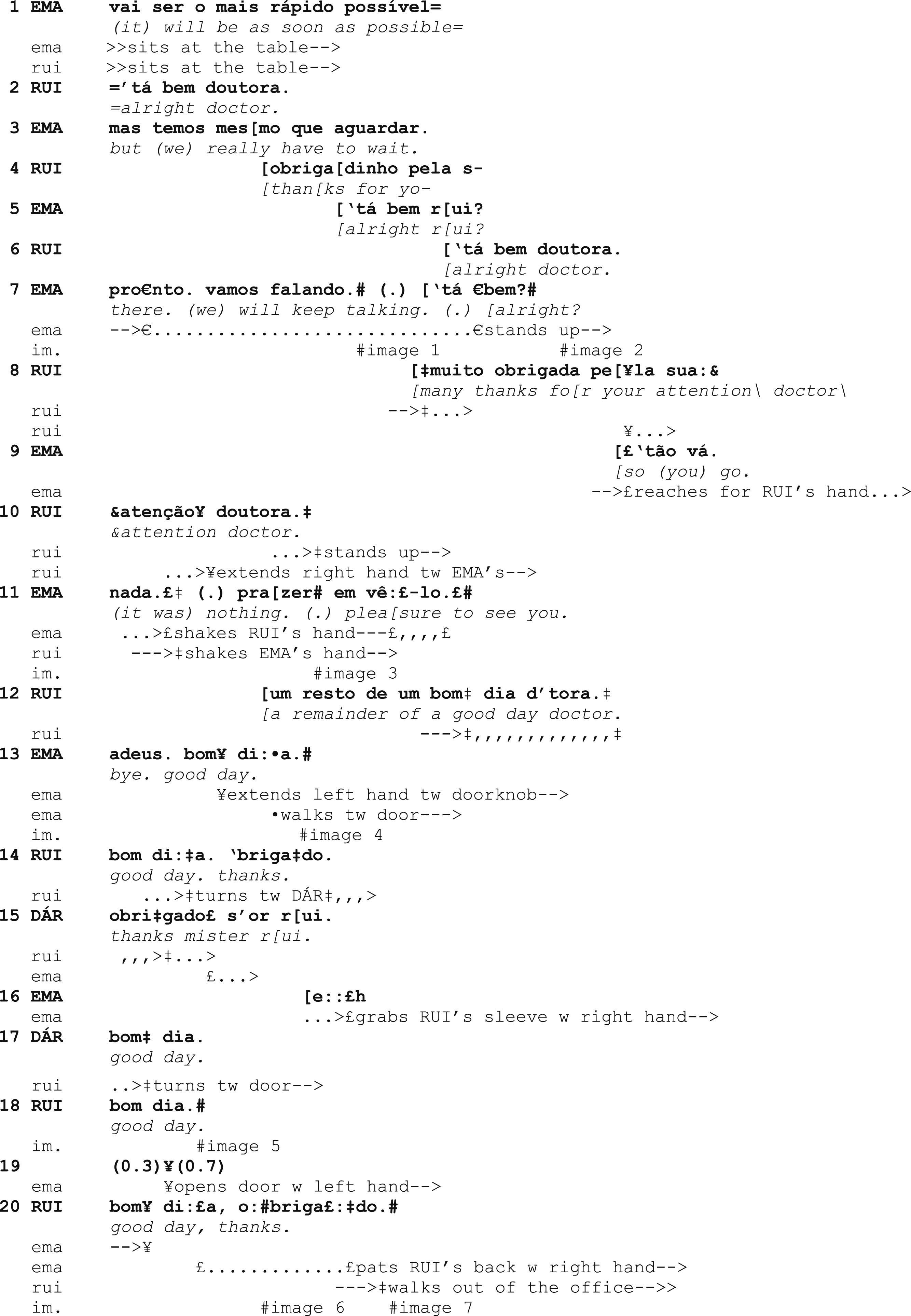
Sitting with Rui at the table (image 1, Figure 2), Ema announces that, although the resolution of the problem at hand will be managed “as soon as possible” (line 1), the next task for both participants consists in waiting (line 3). Rui acknowledges (line 2) and expresses appreciation (line 4), displaying retrospective orientation to what was accomplished in the appointment and thus projecting the end of their encounter. As, in partial overlap, the professional prompts him to confirm (line 5) instead of bringing the appreciation to completion, the client provides an aligned response to the prompt by repeating it (line 6). Operating a transition to a next-relevant task, the professional further pursues the closing of the encounter by making vague reference to the continuity of their relationship (“(we) keep talking,” line 7); rather than confirming, once again, his agreement with the proposed arrangement, Rui upgrades his previously abandoned token of appreciation (lines 8–10). In overlap, the professional launches the impending next-relevant task: terminating the encounter through the physical departure of the client (line 9) and, in the meanwhile, both participants begin to get up from their seats at the table (image 2, Figure 2). Ema reciprocates Rui’s expression of appreciation (line 11) and, standing, the two shake hands (image 3, Figure 2). The professional then begins to walk toward the door, reaching for the doorknob (image 4, Figure 2), while the client greets Dário, who is recording the encounter (lines 14–18). As Rui turns toward the professional, Ema reaches for his arm and conduces the client toward the exit (image 5, Figure 2), touching the client with her right hand and opening the door with her left (image 6, Figure 2). After Rui’s passage was cleared by the professional opening the door, he initiates terminal exchanges with the professional (line 20), who prompts him to begin to walk toward the exit by softly patting his back. In response, the client walks away while the professional stands at the door (image 7, Figure 2), visually monitoring Rui’s departure from the institutional premises.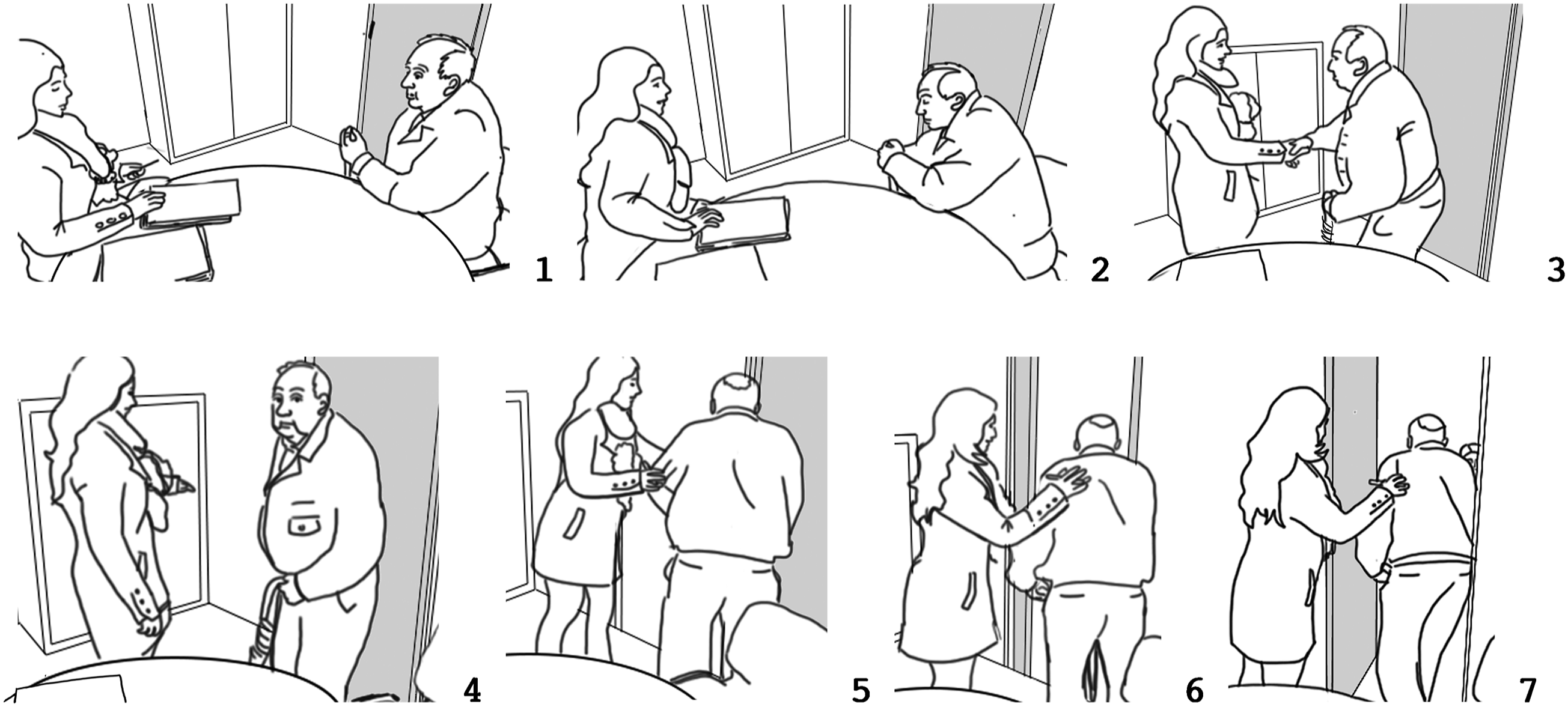
In sum, the activity unfolds in a stepwise manner, sequentially organized so that (1) both participants get up from their seats at the table and begin to walk toward the door; (2) having initiated or responding to terminal exchange, and already at the door, professional reaches for the doorknob; (3) the professional prompts client’s departure, opening the door and gently touching the client’s back or shoulder; (4) the client walks away, passing through the doorway and exiting the office, and the bystanding professional visually monitors their departure. As observed, the activity of closing the encounter is locally organized around participants’ coordinated mobilization of talk, bodily actions and material objects, through an interplay between mobility, tactility, and institutional asymmetry—as both social worker and client position their bodies within the office space, manipulate material objects (e.g. doorknob and hinges) and touch bodies (so that professional touches client, but not vice-versa). Moreover, the coordinated and reflexively embedded production of the professional’s prompt and of the client’s departure can be understood as a “complex multimodal Gestalt” involving “not only talk and gesture, but also the entire body and its movements” (Mondada 2014: 276). By taking a close look at how professionals monitor clients’ trajectory toward the door, managing the opening of the door while sustaining touch, and subsequently remaining at the door while clients walk away, one may appreciate the fine coordination of participants’ talk and embodied conduct and their orientation to the material ecology of the institutional facilities—namely, door and doorway—as well as to the asymmetrical management of the activity.
The doorway as a site for managing transition and continuity
The situated management of transitions between spaces is, in a wide variety of informal and institutional interactions, organized around a mundane yet central feature of the material ecology within which clients’ departure is organized—the door, generally understood as a symbolic and spatial locus of transition and hence recurrently involved in “rites of passing” (Van Gennep, 1909). Taking interest in this mundane yet fundamental architectural element, sociotechnical and ethnomethodological investigations have examined its affordances and constrains. Investigating the practical problem of opening and closing doors back and forth, so to ensure that visitors pass and reserved spaces remain closed, Johnson (1988) shows how this task, initially under the responsibility of a professional groom, was eventually delegated to two mechanic devices, the door hinge and the automated door closer.
As pointed out by (Weilenmann et al., 2014), doors “play a part in the larger courses of action unfolding when we are entering and exiting rooms” (p. 125) and, for this reason, provide a perspicuous setting for investigating embodied transitions to and from co- presence. While participants orient to a general preference for progressivity by opening the door for another (Wiksell, 2015), in the service of ensuring the smooth progression of the activity of passing from one space to another through the doorway, interactions at the door may occasion practical problems to participants. Research on organizational settings shows that the absence of doors may challenge co-workers management of co-presence in open-space offices (Salvadori, 2016) and that open-door environments provide opportunities for initiating unscheduled encounters (Tuncer and Licoppe, 2018); furthermore, moments in which a participant is near a door are treated as affording a special status to turns at talk, due to the imminent break from co-presence projected by participants’ walking trajectories toward the exit (Tuncer, 2015).
For professionals, the task of closing the encounter involves a delicate coordination between contingencies related to the manipulation of material objects and orienting to the sequential unfolding of turns at talk and the initiation of important relational work, such as done through the exchange of appreciations. A next extract shows how the management of topical turns at the end provides a resource for managing clients’ exit from the office. In a community center offering daycare services to the elderly residents of a peri-urban village in the coast of Portugal, social worker Sara and client Ivo meet at her office for revising healthcare issues for which he will need assistance from the institution, for example, transportation to medical appointments and acquisition of pharmaceutical products. We join the action as, preparing to bring the encounter to an end, Sara walks Ivo toward the exit, delaying the projected opening of the door until the client is done with terminal exchanges:
Extract 2 (B3, 17.30)
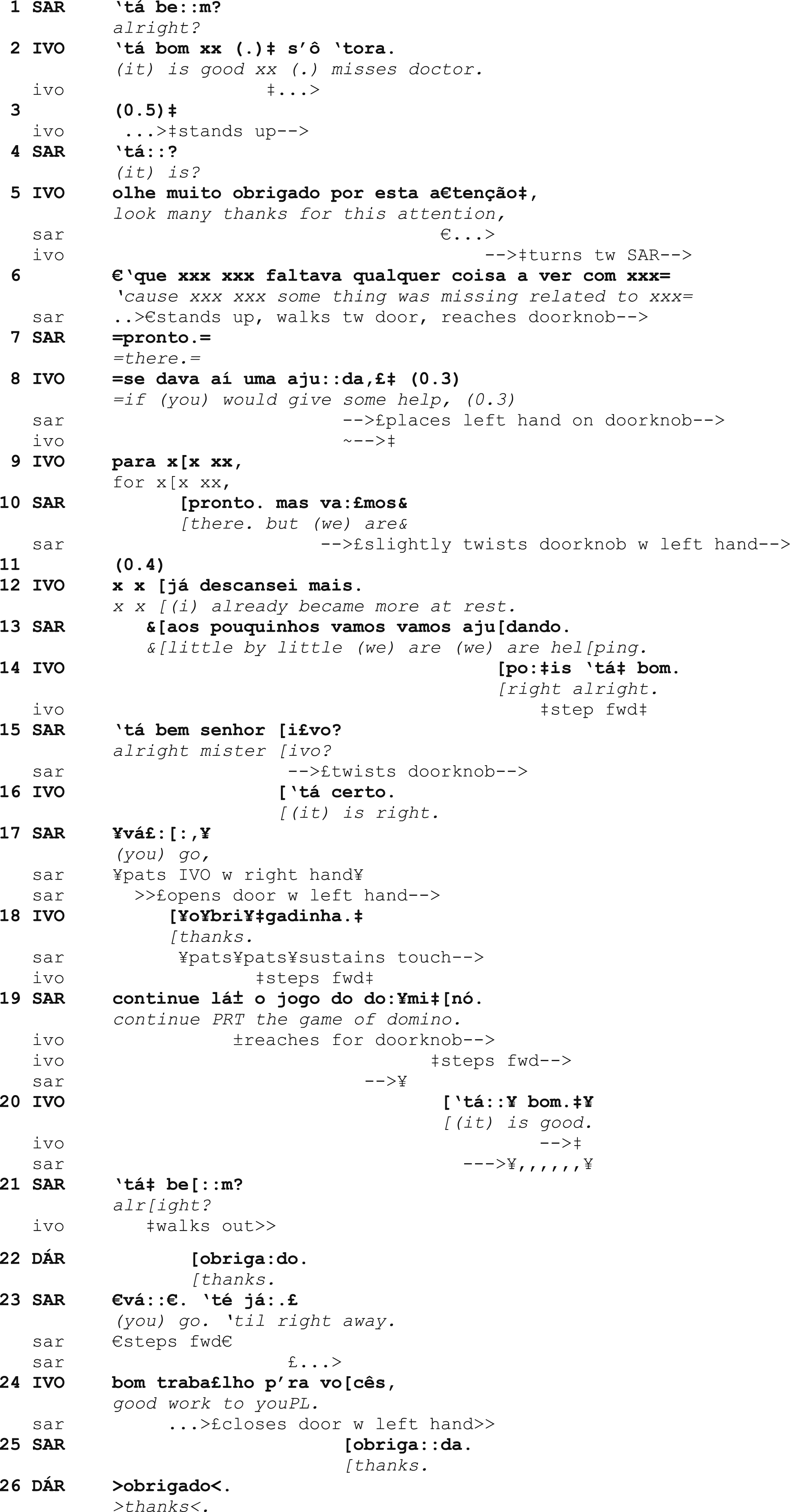
While social worker Sara and client Ivo bring the arrangement-making sequence to a close, confirming the client’s understanding of what is to be done (lines 1–4) and thanking the professional for her support and “attention” (lines 5–6), both participants get up from their seats at the table, walking toward the closed door of the office. Preparing to launch the physical departure of the client by reaching for the doorknob, the professional delays the completion of this task in order to bring the pre-closing sequence to a close, responding to the client’s thanking by addressing the continuity of support (lines 10–13), prompting and obtaining an aligned response from him (lines 14–16). Upon the impending completion of the sequence, Sara begins to twist the doorknob with her left hand while preparing a gesture trajectory toward Ivo’s shoulder with her right hand, so to launch the client’s departure. Prompting the departure of the client, the professional opens the door by pulling the doorknob with the left hand, while patting his shoulder with her right hand, and produces imperative particle “vá”/“(you) go” (line 17), launching the client’s departure as the next-relevant task. Similarly coordinating linguistic and embodied conduct for providing an aligned response, Ivo steps toward the door, thanking Sara once again (line 18). Reaching for the doorknob, the client prepares to open the door himself and, as the client walks through the exit, the professional topicalizes the activity that he will return after the encounter (“your game of domino,” line 19), retracting her touching gesture as he begins to walk away. Initiating terminal exchanges with the client, Dário, who has been operating the mobile camera for recording the encounter, thanks him for his collaboration (line 22), and the professional makes reference to a next encounter between her and the client, to take place “right away” (line 23), as the client will be remain in the institutional facilities, but in another room of the daycare center. Further acknowledging the continuity of the professional’s workday and to the recording activity carried out around it, Ivo wishes “good work” to Sara and Dário (line 24). Monitoring his walking trajectory, the professional begins to close the door as the client walks away.
Whereas the task of opening the door may be delayed by closing-relevant tasks, such as the topicalization of “doorknob concerns” for addressing matters that have not been discussed so far during the encounter (see Robinson, 2001), delays in opening the door may provide opportunities for engaging in small talk, allowing the participants to lift the constraints posed by the institutional agenda and resituating their bounded encounter in relation to the world outside it. A final extract shows how a client exploits the emergence of a problem in opening the door as an opportunity for addressing the professional’s mundane involvements, operating a recategorization of the participants. At the community center coordinated by social worker Ema (see Extract 1), the professional meets with Olga for checking how she and her family are doing and if they need further help for acquiring basic goods and managing institutional their involvements. We join the action as Ema projects the closing of the encounter, prompting Olga to move toward the (still closed) door:
Extract 3 (C12, 14.40)
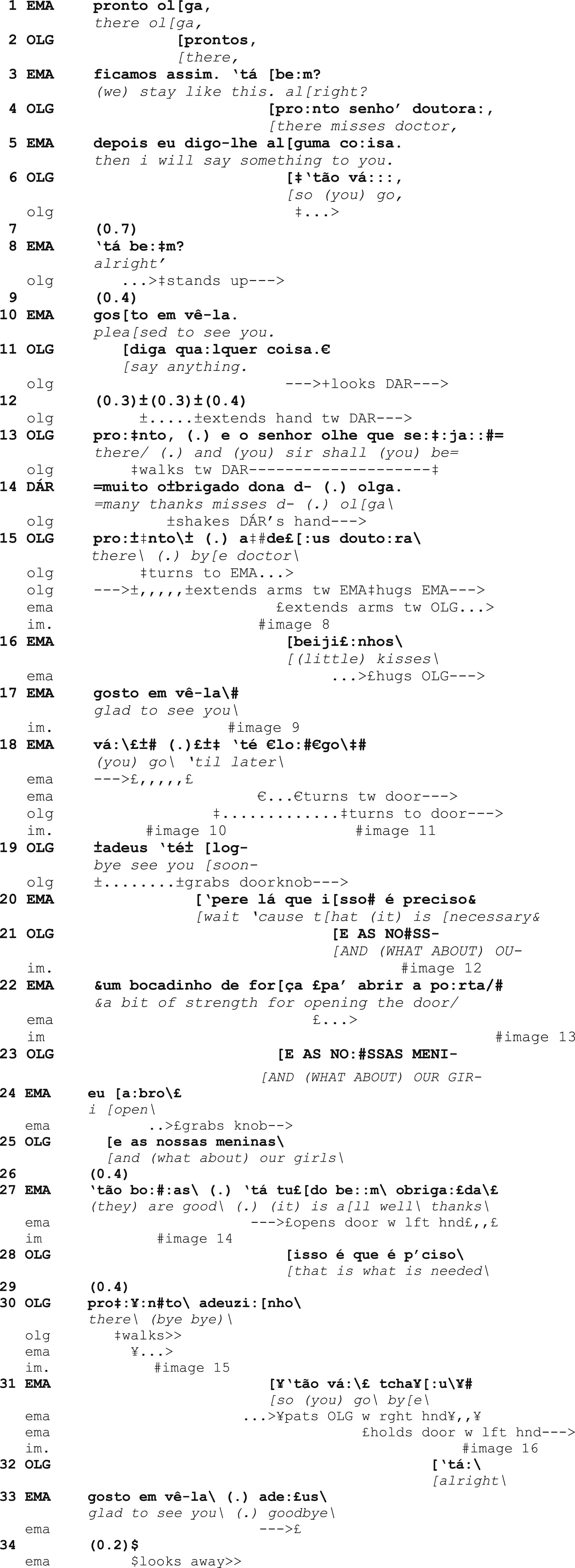
Orienting to the completion of the arrangement sequence, the participants launch the closing of the encounter (lines 1–4). Aligning with Ema, who commits to contact the client in the future for telling her “something” (line 5), Olga gets up from her seat at the table and, while the professional expresses appreciation for the encounter (line 10), the client requests her to say “anything” (line 11), thus making relevant a commitment to their “standing” relationship. After having initiated terminal greetings with Dário, who is operating the camera (lines 13–14), Olga extends both arms toward the professional, initiating a hug (images 10 and 11, Figure 3) and obtaining, in response, Ema’s invitation for “a little kiss” (line 17). The professional then launches the departure of the client through imperative directive “vá”/“(you) go” (line 18). While responding to the greeting, the client turns around, looking away from the professional and toward the door and extending her hand to grab the doorknob (image 12, Figure 3). Addressing the fact that the doorknob is not turning, and hence that that the client may not manage to open the door herself, Ema tells her to “wait” (line 20), then explaining that opening the door requires some “strength” (lines 20–22). Upon the emergence of this technical problem, which delays the client’s departure, Olga seizes this opportunity to initiate small talk—looking at Ema (image 12, Figure 3) and asking her about “our girls” (lines 23–25), in reference to the professional’s daughters. First announcing that she will replace the client in managing the task of opening the door (line 24), the professional grabs the doorknob (image 13, Figure 3) and responds to Olga’s question, expressing gratitude for the attention (line 27), preempting the pursuit of the topic and, in the meanwhile, opening the door (image 14, Figure 3). Aligning with the termination of the topic (lines 28–30) as well as with the opening of the door, the client begins to walk toward the exit. Reflexively responding to and prompting the client’s trajectory, Ema gently pats Olga’s back (image 15, Figure 3) while verbally prompting her departure via imperative “vá” (line 31) and holding the door with the other hand. Finally, the client walks away, while Ema stands by the door and visually monitors her walking trajectory (image 16, Figure 3).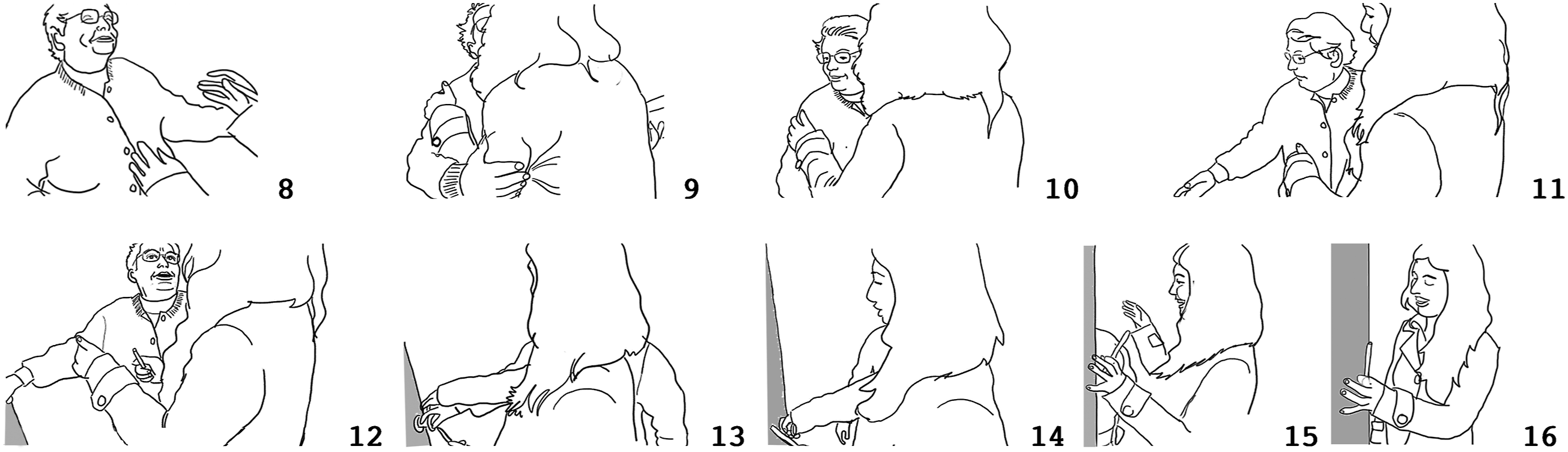
Participants orient to the smooth exiting the door, prevent practical problems and managing the temporality of leave-taking in a way that avoids gaps in the ongoing talk. Within the unfolding of the closing section, the task of opening the door may become a practical problem for the participants. In a first moment, this can be observed as the professional starts walking in the direction of the door while the client is occupied with terminal exchange with the camera person; subsequently, as she explicitly topicalizes a problem with opening the door and provides instructions to the client on how to open it, the professional displays orientation to a tension between care and control: on the one hand, she instructs the client on how to open the door and, on the other, she accounts for the difficulty in opening it, especially considering Olga’s advanced age and physical frailty, and eventually opens it herself.
Upon the impending transition toward the end of the encounter, “showing attentiveness to others’ interests is a general resource for managing topic shifts and closings” (West, 2006: 393), as participants make sense of other activities that will follow the encounter at hand, lifting the relevance of the “professional-client” set organizing the encounter while displaying concern with each other by acknowledging other involvements and relationships. Such can be observed in Extract 2 as participants mobilize categories related to other activities, for example, “player” in the game of domino that the client will resume after the encounter, or “participant in the recording” that will continue to take place and, in Extract 3, as the client mobilizes non-institutional categories and asks the social worker about “our girls,” that is, the professionals’ daughters. Moreover, such orientation to the mutuality of care seems to be further displayed by the client as she initiates a hug, extending her arms toward the professional.
Conclusion
Investigating the local organization of closings in social work encounters, this paper has examined its moment-by-moment unfolding as carried out through talk and bodily conduct. A detailed analysis of participants’ audible and visible conduct reveals that social workers’ task of prompting and assisting clients’ exit from the office is accomplished as participants lift the constraints of the institutional agenda by referring to other involvements, while orienting to an asymmetrical distribution of tasks, for example, as clients’ passage through the doorway and out of institutional premises is prompted and assisted by the bystanding professional.
Throughout the unfolding of the closing activity, participants’ prospective orientation to next-relevant matters can be observed upon mentions of other involvements, for example, ludic activities, participation in recordings, or family life and, furthermore, in the production of minimal imperative directives (notably, “vá”/“(you) go”) for prompting co-participants’ leave-taking. Recurrently produced in minimal formats, without delays or subsequent accounts, verbal directives for embodied action not only display participants’ orientation to a general preference for progressivity and contiguity (see Sacks, 1987), but project clients’ prospective and goal-focus orientation to walking out and away as the next-relevant, aligned response. Besides displaying an orientation to an immediate embodied response, professionals further convey an orientation to clients’ agency and initiative for managing what is to follow the encounter (e.g. by using grammatical singular person for topicalizing participants’ actions as unilateral).
Through bodily movement, the participants launch the transition toward the end of the encounter, and clients’ physical departure, by progressively repositioning their bodies in the direction of relevant elements of the material environment (e.g. the door and the doorway). Transition from the main part of the encounter, in which the participants sit at the table within an “eye-to-eye ecological huddle” (Goffman, 1963:95) to the client’s departure from the room is managed through a reorganization of their bodies’ positioning within the room. Preparing the transition to a “state of decreased access” (Goffman, 1971:47), professional and client reposition their bodies into an asymmetric formation (see Ciolek and Kendon, 1980), so that the professional manages the client’s trajectory while the latter faces and moves toward the doorway. That the closings under study proceed around a asymmetry between professional and client can be further observed in social workers’ use of interpersonal touch: 2 by grasping and patting clients’ bodies upon their imminent departure from the office, calibrate directiveness and affect, enacting an “intimate, although asymmetrical” relationship (Goodwin and Čekaité, 2018: 91). On the one hand, professionals use touch for steering client’s bodies toward the exit; on the other, patting clients operates a form of “haptic soothing” (see Čekaité and Holm, 2017) that “mitigates the coercive features of their own embodied/haptic act” (Goodwin and Čekaité, 2018: 92), that is, that of prompting clients’ departure from the office room, in order to accommodate the impending arrival of a next client.
In conclusion, this paper invites the appreciation of the multimodal practices organizing closings in social work encounters, showing how the leave-taking activity under study provides a perspicuous setting for observing how the “dialectics of care and control” (Čekaité, 2010) are managed in the everyday exercise of social intervention, and how clients’ “moment-to-moment socialization into the intersubjective understanding of responsibility and obligation” (Čekaité, 2010: 4). Through such co-presence breaking practices, participants’ demonstrably and accountably “constitute at that juncture of their interaction a sense of what a ‘standing’ relationship may be for them” (Button, 1991: 272) and “elaborate upon it and constitute it as relevant for their talk and conduct, in their talk and conduct” (idem), as their situated and joint accomplishment.
Footnotes
Acknowledgments
Many thanks to the two anonymous reviewers who commented on earlier versions of this manuscript, and to Lorenza Mondada and Ana Cristina Ostermann for their comments on preliminary versions of this study, which was produced within the scope of my doctoral project “A conversation analytic approach to social work encounters in Portugal,” developed at the University of Basel thanks to generous funding from the Hermann Paul School of Linguistics (U. Basel & U. Freiburg). I would also like to thank all the persons and institutions who agreed to participate in the research project, and to express my gratitude to Michel Binet for his work on the interactional organization of social work and social intervention. Muito obrigado!
Declaration of conflicting interests
The author(s) declared no potential conflicts of interest with respect to the research, authorship, and/or publication of this article.
Funding
The author(s) received no financial support for the research, authorship, and/or publication of this article.

Notes
Transcription conventions
Talk was transcribed using Jefferson’s (2004) conventions; original talk (in Portuguese) appears in bolded face and is preceded to the left by line number, and its translation in English appears immediately below, in italic face. Multimodal annotations follow Mondada’s (2019) conventions.