



Abstract
In 2019 Aotearoa New Zealand added an amendment to the child protection legislation that required the state to partner with Māori. This paper looks at a case study of the development of one of the services developed under the legislative amendment. Section 7 AA, Tiaki Taoka. Tiaki Taoka was designed as a Māori service response for Kāi Tahu, the iwi, tribe of the greater area of Te Waipounamu (the South Island). The service was mandated by Kāi Tahu and funded through the state to provide partial child protection services devolved from the state. The design was “by Māori, for Māori and of Māori” culturally nuanced in Kāi Tahu knowledge and experience. The co-design of the service model, Te Rereka Toroa, with Kāi Tahu community is shared alongside important relational work with the child protection system, Oranga Tamariki. Tensions in Māori and state relationships are provided with a critique on the maintenance of power and control by the colonial state and the current political challenges.
Introduction
In Aotearoa New Zealand the number of Māori children in child protection services has become a crisis and national disgrace, with government services unable to adequately respond to Māori needs (Royal Commission, 2024; Waitangi Tribunal, 2021). Māori are currently 19% of the population, while the Māori youth population, under 25 years, sits at 25% (Statistics New Zealand, 2023). Disproportionately, Māori make up 68% of child protection and 79% of youth justice out of home care (Oranga Tamariki, 2024). Since child protection services directed their gaze at mokopuna (children) Māori from the late 1930’s, Māori have long argued for a Māori led response (Cleaver, 2024). Regardless of continued state failure to meet Māori needs and escalating numbers of mokopuna Māori entering the system, successive governments have been reluctant to share power with Māori and work together in partnerships to seek solutions (Ministerial Advisory Committee, 1986).
Mokopuna in Māori society hold a ‘treasured status’ and traditionally, safety was of paramount importance and representative of the collective and future wellbeing of Māori (Jenkins and Harte, 2011). Ensuring mokopuna stay connected to Māori societal structures of whānau, hapū and iwi 1 has remained important with Māori leadership advocating over the past 50 years for Māori authority and solutions to the crisis. Unfortunately, until 2019 there have been only minimal provisions in child protection policy and practice that has allowed legitimate partnerships between Māori and the state. In 2019, an amendment to the child protection legislation, Oranga Tamariki Act (2019), formally known as the Children, Young Person’s and their Families Act (1989) introduced Section 7 AA requiring the state to partner with Māori and support Māori innovations and organisational development, a welcomed opportunity. Section 7 AA provided for the development of Strategic partnerships between the state and Māori, enabling organisational development of whānau care services to delegate caregiver (foster parents) functions from the state to Māori.
Kāi Tahu was one of the first of ten iwi (tribal bodies) to partner with the state with the goal of developing services to meet mokopuna Kāi Tahu and whānau in the child protection system. The service, originally known as Tiaki Taoka (now simplified to whānau care) developed from late 2019 and started providing to our community from 2020. This paper shares the community design of Tiaki Taoka, highlighting the tensions and barriers present in inequitable government partnerships where power is only nominally endowed. While a critical analysis of the difficulties in designing under coloniality is given, this is balanced with evaluation of the strengths of building a Kaupapa Māori organisation that responds to Kāi Tahu needs in a Kāi Tahu way.
The focus of this article is on designing, researching and developing Tiaki Taoka under a Kāi Tahu methodology, centring Kāi Tahu knowing, being and doing. The general principles developed with our Kāi Tahu community are presented in the service model and demonstrate Kāi Tahu aspirations and the relationships between the Kāi Tahu community and the service and programme delivery. The service development of the practice model, Te Rereka Toroa, embedded with the voices of our community, represents the narratives shared and the beginning of our tribal response to child protection issues. This paper represents the first publication of the work undertaken to create Tiaki Taoka and the background work of Kāi Tahu in both the strategic partnership and our internal tribal processes. Throughout the paper insider knowledge is provided that is unable to be referenced and reflects my various roles for Kāi Tahu before and during the development of Tiaki Taoka.
Background
Aotearoa New Zealand is a collection of islands in the Pacific Ocean with Indigenous tribal nations (iwi) that banner under the collective terminology of Māori. Māori is a term like First Nations and Aboriginal and a descriptor of a grouping. The nation of Aotearoa has many iwi with differing dialect, traditions and migration stories. There are many links through marriage and relationships between iwi, but we independently hold sovereignty rights in our locations with decision-making and self-determining authority over iwi matters (Jackson, 2020). Kāi Tahu (also referred to as Ngāi Tahu when talking about the tribal structural body) exists in the greater part of Te Waipounamu (South Island), Rakiura (Stewart Island) and dozens of small islands off the southern coast. The boundaries of Kāi Tahu cover most of the island south of the Kahurangi National Park (right at the top of the island), and all the southern smaller islands making up about half of all the lands in Aotearoa. Kāi Tahu have approximately 85,000 members who claim ancestry, spread across the world with just over half residing in Te Waipounamu (Ngāi Tahu, 2024). Like all other iwi and hapū across Aotearoa, Kāi Tahu claims the independent right to determine what our people require and how we enact our responsibilities to land and people (Walker, 1990). Kāi Tahu colonial history resulted in unprecedented language and land loss, much through high rates of inter-racial marriages that stripped wāhine Māori of lands and the safety of the tribal structure (Cleaver, 2024; Wanhalla, 2015). These impacts are the foreground of the disconnection and socio-economic disparities that have resulted in many Kāi Tahu being minimally connected to their identity, landless and in the worse outcomes, enmeshed in the child protection system.
Oranga Tamariki (state child protection system) holds specific data for each iwi, but these are not publicly disclosed, shared only with individual iwi, recognising this is an issue of privacy and the statistics belong to iwi (Kukutai and Cormack, 2020). Without breaching our privacy rights, I can say that Kāi Tahu have significant numbers of children in the foster system across the country and many throughout Te Waipounamu. The recording of mokopuna Kāi Tahu as Kāi Tahu on the child protection data and reporting system has always been problematic, often relying on visual recognition and social worker dedication to ensuring mokopuna Māori are correctly identified. Anecdotal evidence locally would suggest that the issue of identification remains a current issue with the numbers provided by Oranga Tamariki are likely not reflecting the full picture (personal communications, 2024). With the statistics we have, the need for Kāi Tahu participation, partnership, leadership, development, and innovation in child protection for mokopuna Kāi Tahu was needed.
Kāi Tahu settled with the Crown for breaches against Te Tiriti o Waitangi in 1998 and we received a settlement that enabled the iwi to start rebuilding financial, cultural and societal strengths (O’Regan, 2001). At the time of settlement Kāi Tahu was impoverished and our marae (ancestral houses) in disrepair (O’Regan, 2014). There was little money to provide cultural restoration prior to settlement the survival of Kāi Tahu language and cultural knowledge was uncertain. The focus in the first two decades post settlement on business developments and cultural restoration enabled Kāi Tahu to build a foundation and open opportunities to start engaging in discussions around the care of mokopuna Kāi Tahu. Kāi Tahu has a guiding whakataukī (proverb) “Mō kā uri a muri ake nei- for our children and our children after us” which centres the work today on the wellbeing of children yet to come. Rebuilding knowledge, capacity and capability across Kāi Tahu through the settlement has secured Kāi Tahu futures and laid down a foundation of values, cultural practices and knowledges that guide our work to restore whānau safety.
In 2017, a group of Kāi Tahu experts with experience as caregivers, social service leaders, foster system survivors and cultural experts was brought together to develop a plan for all mokopuna Kāi Tahu, with a special focus on the child protection system. The group, known as Tōpuni Tamariki, was the start of a wider Kāi Tahu plan to enter the social service delivery space of child protection. I was part of Tōpuni Tamariki. At the same time, as representatives of our local runaka (structural localised tribal grouping) in Ōtepoti (Dunedin), Puketeraki and Ōtakou, Donna Matahaere- Atariki and I had been working with the local regional child protection office on our relationship and tribal rights. The tribal work of Tōpuni Tamariki and the localised work of Donna and I, influenced the Strategic partnership and shaped the service development work that followed.
Section 7 AA
The 2019 amendments to the child protection legislation, The Oranga Tamariki Act (2019) provided the last link in a perfect storm of opportunity, where Kāi Tahu was ready with capacity and capability to innovate solutions, and the state was willing to support. Section 7 AA requires Oranga Tamariki to seek partnerships with iwi, develop, set and report on reduction targets for mokopuna Māori in state care and provide innovation and devolution prospects through the partnerships (Oranga Tamariki, 2024). Devolution is described as the delegating of functions of the child protection system from the state to Māori, with an expectation that this increases over time and in agreement between the parties.
In 2019 Kāi Tahu signed a Strategic Partnership with Oranga Tamariki, under the Section 7 AA obligations, signalling a governance level relationship to address Kāi Tahu disparities in the child protection system. Following the signing of this agreement, a governance group was formed to support policy and practice made up of Kāi Tahu experts and Oranga Tamariki leadership. The group had six Kāi Tahu representatives, a VOYCE Whakarongo mai representative (independent advocacy service for children in the foster system) and six Oranga Tamariki representatives. Through the Strategic Partnership Group practice and policy issues were discussed with a focus on solutions and the project development of Tiaki Taoka was supported and mandated. A tension arises when working with the state that we become vessels of knowledge to be extracted from and the responsibility to reciprocate or do the work that needs to be done is forgone and replaced by token extraction. Extractive behaviours were at times visible in the governance group, but we continued to persevere to progress our mutually agreed outcomes. Extractive behaviours across variations of state/ Kāi Tahu partnerships are always there. These could be seen as embedded coloniality where allies fail to understand the responsibilities to fix colonial problems and naively believe extracting knowledge is akin to connecting to Indigenous peoples. This premises on the idea that non-Indigenous can take Indigenous knowledge, interpret it and apply it without the filtering through settler colonialism having significant impacts on the knowledge. The work of the strategic governance group was clear that Kāi Tahu was not there to be extracted from, nor feed Oranga Tamariki. The task was partnering for reduction of our mokopuna Kāi Tahu in the system.
To meet the duties under Section 7 AA, Oranga Tamariki set up a national office team tasked with supporting iwi to develop whānau care services. Whānau care services were developed to transfer the care of mokopuna from the state to Māori. The authority and court orders remained with Oranga Tamariki, while the caregiver provisions were delegated to the whānau care services. Nationally, tribal whānau care services set up under the Whānau Care National Team held their own individual targets on devolvement, ranging from being content with the limitations of solely providing caregiver services to expectations of full devolvement. We, Tiaki Taoka, held some scepticism on what was being offered under Section 7 AA, on one hand wanting more but contrastly understanding responsibilities to solve the complexity of issues colonially created required a governmental response.
The child protection system is colonially constructed, with a pervasive child rescue model based on western family notions (Hyslop, 2022). The disproportionate numbers of Māori in the child protection system result from mono-cultural system biases mixed with the compounding impacts from colonisation (Hyslop and Keddell, 2019). This includes colonially replacing the Māori social safety net and support systems with normalised violence, colonially enforced gender roles, pervasive racism, land lost, economic deprivation and educational and health disparities overwhelmingly experienced by Māori (Cleaver, 2024; Smith, 1999). To take on the responsibility to solve this complex quagmire of disparity that pushes Māori whānau down and catches so many in the child protection system, would be to take on the enduring legacy of colonially constructed problems when we remain under the control of a colonial system. The likely result would be a set up where Māori become the target of blame when we are unable to succeed in solving a whole of societal structural issue centred in white supremacy and colonialism.
What was offered under the partnerships was limited provisions restricted to caregiver services while power and control deferred as normal to the state. Establishing whānau care services acknowledged the measurable benefits that culture and identity have for Indigenous children in the foster system, prioritising connections but with restraints on how this might be delivered when decision-making ultimately didn’t shift (Durie, 2003; Krakouer, 2023). Cynically the provisions also come at a time when society was and is reluctant to sign up as foster parents for Oranga Tamariki, providing a solution to the practice difficulties from lack of placements, outsourcing the role of finding placements to iwi.
Section 7 AA embedded three key Māori principles into the legislation with expectation that the Chief Executive of Oranga Tamariki would ensure these are prioritised throughout practice and policy. They are mana tamaiti, the integrity, - importance and respect of mokopuna; whakapapa- the intrinsic link between mokopuna Māori and their identity as Māori connected to whānau, hapū and iwi societal structures and to their tribal lands and environment; Whānaungatanga- the importance of relationships and connections. These three principles recognise a Māori world view that mokopuna in the state foster system have a right to their Māori identity and all efforts should be made to safeguard this right in decision-making and practice.
Methods
The development of Tiaki Taoka presented in this paper was adjacent to my PhD project looking at wāhine Kāi Tahu (women) experiences post foster system. In 2019, I was asked to lead the setup of Tiaki Taoka by Donna Matahaere-Atariki to develop the service from scratch with an initial aim of providing some delegated roles in caregiver services from a Kāi Tahu position. As a social worker, I had worked inside and outside of the child protection system and brought lived experience as a foster system survivor, researcher and held a delegated role for my runaka in the relationship with Oranga Tamariki for several years. I was two years into my PhD research thesis and agreed to take up the lead role for the project as the outcomes were in alignment with the PhD focus on the long term improvements for Kāi Tahu who are in the child protection system. These are to transform the child protection system in ways that repair and restore Kāi Tahu while ensuring mokopuna in the system are connected to their Kāi Tahu identity, are firm in their belonging and do not require a lifetime of healing and repair post system.
Tiaki Taoka was a small team, made up of staff of Te Kāika transferred over to complete the required work to design the service. We were initially a team of three women, with oversight from Kāi Tahu, Donna Matahaere-Atariki and a youth engagement advisor. In line with a Māori led, community participatory action research, we were not required to engage with formal ethics processes. However, our work was mandated and approved through Ngāi Tahu leadership, their health and wellbeing team and the Strategic Governance Partnership work. These two key groups received regular monthly updates and provided advice and support as needed.
The methods undertaken in the design of Tiaki Taoka overlapped with the framework developed in my PhD, based on the Kāi Tahu principles of whānaukataka (relationships), Manaakitaka (caring), Tohukataka (expertise), Kaitiakitaka (caretakers), Tikaka (values and beliefs) and Rakatirataka (leadership) (Cleaver, 2020). Kāi Tahutaka is a methodological framing that draws on Kaupapa Māori Theory, contextualises this to an iwi specific understanding (Smith, 1999). In utilising Kāi Tahutaka we draw on wider shared knowledge that sits in the collective Māori experience, while including the specific tribal wisdom and traditions of Kāi Tahu. Kaupapa Māori and Kāi Tahutaka research is focused on emancipation, indigenisation and transformation that is both political and deeply culturally nuanced. Kāi Tahutaka is the foundation with a pūrākau (Māori storytelling) participatory community research approach undertaken to hear from the community on what the service would look like. Parameters were added, prioritising hearing from our community members who had interacted with the foster system. Lived experience expertise has become recognised as important in designing systems that are fit for purpose and accept that those that bring lived knowledge of the issue are both able to explain what is needed and have knowledge that is difficult to understand as an outsider (Roberts, 2023).
We reached out to our community through established relationships, knowledge of our experts and through a general snowballing word of mouth call. The final number of community participants we formally engaged with through interviews was 26. Each of the three team members interviewed community participants mainly individually, some in small groups (hui), some online and mostly one on one. The decisions on location and who was present was left to the participants. Length of time ranged from one to three hours and only some interviews were recorded, according to participant consent. We engaged across twenty hui (meetings) with nine caregivers, seven whānau (family) members, six young people and four Kāi Tahu professionals. Each worker recorded and shared with me the interviews and I collated these into themes using a lose thematic process. All recorded information was checked with participants before this final collation. The process was as robust as we could manage with a small team of community workers that was unfamiliar with research and where the outcome was not to create research but to create a service and practice model. Tiaki Taoka is tribally located and provided as a case study of one iwi development. Across Aotearoa there are other examples nuanced in other iwi cultural frameworks, also providing excellent development and practice examples. It is my belief that mandate to tell iwi (tribal) journeys and stories is required. Tiaki Taoka is shared with the express permission of Donna Matahaere-Atariki, who visioned the development, is a leader in Kāi Tahu and who holds the role of Director for the umbrella hub service that Tiaki Taoka sits under, Te Kāika. Other iwi organisational developments are not included in this paper.
Visioning Tiaki Taoka
Tiaki Taoka was mandated by Kāi Tahu to provide a service that extended across our tribal boundaries, initially located in Ōtepoti, Dunedin as the starting base for delivery under the umbrella of Te Kāika. Te Kāika is a local Kāi Tahu hub service situated in the centre of Ōtepoti offering services across medical, dental, mental health and addiction and social services to our community. Te Kāika was inspired by First Nation hub services Donna Matahaere- Atariki had visited, such as the Nisga nation hub providing health, child protection and welfare services (Charters et al., 2019). The vision was wrap around supports in a one stop shop of health, welfare and social services. This year, in 2024, Te Kāika opened a new building with extended services, partnering with government including a co-located state welfare beneficiary service and wider medical services. Te Kāika is a one of its kind in Te Waipounamu and the perfect locality to situate Tiaki Taoka, enabling whānau to access a range of provisions without the normal waitlists and restrictions.
Te Kāika is the realisation of the work over decades by Donna Matahaere-Atariki and the success of Tiaki Taoka is linked to the success of Te Kāika in a Kāi Tahu modelling of services enabling the repairing and restoring Kāi Tahu wellbeing (personal communication, 2020). The reduction of child protection is intrinsically linked to mediating against socio-economic and health issues (Blackstock et al., 2023; Paki et al., 2023). The wider iwi work of Tōpuni Tamariki and the Strategic Partnership governance group added support and endorsement to Tiaki Taoka, lending hierarchical relational weight to what was being created on the ground (personal experience). Hierarchical relationships between Kāi Tahu leadership and government leadership became an important mediator for conflict resolution when we moved from development to delivery.
Collective designing Tiaki Taoka
Social services in Aotearoa receiving government funding are required to be accredited by the state and need to meet financial, governance, and practice criteria through a state defined process. The accreditation for a whānau care service is level one, the top accreditation, requiring a service model with a pack of policy and procedures. It is the service model design that this paper looks at.
The Kāi Tahu strategic partnership agreed on fulfilment of the shared work when there were “no Kāi Tahu tamariki (another name for children) in state care”. The statement of intent suggested a willingness to devolve to Kāi Tahu solutions that resulted in ending entry to the system of mokopuna Kāi Tahu. It also represented the potential of an equity of relationship to prevent the need for child protection involvement where there is positive partnering with Kāi Tahu. The differences in understanding the extent of services Tiaki Taoka might develop, and deliver was the first relationship hurdle to navigate. The scope of service design and how the service was expected to be designed between Oranga Tamariki and Tiaki Taoka was not consistent. We wanted to design for the future with a holistic view of many parts of the child protection system where functions such as family group functioning, work with mokopuna, and social work decision-making were up for discussion for potential devolvement to Tiaki Taoka. These were considered as staged devolvement of key functions but part of the overall design. We wanted the model and design to reflect what we captured in the voices from our community, designing the service with our community. Oranga Tamariki wanted us to co-design a service with them with a limited service scope focused on getting caregivers to care for Kāi Tahu children.
Working through this, we agreed to our own process and a supplementary co-design of an implementation phase between Tiaki Taoka and Oranga Tamariki teasing out a plan of how we transferred the care of mokopuna Kāi Tahu currently in Oranga Tamariki care and the points of contact for whānau coming to their notice. This was achieved through a series of online hui (meeting) while we were in Covid lockdown, and an in-person hui once were able to meet in person under level two lockdown. This resolved our desire to design the service with our Kāi Tahu community and we were able to do this as a first step. As Oranga Tamariki was paying for the development it was important we worked through these issues, highlighting the power inequity that required state acceptance to proceed.
Aside from the targeted hui we had with Kāi Tahu with system knowledge, formally part of the service and model design, we attended the Kāi Tahu celebration of te Tiriti o Waitangi on Waitangi Day 2 at Ōtakou marae and encouraged a wider tribal engagement. This highlighted the differences in understanding from working or being connected to the child protection system as opposed to being part of our wider Kāi Tahu community. The general themes from feedback from Waitangi Day were conceptual values of care and safety, while our lived experience talked in detail of health, education, relationship, communication and cultural needs. A benefit of being present and having conversations in our community on the day was a focus on making our Kāi Tahu community aware of what we were developing. From the formal interviews and subsequent thematic analysis a service model emerged as a three pou (posts in the ground) model. The richness of what we heard was evidenced in the final model, shown below in its simplest form (Figure 1). In its full form, each pou holds the voices, dreams and aspirations of Kāi Tahu that participated in the design of the service. The model’s three pou are Kaitiaki whānau (caregivers), whānau (family) and mokopuna (children and young people). Each pou carries principles that connect to current practice priorities and future development areas, with lists of up to eight principles sitting under each pou. In this paper there is not time to explore all of these principles, but they are briefly outlined below with a focus on a couple in each pou.
The below visual image is of the designed service model that guides the work of Tiaki Taoka as a whānau care service (Figure 1). The model’s name, Te Rereka Toroa, was gifted by Dr Hana O’Regan, a Kāi Tahu language and cultural expert that held the role of chair for the Kāi Tahu/ Oranga Tamariki strategic partnership governance group (personal communication, 2020). Te Rereka Toroa references the journey of the albatross, which returns to the Ōtepoti coast each year to breed, the toroa (albatross) travels large distances but will always return home. This was the overarching understanding of both the agreed outcome of no Kāi Tahu in state care and the reflections of the community narratives we heard of our mokopuna needing to be connected and have opportunities to return home to their whānau, hapū and iwi. Tiaki Taoka visual representation of the practice model: Te Rereka Toroa.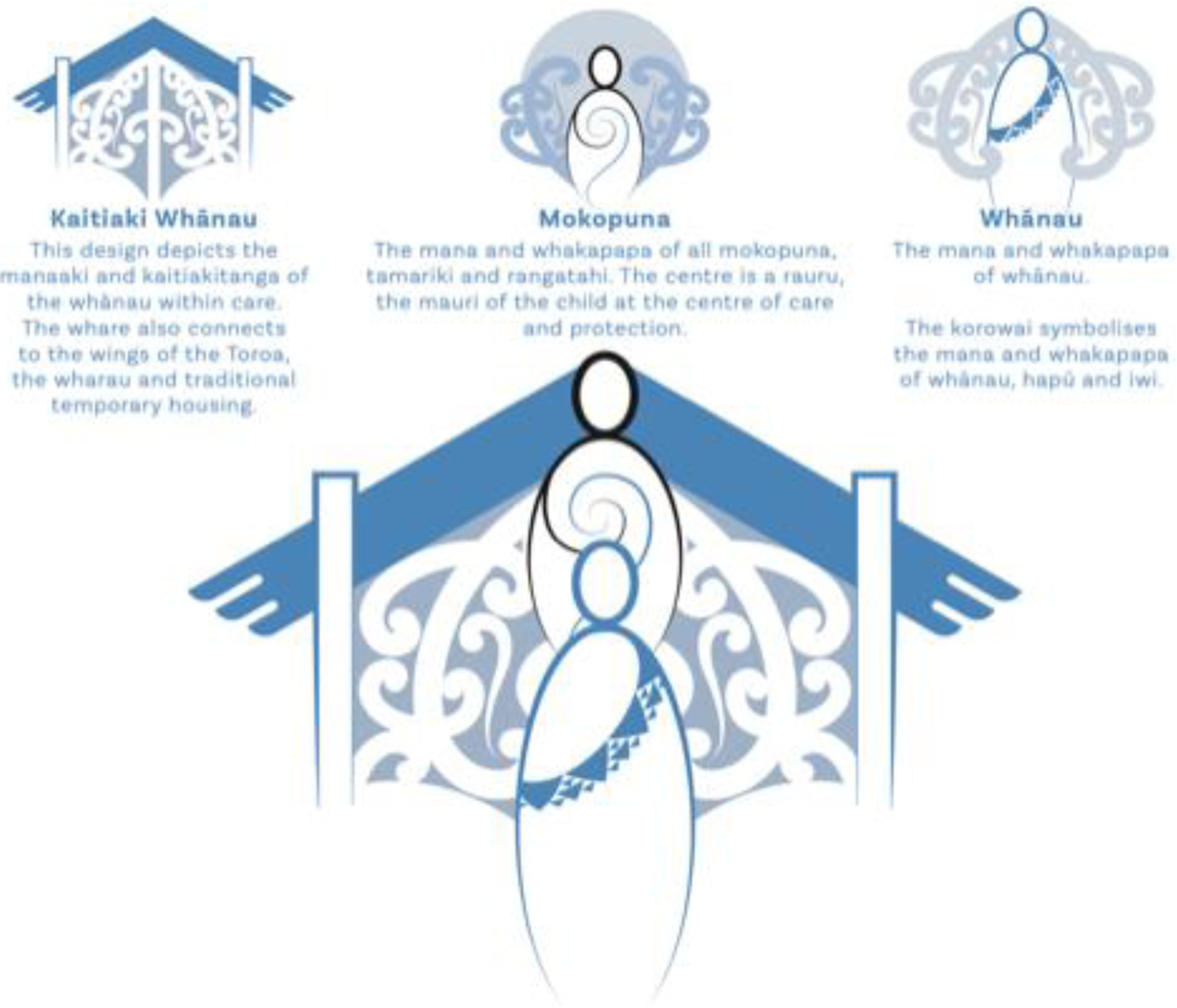
Results: Te Rereka Toroa- Tiaki Taoka practice model
The three pou, Mokopuna, Whānau and Kaitiaki
This paper briefs over each pou. Future publications will provide more in-depth analysis of each pou if you are interested in how each of these pou has translated into practice.
What we heard from our community were shared principles across positionality and time, with some talking about past initiatives such as Maatua whāngai, a Māori initiative of whānau care from the 1980’s that was shut down overnight (Walker, 2006), traditional concepts and knowledges gifted from our ancestors and current experiences. Our Maatua whāngai collaborators told us stories of how families were supported and of the importance of networks at times when the state provided little support for them to provide to Māori children. The principle of mana wāhine 3 contextualised in child protection asserting that at the heart of the system are women and mothers was a consistent theme across all groups. Practical educational and health issues were raised asking our service to do better than the Oranga Tamariki service in providing for mokopuna needs in the system. Connecting to identity and culture as Māori and as Kāi Tahu was strongly threaded through the young people, whānau, professionals and our elders voices.
While we had gathered experiences, challenges, stories, and aspirations from our Kāi Tahu with focus on caregivers, whānau and rakatahi in the system, each talked across all the three areas overlapping ideas, with truth, analysis and understanding that really can only be gained from first-hand experience. We will always be grateful for the treasures and expertise shared with us and the service design and practice model is a direct reflection of what they shared. There is not enough time in this one article to thoroughly explore all the principles in each group so I will provide a few examples in each on starting with mokopuna.
Each principle is provided with a quote that we heard through the community design hui. Our young people shared particularly clear messaging on their needs. The quotes below all come from the interviews we held with our community and represent a small selection of a vast amount of stories and information collected over 2019 and 2020.
Mokopuna Pou- what our children and young people need
The principles drawn from our community that sit in the Mokopuna pou were, mātauraka (knowledge), whakawhitiwhiti (communication), rakatirataka (rights and leadership), hauora (holistic health needs), whānau (family), Kāi Tahutaka (knowing and being Kāi Tahu) and Te Kāika (the village model). We were able to get direct quotes from the young people interviewed and they provide strong statements on there rights. The focus of a service delivering to their needs was on family relationships, cultural identity, knowing their own rights and needs, having good communication and ensuring their health and education needs were met.
Kāi Tahutanga- being KĀI Tahu and experiencing connection and culture
“It would be cool to have the option to learn my Māori side while I was in care, it wasn’t until I went to camp and met [mentor] that I found out more about my Kāi Tahu side, I’m keen to know more” (Kāi Tahu rakatahi, 2020)
Kāi Tahutanga describes the importance of culture and connecting to culture. For Kāi Tahu this includes participating in language revitalisation programmes, on land activities, learning our cultural narratives, opportunities to learn our art practices, food gathering and engaging in the many celebrations that we collect for. It is the specific parts of being Kāi Tahu that make us Kāi Tahu. These overlap the blanket term Māori in some customs and beliefs but also hold very individually specific ways of knowing, being and doing that are only Kāi Tahu. The importance of culture and identity to young people in the foster system resonated unanimously across the voices we heard, telling us being connected to culture was an essential part of their wellbeing.
In practice this required Tiaki Taoka to establish opportunities for mokopuna in our service and their kaitiaki whānau to engage with Kāi Tahutaka. This is naturally done through practice that is delivered by a Kāi Tahu service and through Te Kāika generally, but also included developing school holiday activities where they could come together and connect. One activity provided in late 2020 was to the Albatross colony where one of the Kāi Tahu experts took them on a tour and shared Kāi Tahu knowledge.
Rakatirataka- rights and leadership
“Social workers tell me he can’t be my role model because he is always in and out of prison. But he’s the only one that rings me daily to see how I am” (Kāi Tahu rakatahi, 2020)
Rakatirataka is a term that can be applied to personal or collective authority and rights. Rakatahi (young people) talked about this principle in terms of the personal, that our service needed to uphold their rights, keep them informed, listen to them and communicate. The quote provided highlighted the decision-making imposed on young people by the state, where rakatahi were denied contact with some whānau (family) deemed inappropriate but who (in this instance) were the only person that keep regular contact with them. In Aotearoa we have a pipeline of young people from the foster system ending up in prison and these decisions on access are not straight forward. For this rakatahi, their brother was their person.
Across their narratives we heard strong messaging around education and health needs not being meet and young people feeling that life opportunities they were entitled to were not open to them because their health and educational needs were not met. At times their mental wellbeing was being overlooked and issues in their education were not seen as connected to their wellbeing. All the young people we talked with had exceptional insights into the complexity of what had happened and was happening to them.
In practice this has proven difficult to implement with the power on mokopuna decision-making remaining with the state. Ongoing tensions and attempts to resolve the issue of Oranga Tamariki social worker’s retaining control of health and educational referrals highlight the difficulties in partial devolution. The Te Kāika hub model being onsite and accessible to the Tiaki Taoka team works for mokopuna where quick agreement with Oranga Tamariki is provided, but only when authority is shared.
Whānau Pou- what helps families (preventative and in the foster system)
The whānau pou included the principles of manaakitaka (care and support of each other), whanaukataka (the importance of relationships), rakatirataka (rights and leadership), tikaka (customs and procedures that guide us), tohukataka (expertise), kaitiakitaka (caretaking), Māoritaka (Māori culture), wānaka (hui collective meeting processes). The strong themes across this pou were understanding the knowledge and expertise that whānau brought, their rights and ensuring that processes engaging with whānau were Māori and Kāi Tahu processes. The strongest principle that came through was advocacy which we titled Manaakitaka (caring), while acknowledging the tight connected to action.
Manaakitaka- advocacy and supports
“It would be cool to have someone advocate for whānau in the courthouse, so that family can have a say and be heard before they separate families” (Kāi Tahu rakatahi, 2020)
Across all our hui there was a strong advocacy voice for whānau who had their children removed. Rakatahi and whānau alike understood that sometimes parents were not able to care for their children at that moment in time but consistently we heard the current system dropped whānau as fast as possible and often they were left not understanding the processes and with no one supporting them through court and system processes.
In practice, across Aotearoa there remains no formal agreement by the state to support whānau advocacy. While we now have VOYCE Whakaronga mai- established in 2019 to advocate for children and young people in the foster system there remains no moves to create systems of advocacy and support for parents and whānau (Voyce Whakaronga Mai, 2024). An unmet need that we heard should be addressed.
Tiaki Taoka in practice advocate when situations come up, in alignment with many other whānau care and Kaupapa Māori services nationally. An approach that is ad hoc with no mandate has limitations and can often become adversarial rather than a rights approach that is system embedded. Internationally we have successful examples of embedded family advocacy in child protection systems but are reliant on the state engaging with this possibility (Tobis, 2013). There is current work being done between Voyce Whakaronga Mai and Oranga Tamariki on whānau advocacy and some hope of advancement on this issue.
Kaitiaki- caregivers
The kaitiaki pou principles were Mana wāhine (the strength and rights of Māori women), tohukataka (expertise), tikaka (customs and procedures that guide us), Te Kāika (the village model), whakawhitiwhiti (communication), manaakitaka (care and support of each other), whānau (the important of family) and Kāi Tahutaka (Kāi Tahu cultural practices). These principles focused on recognising the lived and professional expertise that our caregivers brought into the role as kaitiaki, the importance of keeping whānau in the picture and ensuring our service processes keep to Kāi Tahu customs and practices. The Mana wāhine theme most strongly came through the caregivers discussions on the rights of Māori women.
We had a lot of strong messages from Kāi Tahu caregivers who had been caregivers for the state currently and dating back to Maatua whāngai. They talked about lack of information, resources, communication and a desire to be trained and supported to support mokopuna. All talked about relationships with whānau (parents and extended) and many of them discussed an understanding that mokopuna were not theirs to own but that they were now part of a wider whānau.
Mana wāhine- wāhine Māori knowledges and experiences
“Include hākui (mothers) believe in her hopes” (Kāi Tahu Professional, 2020)
We heard from professionals and wāhine (women) who had experienced removal of the importance of wāhine Māori. This was not in-depth in specifics but was a general theme that many discussed. Acknowledging wāhine Māori as those most impacted by child protection removal practices also challenged us to consider how we would build Mana Wāhine into the service. Mana Wāhine Theory centred Māori wāhine knowledges recognising the colonial history that stripped authority and leadership from wāhine Māori replacing it with paternalism. Mana Wāhine Theory is central to rethinking child protection (Cleaver, 2024; Office of the Children’s Commissioner, 2020; Mikaere, 2017).
In practice Tiaki Taoka is currently led and delivered by wāhine Māori who hold firm to the principles of Mana Wāhine. This is best evidenced through the leadership of Donna Matahaere- Atariki who continues to demonstrate Mana Wāhine in all her work across Te Kāika and Tiaki Taoka.
Tohukataka- expertise
Our caregivers told us they were experts too and that Caregiver training should be co-developed alongside our caregivers. The reciprocal nature of relationships was highlighted through the hui with caregivers who came with layers of experience from professional roles to whānau knowledge and caregiving knowledge.
Through the design hui, the past Maatua whāngai caregivers from the 1980’s child protection model shared stories of success where they had problem solved and gotten on with networking and supporting each other when the state had provided less than adequate financial supports and training. The success of these innovations could be evidenced through the mokopuna and whānau they had supported who were now all 40 years older and with many positive outcomes.
In practice these insights supported the perspective of Kaitiaki whānau as experts, working with them in collegial ways, listening and supporting.
Whānau and whakapapa- familial and environmental connections
Many caregivers expressed a view that it was about whānau. There were nuances in how each whānau might be included and connected to mokopuna while holding a consistency that whakapapa was important and creating a normalcy in access arrangements where possible was important.
Service delivery
All of the themes and stories threaded through Te Rereka Toroa, were instrumental in the final service design of Tiaki Taoka. This is the foundation of the service today and will continue to provide insights for future developments. In late 2020 after receiving our accreditation and working through a robust process of how Tiaki Taoka and Oranga Tamariki would collaborate, we started the transfer of mokopuna Māori over to our service. In the time I was Director of Tiaki Taoka, as mokopuna were being transferred over, we had continuous challenges in finding agreement in decision-making between the state and our service. As we meet with caregivers and whānau, it felt like we were cleaning up messes around all the issues discussed in our service design, ranging from lack of whānau communication, lack of health and educational supports and confusion over how decisions had been made up until that point. This really highlighted the need for Kāi Tahu to care for mokopuna Kāi Tahu, having a dedication to future outcomes not present in the state system.
Locally, social work practitioners ranged from fully onboard to explicit examples of resistance, where we were challenged in meetings and more concerningly derogatory office conversations displayed racist rhetoric. Those that were already onboard or came onboard through the process of co-design have remained staunch allies to Tiaki Taoka, while an unchecked “white supremacist” attitude prevails for some social workers that refused to shift. The challenges from these resistant practitioners have continued where blood quantum logics prevail negating “Māoriness” of Kāi Tahu and refusals to meet agreed guidelines have been an unrelenting theme. The impact of resistance is significant when we rely on Oranga Tamariki staff who hold the power to work in relationship with us. The greatest risk and tension in partnering with the state in devolving services from the child protection system, is not the risk in taking on high needs family situations but in successfully working across a chasm of differences in recognising the place of culture and identity for mokopuna in the foster system.
The voices and experiences of our Kāi Tahu community who interact with the state child protection system as professionals and as children of families, expressed frustrations with the system and a lack of communication and accountability by Oranga Tamariki. While we were looking forward to designing a fit for purpose Kāi Tahu service, what we heard were stories of young people denied education and health services and wanting connection to their cultural identities. We heard caregivers needing better supports and wanting to be seen as experts and part of a team around mokopuna Kāi Tahu. Whānau, rakatahi and caregivers told us whānau were often sidelined and there were no processes in place to help guide them through the system or keep them engaged.
Discussion and current system tension
The defining experience of designing an Indigenous child protection service with the state in Aotearoa is one of inequity in the power relations. What Taiki Taoka heard in our community design process was not unreasonable and every part is achievable if power is transferred and supported. The rubs and tensions arise in the reluctance of the state to trust Māori innovations and do not support the premise that Māori know what is best for Māori. There is an ongoing underlying egregious wrong in refusing to trust and fund the full breadth of Māori innovation and development. Māori success when the benevolent state endows authority is already exampled in Māori education systems, Kohanga Reo and Kura Kaupapa with high success rates and a generation of fluent unapologetically Māori young people who are now moving into leadership roles (Smith, 1999). The templates of evidenced success should be driving the state to trust and devolve but a colonial care discourse where the state assumes the need to be parent is too pervasive. While the state has consistently failed Māori through a failed child protection system, it assumes a paternalistic right to define and decide. We are currently in a situation where the government is repealing the Section 7 AA legislation and wanting to remove the standards set in place to support and protect Māori. This was just the beginning of a process towards devolution and removing Section 7 AA before it has had a chance to succeed signals towards a push back against Māori expertise and knowledge and a withdrawal of relationship. While the tensions of working with the state are evident in the Tiaki Taoka case study, they mitigate against the harm that generations of Māori have experienced in the state foster system and to pull back now is to be willing to sacrifice another generation of mokopuna Māori to state violence, where culture and connection are superseded by mono-culturalism and assimilation.
Tiaki Taoka has managed to achieve a service design and beginning delivery that future proofs innovation and development. The service provisions currently provided are partial and state controlled but they exceed past opportunities and have enabled Kāi Tahu to enter the child protection space, which has been long asked for and needed. Designing within communities a fit for purpose model and resisting state agenda has been an important part of ensuring a model that sits comfortably in Kāi Tahutaka and meets Kāi Tahu needs. Current attempts to withdrawal support for Māori innovation in child protection is concerning and will inevitably impact in the short term on resolving the relationship tensions and progressing the wider aspirations of Tiaki Taoka. Te Rereka Toroa will remain for future development and Tiaki Taoka will be able to hold space until it is able to expand to its full potential.
Footnotes
Declaration of conflicting interests
The author(s) declared no potential conflicts of interest with respect to the research, authorship, and/or publication of this article.
Funding
The author(s) received no financial support for the research, authorship, and/or publication of this article.
