




Abstract
Supervision is a core component of professional support and development in social work. In many settings, and perhaps particularly in children’s services, it is valued as crucial in safe decision-making, practice reflection, professional development and staff support. Research has demonstrated that supervision and staff support also contribute to social worker retention in child welfare services. Drawing on data gathered in a 15-month ethnographic, longitudinal study of child protection work that included observations of supervision, we were able to observe the impact of supportive supervisory relationships on social workers’ decision-making about staying in their current workplace. This article presents a single case that demonstrates the potential impact of effective relationship-based supervision on retention and calls for a more humane approach to social work supervision against dominant managerial themes that have increasingly burdened the profession.
Introduction
Supervision is a significant component of social work practice worldwide and many of the themes explored in this article will resonate across borders (Beddoe, 2010). Supervision provides essential support and professional development for social workers whose work involves anxiety laden decision-making (Harvey and Henderson, 2014; Hughes and Pengelly, 1997; Munro, 2011) and can offer containment of emotion and anxiety (Harvey and Henderson, 2014; McPherson et al., 2016). As the result of concern about high turnover rates of social workers, studies have explored the impact of organisational culture (Kim and Kao, 2014; McFadden et al., 2014; McFadden, 2018). Child protection work is subject to significant media coverage, which exacerbates the tendency towards defensive risk-averse practice (Chenot, 2011; Parton, 2014). Frontline public sector employees, like social workers, are subject to intense public scrutiny due to the extent and reach of their mandated activities, and the significant impact of their work on intimate aspects of people’s lives (Lipsky, 2010). This can result in knee-jerk reactions from politicians and policymakers who feel pressure to ‘do something’ in response to public pressure (Warner, 2015). This reaction creates structures in child protection that are not best suited for the very tasks required of it (Blome and Steib, 2014), including strenuous case management systems that keep workers tied to computer work and away from contact with families. Blome and Steib (2014) note that child protection is a dynamic field, requiring flexibility and creativity from its practitioners. Flexibility and creativity, however, are often constrained by increased bureaucracy, resulting from successive inquiries into children’s services (Broadhurst et al., 2010). Research reviews on the impact of supervision found that supervisory dimensions of task assistance, social support, emotional support and interpersonal interactions were all related to good outcomes for workers (Carpenter et al., 2013; Mor Barak et al., 2009), but less effective in changing outcomes in practice through reflection (Wilkins et al., 2017).
This article draws on qualitative data gathered in a 15-month ethnographic study, which took place in two sites in England between 2016 and 2018. The wider research was concerned with organisational structure, staff support and the dynamics and quality of social work practice. Our key research questions for the wider study were how do social workers begin, develop and sustain relationships with children and families over the longer term, or not do so? And what is the influence of organisational cultures, office designs and forms of staff support and supervision on social workers and their relationships with children and families? In this paper, we draw upon the data collected for question two, to explore a theme that emerged inductively through the data collection: the links between organisational culture, staff support and staff retention. We draw upon interview and observational data relating to one social worker and her manager, presenting an in-depth ‘star’ (Wengraff, 2001) case study about relationship-based supervision. This is presented to analyse and demonstrate how supervision can support staff and aid retention. We explore one social worker’s relationship with her manager, focussing on the relational dynamics that informed her retention, whilst 42 others left (overall team size 54) during our 15-month ethnography. There is a large literature on supervision in children’s social work; however, little of it has been ethnographic. This is therefore the first study to observe supervisory relationships and practice on a long-term basis. In this article, we demonstrate what relationship-based supervision looks like and its effects.
Literature
Two bodies of literature were deemed relevant to this case study: (i) literature on organisational cultures within social work with a particular emphasis on retention and (ii) the benefits of supervision in child welfare. Concern about high staff turnover in child protection social work has prompted an emerging body of research on social work retention (Kim and Kao, 2014; McFadden et al., 2014). Within this body of work, researchers and policymakers alike have identified organisational culture as a key factor in retaining staff (Laming, 2009; Munro, 2011). A 10-year longitudinal study exploring why social workers remain in child protection social work found commitment to the work, embeddedness in the context and peer support to be key factors (Burns et al., 2020). Supportive relationships between workers, supervisors and management all further contribute to positive environments (Johnco et al., 2014), which in turn aid workforce stability (Lee et al., 2010). The significance of supportive and relational cultures should therefore not be underestimated.
Within the literature, managers are a repeated theme. Managers play a particular role in creating cultures, using their skills (or absence of) to ‘set the tone’ and attend to agencies organisational climates (Westbrook et al., 2006: 56). Managers’ supervision and leadership is crucial in enacting any changes to (Blome and Steib, 2014), or upholding (Broadhurst et al., 2010), culture. Leading from ‘the front’ is evident in social workers’ narratives, whereby decisions to remain or leave organisations are attributed to the managerial experience they receive (Frost et al., 2017). Some managers foster relationship-based practice through relational management (Miller, 2017), whereas others are described as intimidating (Hunt et al., 2016) or unavailable (McFadden, 2018). Managers, like frontline social workers, are often subject to stressful conditions informed by the broader political climate (Gupta and Blewett, 2007; Griffiths et al., 2019). Nonetheless, managers play a key role, mediating between frontline workers and the larger organisation (Westbrook et al., 2006). Much research emphasises however that frontline workers have the most concerns with managerial, rather than supervisory support (Griffiths and Royse, 2017), although in the UK context these two roles are often combined (Bradley and Höjer, 2009). This may stem from managers not having a social work background (Blome and Steib, 2014), not understanding the work required or being promoted into management without training (Griffiths and Royse, 2017).
Perceptions of support are perhaps a key factor in understanding the nature of organisational culture. Perceptions of inadequate organisational support are frequently reported as reasons for leaving the profession (Griffiths and Royse, 2017). It is the strongest indicator of intent to leave (Kim and Kao, 2014; McFadden et al., 2014), and a key factor in helping new workers into their roles (Healy et al., 2007). For newer workers, providing additional organisational support could reduce turnover rates, benefit clients and there reduce overall costs (O’Donnell and Kirkner, 2009). Its absence is linked to the development of depersonalisation (Lizano and Mor Barak, 2015). Blome and Steib (2014: 187) note that ‘without an organizational structure able to support the challenging work of child welfare, the triage decisions are left to overburdened workers, supervisors, and managers’. Without supportive environments providing space to reflect upon decisions, defensive practice can occur in workers interactions with each other, and with service users (Glisson and Green, 2011). Ascertaining how effective supervision and management supports quality practice and improves outcomes for children and families is a complicated task and an ongoing challenge for supervision research (Frey et al., 2012; Julien-Chinn and Lietz, 2015; Wilkins et al., 2018). The current literature suggests strong relationships, clear communication and the ability to support workers through difficult casework are crucial.
Supportive, relationship-based, supervision is therefore a vital thread in cultivating good practice. The literature demonstrates that sustained and valued supervisory relationships are associated with reduced intention to leave, more so than workload pressures and concerns about the overall climate. However, many retention studies do not offer detailed understanding of the nature of these relationships. Studies such as Burns et al. (2020) have provided important information about those who stayed in child protection over a 10-year period but did not get close to practice or observe supervision relationships. Wilkins et al. (2018) used audio recordings of supervision sessions to analyse narratives and discourses in individual cases. Our study builds on this existing knowledge by providing an opportunity to examine in detail, and over time, the talk, embodied practices and impact of relational supervision in child protection.
Method
Research design
The case study presented in this paper originates from a broader 15-month ethnographic study (Ferguson et al., 2020), which took place between 2016 and 2018 and was funded by the Economic and Social Research Council (ES/N012453/1). It was approved by the research ethics committees of the participating universities and the social work services of the two local authorities in England where the fieldwork took place. These two fieldwork sites were chosen to provide diversity in terms of office designs, degrees of mobile working, travel and a diverse sample of service users. Two research fellows were based in the social work team offices, one at each site, spending between 3 and 5 days undertaking data collection and time away managing the data. Over 402 days of fieldwork we observed 271 practice encounters between social care staff and service users in a variety of settings, including home visits, multi-agency meetings and social workers engaging with families in schools, hospitals, courts and other settings. We observed 54 staff supervisions over the course of the study, embedded within wider observations of practice encounters and organisational cultures. Semi-structured, and more informal, ethnographic, interviews were carried out. Observations of interactions were recorded between social workers and each other, their managers and families they worked with. This article focuses exclusively on a case study of one social worker, who featured in three of the 15 long-term cases we observed at this site (henceforth, Hillrise). Names and identifying features have been changed throughout this paper – particularly important in individual case study research (Surmiak, 2018) – to protect participants’ confidentiality and anonymity. The justification for adopting a case study approach here is informed by two central considerations: the first concerns the nature of case study research more broadly (Flyvbjerg, 2006) and the second concerns how and why we selected this particular case (Stake, 1995; Wengraff, 2001).
There is a long established and deeply embedded dismissal of case study research in the social sciences. As an approach, it is typically undermined for lacking generalisability, reliability and for perpetuating researcher bias (Abercrombie et al., 1984; Diamond, 1996). However, this ‘conventional wisdom’ has been critiqued as ‘wrong or misleading’ (Flyvbjerg, 2006: 241). As Flyvbjerg (2006: 341) notes ‘a discipline without a large number of thoroughly executed case studies is a discipline without systematic production of exemplars’ and ‘…a discipline without exemplars is an ineffective one’ (Flyvbjerg, 2006: 341). Despite the clear benefits of supervision identified in the literature above, there is an absence of rich and in-depth single case studies that demonstrate what good practice actually looks like. Many facets discussed below were present (or indeed absent) in the experiences of social workers in our broader sample; however, the in-depth attention to this ‘exemplar’ combats critiques above by demonstrating how they coalesce in a single, in-depth enquiry. This has clear implications beyond this individual social worker’s experience, an approach widely adopted in anthropology but still fairly new to social work (Ferguson et al., 2020).
Cases observed with one worker.
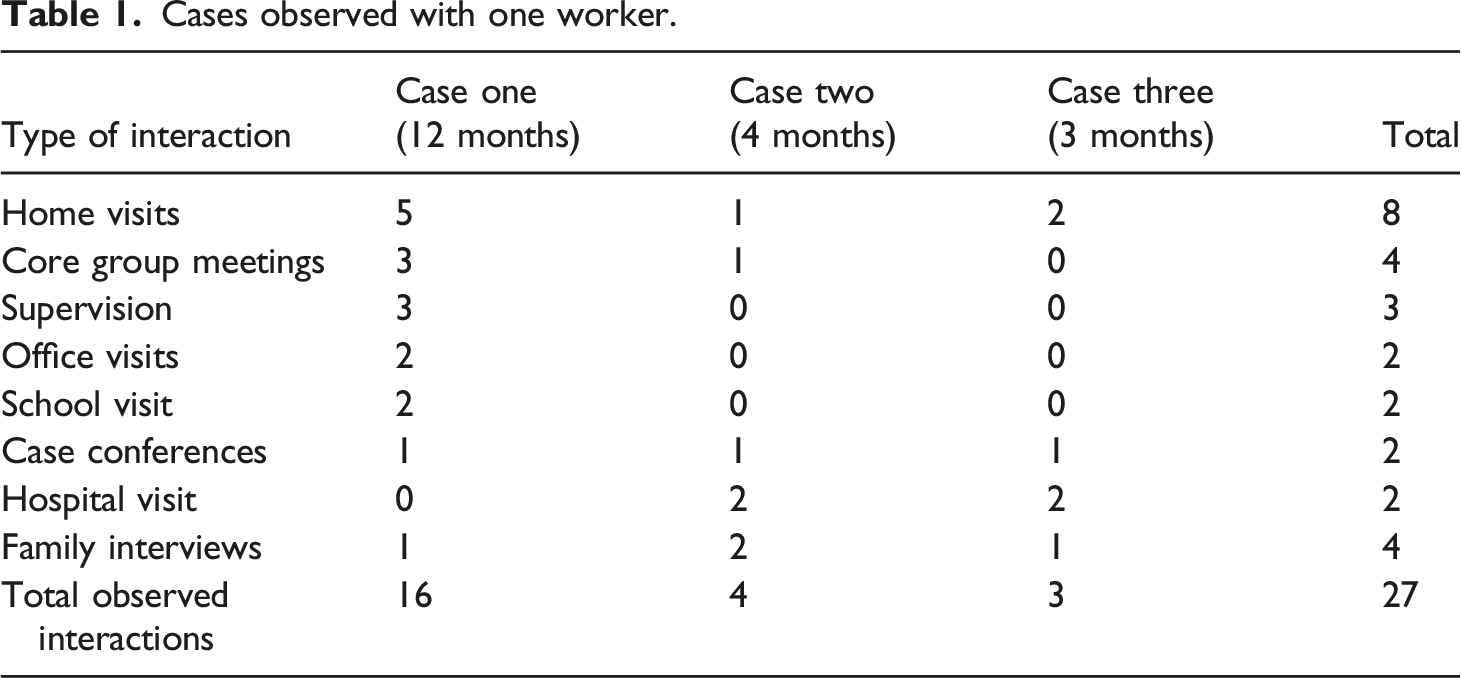
There are many approaches to selecting a particular case study. Some are predefined before the research begins (Stake, 1995), but this is not the case for this article. Our case study of a single worker and her supervisory relationship emerged through the data collection and analysis process as a ‘star case’ (Wengraff, 2001). Star cases are those which have afforded sufficient depth – in this case, via data on practice, organisational culture, supervision and biographical data – and reflect the findings particularly well. We spent a total of 15 months with Sheena, came to know about her personal and professional life, saw her interact with three different families and interviewed her over 59 times. We observed Sheena in the office, various homes, hospital, supervisions, corridors and the car. However, even this does not wholly justify our decision to focus on Sheena. The primary aim when selecting a case study to explore in depth should be the ‘opportunity to learn’ (Stake, 1995: 7). Sheena had a similar case load to many in the study and faced similar challenges, but there was one crucial difference about Sheena – she stayed in the team for the entire 15 months while 42 others left the district. This case therefore was identified by us as a ‘star case’ in order to illustrate an important facet of practice in relation to staff supervision and retention.
All data concerning Sheena was amalgamated from the three cases into one single overarching document. It was analysed thematically and the findings from this analysis are presented below in chronological order. Unless stated otherwise, all extracts below are recorded interviews.
Findings
In the wider study, we found the supervision arrangements and processes reflected the organisational cultures of both local authorities. Whilst both organisations were informed by austerity, reduced funding, performance management and the broader shift towards bureaucratic and managerial supervision practice in social work (Broadhurst et al., 2010), they managed these differently (Ferguson et al., 2020). Importantly, the retention rates were very different: 42 Hillrise staff members left during our research, in contrast to only two at the other site. We chose to focus on Sheena in this paper because she chose to stay, when so many others did not.
Sheena was overworked, but always completed her work thoroughly and on time. She had several managers during her time at Hillrise, some she found supportive and others less so. A few years prior to the study Sheena had time off due to stress, which she attributes to her relationship with her manager at the time. At the beginning of the study, Sheena was happy with her current manager, Sarah. However, Sarah left Hillrise in month two of the research. Sheena’s new manager, Janet, arrived in month three.
What we illustrate in this study is first how Sheena is described to Janet during an introductory supervision between Janet and her service manager. Sheena was described as a problem, not in terms of her proficiency as a social worker, but her efficiency in narrow, performance management terms. We demonstrate how Sarah’s departure and consequent absence of a supportive manager, coupled with a collision of personal and professional challenges, leads Sheena to decide to leave the team. Following this, after getting to know Sheena (and an important encounter between the researchers and Janet), Janet realised that the service manager’s narration of Sheena was itself a problem, and in a reflexive moment changed tack. During a vital supervision, before which Sheena had decided to leave, Janet responds to Sheena in a compassionate way. This humane approach to management meant that Sheena stayed in this office, thus shedding light on some important implications for supervisory practices in social work.
Case study – The supervisory relationship between Sheena and Janet
Sheena is a 42-year-old, White-British, female social worker. She has been qualified for 5 years and has worked for Hillrise City Council since qualifying as a social worker. Unlike some of her colleagues who work from home regularly, Sheena attends the office almost every day. Sheena is one of the team’s most experienced social workers, and, based on many observations, is well liked by her colleagues and families. Evidence from this is found not only in our family interviews, and observations of Sheena in the office, but also around her desk, where she has pinned up multiple ‘loving messages from children and families’ (Field notes, month three).
In month two, Sheena learns that Sarah is moving to a new team, and her team is being disbanded and redistributed. Sheena has the option to move to a new office with Sarah, and tells the researcher that a major factor in this decision rested on who her next manager would be: “I’ve had good and bad managers, I really like Sarah, if I could follow her around everywhere I would […] but there’s always people changing, so you can’t really base it on that” (Fieldnotes, month two)
Sheena made the decision to stay in the same building and move to a new team, primarily because the location was close to her family home. She worried about how her work life may change as a result of the coming changes.
In month three a new manager, Janet (44 years old, White-British, female, qualified for 9 years), arrives and Sheena begins her new role. The research team does not see Sheena for 3 weeks in the office: ‘I ask if Sheena is in today, Joanne (social worker) says no – and explains that she’s working from home all week. Joanne then whispers “I think she’s drowning a bit”’ (Fieldnotes, month three)
The researcher notes the following week that Sheena is back but ‘she looks different. Tired, weary and like she has lost her sparkle. When she smiles, it doesn’t reach her eyes’ (Fieldnotes, month four).
During an interview in month four about moving teams, Sheena notes that she has met her new manager but had to introduce herself to them and she has not yet ‘clicked’ with them. She also notes that she is getting increasingly anxious about the extra work she is being allocated and does not want to return to the same workload as before she went on sick leave.
When asked what Sheena will do next, she replies: “I don't know, because some days, like today, I think, I've had enough. But then other days when I'm out and about, and I'm busy and I'm doing stuff, and don't necessarily think about it that much. But then, if you have a crap visit, and it's a crap visit to the same family that you've done six times already and you think, that's enough, do you know what I mean? It's just emotionally draining, and physically […] I've just been given another new case load, which is different itself. I feel a bit apprehensive when it's just being chucked on me, and they say sort of run with it. But then they double it all”.
During this period, we see a considerable change in Sheena. Initially she is a content worker, with a manager who advocates for her, consequently able to manage a high caseload. In a few short months, she becomes a stressed worker, with an absent manager, consequently coming under pressure and falling behind in her work.
Organisational framing of Sheena
Behind the scenes, Hillrise had their own narrative about Sheena: she was framed as a problem. Here is how this unfolded.
During month four we observed two supervisions: one introductory supervision with Janet and her service manager and one introductory supervision between Sheena and Janet. This first observation (Janet and the service manager) revealed an important organisational framing of Sheena. The service manager had three core concerns about Sheena. First, Sheena spends too much time with families, second her reports are too long, and third – importantly – Sheena openly complains about issues she sees within the organisation. In other words, Sheena does not ‘nod and smile’ in organisational conflict (Leigh et al., 2020). The service manager therefore reframes Sheena’s unwillingness to compromise (in terms of quality and honesty), as her getting tired because she spends too much time undertaking relational work with families. Interestingly, the quality of Sheena’s work is never questioned. Both managers agree that her reports are well-written and on time:
Service Manager: Oh, you’ve got Sheena. I think sometimes with Sheena it’s about establishing what work she’s doing when she’s doing visits…And how long them visits are for…You know, is it something that she needs to be there for an hour and a half…It’s about time management isn’t it?
Janet: We, we spoke a bit about working efficiently.
Service Manager: Yeah. […] I think Sheena is a good worker and has got some good qualities but she also lets herself down. At that team meeting with [senior management] …she was the one that was quite negative and no positives. And not everything’s all bad but she was complaining about high caseloads, not being able to do work with children, which did surprise me given the fact that the team that she’s just come from there was that opportunity because cases weren’t that high.
Following this, the researcher interviews Janet. An important moment occurs during this interview, as Janet recognises she has become focused on performance management, rather than practice, and uncritically accepted the organisational narrative: ‘[Janet] realised they had become focused on managing performance not exploring practice. [Janet] had no idea if Sheena was a good practitioner or not; did know that she spent a lot of time writing up reports. Janet had been focused on getting her to reduce this in supervision so that she would have more time to concentrate on other cases and not go off sick’ (Fieldnotes, month four)
This time for reflection with the researcher enabled Janet to unpack what ‘good’ social work practice means. Janet subsequently begins to understand Sheena and see that she is not the problem, but that the problem is the organisational framing of Sheena constructed by the service manager.
The collision of personal and work stress
Alongside the pressures at work, Sheena’s mother has health challenges and her relationship with her partner breaks down. Here we see the challenging collision of personal and professional stress. When interviewed about the impact of home life on work, Sheena says ‘it’s massive, you’re there (in the office/at work) but not really there…and you have to deal with this’ and hands the researcher her personal phone, pointing to a large number of unread messages.
During month five, alongside the difficulties in her home life, Sheena has a case involving a violent step-father who physically threatens her and takes up a lot of time and focus. Sheena arranges a meeting with him in the office. Janet attends to support her and the father physically threatens Janet. Janet and Sheena leave the room. Both are shaken up about this; Janet gets no support from fellow managers and Sheena ends up crying on the floor in the office. However, Janet is concerned about Sheena and Sheena appreciates that Janet is there for her, stands up for her and recognises and validates Sheena’s work pressures. This is a turning point in their relationship from Sheena’s perspective and plays a part in Sheena beginning to frame Janet as a ‘good’ manager.
During month six and seven however, we rarely see Sheena, who was previously a regular in the office. When we do see her – it is clear that she is not happy: ‘I walk over to Sheena who is laughing but her body is floppy and her eyes are dead. I ask how her holiday was and she tells me “it was amazing (for a second a little spark returns) but I don’t want to be here. I don’t want it anymore, I’m done”. I ask Sheena how long she will stay and she says “Well, there is a big incentive to stay, I get a bonus for staying until [11 months’ time], but do I want the money or do I want my life back? Money or life? It’s not supposed to be like this though is it, you work to live not the other way around”’ (Fieldnotes, month seven)
Six days later, Sheena tells us she has decided to transfer out of the team and plans to tell Janet on Friday. Sheena is adamant that ‘once she makes her mind up it is made up – she is “one of those types of people”’ (Field notes, month seven). Two days after that, Sheena has supervision with Janet.
Should I stay or should I go? The crucial supervision session
This supervision session during month seven lasts 1 hour, 7 minutes. Here, we examine the first 47 min. The supervision begins with 1 minute of small talk and humour, following which Janet swings round towards the desk and begins to type. Without looking at Sheena, she asks ‘How’s things?’
Sheena is sitting back in her chair and has her arms crossed. Sheena tells Janet: ‘I don’t even know how to start that one. I want to go on the transfer list’. Janet stops typing and turns towards Sheena, replying: ‘I thought that’s what you were going to be saying today. But why’s that?’ Janet sits back and allows Sheena time to talk ‘I had two days’ annual leave. So over sort of three weeks I’ve been doing part time hours, if you like. And I felt absolutely snowed under doing it, obviously’.
The theme of becoming stressed before or after annual leave is repeated at least six times during this one supervision session. Janet’s tone of voice remains calm and gentle, as she relays her own struggles with returning to work:
“It is tough on you, after time off […] with me being off last week and coming back this week, it’s just horrendous. […] Trying to keep on top of stuff. You know my view. I think it’d be a bit of a shame for you to go. But obviously if you think that’s the best thing for you to do, then we need to look at, have you looked at the process?”
Crucially, Janet’s relaxed and unpressured tone, her understanding and willingness to explore whether this is right for Sheena, clarifies here that Sheena is valued, and that her well-being comes first. At 5 min, tears begin to stream down Sheena’s face, the complexity of this decision is illustrated as Sheena replies to Janet’s “are you alright?” [Janet passes a tissue to Sheena] with: “I mean, this is a, it’s a little bit like this is my home, if you like. I feel like I’m rooted and grounded and everything”.
Janet remains calm and says: “I think one of the, one of the big things for you is that you’re a perfectionist and want to … You want to do everything really well, and, and therefore you’re doing so many hours to try and achieve that, aren’t you? Which, at busy times means that you end up burning yourself out, don’t you? You’re a perfectionist”.
Sheena laughs and leans back in her chair with her arms folded and again discusses the pressures that stem from periods of annual leave. Janet ignores the pings of incoming emails and says: “But we’ve spoken previously in supervisions, haven’t we, about, about getting the work life balance and, and, and sometimes not working, being strict and not working on a Saturday and Sunday…In the longer term, you end up happier because you’ve got a better work life balance and -- I, I think you end up more productive because you’re … You’re fresher the next week”.
At “I am, I’m, I’m, I’m massively torn. I am, because I do love child protection […] And I love my job”.
“But what, one of the other things that makes me want to move is I don’t feel I’ve got enough time in this long-term team to progress. I don’t feel like I’ve got enough time to sit and do a consolidating award essay [requirement of the Local Authority’s promotion programme] or, [go to] the next one, to, to practice educator and, you know, sort of working my way up”.
At 9 min, Janet turns the conversation to professional development: ‘So with, with the consolidation, you will have to be strict. […] these are my free study days and I’m; I’m not working that one. You need to be stricter; you need to stop working at the weekend’. Sheena is much calmer now, fewer tears. There is good eye contact between the two and a relaxed atmosphere, Janet is not typing but is focused on Sheena.
Sheena agrees with Janet, but replies: “Yeah. And to be fair, I do try and do that, but, you know, say, if a case like [family name] happens … Then that study day is wiped out, and then, because I’ve got urgent leave or paperwork or something like that, because I am quite strict where I say, right. I did it with the pay progression because there was no way I was getting that done … Unless I said, that’s it, I’m not logging on, I’m not looking at emails, phone calls, nothing. So I can do it, but obviously, where I feel that I keep getting sucked in, in this team, is when something urgent does come up. And I know urgent things come up in the other team, but not as much, I don’t think”.
“I mean, from, from my perspective, you’re one of the strong, one of the strongest workers in the team. You do really good work. In terms of the work you’re producing…you’re producing good work, there’s no issues in terms of you’re not getting stuff done. You’re on top of stuff more than a lot of people are on top of stuff. So I don’t have any concerns. But, if it were my decision, I’d keep you here, but it, I, I don’t want you to leave”
Sheena replies: ‘that’s what makes me want to stay [elongated]!’, and Janet again reinforces that this is Sheena’s choice: “But it’s a, but it’s, but it is up to you, isn’t it? It’s up to you to decide what’s best for you. And if you’re at a point where you’re feeling burnt out, it depends whether this is a temporary thing. If you’re at the point where you’re getting, you know, where you’re getting upset about it, then maybe you do need think about moving. But it’s not a decision you have to make today, is it? I can send you this, you can have a read of it. You can see what the process is. You could even, you could even go as far as filling it out and sending it off and seeing whether there’s any vacancies”.
Sheena is clearly torn about this decision, as she replies: “And I think that’s what I’m getting upset about, actually. Wondering, is, is it the right decision? Because there’s a whole, whole kettle of fish that comes with just changing into the assessment team. It’s not just a case of doing the assessments. And long term, I’ve got to think about who I’m going to have as a manager. Because I’ve had some shocking managers, and that just makes things a hell of a lot more difficult. Having a new, different team, not -- Having my desk. I know that sounds trivial, but...If I had no annual leave or training I’d be okay, this happens when I get behind, if I didn’t have those things I would just go round and round on a hamster wheel ((Laughter))”. Janet replies: “Well, you don’t, you don’t want to be just going around on the hamster wheel. You, like, you need to be progressing towards something…this is your decision”.
The next 15 minutes are spent discussing Sheena’s career progression, with Janet taking account of what she knows about Sheena’s ambitions. This is interspersed with humour, such as the joke at 15 min about buying the team biscuits if either win the lottery, managing workloads in the team, annual leave, training, Sheena’s forthcoming student, the new computer system training needs and her father’s health. An important moment occurred at 20:50 as Sheena says ‘I feel like a whining child’, to which, crucially, Janet acknowledges that this is not an individual issue, that the expectations of the organisation are too great for anyone to achieve everything. The discussion therefore focussed not on how to do everything, but on how to make the situation work best for Sheena: “I mean, you, you, yeah, you can’t help how you feel. If you feel like this at the moment, that’s how you feel, isn’t it? And maybe it is just because you’ve had quite a lot, a lot of training. I mean, I did force you to do training because you’ve not done training…But you, sort of, I think that’s the thing, that you should be able to, you should be able to have time off. You should be able to have training”.
Before the supervision transitioned towards case discussion, Janet adopted a more directive stance and repeats: ‘you really, really, really shouldn’t be doing that, you are putting too much pressure on yourself, you have much higher expectations for yourself than I have for you’.
At 37 m Janet admits to Sheena that she is planning to work on Sunday, blushing and saying ‘despite me telling you lot not to work’. At 47:37, both agreed there was nothing more to discuss and the supervision moves towards case discussions.
The supervision is interrupted at 1:06:49 by a colleague in the team, Janet mouths to Sheena ‘do you want to go for a cigarette?’. Sheena and the researcher leave the room and walk outside the building, capturing the following on the move:
Researcher: So how was that?
Sheena: Emotional, difficult to a certain extent, not because of Janet whatsoever. I don’t know it feels like once I say it that’s it, that’s what’s happening… yeah. I don’t really know. […]
Researcher: Do you still feel the same about wanting to transfer?
Sheena: Yes and no ((laughter)). Yes, I do for the reasons why I said, ((laughter)). [..] Do you know if Janet weren’t here and I had a wanker of manager, yeah, it’d be dead set ((laughter)). If you had a shit manager you wouldn’t mind going to a new manager would you, just to see if they’re shit or good or whatever. Janet’s just a really good manager.
Researcher: What, what is it about Janet that is so good?
Sheena: Everything, I can’t fault Janet for anything, nothing whatsoever. Janet is very understanding, so very supportive, Janet’s got your back no matter what… gives you good feedback, that’s very rare I’ve found. I walk in there feeling like shit, oh I’m not doing my job properly, I’m not doing this and I walk out of there feeling amazing ((laughter)), and again you just don’t get that with managers, because I think, so how many managers have I had, I’ve had Erin and Linda and someone between them, I can’t remember who that was, so I think Janet is my fourth or fifth manager, and by far the best yeah
Researcher: So, what are you going to do now about the transfer?
Sheena: I think I’m going to, I’m going to fill the form out, get it sent off and I’m going to do what Janet said, I’m just going to leave myself on the list, if something comes up I’ll look into it, it doesn’t necessarily mean I’ll go but I’ll certainly look into it . If I feel it’s best for me at that time then why not, but if I don’t and I’m quite happy and settled where I am then I’ll stay.
‘I walk over to Sheena; she is in a good mood today and she looks a lot better than last week. She is smiley and bouncy and tells me she feels better, I ask her about the transfer and she tells me she has decided to do what she said in supervision: she is going to submit the transfer form and then move as soon as she gets a bad manager. She laughs as she says this, she tells me she might even be here until the end of the research!’ (Fieldnotes, month 7)
Staying put
In the final month of the research (month 15), after shadowing Sheena (who did not transfer) on several cases, we undertook a final interview, which finished with the following:
Researcher: OK so is there anything else that you want you really want us to know?
Sheena: Just that the manager makes a big difference. I don’t think I realised how much actually until I had Janet […] because I’ve had a really crap manager before and they made my life hell. But even when I’ve had stressful periods, I’ve told Janet this before, even little tiny things like if I was sending an assessment that’s really detailed and I had spent hours doing it, I’ll get an email back saying, I’ve signed this off and it was excellent. Just that little thing makes you work more. It’s, it’s a huge thing it really is having a good manager. And not a lot have that, not a lot have everything what Janet is – approachable, supportive and gives good guidance. Janet is laid back, calm, and doesn’t pass on that stress from service manager to you whereas I know other managers do. Just little things that Janet does, fantastic. Absolutely amazing.
Sheena remained in the office for the duration of our fieldwork and when we were leaving the field, the local authority was looking to replace Janet with a permanent manager (Janet is agency, and therefore expensive) but the team threatened to walk out. Janet remained as the manager for a further 2 months, following this she was relocated to a new team within the same local authority. Sheena immediately requested a transfer and followed Janet to the new team. Three months after this, none of the original team members were left in Sheena’s team.
Discussion
“If I never had training or annual leave, I’d probably be all right, just keep running around on that hamster wheel”
(Interview, month seven)
This case study inevitably tells a single story, it is therefore neither generalisable nor immune to researcher bias. However, what it does show, in an in-depth and vivid example of a good and experienced social worker who decides to remain in an organisation, despite personal and wider systemic pressures. The two workers discussed in this case are share several key identities, both are White-British, a similar age, social class and gender. Therefore, wider issues of marginalisation in social work – which has been critiqued as blind to the impact of culture and other aspects of identity as it is grounded in Western ways of thinking and is entangled within complex power relations (Tsui et al., 2014; Hair and O’Donoghue, 2007) – are not sufficiently explored here. This would benefit from further exploration – and action (Moore and Simango, 2021).
In the current climate of targets and tight, closely surveilled timeframes, Sheena has been problematised by her organisation as a perfectionist (Broadhurst et al., 2010). Sheena is presented to Janet as a problem social worker by her own manager, one who wants to spend too much time with families and raises unabashed concerns with senior leadership teams around caseloads and poor working conditions. However, through reflective discussion with the researchers, Sheena’s manager began to see Sheena through a different light. This reveals not only the importance of reflective spaces to examine organisational conceptions, but also – the deeply embedded nature of ethnographic research and the ways in which researcher effect can inform and shape data produced in ethnographies (see further, Leigh et al., 2020). Janet begins to regard Sheena as a very good worker, who takes pride in her work, builds positive relationships with service users and produces quality written work. Janet acknowledges that Sheena’s work life balance is disrupted by an unachievable workload, not an inability to manage her time. The supervision session reported here provided a pivotal moment for her to discuss her thoughts about moving on as she has become more stressed over preceding months. The expression of emotion and the way Janet validated Sheena’s feelings seemed highly significant in the outcome of the conversation. In this session Sheena states and re-states that if she didn’t have annual leave, or training, she would be able to manage the ‘hamster wheel’. Both the social worker and manager emphasise that taking leave or undertaking professional development is problematised because of work pressures. Both accept that the work needs to be done somehow and so continue to run around the hamster wheel without taking the time to reflect on the impact this culture is having on both of their lives.
This case study presents an example of an effective social worker/manager dyad we observed over many months. This clearly demonstrates aspects of good supervisory relationships and how important they are. The focus on one session demonstrates how this relationship and supervisory style overturned a social worker’s intention to leave. We accept that these small interventions might seem unexceptional. However, Sheena’s manager was able to respond to a distressed worker, suspend the ‘business-as-usual’ case management work, stop typing, actively listen and respond to her feelings in a way that is recommended as best practice but was rarely seen at Hillrise during our 15 months. We observed respectful engagement and genuine use of empathy.
Carpenter et al. (2013: 1851) argue that ‘given the evidence that supervision is associated with job satisfaction and protects against stress, practitioners should insist that good supervision be provided by their employers’. In highly risk-averse practice, safety (of workers and children) is often jeopardised by unstable working relationships, and relationship-based positive supervision may be a casualty. McPherson et al. (2016) suggested that providing emotional safety (a secure base) is so important that it should be added as a fifth dimension of supervision alongside case management, development, support and organisational mediation. When Sheena says she feels ‘rooted and grounded’ in her workplace with the manager, whom she later describes as not passing on the stress from above, she is also describing the process of containment ‘promoted by a consistent setting and familiar person who has an available mind which is open to the emotional experiences of the practitioner’ (Harvey and Henderson, 2014: 344). In the relative safety of this containment, Sheena remains, where 42 others do not.
Conclusion
We have argued in this article that a single case can illuminate the wider findings of research by providing an in-depth exemplar that has clear implications beyond the experiences of the individuals involved (Flyvbjerg, 2006; Wengraff, 2001). This case study demonstrates how and why a supportive supervisory relationship contributed to a practitioner’s decision to stay in a child welfare setting, illustrating the importance of active listening, empathy and security. We have also demonstrated the importance of reflective spaces for supervisors in the context of contemporary child protection, to critically examine how and why social workers are viewed by organisations in particular ways (Beddoe et al., 2021).
Child protection practice is emotionally demanding work, for frontline practitioners and their managers (Griffiths et al., 2019). Contemporary literature has clearly identified the increasing levels of bureaucracy informing child protection across the globe (Broadhurst et al., 2010), an issue echoed in this by paper. However, by focussing on one practitioner’s experience, this article sheds new light on how supervision practices and relationships can shape and inform well-being and retention in practice. By observing and respecting the pressures Sheena was facing, not individualising challenges and validating structural pressures, Janet made Sheena feel respected and recognised. In turn, Sheena wanted to stay and work with Janet because she ‘sustain[ed] a complex and reflective approach to managing practice that resist[ed] responses that are polarised and dehumanised’ (Ruch, 2012: 1320). This retained a high-quality worker for families and the organisation.
Retaining staff in social work organisations has many benefits, including team consistency and individual well-being (Burns et al., 2020), economic savings for financially pressured local authorities (O’Donnell and Kirkner, 2009) and the quality of care and support offered to service users (Ferguson et al., 2020). Recent data demonstrates significant global gaps in the social care workforce (UNICEF, 2019; House of Commons, 2020; International Labour Organisation, 2020), a factor only likely to be exacerbated by the global impact of Covid-19 when accounting for increased service user need and workforce well-being. When facing this challenge, attention to the quality of supervision and supervisory relationships and spaces should not be an after-thought. This article has employed a detailed case in order to shine a spotlight on the benefits of relationship-based reflective supervision for child protection social workers. Further research is needed to explore contemporary management in social work and the impact of identity and marginalisation in supervisory relationships.
Footnotes
Declaration of conflicting interests
The author(s) declared no potential conflicts of interest with respect to the research, authorship, and/or publication of this article.
Funding
The author(s) disclosed receipt of the following financial support for the research, authorship, and/or publication of this article: This work was supported by the Economic and Social Research Council (ES/N012423/1).
