




Abstract
Inspired by critical trauma and embodiment theories, this study aims to illustrate how an arts-based approach such as body mapping assists in exploring the lived experiences of youth, potentially serving as a trauma-informed approach. This qualitative study collaborated with street-involved and homeless youth (SIHY) who have eating struggles while living in situations of food insecurity and other forms of oppression. Eleven participants partook in three individual face-to-face interview sessions and one arts-based body map activity, respectively, at a local SIHY resource centre in a metropolitan city in Canada. Guided by Interpretative Phenomenological Approach (IPA), our findings illustrated how body mapping (1) enabled a deepened understanding of SIHY’s eating struggles as both a form of suffering and an embodied means of coping with food insecurity and other systemic and relational trauma(s); (2) provided a transformative experience leading to greater self-compassion and healing; and (3) served as a trauma-informed method that fostered choice and validation. We attest that, as a creative and supportive clinical and research tool, body mapping taps into the unspoken, expressive, embodied, and somatic aspects of eating struggles, food insecurity, poverty, and other forms of oppression deepening knowledge and informing social work research and practice.
Introduction
Arts-based research methodologies have become increasingly recognized as a valuable source of knowledge creation. Studies that integrate arts-based methodologies often produce powerful and enthralling results that increase awareness on important social issues (Cole et al., 2004). Body mapping refers to a process of creating life-size drawings that represent individuals and their bodies, identities, social contexts, and the embodiment of the phenomena of study (Skop, 2016). For instance, participants are invited to draw their body highlighting where, when, and how in the body, certain lived experiences exist while using symbols, words, and other means of expressing their felt senses, thoughts, and emotions.
Body mapping is a relatively recent arts-based method that emerged from its use for trauma treatment. As a claimed trauma-informed approach to research, body mapping, De Jager et al. (2016) notes, enables participants to process difficult questions and addresses the somatic nature of experiences by encouraging participants to remain connected to their embodied sense of the phenomena rather than dissociating. However, there have been limited studies that integrate body mapping with marginalized populations, such as street-involved and homeless youth (SIHY).
This study thus aims to examine how SIHY experience body mapping as a medium to exploring and expressing their lived experiences of eating struggles, food insecurity, and intersecting forms of trauma and oppression. First, we contextualize experiences of SIHY around complex layers of trauma related to their eating struggles and food insecurity. Next, we illustrate how body mapping can be utilized as a means to access and understand untapped and unspeakable experiences of SIHY who have eating struggles. Then, we briefly describe the research method, particularly in how we incorporated body mapping into data collection while following Interpretive Phenomenological Approach (IPA), as a data analysis framework. Findings of the present study are presented with examples of body maps and our interpretations given critical trauma and embodiment theories. We close by discussing the study limitations and present the implications of using body mapping for social work practice and research.
Understanding Street-Involved Homeless Youth Experiences
Eating Struggles, Food Insecurity, and Trauma
Eating disorders, disordered eating, and body image distress have been increasingly recognized as having an embodied and somatic component often linked to experiences of trauma (Eli, 2018). Homeless youth face multiple, intersecting, and complex forms of trauma associated with the living conditions of poverty, homelessness, food insecurity, and other profound stressors, such as sexual, physical, emotional violence and abuse, structural and societal exclusion, rejection, and marginalization along axes of identity including racism, classism, homophobia, transphobia, sexism, ableism, and ageism (Bender et al., 2014; Davies and Allen, 2017; Wong et al., 2016).
Similarly, other studies linked these traumatic experiences as underlying challenges frequently observed within SIHY populations, including substance use, increased risks of suicide, difficulties in trusting others (particularly that of service providers), challenges in maintaining employment, and decreased concentration at school, along with other health/mental health concerns (Coates and McKenzie-Mohr, 2010; Edidin et al., 2012). The chronic vulnerability and suffering faced by SIHY could be understood as forms of trauma that impact people in ways that are negotiated through the body (Burstow, 2003). For instance, individuals living in conditions of food insecurity, such as SIHY, often report having a tumultuous relationship with food linked to the daily uncertainties they face of how, when, and where they may obtain food (Dachner and Tarasuk, 2002). In addition, SIHY are not immune to internalizing dominant societal discourses surrounding thinness, dieting culture, and size-based discrimination and/or stigma (Luongo, 2018). SIHY who face multidimensional forms of oppression and severe conditions of food insecurity are greatly susceptible to developing severe eating struggles including eating disorders (Bender et al., 2014; Luongo, 2018).
Only until recent years, has there been an emerging body of research exploring the relationship between food insecurity and eating disorders (Becker et al., 2018, 2019; Christensen et al., 2021; Hazzard et al., 2021; Rasmusson, 2019; Zickgraf et al., 2022). These studies suggest that individuals with severe levels of food insecurity were more likely to identify as having eating disorders and body image issues than those who were food secure. In some studies, on SIHY with eating disorders, findings suggest a critical need for future research on food insecurity and eating disorders among SIHY, since food insecurity is shown to exacerbate participant’s restrictive, binge, and/or purging tendencies (Luongo, 2018; Frayn et al., 2022). According to Bender et al. (2014), eating disorders are particularly prevalent among homeless youth with rates estimated to be three to four times higher than those in the general population.
However, SIHY who have eating struggles while living in situations of food insecurity have been historically omitted from the literature on eating struggles and/or disorders. Luongo (2018) rightfully argues two critical points: (1) the majority of food insecurity research studies have been conducted at the household level, thus omitting individual youth on the street, and (2) much of the research studies on eating struggles are often within a strictly biomedical model of understanding, thus omitting the structural issues SIHY experience. Consequently, this dominance tends to depict a particular patient profile of who and what constitutes as having eating disorders, namely, white, middle-to-upper class, heterosexual, able-bodied, young, cisgender, and visibly underweight females (Hazzard et al., 2021; Luongo, 2018). Consequently, SIHY are often excluded from scholarly inquiries on eating disorders since they do not ‘fit’ into the dominant view.
Moreover, SIHY who have eating struggles may not seek support since homelessness and poverty make accessing affordable treatment unrealistic (Luongo, 2018). Even if SIHY access government-funded supports, such as hospital treatment, they may face additional challenges. For instance, depending on the hospital or outpatient eating disorder support within Canada, a treatment site typically requires several weeks of treatment for approximately 4–6 hours per day, several days per week, which limits patients’ ability to work and to support themselves. For example, Frayn et al. (2022) provided further insight into the limitations of eating disorder hospital treatment for food insecure youth. They noted that due to the inability to work, and as a result of food insecurity, these youth are often unable to purchase specific foods in adherence to their treatment plan. Participants described experiencing shame for being unable to successfully abide by the treatment team’s food requirements, which adversely impacted their symptoms and capacity to recovery. Frayn et al. also found that food insecurity contributed to cycles of food restraint leading to binge-eating, and to using food as a means of coping emotionally. Moreover, these participants shared their experiences of the treatment providers who did not demonstrate understanding towards their unique limitations of food insecurity. Lastly, SIHY may also have more urgent issues to address such as finding safe shelter, surviving abuse and/or violence, and seeking help for physical safety (complications associated with homelessness and food insecurity) rather than to seek eating disorder treatment per se (Edidin et al., 2012).
Body mapping as a means to understand SIHY untapped experiences
Body mapping has been noted as particularly beneficial for youth experiencing homelessness, as this activity makes it more accessible for them to convert challenging and highly complex experiences that may otherwise be difficult to articulate into creative and transformative visuals that can be healing (Schwan et al., 2018). The youth participants also shared how they found creating art as a transformational method of self-discovery, self-creation, and self-care in ways that led to deep self-introspection, identity building, and a greater sense of self-empowerment (Schwan et al., 2018).
Body mapping exercises are also inherently an embodied, somatic activity. Somatic practices are recognized as being important for individuals who have endured trauma particularly when sharing about these experiences (Van der Kolk, 2014). Also, Cameron and Kipnis (2016) suggested that art can be healing for individuals who have eating struggles and/or body image concerns for similar reasons, especially since trauma often underlies eating and body image struggles. Skop (2016) thus applied body mapping to their social work research while integrating trauma-informed approaches to engage groups in body mapping interviews, such as checking in with participants regularly to see if they need a break or support. Furthermore, Klein and Milner (2019) provided a detailed process of conducting body mapping which the current study adapted (to be illustrated later).
Despite this growing knowledge, little research has been conducted that (a) illustrates trauma-informed steps to conducting body mapping and (b) integrates body mapping with food insecure SIHY who have eating struggles. To fill these gaps, our research questions include the following: (1) how does using body mapping facilitate meaning making of SIHY’s lived experiences in terms of their eating struggles and experiences of trauma? and (2) what was the experience of body mapping like for SIHY?
Methods
Recruitment
Participant Demographics.
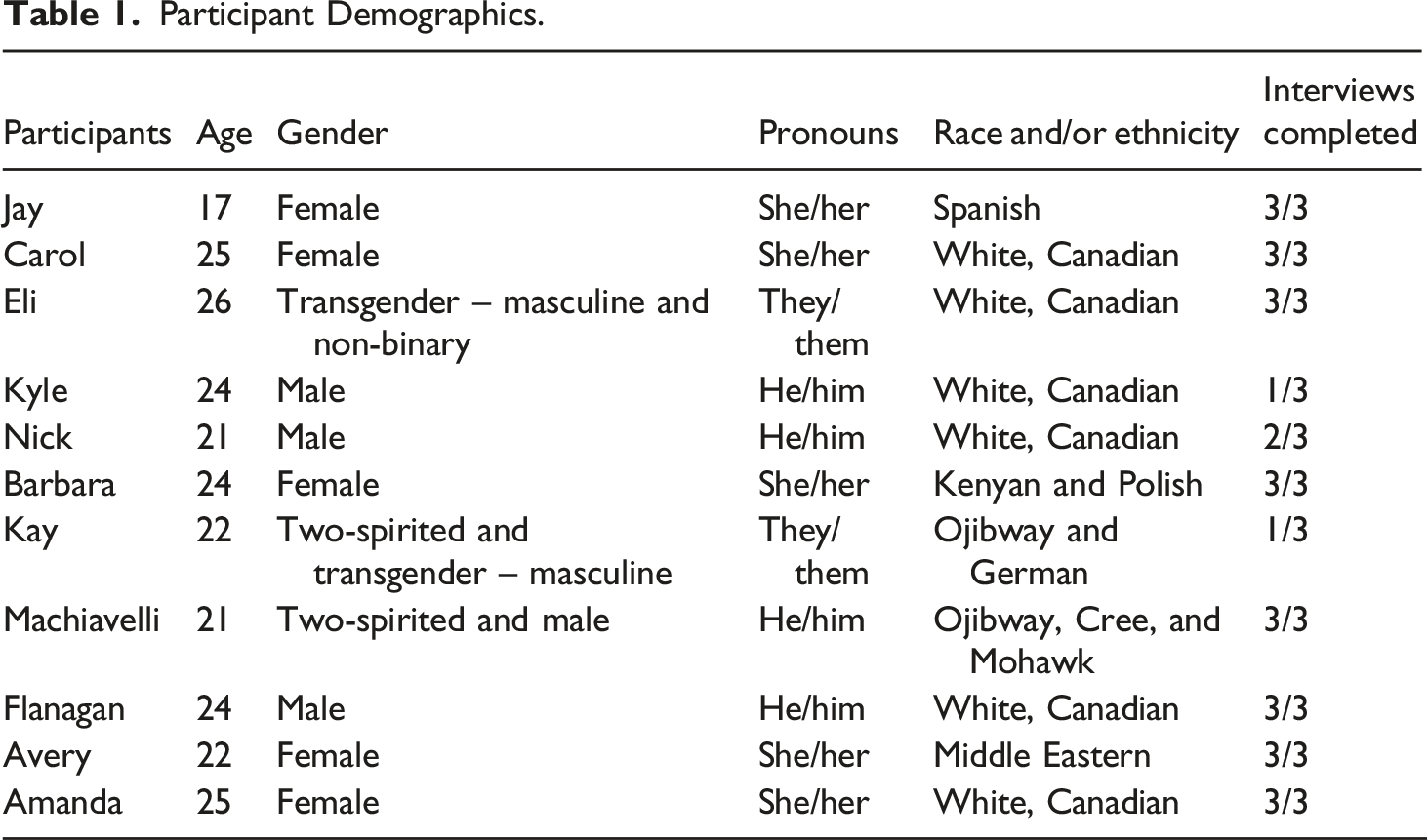
Data collection
After receiving the ethical approval from our affiliated university ethics board, participants of this study were invited to take part in (1) an in-depth individual interview for approximately 60–90 min, (2) a body mapping arts-based interview for approximately 30–90 min, and (3) a follow-up interview of approximately 30–90 min for member checking. The purpose of the first in-depth interview was (1) to collect demographic information; (2) to access verbal narratives of the participants’ experiences of living in situations of homelessness and food insecurity; and (3) to gain a greater understanding of how they define their eating struggles. Questions included inquiring about their current and past housing situation, how and where they access food, their definition of their relationship with food, how they cope, and what their experiences have been while accessing resources. The body mapping interview provided the participants with another medium of expressing their deepened understanding of their own experiences. Lastly, the final interview was conducted to ensure that interpretations of the data analysis were accurately reflecting the participants' lived experience.
Each participant was provided with consent forms to ensure they were informed of the risks and benefits of the study, the limits of confidentiality, and to establish consent to participate. All participants were provided with honoraria which included a $10.00 gift card to a retail store that was recommended by the staff after each interview ($30.00 total per person). Moreover, all participants were reminded of their voluntary participation and right to withdrawal at any time during the interview process without any repercussions. All audio-taped interviews were transcribed verbatim and deidentified for confidentiality. Throughout the paper, we used pseudonyms that were created by the youth participants themselves.
Body mapping
Guided by procedures suggested by scholars on body mapping, we collected data using body mapping as described below: (1) while audio-taping the session the entire way through, we offered body mapping visualization prompts (see Appendix 1: Body Mapping Facilitation Guide) (Lys et al., 2018) to the participant who then created a life-size body map; (2) a semi-structured interview was conducted upon completion of the art that offered a space for the participant to analyse and describe their own body map; and (3) we then documented the artwork by taking its photo, transcribing the interview, and de-identifying the post-art interview for analysis (Schwan et al., 2018). Upon learning the importance of a trauma-informed approach for SIHY who have eating struggles and body image concerns from the first in-depth individual interviews, we incorporated aspects of a trauma-informed approach (e.g. having access to choices) into the body mapping exercise as we illustrate later.
A framework of analysis: Interpretive phenomenology approach (IPA)
Interpretive phenomenology is to explore, understand, interpret, and describe the ‘social world from the perspectives’ of the individuals of study (Glesne, 2001: 8). IPA is highly regarded for its ability to reveal deep issues and for providing the space for those who are often silenced in society, to voice their experiences and the meaning they hold (Glesne, 2001). Scholars stress how written and/or verbal language limits our capacity to fully capture and articulate our thoughts (Szto et al., 2005). They emphasize how depth of meaning is further transformed through the act of presentation and when the audience interacts through viewing. That is, when we are exposed to art, we are affected by it almost immediately. As we reflect on this impact of art as an experience, we deepen our understanding of phenomena and ultimately ourselves (Lys et al., 2018).
Body mapping fits with IPA given many benefits of arts-informed research including (1) its emphasis on human experience, respect of multiple ways of knowing, and interpreting the world, (2) the embracing of multiple subjectivities and perceptions, and (3) the goal of meaning-making and interpretation. According to Klein and Milner (2019), arts-based data such as body mapping aligns with IPA in that they both aim to understand participants’ perspectives on the phenomenon of interest. They further argue that integrating body mapping into IPA enables a triangulation of data which strengthens internal validity through cross-checking these multiple sources of data. Shinebourne (2011) also argues that IPA has been lacking in embodied expressive aspects which might better reflect the voices of youth. Body mapping thus strengthens this methodological limitation of IPA. Others also note that body mapping addresses researcher bias in data collection (Gastaldo et al., 2018).
Researchers’ positionality
In the present study guided by IPA, it is critical to make the researchers’ positionality transparent. The first author’s passion and initial interest of this topic of study stem from her personal and professional endeavours. As an adult, white, middle-class, lesbian, and cisgender woman with past eating struggles, she has become deeply aware of her positions of both privileges and disadvantages. As a clinician and critical scholar, she also works with SIHY and adults who struggle with eating-related concerns through a trauma-informed and critical feminist lens. While she therefore positions herself as an ‘insider’, she has remained fully aware of herself as an ‘outsider’ to the participants’ lived realities during the research process. In alignment with the dual position, the first author strives to remain mindful of the shifts that have occurred in her thinking as she has reflected upon her own interactions with the participants, while also challenging assumptions that have surfaced for her. The second author is also a critical feminist scholar who has focused on critical analysis of power in social work interactions in the field of mental health. She thus brings this expertise as well as her marginalized and privileged positionality as a racialized immigrant working with economic and social security in academia into analysing and understanding the data.
Data analysis procedures
Guided by IPA within a hermeneutic phenomenological tradition and by scholars Elley-Brown (2015) and Ajjawi and Higgs (2007), the data analysis included the following six steps.
Step 1. Immersion
To develop emerging and preliminary interpretations from the transcripts, we listened repeatedly and intently to the audio recordings while reading the transcripts and reviewing the body maps. At times, we paused the audio to extract verbatim responses and pasted them into a separate document, creating a compilation of the participants’ direct stories. We conducted a careful review of each descriptive account in the separate document, paying attention to the nuances and details of their narratives. Underneath each individual’s selected verbatim story, we wrote our interpretive account of that story which helped us to gain a ‘level one’ basic understanding of their descriptions, as mentioned by Elley-Brown (2015:6). The purpose of this first-level interpretation was mainly to fully immerse ourselves into the participant’s account. We described our first interpretation of each participant response story underneath each account as an experiential exercise to embody and sense their experiences fully. Therefore, our response to each account remained as close to the participant’s actual words as possible. We then immersed ourselves in the second interview transcript, audio recordings, and the participant’s body map through the same process. Listening to the second interview helped us further comprehend their creative and visual expression. Throughout the analysis process, we regularly referred back to the body maps to deepen our understanding of the visual art.
Step 2. Understanding: Fusion of horizons
Fusion of horizons refers to the evolution of analysis, whereby interpretations begin to fuse together naturally in ways that elicit deeper meaning and understanding of the data, often resulting in the formulation of themes and sub-themes. In this step, the authors began by reading the level-one stories constructed during the stage of immersion. We also referred back to the original transcripts as well. A ‘level-two’ story began to organically craft, which we documented. This second story contained greater interpretive ‘notions’ that went beyond simply ‘factual information’ or narration (Elley-Brown, 2015: 118). As more interpretive notions surfaced, more descriptive stories were noted underneath the level-one and level-two stories, highlighting the relationship between lived experience of the participants and our role as researchers. This included applying theoretical concepts to deepen the interpretations. This continual crafting and writing of stories surfaced overarching meaning that naturally began to fuse together into more synthesized stories. Each interview, therefore, resulted in having fused interpretations and meaning that were documented as preliminary ‘themes’ and ‘sub-themes’.
Step 3. Hermeneutic circle
The hermeneutic circle is a concept that implies a movement ‘between parts (data) and whole (evolving understanding of the phenomenon)’ with both providing a greater understanding of the other in a circular motion (Ajjawi and Higgs, 2007: 622). We applied the hermeneutic circle twice firstly with each participant’s three interviews and then reflecting on the overall message that exists across all participants. In detail, we reviewed the first participant’s fusion of horizons: We began by reviewing all themes and sub-themes from three interviews in each participant, weaving between each interview’s themes and reflecting back on the overall message that this participant was expressing. Upon completion of this first participant hermeneutic circle, a similar process was conducted with the next participant, enabling the exploration of dis/similarities between the participants’ themes/subthemes. Throughout conducting the hermeneutic circle of each participant, we then engaged in the second hermeneutic circle, which involved moving across each participant’s overarching themes and sub-themes (the ‘parts’) and the overarching/evolving essence of the phenomenon (the ‘whole’). As we did so, we constantly referred back to the body maps, as the visuals at times, deepened, and shifted our interpretations. The outcome of the second hermeneutic circle was synthesized into themes and sub-themes that represented the data as a whole.
Step 4. Synthesis
In this step, we developed ‘structures of experience’, meaning a structure to the accounts that we had selected to illustrate the themes and sub-themes that emerged through the hermeneutic circles. By grouping direct quotes from the transcripts under the themes and sub-themes, we were able to develop a process of storytelling that would allow for thick description of the phenomena of inquiry (Ajjawi and Higgs, 2007). Viewing the grouped themes and sub-themes of Stage 3, a synthesized narrative emerged as illustrated in the findings section. Therefore, the final illumination was structured in a way whereby each theme flowed to reflect the greater message.
Step 5. Illumination and illustration of phenomena
This step involves the writing and re-writing of the findings and linking of the literature to the identified themes to further elaborate and establish the stories chosen to illustrate the phenomenon. The body mapping was also utilized to illuminate the stories visually for readers as shown in the findings.
Step 6. Integration and critique
This step produced the overall writeup and outlining of the research findings. This involves the researcher critiquing the themes further until the analysis had become exhaustive. Following the previous steps, we did iteratively write and re-write the stories shared by the participants until the interpreted stories captured the participants’ lived experiences (Elley-Brown, 2015).
Strategies to preserve trustworthiness
In addition to a member checking interview, the researchers remained carefully attuned to other ways of preserving trustworthiness and connection with the participants throughout the research process. For instance, early in the study, participants provided feedback regarding the importance of not feeling judged: compassionate responses, validation, and kindness were identified as imperative practices in preserving the trust of participants. Moreover, active collaboration was employed by regularly checking in with the participants about their comfort level of engaging in the interviews. This included asking participants if they were in need of resources such as food, beverage, breaks, or other forms of support. Consistent with trauma-informed approaches, the researcher ensured that various options were provided. For instance, the participants were provided with options of
Findings
Eleven participants shared their experiences of eating struggles and traumatic experiences, which highlighted three unique forms of meaning attached to the use of body mapping: (1) understanding embodied forms of one’s coping and suffering; (2) enhancing self-awareness and transformative experiences; and (3) fostering choice, compassion, and validation. We illustrate these meaning-making processes with three selected case examples, considering their diverse backgrounds and space limitations.
Jay was a 17-year-old, cis-gender female of Spanish descent. Jay was experiencing homelessness, significant poverty, and food insecurity with a history of enduring domestic violence and having experienced family estrangement. Jay identified as struggling with body image distress and an eating disorder that presented as severe food restriction, and occasionally binge-eating and purging. Machiavelli was a 21-year-old, two-spirited male of Ojibway, Cree, and Mohawk decent. Machiavelli identified as having struggles with food restriction, binge eating and purging as well as body dysmorphia and body-size discrimination. Barbara was a 24-year-old cis-gender female of Kenyan and Polish decent. Barbara shared the complexities of having eating struggles and how this intersects with her experiences of racism and size-based discrimination.
Body mapping: Understanding embodied forms of coping and suffering
During the first interview, all participants provided in-depth narratives on their lived experiences of homelessness, food insecurity, and their challenging relationship with food and body image. Given nuances and embodied expressions that were too challenging to articulate verbally, the participants shared how their experiences of systemic and relational traumas are imprinted on the body, in felt and somatic ways through body mapping. They described how viscerally these experiences of trauma and oppression are felt daily, and why eating struggles as sensory forms of negotiation, temporarily relieve them from this felt suffering. For example, while Jay’s eating struggles manifested in severe food restriction and Machiavelli’s eating struggles were described as primarily binge eating and purging, they both described how their eating struggles produce a felt ‘high’ sensation that is multi-purposeful for SIHY. As Jay states, … there’s hunger, then there’s like hunger, but once you get past that hunger and your stomach just like chills a bit, then you get…a high off of it … so it’s a distraction cause like you’re hungry and you have no energy left, so you just are so numb and you just, like everything’s funny, you can just chill, like its actually like your high like, I’ve literally felt high from being so hungry…It’s the same as smoking a joint like it’s just like, you don’t think about and can’t think about family, what’s wrong with your life, what you’re doing tomorrow like what’s going on except in the moment because like in the moment you’re just hungry that’s all you know.
For Jay, this high serves as an accessible way that she can experience a sense of calmness and relief. As shown in Figure 1, Jay visually depicted this ‘high sensation’ and its process of re-embodying, as the energy in her throat spirals in overwhelming feelings. When her mind began focussing on painful thoughts related to her experiences of trauma, this subsequently led her to eating struggles and self-critical body image thoughts. The black squiggly line in the centre depicted how the starvation ‘high’ mediates these thoughts. She used the colour black to demonstrate how this ‘high’ boldly took over the layers of her mind and eventually blocked out all thinking. This blocking enabled her throat to slow down feeling peace within her body. For Jay, not only was this ‘high’ a physically felt method of numbing via starvation, but it also enabled her to numb emotionally from trauma. As she stated, ‘you have no energy, so like really your body just shuts down too, almost like in a good way’. Jay: A felt ‘high’ relief.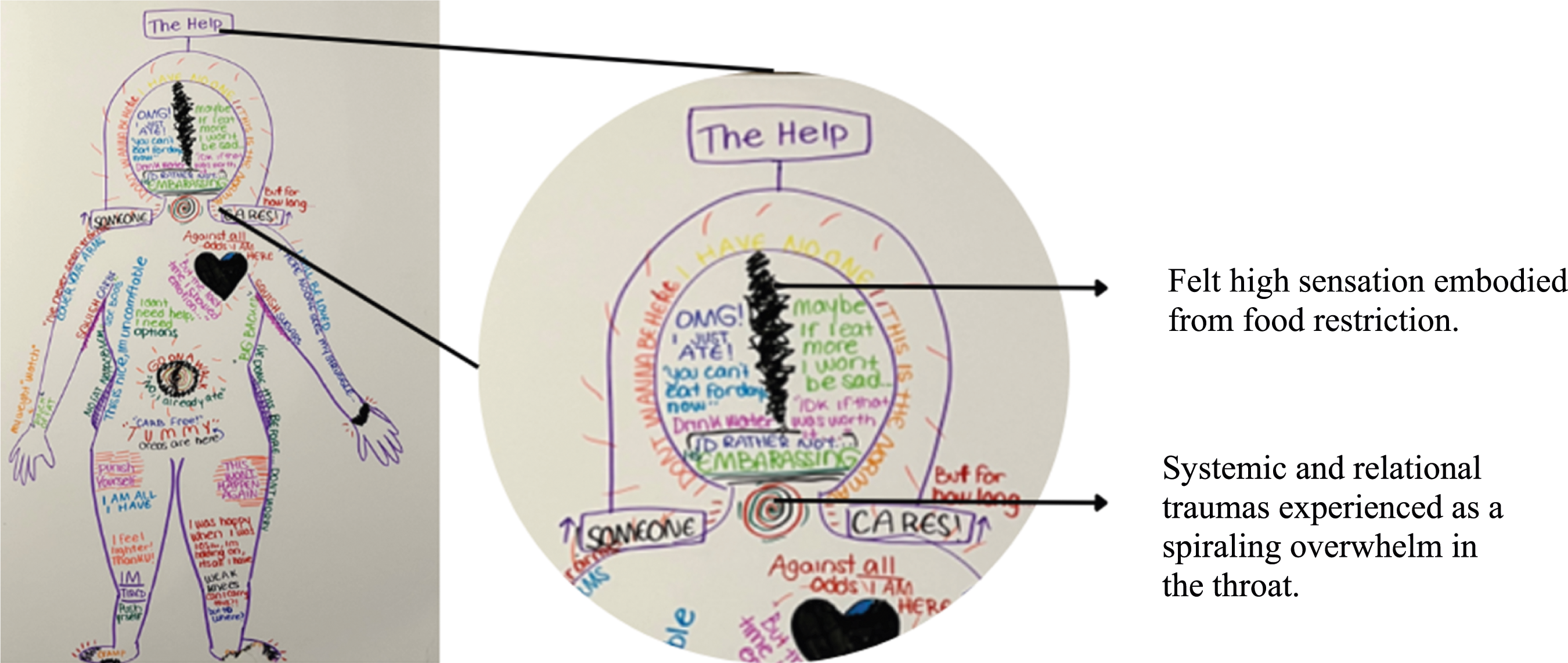
Machiavelli described a similar process of a visceral suffering mediated through his eating struggles of binge eating and purging. In Figure 2, Machiavelli visually expressed how he endured overlapping daily triggers that were felt ‘in my head’ with thoughts ‘racing’ as a tornado within. Many of these triggers were related to post-traumatic experiences of having lived in foster care and with racism, feeling ‘invalidated’ and ‘gaslighted’ in his life. As the ‘anxiety kicks in’ with these triggers, Machiavelli described, ‘I start eating and stuff, or eating more than I should’ and ‘if I have the money, like, I will spend it all on food just munching until I get tired and fall asleep’. To him, ‘the taste – it’s the sensory, like the food takes you out of your mind’. Eating as a sensory act, he explained, ‘balances’ out the visceral emotional triggers ‘because you feel the physical feeling of being full’. To him, eating became a ‘way of controlling something in my life’ including the inner tornado as visually depicted in his art, since ‘when you can’t control your life, you look for other ways to control’. Machiavelli: Gaining control of the inner tornado.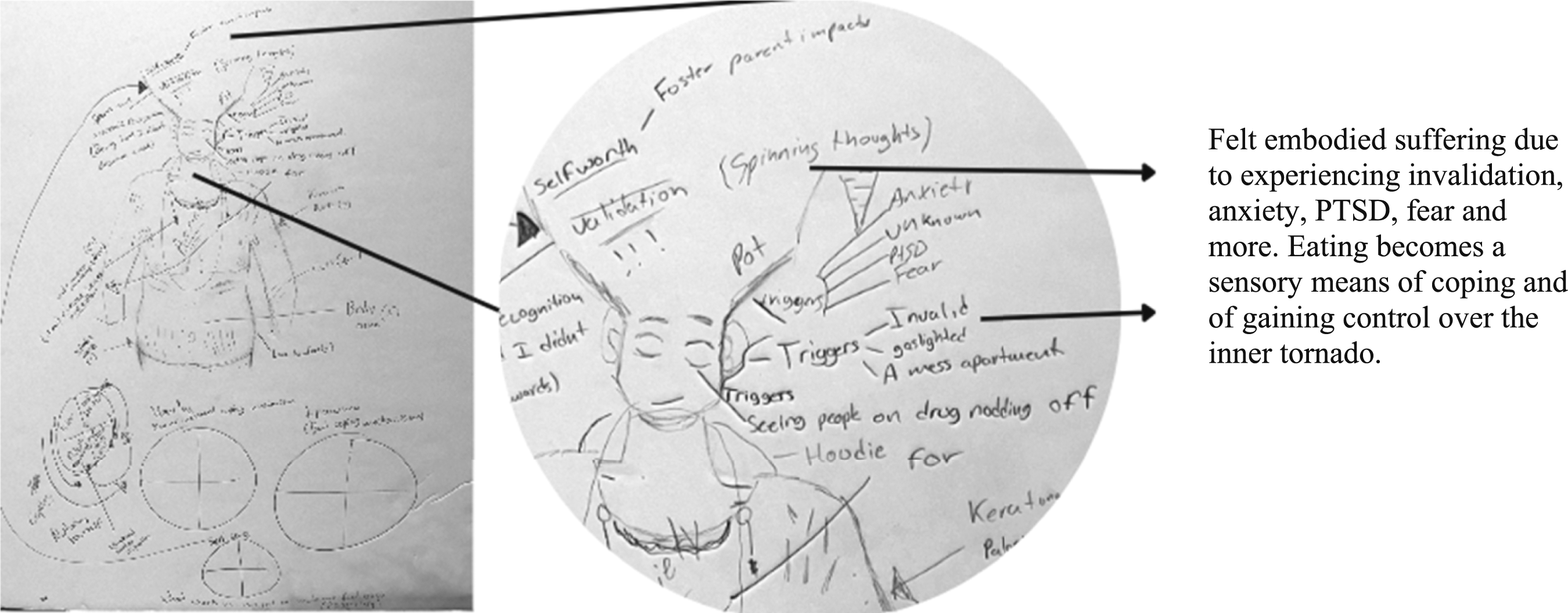
While the ‘high’ enabled a sense of control after consuming large amounts of food, he was, however, flooded with the felt sense of shame: ‘it’s like that high and then that drop’. This often resulted in purging, which again temporarily relieved feelings of shame that surfaced after eating, and yet was met with a paradoxical sense of feeling out of control, as he noted ‘a vicious cycle’. This was further validated by Jay’s own experience of the ‘paradox of control’: …it’s like control but then you don’t use control like, the decision to eat at all…Like something you actually want, rather than whatever the food bank gives you. Because it’s like, maybe I would have ate like 100 more meals if I had what I wanted at the time…So, that’s why sometimes I don’t eat and like when my life is like a mess, it’s like okay my body is all I have…Like, when you don’t have family, you don’t have a house, you just have yourself it’s like that’s all that like you can control…And then once I ate for like 3 days in a row…I would almost get like addicted and then I basically went on a binge…
Here, Jay articulated the complexity of her eating struggles as a paradoxical source of control. While attempting to control her eating through food restriction, she also faced severe food insecurity which limited her control to access food. She described how food insecurity compounded her eating struggles where this severe food deprivation led to binge eating. She described the feeling of her body being all that she had control over even if there were times that her body took over through binge eating due to extreme hunger. This meaning of bodily sensation was shared after having encrypted ‘I am all I have’ on to her body map as shown in Figure 3, a part enlarged from Figure 1. Jay: “My body is all I have”.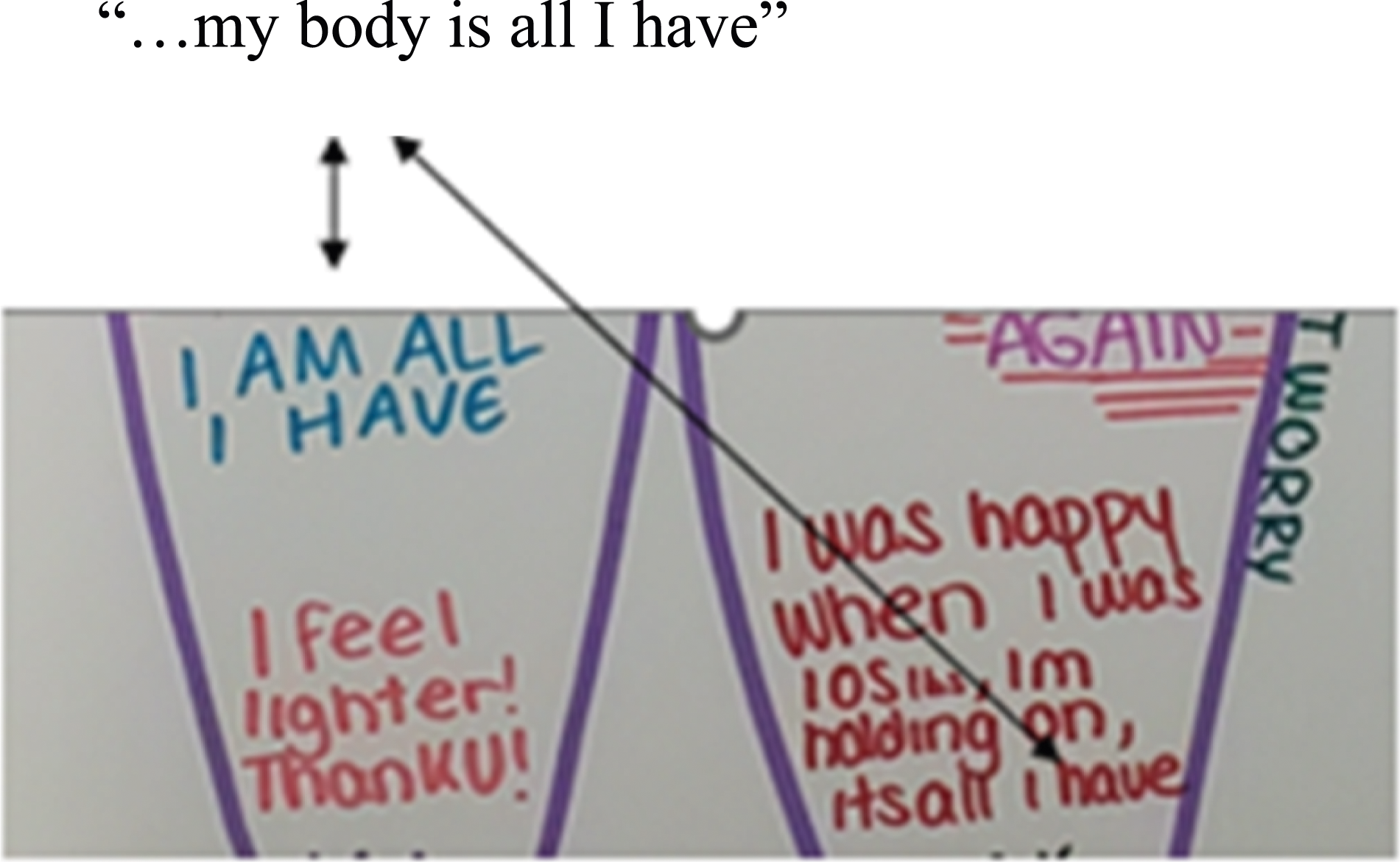
For Barbara, food restriction at one point in her life had also served as a form of somatic coping, both from the realities of food insecurity, and as a means of quieting challenging internalized body image-related thoughts such as the inherent racism interwoven within size-based discrimination: …it was the identity crisis of being mixed race and just wanting to be like the best version of myself and the media and society telling me that… that means I have to be as skinny as possible and like… look like a model.
Barbara also described how her eating struggles had served as a means of embodied/felt coping with deeper identity struggles, and how this ultimately led her to draw on other somatic methods of mindfulness body practice and art creation: I like creating a mindfulness practice for myself…guided meditations…and like creativity…one of the most recent things that I’ve discovered is body scanning, so literally going through every part of your body and just realizing like what is like cramping up and what is tense and there’s like different associations with like body parts versus like um emotions.
In Figure 4, Barbara described this means of coping further through her body map. She explained how using somatic body practices such as creating the body map, mindfulness, and the research site’s food access programs made it possible for her to find ‘inner peace’ from her eating struggles and body image concerns. This is indicated by the orange colour located within her mind and heart area. She described how these practices fostered ‘self-awareness’ (also represented by the colour orange), which enabled her to make sense of her living conditions in ways that were meaningful. Barbara: Somatic practices including art as a means of cultivating self awareness and inner peace.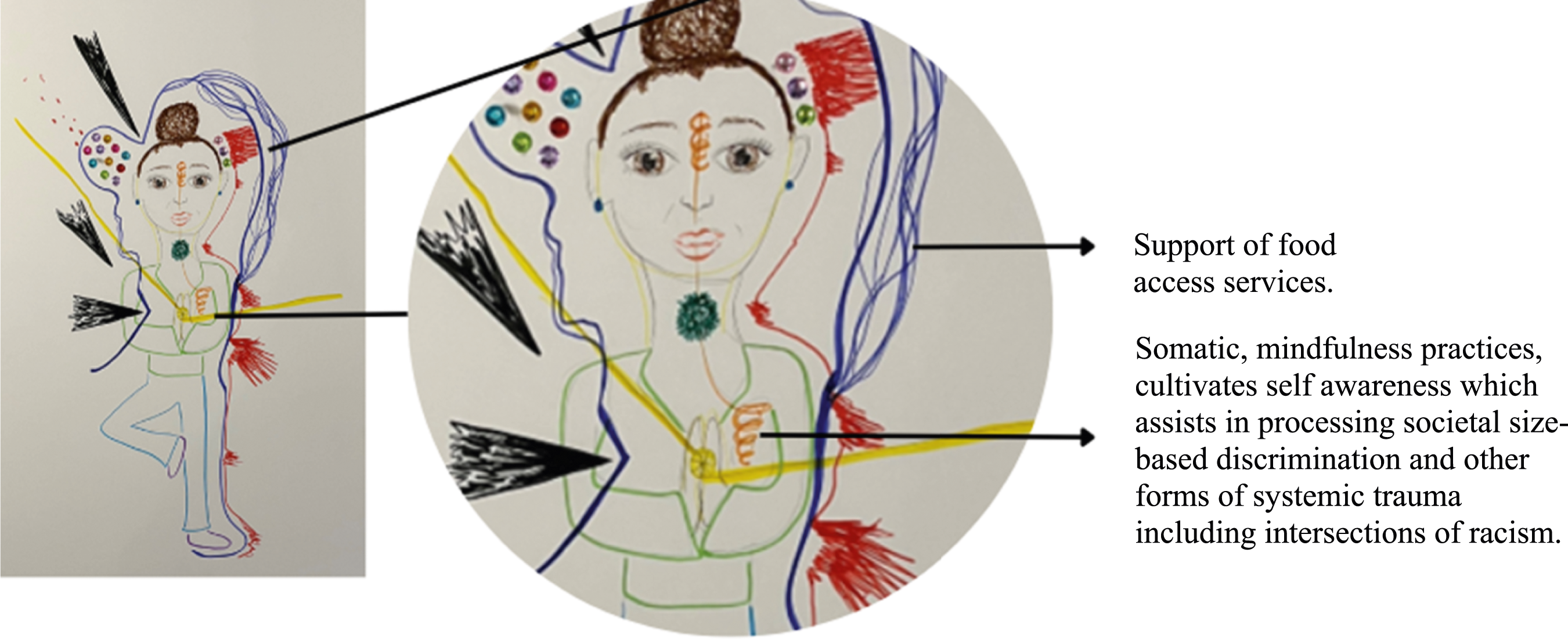
Overall, the body mapping interview enabled the participants to articulate complex experiences of relational (e.g. family estrangement) and systemic forms of trauma (e.g. racism and food insecurity), revealing important information of how these experiences underlined their challenging relationship with food and body.
Body mapping: Enhancing self-awareness and transformative experiences
All participants expressed positive and transformative benefits of body mapping. For example, for Machiavelli, mapping out his experiences through art ‘pieced together a lot of what I didn’t understand about myself’. He noted ‘I didn’t even realize that until now’ while sharing about his body map and exploring the meaning behind his artwork. He also described body mapping as ‘transformative’ as he was ‘looking at this [body map], being able to draw all this and not hate myself for it’.
Upon the completion of the artwork, Jay felt surprised that creating the body map ‘wasn’t hard for’ her and found it as an effective way to express and explore how eating struggles were felt throughout her body noting ‘I got more into it than I thought’. This experience and reviewing her body map also opened her awareness to the realization of how the chronic pain of her eating struggle was felt. She became aware of how repetitive her eating struggle and body image-related negative thoughts were and how cyclical they had become: …this made me realize like, I think the same things all the time. Like when writing this, I’m like, wait I literally think about this every day. This goes on in my head every day. Every single day.
Jay then expressed how she was able to feel a greater sense of compassion and empathy for herself as she felt more deeply aware of how all-consuming her eating struggles and body image concerns were while trying to survive homelessness. After the body mapping experience, she expressed interest in potentially seeking support and requested resources, which were provided during her third follow-up interview. Asking for resources, she noted, was transformative toward positive changes and she attributed it to participating in the artwork.
Having a similar transformative experience, Barbara suggested that research was ‘best like paired with creativity workshops’. She noted that ‘creativity and self-esteem I find are very interrelated’ to engaging in body mapping, particularly for individuals with eating struggles,
Body mapping: A trauma-informed approach fostering choice and validation
Barbara highlighted the importance of using art in working with SIHY: … I think a big part of it might be not eating enough and not having like optimal brain functions might make it hard to communicate like in just like a discussion sense, so it might be best to just start off with like drawings like drawing a picture or like writing something can really help, cause like the emotional barrier I feel like is also there with um food insecurity…Like not really being able to find the words to say what you’re going through or not like feeling comfortable or like not…understanding like what the consequences might be like maybe they don’t feel safe, like sharing like their situation per say. So different activities might help to break that barrier of like just tell me like how you’re feeling without like exhausting yourself with like looking for the right words…
Here, Barbara articulated important insights of how arts-based approaches became trauma-informed: For those who have eating struggles and/or facing food insecurity, answering complex questions verbally could be incredibly challenging due to the impact of food deprivation on cognition and energy. In fact, research shows that regardless of food deprivation, individuals with eating disorders tend to struggle with verbal self-expression (Prijatna et al., 2021). Creating art may bypass these verbal barriers and enable individuals to connect and develop bio-psychological and emotional responses. For Barbara, creating the body map was a more safe and accessible means of expressing difficult and emotional subject matters.
Machiavelli also discussed the importance of compassion and validation for SIHY. While drawing his body map, he expressed it was integral to demonstrate understanding through empathic and intentional listening followed by compassionate responses: …you’re the first person I’ve wanted to talk to about it [eating struggles] because like you listen for understanding, whereas a lot of people are like, ‘aha, I’ve figured it out’ when it’s not like that…And that goes back to validation, because like yeah, you would validate how I felt…I’m just going to put that here, because yeah, that’s huge…And like, hearing it back, like I appreciate, because most studies, they don’t tell you like what they took, but like hearing it back, it’s like, it all still validates.
In Figure 5, Machiavelli placed the word ‘validation!!!’ within the spinning tornado. He described how experiencing validation from others was felt somatically in ways that eased stress, anxiety, and symptoms of post-traumatic stress disorder (PTSD). He also expressed how binge eating provided a similar sensation: like a felt ‘hug’ of validation in an absence of a real hug in his life. This finding provides important insight into the power of art as a compassionate and validating process and ultimately, as a trauma-informed approach when working with individuals who have eating struggles. Machiavelli: The somatic relief of receiving compassion and validation.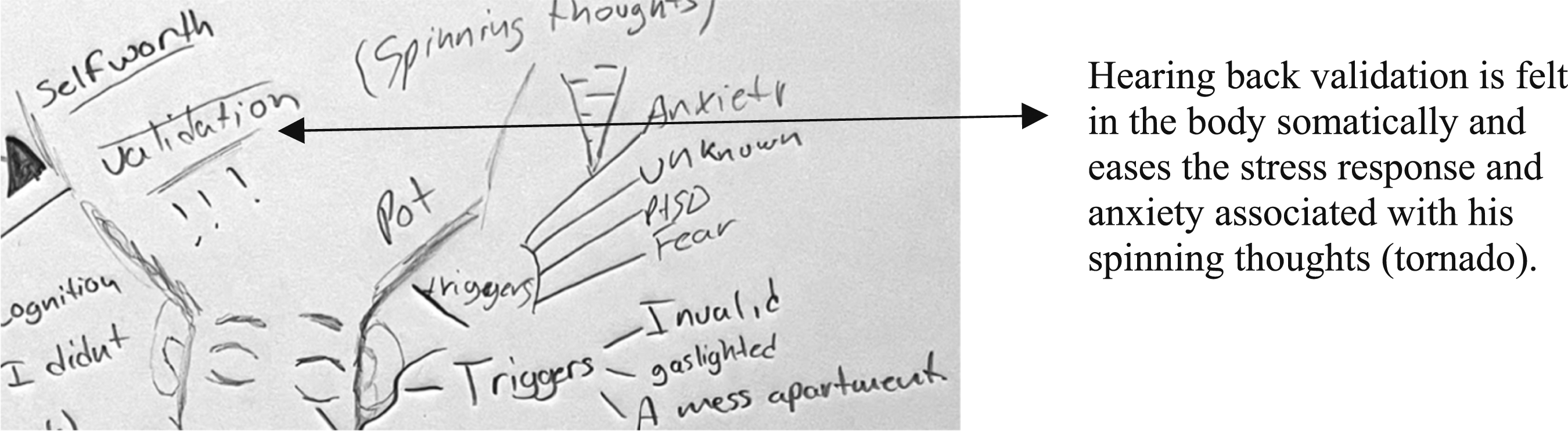
All participants also expressed their appreciation for how the process by which the body mapping interview was conducted. For instance, during the first interview, the participants described the trauma of being unable to access ‘choice’ (e.g. choice of housing, choice of food, and choice of resources). Therefore, to avoid reifying the experience of being limited in options, the body mapping interview began by inviting the participants to bring along anything that would help them to feel safe creating art (e.g. such as playing music, providing choices of food/beverages while creating arts, and having guided prompts). Moreover, various options of art materials were provided to choose from such as paints, markers, crayons, stickers, glue sticks, different sized papers, and more. These considerations appeared important for establishing comfortability and safety. For instance, the participants expressed how being able to play their music of choice in the background, helped them to feel grounded and less concentrated on the researcher’s observation. The participants often chose music that mirrored the emotions they were trying to represent in their art and had assisted them in their process of imaginative and creative expression.
Other important considerations were made during the preparation of the body mapping interview. For instance, the researcher ensured that participants were routinely checked in with, providing the option to take a break, to eat or have a drink, or to simply leave the room if needed. This encouragement stood out for Jay, experiencing eating struggles. As Jay states: So, just that like nice, ‘hey, are you hungry?’, or like, ‘do you want something to eat?’ like, never mind it being about food – just that niceness already makes you feel good. Like makes you feel like, ‘yeah, I want to eat’ like, you know? Yeah, like it already just puts you in a good mood. It like distracts you. Like, just like niceness, or just someone being there.
Here, Jay expresses the importance of compassionate engagement – that is, cultivating an environment where participants who are engaging in arts-based activities could sense the support by checking in with their needs with compassion, kindness, and empathy.
Discussion
The discovery of true meaning in IPA is recognized as never finished but rather as a boundless process. Therefore, our understanding presented in the findings is temporal, partial, and never truly complete. Nonetheless, this study elaborates the use of body mapping as a trauma-informed approach with marginalized population like SIHY as follows. First, the somatic act of creating the body maps enabled the participants to deeply process the complex somatic and embodied experiences of food insecurity, poverty, homelessness, and eating struggles. Scholars argue that trauma and other challenging experiences are internalized non-verbally and thus recollection is often through sensory, visual, kinaesthetic, and affective experiences (Loumeau-May, 2019). According to Gantt and Tinnin (2009), art-based approaches are underscored to help bring structure to traumatic experiences by creating connections to nonverbal embodied memories that are then processed and arranged in meaningful ways. In a study conducted by Lys et al. (2018), the authors explored the effectiveness of body mapping in processing complex subject matter such as sexual health among youth. Their study revealed that body mapping supported participants’ capacity to engage in introspection and to process complex thoughts, experiences, and emotions particularly when exploring vulnerable topics. Similarly, in the current study, the participants underlined that body mapping assisted them in making important untapped connections and increased understanding of the eating struggles in relation to their living conditions.
Second, the participants noted that their art provided as an accessible means of communicating their interpretations of the lived experiences of eating struggles: knowledge that might otherwise have been challenging to articulate verbally through traditional interviewing. Body mapping has become greatly recognized as a supportive approach to translating complex phenomena with marginalized populations. For example, in a recent study involving SIHY, Schwan et al. (2018) demonstrated how body mapping was especially effective for marginalized youth in communicating experiences that were difficult to express in words.
Third, body mapping captured knowledge surrounding how eating struggles develop as a response and adaptation to the systemic and relational traumas that SIHY have endured both in their past and continue to face on a daily basis due to their living conditions of homelessness and poverty. There is a growing body of literature that identifies the connection between food insecurity and eating disorders (e.g. Becker et al., 2019) and how individuals often cope with trauma through embodied ways (e.g. through eating struggles and/or substances: Burstow, 2003). However, the current study is the first one to explore and reveal homelessness, poverty, and food insecurity as traumas that underly the eating struggles among this specific population of SIHY.
Fourth, encrypted on and through the body, the participants’ traumatic experiences including homelessness, food restriction, body discrimination, and subsequent eating struggles such as binge-eating and/or purging were described as ‘felt’ in sensory ways, namely, as a ‘high’ sensation. Eating struggles, therefore, were conceptualized as a somatic means of coping, despite the suffering caused by eating struggles itself. These findings are consistent with Thompson’s (1996) study, which sought to understand the underlying causes of eating struggles among diverse and marginalized women. Her findings suggested that marginalized women internalize, embody, and cope with the oppressive social conditions and the trauma they are exposed to through eating struggles due to the sensory relief and release that it elicits. Also, the cyclical nature of trauma to eating struggles was further mapped out throughout the body mapping and is represented in another study by Luongo (2018) on the lived experiences of SIHY who have eating struggles and substance misuse issues. The participants highlighted the imperative need for a greater understanding of the supports needed particularly for SIHY who endured the intersections of food insecurity and eating struggles.
Lastly, body mapping was described as beneficial and ultimately transformative. The act of creating involves movement and thus in itself is a somatic and sensory form of experiential healing. Through colours, visuals, textures, and more, these youth experienced a felt shift in their self-awareness, perception of their self, and of their struggles overall. This often prompted them to describe why they engaged in particular eating struggles (such as binge eating, purging, and food restriction), the somatic impact of the trauma they endured, and how their eating struggles negotiated with this felt pain: concepts otherwise challenging to tap into if inquired by only face-to-face interviews. This finding is corroborated in Schwan et al.’s (2018) study, as creating art was described as healing, assisting participants in discovering their sense of self, as well as deepening their capacity to nurture themselves.
In terms of the research implication for clinical social work practice and community-oriented practice, we attest that implementing art-based groups and supports is an effective trauma-informed approach to support SIHY and to help them make sense of their experiences of trauma and their responses such as eating struggles. In working with hard-to-reach populations like SIHY who may have developed a mistrust with service providers and agencies, providing different, compassionate, and respectful ways of engaging and collaborating with them through creating arts may further enhance the therapeutic alliance.
During the body mapping instruction, we did not limit how the participants created their art in terms of any expectations and outputs but invited them to take a moment to reflect and be validated about their experiences. This led to reveal how their embodied suffering of eating struggles and body image distress were rooted in multiple sources of pain from relational to systemic forms of trauma and oppression. As illustrated in the findings, this process allowed for the researchers to gain a deeper understanding and acknowledgement of the complexities of SIHY’s eating struggles and their sources. Similarly, we argue that body mapping – a participant-driven and action-oriented approach – can be used as a clinical and community engagement tool to assess and intervene eating struggles and healing.
Footnotes
Declaration of conflicting interests
The author(s) declared no potential conflicts of interest with respect to the research, authorship, and/or publication of this article.
Funding
The author(s) received no financial support for the research, authorship, and/or publication of this article.
