




Abstract
Background
Building friendship is crucial for attaining and upholding recovery from problematic substance use. However, how people who have used substances problematically develop friendships needs to be investigated more from a first-person perspective.
Aim
To provide insight into how people in long-term recovery find meaning in their experience of building friendships.
Method
In semi-structured interviews, 17 people in recovery drew network maps and reflected on how friendships had developed during the long-term process. We analysed the narratives by way of a thematic narrative approach.
Results
Participants presented the friendship-formation process through four distinct storylines: (1) ‘I don’t make friends easily’; (2) overcoming barriers to building friendships; (3) ‘birds of a feather flock together’; and (4) ‘having “regular” friends makes me feel like an “average” person’.
Conclusion
People in long-term recovery from problematic substance use felt haunted and hindered by past experiences when building friendships. These experiences created a social divide between those who had experienced problematic substance use and those who had not. The valuable insights that social workers can gain from this study can support friendship development for people in long-term recovery on multiple levels. By understanding someone’s self-perceptions and their perspectives on others, social workers can engage with barriers when people in recovery enter social environments such as work. We emphasise the significance of a long-term approach to overcoming barriers to building new friendships.
Introduction
Building friendships is crucial for attaining and upholding recovery from problematic substance use (Pettersen et al., 2019; Veseth et al., 2019; Vigdal et al., 2023). Building relationships, expanding social roles, and gaining a sense of belonging to a broader community are key to long-term recovery (LTR) (De Ruysscher et al., 2017).
The concept of LTR (Alastair et al., 2022) recognises that transitioning from a life dominated by problematic substance use often requires significant social changes (Best et al., 2016; De Ruysscher et al., 2017; Vigdal et al., 2022). Recovery capital, an established concept within recovery research, refers to ‘resources and capacities that enable growth and human flourishing’ (Best and Hennessy, 2022: 1140). The inter-individual level is central to the recovery capital theory, with the domain of social capital being key to overcoming alcohol and drug problems. Social capital ‘relates to all the instrumental and expressive social capital accessible to the recovering individual through their relationships and social networks’ (Bunaciu et al., 2023: 1).
To achieve and sustain recovery, people in LTR often distance themselves from friends who engage in substance use, instead often seeking out social communities consisting of others in recovery (Abram and Jane, 2020; Best et al., 2016; Bjornestad et al., 2019). Building positive social connections and friendships with people who do not struggle with substance use can help transform one’s life and identity during recovery (Best et al., 2015, 2016).
Access to employment opportunities (Harrison et al., 2020; Vigdal et al., 2023) and peer groups is essential to help individuals form new friendships (Vigdal et al., 2022). Friends and a supportive network are crucial to have emotional, practical, and social support and a companion for leisure activities during recovery (Veseth et al., 2019). However, several challenges have been identified in building friendships and belonging as part of the recovery process. Parker et al. (2019) observed that people in recovery face challenges in managing relationships and building new support networks. Individuals in LTR face numerous difficult transitions, including changing daily routines. These challenges include entering new social communities, building new relationships, and determining where to live (Best et al., 2015; Vigdal et al., 2023).
Understanding how friendships develop for those in LTR is crucial. Negative perceptions, low self-esteem, and limited social opportunities can impede progress. To better understand, a first-person perspective is needed (Bjornestad et al., 2020). This study offers a narrative analysis of 17 participants’ experience of making friends during LTR and seeks insight into key processes. Our research explores the following question: how do people in LTR find meaning in their experience of building new friendships?
Material and methods
Design
We employed a qualitative methodology – a thematic narrative approach (Riessman, 2008) – to investigate participants’ experiences of how friendships developed during the LTR process. Our approach is based on the understanding that storytelling – how the speaker selects, organises, connects, and evaluates events – is a fundamental tool for making sense of experience (Riessman, 2008). Since storytelling has many effects – creation of group belonging, projection of possible futures, mobilisation of action, and building of identity – the study of stories provides insights into a crucial social actor (Frank, 2010; Riessman, 2008). Furthermore, storytelling shapes and is shaped by socio-cultural context and differs in time and space. By examining storytelling, the analysis can provide insight into the storytellers’ socio-cultural contexts and how these influence their meaning-making. Using Riessman (2008) framework for thematic narrative analysis, we explored participants’ stories of building new friendships during recovery. This thematic narrative analysis focuses primarily on story content: what participants say about building new friendships. We identified and examined detailed stories obtained through individual interviews (Riessman, 2008) and network mapping (Fyrand, 2016). A key area of narrative studies concerns human interactions in everyday life (Riessman and Quinney, 2005).
Ethics
The study was approved by the Regional Ethics Committee in Norway (ref. 131212) and evaluated by the Norwegian Centre for Research Data (ref. 804223). The first author had no relationship with the study participants before the interviews. At the beginning of each interview, the relevant participant signed a consent form and received a gift card (NOK 400). An experienced secretary transcribed the audio recordings of the interviews verbatim. Ethical considerations were taken into account throughout the recruitment, interview, analysis, and data interpretation process. All authors have years of experience working with individuals with problematic substance use or with individuals in LTR.
Sample and recruitment
Characteristics of interviewed participants.
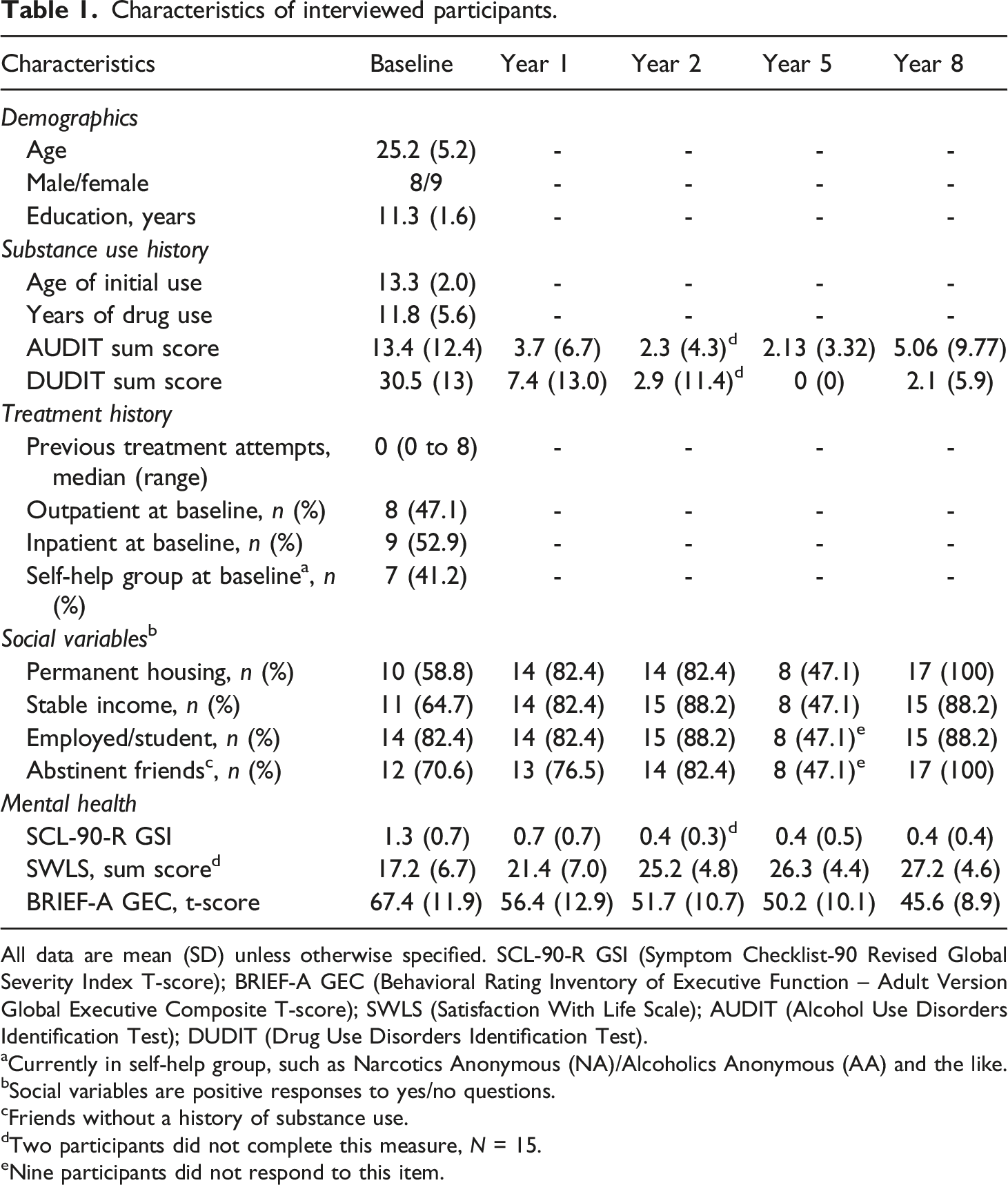
All data are mean (SD) unless otherwise specified. SCL-90-R GSI (Symptom Checklist-90 Revised Global Severity Index T-score); BRIEF-A GEC (Behavioral Rating Inventory of Executive Function – Adult Version Global Executive Composite T-score); SWLS (Satisfaction With Life Scale); AUDIT (Alcohol Use Disorders Identification Test); DUDIT (Drug Use Disorders Identification Test).
aCurrently in self-help group, such as Narcotics Anonymous (NA)/Alcoholics Anonymous (AA) and the like.
bSocial variables are positive responses to yes/no questions.
cFriends without a history of substance use.
dTwo participants did not complete this measure, N = 15.
eNine participants did not respond to this item.
The second author (TSS) contacted 26 participants from the STAYER cohort who met the criteria, provided them with verbal information about the study, and requested permission to obtain their telephone numbers from the first author (MIV). After obtaining consent, MIV contacted all 26 participants interested in participating in the study, of whom 5 did not respond, 3 expressed concerns about participation due to their educational or work commitments, and 1 declined without explanation. Eventually, our study obtained a sample of 17 individuals. At the time of the interview, study participants were either students or employed individuals who performed daily tasks related to parental responsibilities, social interactions with peers, hobbies, and sports activities. Substance use was measured upon participants’ admittance into the Stayer study. The mapping showed harmful consumption of alcohol in 10 out of the 17 and a level indicative of high risk of drug-use-related problems in 16. Of the 17 participants, 3 said they had used hashish, cocaine, or benzodiazepines at social gatherings during 2021.
Measures
In the interview, we invited participants to draw a person-centred map with the interviewer. Person-centred maps can show structural elements and quantifiable qualities, such as number of relationships and types of relationships (Fyrand, 2016). This map helped visually present the network and provided a basis for discussing their experiences and developing various relationships. The map was consisted of five zones: family in the same household, other family members, colleagues, professionals, and friends. Some referred to colleagues and partners as new friendships that developed during recovery. See Table 2 in Vigdal et al. (2023) for details of the size and composition of groups of friends in person-centred social networks.
Procedure
We developed an interview guide with an expert by experience employed at the Centre for Alcohol and Drug Research at Stavanger University Hospital, which led to new follow-up questions being included in the interview guide. In the semi-structured interviews, we focused on establishing a safe space to encourage participants to share their friendship-building experiences. We approached the interviews as a relational practice between interviewer and interviewee, inspired by Hydén’s (2014) teller-focused approach, which supports and facilitates narratives (Hydén, 2014). Participants were invited to discuss their experience of building friendships based on the following question: Can you please share your experience of building a new friendship with me? MIV then used follow-up questions to invite elaboration on meaning-making and concretisation in the friendship-building story.
All interviews were conducted between August 2020 and December 2021 by MIV and lasted an average of 45 minutes (37 to 120 minutes). Seven interviews were conducted face to face and ten were conducted digitally on Teams or Zoom due to the COVID-19 epidemic.
Analysis
Storylines were employed as an analytic tool in the analysis. Bruce et al. (2016: 3) define storylines as ‘a dominant thread running through several narratives’. We followed this definition of storylines when exploring the dominant themes running through multiple participants’ narratives. Another analytic tool used is positioning, referring to how individuals dynamically situate themselves and others through the words, images, and metaphors they choose for their stories (Davies and Harré, 1990). We used these analytic tools to explore the dominant themes in the interviews, the positions produced in discussion, and, thus, how rights, duties, similarities, and differences were created.
The steps were as follows: (i) MIV acquainted herself with the data by carefully reading the transcribed interviews and forming an overall impression of participants’ experiences of making new friendships and noting potential themes, such as ambivalence about making friendships; (ii) MIV identified stories in the material about building friendships and sorted these according to similarities and differences in what they presented as central friendship-building themes; (iii) MIV and the fifth author (LBS) used storylines and positions as analytic tools to identify themes running through the stories and explore the positions the stories constructed; and (iv) all authors contributed to interpreting how participants positioned themselves and investigating the storylines in the narratives. When presenting the results, we provided participants with pseudonyms. Quotes in the results section have been translated from Norwegian to English.
Results
Participants positioned themselves variously during the interviews, and their stories about building new friendships offered different storylines. All participants offered stories about needing to distance themselves from friends who struggled with substance use in order to manage their recovery process. A core element of all stories told by participants included a break-up with friends who still lived a life of problematic substance use. Some participants said they ended friendships by informing friends that they had stopped using substances and could no longer have contact with them. Some said they had moved to new geographic areas to ensure distance from old friends with substance-use challenges. Due to this process of ending old friendships, most described a situation where they had few friends and building new friendships was central. Analysis of how they discussed building new friendships identified four predominant storylines recurring in the interview material: (1) ‘I don’t make friends easily’; (2) overcoming barriers to building friendships; (), ‘birds of a feather flock together’; and (4) ‘having “regular” friends make me feel like an “average” person’. All participants narrated stories about making friends that aligned with one or more of these storylines. The number of participants sharing similar stories about building friendships is specified for each type of storyline.
‘I don’t make friends easily’
The ‘I don’t make friends easily’ storyline depicts difficulties making friends as described by all participants, who indicated that their history of substance use created different barriers. All participants discussed various obstacles to building friendships, including stigma, shame, trauma, adapting to new social situations, and handling social drinking situations. The difficulties they presented are linked to their own characteristics and vulnerabilities or their history of problematic substance use. Participants said that they struggled with negative thoughts and emotions from past experiences, which caused them to distance themselves from others socially.
Some participants said lack of knowledge about politics and society was a barrier to connecting and building friendships. Anne (in recovery for nearly ten years) described the barriers she faced when contacting new people: What is difficult is that you feel like you are entirely different. It’s not a hole, but it was a crater (a knowledge gap) for me. When you were last in the world as a part of life, and until you re-enter it. You jumped out when you were 16 and returned when you were 32. After all, you get questions about what you’ve worked with in the past, so you feel embarrassed about yourself, don’t have much to contribute, and are ashamed and afraid to say certain things and be labelled. You don’t have much to contribute. The others know what has happened in history and politics and you come in (into the world/society) and feel you know very little.
In her storytelling, her lack of knowledge about what has happened in history and politics is an important barrier to building friendships. In the story, she positions herself as someone who jumped out of life and the world when she was 16 and re-entered life when she was 32. As a result, she positions herself as utterly different from others, with a crater (knowledge gap). She felt embarrassed and ashamed about her limited understanding, fearing judgement and labelling. In her story, a distinction is created between her and those who have not used drugs. Others are positioned as knowing what has happened in history and politics. Consequently, she feels ignorant and completely different.
In the interviews, 11 participants described their reservations about making new friends. Some discussed personal limitations and concerns about friends possibly expecting more than they could provide. Some participants emphasised the importance of having alone time, while others found fulfilment in work relationships and spending time with their families after work. Some talked about making friends more as coincidence than deliberate effort, presenting their friendships as being the result not of their actions but of luck or the persistence of friends who actively pursued them. Additionally, many participants reported feeling drained after social gatherings. For instance, Kari (nine years in recovery) discussed feeling exhausted in social situations: I feel it physically when there are too many people around me. My social battery. Poof!! Almost without warning, the social battery becomes empty. It physically hurts in my head. I’ve tried to practise enduring social situations, but it reaches a limit, and then I must escape the situation. I need to take a break, go for a walk or something.
Here, Kari describes herself as having a small social battery that runs out without warning. Due to these limitations, she portrays herself as having limited social capacity even though she has practised. Kari’s social battery runs out quickly when many people surround her. This story places people as a source of physical pain, causing discomfort in Kari’s mind. As a result, she describes feeling a limited ability to build friendships and must escape from social situations and take breaks. Kari shared how she formed a friendship with her partner despite her limited social battery: I have always felt like I was on the outside (of the community) and very lonely to be who I am. Knowing what is self-chosen and what I cannot tolerate is still challenging. Because many have tried to form a friendship with me, but I have kept my distance. It was a coincidence that we met each other. We met in a digital discussion group. Then I noticed how he responded to comments from others. There was something about his care for others, and I thought he was a very good man. We started to talk about more personal subjects together. After a few months, he invited me to visit, and I came to visit several times before we decided that it would become something permanent. I am confident in myself and recognise that he is, too, which allows us to tolerate each other.
In her storytelling, she depicts herself as having always felt she is on the outside and lonely and disconnected from others. However, she is not entirely sure if this is self-chosen due to her own choices. She portrays herself as someone hard to form friendships with because she prefers to keep a distance. She describes the meeting with her partner as a coincidence. Kari strengthened her connection with him by discussing more personal subjects and portraying his caring nature. Kari describes herself and her partner as confident in themselves, which allows them to tolerate each other, understood as acceptance of having small social batteries.
The storyline “I don’t make friends easily” reveals several barriers that participants experienced in building friendships and how participants link the barriers to their own personal characteristics and vulnerabilities. Connecting these barriers to personal characteristics positions the participants as outsiders and as people with limitations. Linking good experiences with luck and coincidence enhances the storyline and shows the process of making friendships as involving many difficulties that the participants are positioned as having little agency to overcome. The stories appear to be influenced by a social and cultural context where stigma and exclusion are associated with a history of problematic substance use.
Overcoming barriers to building friendships
The second storyline, ‘overcoming barriers to building friendships’, shows how 16 participants discussed overcoming certain difficulties in forming friendships. These stories address how engagement with peer groups, employment, and the acquisition of communication skills facilitated friendship-building. In order to show more of the change history, we present elements of Per’s stories. Per (in recovery for nine years) discussed challenges of forming friendships and says he encountered social barriers during his recovery process but found ways to overcome them. He related a change story where he presents himself as someone who developed greater skills and vigour in recovery. Speaking about the first part of his recovery process, he outlined the difficulties he experienced and the distance he perceived between himself and those who had not experienced substance-use difficulties. Per obtained communication skills training to address his thoughts and feelings during substance-use treatment. He said: You sit and talk about thoughts and feelings. You’re a man; you shouldn’t talk about that. You live in a completely different society when you are using substances. You must not show weakness! Opening up and talking about the thoughts and feelings inside. It feels naked. It is not expected in the environment out there.
In his storytelling, he positions himself as someone who needed skills training to talk about his thoughts and feelings to overcome barriers to building friendships. He describes himself as coming from a completely different society, where you must not show weakness. Interaction with people without experience of using substances is shown as being in a completely different environment, where you must be different and talk about thoughts and feelings. These different expectations make him portray himself as feeling naked.
Later in the story, Per says that experiences and learning in the therapeutic group processes gave him the confidence and skills to connect with new people. He illustrates this self-development with a story from his first days at university: In a way, I knew what kind of gender there would be most of in this bachelor’s study. There was a large auditorium so that you can imagine: down here is the lecturer, and it was almost filled with women, and then I see in the middle of all that chaos there – a person is sitting all alone by himself – a male. I went towards him. I noticed that all the others saw. Then it was like when you think of a predator. You see an easy target, and it is. I saw an easy opportunity! I said to myself: Walk over and talk to him then. Then I immediately said: “Hi, my name is XX.” And it was that simple. I just sat down and spoke with him. Then I was assigned to a student group, and he was assigned to another student group. We exchanged numbers and Facebook accounts and all that. So, ever since the first orientation day, he and I have had a friendship.
In the story, Per portrays himself as someone with more agency; he saw a fellow male student and went towards him. Per spoke of the fellow male student as an easy target: he saw an easy opportunity and said to himself, walk over to him and talk to him. Per positioned himself as a predator in this story of friendship-building. By positioning himself as a predator, the story indicates that he had a certain amount of confidence and was in a position where he had agency to build friendships.
As exemplified by Pers’ story, the storyline ‘Overcoming barriers to building friendships’ shows how the learning and new experiences acquired during recovery are perceived as equipping them better to build friendships. Per’s story shows how he connects his communication and relational skills training, along with support from peers and therapists, to how he overcame obstacles to developing friendships. The change story he presented was linked to his learning to communicate in ways suitable for his new environment, a development he associates with greater opportunity and agency in the friendship-building process.
‘Birds of a feather flock together’
The third storyline, ‘birds of a feather flock together’, includes 15 participants relating how they built friendships with people they found they had something in common with due to substance use. In this storyline, participants highlighted the importance of forming friendships with those who had experienced similar struggles. The participants emphasised how valuable it was to have friends with whom they could share experiences and feelings. They also said it was difficult to make friends outside of their peer community. The analysis identified two variants of this storyline.
In one variant, participants wanted friends who had faced prior substance-use challenges. In these stories, participants indicated these friendships developed primarily when they joined treatment or peer groups. Nils, a nine-year recovery participant, said he had developed many friendships in peer groups. He positioned himself as preferring to have only friends in recovery and explained his wish not to have friends without experience of substance-use challenges as follows: I’m not sure, they seem boring to me. But maybe they’re not boring. I just can’t put my finger on it. You know what they say: similar children play best together. It’s been a tough journey, but I’ve fought hard to change my personality positively. This work is fascinating, and there’s often a lot of depth to it. Maybe it’s my fear, but I worry that our relationship might be boring if we don’t have enough in common.
In his storytelling, he positions people without a history of substance-use challenges as possibly boring and fears they don’t have enough in common. Having something in common is linked to having a shared history of substance use and having been on a challenging journey. In the extract, he refers to a well-known saying, similar children play best together, to support his point. In his story, he portrays himself as a hardworking individual striving for positive change, which sets him apart from those not engaged in self-improvement.
In another version of this storyline, participants spoke about reconnecting with friends – and social arenas – among whom illicit drug use is commonly accepted and who are positioned as hobby users or recreational drug users. They sought such friendships and arenas because they had experience of feeling safer and more comfortable with these people. Tone, (almost nine years in recovery) explained that she had used illegal drugs at some social gatherings during her recovery but had now stopped. She positioned herself as having difficulty building friendships with people who had never faced substance-use challenges. In contrast, she positioned friends who still used illicit drugs as providing her with a sense of security, which she explains as follows: I grew up where people were using substances from the time I was 14. It isn’t easy to let them go. They have been my entire network since I was little. They know what you’re thinking. I don’t have to explain it to them. They don’t get mad at me when it comes to substance use because they understand.
In her storytelling, she presents herself as someone who grew up where people were using substances from the time she was 14, illustrating this by positioning people who use illicit drugs as those she can feel comfortable with because they understand her, they do not get mad at her when she uses drugs, and she doesn’t have to explain it to them. Anita (also nine years in recovery) elaborated on her choice of friends who still use illicit drugs as follows: I stayed away from people who use drugs for all these years until last summer. Since then, I’ve been with people using drugs; I call them hobby users because they use drugs at weekends but not during the week. After all, they’re at work. Many hobby users are on the same level as me, but none makes me feel behind. None of these relationships makes me feel inferior. They haven’t settled down yet, so I can relate to that versus those (friends) who have a partner they live with and kids and do not want to go out. Many of those in the group of friends without substance (challenges) are ahead of me.
Anita portrays herself as someone who has tried to stay away from, and has avoided associating with, people who use illegal drugs for years. However, she has formed new friendships over the past year with people who use illicit drugs. Anita justifies that choice by explaining that these friends are on the same level as her and do not make her feel behind or inferior. They are contrasted with others who have a cohabitant and kids, do not want to go out, and are ahead of me.
A theme running through the ‘birds of a feather flock together’ storyline is participants building friendships with people they feel have a similar experience of substance use. This choice is explained in terms of this similarity being central to feeling understood and secure. Their emphasis on the similarity of substance use, as demonstrated in this storyline, provides insight into a meaning-making process that seems to influence future actions and justify choices made when building friendships.
‘Having “regular” friends make me feel like an “average” person’
The storyline ‘having “regular” friends make me feel like an “average” person’ includes stories about the value of friendships with people who have not experienced substance-use problems. The analysis shows that eight participants told a variant of this storyline, where forming new friendships with individuals without a history of problematic substance use could support the process of developing a new social identity. Kristin (nine years in recovery) explains her decision to build friendships with those who had never struggled with substance use as follows: I wanted to be normal. I didn’t want to associate with those who were in peer groups. It sounds selfish, but I just wanted ordinary, regular friends. I wanted to be normal. I tried to build entirely new friendships, which saved me because I did not want to be influenced by someone who had been using substances before. I wanted to avoid associating with those who were in peer groups. I cut everyone that I had been around when using substances. That was the priority for me. For me, it has been finding hobbies and activities. I was involved in all kinds of activities. I found cycling, which I mastered and I cycled long distances. I was being able to cope with others and create that bond. When people asked me what I did, I said I rode a bike, and then it became a theme […] instead of saying that I have nothing. Then I got some confirmation like “Oh, so good.” I felt a bit normal then. I had done something that not many ordinary people could do. That was a big boost for me.
In her storytelling, Kristin presents herself as having a lot of agency to build new friendships among people without a history of substance-use challenges. She positions people without substance-use challenges as ordinary people. She presents the act of being with them as having saved her and fulfilled her wish for a new identity as a normal person. Activities such as cycling are presented as a means to gain a positive new identity that allows her to tell others that she rode a bike with other people. In her story, she shows how being able to bond with people positioned as ordinary, regular friends and doing activities positioned as activities ordinary people can do gave her a basis for feeling a bit normal then.
Mia (nine years in recovery) shared her experience of needing to change her appearance to fit in and make new friends without a history of problematic substance use. ‘It’s impossible to maintain a normal lifestyle without friends who have a normal lifestyle around you’, Mia stated. She said that, to feel accepted, she went from having black hair and wearing dark clothing to dyeing her hair blonde, sunbathing to obtain a tan, and wearing what she called ‘more normal clothing’.
The storyline ‘having “normal” friends makes me feel like an “average” person’ reflects meaning-making that having friends without a history of problematic substance use is helpful for creating a new social identity, which in turn is helpful for feeling more accepted as an equal citizen in society. In this storyline, building friendships with people without a history of problematic substance use is linked to feeling normal.
In sum, we have explored how individuals in LTR perceive the process of building friendships. The four storylines presented provide insights into how people in LTR make meaning of their experience of friendship-building. The storylines also offer insights into the meaning given to challenges and valued experiences during the friendship-building process and into how participants understand themselves and their opportunities to influence the friendship-building process. A consistent finding in all storylines is the significant role of participants’ problematic substance use in their efforts to find meaning in their friendship-building experience, such as what creates challenges and what creates equality, closeness, and security in friendship and in developing social identity.
Discussion
The study adds to existing knowledge by examining the processes and meaning-making behind the formation of new friendships, shedding light on participants’ experiences and how they interpreted these experiences. The way they spoke about the friendship-building process can be categorised according to four main storylines: (1) ‘I don’t make friends easily’; (2) ‘overcoming barriers to building friendships’; (3) ‘birds of a feather flock together’; and 4() ‘having “regular” friends makes me feel like an “average” person’. On the basis of these storylines, we would like to discuss two core topics that we merit emphasis: (1) how participants created meaning through their stories and (2) how the meaning-making process affects the way participants build friendships.
Social distance and self-blame
In all four storylines, all participants understood their drug-use experiences as a burden in their social interactions with people without such experiences. Their past life experiences are shown as causing them to fall short in ways that make them feel abnormal and vulnerable. These shortcomings and vulnerabilities are presented as something that must be overcome to create solutions for building friendships. In addition, our analysis demonstrates how the various storylines build on and reinforce a social dividing line between those who do or have used drugs and those who have not. Other social differences, such as interests, personality traits, age, and other life experiences, are not presented as important. Our analysis confirms the conclusions of Robertson et al. (2021) as regards how individuals in recovery create meaning from their drug-use experiences, a kind of meaning-making that leads to feelings of stigma, isolation from mainstream society, shame, and self-blame among those in recovery (Robertson et al., 2021). The storylines all show in different ways how participants’ meaning-making of social events influences their self-perception. This supports and demonstrates the point made by Best et al. (2016) that identity change linked to recovery is connected to one’s social experiences. Best and Hennessy (2022) review the progress around the conceptualisation and operationalisation of recovery capital and point to recovery capital knowledge gaps, one being the lack of clarity about how recovery capital domains are interrelated entities. Our analysis helps to show how social conditions influence personal capacity. In particular, our analysis of participants’ friendship-building stories reveals how dominant cultural beliefs about those with drug problems and those without are internalised and influence the interpretation of experiences and create expectations for what will come. Our analysis thus shows how socio-cultural factors interact with personal capital such as low self-efficacy or self-esteem.
Not only does our analysis emphasise other research indicating how stigma and marginalisation obstruct the recovery process (e.g. Crapanzano et al., 2019; Krendl and Perry, 2023), it also provides insight into how stigma and self-stigma affect interpretations of social events in everyday life, which broadens our knowledge about how stigma and marginalisation obstruct LTR. Our analysis also demonstrates how stigma influences participants’ social interactions, how they position themselves and others, and what their expectations are of what is to come and thus what actions they will take. The analysis reveals how the dominant cultural assumptions about people who have been using drugs create experiences of essential social differences between those who have used drugs and those who have not faced substance-use challenges.
This assumption of fundamental social differences creates substantial barriers that people in LTR must overcome to build new friendships. Although the literature suggests that stigma is a determining factor in recovery from substance-use problems, studies on this topic remain scarce. A review of interventions to reduce stigma related to people who use drugs indicates a significant knowledge gap with regard to effective, evidence-based strategies (Tostes et al., 2020). Our analysis supports the conclusion of Tostes et al. (2020) that reducing the stigma towards this group is essential to easing their recovery process.
The relationship between friendship-building and meaning-making
Our research demonstrates that how participants find meaning in their friendship-making process influenced their ability to form new friendships. Self-positioning and perceptions of others also played a role in developing these relationships. Our analysis supports the conclusions reached by Parker et al. (2019) and offers an additional understanding of the difficulties in managing relationships during the recovery process. We discovered various methods for forming friendships. Some individuals focused on improving communication and relationship skills to overcome obstacles to creating connections. Others chose to distance themselves from the stigma associated with ‘regular’ activities such as cycling by undergoing a ‘social cleansing’ process. Another approach involved seeking out individuals who had gone through similar experiences with drug use to establish a sense of equality and reduce feelings of insecurity and social isolation. In some stories, people who have not dealt with substance use are sometimes viewed as uninteresting and thus avoided as potential friends. Our analysis complements the comprehensive review by Bjornestad et al. (2020) by clarifying the link between the meaning-making process and the cultivation of friendships. Our findings contribute to a better understanding of elements that can enhance social functioning following treatment. The efforts discussed regarding the process of making friends and the tendency for social distance to arise between those with problematic drug-use experience and those without it serve to emphasise the value of peer support. Additionally, the analysis shows the value of social workers as ‘community connectors’ (McKnight and Block, 2011) and of a focus on community engagement (Best et al., 2017). Our analysis also reveals how important meaning-making is for building friendships and a sense of belonging. The stories identified show that creating friendships and experiences of equality and belonging is a demanding, long-term process, which emphasises the need to see recovery as a long-term process.
Strengths and limitations
In our view, the thematic narrative approach to analysing stories about building friendships yields valuable insights into how friendships develop during the LTR process. The researchers’ extensive experience of qualitative and narrative research and research on LTR processes is a strength. However, their proximity to the research question may have produced assumptions that influenced the focus of the interviews and the analysis.
Those in LTR are a heterogeneous group, but this heterogeneity is not reflected in our participants, who were relatively young (average age 25.2) with an average of 11 years of problematic drug use. As participants were recruited from a treatment centre, we were unable to recruit people who had recovered from substance use without attending formal treatment. It is possible that participants from the geographical area around the treatment centre are overrepresented, which we did not investigate. Nor did we enquire about ethnic background, but there is reason to believe that ethnic whites predominate in the sample, as they are overrepresented in the Norwegian population generally.
Although digital interviews have a limited capacity to capture nonverbal communication and may miss out on nonverbal cues, we opted to use them during the pandemic. Despite these limitations, the analysis provides valuable insights into how people in LTR make meaning of their experience of building friendships. This is a relatively unexplored area of study, and there is a demand for more research on LTR processes.
Implications for practice
Working with individuals and their social connections is crucially important in social work practice. Prior research shows that establishing friendships is vital to one’s overall health, well-being, and LTR (Alastair et al., 2022; Leamy et al., 2011). However, those in LTR report that building new friendships can be challenging (Ness et al., 2014; Vigdal et al., 2023). Social workers can be significant ‘community connectors’ (McKnight and Block, 2011) on several levels. At the societal level, policymakers need to be informed about how stigma and social distance challenge recovery processes and about the importance of working with integration and creating inclusive arenas to promote LTR. At the community level, it is essential to identify groups and arenas that offer meaningful activities and communities for social inclusion and networking. To identify such community assets, methods such as asset-based community development, social identity mapping, and assertive linkage may be useful (Best et al., 2017).
At the individual level, we suggest that social workers can gain valuable insights from this study, which they can use to reflect on and discuss friendship development among individuals in recovery from substance-use issues. Learning about others’ friendship-building experiences can offer new ideas and help normalise emotions that commonly arise during this process. By understanding a person’s self-perceptions and their perspectives on others, social workers can address barriers that arise when people in recovery enter new social environments, such as work, education, or social activities. We emphasise the importance of a long-term approach to overcoming the obstacles to building new friendships. The analysis points to an awareness among social workers of how friendship-building experiences are multifaceted and influence how the experiences are interpreted. As such, it may be helpful for social workers to listen to the friendship-building stories of people in LTR and offer to help them reflect on what their story is telling and to participate in the eventual development of new stories.
Implications for research
To gain a deeper understanding of how people in LTR form friendships and find meaning in their experiences, we recommend delving further into stories on this subject. It is important to continue exploring the complexities of friendship development in different contexts. A potentially valuable subject for research is how strategies for developing friendships evolve and whether individuals in LTR adjust their positions and perceptions of others during such processes. Additionally, more research is needed to explore how social workers can support the development of friendship and a sense of belonging and how to reduce stigma and experiences of social distance.
Conclusions
Participants’ stories about building friendships yield valuable insights into how people in LTR make meaning of their friendship-building experiences. In the storylines identified, the building of new friendships is experienced as a long-lasting process with several barriers. These individuals’ relationship to substance use is found to be a key element in their experiences of equality and belonging. However, their stories also show how experiences of positive and inclusive social situations can strengthen their experience of belonging and friendship and develop their faith in their abilities to build friendships.
By offering empirical insights into how people in LTR experience the friendship-building process, this article emphasises and demonstrates social capital as a key domain in the recovery process and supports the importance of understanding recovery as an LTR process. Furthermore, the article indicates a need to recognise friendship-building and belonging as an essential but demanding area of work for people in recovery and thus, also, as a central area for social work.
Footnotes
Acknowledgements
We are grateful for the time and effort of the study participants, without whom we could not have conducted this study. We are also grateful to the reviewers for their comprehensive and insightful review. We would like to thank Professor Chyrell Bellamy, Director of the Yale Program for Recovery Services and Research (PRCH), for her valuable contribution to the discussion of the results. We are also grateful to Aleksander Waagan Skaalevik for his time and effort in relation to discussing the interview guide. We want to thank Aleksander H. Erga, the principal investigator in the STAYER study and the head of research at the Centre for Alcohol and Drug Research, Stavanger University Hospital, Stavanger, Norway, for designing  , which addresses the characteristics of participants interviewed.
Declaration of conflicting interests
The author(s) declared no potential conflicts of interest with respect to the research, authorship, and/or publication of this article.
Funding
The author(s) disclosed receipt of the following financial support for the research, authorship, and/or publication of this article: This study is funded by Western Norway University of Applied Sciences, Norway.