




Abstract
The article considers the possibility of expressing the contested nature of social work via objects and their stories. Two Collections of objects and their stories (object/stories) are analysed and compared – an English language Collection (Obj1) and a Latin American Spanish language Collection (Obj2). A thematic analysis results in a schema of three categories of object/story: practical, symbolic, and totemic. The object/stories vary in the degree to which they reflect a social work that is community-oriented or focused on the individual. The two Collections are analysed for similarities and differences, and the authors consider wider applications of the learning from the project.
Introduction
The nature of social work is not transparent, nor is it directly experienced by much of the population. Though many people have contact with teaching, nursing, policing, and other public professions, few have first-hand knowledge of social work. Even within the profession, there is a wide arc of social work theory and practice – from therapeutic practice with an individual, to radical political action in the community. Text books and definitions of social work are unlikely to touch the broader public, but perhaps stories of social work can? Narratives in themselves can become rambling and are not easy to elicit, so perhaps these stories can be evoked and shaped through the prism of an object? In this way, a Collection of object/stories might be capable of reflecting the wide diversity of social work, making manifest a profession that is mysteriously described as ‘contested’?
Objects have been used successfully in other domains to tell a story. For instance, MacGregor (2010) selected a hundred objects to lead readers through the history of humanity from the beginning of time. The journalist O’Toole (2013) identified a hundred objects to tell the story of a country, all of which can be viewed in various places around Ireland. In Chile, Errázuriz and Müller (2022) elicited 600 short stories connected to cherished items of clothing to explore the idea of sustainable fashion. The idea of object is not new in social work. For instance, Stevenson and Adey (2010) describe the use of ‘toy tours’, in which children guided researchers around their home to photograph and talk about their toys and, in doing so, open up discussions and reveal the geographies of the children’s domestic landscapes. The object/stories we will come to explore in this article resonate with Stevenson and Adey’s toys as objects and tours as stories. Objects have commonly been used in therapeutic settings with children, for instance, Spooner’s use of buttons in her doctoral research (Shaw and Holland 2014: 140), in what Holland has termed ‘material methods’ (Shaw and Holland, 2014: 139). Objects have long been used by social workers in groupwork practice (Gitterman and Salmon, 2009), and Woodward (2020) has explored the use of objects in research.
Doel (2016) used a broad approach of outreach to a community of people to elicit objects and stories to an online Exhibition of Social Work. This article builds on this work by comparing and contrasting the expression of social work in two separate ‘Exhibitions’ – an English language Collection of objects and associated stories (socialworkin40objects.com 2016) and a recently established sister Spanish language website (40objetos.ulagos.cl/galeria 2021). Both websites continue to collect object/stories. It is the mutual experience of these two Collections that is the focus of this article, leading to a tentative theory and possible practice of object in respect of social work practice.
Material objects and the idea of object
Taking a knife from the table, [Alan] cut me off one of the silver buttons from his coat. ‘I had them’, says he, ‘from my father, Duncan Stewart; and now give ye one of them to be a keepsake for last night’s work. And wherever ye go and show that button, [my] friends will come around you’ (Stevenson, 1886/1979: 70).
This passage from Stevenson’s nineteenth century novel Kidnapped indicates how objects have long been used in literature to signify more than their material existence as object; in this case as a token that will guarantee safe passage for the holder. Indeed, from childhood days we are exposed to object-power, and it is striking how many fairy tales hold an object at the centre of the action: a lamp, a wand, a ring, and a handful of beans are immediate signifiers of their stories. Nor do objects need to have magical power in order to play a central role in the story’s meaning, such as the slipper in Cinderella, the wardrobe in the tales of Narnia, and as an identifier in Red Riding Hood. A magical diorama figures as a centre piece in the Chilean story, Historia de un Oso by Antonia Herrera, telling the life of a lonely bear captured to work in a circus. There he builds the diorama as an attempt to remember the happy life of yesteryear with his wife and son. This relates to Herrera’s grandfather's political exile decreed by the Pinochet military.
As children, we learn about the power of an object to liberate or centre a story, and this continues into adult fiction, notably in Saramago’s (1978/2012) The Lives of Things, in which objects are used as allegory. Artefacts become more than their material selves and start to illustrate what we mean by object, a process by which inert things undergo a transformation in which they become ‘a part of something beyond themselves’ (Errázuriz, 2019: 45; Appadurai, 1986), to become a system of objects (Baudriard 2005/1968).
Material culture theorists turn the idea that ‘people make things’ on its head and consider how ‘things make people’ (Makela 2007; Miller 2010). For instance, many social workers collect their own stuff in the work space, perhaps items that have been gathered during their professional life and are displayed on their desktop. What impact do these objects have on day-to-day practices? Do they become an expression of the social worker’s sense of professional identity? (Orlikowski and Scott 2008; Scholar 2017). We might speculate what consequences arise from the removal of things in the work space, for instance, when hot-desking eliminates personal space and transforms the desk from an object of ownership to an object of function? (Phillips 2014). Material culture theory considers the power to shape the immediate environment through things and, of course, to consider the impact of their loss, absence, or removal.
Svensson and Gluch (2022) assert that intangibles like mission statements and strategic plans can also be considered objects, and Lundin and Nuldén (2007) lay claim to ‘intellectual’ artefacts like language and behaviours. Donations to the aforementioned social work Exhibitions, Obj1 and Obj2, did indeed include intangibles like Eyes and Songs, not to mention Bella, a dog that had been dead for many decades; in fact, there is some irony that all the objects were intangible – digital images uploaded to the website. As the curators of these Exhibitions and as researchers of the process and the product, we are aware of the power of intangible objects. However, for the most part, there is a different quality to object/stories released by a material object. This became evident at two physical exhibitions of objects from the Collections, at the launches of the book, (Doel 2017), hosted in London by Coram and in Dublin by Trinity College. Each attracted about a score of physical objects, and the handling of these artefacts added another layer of significance, one amplified by the later experience of the pandemic lockdowns, in which the dominance of the virtual world (sight and sound) emphasised the significance of touch, and its loss.
A large soup ladle was the object that a participant chose to present in a group of Chilean students (Obj2). The student, Sara Paredes, did not have the actual object but gave a description, which she used to reflect on her current placement in a soup kitchen for destitute and homeless people. Later, in a site visit to this placement, the holding of the very Ladle she had described transmitted an immediate connection to those who touched it. Without her story and the meanings she attributed to her placement, the ladle would have been a mute thing, unremarked. The object had not changed, and it performed the same use that day as it had for many years, but it had become a transmitter of complex meanings, conveying ‘the rich detail of the everyday’ (White, 1999: 88), even the ‘smell’ of practice (Shaw and Holland, 2014: 198). Its materiality, the handling of this ladle, affected those who held it as an object in ways that differ from an imagined or digital image of any ladle.
In the case of our project, the focus on the biographies of objects is oriented to their associations with a profession, that of social work. However, it is to be expected that they often touch profoundly on the personal, with some objects evoking strong feelings as ‘companions to our emotional lives … we think with the objects we love; we love the objects we think with’ (Turkle 2007: 5). There is some paradox that an inert object is capable of generating strong emotion.
The focus on an object can help to liberate a story that might otherwise be untold. The Obj1 and Obj2 projects aimed to transform these personal narratives into a broader professional relevance, with the hope that an expression of social work can make it accessible in ways that are different from text and definition: ‘It is important that the profession manifests itself’ (Doel 2021: 32). It is one thing to elicit a number of object/stories, but as researchers we are curious about whether there are any patterns in the ways the objects are used to tell these stories of social work. Does the choice of object reflect broader cultural influences? The comparative nature of the two sets of object/stories in our study gave us the opportunity to explore these questions in detail.
Cultural influences on object
Sociomaterialism takes a further step from material culture theory to invite us to explore the dynamic between object and human world, in particular the cultural significance of objects (Harris, 1968; De Moura & De Souza Bispo, 2019; Prown 1982), and the cultural significance of the story liberated by the object. As Elliott (2005: 127) notes, stories are not ‘free fiction’, they have cultural hinterlands and use cultural resources. For the purposes of our analysis, there are two significant cultural dimensions in the mix: social and professional.
To what extent does the donor’s social milieu influence the choice of object? For instance, when asked to choose an object of significance, North American families of Indian descent were more likely to choose objects that boosted the prestige of their family rather than their individual self (Mehta and Belk 1991), reflecting the South Asian focus on family. Ibacache’s Pot (Obj2 – see later) is an object very much located in its (and her) own time and place, with deep cultural references to the Maipú community in Chile. Sometimes the object chosen is itself a cultural artefact, such as Enakele’s Traditional beads (Obj1), worn by the elders in his Nigerian village and which he uses as a metonym for social work itself.
The second dimension is that of professional culture. Though codes of practice aim to shape and define professional culture at a mono-cultural level in order to standardise professional ethics and behaviour, local practices have a considerable impact on the way professional culture is shaped and experienced, producing variations that are dependent on location (Paesen et al. 2019). Marshall’s Court hat (Obj1) references a highly formalised piece of apparel to represent gender stereotyping in her early years as a Child Care Officer in north-east England in the 1960s. A pair of objects, Suit/Jeans (appearing in the wider Obj1 collection), is used as a metonym for the stark contrast in professional styles in UK social work between formal, inward-looking managerialism on the one hand and informal, outward-facing community practices on the other. The significance of dress in social work has been further explored by Ferguson (2015) and Scholar (2013). Later, we will compare the cultural influences on the two sets of objects in the study.
Difficulties with object
The authors have shared the notion of object with groups of social workers and students in different countries. The idea is grasped quickly at an intuitive level, with the larger proportion of participants able to think immediately of an object and to relate its social work story. However, some struggle. A group of six Chilean students illustrates the general pattern of response: after the presentation and discussion, four of the six could immediately alight on their own object and tell how it associated them to social work. The fifth student was resistant: ‘people are more important than objects for me, I don’t feel any attachment to objects’. However, after a discussion about materialism and its relationship to the project, she readily produced an object, a Handkerchief she used in community dancing. The sixth student enquired if the object had to be something concrete because he was struggling to move from the abstract: he felt social work was about active listening, so all he could think of were his Ears. Interestingly, this is also the object that a journalist offered in a study by Dickinson and Griffith (2023).
The undercurrent of materialism in object is understandable, and anti-materialistic reactions can be expected. However, this is a misunderstanding of objects as possessions. Some objects might be belongings, but it is not the system of ownership that is significant. Though it is true that attachment plays a strong role in objects that are totemic, as we will discover later, this is not an attachment to wealth but to an artefact that in every other respect usually has little economic value.
The difficulty encountered by the sixth student (Ears), of concretising abstractions, is not unusual. However, in order to communicate and work effectively, social work students do need to learn how to move between the abstract and the concrete, back and forth. Perhaps the exercise of considering a material object in this way can benefit a student’s practice development, though we have no evidence beyond speculation. So, the idea of expressing social work, or an aspect of it, via an object travels across cultures and countries and has meaning and possibilities for most, but not for all.
It is important, too, that a journey that starts from a physical object does not limit or confine the author of the story, especially with regard to the wider context. In the final analysis, the object is the conduit for the story, a means to an end.
Object and story
What will be clear to the reader at this stage is that the relationship between the object and its story is significant. Participants join the Collections via an object, most of which exist in the physical world, though some of the objects are allegorical/metaphysical, such as the Library of Real-Life Service User Experience donated by John Dow, a service user. No physical library of this kind exists, but we can conjure it in our mind’s eye as a notion. Some of the objects constitute a generic type, such as ‘ladle’, anonymously representing a whole class of object, whilst others are specific instances, a particular object with its own biography, such as Sara Paredes’ Ladle (earlier), the actual ladle that she uses every day on placement at a centre for homeless people.
In most cases, the object has the capacity to intrigue observers and evoke a backstory either from their own experience or one that they might imagine. An object like a teddy bear might immediately elicit a connection, as the observer relates it to their own early years. Other objects, like Rachel Hek’s Basil in his Corgi car, produce curiosity, but it is only when we read Hek’s story that this small piece of metal reveals its meaning. It is the story that empowers the object, that powers our understanding of the connections among object, donor, and social work.
Is it the object or the story, then, that is ‘object’? In fact, it is neither the one nor the other, but the fusion of both. Object, the object/story, is the data we have used to compare and contrast the two Collections. In the first instance, we are the curators of these donated object/stories; then, as researchers we explore what connects these individual donations, and what might separate and unite the two different Collections. As insider researchers, we bring our own understandings, interpretations, and insights – and assumptions – to this process, seeking to unearth layers of meaning to consider what object might reveal beyond the singular significances of the object/stories. The stories are presented by donors in their raw state. Only in the analytical stage did we, as researchers, begin to interpret these stories and look for patterns and, perhaps unusually, analysis was not ‘anticipated and foreshadowed in the earlier stages of research’ (Shaw and Holland 2014: 220).
Obj1 and Obj2
The two sets of objects in the study are, by happenstance, the same size (n = 41) but they have different sources. Obj2 is the more recent, gathered in the Spanish language from 2021 onwards and solely from Latin America (and largely Chile). Obj1 was collected in 2016 and is a subset of a larger Collection which is still growing (nearing 170 at the time of writing). Obj1 is in the English language, with over half (58%) from the UK. Overall, the origin of the objects in Obj1 is more diverse than Obj2, with objects donated from 11 different countries. So Obj1 is largely, but not wholly, Western, whilst Obj2 is solely Latin American.
A schema for object
Objects are donated randomly to both Collections, Obj1 and Obj2. After six months, Doel (2017) used a bricolage method to group the objects in the Obj1 Collection that had been donated at that point. The notion of bricolage was first developed by Levi-Strauss (1962) and has since morphed into many meanings in different disciplines, which is fitting since it is primarily about improvisation. In research methodology, it is sometimes interpreted as a mixing of qualitative methods (Denzin 1994; Kay 2016). By extension, it has been used to describe the way an existing set of data can be playfully re-ordered (Turkle 2007). An example of playful bricolage is a sub-set of objects from Obj1 named Clothing Social Work, (n = 10), which gathered all the objects that were items to wear. Objects made of fabric materials, but not clothing, were gathered in The Fabric of Social Work collection. This approach was ‘true’ to the objects as objects – twelve of the thirteen collections in this categorisation derived directly from the nature of the objects, without reference to their stories. The thirteenth collection gathered those objects that spoke to utopian or dystopian social work, whatever their material quality as objects. This method of categorisation focused on the objects as material artefacts.
A subsequent analysis examined the relationship between the object and the story; in other words, the ways in which the donor used the object to express their story. This produced six categories: metaphorical, metaphysical, socio-political, historical, practical, and personal (Doel 2019). So, ladle as a generic implement to spoon soup would be classed as metaphorical, whilst Paredes’ Ladle (described earlier) would primarily be personal, with secondary elements of practical and socio-political. Few object/stories fell solely into one category, but all could be categorised primarily.
As a further development, the cross-linguistic analysis of the object/stories in the two Collections presented in this article, Obj1 and Obj2, has given rise to a new schema involving three meta-categories: • • •
Our cross-national research group tested this schema with all the object/stories in Obj1 + Obj2 (n = 82). Through discussion, we were able to refine our understandings of the schema, especially when an object/story seemed to straddle category boundaries.
Before we present the findings and discuss them, we will illustrate the three categories by way of eight examples from the Collections.
Object A (Obj1 practical)
Memory jar
Social worker Suzy Croft donated a Memory Jar to the collection ‘because it represents some of the most poignant but also the most positive moments of my social work in a hospice’ (Doel 2017: #8). Memory jars are used by social workers with bereaved children to help them make memories of the person in their life who has died. Each memory is represented by a coloured layer of sand in the glass jar, and the children are encouraged to tell each other about their choices of colours and memories. The jar is an object used in the direct practice of social work. We might surmise that it is the material expression of pain and grief and also of resilience and strength.
Object B (Obj2 practical)
Libro de registro de actividades (Activity record book)
A registration booklet is donated by fourth-year social work student Scarlet Alvarado. It has been used since her first year, and today it has very few pages left. It is used to write down important data, dates, names, and activities. The first home visit and the first person with whom she intervened are noted in it. In Chile, this book is called a field diary and is used by students to keep a record of all the activities they carry out in their practice centre, group meetings, and the planning of interventions. It is reviewed by a worker in the community who fulfills the role of field supervisor. We might surmise that its current significance is its practical utility, but that, over time, it might become an artefact, a material reminder of Alvarado’s early years in social work. It might, therefore, transition to a totemic object.
Object C (Obj1 symbolic)
Traffic sign
The sign on the side of the road that warns motorists that there might be older people in the vicinity shows two bent-over people using a walking stick. It is a generic traffic sign and has no intrinsic importance as an object, but social worker Sue Thompson employs it as a symbol for the stereotyping of marginal groups in society. In her story, Thompson generalises beyond older people, and she extends her narrative to include social work’s duty to challenge all stereotypes to promote social justice.
Object D (Obj2 symbolic)
Un puente (A bridge)
In donating this object, Analice Cárcamo (a social work student in the last year of her degree) is prompted in her story to review her own immediate world and to develop a metaphor to consider the discipline and practice of social work as a bridge between the people and the institutions that implement public policies. In her story, she relates how she grew up in a context of social vulnerability where some inhabitants live under bridges, others are abandoned, and others have become lost in criminality or drug use. She symbolises social work as a bridge for others, to provide support and generate new opportunities for those who need them. For the donor, the bridge unites two realities: it is built so people can get to their destinations faster and overcome obstacles like a river or railway line; and, in a better way, it is also a refuge for others who shelter beneath. Like Traffic sign (above), Bridge exists as an external reality and can be conceptualised at a generic level – but, unlike Traffic sign, there is a particularly meaningful bridge, illustrated by Cárcamo’s choice of image to accompany her object.
Object E (Obj1 totemic)
Model of postman pat
A small model of a television character called Postman Pat was made by the five-year-old son of social worker educator Sheila Slesser, presently retired. Now 30 years old, Patrick, as Slesser calls the model, has become a bit grubby and chipped, but it has kept her company on the many desks she has occupied as social worker and social work educator over those years. ‘Managing child care and child protection as a professional worker and balancing this with my own parenting was always a complicated process, invariably involving issues of guilt and self-doubt’ (Doel 2017: #32), but Slesser unfolds the story of how this painted clay model guided her priorities. Certainly, there were symbolic aspects to Postman Pat, but ultimately it is a totemic object whose presence is a daily reminder of Slesser’s obligations to her family as well as to her work. More than any bullet list of guidance from her employer, Postman Pat helps to reduce its owner’s stress and prevent burnout.
Object F (Obj2 totemic)
Mi jirafa clementina (My giraffe clementina)
Johanna Reina Barreto, a social worker from Colombia, donated a stuffed animal to the Obj2 Collection. Clementina has belonged to Barreto for many years, accompanying her in her situation as a Colombian immigrant woman of colour in Spain who now practises social work in Ecuador. She carries this personal object with her; her story highlights its shape as a giraffe, representing the position that she feels social workers should have in their work – feet firmly on the ground and eyes high to be able to see the structures, micro, meso, and macrosocial, in order to recognise the limitations and the possibilities. Clementina is a totemic object, also used for its symbolic significance.
Object G (Obj1 transition from practical to totemic)
School bag
The School Bag was made by members of an arts and crafts cooperative initiated by Ludovic Barillot, a French educateur who lived and worked for 14 years in Île de Réunion in the Indian Ocean. He found island culture oppressed by the colonial French and people’s traditional skills undervalued and in danger of being lost. He used his social work skills to co-found a community organisation, Arts et Traditions, which not only kept these indigenous skills alive but also provided a livelihood and pride for the peoples involved. The organisation continues to this day, 40 and more years on.
The School bag was used on a daily basis by the donor’s son. It started its life as a practical object but has fallen out of use and, through longevity, it has become totemic – a remembrance of a social work triumph early in the donor’s career whose impact has endured. The school bag is perhaps all that remains in Barillot’s personal possession from that time. As an object it has lost its utility – the donor’s son has long left school and the bag is rather delicate to use for other things – but it has become a precious item.
Object H (Obj2 transition from practical to symbolic)
Olla (Communal pot)
A communal cooking Pot is donated by Irene Ibacache, a pedagogue. The Pot evokes Ibacache’s story, one of practical food preparation alongside difficult times in Chile during periods of dictatorship. Her Pot has come to symbolise the struggle against autocracy and also the construction of a supportive community. During the 1970s in Chile, the taking of land and these communal Pots were strategies to confront poverty, by preparing food for a large group of people in the community where everyone can donate an ingredient when resources are scarce, fulfilling an important role of struggle and solidarity for a community organised against the lack of protection from the State, and indeed its violent repression. The communal Pots, far from disappearing, are more present than ever in the face of the increased poverty arising from the COVID pandemic. Ibacache surmises that social work is just as relevant, too, in those circumstances where governments have abdicated their responsibility to build a more just and worthy society.
Findings
We assigned a principal category for each of the object/stories in our two samples:
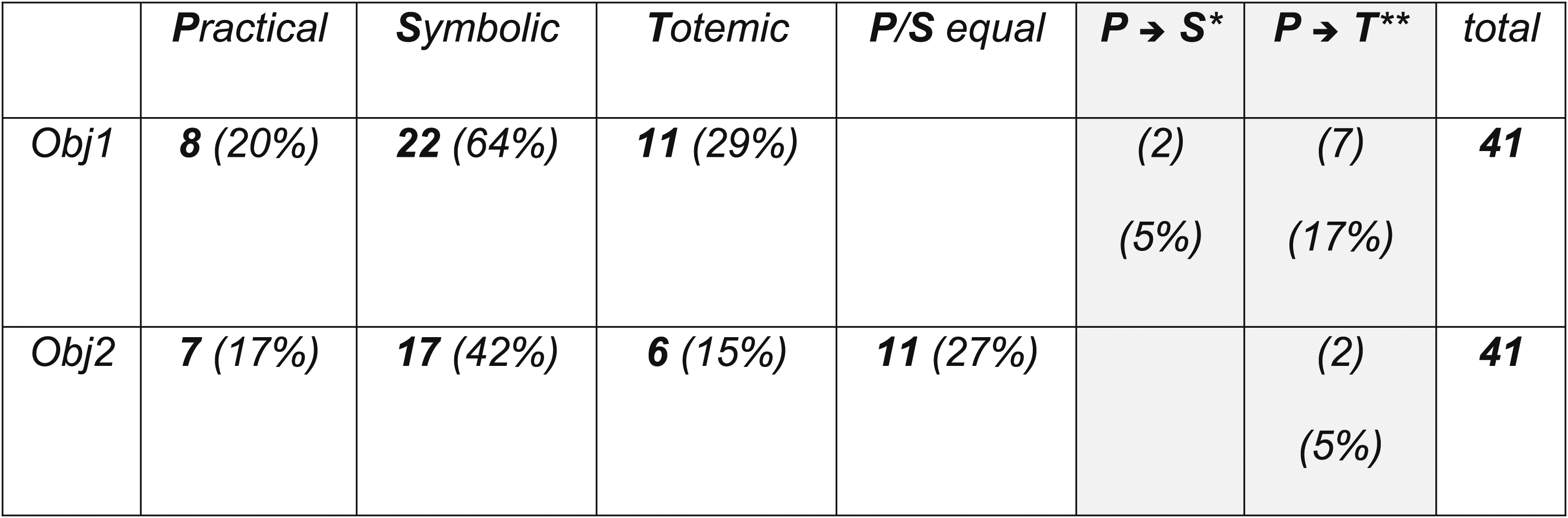
Percentages, rounded to the nearest whole number, relate to each subset, Obj1/Obj2.
* object/stories that started as practical and have become symbolic (so they are already included in the Symbolic category);
** object/stories that started as practical and have become totemic (so they are already included in the Totemic category).
It was possible to allocate the large majority (87%) of the 82 objects to a sole dominant category, but we noticed a subset (2+7 = 9) where there was a transition from an object of practical use to one that had become totemic and a very small subset (0+2 = 2) of those that also began life as practical but transitioned to purely symbolic. An adjudication between practical and symbolic was difficult to make in just over a quarter (n = 11) of the objects in Obj2.
The two sets of Collections compare fairly evenly in terms of the categorisation of object/stories, with two exceptions. The first is the larger number of totemic object/stories in Obj1 – almost double those found in Obj2. This might be accounted for by the different proportions of student social workers donating object/stories in the two Collections: just 3 (7%) in Obj1, but appreciably higher at 15 (37%) in Obj2. As Doel (2019: 836) noted of the full Collection in Obj1 at the time: ‘Student social workers were especially prone to donating metaphorical [symbolic] objects, perhaps because their “attics” had not yet started accumulating artefacts from their own direct practice’. It seems that objects are more likely to become totemic over time, or perhaps social workers’ attachment to things that remind them of their history with the profession increases with the years.
The other striking difference is the relatively large number of object/stories that were difficult to categorise in Obj2, with over a quarter falling evenly in the practical and symbolic categories. Cross-checking across the team confirmed these adjudications, and at present no hypothesis has been proposed for this difference.
The meanings of the object/stories
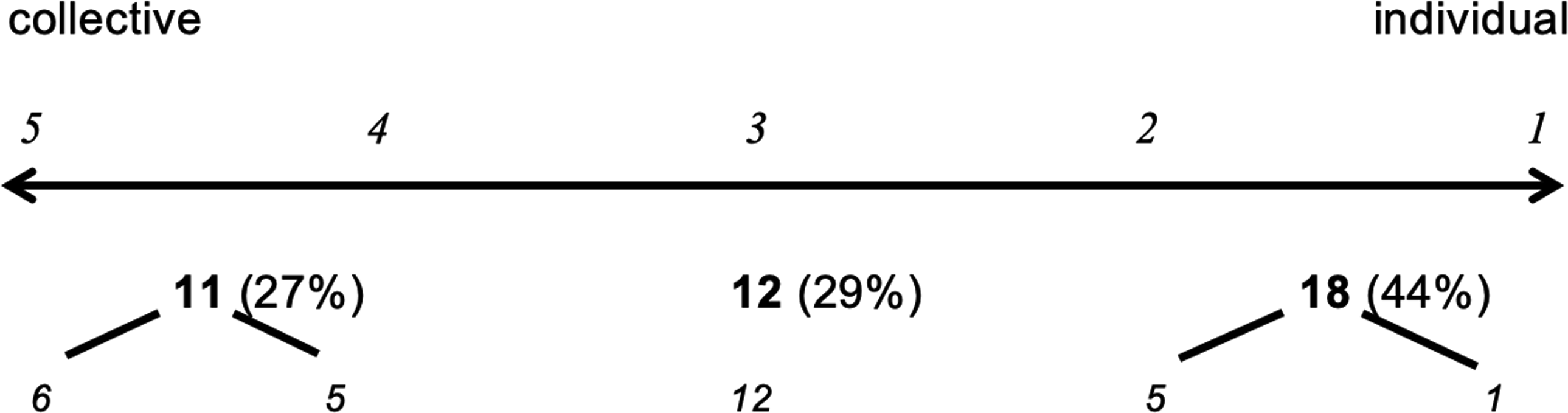
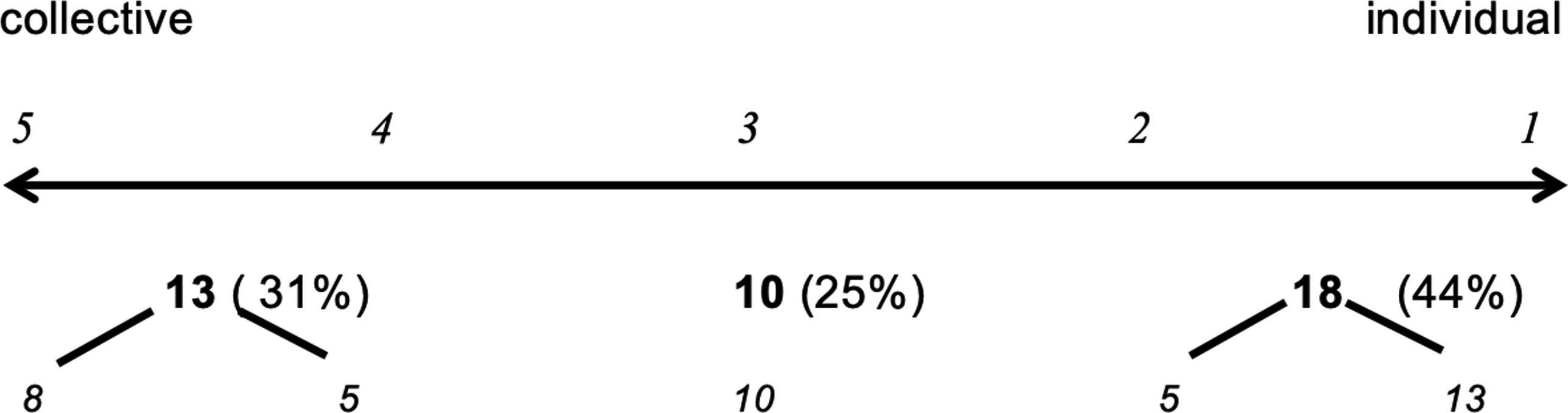
Our analysis using the practical, symbolic, and totemic lens takes the donated object as its starting point: an analysis of the purposes to which the material object was being used by the donor (as evidenced through their story) guided the adjudications. As we have noted earlier, a significant aspect of object as a process is the story that the donor weaves around the object and then attaches to it. This contextualisation is a process that deepens an understanding of why this object has been donated and what significance the donor intends. The stories have various themes, but the clearest differences could be seen in terms of the kind of social work they express – ones focused on social action and others focused on individual case work – from the political to the personal, with many shades in between. Analysis of the object/stories from this perspective quickly led us to a sense of a continuum, with the kinds of social work revealed by the stories shading from collective at one end to individual at the other. No moral weight is attached to either end of this continuum; the fact that it exists is a graphic expression of the contested nature of social work, and perhaps part of the profession’s strength.
The researchers from Chile and the UK used a five-point scale to see how usable the idea of this continuum was in respect of Obj1 and Obj2. We were able to suggest a place along the continuum for each object/story:
What kind of social work does the object/story express?
Obj1:
Obj2:
In Obj1 we see a distribution of 18 object/stories towards the individual pole, 11 object/stories towards the collective pole, and 12 clustering in between. This equates to a larger proportion (44%) with an individual outlook and just over a quarter (27%) with a collective focus.
In Obj2, we see a remarkably similar distribution to the Obj1 Collection: 18 object/stories towards the individual pole (44%, as in Obj1) and 13 (31%) at the collective pole of the curriculum.
Discussion to compare and contrast the two collections
The results from the continuum exercise were, frankly, surprising. When one considers the strong emphasis placed upon collective action and social solidarity in Latin American social work, it is curious that this is not apparent on the continuum. Social work students at the Chilean university are immersed in community social work from the very start of their education, whilst those at a British university could complete the entire programme without experiencing any community social work, the emphasis being placed on statutory (legally sanctioned) settings. Unsurprisingly, a 2020 survey of British social workers found that ‘engaging with local communities is one of the areas that social workers feel their training did not prepare them for’ (Doel 2023: 140).
However, when we drill deeper, we discover some interesting differences that have not revealed themselves on the continuum. In particular, Obj2 Collection includes a strong sense of place, which resonates with the spatial elements of research activity highlighted by Shaw and Holland (2014: 195). The places in Obj2 are ones that establish themselves as a meeting space between social workers and those they work with. Moreover, within the group of objects categorised as individual in Obj2, five relate to books; although mentioned as personal objects for individual learning, the books relate to historical and political themes that reference the collective pain of the Latin American peoples and also a tool to fight against these injustices, such as The Communist Manifesto. Though it is a singular and personal object, a book could be considered as a collective space – the ‘public’ in ‘publication’. With hindsight, the notion of object/story moves these individual objects towards the collective end of the continuum.
We should remind ourselves that Obj1 is a hybrid collection, with a sizable minority (22%) from non-Western sources; and that Obj2 has a higher proportion of student contributors (37%) than Obj1 (7%). Despite the emphasis on community in the Latin American curriculum, perhaps novice social workers are more likely to start their engagement with the profession at a personalised, individual level?
Obj2 proved more challenging to classify, as the ‘background hum’ of Latin American cultural life is highly political, driven by the history of dictatorships, oppression, torture, and disappearances. Student social worker Javiera Gutiérrez Cárcamo’s Flag exemplifies this – an object of her late grandfather’s, a Chilean flag decorated with slogans of solidarity, which he would wave while participating in demonstrations against injustice and poverty. The flag is now in her personal possession, and its story acts as a reminder both of her own history and also of her country’s.
Potential of object for social work practice
Expressing social work through objects is a first step, and the next one is to explore doing social work using objects. This is not an entirely new idea and, as objects like Memory Jar demonstrate, there are current and past examples of practitioners making use of objects in their practice. In particular, social work with groups has a history of employing objects, though often as a product of the group and not necessarily as a central part of the process (Gitterman and Salmon 2009). Might we give objects, developed into object/stories, a central role in social work practice and, if so, how?
The success of the socialworkin40objects project has led one British children’s charity to develop a training programme, Using Objects in Social Work (Coram, 2022), to consider how object might be used as an explicit process with children and young people to facilitate communication and to help start difficult conversations: for instance, asking a child to show an object of theirs that they like the most, or one that is very important to them, or perhaps that they have had for the longest time, and to tell a story about it. Another object strategy is to explain the idea of a mascot, then to ask the child what mascot they would choose to represent themselves – it might be something they already own or would like to, or just an idea – and to discuss why. One organisation for kinship carers adopted a Paddington Bear soft toy as its mascot, as he represents a well-known character from children’s literature, and now film, who relied first on kinship care (his Aunt Lucy in Peru) and then on foster care (the Brown family in London), (Bond 1958).
Objects might lead to words, in the form of a difficult conversation, or they might act as an appropriate substitute for words. For instance, social worker ‘Petra’ gave a child a red apple and a green apple and explained that the child could replace the green apple on the table with the red one if what was being discussed was too upsetting.
In addition to help with past trauma (Prigoff 2000), objects can play a significant role in maintaining personal identity. The frequent changes that characterise the placements of children and young people in care often result in their possessions being lost, so they have few if any things from the earlier parts of their life. What Ward (2011) has called ‘a persistent sense of self’ is often missing. Objects donated to socialworkin40objects by social workers include Black bin bags, with the donors confessing how they had transported children from one placement to another with all their belongings shoved into a back bin bag (an object generally associated with refuse collection), a symbol of the careless treatment of the child’s things: and, by extension, of the child? Social workers and those who care for children need to consider how significant objects from a child’s early life can be safeguarded through turbulent transitions: trove is a container specifically to keep children’s things safe, as well as their story/memories via personalised recordings (Watson et al. 2020; trove 2022); and The Talking and Listening to Children campaign provides social workers with a Kitbag of objects to introduce directly into their work (Ruch 2020).
Recognising that not every object can be saved forever, one creative example is the making of a Quilt from the clothes that a child brought with him to an adoptive home. As the child grew out of the clothes, the adoptive parents and the child made a quilt together, so the child can keep it and the memories attached to the making of it, long into their post-adoptive life.
Object is not confined to individual work with children and young people. Lucy Ketterer illustrates the use of object in the practice of community social work: ‘I was born in the Wallmapu territory – a ‘universe’ that the Mapuches inhabit in the southern Cone of South America. My first job as a professional was in a project where I supported rural women's organisations to support technology transfer processes, soaking up the needs, demands and dreams of the Mapuche nation. I talked with the women and their families, I shared their Tables and their desires, and it was around the Stove and by the side of a good Mate [a local herbal tea], where I learned to respect and value a dignified people, who have an extraordinary culture to teach us’. Via Table, Stove and Mate, Ketterer takes us on a journey into the socio-political sphere, with her professional commitment to the Mapuche nation in their struggles for autonomy and claims for the historical recovery of their territory and identity.
Further discussion and conclusions
There is evidence, then, that object does enable new understandings – and that a focus on a material object can give expression to our emotional attachments. For instance, an online group for social workers and foster carers prepared an object to bring to camera to introduce themselves, and one of the participants later said that she had revealed more about herself through her object/story than she had ever done before, even to her own family.
The initial comparison of the two sets of objects revealed a surprising symmetry. However, when taken together with their stories, the larger part of the object/stories of the Latin American collection, Obj2, shows a fundamental association with place and event, perhaps reflecting the community-facing direction of social work in South America in the context of poverty and rurality, and the legacy of dictatorship and political repression. The collective action that has been necessary to re-assert democracy in countries like Chile is revealed in the back-stories to the donated objects – though this is perhaps less the case with the new generation of social workers, the students.
Personal possessions that have become totemic figure twice as strongly in Obj1 than Obj2, perhaps reflecting a cohort of donors with longer years in practice and also a stronger culture of individual ownership and personal possession in Obj1.
Taken as a whole, the 82 object/stories display a wide range of social work belief, practice, and activity – what is often described as the contested nature of social work (Karsz 2007). Although some people struggle to concretise their relationship to social work, most find it a creative and liberating process, one that speaks to their feelings and attachments to social work as well as their understandings.
As a collective activity, naming objects and telling their stories provide a democratic space for participants to share experiences on an equal footing. The object becomes a conduit by which ethical principles, educational ideals, models of family life, and the like can find expression. Object work can increase awareness of the significance of objects in the lives of the people and communities that social workers work with. It is a strategy, if not yet a coherent method, whose playfulness is not limited to children and that becomes apparent as something quite complex. The stories behind the objects provide an opportunity for re-integration, not dissimilar to narrative therapy (White 2002). So, this is not simply a practice of remembering but of creating new meanings in the telling of the story. The object connects memory with the here-and-now and then again to future potential.
The objectives of this article were to consider the possibilities of expressing the nature of social work through objects and the stories that contextualise them and to use the comparison of two separate Collections of object/stories to illuminate this understanding. We also speculated whether this might enable the idea of social work to become more accessible to those who do not know it. The full completion of that final goal awaits a physical exhibition of social work in which these objects and their stories might be exhibited in person to a wider public.
Footnotes
Acknowledgements
We would like to record our grateful thanks to all those who contributed their objects and stories to the Collections that formed the basis and focus of the authors’ research.
Declaration of conflicting interests
The author(s) declared no potential conflicts of interest with respect to the research, authorship, and/or publication of this article.
Funding
The author(s) received no financial support for the research, authorship, and/or publication of this article.
