




Abstract
Exhaustion is not about being tired. It is an intense feeling of restlessness, of insomnia, and awakening when I ask myself: have I exhausted all that is possible? Such a state of restlessness and wakefulness represents a turning point for having enough, and opens for new possibilities to act for social change. This reflexive essay departs from the notion that the language of exhaustion offers a wor(l)dly possibility for social work(ers) to engage in critical analytical reflexivity about our locations of power from the outset of our (g)local environment worlds. The aim is to trace the transformative possibilities of social change in social work practice through the literature of exhaustion (eg. Frichot, 2019; Spooner, 2011). The methodology is based on uses of narrative life writing genres such as poetry, written and photographic diary entrances between the 4th of April and 4th of June. The essay shows how tracing exhaustion during the pandemic, visualises a multiplicity of forms of oppression and privilege, an increasing attention and relationship to things, and border movements and languages. I suggest that social work replace the often-used terminology of social problems with exhaustive lists to address structural forms of racism, sexism, ableism, ageism, which has been further visualized through death, illness, violence, and poverty during the pandemic. I argue that the language of exhaustion is useful for reflexivity and action in social work practice through the way it contributes to intensified awareness, attention, engagement, listening, and agency to create social justice.
Tiredness/trötthet/väsymys 1
My heart beats pounding in my ears
The chorus of a whistling/susande/vihellysten/sound
Restlessness, insomnia, dreams, shivers
Dots with red legs, dancing in the darkness/mörkret/pimeydessä
Spring trees/vårträd/kevätpuita
Arms and legs of bark skin
Stretching out, touched by the wind
Rooted in the earth/jorden/maahan
My skin/min hud/minun iho
The largest organ of the body
Breathing/andas/hengitys
Connecting with all other bodies/kroppar/kehoihin (Figure 1)
Windows to a pandemic: (G)local environment worlds
I am located in my home and the nearby surroundings in the urban space of Stockholm in Sweden when I write this reflexive essay. I perceive everything I do since mid-March, when Covid-19 began to restrict life, as being done in a slower paste; like a patient with diffuse symptoms that has been left in a waiting room. The large window in my working space offers a view to the world outside. Other windows are the digital spaces in my computer: zoom for work meetings and teaching; a textual spatiality for reading and writing; a visual space for news, television broadcast, newspapers; and streaming. My flat in this (g)local environment world in urban space is connected to another geography in Helsinki, Finland, where I have a new post from 1st May. My (physical) relocation has been disrupted and I work remotely. In this time of restriction and ‘lockdown’ of societies in the midst of a pandemic, I wish to trace the transformative force of social work practice through the literature on exhaustion (Barth, 1984; Deleuze and Uhlmann, 1995; Frichot, 2019; Spooner, 2011). I was drawn to this language when I (Livholts, 2019b) read Hélène Frichot’s (2019: 71) book Creative Ecologies, where she writes:
Exhaustion is more profound than tiredness; its structure of feeling is rather about an anxious restlessness. Exhaustion is about wakefulness and the distance of sleep. It is insomnia. Exhausted, awake, not tired, a constant wondering plagues you, as you ask yourself: Have I exhausted all that is possible? Have I done everything I can to ameliorate my local environment-world? It is an exhausting challenge.
My departure is that exhaustion offers a wor(l)dly possibility, an alternative language for social work practice, to better understand contemporary and future challenges and possibilities. As Frichot (2019) argues, exhaustion is a state of restlessness and wakefulness, a turning point of having enough, which opens for new possibilities. Social work as a discipline straddles between exhaustion and possibility; privilege and poverty; intersecting inequalities and social justice; fear and violence, safety, community building and peace; exploitation, anxiety, death and caring, capacity building, hope, courage and human rights. Glocality is the becoming of social work practice in a future of unexpected events, interconnecting multiple localities, and ‘power asymmetries that shape interspatial social issues’ (Livholts and Bryant, 2017: 2). The pandemic is widely spread across the world, but with local and regional differences. In many countries centered to large cities, and people who live in poverty and in in communities with migrant background suffer from higher death rates. This makes it important for social work practice to scrutinize power relations related to space and place; to use scaling as a tool to recognize intersectional inequalities from the micro level of bodies, private and institutional homes, welfare systems and civil society (compare Bryant and Williams, 2020).
This reflexive essay consists of poetry, and written and photographic diary entrances between the 4th of April and 4th of June. It is inspired by situated writing: grounded in a politics of location, affirmative of the historical and geopolitical location of the writer, multiple intersections of oppression and privilege, composed by narrative life writing genres such as diaries, letters, poetry and photography (see Livholts, 2019a). The reflexive working process includes writing and reading, re-writing and re-reading the diary, allowing for a selection from the original diary notes to spur photographic acts, memories and analytical thinking on exhaustion.
4 April 2020: Closer to things
Dear Reader,
The last weeks have gradually infused a different rhythm into my life. I spend more time with myself, I read more, I avoid to go to the grocery store if not necessary, and I keep a distance to people. I watch TV more often to keep updated with news about the virus. Every morning I talk to my 78-year old mother, who live in isolation. The epidemic has brought an increased awareness to my daily life, an uncertainty, sometimes a sense of failure. I use the camera to photograph my surroundings. I feel a renewed attachment to windows, buildings, furniture, trees, flowers, and parks. It is as if the social distancing between people bring me closer to things; made me attentive to all forms of life, materials and architecture. I take a photo of the window in the room where I most often work at home. I have always loved this window, but I now see it as more than a window; an extension of the flat intertwined with the large trees outside, with the ivy that climbs and embraces the tree trunks.
14 April 2020: Coronation and cremation
Dear Reader,
The area of Nyland (the geographical area that includes the capital city of Helsinki) has been cordoned since 28th March. I worry about the differences in the Swedish and Finnish strategy and the high death rates in Sweden. I watch a reportage from a morg in Stockholm. They show the cremation of bodies through coffins on fire. Images of the coronation of Nyland and cremation in Sweden will stay with me forever.
19 April 2020: Language III
Dear Reader,
I read Deleuze and Uhlmann’s (1995: 11–12) text “The Exhausted”. It was difficult to read and I felt alienated. I picked up on two ways of exhausting the possible that I thought was interesting: extenuate the potentialities of space and dissipate the power of the image. The authors refer to these ways as language III, the language of images and spaces, originating from the novel and the novella and transforming into television. I visualise the image of the corona-virus, a round grey body with an uneven surface, yellow dots and red cutters attached to it. It seems to hover in space. So colorful in the image world and so invisible in everyday life. I reflect on how the pandemic seems to increase the visibility of what social work often calls ‘social problems’, or ‘vulnerable groups’, a language that has a clinical sound to it and does not call for action in the same way as exhaustion does.
3 May 2020: Breathing and violence
Dear Reader,
Today I passed a green bench, where someone had written with pink color (Figure 2): ANDAS… LYSSNA PÅ TYSTNADEN (Swedish) BREATH…LISTEN TO THE SILENCE (English) HENGITÄ… KUUNTELE HILJAISUUTTA (Finnish).
Today I also read an article about a woman who suffered from violence from her boyfriend for many years. Unexpectedly, photographs of her injured body were published: cuts, wounds, yellow, blue, and red bruising, and blood. Finally, near death, she reported the abuse to the police, there was a trial and the man was sentenced to eight years in prison. She survived.
I had to pause the reading several times, and breathe.
8 May 2020: Finland opens for workers
Dear Reader,
Today I received news that from 14th May Finland opens for workers. I need a valid passport and my working contract. I have this privileged situation of a work permit and supportive structures for my relocation to enter into the country. I think about how the language of ‘lockdown’ is used specifically for the problems with closed borders for trade and work during the pandemic, while ‘open borders’ are often referred to as a problem when it comes to refugees and asylum seekers.
11 May 2020: Reflexive bridges, traces of rust and exhausted things
Dear Reader,
This morning I photographed shadows under the bridge. It felt like me too was made of water, stone and mud. The sun beams broke through the water movements, created shadow patterns on the vaulted concrete passage under the bridge. I assigned this moment reflexive bridges (Figure 3).
I continued my walk and unexpectedly saw traces of rust on the bridge by the waterfront. I felt the smell of something rutting, of mud, and passed a container filled with steel garbage. Beside was a row of food carts. At first, I just passed, but when I came back I took a photo; I understood then that traces of rust came from bikes, and food charts that had been brought up from the bottom of the lake (Figure 4) . I thought there was something hopeful about the scene. I thought it should be made a permanent exhibition; an invitation for people to think and re-think their relationships to things.
12 May 2020: Deaths in elderly homes – Clinics for the exhausted?
Dear Reader,
I feel sad and upset. We have many deaths of people in homes for elderly in Sweden. There is a shortage of staff and part time work in these homes, and a lack of protection equipment. The guidelines say ‘protect our elderly’ and the place where most deaths occur are in these homes. This is a clear sign of exhaustion and makes me think about Spooner’s (2011) A clinic for the exhausted. I think about how the pandemic visualise the existence of unworthy institutional spaces for elderly care in Sweden. I remember words spoken by my mother: “I am afraid I have to socially isolate for long. That the whole summer will be like this. I can’t make it throughout the year.”
27 May 2020: A necessary travel
Dear Reader,
This is an unusual day. I am travelling from Stockholm to a city about one hour away to go to a funeral. When I look around in the train I see how much has changed from last time I travelled several months ago, and I am reminded of my privilege most of the time to make the choice to travel or not travel. I bought two more small bottles of hand disinfection at the central station. I chose a single seat opposite to a bag storage space and feel relieved that there are only a few passengers so we can spread out. I see passengers going to sleep. I am tired, but at the same time intensely awake. This tiredness between wakening and sleeping on a train is similar to a state of dreaming. I am still, but in movement; an image of my-self reflected in the window, framed by shifting landscapes as the train passes houses, societies, fields and forests. The rain starts pouring down. On the return journey the water runs down alongside the window glass. I feel sadness and loss; memories keep coming; scenes from the summer house; the sound of the Finnish language. I take a photograph. The photo does not show what I see. I fall asleep.
31 May 2020: Minä harjoittelen suomea
Dear Reader,
The last Sunday in May is warm and sunny. I train Finnish/Jag tränar finska/Minä harjoittelen suomea. The sound and rhythm of the few words I have learned so far is intimately intertwined with a new possibility. I don’t remember that learning English (or German and French when I was young) was such a visual process. I have asked some of my colleagues to write greetings and the first sentence in each email in Finnish. Helsinki university is a trilingual working space: Finnish, English and Swedish. I write in different languages to different colleagues. If I write an email, or submit an examination, an automatic reply in these three languages appear. I think of language III! I will mainly teach in Swedish, but courses often use more than one language: Swedish and Finnish, English and/or Finnish. I regard this as a possibility to create spaces for multiple language use.
1 June 2020: “I can’t breathe”
Dear Reader,
Protests have been going on for almost a week across cities all over the United States and many other countries, due to the death of Georg Floyd, an African-American man who died from the violence of the police 25th May. The death of Georg Floyd visualises violence and death in a context of colonial history. The words he says before he dies - “I can’t breathe” - has become an expression in the many protests against racism, a call for social justice and equality. I think about how the pandemic, in a similar way as other disasters, have the most serious consequences for people who are racialised. Sweden is no exception. In Stockholm there is an over-representation of deaths in suburban areas where many people with migrant backgrounds live. Colonialism and racism have exhausted minority and indigenous people for generations. Who is seen as worthy and unworthy is intimately intertwined with embodiment, education, recourses, nation, and community.
The language of exhaustion in post/pandemic social work
“Exhausted, awake, not tired, a constant wondering plagues you, as you ask yourself: Have I exhausted all that is possible?” (Frichot, 2019: 71) I suggest that this intriguing question introduces further thinkable practices and action for social work practice from the outset of this reflexive essay. I have invited the reader to a photo/diarist reflexive methodology characterized by slowness and vulnerability to document unexpected disruptions and visible signs of exhaustion and possibility as we move into post/pandemic times. Writing and photographing creates a slower form of reflexive engagement to include place and space, which makes it possible to see and live in the (g)local environment world in new ways, to attend to detail, and to listen. I propose that social work replace the often-used terminology of social problems with exhaustive lists: violence, trafficking, disasters, racism, sexism, ableism, ageism. To enter into the language of exhaustion demands awareness, attention, listening skills, and agency for social change. This is where we slow down. This is a turning point for new possibilities in social work practice.
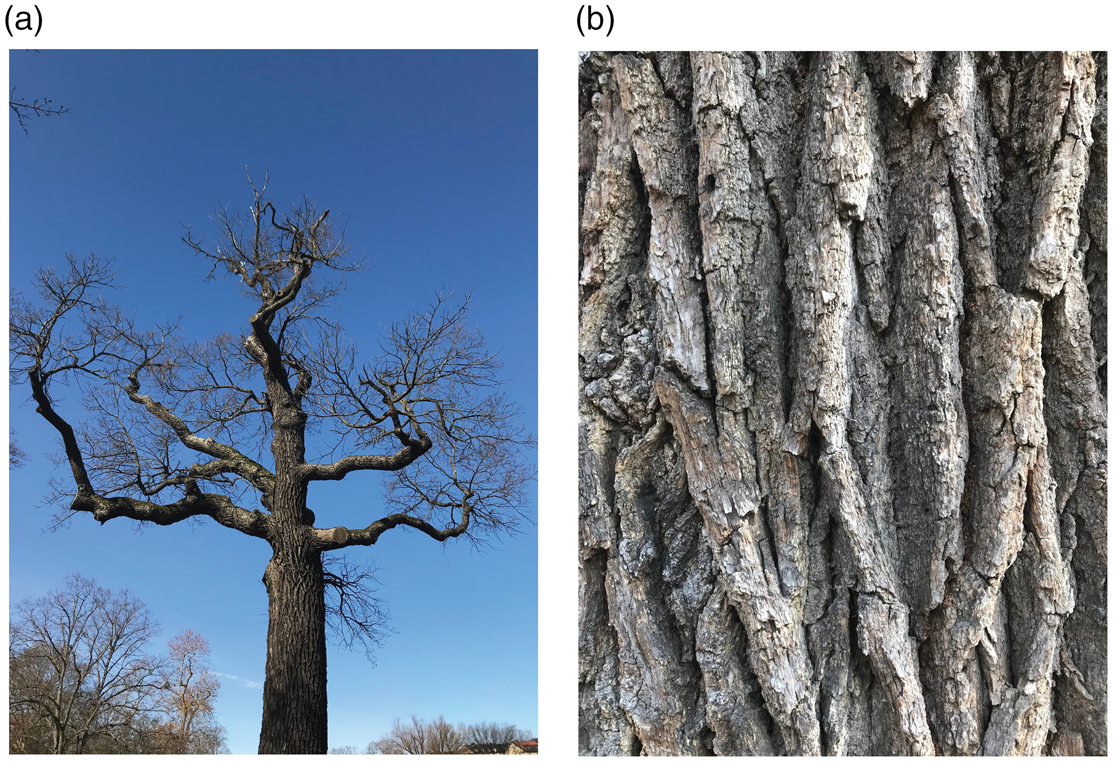
(a) Spring trees and (b) Bark skin.
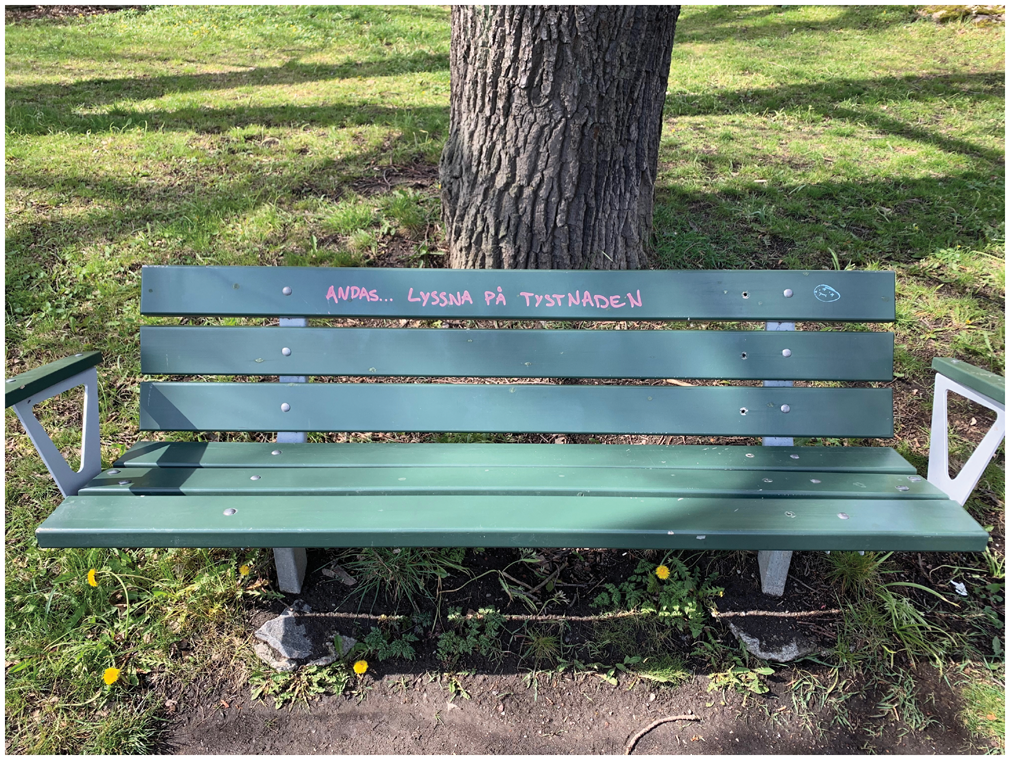
The green bench.
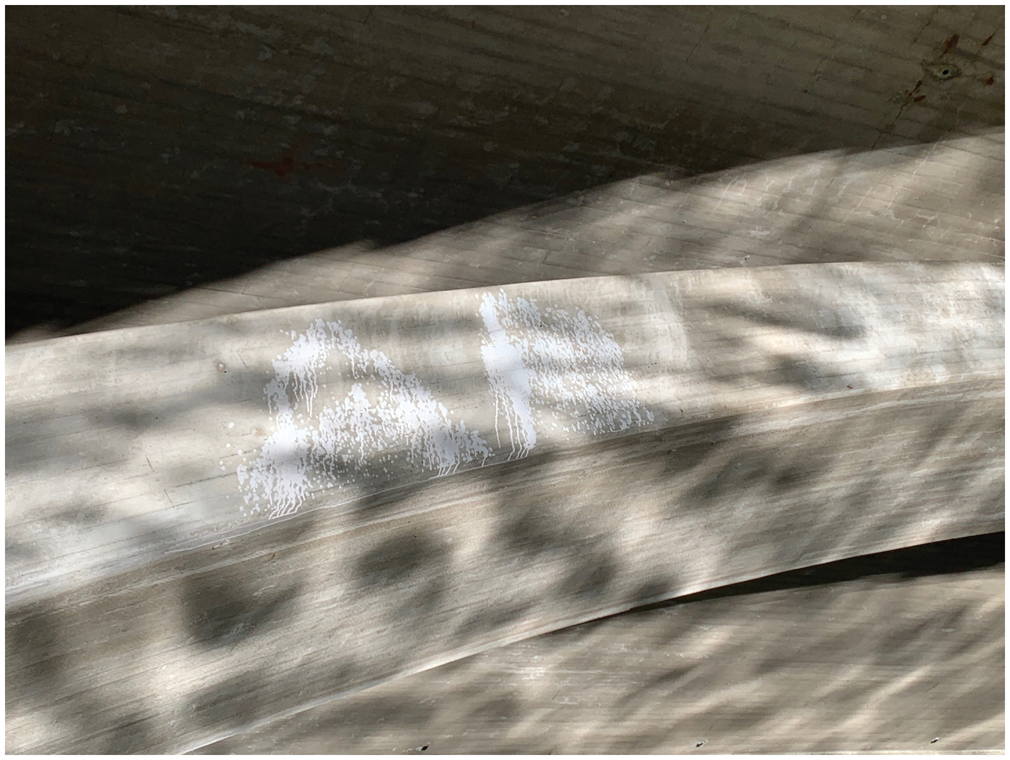
Reflexive bridge.
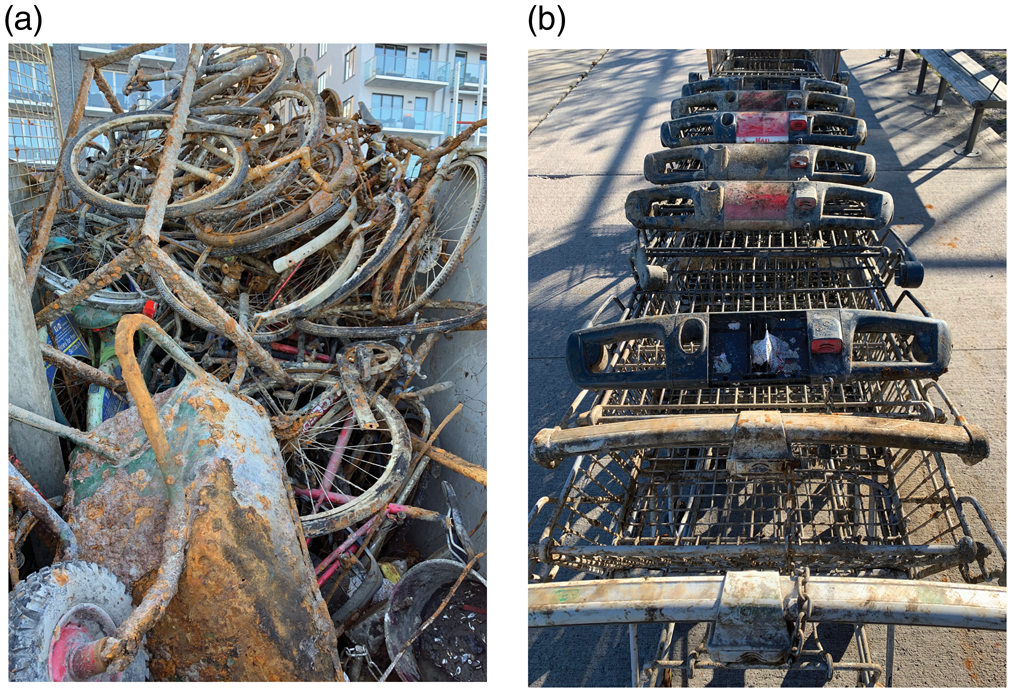
Exhausted things. a. Exhausted wheel barrow and bikes
Footnotes
Acknowledgement
Thank you to Päivi Vetsch, University instructor at Helsinki university, for helping me to check the translations of the Finnish words in this reflexive essay.
Declaration of conflicting interests
The author(s) declared no potential conflicts of interest with respect to the research, authorship, and/or publication of this article.
Funding
The author(s) received no financial support for the research, authorship, and/or publication of this article.
