




Abstract
The World Café (TWC) method is now established as a participatory tool used in community development and qualitative research. However, there is a limited critique of TWC as a social work research method, especially with children. This paper discusses TWC as a method for understanding what matters for children on the British Overseas Territory of St Helena Island. As a social worker, the importance of supporting children’s engagement and voice is well known in participation, necessitating careful ethical consideration. Within this project facilitating authentic conversations with children on a remote island required examining assumptions alongside engaging with colonial legacies to bring forward respectful participation. TWC shares several fractures of other participatory approaches evolving from critical pedagogy, which appeared aligned with social work values and ethics. Facilitated shared learning and allowed children to discuss issues that mattered to them, although handing over dialogue to children required commitment to trust and sharing control with young people. Café events revealed the complex positioning of social roles situating lived experiences, whereby children developed their learning of what mattered to them through interactions and a growing understanding of their global position. The method edged dialogue towards transformative conversations, acknowledging the oppression of marginalised peoples, requires reflection and action from children and young people themselves to elevate their positions from within their own knowledge. This supports the potential for further research to understand if creative methods can create more spaces for dialogue, allowing the emergence of more authentic children’s engagement in research which is more socially just.
Introduction
This article explores the application of The World Café (Brown and Isaac, 2005) in Social Work research with children on the small island of St Helena in the South Atlantic in 2020. From the initial design of this study, a central method was required that supports the creative induction of knowledge. Recognising epistemological diversity was needed to challenge the dominance of Eurocentric paradigms, (Lorenzetti et al., 2016; Thambinathan and Kinsella, 2021) there was a need to choose a method which supported decolonisation of research methods and practice. With the authors’ experience of facilitating and participating in The World Café (TWC) events in community development, it was considered that drawing on TWC as a research method could allow the project to remain grounded in emerging voice with transformative possibilities (Lorenzetti et al., 2016).
Building on critical pedagogical approaches and action research (Freire, 1970; Lorenzetti et al., 2016), TWC method is widely applied as a participatory tool in communities and organisational change and asserts its ability to travel well across cultures, but there is limited analysis of its potential as a research method (Aldred, 2009; Löhr et al., 2020). Designed to be as inclusive as possible, the method involves revolving rounds of questions to support dialogue and motion towards action. Within this study it was felt that this held the possibility to respect that islanders themselves held knowledge and the ability to improve their own situations, presenting as ethically compatible. Yet despite its grounding in community action, there is a limited critique of the methods’ attention to power differentials and recognition of structural inequalities within its processes (Lorenzetti et al., 2016). While this article does not intend to untangle all the complexities that this brings in participatory research (ibid) it is acknowledged as being relevant for research with children living in the British Overseas Territories (BOTs) within this research project.
This small-scale qualitative project was initiated as part of doctoral research by an experienced Social Worker interested in participatory approaches which children aiming to understand their lived experiences, elevate their voices in research and support their own development to what matters to them. However, in supporting others’ development, it was quickly realised that there is a need to explore the researcher’s own position within the study. This requires recognition that realities are constructed and shaped by social, political, cultural, economic, and racial/ethnic values showing how power and privilege remain important drivers in showing which reality is privileged (Lorenzetti et al., 2016; Shaw and Holland, 2014). As a Social Worker from England this introduced the need to reflect on one’s own transformation within the project. In this study the context being so unique required immersion and reflection throughout. Consequently, while the attention to ethics is apparent in all research, the importance of ethics gained weight. Involving personal and professional responsibilities that inevitably shaped the study’s methodological choices. Entering a context where social work is lesser known prompted a more global understanding of what social work means.
In 2014 the International Association of Schools of Social Work (IASSW, 2014) and the International Federation of Social Workers (IFSW) adopted the definition of social work, Social work is a practice-based profession and an academic discipline that promotes social change and development social cohesion and the empowerment in the liberation of people principles of social justice human rights collective responsibility and respect for diversities are central to social work underpinned by theories social work social sciences humanities and indigenous knowledge social work engages people and structures to address life challenges and enhance well-being.
Significant for this study the definition includes the requirement to consider indigenous knowledge. Social work research is clearly not a unitary ontology and needs to be dynamic, critical, and engaged with people in their environment to support practice to be anti-oppressive (Sewpaul and Henrickson 2019). Nevertheless, even when committed to ethical codes, there was a risk of reproducing inequalities (Sobočan et al., 2019). This is especially relevant in researching marginalised communities who have to navigate political implications, systemic power imbalances and stigmatised status (Shaw and Holland, 2014) and when researching as outsiders. There was a need to understand and respect indigenous knowledge throughout at the beginning of this project, an initial literature search identified that little research could be found about children’s lived experiences on St Helena Island. Children appeared silent or lost within historical, geographical, and anthropological projects or filtered through the textual analysis of others (Cohen, 2017; Hogenstijn and Van Middelkoop, 2002; Schulenburg, 1999). On St Helena, this also required considering the impact of colonialism and economic migration islanders have experienced.
The island of St Helena is in the middle of the South Atlantic, between South America and South Africa. Discovered by the Portuguese in 1502 (Gosse, 1990) and used by the East Indian Company as a refuelling stop (Royle, 2019; Winterbottom, 2010) the island was transferred to the crown in 1834 (Gosse, 1990). Populated against a history of violence and both forced and elected migration, islanders are British yet situated far from the mainland. While it is recognised that children of overseas territories have the same rights as children in the outer regions of the UK (Wass, 2015), including the right to be heard and part of decision-making through participation (UN, 1989) their voices are distorted through current colonial glaze with a marked absence in research and policy to date (Winterbottom, 2010). This brings the past to the present, showing a clear need to bring forward more authentic understandings of what matters to children on St Helena. But to enable this there is a need to first engage with children to build motivation and engagement, which in completing this required engagement with islanders to gain access to children’s worlds.
Importantly bringing forward voices required consideration of power and representation (Spyrou, 2017). This necessitated critical reflection throughout the project with situational analysis to understand children’s lives and the position of childhood on the island taken to the island and forward into representation of these findings. Participatory research is a collaborative effort in which marginalised peoples are partners in the process to influence socially just change (Banks and Byron Miller, 2019). What began to emerge in planning was that understandings of situations required more critical reflection on the unpredictability and messiness of researching, to understand what participation meant and how to research ethically as a social worker to support a space where children and young people themselves decided on the agenda that was meaningful for them.
The World Cafe is a participatory method
The World Cafe approach to Collaborative Learning was ‘discovered’ in 1995 by a workshop held in California. It was then consolidated as a new method of dialogical inquiry in 2001, based on the thesis of Juanita Brown. Brown (2001), based this approach on Paulo Freire’s (1970) ideas and use of Brazilian cultural circles to support community action, Brown detailed The World Cafe (TWC) through the metaphor. Brown (2001; Brown and Isaac 2005) claimed that Café events can illuminate the dynamic and diverse conversation, social learning networks, and ‘living’ knowledge (Brown 2001: iii). Brown’s (2001) focus on enhancing participation stems from her own lived experience, in which conversations about changes and possibilities led her to take action. It is also a result of her extensive research into organisational dialogue and knowledge. It has radically influenced her perspective and, therefore her approach. She draws on storytelling as inquiry (Brown and Isaac, 2005), critical pedagogical approaches (Giroux 2010), and respect for indigenous knowledge (Rowe et al. 2015) alongside Appreciative Inquiry (AI) (Vogt et al., 2003) to structure questions in order to explore possibilities at Cafe events.
Initial studies examined TWC by comparing it with other research approaches (Löhr et al. 2020), notably Appreciative Inquiry (AI) (Fouché and Light 2010) and Participatory Action Research (Aldred 2009). Both TWC and AI encompass community development as part of the new generation of participatory approaches, moving towards a critical stance and both methods are closely intertwined in their development (Aldred, 2009). Cooperrider et al. (2003) defined AI as ‘a methodology that takes social construction to its positive extremity’ (2003: 2). Methodologically they create environments where intersubjectivity is shared and can be designed to allow positive responses to challenges or problems (ibid). Aldred (2009) noted that both are constructivists. AI asserts that dialogue can be a powerful tool for challenging the social order (Lorenzetti et al., 2016). It was hoped that as the research project had a limited time frame, the method would spark transformative conversations, to support children to discover and take action towards what matters to them. Although there was also a need for transparency with islanders, this would be their choice once the project ended.
Planning for research on a remote island
Ethical approval was gained through the university and secondary approval was gained through the St Helena Research Institute (SHRI). As requested children from 10 years old to 16 years were included. Through radio interviews and conversations with islanders it became apparent that by widening the age range to include 16 year olds the project had inadvertently omitted 17 year olds who expressed their wish to be part of the events. It was agreed that they could collaborate with the project as advisors and both participants and hosts in events. This provided a unique opportunity for the project to move from participation to collaboration, while requiring additional planning the contribution of young people was invaluable. As this was participatory research supporting collaborative learning (Lorenzetti et al., 2016) with the islanders, it was inevitable that approval would need to be revisited in the field as the project and sampling developed. Attention was given throughout to ensuring that the project remained theoretically and methodologically grounded, considering democratic, participatory, empowering, and educational ethics (Banks, 2016) along with the unique global events of the time.
Being led by Social Work ethics and values (Banks, 2016) this project respected that there are many versions of what people believe to be true and that multiple factors would influence them. It was important to consider our power and cultural lens, and how these influenced relationships with participants. As one teacher stated within a few days of arrival on the island: ‘We don’t talk to you straight away. We watch and decide first’ Islanders felt marginalised and oppressed by the constant flow of experts. They chose navigations that recognised their fragile situation valuing relationship building to develop trust, which required extended planning time to understand what mattered on the island and how the researchers presence could be of value. Introducing a new method which was unheard of therefore took time, no one had heard of TWC and although they talked about attending focus groups, these were seen as not useful as data was not seen as improving their lives. When discussing previous projects, islands talked about the persons who ran the events instead of the content or discussions held. This was significant as understanding relationships became central.
Lorenzetti et al., (2016) make a convincing argument that TWC effectiveness is limited if the power difference between the host and participants is not considered. The flexibility of this study was that 17 year olds could collaborate and influence the methodological shape of the events but the reach of their control and impact on the research project was initially undecided. This research recognised that considerations of power are inevitably linked to historical oppression and consequently a critical and transformative paradigm was adopted with the need to ensure that the project was not only ethically grounded but linked to supporting addressing inequalities through supporting the potential of children themselves to transform their own lives (Mertens, 2017). Including 17 year olds deeper in collaboration offered opportunity to shape a research project for children and young people thus providing a level of empowerment. However, as a researcher relinquishing power required more intensive immersion into island life to understand how best to support the young hosts and a building level of acceptance of young people interpretation of what Café events would look and feel like for them.
Fouché and Light (2010) acknowledged the method’s potential to reduce the distance between those in power and those less influential. However, the 4-month stay on the island also limited the project’s ability to demonstrate transformation. The potential was still evident when balancing these factors, so long as islanders had ownership of the project and were motivated to continue dialogues after the project ended. Conversations were held before leaving for the island with St Helenians in the UK to begin to understand the challenges children encounter on an island with a reduced level of power (Lorenzetti et al., 2016). Upon arrival on the island, the project began engaging with the community. The community provided feedback, and questions about the project were answered on radio stations, the island’s main media outlet. While confidentiality and anonymity of location are ethical considerations, conversations with islands reinforced that for them transparency about the project, and accessibility of information on the island outweighed any potential negative with the location being known.
In discussing the need for further research into TWC as a method, Löhr et al. (2020) discussed how the shift in qualitative research towards narrative approaches has the potential to bring forward lived experiences in social work research. Utilising TWC within a German-Tanzanian food project, they found that the method was well suited to complement other methods to explore a topic or verify findings (Löhr et al., 2020). Fewer questions were asked within TWC than in focus groups or interviews; the data collection was less time-consuming and provided multiple themes. Interestingly, they found more interaction between tables in Café events compared to focus groups, suggesting that the method supported greater inclusion and ownership and similar to this project the level of ownership with participants meant reporting on findings was more transparent. But, limited analysis was possible since data collection was based on tablecloths. Löhr et al. (2020) also point to the need to ensure that a limited number of questions is posed to the tables. What is less attended to is possible ethical concerns with how voices are documented and represented within Café events.
As Spyrou (2011) pointed out, when supporting ‘absent’ voices or claiming ‘authentic voices’, caution is required to respect the dynamic nature of voices. The expansion of creative methodologies in qualitative research aims to give children a voice in capturing children’s lived experiences, giving them agency in research (Spencer et al., 2020). Still, there is a need to expose the tricky epistemological tensions and relations of power embedded in producing knowledge with children. Recognising the situatedness of voice and the dynamic nature of childhood on St Helena how engagement with adults or children would manifest on the island was subject to negotiation with island. Children were quick to show interest in what happened to their views. For example, one young person stated, I don’t mean to be rude, but before I start talking with you, I want to know what will happen. I mean, so many people come here, and we talk, but nothing happens.
From the children’s experience, previous visitors had exploited their voice, with no action or reflection on what happened once their views were shared. Engaging with young people before the events was crucial in deciding how best outcomes from events would be represented and to be clear about expectations around the project’s limited impact. It was decided that the results should be published in the local paper, be sent to all children, and presented to decision-making boards on the island in visually accessible formats.
Against this, it was apparent through conversations on the island that islanders perceived the project would provide ‘answers’ to come from the researcher’s work, reinforcing earlier research suggesting that islanders perceived change to be outside their own potential or reach (Essex, 2000). Yet perhaps paradoxically, they still desired participation, reflecting the feelings of disempowerment between themselves and those governing them (Harmer, et al., 2015; Hogenstijn and Van Middelkoop, 2002). Being aware of this, the use of open questions and valuing of indigenous knowledge gained importance to minimise unintended transfer of ideas of knowledge.
The architecture of powerful questions can support cultural respect, enhance the quality of insights but often require adjustments in the field (Cooperrider et al., 2003). Appreciative Inquiry (AI) provided a framework for asking questions, which was developed with islanders. AI must involve people in their own identified change, so for this project the appeal was clear. Vogt et al. (2003) and Cooperrider et al. (2003) suggest three types of questions for the events: questions to focus collective attention (concerning the space and situation), questions to connect ideas and gain deeper insight (by moving to contributions, patterns, and diverse perspectives), and questions to create forward motion (in the direction of collective sharing). In this project such integration of AI and TWC aimed to provide a level of focus. Three questions were developed in collaboration with two St Helenians, to help young people reflect before discovering the ‘big question’ by gathering group feedback in a harvest at the end of Cafe. The questions brought into the series of Cafes included:
* What matters to children like you on St Helena?
* If you could ask one question to someone in a position of power on St Helena about something that matters to you now, what would you ask them?
* What needs to happen next to support children like you on St Helena?
Leaflets about the main event and local cohosts were developed to support increased understanding and the inclusion of unique factors of the island, such as the endemic plants and island sea life. Advising engagement with the community the St Helena Research Institute and Human Rights Office actively joined with the study and a member of the Human Rights Office co-produced Café events.
The World Café events
The metaphor of a Café was reviewed during the planning with islanders. This recognised that the symbolic use of objects (flowers, tablecloths, music) in an environment could turn on or off potential conversational flow (Jorgenson and Steier, 2013). With no actual ‘Café’ on the island, many Islanders did not fully understand what a Café was or looked like. Local restaurants visited showed how spaces that were welcoming drew on nature being outside, simple furnishings with active ‘hosting’ and familiar faces being very personable. For the events on St Helena, more visual images were used, including placeholders on each table. Each table was set with a material tablecloth, flip chart paper overlaid (referred to as the ‘tablecloth’), and paper and pens. Recognising the emerging challenges of engaging a larger group of children in attending an event, negotiations with the Research Institute and the islanders’ educators led to an agreement for four Mini Café events in the three primary and secondary schools alongside a main event for all children.
On arrival, children were greeted, invited to take a seat at a table, and invited to participate in a discussion about Café etiquette as ground rules for the event. The method applied included three revolving rounds of 15 min. Questions were displayed on a menu on the table with a ‘starter’ question, a ‘main’ question, and a ‘dessert.’ Each round aimed to discuss one question in sequential order. Each child could access pens to capture conversations and were invited to draw, doodle, or write expressions from the questions. Large sheets of paper acted as ‘tablecloths’ to capture and doodle ideas. Following each round, the children were invited to change tables and to sit with different children. For secondary school children and in the main event, an audio recorder was positioned on each table, and a supporting host monitored the recording device. This aimed to recognise that previous studies suggested that data could lack richness if only tablecloths were retained (Lorenzetti, et al., 2016; Fouché and Light, 2010) but balanced that audio data was considered not appropriate for younger children by the islanders. This project delved deeper into both table and whole-group discussions through documenting at least one discussion per table in primary Café events.
It is worth drawing attention to the two kinds of hosts used in these events. A hosting team intended to support the event, and table hosts participated in the event. The supporting hosts in the event (young people from the island) supported children to contribute to the event and create a hospitable context (Brown and Isaac, 2005). While Lorenzetti et al. (2016) and Löhr et al. (2020) considered the role of additional hosts as potentially influencing power, advising caution, TWC guide suggests, hosting events should never be alone (Brown and Isaac 2005). Within this project, it was decided that the inclusion of local supporting hosts was essential to allow the researcher to step back and facilitation to be locally led. Although agreement had to be gained from the islands research institution, drawing attention to the hierarchy of decision-making, even on small islands.
It was intended that to further diverse responses, one participant host remained on each table (termed table hosts), their role was to summarise the previous conversation in the next round. A new host was chosen at the end of each round, while the other participants moved tables. The idea of changing participants and hosts intended to circumvent power inequities by ensuring that participants met other participants with whom they could interact differently (Löhr, et al., 2020). By switching tables, group dynamics were mixed, with new groups forming at each round, supporting cross-fertilisation and connecting ideas. The last phase was the harvest and involved a group discussion and reflection in findings (Brown and Isaac 2005). To retain key learning points, participants were invited to ‘post’ ideas and comments on large sticky notes placed on a monster sticky wall.
Illustrating impactful conversations
Recognising that participatory research is a collaborative effort in which marginalised peoples are partners in influencing socially just change (Banks and Byron Miller, 2019) there was a need not only for this research to meet the aim of being a doctoral project but to support impactful dialogue. Whilst academic language gives researchers a voice in presentation, it also would limit accessibility for readers on the island. Plain language (written or performative) could have facilitated a more democratic dialogue about issues and meaning making. It was also considered that this might deny important nuances that could help some audiences think more deeply. Therefore, to support the visual representation of events a graphic recorder joined the research team with local support. Therefore, whilst there were potential risks in introducing another layer of analysis, the benefits to islanders of having a visual recording of the World Café, from a person who was neither a researcher nor a participant, was thought to outweigh this. Each child would be provided with a copy of the event, and posters were circulated following school events to support continued conversations.
Findings and discussions from Café events
In total 171 children attended the events. Three mini TWC events were facilitated firstly within the island’s primary schools, including 97 children. A warm-up activity including ‘what is a need?’ and ‘what is a want?’ introduced an immediate hands-on activity with children exploring their own understandings of picture pictures on cards. While children engaged to a level, the conversation was limited in most groups until the discussion was opened as a whole group where the discussion widened. It was found that awareness of children’s rights across all three schools was low; while some had heard of the United Nations Convention on the Rights of the Child (UN, 1989), few could name any rights they had. The Café etiquette was then introduced and translated well to the children, children began quickly drawing and talking which created excitement in the room as the rounds of questions built. It was apparent from these observations that conversations quickly deepened from abstract to critically discussing issues that children felt strongly about. Perhaps inevitably, COVID-19 and the risks to islanders were a live topic in all three primary school events:
Child 2: What do we need to do?
Child 1: Blow up the airport!
Child 2: Ask your dad to get a digger to crush it.
Child 3: But if we do that, it will not work again.
Child 4: So maybe no planes for a while, that’s go…
Child 3: YES!
Child 2: So how do we get doctors and nurses and food if there’s no airport?
Child 3: Mmmm
Child 1: [looks thoughtful]
Child 3: THE BOAT!
Child 4: NO! The boats from South Africa – we don’t want that.
Child 1: Wow, this is hard!
Child 2: We need the place, but for supplies and stuff like the vaccine, we need to protect people.
Child 3: We only have a small hospital.
Child 1: Yes, protect them, keep them healthy.
Child 2: That’s one of our rights, keeping safe.
Child 1: Yes, so us put health and safety as things to ask Government for.
The outcome of the discussion was written on the tablecloth as ‘health and safety’. The discussion drew attention to how understanding the emergence of a final written idea was important, especially when researching across cultures. The term ‘health and safety’ could easily be misinterpreted. The above demonstrated how children could quickly dialogue towards their own solutions with the right guidance, even over situations of the highest concern.
Dynamics changed in the second primary school, when unpromoted, the teacher had placed children into groups of four and attempted to arrange the tables. This is against the method where inclusion and individual decision-making is encouraged. It was apparent that this initially impacted on discussions were limited seeking eye contact from the teacher, now stood to the side of the area. However, by the second round, children started to dialogue more actively. The teacher had now stepped away from the room. Criticality again emerged as children debated different ideas and dialogue deepened. Children’s discussions focused on the environment and the impact on vulnerable community members living in a remote community,
Child 1: It’s like milk, when a mother needs to buy milk, is not always there.
Child 2: Yeah, people buy milk, too much.
Child 3: It needs to be fair.
Child 1: People who need it should have it, other people need to share.
Child 2: Something needs to be done, younger children need milk, adults don't need all they buy, all they buy, they buy too much, then there is not enough to go round.
Child 1: But they don’t always share. Something need to be done about that.
Cross-table - That’s equality – us need equality.
Child 3: Like if a child has disabilities?
Child 1: Yey, like they need a ramp to have access, same thing, we all need access to things.
Once children felt safe in the space, dialogue was released. This is was significant in showing how adult presence can also suppress children’s creativity Figure 1. Tablecloth from primary school one.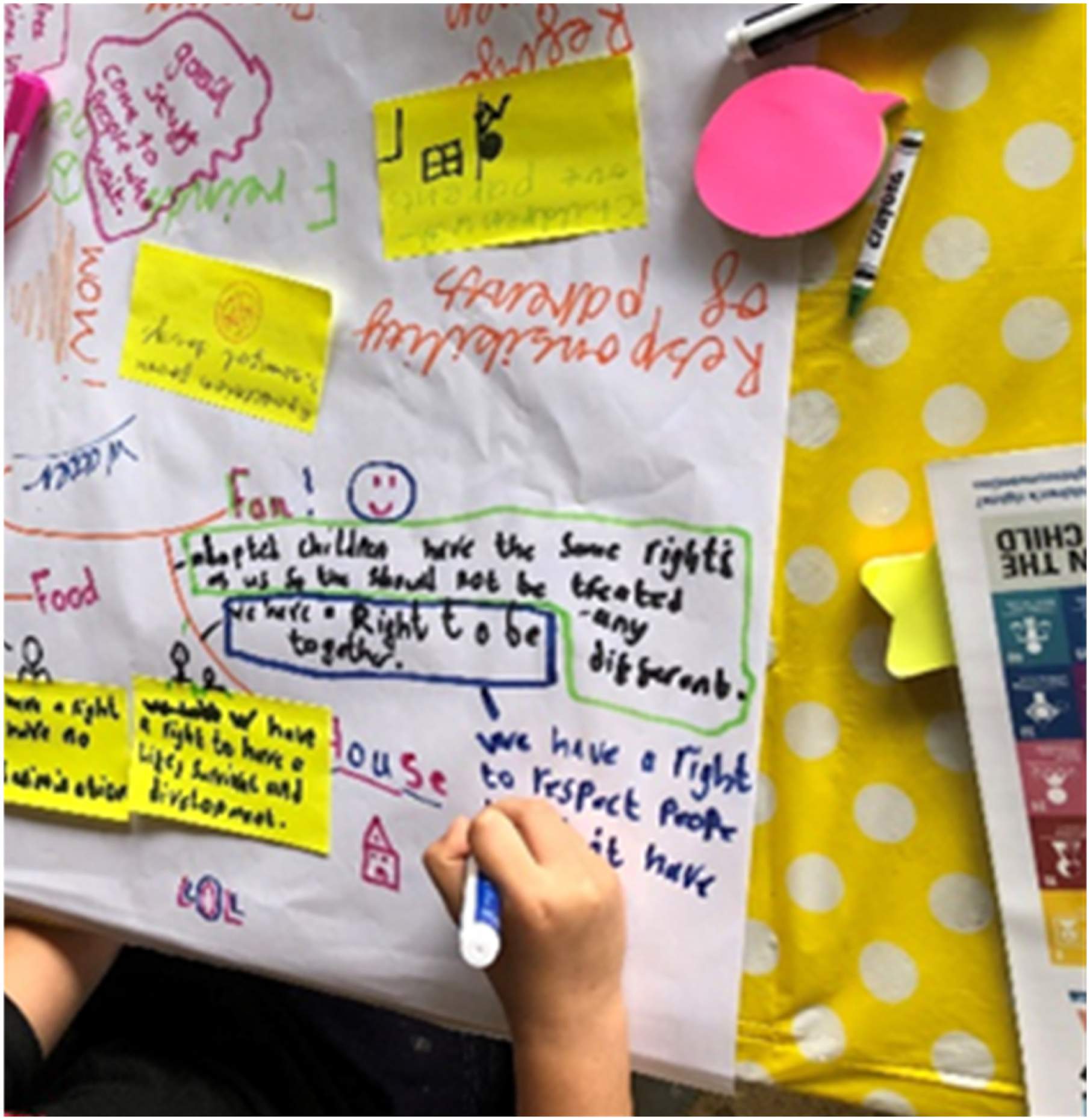
Ideas continued to connect through events around the central areas of family mattering to children and of equality for children living away from home, alongside respect. Children dialogued about how other children on the island can be supported in their families, including fundraising for needs, how they could be nice to other children, alongside what rights were important to them. As such, primary-aged children expressed that they wanted to be active agents in supporting other children, but not alone. Conversation for younger children included the responsibilities of parents to keep children safe and to make sure all children had ‘a roof over their heads’. Within such debate, the possibility of TWC method supporting education as a driving force to expand democratic public life was apparent, linking civil and moral practices towards what Freire refers to as ‘a practice for freedom’ (Giroux, 2010:715). As the events progressed one teacher was taken aback saying ‘I have never seen the children so focused, even **** I can never get him to focus’ The freedom to stand and interact both verbally and on paper appeared to support inclusion as children both supported each other and moderated conversations. Equality and diversity emerged as a central category in all three primary school events with children discussing challenges to open spaces, exposure to inappropriate adult behaviours and supporting vulnerable community members as most important to them Figure 2. Graphic recording from primary school events.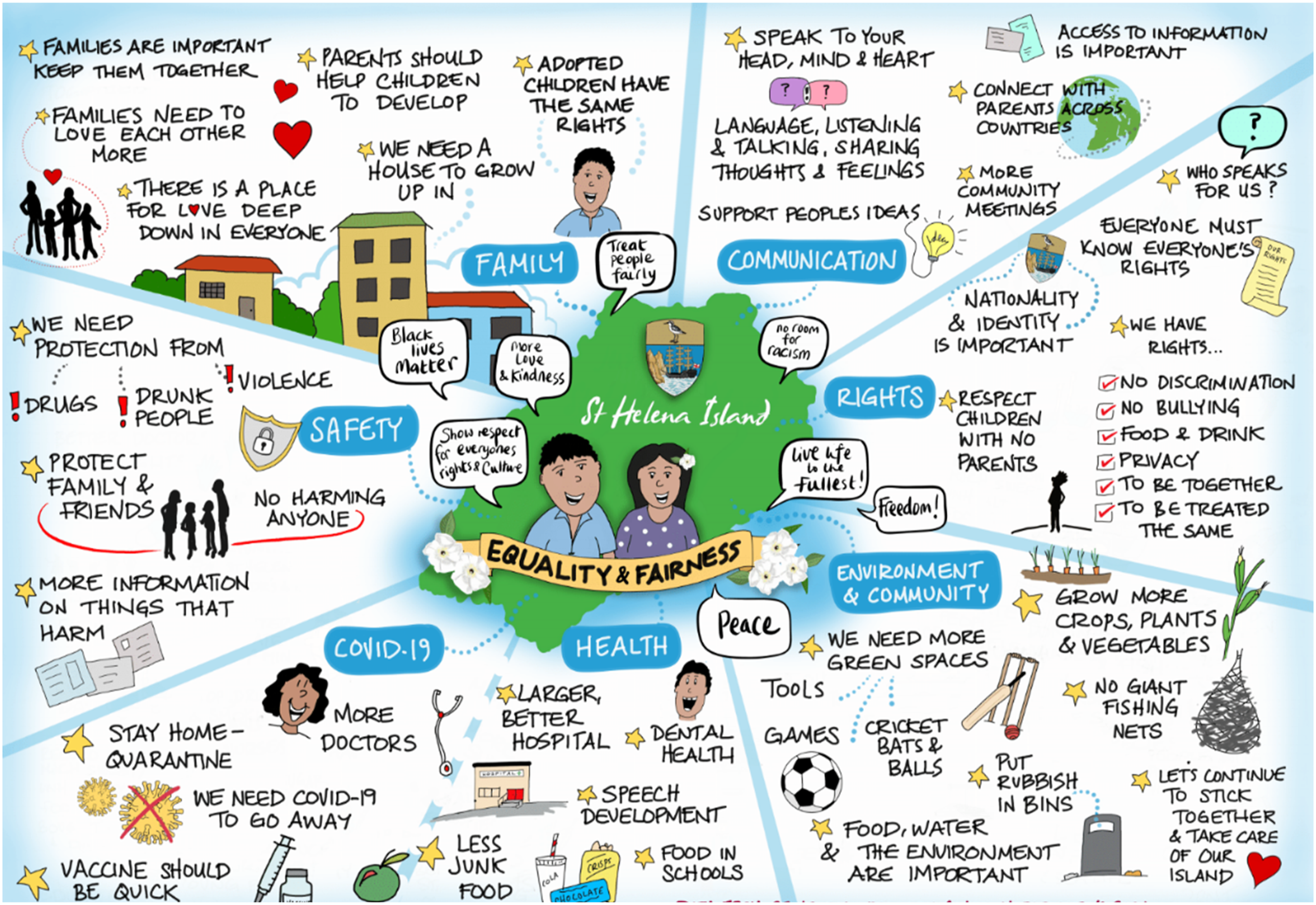
The main event took place in a community venue in February 2021 and was held in collaboration with several young people and local volunteers. During the planning phase, it became evident that while primary school children showed motivation to attend and engage in discussions within their schools, identifying motivation among older children posed a greater challenge. As stated by one professional: “You won’t get the kids to go, some will, the usual ones. I worry that the harder-to-reach ones won’t attend; they don’t like talking.”
There was a risk that selecting a group discussion method might discourage less articulate or confident individuals from attending and participating (Adler et al., 2019). Holding the event in the community did pose physical barriers for many children, with limited access to get to the event. While TWC was important in the research project, for young people it could be positioned as polluting their free time.
In total, 37 children and young people participated in the main event. During the initial round, conversations appeared superficial, and responses such as ‘what is it she wants us to say’ were swiftly followed by older children providing guidance to shape the younger children’s answers. The Café rules suggest that hosts should not direct conversation (Brown and Isaac, 2005), but asking young people who were hosting to adhere to this did not happen, they began asking additional questions of younger children to encourage their inclusion. Initially, there was concern that this would impact on the data collection. However, this event was planned with young people for their island children. Letting go of researchers’ anxieties was required to enable children and young people to facilitate the event how they wanted. After a while, discussed began and appeared to flow not dissimilar to the primary school events, albeit hesitantly, Well, I know what harm is. I know of someone who was harmed, but I can’t say what needs to happen to keep children safe. They don’t want to know that. We know it, but I’m not writing it down. What us put is a playground.
As they entered the second round, children began to speak more freely, and discussions on education and feelings of inequality brought together younger and older participants. By the third round, younger children proactively sought guidance from their older counterparts on topics such as the internet, online safety, and dealing with bullying. This assisted less confident children and children both moderated and supported each other. Discussions deepened, and children addressed central themes they collectively deemed important. As such while a deviation from the method, older children contributions in supporting less confident children supported dialogue. The cross-pollination of ideas persisted during the main debate, where children discussed inappropriate online contact and how limited internet access hindered their learning and communication abilities.
Concerningly for professionals on the island through the rounds, most children admitted to being exposed to inappropriate online content or contact, yet none had reported it to adults. The conversation continued even after the event, as children remained to exchange ideas on keeping themselves safe and warding off unwanted online attention, completely disregarding the presence of audio equipment. Younger children continuing to seek guidance from older children and young people, suggested that the setting provided opportunities for children to discuss topics of interest. While the structure of the Café facilitated the progression of these discussions into critical ideas, informal conversations allowed practical advice from trusted young people to support children to keep each other safe Figure 3. Graphic recording from main world café.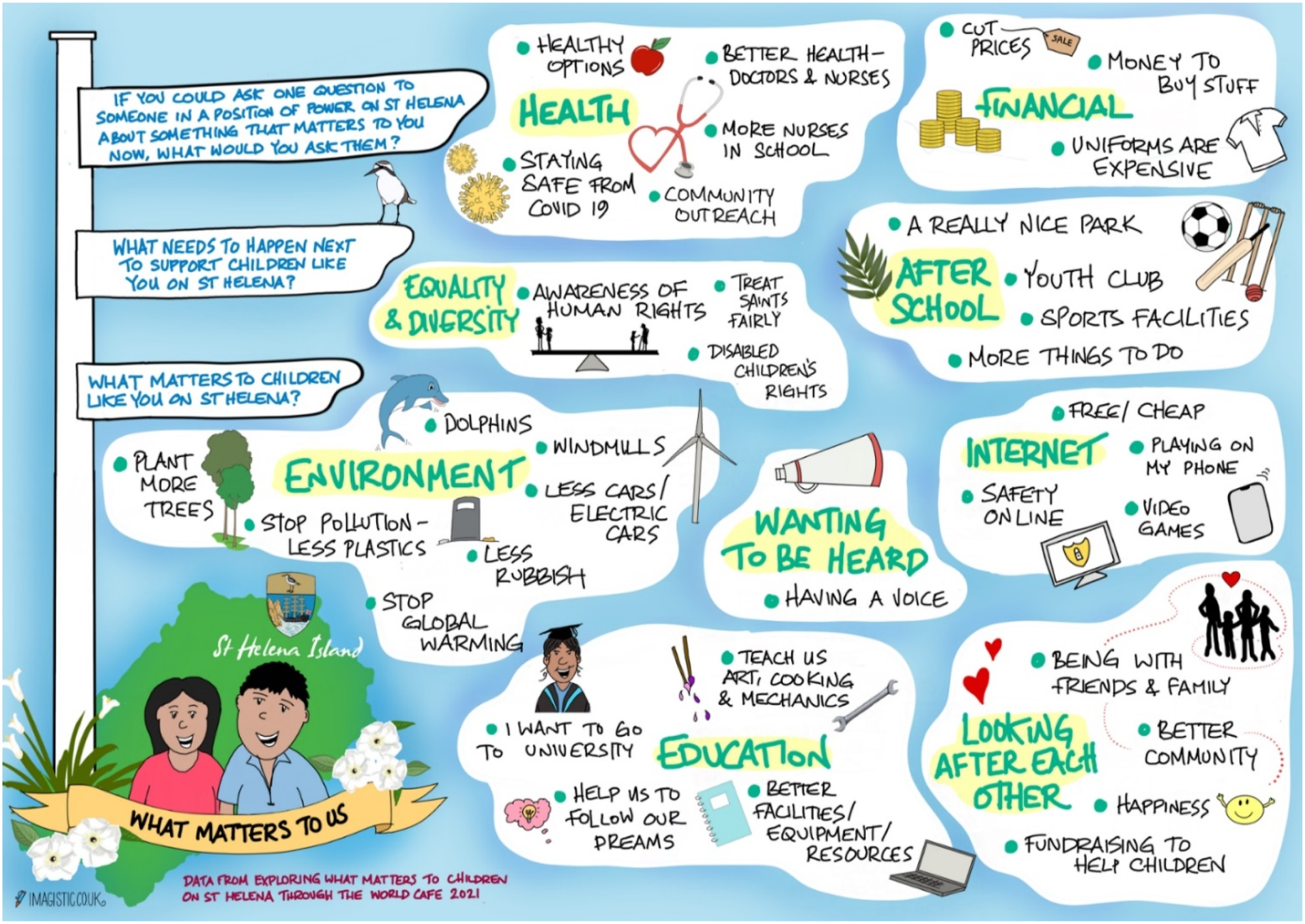
A final World Café was held with a further 37 children within the secondary school. It was hoped this event would cement earlier positive findings from primary schools within a similar age group. Having choices and experiencing discrimination were predominant categories in the secondary school event. Dialogue across tables indicated young people’s discontent about feeling unheard in education and the community, leading to the perceptions that their rights were being sidelined: I mean, just sitting and listening, we don’t learn. I like this way. Adults need to listen to us more. Adults have more rights, they input on our choices: we need more choices, I need a voice. This is the bestest learning ever – we need more talking about us. (Secondary Café: Table four)
While Freire (1970) advocates the need for wholesale reforms for oppressed peoples, for these young people it was the lack of access to crucial tools to feel connected and to learn, (such as the internet) alongside a growing awareness of their marginalised position in decision-making, which dominated conversations. TWC provided a forum for these voices to emerge, but unlike the positive emergence in the primary school and within the main event, the secondary school event also showed children had internalised negative representations of each other from the community.
In a conversation about bullying, children discussed what could be done to support while simultaneously excluding from a discussion another child they perceived as an outsider to their culture. This may have been due to the timing, circumstances or group dynamics, but this encounter also provides researchers with a warning that the method does not completely eradicate the possibility of harm between children from arising. Freire (1970) reminds us that there must be a balance of reflection and action for transformation, also though that horizontal violence is not uncommon in oppressed persons, as they struggle to navigate choices (ibid). At time of the secondary school Café, tensions of quarantine on the island had created division over place and belonging. But at the same time children continue to dialogue towards how they could achieve their aspirations, although largely concluding that this required them to leave their island. With a sense of resentment, they talked about the position of privilege outsiders have and their own limitations educationally and financially on their island. Far from being passive recipients of knowledge as previously portrayed (Schulenburg, 2002; Cohen, 2017) children’s determination showed internal motivations and a desire for change for their island. The Café therefore still enabled conversation which brought forward debate and consideration of different possible futures.
Conclusions
The findings of this study contribute to the limited body of literature and primary research on St Helena Island, shedding light on the voices and perspectives of children and young people in this unique context. The project’s initial findings highlighted the importance of how children learned what mattered to them, shaped by experiences and their environment. However, instead of providing a fixed reference point, TWC allowed children to engage in dialogue and develop their own evolving understandings, allowing their voices to emerge, develop, and critical discussions to be held. This holds possibility for other children in remote communities whose unique experiences and perspectives need creative platforms to be brought forward.
As a methodology, TWC allowed for dialogue and the development of evolving understandings, enabling children to express what mattered to them through emerging authentic voices. The study revealed common themes among the participating primary schools, centring around desires for equality and diversity, and showcased the motivation and positive aspirations of the children in discussing daily matters. But older children exhibited a level of hesitation or resistance to open conversations, which underscored the importance of understanding the historical and current oppression faced by children on the island as their situation living on an island which was neither colonial nor post-colonial continued a level of forced dependency (Royle, 2019).
As a method that fosters energy, children in primary events spoke up, talked, moved, and drew in ways they chose, gaining control over their learning environment. Children in secondary school showed increased awareness of inequality at a personal level projecting this to others, leading to the exclusion of certain children. This draws attention to the fact that events require careful support for vulnerable groups and highlights potential limitations of inclusion. Despite these challenges, events facilitated movement, empowering children to express their thoughts through drawing and dialogue on self-selected issues. In the main event while the presence of mixed-age groups initially posed challenges to dialogue, the continued discussions after the events demonstrated that the Café served as a platform for important conversations, particularly around online safety.
Throughout the study, the significance of power and the researcher’s role were emphasised. The critical pedagogical foundations of the methodology drew attention to the positions of the researcher, the island, and the disadvantaged social position of children on St Helena. By supporting young people in leading these events, it was acknowledged that educators’ and researchers’ influence needed to be reduced, to allow children to process and develop their own ideas. Although the active involvement of young people in the main event exceeded boundaries set by Brown’s (2001) method, giving voice to children on St Helena through TWC allow for critical discussions led by the children themselves. A risk for a project relying on one method, but a necessary ethical step.
Handing over power to children in facilitating the events allowed for dialogue to be led by them, showcasing the advantages of employing critical pedagogical methods to increase children’s confidence and ability to learn from each other in a safe environment. The clear potential to further this with children to increase motivation, most notably for children who are positioned through no fault of their own, in struggling to engage with a curriculum fully with was clear.
In future research, it is recommended to explore the long-term impact of World Café events on children’s agency, well-being, and engagement with their communities holds possibility to link the methods community beginnings to current social development concerns and potential. This could inform policies and practices that better recognise and amplify the voices of children in research and decision-making processes not only on St Helena but beyond. Creating inclusive spaces for dialogue and learning remains essential to ensure the participation and empowerment of children and young people in research and to increase the ability to see more authentic voices.
Footnotes
Acknowledgements
The authors want to acknowledge the contribution of the St Helenian community and the St Helena Research Institute alongside the Human Rights Commission for their valuable contributions to this project and article. Graphic illustrations and recordings by Emma Paxton.
Declaration of conflicting interests
The author(s) declared no potential conflicts of interest with respect to the research, authorship, and/or publication of this article.
Funding
The author(s) received no financial support for the research, authorship, and/or publication of this article.
