



Abstract
Summary:
From being sexually/criminally exploited by adults in public spaces, to being sexually or physically harmed by peers in their schools, young people are significantly harmed beyond their families. Historically, many of these children have been criminalised rather than protected, and despite mounting concern from governments, and efforts at structural reform, many countries still struggle to offer welfare-orientated responses that effectively target the contexts where such harm occurs. In this paper we use cumulative evidence from four projects within a multiyear research programme to surface cultural factors that hinder or facilitate the development of welfare-orientated and contextual responses to extra-familial harm.
Findings:
We analyse nine published outputs from these four projects using a synthesis of Schein's theory of organisational culture and the ‘cultural rules’ of Contextual Safeguarding, developed through an application of Bourdieu's social theory. The results of our analysis locate cultural misalignment not solely within the social work and wider child welfare organisations that participated in the project, but in the underlying assumptions of the systems in which those organisations are based. Consequently, we illustrate why seemingly ‘common-sense’ responses to young people in need of protection are complicated to enact.
Application:
To resolve such complications, we argue that victim-offender binaries, individualised outcome measures, and the relationship between state and parental responsibility, require reconceptualization in the design of child protection systems and research; and in the interim, offer four questions organisations can ask themselves to test, for the first time, their cultural readiness for adopting a contextual approach to extra-familial harms.
Introduction
In 2001 the UK Government commenced its response to extra-familial harms (EFH) via safeguarding guidance on child sexual exploitation. Despite further internationally recognised policy reform spanning over-twenty years (Shawar et al., 2022), many young people in the UK remain unsafe in extra-familial contexts (MacAlister, 2022) including being, exploited sexually or criminally (including via drugs harvesting/transportation), sexually harassed by peers in schools and youth-settings, physical abused in their romantic/dating relationships, or encountering weapon-enabled violence in public spaces (Radford et al., 2015; United Nations, 2022). Challenges in responding to EFH have been documented beyond the UK, in the US, Australia and European countries (de Vries et al., 2025; Fukushima et al., 2020; Gregulska et al., 2020), despite a context of significant policy reform (Economist Impact, 2022), various practice innovations (Firmin et al. 2022; O'Brien et al., 2022), and a body of dedicated youth work and social work practitioners who support young people. This article argues that one factor complicating the implementation of effective responses to EFH around the world is found less in the structural design of systems/organisations in which these practitioners work, and more in cultures that underpin those systems/organisations. We define organisational culture as: a pattern of shared basic assumptions that the group learned as it solved its problems of external adaptation and internal integration, that has worked well enough to be considered valid and, therefore, to be taught to new members as the correct way to perceive, think, and feel in relation to those problems. (Schein, 2016, p. 6)
Background
Extra-Familial Harm: An International Struggle to Mount an Effective Response
Around the world an estimated 400 + million children are exposed to child sexual exploitation and abuse annually (Economist Impact, 2022) and over 193,000 homicides occur among youth aged 15–29 years (WHO, 2024). The nature and prevalence of these harms have received growing attention over decades, with mounting pressure for effective responses (UNDOC, 2022).
A key driver of reforms in this field has been recognition that a) these issues often escalate in extra-familial contexts (de Vries et al., 2025; Firmin, 2020) and b) the young people affected have often been framed as ‘delinquent’, ‘absconders’ and ‘risk-takers’ – and duly punished rather than protected (Baidawi et al., 2020; Marshall, 2023; Musto, 2022). In response, governments including the US, UK, and Australia have sought to shift from justice towards welfare-orientated responses to EFH (Firmin & Lloyd, 2022; Fong & Cardoso, 2010; Victoria Government, 2017). However, the systems used to achieve this were not designed to facilitate such a practice shift.
Western child protection systems, while variable in approach, were predominantly designed upon ideas that include a) the state intervenes to protect children when their parents/carers are at fault (yet in many cases of EFH parents/carers are not the primary source of harm); b) child protection systems intervene with young people and their parents/carers (not the extra-familial contexts where EFH occurs); and c) there is a clear divide between victims and perpetrators (whereas young people affected by EFH often harm others while being harmed) (de Vries et al., 2025; Firmin, 2024; MacAlister, 2022; Merkel-Holguin et al., 2019).
Such misaligned system-design has rendered it challenging to recognise young people, commonly framed as a risk, to be at risk; and young people have been inadvertently controlled, constrained or punished by systems charged with their safety (Baidawi et al., 2020; Marshall, 2023). For example, in some situations, young people are moved into residential care (including when families are protective) or placed into secure settings and deprived of their liberty, to remove them from exploitative contexts and relationships (Aussems et al., 2020; Crowe, 2024; Pullmann et al., 2020). Some young people are criminalised for prostitution or immigration related offences (Gregulska et al., 2020; Pullmann et al., 2020). Other young people are screened out of statutory systems and rely on non-governmental organisations (NGOs) for support (Hood et al., 2023; Lloyd & Firmin, 2020). These challenges are exacerbated for young people who are racially minoritised, have insecure immigration status, or instigate criminal activity in the context of their own victimisation (Degani et al., 2015; Lloyd et al., 2023).
Responses to contexts and relationships where EFH occurs have shown promise: for example, bystander and location-based interventions in schools (Foshee et al., 2014), or community guardianship in public spaces (Perdue et al., 2012). However, these interventions are often developed/delivered outside, rather than as a formal part, of child protection systems; with the latter predominantly focused on young people and not contexts affected by EFH. ‘Contextual safeguarding’ is one response to these challenges (Action for Children, 2024).
Contextual Safeguarding: A Brief History
The term ‘Contextual Safeguarding’ was coined after a review of nine cases in which social work assessment and intervention targeted individual young people impacted by EFH, and their families, but not the extra-familial contexts where harm had occurred (Firmin, 2017a). Following publication of the Contextual Safeguarding conceptual framework in 2017 (Firmin, 2017b), a first whole-system implementation was attempted in the UK 2017–2019 (Lefevre et al., 2023), and learning scaled into nine further test locations from 2019–2022 (Firmin & Lloyd, 2022). These pilots featured social work organisations that could receive referrals for contexts associated with EFH, and offer a welfare-orientated response to those contexts, as well as support young people unsafe within them; parallel pilot-studies in schools and youth-facing organisations ran simultaneously (Lloyd & Walker, 2023; Walker et al., 2025).
In this programme of work we prioritised structural reform. We worked with organisations to: amend the meetings/policies they used in response to EFH; create processes for practitioners to identify and respond to peer groups or places where EFH occurred; and update organisational recording systems so that practitioners could document the contextual features of said harm. Such structural changes yielded some success. For example, action research projects that: utilised ‘Family Group Conferencing’ methods familiar to child protection systems to undertake ‘community conferencing’ and coordinate networks to build safety in extra-familial locations/groups (Owens & Bradbury-Leather, 2025); or redesigned child protection meetings to focus on extra-familial contexts where young people are unsafe, with parents as partners in, rather than the subject of, proceedings (Firmin, 2024). These progresses were scaffolded by changes to child protection guidance in England (HM Government, 2023), Wales (Welsh Government, 2021) and Scotland (Scottish Government, 2021), which gradually required welfare-orientated responses to young people who experience EFH.
However, our data suggested that the same structural changes produced different results when operationalised in different services (Firmin & Lloyd, 2022). For example, some social work responses to peer groups were dominated by activities to map and monitor young people's associations, rather than support them as a group of friends to understand, and meet, their collective needs (Firmin, 2024; Lloyd et al., 2023). In these situations, efforts to reimagine systems/organisations via structural redesign were premature and missed a critical first step. We failed to appreciate that contextual safeguarding would likely require a cultural shift (how things were done) not merely a structural one (what things were done). While parents and carers have told us that Contextual Safeguarding feels like common sense to them; a decade of testing reveals that in the contexts of cultural misalignment common-sense can be complicated.
In the UK, these divergent results reflect broader features of children's social care where New Public Management methods dominate, prioritising managerialism and target-oriented practice that distances practitioners from the complexity of human lives/relationships (MacAlister, 2022). Related to this, social workers across the UK and internationally are navigating increasingly complex situations, leading to burnout, poor staff retention, and social workers reporting poorer outcomes for service users (McFadden et al., 2024). In this context, innovative and resource-intensive systems change has clear structural and systemic challenges.
Now that contextual safeguarding is embedded in national policy, adopted by over 90 local authorities in England, Wales and Scotland, and is being tested in NGOs in Europe, Africa and Australia, it is critical that we better understand and address these complications.
Methodology
The Dataset
We are part of a team who since 2013 completed 23 studies on contextual approaches to EFH, using predominantly qualitative, action-research methodologies to co-produce knowledge with practitioners and service leaders. We selected four of these, and all outputs published from them (n = 9), for inclusion in this article. These four studies offer differing sector or geographical perspectives on the implementation of Contextual Safeguarding at an organisational level, and were led by us (as members of the Contextual Safeguarding team):
Study 1 – Scale-Up: An action research project (2019–2022) to embed Contextual Safeguarding in five statutory children's social care organisations in England and Wales: Article 1 (Firmin & Lloyd, 2022); Article 2 (Lloyd et al., 2023); Article 3 (Owens & Lloyd, 2023); Article 4 (Owens & Bradbury-Leather, 2025). Study 2 – Planning for Safety: A two-stage study (2021-2022 and 2022-2023) conducted with three statutory social care organisations in England to pilot alternative child protection pathways for children at risk of significant extra-familial harm not attributable to (in)actions of their parents/carers: Article 1 (Firmin et al., 2022); Article 2 (Firmin & Manister, 2023); Article 3 (Firmin, 2024). Study 3 – Contextual Safeguarding Across Borders: A study (2021–2023) testing the relevance of Contextual Safeguarding approaches beyond the UK through action research with non-governmental voluntary and community sector organisations in Germany and Tanzania: Article 1 (Wroe et al., 2023). Study 4 – Towards Safety: A study (2021-2022) with three youth-facing NGOs in England, exploring the levers and barriers for creating contextual safety in faith, sports, and general youth settings: Article 1 (Walker et al., 2025).
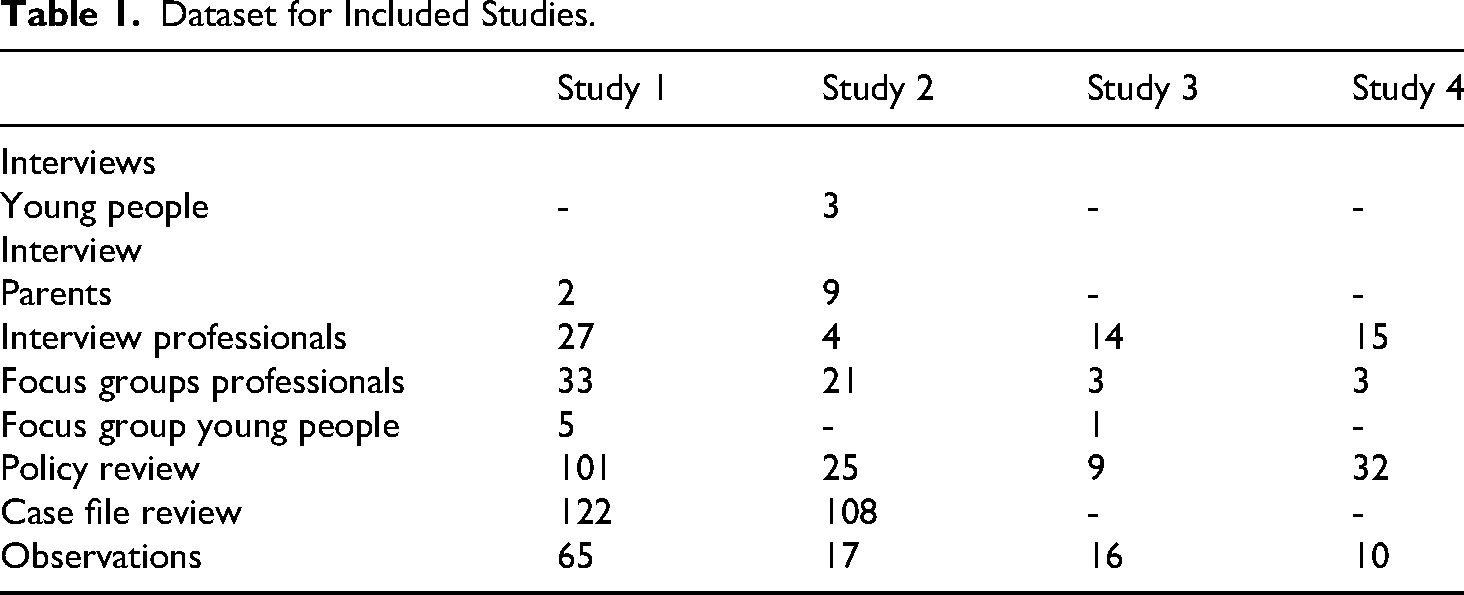
Each of these studies explored how organisations responded to, or created contexts that were protective against, EFH and we documented their work via a range of methods (Table 1) including: focus groups and interviews with young people, parents and professionals; reviews of organisational policies, procedures and recording systems; observations of meetings between professionals as they coordinated or reviewed responses; and reviews of social work assessments of, and plans for, young people and contexts. We worked with professionals in these organisations to: understand what our data suggested about their approach; identify alignment between their approach and contextual safeguarding; and, in three of the four studies (1, 2 and 3), document their efforts to increase this alignment by piloting and embedding changes to organisational structures.
Dataset for Included Studies.
Analysis
The primary results of the structural changes achieved by organisations in each study have been published across the nine articles listed above. For this study we analysed this body of work to identify what it collectively evidenced about organisational cultures that facilitate or hinder Contextual Safeguarding approaches. To do so we created an analytical framework that synthesised Bourdieu's meta social theory as applied to Contextual Safeguarding and Schein's levels of workplace culture.
The lead author of this article theorised the cultural ‘rules’ of Contextual Safeguarding, using Bourdieu to articulate both the contextual dynamics of EFH (the rules at play in the social fields – young people's peer relationships, school and neighbourhood contexts – where EFH occurs); and professional responses to EFH. This process highlighted the rules of systems in which social work, education, and voluntary sectors practitioners responded to EFH, the habitus of those practitioners, and the capital available to them (Firmin, 2020; Firmin & Manister, 2023). By viewing early efforts to adopt Contextual Safeguarding (Firmin, 2020) through this lens, Firmin identified six ‘rules’ of individualised child-and-family-focused child protection systems (as present in cases analysed to first coin the term), compared to the rules practitioners tried to embody in the first Contextual Safeguarding pilots (Figure 1).
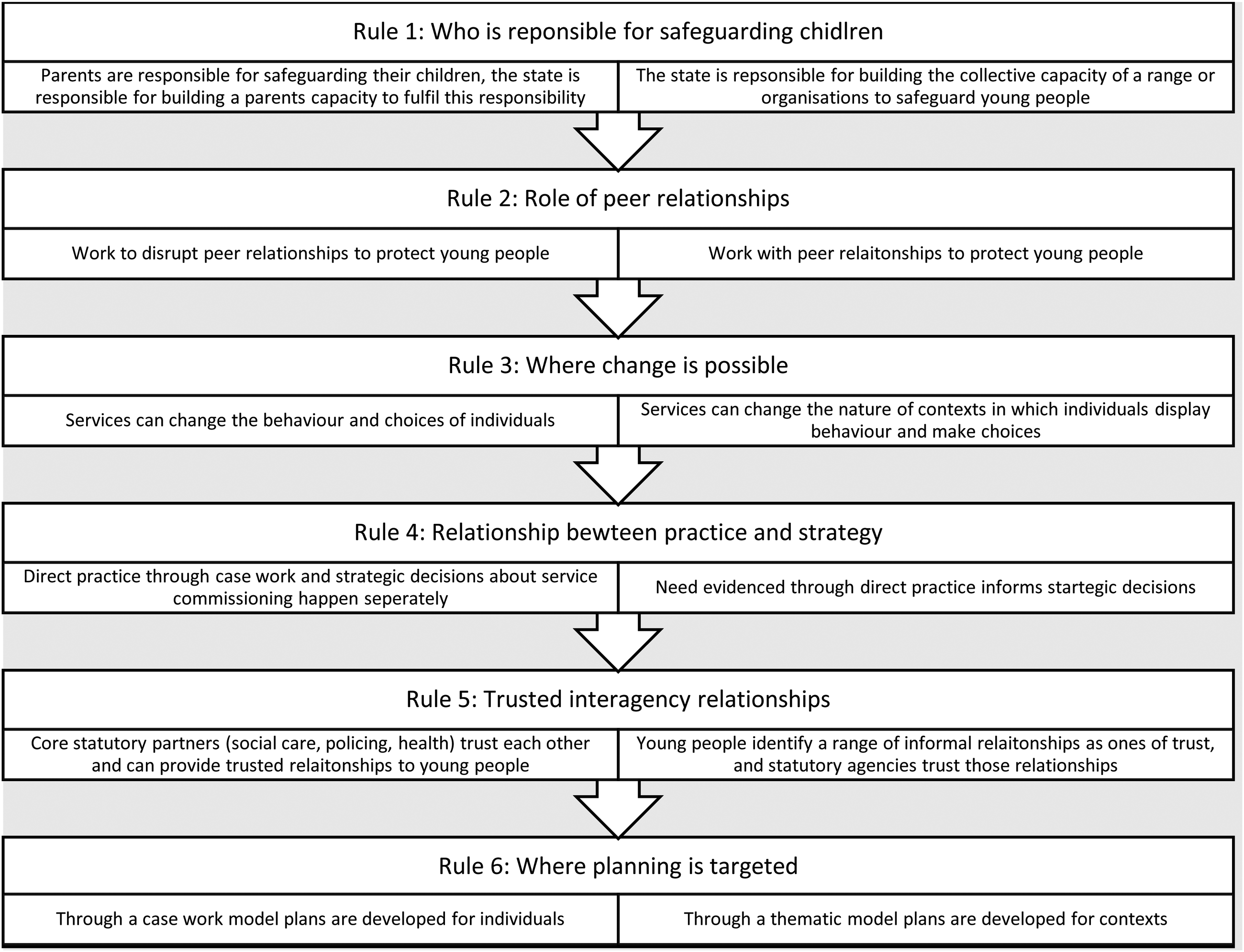
Six ‘rules’ of child protection rewritten by contextual safeguarding.
For this study we converted these six rules into four questions to ask of our dataset. We used these questions to assess the extent to which participating organisation provided conditions in which practitioners could embody the ‘rules’ of Contextual Safeguarding systems:
How do they frame state responsibility in respect of young people's safety? (Rules 1, 5). How do they perceive young people and their social relationships? (Rules 2, 5). Do they look beyond individuals when describing, or responding to, extra-familial harm? (Rules 3, 4). Do they respond to extra-familial harm in a way that suggests they believe contextual change is possible? (Rules 3, 6).
We answered these questions by mapping findings against Schein's three levels of workplace culture:
− Artefacts: products that described how organisations worked (in our dataset these included policies, assessment templates and meetings structures). − Espoused beliefs and values: how members of organisations explained what they do and why (documented through interviews and focus groups, coproduction workshops and observations of meetings/trainings). − Basic assumptions: how groups defined who they are, how to behave and how to feel (documented through our engagement with professionals and our ongoing knowledge of the wider systems within which they work).
Using Schein's framework for organisational cultures and the Bourdieusian ‘rules’ of Contextual Safeguarding and child protection, we created a template to document the artefacts, espoused beliefs and values, and underlying basic assumptions of participating organisations and their alignment to Contextual Safeguarding.
Ethics
All studies received approval via Sociology Department ethics panel at Durham University. Participants gave informed consent across various activities including professional observations (opt-out consent), observations including young people and parents/carers (opt-in consent), reviews of redacted organisational documents and interviews or focus groups with practitioners, managers, and service-users (written opt-in consent followed by verbal consent). We preserve anonymity of participants by writing results thematically rather than by organisation/location. We prioritise an ethical approach to dissemination, ensuring all findings from peer-reviewed publications are converted into practice/policy resources to support implementation.
Findings
We present our findings in three stages:
− Stage 1: We use two examples from the featured studies to illustrate how we identified alignment with the rules of Contextual Safeguarding in relationships between artefacts, espoused beliefs and values, and basic underlying assumptions of participating organisations. − Stage 2: We detail how these illustrative examples were represented across the four studies through thematic answers to the four analytical questions used in this study. − Stage 3: We summarise the Stage 2 thematic analysis in tabular form to articulate the basic assumptions that organisations require for the artefacts they use, and espoused beliefs of their staff, to create a culture facilitative of Contextual Safeguarding.
Stage 1: Illustrative Case Studies
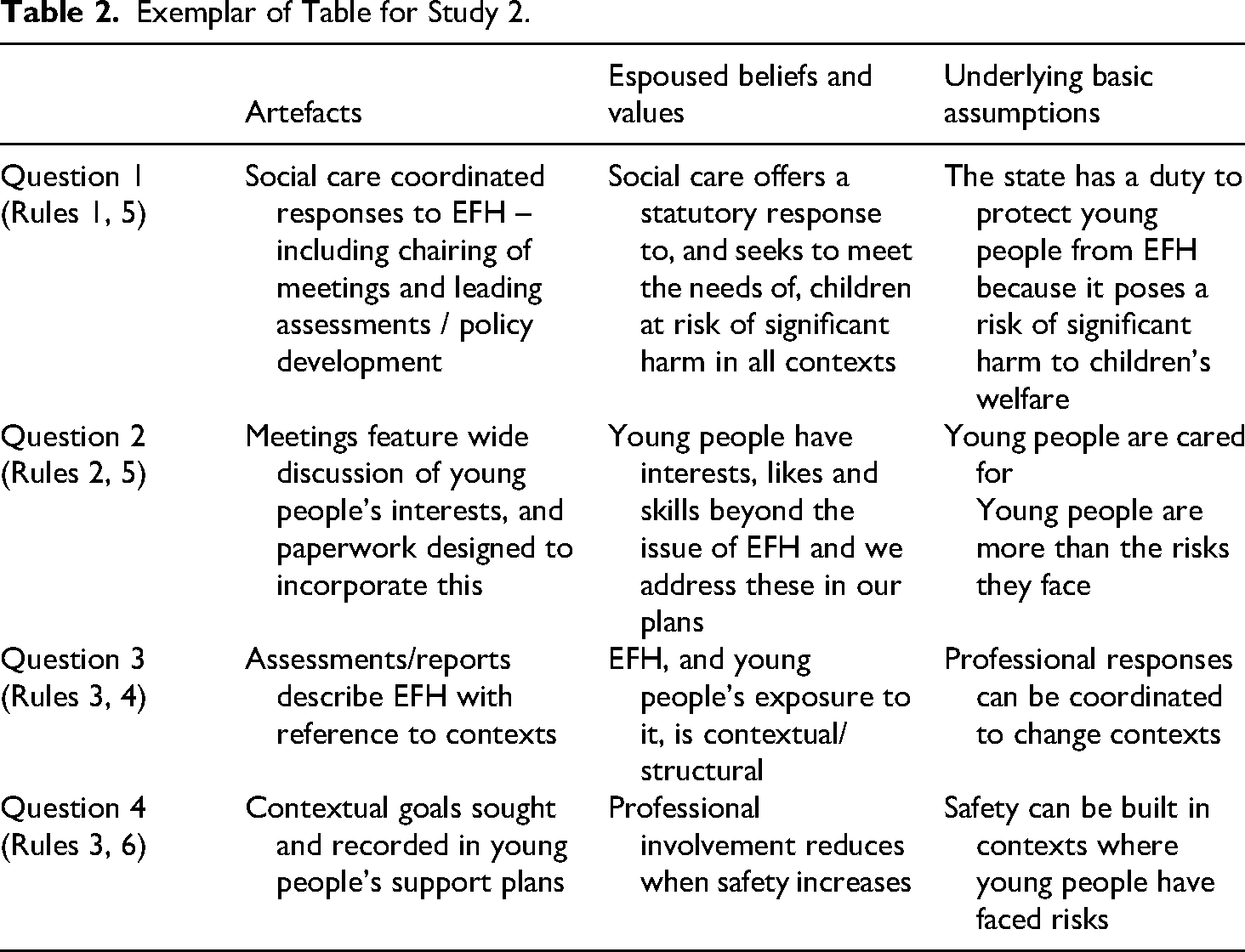
In Planning for Safety (study (2)), organisations gradually redesigned their child protection procedures to respond to significant/severe instances of EFH. This included introducing a new meeting in which professionals identified contexts where young people were unsafe, and collaborating with young people and parents/carers to agree how agencies could build safety in those contexts.
This new meeting structure demonstrated that participating organisations believed the state had a duty to safeguard young people from EFH using child-welfare services (Rules 1, 5). Meeting chairs challenged language that held young people, or their parents, responsible for EFH, and encouraged colleagues to recognise young people's strengths and vulnerabilities (Rules 2, 5). Meeting observations demonstrated how professionals recognised, and sought to address, the contextual dynamics of EFH, and were frustrated when this seemed unfeasible (Rules 3, 4). Professionals coordinating the redesign process viewed these meetings as a vehicle for illustrating that contextual change should be possible (and for investing in interventions to achieve this) (Rules 3, 6); however, for most this remained aspirational. We documented the artefacts that communicated this structure, the beliefs and values of those involved in testing it, and the basic assumptions of the organisations that used. Table 2 shares an extract of what we produced.
Exemplar of Table for Study 2.
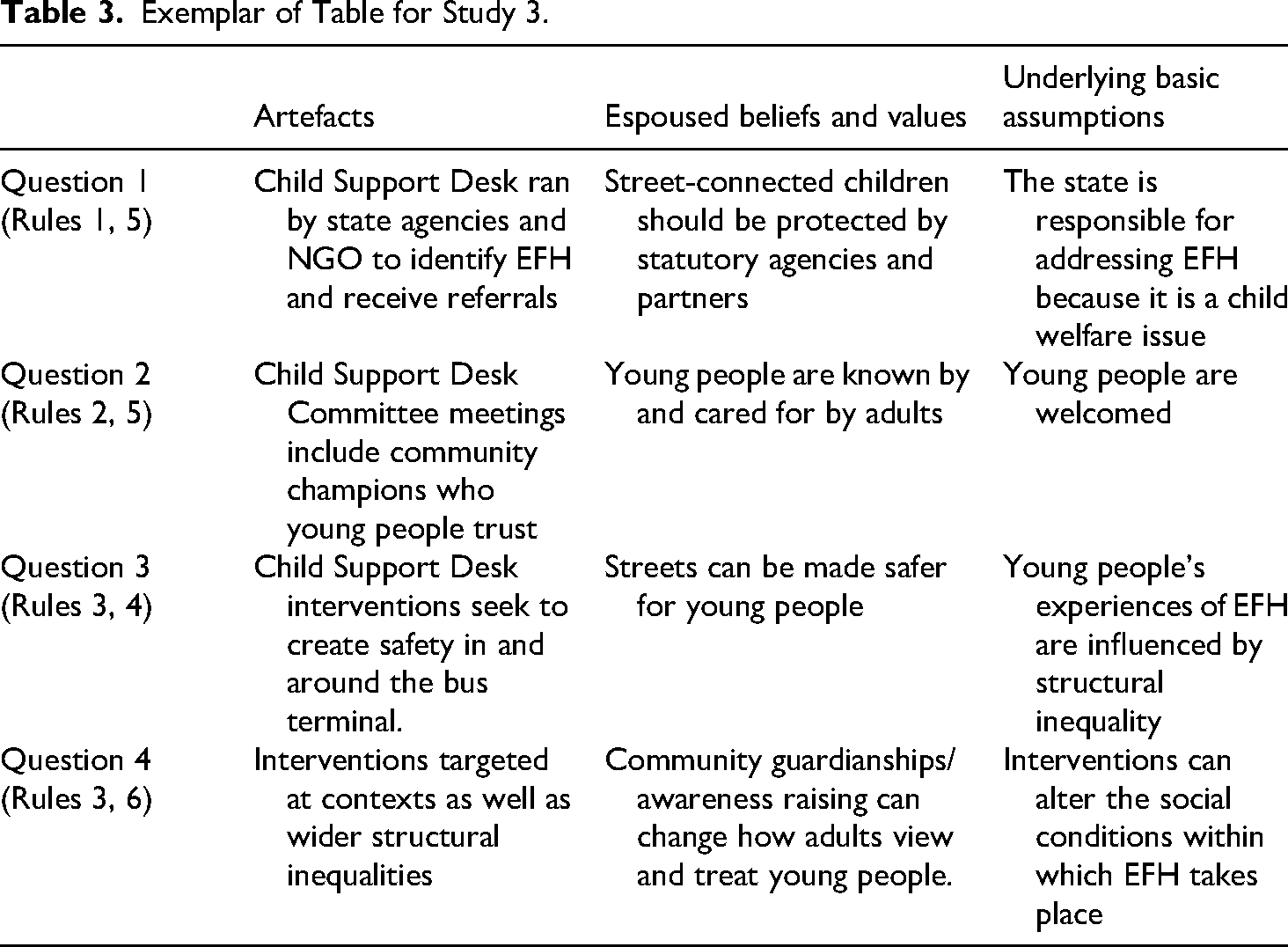
In Contextual Safeguarding Across Borders (study (3)), a participating NGO in Tanzania deployed outreach youth workers into transport hubs to support ‘street-connected’ young people and partnered with local stakeholders to create safety in/around a bus terminal. Young people travelled to this city searching for means of survival and ended up working/living on the streets, where they were exposed to EFH. The NGO established a ‘Child Support Desk’ in the bus terminal, co-run with the social welfare agency and police, to identify and support young people. The NGO also supported ‘community champions’ – adults working in/around the bus terminal, i.e., bus drivers and shop vendors. Young people had identified them as adults who helped them, for example, by giving them food, caring for them during illness or reporting safety concerns. The NGO trained community champions and invited them to join a committee with stakeholders from their Child Support Desk to address safeguarding concerns.
By facilitating partnerships between statutory agencies and community guardians, the Child Support Desk offered a new structure that centred relationships and built safety in/around transport hubs, rather than dispersing young people away from them (Rules 1,5). The NGO promoted community guardianship by building on existing trusted relationships that young people identified and advocating for the protection needs of ‘street-connected’ young people (including those engaged in criminal activity resulting from exploitation) who were viewed as criminal and antisocial (Rules 2,5). These interventions targeted the community contexts in which EFH occurred (Rules 3,4) seeking to change the nature of those contexts by advocating for inclusive attitudes to young people and supporting protective adults (Rules 1, 6). We documented the relationship between the artefacts that communicated this structure, the beliefs/values of those who tested it, and the basic assumptions of the organisations involved. Table 3 shares an illustrative extract:
Exemplar of Table for Study 3.
Stage 2: Thematic Answers to Four Analytical Questions
We deepen our account of these illustrative examples through a thematic analysis of the four completed tables, organised under answers to the four study questions.
Question 1: How Did the Organisations Frame State Responsibility in Respect of Young People's Safety?
Organisations that recognised state responsibility to a) respond to EFH, b) protect/safeguard young people affected, and c) offer welfare interventions into contexts impacted by EFH, held basic underlying assumptions conducive with contextual safeguarding. When organisations faltered on any of these grounds, their capacity to adopt Contextual Safeguarding was compromised.
In Studies 1 and 2, participating statutory social work organisations developed this perspective. In 2019, many framed state-responsibility for young people's safety with reference to parenting capacity: the state had a duty safeguard young people from EFH when parents were unable to: … the rationale for continued social work involvement in these cases was to address the ‘risks’ posed by parents rather than risks of EFH – or assumptions that decreasing the former would impact the latter. (Study 2, Article 1, 2020, p. 12) the social workers and partner organisations focused on the context(s) in which young people were at risk of harm, as opposed to the (in)action of parents. Parents/carers attended the meetings as safeguarding partners. (Study 1, Article 1, 2022, p. 8)
NGOs in studies 3 and 4 also believed that states had a duty to protect young people from EFH. Some demonstrated this through artefacts (i.e., policies) that required them to refer individual young people affected by EFH into child protection processes. Others saw their role as advocating for state intervention into contexts where young people spent their time.
The answers to whether organisations believed the state's duty was to respond to extra-familial contexts, or solely to young people at risk of EFH, was further identified in views about which arm of the state should fulfil that duty: criminal justice or welfare. Many participating organisations (of partnerships with whom they worked) deferred to the police to respond to extra-familial contexts: There remained multiple examples of how social workers and their partner agencies framed responses via policing and community safety. (Study 1, Article 1, 2022, p. 9)
This appeared to be related to where organisations positioned expertise. Most had little confidence that social workers could influence extra-familial contexts and so deferred to the police who they considered expert in dispersal and disruptive-based intervention (see question 3).
Question 2: How Do Organisations Perceive Young People and Their Social Relationships?
Contextual Safeguarding requires an organisational culture that views young people, and their social relationships, holistically and positively. This was demonstrated by participating organisations in three ways.
Firstly, organisations foregrounded the contexts in which young people faced/posed risks. In statutory social work organisations (Studies 1 and 2) structural changes facilitated this. For example, artefacts such as meetings that explicitly discussed extra-familial contexts impacted by EFH, or assessment forms that prompted social workers to assess safety/harm beyond family contexts, facilitated understandings of young people's behaviour in context. For many practitioners this shift brought them closer to young people's and families’ day-to-day realities: a child protection route…it goes against mum and we’re blaming mum and – and [in the new meeting] just felt like mum was a part of the group and it really felt like we were all trying to share ideas and we were just all on the same page rather than looking at mum (Social worker, focus group 3). (Study 2, Article 3, 2024, p. 13)
Secondly, to view young people positively and holistically, practitioners needed to see them and their social relationships beyond the issue of EFH. NGOs appeared more able to create conditions that facilitated this than statutory organisations, particularly with peer groups: young people's peer relationships were a crucial site of safety building. In Tanzania, young people were encouraged to look out for each other on the street, to form networks of support and to connect new arrivals to the street with support services. In Germany, strong peer group bonds were formed and supported within the accommodation centre as a means of galvanising a positive identity and support network for young people living in segregated environments. (Study 3, Briefing 1, 2023, pp. 3–4)
In organisations that did not view young people, and their friends, holistically and positively, efforts to embed Contextual Safeguarding led to increased intrusion in young people's lives. In multiple meetings observed in Study 2 for example (articles 2 and 3), professionals shared information with each other to map young people's relationships without their involvement, and with little indication that such practices would result in the friendship group receiving support.
Question 3: Do They Look Beyond Individuals When Describing, or Responding to, Extra-Familial Harm?
When describing EFH, most participating organisations looked beyond individuals and recognised associated contexts. For statutory social work organisations, this recognition was incremental, and was demonstrated by amending/introducing structures/practices (artefacts) that asked contextual questions: Sites V and X piloted social-work-led assessments of extra-familial contexts, including peer groups and public spaces, such as streets, beaches, and parks. (Study 1, Article. 1, 2022, p. 8)
Despite most being contextually aware, fewer organisations were able to offer a contextual response to EFH. Many NGOs operated in commissioning contexts that promoted intervention with individuals not contexts: Drug use awareness raising sessions … were offered to support young people in contexts where local drug dealers targeted ‘street-connected’ young people; and awareness-raising sessions on gender inequality and racism were offered to refugee girls. (Study 3, Briefing 1, 2023, p. 4)
Such impact on extra-familial contexts often appeared beyond the reach of child protection teams. In Studies 1 and 2 most social work organisations assessed young people's needs in extra-familial contexts, but relied on criminal justice agencies to change those contexts, citing limited resources/services for their inability to do so: social worker responses featured a reduction in interventions with parents, but this did not equate with an increase in interventions that targeted contextual, system, or structural sources of harm. Participants commented that this was in part due to a lack of relevant responses/services to address the extra-familial factors. (Study 2, Article 2, 2023, p. 13) Professionals made decisions about safeguarding responses that also prioritised young people's need to have fun. They took time to understand what young people liked about the street … people are friendly, playing pool, it is diverse. (Study 1, Article 3, 2024, p. 13)
Question 4: Does the Organisational Response to EFH Suggest They Believe Contextual Change is Possible?
Despite recognising the contextual drivers of EFH, many participating organisations struggled to believe in contextual change.
For NGOs slithers of hope were visible; particularly when they could demonstrate their impact on young people's peer relationships or the places where they socialised: the NGOs we partnered with were all variably working with young people to identify and understand harm in their environments and in some cases delivering interventions that sought to change the nature of those spaces; i.e., by advocating locally for inclusive attitudes to young people and providing training to local business people to help keep young people safe, or ensuring safe and trusted adults were visible and supported…. (Study 3, Briefing 1, 2023, pp. 14–15)
Similarly, when faced with limited resources/partnerships, statutory social workers produced plans (artefacts) to intervene with parents/caregivers when young people were unsafe in extra-familial contexts, or expressed beliefs in their powerlessness: …. In other scenarios, social workers struggled to identify partners and actions that could address the contextual concerns identified during assessment, with one writing that they ‘didn’t know what else to do’. (Study 2, Article 1, 2021, p. 16) A referral was received by the local multi-agency safeguarding panel for a peer group belonging to a minoritised ethnic group at risk of criminal and sexual exploitation within a park. When the lead coordinators consulted young people, professionals and residents, they realised that the social conditions contributing to the harm included very limited access to education. Consequently, the coordinators convened a conference to address two issues: (i) the breakdown in the relationship between agencies responsible for providing services, and (ii) how assumptions and stereotypes about the young people's ethnicity might be playing into the lack of provision. (Study 1, Article 4, 2024, p. 752)
Cumulative Results
The cumulative results of our analysis are summarised in Table 4, illustrating the relationships between artefacts, espoused beliefs and values, and underlying basic assumptions (using Schein's framework) when participating organisations were culturally aligned to Contextual Safeguarding.
Cumulative Learning About Basic Assumptions Underpinning Organisational Adoption of Contextual Safeguarding.
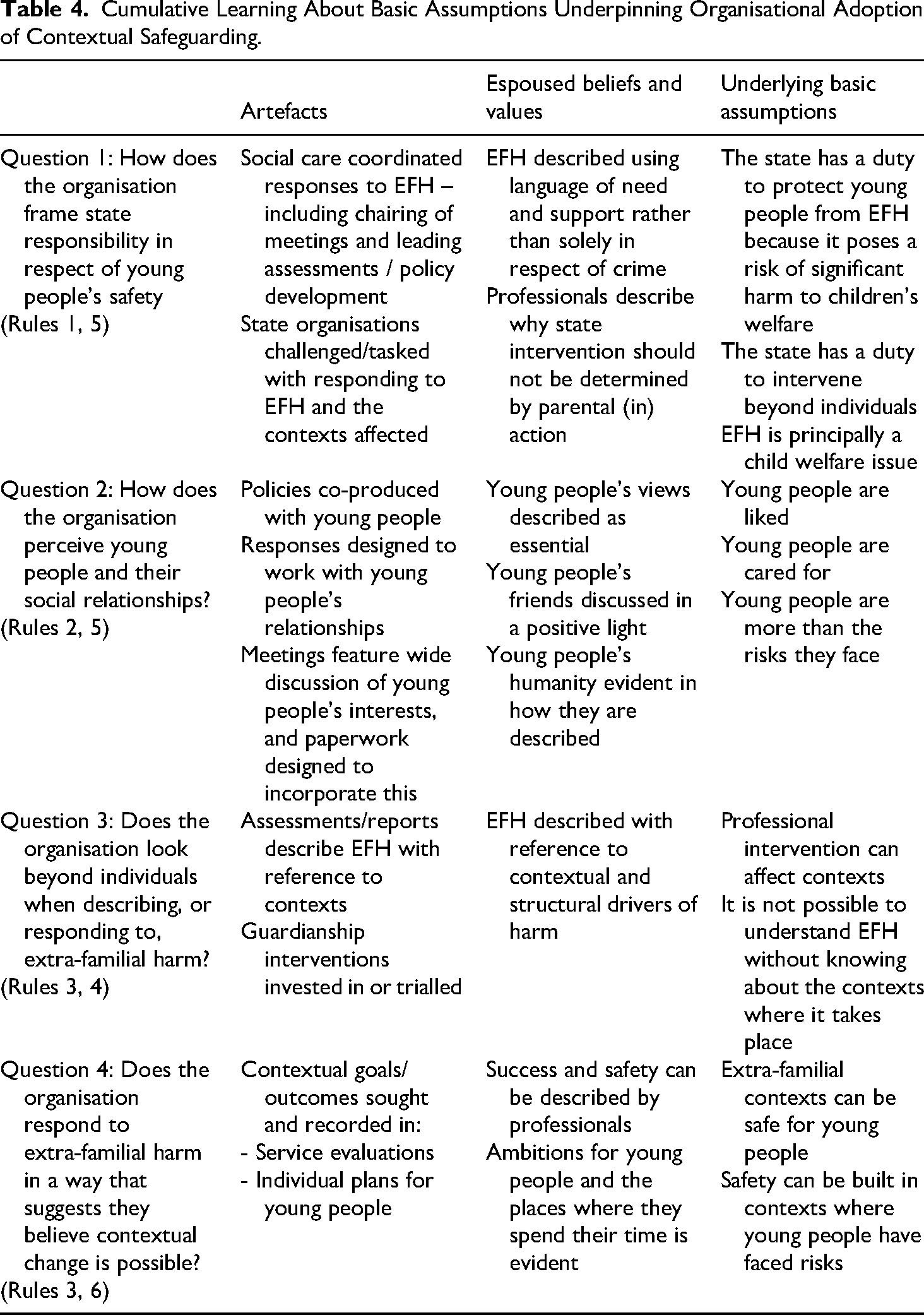
Despite being contextually focused, various artefacts including contextual outcomes tools, peer group interventions, and meetings focused on contexts, could be culturally misaligned to Contextual Safeguarding if practiced in organisations without the according basic underlying assumptions. If an organisation co-produces a ground rules document with young people (artefacts) but has a culture that sees those young people through a lens of risk (basic assumptions), the resulting practice might only focus on harm young people face/cause and not on their wider interests/contributions (expressed beliefs). If any of the underlying assumptions summarised in Table 4 are absent, our dataset shows that reform via structural-change or training may not produce welfare-orientated responses to EFH. Organisations, and the systems in which they work, must be underpinned with assumptions that recognise both state responsibility for responding to the contextual dynamics of EFH and young people's value beyond EFH, to create conditions conducive with welfare-orientated practice.
Discussion
By foregrounding organisational/system cultures, this study has illustrated why adopting seemingly ‘common-sense’ approaches to EFH can be complicated. Far from being a shortcoming of individual practitioners, or even participant organisations, these complications reflect systems in which responses to EFH are delivered. Global commitments to protect young people from EFH do not, on their own, enable the adoption of Contextual Safeguarding or broader welfare-orientated approaches to protecting young people. The assumptions underpinning the legal, commissioning, evaluative or operational artefacts in systems used to realise those commitments must also be aligned culturally. This study suggests that we have assumed too much about the cultural underpinnings of safeguarding systems. Revisiting the challenges summarised in the background of this article in light of our findings, we see three system assumptions that require attention/mitigation for organisations to pursue contextual and welfare-orientated practice.
Numerous governments are yet to fully understand the implications of responding to EFH using child protection systems that largely situate harm/protection with actions/inaction of parents/caregivers, and not wider contextual/structural factors. Whether redesigning child protection pathways in the UK (Firmin, 2024) or child welfare courts in the US (Musto, 2022), such structural redesign is hindered by underlying assumptions about parental and state responsibility upon which those systems are built: i.e., that the state intervenes (into family life) to protect children, via child protection systems, when risk is attributable to parental (in)action. We lack cross-country accounts of child protection responses to adolescents that map global variations in these assumptions, with the specific experiences of adolescents impacted by EFH often invisible in child protection comparator studies (Merkel-Holguin et al., 2019). Studies into the lives of young people affected by EFH readily name their individual and family histories but rarely give similar attention to contextual factors that shape journeys to harm (de Vries et al., 2025). Emergent efforts to address this knowledge gap require greater attention to rebalance a largely individualised narrative.
A further set of legislative artefacts that suggest underlying assumptions are ill-fit for welfare-orientated responses to EFH are those which criminalise the children impacted. Our protective systems are wedded to a division between victim and perpetrator, and participant organisations (and their partners) reflected this. Rather than centre young people's humanity, our systems orient responses around young people's ascribed labels. Participant organisations were supporting young people who straddled both victim and perpetrator identities, in legislative contexts that maintained social discourses of delinquency and risk rather than harm and need (as we saw with some organisations in response to question 2); discourses that our participating organisations either succumbed to or battled. Moreover, EFH itself can be viewed through a lens of crime or welfare, and this impacts both which agencies (policing or social work) are identified to lead responses and the legislative tools that organisations use guide said response. These dynamics require debate, in various settings, to excavate what professionals, their organisations, and the researchers who evaluate them, assume about young people impacted by EFH; and how these assumptions shape criminalising landscapes that organisations either navigate or inadvertently uphold.
Commissioning and evaluation frameworks can reinforce cultures that undermine contextual approaches. All participant organisations were funded to work with individual young people principally due to risks they faced or posed. Their impact, and how their work was valued, was measured in respect of changes to young people's behaviours, and a reduction in risks they faced/posed as measured by individual outcomes (i.e., re-engagement in education, reduction in offending). This is the dominant model for commissioning and evaluating responses to EFH in Anglophone and neo-liberal countries. It drives what organisations record, creating conditions which overshadow (or fail to document) the contextual impacts they achieve, their ability to impact the social conditions of harm, or young people's value beyond the issue of EFH. As discussed in the background section, such limitations are reflective of New Public Management methods, and associated target-oriented practice, which characterise the systems in which social care organisations often operate. The administration and bureaucracy entailed in the neo-liberalisation of public services like social work, in the UK and across Europe, and the associated economic stagnation and spending cuts, places huge resource and time pressure on practitioners and creates a stifling environment for truly creative and innovative practice (Rogowski, 2021). The post-colonial context of East Africa is not immune, with a similar increase in neoliberal policies across public and (I)NGO sectors, with western child protection and youth welfare models (with all their aforementioned shortfalls) shaping provision. Our findings evidence, that despite these significant structural and cultural restraints across child social care and welfare sectors internationally, such practice can be resisted (Ioakimidis & Trimikliniotis, 2020); but likely create conditions in which welfare-orientated practice is the exception rather than the norm.
Limitations
This study presents cumulative learning across four projects. While multiple local authorities and voluntary sector partners participated in the four studies, they may not reflect the practices of all statutory or voluntary sector responses to EFH. We also analysed published results of four studies (across nine outputs) rather than re-analysing all the raw data held in those four studies. It is possible that additional results would have been found if raw data was subject to this level of analysis.
Conclusion
In this study, organisations in the UK, Germany and Tanzania, created cultural conditions facilitative of contextual and welfare-orientated approaches to EFH. Our findings demonstrated, for the first time, what this means, and how others can look beneath their organisational structures (artefacts) to surface the cultures (underlying assumptions) enabling such work. However, their achievements occurred despite wider systems cultures rather than in concert with them. International research into EFH, and the relatively limited cross-country knowledge on social work with adolescents, signal system shortcomings that we discuss in this article. If governments wish to pursue welfare-orientated responses to EFH and develop responses representative of an evidence-base that endorses contextual practices, then this study suggests a need to move beyond structural reform or training programmes. The basic underlying assumptions about the role of the state in safeguarding adolescents, and the relationship between justice and welfare systems, requires more sophisticated interrogation. The academy has a key role to play. The prevalence of individualised evaluation methods and metrics further reinforce cultures in which organisations/practices that could change the social conditions of contexts are reduced to targeting individuals within contexts. Over a decade into the development of Contextual Safeguarding, and with international interest increasing, now is the time to prioritise cultural reform. In doing so we may make local structural reforms, and global policy commitments, far less complicated to realise.
Footnotes
Acknowledgements
This study was funded by the National Lottery Community Fund, the Department for Education, The Porticus Foundation and the Esmee Fairbairn Foundation. The authors thank all young people, families and practitioners who participated in these projects, bringing us gradually closer to seeing Contextual Safeguarding in practice, and helping us understand what such practice requires. In addition to our funders, the authors gratefully acknowledge the contribution made by other members of the Contextual Safeguarding research team who participated in studies from which this dataset is drawn, namely: Vanessa Bradbury-Leather, Lisa Bostock, Jenny Lloyd, Molly Manister, Rachael Owens, Lisa Thornhill, and Joanne Walker. We also extend our gratitude to the research sites who participated in the four studies against which we report, and the young people, parents and practitioners from those sites who shaped our learning along the way.

Ethical Considerations
Ethical approval for the study was given by Durham University. Reference numbers: SOC-2021-09-02T10_31_04-dmwm66 (Scale-Up), SOC-2022-09-23T11:50:37-dmwm66 (Planning for Safety), SOC-2023-03-06T15_23_20-zlmm3 (Contextual Safeguarding Across Borders), and SOC-2021-11-26T11_42_41-dmwm66 (Towards Safety). Approach to consent, anonymity and participant/researcher welfare are summarised in the manuscript. The four studies featured in this paper, and our secondary analysis on this dataset, received ethical approval from Durham University's ethics panel, and three received additional approval from the University of Bedfordshire's Institute for Applied Social Research Ethics panel.
Funding
The authors disclosed receipt of the following financial support for the research, authorship, and/or publication of this article: This study was funded by the National Lottery Community Fund, Esmée Fairbairn Foundation, Porticus Foundation, and the Department for Education, UK Government.
Declaration of Conflicting Interests
The authors declared no potential conflicts of interest with respect to the research, authorship, and/or publication of this article.
Data availability
This study involves analysis of nine published papers and/or practice resources which are publicly available for others to analyse. Case studies are taken from the raw datasets gathered for those papers which are not publicly available.