




Abstract
Warmth and respect are considered essential skills for relationship building in social work. However, these skills are often treated as common sense, and how to be respectful and warm, particularly in challenging situations, remains unclear. Practice guidance is commonly given as a list of generic behaviours or vague directions. Furthermore, it is not clear how being respectful or warm leads to effective relationships. In this article, we applied conversation analysis to examine transcripts of video recordings of 12 sessions of ‘Moving Forward: Making Changes’, the national groupwork programme addressing sexual offending in Scotland, to outline and specify the interactional practices that constitute instances of respect and warmth in social work practice. We found practitioners demonstrated warmth and respect by recognising and acknowledging clients’ accounts and identities in the interaction through subtle discursive practices. These practices include using hedging words and phrases (e.g. sort of, maybe), framing challenges as questions or suggestions rather than declarations, and using therapeutic phrasing (i.e. ‘I’m curious about’, I’m wondering’). As such, we propose the actions of demonstrating respect and warmth are achieved in interaction through the ways practitioners delicately manage issues of epistemic authority, that is, a person’s primary rights to knowledge about themselves, and face, that is, self-presentation. Drawing on the concepts of epistemic authority and face furthers our theoretical and practical understanding of the practice skills of respect and warmth, and their role in building effective working relationships.
Keywords
Introduction
Being respectful and warm are considered core skills in social work and essential for building effective working relationships, the cornerstone of social work practice (Baldock & Prior, 1981; Koprowska, 2020; Raynor & Vanstone, 2015; Ruch, 2005; Trevithick, 2003; Trotter, 2006, 2012). However, these skills have a taken-for-granted common sense quality making them simultaneously obvious and vague; a quality reflected in generic guidance for social workers on how to be respectful or warm. Demonstrating these skills is particularly challenging when social workers are working with people who have exhibited harmful or abhorrent behaviours, such as child abuse or sexual offending (Ward & Salmon, 2011). Social work research, theory and practice would therefore benefit from a richer understanding of how being warm and respectful are done in social work interactions. Using conversation analysis, we examine how social workers demonstrate these key practice skills in interaction with clients of a groupwork programme for addressing sexual offending behaviour. By focussing on what people are doing when they talk, and how they are doing this, conversation analysis methods enable us to unpick how respect and warmth are done in interaction. Through this we identified face-work and epistemic authority as useful concepts to understand and make visible these tacit skills. We argue respecifying these skills as interactional practices furthers our understanding of the micro mechanisms of engagement in social work.
Respect and warmth
The skills of respect and warmth are intertwined; the former is embedded in core social work values (BASW, 2014) and the latter draws from Rogers' (1957) therapeutic concept of unconditional positive regard, a core condition for supporting change. Unconditional positive regard means accepting and respecting the person for who they are without judgement. Influenced by Rogers, Truax and Carkhuff (1967) define warmth as demonstrating you value the whole person, as opposed to only focussing on presenting behaviour. Respect is having due regard for a person’s rights, feelings or wishes and their inherent worth and dignity (BASW, 2014). Marshall and colleagues (2003) note that respect demonstrates to clients they are valued as people, similar to Truax and Carkhuff’s (1967) definition of warmth. Furthermore, Lishman (2009:79) notes ‘warmth is linked with acceptance, and…conveys respect’.
Trevithick (2012:119) defined a skill as ‘an action with a specific goal’. The skills of respect and warmth, amongst others (e.g. empathy, genuineness), are identified as necessary for building effective working relationships, a key vehicle for change and achieving good outcomes, for example, reducing reoffending, increasing parental capacity (Koprowska, 2020; Marshall et al., 2002; McNeill et al., 2005; Raynor et al., 2014). They are highlighted as core to effective and ethical practice in most texts on communication skills in social work (e.g. Koprowska, 2020; Lishman, 2009), and embedded in social work guidance and policy (e.g. BASW, 2014; McNeill et al., 2005; Scottish Government, 2010). How respect and warmth are done in interaction, however, is less clear. Such skills are often abstractly defined (Horvath & Muntigl, 2018) or described through a list of behaviours, which are context specific and culturally sensitive (Koprowska, 2020). For instance, respect is described as introducing yourself, not using jargon, addressing people appropriately, listening, and not being distracted, rude or dismissive (Koprowska, 2020; Raynor et al., 2014; Vanstone & Raynor, 2012). Warmth is outlined as involving smiling, eye contact, leaning forward, physical proximity, being relaxed (Lishman, 2009), being non-blaming, friendly and interested (Trotter & Evans, 2010), being ‘accepting, caring, and supportive’ (Marshall et al., 2003: 210) and not being stiff, cold or formal (Vanstone & Raynor, 2012). Lishman (2009) specifically notes warmth is expressed mainly non-verbally and difficult to define, reflecting its tacit nature.
Describing warmth and respect through a list of behaviours seems mechanical and may not translate into authentic practice; whereas more general descriptions (e.g. ‘friendly’, or ‘not cold’) are rather circular, open to interpretation and lack the detail necessary to guide practitioners on how to effectively engage clients. Moreover, the nature and appropriateness of different ways of communicating respect and warmth are likely to vary for different individuals, groups and contexts. Given the importance of respect and warmth for building effective working relationships, it is necessary to understand how these skills manifest in social work practice. Due to the intertwined understanding of respect and warmth in social work literature, both behavioural and definitional, we examine them together. We draw on the concepts of face-work and epistemic authority as a theoretical lens through which to understand the actions of being warm or respectful. Concerns with face and epistemics are ubiquitous in interaction; understanding how these are managed in the moment-by-moment talk within a social work context allows us respecify respect and warmth as interactional practices, rather than general or innate skills.
Face and face-work
Goffman (1967) proposed the concept of face as the self-image people project contingent on the structures of social interaction and the local context, where people are invested in their own face and that of others. Brown and Levinson (1987) further outlined two aspects of face: negative face and positive face. Negative face is concerned with the desire to do what you want, unimpeded, and have your autonomy and prerogatives honoured. Positive face is the desire to have a favourable self-image that is validated by others. Maintaining face is not an objective in interaction, but a condition of it. To do this people engage in face-work: the ‘actions taken by a person to make whatever he is doing consistent with face’ (Goffman, 1967: 12). It is an active and cooperative effort people make to preserve their own and each other’s self-image, maintaining their sense of autonomy and solidarity in conversation. Face-work is an inevitable and crucial aspect of any interaction and produces orderly communication (Viechnicki, 1997). More recently, Arundale (2010) outlined face as the relational connection or separation achieved in interaction.
Face and face-work are interactional achievements observable in how talk is sequentially organised (Clayman, 2002; Lerner, 1996). Most straightforwardly, when we show agreement with what another person is saying and how they are saying it, in the sequence of conversation, negative and positive face are maintained. When there is disagreement, the interlocutors’ face, and consequently cooperation in the interaction, is threatened. As such, people shape their utterances to minimise any threat and maintain solidarity (Pomerantz, 1984). Of course, there are pronounced acts in interaction which threaten face, like name calling or refusing to allow someone to speak, which accomplish other social functions, for example, arguing (Maynard, 1985). However, there are smaller ways face can be threatened in the moment-by-moment talk, such as making a request, overtly disagreeing, interrupting or correcting someone (Lerner, 1996; Schegloff et al., 1977).
Face-work provides a conceptual framework for understanding the nature of warmth and respect in interaction. Goffman (1967: 19) highlighted the link between face and respect, noting by maintaining face ‘the actor shows how worthy he is of respect or how worthy he feels others are of it’. By striving to uphold co-participants’ self-image in the interaction, we also convey the person is accepted and valued, which are key characteristics of definitions of warmth and respect. Furthermore, this creates a sense of solidarity and cooperation in the interaction, reflecting the more nebulous descriptions of warmth, that is, friendly, not-cold and of respect, that is, a person’s worth in that moment is honoured.
Epistemic authority
People are usually afforded ‘privileged access to their own experiences and as having specific rights to narrate them’ (Heritage & Raymond, 2005: 16). This is epistemic authority, people’s rights and responsibilities to know things about themselves and their own experiences. This is a central aspect of managing face in interaction, as people are held accountable for what they know, how they know it and whether they have the rights to describe it, for example, is it first-hand experience (Stivers et al., 2011; Heritage & Raymond, 2005; Izadi, 2018; Stevanoic & Perakyla, 2014).
Upholding people’s interactional rights to knowledge of their own experience reflects the definition of respect offered by the British Association of Social Workers (2014), to have due regard for people’s rights, feelings and wishes. Furthermore, this links to demonstrating value for the person’s worth and dignity, a necessary condition to project a sense of warmth. Upholding a person’s right to know and speak about their own thoughts, feelings and experiences in interaction are central to conveying warmth and respect in everyday conversation. In certain institutional contexts, however, professionals may be afforded rights over another’s experiences. For example, in doctor/ patient consultations the doctor’s epistemic authority as an expert is privileged over the patient’s experiential knowledge in making a diagnosis (Heritage, 2013) or in therapeutic settings, therapists are entitled to propose clients’ experiences are different to what they say (Voutilainen & Peräkylä, 2014). Epistemic authority is therefore a useful analytic concept to help elucidate how warmth and respect are demonstrated in practice. There are two other essential components in interaction for managing and maintaining face: deontic authority and emotional authority, that is, rights to determine what is or is not allowable or impose actions on another, and the rights to emotional expression, respectively (Stevanovic & Peräkylä, 2014). Balancing these three essential components in interaction is delicate, where people risk being over familiar or coming across as distant and cold (Heritage, 2011). Alongside epistemic authority, we will draw on these where relevant in examining how respect and warmth are done in social work interactions.
Examining warmth and respect in the context of social work practice
The nature of face-work and demonstrating epistemic authority are complicated by the institutional context of social work practice. Face and epistemic authority are, mostly, smoothly navigated in everyday conversation, however in social work, as with many other professions, the professional role may involve offering accounts, descriptions and explanations that run counter to those offered by clients. For instance, social workers may challenge the voicing of pro-criminal attitudes, lead clients to unpick accounts of their behaviour that deny culpability, or encourage people to rework descriptions of their experiences. Furthermore, in this context, social workers hold ‘deontic authority’ and ‘emotional authority’ , they determine how things should be and the rules of emotional display (Stevanovic & Peräkylä, 2012, 2014). As such face (as a person’s self-image and rights to autonomy) and epistemic authority (as a person’s primary rights to knowledge about themselves and their experiences) are contestable as the narratives of people’s lives and identities are being negotiated, possibly to incorporate some shameful or stigmatised characteristics (e.g. Digard, 2014; Lacombe, 2008; Waldram, 2007). Truax and Carhuff (1967) highlighted it is easier to be warm and respectful when clients are ‘good’, that is, their narrative or actions conform with the institutional aims so there is no disagreement to be managed. We propose it is where face and epistemic authority are being contested that the interactional practices that constitute ‘being warm’ or ‘being respectful’ may be more noticeable. To unpick these practices, we use conversation analysis to examine interactions between social workers and clients during a groupwork programme for addressing sexual offending.
Conversation analysis
From a CA perspective, people are doing things with their talk, for example, making invites, presenting identities, or demonstrating respect and warmth (Liddicoat, 2011). We are interested in how these actions and aspects of interaction are done and received. CA research has demonstrated there are fundamental structures that make conversation orderly (Liddicoat, 2011; Schegloff, 2007), such as taking turns to talk, and these ‘rules’ of conversation are social ‘common-sense’ (Goffman, 1983; ten Have, 2007). These methods make the ‘thisness’ of interaction visible (Psathas, 1995), allowing us to examine how the tacit skills of ‘being warm’ or ‘being respectful’ are constructed in practice. Two interactional resources in particular can help us in this examination: alignment and affiliation.
Alignment refers to the cooperation with the interactive activity in progress, whereas affiliation refers to demonstrating understanding of and support for the meaning of the talk (Stivers, 2008; Stivers et al., 2011). For example, Stivers (2008) demonstrated that a continuer token such as ‘hmm’ aligns with the action of storytelling, accepting the other’s position as the storyteller and encouraging them to continue, whereas a nod or ‘yes’ demonstrates some support for the teller’s stance on the story, showing affiliation. Alignment and affiliation are considered essential for the smooth running of interaction as they demonstrate cooperation and participation in the interaction, building social solidarity and positive relationships, and preserving face (Lerner, 1996; Clayman, 2002; Lindström & Sorjonen, 2013; Stivers, 2008).
The normative tendency towards cooperation in interaction through alignment and affiliation can help in building working relationships in institutional settings (Weiste, 2015), by creating space for and encouraging clients to tell their story (Ford, 2018; Hepburn & Potter, 2007; Symonds, 2017), and by demonstrating understanding of this storied experience (Heritage, 2011; Stivers, 2008). In therapeutic settings, through alignment and affiliation therapists can preserve the good working relationship with clients even where there is disagreement (Muntigl & Horvath, 2014; Voutilainen et al., 2010; Weiste, 2015). These interactional resources are important tools which allow people manage conversation, and navigate concerns of face and rights to knowledge.
Methods
To examine how respect and warmth are interactionally achieved we analysed video recordings of sessions of the Scottish national groupwork programme for addressing sexual offending, ‘Moving Forward: Making Changes’ (MF: MC) using CA (Liddicoat, 2011). Through detailed transcription, capturing what is said and how it is said (Jefferson, 2004), and pursuing the micro-level sequence of talk (Schegloff, 2007), we examined how people made sense of their conversations and what they are doing in their talk, for example, constructing certain identities (Mullins & Kirkwood, 2019a), or navigating expressions of shame (Mullins & Kirkwood, 2019b).
MF: MC is a court mandated groupwork programme for adult men (18+) convicted of sexual offences, run in the community by local authority justice social work services. It is influenced by the Good Lives Model (GLM), a strengths-based model positing offending behaviour functions to achieve universal goals, for example, happiness, relatedness (see Ward & Maruna, 2007), albeit harmfully. As with social work practice generally, the working relationship, built through demonstrating respect, warmth and other skills (e.g., empathy), is positioned as a key vehicle for change in justice social work policy in Scotland (McNeill et al., 2005; Scottish Government, 2010) and specifically in relation to MF: MC (Scottish Government & Scottish Prison Service, 2013).
Sessions of the MF: MC programme are examples of institutional talk. Institutional talk differs from everyday talk in three key ways: there are certain goals tied to the institutional identities (e.g. doctor/ patient, teacher/ student, social worker/ client), what is deemed allowable in the interaction is constrained by the institutional context, and the interaction involves inferential frameworks and procedures of that particular institutional context (Heritage, 2005). Here the goal is for practitioners to engage clients in the process of the groupwork programme and build effective working relationships through demonstrating respect, warmth and other skills, to ultimately reduce clients’ risk of reoffending and promote desistance (McNeill et al., 2005; Scottish Government, 2010; Scottish Government & Scottish Prison Service, 2013). As a manualised programme, within a wider justice system, there are clear expectations of what is discussed in the sessions and how (Scottish Government & Scottish Prison Service, 2014). For example, clients are expected to discuss their offending, the risks and needs related to this, and their process of rehabilitation; practitioners are expected to direct the discussions, ask questions, provide advice and information, and challenge inappropriate talk.
Twelve video-recorded sessions, approximately 28 hours, of the groupwork programme across three separate groups were analysed. The local authority routinely video records the groupwork sessions for internal quality assurance. The authors’ university and relevant local authority gave ethical approval for this study. Research participants gave informed consent and all identifying features were anonymised. Recordings were selected on practical grounds, that is, best visual and audio quality. Each group had two groupworkers and six men convicted of sexual offences, eighteen men in total. The range of offences included accessing indecent images of children, rape of adults and child sexual abuse.
Through repeated viewing, the first author transcribed the groupwork sessions in detail, including other features of communication, for example, gestures, pauses, hesitations (Jefferson, 2004). To examine the data, we used the following working definitions of respect and warmth drawn from the literature. ‘Warmth’ is the practitioner’s accepting, caring and supportive behaviour, particularly valuing the client as a person separate to evaluating their behaviours. It ‘is expressed as a genuine interest in the client and an acceptance of him as a person’ (Rogers, 1942: 87). ‘Respect’ is behaviour that conveys to clients their feelings, rights and wishes are valued, where they are appreciated separately to any disapproval of their behaviour. We also took guidance from checklists developed in previous studies of practice skills in criminal justice interventions (e.g., Trotter & Evans, 2010; Vanstone & Raynor, 2012). Drawing on these working definitions, the first author identified sequences in the interactions relevant for analysing the key practice skills of respect and warmth. Here we depart from a more traditional CA approach, which focuses on participants’ orientations in interaction rather than a priori phenomenon (Liddicoat, 2011), to use ‘interaction analysis to critically explore and perhaps respecify’ our understanding of respect and warmth (Hepburn & Potter, 2007: 99). This is in keeping with other studies of institutional talk, which have examined actions such as resistance (Hall et al., 2014), active listening (Hutchby, 2005), advice giving (Vehviläinen, 2001) and empathy (Wynn & Wynn, 2006). To ensure we focussed on participants orientations we adhered to Hepburn and Potter’s (2004) advice, concentrating on how respect and warmth were conveyed in the interaction, rather than how they influence change, for example. Furthermore, we oriented to a central guiding question in CA, ‘why that now?' We explored what people were doing with their talk across those sequences and considered how the conversational actions demonstrated acceptance of the whole person and their rights to self-determination. Through this process we identified face and epistemic authority as useful concepts to understand how practitioners ‘do respect’ or ‘do warmth’ in practice.
Findings
We present four extracts, chosen for their clarity and brevity, to unpick how the skills of ‘doing warmth’ and ‘doing respect’ are interactionally achieved. Initially we outline how groupworkers can display ‘warmth’ and ‘respect’ by attending to concerns of face, that is, a person’s self-presentation and their autonomy in the interaction. In the second and third extracts we examine these skills through the lens of epistemic authority. Finally, we present an example of when face and epistemic authority are not attended to, highlighting the visible absence of the practice skills of ‘warmth’ and ‘respect’, and the resultant disengagement. By looking at how the interaction then unfolds, we consider how attending to face and epistemic authority can promote client engagement and how these skills as interactional practices can fluctuate within short sequences. The extracts we present are representative of a larger sample of similar identified patterns in that they are examples of how such interactions unfolded. They are presented verbatim allowing the reader to judge the validity of the interpretation themselves, as is convention with CA (Liddicoat, 2011). Clients’ names have been anonymised. Groupworkers are denoted by G#.
‘Warmth’ and ‘respect’ via face-work
In Extract 1 below we unpick how practitioners can do ‘being respectful’ and ‘being warm’ through doing face-work. In this example, G3 manages face in how she navigates and designs her challenge to Calum’s self-presentation.
Extract 1:
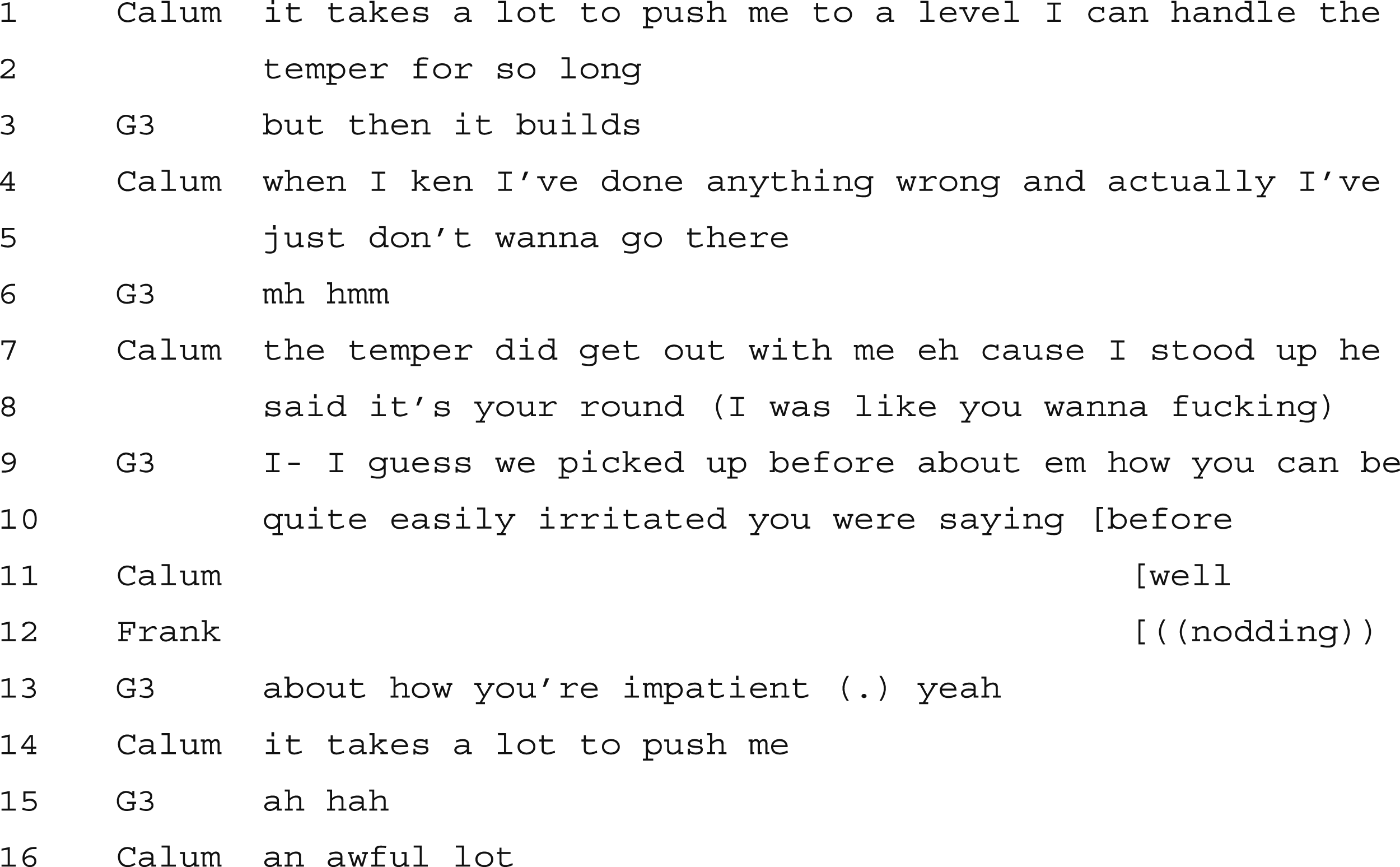
Here, Calum presents an image of himself as generally coolheaded and slow to anger, legitimised by the extreme case formulation ‘it takes a lot to push me’ (l.1) (Pomerantz, 1986), but having had an angry outburst (l.7). This is his positive face. His negative face is expressed through his rights and wishes to give his own account. The appeal here is for G3 to align and affiliate with Calum’s description of his temper. However, in this institutional context groupworkers are expected to exercise their deontic authority and challenge talk they deem problematic. We can see this here, as the groupworker presents a contrary image of Calum as someone with a short fuse (ll. 9–10, 13).
By doing face-work, G3 encourages Callum to align with her characterisation of his temper, whilst also demonstrating respect for his self-image, as both positive and negative face, in the interaction. G3 is doing ‘being respectful’ by aligning with Calum’s action of telling his story which honours his rights to speak and complete his story, preserving his negative face, that is, the right to self-determination and autonomy in the interaction (ll.3&6) (Clayman, 2002). This is evident with the simple utterance ‘mh hmm’ at line 6, which encourages Calum to continue. This action aligns with the idea of active listening, which is noted in practice guidance as a way of demonstrating respect and interest, a characteristic of ‘warmth’ (Koprowska, 2020; Raynor et al., 2014). It is also evident by the way G3 begins her turn at line 3 with the conjunction ‘but’. Vehviläinen (2003) noted psychotherapists use conjunctions in this way as a device to bring up connections, parallels or juxtapositions between the client’s talk and the professional’s interpretation, allowing the professional to remain aligned to the client’s actions in the talk, for example, telling a story, whilst also incorporating institutionally relevant aspects. G3’s action here extends Calum’s description of his temper, demonstrates understanding whilst seamlessly moving into an intersubjective and collaborative describing of Calum’s character and experience, and steers this towards descriptions of Calum losing his temper. ‘Being warm’ is also seen in aligning and collaborating with Calum’s actions of storytelling (ll.3&6) as it demonstrates G3’s connection to and interest in the interaction.
G3’s ‘being warm’ and ‘being respectful’ is further evident in her delicate challenge to Calum’s positive face. At lines 9 and 10, particularly, we see the groupworker’s effort in producing her alternative description, and deal with the consequent threat her challenge poses to Calum’s face, his self-presentation of having a high threshold before becoming angry. She does this by downgrading her certainty (‘I guess’, ‘we picked up before’: l.9), hesitating (‘I- I’; ‘em’), using a conditional verb (‘can be’), downgrading temper to irritated (l.10) and impatient (l.13), and situating her challenge as consistent with Calum’s previous descriptions of his temper (‘you were saying before’: l.10). This positions the described behaviour as possible rather than definite, consistent with Calum’s previous report and within his epistemic domain. Actions like hedging (e.g. saying ‘sort of’, ‘kind of’), mitigating challenge, providing accounts, and drawing on common ground do face-work as they soften any directiveness, respect the other’s ownership of their experience, and encourage cooperation. Even within settings where challenge or directiveness are expected people draw on such conversational resources to mitigate threat to face (Benwell & Stokoe, 2002). G3 gently encourages Calum to agree with her assessment, or evaluation in that moment, that he is easily irritated, rather than directly challenging. Furthermore, in being presented as an assessment rather than a statement of fact, Calum can confirm or refute this by claiming his higher epistemic status (Heritage & Watson, 1979; Pomerantz, 1984). Softening the challenge works to maintain alignment and protect Calum’s self-image or face, whilst withholding affiliation or support for his presentation maintains the groupworkers’ professional responsibility and face. The characteristics of ‘warmth’ as valuing the whole person and not only judging their behaviour are evident through the ways groupworkers preserve clients’ face by maintaining alignment and as such cooperation in the interaction, even when disagreement about the topic or content means there is no affiliation, that is, explicit support. Here, the groupworker focuses on Calum’s self-description rather than the emotional expression in the story (i.e., she does not affiliate with the implication that Calum’s anger was justified), which may be perceived as ‘cold’. However, her efforts to uphold and protect Calum’s self-image, his positive face, maintain cooperation and solidarity in the interaction creating a sense of friendliness but more so demonstrates Calum is valued and accepted as a person, key characteristics of ‘being warm’. As we see here, when Calum rejects G3’s characterisation of his temper (l.11, 14, 16) she does not further challenge Calum, but instead moves into a listening position with a minimal utterance ‘ah hah’ (l.15). This respects Calum’s self-image in the current interaction and his rights to knowing his own experiences, avoiding direct confrontation, maintaining cooperation and leaving the topic to be picked up again at a later stage. By aligning with Calum here G3 is doing what practice guidance refers to as ‘rolling with resistance’, where practitioners are advised not to confront resistance but encourage clients to re-evaluate their thinking, a process that is considered to respect clients’ autonomy and support a positive working relationship (Miller & Rollnick, 2002; Vanstone & Raynor, 2012).
‘Respect’ and ‘warmth’ via managing epistemic authority
In the MF: MC sessions clients’ experiences, thoughts, feelings and behaviours are being debated and re-evaluated, which risks undermining their epistemic authority. We propose the skills of expressing ‘warmth’ and ‘respect’ are evident in how groupworkers navigate this potential trouble, which we examine through how groupworkers formulate and ask questions about clients’ experiences.
In Extract 2 G1 presents a formulation of Alan’s experience. Formulations are a common way in therapeutic settings to display an understanding of clients’ experience and, importantly, interpret clients’ talk in therapeutically relevant ways (Antaki, 2008; Voutilainen, 2012; Weiste & Peräkylä, 2013).
Extract 2:
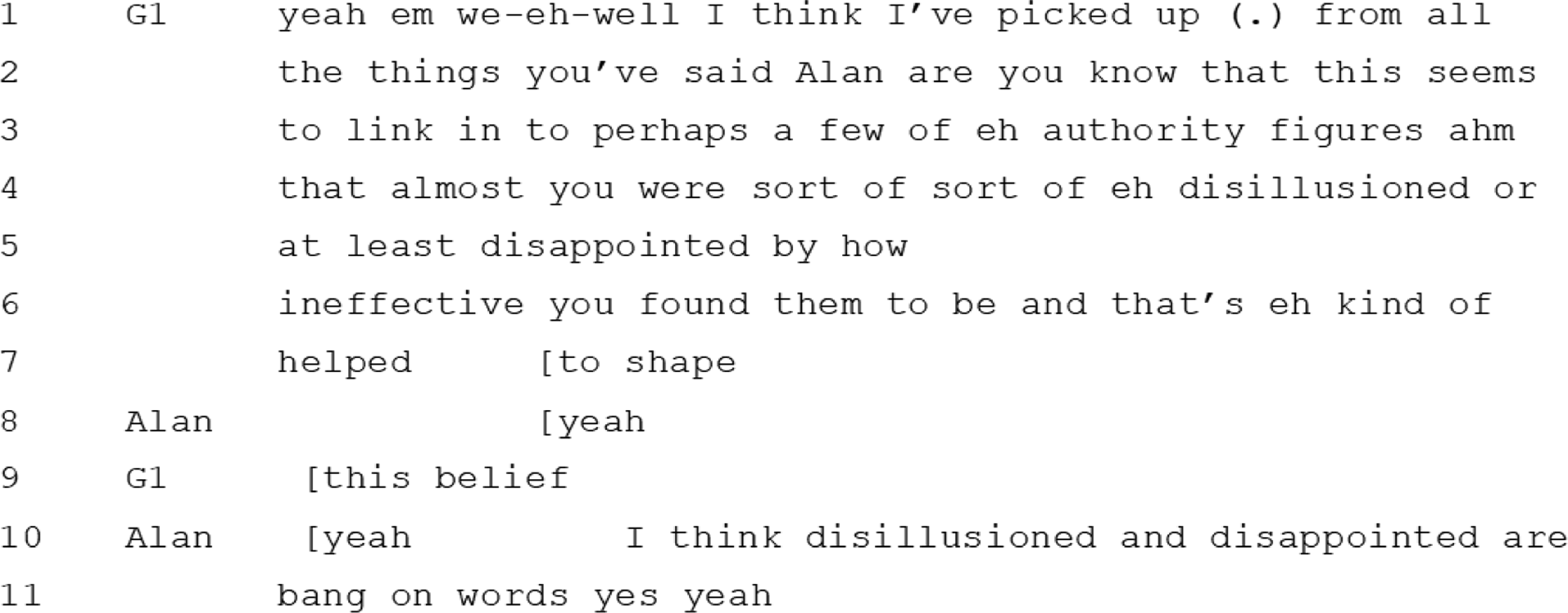
Here G1 reduces his claims to knowledge in his turn, which is replete with hedging and low modality phrases (‘I think I’ve picked up’, ‘seems to’, ‘perhaps’, ‘sort of’, ‘kind of’), and also hesitations and filler (‘you know’). As such he presents his formulation as a suggested understanding of the origin of Alan’s beliefs regarding authority and checks this with him rather than stating it as fact, an action his institutional role might permit. In designing his turn in this way, G1 mitigates the threat to face. That is, in making a suggestion G1’s ‘knowing’ wouldn’t be called into question, and Alan can more easily disagree. By reducing their claim to knowledge, groupworkers can demonstrate ‘respect’ for clients’ ownership of their own narratives, rather than imposing the groupworkers’ or institutional narrative, recognising clients’ greater epistemic status around their experiences, thoughts and feelings (Weiste, 2015). Formulations allow people to demonstrate and clarify they share a congruent understanding of the ongoing interaction (Heritage & Watson, 1979). This sense-making method is necessary to progress cooperation, and as such solidarity, in interaction. It contributes to a sense of ‘warmth’, as described within practice guidance, as it can demonstrate the professional has listened to the client, and is showing interest in and value for the client’s narrative or self-presentation, their face (Lishman, 2009; Marshall et al., 2003; Truax & Carkhuff, 1967). However, in interpreting the client’s talk practitioners may also change it too much (Heritage & Watson, 1979), overstepping the mark, threatening face and disrespecting the client’s epistemic rights, resulting in disalignment and disaffiliation which would need to be addressed (Weiste, 2015). Here however G1’s formulation is wholeheartedly accepted by Alan as understanding his experience (‘bang on words’, l.11).
The action of managing epistemic authority is further evident in how groupworkers ask questions. Questions are very common in institutional interactions (Drew & Heritage, 1992), and as with other institutional contexts (e.g., medical, journalism), the agenda and goals of the specific social work context shape the questions asked and thus the available answers to give (Hayano, 2013; Heritage, 1984). Generally, groupworkers ask questions and clients answer them. Questions are directive in that they set the topic and the agenda, and expect a relevant response (Hayano, 2013). This directive action is possibly face-threatening in terms of both negative face (autonomy) in its action, and positive face (self-image) in its content (Brown & Levinson, 1987). To mitigate this threat, groupworkers will soften the directiveness of their questions, such as in the following extract.
Extract 3:
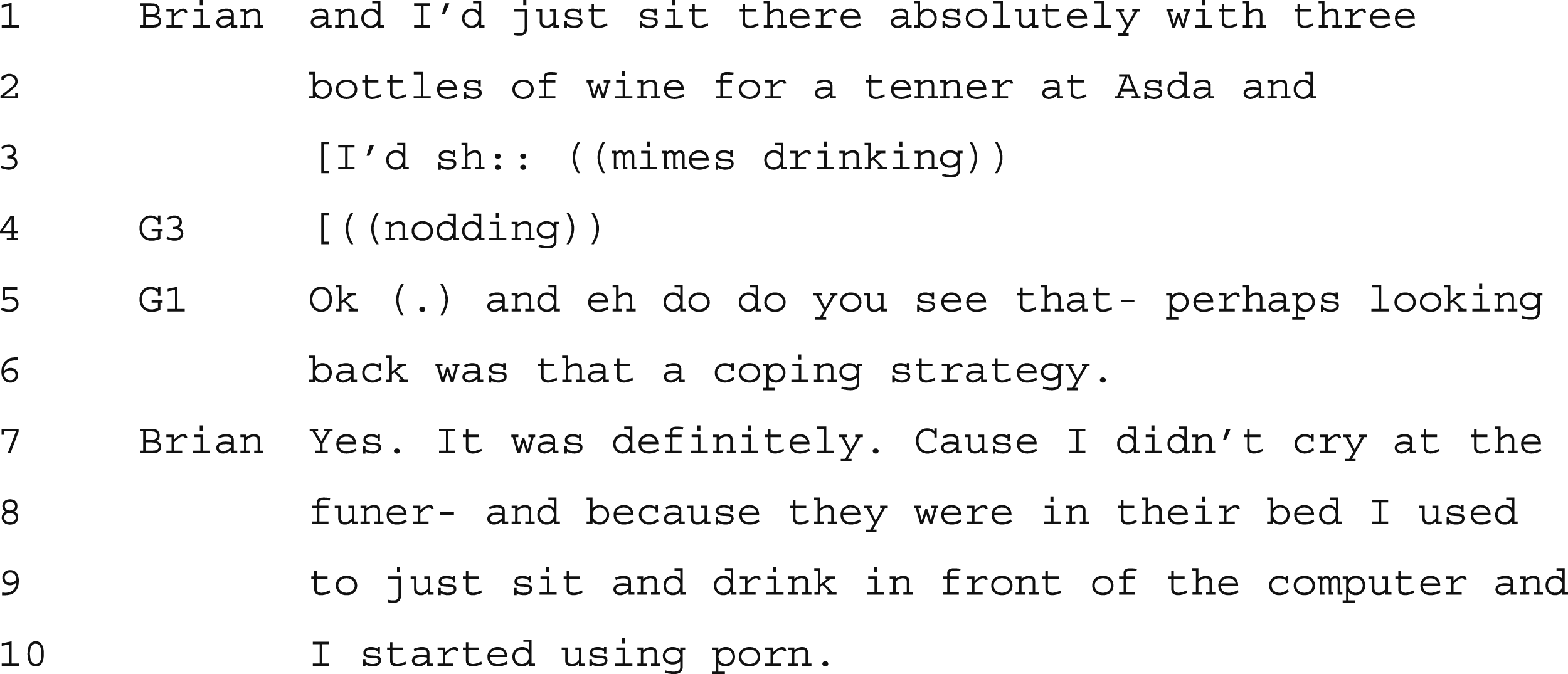
In Extract 3, G1 repairs or corrects his question in the middle from ‘do you see that’ to ‘perhaps looking back was that a coping strategy’ (l.5–6) in response to Brian’s description of his alcohol use at the time of his offending. Both questions are declarative, warranting a yes/no response. By changing his question, G1 moves to a less knowing stance, away from a potentially direct assessment that strongly requests confirmation (i.e. ‘do you see that perhaps was a coping strategy/ how you coped’), to inviting Brian to elaborate in making that assessment himself (‘was that a coping strategy’). Although still calling for agreement, the latter format is less face-threatening as the presupposition (i.e., that alcohol use was a coping strategy) is less firm and the action is less confrontational (‘perhaps looking back’). Brian has more room for manoeuvre; he could account for his alcohol use in another way. With the question’s original beginning, if he disagrees, he risks being seen as not recognising his alcohol use was a coping strategy before the groupworker’s assessment, or worse that he does not recognise it now. The first challenges his self-image or face of being seen to be aware, whilst the second also places him in direct disagreement with the ‘expert’ assessment, which could result in trouble, both interactional (Pomerantz, 1984) and institutional (Waldram, 2007). Brian’s categorical agreement (l.7) aligns and affiliates with G1’s suggested assessment, and by elaborating on his answer Brian demonstrates he has interactional rights to ownership of that experience and is supported and valued to share it (l.8–10).
G1’s repair mitigates possible trouble maintaining cooperation and social solidarity, by softening the question’s demands and respecting Brian’s epistemic right to make the assessment that his previous behaviour was a coping strategy, albeit still a difficult suggestion to reject, over G1’s right of expertise and his deontic authority in this instance. Although questioning is inherently directive and places constraints on the responder, groupworkers tried to moderate the potential adverse impact on the ongoing cooperation in the interaction, by taking a less knowing stance and avoiding direct confrontation. This strategy attends to concerns of epistemic authority and, thus, face, which accepts and values clients’ personhood while also pursuing the institutional agenda, aligned with practice definitions of ‘respect’ and ‘warmth’. Groupworkers balance their rights as experts to assess and describe clients’ circumstances with clients’ privileged access to this by framing their turns as suggestions rather than clear assessments.
Doing ‘respect’ and ‘warmth’ as actions of engagement
In the final extract, we see how the skills of ‘respect’ and ‘warmth’ are moment-by-moment interactional achievements, highlighting the potential problems when ‘respect’ and ‘warmth’ are not shown, as understood through face-threatening talk and talk that does not honour epistemic authority. The discussion is about Dave’s response if his girlfriend reacts badly when he discloses his previous offences, something he is required to do. Unlike extract one, the groupworker does not go along with the client’s self-presentation but undermines his face and epistemic authority by giving advice based on a different characterisation of Dave.
Extract 4:

As with the previous extracts, the directiveness of G1’s extended question is softened (ll.1–4, 6, 8–11) through hesitations, hedging and word choice (‘perhaps prone’), mitigating the potential threat to face. Furthermore, G1 is managing Dave’s epistemic authority by grounding his question in Dave’s previous talk (‘I think what you’re saying Dave’, l.1) (Vehviläinen, 2001). The first point of trouble we see, where there is a mutual breakdown in respect for each other’s face, is at lines 12 and 13, when Dave talks over G1 and G1 asserts his rights to speak with a loud ‘what’ (Schegloff, 2000), continuing his question which Dave clearly already disagrees with (l.12). By asserting his rights to speak here, G1 is denying Dave’s rights and wish to speak, his negative face, and constitutes misalignment in the interaction. Furthermore, in continuing to pursue a question Dave has already discounted (l.12), G1 is undermining Dave’s epistemic authority. This is a seemingly momentary lapse as G1 then moves to align with Dave’s action of answering the question (l.17, 20, 22), which as discussed above can demonstrate ‘warmth’ and ‘respect’ in showing interest in and connection to the client’s talk as well as allowing them the floor. G1’s responses to Dave at lines 20 and 22 are quick, almost overlapping – ‘right’, ‘yeah’. These turns can be interpreted in different ways: encouraging the progressivity of talk; demonstrating G1’s understanding of Dave’s response, both of which are aligned with guidance around active listening (Koprowska, 2020; Hutchby, 2005); or, given their quick succession, G1’s turns could be seen as ‘predicting’ what Dave is going to say, and even potentially trying to hurry him along.
Dave rejects the premise of G1’s question, clarifying his anger would be towards himself and others, asserting his face and his primary access to knowledge of himself, that he would not ‘need covered’ (l.15). By persisting in his line of enquiry and giving unsolicited advice to Dave on what he ‘should do’ (ll.26–31), G1 dismisses and disaffiliates with Dave’s account, threatening his face and challenging his epistemic authority (Heritage & Sefi, 1992). This action threatens cooperation in the interaction and by not being made relevant to Dave’s previous talk it fails to acknowledge his wider self-presentation, resulting in an implied evaluation of Dave based on his assumed problematic behaviours. Judging someone on their behaviour contradicts the accepted definitions of ‘warmth’ and ‘respect’. In response to G1’s advice Dave disengages, uttering a quiet ‘yeah’ followed by a long pause (l.32&33). Heritage and Sefi (1992) described this as passive resistance, when unsolicited and ungrounded advice giving is left unmarked by the recipient, bringing an end to the sequence. In an institutional context, such as this, the advisee may not be able to overtly reject the advice but also does not need to overtly accept it. In these sessions, when advice giving threatened face and denied the client’s epistemic authority, passive resistance was common.
From line 34 we see how cooperation in the interaction can be re-established by being ‘warm’ and ‘respectful’, through upholding face and epistemic authority. G4 tries to reconnect with Dave’s original account, reframing the question around how his anger ‘might be conveyed’ (l.36). By taking his stance into consideration in her framing of the question, G4 demonstrates value for Dave as a whole person, someone with multiple aspects to his behaviour and identity including his self-presentation in that moment, as well as honouring his rights to know his thoughts and feelings around his relationship. There is a return to cooperation and solidarity in the interaction as Dave gives a full answer to the question (ll.43–44, 46–49). These actions of ‘doing warmth’ and ‘doing respect’ allow G4 to engage Dave in the institutional agenda, asking him to talk about his possible reaction. We see realignment in the interaction, as Dave provides a fuller response to G4’s question, and affiliation in G4’s positive response at line 45. Importantly, G4 was able to build from Dave’s resistance to the presupposition in G1’s question to frame her question in a way that respected Dave’s face and epistemic authority. The groupworkers did this between their turns, or across their own turns, demonstrating the micro mechanisms of engagement in the interaction through ‘being warm’ and ‘being respectful’.
Discussion
Warmth and respect are noted as key practice skills for building effective working relationships in social work which are necessary to achieve good outcomes, for example, reducing reoffending (Burnett & McNeill, 2005; Dowden & Andrews, 2004; McNeill et al., 2005). Here we propose that these skills are necessary for building working relationships as they are evident in the actions of managing face and epistemic authority, which maintain cooperation and solidarity in interaction, in turn strengthening social relations. We propose it is through doing face-work in interaction that groupworkers demonstrate both value for and acceptance of the individual, beyond their offending behaviour. Such acceptance and support are linked to demonstrating warmth and respect (Marshall et al., 2003; Truax & Carkhuff, 1967). Furthermore, in delicately negotiating the tension between the groupworkers’ deontic authority and the clients’ epistemic authority we propose groupworkers convey they respect and value clients’ thoughts, rights and wishes, for example, by making suggestions rather than assessments, or acknowledging clients’ stance. This action reflects Raynor and colleagues’ (2014) outline of respect, where practitioners should not be dismissive or rude, and they should listen to the client, and demonstrates understanding, a key aspect of warmth (Marshall et al., 2003). However, being warm is not simply equivalent to affiliating with the emotional stance of a client, such as reciprocating with expressions of anger, which could conflict with the institutional task, but rather carefully managing face and epistemic authority to maintain cooperation and solidarity in the interaction. Here we offer face-work and epistemic authority as a theoretical framework for understanding the nature of warmth and respect in interaction, moving beyond vague descriptions or lists of behaviours, showing how they are integral to achieving and sustaining engagement in social work intervention.
The asymmetry of the institutional relationship means it is largely incumbent on social workers to manage issues of face and epistemic authority in interaction (Drew & Heritage, 1992), as they are primarily doing the initiating action, for example, asking the questions, inviting others to speak, evaluating, summarising. Reflecting this responsibility, previous criminological research has highlighted that successful engagement in supervision relies on the relationship building skills of the professional, rather than the client (Rex, 1999). Such skills involve the sophisticated use of alignment and affiliation. In this context practitioners must carefully balance showing acceptance of the person, in terms of their role in the interaction and their self-presentation, and convey due regard for their rights, feelings and wishes, whilst also withholding support for anti-social or inappropriate talk and upholding the institutional agenda. Here we demonstrated how practitioners can design their talk, such as how they ask questions, to mitigate any possible threats to face and demonstrate respect for the clients’ epistemic domain, promoting ongoing engagement in the moment-by-moment interaction, whilst also attending to the institutional task (e.g., promoting pro-social ways of thinking and behaving). As shown in the final extract, actions that violate principles of warmth and respect may be followed by disengagement, with reparatory moves necessary to re-establish engagement.
The present study has limitations, notably in terms of the specific context in which it was undertaken, lack of attention to tone and prosody, and the broader challenge of translating rather loose and culturally contingent concepts of warmth and respect into specific dimensions of interaction. However, overall conversation analysis provides a valuable approach for making tacit social work skills visible, moving beyond a list of generic behaviours which necessarily gloss over the nuance of interaction, providing greater insight into the micro mechanisms of engagement. Moreover, it provides a framework for reflection on practice, as social workers can look at specific examples of practice to consider how they function from an interactional perspective (Dall & Jørgensen, 2021; Kirkwood et al., 2016). This study provides an initial examination of these core social work skills as interactional practices, drawing on the specific concepts of face and epistemic authority. Future research could test and build on our findings, examining whether our framework for understanding warmth and respect holds up in other cultural and practice settings, how the aspects of deontic and emotional order can further refine our understanding of relational practice skills, and how these skills link to service user engagement and outcomes.
Footnotes
Acknowledgements
Firstly, we would like to thank the people who participated in this project, and the local authority which supported it. We would also like to thank the members of DANASWAC, the two anonymous reviewers and Professor Liz Stokoe for their really helpful comments on earlier drafts of this article.
Declaration of conflicting interests
The author(s) declared no potential conflicts of interest with respect to the research, authorship, and/or publication of this article.
Funding
The author(s) disclosed receipt of the following financial support for the research, authorship, and/or publication of this article: This work was supported by the Economic and Social Research Council as a collaborative studentship with the Risk Management Authority and a local authority, in Scotland [grant number 1611091].

Appendix
Transcription notation adapted from Jefferson (2004): (.) Micro pause (0.2) Timed pause [ ] speech overlapping > < Pace of speech quickens < > Pace of the speech slows ( ) Unclear section (( )) An action ºwordº Whisper or reduced volume speech ::: Stretched sound = Latched speech, continuation of talk . hhIn-breath hh out-breath