




Abstract
Supervision is widely recognised as a core activity for social work. In this paper, we explore the nature of decision-making in supervision, using a collection of twelve audio-recordings from one child protection team in England. We apply Conversation Analysis to see how potential actions are put ‘on the table’, by whom, and the interactional work that occurs before any final decision is made. Within these data we find that supervision may not be an especially key site for decision-making. When actions are proposed, we identify three primary patterns: unilateral decision making, bilateral decision making and polar questions which instigate decision making sequences. In each, it is almost always the supervisor who proposes a possible future action, and the social worker who responds. If the social worker is agreeable, there is often little further discussion. When the social worker resists the proposal or there is further talk around the future action, the subsequent conversation was likely to focus on how it reflects on the worker’s professional competence, rather than the merits of the action and implications for the family. These findings raise the question of how (and where) casework decisions are made in this social work team, if not in supervision. They also suggest we need to pay more attention to issues of professional standing and creating opportunities for shared decision making when thinking about supervision. Our analysis furthers current knowledge of what happens in social work supervision by demonstrating how epistemic and deontic domains, as well professional competency, are interactionally relevant forces shaping the decision-making process.
Introduction
The importance of supervision is widely accepted within social work (Leddick and Bernard, 1980; Cohen, 1999; Department for Education, 2018; Gibbs, 2001; Wonnacott, 2011; Chiller and Crisp, 2012; White, 2015). Yet the empirical evidence for its efficacy is limited (Carpenter et al., 2012) and needs to be developed (Beddoe et al., 2016). Existing studies tend to highlight a gap between the rhetoric of what supervision ‘should be’ and the realities of day-to-day practice (Turner-Daly and Jack, 2017). In this paper we report our analysis of audio-recordings of supervision case discussions from one child protection team in England, with a focus on decisions (Saltiel, 2017), which from a conversation analytic perspective are defined as a ‘commitment to future action’ (e.g. Miller et al., 1996; Stevanovic and Peräkylä 2012). We seek to answer the research question, ‘how are decisions made in child and family social work supervision case discussions?’. Our research aims were to identify decision making sequences from real interactions in supervision meetings, to examine how they were initiated and how the shape of proposals influenced the sharedness of decision-making processes. In doing so, we explore how the display of professional competence and potential threats to face are live concerns within these sequences, and how these issues are interactionally managed. We begin by examining supervision as a decision-making space.
Supervision as a decision-making space
Supervision has long been regarded as a space in which decision making, and reflecting on decisions already made, are central to the process. In Social Diagnosis, originally published in 1917, Mary Richmond (2017) argued that supervision operates as a necessary corrective to ‘flaws’ in the worker’s judgement. According to Richmond, workers are prone to such errors, because of their inability to analyse case-related information by themselves. Supervision provides an important opportunity to discuss casework formulations with an expert ‘outsider’. The supervisor can adopt a different perspective because they do not know the family as well and can identify problematic patterns in the worker’s analysis. This helps ensure a (more) reasonable course of action (Hair, 2014). This historical view of supervision highlights the value of discussing casework with another person, and how this has long been seen as a way of helping workers make better decisions (Karvinen-Niinikoski, 2016).
In contemporary social work in England, supervision case discussions are (still) considered to be a key space for decision-making. In policy terms, the Knowledge and Skills Statement for Child and Family Practice Supervisors (Department for Education, 2018) says that supervisors must ‘interrogate decisions, ensuring they are underpinned by theory and the best evidence” (p. 3). The same document says that supervision should “help practitioners to make decisions'' and “[make] sure the rationale for why and how decisions have been made is comprehensive and well expressed” (p. 5).
The British Association for Social Workers (BASW) has similarly identified the role of supervision in relation to decision-making, saying that “supervision…supports social workers to make ethical decisions” (2011, p. 4). BASW’s policy on supervision also says that it should “provide a supportive environment for…making well informed decisions using professional judgement and discretion” (p. 7). Various social work academics have also characterised supervision as being “key to sound decision-making in child and family social work” (Collins and Daly, 2011: p. 5; see also Lietz, 2009). Practice guidance for supervisors also implies that decision-making is a core activity for supervision, by suggesting that “decisions and actions from each supervision session [should be] recorded on a standardised template” (Research in Practice, 2020, p. 2). In a relatively recent qualitative study by Saltiel (2017), supervisors and social workers expressed their views that supervision is “an important site for evaluating practitioner accounts…and making decisions about cases against a backdrop of uncertainty and complexity” (p. 533).
Yet, particularly in child protection services, supervision is often and overwhelmingly focused on managerial oversight and surveillance (Beddoe, 2010; Munro, 2011a, 2011b). The importance of reflective discussions which might contribute to better decision-making may be more honoured in the breach than in the observance (Beddoe et al., 2021; Hall and Slembrouck, 2011).
Despite the often stated importance of decision-making in social work supervisions, there have been no studies of how decision making is actually done in this setting.
Methodology and data
Data collection and ethical approval
Our sample consists of 12 audio recordings of supervision case discussions, collected as part of a wider study (Wilkins et al., 2020). Between January and September 2019, supervisors (n = 6) in one social work team in the midlands were asked to audio-record their own supervision case discussions. The team operates in one geographical area of the local authority, working with families in which the children are subject either to child in need plans (voluntary family support services) or child protection plans (because of concerns about significant harm). The supervisors were given digital Dictaphones and, with consent from a parent, they audio-recorded the next supervision session between themselves and the allocated social worker for the child. Ethical approval for the study was granted by Cardiff University (School of Social Sciences’ ethics committee) in May 2017 (SREC/2765).
Sample
All the supervisors who provided audio-recordings for this study were employed as team managers or deputy team managers within one child protection social work team in England. Typically these managers were all qualified social workers and responsible for supervising the day-to-day work of practitioners in their team, among their many other duties such as recruitment, budget management and liaison with more senior managers. All the managers in our sample were female, with extensive post-qualifying experience. For the purposes of our analysis we treat the sample as a single ‘supervisor corpus’ and make no attempt to provide analysis at the level of the individual, or in relation to specific supervisory dyads (supervisor + social worker). We do so not because we believe this type of analysis would be unhelpful or uninteresting, but because our dataset is relatively small and not amenable to this degree of differentiation.
Conversation analysis
We adopted a conversation analytic (CA) approach to identify and examine how decisions are made in social work supervisions. CA is an approach to analysing and identifying patterns, shapes and regularities in interaction, with a focus on producing accounts of how actions are accomplished through talk in order to discover the mechanism(s) by which social order is maintained (Psathas, 1995; Sidnell, 2013).
This is realised through the identification, collection and analysis of a recurring interactional phenomenon in order to uncover norms and conventions by which the practice is accomplished (Sidnell, 2013). Typically, conversation analysis utilises audio or video recordings of real (i.e. unscripted and naturalistic) interactions to examine the reasoning that enables actors to manage interactional contingencies and achieve mutual understanding (Sidnell, 2013).
Analysis proceeds by scrutinising the turn-by-turn sequential organisation of the interaction (Psathas, 1995). This is because talk is context shaping and context renewing (Heritage, 1984); that is, speakers react to what happened in the prior turn, and design their subsequent turn in light of that action, using a variety of linguistic and multimodal resources, to which hearers will respond on the next turn. CA’s close focus on the ‘interactional accomplishment of particular social activities’ (Drew & Heritage, 1992: 17; Levinson, 1992) makes it an ideal approach to investigate decision-making sequences.
Epistemic and deontic authority in decision-making
Within professional settings generally, decision-making is mediated by epistemic and deontic authority. Deontic authority is observed when someone treats themselves (or is treated) as having the right and responsibility to determine a course of action (Stevanovic and Peräkylä, 2012). Epistemic authority is observed when someone treats themselves (or is treated) as having the right and responsibility to know about something (Heritage, 2012a, 2012b). Social work supervision may provide a complex space in which these domains are enacted, as social workers typically know more about the family (epistemic authority) while supervisors have greater formal authority within the organisation that may license them to propose appropriate procedural courses of action (deontic authority).
Decisions made within groups (including groups of two) are not simply ‘arrived at’ but are ‘talked into being’ (Boden, 1994). Decision-making as an activity typically begins when a speaker makes a proposal regarding some future action (Stevanovic, 2013). Such proposals may be constructed as requests, suggestions, or other formulations, but are not solely defined by the speaker; they may be interpreted or constructed as decision-implicative by other interactants (Wasson, 2016). Proposing an action allows for the possibility of being disagreed with, while imposing an action can involve the discomforting use of authority (Stevanovic, 2013; Stevanovic and Peräkylä, 2012). Goffman (1955) defined the way these ‘threats’ are managed in-situ as ‘face work’.
Managing ‘face’ in social work supervisions
Goffman (1967) introduced the concepts of ‘face’ and ‘face-work’ to explain how social encounters are organised. ‘Face’ is one’s public image, a matter of mutual concern and maintenance, enacted and patrolled in social intercourse (Goffman, 1963). A person ‘maintains face’ when they present an internally consistent image of themselves, supported by the judgement of others, and confirmed by available evidence (Goffman, 1955). ‘Face’ is a person’s claim(s) about who they are (within the interaction), and ‘facework’ is what they do to maintain this image, as well as what they do to help others maintain their own ‘face’ (Heritage, 2001). Whilst all interactions carry the risk of face-threatening acts (Brown et al., 1987), making joint decisions in a professional space can be especially face-threatening (Ong et al., 2020). This may be even more acute in social work where supervision is not only a space in which decisions are made, but also where the social worker’s professional competency may be under scrutiny (Hair, 2014). The worker must demonstrate accountability for their practice and compliance with accepted ways of working, intertwined with more reflective activities, and decision-making. We draw on the concepts of epistemic and deontic authority and face work in our analysis of how decisions are made in social work supervision.
Analysis
Our analysis began with repeated listening to recordings of 12 audio recorded social work supervisions, alongside detailed Jeffersonian transcripts which included prosody, overlaps, and pauses (Jefferson, 2004). The research team then engaged in multiple data sessions focusing on instances where future actions were proposed and accepted.
We found that it was rare for decision-making to be explicit or overt (e.g., ‘so what shall we do’; ‘shall we make a decision on this?’). Indeed on an initial transcript search, the word ‘decision’ only appears once in the data. Rather, as previous research has showed, decision making sequences have an ephemeral quality (Boden, 1994; Miller et al., 1996), making the close analysis of interaction turn-by-turn an ideal way to identify and explicate and understand these sequences.
To create our collection, we identified 31 instances where a future action was topicalised, and which was then either accepted, agreed upon, or otherwise not resisted by the interlocutor in second position. Decision-making activities could begin when a speaker proffered a future action. These proposals could be constructed as suggestions, requests, musings, or assertions. In line with previous research (Stivers, 2005; Ijäs-Kallio et al., 2011), responses to decision implicative turns could be outright agreement (‘let’s do that then’), or receive minimal responses (‘mh-hh; ‘yeah’; ‘okay’). We focused only on examples where a future course of action was topicalised and was met with agreement or acceptance by the second speaker.
As we amassed our collection, it became apparent that supervisors overwhelmingly instigated the decision-making process with proposals for future actions. Through analysis of the 31 decision making sequences, we discovered that they were initiated unilaterally, bilaterally or by polar question formulations. These categories were not imposed a-priori but were identified through close scrutiny of the data. That they reflect decision making strategies in other settings (e.g. Collins et al., 2005; Stivers, 2005; Ijäs-Kallio et al., 2011) is therefore not surprising given such ways of doing social actions are not confined by setting.
Unilateral decision-making occurs when one speaker decides autonomously, relying on the other speaker only for acceptance. Bilateral decision-making occurs when the other person’s point of view is actively sought (Collins et al., 2005). Polar questions are typically constructed to have a response ‘preference’ (Sacks, 1987). For example, if constructed as a positive interrogative (‘yuh coming down early?’; Robinson, 2020), this invites a ‘yes’ response. We found that polar questions could be vehicles for initiating discussion of future actions when the response ran counter to the preference of question, typically relating to an action that it is revealed by the response to have not been completed. We outline our findings below, and the implications for understanding if and how decisions are made in social work supervisions.
Findings
Here we describe the different ways in which future courses of action were topicalised in this collection, and how they facilitated or impeded collaboration in the decision-making process. Of the 31 decision making sequences identified, 17 were unilateral (with one case of a social worker unilaterally deciding on a course of action), 11 were bilateral (with two cases of a social worker instigating the decision-making sequence), and three were occasioned by polar questions (with one of these also being a bilateral construction, as the supervisor actively sought the social workers acceptance). Of the 31 sequences only three were initiated and decided upon by the social worker. In all extracts, the supervisor is referred to either as SUP (supervisor) or TM (team manager), and the social worker as SW. For clarity we use the term ‘supervisor’ throughout our analysis. All personal details, including names, have been anonymised (with replacements indicated using all-capital letters).
Unilateral decision-making formulations
Decision making pronouncements
One pattern occurred when supervisors pronounced the next course of action, projecting a high degree of epistemic and deontic authority. The supervisor knows what should happen (epistemic authority) and invokes their hierarchical status to treat the future action as settled (deontic authority). The essential feature is the assertion of agency by the supervisor, treating the decision as largely predetermined.
In Extract 1, the social worker has updated the supervisor about two parents and their baby, who is subject to a child protection plan. The social worker had said there used to be domestic abuse between the parents and recounted one incident in which the mother threw a cup of tea at her partner. The worker also said there had been no new concerns about domestic abuse since the baby’s birth. However, the supervisor believes the issue still needs to be addressed, and we join the interaction as they begin to formulate a future action.
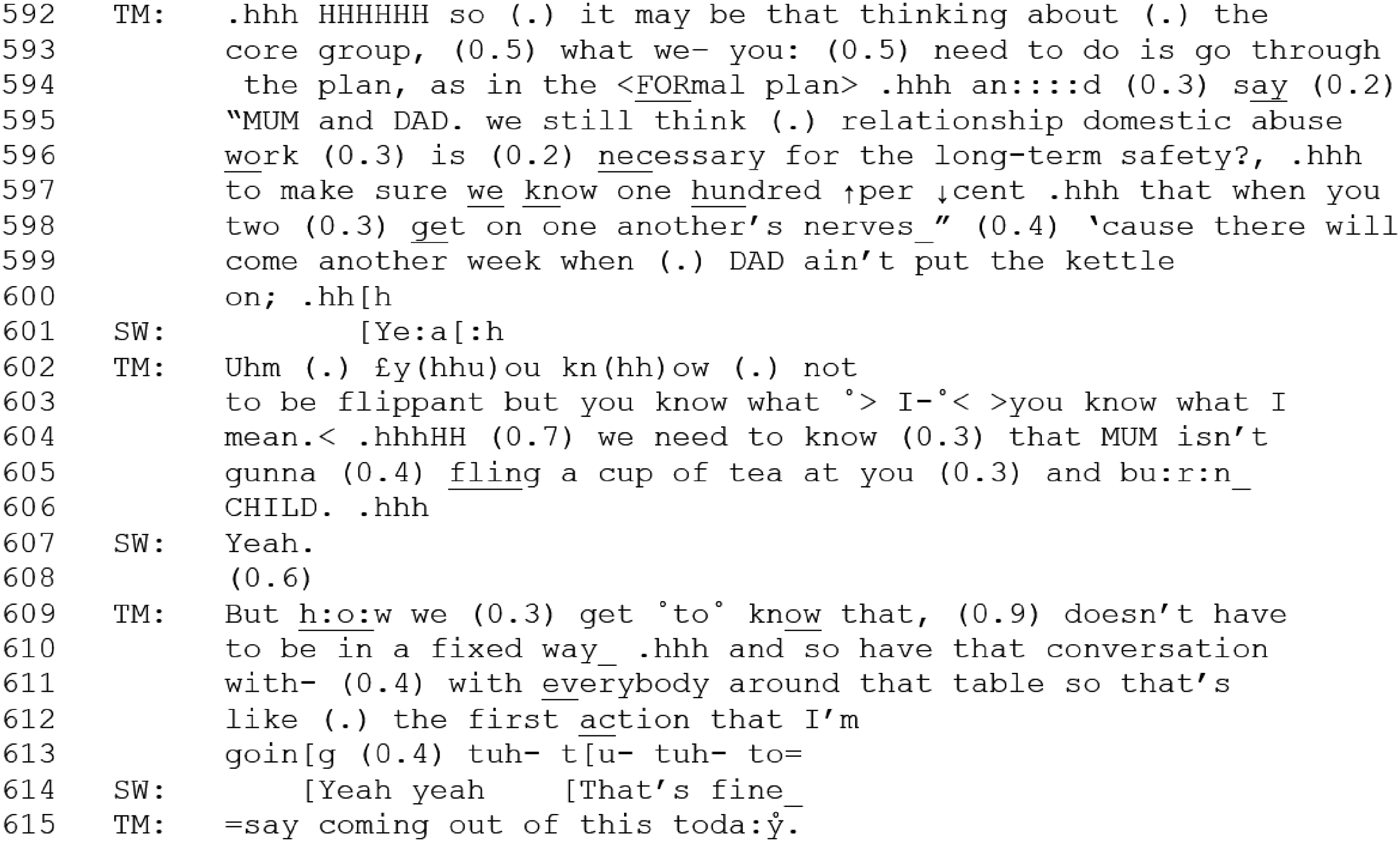
On line 592, the supervisor’s proposal is introduced albeit downgraded through the use of ‘may’ as a qualifier (‘it may be that thinking about (.) the core group’), and not presented as a directive. This mitigated approach is quickly upgraded as the supervisor issues a directive, and models what the social worker should do, via an imaginary discussion between the worker and the parents (lines 595–598). We draw attention to the supervisor’s repair in line 593 (‘what we– you:\ (0.5) need to do is go through the plan…’). This highlights the co-constructed nature of supervision, in which the social worker is often responsible for completing the actions while, in almost all cases from our recordings, the supervisor is the one suggesting them. Perhaps to avoid confusion, the supervisor repairs from ‘we’ to ‘you’, making it clear who should complete the task.
The supervisor draws on a past incident when he mother threw a hot cup of tea at her partner (604–606) and imagines that it could be repeated. This possibility is recruited as evidence, adding weight to the supervisor’s suggestion (line 602–606). Finally, the supervisor transitions to a decision implicative resolution turn (lines 609–615), in which they pronounce a decision has been made regarding a future action for the worker (‘so have that conversation with- (0.4) with
Here, the supervisor proposes a complex intervention, albeit one that in the contextual domain of social work is likely to be a regular occurrence. Yet the substantive content of the discussion is only briefly touched upon. The worker accepts the supervisor’s proposal, and the conversation moves on. We found that acceptance in second position without further discussion is a recurring feature of these unilateral decision sequences. This reflects previous studies of supervision, in which supervisors and workers were often heard to talk about ‘what’ they would do, without reflecting on questions of ‘how’ and ‘why’ (Wilkins et al., 2017).
We also found occasions in which the supervisor’s deontic authority was prosodically softened, even as they pursued unilateral decision making. In Extract 2, the social worker has been discussing a family with a young toddler. We join the extract at lines 1006–1007 where the supervisor asks about what childcare equipment the family have.
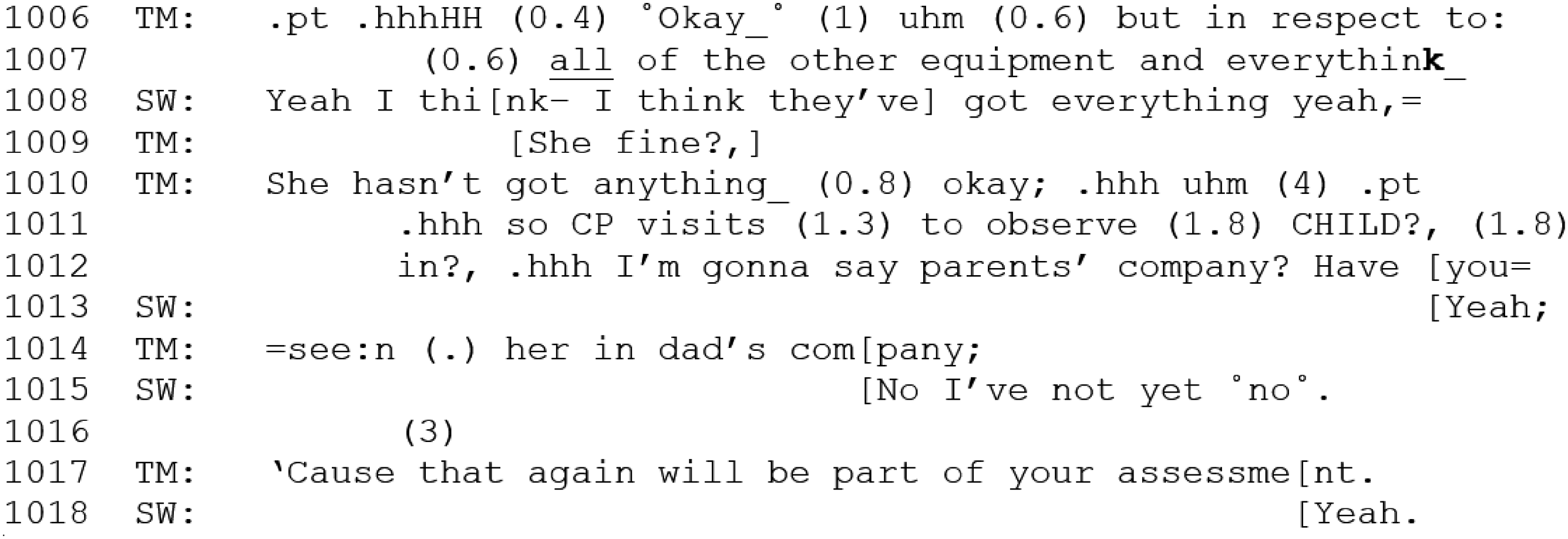
As in Extract 1, the supervisor asserts a course of action, and although it is delivered grammatically as a declarative statement (so CP visits (1.3) to observe (1.8) CHILD?’) the questioning intonation points towards an invitation to agree. In line 1011, the supervisor is typing, which may account for the pauses. These could offer the worker an opportunity to ‘jump into’ the conversation, but the intonation of the supervisor projects an ongoing utterance. The supervisor’s proposal to organise child protection (CP) visits to see the child is elaborated by a declarative increment (line 1012; ‘in? I’m gonna say parents’ company?’), the deontic authority of which is softened again by the questioning intonation. This receives agreement from the social worker (line 1013), but crucially the supervisor does not treat the confirmation as a necessary part of the process. Instead, they move onto other business as the worker’s response is delivered in overlap (line 1113). Here, again, the supervisor’s turn invites but does not pursue agreement, or discussion of the substantive qualities of the decision. Whilst the social worker knows about the family (epistemic domain), the supervisor has epistemic authority in terms of knowing about institutional aims and processes (for example, that child protection visits may normatively be organised at this juncture), and draws on their deontic authority to announce a decision (Brown et al., 1987). This again reflects previous studies of supervision, in which supervisors often took responsibility for identifying ‘the problem’ to be discussed and what action to take (Wilkins et al., 2017).
Mixing deontic and epistemic domains to do unilateral decision making
Whilst it was not uncommon for supervisors to pronounce a decision, asserting a future action without pursuing acceptance, they also used ‘weaker forms’ of unilateral decision implicative turns. Typically, these were formulated as an epistemic stance from the supervisor about an issue, before transitioning into deontic issues about how to deal with it (e.g. ‘I think we should do X’). These formulations tended to be met with acceptance rather than discussion, resistance, or elaboration. In Extract 3, social worker 2 is handing over case responsibility to social worker 1. As we join, the supervisor is discussing how to manage a hypothetical situation in which the mother says the family no longer needs social work input.
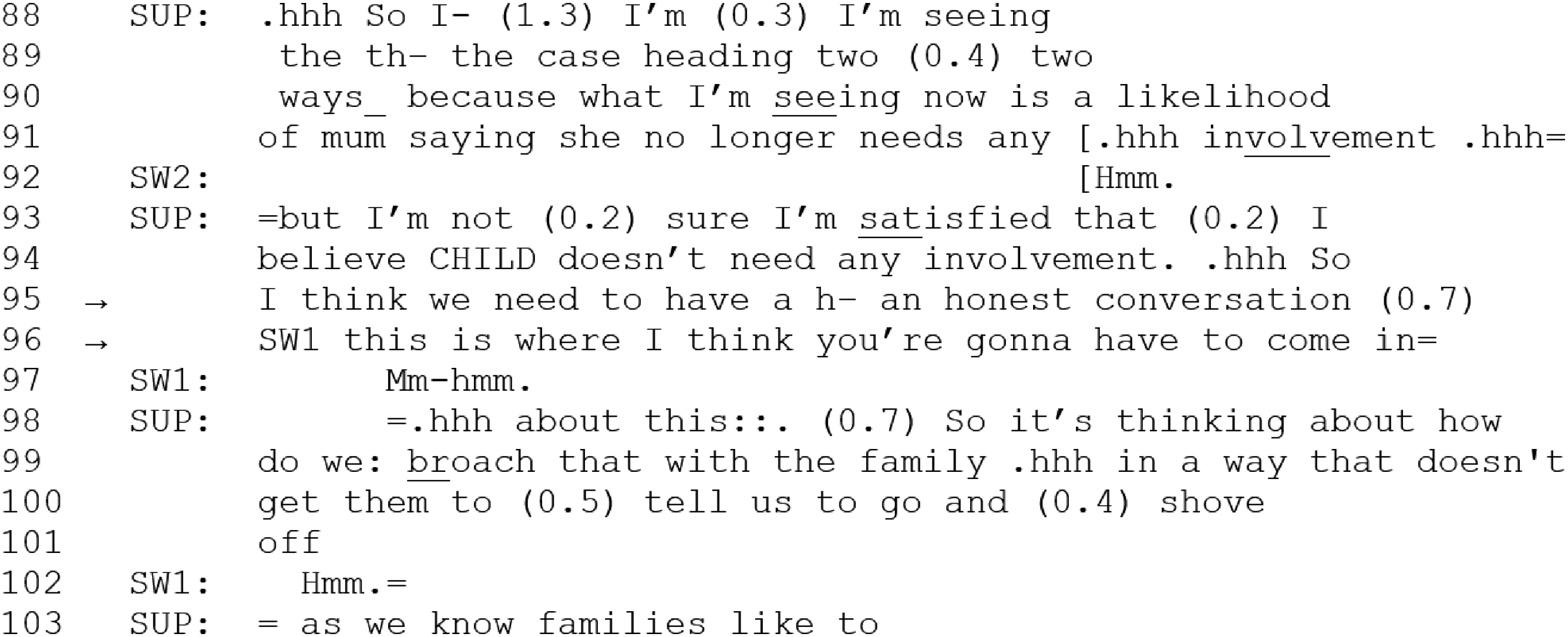
As in Extracts 1 and 2, the supervisor’s transition to decision making activity (line 88) is marked by a ‘so prefaced’ turn. The supervisor takes an epistemic stance to frame a possible future scenario (‘I’m seeing the case heading two ways’), before outlining a possible response – that the child does need further social work input, despite what they anticipate the mother may say (line 93–94). This is explicitly tied to her epistemic stance (‘I’m not (0.2) sure I’m
Summary of unilateral decision-making in social work supervisions
We identified the following features of unilateral decision-making sequences in these social work supervisions: (1) They are often occasioned by ‘so-prefaced’ turns by the supervisor, signalling a move into a decision making. (2) They were almost always instigated by the supervisor, showing how roles and institutional authority are talked into being. (3) Supervisors sometimes treated themselves as having sufficient deontic authority to unilaterally assert the action, even when this involved difficult to navigate interpersonal and professional practice tasks for the worker. (4) Social workers generally did not treat supervisor’s first turns as proposals that invited participation. Instead, they orient to these utterances as informing what would happen, typically eliciting acceptance such as period intoned ‘‘Yeah.’’ or ‘‘Fine.’’; or minimal assent tokens such as ‘mmhmm’. Thus, unilateral formulations were oriented to by the social workers as not inviting collaboration or further discussion.
Bilateral proposals to instigate decision making sequences
Having examined instances where future actions are treated as fait accompli, we now look at constructions which solicit input and accountability from the social worker. These examples fall into Collins et al.’s (2005) bilateral decision-making categorisation, meaning that decision-making outcomes were dependent in part on the social workers’ contributions. These mostly take the form of ‘proposals’ in first position, whereby the supervisor proposes an action whilst conveying that it is contingent upon the worker’s acceptance (Stevanovic et al., 2020).
Thought proposals
We begin by examining ‘thought proposals’, a type of construction initiated by supervisors to place a possible action ‘on the table’ (e.g. ‘I’m wondering about X’ + account). Stevanovic (2013) notes that speakers can mitigate a proposal and the imposition on the second speaker by constructing the proposal as a thought. In Extract 4, a social worker and supervisor are discussing a mother and a young boy. The social worker has said she finds it difficult to work with the mother, and attributes this to her changeable moods.
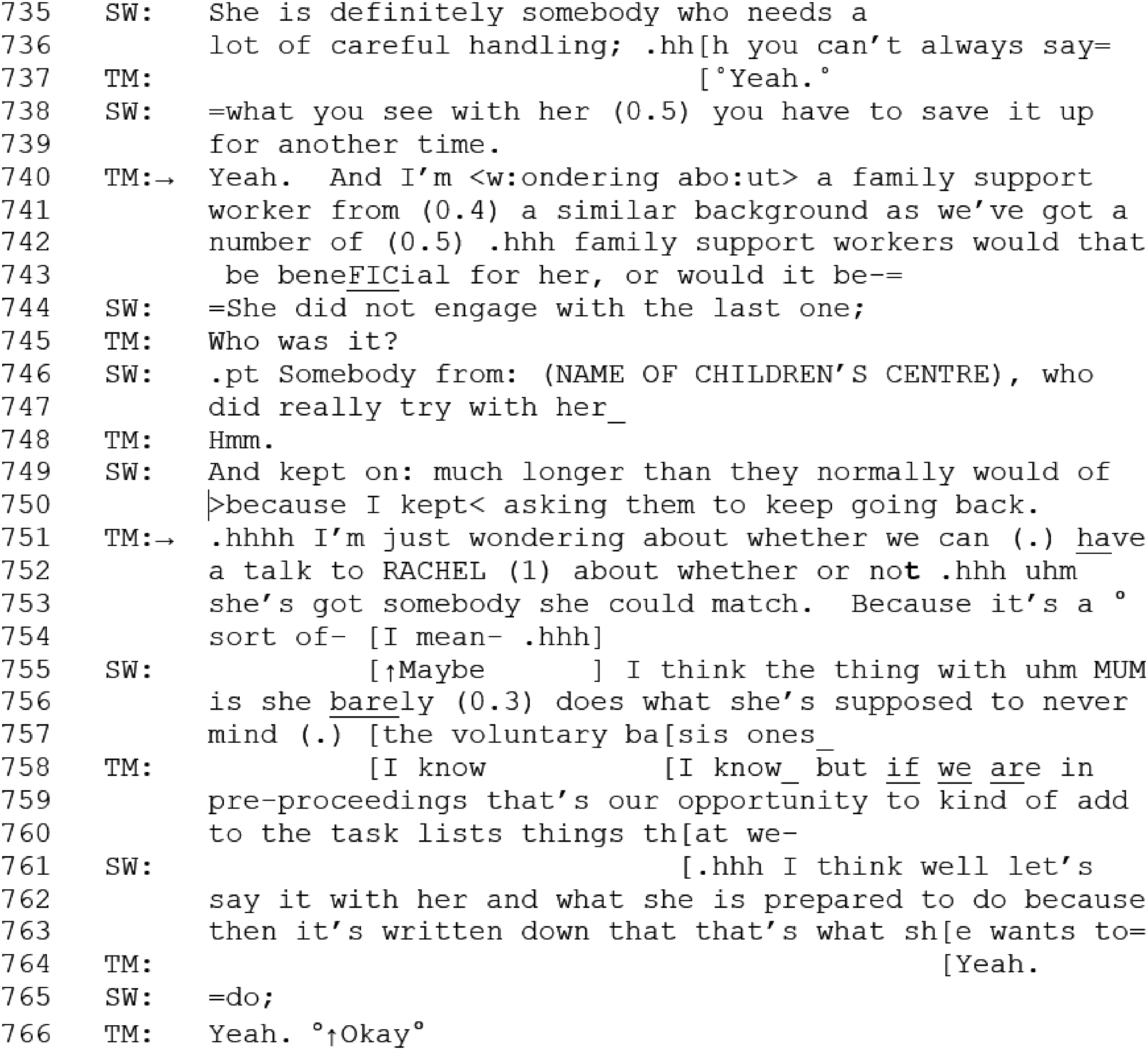
On lines 735–739, the social worker takes a strong epistemic stance about the approach needed to work effectively with the mother. This is delivered unmitigated and declaratively, showing a strong epistemic claim to knowledge (‘She is definitely somebody who needs a lot of careful handling;.hhh you can’t always say what you see with her (0.5) you have to save it up for another time.’) The supervisor provides agreement and alignment (line 740) with an initial ‘yeah’ before formulating a thought proposal (‘Yeah. And I’m <w:ondering abo:ut> a family support worker from (0.4) a similar background’). The use of ‘and’ prefacing the turn explicitly marks the upcoming thought proposal as a continuation of the issue raised initially by the social worker.
The use of the present tense (‘I’m wondering…’) marks this as a thought currently in formation (as opposed to ‘
The social worker’s turn on line 744 (‘She did not engage with the last one’) pushes back against the proposal by demonstrating they have already tried something similar. Proposing a (new) way to deal with a reportedly difficult situation is potentially a face threatening act; the implication could be that the worker should have tried or thought of it already. Here, the worker provides evidence for their own professional competence by locating the problem with the mother. In response, the supervisor again employs a ‘thought proposal’ formulation to propose a revised version of the original plan on line 751–753 (‘I’m just wondering about whether we can (.)
This is met with less resistance by the social worker, who provides a qualified acceptance (‘maybe’) followed by another account of the mother’s problematic character, and her probable lack of compliance (lines 755–757). This is countered by the supervisor, who suggests they have a situational advantage; pre-proceedings gives them extra leverage because if the mother does not engage, the authority may then decide to initiate care proceedings. The supervisor’s response, beginning with affiliation plus contrastive conjunction (‘I know, but’) seems designed to acknowledge the validity of the social worker’s opinion, whilst pushing back with a plan framed as a joint ‘we’ activity (line 758–760).
Finally, this is met with a mitigated acceptance, whereby the social worker agrees to put the plan to the mother (761–763). This proposal for a future action is accepted by the supervisor, and a decision is made (line 764–766): the supervisor proposes involving a family worker of a similar ethnicity to the mother, and the social worker and supervisor debate the likelihood of this working, leading to an acceptance by the worker to (at least) raise the issue. Crucially, it is the supervisor who is agreeing to the social worker’s modified proposal, showing that this formulation is treated as enabling a greater sharing of deontic responsibility about what exactly will happen. By constructing the proposal as a mere thought, it orients to the fact that thoughts can change (Potter and Puchta, 2007: 113–115).
‘Do you think’ + proposal constructions
‘Thought proposals’ work to get an idea for future action on the table by presenting it as a thought in development from the first speaker. They invite (without mandating) the second speaker to ‘get involved’. We now move on to a stronger bilateral form wherein a second party is explicitly recruited to become involved in a shared decision-making sequence by the first speaker asking what they think about a proposal.
In Extract 5, the social worker and supervisor are talking about a thirteen-year-old girl, Tina. The social worker is concerned about her staying out late at night, and a lack of parental oversight. This was identified by the supervisor as a safeguarding concern.
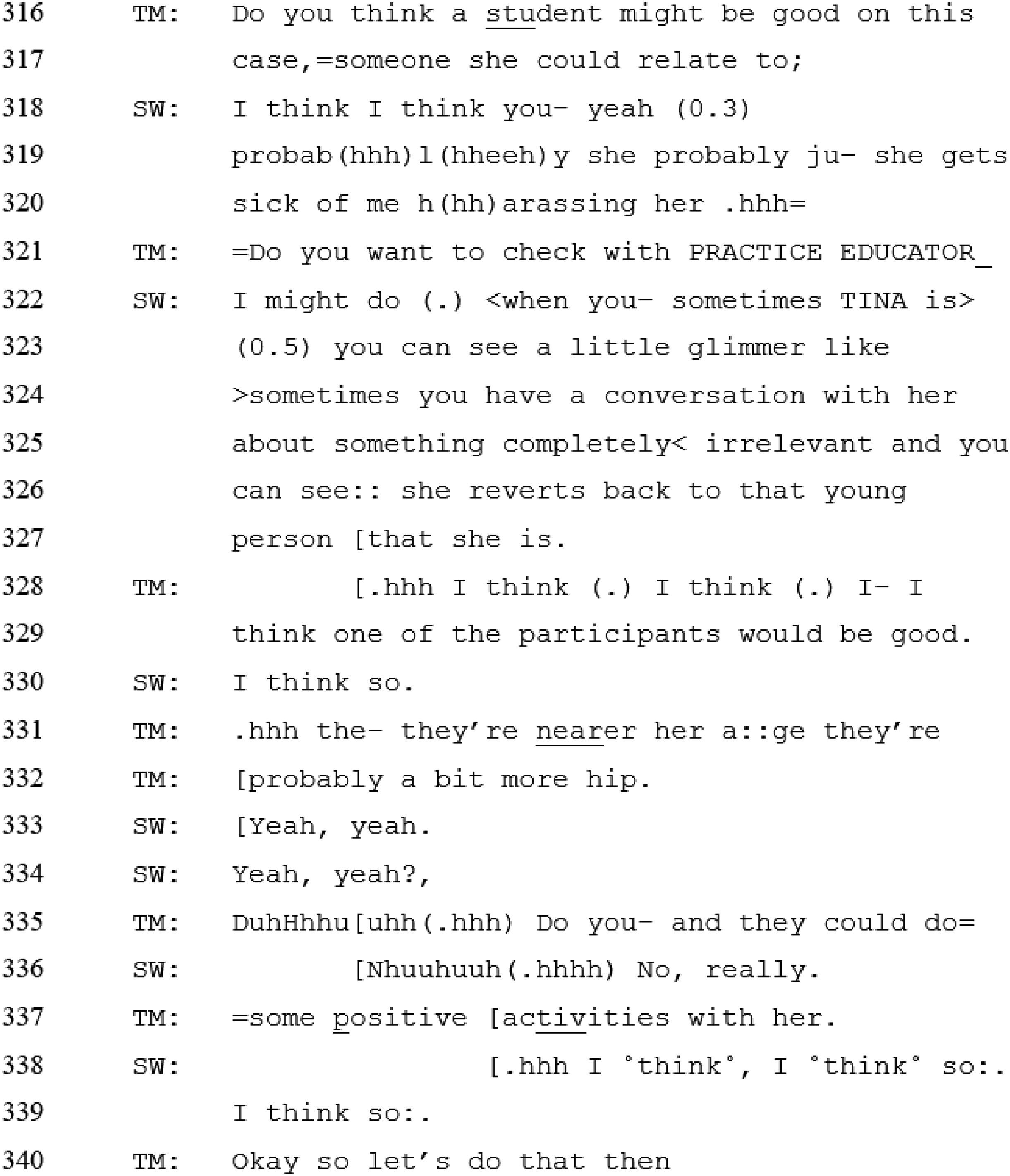
The extract begins with the supervisor asking the worker about getting a student social worker involved to work with the young person. This could be construed as a face threat, implying the worker has not been able to suffiently engage with Tina. Future actions are proposed by the supervisor at each step of the way, but the deontic responsibility is always given to the social worker to agree (line 304, ‘Do you want me to check with THE PRACTICE EDUCATOR’). The worker’s responses align but do not confirm the plan, offering only tentative and mitigated agreement (line 322, ‘I might do’). The social worker gives an account that foregrounds the good interactions they have with the child (line 322–327) and works to mitigate the potentially negative portrayal of their relationship that bringing in another person to help could imply. In response, the supervisor makes a subject side epistemic stance which pushes the proposal to get a student social worker involved (Edwards and Potter, 2017) (‘I think (.) I- I think one of the students would be good’). By framing the stance as explicitly a ‘subject side’ thought, it softens the possibility of upcoming disagreement (Potter and Puchta, 2007) by restricting it to the judgement of the supervisor; one may disagree or have a different opinion, but it is harder to push back against a statement about how the world is (e.g. ‘one of the student social workers will be good to work with her’). Thus, the supervisor’s epistemic assessment enables disagreement (if forthcoming) without contradiction. The supervisor’s epistemic stance is not met with simple agreement, but with a subject side stance from the social worker (‘I think so’). In response, the supervisor provides further reasons for why a student would work well with the child (lines 331–332, 335–337), which then leads to a collaboratively framed decision by the supervisor (‘Okay so let’s do that then’).
Here we can see that the social worker does work to be seen not as simply agreeing to a proposal, but (also) producing an independent assessment (‘I think so’, instead of ‘yes’ in second position). This works to ‘defeat the implication that their rights in the matter are secondary to those of a first speaker’ (Heritage & Raymond, 2005, p. 16). Whilst the extract ends here, the social worker subsequently provides several other accounts for why the proposal is a good one before re-confirming their agreement. These additional independent stances work further to defeat the implication that a) they are simply going along with the supervisor’s proposal, or b) they are agreeing because they do have an inadequate relationship with the child. Most of the interactional work is focused on managing these face concerns and demonstrating an independent stance about the decision. Little attention is paid to what the student will do, how and why their involvement will help, or what the child or her parents might want. Face concerns and potential threats to professional identities are perhaps inevitably interwoven into the fabric of social work supervisions, given the dual role of the senior participant as manager and supervisor. As we have seen, the need to maintain (professional) ‘face’ can mitigate against a more nuanced discussion of the decision itself.
In the final section of the analysis, we outline one more category of decision eliciting actions, demonstrating how face work and professional accountability are made relevant in polar questions which occasion commitment to future action(s).
Polar questions as decision implicative actions
Polar questions from the supervisor could be a decision implicative “format for social action” (Raymond, 2009, p.939). Polar questions are typically constructed to have a response ‘preference’ (Sacks, 1987). For example, if constructed as a positive interrogative (‘yuh coming down early?’; Robinson, 2020), this invites a ‘yes’ response. In these recordings, they invite confirmation rather than collaboration.
In Extract 6, the supervisor’s question on line 449 invites a yes preffering ‘no problem’ response. Where the response aligns with the questions preference, there is no further discussion other than a high-grade assessment from the supervisor (line 451).

When the social worker did not provide an answer aligned with the question’s preference, this led to expanded sequences in which the social worker accounted for not having done something. Extract 7 starts with the supervisor asking about a discharge plan for a baby in hospital.
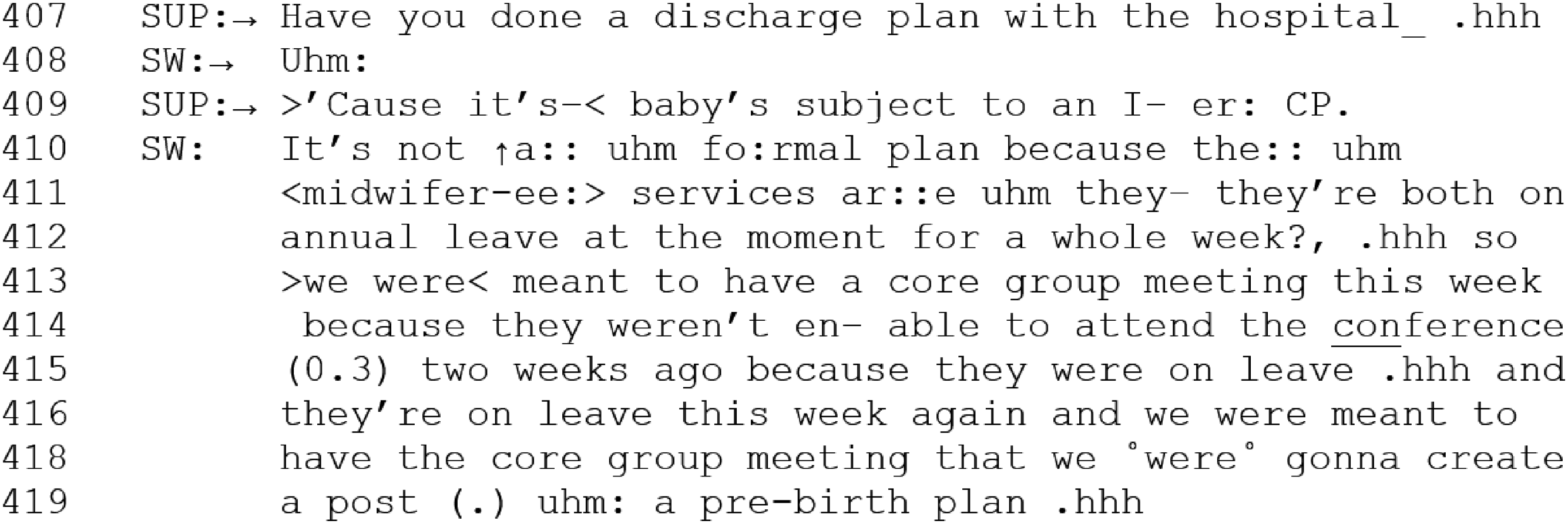
As in Extract 6, the supervisor asks a ‘yes preferring’ polar question (line 407). However, the worker does not provide immediate confirmation (line 408). This makes relevant further decision implicative talk, which the supervisor pursues in the next turn (lines 409–419) (Pomerantz, 1984). In line 409, the supervisor is not simply informing the worker about the category of the baby’s care plan (CP = child protection). They are doing decision-making work, and there are issues at play for the professional accountability and face of the social worker. This can be seen clearly in the social workers following turn where they account for the absence of a discharge plan (410–419), responding to the implication that one is needed.
We skip forward 90 seconds (for reasons of space) during which time the worker produces more reasons for why they had not been able to formulate the plan, including a reference to the supervisor having said previously there was ‘no point having loads of different plans’. We re-join the extract as the social worker is agreeing to ‘do something’ (line 475). This vague commitment is not treated as sufficient by the supervisor who pursues a firmer commitment to action.
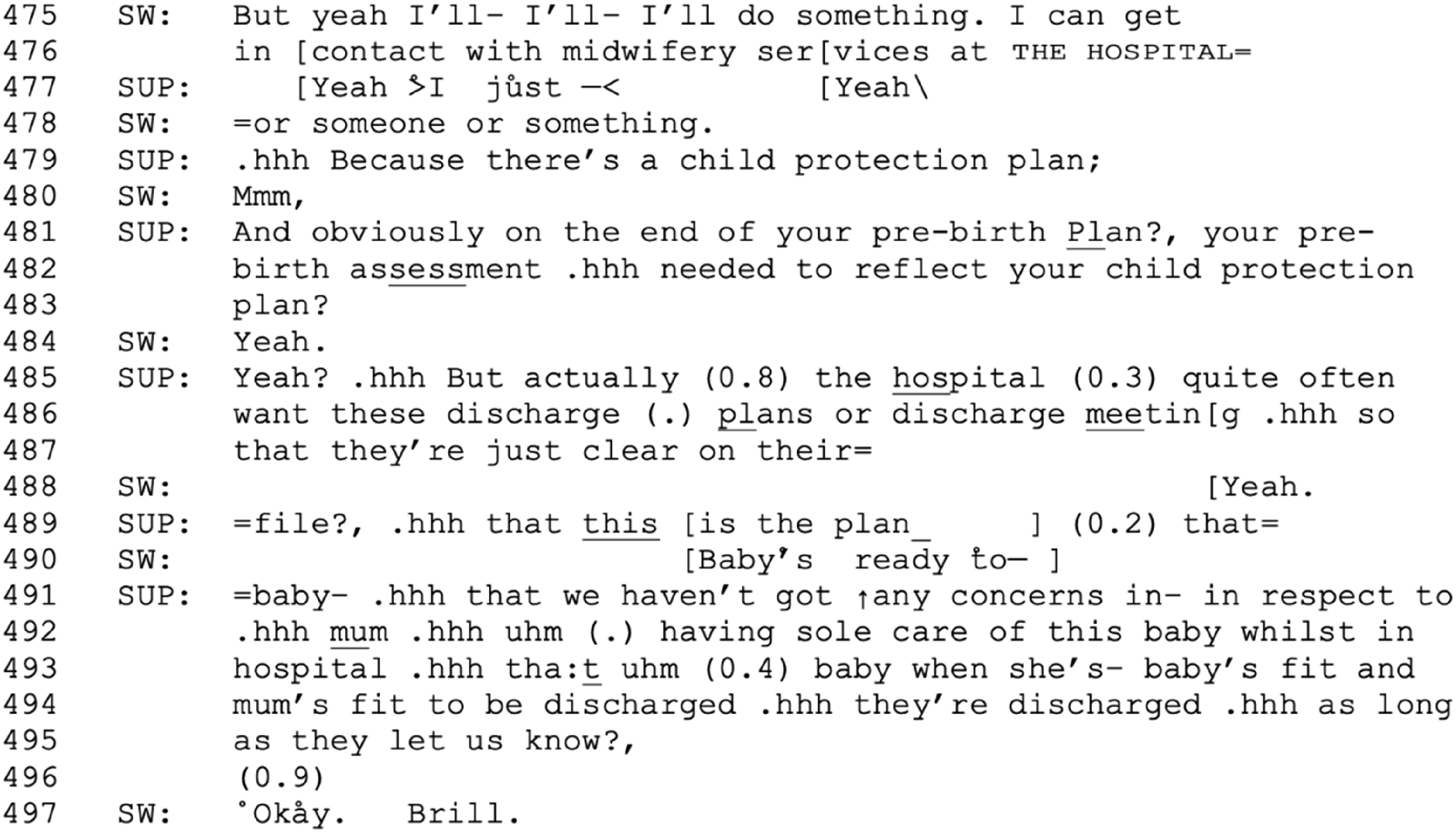
Although the social worker proposes a commitment to future action, it is mitigated by the lack of a clear plan (‘I’ll do something’, line 475) whilst the modal verb ‘can’ (‘I can get in contact with midwifery services at THE HOSPITAL’) projects a moderated commitment to action. This is compounded by the vagueness in the propositional context where the social worker refers to ‘someone or something’. This plan is treated as insufficient by the supervisor, who pursues something more solid by outlining that the hospital will (also) require a discharge plan (i.e. it is not just the supervisor who wants it). Only once the social worker delivers a firmer commitment action (‘Okay. Brill.’), is the topic treated as closed.
As before, much of the discussion following the polar question was not spent considering what should be in the discharge plan. The focus is on the worker’s reasons for not having one, followed by the supervisors outlining why it is a neccesity. Polar questions occasion decision making by virtue of an absence of confirmation from the worker. Whilst polar questions invite social worker contribution(s) and do not impose decision without discussion, by checking a past action has been done they imply the action should have been carried out. Where the social worker could not align with the preference of the question, this occasioned talk about its future completion. This further demonstrates how accountability, and the management of professional competency are live forces in shaping supervisory decision making.
Discussion
We investigated how decision-making sequences were instigated and initiated in social work supervision meetings, and how the shape of proposals influenced the sharedness of decision-making processes. We outlined how issues of face and professional competency were interwoven with decision-making sequences, both in the affordances and delicacy of some of the supervisors’ proposals, and in social workers’ responses. We found that supervisors almost unanimously instigated decision-making sequences by pronouncing a decision, seeking some degree of bilateral shared decision making, or via polar questions regarding the (in)completion of a past action. We are not able to say to what extent this approach would be replicated in a larger and more diverse sample based on the data we have. Whilst the workers’ input was more overtly sought in the bilateral forms outlined here, recipient responses were still constrained to either being in favour or against something proposed by the supervisor.
It is notable that decision making sequences without a plan embedded in the proposal were rare. We found only one open ‘wh’ decision making proposal in the collection (‘what else do you think we could be doing with him’), not included here for reasons of space. Even with this open format, it still ended with a specific proposal for future action from the supervisor. Proposals that invite collaboration but nevertheless put forward a specific plan (however mitigated) reduced the potential threat of the social worker being put on the spot to come up with a proposed course of action, while leaving space for social workers to construct their responses in substantial ways. However, even downgraded proposals which sought social worker involvement were not neutral, as acceptance of the proposal was often pursued by the supervisor in the face of resistance. The mere fact of putting something on the table suggests some commitment to the idea.
Bilateral sequences which sought greater input from the worker were more responsive to the potential upcoming resistance or threats to face and implications for the social worker’s professional competency. This was evidenced by such proposals frequently being met by workers managing the potential implications for their professional competency and accountability, including having previously tried something similar, legitimating and accounting for why they were not able to complete the action already, or working to demonstrate independent agreement.
In most instances, proposals were instigated by supervisors. We showed how this was accomplished on a deontic gradient, from a heightened deontic stance (unilateral formulations, and polar questions which presuppose or suggest a course of action should have or will be taken), to downgraded forms (bilateral formulations). Regardless of the stance supervisors adopt to get a proposal on the interactional table, we have shown they treat themselves, and are treated, as having the deontic authority to direct future courses of action. This speaks to the asymmetrical interactional space of social work supervision, but also perhaps the difficulty of explicitly declining a proposal from someone in a position of formal authority. To do so would itself constitute a threat to the face of the supervisor. Where bilateral forms were resisted, this was often in ways that foregrounded the positive face and professional competency of the social worker, rather than the quality of the decision or how the child or family might feel about the decision. Turney and Ruch (2016) point out that a “range of factors— practical, cognitive/psychological, emotional and systemic/organisational—have been identified that undermine the capacity to think purposefully and effectively in practice, with potentially adverse impacts on assessment and decision making” (p. 670). We agree and would add that accounting for, and maintaining, professional face concerns may take precedence over discussion about what decisions may mean for, or impact upon, children and families.
Accountability and concerns over face were shown to be inextricably intertwined with decision-making activities in these recordings. This was most starkly evident in polar questions about whether a task had been done. These questions were valanced in such a way to ‘prefer’ a positive answer to the question (i.e. the activity has been completed). They instigated decision-making sequences only when the worker was unable to confirm they had completed said action.
We also outlined the features of unilateral decision sequences, and noted the minimal responses of the social workers, with no examples in our data of deontic authority being resisted. Policy and research have both pointed to the experience of social work supervision as a space for decision-making, but also one in which unequal power relations operate (Hair, 2014). Supervisors are accountable for the social worker’s practice and thus may be more likely to shape the actions that they expect the worker to follow (Kadushin and Harkness, 2014). Our analysis of how decisions are interactionally accomplished furthers and adds detail to this observation, by outlining the different ways that proposals were constructed by supervisors to shape the future actions of the social worker (as well as children and families).
The orientation to proposing future actions may be related to the fact that fast-paced, stressful work environments lead supervisors to be directive and content focused (Lietz, 2009; Lietz and Rounds, 2009). Under these circumstances, supervision may not be able to provide opportunities for social workers to develop their critical thinking, or to fully participate in a reflective decision-making process to the benefit of people using services (Noble and Irwin, 2009). This may especially be the case where their professional competency and accountability is a territory which must be constantly maintained and defended. It also seems apparent to us that relative to the significance of decisions made by and via social work services (e.g. to initiate care proceedings and seek to remove a child from home, or to make the formal judgement that a child is at risk of significant harm from abuse or neglect), that the decisions observed in our data are relatively less significant, and related more to the worker’s everyday practice. It is possible that more significant decisions were/are made in other supervisions sessions that were not recorded. Equally, bigger decisions may be borne out of crisis, and so may not be tackled in pre-scheduled supervisions due to the necessity to make such decisions in a timely fashion. A larger data set across different teams and locations is therefore needed to better understand whether the types and patterns of decision making seen here are typical across settings. We reflect further on this point in the following ‘limitations’ section.
Finally, we offer a few thoughts about how our findings might add to the conversation analytic decision-making literature. Although we drew on Collins et al.’s (2005) identification of bilateral and unilateral decision-making structures, we found less true collaboration than they did. Their study took place in a medical setting, and there are key differences between medicine and social work, especially child protection. Stivers et al. (2018) note that “[w]hen doctors recommend treatment to patients, they do so in a context in which the patient has actively sought medical advice” (p.1335). In simple terms, medical encounters are initiated by patients because they have identified themselves as needing medical intervention, often in response to a specific issue (e.g. persistent headaches). Social work supervisions are mandated, not made in response to a specific issue identified by clients. ‘Problems’ may often be identified and labelled as such by professionals, and not necessarily by family members, including the child. We add to the CA literature through exploring this complex decision-making space, where what counts as a ‘problem’ is interactionally negotiated and emergent. Decision-making is also only one part of supervision, which (in theory) needs to achieve a great variety of objectives (Saltiel, 2017) – perhaps too many for it to reasonably bear. Lastly, this article also adds to what is known about the intersection of ‘face work’ and decision making. We showed that ‘doing’ professional competency and the avoidance of face threats are live concerns in decision making sequences in social work supervision settings, but which can take precedence over the reasoning and deliberations of the merits of proposed decisions.
Limitations
The most significant limitation of our study is the relatively small size of the dataset, and that all the audio-recordings were collected from the same social work team. While this has enabled us to look in detail at decision-making processes within some examples of social work supervision, we do not know how varied such processes might be in other teams, and with other supervisory dyads. While our focus here has been on the use of supervision case discussions as a decision-making space, we do not know to what extent and how these discussions might also have influenced subsequent decisions. For example, following a case discussion, the worker may reflect on their practice, and do something differently at the next home visit. This would be an interesting area for future study but is not something we have been able to address here.
Conclusion
There is limited empirical research about what actually happens in supervision and the difference it makes especially for children and families (Turney and Ruch, 2016; Carpenter et al., 2012). Before we start to measure efficacy in a meaningful way, it is important to know what we are measuring and why. Understanding the interactional and social context in which decisions are made in supervision case discussions is key to this goal. As Saltiel (2017) argues, ‘it is important to know more about how supervisors and supervisees actually ‘do’ supervision – what they discuss, how they discuss it, how they negotiate with each other, how they construct knowledge and make decisions’ (p. 546). We have furthered this goal by explicating the interactional strategies used to make decisions by (some) supervisors and social workers. As we and other researchers continue to make progress towards knowing more about how supervision is actually enacted in practice, we hope our findings offer insights and a point of comparison to help us understand more about the variety (or potential homogeneity) of decision-making processes within child and family social work supervision.
Footnotes
Declaration of conflicting interests
The author(s) declared no potential conflicts of interest with respect to the research, authorship, and/or publication of this article.
Funding
The author(s) disclosed receipt of the following financial support for the research, authorship, and/or publication of this article: The data collection for the data used in this article was funded by the Department of Education.
