




Abstract
Reflective supervision is widely recommended as an effective way to support social workers to think about their practice and to make better decisions. Although previous research has proposed methods of pursuing reflective supervision, little is known about how supervisors attempt this in actual supervision meetings. One proposed method for supervisors is to elicit third person perspectives so that social workers can consider a situation from different points of view. In this article, we examine this method by analysing audio recordings of 12 supervision meetings from one local authority Children and Families Social Work team. Using Conversation Analysis (CA), we explore supervisors’ attempts to elicit other people’s perspectives, focusing on how such requests were formed and how the social worker responded. We found 35 instances of supervisors attempting to elicit third person perspectives and identified four different ways that supervisors designed these enquiries. Supervisors oriented to two concerns, based on whether they enquired about a perspective that was currently established or projected into the future, and whether the information was verifiable through speech or actions, or imagined based on the other person’s thoughts or understanding. We draw on CA work on epistemics and stance to show how these different approaches have implications for what the social worker is expected to know and how both speakers orient to the accountability of the social worker. We conclude by considering the epistemic friction between the design of these enquiries, the relevance of professional accountability and the possibilities for pursuing reflective supervision in practice.
Introduction
In child and family social work, supervision is considered ‘the cornerstone of good…practice’ (Committee HoCH, 2003: 12). More specifically, it is argued that social workers need reflective supervision (Karvinen-Niinikoski, 2016), to enable the use of theory and research in practice (Social Work England, 2019), to help test hypotheses about the family (Department for Education, 2014) and to support good practice more generally (British Association of Social Workers, 2011). Within the academic literature, the claimed benefits of reflection include an increased capacity to interpret behaviour (Fonagy and Target, 2005), improved critical thinking skills (Julien-Chinn and Lietz, 2019) and enhanced emotional support (Glassburn et al., 2019). Ferguson’s (2018) finding that practitioners sometimes avoid reflecting too much, because it can be emotionally draining, is a rare example of dissent from this consensus about the vitality of reflection for social work. In this article, we use Conversation Analysis (CA) to examine what happens in a select number of supervision case discussions. By so doing, we explore how reflective supervision can be observed and described, and to see how supervisors create reflective spaces as part of casework discussions.
Background
When discussing reflection in social work, it is conventional to acknowledge the work of Schön (1983). His seminal work, The Reflective Practitioner, is often cited although the book itself hardly mentions social work. Schön’s ideas are nonetheless influential for our contemporary understandings of reflection. Schön started from the premise that expert professionals know more than they can put into words. When faced with a complicated task, they do not rely on standardised processes that can be articulated (and thus taught to others). Instead, they improvise, using reflection-in-action to develop novel solutions. If they were subsequently asked to describe how they knew what to do, the expert would find it hard to articulate their process or might generate a post hoc rationalisation that bore little resemblance to reality. In Schön’s words, ‘when a practitioner displays artistry, his [sic] intuitive knowledge is always richer in information than any description of it’ (p. 276).
Schön also described reflection-on-action, a cycle of reviewing, analysing and evaluating things past (McLeod, 2017). Schön thus identified two types of reflection – in-action and on-action – quite differently. When discussing reflective supervision, it is the latter concept that is being invoked. Yet reflecting on action means more than simply asking the worker about past events and activities. It should also involve, variously, identifying and discussing the worker’s emotional reactions (Ruch, 2012), developing hypotheses (Julien-Chinn and Lietz, 2019), cultivating multiple perspectives (Heffron et al., 2016) and thinking critically about wider social structures, such as inequalities, discrimination and culture (Wilson et al., 2018; Ryde et al., 2018; Sullivan, 1999). Given this diversity, it is something of an open question as to what ‘counts’ as reflective supervision.
This may help to explain why, despite the widespread consensus about the importance of reflective supervision, there are many studies which demonstrate how difficult it is to achieve in contemporary practice. Different studies have found that reflection in supervision is often squeezed out by management oversight of practice (Wilkins et al., 2016) and the surveillance of workers (Beddoe, 2010). Rather than receiving reflective supervision, workers spend much of their time providing information, which the supervisor records on the child’s electronic records (Baginsky et al., 2010). Supervision often seems to function not as a reflective space, but as a forum for professional accountability (Beddoe et al., 2021). What these studies have in common is the finding that reflective supervision is hard to do, because of wider organisational pressures. Yet it may also be true that reflective supervision is hard to do because reflection itself is hard. As noted already, social workers may actively avoid reflection to protect themselves from emotional distress (Ferguson, 2018). Reflection requires well-developed skills, such as emotional intelligence (Herland, 2021). Student social workers must work hard to develop their reflective skills, alongside a whole set of other professional competencies, suggesting they are far from innate (Gursansky et al., 2010). Being ‘reflective’, especially with another person, is a process of exposure, which relies on the quality of the existing relationship and expectations about what such exposure will involve and lead to (Hargreaves, 2004). Thus, even without problems such as high workloads, and insufficient resources, it is not certain that reflective practice, in supervision or elsewhere, would automatically flourish.
In many social work teams in England, supervision is provided by team managers or deputy team managers, and sometimes by senior social workers too. In policy terms, supervision fulfils a range of functions: accountability (of the worker), skills development, analysis and decision-making, and performance management (Department for Education, 2018). There is no one national model of supervision that teams are required to use, and various models or none may be implemented in different places (Webb, 2021). One of a limited number of UK observational studies of supervision suggests that many case discussions lack an overt structure, starting with a relatively lengthy case update by the worker, interspersed with clarifying questions from the supervisor, who will often then provide advice, information and guidance on what the supervisee should do next (Wilkins et al., 2016).
However, most of the research on supervision has not commonly focused on naturally occurring instances of interaction. This is surprising given that supervision is, at its heart, an interactional accomplishment achieved by two (or more) speakers taking turns to talk. CA has provided insights into interaction in institutional contexts such as how psychotherapists demonstrate empathy (Voutilaenen et al., 2019) or how social workers build up engagement with parents (Symonds, 2018). In this article, we use this approach to examine audio recordings of supervision case discussions to investigate how supervisors promote reflection through one recurrent practice, namely attempts by the supervisor to ‘cultivate multiple perspectives’ (Heffron et al., 2016). To identify concrete examples of this, we have specifically focused on attempts by the supervisor to elicit third person perspectives from the worker, to understand how supervisees are supported to achieve this one aspect of reflecting on their practice during supervision.
Being asked to take a stance in social work supervision
As is common in institutional interactions, supervisors routinely lead the direction of the interaction by asking questions of the worker (Hayano, 2012). Asking a question treats the other person as having the right to, or epistemic authority over, knowledge about their own points of view, thoughts, feelings and experiences (Kärkkäinen, 2006; Pomerantz, 1980). This is evident in supervision meetings when social workers are asked to give their professional opinion on casework-related matters. By making decisions about how to present these perspectives, social workers will draw on the evidence available to them but are also unavoidably required to take a ‘stance’. Our use of stance here refers to how people are not just describing or reporting information within the interaction, but are also ‘simultaneously evaluating objects, position[ing] subjects and aligning with other subjects’ (Du Bois, 2007: 163).
One might expect social workers to be asked for their own perspectives in supervision case discussions. However, as noted above, one of the key aspects of reflection is the consideration of different and multiple perspectives, including from different people (such as family members) (Heffron et al., 2016). Taking a stance on what someone else may think or feel can be a tricky interactional goal (Webb et al., 2018), due in no small part to the speaker’s relative lack of knowledge regarding what is in another person’s mind, and the dubious social rights they have to speak for someone else. Social workers may have access to things they have seen, or what family members have said, yet cannot claim access to their inner worlds, upon which they may be asked to speculate in supervision meetings. The essence of who knows what, and who has the right to describe it, is the cornerstone of epistemic research in CA (Gardner, 2007; Heritage, 2012a). In expressing knowledge which ‘belongs’ to someone else, people may or may not have primary access to this (for example, because they have or have not been told directly by the other person) and are therefore accountable in the interaction for their stance in relation to this (Heritage, 2012a). The way that social workers adopt a stance in supervision, and the questions that precede them doing so, have implications for the way that the supervisor and supervisee navigate their way together through the case discussion.
Methodology and data collection
The empirical basis for the analysis is 12 audio recordings of supervision case discussions between supervisors and social workers, collected as part of a wider study of supervision (Wilkins et al., 2020). The recordings were collected between January and September 2019, from the same child protection team in one local authority in England. Supervisors were provided with digital Dictaphones and asked to record themselves in supervision meetings. The individual discussions were selected by the supervisor and social worker together, and only then recorded with parental consent. The supervisors were not implementing any specific model of supervision. Ethical approval for the study, and for secondary analysis of these data, was granted by Cardiff University (School of Social Sciences ethics committee) in May 2017 (SREC/2765).
The recordings were transcribed in detail, including paralinguistic and prosodic features such as pauses and pace (Jefferson, 2004). From these materials we assembled a collection of 35 instances in which the supervisor invited the worker to comment on another person’s perspective (for example, what do you think the father thinks about his child’s behaviour?). As we were focusing on the role of the supervisor in facilitating reflective supervision, we did not include instances when the social worker offered third person perspectives without solicitation, or when the supervisor provided their own account of other perspectives. The instances in our collection were extracted and organised into a shared spreadsheet to which all authors added initial analysis using a CA approach. CA allows us to identify what people do through their talk, (for example, inviting, instructing, reflecting), and how they are doing it. Language is treated as actively constructing social reality and accomplishing social functions (Liddicoat, 2011). By closely examining the ‘naturally occurring’ interactions (Ten Have, 2007) we were able to explore in detail how the supervisor elicited third person perspectives, focusing, for example, on how enquiries used tense and the actions they focused on. In keeping with CA, we inspected the social worker’s next turn for evidence that supported or disconfirmed our analysis (Heritage, 1984). To build up the quality of our claims, we followed the CA tradition of data sessions (Ten Have, 2007) in which we compared analysis, identified key features of turn organisation, and selected illustrative examples. Thus, we were able to critically examine our findings and insights throughout the process. Furthermore, we present the extracts verbatim for the reader to judge the validity of our interpretation themselves (Liddicoat, 2011).
In examining patterns of how eliciting other people’s perspectives are accomplished in the interaction we have isolated extracts from their conversational context. However, when people interact, they continually give information about the context they orient to by demonstrating that they consider the shared cultural and contextual knowledge that the other participants are presupposed to have. This orientation shapes the way participants speak and can thus be seen as talking context ‘into being’ (Heritage, 1984). In other words, within CA, contexts are viewed as generated in and through the interaction itself rather than as something external. Turns-at-talk are both viewed as context-shaped (since participants’ contributions are always understood in the light of and as responsive to prior actions – particularly the prior turn) and context-renewing (in the sense that they provide a framework for the understanding of the conversational contributions that follow) (ibid). In the following analysis we take into consideration how contextual features of the situation and conversation are made relevant by participants when eliciting third person perspectives, thereby drawing attention to some of the complexities connected with promoting reflection as a desired component in supervision.
Data and analysis
Our analysis presents approaches taken by supervisors which orient to two different concerns. The first was whether the enquiry relates to a current perspective (already established) or a perspective projected to be in the future (not yet known). The second concern was whether the perspective was derived from empirically verifiable evidence (such as what the other person had said or done), or from imagined states (what the person thought, understood or wanted).
The supervisor’s orientation to these two concerns led to four approaches which we present below. The design of these enquiries treats the social worker as having access to different types of evidence and prompts them to take a stance. We go on to show that the stance taken has implications for the progress of the assessment, the social worker’s professional accountability and the possibilities for reflection.
Approach 1: Current perspective – empirically reportable evidence
The first approach focuses on a third person perspective that has already been established and which the social worker is able to report based on direct evidence of what the other person had said or done. In Extract 1, the supervisor asks the worker to present the mother’s perspective on her use of cannabis based on what she has said in the past and which the social worker is treated as having direct access to.
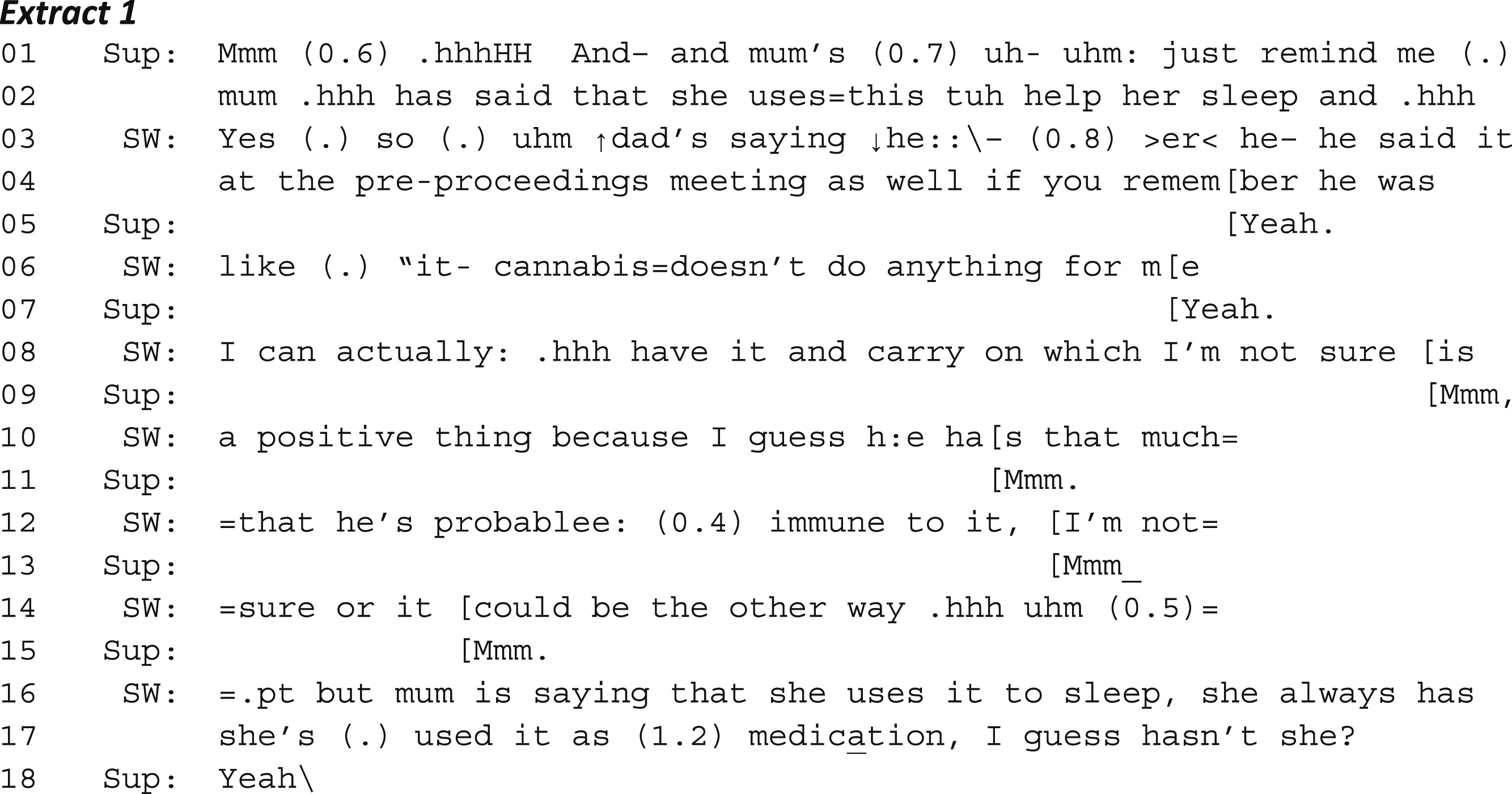
In line 1, the supervisor begins toask about a mother’s reports of her cannabis use. The turn design is built from two components. First, it is framed as requesting a reminder (‘just remind me’ line 1), which implies they both know this information already. This is supported by the second part, which is formatted as a declarative, seeking confirmation (‘mum .hhh has said that she uses=this tuh help her sleep’, lines 1–2). While the turn final ‘and’ seems to function as an invitation to elaborate on the assertion, the supervisor treats the matter as something that she has some existing confidence about.
The social worker’s response begins with a straight ‘Yes’ (line 3) demonstrating a clear confirmation of the supervisor’s assertion. Here, the social worker endorses the assumption that she can report directly on the mother’s perspective based on the evidence of what she has said. Although there is space for the worker to expand on this perspective, she adopts a different stance by shifting the topic on to the father. This does two things. First, the supervisor is invited to jointly remember a previous meeting where the father shared this information, thus establishing a common ground of shared knowledge (the supervisor confirms this in line 5). Second, the social worker problematises the father’s apparent immunity to cannabis as not ‘a positive thing’ (line 10) which is in contrast with the mother’s medicinal use of cannabis (line 17), something to help her sleep, a formulation which might be a more acceptable justification for substance use. In this extract, a question focused on a reportable current perspective is treated as known, familiar and accessible. The social worker confirms her knowledge of this information, but develops her response, not to add further detail about the mother’s perspective which she might have chosen to explore, but to offer a stance which evaluates the parents’ actions, thus progressing the professional assessment of their parenting.
In Extract 2, the supervisor asks a similar question, focused on what a mother has said to the social worker about her 16-year-old daughter caring for her younger sister. In this discussion, the 16-year old has been involved in a violent gang dispute which is characterised by the supervisor as ‘a bit of a worry’ (line 1 below) and which sets the immediate context for her question about the mother’s perspective in lines 3–4.
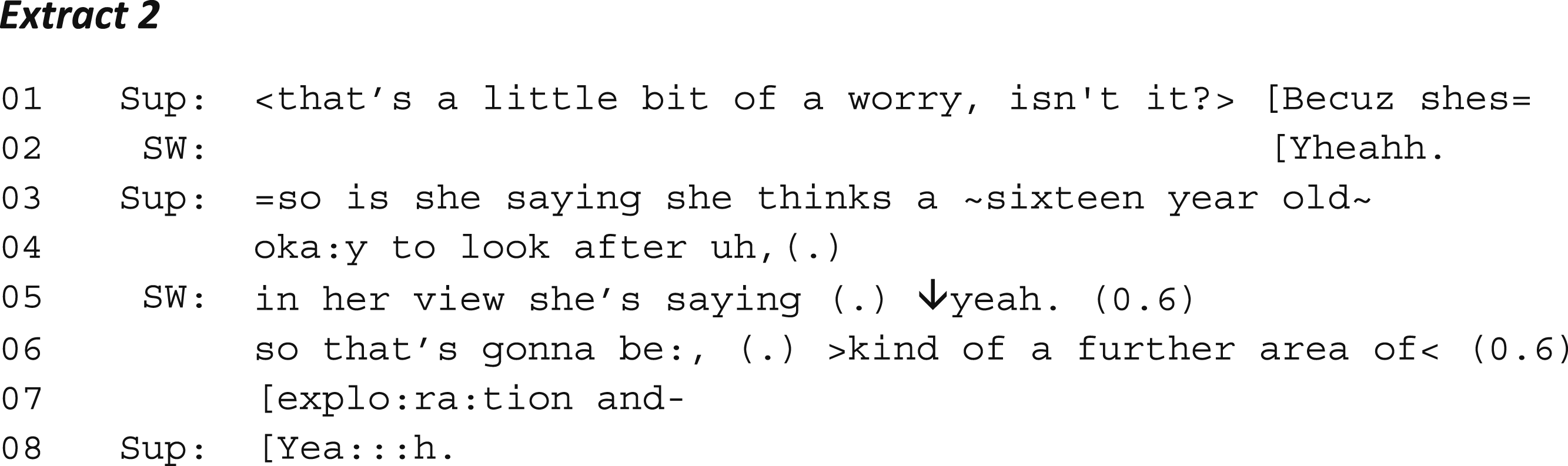
In this extract, the supervisor presents her enquiry as a straight polar question ‘is she saying’ requesting a confirmation or a rejection (line 3). This positions the social worker as knowledgeable about the matter and able to report on the empirically available evidence of what the mother said. However, the question is also prefaced with the discourse marker ‘so’, indexing a connection with the preceding talk. The inquiry into the mother’s viewpoint is launched in a conversational environment in which a concern has already been raised. The supervisor’s tag question ‘isn’t it’ (line 1) exerts interactional pressure to agree with the asserted concern (Hepburn and Potter, 2011) and this is confirmed by the social worker in overlap in line 2. This makes the mother’s viewpoint relevant for making such an assessment. Additionally, the topicalising of the daughter’s age immediately after assessing the situation as ‘a worry’ strongly hints at the supervisor’s negative evaluative stance of the daughter’s age as being part of concern.
The social worker’s response accepts that she can answer this question and her response follows afterwards with a confirmation, prefaced with ‘in her view’, emphasising that this is what the mother is saying. This can be heard as an orientation to the limited rights to report on someone else’s viewpoint, but also creates some distance between the mother’s view and that of the social worker, a stance which might be understood to endorse the supervisor’s concerns about the children. After the social worker’s confirmation, there is a pause of 0.6 s in which a turn transition is relevant, but not taken up by the supervisor and the worker concludes that this will be a 'further area of exploration’ (lines 6–7).
This sequence forms part of an assessment about the quality of the mother’s understanding of her children’s safety. It is an example of how what is hearable as an invitation to reflect on the mothers’ viewpoint is made relevant not merely as something to neutrally explore, but as a part of the risk assessment and thus linked to the institutional setting. The inquiry brings to the foreground the social worker’s rights and obligations to hold and express knowledge about what the mother has said in relation to this. In other words, the social worker is held normatively responsible to have insight into the mother’s perspective. As we can see the ‘simple’ confirmation of the mother’s view was taken by the social worker as warranting an explanation of her planned next steps, and not for further reflection. This suggests there is further information the social worker orients to as necessary to give a more comprehensive response and which creates some epistemic friction in the worker’s ability to provide other people’s perspectives within a context of an institutional assessment.
In Extracts 1 and 2, the supervisor asks the social worker to report another person’s perspective based on evidence that the worker is treated as if they should have access to, namely, what the other person has already ‘told’ them. The social workers are treated as competent in answering these questions and demonstrate this in their responses. Despite this, the social workers also oriented to the professional context of the setting by elaborating on their answers, not to develop the other person’s perspective, but to link what was said to aspects of the professional role. Social workers treated these questions not only as reporting on another person’s perspective (of ‘doing reflection’) but as invitations to take a stance on the matter which supports their assessment of the family.
Approach 2: current perspective – imagined evidence
The second approach we consider appears in an extract where the supervisor asks the social worker to imagine the other person’s internal state of being. In Extract 3, we join a discussion as the supervisor asks the social worker about a father’s understanding of his offending behaviour (in the context of concerns about his daughter’s safety in the community). Note that the supervisor enquires not about what the father has said, but about what his understanding is.
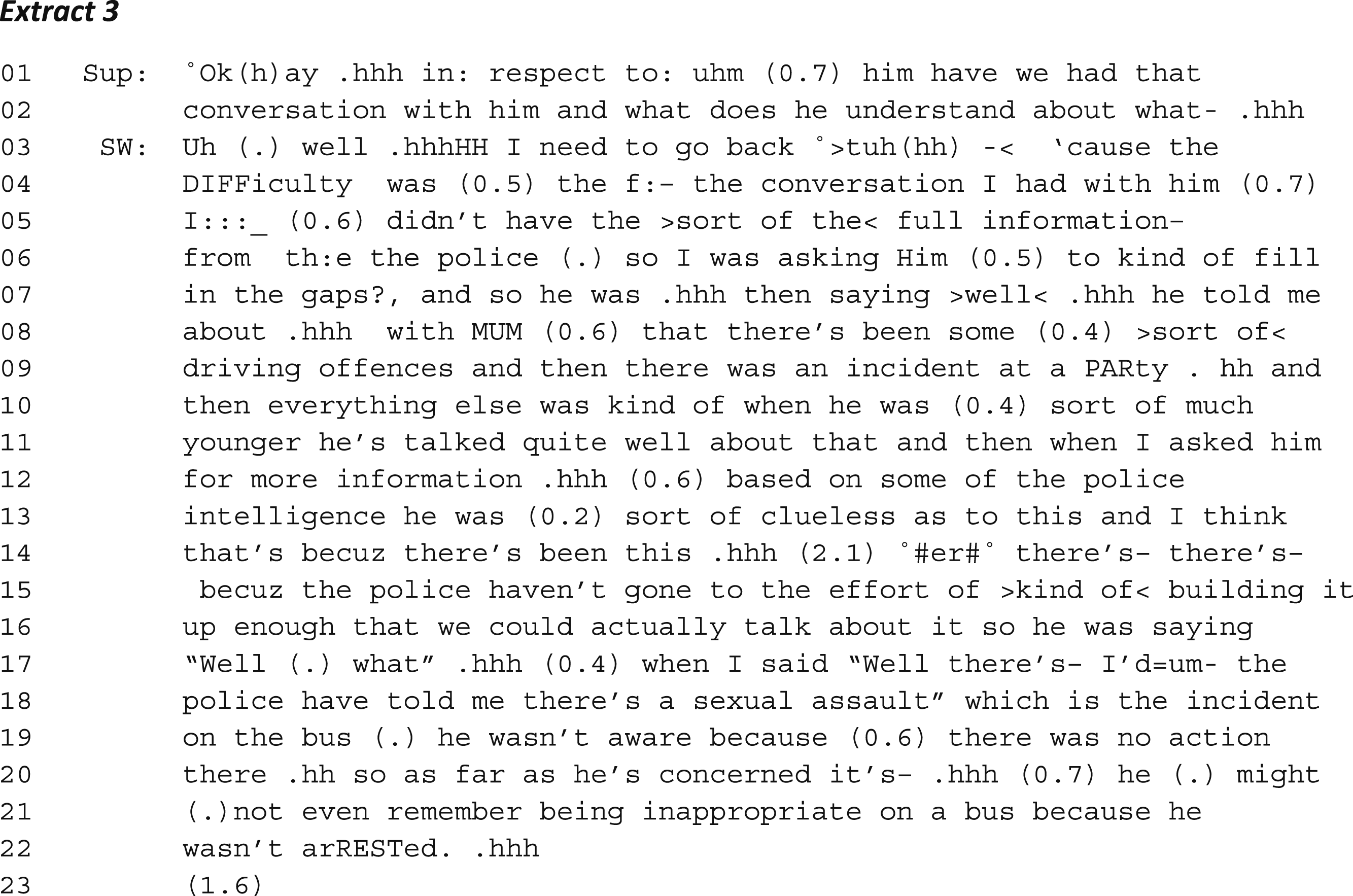
In the supervisor’s first turn (lines 1–2), she makes two enquiries – ‘have we had that conversation with [the father]’ and ‘what does he understand about’. The first enquiry serves as the foundation for the second and can be seen as a pre-sequence checking the preconditions for the second inquiry, that is the social worker needs first to have had ‘that conversation’ to be able to speak to the father’s understanding (Schegloff, 2007). It is not explicit in the supervisor’s second question what she is referring to. The delivery of the question (with hesitation, stretched words, use of the pronoun ‘we’ and the question petering off) indicates some delicacy around the action and/or the content of the question. We identify three potential reasons for this: the topic at hand which is revealed in the worker’s turn to be the father’s criminal history, particularly the issue of alleged sexual assault; the presupposition in the question that the worker has ‘had that conversation’ which holds them accountable; and the difficult epistemic position this places the social worker in, asking her to claim access to the father’s inner experiences. This is made more challenging without knowing their response to the first question. To claim access to the father’s internal experiences, the social worker must meet the preconditions set in the first inquiry – she must have had ‘that conversation’.
The worker’s well-prefaced hesitant response indicates that the answer is not going to be straightforward and may not address the question (Schegloff and Lerner, 2009). Her response highlights issues in the presupposition of the question in terms of the worker’s practice and their subsequent rights to speak to the father’s understanding. Although she clarifies she has had a conversation with the client, we can see how it is positioned as different to ‘that conversation’ the supervisor is referring to. The worker expresses their ‘need to go back’ (line 3), explains the difficulty of not having the ‘full information from the police’ (lines 3–5) and ultimately, that the father (maybe surprisingly) was not aware of the allegations (line 16) so presumably did not (or could not) express their understanding of them. In justifying why she has not had ‘that conversation’, the worker firmly adopts a stance allotting blame to the police (lines 5, 12–14), highlighting both her and the father’s willingness to discuss his criminal history more broadly, and praising the father for having ‘spoken quite well’ about these things. Although the worker is responding to the question, she undertakes considerable effort to adopt a defensible stance, of herself and the father, to explain why she does not know more about the father’s understanding.
By asking this social worker about the father’s existing understanding, the supervisor presumes that the worker has established a sufficient level of information to speak to this. It is a more complex question to answer than reporting on what a person ‘is saying’ as in Extracts 1 and 2. In Extract 3, the social worker could have speculated (or reflected) on the father’s understanding, but she does not, and instead develops a position that accounts for her not having had ‘that conversation’. Providing an account for not-knowing offers further evidence of epistemic friction for the social worker in answering a question about another person’s internal state as opposed to what the person has said to them. At the moment where it would have been possible to imagine the father’s understanding, the social worker seems to take a stance which has a different purpose, managing the potential threat to her professional accountability, and it is this consideration which the worker prioritises in the interaction.
Approach 3: Future perspective – empirically reportable evidence
In the previous extracts, supervisors sought to establish information about a person’s current perspective which the social worker was positioned as having access to. On other occasions, supervisors oriented their questions towards a future situation using the conditional ‘would’. Asking such questions holds a person accountable not just for knowing a person’s expressed words or thoughts, but also what they might be in the future. On the one hand, this has the potential to move the discussion from reporting to elaborating on another person’s perspective by imagining what that person might say. On the other hand, it introduces considerable epistemic uncertainty in the interaction which speakers need to manage. In the following extract, the social worker has been discussing her work with a couple and the difficulties they have in resolving a pattern of fights between them. In her turn, the supervisor begins to ask the social worker what the parents ‘would say’ (line 1) in relation to something she does not elaborate on, before orienting to the possibility that the social worker has not yet explored that topic with them.
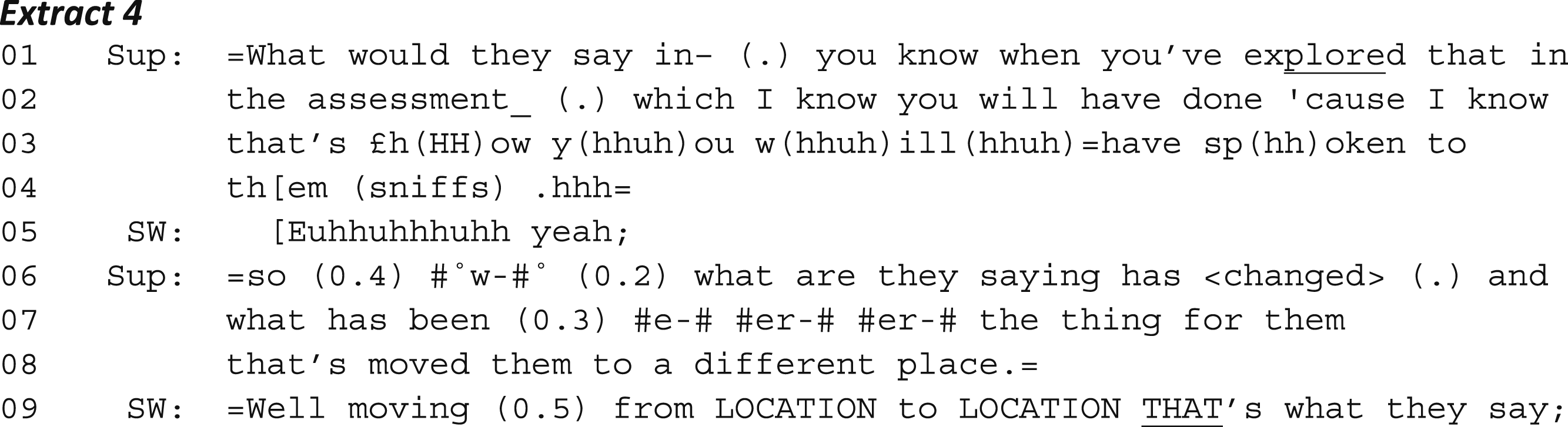
As in Extract 3, the supervisor makes relevant the social worker having had a prior conversation in order to have sufficient information to provide the parents’ perspective. In this approach, however, the supervisor asks the social worker to speculate on what they 'would’ say in the future (line 1). The discussion in this meeting so far has focused on the parents’ existing relationship, but there has been no consideration of what they might be expected to say and no knowledge of whether the social worker has established this. Before putting the social worker in this potentially delicate situation, the supervisor breaks off completing the question, pausing momentarily before asserting that the social worker will have ‘explored that in the assessment’. The inference here is that although the question seeks to establish the parents’ perspective, it is focused on the professional task of assessment and presumes, as in Extract 3, that the social worker has sufficient evidence to take a stance. For a professional task such as an assessment, this raises the potential issue that the social worker has not previously explored this and rather than leave the social worker to address that point, the supervisor extends her turn by reassuring the worker that she ‘knows’ the worker ‘will have done’ this. The use of ‘knows’ and ‘will have’ presents a high degree of certainty in this view of the worker, while the dispersed laughter in line 3 orientates to the potentially troubling content in this interaction (Jefferson et al., 1984), which is taken up in affiliation by the social worker in line 5. Rather than pursue the matter, the supervisor reverts to asking the social worker to report on current things the parents ‘are saying’ (line 6). As we have argued above, this approach provides firmer epistemic ground for the social worker who then readily provides a stance on the parents’ words with a turn-initial ‘well’ initiating a longer explanation.
The delicacy that is evident in this extract can be traced back to the initiation of the question which asked the worker to present a view on what the parents would say hypothetically in the future. For the supervisor, the consequences that emerged from that question were related to threats to the professional accountability of the social worker, and the supervisor did considerable additional interactional work to mitigate the implications of this. Although this question was focused on the future, it did specify the speech of the parents which the social worker could have surmised from evidence of previous conversations. In our final extract, the supervisor invites the social worker to imagine what a mother would like in the future.
Approach 4: Future perspective – imagined evidence
The fourth approach we identified is illustrated in Extract 5.
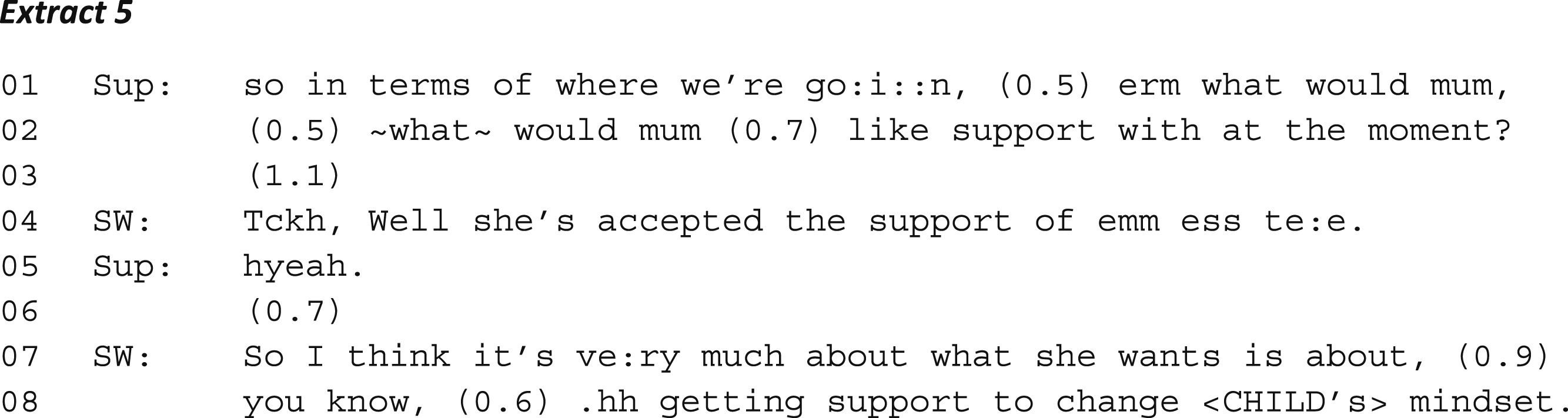
Here, the supervisor elicits the social worker’s views on what the mother would like support with. The presupposition in the supervisor’s initiating question (lines 1–2), that the social worker has knowledge of the mother’s internal views and wishes, is tricky for two reasons. First, as we highlighted earlier, in general people do not assume authority over others’ personal knowledge domains (Heritage, 2012b) so to ask the social worker to speak on behalf of the mother cuts across normative social expectations. Second, the question holds the assumption that the social worker has access to the mother’s views on the support she wants, and presumably has gained this through appropriate discussion with her. This holds the social worker accountable for their practice.
The delicate treatment of this question reflects these issues. The supervisor frames her enquiry by the progress of the institutional work with ‘where we’re going’ (line 1), so the answer is key to initiating and recording further action in this case. There is some hesitancy in delivering the enquiry and a repeat of ‘what would mum’ over lines 1–2 which indicates some difficulty in pursuing this question. However, when the question is delivered, there are no caveats or mitigations which positions the social worker as higher on the epistemic gradient than the supervisor, and thus accountable for providing an answer (Heritage, 2012b). The use of the modal verb ‘would’ requests information about a conditional future which the social worker cannot be certain about. So, in this extract, the worker is being asked both to claim knowledge about the mother’s current wishes and what they will be in the future. The way in which the supervisor does this makes the social worker accountable for not being able to provide such an answer. Even with the delicate treatment, the question puts the social worker in the position of having to claim access to another’s personal domain of knowledge and holds them accountable for their epistemic stance and thus their practice. This is evident at line 3 where there is a lengthy pause of over a second, followed by the social worker presenting a concrete example of the support that the mother has previously accepted (line 4). The supervisor aligns with this at line 5, leaving the interactional space open for the worker to elaborate. The further delay in the social worker’s response (line 6) could indicate their treatment of the answer at line 4 as complete and sufficient or herald the challenge and complexity of presenting another’s views which you do not have ownership of or necessarily access to. It is in the eventual elaboration on lines 7–9 that we see the complicated matter of formulating another person’s future perspective on what they would like. The social worker initially positions their stance as owning this knowledge (‘I think it’s ve:ry much about’, line 7) before repairing to answer the question asked and explicitly present the mother’s current perspective (‘what she wants is about’, line 7). This way of formulating another person’s perspective side steps the epistemic issues of speaking for the mother’s future needs, while also being accountable for providing an answer to the supervisor’s enquiry.
Discussion
Levels of access of evidence in four approaches to eliciting third person perspectives.

By formulating their questions according to these different considerations, supervisors packaged their turns in ways which addressed different orientations to the epistemics of what the social worker might be expected to know. As noted above, asking a question positions the recipient as having the information necessary to answer it (Hayano, 2012), but speakers will moderate their questions to convey different gradients of knowledge that the questioner asserts themselves as having access to, and that which the recipient may have access to (Heritage, 2012a). In the context of supervision, there appears a tension between the social worker’s epistemic authority over their own view of the situation and their respect for, in our extracts, the parent’s epistemic authority over their own lives, reflecting the balance of power in the social work relationship between acting to or with people using services (Tew, 2006).
In our analysis of supervision case discussions, social workers were routinely positioned as having access to another person’s perspective such as when a supervisor asked, ‘is she saying?’. This is epistemically reasonable when the social worker has had a conversation with the other person, but when a supervisor asks, ‘what would they say’, the social worker is positioned in more uncertain epistemic territory related to having knowledge of the parent’s future views and wishes, and/or their future actions. In our data, social workers were presented with a dilemma about how to respond to such enquiries about third person perspectives. Rather than using them as an opportunity for reflection, social workers oriented to the relevance of providing not only the other person’s perspective, but also providing a stance on it themselves in relation to matters of professionalism, and their own accountability.
We finish this section by asking, is the elicitation of third person perspectives a device for reflective supervision? It is certainly one key principle found in the literature on the topic (Heffron et al., 2016), but it did not seem to be used as such by our participants. However, the supervisors in our study had not been provided with any specific training in reflective supervision that we know about and were asked as part of the wider study to continue with ‘supervision as normal’. We do not know whether they were intending to ‘do’ reflective supervision, or if they believed they were. We do not know what other intentions they might have had besides reflection, or their views on reflection in supervision and practice more generally. Neither are we making any claims about the consequences for the families they worked.
Conclusion
The tensions identified in our extracts, between reflection, casework progression and threats to accountability, we believe resonates with the work of others who have argued similarly (Beddoe, 2010; Turner-Daly and Jack, 2017). By analysing actual examples of supervisory practice in which third person perspectives are sought, we have shown how professional issues of assessment and accountability are tied to the types of questions asked. We hope that our analysis illustrates for the first time how the issue of professional accountability is not just related to the institutional context but is progressively built through the interactional moments of supervision case discussions.
We conclude by suggesting that eliciting third person perspectives may be conceptually important in reflective supervision, but our understanding of how to deliver them in practice requires further investigation. We have focused on tense and third person actions in our analysis, but there may be other forms of delivering these enquiries which could help mitigate the ‘push’ towards accountability that we observed. For those concerned with reflective supervision in social work, we hope we have shown the insights that a CA approach can offer.
Footnotes
Declaration of conflicting interests
The author(s) declared no potential conflicts of interest with respect to the research, authorship, and/or publication of this article.
Funding
The author(s) received no financial support for the research, authorship, and/or publication of this article.
