




Abstract
Agile working (flexibility about where and when practitioners do their work) is increasingly common across public sector social work, but there has been little research about how practitioners engage with it or its impacts on communication between social workers, their colleagues and the families with whom they work. This article presents findings from an ethnographic study of a children’s safeguarding social work team in an English local authority who were engaged in agile working. It draws on data from observations, local authority documents, semi-structured interviews, participant research diaries, participants’ photographs and the researcher’s photographs taken during fieldwork. An analytical frame drawing on Henri Lefebvre’s concept of spatial dialectics and Wanda Orlikowski’s concept of sociomateriality is used to identify how agile working involves entanglements of practitioners and families with restructured office spaces, digital information systems and mobile devices such as convertible laptop–tablet computers and mobile phones. Innovations such as these are commonly understood as promoting more effective and transparent social work practice, but the study’s data show that entanglements between workspaces, digital devices and people in practice are having multiple effects, producing new hierarchies of belonging in space, shaping what can be communicated, and the ways it can be presented and received. The article argues for critical attention to the role of material space in digital and place-based innovations in social work practice.
This article reports findings from a study of agile working practices in children’s safeguarding services in England. Agile working entails practitioners engaging in new working practices and locations (‘hot-desking’, frequently doing administrative work at home or in public spaces) and the use of digital devices and systems to support communication between practitioners who are separated in space. The British social work press, prominent social work academics and practitioners themselves have raised questions about the impact of certain agile working practices, particularly hot-desking and more remote working, on social workers’ experiences, communication and sense-making (e.g. Munro, 2019; Stevenson and McNicoll, 2016), but there has been little research about these practices or their impacts. This study provides data about changing practices in children’s social work and their influence on communication between social workers, their colleagues and the families who use social work services.
Agile working’s origins can be traced back to the Manifesto for Agile Software Development (Beck et al., 2001), which emphasised the need for small teams to work creatively and collaborate with users to solve complex problems. The drivers for agile working in the British public sector, however, have been the perceived need to establish more flexible working practices that can adapt to unpredictable changes in demand and, since the financial crisis of the late 2000s, sustained and severe cuts in funding (Pwc, 2018). It is ironic that, while agile software development emphasises the importance of small, autonomous groups of people working closely together and communicating face-to-face, ‘agile’ in social work has tended to mean more autonomous individual workers, having less face-to-face contact with colleagues. Users or customers are placed centrally in agile software development and the business agility literature, but little is known about the impacts of agile working on the experiences of people using social work services or social workers’ interactions with them. Discussions so far have tended to focus on practitioners’ experiences and their effectiveness in carrying out core administrative tasks such as electronic recording and report writing. Promotional literature has tended to emphasise greater flexibility of workspaces and the freedom to access information systems remotely (e.g. 5plusarchitects, n.d.; Telereum Trillium, n.d.) while critical discussions have identified risks of reduced communication between practitioners and greater isolation (Jeyasingham, 2016, 2019; Winter et al., 2017).
This article concerns the material and spatial practices involved in agile working and their influence on social workers’ interactions and relationships with children and their families, other practitioners and social work supervisors. It focuses on two particular contexts with implications for social workers’ spatial practices: changes to the design and use of office spaces and practitioners’ increased use of digital information systems, mobile computers and mobile phones in their communication with other practitioners and with families. The discussion complements the developing literature about space and mobilities in child protection work (Disney et al., 2019; Ferguson, 2016; Lloyd, 2019), practitioners’ sense-making practices in child protection (Helm, 2017) and communication and relationships between social workers, children and families (Forrester et al., 2008; Winter et al., 2017).
Agile working entails new configurations of people, things and spaces and requires the development of new forms of agency (e.g. the blurring of work and non-work lives) and embodied practice (e.g. developing skills in using electronic devices). Two complementary conceptual frames are used to investigate these matters: Henri Lefebvre’s (1991) spatial dialectics and Wanda Orlikowski’s (2007) concept of sociomateriality. Lefebvre’s work critiques common apprehensions of space as a passive background to social relations or as primarily having symbolic value (e.g. court buildings as representations of the transparency of the law – see Dovey, 2010). Instead, space is a participant in social and material relations: it is constituted through social practices, relations and experiences and simultaneously constitutes them. Lefebvre identifies a three-dimensional dialectics, where spatial practices, representations of space and moments of lived space continually interact with each other to produce spaces (Schmid, 2008). Lefebvre uses ‘spatial practices’ to refer to everyday, unthinking actions which establish routine pathways of travel as well as material changes to space which have similar effects in promoting certain movements and shutting down others. ‘Representations of space’ refers to how spaces are conceived and represented, for instance in maps, plans of buildings and common talk about places. ‘Lived space’ refers to moments of action which escape standard ways of thinking, presenting and moving in space and open up opportunities for different social relations (Lefebvre, 1991; for discussions related to social work, see Jeyasingham, 2014; Davidson and Harrison, 2019).
Digital technologies are often imagined as straightforward enablers of new forms of communication and mobility across space but they are also material, spatial structures that have specific material and spatial effects. Wi-Fi systems, for instance, are networks of hardware distributed unequally across space, which influence where activities dependent on online connections occur. Orlikowski’s (2007) concept of sociomateriality addresses this disjuncture between representation and relations in practice, focusing in particular on the interactions between human and digital agents in organisations. In these contexts, technologies do not simply serve or enable the work people do, nor do they function as discrete agents that control people’s activity. Instead, humans, software and machines are all entangled together in the social relations, communication and sense-making that occur in contemporary work. Digital agents constitute social practices, for instance through their affordances (design features that enable certain kinds of function) and are themselves moulded and adapted by the people who engage with them and put them to particular uses. Social work research has already drawn on these ideas in relation to predictive algorithms (Eubanks, 2017) and digital information systems (Broadhurst et al., 2010; Gillingham and Graham, 2016). While not tangible objects, these are material systems in that they are more than simply conceptual, and they have material effects (Leonardi, 2010). Information systems have been shown to impact on sense-making because of the information they require social workers to collect, while practitioners develop ‘workarounds’ in order to manage these requirements (Broadhurst et al., 2010). As Gillingham and Graham (2016: 197) have noted, information systems have been key agents in the application of New Public Management in social work, with all the material consequences of that paradigm. While these are important insights for digital engagement in social work more generally, there has been less attention to the material and spatial qualities of social workers’ practices with digital technologies: for example, the material qualities of the devices in use and the ways practitioners engage with apparently non-material artefacts such as information systems in various contexts, using various devices, which result in a wide range of different entanglements. Using spatial dialectics and sociomateriality together shifts attention away from questions about the qualities of spaces or machines being used towards the forms of agency produced by interactions between people, spaces and machines together. It enables attention to how representations of space and technology (e.g. ‘place-based working’, ‘digital transformation’, ‘agile working’) and the emerging digital and spatial practices these actually entail are producing new forms of social interaction and sense-making and new structures of belonging in space.
Research focus and design
The study sought to explore how agile working practices were influencing where and when social workers did their work, what materials and devices were involved and how this affected social workers’ experiences of their work. The research was conducted with one children’s safeguarding team in Bluefield, a local authority in England that was seeking to transform itself through place-based integration of services and engagement with digital technology, including more agile working practices. Bluefield is made up of a mix of urban and rural areas and includes areas of significant social deprivation. The participating safeguarding team covered one geographical area within the authority. At the time of the research, they were based in Bluefield Central Offices, an office building in the authority’s largest town, and there was a plan for them to move to refurbished offices in Brownsville Public Hall, which were designed to enable more responsive and digitally engaged ways of working as well as being more modern and efficient than Central Offices.
I conducted the research using an ethnographic approach, involving observation, analysis of documents, participant research diaries and interviews with participants in the children’s safeguarding team. These methods were chosen as effective ways of exploring actual practices and the ways these were imagined and represented by practitioners, supervisors and senior managers, including those leading the adoption of new ways of working. The focus and methods developed during the course of the study: for example, the study initially focused on current practices and used observation, diaries and interviews and analysis of local policy to explore this. Documents relating to the proposed development of Brownsville Public Hall were later included because of their significance as representations of effective office space. Observations took place in the office and involved non-participant observation to identify activity across the office space as a whole over five non-consecutive days, alongside short-term ethnographic methods to research key activities such as work involving mobile digital devices. Short-term ethnography is a data-intensive approach where researchers ask questions about what they observe, explore experiences and take photographs or make sketches in order to understand particular practices, their meanings, how they are done and participants’ experiences of doing them (Pink and Morgan, 2013). Participants were asked to complete research diaries over one week, concerning the times and places they worked and the materials and devices they used in their practice (diaries were kept on a template and could be handwritten or on Word documents). Participants were encouraged to include photographs of the spaces in which they worked, excluding work with service users and where photographs could ensure anonymity. Interviews were carried out with 13 participants, including all nine social workers in the team, a family support worker, a business support worker and two managers, and these interviews explored the text and photos that participants had included in their diaries. Data from diaries therefore enabled participants to provide more detailed accounts of their work during interviews and were also analysed directly. A grounded theory approach was used to analyse data from diaries, photos, documents, interview transcripts and field notes, paying particular attention to data about materials and spaces. Data collection and analysis proceeded together, and concepts were developed to explain initial findings, which were then explored further in subsequent interviews, observations and analyses of diaries. Spoken and textual accounts of practice are not treated as simple descriptions but as representations which seek to construct practices in particular ways. Visual images are also approached as representations that frame imagined or actual spaces in certain ways, for instance in how objects are arranged prior to a photograph, the composition of the image and what is positioned as outside the captured image (Rose, 2016). The images presented in this article are a mix of participants’ and my own photographs, which I took during observations. I conducted all the fieldwork for the study, and data from observations, interviews and photos taken during fieldwork should all be understood as emerging out of my interactions with participants and the site. Analysis of these data has therefore involved a reflexive approach to my own perceptions and research practices in composing the focuses of the study and generating data. Ethical approval was granted from University of Manchester Research Ethics Committee, and all participants gave written consent to take part in the study. Names of places and people have been pseudonymised, photos have only been included if they do not compromise anonymity of people or places and some text in photos has been obscured to ensure such anonymity.
Findings
As with other British local authorities with significant levels of social deprivation, Bluefield has experienced severe and sustained budget cuts since 2010. The council has responded with a vision of a transformed relationship with its local community, detailed in publicly available literature (not cited here in order to maintain the authority’s anonymity), which articulates similar aims to those proposed by many local authorities trying to survive central government cuts while remaining effective. Paradoxically, these aims are simultaneously ambitious and seek to establish a much reduced role for municipal services in local community life. Healthier, more socially connected residents are envisaged, meaning less demand for expensive specialist support. The council will become smaller, delivering fewer services and shifting many of its remaining functions online. Many buildings and activities will be transferred to community-run collectives. For those services that will continue, there is an emphasis on coproduction with local citizens, delivery of services via integrated local hubs and working more cheaply and effectively by engaging with digital technologies.
Senior managers explained that, for children’s safeguarding services, the vision means smaller, more flexible office bases that are cheaper to maintain, with social workers working more autonomously, spending more time away from the office and integrating their work more closely with that of local services. Practitioners are no longer constrained by a 9–5 working day, and they can do administrative work in their own homes or in ‘hubs’ such as schools or health centres, close to the families they work with. Meetings with families and other practitioners are also held in these places. This is seen as offering practitioners flexibility to work where and when they can be most productive and most responsive to families and other services.
Social work offices now function as a base from which to visit families elsewhere, not as a place for planned or unplanned encounters between social workers and families. The proposed design for the new office at Brownsville Public Hall shows a building with no public-facing functions: there is no reception area, and meeting rooms are deep in the building’s plan, situated for professionals to meet each other rather than families. This contrasts with the design and original purpose of Central Offices, which had once functioned as a place for local people to access a broad range of council services. Central Offices is a noted example of early 1970s municipal architecture, drawing on a modernist design lexicon that tended to be associated with civic confidence, responsibility and progressiveness (Swenarton et al., 2014). Its most prominent features are the large front entrance and canopy, which together have a near-monumental quality and would have marked the building as open for local people to use.
Spatial practices at the office
Despite the openness of its original design, spatial practices (Lefebvre, 1991) – social workers’ everyday movements around the building and material changes to it – are implicated in producing Central Offices as separate from practitioners’ work with families. For example, at the time of the research, the front entrance had been adapted so it could only be opened from inside and the reception desk was no longer in use. Staff tended to use a card entry system at the back entrance of the building, some distance from the children’s safeguarding office room, while the front entrance was used only intermittently, by families being let in for pre-arranged meetings and by certain staff when they left to visit nearby offices or shops. It was possible to enter the building through the back entrance without a key card, because social workers frequently came and went and would allow people into the building if they believed they had a legitimate reason to be there. These were informal, unstandardised practices, so staff were also vigilant, making judgements about who belonged inside the building based on people’s familiarity, appearance and behaviour. The following example shows how this worked in practice: a participant spoke of finding a man with a ‘shaved head and cauliflower ears’ waiting to get into the building; she recognised him as a practitioner from another team and let him enter alongside her, but a colleague later told her she was ‘really uncomfortable you let him in – we don’t know him’. Small material changes were also made to spaces to manage the risk of aggression or violence in the building: for example, the children’s social care room had a notice posted next to the inside of the door showing photos of people who were expressly barred from entering. Interactions and adaptations such as these were not just about managing the risks associated with a small number of people but also about establishing relations of belonging that pervaded encounters with families more generally. To gain entry to the building, families had tended to knock on a window of the children’s social care office that was next to the front entrance, so a notice asking people not to do this had been posted in the window (see Figure 1). Participants explained staff continued to knock but service users complied with the notice, having to phone social workers to tell them they were waiting or go to the reception of a neighbouring council building and ask them to phone.
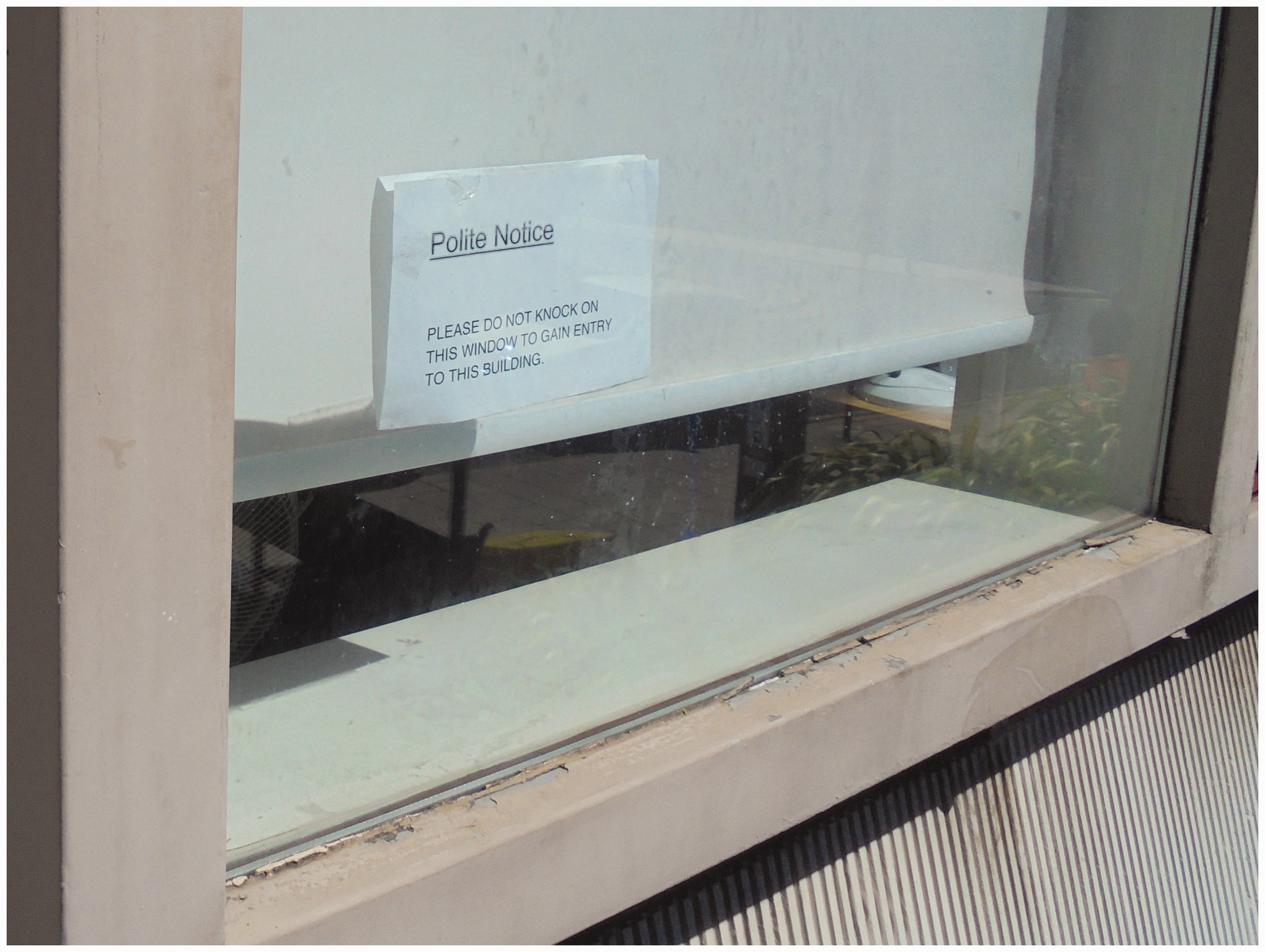
Researcher’s photograph: notice in office window at Central Offices.
It was still not unusual for social workers to meet with families at Central Offices, but it was infrequent enough that arrangements were inconsistent when families did attend. Anna, a social worker, explained: Sometimes if [staff] see someone at the front door, they’ll let them in—they’ll say “Oh, I’m here for a meeting with Anna” and they’ll sit in the reception area and wait, but people don’t always come and tell you there’s someone here for you, so that’s difficult.
Transforming practice: Representations of engagement with digital technology
In addition to a transformation of office spaces, Bluefield’s vision for children’s safeguarding involved the use of mobile digital communication technologies – convertible laptop–tablet computers, mobile phones and Wi-Fi connections – to promote more agile working practices. These technologies were seen as important, not simply to sustain connections between practitioners who were now separated in space, but to transform communication between professionals and families, making it quicker, more transparent and more expressive. Senior managers gave examples of how social workers could use the convertible computer to share reports with parents simply by showing them a pdf, which parents could then sign using the pen function. Children could draw pictures directly on the tablet, and the social worker could photograph their artwork or make short video recordings using the device, all of which could now be stored on the information system. These are accounts of digital devices opening up new opportunities for communication between social workers and children and their families, and sometimes practitioners described exactly that. Leah gave an example from when she had worked as a social worker in another authority: I transported a little boy once—he wasn’t my case, I was just driving because it needed two of us. And he wanted to say some things but couldn’t tell us. I think some of that was because I was there and he didn’t know me. I gave him my Yoga [a convertible tablet computer] in the car, with the pen— because it comes with a pen—and he wrote it all down and saved it to my desktop and titled it ‘Please forward this to’ and then the name of the worker. So when I got back in and got online the next day, I just forwarded everything across […] We’d taken him from a family member and he was coming into local authority foster care, it had completely broken down. So, I think a lot of it was about saying sorry, about how he wanted things, and who he wanted to see. I know [the social worker] used it, but I didn’t actually read it myself.
Sociomaterial practices, heterogeneous effects
While convertible computers were seen by management as opening up communication between social workers and parents or carers, most social workers viewed this in more complex terms. Elaine spoke about the problems of using a computer during home visits with families she did not know well: I think if someone came into my home and sat there and got it out and was, like [mimes typing and looking at a screen], and didn’t even look at you, I think because you have to concentrate, don’t you? When you’re looking at it, you can’t really do two things at once, can you? I think it would make me feel a bit uncomfortable. There’d been a few issues and a few anonymous phone calls so there was quite a lot of information to go through with this family and, because there was the duty social worker involved as well as ourselves, we were running assessments alongside each other. I found [the computer] was useful to use because I could go through the contact with the family, if that makes sense. So, because usually if we get an anonymous referral, we’d go out and speak to them about it, but I found it easier to get it up and basically read from it, if that makes sense, and then what they agreed with and what they didn’t agree with, I could literally write it in a case note. It was just, I felt it was easier and then it was dealt with, it was done with.
Convertible computers were not the only mobile devices involved in social workers’ practice. All the social work participants were equipped with work mobile phones but they also used their personal phones for several purposes, from tethering, as in the example above, to phoning colleagues and service users (while always being careful to withhold their numbers when phoning service users). Social workers gave various reasons for using their personal phones rather than their work phones – the work phones had no internet access or hands-free function, they were too quiet, their batteries did not last – but the key issue was often that participants were just more comfortable using their own phones because they were so connected to them. This points to some key aspects of interactions that featured social workers’ own phones: they involved a valued personal object and had the same structure as many informal interactions social workers engaged in outside work. The use of small, portable devices such as phones also meant practice spilled easily into non-work time-spaces, with social workers receiving texts on their work phones from service users in the evening at home. The following excerpt from an interview with Emma, a social worker, shows some of the reasons why texts might be used: Dharman: How often do you get texts [from service users]? Emma: Oh, several times a day. I was receiving some last night up until eight o’clock. Dharman: What sort of things do people use texts to communicate? Emma: The family that was texting last night, it’s an ongoing parental dispute in private law and dad was giving me an update on what the situation was, from having contact with mum and then giving me an update on how the children are. And one of the children has been excluded from school, so that’s what he was giving me an update on, ahead of the meeting today. Dharman: Were you also replying to that? Emma: No, I just read it. Dharman: And why does he text? Emma: [laughing] Without giving too much away, he texts because his phone calls go on for over an hour and we’ve put an agreement in place that he can either email or text because they go on for so long. I do a lot of text reminders, ‘You’re in court tomorrow’, ‘We’ve got a meeting tomorrow’. Some parents really don’t like that, but others find it very helpful, so it depends on the person. Dharman: Would you do it if somebody didn’t like it? Becky: It depends on the circumstances. If they didn’t like it and we were at a lower level of threshold, then absolutely not. If they don’t want that, we can write it, we can send letters. But, for example, the cases that are in court, it can be very good to have a paper trail, to say, yes, you’ve done it. And the case I’m thinking of, parents don’t open their mail. So, you can send letters, they’ll come back. Phone calls, they won’t always answer the phone to you. So, you have to make sure that they’ve been reminded.
Representations of space: An office for autonomous work and planned supervision
The proposed office design at Brownsville Public Hall enables flexibility about where and how practitioners work, in ways that are qualitatively different from the large, open-plan offices that were typical in the early 2010s (see Jeyasingham, 2016). Open spaces are avoided, with most of the 115 workstations distributed across rooms accommodating between six and ten workers. Two-thirds of workstations are conventional desks with monitors and keyboards, the rest are ‘go-bars’ – high benches that are clear of electronic hardware, where practitioners can work on mobile computers or phones for brief periods. A virtual desktop infrastructure means staff can access the information system equally effectively via mobile or desk-top machines. No workstations are allocated to individual workers, and there are slightly under half as many workstations in the office as there are staff based there.
As with any office design, this one is based on a compromise between various anticipated requirements. It prioritises the need for separation from large groups, physical comfort, reduction of noise, flexibility to use a variety of electronic devices, connectivity with digital information systems and connections via phone and email with service users and other professionals elsewhere. Fewer opportunities for unplanned interactions between colleagues in the building are the trade-off. The design segregates practitioners according to what kind of device they plan to use and how long they expect to be in the office, rather than whom they wish to sit close to. With such a high ratio of people to desks, there is also an inevitable pressure on workers to find other places to do the work they once would have done in the office and to be with other team members less often as a consequence. Workers may be more likely to come to the office for work on digital devices and planned meetings with colleagues, less likely simply to be alongside colleagues and available for unplanned conversations.
Formal supervision is a key planned meeting between colleagues in children’s safeguarding social work, and the design for Brownsville Public Hall accommodates this with the provision of a number of small meeting rooms. Internal literature promoting the new office shows how these will be furnished, with a photo showing two comfortable tablet chairs (chairs with a small work surface that swings from one arm) arranged around a low table. A mobile phone is close to hand, and a large electronic screen is mounted on the wall. Here, the space of supervision is imagined as a face-to-face interaction between two workers in which information flows freely, supported by digital devices and the information system to which they provide access. In this representation, the office is a space where individual work and planned supervision are enhanced by a leisure aesthetic and ubiquitous digital systems, distractions from co-present practitioners are minimised and families are absent.
Current sociomaterial practices
The promotional literature implies novelty, but similar sociomaterial practices were already happening at Central Offices. Supervision commonly occurred between practitioners and supervisors using laptop computers to access and update the information system during the session. As Natalie, one of the team managers, said: I’ve done supervision just sort of paper-based, face-to-face but I find it’s far more helpful to have my laptop there to go through the statutory things really, so I can actually see whether the case summary’s been updated or the chronology, and see the last home visit. Whereas previous supervision with paper really was just self-reported by the worker, as to whether the system was up to date. Dharman: What else would you say about the differences in the interaction? Natalie: I think you can have more meaningful conversations at times because you can kind of pull things out that are there, that wouldn’t necessarily be recorded on the paperwork the social worker’s given you. I think, also, it’s kind of more efficient because the notes [supervisor’s notes of the session] are already typed up, so they could potentially be on the system quicker than if a business support officer had to write them up themselves.
Other apparent differences between Central Offices and recently refurbished workspaces belied shifts in practice that had already occurred across them all. For instance, participants at Central Offices observed that agile working practices meant that there were likely fewer people in the office at any one time than previously, and they were more often working on their own when they were there, just as in offices where hot-desking already occurred. One material difference was that staff at Central Offices had much larger desks than people based at new offices and were able to fill them with various objects they needed at work. Andrea, a social worker, included a photograph in her research diary so I could ‘see how much stuff we have on our desks’ (Figure 2). This image, with the mug’s distinctive message centre-frame, the keyboards and diary all available for access, is a representation of busy, organised activity rather than clutter. Figure 3, a photo taken by me, shows an abundance of stationery and knick-knacks in another participant’s drawer. It was taken during an observation where participants explained the importance of desk space for self-care and the storage of personal belongings as well as work materials.
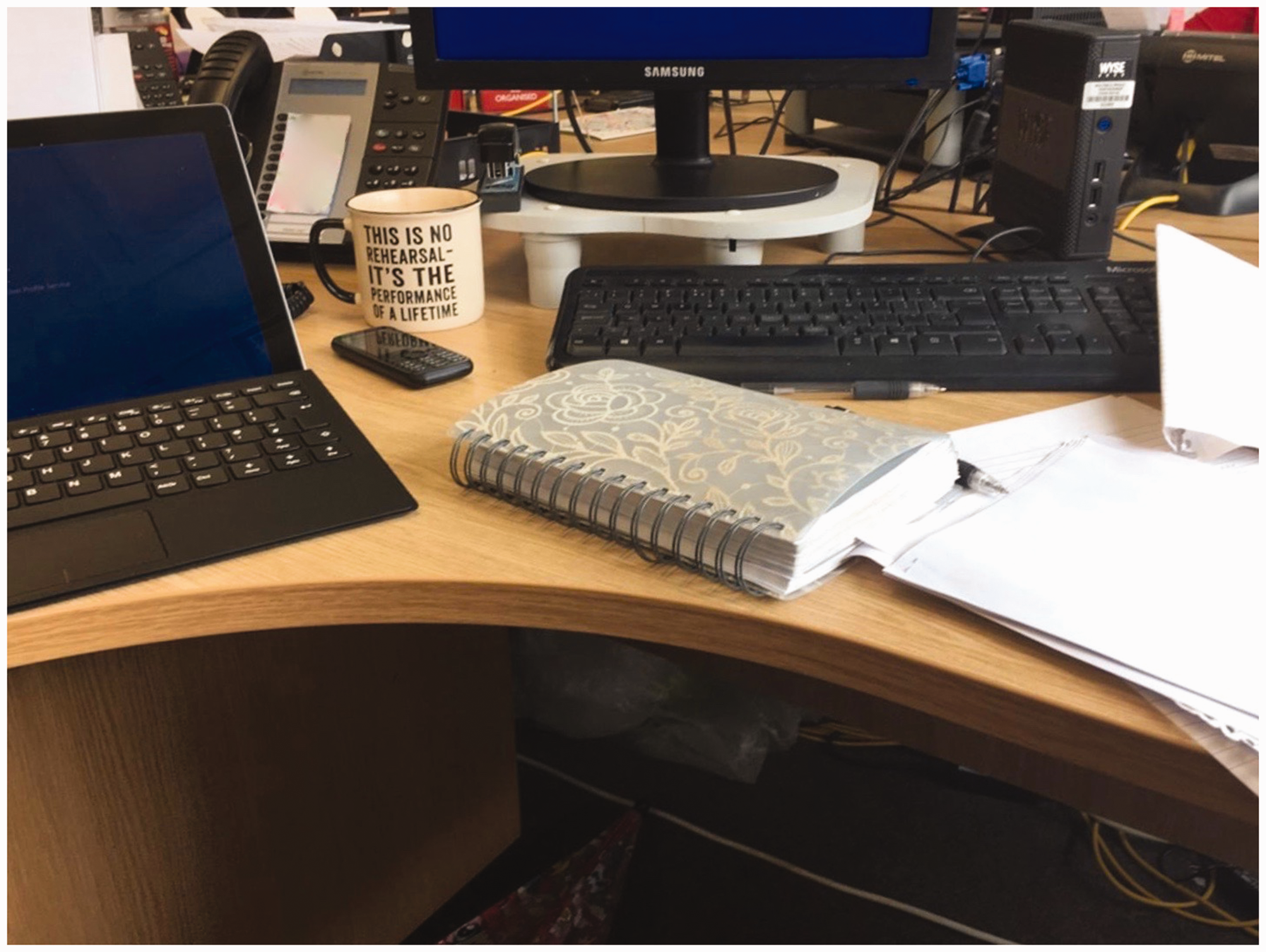
Participant’s photograph: ‘see how much stuff we have on our desks’.
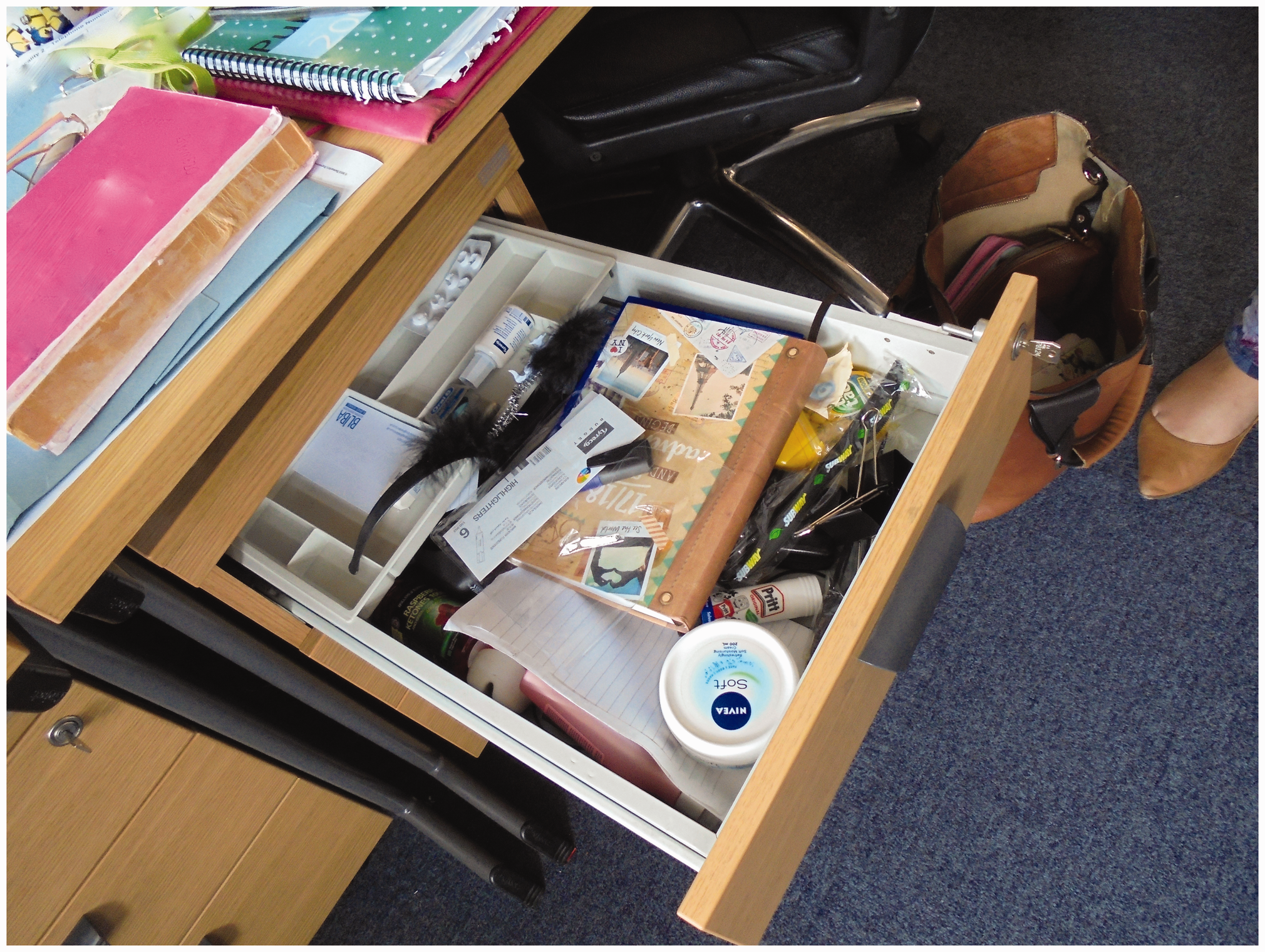
Researcher’s photograph: desk drawer of family support worker.
We should not infer from these representations that participants felt more at home or rooted in their workplace over time; instead, they tended to describe a transient relationship with it. One social worker spoke of finding out the date of an office move on the day it happened, when removal staff came and started putting belongings in boxes. Others talked about how they had recently moved from another office and expected to move again soon. A significant difference with the proposed office was that desks would not be allocated to workers and so would not be used for keeping personal items. Most participants were not worried about moving to a hot-desking office per se but were concerned about whether there would always be enough workstations and storage at Brownsville Public Hall. This was realistic, given the planned ratio of staff to workstations there and limited permanent storage for each worker but it also reveals social workers already articulating their needs primarily as autonomous practitioners, rather than members of interdependent teams.
The material and design features of digital devices also served to constitute how practitioners interacted with the information systems and with each other. The keyboard and screen of the convertible computer are connected magnetically and so can be snapped apart easily. The writing function, as demonstrated by a participant (Figure 4), was seen by management as enabling social workers to record notes and minute meetings more comfortably and unobtrusively than by typing; the computer would then convert these into a Word document that could be circulated and uploaded to the information system. In reality, practitioners chose not to use the handwriting function because it was rather more cumbersome than typing. As Jamie, a business support officer, explained: It does recognise your writing and it can write sentences, and it’s learning because if you’re writing something and you correct it, the next time it does write it right, so it’s quite a clever machine. But you can only write four words, and it’s the same hand that you press the return key, so you’re writing [demonstrates stopping writing to tap return]. There’s no way I’d be able to take all my notes that way.
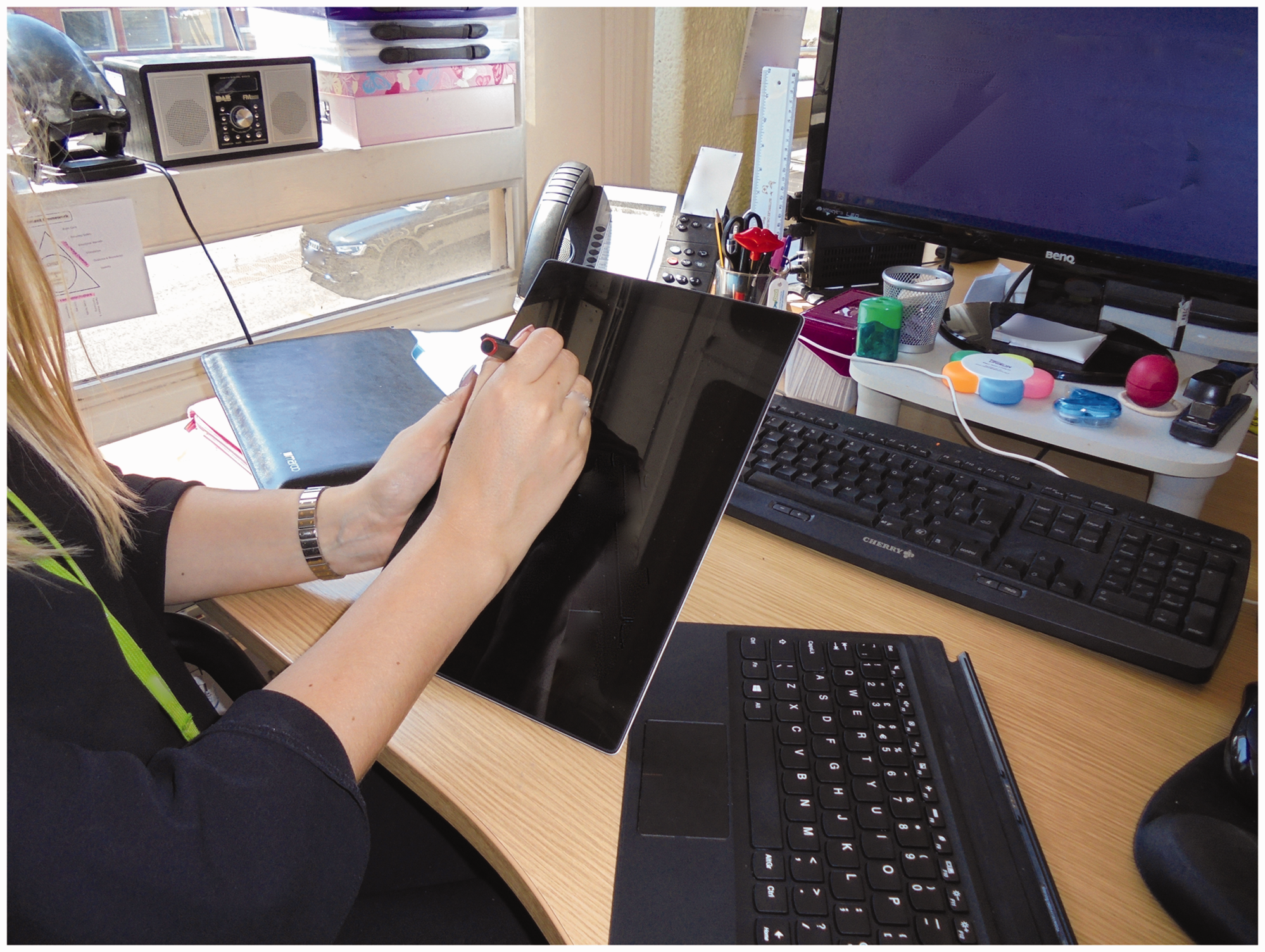
Researcher’s photograph: a participant demonstrates writing on the computer.
The device’s keyboard is light and does not bear weight so its screen is supported by a hinged stand (see Figure 5) that makes typing on one’s lap awkward. Rather than truly ‘laptop’-based working in families’ homes, it was best suited for work on table tops, such as during solitary work in cafes and practitioners’ own homes (Jeyasingham, 2019) or the small, planning and review focused meetings that make up a considerable amount of children’s safeguarding practice. As Julie, who photographed her device in use during one such meeting (Figure 5), explained: ‘All I use [the computer] for is meetings now, so I use for care planning meetings or Child in Need, core groups, and that’s all I do’. The convertible computers allowed these meetings to become more easily focused on records of past meetings. As Anna wrote in an entry in her research diary: I was chairing a Child in Need meeting. I was able to take my laptop and type minutes there and then which saves time when getting back to the office. It was also useful for pulling the CIN plan up on the system to go through with parents and professionals as previously I used to print a copy off.
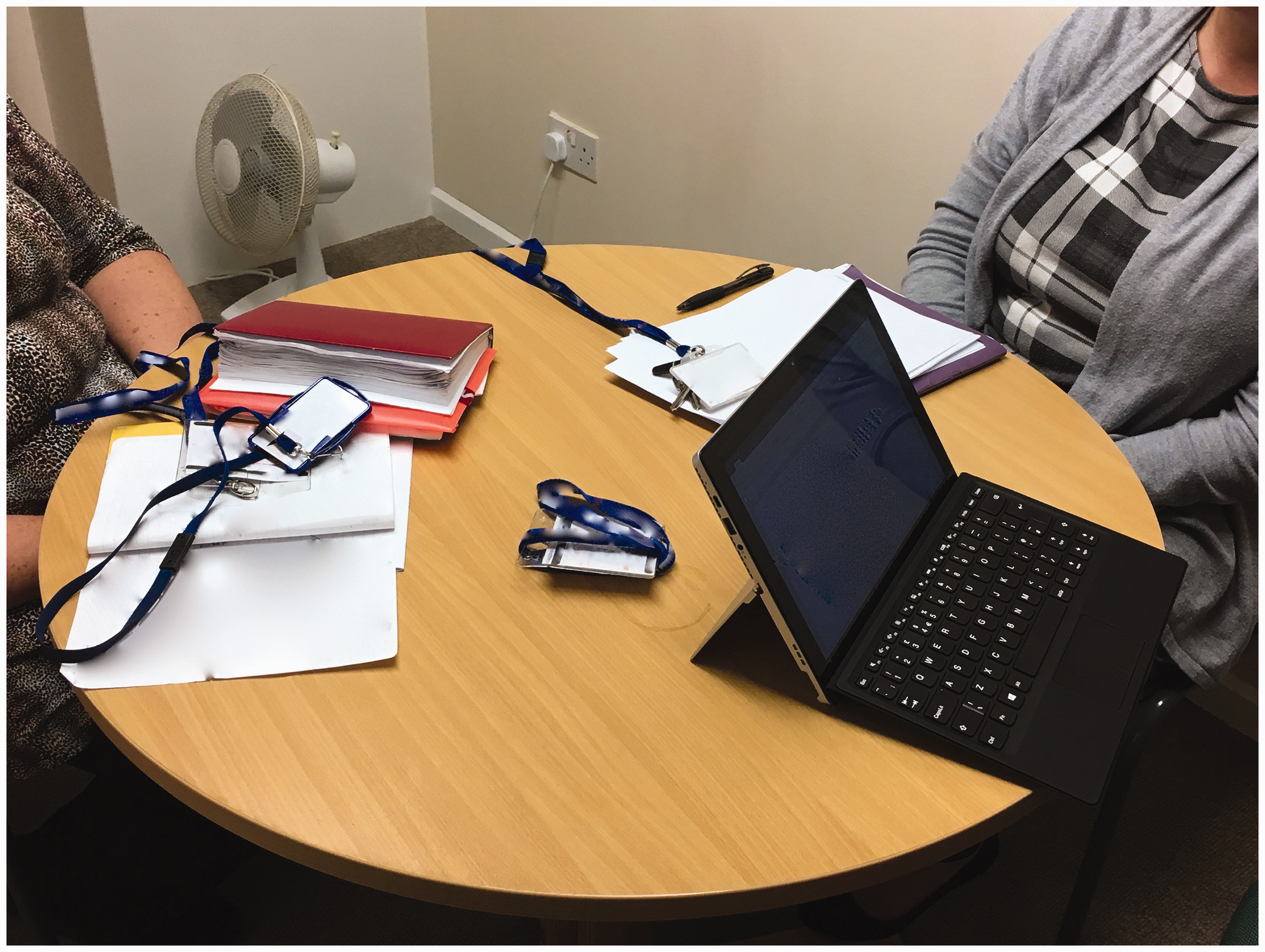
Participant’s photograph: accessing and updating plans in small meetings.
Conclusion
This article has explored how social workers’ practices are entangled with spatial and material agents such as offices, information systems and mobile devices, and how such entanglements influence the quality of social workers’ interactions with families and other practitioners. Without an appreciation of their potential effects, practitioners’ work might be informed by an ethos of humane or person-centred practice but still work in ways that marginalise families in space or limit sense-making to superficial engagements with information.
Mazmanian et al. (2013) have shown how the availability of mobile devices to access work email can lead to an increase in the autonomy practitioners perceive – they can access emails whenever and wherever they wish – alongside a paradoxical decrease in the actual autonomy practitioners exercise – expectations grow that they will read emails at any time, wherever they are. This study identifies a related shift in engagements with digital information systems and the significance these hold in practice. Systems initially designed to organise and store data gathered in practice are now active agents in the most sensitive interactions between social workers and families, such as direct work with children and child protection enquiries. This agency is not consistent or predictable; it occurs through the interaction of people, spaces and devices together, and the material features and cultural resonances of these spaces and devices influence its form and feel. These factors may be as significant as the design and structure of information systems themselves. Even when information systems are absent, practice may still be entangled with devices such as mobile phones and computers. Social work needs critical concepts to understand this influence.
Space is also always an agent in practice interactions, and the findings presented here show how the spaces in which social workers practise are changing, influenced by public sector austerity and shifts toward place-based approaches which are partly a response to austerity, partly based on claims to better integration of public services and coproduction with local communities. There are two problematic consequences of these shifts as they relate to children’s safeguarding social work. First, office spaces are being reimagined as more efficient and desirable at the same time as families are being absented from them. Some of these features depend precisely on the repositioning of encounters with families at a distance from office spaces: for example, the leisure aesthetic of work spaces and the simultaneous representation of office work as an intense, undisturbed engagement with records and information systems. Second, the ‘place’ in place-based working is an administrative unit defined in relation to local authority systems, not a neighbourhood or local area as might be understood by people using social work services. Place-based working in this study meant working more closely with local services and meeting families in the places where these services were based or in families’ own homes, meaning children’s safeguarding work was more narrowly confined to encounters that were planned and structured by practitioners, not initiated by families. Lefebvre’s spatial dialectics offers a framework for analysing the interactions between powerful spatial metaphors such as place-based working, seductive representations of work spaces and radical shifts in spatial practices and examining their impact on social relations.
The study raises questions about beliefs underlying current approaches to agile working, engagement with digital technologies and place-based working in social work. These beliefs, expressed by senior managers in this study and other discussions in practice more widely (e.g. Telereum Trillium, n.d.), can be summarised as follows: the workspaces and electronic devices social workers use can be re-designed to address their and families’ requirements more directly, enabling better practice; if they are designed right, these spaces and machines will facilitate practice without intruding on it; greater mobility in space and fuller engagement with digital technology will promote more responsive practice and more open communication.
The range of possible spaces and machines available for British public sector social work is actually quite narrow. Brownsville Public Hall is owned by Bluefield Council but contemporary social care offices are just as likely to be privately developed and leased to local authorities, so the designs are intended to meet generic requirements of office-based services rather than the specific needs of social workers, whatever they might be. Regardless of who owns the building, the key driver for development of office accommodation in British local government currently is reducing costs, so many of the positive features of refurbishments exist to ameliorate the impact of less floorspace and therefore fewer workstations and meeting rooms and less storage. The range of digital devices, too, is limited by several factors. Codes such as the Qualcomm Reference Design mean convertible computers tend to have the same kinds of features and capabilities, whatever the brand and wherever they are sold. Devices that practitioners can write on or make films with are therefore being introduced to social work practice because these are standard affordances, not because social workers require these functions.
The discussion offered in this article shows social workers continuing to recognise the importance of communication with families and other practitioners, and utilising heterogeneous forms and contexts of interaction in their work, while insufficiently appreciating how such heterogeneity might impact on their communication. On occasions, more diverse uses of the information system combined with more narrowly delineated interactions between social workers and families or social workers and supervisors, to limit communication and sense-making. Expectations of change were tied more closely to formally recorded data, and families were associated more narrowly with the places where they lived. At times, communication was performed as a unidirectional process of giving information, rather than a shared process of sense-making.
Communication in safeguarding practice has often been presented as a simpler issue than it really is: for example, the emphasis on sharing more information as a solution to complex problems in safeguarding (e.g. Golden et al., 2011; Laming, 2003). The Department for Education’s statement about the knowledge and skills expected of children’s social workers exemplifies a more detailed model of communication, but one that is still based on exchange rather than engagement (Dept for Education, 2018). Agile working reproduces a discourse of social work practice as autonomous, confident and focused, with practitioners who are able to deliver information transparently and enable children, in particular, to give their views and be listened to, but it carries a danger of ignoring the complexity and tenuousness involved in building trusting relationships and reaching shared understandings in children’s safeguarding practice.
Footnotes
Declaration of conflicting interests
The author(s) declared no potential conflicts of interest with respect to the research, authorship, and/or publication of this article.
Funding
The author(s) disclosed receipt of the following financial support for the research, authorship, and/or publication of this article: This study was funded by a grant from the Division of Nursing, Midwifery and Social Work, University of Manchester.
